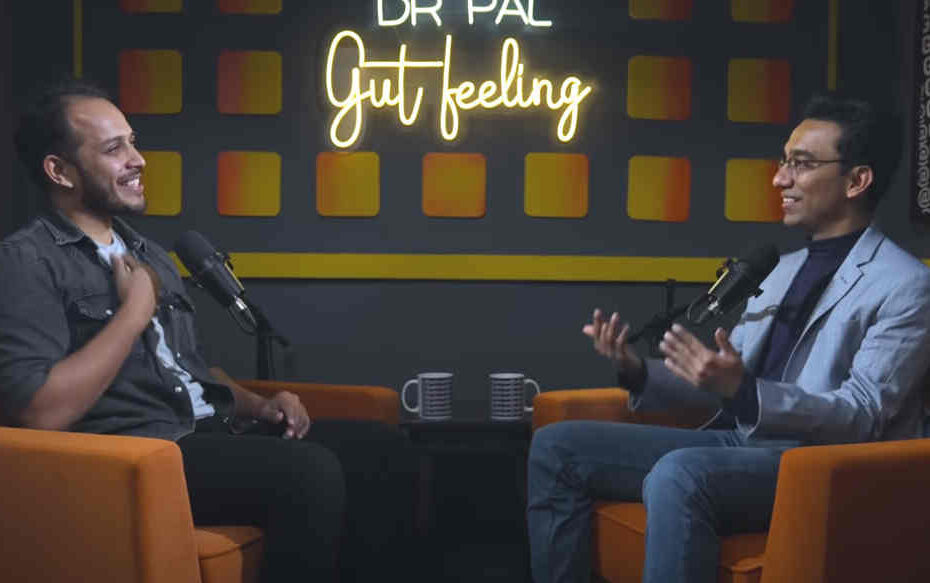
Read the full transcript of neurologist Dr. Sid Warrier’s interview on Gut Feeling with Doctor Pal podcast on “Shocking Links between Mindless Scrolling, Stress & Depression”, Premiered February 17, 2024.
INTERVIEW BEGINS:
DR PAL: I’m so excited.
DR. SID WARRIER: Me too.
DR PAL: Because I always wanted to be a neurologist. Because the function that the brain can do, I think gut can do as well.
DR. SID WARRIER: It actually can.
DR PAL: But it is a masterpiece. Right. Brain is a masterpiece. Right off the bat, I wanted to ask you that there has been increasing mental health issues in the last couple of years, especially after Covid. I have seen your videos in the past and you said whenever there’s a mental health issue, just rant about it. So I want you to rant about why mental health issues are on the rise in the last couple of years.
The Power of Ranting
DR. SID WARRIER: Yeah, ranting is great. I would recommend it to everyone. The ranting has got a bad name, but that’s more because people who are being ranted to don’t know what to do with this information. But it’s great for the ranter. So I would definitely recommend ranting.
DR PAL: Ranting can be done without anybody else.
DR. SID WARRIER: It actually can. Yes. Which is what journaling is. Because the more you rant, what you are doing is you are giving emotions words. So emotions are very chaotic things. It’s like a cloud. There is no structure. They’re just feelings, but when you give them words, they suddenly start taking shape.
And the more shape you give, the more your brain has control over them now. So in a way, ranting is a way for your brain to get control over chaotic emotions. So the more you rant, the calmer you will feel. So I would say rant, it helps.
Why Mental Health Issues Are Rising
The reason that mental health issues are rising, I feel there are two reasons. One is greater awareness. So a lot of these mental health issues earlier would not be diagnosed or they wouldn’t be called as mental health problems. But now we know that it is an issue. So the awareness is increasing, the diagnosis is increasing.
But on the other hand, our lifestyles are also changing. So now there is more stress on our nervous system, there is more anxiety, there is more things that our nervous system has to deal with. So both of these things put together is causing mental health problems to rise.
DR PAL: In your practice, you’re seeing which age group, 20 to 30 or 40 to 50?
DR. SID WARRIER: So I’m actually seeing all age groups, but the kind of problems that they come with are different. So kids would have more of developmental problems. So there’s something genetic, there’s some hormonal problems at that age.
DR PAL: You’re talking about less than 20, less than 10?
DR. SID WARRIER: Less than 10, yes. So for example, cerebral palsy or seizures. So less than 10 years old, that is the issue. The kid is not able to walk, the kid is not speaking properly. That kind of patients.
Around teenagers, 18 to 30, most of them will have some kind of spectrum problem of mental health and physical pain. So I call this an emotional physical pain spectrum. So that could be anxiety, sleep problems, migraine, back pain, neck pain. All of this is on that spectrum of the body and mind not able to deal with the stresses of life.
DR PAL: Migraine can be?
DR. SID WARRIER: Yes. So migraine is also part of that pain spectrum. And then once you’ve crossed 40, 50, then you have problems of age. So now your brain is slowing down, you start having forgetfulness, you’re not able to think so clearly and you can have early onset Alzheimer’s. Some of them have Parkinson, they’re unable to walk properly. So that is the spectrum.
DR PAL: All this starts at 40 itself?
DR. SID WARRIER: Yes. So 40, 50 is when it can start, but the symptoms are very mild. They usually get caught much later.
DR PAL: Thank you so much. I just turned 40.
DR. SID WARRIER: You look fine, Dr. YouTuber.
DR PAL: I think I’ll slowly come.
DR. SID WARRIER: I’ll give you my clinic address.
DR PAL: Wow. Earlier at 40 dementia, huh?
Early Onset Alzheimer’s
DR. SID WARRIER: Yes, yes. So some patients do come at 40, 45 with early onset Alzheimer’s.
DR PAL: Early onset Alzheimer’s.
DR. SID WARRIER: Yes, yes.
DR PAL: So Alzheimer’s is for the audience, just the most common cause of memory loss.
DR. SID WARRIER: Yes, it is the most common cause of dementia and early onset Alzheimer’s usually has a genetic cause, so their family history will be strong. So if anyone in your family, your grandfather, grandmother, has started having memory loss at the age of 40, 50, then it’s better to go to a neurologist.
DR PAL: And get it checked out even without any symptoms or?
DR. SID WARRIER: No, if you have, if you’re having symptoms.
DR PAL: And how do we usually, the spouse or the close family members will notice, correct?
DR. SID WARRIER: Yes. They are the first ones to notice because initially they will think, “Oh, you’re just being forgetful.” You forget a birthday, which is completely fine, but then you start forgetting more important things. You’ll start forgetting what you’re supposed to do today. You start forgetting somebody’s name, you start forgetting your own phone number.
That is when they start thinking, “Oh, this is not just work stress, something is actually wrong.” Then they will come to a neurologist.
DR PAL: Tell me an interesting patient that you have seen, which is a different presentation at the age of 40, small things that you picked up in your practice.
An Unusual Case of Dementia
DR. SID WARRIER: So one interesting patient was a 55 year old. He used to be in the merchant navy. And then he left merchant navy at the age of 40.
Now at the age of 55, he started having dementia and he had a slightly rare kind of dementia wherein he started forgetting about time. So he started getting confused about what time it is and what year it is. And he started thinking that he was actually in 1990. So his mind went back to the time when he was still in the merchant navy.
DR PAL: And he was only 55.
DR. SID WARRIER: He was 55. And he used to think that now I’m 35. So he would start behaving like that. He would get up and say that tomorrow my ship is leaving. And he would pack his bags and he would say that I have to go.
And what was causing the family problems was that he would expect his wife to be as involved with him physically as they were back in the day. And now they have kids and the kids are grown up and one of the kid is married and now his wife has not been in that state of mind. And this man is thinking that I am a 30 year old and why is my wife not finding me attractive?
So that was the complaint that they came with. So brain problems can, there are maybe two, three things that can go wrong, but there are a hundred things that they can come to you with. The presentation might be very varied. That is what makes it both challenging.
DR PAL: Exciting as well.
DR. SID WARRIER: Yes, exciting as well.
DR PAL: I mean, Alzheimer’s dementia. It’s been a while since I have seen a neurological patient, but based on what I know is it’s a deposition of amyloid. It’s a protein deposit in the cells of the brain.
DR. SID WARRIER: Yes. Tau proteins get deposited and there’s something called neurofibrillary tangles. So that’s when those amyloids get caught up on top of each other. So it’s literally like clutter. Clutter in your brain.
DR PAL: Correct. Like a trash can.
DR. SID WARRIER: Like a trash can. So over a period of time, that deposition becomes too much. So there’s too much trash. And now your brain stops working in that way.
DR PAL: And you have seen patients with earlier 40, 45 as well.
DR. SID WARRIER: Yes, yes. But of course it’s very important to check if is this Alzheimer’s or is this something else? Sometimes there are other diseases, like prion diseases, Creutzfeldt-Jakob disease, that can also present early on. But then it’s not Alzheimer’s, it is something else.
Preventing Alzheimer’s
DR PAL: Let’s say, I’m asking for myself. So let’s say I’m 40. I want to prevent Alzheimer’s and any steps that I can take.
DR. SID WARRIER: Absolutely, yes. So even if there is a genetic background, it is always, you always have to remember that genetic is just one part of it. You can never blame only genetics because environment makes a difference. So, for example, I’ll use an example from your field doctor.
DR PAL: No, use me as a patient.
DR. SID WARRIER: No, I wouldn’t do that. But I would use an example of someone, a friend of mine, his father recently passed away with liver cancer. Now when they were diagnosed, and it was a very brief diagnosis. So he was diagnosed and he passed away within three, four weeks. And he was 70 years old.
And when I asked the history, father’s father, grandfather and his two elder brothers all passed away with liver cancer at the age of 60 to 64. So clearly there’s a very strong hereditary history of liver cancer. But my friend’s dad lived up to 70 and I asked him what kind of lifestyle he led.
And I’ve never heard of a man living more of a disciplined life. So he never touched alcohol. No smoking, very clean habits, wake up on time, sleep on time, meditate every day, yoga. He would spend every morning, wake up and write. He would journal. He would take long walks with his wife. Every morning he would have a very close family system.
So overall his body was very healthy, which is, I believe, what made the difference and gave him an extra 10 years. So from 60 to 70, he was able to live a good life because of his lifestyle. Now suppose if he was also drinking, smoking, if he had a bad lifestyle, I believe he would have had these symptoms even earlier. So genetics is one reason, but your lifestyle makes a big difference.
DR PAL: You can compensate for that.
DR. SID WARRIER: Compensate for that. So Alzheimer’s at 50 and Alzheimer’s at 70 is a big difference because you get 20 more years of good life. So that is why lifestyle makes a difference.
DR PAL: When I say lifestyle is main thing.
The Importance of Sleep
DR. SID WARRIER: According to me, sleep, sleep is the most important thing. Because when we say trash in the brain, the trash in the brain, sleep is when that trash gets taken out. So there is this drainage system called as the glymphatic system in the brain, that is the sewage system.
DR PAL: Sewage system takes all the trash out.
DR. SID WARRIER: All the trash out. It gets activated in sleep. So no sleep, the trash gets accumulated. So over a period of time, that is what causes most damage. And the second thing is stress, inflammation, to be specific. So anything that increases inflammation in your body increases the chances of Alzheimer’s.
DR PAL: So the first part, sleep is the one thing that we do, we doctors don’t get.
DR. SID WARRIER: Unfortunately. Yes.
DR PAL: No. I will think about all the night duty that we did.
DR. SID WARRIER: Correct.
DR PAL: Absolutely. And all these people, especially in US, I see all these big software companies and majority of their employees are in India.
DR. SID WARRIER: Yes.
DR PAL: And their work hours is 8:00am to 5:00pm. Here it’s 10:00pm to 6:00am graveyard shift.
The Dangers of Night Shift Work
DR. SID WARRIER: It’s a very serious problem.
DR PAL: Dangerous problem. Yes, dangerous problem. Multiple studies, as you know, that says that night shift workers are increased risk of obesity, diabetes and hypertension.
DR. SID WARRIER: Yes. Heart disease.
DR PAL: Heart disease, everything.
DR. SID WARRIER: Yes.
DR PAL: I just want to know from a neurological standpoint, how long, how much is too much? A young guy joins, graduates, does all the good work, passes in high flying colors, gets in Amazon.
DR. SID WARRIER: Yeah.
DR PAL: It’s a wonderful thing to get in Amazon. It’s not easy. Then they get a handful of handsome amount of money and then their life is settled. That’s what they think. So they start doing this night shift around 22, 23 years of age.
And based on what I’ve seen since my YouTube channel is that many people have been doing this for the last 15, 16 years. So is there a timeline that, okay, more than five years if you do this, the risk goes up or more than 10 years? What is your, I know there’s no big research on that, but your thought process?
The Body’s Reserve and Recovery
DR. SID WARRIER: The thing is that our body can get used to anything. So our body has a reserve. So till this point, there’s not a lot of harm done because our body can recover from it. The problem is that the pace of recovery slows down.
So you can take more risks with your body when you’re 20, which you cannot take at the age of 30, which you definitely should not take at the age of 40. And if you take it at 50, it can be harmful. It can kill you. That same risk. Right.
So going three sleepless nights at the age of 18 versus at the age of 60, big difference. So I have seen patients of Parkinson’s and Alzheimer’s who are doing well. They’re taking medicines. They have one sleepless night, say they’re traveling by train and they are not able to sleep. The next day, they crash.
So that is how powerful sleep is and the amount of reserve you have. So I wouldn’t say that this is the time limit, but if you have to work hard at the age of 20, work hard so that after 25, you can start slowing down and shift to a more sustainable lifestyle.
So that’s what I tell students. Also, a lot of students are used to studying at night. They call themselves “night owls.” Fine. I don’t want to interfere with your studies. You study at night, but don’t think that this is the lifestyle that you should sustain for the rest of your life.
So by the time you’re closer to 30, change that definition in your head. Don’t call yourself “night owls” anymore. Switch. Because your body is switching. So it’s okay to say that I used to enjoy staying up, but now I don’t. And that is something that happens naturally also. But you should also try to make that change.
DR PAL: And people say that, you know, I’ve been, I’m getting aged because I’m not able to wake up at night.
DR. SID WARRIER: Yeah.
DR PAL: I’m not doing night oaths anymore. It might be a good thing.
DR. SID WARRIER: It’s a good thing. Listen to your body. It is telling you.
DR PAL: And, you know, people feel socially pressured where, you know, they cannot extend the night for a long time.
DR. SID WARRIER: Yeah, correct. But that’s so silly because your body is trying to tell you something. It’s absolutely okay to grow up.
DR PAL: Okay to grow up.
DR. SID WARRIER: Yeah. You should grow up gracefully, not screaming and protesting.
Sleep Deprivation in the Medical Community
DR PAL: So, you know us doctors.
DR. SID WARRIER: Yeah, correct.
DR PAL: And we don’t have a choice. You know, even with 30 we do the exact same thing. I have a strong feeling, I think I have a strong feeling where we see a lot of young deaths among doctors per se and we are seeing young heart attacks throughout India increased compared to other parts of the world. I have a strong feeling that it is tied to sleep.
DR. SID WARRIER: Absolutely. In the medical community, there is a glorification of work beyond time that, you know, the doctors are available 24/7, they will always be there. And I understand that of course as the people responsible for the health of the country, you should be available.
But we should also be aware that what this is doing to you. So there should be maybe a rotation system where if you spend one week on night calls, then the remaining three weeks you are able to sleep better because that also makes a difference.
Whereas if there is a private practitioner who is available every day 24/7 all throughout the year, the harm he’s doing to himself or herself is much more than what they know and it will come back. So it’s always better to take care of your own health so that you can serve the public longer rather than having to retire at 40.
DR PAL: And that retirement at 40 is not going to happen.
DR. SID WARRIER: That’s not happening. That’s just a pipe dream.
DR PAL: That’s just a pipe dream. Yeah, it’s not happening. The same thing with the engineering or any other occupation as well, where I think that they should just be aware that the abuse to the body is happening at some level and then they should just revert back a little bit whenever there is a chance.
Short Bursts vs. Marathon Running
DR. SID WARRIER: It’s the short burst versus the marathon run concept. Because what hustle culture says is you go all in, you work, work, work, don’t think about anything else and then you get your goal. But then the goals keep shifting and you keep having more and newer and newer goals.
But if you are somebody who thinks long term, saying that it’s okay if I’m not succeeding in two months, but I want to be successful in 20 years, your whole thought process changes. Now taking care of your health, taking care of your diet makes more sense, it becomes more important.
That is the shift. If you are only concerned with short term gains, then it makes sense to have sleepless nights. But if you are planning for your long term future, then taking care of your health makes much more sense.
Understanding Sleep Debt and Sleep Cycles
DR PAL: How about sleeping in the afternoon?
DR. SID WARRIER: They say they’ll catch up.
DR PAL: What is your thought process?
DR. SID WARRIER: So the problem is that people misunderstand the concept of sleep debt, you know, this is a famous term, “sleep debt,” that I’ve slept for three hours, then I’ll sleep for three hours later. But they don’t understand that what uninterrupted sleep does is very different.
So it’s not about just giving back 200 rupees, it’s about having that uninterrupted time so that your brain can go up to that REM stage, come back to NREM. And you need four such cycles of NREM followed by REM for a good recovery of sleep.
DR PAL: All these are stages of sleep where you go to deep sleep.
DR. SID WARRIER: Yes. So ideally you should have around four cycles. And each cycle takes approximately 90 minutes. So one stage, as you go from awake to sleep, your brain waves keep slowing down, so you’re going deeper and deeper into rest.
So you first go through a stage of NREM, which is non-rapid eye movement, and then you go through a stage of REM, which is rapid eye movement. That’s when your eyes flutter. And then you come back to NREM and then you go back to REM. This cycle is what sleep is. And you have to go through four such cycles, minimum for a good sleep.
DR PAL: So comes to six hours.
DR. SID WARRIER: Six hours is minimum. Eight hours is ideal.
DR PAL: And then when you are doing only 3, 4 hours this cycle, you’re not going through.
DR. SID WARRIER: Correct.
DR PAL: And then when you are sleeping in the afternoon, again the same thing, the cycle is not being completed.
DR. SID WARRIER: Correct. And people who keep waking up also will not complete the cycle adequately. So that is why it’s very important to see if do you wake up multiple times at night.
So things like obstructive sleep apnea, for example, one of the most under-diagnosed conditions, disturbs your sleep and you won’t even know it. You might not even know that you’re waking up and going back to sleep. So these things make a big difference.
Understanding Sleep Apnea
DR PAL: Can you explain sleep apnea to the audience?
DR. SID WARRIER: Of course, yes. I think it’s something that everyone should know about. Traditionally it was associated with obesity. So obesity and a thick neck means that when you’re sleeping, your trachea, which is your windpipe, it gets compressed and you’re not able to breathe properly, but not enough that you’re choking, but just enough that your oxygen supply becomes less. That’s when you traditionally snore. So sleep apnea is associated with snoring.
Now throughout the night, your oxygen levels go down and your brain activity suffers. And over a period of time, if you keep having these apnea episodes where you stop breathing, your body suffers in multiple ways. You get blood pressure, you get hypertension, so your blood pressure goes up. You can have cardiac problems, you can have anxiety, you can have morning sleepiness because you haven’t slept at night.
And over a period of time, the chances of your heart attacks, strokes, all of these things go up. It’s very important to check. The only way you can check is by doing a sleep study. So currently in my practice, after my core test, which is say a nerve conduction and MRI, sleep study is the third most common test that I prescribe. Very, very important.
DR PAL: I actually, I did a sleep study.
DR. SID WARRIER: Yeah.
DR PAL: Myself. You know why I found that out? I have a mild sleep apnea.
DR. SID WARRIER: Right.
DR PAL: The reason I found that out was I felt extremely tired in the morning, even after seven hours, eight hours of quality sleep.
DR. SID WARRIER: And that what you thought was quality.
DR PAL: Correct, what I thought was quality sleep. And I was like, you know, I thought initially it was night shift, maybe it was too much work. Then I realized, okay, even on vacation this was happening. So early daytime sleepiness.
DR. SID WARRIER: Yes.
DR PAL: Is one of the most common symptoms.
DR. SID WARRIER: Yes. Yes.
DR PAL: Like you’re feeling tired even after you have sleep.
DR. SID WARRIER: After you have slept. So you go to sleep at 11, you wake up at 7, you think that you’ve slept well, you’re having breakfast and you’re sleepy. You’re in a meeting and you’re sleepy. If it becomes worse, sometimes you sleep while driving, which is very dangerous.
So obstructive sleep apnea in a severe form can be life-threatening in itself and in its milder form can cause other problems.
DR PAL: I have a feeling that, you know, because of the sleep deprivation things, the sleep apnea kicks in in terms of, you know, most common condition.
DR. SID WARRIER: Yeah.
DR PAL: That decreases the oxygen level in the body, that strains the heart, as you said.
DR. SID WARRIER: Yeah.
DR PAL: And I still believe that that might be the initiating factor for all the heart disease that we are seeing.
DR. SID WARRIER: Yeah.
DR PAL: Because we don’t give the respect to sleep as much as it deserves.
DR. SID WARRIER: As it should. I know. Absolutely. And nowadays things are changing. People are apparently appreciative that sleep is important, but I don’t think they understand how much.
DR PAL: How much?
DR. SID WARRIER: Yeah. And in how many different parts of our lives sleep affects. So even memory loss. There are a lot of young people coming to me with memory loss and it’s very subjective memory loss. Maybe on the tests they are okay, but subjectively they feel that I’m not able to remember, I’m not able to focus. I keep forgetting small, small things. Very likely that their sleep is affected. Absolutely.
Sleep and Cognitive Health
DR PAL: So for me, if I sleep properly, you’re saying that Alzheimer’s dementia will be…
DR. SID WARRIER: Gone down, the chances reduce.
DR PAL: So I’ll get it eventually. Very optimistic. Thank you so much.
DR. SID WARRIER: I’m happy to help.
DR PAL: So that’s my 40 plus.
DR. SID WARRIER: Okay. Yeah.
DR PAL: So how about this? 20 to 30?
DR. SID WARRIER: Yeah.
DR PAL: To be honest, I’m very concerned about them and I think this social media is not helping. Okay. And the second step is, I really want to talk to you about is I know you have talked in the past as well on the social media, addiction causing sleeplessness, mental health issues and all those things.
One other problem that all my patients tell me is that, you know, they wake up in the middle of the night and then, you know, they use the restroom and then they come back and then finding it difficult to go back to sleep. Will that interfere with anything?
Sleep Disruption and Nocturia
DR. SID WARRIER: So waking up to go to the washroom is absolutely okay. Of course, if you are waking up too many times, so say more than twice in a night, you might have to get checked for other things. So if you’re a middle-aged or older man, you should get your prostate checked out, but that’s a different issue because that can cause some, what you call nocturia, which is increased urination at night. And that can disturb your sleep, which has a waterfall effect. So going down because of the… There might be nothing wrong with your sleep per se, but because of a urine problem, your sleep is affected. So that is one thing.
Re-initiation of sleep can be a problem as your age goes up. So you might sleep, but if somebody wakes you up, then you might have trouble going back to sleep. So that is an age issue. You might have to see a sleep specialist for that and you might even need medication.
The other reason why you have trouble initiating sleep is because of anxiety. So if you’re stressed out about work, if you’re thinking about a lot of things, you might have trouble calming down. So that is a third thing.
People who consume alcohol, there is an inverse relationship that you drink alcohol, you can sleep. But if you are a chronic drinker, then you might have trouble initiating sleep without alcohol. So again that you might need to go through a de-addiction program because alcohol really messes up with your nervous system.
DR. PAL: But even social drinking can interfere with your sleep.
How Alcohol Affects the Brain
DR. SID WARRIER: Yes, it depends on how often you do it. And once your brain gets used to a certain chemical, your brain cannot tell if this chemical is coming from inside or outside. That is the issue. So all these drugs, even alcohol or anything else does not actually do anything from outside. They go into your brain and they affect the chemicals that are already there.
So, for example, alcohol affects this chemical called GABA. Now, GABA is an inhibitory neurotransmitter. It slows your brain down. So our brain is thinking that for some reason my GABA receptors are more active, and so I don’t have to do anything now because it’s automatically coming down and it gets used to this. So when you take away the alcohol, now our brain has kind of forgotten how to activate GABA by itself, and so now it needs alcohol to come and do the job.
It’s like somebody who’s always known how to drive, and then they hire a driver, and the driver has been driving for 10 years, and suddenly they are told to drive for a minute. They forget where is the steering wheel. So somebody who’s been drinking alcohol a lot, that is the way it is that they forget how to go to sleep by yourself.
DR. PAL: Teach me here. I’ve seen many of my US patients, every time I talk to them about not eating late at night, they say, “Oh, I don’t eat anything. I just drink wine.” Did you know that every American household dinner always has wine? Always has wine. And they think that wine is relaxing them. And I tell them that wine is going to disturb the circadian rhythm. If it was you in America, will you drink wine?
The Wine Myth and Brain Adaptation
DR. SID WARRIER: There was that one study, right, that showed that wine is good for your resveratrol. I cannot think of another study that has done more harm to the world. Honestly, that’s… It is because that study has been misinterpreted and taken so much out of context that, “Oh, one drink is okay, one thing.”
Now there are two ways to look at it. Our brain can get used to anything. And like I said, at a younger age, if you are giving it a particular amount of stress, it can get used to it and it might not even do harm because if there is enough reserve, it can get used to it. But the problem is that as you keep growing older and you increase the stress more, it can do harm.
So similarly with alcohol at a younger age, if you’re drinking a little bit, little bit, little bit, little bit, our brain gets used to it and you can have an almost normal life. Of course, our liver problems are different, okay? But over a period of time, that same amount can seem more and more to the brain because our brain’s capacity is going down.
So I would… Yes, I know that people go through a college phase, they want to experiment, they want to drink. So the alcohol is just part of a larger exploration. Right. Our brain is curious. It wants to experience new things. And anyone who says, “Don’t do this,” they become part of the problem. Ah, you want to do more. So I have realized that the human behavior is such that don’t say absolutely no to anything. You are just egging them on.
But after they have done with that curiosity phase, then is the time to teach them that, okay, now you’re done with this. Now understand that this is the harm you’ve done to your brain and do you want to keep doing this? And it’s just like how they get exposed to alcohol at the teenage years. They should get exposed to alcohol awareness at their 25, 26 years of age. And the earlier they get exposed to this knowledge, the better.
So human beings are not meant to drink alcohol. By the age of 30, 35, 40, it should definitely slow down and stop. It can be a part of that exploratory phase, but then they should stop. Absolutely. And if somebody goes through life without that exploratory phase, even better.
DR. PAL: Even better.
DR. SID WARRIER: Yes.
DR. PAL: But sometimes the problem is the exploratory phase is very difficult to cut down. Correct. Yeah, that’s the hook over there.
DR. SID WARRIER: So the solution is to find healthier things to explore.
DR. PAL: Like Sid Warrier channel.
DR. SID WARRIER: That’s it, Warrier Channel. I have to say, Doc, you’re very good at plugging things in. I must learn this from you.
DR. PAL: So you surround yourself with good things and then you explore. There are lots of good things.
Finding Healthier Alternatives
DR. SID WARRIER: There are so many things to explore in life. But whatever comes easily to us, we will explore those things first. And the one thing that alcohol companies have done very well is marketing. They have made it so easily available.
Like, for example, rock climbing is a great thing to explore. But if I, if in living in Bombay, if I want to go rock climbing, I can’t think of a single place, nowhere, where do I go? But alcohol? There’s a shop in every corner. So healthier things are always more difficult to come across, whereas harmful things are so easy, so easy everywhere.
DR. PAL: But you agree that even social drinking interferes with your sleep, correct?
DR. SID WARRIER: Yes, absolutely. Yes, absolutely.
DR. PAL: And so to start with, our life is like a lot of stress as well, to start with. And then you’re adding this, you’re thinking that we’re drinking alcohol to loosen us up.
DR. SID WARRIER: Yeah.
DR. PAL: And then that disturbs the sleep overnight, and that adds the stress in.
The Impact of Binge Drinking
DR. SID WARRIER: Anyone who has woken up saying, “Never again,” knows how much alcohol messes with your sleep, because you wake up feeling completely messed up. Right? You feel horrible. And that is your brain recovering from what is essentially a big, big punch that it has taken to itself. So drinking alcohol or binge drinking is like somebody punching your brain. It is reeling, it is recovering from it, and slowly it is coming back to reality.
Now imagine getting punched again and again every week. Of course there will be some damage. Right? So that is the problem. Binge drinking is, of course, extremely bad. Social drinking is less bad, but it is also bad. Not drinking is best. So everything in a spectrum.
So if somebody’s binge drinking, I would say come back, come down to social drinking. And when somebody is in social drinking, I would say instead of three, take one, and if you’re at one, then slow down, stop. Right. So there are these small tricks that one should use while weaning off. Because while it is good to say that you should be completely strong willpower, you should just quit, with people it is difficult.
So many times it is a social action that they crave. I’m sitting with you. You have a drink in your hand. I don’t have a drink in my hand. My brain is saying, “Oh, why am I not part of this culture?” Right. They may not even like the alcohol. They want to be part of it. So to such people, I would say that instead of 60 milliliters, you put 10 milliliters and you fill the rest with water and ice. You will still enjoy the night as much. It’s not about the alcohol.
DR. PAL: Many times that’s why I say do buttermilk.
DR. SID WARRIER: Yes, absolutely. But it has to look also, that’s the thing. They don’t want to seem like, “Oh, you’re drinking buttermilk.” Right. They want to look like they’re drinking alcohol. Which is why you see those kids who have those little candies that are shaped like cigarettes.
DR. PAL: Correct?
DR. SID WARRIER: Right. So because they think, they look at movies, they think, “Oh, this hero is so cool,” and they pick up those candies that are shaped like cigarettes and they put it in their mouth and they think they’re cool. Our brain plays these tricks on us.
So if somebody’s trying to quit alcohol, just cut down the quantity and enjoy your social gathering. You will have as much fun with your body taking a lot less damage, which is what we want. At the end of the day.
Alcohol and Productivity Culture
DR. PAL: I think this alcohol consumption has become a part of the productive community.
DR. SID WARRIER: Yes.
DR. PAL: Especially between 20 to 35, they work hard, they relax, they drink alcohol. At the same time, they are also very productive that they are working like 40, 50 hours a week. And we are having leaders in the field saying that you should work even 70 hours a week.
DR. SID WARRIER: Yeah, correct. Yeah.
DR. PAL: And when they say that, it’s almost similar to like what we are going through in our training.
DR. SID WARRIER: Yeah.
DR. PAL: So we used to do like 36-hour shifts and everything. Correct. And so I personally feel like I have abused my body because of that. And I have had a health scare five years ago, which was my wake-up call. And when this person, I mean, when the thought process is that you work more, you become productive, what is the fine line that they should do? Right. What is the brain damage that will happen or you should be productive at this age. Similar to how you said, 20 to 30 and then 30 after slow down. Do you have any thought process on that?
Work, Stress, and Brain Health
DR. SID WARRIER: So here’s the thing. Our brain doesn’t really differentiate between work and non-work. Okay. It only knows between work and rest. We divide it saying that, okay, this is work, this is hobby, this is my personal time. This is something I’m reading, this is something for fun. We make those classifications for our brain. It is either work, wherein it has to pay attention and create stuff, or it is rest, sympathetic and parasympathetic in the autonomic nervous system language. These are the two states.
So if what you are doing, actively doing, is something that you enjoy, it is not really work, okay? So I would say that you can work as much as you want, okay? But if you are getting stressed about it, if you are not enjoying it, if it is not giving you pleasure, if your body is fighting against it, even two hours of that is more harmful than spending 16 hours doing something you like.
Because ultimately, what difference is it to the brain? If you are at home and you are arguing with your wife, okay, technically you are at home, it’s family time, but you are arguing all the time. Your work is actually better for your brain. So it’s not really about the 70-hour work week, it’s about how stressed you are while doing that activity. Because for the brain, it is just another activity. The brain does not care.
You could get more stressed watching a bad Netflix movie than having a good time at work with your friends. So if you are getting along with your colleagues, if the work that they’re doing is stimulating, if you’re getting good validation, they’re enjoying your work, it identifies with you. You feel like this is what I want to do in life, you can work hundred hours a week, it’s fine.
But the more your body is in sympathetic, that is in stressed zone, that is when you suffer. So the 70-hour work week is very arbitrary. It assumes that the people don’t enjoy work. So for say Narayan Murthy, 70 hours is nothing because it is his baby.
DR. PAL: He will work on 90 hours.
DR. SID WARRIER: Absolutely. And it is not going to harm him.
DR. PAL: Correct.
DR. SID WARRIER: Because it is him. That’s what he wants to do with his energy and time. The problem happens when what you actually want to do is something else and you’re doing this against your will. That is when you get stressed out. That is the harmful time.
DR PAL: I’m going to ask a controversial question.
DR. SID WARRIER: Okay.
DR PAL: I think both of us can relate to this. Not controversial, just brainstorming ideas. So we are, we all have a full time profession of doctors.
DR. SID WARRIER: Yeah.
DR PAL: And we also do this YouTube thing. And you’re also very active. Given an option between these two, which one you will be in parasympathetic. Let’s have your hospital not watch the podcast.
Finding Peace in the Consulting Room
DR. SID WARRIER: Yeah. No, I actually enjoy my time at the hospital. I absolutely love it. In fact, I remember thinking that when I enter my OPD and that door shuts and I’m in my consulting room, I feel so peaceful because I know that for the next four hours, five hours, I don’t have to pay attention to anything outside of this room. I am completely there and my entire world is just me and my patient.
Whoever calls me, I can just say I’m in the hospital. It is actually very peaceful because you’re not conflicted. You don’t have to be anywhere else. You know, this is what you want to do. When they come with a problem and you are able to help them, is there any better feeling? Right. And when they come back and say that whatever medicine you gave, whatever advice you gave, it helped them, it is constantly calming.
Of course there are stresses. You know, some patient who’s very serious, some patient who’s not getting better, those stresses are there, but that’s what we went through residency for. So I spent three years in KEM Hospital, three years in Lucknow, Sanjay Gandhi Hospital, and before that in MBBS, I was in JJ Hospital. I have been through government setups. I have had all the stress that I could take and now I know how to handle stress. I know how to handle this stress. So I’m okay.
YouTube is different because YouTube is a whole new kind of stress. So for me, YouTube stress is actually more difficult to take because I’m not used to it. So I’m getting used to it now. So for me, YouTube is actually more work. More work because I’m trying to figure out how to do it. And I’m sure everyone can relate to this. There’s some things that they’re very good at and some things that they’re learning.
DR PAL: Like me learning the podcast.
DR. SID WARRIER: Yes. And you’re so good at it already.
DR PAL: See, the consultation space is the space I absolutely love.
DR. SID WARRIER: Right.
DR PAL: Because even when my wife says, I say, shh, I’m in the consultation room.
DR. SID WARRIER: No one will complain. Whereas if you say that I’m shooting.
DR PAL: Something, what is this new hobby that I’ll be shooting in the consultation space?
DR. SID WARRIER: See, that’s a hack. I should try that. That’s very clever.
DR PAL: So you’re absolutely right. You know, so, but I think every doctor should be in YouTube. The reason is that, you know, in that consultation space, you are just helping that one particular patient.
DR. SID WARRIER: Yeah.
DR PAL: In the YouTube space, you’re helping a lot. So many people. You know, look at all the comments that you get. Where you never know how many lives you are touching based on all the good information that you put in. So for me, I think I’m in parasympathetic state on both. Maybe more on the YouTube side sometimes. Amazing.
DR. SID WARRIER: Yes.
DR PAL: Because I think the response that we get, I always have a feeling that, you know, it had a larger purpose.
DR. SID WARRIER: Yeah.
DR PAL: This is also good. I mean, gastroenterology, doing endoscopies and everything, finding colon cancers and all those things, that is a definite must have profession. And this is a larger. So what I’m understanding is, okay, if you enjoy both.
DR. SID WARRIER: Yeah.
DR PAL: So the stresses might be a little bit less. That’s what you’re saying.
The Power of Curiosity
DR. SID WARRIER: Yes, absolutely. So if you are curious, I feel that curiosity is the game changer. Whatever you do, if you’re curious about what is the outcome of this? If I do this now, suddenly your anxiety goes down because anxiety is wondering about the future with fear. And curiosity takes that fear away and makes it exciting.
So same work, same job, same outcome. The way you look at it depends on whether you’re curious or not. So if you’re curious, your anxiety is low and you’re not really working, then it’s fine. Work 90 hours, 100 hours is fine, as long as the remaining time you are resting.
Now, the controversy is, I will flip that what Narayan Murthy said around. You’re saying you work for 70 hours. Suppose you have to work for 50 hours, but the remaining time you’re scrolling on Twitter, which you think is rest, you think is your personal time. But Twitter is full of hate comments and you are getting into arguments with strangers.
DR PAL: You’re talking about my channel.
DR. SID WARRIER: No.
DR PAL: The cortisol level goes up for everybody, including the producer.
DR. SID WARRIER: Everyone is stressed. Everyone is stressed. Nobody is, technically you’re not working. But more harm is done to your sympathetic system in that time. Scrolling on Instagram or Twitter, you think is resting, but it’s not. It is actually more work for your brain than doing your actual work. So you have to figure out what is rest and what is work. That’s very, very important. That’s the key.
Social Media Algorithms and Echo Chambers
DR PAL: I think that’s a fantastic segue to the next topic that I was thinking about. You know, social media per se, you know, we are talking about. I myself, I have felt that, you know, this social media algorithm is so addictive where what I initially when I started about fasting. So I signed up for this channel. My professor, Sachin Panda. He’s my professor. He was the one who taught me everything about this time residual feeding. So I signed up for this YouTube channel then and then everything about fasting came to me.
DR. SID WARRIER: Okay.
DR PAL: And let’s say a person has signed up for an anti fasting channel. And the algorithm is in such a way that they will just feed the videos where say fasting is bad.
DR. SID WARRIER: Yeah.
DR PAL: I think it is just a matter of chance and luck. You wear which bubble you land up in.
DR. SID WARRIER: Right?
DR PAL: Yeah. And I’m very concerned about this 20 to 30 year old where they are just trying to explore the world and they just get lobbied into this also scrolling thing. In your practice, are you seeing teenage, you know, depression, anxiety? Slightly more?
Rising Mental Health Concerns in Young Adults
DR. SID WARRIER: Yeah, definitely. So I’ve been practicing for the last five years private practice and before that I was in government hospitals. So I won’t say that I’m seeing it more, but I’m definitely, I know that a lot of patients who come to the neurology OPD with things like back pain and migraine seem to be having an underlying psychological stress.
Now all psychiatric problems, not all, but the mood disorders like depression and anxiety, they lie on a spectrum. So everyone is somewhere on that spectrum. Because everyone feels sad sometimes and everyone feels low mood sometimes and everyone feels anxious sometimes. So you’re all on that spectrum. But if that anxiety increases to a point that it stops you from working your everyday jobs. Right. Or if your low mood goes to an extent.
DR PAL: Compromises your quality of life.
DR. SID WARRIER: Compromises your quality of life, reduces your functionality. So if you’re not functional anymore, you cannot able to maintain a good relationship. If you’re not able to take care of your own health, you’re not able to work. That is when it becomes pathological. So there’s physiological anxiety and there’s pathological anxiety. And I have seen more and more people kind of going from that physiological to that pathological. Yes. Because example. Yeah.
DR PAL: One of my friend, you know, he’s a big Vijay fan.
DR. SID WARRIER: Vijay is a big actor.
DR PAL: And then, you know, the other person is an Ajith fan. And there is a WhatsApp group that’s within the school group. So this guy keeps on talking about Vijay and this guy keeps talking about Ajith, and they are not stopping. And all the other people are just watching.
DR. SID WARRIER: Oh, wow.
DR PAL: Good. Beautiful. Oh, this guy is not responding yet. Oh, he’s typing. We’ll just wait. Right. So the point I’m trying to make here is that the stress that is happening to a point that their kids are crying. And the wife is asking him, okay, did you buy the grocery store? He said, no. I need to reply to this. Right. Many of them are in that situation.
DR. SID WARRIER: More than what you think.
DR PAL: Yeah, more than what you think. That is called pathological because it is compromising the quality of life and it is losing your functionality.
The Modern Gladiator Arena
DR. SID WARRIER: Yes. Yes. This is so funny because I suddenly got this scene of ancient Rome and the gladiators, and I just realized that society does not change. We are always so keen to watch other people fight, whether it is in the gladiator stage with lions or WhatsApp group.
DR PAL: Or on Big Boss.
DR. SID WARRIER: Or on Big Boss. Exactly. The reason Big Boss is successful is because gladiators. Gladiators would be fighting with lions. Now they are like, who stole my toothbrush? That is the gladiators of today.
DR PAL: No, absolutely. But I think it might sound very silly. Like, you know, okay, this is, you’re just talking about actor. Right. But that particular concept is so important for that person.
DR. SID WARRIER: Yeah.
DR PAL: Where they’re not able to overcome, even if they are very highly efficient.
DR. SID WARRIER: Oh, yes.
DR PAL: See, that is where the problem is and we need to be aware of it. And then if that is the case, the spouse or any other family member should bring that person to a mental health therapist.
How Algorithms Feed on Anger
DR. SID WARRIER: Yes, absolutely. In fact, when the Facebook algorithm was being made, they realized that messages or posts that got more hate reactions did so much better. And so they started pushing those comments. So as you would scroll the number of posts that would elicit the anger reaction would be pushed up. So they got more likes, they got more reactions, more comments.
And so it becomes a self fulfilling prophecy because that’s what you see. More, you’re triggered more you will type like that. And you will also find that, oh, my engagement is increasing if I’m typing this. So overall it becomes a very hateful space. And you can’t even blame the algorithm because the algorithm just reflects who we are. We create the algorithm.
DR PAL: No, I think the algorithm is feeding on the human behavior and I think they are winning.
DR. SID WARRIER: Yes, big time. And Big Boss is a great example. The day Big Boss stops being popular is when human beings evolve.
DR PAL: Why do you say that?
DR. SID WARRIER: Because the only reason Big Boss is popular is because our primary instinct of wanting to watch other people fight and argue, it is voyeurism. Right? We are voyeuristically enjoying violence. That is our primary instinct. The day we evolve out of that and we think that this does not make any sense, that is the day we realize that, oh, there’s so much more to our brain.
Dealing with Teenage Phone Addiction
DR PAL: So you know, in your experience with teenage patients, you know, many parents have come to me and then they said that hey, you know, my son and daughter is always on the phone or not talking to anybody. And yes, I agree that, you know, technology is good and they have caught into this vicious cycle. What do you tell them in your practice?
DR. SID WARRIER: So I realized that it’s now impossible to tell a parent that don’t allow your child. It’s not possible, it’s not practical. Especially because so many schools and colleges have submissions online, they have apps that they have to use, they keep in touch with their teachers and all through WhatsApp. So now our times have changed to the extent that unless we change all of that and go back to a non mobile world, it’s not feasible.
DR PAL: That’s not going to happen.
The Impact of Screen Time on Children’s Behavior
DR. SID WARRIER: It’s not going to happen. So we should be practical. Correct. What is important is that when we rely on the screen for everything—education, entertainment, love, romance, food, everything—there is no need to look up from the phone. Our entire world is on the screen now, right?
So where the parts of our life that are unavoidable on the screen, fine. But there are parts that are avoidable. So unless we make an active effort to come out of the phone for that, it’s not going to happen.
And kids learn from parents. The amount of time that a kid spends on the phone is a direct reflection of the amount of time the parents spend on the phone. Because the kid is looking around and seeing that, “Oh, this phone is always in your hand.” So the kid’s brain thinks that this is what the human body looks like. And the baby is thinking, “My hand is empty now, why is there no phone in my hand?”
And clearly this phone is important because the parent is always looking at the phone. So a kid can know—even a kid of one year old can follow the eyes of the parent and see what the parent is looking at. And if the parent is looking at one thing a lot, the kid knows that this thing is important. It doesn’t know why it’s important, but it knows it’s important.
And now the kid’s brain is thinking that whatever is important, I also want. So the parents wire the kid’s behavior and then if they complain that the kid is on the phone all the time, change your own behavior first.
DR PAL: Well, that starts right from childhood.
DR. SID WARRIER: Yeah.
DR PAL: Right.
DR. SID WARRIER: Because the brain, from one year of age also it’s… Yeah.
DR PAL: So I have had people where me and my friend were there. The kid is telling the dad, “You are on the phone all the time,” right?
DR. SID WARRIER: Yeah.
DR PAL: And the dad is like, “Oh, you know, two minutes, two minutes, you know? Don’t come near me when I’m on the phone.” So this is what happened. I’m talking to my friend, okay. And the kid is coming towards him and then he says that, “When dad is on the phone, I told you so many times, you should not come to me.”
DR. SID WARRIER: Wow. Role reverse.
DR PAL: And we were not talking about anything important either.
DR. SID WARRIER: Yeah. Maybe the new generation of kids will know that this is a problem. Maybe. Maybe because our generation, I think, is already hooked.
DR PAL: Already hooked.
DR. SID WARRIER: Yeah, there’s no coming out. So…
Screen Time Management for Teenagers with Migraines
DR PAL: So regarding the screen time, do you tell your teenage patients, are you limiting everything?
DR. SID WARRIER: Yes. So it’s interesting because once they have a problem, say migraine, then they are much more willing to listen. Right. Because now they have a reason to cut. And then they are more conscious of it and all. Until then why will they believe you? Because their life is going great.
So it’s always like that. There’s always some health scare. And if there’s a health scare, you should take full advantage of that. You should not wait for a big one to make changes. Even a small health scare, you should make those changes with that.
DR PAL: So a teenage girl comes to your place. Okay. Let’s say 18 year old. Okay. Or 20 year old comes in with a migraine headache. It’s a very common complaint.
DR. SID WARRIER: Very, very common. Yeah.
DR PAL: Do you have screen time as one of your treatments?
DR. SID WARRIER: Yes, yes. I ask them if they are on the phone a lot. Invariably, the parents start ranting. “I’ve always told her not to.” And the kid is going, “Oh, no.” And so I tell her, in America…
DR PAL: Parents are standing outside. Oh, yeah, yeah. If you’re 18 plus, you have to ask the permission of the kid. Oh, interesting. Is it okay if the parents are correct?
DR. SID WARRIER: Correct. That’s ideal. So in my practice, the parents will come in first and the kid will come in later, and the parent starts talking, and I have to tell the parents to shush. Let me ask her. And even then, they are—it’s very difficult to shush the parents because they think that the kid doesn’t know.
DR PAL: Yeah, yeah.
DR. SID WARRIER: And the parent will keep talking. So I sometimes have to tell them that it’s okay, let me talk to her. And very rarely, if the kid is being very reserved, I can sense that she or he wants to say some things, and they don’t want to talk in front of the parent.
So I have to make that call, and I have to ask the parent that, “Can you step out for two minutes? I will talk to her.” This happens one patient a day. Out of 30, 40 patients, one patient I have to do this where I know, I can see that they want to say something, but they’re not comfortable talking in front of the parents. So I have to make that call.
DR PAL: And then you talk about the screen time with them.
DR. SID WARRIER: Screen time. It’s usually some personal anxiety that they have, some personal stress that they have. It could be something like a relationship problem. They are stressed about it, and if it’s causing their migraine, then it becomes my problem. So then I have to kind of advise them.
The Role of Therapy in Neurological Treatment
DR PAL: As a neurologist, you are pretty much, you know, you involve everything.
DR. SID WARRIER: Therapist, you have to know a little bit because you end up doing it. I think all doctors are therapists to some level, but there are still issues that doctors cannot handle because of lack of time, mainly, and a little bit of lack of awareness also. Right.
So they may not understand the full complexity of depression or anxiety. Why would an orthopedician or why would a cardiologist understand the full complexity of depression? They have not been trained in that. So a lot of doctors, especially old timers, might find it offensive that, you know, “Oh, I can talk to the patient,” but then it’s a different specialty.
So it’s always better to work together. So I have a therapist that I refer to and I have found it helps a lot. So my patients improve after talking to her.
DR PAL: Have you prescribed antidepressant to a teenager?
DR. SID WARRIER: No, so not necessarily correct. The interesting thing is that a lot of medication work differently at different doses. So say, for example, a drug like a tricyclic antidepressant at a higher dose works as an antidepressant, but at a much lower dose works as a painkiller because it soothes the nervous system because at the chemical level, it works at that stage. Right. It works at the neurotransmitter level.
So I have used tricyclic antidepressants because it works for migraine, but at a much lower dose. So whereas a psychiatrist might give it at a much higher dose for depression. And if somebody needs that dose, they will go to a psychiatrist. I will send them to a psychiatrist. But if they have migraine, a very low dose of antidepressant can work. So it depends on patient to patient, what they need.
Lifestyle Changes vs. Medication for Migraines
DR PAL: What I was trying to get at was, so just limiting screen time, improving health, lifestyle measures, will that take care of the migraine problem?
DR. SID WARRIER: 90% yes, it will, but over time. But if somebody’s having headache today, I can’t expect them to wait for three months for the headache to go, because these things take time. So many patients require medicines for a couple of weeks while—yes, but much shorter. So two, three days.
So we have to tell them that they have to be patient, and over two, three weeks, the medicines will work. But you have to tell them that if you don’t want to be on medicine for a long time, lifestyle change is the only way. And most of them, 90% of them will have benefit with lifestyle changes.
DR PAL: But one of the lifestyle changes to limit the screen time. Yes, but it’s very difficult to limit the screen time because you keep scrolling. Correct. And what is that mechanism? You know, I know there is something called dopamine hit and everything. Can you explain to the audience as well, please?
Understanding Dopamine and the Scrolling Addiction
DR. SID WARRIER: So in simple terms, dopamine is a motivation molecule. Okay. People used to think it’s a happiness molecule. It’s not the happiness…
DR PAL: It’s not a happiness molecule. No.
DR. SID WARRIER: Dopamine does not itself make you happy. Dopamine rises when there is anticipation of happiness, when you feel that you are about to be happy. That is when dopamine is at its peak.
So, for example, if I give you a gift, okay, and that gift is a book. It’s a good book. You take the book and you think, “Oh, I see the book.” You have a little dopamine spike. So you are a little happy.
I gift wrap the book with a nice ribbon and with a word saying, “Surprise!” exclamation mark and I gift it to you. Now your dopamine is this high because your brain is thinking, “What can it be? What can it be? What can it be?” And the moment that you’re unwrapping the gift, that is when dopamine is at its peak. As soon as you’ve opened it and you see the book, your dopamine starts falling down. Because now you know what it is. You’re not unhappy, but you’re not as happy as you were just before you opened it.
That’s why reels work, because as soon as you’ve opened one reel, you’ve got that dopamine spike. As you’re watching the reel, your dopamine is falling, falling, falling, falling. Now you need another hit. What can you do for the next hit? Just one swipe.
So the amount of effort it needs for that next dopamine hit has never been smaller. Right. A smoker will need to take out a cigarette, put it in his mouth, light it, wait for the wind to stop, find a corner, then take a drag. Then he will get that hit. But here it just, that’s it, just one muscle has to move and you’ve got the next hit. So the amount of effort it takes for a dopamine hit has never been smaller. That’s why scrolling is so…
DR PAL: And then scrolling takes hours together sometimes.
DR. SID WARRIER: Yeah.
DR PAL: And what can we do to stop it? Any tips and tricks that you do. I mean I have been into that situation as well. I tell patients not to do it. But sometimes, you know, while we are doing this YouTube thing, you know, you look at your videos and then your videos come through. “What is Siddharth doing now?” And “What is Siddhi’s mom doing now?”
DR. SID WARRIER: It’s a dangerous spiral. Yes.
DR PAL: So even without your conscious decision and subconsciously you keep scrolling.
DR. SID WARRIER: I think it’s safe to say that if you’re scrolling so deep that you’ve reached my mom’s Instagram channel, definitely time to stop. I would say that because she doesn’t even have a public account.
DR PAL: That is, I’m just joking. You know, you keep on seeing the same thing. So your thing comes up and every doctor thing comes up because you know the algorithm feeds.
DR. SID WARRIER: Exactly.
Practical Tips to Reduce Screen Time Before Sleep
DR PAL: And sometimes I have been in the vicious cycle as well. Yeah, maybe. You know, one time I told my patients, create a timer. I said, okay, you know, your sleep time as you know. Right. You know, we always say that you go to the bed at the same time. You wake up at the same time so that your circadian rhythm is good. And then when you wake up, go to bed, let’s say 11 PM and you want to scroll, preferably don’t scroll at all. But if you scroll, create a timer for 15 minutes.
DR. SID WARRIER: So I generally what I advise ideally is that the last 15, 20 minutes before your sleep should be screen free. Right. And it should not be in bed. Now that is very difficult. I understand. But that is ideal because your bed should be a temple for sleep, sex, but mainly sleep, because if you associate that with screen, then your brain will keep turning towards that.
So there is a transition time for a week where you’re uncomfortable, but just put the phone for charging on another table, another room and come to sleep. And you, in a week’s time you’ll be fine and you’ll get much better sleep. So the last 15 minutes ideally should be in the dark, lights off and…
DR PAL: No screens and no stressful conversation in the last 30 minutes before going to bed.
DR. SID WARRIER: I mean, that’s ideal.
DR. PAL: But for married couples, you should buy a separate house.
DR. SID WARRIER: Yeah. Married couples, it can be tricky because.
DR. PAL: That’s the time that, you know, people get.
DR. SID WARRIER: Exactly.
DR. PAL: Time for themselves. That’s what they say.
DR. SID WARRIER: Exactly. And all the arguments of the day have kind of piled up for that moment.
DR. PAL: Yes. I tell my wife, I respect your decision of bringing this argument right now. I will answer tomorrow. Really?
DR. SID WARRIER: You do that? You have separate rooms?
DR. PAL: No, after that discussion, I had a separate room.
DR. SID WARRIER: But.
DR. PAL: But I think we underestimate. You know, similar to that wake up morning routine, there’s a sleeping routine as well.
DR. SID WARRIER: Correct.
DR. PAL: It has to be a sleeping routine.
DR. SID WARRIER: Yes. Absolutely amazing.
The Connection Between Stress, Sleep, and Obesity
DR. PAL: So moving on to the next segment of this podcast where I have a strong feeling that, you know, your stress sleep, whatever we talked about so far is tied down to obesity. And how I say that, you know, your gut bacteria makes you crave for what you need. I have a feeling that your stress and lack of sleep also makes you crave.
DR. SID WARRIER: Yes.
DR. PAL: What you want even more maybe than the gut bacteria. And we are in an obesity pandemic. And we’re also in a mental health yet to be a pandemic as well. And you know, we are not that unfortunate to have multiple diseases at the same time. Right. It has to be linked together. Yeah, it has to be linked together.
In your practice, you think that the people who are coming to your practice now compared to before, is obesity more compared to before or it’s almost the same that you’re just diagnosing mental health issues?
DR. SID WARRIER: More obesity in the younger population definitely is on the high.
DR. PAL: Younger is age group?
DR. SID WARRIER: So say less than 30. Less than 30. So around 20, 24, 25. Definitely more and more people because I see very little above 50 year olds who are obese. Most of them are, their BMI is reasonably okay, but many of them less than 30, they are on the obese side now.
DR. PAL: They come to you for what most commonly?
DR. SID WARRIER: Usually with some sort of pain. Neck physical symptoms. Yes, physical symptoms. Because they’re also people who are leading kind of sedentary lives. They might be on their laptop all day, typing all the day. So then they could have a lot of neck pain. They also have carpal tunnel quite often because of the typing.
DR. PAL: Carpal tunnel is explained.
DR. SID WARRIER: So carpal tunnel is pain on your wrist and your hands because of a nerve called median nerve which gets compressed in the wrist. And this is associated with obesity because of certain bad positioning of the wrist that can happen.
DR. PAL: And because of the fat tissues accumulating, there is lack of movement of the nerve. There’s a lack of movement. And that’s why when a lean person types, they might not get carpal tunnel that much compared to an obese patient.
DR. SID WARRIER: Yes, but of course there are lean people also. But we see this association a lot. So obese people do come in and I feel like there is a general increase in that incidence, of course, nowhere close to what it is in the west, you know.
So I was reading about this obesity being so common in the west where there is a dichotomy where somebody is either very fit or quite obese. It’s almost as if there is no middle ground anymore in the west, especially in the US. And I would love to ask you about why is that? Why is it so spread out over there?
Environmental Factors in Obesity
DR. PAL: I think it is environment. If you go to San Francisco, downtown, everybody will be running around.
DR. SID WARRIER: Right.
DR. PAL: Sometimes without clothes. That is not a good thing.
DR. SID WARRIER: Freedom can mean different things to different people.
DR. PAL: Maybe not that much amount of freedom. It’s an issue for others. But if, let’s say the same person, if you put them in Birmingham, Alabama, which is a southernmost state in US where obesity is pretty common.
DR. SID WARRIER: Okay.
DR. PAL: Because they say that obesity runs in their families. That’s not true. Because nobody runs in the family. So you know, this like said, you know, in neurology, you see that you are what you are surrounded by, the five people that you actually interact with.
DR. SID WARRIER: Correct?
DR. PAL: That is exactly true. What is happening in US. Exactly true. If you look at San Francisco and LA, Hollywood main areas, it’s all, everybody is running around, working out and all the gym memberships are so crazy expensive.
DR. SID WARRIER: Right.
DR. PAL: And people do Pilates two times a day.
DR. SID WARRIER: Yeah.
DR. PAL: So if you go to Alabama and they do yoga.
DR. SID WARRIER: Except they do yoga TM because it is registered in the US now.
DR. PAL: They do hot yoga. Yeah. Then only realize that hot means the temperature. So that’s what the environment is. I think it’s absolutely in US to answer your questions based on the environment. And I can see that that might be happening here as well. If you classify between urban and rural areas. Yes, I think so. Urban cities are a little bit obesity.
DR. SID WARRIER: Yes, that rate of obesity is increasing more because of, again, like you said, lifestyle, the work from home culture. You don’t have to travel much. You don’t have to. There’s no social pressure to exercise, you know, so unless you are part of that group, there’s no, in the traditional Indian family, there’s no social pressure to exercise.
DR. PAL: There’s a social pressure to perform well in academics.
DR. SID WARRIER: Exactly right. There’s a lot of that. There’s social pressure to get married and which is why before marriage there’s a lot of social pressure to exercise because you want to, A, find a partner and B, look good in the wedding photos. After marriage, no more social pressure. You can let yourself go and there’s no one who will say anything.
DR. PAL: The only goal is to, for me, is to fit in the marriage sherwani.
DR. SID WARRIER: Correct?
DR. PAL: Absolutely. Absolutely. So, but you are basically agreeing to the fact that, you know, mental health and obesity is pretty much associated closely or not?
The Web of Interconnected Factors
DR. SID WARRIER: No, that’s, so those are two different things. So there are lifestyle choices that can affect both. So for example, less exercise has an impact on both obesity. Less exercise leads to obesity. But less exercise can also mean there are less endorphins. There are less, your brain activity slows down, which can be one of the contributing factors to a mental health problem.
So we cannot say that obesity leads to mental health, but there are common factors that lead to both. So for example, stress can lead to stress eating, which can lead to obesity, but stress can also lead to anxiety and depression. So stress is the common factor. So that somebody who has obesity because of stress could also have a mental health problem.
So there are these, it’s like this web of interconnected things and we still cannot say that one thing leads to another because I feel that is too simplistic. You know, it might be us trying to find a simple answer that if you’re obese, then you have a mental health issue. But it’s not so straightforward.
There are multiple other things that affect each other, which is also why people don’t get into it, because it’s too much of cognitive load. You know, they don’t want to think so much. But definitely there is an interconnection between obesity, stress, migraine and mental health problems like anxiety and depression. They’re all connected to each other.
DR. PAL: But when you exercise a little bit more, the risk goes down.
DR. SID WARRIER: Yes, absolutely.
DR. PAL: And when you are saying this, I think this is the most common complaint that people come to me when I say, I know that you will agree to the statement that, you know, from a GI standpoint, gastroenterology standpoint, I tell my patient is that don’t expect me to prescribe medications for weight loss.
No, for GI problems. Okay, you do weight loss. That is the treatment. 50% even I will say 100% sometimes that plays a major role in all your GI problems.
DR. SID WARRIER: Correct.
DR. PAL: And the first answer that they say is that, you know, I’m very stressed out and whenever I’m stressed out, I reach for the chips, I reach for the thing.
DR. SID WARRIER: Yeah.
DR. PAL: And what is this connection between stress and emotional eating?
DR. SID WARRIER: Yeah.
DR. PAL: Is that dopamine is more or that it’s, they are satisfying that with the food cravings?
Understanding Stress Eating
DR. SID WARRIER: So when you eat, eating is a parasympathetic action. So you eat and you feel rested. Okay. So stress is a sympathetic activity which is against parasympathetic. So whenever you’re sympathetic, you are alert, you are active, you want to do things. But when you’re too sympathetic, that is when you’re too stressed out, your body desperately wants you to come back towards parasympathetic. Yes, it is a kind of auto regulation.
Now, there are many ways to convert sympathetic into parasympathetic. You can sleep, you can sit with your friends and laugh. You can just close your eyes and do some deep breathing. You can chant, you can meditate, you can go for a walk. All of these things are parasympathetic activities. But you can also eat.
Now, amongst all these things, eating is probably the easiest because it is right in front of you. You don’t even have to get up for everything else you have to put in some effort. But there’s a bag of chips. You are stressed out. Now would I rather go down for a walk, which takes physical effort or can I just open this bag of chips and eat something? And as soon as I eat it, my body goes into parasympathetic so I feel better now I can go back to work.
So now there is a connection between working and relaxing by eating. Which is what stress eating means. It is like an emergency parasympathetic booster. Right. So it’s like firefighting where there is fire and you break the glass and you take out the fire extinguisher and you put it. Except here the fire extinguisher is a bag of chips.
So the problem is that we become so used to putting out fire by eating the bag of chips that we don’t realize that you should not have so much fire in the first place.
DR. PAL: So the chips packet is red in color.
DR. SID WARRIER: Exactly. Which is also why McDonald’s is red, all the burger. Because we associate red with hunger. Food, you know, it’s bright, you chase it. So having that connection is one of the problems with obesity. Wow. Whenever you’re stressed, you’ll eat.
Practical Tips for Managing Stress Eating
DR. PAL: So one tip that I tell all my patient is that okay, you know, take all the junk foods out of your closet. You can eat when you go out to start with.
DR. SID WARRIER: That’s what I say.
DR. PAL: So take, you know, in many of my South Indian patients ask for murukku.
DR. SID WARRIER: Yes, of course. Okay.
DR. PAL: And they say I love murukku. I said, you know, yes, you can have murukku if you’re going to a friend’s place or a get together or a potluck or something. I don’t want, especially when I do this fasting method, talking to them. I say that the first step that you should do was go and eat all the murukku at your place.
DR. SID WARRIER: Right. Now I can see why they love you for the first visit.
DR. PAL: And then from next time, no murukku at all. I’m not saying don’t eat it. Go and eat whenever you are outside. I think now, so then when they’re stressed out, they don’t have anything to eat.
DR. SID WARRIER: Yes.
DR. PAL: Eat.
DR. SID WARRIER: Yes.
DR. PAL: And then they’re forced to unsubscribe from my channel.
DR. SID WARRIER: There’s no other way, no other solution that they can think of. So my personal demon is what we call sharkaruperi, which is those banana chips that are made with jaggery.
DR. PAL: Jaggery.
DR. SID WARRIER: Have you seen those? You make it with jaggery. I love those.
DR. PAL: I do.
The Philosophy of Earned Eating
DR. SID WARRIER: So my problem is that I have a magic trick where one second they are there and the next second they’ve gone. And my mom is always amazed that, oh, this full bag of jaggery chips, where did it go?
DR PAL: My friend, different magic trick. You close your eyes, that’s the second packet that comes.
DR. SID WARRIER: This is the main issue. So the way the advice that I gave is that you can eat whatever you want, okay? But you have to earn it. So evolutionarily, you can only eat something that you’ve worked for, okay?
So if you’re a monkey and you want to eat a fruit, you have to climb a tree, right? If you’re a tiger, you have to eat a deer, you have to hunt it, you have to kill it, then only you will eat it, correct? So whatever you worked for, you can eat.
So eat whatever you want. If you’re making it, if you are cooking it, or cooking it, if you have made it. So you buy the raw materials, you cook it, you make it, you eat it, no problem. The problem is that you have not earned that packet of chips, right? You have not grown the potatoes, you have not even bought the potatoes, you have not cut them, you have not fried them, you have not put the masala on them. Nothing.
So our brain doesn’t know that. So when our brain eats such a high calorie food, our brain thinks that such a high calorie food means you have earned this high calorie food. So it gives you a lot of dopamine. Because high calorie food is very hard to come in the jungle. But here, just opening a packet of chips and eating it, our brain gives you so much dopamine that you’ve not deserved, right?
So no packet foods. Eat whatever you want, but no packet foods. According to me, out of all the diets, this is probably the best one. You cook and you eat whatever you want, your body will get used to it, right? Over a period of time, the body will get used to it. Especially if something that you’ve grown up with, but nobody’s grown up with chips. It’s a very new phenomenon. Evolutionarily, we are not used to such high density, processed high fat. So my take on diet would be that everything cooked is fine.
Managing Stress Eating Through Vagal Nerve Stimulation
DR PAL: But at the time of stress eating, stressful eating, alternative methods is okay. So let’s say I have, let’s say my patient, okay? And I said there’s no snacks at all. And they’re stressed, they want to bring the limbic system to the prefrontal cortex.
DR. SID WARRIER: Yes.
DR PAL: Okay, so when they do that, what else they can do? I have read something about this. Vagal nerve stimulation.
DR. SID WARRIER: Yes.
DR PAL: That Valsalva maneuver and all those things help.
DR. SID WARRIER: So Valsalva doesn’t help so much, but deep breathing helps. So when you stretch the diaphragm under your lungs, when you expand your lungs with air, your diaphragm gets stretched. The diaphragm will activate the vagus nerve, and it will activate the parasympathetic nervous system.
So if you take a deep breath and you count from one to five, and you exhale slowly and you keep doing this five times, your body will automatically shift from sympathetic to parasympathetic. So this is probably the simplest way. So when they say that if you’re angry, you should count to 10 and take a deep breath, it is just this.
You’re angry, you’re in sympathetic overdrive. You take a deep breath and you count to 10. You’re coming back into parasympathetic. So coming back to parasympathetic means in your brain, you’re going from limbic to prefrontal now. You are calmer. You have more control. You will not say stupid things that you will regret later. So this is the simplest way.
DR PAL: Wow.
DR. SID WARRIER: Yeah.
DR PAL: You know, while you are saying this, I am picturizing a patient in front of me. I was getting a consent for the procedure, for endoscopy, and then he got a phone call. And then he took the phone call, and then all of a sudden, he was talking to me, and then he was talking on the phone, and then he kept like this. And then he said.
DR. SID WARRIER: Yeah, right.
DR PAL: And then I said, who are you talking to? See my wife. No, you have been bashing my wife. I think I have to go back to home.
DR. SID WARRIER: Like you said, my hospital does not see the podcast. I hope your wife does not.
DR PAL: But actually the other way around. My wife does that when I talk to her. And then I was shocked. That’s the first time that I’ve seen somebody actually seeing that in front of me.
DR. SID WARRIER: Yeah.
DR PAL: And he said he was 65 years old. And he said, Dr. Pal, you need to do this.
DR. SID WARRIER: Yeah.
DR PAL: Take this tip. And then, you know, take a deep breath and then exhale to five seconds.
The Power of Chanting and Vocal Cord Vibration
DR. SID WARRIER: So what chanting does is just take this concept and add another layer, which is vibrating your vocal cords. So your vocal cords are also controlled by a branch of the vagus nerve. Recurrent laryngeal nerve. So that branch also activates the vocal cords.
So when you are chanting, basically what it means is that your vocal cords are vibrating. Now, that in itself can be an activator of the vagus nerve, so it increases the vagal tone. These are all very transient spikes. Okay. It’s not going to be a massive difference, but in that moment, that’s all you need. So whenever people are chanting om, for example.
DR PAL: Like O, like deep down.
DR. SID WARRIER: So that word om, people, I think, attribute a lot of spiritual significance to that word itself, but it is actually a syllable. And the focus is not on the word, but it is on the sound coming from your throat. So when the sound is leaving your throat, it’s okay. And then eventually when you put your lips together, it becomes. That’s all it is.
So the focus is on the vibrating vocal cord so that your body shifts into parasympathetic and you feel calm. That’s the important thing. Wow. Yeah. Wow. It’s really good. You feel something when you do this. Wow.
DR PAL: Wow. Super. So all this, we’re talking about that stress, emotional eating thing, and these are the tips and tricks that we can.
DR. SID WARRIER: Cut down to cut down. To cut down.
DR PAL: Correct. The other end of the spectrum is where people are obese.
DR. SID WARRIER: Okay.
DR PAL: By the weighing scale, body mass index.
DR. SID WARRIER: And fat percentage and everything.
Body Positivity and Health: Finding the Balance
DR PAL: And there is one school of thought where they say that love your body.
DR. SID WARRIER: Correct.
DR PAL: And when you say love your body, there is a fine line where you need to be a little bit aware that this end of the spectrum where your body mass index is slightly high, it’s okay to love the body. At the same time, there’s some health consequences associated with that as well.
And I get this concept all the time from my audience that, hey, what about body positivity?
DR. SID WARRIER: Right.
DR PAL: You know, you need to love your body. So it is. This is what I am. And my body mass index is 35. So what, it is what I am. So I’m still trying to wrap my head around in terms of how do I convince a patient that, you know, what body mass and 35 is?
DR. SID WARRIER: Okay. Yeah.
DR PAL: As long as it is not causing any health problems.
DR. SID WARRIER: And I’m saying that it is an.
DR PAL: Increased risk of all the things that we’re talking about.
DR. SID WARRIER: Yeah.
DR PAL: From a neurological standpoint, what is that body positivity about? Is that something like a confidence that they get?
Understanding Inflammation and Self-Image
DR. SID WARRIER: So in my mind, I try to look at it as scientifically as possible, which is that your ultimate risk is because of inflammation. Okay. So you are at increased risk of heart attacks, your increased risk of stroke.
DR PAL: Inflammation is like a burning volcano inside the body.
DR. SID WARRIER: Burning in the body, right? So that burning is basically your body creating inflammatory cells because it thinks that it is under attack. Now obesity is a pro-inflammatory state. So the more obese you are, the more inflammation is there in your body, which is what causes the risk of heart attacks and stroke.
Now, a poor self-image when you look at yourself in the mirror and you hate yourself is also a pro-inflammatory state. So when you look at yourself and you hate yourself, what happens is that there is a part of the brain called insula. Insula is responsible for self-awareness, how you perceive your own body to be.
Okay, now if you have a self-image of someone who is thin and you see a mirror that shows you as a fat person, there is a conflict and your brain rejects this image. Okay? So there’s a conflict in the brain and that causes stress and that causes anxiety, which increases your inflammation. Okay? And that is also a problem.
So if there is somebody who is looking at the mirror and seeing a fat person and they know that they are a fat person, so there’s no conflict anymore, then at least that stress is gone.
DR PAL: They are at peace with the body.
DR. SID WARRIER: They’re at peace with their body. So that inflammation is gone. Great. Otherwise you are adding inflammation on top of inflammation. So that’s double the problem. So if somebody is fat and they’re stressed, or they’re feeling guilty about being fat to the point that their body is rejecting itself, then they’re at twice the risk.
So starting, I would definitely say be at peace. It’s okay. It’s okay, right? Like if you are 100 kilograms, we can’t shift you to ideal body weight in a day. It will take what, a year? That one year, let’s avoid additional damage through negative self-talk. So positive body image, very important. Okay? Be at peace with yourself.
But that doesn’t mean that people don’t change, right? So a 50 kilogram person can become an 80 kilogram person. That can also create body image issue. But 100 kilogram person can become a 70 kilogram person. Whatever is your ideal body weight, you should try to become that.
So body positivity means “I am who I am.” But wanting to lose weight means “this is not who I want to be later.” So this distinction has to be made. So the problem happens when people say “I want to be thin” and now then there is a problem. So the language has to be very clear. “I am obese. That’s okay. But in 2025, I don’t want to be obese,” so I’m at peace now, but I want to be peaceful later. But I want to be a peaceful, thinner person.
DR PAL: But let me ask you this way, where they don’t want to be thin at all.
DR. SID WARRIER: Okay.
DR PAL: And they just want to be where they were.
DR. SID WARRIER: Yeah.
DR PAL: And we as doctors, we know that there’s an increased risk of all these health complications. What is your way to tell them that? You know, I think you must at least consider decreasing the BMI because there’s an increased risk of all this. What is your way to explain to them in a very.
The Doctor’s Role: Knowledge, Empathy, and Patient Autonomy
DR. SID WARRIER: Yeah, so I believe that the role of the doctor is to provide knowledge, facts, facts, and that fact should be given in as empathetic a way as possible so that the patient does not feel attacked. It sometimes is very difficult for the patient to remember that the doctor is on their side. Right. Nobody’s attacking them. Ultimately, what everyone wants is for them to be healthy. So this message has to get across very clearly.
But at the end of the day, every patient has autonomy. Decision making, decision making. So if somebody is an alcoholic, right, you tell them that you should stop drinking. They don’t stop drinking. They don’t stop drinking. But then when they come to you with an alcohol-related problem, you will not say, “I told you so, you should go.” That is your own ego. So that is a doctor’s ego coming in the way.
The doctor’s job is not “I told you so.” Doctor’s job is to treat the patient in whatever condition they come in and then give them advice about how to live a better life. But if they don’t, the doctor doesn’t have to take it personally that I have failed as a doctor. It’s not like that. Every patient has their own journey, right.
So I feel that a lot of times the person who’s trying to help, their own ego comes in the way. It’s fine. You give them all the information so that they should never feel that I wasn’t told. But then at the end of the day, the decision is theirs.
DR PAL: It’s a huge thing in us.
DR. SID WARRIER: Yeah, it’s a huge thing in us. Yeah.
DR PAL: And I always say, I have a template. And then I say, oh, increased body mass index, increased risk of diabetes, hypertension, stroke, colon cancer and all those things. Now you can choose.
DR. SID WARRIER: Yeah, correct. But if when they feel attacked, then they are less likely to listen.
DR PAL: So I always say that when I promote this fasting method, I start very slowly. I said, I don’t say that, oh, you are going to lose weight in one year. And I say that right now you have this liver enzyme elevation.
DR. SID WARRIER: Yeah. Okay.
DR PAL: For this liver enzyme elevation to come back to normal, you need to do this.
DR. SID WARRIER: Yeah.
DR PAL: Similar to how you said that when there’s a problem with migraine, it’s very easy, same thing. The trick that I use.
DR. SID WARRIER: Yeah. For some hook that they can use. Yeah. The issue is that before they start on a weight loss journey, I believe that there are certain mental states of mind that they have to work on. For example, resilience, how to handle stress should be something that they learn before they embark on their weight loss journey. Because you need a lot of resilience to go through it.
And invariably the reason people want, people don’t want to do it is because they are afraid. Nothing else. People are just afraid of what will happen if they try and they fail. So then they would rather not try at all and say, “I’m happy with this.” So it is a kind of defense mechanism. So it’s completely understandable.
It’s like if you tell a child that you have to study to get good marks and the child feels that they can’t, then they will say, “I don’t want to study.” Then they’ll try and do something else. So that empathy has to be very correct, individualized. Yeah. Because I’ve realized that putting yourself or if the patient feels like you are against them.
DR PAL: Correct.
DR. SID WARRIER: Then that is nothing is going to happen. Nothing will happen. Nothing will happen. Then neither the patient will benefit, nor will you. Yeah.
DR PAL: And then you keep seeing the patient repeatedly.
DR. SID WARRIER: Correct.
DR PAL: That’s what happened. So in, for example, that brings to the next segue where I promote this sunrise to sunset method of eating. That’s what we did some research in my lab. Not my lab, in my professor’s lab. And then we found out that, okay, if you respect your circadian rhythm, all the hormones, what you talked about, the melatonin, cortisol, everything works at night.
DR. SID WARRIER: Yeah.
DR PAL: Growth hormone comes and repairs all the hormones at night. All the damage that happens at night. And then we wake up in the morning with good 7 hours of quality sleep and then a minimum of 12 hours of fasting. That’s what our nature demands. So when I say that people understand, and then I say, then, hey, this is a method that work for me. It’s not for everybody. You try it out and then say, so they try it out for like a month or two and then they absolutely love it.
DR. SID WARRIER: Okay.
DR PAL: Okay. Because they start seeing changes. But the problem is in terms of consistency. Okay. And then what is happening is, yes, I know that this is good for me.
DR. SID WARRIER: Right.
DR PAL: But I’m so busy that I’m not able to prioritize this. Okay. And then I say that, oh, okay, no, do this on a daily basis. It’ll become a habit. And all things I want to ask from a neurologist in terms of what is this habit forming loop and how long does it take for a person to bite the bullet and do this? And then it becomes a habit and not with the willpower.
The Neuroscience of Habit Formation
DR. SID WARRIER: Yeah. So I’m glad that we earlier spoke about limbic system and prefrontal cortex, because that is the framework to understand habit also. So a habit is an action that initially starts from the limbic system, initially starts from the prefrontal cortex.
DR PAL: So for the audience, prefrontal context is the.
DR. SID WARRIER: Is the more evolved recent part of the brain. It is right behind the forehead and it matures throughout the life. But it reaches adult maturity by 25, whereas the limbic system is behind. It’s under your brain. It is an old part of the brain. And that is what is responsible for your emotions. Instinct, love, anger, jealousy. All of those things come from the limbic system.
DR PAL: Opposite of the spectrum.
DR. SID WARRIER: Yeah. Correct. But they both need each other. And they’re always in conflict. Or mostly they’re in conflict. Which is interesting because going a little deeper into neuroscience, there is a part called as the anterior cingulate cortex.
DR PAL: Cingulate cortex looks like anatomy class.
DR. SID WARRIER: So the anterior cingulate cortex is literally like the meeting room between prefrontal cortex and limbic. So whenever there is a conflict, the anterior cingulate cortex lights up on MRI.
DR PAL: Say it again.
DR. SID WARRIER: Whenever there’s a conflict, whenever there’s a conflict between emotion and logic, anterior cingulate cortex is what lights up.
DR PAL: Wow.
DR. SID WARRIER: So this, it’s called the ACC. The ACC is responsible for all conflict resolution and it is always working. So I always think that the most overworked part of our brains is the ACC, because we are always arguing between prefrontal and limbic. Wow.
DR PAL: And the prefrontal is the area where you initiate the habit, trying to form the habit.
DR. SID WARRIER: It is logical.
DR PAL: Logical.
DR. SID WARRIER: It plans in the future, all of that. So a limbic cannot plan to the future. That’s the problem. I see. So the reason habits are so difficult is because the limbic can only plan for one or two minutes. Ten minutes. That’s it. So it might seem that, oh, I should go to the gym. But the effect of the gym will come after six months. Our limbic system does not care. After six months, our limbic system says abhi.
DR PAL: So limbic cortex is like Amazon Prime Start two day delivery.
DR. SID WARRIER: Yes, two day delivery. Immediate drone delivery. Drone delivery. So given the option between eating a cake, which will feel good now, versus going to the gym, which will feel good after three months, the prefrontal says gym, limbic says cake. The anterior cingulate cortex has to decide. And so whichever one is more powerful will convince the anterior cingulate cortex that pick me. Wow.
DR PAL: So the more it looks like my older son and younger son.
DR. SID WARRIER: Yes, exactly. And the older son is the limbic system. And the prefrontal cortex is the newer. Correct. So that newer kid has to prove itself saying that I also know I’m not a kid anymore. I’m also a grown up now. It has to prove itself.
DR PAL: Wow.
DR. SID WARRIER: That is the only way the parents will listen. Wow. Otherwise they will think that of course the older kid is more mature. It has been going on for billions of years. Prefrontal cortex evolved only like, 500 million years ago. So it’s very young in evolutionary terms.
DR PAL: So we need to make sure the limbic system works. Prefrontal context works more than the limbic system. Yes.
Strengthening the Prefrontal Cortex
DR. SID WARRIER: So the only way you can form habits is if the prefrontal cortex has more veto power against limbic. And that veto power cannot happen just like that. So the prefrontal cortex needs to get a lot of practice in saying no to the limbic system.
DR PAL: Wow. Wow.
DR. SID WARRIER: So saying no is an independent exercise. It doesn’t matter what you say no to, just say no to the limbic again and again just to keep your prefrontal cortex more active. And religion has understood this very long ago. So all those things. Right. In if you say Christianity, seven cardinal sins. Right. So those are all the things that we would have liked to do, our limbic system would want to do, which is gluttony. So you want to eat food lust, which is you want to have sex or porn or masturbation or anything.
So all of that comes from limbic, and those are all considered as sins. So it is Christianity says say no to these things. In a way it is saying, make your prefrontal cortex more powerful. Correct. And the more powerful your prefrontal is, the easier it is to form a habit.
DR PAL: So you’re saying the next time when you are, let’s say in my example, so patient decides to stop eating at 8pm and then he is having a buffet or a get together at 9pm okay. And he goes to the buffet and he keeps. Based on what you’re saying, he has to keep on saying, no, no, no.
DR. SID WARRIER: Yeah. So.
DR PAL: And then eventually if he, if he had have one, it’s totally okay because.
DR. SID WARRIER: So I have this rule that again, to make your prefrontal stronger, say you want to eat a cake. The limbic is eat it now. If you can just say, “I’ll eat it after one hour,” that is your prefrontal cortex becoming stronger. That’s it. Just one hour later, same kick. But now when you eat it, your prefrontal is calling the shots. But if you eat it immediately, your limbic is calling the shots.
So delaying gratification is a prefrontal strengthening activity that I will, I want it, but I won’t have it now. That’s it. So you can time your vices. Suppose if you say that Sunday morning, 9am I’ll eat a cake. Absolutely. Okay, that’s your prefrontal cortex. But you have to wait till then. So you have to do these tricks. You have to keep strengthening your prefrontal cortex. Wow.
DR PAL: See, I think maybe that’s why people say that initially when I say, okay, stop eating at 8pm, so they say, it was a very difficult doctor, but after two, three weeks, I tell myself that, okay, I have biryani at 9pm which my spouse ordered somebody, but I kept it in the fridge. I woke up in the morning and then I ate it. So I think they are satisfying two things. One is they are strengthening the prefrontal cortex. Another, they are having the biryani.
DR. SID WARRIER: Absolutely fine. I always say that if you can go to sleep today, knowing exactly what all you will eat tomorrow, all day, you will automatically eat healthy, plan your meals. Yes, but you have to know snacks, drink, a dessert, everything.
DR PAL: I mean, no means like specific. Okay, this is the snack that I’m.
DR. SID WARRIER: Going to eat at this time. Even if it is quote unquote unhealthy, at least you’re not binging. So you’re giving your prefrontal cortex power. So later on, one month later, when you decide to go on a diet, you’ll find it much easier because now your prefrontal cortex is used to having its commands listened to. Otherwise it gets tired. Right. It will keep making these plans and ultimately we are doing what the limbic is saying. It will get frustrated that nobody’s listening to me, I don’t have any power in this house, so it needs to be given that importance.
The New Year’s Resolution Phenomenon
DR PAL: I see. So after two weeks, the pre, let’s say newer resolution, January 1st. I think the prefrontal cortex, like, rides over the limbic system.
DR. SID WARRIER: Yeah.
DR PAL: Full energy. Full energy. January 1st, midnight, it goes.
DR. SID WARRIER: Yeah. The limbic is saying, okay, you had your moment. Now go back.
DR PAL: Now go back. So I think the January 2 going down, if you keep saying, no, no, no, that January 2nd might go to January 10th next year.
DR. SID WARRIER: Yes. So basically, January 2nd to December 31st is limbic, and January 1st is prefrontal for most people.
DR PAL: Correct. So you need to train your mind.
DR. SID WARRIER: Yeah.
DR PAL: And then what do they say? That it’s okay to be uncomfortable. Train your mind to be uncomfortable.
DR. SID WARRIER: Correct.
DR PAL: All right.
DR. SID WARRIER: So whenever we are slightly uncomfortable, the limbic wants you to come back to comfort.
DR PAL: Correct.
The Drama Queen Limbic System
DR. SID WARRIER: Saying that, “Oh, this is scary. We don’t know what will happen.” And the limbic is a drama queen. Slightly uncomfortable and it says, “You will die.” Okay, that’s what it is. Anything uncomfortable and “you will die.” It doesn’t know anything else.
So you go up on stage the first time, so many people are looking at you. Limbic is saying, “You will die. So many people are looking at you. If they are judging you, they will throw you out of the community.” You know, they will judge you, and you will not get anything to eat. You’ll be rejected.
But after some time, the prefrontal cortex gains control of the limbic and says, “Shut up. They are all liking me.” And then eventually the limbic starts enjoying it.
DR PAL: A full circle.
DR. SID WARRIER: The full circle. And then the limbic and the prefrontal join hands. That is when the habit becomes real. So now I enjoy going to the gym. I enjoy swimming. So now there’s no conflict. And so habit is formed until the prefrontal has to insist it’s not a habit.
DR PAL: So it’s almost like a divorce waiting to happen. And your marriage counselor is trying to make peace. And then one point of time, after six months of therapy, both are joining, join.
DR. SID WARRIER: And now they work together. That’s a happy marriage. So every habit is actually a happy marriage between prefrontal and limbic. Habit is the baby.
DR PAL: And you can have more babies.
DR. SID WARRIER: You can have more babies once you know how to raise one.
DR PAL: Correct.
DR. SID WARRIER: Then after the third one, you don’t.
DR PAL: Even know how many children in the room. Exactly.
DR. SID WARRIER: Which is why our grandfathers used to be very disciplined. Eight kids.
DR PAL: Eight.
DR. SID WARRIER: Eight kids.
DR PAL: Even the grandfather says the kid, “Okay, you know, better listen to me. If not, I’ll make one more.”
DR. SID WARRIER: That’s exactly how habits are born.
DR PAL: Habits are born. Maybe my grandfather did not hear this.
DR. SID WARRIER: The number of people who should not hear this podcast is more than the number of people who should. But you’re 10 kids, man. Yeah, exactly.
DR PAL: His habit was very strong.
DR. SID WARRIER: I know earlier they used to think they have no self control, but it turns out there are a lot of self control.
Transferable Prefrontal Strength
DR PAL: Wow. Wow. I think this is one of the best to take away to my audience. You know, in terms of this limbic system and prefrontal cortex, every nice habit doesn’t have to be exercise, diet, even, you know, meditation. Everything.
DR. SID WARRIER: Correct. Everything follows this same format. And one of the good things is that prefrontal strength is transferable. So if you learn it in one discipline, you’ll find it easier and easier to apply to other skills. It’s just about learning it in one skill, but you have to learn it completely weekly.
The Skinny Fat Phenomenon
DR PAL: Let me ask you this. You know, I always, you know, I look skinny, but I’m not healthy. Okay, because I have a body fat percentage.
DR. SID WARRIER: Okay.
DR PAL: My body fat percentage is 24. For men, it’s around 20 is considered normal. It’s not a big thing.
DR. SID WARRIER: But still, is it different for Indian?
DR PAL: Indian sub population, even less. It has to be less.
DR. SID WARRIER: Oh, really? How much?
DR PAL: So for men, is it usually for 17 to 20%?
DR. SID WARRIER: Wow.
DR PAL: Virat Kohli is 13, 10 to 13%, my man. I mean, yeah, on big, all these, you know, bodybuilders and everything, the body fat percentage is four, five. Okay. And men, women have a slight leeway, of course, because of the hormonal thing. They can even have like 25, 27%. For me, when I was big, I was 38%.
DR. SID WARRIER: Really?
DR PAL: Yeah. And now it’s 25. Yes, I’m skinny, but I’m fat, and that’s why I’m skinny fat.
DR. SID WARRIER: Yeah, that term. Is that a real term? Skinny fat.
DR PAL: Real term for Indian people.
DR. SID WARRIER: Okay.
DR PAL: Mainly for our Southeast Asian population.
DR. SID WARRIER: Okay.
DR PAL: There’s a study called Masala Study in UCS San Francisco area where they do just take patients from Southeast Asian population. Indians, Asians, everybody looks skinny, but the body fat percentage is high. Especially for South Indians. Especially for South Indians. Belly fat is a big thing because we’re genetically predisposed as well.
DR. SID WARRIER: Correct. So it’s all that rice that we’ve been eating for centuries.
Breaking the Excuse Cycle
DR PAL: Not rice. And also your department, you know, stress, sleep, everything comes down as well. So for me, I always wanted to get to that 17%. I always wanted, I wanted to lift weight, I want to eat right, protein and everything. I will never go back to my 38 percentage that I have created that. Yeah, okay, so I’m not going to go there.
But I’m not able to create this discipline about working out four to five times a week of eating the protein intake of 1 to 1.25 gram per kilo on a consistent basis more than three to four months. Okay, so based on our discussion, what I’m going to take now is, okay, I will do it for six weeks.
Oh, I do this 30 day challenge. I motivate my audience so that I get motivated myself, that I become a role model for them. And after 30 days, something or the other happens. Some shoot or something like that, or some work happens and it goes down.
So next time what I’m going to do is when something happens, I’m going to train my prefrontal cortex. I’m going to say, “No. Sid Warrier has told. Right, you better hit the gym. Even if it is for five minutes.”
DR. SID WARRIER: Yes.
DR PAL: You go there, you break that connection.
DR. SID WARRIER: Yes. And you reduce resistance as much as possible. Even if you can’t go to the gym, do 50 push ups. Right there, right there. Because the limbic keeps coming up with excuses. If you pay attention, our brain keeps coming up with excuses to not do something. And that’s the limbic testing you. Literally testing how resilient you are.
And every time you break that excuse, it becomes a little calmer until there are no excuses, until all of it stops. But you have to keep doing it. That initial part is difficult. It’s like training a new pet in your house. If you get a puppy initially, it can be anything, but then you train it properly and it’ll be a very well behaved puppy. And the next 10 years of your life is going to go very well.
But if you don’t train it and just starts biting everybody who comes in you, your life is so chaotic. Right. So you have to put in that initial training work. Which is why kids who are brought up in disciplined households actually have an easier time.
Sleep Training and Discipline
DR PAL: Easier time. Your example will change when you have a kid.
DR. SID WARRIER: I was afraid of that.
DR PAL: So now you’re saying puppy. Now you will say, “If you sleep train your kid, your sleep quality will get better.” And don’t be like the Indian family where all four people sleep together in the same bed where the husband lies down on the ground.
DR. SID WARRIER: I’ve heard of the sleep. Training kids is a big thing.
DR PAL: Yes, big thing. And then you know Indian parents, they have this mentality that, you know, if the kid sleep separately.
DR. SID WARRIER: Yeah.
DR PAL: The bonding is lost. Yeah.
DR. SID WARRIER: They won’t love you.
DR PAL: They won’t love you. They won’t love you. And they are especially mothers. I mean my fathers as well. But.
DR. SID WARRIER: But not me.
DR PAL: I said my sleep quality is very important. I told my, tell my wife as well.
DR. SID WARRIER: Your sleep quality is important as well.
DR PAL: How are we going to have all four people in this queen size bed? Eventually my older son Arjun kicks me out.
DR. SID WARRIER: Yeah.
DR PAL: And then I say, “Okay, thank you so much. This is the best thing ever happened to me.” So I go to a different room and then I sleep very well when I’m on call because whenever I’m on call, Priya, my wife Priya will say, “You go to the separate room. You know, you might be busy,” even though nobody will call me.
But anyways, wonderful discussion. I think this is, I’m going to take your, I’m not kidding. I’m going to take this very seriously.
DR. SID WARRIER: Yeah.
DR PAL: Next time I’m coming to meet you, I will be having a six pack.
DR. SID WARRIER: Wow.
DR PAL: Or maybe not wow.
DR. SID WARRIER: You’ve said it on a podcast. There are three cameras pointing at you and two microphones.
DR PAL: Okay. Maybe not a six pack. Okay. How about this? Maybe I will not have this backpack. Okay.
DR. SID WARRIER: Amazing. I would love that. We will see it. And we’ll see it live at Habitat.
Rapid Water Round
DR PAL: Super, super beautiful. So this is my favorite segment.
DR. SID WARRIER: Okay.
DR PAL: I call this as like a doctor Pal segment. Rapid water.
DR. SID WARRIER: Okay.
DR PAL: Yeah. Because our hormones need water, not fire. Okay.
DR. SID WARRIER: Rapid water sounds like loose motion.
DR PAL: Welcome to Gut Feeling without a, I never realized that that’s true. Castro. It’s okay.
DR. SID WARRIER: Of course.
DR PAL: Okay. So the first thing is, okay, in this segment, what I do is I do research on the guest.
DR. SID WARRIER: Okay.
DR PAL: Okay. And I want to tell the audience how much amount of time that you put in on your channel to give good content to the audience. Okay. So I’m going to pick up some of the things that you’ve done in the past.
DR. SID WARRIER: Okay.
DR PAL: The first thing is you have put a video where, how you spoke about if you are the brain of Hulk. Yes, right. Yeah. It was such a cute video. We’ll play that while we are talking about it. I may see my.
DR. SID WARRIER: A little bit.
DR PAL: Same thing. Okay. Did you see this? It’s called Gutman on air.
DR. SID WARRIER: Yes. Right.
DR PAL: So Gutman is a new superhero that we are trying to create. Okay. And especially for kids. And similar to how you spoke from a brain of a Hulk. What will you do if you are inside the brain of Dr. Pal, the gut man.
Gutman’s Superpowers
DR. SID WARRIER: So what are, what are his superpowers?
DR PAL: So superpower is his, he will do anything to save the gut bacteria. If somebody is damaging the gut bacteria, he will go to the extent that he will pull the mobile phone out. Wow. So as a neuro, what will you say?
DR. SID WARRIER: So I would imagine that a gut man would have a lot of access to what is going on in the gut. Right. So he might be having sort of X ray vision. He has to, because he has to know correct what is happening. Right. So you won’t need to do a CT scan, you won’t need to do an MRI. You can directly see into the gut and understand what is going on.
You will have very microscopic vision because you will need to know what each bacteria is also doing, which is a very crazy superpower because you can actually tell the bacteria, maybe you can even communicate with the bacteria. So at some level, your language centers are so evolved that you are able to understand what the bacteria are saying to each other and you’re able to communicate with it. So you might be having different means of communication with the bacteria.
And I guess fourth would be you would have a very good persuasion power because you’ll have to convince people to change their diet and their lifestyle, which is close to impossible. So that would be our fourth superpower.
DR PAL: That’s why all the comments on my video says, “For this, why are you living? You better die.”
DR. SID WARRIER: Oh, no. Then you will do what every other superhero does, which is try to save lives.
DR PAL: What should be the mascot?
DR. SID WARRIER: The mascot.
DR PAL: You know, like, you know, Iron man has this big thing.
DR. SID WARRIER: Oh, the, this central.
DR PAL: The central thing.
DR. SID WARRIER: Yeah.
DR PAL: Gutman. No, we don’t have to go there. No, I don’t think we should.
DR. SID WARRIER: I don’t think we should. But I’m glad that you and I and everybody listening would have imagined it.
DR. PAL: Imagined. Okay. Super wonderful. Okay. You passed in flying cover. Okay. Second, I know that you have a special trick to handle anxiety. Okay.
DR. SID WARRIER: Yes.
DR. PAL: And you call that as 5, 4, 3, 2, 1 rule. Okay. I want my audience to know that as well. So I want you to do that for me because I’m anxious about this whole podcast thing. What will I do?
The 5-4-3-2-1 Anxiety Technique
DR. SID WARRIER: So one of the things in anxiety is that you have an out of body experience. You are not connected anymore because your mind is always thinking about what will happen. Right. So you’re visualizing a future or you’re anxious about something that has already happened. So you are visualizing the past. You’re remembering the past. And your mind is sort of driving itself up into more and more anxiety, just overthinking about it.
One of the ways to bring your consciousness back into the prefrontal cortex is to connect it to the present. Where are you now? Are you in danger? Now?
DR. PAL: Nods.
DR. SID WARRIER: In your imagination. In reality, are you in danger? So one of the ways to bring your body back to the present is through your senses. Right. So we can see, we can hear, we can touch, taste, smell. So there are five senses. Now, we’ll start with five things that you can see. So just look around and name five things you can see.
DR. PAL: Okay.
DR. SID WARRIER: I’m going to say.
DR. PAL: Okay, you have gone guts, gut feeling with Dr. Pal. Gut. Man on air. Sid. Warrior.
DR. SID WARRIER: Yes. And then camera. Camera. Now, five things. You are literally constructing your reality. Because of anxiety, your reality is completely blurred. When you are very anxious, you won’t even know where you are. Right. When you’re having a panic attack, you are completely in a maze. It’s very hazy. Now, four things that you can touch.
DR. PAL: So touching this so far.
DR. SID WARRIER: Yes.
DR. PAL: My jeans. Pants.
DR. SID WARRIER: But feel the texture. Texture. Yeah. You’re able to. You should be able to describe the texture.
DR. PAL: I see. Okay.
DR. SID WARRIER: Soft.
DR. PAL: Velvety.
DR. SID WARRIER: Yes.
DR. PAL: Jeans. Pant is thick.
DR. SID WARRIER: Yes.
DR. PAL: And this is a plastic mug. And a stool.
DR. SID WARRIER: Wooden. Wooden, yes. So once you start feeling this and you focus on that sense, you will find yourself more and more connected to your present moment. Then three things you can hear.
DR. PAL: Okay. So your voice.
DR. SID WARRIER: Yes.
DR. PAL: Fan.
DR. SID WARRIER: Yes.
DR. PAL: What else?
DR. SID WARRIER: If that’s the thing we’re hearing that the more you listen, distant sounds will start becoming audible to you. Wow. Eventually, you’ll hear a clock ticking. You’ll hear some distant traffic. You’ll hear the rustling of the leaves.
DR. PAL: Leaves.
DR. SID WARRIER: Huh.
DR. PAL: I was about to.
DR. SID WARRIER: Which you would never have paid attention to. But you have to give it time. And then two things. You can smell the perfume. Yeah.
DR. PAL: And then just the ambience of the room.
DR. SID WARRIER: Ambient smell. I can also smell a little bit of polish.
DR. PAL: Polish.
DR. SID WARRIER: Somewhere something must have been polished. And then one thing you can taste.
DR. PAL: So drink something.
DR. SID WARRIER: Yes. So while you do this, by the time it’s done, you feel calm. Wow. Because now you are here, in this moment, you are not anxiously thinking about your exam tomorrow or regretting about what you fought with your wife about. You are in this moment.
DR. PAL: I see.
DR. SID WARRIER: And so now your prefrontal cortex has control.
DR. PAL: Control.
DR. SID WARRIER: Wow. So this is the 5431.
DR. PAL: Beautiful. Wonderful. Thank you so much. That’s our audience. Please, please make use of 5, 4, 3, 2, 1. Okay. All right. So next one is. I came to know from your videos, is that you love chess. Yeah, I love chess as well.
DR. SID WARRIER: Okay.
DR. PAL: I was an under 14 national second.
DR. SID WARRIER: Wow.
DR. PAL: In Cochin.
DR. SID WARRIER: That’s amazing.
DR. PAL: And this was under 14 and more than 14. My mom said that MBBS.
DR. SID WARRIER: Enough. Enough is enough, which is a good thing.
DR. PAL: I’m so glad she did that.
DR. SID WARRIER: Thank God.
DR. PAL: I would not have been rankled. I would not be in this position if my mom had not taken the position. No, I don’t.
DR. SID WARRIER: There’s another Chennai player who became world number one.
The Chess Analogy: Five Pillars of Health
DR. PAL: Let’s be only one. Okay. So you play chess. Okay, so these are the five things that I always tell my patients. Okay. We talked about sleep, meditation, diet, exercise, and water. Okay.
DR. SID WARRIER: Hydration.
DR. PAL: So, and then we have five pieces in the chess. Correct. So we have pawn, knight, bishop, rook, and queen. And out of these five things that I tell you, which one you will choose to be the queen? I’ll repeat the answer. Sleep, meditation, diet, exercise, and water. And queen is the most powerful. It has nine points, as you.
DR. SID WARRIER: Correct, Correct. Correct. So I would definitely say that sleep would be queen.
DR. PAL: Queen. That’s a neurologist answer.
DR. SID WARRIER: Yeah, because. No, no, I agree with that as well. Yeah. Because sleep affects everything. And you have good sleep, a lot of things become easier. Easier, Right.
DR. PAL: Second is rook. Rook is five points.
DR. SID WARRIER: Rook is five points. I would say so here. Diet, water, exercise, they’re also connected, of course. But meditation, I would say. Yeah, meditation. I think meditation would be the rook because meditation gives you the control, like the castles. Right. Like that also makes everything else easier. Absolutely.
DR. PAL: And.
DR. SID WARRIER: Exercise for me would be the pawns, because multiple moves, you are. They form the structure that gives you, you know, going ahead. And what are the two things knight is.
DR. PAL: We have two more, which is diet.
DR. SID WARRIER: Diet and hydration. Hydration. Yeah. Hydration is very interesting. I would say that diet would be knight and hydration would be bishop. Yeah. Because again, because of the range with which it works, hydration is something that we kind of ignore. Or I could actually switch because I feel that knights are underrated.
DR. PAL: Knight is very powerful than bishop.
DR. SID WARRIER: Knight is very powerful. Correct.
DR. PAL: With the phone.
DR. SID WARRIER: But knights are underrated and hydration is underrated. So I would say that knights are hydration, and bishops would be your diet.
DR. PAL: Wow. Beautiful. But one thing I really want to emphasize as neurologist. Right. He’s saying that sleep is the queen.
DR. SID WARRIER: Yeah, I think so.
DR. PAL: So I also completely agree. Don’t focus too much on your carb protein fat if you’re not sleeping well.
DR. SID WARRIER: Correct. Also because in order to sleep well, which is regular time and fixed sleep and waking hours, a lot of your other things have to get sorted. So if I meet somebody who sleeps and wakes up every day at the same time, I would automatically know that they have many other things sorted out.
DR. PAL: Beautiful. Beautiful.
DR. SID WARRIER: So I think that is why I think Queen is beautiful.
DR. PAL: Wonderfully. Wonderfully done.
DR. SID WARRIER: Okay.
Manifestation and Understanding the Brain
DR. PAL: The third one is I know that you talk about manifestation. Okay. So manifestation is, you know, you visualize something and it’ll happen. So that’s what manifestation is. So if your manifestation works, what will you manifest for the change of society in the community from a neurological standpoint? Usually I wish this happens in my patients.
DR. SID WARRIER: For my patients, actually, for society as a whole. I would definitely want everyone to just know that their emotion and their plans for the future are coming from two different places. Because I feel that there is a lot of many people, most people, in fact, do I know are in conflict because they think that sometimes I want this, sometimes I want that. Why can’t I do this when I say I want that?
But they don’t understand that there are different parts of the brain that have different priorities. So it’s okay, you know, you don’t have to struggle so much. Just understanding that it’s this conflict between your prefrontal and limbic that is causing all of this. It has brought me a lot of peace. Beautiful. So I would want everybody to feel that peace of mind.
DR. PAL: I remember the ACC as well.
DR. SID WARRIER: Yes.
DR. PAL: Okay. Okay. So I know that your favorite book is Hitchhiker’s Guide to Galaxy and you’ve written a video as well. And if you are the last surviving man and the alien abducts you to another planet where you meet another human, what neuro aspect would you ask him about the aliens?
DR. SID WARRIER: Wow.
DR. PAL: I mean, that’s what the book.
DR. SID WARRIER: This is so interesting. I recently read this book called Three Body Problem and there also. Spoiler alert, if you haven’t read it, then don’t listen to the next two minutes. But there also, they meet alien species. And the difference is that the alien species can’t lie. Wow. They can’t lie because lying requires a specific brain skill, which is story creation. So you can just create a story when there is no story, which is what lying is. So I will ask if are the aliens capable of lying?
DR. PAL: Wow. Wow. That’s so deep. Good. Perfect.
DR. SID WARRIER: Thank you.
A Poem on the Brain-Gut Connection
DR. PAL: Thank you. Okay, so I know that you write Poems.
DR. SID WARRIER: Yes.
DR. PAL: Okay. So I know it’s this last minute request, but I want you to sing a poem or write. Tell a poem to audience on circadian rhythm.
DR. SID WARRIER: Wow. So I have today, I know that you texted in the morning and I thought, okay, I have to write something on gut. So what I actually wrote was not about circadian rhythm, but it was about brain gut axis.
DR. PAL: I mean, that also is a part of circadian rhythm.
DR. SID WARRIER: Exactly. Right. Because I thought that it’s so apt that you and I are sitting here and there is a connection here. Right. So I’ve.
DR. PAL: I’ve written the brain.
DR. SID WARRIER: Yeah.
DR. PAL: Just so that people know he’s the most important one.
DR. SID WARRIER: So I’ll read out to you. It’s a small poem.
DR. PAL: Yes, please.
DR. SID WARRIER: “The brain and the gut are long lost friends. One makes poop and the other makes sense. They both work hard. They both need rest. They’re both tired of the crap that you ingest. They both want the love that they deserve. They crib all day through the vagus nerve. Whether it’s food for thought or thought for food. You take care of one and the other feels good.” Wow. Thank you. Thank you.
DR. PAL: Wow. Wonderful. Wonderful. Amazing, amazing. Such a pleasure talking to you. It didn’t feel like a podcast at all. Just a casual chat. And so good. You know, the brain gut.
DR. SID WARRIER: Yeah.
DR. PAL: I think I felt like we have an axis.
DR. SID WARRIER: I did too. This was very, very nice. I’m so glad I was part of this.
DR. PAL: Something tells me that you. This is not the first time. And we will think so too. Thank you, sir. Thank you so much for your time.
DR. SID WARRIER: Thank you, Dr. Pal. Thank you so much. Bye, everyone.
DR. PAL: Bye. Bye. Bye.
Related Posts
- Mel Robbins Podcast: w/ Dermatologist Dr. Shereen Idriss (Transcript)
- Diary Of A CEO: w/ Glucose Goddess Jessie Inchauspé (Transcript)
- How Microplastics Are Ruining Your Health And What You Can Do About It – Dr. Rhonda Patrick (Transcript)
- Diary Of A CEO Podcast: Jonathan Haidt & Dr Aditi Nerurkar on Global ‘Brain Rot’ Crisis (Transcript)
- Diary Of A CEO: w/ Sleep Expert Dr. Michael Breus (Transcript)