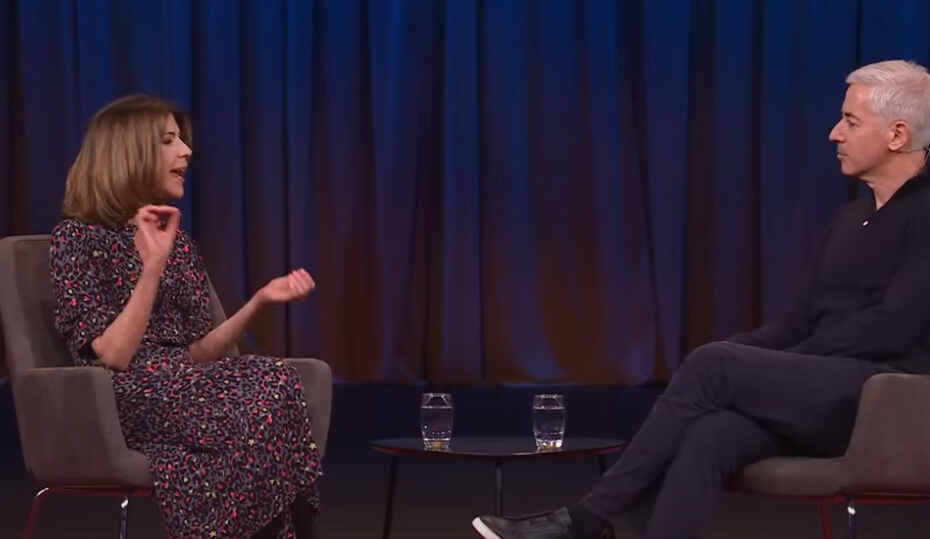
Read the full transcript of American hedge fund manager Bill Ackman in conversation with author and business ethics professor Alison Taylor on “An Activist Investor on Challenging the Status Quo”, at TED Talks conference, May 14, 2024.
Listen to the audio version here:
The Fundamentals of Successful Investing
ALISON TAYLOR: Talk to us about what the key elements are of success in this world. There’s research, there’s strategy. It also seems you need to react very dynamically to events in a way that seizes control of the narrative. But talk to us about how you see this.
BILL ACKMAN: So investing is about putting out money today in the hope or promise of getting back more in the future. And so it’s about predicting the future. And what we do is we find businesses where we believe with a very high degree of confidence, we know what the business is going to look like over decades.
ALISON TAYLOR: Right.
BILL ACKMAN: Because decades matter in valuing something. And so it’s really an analysis about disruption. What’s the risk of two former Stanford students in a garage coming up with something that disrupts a business? So that’s the most important part of being a long term investor. Figuring out the durability of the franchise, the barriers to entry, the moat around the business, and then the rest of it is just making sure you’re buying that business at a price where you put up money today and you’re going to get a lot more back in the future. Very simple.
From Corporate Activism to Social and Political Realms
ALISON TAYLOR: All right, so more recently you’ve taken this approach to other realms, to social and political realms. So can you talk to us about what is similar in these other realms? You have said, for example, that problem at Harvard is a governance problem. And you work a lot on governance problems and making them better. So tell us how social and political activism is the same as activist investing and tell us how it’s different.
BILL ACKMAN: So I’ll just correct one thing. So I’ve been at this for a long time. Yes, yes. The social stuff, actually, yes. It’s just a little more visible in the last kind of six months. But I’ve had various campaigns over time.
ALISON TAYLOR: That is very true. But you have now entered the headlines in a new way. So talk to us about that.
Harvard as a Governance Case Study
BILL ACKMAN: Sure. So Harvard is the oldest American corporation. And as a corporation, it has a governance structure, board of directors, a certificate of incorporation, bylaws, things like this. And what we do for a living is basically find a great company that’s kind of lost its way and then we help that great business kind of find its way. And sometimes you find the way by making a change in management, sometimes it’s a change in governance, sometimes it’s change in strategy, sometimes it’s all of the above.
And what we find with really great businesses is that they do tend over time to lose their way, because the problem of success and greatness becomes hubris. And also in a disruptive world, you have to disrupt yourself, because if you don’t, someone else will. But the problem with the nonprofit model, and again, as someone who spent a lot of time in philanthropy, one of the biggest lessons is that if you can find a for profit solution to a problem, the probability of success is much greater.
But if you think about Harvard, the business model. So when I went to Harvard and I graduated in 1988, our class had 1600 people. The Harvard class, now, 36 years later, has about maybe a little bit more than 1600 people, not much. So this is supposedly a great corporation, right? I don’t know of another great one that has not grown over the last 35 years. Now, one thing that has grown is the cost to go to Harvard. That has grown at about an 8% compounded rate. If you could invest in that, that would have been great. So the way that Harvard has grown its revenues over time is by increasing the price.
And the question is, is the service that you’re being delivered as good as it was 34 years ago? Is it better? I think it’s worse. And I think it’s worse because universities were designed to be places where people could share controversial ideas. And that’s why they developed this thing called tenure. And that was to protect faculty so they could say controversial things and not lose their job. But what’s happened is tenure has actually led to the reduction in the free speech necessary for people to be exposed to ideas.
Because what happens is you’re a student, you graduate with loans because it’s expensive to go to a place like Harvard. You try to get your PhD and you want to advance in the university, well, you’ve got to appeal to the faculty that ultimately they’re going to point to you. And so to the extent an institution has veered one direction or another kind of politically, you have to kind of follow that lead, otherwise you’re not going to get advanced. So ironically, the system of tenure designed to create a world where controversial ideas could be discussed, has actually led to the shutdown of those ideas.
And that’s led Harvard, despite the massive it costs today $84,000 a year to go to Harvard as a student. But I think what you’re getting, the education, is not as good as it was. It’s gotten worse. So that ultimately is a governance problem. You don’t blame the CEO in a case like that. You blame the board that selected the CEO or hasn’t helped the CEO. So it’s very analogous to what we see in the corporate world.
The Differences Between Corporate and Institutional Activism
ALISON TAYLOR: All right, so a governance problem.
And you’ve described in a lot of detail the way you feel that the institution has lost its way. But what about this is different from activist investing? Where do the parallels stop? And also maybe more specifically, how do you see your role? You decided to intervene primarily as an alumni, primarily as a donor. How do you see your role in this conversation?
BILL ACKMAN: Very analogous in some ways and not in others. So it’s analogous in that in my day job, we buy a small percentage of a company, far from control, we might buy 5% or 10%. And then this is sort of the earlier days of Pershing Square. Today we’re less of an activist. But the earlier days we wanted to influence a big company to make change, to make it a more successful, more valuable company. The only way you can do that with a small position is by advancing your ideas in a public way and getting those ideas adopted from a broad collection of other shareholders. Right.
ALISON TAYLOR: And that’s the taking control of the narrative. And then you get momentum and you get people, you bring people along with you.
BILL ACKMAN: Sometimes you literally have to run for office, but other times, just the risk of embarrassment to the director motivates sort of the decision making. But the good news is ultimately you can get to an election in a corporate context, a for profit corporate context, where shareholders are sufficiently dissatisfied with the directors, you can replace them and take control of the corporation and fix it.
The problem with Harvard is that the governance structure is set up in such a way that, that there is. The corporation board, which is comprised of about 13 members, is self appointed. There are no outside shareholders. Like an alum is not a shareholder, you can’t call a shareholder meeting and vote out the directors. And it’s really the only way to have influence is to sufficiently convince the world of the importance of your concerns so that other people adopt them. And somehow it permeates into the boardroom. And some combination of people saying, look, this is correct, we should do this. And some combination of the pressure of embarrassment, of shame gets people to do the right thing. But there isn’t a legal mechanism to barge your way in in the same way there is in a for profit context.
The Stakes of Educational Leadership
ALISON TAYLOR: Right. And so if you are taking a position in the company, the stakes are a lot of money, the future of the company and your own reputation and that of the company.
BILL ACKMAN: Yes.
ALISON TAYLOR: How do you see the stakes in conversation about Harvard? They seem higher to me. Do you think they’re higher?
BILL ACKMAN: They’re much higher. They’re much higher. Because if you think about. Well, first of all, Harvard is sort of symbolically, very important. Depending on where you went to school, people will call it in the top, at least they used to in the top universities in our country. And they educate, as a result, some of the most high performing, most intelligent, motivated people you would expect to that to be the Harvard community. And those people take their place ultimately in society and media, in government, on the Supreme Court. And so the education of the next generation of leaders is something all of us have to be concerned about because that will determine the future.
ALISON TAYLOR: So this is the pipeline for the next generation of leaders, and you want to have a role in shaping that pipeline?
BILL ACKMAN: I think society wants to make sure that that group of leaders is a good group of leaders. Even if they disagree, they’re prepared to listen and perhaps learn something.
A Vision for True Diversity
ALISON TAYLOR: All right, so you’ve made lots of arguments during this wider conversation about the future of Harvard. I’d like to spend a little time on one in particular. You’ve been framed by the press as an anti DEI activist at this point. And when you first appeared on my social media feed, I saw this post that said something about your belief in support of diversity. And you seem to be contrasting that with this orthodoxy as you argue it. That is DEI. I had a reaction to that. The first thing I did was to go on Pershing Square’s website and to look at your own track record. And I have to say, it was not what I expected. So I think what I would love to hear from you is can you articulate a positive vision, in your opinion, for what good diversity looks like with reference to your own firm and your own investments?
BILL ACKMAN: So when I first heard of DEI, I thought, diversity, that’s a good thing inherently, I believe equity. How can you argue with fairness? That was my understanding of what equity is. And then inclusion, of course, in any organization, whether it’s a university or a business, you want people to feel comfortable. That’s culture. When I think about my job as a CEO of a company or when I think of my role on a board, one of the first concerns I have about a business is the culture. This is an environment where the best people are attracted to come work there, where they can succeed, where they can challenge authority when they think authority is doing the wrong thing. So these are all, I think, inherently good things.
But someone once said to me that first it starts out as a movement that’s good, and then it becomes a business, and then it becomes a racket. And I think it’s an accurate description of what happens to things. I’ve come to have an aversion to when a movement becomes a three letter acronym, it seems like that’s when they can go a different way.
But in terms of what diversity means, to me, it’s not simply race and gender. You know, viewpoint diversity is critically important, not just in a university, but in a business. Someone’s socioeconomic background, I think is irrelevant. If you’re running an investment business, you want to have perspective on, you know, you’re investing in companies that sell products or services to the country. And the country is very diverse. So it’s very helpful to have people on your investment team, for example, who might have come from a low income background.
And then just, just in the spirit of fairness, you want a society where people who grew up on the Upper East Side and you went to a private school and you had SAT tutoring, you had a lot of advantages versus the student, for example, going back to your admissions example, who maybe grew up in Mississippi and didn’t go to a very good school, maybe had a single parent, you would make adjustments there. But also the grit that someone develops coming from a more challenged background is something you consider in a business.
So when you look at Pershing Square today, a very high percentage of our employees came from, I would say, quite a modest economic background. We have enormous diversity in terms of political views, like who should be president, things like this, and we occasionally discuss these things. But people respect each other and they share different points of view and they come from, you know, some are, you know, our investment team is comprised of, you know, a Muslim from Pakistan, a Hindu from India, a refugee from Iran, a Mexican whose grandmother picked cotton in California, a Canadian whose family was in the. Had a private business.
But we selected them not because of their particular backgrounds, but we selected them for their excellence. And the fact that they came from different backgrounds has made us a more successful kind of organization. That in my mind is a reason, you know, very appealing way to think about diversity as opposed to saying, let’s look at the percentage of various groups of different ethnic groups in the country and then let’s force design an organization so we match that collection.
ALISON TAYLOR: For sure. You hear that sort of Noah’s Ark frame that if we have a certain set of a certain type, then our problems will be solved. Which does not necessarily seem to be the case. But you see this really the benefits of being dynamism, better decision making, better reflection of what society looks like within businesses.
BILL ACKMAN: And also there is a fairness component. My point is I like a world in which someone who started out with disadvantages gets a closer look, than someone who had everything sort of handed to them. I think that seems right to me.
On Being Labeled an Anti-DEI Activist
ALISON TAYLOR: So I think it’s so fascinating. You’ve just articulated very well what the benefits are. So how do you feel about being framed on these headlines saying that you’re an anti DEI activist?
BILL ACKMAN: You know, the short form description of me is never really an accurate one. I would say I’m more nuanced. Look, I think I certainly want to be perceived the way that I actually am, as opposed to some caricature of myself. And also, I think the ideas are important, and if you want to challenge them, I’m always up for the debate.
But, you know, we are in a world today where if you challenge conventional wisdom or you take on sensitive topics where you’re at risk of being, quote, unquote, canceled, you know, you can be accused of being a racist, you can be accused of lots of things. And I think that’s led to a shutdown of kind of free speech generally, which I think is a big negative for society.
ALISON TAYLOR: So, yeah, it does seem a factor of our current era that arguments get sort of flattened and oversimplified and made more vicious and polarized. And so how do you feel about your arguments being treated like that? Do you feel that’s okay as long as I get the job done? As long as I get my goals met at Harvard or any future campaign or. Does this bother you? Does it bother you to be oversimplified in the like this?
BILL ACKMAN: Of course. But I’m a big boy. It’s okay. And also, I think, you know, I’m a very fortunate person in many ways, but one of them is I don’t have to worry about my employment. And, you know, today, if you work for a company and you are unhappy with, you know, you want to comment about something in politics, for example, and you do it on Twitter, you can end up losing your job for expressing your views.
And I think the world is a better place where all views can be heard, can be assessed, can be debated, but where, you know, the. You’re not shouted down or canceled, or worse, you become unemployed because you have a controversial opinion about gender or whatever the topic.
On Voice, Power, and Responsibility
ALISON TAYLOR: It’s true that more of us have the opportunity to have a voice and make our views heard, but that’s not proportionate. Right. Some people’s voices are boosted more than others. So how do you think about your voice and your power and maybe your responsibility in this realm and how you use your voice, especially given what we’ve been talking about, about how it may become distorted and your arguments may become more flattened and reduced to something that they were not.
BILL ACKMAN: So one of the criticisms of me during the Harvard campaign is some professor from Yale said, oh, you shouldn’t listen to him simply because he’s a rich guy. And I totally agree with that. I shouldn’t have more voice by virtue of net worth, but I don’t think that I do. My Harvard campaign was not a disinvestment or I never said anything about making or not making a donation to Harvard. I don’t think they should listen to me more or less, whether I have been a contributor or not.
I think what’s given me voice and followers, if you will, is just my willingness to share points of view on ideas. And if people think those ideas are interesting, I get followership. If they weren’t concerned with what I have to say, they would not follow me. But I don’t think I have more voice. Maybe I’m naive by this, but I think the reason, plenty of other people in my industry, similar economic circumstance, have very little voice because they’ve not put themselves out there, they’ve not shared their views. And I’ve done that in some depth. I’ve been criticized for writing the longest posts in history, but at least you know what I feel with particularity, I guess.
ALISON TAYLOR: And you certainly invite disagreement, you invite debate.
BILL ACKMAN: Yeah, I actually, I put ideas out there to learn, not because I’m trying to impose my will on others. I actually read the comments, even the mean ones, because I think it’s. And actually my approach to X, I should call it X, is I follow people on both extremes of many important debates, and I try to follow the most articulate, seemingly intelligent ones. And that’s how I find the truth. Right.
You know, just following people that support my beliefs, I don’t feel like I’m going to learn very much. Again, going back to the importance of viewpoint diversity at universities, if you’re not hearing, you know, if you’re 18 years old and you show up on the Harvard campus, you want to hear the full spectrum of views, from progressive to the most conservative, to find truth. Right. That’s what education is about, finding the truth. How can you find the truth if there’s a limit to what speech is acceptable?
ALISON TAYLOR: So you will put a provocative position out there, and then you will ask to be challenged, ask to be corrected, and you will look for information that challenges what you thought already.
BILL ACKMAN: I don’t necessarily think it’s provocative. Right. I try to put out my points of view on things other people may find them provocative, but I certainly welcome criticism and an alternative point of view. That’s how I learn.
On Wealthy Influence in Democracy
ALISON TAYLOR: All right, so let’s go back to this topic of influence. You said you don’t think you have disproportionate influence. Certainly something I hear and read about, and that is a big topic in current discourse, is the excessive influence of wealthy people on our democracy, on technology. You know, the circulation goes on. Do you think this is a legitimate source of concern? And if so, are you part of this problem or not?
BILL ACKMAN: Yeah. So let me sort of kind of address that two ways. One, I think the notion that you can spend an unlimited amount of money on political campaigns, in effect through PACs and otherwise, and you can even do it anonymously, I think is a disaster. And that’s wrong. I do think wealthy people can have more influence. Absolutely.
The point I was making was I think the influence I’ve had has not come from because I spent a lot of money on an XYZ campaign, but rather because I put out an idea that had impact. The tweet I wrote on DEI, which is 5,200 words, whatever, has been viewed 36 million times. You know, it’s probably the most viewed long tweet. Maybe it’s maybe the only long tweet, but it’s had an impact. I happened to bump into a governor who said, who had an impact on changes in policy they’ve made. But I think it had nothing to do with, you know, how many stocks I own or anything like that.
ALISON TAYLOR: I don’t hear an answer to the question. Do you think this excessive influence of rich people in society is a genuine problem or is it exaggerated?
BILL ACKMAN: Look, I think the notion that someone can spend several hundred million dollars on various campaigns at state levels and otherwise and impact the politics of attorneys general around the country, I think is not a good thing. The democratic process should be democratic. Right. In order for it to be democratic. It’s kind of one man, one vote.
Now, all that being said, people, I look at the Elon Musk of the world and the fact that he had the resources, that profits he made from PayPal is what enabled him to launch Tesla and SpaceX. No venture capitalist would have put up the capital to launch Tesla. It was the 100 million from Elon that made that happen. I think Jeff Bezos and Blue Origin Avi’s talking about what could be accomplished with $4 trillion. The fact that people have 100 something billion dollars are prepared to invest that on space exploration, I think is a very positive thing. For society. It does have influence. And otherwise. What I worry about is the political stuff. I think that Supreme Court decision needs to be reversed.
ALISON TAYLOR: All right.
BILL ACKMAN: Ironically, it was Citizens United is the decision. Right. And it’s disunited the citizens. Yeah.
On Free Speech and Platform X
ALISON TAYLOR: So voice is legitimate within reason. We need to have.
BILL ACKMAN: No, no voice is legitimate without reason. Right. You know, free speech. Share your views and let the most powerful ideas capture the minds.
ALISON TAYLOR: Okay. And you say you believe that is happening.
BILL ACKMAN: Actually, I’m a big fan of X. I think it really is a free, open, free speech platform and I’ve learned a lot and it’s affected my views, my politics, my insights. And I think it’s one of the few places you can go and have a true free speech platform. The negative is, of course, you’re going to confront hate speech and vile speech and things that are the detritus of free speech. But I still think it’s a very, very good thing.
I no longer rely on just the Financial Times, the Wall Street Journal, the New York Times, the economists. Right. You know, or in CNN, whatever, Fox News, whatever media you follow. And I think being able to kind of custom select interesting insights has been. Is good for humanity.
ALISON TAYLOR: Amazing. We need to wrap up. Thank you so much.