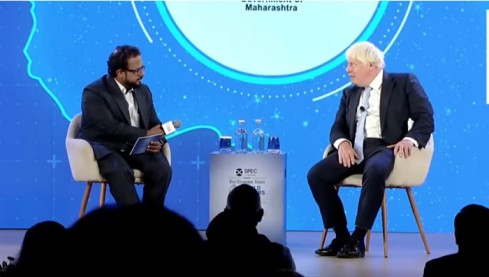
Read the full transcript of former UK Prime Minister Boris Johnson’s interview with Executive Editor of The Economic Times Sruthijith KK at Economic Times World Leaders Forum, August 22,2026.
EDITOR’S NOTE: At the ET World Leaders Forum 2026, former UK Prime Minister Boris Johnson sits down for a wide-ranging and often humorous conversation covering the Ukraine war, Iran, Donald Trump, Brexit, and the India-UK free trade agreement. In the interview, he shares insights on global geopolitics, reflects on Queen Elizabeth II and India-Russia ties, and even combs his hair on stage while reciting Homer in Ancient Greek.
Introduction
SRUTHIJITH KK: (00:00:00 – 00:00:30): Popular journalist and columnist, an orator with a real knack for entertaining listeners, multiple terms as Mayor of London, 2 terms, Foreign Secretary, Prime Minister.
What an extraordinary career so far, and a politician with a real sense for the pulse of the people. Boris, it’s a real pleasure to have you with us here today.
BORIS JOHNSON: (00:00:31 – 00:00:36): SK, it’s a great honor to be here and thank you very much. It’s wonderful to be back in India. Absolutely wonderful.
SRUTHIJITH KK: (00:00:36 – 00:00:39): You’ve been coming here a long time. You have extended family here.
BORIS JOHNSON: (00:00:39 – 00:00:44): I do. I’m having lunch with some of my extended family later on. I certainly am.
SRUTHIJITH KK: (00:00:44 – 00:00:50): Can you give us a sense of what it’s been like to— I mean, tell us a little bit about the India you have seen firsthand over the years.
BORIS JOHNSON: (00:00:51 – 00:01:07): I just think the change— it was wonderful listening to Prime Minister Modi last night. I thought he gave a brilliant speech.
And, you know, I just want to check whether you were paying attention. How many more biochemical toilets are there now on Indian trains?
SRUTHIJITH KK: (00:01:08 – 00:01:09): 3,746.
BORIS JOHNSON: (00:01:09 – 00:01:35): No, it’s 360,000. And I think the progress I’ve seen, the change is quite amazing.
And, you know, look, India was already an amazing country. Free trade deal that I started, I mean, it was good. We’ve done a lot, but there’s a lot more to do. And it’s a fantastic story. The Indian story today is a really wonderful story.
On Boris Johnson’s Hair
SRUTHIJITH KK: (00:01:36 – 00:01:52): I will come back to the free trade deal. But firstly, with so much strife around the world, so much going on, I think one of the questions that is top of the mind of a lot of folks here I want to come to you with first. Why don’t you comb your hair?
BORIS JOHNSON: (00:01:54 – 00:02:31): Now, SK, you were very kind that you gave me advance notice of this impertinent question last night. And I’ve taken the trouble. I was shaving in the Imperial Hotel this morning.
And out of love and respect for— For India and for the Economic Times, I’m going to for the first time in in history, I’m going to comb my hair in front of in front of you. There you go. I hope I hope you consider that an improvement, S.K. Ladies and gentlemen, we’re witnessing the best I can do.
SRUTHIJITH KK: (00:02:31 – 00:02:32): A historic moment.
BORIS JOHNSON: (00:02:32 – 00:02:38): There you go. You cannot say I’m not willing to oblige you for for the sake of.
On US-UK Relations and NATO Defense Spending
SRUTHIJITH KK: (00:02:41 – 00:03:22): Respect. An important moment in the history of British-India ties, Mr. Johnson combing his hair for us. That was fabulous.
Speaking of friendships between countries, etc., you know, the spending on defense has become— appears to have become a great fault line between Europe and longstanding strong partner the United States. The blame game is big. Trump is very fond of telling European allies that, you know, you’re not footing enough of the bill for NATO and for protection. Defence spending is now going up. How do you see this whole—
BORIS JOHNSON: (00:03:23 – 00:07:30): Yeah, you’ve got to be realistic, SK, about the so-called special relationship between the UK and the United States.
I mean, the United States is the is the proudest invention of England, right? I mean, I was— 250 years ago, a bunch of exclusively British or British-descended people signed the Declaration of Independence. It’s a British invention, no question about it. But they’re independent and have been for 250 years. That it’s a— we have rouse. It took them 2 years to enter the Second World War. We burned down the White House. I mean, obviously before the Second World War.
And this is a fractious relationship. I actually think it’s in very good health at the moment. And NATO is in very good health. NATO is, as you rightly say just now, NATO is being better funded than ever before. I think partly as a result of the criticisms that Trump has rightly made of other NATO members on defense spending.
I mean, I think we’re going to be increasing our spending, though the other NATO powers, by about $1.5 trillion, something like that, over the next 10 years. And that’s a lot more money going into defense, and it needs to go into defense.
You know, the elephant in the room is that there’s a disagreement, you know, We weren’t consulted about this war in Iran, right? And I honestly think that was a mistake. And I think, you know, if I can— I honestly think that if I’d been Prime Minister when that thing kicked off, it would not have happened.
Because, you know, if you remember, this is the 3rd Gulf War. The first 2 Gulf Wars, The US and the UK were absolutely shoulder to shoulder. And there was even a joint cabinet with Margaret Thatcher and Bush, George H.W. Bush. And Tony Blair and the younger Bush absolutely coordinated their efforts.
There was no coordination.
And I think it was a fiasco because someone should have interrogated the United States, if not President Trump, his planners, the Pentagon, what is the objective of this war? And we are your number one ally, right? We’re your fiduciaries. We’re your loyal henchperson. What do you want us to do to help you achieve your objectives, and what are those objectives? And by the way, what are you going to do if they close the Straits of Hormuz? Because the UK used to be quite heavily involved in that area, as you may remember, and people from the Gulf know very well.
And so I think it was, you know, and we’ve got very good intelligence agencies. I really think we could have averted an obvious, obvious trap. I don’t know what the UK was doing then. I wasn’t in power, obviously, tragically. You know, I think it was a mistake. But why weren’t our security services briefing the government that the US is about to walk into a terrible trap? I don’t understand it.
However, we are where we are. And the mistake has been made and the Straits of, you know, we’ve got the problem with, you know, that ship has sailed, as they say, though obviously not through the Straits of Hormuz. Going through a very good period under very strong and stable leadership. I think that’s a good thing. But the world needs leadership too. And for better or worse, America is the hegemon. And I’d frankly much rather have America as the hegemon than anybody else. Apart from the UK, obviously, but that’s a long time ago, and that ship has sailed too.
SRUTHIJITH KK: (00:07:30 – 00:07:31): That’s kind of in the past.
BORIS JOHNSON: (00:07:31 – 00:10:37): And it’s not going to happen. So I’d rather, given where we are, I’d rather have America than China. Putting it out there, okay? Shoot me, but that’s my view.
Now, given where we are, people who love America and want to help America have got to think what we can do to Get the straits open, help America out of the cul-de-sac. That’s what we’ve got to do. And I think probably that goes for India too. And I appreciate that it’s very difficult right now for India. It’s difficult for the whole world. It’s a very, very tough position to be in.
But we’ve got to find a deal with Iran, difficult though that will be, and brutal negotiators though they are. We’ve got to do that. And by the way, we’ve got to find alternative solutions. We’ve got to build pipelines, you know, from Fujairah or wherever. We’ve got to sort it out. We’ve got to have a logistical alternative to the Straits of Hormuz.
And, you know, I think what I would have said had I been in office and had I been— because you will not change— it was totally deranged to think that you could change the regime in Iran from the air. Did we learn nothing from 2003? You know, why have we done this again? Really, anyway, too late. Change has got to come from within Iran. The Iranians are a great people. They’re a wonderful people. And they need to be encouraged to change.
And that’s the way this thing has got to go. But the way to do it is by sticking together, and that means the US, the UK, India consulting each other, concerting our plans, working out how to get the world out of this mess, get the price of oil down, get the ships moving. That’s what needs to happen now.
And, you know, I think Enough schadenfreude about the mistake that President Trump has evidently made. There’s no point in that. By the way, it’s not a bad idea to be tough on Iran, okay? I mean, I think in principle it’s a good idea to stop them getting a nuclear weapon, right? And in principle, it’s a good idea to stop them sponsoring terrorism across the whole of the Middle East and around the world. That’s a great thing to do. And by the way, I don’t much like a regime that kills women for not wearing the right headgear. Okay?
So I would love to see regime change in Iran. I’m just not convinced we’ve gone about it the right way. And, you know, in all humility, I think that it would have— I think the UK could have played a stronger role in trying to stop this mistake from happening. But we’re now in— we’ve gone down the cul-de-sac. We now need to back out.
SRUTHIJITH KK: (00:10:39 – 00:10:49): You said countries should consult each other and jointly formulate strategies. Is President Trump a consultative sort of a person? And is he likely to change?
BORIS JOHNSON: (00:10:50 – 00:11:25): Yeah, look, I think he is, yes. Donald Trump is a deeply consultative type of person.
I mean, honestly, I’ve been shocked. I’ve been lying. Comatose in hotels in Miami when he’s rung me up and asked my opinion on something. And so, I’m sure that Prime Minister Modi knows this too, he loves to hear from his friends and to get advice. So, I think that we should have done more. I really, really regret it.
SRUTHIJITH KK: (00:11:27 – 00:11:37): And where do you see it going? I mean, where do you see this stalemate over Iran going? What’s the outlook for that particular conflict over the next few months?
BORIS JOHNSON: (00:11:40 – 00:12:50): Honestly, I wish I could offer you an optimistic view about negotiating with Iran. Has anybody here negotiated with the Iranians? Anybody?
I have. It’s miserable. They are absolute— the IRGC you’re basically talking to are tossers, if I can use that word in the hallowed precincts of the Economic Times World Leaders Forum. They are— once they think they’ve got you, they’ve got something over you, once they’ve got something that you are in, you are stuck. And they will continue to weaponize whatever advantage they have.
And I wish I could say I was optimistic about negotiations. That’s why I think that other logistical solutions, no more supporting the Houthis and Hezbollah and all the rest of it, no more supporting terror around the region, and no nuclear program. That’s what they need to agree. And they can be made to do it. But I think that the trust levels with the United States are very low right now. That’s a sad thing.
On Europe’s Decline and Work Culture
SRUTHIJITH KK: (00:12:51 – 00:13:29): Well, speaking of hegemons and superpowers and the world order in that sense, one of the gaps I think the world feels today is that of Europe, or rather the narrative of Europe as a continent in retreat, not a great leader in emerging technologies, not very strong economic growth. This whole idea that Europe should be able to sustain a lifestyle that affords people 4-day work weeks and so on, while things are far more severe elsewhere. How do you look at this? Is this a problem or is it an—
BORIS JOHNSON: (00:13:30 – 00:14:42): Yes, it is a problem. And we have an aging population in Europe and we don’t work anything like hard enough to support that population.
I was in a— I think it was last year, I was giving some lectures and I spent a long time in Texas. And I took my family out there, and we all went swimming in this wonderful river, the Guadalupe River, and we camped and all this stuff. And there was nobody there. The sun was out. There was nobody there, day after day. In Britain, the place would have been swarming with people bunking off work.
The Americans have 2 weeks holiday a year. And they work unbelievably hard. I mean, that’s why they have per capita GDP of $94,000, $95,000 a year, whatever it is. You know, they are an amazing country. And Europe does not have that work ethic, I’m afraid, right now. And we spend far too much on welfare. And yeah, I mean, we need to import into the into Europe, some of that American zap. There’s absolutely no question. And into the UK.
SRUTHIJITH KK: (00:14:44 – 00:15:00): And given the kind of values that Europe has historically promoted around the world and has generally been a force for good in terms of, I mean, not speaking of the colonial period, but in terms of the institutions they have promoted, democracy.
BORIS JOHNSON: (00:15:00 – 00:15:30): Yeah, I think you could argue that post-war, the rules-based international system that Europeans have by and large promoted. And I think human rights, the rule of law, they’ve been very important. Yeah, I think that’s right. And they need to be protected.
But look, I mean, there’s a lot of polemic at the moment from the Americans about Europe. And I love America. I was born in America. Fantastic country.
SRUTHIJITH KK: (00:15:30 – 00:15:31): And you were a citizen till you—
BORIS JOHNSON: (00:15:31 – 00:17:09): Yeah, I was. It was very expensive being American. They tax you. Even I was mayor of London, they taxed me on the sale of my primary residence in London. That’s why I gave up being American.
But there’s a certain amount of anti-European polemic that is unfair, right? I’ve agreed with you about welfare, I’ve agreed with you about about work ethic. But, um, you know, if you say that, um, you know, I see some stuff about crime in London, right? And why London is unsafe and all this sort of nonsense. London is safe as houses.
Now, I was Mayor of London and I got it, as you kindly pointed out, and it was unbelievably safe. I haven’t seen the recent statistics, but when I was Mayor of London, I mean, you were 5 times more likely to be murdered in New York than you are in London. And that’s still, by the way, that’s still more or less true. So, you know, this is just the negative propaganda that you would expect from a New York realtor who wants to do down his number one global competitor. That’s what’s going on.
It’s just a— London is a very, very safe city, a wonderful city. And good times are ahead for the UK. I think one of the problems we’ve got is that we have all these inventions like AI started in the UK. A lot of things started in the UK. And then we keep selling it to the Americans. That’s a mistake.
On Andy Burnham and UK Domestic Politics
SRUTHIJITH KK: (00:17:11 – 00:17:22): Andy Burnham, like you, former mayor of Manchester, is now in 10 Downing Street. What are the— what would you say are the top issues he needs to contend with at this point?
BORIS JOHNSON: (00:17:23 – 00:20:25): He needs to— well, he’s doing a lot of things that I did, actually. Like the £2— I got— the reason I got a huge majority in 2019 was because we did some things like a £2 bus pass, which is a very good idea because it helps people.
I mean, Prime Minister Modi’s speech was brilliant because he talked about retail issues because it helps people. I mean, Prime Minister Modi’s speech was brilliant because he talked about retail issues. He talked about improving the transport network. You know, that— honestly, I reckon— I don’t know whether that speech was widely broadcast in India last night. Was it? Did everybody— I really hope it was because people would have seen that some of the things the government of India is doing that really make life better.
And a £2 bus ticket, which is what we did, which is what Burnham has now done again, That’s useful for people. It gets people on low incomes to their place of work, right? It drives the economy. It’s a leveler. It helps level up. It’s a great thing to do. So I think Burnham’s done the right thing there.
But he’s pathetic on lots of other things. Absolutely pathetic. So, you know, his big challenge is illegal migration coming across the Channel in the boats, which is absolutely tragic. These gangs taking people across in in children’s plastic blow-up swimming pools and stuff like that. It’s absolutely appalling. And that needs to end.
He could end it. What he needs to do is get back to the Rwanda scheme, brilliant humane scheme devised by me, which was to send them as soon as they arrive in Kent straight to Rwanda. Right? What could be nicer? Twin Kent with Kigali and you’d immediately bust the business model of the gangs. And as soon as they knew that was going to happen, by the way, the numbers started to go down.
Unfortunately, Labour’s— the Labour Party is very squeamish about that kind of thing. Doesn’t like— it’s basically pro-free movement. And that’s a disaster. And the Brits have totally moved beyond that. So they need to get back to the Rwanda— they need to get rid of the European Convention on Human Rights insofar as that’s blocking that. They need to get back to the Rwanda scheme, stop the boats, need to cut the welfare bill.
I talked about that just now. You know, the spending on mental healthcare in the UK has more or less doubled since the pandemic. Okay? I mean, how gloomy can we be? Is that really right? Do you notice people in Britain being substantially gloomier under a Labour government? Maybe they are, but I mean, you know, it’s not right. It’s many tens of billions. It’s too much. We should be cutting it. Cut welfare and then cut taxes. Taxes are far too high. Stimulate growth, stimulate investment. That’s what he needs to do, just for starters.
SRUTHIJITH KK: (00:20:28 – 00:20:34): Anyway, speaking of, uh, I mean, I mean, we spoke about Trump’s mistakes. I want to come to perhaps some of the mistakes.
BORIS JOHNSON: (00:20:34 – 00:20:36): About whose mistakes?
SRUTHIJITH KK: (00:20:36 – 00:20:38): We spoke about President Trump’s mistakes.
BORIS JOHNSON: (00:20:38 – 00:20:50): Yeah, I’m not going to get in too much trouble for saying all that. I mean, I’m saying it in a loving way, right? But I can’t see, I cannot see how this— I want, you know, we weren’t consulted. That’s my objection. We weren’t consulted.
SRUTHIJITH KK: (00:20:51 – 00:20:51): No, I want to—
BORIS JOHNSON: (00:20:51 – 00:20:55): or if we were consulted, We didn’t say the right thing. I don’t know. I wasn’t there.
On Brexit
SRUTHIJITH KK: (00:20:57 – 00:21:04): But from Trump’s mistakes, I want to discuss perhaps some of the mistakes you have made during your time in office.
BORIS JOHNSON: (00:21:04 – 00:21:05): Well, that won’t take long.
SRUTHIJITH KK: (00:21:08 – 00:21:09): What, really?
BORIS JOHNSON: (00:21:10 – 00:21:12): So we’ve got another 22 minutes to fill.
SRUTHIJITH KK: (00:21:16 – 00:21:18): The British electorate, when polled in January—
BORIS JOHNSON: (00:21:18 – 00:21:19): Yes, go on.
SRUTHIJITH KK: (00:21:19 – 00:21:30): In January this year, 58% of the folks said Brexit was a mistake. Are they having buyer’s remorse about listening to you?
BORIS JOHNSON: (00:21:30 – 00:21:51): Well, don’t forget that 49% said they were against it. So that’s a very small shift, in my view, and it’s probably not within statistical margin of error. You know, but people said they were against it before. The majority of the polls were in fact against coming out of the EU before miraculously the British people voted to come out.
SRUTHIJITH KK: (00:21:51 – 00:21:59): If you want to stick to the same poll, 30% said it was a good idea, 58% said it was a bad idea. This is a YouGov poll.
BORIS JOHNSON: (00:21:59 – 00:24:44): Okay, fine, thank you. Well, look, I certainly don’t think it was a bad idea, and I don’t think, just looking at some of the things that have happened, you know, we certainly wouldn’t be able to stop the small boats if we stayed within the EU, right? Because there’s no way you could send people to Rwanda under the common asylum and immigration policies that we have in the EU. No way, right?
So, and on immigration, actually, the numbers on legal immigration, the numbers are now coming right down because were out of the EU. In the EU, there’s no way you can legally stop the free movement of 450 million people who might want to come to the UK. They have a legal right to do it under basic EU principles. That’s a lot of people by our standards. So we have that freedom.
I think I’ve mentioned many times that We were able, thanks to Brexit freedoms, to vaccinate the— whatever you may think about vaccination, actually, you know, we had a vaccine that was very largely made in India, the AstraZeneca vaccine, and I had it myself. I had the Indian version of the AstraZeneca vaccine, so thank you very much. It seemed to work. Seriously, thank you, thank you.
And we were able to roll that out literally months faster than the other EU countries, or than the EU, because we were then out. Because they delayed, their European Medicines Agency for some reason took weeks and weeks and weeks longer to give approval to these vaccines, Moderna, Pfizer, AstraZeneca, all of them. And so by the middle of 2021, when I was Prime Minister, that was because we had a Brexit freedom, right?
And so, you know, I’m not going to hear any nonsense about that. And if you think the British people are going to vote to go back into the EU, you are out of your tiny mind. I probably— not that you’re saying you’ve got a tiny mind, but, you know, of course, you know, but, you know, it is just not going to— it’s never— to go back into the EU, you have to vote to give up, well, your control of your borders, your laws, All that again, your currency, because under EU rules you have to join the euro, we’d have to give up the pound sterling, plus we’d give up hundreds of millions of pounds a week.
And, you know, it’s just not going to happen. And, you know, just to anticipate your next question, SK, no, go on, ask it anyway, but I bet I know what it is.
SRUTHIJITH KK: (00:24:45 – 00:24:46): No, keep going.
BORIS JOHNSON: (00:24:46 – 00:24:50): Is it about the £100 million, how much we get back a week? Let me tell you—
SRUTHIJITH KK: (00:24:50 – 00:24:52): It’s about what you’ve promised.
BORIS JOHNSON: (00:24:52 – 00:26:04): It’s what I’ve promised. Well, okay, we over-delivered. Thank you. We teed each other up there.
Look, we put on the side of that famous bus, I don’t know whether you saw it, but there was a big red bus that went around the UK promising that we would restore £350 million a week. Actually, that was an underestimate. If you look at how much we were going to be asked to pay by 2020, it was more like £450 million a week, okay, or gross, but, you know, a huge— even a huge amount net, you know, half the whatever, half of £225 million a week, it’s a lot of money. You can build a hospital a week for £215, £225 million, right?
So, and that money did go into the NHS. What I, we put a huge amount, we built, we started a huge program of hospital building, but you can’t waste that money. So it’s a mistake to waste it. And I think, as I say, you know, too much is going on welfare spending that can be trimmed.
On the War in Ukraine and Drone Warfare
SRUTHIJITH KK: (00:26:07 – 00:26:32): In April this year, you went to the front lines of the war in Ukraine. You have since spoken out about the impact of drone warfare. Yes. How are drones changing the— I mean, firstly, take us through your thoughts on the war and where it’s going, and especially how are drones changing the equations on the ground?
BORIS JOHNSON: (00:26:32 – 00:32:30): Yeah, well, SK, I mean, it’s a brilliant point. I mean, I don’t know whether anybody has been to Ukraine or talked to the Ukrainians about what’s happened, or to the Russians, but the drone thing is really terrifying. You can be blapped, you’ve zapped, blipped at any time, and miles from the front line. And so it has changed the face of war, and it’s very scary. And those Ukrainians are heroic.
But the thing I would like to convey to a great, great Indian audience is, look, do not believe the propaganda that Putin is fated to win this war. He is not. I would put it to you that he is fated to lose this war. He’s fated to lose it because he’s going up against the desire of the Ukrainian people to be independent and to be free. And when the people want to be free, they’re just about the most powerful human emotion apart from religion in the, in the, in our breasts, right? But people want their country to be free. There’s nothing that’s going to stop them. British Empire discovered that, right? Nothing. And they will be free.
What needs to happen is that war needs to end. And if you ask me what I think should happen, I think that the Ukrainians should be given the maximum possible help. And yeah, I think that it would be a good thing if the Tomahawks were given to them to take out the Russian bases that are used to bomb Ukrainian civilians. I think that the hundreds, $140 billion of Putin’s cash that’s sitting there in a Brussels bank account, that should go to Ukraine. Those are some of the things that I think we should stop the trade in illegal, in sanctioned oil that’s going on around the world in Putin’s oil. That would make a huge difference. Get it over. Get it over.
And I don’t think it’s that far. Honestly, sometimes I don’t think it’s that far from being over. The only guy who can end this war is Vladimir Putin. Trump can’t do it. Zelensky can’t do it. Only Putin can do it. And he’s losing 30,000 people a month. His economy is in real difficulties. He needs to be persuaded that it’s in his interests to get it done.
And that’s the difficult thing. And at the moment, he’s worried that what will happen is the minute he stops, the recriminations will begin. And everybody will say, Vladimir Vladimirovich, why did you kill 1.1 million Russians, or whatever the number now is, far more that have died in any conflict since the Second World War. Why have you done this when we’ve achieved so little? He’s terrified of that. That’s why he won’t stop.
And somehow, we need to flip the switch in his brain to make him realise that going on is worse than stopping. I mean, going on is worse than stopping because he’s just going to keep losing people to no avail. A snail, literally a snail, would go twice as fast to the Polish border as the Russian advance in the last year. They’re never going to do it. And the Ukrainians are never, never going to surrender their country.
So the faster, the more pressure we— what I’m trying to make is, the more pressure we can put on Putin, And I appreciate that India is in a particular position on this, but the more pressure we can put on Putin, the faster we can do it, the better.
But, you know, I remember once, I mean, I had this conversation with your great Prime Minister many times, and I was once saying to Her Late Majesty the Queen of England, you know, how difficult it was to persuade our Indian friends firmly to come down against Russia. And she said, well, she was quick. Actually, it was very shortly before she died. And she said quick as a flash, oh yes. I remember in 1952 when I was talking to Prime Minister Nehru and he said, “Your Majesty, India will always basically be on the side of Russia. Some things never change, they just are,” he said.
I don’t know whether you agree with that analysis, I was very struck by that. And it just, you know, I think we have to go with the historical reality. But I would just urge you to, you know, I don’t think this thing is going to end without more pressure on Russia. And honestly, what I would love to have seen is, you know, India doing more. I mean, this is our fault, right? Like so many other things. But I would like to have seen more military cooperation between India and the UK and India and the United States. I think that would have been much more sensible. And, but it’s happening now.
On the Late Queen Elizabeth II
SRUTHIJITH KK: (00:32:32 – 00:32:40): What were your interactions with the late Her Majesty the Queen like? Did she think you were funny?
BORIS JOHNSON: (00:32:43 – 00:34:20): God, I was always too nervous to ask. I never asked, no one cared to ask me, ask her. I think, I don’t know, I think, look, you’ve got to understand that she’s seen a lot of us, right?
You know, I’m very honored to be here, by the way, at this World Leaders Forum, but there’s a, you could have picked a wide range of former UK prime ministers You know, there’s a ready supply, okay? We’re making them the whole time. We did a poll. We’re exporting more former UK prime ministers than almost anything else at the moment.
So look, you know, she was very, very gracious. I think what it was like was it was like talking to your favorite grandmother. Right. And literally, you could tell her, you could make appalling confessions that you would never tell your parents. Do you know what I mean? And she was so understanding because she really, I mean, it was like a priest or whatever. She’d heard it all before and she’d heard worse.
So she was wonderful. She was very kind. And what was so noticeable about her was she She always saw above what was so important. She always saw beyond the politics to what was the long-term interest of the country. And she was very, very good at, you know, keeping you focused on that. She was a wonderful, wonderful person.
On Humor in Politics
SRUTHIJITH KK: (00:34:21 – 00:35:16): I want to talk about the role of humor. I mean, you’ve been a a communicator your whole life, and then you became a politician, and you use humor a lot. And we see, I mean, it has helped you in your political career. We see someone like President Trump, who’s also really entertaining in his own way. Not if you’re on the receiving end of his policies, but otherwise. President Zelensky used to be a comedian. I mean, Now, of course, he’s a very serious wartime president, but that’s a separate matter. Can you talk us through— like, I was struck by this comment of one of your rivals. I don’t know if it was Ken Livingstone during your mayoral races for London. They expressed great exasperation. They said that you talk to the average person, average voter, and they say, “well, I’m going to vote for Boris because he’s funny.” I know.
BORIS JOHNSON: (00:35:16 – 00:36:24): Well, they should have been given a chance to do so again. That was a great thing.
Anyway, I think humor is obviously a defense mechanism, isn’t it? First, it’s, you know, people tell jokes in order to protect themselves is one thing. The other thing I would say, so that’s a common psychological trait, I think. Otherwise, you know, I can, you know, I don’t want to— this has been an unusually attentive audience, by the way. I want to thank you very much. But I think you’ll find it amazing considering how early it is in the morning and, you know, But quite a lot of people, politics, they wanted to discern it. So you have to keep some jokes going and keep entertaining them.
And Ronald Reagan told a lot of jokes. Winston Churchill told a lot of jokes. Who else? It’s not a disgraceful thing to do as a trustee to try to It’s like a McVitie’s digestive biscuit with chocolate on top, right? You need the chocolate on the top to make the rest of the biscuit worth eating.
SRUTHIJITH KK: (00:36:27 – 00:36:27): Yeah.
BORIS JOHNSON: (00:36:27 – 00:36:28): In my experience anyway.
On the India-UK Free Trade Agreement
SRUTHIJITH KK: (00:36:30 – 00:36:43): I want to talk about the India-UK FTA, which, you know, you promised in 2022 when you were Prime Minister and visited Ahmedabad along with Prime Minister Modi. You said we’re trying to get it done by Diwali that year.
BORIS JOHNSON: (00:36:44 – 00:36:45): Of course, well, you didn’t say which Diwali.
SRUTHIJITH KK: (00:36:47 – 00:36:47): No, I was very—
BORIS JOHNSON: (00:36:48 – 00:36:48): we were very careful.
SRUTHIJITH KK: (00:36:54 – 00:36:59): Very clear. Sorry for the misunderstanding, but it’s, um, it’s now finally—
BORIS JOHNSON: (00:36:59 – 00:40:43): I always keep my promises. Yes.
Um, yeah, look, I, I, look, I’m thrilled that it’s happened. Um, and it’s a great deal. And if I’ve achieved nothing else in my life, my friends, I have cut the tariffs or I have given— persuaded, helped to persuade the brilliant, doughty, remorseless Indian negotiators to cut the tariffs, the exorbitant 150% tariffs on Scotch whisky to 75% and going down further to 40%. In the next few years.
So, you know, that’s a big deal for my relatives, by the way, because, you know, the one thing they wanted me to do, really, I think probably the only reason they allowed their beautiful daughter to marry me was in the hope— because the other day, you see them going through duty-free with these huge clinking, you know, carrier bags of Johnnie Walker. And now it’s— or whatever it is. And now it’s— I hope— I think the cut came in in July. But it’s going to be substantially cheaper.
By the way, amongst the many benefits of Brexit, I should say, is that trade with India has gone up by how much? 186% since Brexit. And it’s literally going up like that the whole time. And I’m very, very proud of that.
And, you know, we’re seeing huge— we’ve got wonderful, amazing investments in the UK from India. Every Brit is proud of Jaguar Land Rover. We think they’re amazing vehicles, but they’re Indian-owned. And actually, the recovery of JLR, as everybody knows, is very largely an Indian triumph. I have a motorbike at home, a Birmingham Small Arms motorbike, which is made in this country. And there is more and more of this stuff happening, which is Very exciting.
And, you know, if you ask me, where does it need to go? You know, I said earlier on that I think India has got an incredible future. It really has, because you’re a democracy and you’re a free country. Amazing, amazing place. And you’ve got so many, so many amazing natural advantages.
Listening to what Prime Minister Modi was saying last night, About— obviously, he used a phrase I hadn’t heard, the licensing or something, the license raj. Did I catch that correctly? Well, I mean, come on. What about— yes, that’s right, PLP, which I thought was the Parliamentary Labour Party, but it turns out it means something else. Why is it so difficult for a UK lawyer to— what are you frightened of, UK lawyers? There’s nothing wrong with them.
I think there is— all I’m saying is we benefit massively in our country from Indian investment and Indian talent. You know, I probably had a cabinet that contained more people of Indian origin than ever before, I’m proud to say. Not all of whom supported me for quite long enough, but never mind.
You know, there’s a massive, massive future, but There are some things we could fix. Law, accountancy, supermarkets. We fix supermarkets. I’m not convinced that Tesco could set up here very easily. You know, maybe you don’t want Tesco. Fine. Okay. But, you know, there’s more to be done. And it would promote growth and jobs in Both countries, both countries, believe me.
On Football and Lighter Moments
SRUTHIJITH KK: (00:40:44 – 00:40:50): I have 2 more questions for you. One is, can you pick your favorite English football team?
BORIS JOHNSON: (00:40:50 – 00:41:56): No, because I haven’t got a clue about football. My sons all— I have lots of sons. They back— some of them back Newcastle for reasons I simply don’t understand, which I think is now owned by Saudi Arabia. But there you go. My wife backs Arsenal. God knows why. Um, I have one son who backs Manchester United.
I think when I was a kid in London, I remember being a fan of George Best, but I can see by the blank looks on your faces that means nothing to you. George Best was a big, big star in, in, uh, when I was growing up.
Um, but I wasn’t good with— I wasn’t, you know, I, I was quite good at rugby. I was good with anything that involved just bursts of aggression. That I could do. But controlling a ball with your feet and passing it to somebody else on your own side— I could pass it to the opposition, but trying to pass, that was very difficult, I thought. Are you good at football?
SRUTHIJITH KK: (00:41:56 – 00:41:57): Not at all, sir.
BORIS JOHNSON: (00:41:57 – 00:42:05): Can I ask you just to see whether you Did I ask you how many biochemical toilets there were on Indian trains?
SRUTHIJITH KK: (00:42:05 – 00:42:08): You did. I gave a very specific and wrong answer.
BORIS JOHNSON: (00:42:08 – 00:42:19): Oh yeah. Okay, how much has the punctuality of the train service in the Delhi region improved?
SRUTHIJITH KK: (00:42:19 – 00:42:20): 99%.
BORIS JOHNSON: (00:42:21 – 00:43:08): Correct. Isn’t that fantastic? 99.9%, I think. Yes, I think you’re underestimating it. But it’s fantastic.
I mean, it was a brilliant speech because people need to know this retail stuff. They need to know the way the government— I used to say that I’d made the Tube trains run 30% faster, which was basically true. You jiggle around with the statistics because of the signalling things we did, or that we cut the murder rate by 50%, which was also true. But You know, people need to know that.
And I thought, you know, you don’t hear— honestly, you don’t hear speeches like that enough in the UK. You know, politicians should be constantly telling the voters what on earth they’re doing. So that’s my view.
On Classical Poetry Recitals
SRUTHIJITH KK: (00:43:09 – 00:43:30): Boris, you revived interest in Greek poetry single-handedly worldwide by doing a recital of Iliad during an interview some time back in the US. Do you think that’s true? No, greatly. It’s got millions upon millions of views online. Could I request you to reprise the performance, maybe with any ancient language of your liking?
BORIS JOHNSON: (00:43:32 – 00:43:54): I wish I could. I wish I could. Rishi once gave me the Bhagavad Gita, and I looked at it, but unfortunately, I just wasn’t good enough. I could do— I’ve done the Iliad, right? Who knows the Aeneid by Virgil? The Latin epic.
SRUTHIJITH KK: (00:43:54 – 00:43:56): Anybody speaks Latin here?
BORIS JOHNSON: (00:43:57 – 00:44:03): I guess not. Listen, I bet there’s some lawyers here. Hands up who’s a lawyer. Okay, maybe not so many.
SRUTHIJITH KK: (00:44:03 – 00:44:07): There are many lawyers, but we have a top lawyer.
BORIS JOHNSON: (00:44:07 – 00:45:45): I’m rusty on all this. The Aeneid of Virgil is a wonderful poem about the foundation of Rome. Which is the beginning of of so much. Okay.
[Boris Johnson recites a passage from Virgil’s Aeneid in Latin.]
Hang on, how’s it go?
[Boris Johnson continues reciting in Latin.]
Anyway, I could go. I’m rusty. Give me more notice and I’ll give you 100 lines, but it gives me a problem.
[Boris Johnson recites further lines in Latin.]
Well, it means Divesopum. Anyway, I could go. I’m rusty. Who was following it?
SRUTHIJITH KK: (00:45:47 – 00:45:48): We understood everything.
BORIS JOHNSON: (00:45:50 – 00:46:09): It’s a great poem.
[Boris Johnson recites another Latin fragment.]
I can’t remember the rest of it. Anyway, it’s a great, great poem. It’s about the foundation of Rome, and I obviously need to go back and brush it up. Next time, next time, next time. If there is a next time, I’ll give you. I’ve done the Iliad. Maybe I’ll go and learn the Odyssey.
SRUTHIJITH KK: (00:46:10 – 00:46:11): You want to do two lines of Iliad?
BORIS JOHNSON: (00:46:12 – 00:48:47): The Iliad. Okay.
[Boris Johnson recites an extended passage from Homer’s Iliad in Ancient Greek.]
I can generally go on for a long time with this, so you don’t want to. You’re only interested. But this is, that’s a very, that’s the beginning of, that’s, I don’t think that’s as old as the Bhagavad Gita, but it’s a very old book.
And by the way, by the way, just— I’ll end with this thought— has many of its cultural origins in Indian poetry, ancient Indian poetry, and in Sanskrit. If you look at it, a lot of the stories are the same, and a lot of the ideas are the same. I don’t know quite what that tells us, but it probably tells us we should stick together. We should stick together.
And I really think the The lesson of the current discontents, I think, is that when you look at Iran, you look at the problems the world has got, I think they’re all soluble. I even think Gaza is soluble, by the way. We didn’t even cover that. But they depend on the democracies, the great democracies of the world, whose interests are so similar, Sticking together. That’s my strong advice. Thank you very much. I better head off now. Thank you.
Closing
SRUTHIJITH KK: (00:48:48 – 00:48:53): We’re going to send you a good English translation of the Bhagavad Gita at cost.
BORIS JOHNSON: (00:48:53 – 00:48:59): My former mother-in-law could definitely do it all, but I can’t, I’m afraid.
SRUTHIJITH KK: (00:48:59 – 00:49:03): A real pleasure. Ladies and gentlemen, a big round of applause for Boris Johnson.
BORIS JOHNSON: (00:49:03 – 00:49:04): Thank you. Thank you. Thank you. Thank you.
Related Posts
- Scott Ritter: Trump vs. Zelensky – End of Ukraine, NATO & EU (Transcript)
- Seyed M. Marandi: Egypt Joins Saudi War – A Wider War Is Coming (Transcript)
- Joe Kent: Why the U.S. Proxy War in Ukraine Must End Now (Transcript)
- John Mearsheimer: Russia’s Existential War & the Rise of a Post-Western World (Transcript)
- Transcript: Western Dominance Ended 25 Years Ago – Jeffery Sachs