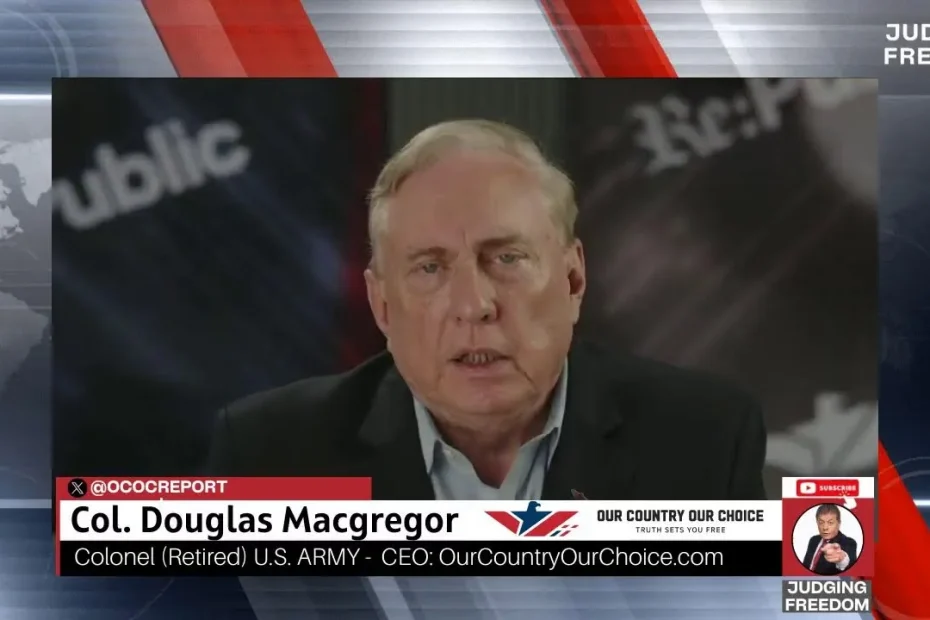
Read the full transcript of a conversation between Judge Andrew Napolitano and political commentator Col. Douglas Macgregor on Judging Freedom Podcast titled “Will the US Attack Iran For Netanyahu?” premiered April 1, 2025.
Here the interview starts:
Introduction
JUDGE ANDREW NAPOLITANO: Colonel Douglas Macgregor, welcome here, my dear friend. Before we get to your opinion on the likelihood, probability, desirability, however you want to characterize it, of the US using military force in or against Iran, a few other questions. Are EU leaders or NATO without the US actually preparing for a war with Russia?
COL. DOUGLAS MACGREGOR: I think there’s a great deal of talk, but I don’t see much evidence for action. And you’re talking essentially about London, Paris and Berlin. And as you know, in Berlin they had to vote to change a provision in the Basic Law so that they could exceed their budgetary limits.
Frankly, it’s very hard to believe. Military power takes time to develop and grow. It doesn’t happen overnight usually. On average it’s about 10 years. And so whatever you invest today will begin to see an impact provided the organization changes and adapts to the new technology in about five years. But you won’t have the full impact militarily on a battlefield for perhaps another five.
So I’m a little skeptical. Plus, you’ve got to look at the financial realities. Britain’s about to go under financially. France isn’t far behind. The Germans are in a lot of trouble. It’s hard to take any of it seriously, frankly.
European Political Instability
JUDGE ANDREW NAPOLITANO: But how do you explain the bellicosity of Prime Minister Starmer, who has nothing to back up his bellicose words with President Macron and even von der Leyen. How do you explain all of their condemnations and warning of fears of Russia?
COL.
They’re going to go down fighting. As far as they’re concerned, the initial strategy was to try and drag us into the war that we didn’t want to fight in Eastern Europe. That failed miserably. And so the next stage was either we stand up, join hands, and try to march into war together, or will simply be removed from power and it’s over. And I think they’re sensing that it’s over.
So I don’t take these things very seriously at all. Starmer? Good Lord. I’m surprised that the English population has at least risen up and done away with him. That may yet happen. The situation in the west is very, very, very fragile.
JUDGE ANDREW NAPOLITANO: Does the EU have troops independent of each country’s troops? I mean, this is terrifying. But does von der Leyen command troops?
COL. DOUGLAS MACGREGOR: That’s a great question. No. There have been attempts for the last 50 years to create what people referred to as an EU army. They even stood up an EU headquarters that was designed to be like the NATO deployable headquarters, and it failed. It just has gone nowhere.
Because until this point in time, Judge, no one in authority in Europe has been willing to invest any money in any of the critical capabilities, not just weapons, but also command and control. And they’ve been unwilling to adapt to new technology in any way. So these are empty threats. And I think that’s why you’ve seen President Trump has largely ignored it, which he should. It has no meaning, and it’s not going anywhere, by the way. I don’t see any evidence that the Russians are in the least worried about it.
US-China Relations
JUDGE ANDREW NAPOLITANO: Okay, let’s go 10,000 miles away. Secretary of Defense Hegseth sounds bellicose about China. Is the United States preparing for war with China, perhaps over Taiwan?
COL. DOUGLAS MACGREGOR: It’s hard to imagine, but I guess we can’t exclude the possibility. The problem is, and we’ve been through this before, you’re talking about fighting 6 to 10,000 miles away from home. That means that you’re entirely dependent on very fragile logistical supply lines, most of which have to come by ship or air.
You’re also dependent upon a collection of strong points in Japan, Okinawa, places like that, even Australia. And they’re not reliable because they’re static. And anything static can be targeted. Anything you target can be destroyed. So frankly speaking, you know, that’s another one where I sort of shake my head.
People say, well, we’ve got to pivot and spend billions and billions and billions on new infrastructure in Asia. Well, we have an infrastructure problem here at home, so I don’t think it’s going to happen. And I think a lot of this talk is a desire to seem strong or tough or masculine. I mean, it’s kind of crazy, to be frank with you.
And the Chinese would win any contest in their home waters, hands down. I mean, there’s a reason why after the Germans conquered most of Europe by 1940, that we did not land until June of 1944 because it took all of those intervening years to wear down the German military machine on multiple fronts. But you’re not doing any of that against the Chinese. And the Chinese are a much more difficult proposition. They’re the largest fortress in the world. So you’re taking on something from the sea, in the air that you have no chance of fundamentally damaging and changing.
Yemen Bombings
JUDGE ANDREW NAPOLITANO: Well, I wish the people around the President understood that. As you’ve just explained it, Colonel, is there any military justification for the bombings in Yemen? That last count, it was 65 different bombings in a 48 hour period.
COL. DOUGLAS MACGREGOR: I think it’s done more than anything else as a demonstration for Iran. The problem is the bombings haven’t had the desired effect on the people on the ground in Yemen. They remain defiant. They seem to have survived these horrendous bombings. They still seem to be able to manufacture much of their own equipment, including missiles. They have access to satellite intelligence, probably via Iran, but potentially from Europe, Russia, elsewhere.
It’s kind of a double edged sword. On the one hand, I think the President and his advisers are trying to intimidate Iran. On the other hand, we look foolish because we haven’t fundamentally changed anything on the ground. And by the way, Colonel Gary Anderson wrote a pretty good article about the Marine Corps explaining why the contemporary Marine Corps is not capable of moving to these points via sea, coming ashore and rooting out the enemy. Because to be blunt, that is exactly what would be required if you really want to eliminate the Houthis and their capabilities. You’ve got to go in on the ground.
US-Iran Tensions
JUDGE ANDREW NAPOLITANO: You mentioned the threats from the United States. Here’s State Department spokesperson Tammy Bruce. Now, full disclosure, I know her, we worked together for 10 years at Fox. But she sounds just like those two characters that used to be State Department spokespersons for Tony Blinken. But of course, you give me your own opinion.
[VIDEO CLIP STARTS] UNIDENTIFIED SPEAKER: Iran’s behavior across the globe threatens US national interests, which is why President Trump reimposed the maximum pressure campaign designed to end Iran’s nuclear threat, curtail its ballistic missile program and stop it from supporting terrorist groups. As the President has said, Iran can never have a nuclear weapon. He has also been very clear that the United States can’t allow that to occur. The President expressed his willingness to discuss a deal with Iran. As we know, if the Iranian regime does not want a deal, the President is clear he will pursue other options, which will be very bad for Iran. [VIDEO CLIP ENDS]
JUDGE ANDREW NAPOLITANO: There’s Iran’s Response.
[VIDEO CLIP STARTS] UNIDENTIFIED SPEAKER: The enmity from the US and Israel has always been there. They threaten to attack us, which we don’t think is very likely. But if they do commit any mischief, they will surely receive a strong reciprocal blow. The Americans have at least 10 bases and 50,000 forces near Iran. This means they are sitting in a glass room. Someone sitting in a glass room should not throw rocks at others. [VIDEO CLIP ENDS]
JUDGE ANDREW NAPOLITANO: I don’t know what rank that general was, but is that true? 10 bases and 50,000 troops surrounding Iran already?
COL. DOUGLAS MACGREGOR: Well, right now it’s over 50,000. And I think you have to include the naval forces at sea as well as the air forces and army ground elements in the region. We can expect at least 26, 27,000 ground troops that are in places like Jordan, Syria, Iraq.
What’s interesting is that the president, the current president, was very anxious to withdraw all of our ground forces from the region out of concern that in any future war, these ground troops were indefensible. They were spread about in these small forward operating bases, most of which could not be protected from incoming intermediate range, medium range, short range missiles.
So it’s kind of interesting to hear people now talk about that. I think the President is genuinely concerned about the safety and welfare of American soldiers on the ground and American airmen on the ground. No doubt in my mind. And that may be why even now there are talks going on behind the scenes between the government in Tehran and Washington.
Now, I don’t know the content of those talks, but as you and I have frequently mentioned, the President is not someone who wants to go to war. He really would like to negotiate another agreement, which is also interesting since he jumped at the opportunity to throw the old one out. We’ll see if it can be done. And then again, the wild card remains, Mr. Netanyahu. What will he do? What will he tolerate? What will he reject? Because he’s really running the show from behind the scenes.
Gaza Situation and UN Aid Workers
JUDGE ANDREW NAPOLITANO: Two days ago, the IDF executed one after another after another, 15 UN aid workers. No outrage, no apology. In fact, the State Department spokesperson didn’t even want to address this. Here’s the same Tammy Bruce.
[VIDEO CLIP STARTS] UNIDENTIFIED SPEAKER: The UN’s Humanitarian Affairs Office has said that 15 paramedics, Civil Defense, and a UN worker were killed, in their words, one by one by the IDF. They have dug bodies up, they said, in the shallow grave that had been gathered up, and also vehicles in the sand. Have you got any assessment of what might have happened? And given the potential use of American weapons, is there any assessment of whether or not this complied with international law?
UNIDENTIFIED SPEAKER: Well, I can tell you that for too long, Hamas has abused civilian infrastructure, cynically using it to shield themselves. Hamas actions have caused humanitarians to be caught in the crossfire. The use of civilians or civilian objects to shield or impede military operations is itself a violation of international humanitarian law. And of course, we expect all parties on the ground to comply with international humanitarian law.
UNIDENTIFIED SPEAKER: But it’s specifically a question on any… It’s a question about accounting and accountability, given it may have been the use of US weapons.
UNIDENTIFIED SPEAKER: So it’s a question about the State Department rather than Hamas. Is there any action? Well, every single thing that is happening in Gaza is happening because of Hamas. Every single dynamic. I’ll say again, I’ve said it, I think, in every briefing. All of this could stop in a moment. If Hamas returned all the hostages and the hostage bodies they are still holding and put down its weapons, there is one entity that could stop it for everyone in a moment, and that is Hamas. [VIDEO CLIP ENDS]
JUDGE ANDREW NAPOLITANO: One entity that could stop it in a moment, and that’s Donald Trump. I know you have praised his impulses toward peace. They are certainly not apparent there. What’s apparent there is no matter who you vote for, you get John McCain, and that’s what we have in Gaza.
Netanyahu’s Influence on US Foreign Policy
COL. DOUGLAS MACGREGOR: Well, I think it’s even more than that. Now, Tammy Bruce has done an excellent job of articulating the Israeli position. We used to try to be more even handed. If you go back a few years ago, there’s no effort at that, at all, no attempt whatsoever. We have wholeheartedly adopted the Netanyahu narrative for everything. That’s why I said earlier, he’s ultimately in charge. He’s determining everything. And his agents inside the government and the White House are determining everything that happens.
So quite frankly, you’re no longer listening to a truly independent American government. This is very much an Israel first administration. Might as well come to terms with that, understand what it means, which is unconditional support for whatever the Israelis want to do, regardless of whether or not that actually supports or harms our interests. Doesn’t make any difference. That’s the position. That’s where we are. Tammy did a great job of taking the right positions from that standpoint and saying exactly the same things that you would have heard from any cabinet member. Doesn’t make any difference. Everyone in this administration is singing the same tune.
JUDGE ANDREW NAPOLITANO: I guess I know the answer to this question. Can Trump say no to Netanyahu? Maybe that’s the wrong question. Because Netanyahu, you say, is calling the tunes. If Netanyahu wants the American Air Force to bomb Tehran, will they do it?
COL. DOUGLAS MACGREGOR: Yes.
JUDGE ANDREW NAPOLITANO: And what will the Russians and Chinese do? Just sit back and watch?
COL. DOUGLAS MACGREGOR: No. There are a couple of things that hurt us. First of all is what I would call national amnesia. We don’t remember the past in the United States judge. In fact, one of the reasons we don’t remember the past is because at the time things happened, whether it was the intervention in Iraq, intervention in Afghanistan, intervention in Libya, intervention subsequently in Syria, most Americans paid no attention.
The politicians in Washington learned the long term lesson that you cannot sustain large casualties because those attract attention. So if you can bomb with impunity, long range strike with impunity, and minimize the casualties that your side takes, the average American will pay little or no attention to what happens. But again, even the average American may never have paid any attention to begin with. That’s the sad part.
So the real question is, can we continue this process in the Middle East against Tehran if Tehran continues to resist any negotiated settlement? And it’s very difficult to imagine how they could sign up for what President Trump asked because his ultimatum was actually more strident and left far less room for negotiation than the ultimatum presented by the Emperor of Austria to Serbia in 1914.
So I don’t see how we avoid being dragged in. The other thing is, look at the interaction between President Trump and Mr. Netanyahu whenever they’re together, it’s very clear that Mr. Netanyahu is in charge. He’s very delighted. He’s happy. And there are key people in all of the positions, deputies or primaries, all of whom are signed on for what Mr. Netanyahu wants.
So I don’t know how else to explain it. The question is, will it last? Is America first in the true sense of the word, compatible with Israel first? Well, we don’t know. I don’t think so. But until there is a reason for Americans to pay attention, and that means losses on the battlefield, at sea, in the air, I don’t think much is going to change.
Netanyahu’s Comments on Free Speech
JUDGE ANDREW NAPOLITANO: You and I have complained about the suppression of free speech in the United States of America. It’s particularly poignant here in New York City because it goes on rather aggressively. Not far from where I am at Columbia University, here’s Prime Minister Netanyahu at his bellicose worst, complaining about free speech. I would like you to pay careful attention to the last sentence he uses. Not a long clip. It’s only about 45 seconds. Chris, cut number 11.
[VIDEO CLIP STARTS]
COL. DOUGLAS MACGREGOR: These ignorant demonstrators, who are they demonstrating for? For these murderers, these rapists, these mass killers? This is a reflection of a deep rot that has pervaded the intellectual hub of free societies. And this vilification of Israel, the Jewish people and Western values has been propagated by a systemic alliance between the ultra progressive left and radical Islam. It must be resolutely fought by civilized societies to safeguard their future. This is why we must all come in. President Trump’s decisive actions against anti-Semitism, and we must pressure other governments to do the same.
[VIDEO CLIP ENDS]
JUDGE ANDREW NAPOLITANO: And we must pressure other governments to do the same. That’s the man that’s telling Donald Trump what to do.
COL. DOUGLAS MACGREGOR: Yeah, I think that’s true. We have to understand that the war for Israeli hegemony in the Middle East, or frankly, Jewish supremacy, which is the way the Arabs look at it, I think is part of this larger global effort that he’s describing. This is a power grab, and it’s a very dangerous thing to do.
Many people that are familiar with history know that if you create a category of people who are treated as privileged, immune, and beyond the law, effectively you create targets, and eventually it all breaks down in hatred and violence. The first thing that Lenin did, or almost the first thing when he took over the Bolshevik Revolution was outlaw essentially the same thing. He attacked anti-Semitism and tried to eliminate any opposition to anyone or anything that was Jewish, because most of his inner circle, and frankly, at least a third or more of the key members of the Bolshevik revolution that took over after the czar was removed. They were Jewish, and so he wanted to protect them.
I don’t think that that worked out very well in Russia. It didn’t work out well in Europe at all. And I don’t think it’s going to work out very well here. I think it’s a mistake. I would think if I were Jewish, I would want to attract a great deal less attention to myself and to those of us who are influential citizens for fear that you get the opposite of what you’re trying to protect.
But, you know, this is where we are. It’s all part and parcel of the same thing. The media is not going to cover any of it. As you saw with Tammy Bruce, even though she’s a State Department spokesman, there’s not much difference between what she says and what you’re going to get for the mainstream media.
And eventually you reach the conclusion, if you take it to the inevitable end, that all of these Palestinians really deserve the worst. They deserve to die. They deserve to be killed. And that’s the effort. And as I said earlier, until quite recently, I don’t think most Americans have paid any attention to it. And again, I don’t think they will until we are somehow or another seriously harmed.
This could come as a result of both the financial crisis and an overseas conflict that we really don’t need to fight. They combine to tank our economy and ruin our position in the world, ruin our standard of living. Those kinds of things are no longer impossible right now.
Russia’s Position and Strength
JUDGE ANDREW NAPOLITANO: Can Donald Trump intimidate Vladimir Putin?
COL. DOUGLAS MACGREGOR: No. Absolutely impossible. People need to understand that in Europe in general, but particularly with President Putin, he’s focused on the interests. And when you ask him to do something, he’s going to look at the limits of Russian interest. And if the Russian interest supports it, he’ll do. Has nothing to do with personalities or how much he likes or dislikes Trump.
And ultimately, these people are gentlemen. They are absolutely polite, by the way. That’s true in the Middle East as well. The Saudis, any of the people in the Middle East are not going to tell you to your face that they utterly hate and despise you and that you are a madman. They’ll be polite and they’ll try to talk in terms that we understand, that are not too blunt, but tactful. I don’t think we understand that.
So Putin is not going to be intimidated in any way, shape or form. Look, Russia is flush with victory in Ukraine. They can move in any direction at any time as far as they want to go. They’ve had setbacks, to be sure, over the last three years, off and on, but they’re in the driver’s seat. They’ve got victory.
More important, I would say perhaps, is the demonstration of their technological superiority in military equipment, particularly in missiles, rockets and so forth, as well as the superior performance and training of their soldiers. So this is not an inconsequential situation.
Expecting the Russians to be intimidated by us when our equipment is performed badly, when the strategies and tactics that we have pushed on the Ukrainians have failed badly, when we have embarrassed ourselves in so many places in the world today and are struggling financially. The sovereign debt that we carry that people dismiss out of hand is almost non-existent in Russia. Russia is solvent. We are not. So there’s no real rush for President Putin to push anything. In fact, if he’s patient, we stand an excellent chance of falling apart on our own.
JUDGE ANDREW NAPOLITANO: Colonel McGregor, thank you very much. Thanks for allowing me to go all across the board from Taiwan to Kiev. Much appreciated as always. I appreciate your time. Look forward to seeing you next time. Thank you, sir.
COL. DOUGLAS MACGREGOR: Sure. Thank you, Judge.
JUDGE ANDREW NAPOLITANO: Of course, coming up later today at 2:00 this afternoon, Scott Ritter. At 3:00, Colonel Karen Kowski, Judge Napolitano for Judging Freedom.
Related Posts
- Transcript: Vice President JD Vance Remarks At TPUSA’s AmericaFest 2025
- AmericaFest 2025: Tucker Carlson on America First Movement (Transcript)
- Prof. John Mearsheimer: Unintended Consequences of a Meaningless War (Transcript)
- “It’s Really Not About Drugs” – Max Blumenthal on Mario Nawfal Podcast (Transcript)
- Erika Kirk’s Interview on Honestly with Bari Weiss (Transcript)