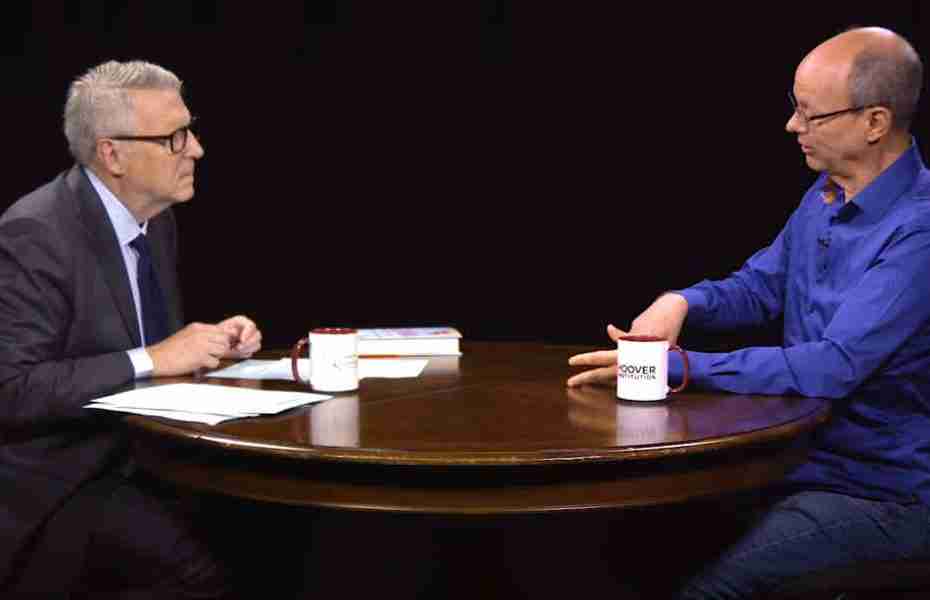
Read the full transcript of Dutch historian Frank Dikötter’s interview on Uncommon Knowledge with Peter Robinson episode titled “Empire of Illusion: Frank Dikötter on Why China Isn’t a Superpower”, (Apr 1, 2025).
The interview starts here:
Introduction
PETER ROBINSON: China, a nation of 1.4 billion people that in the lifetime of anyone over the age of 35 has lifted hundreds of millions out of poverty and built a navy bigger than ours. How did China do it? And how frightened should we be? Frank Dikötter on Uncommon Knowledge now.
Welcome to Uncommon Knowledge. I’m Peter Robinson. A native of the Netherlands, Frank Dikötter holds bachelor’s and master’s degrees from the University of Geneva and his doctorate from the School of Oriental and African Studies at the University of London. For 18 years, a professor at the University of Hong Kong, Dr. Dikötter is now also a fellow at the Hoover Institution here at Stanford.
Dr. Dikötter’s many works on China include his classic trilogy, known as the People’s Trilogy: Mao’s Great Famine, The Tragedy of Liberation and The Cultural Revolution. Dr. Dikötter’s most recent book, China after the Rise of a Superpower. We’ll come to this. But Dr. Dikötter argues that China, as the supposed economic superpower, isn’t all that it appears. Frank, welcome.
FRANK DIKÖTTER: Thank you for having me, Frank.
Democracy and China’s Communist Reality
PETER ROBINSON: Let me set up my first question as follows by giving you a quotation. This is the late Hoover fellow Henry Rowen writing in 2007, quote, “Should China’s economy and the educational attainments of its population continue to grow as they have in recent years, the more than one sixth of the world’s people who live in China will, by 2025, that is this year, will by 2025 be citizens of a country correctly classified and as belonging to the free nations of the earth.” Close quote.
That hasn’t happened. On the other hand, South Korea, economic growth, pressure for political freedoms, democracy, Taiwan, economic growth, pressure for political freedoms. It’s a democracy. Why was Henry Rowen, who was no fool, I don’t know that you knew him, but I did. Henry Rowen was a highly intelligent man. How did he get it wrong?
FRANK DIKÖTTER: If my memory is correct, Henry Rowen, I read the stuff in the archives here at the Hoover, predicted that China would be a democracy by the year 2015.
PETER ROBINSON: This is the later. I’m going a little soft on him, actually, because he revised that. He put it back a decade in a later article.
FRANK DIKÖTTER: Yes, yes.
PETER ROBINSON: But at first he thought it was going so quickly. It would be 2015. You’re quite right.
FRANK DIKÖTTER: Yes. So it does sound a little bit like assessments of the Soviet Union’s economy in the 1960s and 70s overtake the United States. But of course, the date is constantly postponed until the moment where that entity implodes altogether in 91, 92.
Why was he wrong? And so many others. It’s a very good question. I think that ultimately there is at the very heart of this a failure or unwillingness to recognize something reasonably straightforward, namely that Chinese communism is communism. That would be my. That would be the way I would summarize it.
PETER ROBINSON: And that distinguishes it clearly from South Korea and Taiwan.
FRANK DIKÖTTER: Yes.
The Transformation of China
PETER ROBINSON: All right. Well, something happened. You argue again and again, and we will come to this, that you can’t trust a single statistic in China, including the economic statistics. So if I may, the next largest question that I’d like to get at is what has happened? We all feel. I mean, I don’t know. Here’s a pen. The chances are very good it was made in China 30 years ago. I wouldn’t be using a pen made in China. We all feel something has happened.
So could I ask this? You began your studies in China in 1985. You write at Nankai University. I will apologize right now, once and only once for all my mispronunciations of Chinese words in our program here. Nankai University in the city of Tianjin, a coastal city close to not far from Beijing. And you returned to Tianjin, that same city, in 2019, to celebrate Nankai University’s 100th anniversary. The city of Tianjin in 1985 when you arrived, and the city of Tianjin in 2019. What was different about it? What could you see? How was life in the city different?
FRANK DIKÖTTER: Well, it’s like everything. It’s completely different. You wouldn’t recognize it.
PETER ROBINSON: So it has been. A transformation has taken place.
FRANK DIKÖTTER: Oh, absolutely. The question is what kind of transformation? And what is it that you see and what is it that you do not see? Now, if you take the countryside, for instance, you will find out that those beautiful manicured highway with roses all along from Tianjin or from Nanjing or from Shanghai, out of the city at some point become sort of dusty roads and then disappear altogether in the countryside. So there’s really two worlds. There’s people in the countryside where the majority of people live. And they are.
PETER ROBINSON: The majority is still rural.
FRANK DIKÖTTER: The majority is still rural.
PETER ROBINSON: I see.
China’s Two-Tier Society
FRANK DIKÖTTER: If you include, of course, the migrants in the cities who come from the countryside to work from next to nothing with no protection. So the countryside, if one is born from a woman who is classified as being a villager, one’s status is not the same as one who was born a resident of a city. It’s an apartheid system, like South Africa. In other words, a great many people have an inferior status. They don’t have access to the same welfare or other resources allocated by the state. So that’s something important to bear in mind.
So what has happened?
That image, unfortunately, is not the only aspect that you will find in China. But the other key point is that a great many resources have been poured into building up those cities and projecting an image of power, strength and modernity. But who has funded all of it? It’s the savings of ordinary people.
In other words, the vast majority of people in the countryside and of course, those in cities from 1949 till now. There’s one constant, there are many constants. One constant is that the vast majority of GDP of growth goes into the coffers of the state. And ordinary people have the lowest share of GDP in the history of the modern world. In other words, the state is rich and the people are poor. Or to put it slightly differently, the temple is rich amongst the poor.
The State vs. The People
PETER ROBINSON: Alright, how big is the state?
FRANK DIKÖTTER: You’re looking at the temple.
PETER ROBINSON: How many people? How many people would. The state is rich? That means members of the Communist Party. What are we talking about here? The figures I saw when I was getting ready to talk to you. Wikipedia is a very good place to go for conventional wisdom, I think. And the number that I found over and over again was 8 to 900 million people lifted out of poverty since Deng Xiaoping announces his reforms in 78.
FRANK DIKÖTTER: Yes.
PETER ROBINSON: All right, so when you say the state.
FRANK DIKÖTTER: Yes, you read that in Wikipedia, but no, that’s all propaganda.
PETER ROBINSON: All right, that’s what I’m asking, Frank.
The Truth About China’s “Economic Miracle”
FRANK DIKÖTTER: Yes. So who lifted who out of poverty? Chairman Mao dies in 1976. At that point, the average standard of living for the vast majority of Chinese is lower than what it was in 1949. So they’ve been going through first a massive famine. A man made famine from 1958-62, which caused tens of millions, at least 45 million people to be beaten, starved to death. Then we have the Cultural Revolution, excuse me, which is deeply devastating.
PETER ROBINSON: That induced famine is at least an order of magnitude greater than Stalin’s famine. Is that correct?
FRANK DIKÖTTER: Well, it’s a large country, you know, the number of victims just for those four years, 58 to 62, is roughly equivalent to number of victims during the Second World War. It’s roughly comparable 45, 50 million. It’s enormous. The vast majority of victims being in the countryside.
Then you have a Cultural Revolution which pretty much devastates the entire country. So by the time this man dies at 76, people live in dire poverty. This is an extraordinarily backward country. So to somehow have some sort of growth from there onwards is actually not all that difficult.
But the question is, who lifted who out of poverty even before Mao dies? Ordinary people in the countryside by 1972, when first every party member has been taken to task during the Cultural Revolution, and then the army, which was deployed in every farm, every factory, every office from 1968 onwards, that army goes back to the barracks and is spurged. In turn, people in the countryside realize there’s nobody there to supervise them. There’s nobody there to tell them, go and work in the collective fields.
PETER ROBINSON: The boot is off their neck.
The People’s Self-Liberation
FRANK DIKÖTTER: The boot is off their neck. So they start operating underground factories. They open black markets. They trade among themselves. They take back the tools that belong to the collectors. They divide the land among themselves, frequently with the approval of the local party officials who are sick and tired of decades of revolutionary violence and poverty.
So, well before Mr. Deng Xiaoping returns to power in 1979, these collectives in the countryside have already been sapped from within. So what am I trying to say? I’m trying to say that Deng Xiaoping, when he allows the countryside to have a certain measure of economic freedom, he does it in order to maintain what he calls the backbone of agriculture in China, namely, the collectivized economy.
But in fact, he’s merely putting the stamp of approval on something that escapes them altogether, namely the drive of ordinary villagers to claim back the freedoms they had before 1949. By 1982, the People’s Communes collapse. The hundreds of millions of people in the countryside have lifted themselves out of poverty.
PETER ROBINSON: All right, this is an absolutely vital point because it gets to the way we understand China today and this notion that in one way or another, the regime, the government, I don’t know what is a neutral word. You say what you want, but I should be trying to use neutral words. The government, the Communist Party, that it has achieved some degree of legitimacy.
We have to grant it some degree of legitimacy, because when it came to power, China was poor and backward. And now, after, what is it now, seven decades of the CCP in power, at least half of the country is reasonably well off by global standards. And there are some thousands of real entrepreneurs and some thousands of truly rich people. And it has to be granted some legitimacy because it has lifted these hundreds of millions of people from poverty. And Frank Dikötter says, not a chance.
FRANK DIKÖTTER: And I will go further.
PETER ROBINSON: All it did was get out of the way enough to permit Chinese to be Chinese.
FRANK DIKÖTTER: Exactly, exactly.
PETER ROBINSON: Exercise that. Whatever it is that makes people Chinese. Somehow or other, there seems to be a particular cultural genius toward enterprise and organization. Is that correct?
The Party’s True Agenda
FRANK DIKÖTTER: Yes, absolutely. You allow ordinary people to get on with it, they will. But this is not a party that will allow ordinary people to get on with with it. You got to remember that the key of the reforms, the party calls it 40 years of reform and opening up. That’s the official slogan. So it starts in 79, 40 years, all the way till roughly now. It’s a little bit more than 40. So what is it they wish to achieve with reform and opening up? Quote unquote. A little bit like the Russians, perestroika, Vietnam.
PETER ROBINSON: Doi Moi knows quite what it means.
FRANK DIKÖTTER: In fact, every run of the mill dictatorship around the world from the late 70s, early 80s onwards start allowing farmers to have a private plot, foreigners to invest, and private entrepreneurs to participate. This is how these dictators manage to avoid complete and utter economic collapse. So it’s hardly China that is being alone in doing this. But the key point is, what is it they wish to achieve? It’s actually very straightforward.
PETER ROBINSON: When you say they, you mean the party.
The Party’s Principles and Goals
FRANK DIKÖTTER: I mean the party. What does the party wish to achieve? It’s very straightforward. Deng Xiaoping puts the four cardinal principles into the constitution. The Party Constitution, 1982. These four cardinal principles are being repeated time and again by every single leader. The last time I heard about it was, I think in January just before I left Hong Kong. This January, it was repeated by Xi Jinping when he wrote about it in one of the party’s mouthpieces.
So what are these four cardinal principles which nobody ever seems to remember the moment you leave the People’s Republic of China? Very roughly:
- Uphold Marxism, Leninism, Mao Zedong Thought
- Uphold the socialist way of doing things, the socialist economy
- Uphold the dictatorship of the proletariat
- Uphold the Communist Party
All the four principles really boil down to two. One is Marxism. The other one is Leninism. What does it mean? It really means uphold the monopoly over power of the Communist Party and uphold the socialist economy. That’s what it means. It’s Marxism, Leninism. So this regime sets out to reinforce the socialist economy, transform it, not get rid of it.
PETER ROBINSON: So let me ask you, then, this will be a little bit crude, but you’ll see the point I’m trying to get at. Let me just assert it again. It’s crude. There are a couple of ways of looking at a big communist operation, and I’m going to call one the Tito model. Josip Broz Tito. Now, there he is, trying to hold Yugoslavia together and the Balkans for centuries, not decades. Centuries are after each other on grounds of nationalism and religion. The Orthodox Serbs hate the Catholic Croatians, and they both hate the Muslim Bosnians.
And so Tito uses communism precisely because it is useful. It is an instrument he can use to suppress nationalism and religion and hold the country together and prolong his power that way. Is Tito a believing Communist? Answer, who cares? It doesn’t matter. He’s using it to hold together something that might otherwise fall apart, and that, indeed, the moment communism ended, did fall apart.
And then the other model is, well, our colleague and friend Stephen Kotkin, who spent, as far as I can tell, more time examining Soviet archives than anyone else alive. And I once said to Stephen, what’s the central finding after all these decades of studying these documents? Can you reduce it to one sentence? And Stephen immediately answered, “They were Communist. They really believed it.” Even when you’ve got the Politburo talking among themselves, at their ease, with no reason to posture for anyone, they still sound like Communists. They really believed in some kind of worldwide revolution that Russia or the Soviet Union, forgive me, would lead.
So is the CCP… China is a big country. The dialects are different, the regions are different. The history is extremely difficult. Through the late 19th century and into the first half of the… Well, you could argue that it’s still difficult now, but you’ve got warlords and the Cultural Revolution, violence. This is in the living memory of the people who are running the Communist Party today. And is it fair to say? Who knows what they believe? But what they are saying is, we must have order. We will not permit that. The Cultural Revolution, the humiliation of our country by foreign imperialists, we will not permit that to happen again. Or are they true believers?
FRANK DIKÖTTER: Well, they are both. So it goes back to what I said.
PETER ROBINSON: Option three is the worst.
China as an Empire Under Communist Control
FRANK DIKÖTTER: Both. It’s what I said at the beginning. Chinese Communism is Communism. These are true Communists, and you should listen to what they say rather than try to second guess or think, oh, we know better. Or they must say that, no, they are true believers. But what is it they believe in? They believe in the existence of an enemy referred to as either capitalism or the capitalist camp or the imperialist camp surrounded. That’s the impression they’ve had from 1949 onwards, when the red flag goes up over the Forbidden City in Beijing, if not before now.
The key point is you say it is a large country. I would say, well, no, it is not a country. It is an empire. They inherited the boundaries of the Qing Empire. The Qing Empire that collapsed in 1911, very much like the Bolsheviks inherited the boundaries of the Tsarist empire. So the key geopolitical question here is how do the Communists maintain the boundaries of an empire and not decolonize like most empires have done? So that includes Tibet, it includes Xinjiang and the Uyghurs. It includes a whole Muslim bout.
So how do you do that? Well, by imposing unity. And that is what communism does. One language, one time zone. You know, the difference in time zones.
PETER ROBINSON: Only one time zone.
FRANK DIKÖTTER: It’s one time zone, yes. It’s like the United States would have one time zone. In fact, it’s slightly longer than the United States. I think there are about 4,005 hours in that. It’s all one time zone, one language, one party, one time zone. And on and on it goes. There’s a firm belief in order imposed from above.
But here’s the trouble, not just with China, but any and every attempt to impose order from above through a monopoly over power. That’s what Leninism is. It’s a monopoly over power. You basically have a choice in the 20th century. You can either have the separation of powers is what you and I refer to as a democracy, or you can have a monopoly over power. That’s what you and I refer to as a dictatorship.
So the key point really is that when you impose order from above through a monopoly over power, you create disorder on a huge scale, some of which you can see. Some of it will only appear the moment that whole projection of stability vanishes, as it did with the Soviet Union in ’91.
The Truth About Tiananmen Square
PETER ROBINSON: This brings me to the midpoint in this period of reform, and that is the events at Tiananmen Square in the spring of 1989. And again, the conventional view of this is that there was a democratic… Excuse me, democratic may be too strong a word, but there were pressures. Students protesting for greater freedoms, let’s put it in that modest way. Including greater political freedoms.
FRANK DIKÖTTER: Yes.
PETER ROBINSON: And that at first the regime does nothing, perhaps even on some accounts, tries to see if it can find ways of accommodating the students. And then the regime says, no, no, no, we can’t permit this. And the tanks roll in and numbers are disputed to this day. But the conventional wisdom that I see as I Google around looking at all this is a few hundred students perhaps are killed. And you say Frank Dikötter says, oh, no, no, no, that’s not quite the way it went down in 1989.
FRANK DIKÖTTER: It does not. So you are quite right. It is portrayed as a student movement in favor of democracy. Yes. In Beijing, the capital. Now, here are a few things you want to bear in mind. What happens in 1984, this Zhou Ziyang premier allows local banks to make loans to a much greater extent. Now, in a one party state, this means that the person who can go and get a loan locally is your party official knocks on the door, says, I want your money, I want it now.
PETER ROBINSON: That’s the form a loan takes.
FRANK DIKÖTTER: So what you get from ’84 to ’85 is inflation to the extent of about 48, 50% by the summer of 1988. In a country where it’s running at…
PETER ROBINSON: An annual rate of 50%, it has…
FRANK DIKÖTTER: Reached 48 to 50% in the summer of 1988. In a country where people are used to paying the same price for decades, they are outraged. You don’t like your inflation here? Try 50%. Right. People in cities are enraged. What happens with the people in the countryside? They must deliver their goods to the states. But the extent to which the Bank of Agriculture on the countryside has been used by local cadres is such that they are bankrupt. So farmers by the end of 1988 get little IOUs, pieces of paper.
So who turns up in 1989, in May 1989? It is people from all walks of life and people from the countryside who didn’t get paid. There’s people in the cities who are sick and tired of corruption. And they see how power…
PETER ROBINSON: Cities plural, not just Beijing cities, plural, yes.
FRANK DIKÖTTER: It’s how ordinary people see how party officials can turn their power into money, whereas they have to suffer with inflation. Students appeared not just in Beijing, but in cities around the country, all the way to Xinjiang. Urumqi demonstrations in May 1989. So people of all walks of life, not just in Beijing, but in every major capital, including provinces most people haven’t even heard of Gansu Province, Lanzhou, with violent assault on the party headquarters. So what you see is an upheaval which is threatening the very existence of the Communist Party. Within the party, there are voices who are actually in favor of doing something to help this system get rid of corruption.
PETER ROBINSON: Frank, am I still stuck in simplistic thinking, or is this a moment? 1989. Is this the moment when China might have turned towards some form of democracy? This is the moment when Harry Rowen might have been correct. They might have been able to choose in one way or another to move toward reforms of the kind that might ultimately lead to democracy. They have to choose between… What do they have to do? They have to choose between the good of the ordinary, of the common people, restoring some kind of economic order and economic growth on the one hand, or the power of the Party on the other. And they say the power of the party.
FRANK DIKÖTTER: Yes. And there’s a reason for that. I’ll tell you that in a minute. On the 4th of June, 1989…
PETER ROBINSON: Yes.
FRANK DIKÖTTER: The Poles in Poland, as it so happens, vote themselves out of communism.
PETER ROBINSON: Yes, yes, yes.
FRANK DIKÖTTER: And that very same day, 200 tanks and 100,000 soldiers crush the population in Beijing. Now, why is it that they are…
PETER ROBINSON: They sent 100,000 soldiers.
FRANK DIKÖTTER: A hundred thousand soldiers and 200 tanks, plus other vehicles. It’s a civil war, right? No mercy. And the army has been trying for several attempts to get back into the city. They were turned back by the citizens about six weeks prior to that. So about 2,600 to 3,400 people killed in Beijing alone.
But the key point is that the leadership is not prepared to do very much about it. The key stakeholders here, the party members, overwhelmingly remember what happened during the Cultural Revolution. And what happened during the Cultural Revolution? What is the Cultural Revolution? There’s an old man called Mao who’s afraid that after having caused tens of millions of people to die during the Great Leap Forward, he will be shown the door, there’ll be a coup against him, he will be demoted.
So he thinks very carefully that how can I find who opposes me? Well, I’m going to try to… I will allow ordinary people to denounce every party member who has doubts about me. In other words, the Communist Party, the Cultural Revolution is this: Mao uses the people to purge the party, and then he uses the army to purge the people.
So every party member who’s been a victim of the Cultural Revolution remembers this and is afraid of ever allowing ordinary people to have a say. Because during the first stage of the Cultural Revolution, people are up in arms and announce every crime that has been committed by a local party member. Of course, Mao uses the people. He allows them to, you know, criticize or take to task every person. Basically, Mao purges the party. That will not happen again. So these tanks, they send a very strong signal. That signal is very clear, resonates to this very day. Do not query the monopoly of the power of the Communist Party of China.
The Illusion of Reform
PETER ROBINSON: All right, 1989 takes place and then China under Jiang Zemin and Hu Jintao. I’m sure I’m mispronouncing these, but we get again, I’m just giving you what Wikipedia says. Under Jiang’s leadership, China experienced substantial economic growth with the continuation of market reforms. So we get about 20 more years. According to the conventional wisdom of economic growth, Hu Jintao succeeds Jiang and his signal contribution is to take China abroad. We now have so much capital accumulated in China that we, the Chinese begin investing abroad and we get a signal moment in 2001.
This is just at the transition between Jiang Zemin and Hu Jintao when China joins the World Trade Organization with the support of the United States. I’m going to quote George W. Bush, president at the time, quote: “WTO membership will require China to strengthen the rule of law and introduce certain civil reforms such as the publication of rules. In the long run, an open rules-based Chinese economy will be an important underpinning for Chinese democratic reforms.” Close quote. So as late as 2001 you have the President of the United States believing…
FRANK DIKÖTTER: It all and a great many others too.
PETER ROBINSON: Did he get any of that right?
FRANK DIKÖTTER: No, of course not. And he should have known better, first of all.
PETER ROBINSON: So all right, I want to get to that question of the extent to which we have genuine economic reform in China and the extent to which that we in the west deluded ourselves. Meaning should have known better.
China’s Economic Growth: Myths and Realities
FRANK DIKÖTTER: Should have known better. So first of all, the economic growth that we have witnessed in the People’s Republic of China really only dates from the WTO onwards. In other words, 2001, 1999 at the earliest. So before that, the World Bank has a number of statistics which I think are quite clear. If you take China in 1976, when Chairman Mao dies, the GDP per capita of China ranks 123rd on the global scale. In other words, it’s very low. This is 1976, a quarter of a century later, with extraordinary emphasis by the leadership on GDP growth, growth, growth. 25 years later in the year 2000, the World Bank says that China ranks 130th. In other words, it has barely been able to keep up with the rest of the world.
So that’s the delusion we have lived with. You know, the so-called decades of double-digit growth is nonsense. The countryside by the year 2000 is entirely bankrupt. The four state banks are awash in red. The state enterprises as a whole cannot generate a profit. This country is on the verge of utter and complete bankruptcy.
In comes not just Bill Clinton, but others. May ’99, Belgrade. NATO accidentally hits the Chinese embassy. Jiang Zemin is up in arms. You should read the transcript of what he says to the Standing Politburo. I read it in the archives. He says, “The Americans hate us. We must build up our army. We must join the WTO, but not adhere to their rules.” Now, this was not publicly available, but at this point in time, Bill Clinton apologizes several times and the Chinese say, “Show your sincerity by allowing us to join the WTO.” Which Bill Clinton does a few months later.
Why should he have known better? Why should everyone else have known better? Because the People’s Republic of China has a leadership which time and again has made it very clear that they are fighting capitalism and wish to maintain a socialist economy. Because time and again, when it comes to intellectual property rights, promises have been made every two, three years, which are then broken as a long record of making pledges and promises. More transparent governance, greater protection of intellectual property rights, strengthening the rule of law, opening up the country to foreign investment. Very little of that is ever done.
The result of the WTO is that in an economy which suffers… You know, we think of communism as lack of production, under-production. But what we’re talking about in China is overproduction, massive overproduction. Already with the Asian crisis in 1997, when China is seen as a sort of island of stability, about a fifth, if not two-fifths, of the products that they make end up in warehouses. A total of some 68 square kilometers of warehouses in total, where stuff is stored. They produce 30 million televisions. They can only sell 15 million. This goes on for bicycles, refrigerators, sewing machines, clothes, you name it.
PETER ROBINSON: So it’s not just real estate that gets overbuilt. That’s what makes the front pages of the Wall Street Journal.
The WTO Effect and Economic Distortions
FRANK DIKÖTTER: Exactly. So this is before the WTO. So when they join, you can see what happens. All that stuff that has accumulated. Factories are not allowed to go bankrupt in a normal economy. Bankruptcy happens when you cannot sell your stuff. Now, there’s a point where you have to account for it.
PETER ROBINSON: It’s a market discipline.
FRANK DIKÖTTER: Yes, exactly. So what you have is boom and bust.
PETER ROBINSON: So they join the WTO and start.
FRANK DIKÖTTER: Dumping this, and they can just export as much as they want to anyone. Not even Bangladesh is able to compete in the production of clothes by 2004, 2005. So China has been allowed to join the WTO on promises and pledges and has not been required to reform the state enterprises, make its capital account convertible and float its currency rate, unlike all other countries.
So by 2004, reform of the banking system is put on ice. Reform of state enterprises postponed forever. In fact, by 2005, some 96% of the 500 largest enterprises in China are in the hands of party members. Yet still abroad, there are those who go on and on about the private sector in China. Of course it’s there. There was a private sector under Lenin with the New Economic Policy after the First World War. Communists will always allow some leniency to the private sector when they need it, only to clamp down when they believe it is no longer required.
Overproduction. The rest of the world must buy. And then something else happens in Mexico, in the United States, in Japan, in Europe. Since you can no longer compete, you have a very simple choice. You go bankrupt or you set up a factory in the People’s Republic of China.
Xi Jinping’s Rise to Power
PETER ROBINSON: All right, China today. Xi Jinping again. I’ll give you the conventional view. Xi Jinping emerges in 2012. Here’s the conventional view. He represents perhaps the most powerful and consequential Chinese leader since Mao himself. In 2018, Xi has the party change the rules enabling him to serve a third five-year term as president after his second term ended, which it did in 2023. He’s now two years into his third five-year term. He’s dramatically expanded the Chinese military. He’s overseeing the Belt and Road initiative that has projected Chinese influence around the world. He’s put China in a position to make increasingly credible threats against Taiwan. Conventional view.
Here’s what Frank Dikötter writes about Xi in “China After Mao.” This is from your epilogue when you’re writing about the party’s decision to make Xi the new leader: “Xi had several advantages, not least an ability to say or do little of any consequence, thus avoiding closer scrutiny by potential rivals. He rarely took sides, cultivating a neutral persona and a benign smile which revealed nothing. He seemed harmless and was therefore acceptable to different factions within the party.” Close quote. Frank, Xi Jinping is the supreme leader of a country of 1.4 billion people. How can you dismiss him with the back of your hand like that?
FRANK DIKÖTTER: I don’t dismiss him. He’s very important. But you got to remember quite a few dictators who seemed utterly harmless were picked as compromise candidates, including, of course, Nicolae Ceaușescu, who was the youngest member at the time when he took over in the mid-60s. And of course, another man who went by the name of Stalin, when most leaders in the Soviet Union thought, Trotsky is the one who can write. Trotsky is the one who can speak. Trotsky is a true revolutionary. Stalin is a mere scribbler.
PETER ROBINSON: He’s a bureaucrat.
Xi Jinping in Historical Context
FRANK DIKÖTTER: He’s a bureaucrat. And he was very quiet, just like Xi Jinping. And he tried not to offend too many people. He bided his time. He was very clever. He was good at corridor politics. Xi Jinping is very good at corridor politics.
Having said that, he is not substantially different from his predecessors. Take the issue you mentioned. Taiwan. Taiwan Strait Crisis, 1955, under good old Chairman Mao. Again, three of the islands belonging to Taiwan bombed in 1958. Jiang Zemin, 1995 and 1996 sends missiles near the coast and over Taiwan. The third crisis. Deng Xiaoping himself in ’74 says, “We will never renounce violence.” ’79 says again, “We will never renounce violence against Taiwan.” Hu Yaobang, always seen as a reformer, 1985, says, “The moment we have a stronger army, we might very well recuperate Taiwan.” Every single one of them has made it very clear that Taiwan is a threat. So Xi Jinping is no different.
The key difference here is that he can do what his predecessors, in particular Jiang Zemin, would have liked to do but couldn’t. You got to remember that Mao, somewhat paradoxically, and I know this may sound somewhat counterintuitive, but Mao didn’t just purge the Communist Party, he pretty much ruined it, had to be built up again from scratch, and that takes decades. So he ruined the economy. He ruined the clout of the Communist Party that is being rebuilt very gradually over time.
So Xi Jinping profits from the wealth brought about by China’s participation at the WTO. From 2001 onwards, he’s got more assets at his disposal. He can afford to put hundreds of thousands of cameras in every single city. He can afford to build up his army like none of his predecessors was able to do. He can afford to supervise, to surveil his citizens. He can do things that Jiang Zemin could only dream of. But the structure comes from Jiang Zemin.
China as an Adversary: Strong or Weak?
PETER ROBINSON: All right, China is our adversary. Here’s the argument that China is very, very strong. China now has a bigger navy than that of the United States. Shipbuilding capacity in China is some 200% greater than ours. If fighting broke out over Taiwan—this is told to me by a retired four-star admiral—our aircraft carriers would have to remain 1,000 miles away from the action. The Chinese have already pushed the surface perimeter out 1,000 miles.
Under President Trump, it appears to be American policy to end the war in Ukraine and limit fighting in the Middle East precisely so we can concentrate our resources on the threat from China. In the words of Elbridge Colby, President Trump’s nominee as Under Secretary of Defense for policy, quote, “Everything should be going to Asia. To deal with the Chinese threat. We will have to deprioritize everything else.” China is formidable.
Here’s the argument that China is weak. China had 14% economic growth in ’92 and again in 2007. In 2022 and 2023, you’ve got just 3% and 5.2% growth. The Chinese population is aging and shrinking. By 2100, the UN estimates almost half the Chinese population will be over the age of 65, which will make China even older than the population of Japan. And nobody, not even Xi Jinping, knows whether this great big shiny military is any good because it has not been battle tested in three quarters of a century.
Here is Frank Dikötter in “China After Mao”: “China resembles a tanker that looks impressively ship-shape from a distance, while below deck sailors are desperately pumping water and plugging holes to keep the vessel afloat.” Close quote. Are we too frightened of the Chinese or not frightened enough?
FRANK DIKÖTTER: One thing is for sure, they’re damn frightened of you. They’re paranoid.
The Fear Factor in Chinese Politics
PETER ROBINSON: So Frank, this has been a kind of sub-theme of several points that you’ve made and I want to just take it straight on. You’ve talked about how Mao was afraid that this, that or the other might happen. In 1989, the Chinese Communist Party was afraid. It is so striking that in the conventional view, the notion that China is immensely formidable. It looks to us as though these people have total self-confidence, national morale. And you say no, no, no again and again and again. They do what they do because of fear.
FRANK DIKÖTTER: Beyond fear is paranoia. It’s paranoia. The fear is two things. Fear of their own people. They live in fear of their own people.
PETER ROBINSON: How big is the CCP? How many people are running? How many of those people live in fear of everybody else?
FRANK DIKÖTTER: If you’re a party member, you get benefits.
PETER ROBINSON: Right.
FRANK DIKÖTTER: So clearly you’re not too keen on seeing your party being overthrown.
PETER ROBINSON: Right.
FRANK DIKÖTTER: But of course, it’s also true that within the ranks of the party, there may very well be those who secretly…
PETER ROBINSON: But I mean, of the 1.4 billion people in China, how many are party members?
FRANK DIKÖTTER: I would say about 120 or so.
PETER ROBINSON: 120 million?
FRANK DIKÖTTER: Yeah. Okay, maybe 80 to 120. I haven’t counted recently.
PETER ROBINSON: 8 to 10%. So we’ve got a ruling class, to put it in old 19th century European terms. We’ve got a ruling class of 8 to 10%. Is that fair?
FRANK DIKÖTTER: Plus all those who of course depend on that ruling class. All those who profit from it.
PETER ROBINSON: So you’ve got 10% afraid of the 90%.
FRANK DIKÖTTER: Well, I would say 25% afraid of the 75%. But of course there’s a big chunk in the middle who will just go in whatever direction they need to go to somehow survive. But the key point is that they live in fear of their own people. Whether this is justified or not, whether you can come up with a percentage or not, they’re terribly afraid of it.
And it goes back to something that good old Chairman Mao said on 5 January 1930. Very simple saying, “A single spark can set the prairie alight.” He said this to explain how a revolution could just happen like that. A single spark was sparked, but now it’s flipped. Now it’s flipped.
PETER ROBINSON: They’re the status quo.
The Fear of Counter-Revolution
FRANK DIKÖTTER: It could be a counter-revolution, which is why they’re paranoid and why they must crush even the faintest attempt to have a voice. During the Olympics 2008, two elderly ladies, age 70, wish to use the right they have to speak out. That’s a right that’s been granted by the Olympics Committee. They get arrested right away. They’re in their seventies, two old ladies. Why?
Why crush Hong Kong? Because there’s always the fear that something that happens might trigger a counter-revolution. And the other fear is fear of the capitalist camp. From 1949 onwards, if not earlier on, this is a country that sees itself surrounded by the formidable capitalist system. And the conviction is that capitalist camp is out there to get them, to infiltrate them, to subvert power.
1989, the tanks, the army – that has all been organized by the capitalist camp and insiders, the black hands behind this drama. What happened recently in Hong Kong, it’s the Americans who are behind it. They’ve been funding it and provoking it. Whatever happens, everything is organized by these wicked forces.
PETER ROBINSON: So I asked a moment ago, to what extent have we been deluding ourselves? But you’re describing thinking that is delusional.
FRANK DIKÖTTER: Completely delusional.
PETER ROBINSON: Yes. I mean, Japan is a capitalist country in Asia, South Korea, there are capitalist countries. Vietnam is becoming more capitalist. I suppose if I were Chinese, that would make me nervous. The notion that the United States was behind the democracy movement in Hong Kong, somehow or other, it was capitalists who organized the events in Tiananmen Square in 1989, that is delusional.
FRANK DIKÖTTER: Yes. And you know what it’s called.
PETER ROBINSON: So how do we deal with these people if they’re delusional?
FRANK DIKÖTTER: It’s very difficult. Be very patient. I would say peaceful evolution. Have you heard of that concept? Peaceful evolution comes from one of your Secretaries of State, a man called John Foster Dulles.
PETER ROBINSON: So we’re talking something very close to containment, right?
Peaceful Evolution and Communist Fears
FRANK DIKÖTTER: 1957, peaceful evolution – help satellite states of the Soviet Union, help them economically. And by doing that, they will peacefully evolve into a democracy. Now, you remember what we said about Poland. This is exactly what happened on the 5th of June, 1989. The Poles vote themselves out of communism. They become a democracy. That’s the biggest fear.
PETER ROBINSON: And in Beijing, they can hardly…
FRANK DIKÖTTER: In Beijing, they say, horrified, this is peaceful evolution. They’re horrified. That becomes the number one concern. From July 1989 with Jiang Zemin all the way to Xi Jinping today, that’s the major concern.
PETER ROBINSON: When Gorbachev wraps up the Soviet Union and it goes out of existence on December 25, 1991, the Chinese say to themselves, not that.
FRANK DIKÖTTER: Never. Never. All right, never.
PETER ROBINSON: Frank, would you look at a video for a moment of Niall Ferguson, our colleague at the Hoover Institution, Niall Ferguson, during an interview at this table just 10 days ago, as I recall.
FRANK DIKÖTTER: So the key question for us, the big geopolitical question, is does Xi make a move on Taiwan? While the opportunity is almost irresistibly tempting, it will be, I’m absolutely sure, during this administration, during this presidential term. I can’t tell you if it’s 2025, 2026 or 2027. Nobody knows. Only in the end, only he knows.
The Taiwan Question
PETER ROBINSON: Niall Ferguson is absolutely certain that Xi Jinping will make a decisive move on Taiwan during the second and final term of Donald J. Trump.
FRANK DIKÖTTER: Like Niall, I studied the past. I can’t foresee the future. But you did say that the PLA Chinese army doesn’t have any fighting experience in three quarters of a century. That’s not entirely accurate. They did go into Vietnam in 1979.
PETER ROBINSON: Oh, all right. I was thinking of Korea, but yes.
FRANK DIKÖTTER: And that was…
PETER ROBINSON: Vietnam is more recent.
FRANK DIKÖTTER: It was a disaster. It was a disaster.
PETER ROBINSON: The sortie into Vietnam was a disaster.
FRANK DIKÖTTER: Absolutely. And then they went in again in 1989 and that went slightly better. Although admittedly…
PETER ROBINSON: You mean Tiananmen when they attacked their own people. Yes. I see.
FRANK DIKÖTTER: So when it comes to unarmed civilians, it’s fair to say that they did better. But otherwise we don’t know.
PETER ROBINSON: And neither does he. Neither does Xi Jinping.
FRANK DIKÖTTER: Neither does he. Xi Jinping. How would he know? He’s been purging the ranks of the army from the moment he got into power in 2012. A general disappears, another one goes. God knows what’s going on. And who tells you that the army is actually willing to fight?
Something very interesting happened in 1989. Not only Poland, but in other countries. They all watched the massacre in Tiananmen Square on television, right?
PETER ROBINSON: Yes. Yes.
FRANK DIKÖTTER: “After hours of shooting and facing a line of troops, the crowd is still here. They’re shouting stop the killing and down with the government.”
PETER ROBINSON: Always did it myself.
FRANK DIKÖTTER: Indeed, there’s this great fear in Eastern Europe. But the Chinese solution might be used by, for instance, the East Germans in Leipzig. When these Germans went out to protest. But they didn’t. I think even the Russians realized watching that. They realized we don’t have it in ourselves. We just can’t do that. We cannot apply a Chinese solution. Now. Within years, the whole thing unraveled. So my question really is, can they fight? How corrupt are they? And secondly, do they have the will to fight?
PETER ROBINSON: Frank, thank you. Because I haven’t slept since that interview with Niall, you’re giving me some reason to sleep a little bit better tonight. Once again, Niall…
The Stakes of American Policy
FRANK DIKÖTTER: The fate of this administration and of Donald Trump’s reputation hinges on whether his realpolitik, this Nixonian realpolitik that he, J.D. Vance, Marco Rubio are applying, whether it avoids China gaining Taiwan. If China gains Taiwan, I think that is the end of American primacy in the Indo-Pacific. If it’s the end of American primacy in the Indo-Pacific, I think it’s at least the twilight of the reserve currency status of the dollar and the ten-year treasury. That’s the risk they run.
PETER ROBINSON: That’s the game. So the Trump administration’s realpolitik, as Niall laid it out, end the war in Ukraine, tamp down conflicts everywhere else, including the Middle East, and with the war in Ukraine ended, persuade Putin to join us in resisting China. Does that make any sense to you?
FRANK DIKÖTTER: I would say, I would say good luck to you, sir. In particular with the Russians. Good luck to you. It’s not going to happen.
Nonetheless, the key point is that if Taiwan were to go, and you got to remember Thomas Hobbes, power, it’s never enough. And he explains it very clearly. It’s not because there’s greater enjoyment, as he said, to be derived from more power, it’s that more power is required to protect the power one already has. There’s no limit within a one-party state.
So the fear would be that once Taiwan has been acquired, then there might be an attack coming from Guam. So you must take Guam. And then, of course, as the Japanese reasoned quite some time ago, Pearl Harbor is a potential threat. And before you know it, they’ll be out here in California. In other words, there is no situation in which there’s no limit. All right? Until that opponent, the capitalist camp is gone. Is gone.
The Threat to Freedom
PETER ROBINSON: All right, so then let me put this question to you. Again, it’s an outlandish question, but again, it gets at something, I think. What difference would it make if Xi Jinping and the Chinese Communist Party got everything it wanted? How would it change life for us here in the United States?
FRANK DIKÖTTER: Well, your basic freedoms will be curtailed even more because as I said, if the PLC were allowed to extend its power by taking, for instance, Taiwan and possibly even beyond, the clout it will have on your everyday life will be greater. They will not give up. They will always want to know what you are doing. They will always want to. They will always live in fear of who you are and what you might be doing.
PETER ROBINSON: Therefore, the surveillance state, to the greatest extent of their strength and ingenuity, they will extend, okay, much further.
FRANK DIKÖTTER: Much further.
PETER ROBINSON: So at a minimum, it will mean that when we’re working on the computer, the computer will be watching us.
FRANK DIKÖTTER: For instance. Yeah.
Historical Patterns and Containment
PETER ROBINSON: All right. All right, so a couple of questions about grand strategy. Now, I know that you’re Dutch, you studied in Switzerland and London. You’ve lived a substantial part of your life in Hong Kong. You’ve only just moved, you’ve only just joined us here in California months ago. So you don’t, you haven’t spent your entire life looking at the world through the American lens, but I have.
So here’s one possibility. The Soviet Union comes into existence in 1917 and collapses in 1991. That’s a span of about three generations. The founders are zealots, but their grandchildren are cynics. And Mikhail Gorbachev himself says when he becomes General Secretary in 1983, we cannot continue this way. The People’s Republic of China comes into existence in 1949. They’re about a generation behind the Soviets. Can we expect this just as an arc that will be produced by human nature itself, that Mao’s grandchildren, that the princelings or the grand princelings – that the next generation, the rising generation, will have had enough?
FRANK DIKÖTTER: I think they’ve had enough. I think the moment with COVID really. Yes. The moment when they got locked up, not for a few weeks, for months on end, including in big cities like Shanghai, that made people think, gave them enough time. Right. There was nothing else, nothing else to do. Literally locked in. I mean, doors locked, cities closed down months and months on end cost an absolute fortune. Alienated just about every person in that country.
PETER ROBINSON: And yet there’s nothing they can do.
FRANK DIKÖTTER: Well, they could. They had the paper revolution, you remember? They have held blank sheets of paper in protest in Shanghai.
PETER ROBINSON: So does that imply that. Again, it’s crude, but here we are searching for historical analogies. I don’t know what else to do. Containment the policy that we displayed toward the Soviets for four and a half decades during the first Cold War.
FRANK DIKÖTTER: Yes.
PETER ROBINSON: It worked. It might not have been as honorable and noble. It may be that we let the Hungarians go down in 1956 instead of going to their assistance, but containing the Soviet Union did force it, in the end, to confront its own internal contradictions. And when the moment came, it just collapsed.
FRANK DIKÖTTER: Yes.
PETER ROBINSON: So do you advise a similar policy toward China?
FRANK DIKÖTTER: Yes.
PETER ROBINSON: Contain them and wait.
FRANK DIKÖTTER: Yes. They’ve locked themselves in. Right.
PETER ROBINSON: They’re hopeful.
China’s Self-Isolation
FRANK DIKÖTTER: Take, for instance, the Internet. There’s an Internet for the world. There’s an Internet to cut off the world, which is in China. It’s not an open country. The leadership goes on about reform and opening up. It’s not an open country. And open means people, ideas, objects can move in and out.
People can move out in massive quantities. Very few people go in. But it has 0.05% of the entire population is foreign. There are more foreigners…
PETER ROBINSON: 0.05. 1/20th of 1%.
FRANK DIKÖTTER: Sorry. 0.05. Sorry, I apologize.
PETER ROBINSON: 1/20th of 1%.
FRANK DIKÖTTER: Yes. There are more foreigners as a proportion of the overall population in North Korea than there are in the People’s Republic of China. Ideas can go out. It’s called propaganda. Few can go in. But wait.
PETER ROBINSON: But, Frank, the last time I checked, there were almost 400,000 Chinese nationals studying in the United States right now.
FRANK DIKÖTTER: This is what I’m trying to say. People can go out.
PETER ROBINSON: Oh, I see.
FRANK DIKÖTTER: But they can’t go in.
PETER ROBINSON: But those nationals. Won’t most of those nationals go home?
FRANK DIKÖTTER: Well, some of them go home, but foreigners clearly not keen. It’s not an open society. This is a very archaic society. You could walk around for days without ever seeing any foreigner. Try that anywhere else on planet Earth. It’s not going to happen. Ideas are blocked. Can’t go in, they can go out. Money can go in. They can’t go out. Objects can. Commodities can go out, but can’t go in.
PETER ROBINSON: This is the Hotel California.
FRANK DIKÖTTER: You may check in, but you may not check out. Yeah, exactly. Exactly. So I would say contain them even more. Contain them even more. Let them rot.
America’s Challenge: Containing China
PETER ROBINSON: All right, last question, Frank. This is a question about this country. The American diplomat George Kennan, who is in some ways the main author of the containment policy, writes at the beginning of the Cold War against the Soviet Union, the first Cold War quote, “I’m quoting Kennan, the thoughtful observer of Russian American relations, will find no cause for complaint in the Kremlin’s challenge to American society. By providing the American people with this implacable challenge, Providence has made their entire security as a nation dependent on their pulling themselves together and accepting the responsibilities of moral and political leadership that history plainly intended them to bear.”
That was at the beginning of the American struggle against the Soviet Union. And it worked. The American people did pull themselves together enough. It wasn’t an unmarked glorious four and a half decades, but they pulled themselves together enough. Is this country up to containing China? Can the American people do it again?
FRANK DIKÖTTER: There’s been a sea change, right? And a sea change that predates COVID in America. But COVID accelerated that. It was difficult to believe how naive this country was about the PRC and how many people were naive about the PRC up till roughly 2018-19, and particularly COVID, 2020. There’s been a complete change there. My only fear might be change has gone too far. It is an evil empire, no doubt, but it’s not the superpower.
You got to remember there were people who would go to Siberia in the 1960s and come back to the United States and say, “Oh, God, why are we even fighting the Soviet Union? These people have discovered a superior system. Their economy will overtake ours. Let’s not even try.” Well, that’s the PRC now.
All these regimes, as I said in the beginning, are very good at projecting power. But what you find behind it is a very frail empire. Xi Jinping himself lives in fear, not just of the capitalist camp, as he calls it, but of number 2, 3, 4, 5, and everyone around him. You cannot approach him without going through a metal detector. Dictators live in fear and paranoia about everything and everyone around them. He must keep tabs on just about everyone. That’s his daily routine.
You think he’s got time to think about grand strategy and this and that. This is a machine that keeps on turning on if you wish. But inside it’s much weaker than it appears. So don’t underestimate the clout that the United States have and a great many other democracies. And yes, people are fed up inside China.
And yes, the population has probably reached a peak already. A few years ago you said 1.4 billion. I’ve seen that figure many, many times. But there’s at least one economist in this country from the PLC who says these numbers are fake. And it’s probably already less than India. It’s probably more like 1.3 billion.
So Taiwan. Yes, of course it’s a threat. Imagine that during the Soviet Union, the Soviets come, take Cuba, drag this island all the way up, if it were possible. Right, and place it somewhere between, say, New York and Washington.
PETER ROBINSON: That’s what Taiwan is doing.
FRANK DIKÖTTER: Which you could bomb. Yes, which is exactly what Taiwan is. It’s an unsinkable battleship and it belongs to the imperialist camp. Of course they’re afraid. Of course they’re paranoid. Of course they believe that the Americans are hypocrites. They say they are true friends. Had they been true friends, they would have handed over Taiwan on a golden plate, which they never did.
PETER ROBINSON: So, Frank, you’d put your money on the United States?
FRANK DIKÖTTER: Yes.
PETER ROBINSON: Thank you, Frank. Dick Cotter, the man who knows who commands all of Chinese history and whose most recent book is “China After Mao, The Rise of a Superpower.” Although I now think that there’s an implied subtitle, the Rise of a Supposed Superpower.
FRANK DIKÖTTER: There is that question mark.
PETER ROBINSON: Yes, Frank, thank you very much.
FRANK DIKÖTTER: Thank you. Thank you.
PETER ROBINSON: For Uncommon Knowledge, the Hoover Institution and Fox Nation, I’m Peter Robinson.
Related Posts
- Transcript: Why Adaptability Beats Planning in an Unpredictable World? – Mr. Sanjeev Sanyal
- Transcript of Dr. Prathosh AP Lecture: AI Is Making Intelligence Cheap
- Transcript: Stanford’s Chad Jones on The Future of Jobs in an AI World
- Jared Isaacman: A New Era for NASA and American Space Exploration (Transcript)
- Transcript of Bill Gurley: Searching for Feynman at All-In Summit 2026