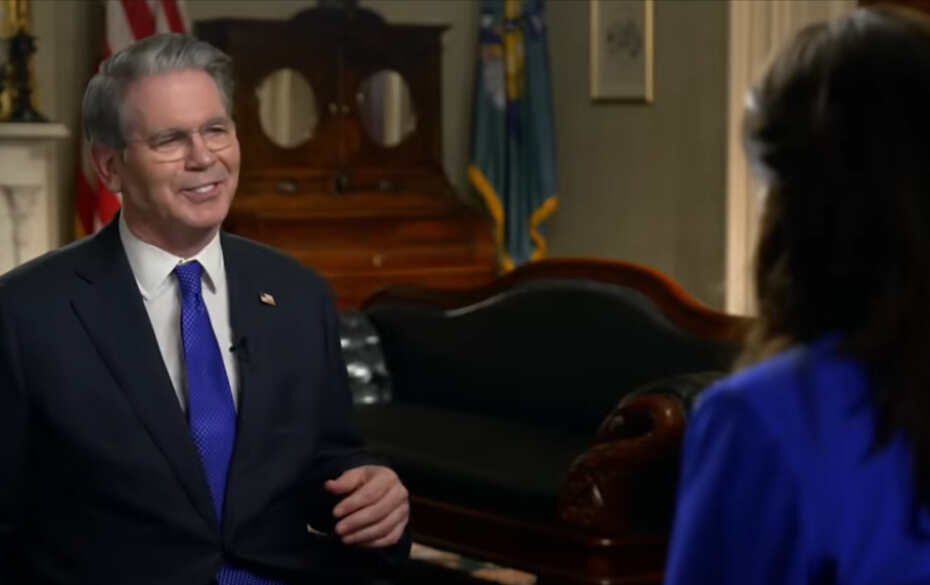
Read the full transcript of Treasury Secretary Scott Bessent’s interview on Pod Force One with Miranda Devine on “Tariff Derangement Syndrome, Elon Musk Feud, and the Royal Family”, premiered June 18, 2025.
MIRANDA DEVINE: Hello, and welcome back to the PodForce One podcast. I’m Miranda Devine. Our weekly podcast features the biggest players in Washington. And today we’re coming to you from the US Treasury, and we’re speaking with one of the most important figures in global finance, Treasury Secretary Scott Bessent. Thank you very much, Secretary Bessent, for being our second guest on PodForce One. I know you’re incredibly busy and you’ve brought us into this absolutely beautiful room in the historic Treasury building. Can you tell us a little about it?
SCOTT BESSENT: Miranda, first of all, congratulations on the podcast. This room is one of three museum offices here in the fantastic Treasury building. Salmon Chase was the Treasury Secretary for Abraham Lincoln during the Civil War. And he financed the United States or the Union army, so he created the term greenback and he led the war effort.
And there have been several times during the course of the United States history when Treasury has been called on to really hold the nation together. Once was during the Civil War, during the Depression, during World War II, to finance the war effort, and then during COVID. So we’re sitting here today, this office, it’s the exact furniture. His portrait is in here. Same everything. So this is a museum quality office. It’s not my office. It’s the General Counsel’s office. But I like coming down and sitting in it sometimes.
The Legacy of Alexander Hamilton and Modern Tariff Policy
MIRANDA DEVINE: It must be incredible for you to come from Wall Street to basically your living history. Your predecessor, the very first Treasury Secretary was of course, Alexander Hamilton.
SCOTT BESSENT: Well, look, Alexander Hamilton set up the financial system for the US Government. Before then, it was this loose alliance and a lot of states issued money, there were banks, there was no central bank. It all happened in Alexander Hamilton’s head. It’s incredible, brilliant.
And one of the things that happened in his head was this idea of tariffs. And he did it for two reasons. One, to finance the Treasury. So the US Government used to be solely financed by tariffs, sole form of revenues. And then two, to protect nascent US Industries from the British, from the French, because he was trying to develop an industrial base.
And as I always say, President Trump has added a third leg to the tariff stool, and that’s negotiation. So he uses tariffs for leverage. So he’s using it to raise revenues, he’s using it for our industry, and he’s also using it for negotiations, which is very powerful. Very powerful.
So two weeks ago today, I was in the Fox Green Room and the President announced that he was thinking of putting a 50% tariff on the European Union. And the European Union is very difficult to negotiate with. There’s 27, 28 members. They have a collective action problem. The Germans care about cars, the French care about agriculture. Not sure what the Spanish care about, but it’s the old Henry Kissinger saying, when I call Europe, who do I call?
MIRANDA DEVINE: Right?
SCOTT BESSENT: And the Ursula van der Leyen was not really coming forward in terms of a tariff negotiation. So once the President threatened to put on a 50% tariff, 4, 5, 6 of the European state leaders called him. And then he was on the phone with her within 48 hours. And the Europeans have started moving forward.
Debunking Tariff Derangement Syndrome
MIRANDA DEVINE: We were told when Donald Trump upended world trade with all these tariffs that we were going to have a recession, that inflation was going to soar. Has that happened?
SCOTT BESSENT: Well, Miranda, I call it TDS. And a lot of people think that’s Trump derangement syndrome. It’s tariff derangement syndrome.
MIRANDA DEVINE: The next stage.
SCOTT BESSENT: The next stage. And I think that a lot of Democrats are in favor of tariffs, but now that President Trump is leading the charge, they can’t be. And so they call them the Trump tariffs. And all these predictions have just been baseless and a flop. And nobody wants to admit it, nobody wants to admit it.
That the CPI, the PPI, were both 0.1% last month and we had which was the cumulative, was the best number since 2020 and the month before that was the best number since 2021. We haven’t had a recession. As a matter of fact, the economy is very strong. Household income growth was 0.7 or 0.8% in April for one month. That’s out of the park.
MIRANDA DEVINE: And you’ve got some other good news, haven’t you, about blue collar wage growth?
SCOTT BESSENT: Blue collar wage growth. The only other time it’s been this high, wait for it, was during President Trump’s first term. So we’ve seen real wages for hourly workers, non supervisory workers rise almost 2% in the first five months.
MIRANDA DEVINE: Why is that?
SCOTT BESSENT: No president has done that before.
MIRANDA DEVINE: And why is that?
SCOTT BESSENT: It’s the President’s emphasis on manufacturing. I think there’s also likely a component of whether it’s 12 or 20 million illegal aliens coming out of the workforce. And Joe Biden opened the border and it was flooded. And that for working Americans, that’s a disaster because it’s pressure on their wages.
MIRANDA DEVINE: And so blue collar wage growth went down during Biden.
SCOTT BESSENT: It did.
MIRANDA DEVINE: And it’s back up again just in a few months.
SCOTT BESSENT: In five months.
MIRANDA DEVINE: Five months.
SCOTT BESSENT: Five months.
MIRANDA DEVINE: Five months.
Working with President Trump
MIRANDA DEVINE: That’s amazing. You’ve just been named the most popular Treasury Secretary in history. What’s the secret and what’s your relationship like with Donald Trump?
SCOTT BESSENT: Well, look, the secret is following President Trump’s lead because he has incredible instincts. I am fortunate that his knowledge of the economy, his instincts. We haven’t had a president like this for over 100 years, maybe ever. You know, someone who comes from the business community who wants to do deals, and he’s reconstituted the Republican Party because when you think about it, you have the richest people in America from Silicon Valley on one side.
And then two weeks ago tonight, I was in Pittsburgh with President Trump at a steel U.S. steel plant. And it was incredible. Incredible. The steel workers and the warmth and his feelings for them, their feelings for him. And those were working class Democrats, and not anymore, but because President Trump cares about them. He’s gotten great trade deals. He realizes that we have strategic industries that were slipping away from us, you know, like steel, semiconductors, pharmaceuticals. We got to bring them back home.
MIRANDA DEVINE: And you used to be a Democrat donor. What made you decide to throw in your lot with Donald Trump? And I mean, did you lose friends?
SCOTT BESSENT: Well, let’s talk proportionality.
MIRANDA DEVINE: Right?
SCOTT BESSENT: So in my life I have probably given 95% to Republicans, 5% to Democrats, and the New York Times and others like to refer to, I gave $100,000 to Al Gore in 2000.
MIRANDA DEVINE: Yeah.
SCOTT BESSENT: Which things might have gone a bit differently in Iraq if that had happened. But again, it’s back to President Trump has reconstituted the best parts of the Republican Party. And it’s for everybody. It’s, you know, it’s not the country club anymore. It’s not big business, but it’s pro business, but with an eye on working Americans. And that’s what we really lost.
When China came into the WTO, there’s something called the China shock. And working Americans were just left on the side of the road. The Democrats took them for granted. Republicans didn’t think that they could get them. And I think back to your question on wages for working Americans. They’re doing fantastic under President Trump.
The China Challenge and Strategic Decoupling
MIRANDA DEVINE: You talked about the China shock. Do you think, back in, I think, 2001, when we allowed China to join the WTO and it had special advantages, do you think that people should have realized that it was going to be so damaging to American workers?
SCOTT BESSENT: I think they should have realized that there should have been better guardrails. So I think I’m trying to think who it was. Oh, is that actually Larry Fink, the head of BlackRock, said that we had capitalism without guardrails.
MIRANDA DEVINE: Right.
SCOTT BESSENT: And I spoke to him the other day and I said, what a great phrase. And I think that the US Economy got more and more financialized. The coastal elites were doing great, and then the middle of the country just got hollowed out. And the Democrats have this strategy called compensate the loser, which is just more benefits, more welfare. We don’t care what’s happened to your community.
And I’m sure you’ve seen the same surveys that I have that say that. Would you be willing to pay a little more if your community was back to the way it was? And this gets mocked by the, what I would call the orthodox hardcore free market right. And by Democrats as being this nostalgic concept. We have 9% of the workforce is in manufacturing. And it’s a fact that we get much stronger wage growth for the workers and manufacturing jobs than the service economy. So sorry. The steel plant, the auto plant, the ball bearing plant has closed. Have a job at McDonald’s instead.
MIRANDA DEVINE: I guess, towards China now with Donald Trump. You just recently flew to London to have some pretty willingness trade negotiations with the Chinese. And I think this was just over the sort of retaliatory measures that China had slapped on America. For instance, magnets and some rare earths they had put a ban on and then we’d slapped some payback to them. And so did you manage to sort that out? And do you think that we’re going to get to a point that Donald Trump has said he wants, where China opens up to America?
SCOTT BESSENT: Well, on whether they’ll open up, we’ll see. So if we go back on April 2, President Trump and the economic team gave out reciprocal tariffs for the world. And I think China’s is maybe at 34% or something. And it was if you want to come negotiate, you negotiate, but do not escalate. And the Chinese were the only ones to escalate. And then it turned into this tit for tat.
MIRANDA DEVINE: Yeah.
SCOTT BESSENT: And then we were at 145% tariffs on them. They were 125% on us and which is effectively an embargo.
MIRANDA DEVINE: Yeah.
SCOTT BESSENT: And you know, I believe that Chinese were feeling more pain. Their system takes pain better. But I believe it was probably very painful for them because we import three times more than we sell to them. So we are the deficit country. In the history of trade wars, the surplus country always takes more pain.
MIRANDA DEVINE: Their economy is not doing very well, is it?
SCOTT BESSENT: At the moment they’re in the middle of a real estate downturn, some might call it crisis. They’ve had low growth. There’s something called the middle income trap for developing economies. And what we will see with China is can they be a reliable partner?
So from COVID we learned, and this may be the only good thing that came out of COVID was that we have to bring back strategic industries to the U.S. you know, again, steel, semiconductors, medicines, some others. And we these rare earth magnets and we rely, have an over reliance on China and other countries, not necessarily our allies for these and we’re bringing that back home.
So I would call that a strategic decoupling. The idea of a generalized decoupling and the two largest economies not trading with each other is not a great thought. So the ball’s in China’s court. We are definitely doing a strategic decoupling for important industries. We would like for them to open up and they buy more US goods and services, allow US market access because it’s crazy. China’s tariffs are only about 5%.
MIRANDA DEVINE: Right.
SCOTT BESSENT: It’s just that the non tariff barriers that are really tough, we gave them full access to our market. We have so many things on the shelves here that are Chinese products. So look, if they are in the mood to help rebalance trade with us, then we can do it together and then if not, it’s going to be choppy.
Future Trade Relations with China
MIRANDA DEVINE: So what’s your prediction then? How do you think it’s going to go now? What’s the next stage?
SCOTT BESSENT: Well, so we had a meeting in Geneva May 11th and 12th to bring down basically the embargo 145%, 125% tariffs. We each brought them down to 15%. So we’re at 30 that were put on this year plus another 20 from President Trump’s first term. There were 50, they’re at 10, that’s fine.
But what the Chinese had also done in April, they put on a series of non tariff trade barriers, what they call countermeasures. And one of them was putting these rare earth magnets which are these crazy little product that’s in everything. It’s in your iPhone, it’s in your car.
MIRANDA DEVINE: It’s how scary that we rely on them for it.
Addressing National Security and Economic Challenges
SCOTT BESSENT: Well, I look, I blame the past administrations for letting this happen. And one thing that we’re determined, the national security team, which I’m on the national economic team that I’m on. We will not leave in 2028 without having solved many of these problems. All of these problems. We are not going to be held hostage or over a barrel. And we’ll go from there. We’ll go from there.
The meeting in London was to establish. We were trying to take off the export controls. So the magnets were not flowing as promised in Geneva. Unclear how much was just a glitch in the Chinese system, which is a slow command and control system. In the meantime, we had put some countermeasures on them. Some of them got publicity. We had embargoed aircraft engines, engine parts.
MIRANDA DEVINE: Grounded a few of their planes.
SCOTT BESSENT: I think grounded a few of their planes. We were reviewing the visa status of Chinese students. We were withholding ethane, which is the base product for plastics. So the ideas we agreed in London, magnets start flowing. We will take down our countermeasures and then we’ll probably have another in person meeting again in three weeks to see if we can do this mutual rebalancing.
And look, it should be natural. President Trump wants the US to manufacture more and become a manufacturing powerhouse for, you know, precision manufacturing again. There’s 30% of global manufacturing now, which is too high.
MIRANDA DEVINE: Yes.
SCOTT BESSENT: And it can’t go higher. It can’t go higher. So the way for them is not to try to export their financial problems is to switch to the consumption model. And if we could do that together, it’d be incredible.
Working with Howard Lutnick and Cabinet Dynamics
MIRANDA DEVINE: And now Howard Lutnick was. The Commerce Secretary, has been, I guess, put into this team with you. And I think it’s part of Donald Trump’s team of rivals philosophy, because there’s been a lot of talk about your. You’re both billionaires from Wall Street, some competition between you.
SCOTT BESSENT: Miranda, you know what I love on the Internet? I’m 6 foot 8 and have 5 billion dollars. Neither one of those is correct. And look, President Trump fills the right people with the right jobs with complementary skill sets. So I actually think that we work quite well together. I think that the.
MIRANDA DEVINE: There are a few troubles at the beginning, butting heads.
SCOTT BESSENT: Look, some people in the Cabinet knew each other quite well. Secretary Lutnick, Howard and I are both from the private sector. We’ve never been in government before.
MIRANDA DEVINE: Right.
SCOTT BESSENT: So everyone’s feeling their way around. But I tell you, the camaraderie in the Cabinet’s incredible. Yeah. When we have the cabinet meetings, we’re getting a lot of business done. And think how transparent President Trump is in these meetings.
MIRANDA DEVINE: It’s incredible.
SCOTT BESSENT: The last one, if it went for two and a half hours. All but ten minutes was televised. Yet President Biden didn’t have a cabinet meeting for 10 months. If the Cabinet wanted to invoke the 25th Amendment to remove him, they couldn’t have because they hadn’t seen him.
The Elon Musk Dynamic and DOGE
MIRANDA DEVINE: Yeah, Elon Musk was a little bit of a thorn in the side, I think, for a few of the Cabinet members, including you. And I asked President Trump about the famous stoush between you and Elon Musk, where there was a shouting match outside and Elon Musk reportedly shoved you. Is that true?
SCOTT BESSENT: We have had disagreements, but we both want to get to the same place. We both want to eliminate the waste, fraud and abuse in government. The Silicon Valley mode of operation is move quickly and break things. I always say here at treasury, we move deliberately and fix things. You know, I think Elon’s probably fancies himself more of a Viking. I think I’m more of a ninja, sort of. The submarine surfaces, fires, goes back under. And look, everybody’s very passionate about doing the best job for President Trump and the American people.
MIRANDA DEVINE: And did you call him a total fraud?
SCOTT BESSENT: Absolutely not.
MIRANDA DEVINE: And I mean, he said that he was going to save trillion dollars. Is that in spending? I mean, how did we get the spending under control, I guess, if DOGE can’t do it?
SCOTT BESSENT: Well, I think what DOGE has done that’s very important is Elon set the pace. And DOGE is a movement, so he set the base. And look, he was vilified by the press, by the Tesla customers, and I think.
MIRANDA DEVINE: And that probably put stress on him.
SCOTT BESSENT: Oh, I. I would have been, yeah. I mean, and the personal safety, domestic terrorist attacks on Tesla vehicles, it was insane.
MIRANDA DEVINE: Yeah.
SCOTT BESSENT: And I think in a way, that the base that he set and some of the people he’s brought into government and the ethos. So I think of DOGE as an ethos. And to the extent that, that Elon has departed physically, I think that ethos is there and the momentum for what he’s done will yield bigger and bigger savings over time.
Tackling the National Debt
MIRANDA DEVINE: He is right about the debt, though, isn’t he? I mean, it is a train wreck ahead. At some point. Is there any way of. The debt ceiling obviously isn’t working. Is there any way of dealing with the debt in our lifetime?
SCOTT BESSENT: What we’re trying to do is there are two ways to fix the debt. One, spend less. And we are getting spending under control, whether it’s the House bill or the Senate bill, we’re probably going to cut 1.5 or 2 trillion dollars of spending. And then through President Trump’s trade policies, tax policies and deregulation policies, we’re going to grow faster.
So what’s really important is the debt to GDP. So it’s that number. So we’re going to grow the GDP and then shrink the growth of the debt, and that completely changes the trajectory. So we were left with a mess. There was 6.5, 6.7% deficit to GDP. So imagine a household that’s overspending by that much every year, and we’re going to bring that down slowly. And I’ve said I’d like to see the deficit get back to something with a three in front of it by the end of the president’s term in 2028. That’s about the long term average. And we don’t have a revenue problem, we have a spending problem. And we are constraining the spending and we’re going to grow the economy. Nobody does that better than President Trump.
International Financial Institutions
MIRANDA DEVINE: And in the budget, there’s a measure to increase the amount of money that we put into the IMF. Is that, I mean, do you think it’s enough? And why are we doing that?
SCOTT BESSENT: We are going to give the multilateral development banks a chance. And I am in contact with the head of the IMF, the head of the World Bank. And what’s happened is the Democrats just let them do what they wanted and let them create these green agendas, climate agendas, DEI agendas, and they just got so far off course. Republicans had never paid much attention to them because they didn’t really like them. And it was what I would call benign neglect. And I have this saying, nature may abhor a vacuum, the Chinese don’t.
So the Chinese have just moved into these institutions and are trying to take them as much of the global south, the BRICS. So I gave a speech during IMF World Bank Week here in Washington, and I said, we’re going back to basics, core principles, and we’ll see. I’m optimistic that we can leverage our, the largest shareholders. I’m optimistic that through capital contributions we can leverage our shareholdings and then leverage our influence. But we’re going to do it properly and we’re going to be in it to win it.
Personal Background and Formative Experiences
MIRANDA DEVINE: Yeah. Now, let’s just talk about your childhood. What makes you tick? You grew up in a small town, I guess, in South Carolina. I was impressed to hear that your father had the largest science fiction collection in South Carolina. I’m a sci fi buff myself. What was he like?
SCOTT BESSENT: Look, he loved to read. I think that I knew I could show you Alpha Centauri on a map before I could show you Chicago. And he’d sit and we’d sit. We’d look at the stars, we’d talk about who was out there, when we were going to be able to go out there. One of my childhood memories is being woken up and to watch Neil Armstrong walk on the moon. And so he was a great dreamer. He was a great dreamer, not always a great executor.
MIRANDA DEVINE: Yes. So he went broke, didn’t he?
SCOTT BESSENT: Twice.
MIRANDA DEVINE: Twice, right. And what impact did that have on you? I think you said watching the family home that’s been in the family for generations get sold off.
SCOTT BESSENT: Well, that or watching. Watching some the family belongings get carried out, things like that. And how old were you first time? Nine, Right? Eight. Nine. So I got my first job when I was nine.
MIRANDA DEVINE: Right. Because of that?
SCOTT BESSENT: Well, yeah, I didn’t want to be a victim and it was okay. You can do one or two things. You could just sit around and wring your hands or you go out, take control of your own life, which I did at age 9.
MIRANDA DEVINE: What did you do?
SCOTT BESSENT: I had two jobs, actually. One, I worked on the beach putting out umbrellas and chairs because, you know, as a lifeguard, you’re supposed to do like the one thing, not get your hair wet. So I did. Did that. And then I also worked on a restaurant, busing tables.
MIRANDA DEVINE: Wow.
SCOTT BESSENT: I can tell you that’s why I support the President’s no tax on tips. I was getting tips when I was nine years old.
MIRANDA DEVINE: You knew what it was like. And your father. So did it break him? I mean, what was the impact on him? I mean, your parents split up, didn’t they?
SCOTT BESSENT: Yeah, well, my mom was married five times.
MIRANDA DEVINE: Right.
SCOTT BESSENT: Wow.
MIRANDA DEVINE: Twice to your father?
SCOTT BESSENT: Twice. My father kind of like Elizabeth Taylor and Richard Burton. So there was a lot of passion there.
MIRANDA DEVINE: He was the love of her life.
SCOTT BESSENT: Allegedly. She. And. But I think that’s why I am so focused on the debt here and having responsible finances, because that’s one of the things that it always did for me, having that experience early on. Because I can tell you our family had been one of the first arrivals in South Carolina. We had been affluent for 250, 300 years. And then just some mistakes he made too much real estate leverage, some neglect, that all of a sudden the lifestyle ended. And I’m going to make sure we don’t do the same thing in the US it’s the 250th anniversary next year. And we are not going to make the same mistakes my family did. The United States is going to be affluent for the next 250 years.
MIRANDA DEVINE: And what did that mean for you, you know, at that tender age that the lifestyle changed? I mean, did you have to go to a different school?
SCOTT BESSENT: Yeah, it’s all those things. It’s. I think my golf game would probably be much better if I’d been golfing instead of working. But again, it also taught me this incredible independence. It’s incredible self sufficiency. And it also. You’re never afraid of anything. Anything’s possible.
MIRANDA DEVINE: Right.
SCOTT BESSENT: The worst has happened, but one of the worst things has happened. So my first job in New York, I think some people might have thought it would have been beneath them, but I took it because it was a great chance to be a stock market analyst. But it was also the fellow who owned the firm said, oh, you can sleep on the sofa at the office.
MIRANDA DEVINE: Oh, really?
SCOTT BESSENT: It was great. It was great. I had a free place to live in Manhattan at age 19.
Career Path and Early Ambitions
MIRANDA DEVINE: Yeah. Let’s talk about your career. You wanted to be a journalist, I think, at one point, but journalist, computer scientist, I couldn’t figure out which one.
MIRANDA DEVINE: Me too, by the way.
SCOTT BESSENT: Really?
MIRANDA DEVINE: Yes.
SCOTT BESSENT: Well, journalism seems to have worked out, Miranda.
MIRANDA DEVINE: Yes. I’m happy I made that decision.
SCOTT BESSENT: But I will tell you, when I arrived, I think one of the things that broke me from computer science was when I arrived at Yale in 1980. Maybe some of you are older, the viewers and listeners can remember what punch cards were.
MIRANDA DEVINE: Yes. Right.
SCOTT BESSENT: And so Yale had just switched from punch cards, the university computing system, to screens and keyboards. And the transition was a disaster. I mean, worse than anything I’ve seen at the IRS here. Wow. It was bad and it just broke me.
MIRANDA DEVINE: Yeah.
Career Transition and Finding His Calling
SCOTT BESSENT: I’m not doing this. And then, you know, again that back in the 80s, newspapers, Time magazine, News, Newsweek, the newspaper at Yale is called the Yale Daily News. And if you became editor in chief of that, you pretty much got to take it to be a reporter in one of those. And I ran for it, lost, kind of pounded for three months, and then picked myself up, did this internship in New York. And it turned out that investing suited me because it was a combination of quantitative and the computer side, and then journalism, investing, a lot of it’s really telling a story.
MIRANDA DEVINE: Right.
SCOTT BESSENT: So you’re putting those two together, researching, creating a narrative. Researching, creating a narrative. Is there a story here? Is there not being willing? I’m sure you’ve done tons of research and just there’s nothing here.
MIRANDA DEVINE: Right, right.
SCOTT BESSENT: Or put it on the shelf, bring it back. And so it was a great. For me, it was a great combination of qualitative and quantitative. My sister always says you’re really lucky because what you love doing. And for up until I took the position here at Treasury, I was doing it 15, 20 hours a day. What you love doing pays well, but you’d probably be doing it if it didn’t.
Creative Outlets and Architecture
MIRANDA DEVINE: Yeah. Do you have, like. I asked President Trump about his. He had musical aptitude, and his mother. Everyone was surprised. Got him to learn the flute. Do you have any sort of, like, creative outlets?
SCOTT BESSENT: I love architecture and all that. So, again, this is why I’m fascinated by this building. It’s not only an honor for me to be in the White House, but it’s very visually inspiring.
MIRANDA DEVINE: Yeah.
SCOTT BESSENT: And this is the first time I’ve ever lived in Washington and just the monumental buildings and the history. And I moved here from Charleston, South Carolina.
MIRANDA DEVINE: You had a beautiful house there that you’d renovated.
SCOTT BESSENT: Yes.
MIRANDA DEVINE: Yep.
SCOTT BESSENT: And so Charleston has the largest historic district in America, and it’s always voted the number one tourist destination. So it’s great that Americans, people all over the world want to come and see it.
Working with George Soros
MIRANDA DEVINE: And so back to your big job was to work for George Soros, who, I guess he’s like the bete noir of the MAGA movement. And what’s he like? And do you still talk to him?
SCOTT BESSENT: No, I haven’t spoken to him since 2016. And George was very smart for most of the time I was there. So I was at Soros Fund Management twice. My real mentor is Stan Druckenmiller, who’s most incredible genius investor in history, but also just the best person. He cares about his family and a few other people. In New York, Ken Langone felt like Jeff Canada started this thing, Harlem Children’s Zone, which takes these kids at a very young age and helps their families move them forward and break the generational poverty problem. So I worked mostly for Stan, but interacted with George. And I’ll tell you what George is really good at is figuring out how systems work, how they accelerate and how they break down. And what we saw with what he did with the district, mainly the district attorneys. He figured out that. And again, I was there until 2000, and George’s political activities were really limited to bringing down the. Helping bring down the Iron Curtain.
MIRANDA DEVINE: Right.
SCOTT BESSENT: And very laudable.
MIRANDA DEVINE: Yes.
SCOTT BESSENT: When I got there, the what is now the notorious Open Society Foundation, I think it was five. It was either three Hungarians, two Russians. Two Russians, three Hungarians. But they were sneaking, you can remember, fax machines behind the Iron Curtain, so doing good work so that the dissidents could get the word out. And then by the time I came back in 2011, George was more politically polarizing, but it hadn’t really accelerated.
MIRANDA DEVINE: Why did that happen? Did he get married to someone woke or something?
SCOTT BESSENT: No, I don’t know what it was. I’ve never been able to figure it out. The country’s been great to him.
MIRANDA DEVINE: And why the district attorneys? Why does he want to do that?
SCOTT BESSENT: Oh, because like I said, what George is very good at is figuring out systems. And he figured out that a lot of money in presidential politics, Senate, House races, but at the district attorneys, if you have a view of a different kind of America, those are easy races. Yeah, cheap, cheap. So he went in and was able to get a lot of progressive candidates over the line, defund the police, decriminalize this, decriminalize that.
MIRANDA DEVINE: That’s been hugely destructive to the country in law and order. So why would he want that chaos again?
SCOTT BESSENT: He has a very different vision than I do, President Trump, but it’s a vision that some people in America have. And I’m not happy he did it, but shame on us, shame on our movement for letting him do it.
MIRANDA DEVINE: Allowing it to happen.
SCOTT BESSENT: For allow it to happen. But I will tell you, one of the things that I was involved was something called Moms for Liberty, because what was even less expensive was taking over the school boards. And it turned out that many of these school boards, the school board members were funded by teachers unions, of course, and. Or the other left wing groups. So to get on a school board, a candidate might spend $1,000 of their own money, but if a teacher’s union shows up and puts in $20,000, then that candidate’s going to win. Of course, who knows who the school board member is. So just with not much money, this group, others have been able to push back against takeover school boards and also to do more with charter schools or school vouchers. School choice.
MIRANDA DEVINE: That’s incredible. So you donated to them? Yeah, yeah.
SCOTT BESSENT: Or I’ve been very active in school choice.
Breaking the Bank of England
MIRANDA DEVINE: Yeah. And now one of the things you did, you were just 30 years old, you pulled off the biggest, I guess, trade in the history of 100 years.
SCOTT BESSENT: At the time.
MIRANDA DEVINE: At the time, yes. Which was you broke the bank of England. Tell us like you came up with that idea. What, what made you think of that? And did you realize what you were really. The enormity of it at the time.
SCOTT BESSENT: Well, it was a group effort. My contribution, so it was Stan Druckenmiller had this idea that there’s something called the exchange rate mechanism. The pound was tied to the German mark, this is before the euro and was trading in a band. Stan had this idea that it might not stay in the band. My contribution was I was running the SFM office in London and I was observing that there was a big property hangover after Margaret Thatcher. And the Chancellor of the Exchequer had been a fellow called Nigel Lawson and there was something called the Lawson housing boom. And he had really done the economy to get Baroness Thatcher reelected through housing. And they really made working class Brits into homeowners. But what I realized was the mortgage structure in the UK, very different than the US in the US we have 5, 10, 30 year mortgages. In the UK, your mortgage at the time, 90% of the mortgages moved up and down with the bank of England’s interest rate. So if the Chancellor raised rates on Wednesday, your mortgage went up on a Friday.
MIRANDA DEVINE: Right.
SCOTT BESSENT: So you, you had no certainty. So what, what happened was as we went in and started selling pounds and buying Deutsche marks, the surefire way to chase away a currency speculator is to make it expensive. So the bank of England, the British government were raising interest rates and they kept raising rates and raising rates. We’ll take a little bit of short term pain, but they will bankrupt all the new homeowners that they have in the country, which they did. They created a property crisis. And so eventually the British government had to say, uncle. They came out of the exchange rate mechanism and you guys made a billion dollars in a day.
MIRANDA DEVINE: In a day.
SCOTT BESSENT: In a day. Wow.
MIRANDA DEVINE: Bit of champagne popped that night.
SCOTT BESSENT: Well, it was a good day. Yeah, good day.
Royal Connections
MIRANDA DEVINE: Incredible. And you also know King Charles and Queen Camilla too, don’t you?
SCOTT BESSENT: I do.
MIRANDA DEVINE: How do you know them?
SCOTT BESSENT: I do. I was introduced to then Prince Charles back in the 90s and then I got to know then just Camilla Parker Bowles.
MIRANDA DEVINE: Yes.
SCOTT BESSENT: And I invited her to come stay with me out in the Hamptons there.
MIRANDA DEVINE: Wow.
SCOTT BESSENT: And it was her first trip to the US, so 1999. And then we stayed in touch ever since. I’m looking forward to seeing them.
MIRANDA DEVINE: And what was she like then?
SCOTT BESSENT: She was very down to earth, very English county lady that I could see why probably the love of then Prince Charles’s life. They seem to be very similar. Have a great time together, a lot in common.
Family Life
MIRANDA DEVINE: So that brings me to John, your husband. You have two children together, Cole and Caroline. Tell me he was a former New York prosecutor. He was very handsome.
SCOTT BESSENT: Well, your words, not mine. Real New Yorker, born at Columbia Presbyterian Hospital, grew up in New York Jesuit schools and an attorney and a prosecutor, which comes out a lot of times during arguments. And he was a prosecutor in the Bronx, in the Bronx County District Attorney’s office up by Yankee Stadium.
MIRANDA DEVINE: So he saw a lot of life.
SCOTT BESSENT: Well, and death.
MIRANDA DEVINE: Yes.
SCOTT BESSENT: So during the worst murder years for New York. So I think 1989 to 1992. 93.
MIRANDA DEVINE: Pre Giuliani.
SCOTT BESSENT: Pre Giuliani. Yeah. I still remember when Giuliani won. Incredible.
MIRANDA DEVINE: Yeah. You could see what a mayor could do, what a politician can do.
SCOTT BESSENT: Well, and then, unfortunately, I was living in New York when Bill de Blasio won. And you got to see what the other side did.
MIRANDA DEVINE: That’s right. And so tell me, how did you and John meet?
SCOTT BESSENT: We were introduced by friends.
MIRANDA DEVINE: Right. And was it love at first sight?
SCOTT BESSENT: I don’t know. I don’t know.
MIRANDA DEVINE: Are you a romantic?
SCOTT BESSENT: Sorry?
MIRANDA DEVINE: Are you a romantic?
SCOTT BESSENT: I am practical.
MIRANDA DEVINE: Right.
SCOTT BESSENT: I’m practical.
Personal Journey and Service
MIRANDA DEVINE: So when did you find out that you were gay? When did you realize?
SCOTT BESSENT: Well, I think you and I have talked about it before. I actually was offered an appointment to the Naval Academy. And given that my dad had decided to have another financial hiccup right before I left for university, timing couldn’t have been worse. But I want to serve my country. I want to serve my country. And the good part of that was also the service academy is here are the government pays for your education, then you go and you spend five years as an officer. So coming back to that, this is a dream for me because I’d want to serve my country since I was 17 or 18.
MIRANDA DEVINE: Right.
SCOTT BESSENT: But back then, so this is 1979, there were no gays in the military. And look, I didn’t want to break the rules. I didn’t want to hide things and thought it was probably a better idea to go to Yale and work three jobs.
MIRANDA DEVINE: That’s quite a lot of integrity, though, to not want to.
SCOTT BESSENT: Well, there’s a lot of integrity, but I am an eminently practical person. And you’d be court martialed.
MIRANDA DEVINE: Right?
SCOTT BESSENT: Like, they used to follow people off the bases. And what are you doing in your private life? What are you.
MIRANDA DEVINE: And what an amazing time now. I mean, you’ve gone full circle. You’re now married, you have two children, and you’re the. I mean, not that Donald Trump ever talks about it and neither do you or make a big deal about it. It’s obviously merit, but still, it is kind of historic that you are the first gay treasury secretary and, well, thanks.
SCOTT BESSENT: To President Trump, the highest ranking US Government official in the history of the United States. But as I always say, it’s coincident, not causal. He wanted the best people. I sleep very well at night knowing that it’s because he thinks that I can advance the economy for the American people, handle the finances and get his agenda rather than some identity politics thing. Some identity politics, yeah.
Breaking Barriers and Representation
MIRANDA DEVINE: But still, I mean, the position that you’re in must be for young gay boys maybe growing up to see you in that position. And that is on merit. You must sort of feel happy that you’ve done that.
SCOTT BESSENT: Yeah, look, but. But I’m happy about it. But I think may go back to my dad’s interest in science fiction. I always thought everything was possible.
MIRANDA DEVINE: Yes.
SCOTT BESSENT: Like I was just unconstrained in my thinking. Unconstrained in the, you know, the possibilities and life. Like, you know, from Little River, South Carolina to the sitting the at Buckingham palace with the royals being back and forth. For those who don’t know, on your show, that treasury building is part of the White House campus.
MIRANDA DEVINE: Yes.
SCOTT BESSENT: So it’s Treasury, White House, Eisenhower Office Building. So, yeah, I’m back and forth in and out of the Oval Office. I have a good imagination. I couldn’t have imagined this.
MIRANDA DEVINE: Yeah, yeah. I mean, you’re very similar in that way to Donald Trump in that just enormous self belief and kind of no barriers on what your ambition is.
The Ukraine Economic Partnership
SCOTT BESSENT: Well, it’s that and also it’s a different way of looking at the world. This Ukraine minerals deal, the. And we’ll call it. It’s really an economic partnership. That was President Trump’s idea. It was. Well, we’ve put in all this money. A large segment of the American population is becoming disillusioned with the US Overseas incursions, we’ve got this big debt. So what is a better way to engage with a country in distress?
So now, you know, despite President Zelensky’s kind of toing and froing, once the agreement was signed, there’s no daylight between the Ukrainian people and the American people. And if they win, we win. If we win, they win. And I always say economic security is national security. That when the Iron Curtain came down, Ukrainian economy and the Polish economy were the same size. Polish economy is now three times bigger. So when this tragic conflict ends, and perhaps with the help of this economic partnership, if the Ukraine economy could grow at that rate, then I think the Russians might be afraid of them at that point.
MIRANDA DEVINE: Right. So that’s their security is economic growth.
SCOTT BESSENT: But it was just a different way. And we were. When President Trump came up with this, when I showed up in Kiev to encourage President Zelensky to sign it, we were just pilloried. Yes. Especially the foreign policy community. How dare you do this, do that.
MIRANDA DEVINE: Is that why Zelensky refused to play ball? Because the foreign policy wonks were all telling him not to?
SCOTT BESSENT: No. I think President Zelensky internally has been dealt a tough hand. And Ukraine, I can’t remember where it ranks, but it’s 102nd, 105th most corrupt country in the world.
MIRANDA DEVINE: We know that from the Burisma.
SCOTT BESSENT: Yes.
MIRANDA DEVINE: Laptop for mill.
SCOTT BESSENT: So I think he had a lot of domestic constituencies who didn’t want this partnership signed, because what it does is make sure the money goes to Ukraine.
MIRANDA DEVINE: People and not to the oligarchs.
SCOTT BESSENT: Not to the oligarchs. It’s not siphoned off to the south of France. It’s not siphoned off to the Geneva bank account.
The Zelensky Meeting
MIRANDA DEVINE: Why was he so obstreperous in that? You were sitting there in that meeting. I mean, it was probably even more stressful in there or tense when you were there in person. Why do you think he did that?
SCOTT BESSENT: I actually didn’t find it that stressful. I was incredulous. I was incredulous because we had the economic deal and we’d had a fantastic week that week. And again, this is one of the real perks for me, that on Monday or Tuesday, we’d had President Macron and the French delegation come in, and we had a great meeting in the Oval with them. We had a great working lunch and press conference day before. We had had Prime Minister Keir Starmer from the UK and again, same thing. Great meeting in the Oval. Some great chemistry between Prime Minister and President Trump. Very robust working lunch. So Tuesday, Thursday, Friday, all President Zelensky had to do was come in, have a press conference. If he was out of sorts, could have done it over the meal instead.
MIRANDA DEVINE: But he’s an actor. He knows how he comes across. He must have done that for a reason.
SCOTT BESSENT: Look, he’s a vaudevillian, right? He’s a vaudevillian. He’s a guy who got thrust into unusual and dangerous circumstances and has played a tough hand. And I think. But I think with President Trump. President Trump wants to end the war, and so he. It needs to negotiate with both sides. And I think to some people, that’s outrageous.
MIRANDA DEVINE: Yeah.
SCOTT BESSENT: Like the other day, someone said, do you think Putin’s a war criminal. I said, so what if he is? You still got to negotiate with him. Yeah, look, we didn’t end. I’m sure today that the Japanese in World War II would be considered war criminals, but we signed a treaty with them to end the war. You can’t. Usually the people who start wars are not good people.
Understanding Trump’s Strategy
MIRANDA DEVINE: President Trump, I think, is probably, to use George W. Bush’s word, the most misunderstimated president we’ve had. I mean, do you see the method in what he does? To me, he’s sort of operating on a number of different levels. It’s not all chaos and craziness.
SCOTT BESSENT: Well, in game theory, which I’ve studied a lot, there’s something called strategic uncertainty. President Trump creates a lot of strategic uncertainty. He creates a lot of optionality. The biggest misunderstanding about him is that is his love for people. Look, I have a lot of progressive friends, or when I say this in the media, he regards himself as the mayor of America, and he cares deeply about the 330 million Americans.
We were taking an action at treasury, and I said, well, you know, sir, this may result in 300 layoffs. Well, fine. It’s up to you to find jobs for those people. I mean, he really. When we were at that rally in Pittsburgh with the steelworkers, I was fortunate enough to be with him the last night of his campaign in Pittsburgh and then on to Grand Rapids, which he didn’t finish till three in the morning. But, yeah, it was incredible. Like, the steel workers are there. They’ve got their hats, they got their vests, they got their families, and they believe in him. But he has a strategy, and it’s not a conventional strategy, but what conventional person ever done great things?
MIRANDA DEVINE: Yes.
SCOTT BESSENT: Does anybody think that Winston Churchill was conventional?
MIRANDA DEVINE: No.
SCOTT BESSENT: He’s also so flexible in terms of the way he looks at things. The way we’ve just spent basically the past 24 hours in the Situation Room over the Iran, Israel conflict. And I can tell you that the American people should know and the American troops should know that Donald Trump is doing an incredible job looking after their interest in what could turn, without someone like him could turn into a widespread conflict that U.S. soldiers and interests could get sucked into.
Legacy and Goals
MIRANDA DEVINE: That’s comforting to know for you. Your legacy. What do you hope to achieve at the end of your four years?
SCOTT BESSENT: That’s a very good question. Because what is difficult here at treasury is there’s so much to do every day. And just if you were to look at the kind of statutory responsibilities of the Treasury Secretary. I’m also overseeing the Social Security trust fund, new sovereign wealth fund, the sovereign wealth fund. So it’s really what I’ve done is taken a step back and I assume that I will walk out of the building in January of 2029. That what are the three to five things that I would have liked to have done?
So stabilize the US Finances and put that on a good trajectory that will make sure that we have another great 250 years bring back and make sure that Main street and Wall street have both done well because Wall Street’s had a great run and now it’s Main Street’s turn to also participate. And Wall Street Journal accused me of populist remarks. What’s wrong with both doing well? And then the third is, I think, to lock in the US Dollar as the reserve currency for many more generations. I got lots of ideas that we’re working on on how to do that. I will plug a book. One thing I learned from my dad is I read constantly and there’s a new book called King Dollar. A journalist who’s followed treasury for about 40 years, and he talks about every time there was a narrative that the US Was going to lose reserve currency status, why it’s never happened.
Crypto and Dollar Supremacy
MIRANDA DEVINE: Because crypto, I mean, that seems to be a threat to the dollar, doesn’t it?
SCOTT BESSENT: I think it’s the opposite.
MIRANDA DEVINE: Oh, really?
SCOTT BESSENT: I think stablecoins could reinforce dollar supremacy because with stablecoins, stablecoins could end up being one of the largest buyers of U.S. treasuries or T bills. So all of a sudden, if you are using a stablecoin in Nigeria that’s backed by the US Tower, you don’t actually have to have dollars. It’s on your phone. You can transact. So I think there’s a very good chance that crypto is actually one of the things that locks in dollar supremacy.
MIRANDA DEVINE: And is that why it was crucial that Donald Trump get involved in crypto rather than trying to constrain it like Joe Biden was?
SCOTT BESSENT: Well, I think constraints too mild a word, I think make it extinct. Oh, so this administration’s commitment to digital assets, it’s innovation because there’s so many other things that happen around digital assets. And also it’s one of those things that it’s one of the most important phenomena that’s happening in the world and the US Just ignored it.
And what we are doing, the very good bill that may get voted on the Senate next week, week after that will give us will bring crypto and digital assets and make The US the leader. So just as we’re the leader in AI, just as we are the leader in biomedicine, we will become the leader in this on the technology side and here been led by treasury, led by some great leadership and the Senate and this is bipartisan, there may be 16 Democrats who are going to vote with Republicans on this, on this bill, which so it tells you how the inclination toward crypto was there. It was just the White House, the previous administration wanted to kill it. So once we get this bill passed the U.S. we can put our best standards and practices out to the world. It won’t be something that happens in a Caribbean island. It won’t be something that is used for nefarious purposes or primarily used for nefarious purposes in the Middle East.
Cleaning Up Previous Administration’s Policies
MIRANDA DEVINE: It sounds like it’s just another of the messes that you’ve had to clean up for from the previous from the Biden administration and your predecessor Janet Yellen.
SCOTT BESSENT: There’s a lot of low hanging fruit. There’s a lot of low hanging fruit. And one of the things with low hanging fruit was bringing everybody back to the office. Work from home wasn’t working. And people like being back at the treasury building. And I tell you, one of the great upside surprises for me has been the professional staff, the career staff here at Treasury. I would have hired most of the people I’ve met in my private business.
MIRANDA DEVINE: Right. Well, that’s comforting.
SCOTT BESSENT: They’re fantastic. I need a 25 page report this weekend. With pleasure.
Success and Parenting Philosophy
MIRANDA DEVINE: So two quick final questions. I asked President Trump as well. They’re sort of a bit off piste, but so he says that the one quality that he looks for in people that he thinks is a recipe for success is energy. Is there something that you see in people that makes you think that they’re going to be something be successful?
SCOTT BESSENT: Yeah. I always say, and I think I’m just a more nuanced version of what he’s just said. I call it love of the game. Michael Jordan would have a great basketball game and most basketball players have in their contract that they can’t play for fun. He had a love of the game clause, so he would actually go out and shoot baskets afterwards.
MIRANDA DEVINE: Really?
SCOTT BESSENT: Or he would play on weekends. So in my investment business I would always try to tell like do you dream about the currency markets? Do you dream about the stock market? Are you always trying to find a new angle to make money? So it’s like love of the game.
MIRANDA DEVINE: All consuming. Yeah. And parenting tips. I mean, Donald Trump is a great father Obviously because he’s got such a good relationship with his adult kids. So do you have parenting tips?
SCOTT BESSENT: Time? Nothing. I remember talking to you once and you were taking your boys to rugby in Paris. I think.
MIRANDA DEVINE: Yes.
Finding What They Love
SCOTT BESSENT: And it’s just. I think there’s nothing that makes up for time. I was fortunate that I had time. Also the ability to tell you. I told my son he had maybe a little wobble one term in academics and I said, my self worth isn’t whether you get into the Ivy League or not. I have a pretty sound ego. I just don’t want you in four years to not have choices. So trying not to live your life for your kids or what you didn’t do. So, yeah, I think it’s time and just let them do what they want.
MIRANDA DEVINE: To do to get their own love of the game.
SCOTT BESSENT: Yeah. Help them find what’s the game they love.
MIRANDA DEVINE: Yes.
SCOTT BESSENT: What’s the game they love. My son just started rowing and it’s changed his life. Really changed his life.
MIRANDA DEVINE: My son’s rowed as well. It’s amazing discipline.
SCOTT BESSENT: Amazing discipline that we were together over the Christmas break and he was in his athletic gear and. And I said, where are you going? He goes, no, I’ve already been to the gym. I was there at 6.
MIRANDA DEVINE: Oh, wow. How old is he?
SCOTT BESSENT: 15.
MIRANDA DEVINE: That’s amazing.
SCOTT BESSENT: That was amazing. I said, will the alien who’s stolen my son please return him? Actually, I kind of like this son. Yes. So that’s wonderful. He found what he liked.
MIRANDA DEVINE: Isn’t that great?
SCOTT BESSENT: Yeah, same with my daughter.
Closing Remarks
MIRANDA DEVINE: Right. Well, thank you so much for your time and I know you’re incredibly busy, but we really appreciate it.
SCOTT BESSENT: Thank you. I got a feeling this is going to be a long running series. I think so. You’re really great at this.
MIRANDA DEVINE: Oh, thank you. I’m Miranda Devine. Make sure to join us next week for another edition of Podforce One.
Related Posts
- Colin and Samir Show: with MrBeast (Transcript)
- All-In Podcast: with Scott Bessent on Fed, Tariffs and 2026 Economic Vision (Transcript)
- WTF is Finance #Ep 2: Ray Dalio on Money, Bubbles, and Playing the Game (Transcript)
- The Diary Of A CEO: MrBeast on Building a Billion‑Dollar Creator Empire (Transcript)
- Does The Wild West Of Crypto Still Exist?