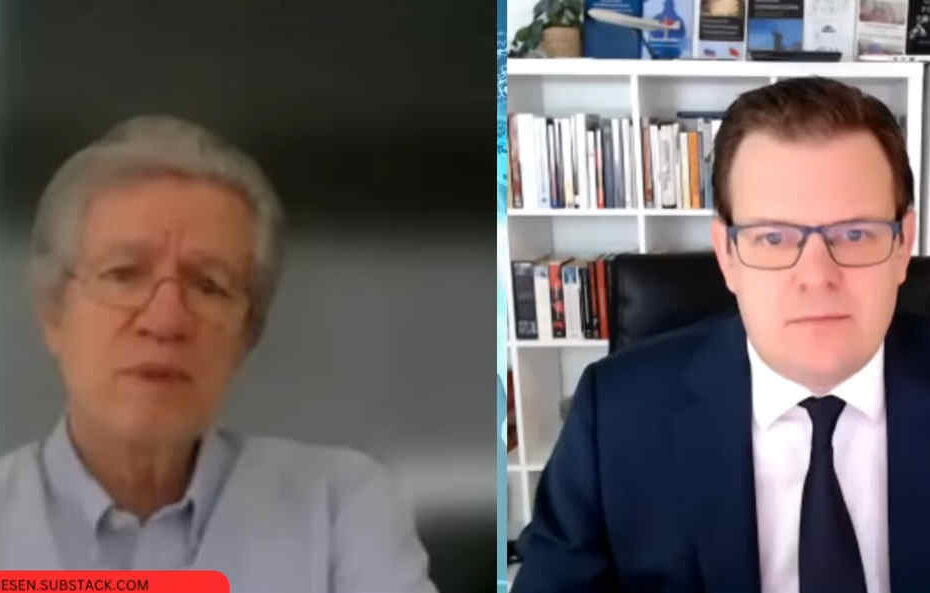
Here is the full transcript of founding Vice President of BRICS’ New Development Bank Paulo Nogueira Batista Jr.’s interview with Prof. Glenn Diesen on “Decline of the IMF & Rise of the BRICS New Development Bank”, November 21, 2025.
GLENN DIESEN: Hi everyone and welcome back to the program. Today we are joined by a very extraordinary guest, Paulo Nogueira Batista, who is a former executive director at IMF. Between 2007 and 2015, he was also founding Vice President of BRICS New Development Bank, responsible for risk strategy. So thank you very much for taking the time.
PAULO NOGUEIRA BATISTA JR.: It’s a pleasure. Glad to be here.
GLENN DIESEN: So you have extremely unique work experience that allows you to, I guess, compare the IMF with the BRICS New Development Bank. And also some of the challenges I think that BRICS has. As we know, it’s great opportunities, but also is facing some challenges in terms of being undermined from the US, for example, but also how to organize the bloc from within.
However, I thought we could start perhaps just with the IMF, given that this is a model which the BRICS New Development Bank to some extent have to use as a starting point to compare. I was just wondering, how do you see the IMF governance structure in terms of favoring some economies over the other? And what kind of reforms do you think were required? Because I guess one can see the BRICS Development Bank as a response to the failure perhaps of not pushing through some of these reforms.
The IMF’s Frozen Governance Structure
PAULO NOGUEIRA BATISTA JR.: That’s right, yeah. My experience in the IMF ultimately led me to believe that fundamental change in Washington institutions, in Washington-based institutions like the IMF World Bank, is not really possible. We did make some progress back in 2008, 2010, when the deep financial crisis on both sides of North Atlantic led the advanced countries to be more amenable to changes. But since then nothing happened.
And for 15 years the IMF has been frozen, as well as the World Bank, in terms of fundamental changes in governance. So it’s like, I would say in a nutshell, it’s like this: The IMF and its major shareholders, Europe and the United States notably, they are determined to keep the institution in the 20th century, whereas we, BRICS and other developing countries, want to move into the 21st century.
Which means having institutions that are more representative, more inclusive, and less politically biased than the IMF and the World Bank are.
GLENN DIESEN: And how do you see in the IMF though, the informal power structures, the voting powers, or the use of political conditionality? To what extent do you see this as a, I guess, enduring problem?
The Weaponization of Western Institutions
PAULO NOGUEIRA BATISTA JR.: It’s an enduring problem. It’s getting worse, in fact, I believe, because not only governance has been frozen, but the West, dealing badly with its… By West, I mean essentially Europe and the United States and led by the United States. The Western bloc has been holding on to its privileges and power in the IMF and using it increasingly as a political weapon.
So see, the West has weaponized everything. It’s weaponized the dollar, weaponized the euro, weaponized the Swift payment system, weaponized the IMF, weaponized the World Bank. This means, of course, that first, the West is willing to do anything, and second, that it’s willing to wreck the credibility and reputation of the institutions that they created and control.
So it’s a very peculiar situation which we’re living now. And that’s why the BRICS have come together, first of all as a group of countries, and second, have decided to create institutions of their own, notably the BRICS Development Bank of which I was a founding member.
But Glenn, this is a very unexpected turn of events. When I first went to Washington in 2007, when the BRICS started getting together around 2008, I never expected the BRICS to go as far as creating their own bank and their own monetary fund. But we did that. Why? Not because the BRICS were hostile to the Washington-based institutions. Because we realized around 2012, more or less 2011, that no fundamental changes would be forthcoming beyond those that we had achieved in 2008, 2010 reform in the fund, you see.
So actually, you are often in Valdai and I’ve been involved in Valdai for the annual meetings. I don’t know if you remember, last year I asked Putin a question. I asked President Putin, “How do you see the BRICS role in de-dollarizing the world economy?” And he responded, “Look, let’s take it easy, let’s take it slowly,” more or less in this sense, because the dollar… “We are not against the dollar,” he said. “The dollar is against us.”
So really, I see the BRICS mostly on a defensive line and the West, unaccustomed to decline, struggling and kicking and screaming all the way down. It’s a very dangerous situation, very dangerous, because superpower decline may be more violent than in normal times.
Institutions Must Reflect the Distribution of Power
GLENN DIESEN: Yeah, well, it’s often said that institutions work best when they reflect the actual distribution of power. So when all this power shifted to the East and, well, in general diversified away from the political West, one would assume that for existing institutions like the IMF to maintain its relevance, it would have to reform, adjust to realities. And failing to do so, one would expect new institutions to emerge.
And I guess there’s a reasonable way of looking at the BRICS. Well, I very much agree with you. I get the impression from listening to different diplomats and economists that the goal isn’t to sink America into the ocean. Rather, it’s simply to diversify, to make other countries less reliant on unreliable and weaponized dollar.
But do you see it the same way?
PAULO NOGUEIRA BATISTA JR.: I think it’s a relative decline of the political West, more generally. You see, for them, all these institutions, they’re relevant. We say they’re increasingly irrelevant, often because, for the reasons you mentioned, because we feel they’re not representative, they’re not inclusive.
But for the West, the dollar system, the Swift system, the IMF, the World Bank, all these are in fact weapons in the struggle against the rising new powers, especially China. So I believe that really what happens is that the West… I think this, again, that’s the major factor in international economics and politics right now: the United States’ willingness to use all instruments in a harsh and violent way to preserve the power it has now.
The power it has, it’s no longer as great as it was even 10, 15 years ago, but it’s still capable of doing a lot of damage, as we see right now in 2025.
The Dollar as a Weapon
GLENN DIESEN: Well, political economists often make the point that the economic hegemon which is dominant and confident will want to build trust around its economic infrastructure, the institutions, the currency, the technologies, supply chains. But a hegemon in decline will weaponize all of these economic instruments of power to prevent the rise of rivals, which then ultimately intensifies the rejection.
But you did mention the dollar, though. Why do you think it’s become so dysfunctional?
PAULO NOGUEIRA BATISTA JR.: Basically because, again, it’s a weapon now more than anything. In old times, the dollar was accepted and trusted and there was confidence in the dollar. Now this no longer holds. Why? Because the dollar has one major political enemy. That enemy is United States of America itself. You know, it has undermined trust in the dollar.
So now we have a very peculiar situation which we would not have expected. Say three… The US is trying to coerce other countries into using the dollar. That’s a complete change from what we had since World War II, when the dollar was naturally accepted. You know, I don’t want to idealize the previous situation. I mean, the US was always a hegemon that was willing to use power, interfere in countries, topple governments, et cetera, et cetera.
But now, as you said, in times of decline, it’s much more inclined to be violent, to be oppressive than it was before. And this is showing very much. And you said it quite well, I mean, countries of the global South, even allies of the United States, are increasingly realizing that they cannot trust the United States anymore. Trust is lost.
And even if, let’s say, Trump is replaced in the future by a more amenable president, trust will not be regained easily. It’s easy to lose trust and very difficult to recover trust once it is lost, as we know, in personal relations and political relations and international relations.
So I’m a pessimist about any attempts, any chances of getting back to a relatively calm, peaceful situation in terms of geopolitical relations with the political West.
The Seizure of Russian Reserves: A Turning Point
GLENN DIESEN: So you have your finger on the pulse of many economies around the world and the governments. How much sense do you get that the discussions now to seize the sovereign funds of Russia has, I guess, struck some fear into countries, not just China, but India? How widespread is this concern about the new, I guess, lack of reliability?
PAULO NOGUEIRA BATISTA JR.: I think that it’s pretty widespread. It was always somewhat there because the US has been using weaponization of the dollar. And in Europe, too, remember, as well as gold reserves were confiscated in London. So the West has always been somewhat prone.
But I think the major change, the major decision that marked the reversal of confidence was the decision to block, to freeze Russia’s reserves in 2022 after the invasion of Ukraine, not only in dollars, but also in euros. So distrust has also spilled over into the euro, since the euro has become a satellite currency of the West for geopolitical purposes.
So I think now the issue is that the West is no longer trustworthy. But the economic decline, which I think is what you’re driving at, the economic decline in relative terms, is more pronounced in Europe than in the US, and the rise is more pronounced in China than it is in Latin America.
So when you look at global concepts like global South, global West, that’s not enough. You need to go into the breakdown of these groups and see who’s getting stronger, who’s getting weaker, who’s stagnating.
And I think the major thing, in my opinion, is the decline, not only in economic terms. Glenn, let me tell you, I’m a Eurocentric person in political and cultural formation. I lived in Europe. I admire Europe. I’ve never seen in my entire life such a weak crop of political leaders as the ones we have now, with almost no exception.
And the same for the United States. United States elected George W. Bush not only once, but twice, elected Trump not only once but twice. The Democratic leaders like Biden, very weak as well and very prone to geopolitical bullying.
So I mean, it’s really amazing, really amazing to see a continent like Europe, a country like the United States in such an embarrassing decline. I mean, things that happen, you would never believe them.
The Problem of Weak Political Leadership
GLENN DIESEN: Well, I often make that point as well, that one of the key problems of our times is these politically weak leaders, too ideological, incompetent, as we see in Europe, even incapable of doing very basic diplomacy. Such as the recent Dutch adventure by first seizing ASML, a Chinese tech company, and then being flabbergasted by the consequences, and then now they have to hand it back.
I mean, it’s just… it is very strange that this isn’t thought through properly because they’re not even back where they started. Now not just the Chinese, but the rest of the world will be very careful before they put anything of value, investments, in Europe. It’s just extraordinary self-harm is where I’m getting at.
But in terms of the dollar though, you mentioned before that Putin made this comment that Russia didn’t quit the dollar, it was the dollar that quit Russia or put sanctions on Russia. But what is the process of de-dollarization? Because many people think it can almost be done overnight. But is it the capability to diversify or is it just the lack of intention? That is, you see the Chinese, for example, have some incentive to continue to use the dollar as well.
The Dollar Under Threat and the Path to De-Dollarization
PAULO NOGUEIRA BATISTA JR.: That’s a crucial question, the one you’re raising now, because ultimately what we have is the Western willingness to violate property rights in a major way. In this case, to mention of the Dutch, also in the case of the freezing of Russian reserves, and now all the talk about actually confiscating them. So the dollar is under threat because of all this.
De-dollarization has become a major issue. I’ve been writing on this since 2023 on a more or less systematic basis, and I’ve been making the point that de-dollarization ultimately means—that’s a controversial one, by the way, this point I’m making now—de-dollarization ultimately means driving for a new reserve currency.
For a number of reasons, I don’t believe the dollar will continue to be important. So will the euro, but they’re no longer as important as they were. They tend to decline. International money is sort of a mirror of geopolitical circumstances. So the United States and Europe are declining, so will their currencies in terms of relative weight.
Who’s going to pick up the slack that the dollar is leaving? Not the euro, not the other Western currencies. Will it be gold? Yes, that’s happening. The collapse in confidence has left major central banks no choice but to go to gold.
Can it be the renminbi? I just spent a few weeks in China, discussed this with a lot of Chinese experts, and I came out with the impression—reinforced—that the Chinese are hesitating in putting up their currency as a replacement to the dollar for many reasons that we can discuss if you want.
And so if that’s true, the only alternative would be to build a new reserve currency, not a global currency, because you cannot have a global currency with this geopolitical split that we have in the world now. So it would need to be a new currency sponsored by a group of countries, probably only of the global south. And that would be something truly new in terms of international money.
GLENN DIESEN: Well, what are the reasons for China not to want to carry, to hold the new reserve currency?
China’s Hesitation on Currency Internationalization
PAULO NOGUEIRA BATISTA JR.: Well, China is torn between the pros and cons of having its currency play an international role in a greater way. The pros are well known. You have seigniorage, increasing lower borrowing costs. You have protection against weaponization. You even have, ultimately, the opportunity to weaponize. China would have that.
But the cons, I think, are very heavy for China, you see, because to become a global currency, the Chinese would have to accept some changes in their economic model that would be doubtful, to say the least. They would have to have full convertibility of their currency onshore, I believe, onshore. And they would have to accept appreciation of the currency.
Why? Because who would demand renminbi as an international currency if you cannot fully convert it into other currencies as you wish? Number one. So this leads to instability. Major flows of capital in and outside the Chinese economy could disrupt the stability, so hard-won stability of the Chinese economy.
And the appreciation—because if you have a currency that is in widespread demand outside your country, your currency will need to appreciate in principle. Look at this from the point of view of the central bank of China. Renminbi is demanded outside China for use. Demand increases, currency appreciates. How can you counter that?
You can, of course, allow it. You can also buy foreign currency and sell renminbi to try to maintain its value. But then look what happens. The Chinese central bank receives what? Dollars and euros that it doesn’t want to accumulate for safety reasons.
And so China would be—in the last resort—would be to impose capital inflows controls, which would distance their currency from any major international role, would actually reverse the internationalization which they have achieved already to some degree.
So I may be wrong about this because it’s a highly controversial issue. I sense that it is controversial in China too. But I believe that Chinese will probably test the temperature of the waters. They’re doing that already, allowing careful use of their renminbi outside China.
But, you know, Brazil—we say in football, in soccer—we say you don’t change a winning team. So why would the Chinese change their economic model? It has been so successful in the last decades. Any change would be very cautious.
For example, appreciation. Do the Chinese really want to follow Western advice, which is long-standing, as you know, to allow their currency to appreciate? But if they do that—I mean, no country in the global south has prospered following Western advice. I tell you, from a Latin American perspective, we followed the Washington Consensus to a large extent. We’re not successful.
We liberalized the capital account, we allowed our currencies to appreciate, we de-industrialized, exactly like the United States and like Europe. So I think the Chinese are very experienced people. They follow, without having ever heard of it, the maxim of Bismarck, Otto von Bismarck, who used to say, “I don’t learn from experience, I only learn from other people’s experience.”
So you look at the experience of the United States, the experience of Latin America. What happened to the United States being a global monetary hegemon? They know all that. It’s not by chance that they’re so successful as a country. They’ve been very systematic in learning, studying other people’s mistakes and good decisions.
The BRICS Path to an Alternative Currency
GLENN DIESEN: I like the Bismarck quote, by the way. How about the BRICS, though? Is it in a position to facilitate an alternative? Because many people were speaking about the prospect of a BRICS currency. But from another perspective, it does seem less likely, and it seems it would meet a lot of internal resistance as well.
Especially whenever I talk to Indian diplomats or ambassadors, they always make the point that, “Oh no, we would never accept a common currency,” I guess. Can you speak to this? Do you think there is any pathway, or why would there be resistance to it?
PAULO NOGUEIRA BATISTA JR.: Well, you know, right now I’m finalizing a paper that’s called exactly “A Pathway to a New Reserve Currency.” And there I recognize the point you just made, which is crucial. There’s no full-scale, full cohesion inside the BRICS on this matter.
India is, of course, one resistance, one resisting factor. The other one, less commented upon, is the stance taken by our central banks that are very conservative and do not like to think or envisage this sort of change, use of a creation of a new reserve currency. Even modest, even more modest steps are resisted by Indian and our central banks. So it’s not an easy proposition.
How do I respond to this in this paper that I’m finalizing? First, we should recognize that any new currency or any new initiative, practical, taken in the financial field, should be not BRICS but BRICS-centric. Let’s put it this way. Most of the BRICS would be in, but not necessarily all.
India might want to stay out and join later, perhaps. So we should not be paralyzed by the need to mobilize every single member. Just look at the BRICS now—ten countries. India may be reluctant, but also Emirates, United Arab Emirates may be reluctant for political reasons. Ethiopia and Egypt may be reluctant given their relations with the IMF. They’re dependent on the IMF right now.
So they might be very cautious in adopting any and joining any initiative that might touch on the raw nerves of the West. So definitely, if you look at the world, the global south, any initiative of that sort would have to be BRICS-centric. But it could also come from countries outside, countries outside the BRICS, partner countries or even others might want to join.
So you would have not a BRICS group, but a BRICS-centric group, and of course, China-centric. That’s another point. One of the difficulties we have in envisaging new multilateral situations, initiatives, is the overwhelming relative size of China in any group, in any conceivable group of countries that you might put together for this sort of initiative. So there are many challenges, I would say.
Now the prevailing view, Glenn, which you may have heard already, the prevailing view is, “Oh, okay, we’re de-dollarizing our international transactions. That’s whether that works well enough.” That’s what the Indians are publicly saying. But there’s a major flaw, economic flaw in this argument that India uses, that, you know, international transactions in your own currencies only take you so far because they do not allow, this system does not allow the persistence of trade surpluses and deficits between the countries, you see.
So you need—you always need money, trustworthy money. The dollar is no longer that. The euro is no longer that. Renminbi hesitates to play that role. Gold doesn’t work very well. So you need some international money to de-dollarize more fully.
It’s not by chance, Glenn, that Donald Trump has been very consistent and very cautious, exceptionally cautious in the way he frames the matter. He says, “We will not allow the role of the dollar as an international reserve currency to be threatened.” So he’s been well-advised by his people. Take a look at this. The BRICS are trying to put a different act together—warn them, threaten them. And that’s what he’s been doing. He’s very good at threatening, or was very good at threatening. Now he’s losing his credibility a bit.
This issue you’ve raised is a very complicated international economic political economy issue. But it will stay with us because I don’t believe the dollar and the euro can recover their credibility. So we will need to look for alternatives.
A Basket of Currencies as an Alternative
GLENN DIESEN: Yeah, well, the first rule to economics seems to always be predictability, which makes sense that the different countries want slow, gradual changes based on testing, and as opposed to doing anything revolutionary that disrupts markets.
But without a common currency, though, is it possible—is a more likely pathway to have a basket of currencies? Because after the Second World War, you know, there was some ideals pushed, especially by the British, who instead of just having the US dollar as a reserve currency, who favored more this, you know, special drawing rights based on a basket of currencies. Again, the IMF did move, well, significantly forward this. But is there any similar thinking in BRICS, or are they going down a different path?
PAULO NOGUEIRA BATISTA JR.: It’s important to understand, Glenn, that the BRICS are not a revolutionary force. They had never been. I can tell you from my experience inside the BRICS process, the BRICS are very cautious, always very careful. Even Russia—Russia is effectively at war with NATO, with NATO—even Russia is very cautious. So it’s a reformist force, and we’re looking at things we can.
Nobody’s—by the way, let me make one thing clear. Nobody on the side of the BRICS is thinking of a common reserve currency like the euro. We’re thinking of a parallel international currency, limited to international transactions of the countries. And this could take the form, exactly like you said, it could take the form of a basket of currencies, an SDR-like basket of currency, not a euro-like currency. That’s the major distinction that must be made.
The SDR was a good idea. It was created, by the way, in my native town, Rio de Janeiro, in 1969, in an international meeting of the IMF. But it has not become an international currency. Why? Because the US never accepted that. The US never accepts to encourage things that rival the dollar. You can see it all along. Who was very hostile to the euro? Remember, the US was systematically hostile to the euro.
All American economists who spoke out about the chances of the euro working were negative, excessively negative, as it turned out. But they control the IMF, so they won’t allow—they have veto power of decisions governing the SDR, the special drawing rights, and they exercised that veto power.
I remember when I was eight years in Washington, in the IMF, I tried—we tried, several of us tried several times to improve the role of, to increase the role of the SDR. The US never allowed, didn’t even come to voting on the board because the US director was always signaling that it would veto. So what’s the purpose of bringing it to discussion? The board of the US is firmly opposed to it, so it’s difficult.
You know, my Indian colleagues, I always say to them, “Look, what is the alternative to a reserve currency that we might build? It’s China. It’s the Chinese currency. Do you want that?” They don’t have a response to that because they’re hostile to China, but they’re afraid at the same time of provoking US displeasure with them.
This may change, Glenn. Trump is always helping us a bit, and he stabbed India in the back with high tariffs. So the special relationship that India thought it had with the United States may not really exist. And perhaps they realize that now.
The Risk of Dollar Implosion
GLENN DIESEN: Well, if de-dollarization is to a large extent driven by, I guess, hedging against the growing risks of the US, you know, taking on unsustainable debt and weaponizing its currency, it could be forced upon the BRICS countries, though, to take stronger actions.
I mean, if the dollar is less reliable, then sticking to the status quo is not going to deliver that much predictability. And we see, for example, with Trump that he warns whoever tries to de-dollarize will be sanctioned. But there’s a bit of a contradiction in there, built in, because it’s the constant threat of sanctions and economic coercion which is incentivizing countries to de-dollarize.
So it’s a bit like threatening to bomb Iran if they develop nuclear weapons. I mean, you’re only going to encourage it. And do you see the dollar possibly going into a death spiral or heading towards implosion in which BRICS is going to have to, yeah, take a more daring revolutionary step?
The Risk of a New Financial Crisis and the Dollar’s Safe Haven Status
PAULO NOGUEIRA BATISTA JR.: I agree with the way you put the matter before your question, which is a crucial question. I have been making the point, including in this paper that I’m finalizing. I’m trying to argue the following: that the U.S. is in a relative slow decline. So is Europe. Europe a little more rapid.
But we may reach a sort of tipping point which would be a new international financial crisis in the United States coming from the United States and from Europe, something similar to what happened in 2008, 2009. Now, at that time, don’t forget this, at the time of the Lehman crisis, U.S. was still seen, the dollar was still seen as a safe haven. So we had the paradoxical effect of a crisis originated in the financial system of the United States, provoking a flight to quality, quality being the dollar.
Now, I believe I may be wrong, but I believe that the U.S. Dollar will no longer play this safe haven role if a crisis erupts. See, the bubble in stock markets and assets in the United States bursts. This has happened many times since the 1980s in the Western financial system. Say it first, what will happen? You will have a decline in the U.S. Dollar with people fleeing the United States in the direction of gold, in the direction of the renminbi.
And then China will have to ask itself a question: What do I do with these massive portfolio inflows coming from people fleeing the dollar to my currency? If you allow them in, you will have appreciation of the currency and potential volatility of capitalism may fly out in the near future. Exactly what we saw in Latin America. I don’t think the Chinese will accept that.
So the point I’ve been making in debates about this is, look, people, we may be risking a crash, a major crash. Let’s put the ideas on the table now. Radhika Desai, our colleague in Canada, the Indian scholar, in a debate promoted recently, she said that quite clearly: look, there may be a crash in the United States and we will all over the world be scrambling for alternatives. So why not discuss the alternatives now?
Because people will be surprised to see what damage can arise from a major crash in the United States or Europe in the present circumstances, where the U.S. and Europe are still, are already very weak. Very weak is an exaggeration, but in relative decline. So I think we need to brace ourselves for difficult times.
And I know that the BRICS are somewhat timid, contrary to what popular perception suggests and Donald Trump’s aggressive rhetoric. I think Trump overestimates the BRICS in the sense that he believes the BRICS are in a conspiracy to dethrone the dollar. In fact, we are very cautious, too cautious in my opinion. And we need to take courage and realize that if you look at the world, there’s no other place to run to except the large emerging market countries that are mostly BRICS countries.
The Need for Economic Contingency Planning
GLENN DIESEN: Yeah, well, whenever one speaks to generals and different military leaders, they always make the same point that they have different war plans for almost every scenario. In case there’s a war tomorrow, you don’t want to be caught off guard. It would make sense if the economists as well had some plans. I mean, if you do see the U.S. dollar exhausting itself, it could reach a real tipping point, as you phrased it, that there would be some plans. One doesn’t have to commit oneself to those, but at least having possible road maps where to go.
But what makes sense of Trump’s threats though, to destroy BRICS? You said he called BRICS a conspiracy. I think that was actually the word he used as well. There was a conspiracy against the U.S. But he’s also made some comments that he wanted to destroy BRICS. He also made some very strange comments that countries were leaving BRICS in big numbers because it was because of his great threats. I haven’t, he didn’t give any examples.
On the other hand, he once suggested that Spain was a part of BRICS. So maybe he thinks that Spain quit BRICS. I’m not quite sure. But the desire to break up the BRICS and cause internal divisions, this seems to be quite real and they would have a lot of political force behind it in Washington. Do you see this being actually played out? And what is it that the U.S. can actually do to drive these countries apart?
Trump’s Self-Defeating Strategy
PAULO NOGUEIRA BATISTA JR.: Well, you know, the U.S. under Trump is driving the countries together because the U.S. is hitting at its traditional allies, hitting at Europe, hitting at Canada, hitting at India. And India used to be the country more linked to or is perhaps still more linked to the United States.
So I think there’s a disconnect between Trump’s rhetoric and Trump’s stated goals and the actual actions he takes which are not in line with these goals. You see, if the U.S. were more realistic about its own power nowadays, it would try to join forces with its traditional allies against the supposed threat of the BRICS and notably China and Russia. But he does the contrary. He undermines relations with the West, Europe, Canada. You can see maybe Canada now looks more amenable. Europe is trying to please Trump.
But we know, you know better than I, that the Europeans deeply resent what Trump has done since he came into office. Again, the same goes for Canada, same goes for Mexico, another country that is close to the United States. So I think Trump is shooting himself in the foot all the time.
So I think that there’s a, coming back to the issue that we’ve mentioned before, the incompetence of leadership in the West makes it very difficult for the West to resist. Theoretically again we could have a scenario where the United States gets its act together, Europe too, and there’s a reversal in the decline that happened already in history, in recent history.
Remember in the 1970s the U.S. was in decline and then in the 1980s under Volcker and Reagan they recovered their relative position. But two things. First, the U.S. is no longer what it used to be and second, China was not a rival then. China has become the major rival and Russia has become much stronger. So they cannot play the same trick again.
I don’t think in short that Donald Trump is the second coming of Ronald Reagan. So the decline will be there and it may become even precipitous if a crash, financial crash occurs in the United States.
China’s Role and the Balance of Power Within BRICS
GLENN DIESEN: Now in public the European leaders call Trump “daddy” and think he’s the greatest thing since sliced bread. But as soon as they come back to Europe, their loathing of him, it’s, well, it’s not a secret.
But before though you mentioned that one of the challenges within BRICS was the disproportionate power of China. Indeed one could put the hypothesis that the institution would be more stable if there was an internal balance of power that was better within the grouping. Of course this could be improved by now taking large countries like Indonesia. So it’s more giants inside the same block. So China will still be the leading economy but less ability to dominate. I think this would have a soothing effect on the other members.
But I always say the same comment that all the other BRICS members recognize that China is the leading engine, that it drives BRICS forward simply because it has the capabilities. Yet because everyone wants this to be a multipolar club, not another IMF run by either America or China, they don’t want the Chinese to be dominant.
But how do you see this playing out for example in internal discussions about the voting power within the BRICS New Development Bank? Is this a key friction there or no?
PAULO NOGUEIRA BATISTA JR.: I think you made the point very well, but not there. I mean there’s no friction on the voting rights within the New Development Bank because this is established by treaty since 2014 and the five founding members, Brazil, Russia, India, China and South Africa have equal voting power around 18% now because some countries have joined the bank beyond the five founding members.
But the major point you’re making is totally relevant. It’s really the crucial question for BRICS. Let me put it this way. I often watch your debates with prominent figures in the West and the major, let me summarize, just check if I’m correct. If you look at a scholar like John Mearsheimer, he would say that China is going to be playing the usual game of great power geopolitics, be dominant, egoistic, etc. And Jeffrey Sachs, for example, on the other hand, believes that China can play a different role based on its history of Confucianism and whatever.
So the question I ask myself all the time is whether China will stick to its traditional policy of peaceful relations with other countries, not imposing its will, or whether, let’s say, growing power will go to the country’s head, so to speak, and China will become a second United States. We hope for the best, but prepare for the worst.
I mean, countries like Brazil are large enough. Brazil, India, Russia to realize that we don’t want to exchange six for half a dozen, which would be exchanging U.S. hegemony for Chinese hegemony. No. For example, if we go forward in the discussion of a new reserve currency, we need to make sure that China’s role in a new monetary system is not overly dominant. Otherwise we would be back to zero in terms of international relations.
So the issue is whether China can be constructive in the sense of realizing that it’s powerful, but it should not try to crush the interests of other countries. I believe there’s a chance. I believe there’s a chance that China might be different. But let’s see if it’s Mearsheimer or Sachs who are discussing the issue more appropriately.
Multipolarity Versus Hegemony: China’s Critical Choice
GLENN DIESEN: Yeah, no, I thought, well, I just got back from China yesterday and I was making some lectures at a few universities about, well, primarily Russian geoeconomics. But I was making that point as well, that how China’s accommodated is largely organized around this principle: if it will be a hegemon or essentially the first among equals in a multipolar system.
Because for countries like India, they want multipolarity and they know they need China to have a multipolar system. But if it becomes hegemonic, that undermines, that flips the whole thing. And even the Russians who consider China to be their main ally, the most important partner state, if the Chinese would become another America seeking to dictate, then that would strike fear in the hearts in the Kremlin. They would not accept this.
And even for the United States, one gets the impression that one of the key concerns about China is that the rhetoric is organized around this idea: should we be the hegemon or China be the hegemon? But if there’s a third option there, that is the Chinese are facilitating a multipolar system, well, that would be very different from the America for the Americans. Because then they could retreat a bit back across the Atlantic and the Pacific. They could recover their strength, they can rebuild their economy.
I mean, the whole world would benefit from a U.S. which is a bit more economically, socially and politically stable. So I think the whole world would look very favorably, I think, towards a China dedicated to multipolarity, while a hegemonic China would even have its key friends turn on it, perhaps.
So it’s a very important distinction to make: be the first among equals or dominant. And it appears that they’re leaning into the multipolar system for the time being, though.
The Challenge of American Hegemony
PAULO NOGUEIRA BATISTA JR.: Yeah, for the time being. Their rhetoric is exactly that. They present themselves as members of the global south. I think they don’t use the phrase that you now use, but which is a good way of putting it. Whether China will be the first among equals or a new United States, I’m not sure. Looking at these two options that you set out, I’m not sure what way China will take.
But I believe that the US is not willing to accept a balanced geopolitical landscape. It still wants to be number one. US is addicted to being number one. I’ll tell you, when I was in the IMF and also in the G20 process as a Brazilian delegate, the one thing that struck me, Glenn, is that it’s not easy to work with the Americans. Even when you agree with them. They’re so arrogant, they’re so full of their own position that they don’t allow diplomacy to really work.
So it’s a very strange situation. The country is completely addicted to being the world hegemon. And why do they look at China so uncomfortably? Because China is clearly the main source of rivalry that they face in the world. And China is very different from the rivals it had before.
Take the USSR, it was militarily strong, but economically weak. Then Japan came in as a threat, supposed threat, politically weak, militarily weak, economically strong. Now China holds two things: economically strong and militarily strong as well. So the United States never faced such a challenge. And they face such a challenge at the times when they are internally weak politically, economically, socially.
So I believe the US, I agree with you, it’s so much better for the whole world that the US realize that the world is changing. It will not go back to the unipolar moment anytime soon or never. And they should do their part in bringing about a peaceful, harmonious cooperation. So it largely lies in the hands of the United States. They won’t take it, though.
China’s Crossroads: Leadership or Duty?
And the Chinese, I believe, are at a juncture where they look both ways. When I was living in China, I was struck by a comment made by the spokesperson of the Foreign Ministry, a lady. The press asked her, “What is China’s view of leadership in the world?” And she answered, “No, no, it’s not leadership, it’s duty.”
That was the old way of China. Relatively low profile, win-win cooperation, Global South. Truly, truly. Not only rhetoric, because if it moves away from that in the direction of being a new United States, of course, the whole world would resist: Russia, as you said, India, Brazil, other countries in the neighborhood of China.
So I think China would be well advised to take a very soft and cooperative stance with respect to the rest of the world, especially because, no illusions, the United States will not give up attacking China in different ways. I hope they lost this illusion because they are so moderate vis-à-vis the United States, Glenn, that at some points in the last 15, 20 years, I had the impression that they wished to have a G2 process with the United States and China balancing the guardian.
But I think with Trump, they have finally realized that this is not possible and they have been resisting successfully the attacks the United States is making or threatening to make against them.
GLENN DIESEN: Yeah, it’s a bit of a wasted opportunity they had there by going after China in this manner. Yeah. My last question, though, is just about the… Well, actually, first quick comment. I think it has always been an arrogance. If you have a Western-centric world for 500 years, it does fuel some big heads and arrogance.
The Post-Cold War Hubris
But I think after the Cold War, I think the hubris took this to a whole new level because I spent a lot of time in Russia and there the impression is that after the Cold War, I mean, during the Cold War, at least you would sit down with the Soviets as somewhat of an equal. You would recognize their concerns, you would seek some diplomatic solutions through compromise.
But after the Cold War, it all went out the window. Instead of empathy, compromise, mutual understanding, it was all replaced with very much the language of ultimatums and threats. So it’s not for us to make peace with you or to make compromise. We have the superior values, we have the power. Diplomacy is you’re doing as you’re told effectively.
So I think that’s part of our problem today. I think in Europe as well, as well as the US, that the unipolar world is gone, but the unipolar mindset is still there, which is why you ended up in a situation where the Dutch can seize a Chinese company and then they’re surprised when the Chinese respond. I mean it should be the most predictable thing in the world, but I think this is the main problem.
They have no problems putting sanctions on other countries. But once the sanctions comes back to them, there’s a very furious anger. The assumption that economic sanction is the prerogative of the political west, that this is, we have the legitimacy to do so. Not you. So it’s a very strange thing.
The Russian Assets Question
Yeah, sorry, my last question was the Europeans, now they’re talking about stealing the Russian assets or they want to legalize the use of them as guarantees for a loan. Again, a lot of different framings to make it legal to take these assets, which has never been done before. How do you see the likelihood of this going through and the consequences?
PAULO NOGUEIRA BATISTA JR.: I don’t know about the likelihood. You may know better than I what the likelihood of this is, but it would be, if it happens, it would be the culmination of what has been going on. The freezing of Russian assets is already a violation of property rights. And if you confiscate them legally, illegally and try to use them to support Ukraine, you would of course be taking this to a new level.
Again, what the west is doing, it’s undermining its own philosophy, its own basic principles: rules of law, private property, respect of private property rights. It’s doing the opposite of what it always preached in Latin American countries that were temporarily or lastingly dominated by left-wing governments. When they confiscated US assets, there was an outcry in the west, in the US. “No, this goes against property rights. We don’t accept this. Expropriation is unacceptable.”
Now the west does that with a clean face. Correct me if I’m wrong, I believe the Dutch expropriated without compensation. Right?
GLENN DIESEN: Oh yeah. We’re trying to just change the leadership. Yeah.
PAULO NOGUEIRA BATISTA JR.: What is this? Crazy. Not completely crazy. It shows the decay of the Western leadership. That they think they might want to do that. And second, they do that without assessing the consequences, without thinking, what’s the next step? What if China does this?
A Turbulent Future Ahead
So I really believe that we’re in a dangerous world now because the still very important powers of Europe and the United States do not behave in a constructive manner, to put it, to make an understatement. And we in the rest of the world need to brace for that because it’s going to be turbulence all the way. We have to tighten our seat belts because it won’t be easy for anyone.
GLENN DIESEN: Great. Well, thank you so much for letting me pick your brain. I know you have a busy schedule ahead of you, so thank you very much.
PAULO NOGUEIRA BATISTA JR.: Thank you, Glenn. It was a pleasure.
Related Posts
- Transcript of Mohandas Pai Interview: Raj Shamani FO539 – Truth About India’s Tax System
- Transcript of Alex Hormozi Interview: The Diary Of A CEO – Jul 20, 2026
- Transcript of Scott Bessent Interview: The Way I Heard It with Mike Rowe
- How To Buy A Used Luxury Car Safely
- Only In America Interview: w/ Indra Nooyi (Transcript)