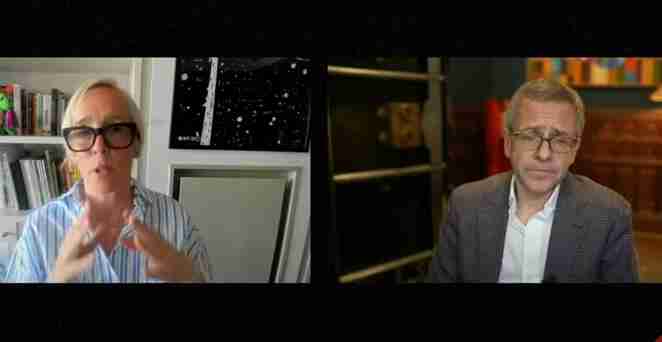
Here is the full transcript of a conversation between TED’s Helen Walters and political scientist Ian Bremmer on Tariffs, China and Trump’s First 100 Days in Office, recorded on April 29, 2025.
Listen to the audio version here:
The interview begins here:
HELEN WALTERS: Hello, everyone. Welcome and thank you for joining. I am Helen Walters. I am head of Media and curation at TED. I am so happy to be here on April 29, 2025, the 100th day of the Trump presidency. Now the White House is touting this as the most productive and consequential start to any presidency. Others have a different take with a series of new polls indicating that the president’s approval rating has dropped precipitously. Conflicting interpretations how vary 2025. So who else but Ian Bremmer to help us make sense of it all? He’s the founder and president of Eurasia Group. Ian helps us to process signal from noise. Ian, thank you so much for being here and hello, Helen.
IAN BREMMER: Wonderful to be with you.
HELEN WALTERS: All right, so we’re going to think of this as some form of evaluation of the first 100 days of this administration and a look forward to what we should be expecting. Now, we asked our community to share their burning questions that they want you to make sense of. And far and away the topic that they want to understand better is about the economy. So Trump’s so called Liberation day happened on April 2. The President described it as one of the most important days in American history. What’s your verdict? What are we watching? What should we be looking for?
The Economic Impact of Trump’s Tariffs
IAN BREMMER: Let’s first go back to your introduction for one second when you know, you said that Trump is saying that this is the most consequential first hundred days of any president in modern history. Fair enough. Enormously consequential. And his policies are by and large popular. But the implementation of those policies has been shambolic. And nowhere is that more true than than in the economy where Trump was elected.
Expected to do better on the economy than Kamala Harris. He was polling well on that issue. Consistently. The US Economy was performing pretty well, but a lot of Americans didn’t think it was going well for them. And a big piece of that was free trade. Didn’t support free trade. Democrats didn’t, Republicans didn’t because they saw cheap goods from all over the world. But they also saw a hollowing out of the middle and working class in the US and fair trade was Trump’s willingness to try to address that.
So wants to ensure that if the United States is getting high tariffs from other countries that US is going to put equivalent tariffs on those countries or the US is going to use a stronger position economically and in terms of power more broadly to get other countries to capitulate, to open their markets more to the United States. That was the theory that has not been the implementation.
Hasn’t been the implementation because they’re picking fights with literally everyone, whether the US is in trade surplus with those countries or running a trade deficit. Irrespective of the reason for the trade deficit, for many countries, it’s because they’re very poor and they can’t afford American goods. And Americans want to buy a lot of cheap commodities, for example, from those countries.
Also picking a massive fight with China. And the Chinese have been willing to hit the Americans back hard. And of course, that’s leading to very significant costs that are only beginning to be borne by the average American and by the global economy. So as a consequence, Helen, we’re 100 days in, we’re only a few weeks in to post Liberation Day. But the markets have taken a hit and consumer confidence has taken an even bigger hit. And Trump’s approval ratings have taken a big hit, too.
HELEN WALTERS: I think it’s fascinating to think about the rollout of the tariffs, which indeed seem to be kind of arbitrary and a little strange, at least to a layperson watching it. We just saw that Jeff Bezos or Amazon are going to push, put a little tag on products on Amazon to denote how much, how much of the cost is coming from tariffs. Trump is not in favor of this plan. What should we be expecting with consumer goods as we move forward over the next 100 days?
Amazon’s Tariff Labels and Administration Infighting
IAN BREMMER: Well, first, since it’s breaking news when you and I are discussing it, Amazon is not going to do that. They were thinking about doing that. And then Trump immediately got on the phone with Jeff Bezos, who is not the Amazon CEO but still has a lot of influence over there, there. And I am sure I haven’t gotten a readout of the call, but read him the riot act.
This is after Trump’s spokeswoman had come out and said that this was considered a hostile act. Amazon engaging in putting out what the tariffs would actually be in terms of consumer costs. Because, of course, Trump has been saying the tariffs aren’t a cost that’s going to be borne by consumers. It’s going to be paid by the Chinese, it’s going to be paid by other countries, and the US is going to get all that revenue. Well, that’s not the way it actually works. And Trump doesn’t want anyone gainsaying him on that issue.
So Amazon very quickly backed down. And if they hadn’t, I expect they would have seen the kind of behavior that, you know, Harvard and Columbia have seen or that a lot of law firms have seen, which is, you know, Amazon gets a lot of business from the US Government, from the Trump administration and from the bureaucracy.
More broadly, the story is that there are too many cooks, all of whom have different ideas of what a tariff rollout should look like, but all of whom are loyal to the president and are going to do their damnedest to give him whatever he wants at the moment. And so there was internal fighting of the best way to implement tariffs. And that went on for a while.
You had sort of the Scott Bestant, the Treasury Secretary, saying, should only be 19 countries with a defined tariff. That’s meant to get to reciprocity. You had Peter Navarro saying, you got to get everyone, and especially the Chinese really hard. You had Howard Lutnick, the Secretary of Commerce, in between. And Trump got sick of the debate, not really a detailed policy guy. And so ultimately, after some days of this, said, I’m just going to put tariffs on everyone. Doesn’t matter if we’ve been negotiating with them, doesn’t matter how close they are with us, don’t care about the surpluses. Everyone’s getting a tariff. I want one formula. That’s what we’re going to do. Navarro had that formula at the ready. That was what was announced on Liberation Day. And predictably, the markets and everyone else threw up all over that policy.
HELEN WALTERS: So given that the markets and everyone else threw up all over that policy, what is the future for that then? How is Trump going to get himself out of this and actually towards a policy that does pay attention to the detail, given that they do matter.
The Path Forward on Tariffs
IAN BREMMER: So there are a couple of different answers to that question, Helen. One answer is that he’s going to blink. And so you saw that there was almost immediately this 90 day suspension on a lot of these tariffs to give time to negotiate and also so that you didn’t have even greater costs that were going to be imposed on the American economy, not just other economies. So part of it is Trump showing more flexibility and backing away from a more maximalist announcement that he made on Liberation Day. Let’s face it, he declared essentially a national holiday around these tariffs. So you knew they were going to be big and historic, but turned out that they were a little too big and historic for him to swallow. That’s one thing.
Second thing is he’s going to actually cut deals. There will be a number of countries that are very, very concerned about having a fight with a much larger US economy. I’ve spoken, for example, with high level Japanese officials and they worry that their government will fall if they don’t get a deal quickly with the Trump administration. The Prime Minister is not popular. The July snapback after the 90 days of high tariffs against Japan is right before their upper house election. So they urgently want to do a bunch of stuff that will make Trump happy, like buy more American LNG and promise more investments into the United States in semiconductors, in automotive and other sectors. They even want to find a way to get their currency, the Japanese yen, down to about 120 from the present 140 plus. So they want to get to a deal.
And there are other countries like that, a bunch of really small countries across the global South, India, the United Kingdom. There are a lot of countries like that. And even though you won’t have fully fledged deals that can be inked, there can be framework agreements with letters that are submitted to the Trump administration saying, here is what we’re prepared to do. Trump will say, great, we’ll work this out. And that will calm the markets. That’s the second thing he can do. Remember, first was capitulate a bit. Second is cut a bunch of deals.
But then there’s the third, which is that even with number one and two, we are still going to be in by far the highest tariff environment that we have experienced since the 30s without a deal with the European Union, certainly without a deal with the Chinese, where right now the sides aren’t even talking to each other, irrespective of what Trump is saying. And also without a deal with Mexico and Canada, which requires a renegotiation of the US Mexico Canada Agreement, the trade agreement that came after NAFTA from the first Trump administration, which is complex and will take time to do.
And what that means, and the China piece is particularly important. I’m sure we’ll get into it. But broadly, what that means is massive costs, like much bigger than the shock that came from the pandemic, that will lead to higher inflation for American consumers, will lead to lots of bankruptcies and massive pressure on corporates. And that is going to play out over time because you’ve already imposed a bunch of those costs. You’re already seeing the shipments get hit and the goods not being in the containers. And it takes a while for that to flow through into the global economy. But as it does, the impact is going to be massive.
And here’s the biggest problem, is that back in the first Trump administration, when Trump made mistakes, he had a lot of people around him that weren’t loyal to him. They were loyal to the Republican Party and they were loyal to the country. And they would also tell him when they thought he was making significant mistakes. That is not true in this administration. I don’t believe you have cabinet officials that are loyal to the country before they’re loyal to Trump. I think they’re loyal to Trump first and they are unwilling to tell Trump when they disagree.
We saw that play out with Signalgate. This extraordinary look into an actual real time conversation between Trump’s top national security advisers on matters of war and peace, on whether or not there was going to be a military, a series of military strikes against the Houthis in Yemen. And you saw the Vice president, the most important, most powerful person on that call, on that text chain saying, I don’t think Trump understands what he’s approving here. This is a bad idea. Maybe we should tell him. And getting shut down and no one ending up telling Trump and going ahead, they went ahead and they decided to go to proceed with those strikes.
Point is, that same thing is happening on trade. So even as the economy takes a hit, even as the markets take a hit, even as his numbers go down, he is going to have people, particularly Howard Lutnick, who is sort of the ultimate hype guy around Trump on the economy. But he’s going to have a bunch of advisors around him that are saying, sir, you are so brilliant. You are doing such a magnificent job. Don’t listen to the haters, don’t pay attention to what you’re seeing in the New York Times and the failing fake news. You’re brilliant. And that plus Trump’s own far greater confidence in himself this time around compared to the first term, means that the impact, the negative impact of these trade policies is going to go a lot further before Trump is willing to make a significant change in what he is convinced is an utterly brilliant policy.
The China Situation
HELEN WALTERS: So you’re quite right. I do want to talk a bit more about China. You allude to the fact that Trump seems to think that the conversations are ongoing with the Chinese officials. I want to quote yesterday, the Chinese Foreign Minister, Wang Yi, who was speaking to a group of foreign ministers of BRICS countries and he warned them with some pretty severe rhetoric or severe language. He said, and I quote, if one chooses to remain silent, compromise or cower, it will only make the bully want to push his luck more. So America is obviously playing the role of the bully in this moment. What should we make of what is happening with China? Obviously we’re hearing one thing, but, you know, what is happening behind the scenes. Tell us what we should be paying attention to. Tell us what’s going on and tell us what’s to come.
Trump’s China Strategy and Its Implications
IAN BREMMER: So there was just a large Chinese delegation in Washington for the IMF World Bank spring meetings. They did not meet bilaterally with the Americans, but they were in a number of multilateral meetings that the Americans attended, and there were discussions that included both. So it’s not as if there’s overt hostility that prevents them from engaging in a way that, you know, we’ve seen over the Biden administration between the Americans and Russians, for example, that’s not where we are right now.
But there isn’t any ongoing negotiations on trade. And the Chinese position as of right now is that the tariffs are a joke. They amount to a full embargo on goods between the US and China, and that Xi Jinping is not prepared to authorize negotiations unless and until the Trump administration unilaterally takes those tariffs down. Now, what that number means doesn’t mean the whole 145%. Maybe they need to get to 50 or 60 or whatever, but something that feels like a real start to negotiations, and that’s going to be a tough thing for Trump to do in the near term.
Furthermore, the Chinese expect that they are going to have a hit of about 2.5% to their GDP this year because of the lack of export trade with the Americans. They expect that lots of their own firms will go bankrupt, that they’re going to have to put massive stimulus in place, targeted stimulus, to keep those companies afloat and also to hit 4% GDP growth at a minimum, which is a huge stretch from what their present numbers are looking like.
What that means is that the Chinese are completely convinced that they can take more pain politically than the Americans can. They can outlast the Americans, kind of the way the Russians feel about the war in Ukraine. And as a consequence, they don’t need to blink. They’re angry at the Americans, they’re surprised at the Americans. And if the Americans aren’t going to change their position, their view is that long term, China will benefit because it’s the United States which is unwinding its leadership role in multilateral institutions and architecture, whether it’s broad free trade or whether it’s the World Health Organization or the Paris Climate Accord, all of which the Chinese presently stand as the second most powerful country.
So if the Americans leave, they become the most powerful country, helping to set the standards and rules and appoint the people that are in key positions. Ditto when the Americans pull out of USAID and they contract the Peace Corps and they’re no longer interested in the Global South. Well, the Chinese, of course, are already the dominant trade partner in the Global South, so they have a greater advantage there.
If the Americans alienate their top allies, the Europeans, they alienate their allies, the Japanese, the South Koreans. Those countries will not decouple from China. They will de-risk, but they will also look to hedge. So longer term, the Chinese see themselves as the principal beneficiary of Trump’s unilateralism and his desire to return to the rule of the jungle. The Chinese think they will end up in a stronger position.
HELEN WALTERS: So I’m curious if you agree, because the way that you describe it there, it sounds very plausible, it sounds very convincing. What is in it for the United States if they are backing away from all of this lengthy years-long diplomacy that has been executed over the years, what do they get from that? Are they not in fact, just handing a giant gift to the Chinese?
America’s Strategic Gamble
IAN BREMMER: Well, I mean, in the near term, the Chinese are going to experience an awful lot of pain. And the Americans are making a bet that the US with a larger economy and with the global reserve currency and with a lot of really dominant global firms, including banks, so the US really controls the global financial architecture that that’s going to force other countries to align with the Americans, not the Chinese.
The Chinese get the Global South, but the Global South is underperforming. They’ve got a lot poorer governance. They have more internal radicalism. They’re facing a real uphill struggle because of climate change, where the economic impact is being felt most on the poorest countries. So if China ends up with a dominant position with all of these really poor countries, that’s going to be a weight around China’s feet as opposed to an advantage for them. That’s what you hear from the Trump administration.
My view is different. I think that while it is true that the United States is the most powerful country, you should not try to pick fights with everyone simultaneously. I mean, that’s like the king of the jungle, the mighty lion, is going after an entire herd of wildebeests simultaneously. You will get trampled that way. There will be nothing left of you. So what you instead do is you look to pick off, you know, a couple that are lame, or some juveniles or even one or two full adults, but that are by themselves. You don’t go after the entire herd.
So I think that part of the problem is that Trump has decided that he’s going to do everything everywhere all at once, right, as the movie says. And he’s not going to win any Academy Awards, any Oscars for that. And at the same time, the United States is not a dictatorship.
So I’ve heard from many Trump advisors, senior Trump advisers, about this idea that they want to pull off a reverse Nixon, that they’re hitting the Chinese hard, but they want to cut a deal with the Russians and they want to somehow pry the Russians away from China. Now, you know Trump, even if Trump were seen to be the most extraordinary genius politician that knew how to implement policy well and wasn’t 78 years old, even if that were true, and it’s not, you would still have the reality that the United States is not a dictatorship. It has checks and balances. It has a reasonably independent judiciary. It is a federal system. And in 2028, you can buy as many hats as you want. But Trump is not going to be up to be president again. And Putin knows that.
And Xi Jinping leads. He has, first of all, he’s essentially ruler for life. And he also leads the country with a multi-generational Communist Party that runs the place. So if you’re Russia, you can count on the Chinese as your long term friend in a way that you can’t count on the Americans.
And so the idea that the Americans are going to execute long term, and I mean, the reason why rule of law has worked for the United States in part, is because the US itself cannot implement consistently on policies from one to the next administration. And when you tie yourself into treaties, you tie yourself into multilateral institutions and architecture and the norms and standards that are aligned with your system broadly, yes, sometimes it’s uncomfortable, sometimes it makes you do things that you would otherwise not want to do. But it also means that the next person that gets elected that you don’t like very much also has to stick with those things. And since you’re the most powerful country, other countries have to align with it.
I think that Trump breaking that is much worse for the Europeans than the Americans, but it’s actually better for the Chinese. So Trump is essentially trying to align the United States with a set of policies that actually work better for China long term than they work for the Americans or than they work for America’s allies. And I think that is a fundamental strategic mistake.
Prospects for US-China Dialogue
HELEN WALTERS: So you and I actually talked when President Biden met with President Xi in a historical meeting back in November 2023, and that was the first time that President Xi had been to the US in six years. This is maybe a really stupid question, but is there any chance that officials might somehow engineer a meeting between President Trump and President Xi anytime soon?
IAN BREMMER: I’ve certainly been saying to officials on both sides that they would be wise to facilitate a meeting between the two heads of state as fast as possible. Because absent any conversations between the two, the potential that we get an inadvertent crisis that escalates into something really dangerous is higher than we want it to be. So I’d like to see that happen, but right now I don’t see it.
Right now we’ve got 145% tariffs from the United States on China and the Chinese essentially reciprocating. So goods trade between the two countries, with some exceptions, is basically being cut off. You see Apple, one of the top companies in the world, never mind the United States now moving their iPhone production for the US all out of China into India. That’s a permanent move that’s not going to go back. That’s a real hit to the Chinese.
You see an effort by the United States to contain China and to reduce, get their trans-shipments out of third countries into the US. So through Mexico, through India, through Southeast Asia, like Vietnam, these are all long term decisions. And in that environment, we seem to be very far from trying to reconstruct a strategic and economic dialogue that Biden and Jake Sullivan and others had been trying to put together.
Not to recreate a relationship of trust which wasn’t happening, but to improve mutual understanding of the two most powerful countries in the world of what each other was up to, what they wanted, what they were doing to reduce risk. Risk has increased in the global system dramatically as a consequence of what the Trump administration has been doing over the last hundred days, but perhaps nowhere more significantly than in the US-China relationship.
Economic Impact and Political Consequences
HELEN WALTERS: So what is the next milestone that we should be looking for here? Is it July when the tariffs come up for re-examination or what is the, especially with China, what is the next milestone that we should be looking at?
IAN BREMMER: Now with China, it’s not actually July. With China it is kind of every day, every week, every month, as we start to see the implications of these goods not getting to the United States playing through the US economy. So that was what Amazon was, you know, a shoe to drop. And Amazon backed off because they were threatened by the Trump administration.
But I mean, why did they say they wanted to do that? Because if you are an American who shops on Amazon, which means if you are an American, right. You are going to notice in very short order that a lot of the things that you buy are going to be a lot more expensive and a lot of the things that you want to buy aren’t going to be available.
I mean, when 99% of like the alarm clocks that Americans consume come from China, maybe you’re not going to buy an alarm clock, that’s not such a disaster. But when you add that with every other good that comes from China or is affected or has inputs that come from China, suddenly this is going to be a massive problem.
And you know, we had a lot of that that happened after in the teeth of the pandemic. And yes, the pandemic likely originated from China and very plausibly from a lab in China, in Wuhan, but still, people didn’t see that as an overt political decision to ruin their lives economically. This is going to be a series of costs on people that was absolutely self-imposed.
And one way you know that is because Trump decided to do Liberation Day the day after you had those special elections in Florida and in Wisconsin. He understood that this was not going to be popular. He understood that in the near term there were going to be major economic costs. And that is what the Americans are now going to see.
HELEN WALTERS: But what’s so interesting is that we’ve already seen the polls going down. The favorability rating for Trump is already going down. And that is before these costs have really impacted voters. The voters are really having this sense or are about to have this sense of, wait, this is impacting me. If they’re a Trump voter, maybe they really like some of his policies, but people are having that wait, the leopard’s eating my face moment of like, wait, this is actually really negatively impacting my life. So it seems to me that those polls are going to plummet yet further. And we know that Trump really likes polls and he really likes to do well in them. So again, sorry for like stupid questions, but what is he doing? Why is he prepared to tolerate this negative opinion?
Trump’s Economic Strategy and Political Support
IAN BREMMER: Well, we also know that he likes markets and he talks a lot about how the markets are doing. And he took huge amounts of credit for when the market was doing well under Trump and when the market wasn’t doing as well under Biden, he blamed Biden. I mean, you probably noticed that Fox News stopped running the markets chiron streaming underneath their coverage when the markets were taking a dump, because it wasn’t helping sort of lean in favor of Trump.
Trump certainly doesn’t want to talk as much about that. And he is clearly more willing to accept negative impact on the markets, at least for a period of time, because he’s decided it’s necessary. He’s not running again. He’s 78. He’s much more confident that his views are correct and he is being told by the people around him how brilliant he is.
I think that plays with his polling as well. Maybe not as well. But of course a solid 90% of Republicans still support Trump. His base still supports Trump. Now what’s going to be interesting to watch, Helen, is for the last several years, voters’ view of the economy had less to do with how the economy was doing and more to do with their political alignment with the President that was running the country, which is weird and shocking, but nonetheless is true.
The question will be, does that break when Americans see that suddenly prices of goods have gone way up, that they are not able to live with the same standard that they were before Liberation Day? Is that going to make Republicans say, “I know that this is my guy and I know that I’m supposed to support everything he does, but actually he really just messed my life up”?
That is completely contrary to the way American politics have been working for the last few cycles. But this is a major piece of cognitive dissonance that’ll have to be swallowed. So far the negative trend in Trump’s numbers has been overwhelmingly driven by Trump-oriented Dems or Trump-curious Dems and Independents, not by Republicans. I expect that is going to change significantly as these costs start hitting Americans because the scale is going to be so massive. But I might be wrong. We’ll get to see this play out in real time over the next few months.
Ukraine and Russia Relations
HELEN WALTERS: Indeed we will. All right, let’s get back to international affairs and in particular Ukraine. We saw President Zelensky came to the US had a very fractious meeting in the Oval Office. We just saw President Zelenskyy and President Trump meeting at the Pope’s funeral. So what do you think? What’s happening? What should we be looking for over the next 100 days and beyond?
IAN BREMMER: That was of course a much better meeting and it was a meeting that was attended only by Zelensky and Trump. Even though French President Macron tried to wangle his way in there, that was not happening. Trump said no on that and I’m glad they had that meeting.
It does show that even though everyone was really concerned about Trump cutting off the Ukrainians. And remember, after that disastrous meeting in the White House, the United States actually suspended intelligence and defense support for Ukraine. And I will tell you, that had a huge impact on the Ukrainian leadership. They didn’t think that was possible. They suddenly realized the US is their principal backer, and they can’t continue to fight the war and defend themselves against the invading Russians if the Americans continue that suspension.
So that showed the Ukrainian leadership they needed to take Trump more seriously. They needed to sign a letter of intent for a critical minerals deal that they will implement going forward. So that’s a win for Trump. And they also accepted Trump’s demand for a ceasefire with no preconditions. So Trump hit the Ukrainians pretty hard. The Ukrainians have now accepted Trump’s terms to get to a ceasefire.
Trump has not been willing to hit the Russians hard. And it’s funny, there’s been a lot of effort to try to convince Trump that the Russians aren’t taking you seriously. They’re walking all over you. And we have now seen over the last week that Trump is inching towards an understanding of that reality. He has now mentioned that, “Well, I’m losing my patience. I’m angry that the Russians are continuing to bomb, including in Kyiv, and killed a bunch of civilians when I told them not to. I’m angry they’re not coming to the table.”
Privately, Trump keeps telling people, “I want the Russians to come to the table. They won’t come to the table. What do I need to do to get them to come to the table?” And that was behind this decision for Trump to post that maybe he needs secondary sanctions on companies and financial institutions.
What he is hoping and what he has been told by advisers and by some foreign leaders from Europe, is that if you’re willing to go after a couple of the top Russian companies—companies like Rosneft, for example, Lukoil, for example—specific examples that you won’t even need to implement, Putin just needs to believe that you’re serious, and then he’s going to back down and he’s going to come to the table. And Trump’s view is, “Well, if that’s what I need to do, okay, I’ll do that.”
Is that enough? I don’t think that’s enough. I think that Putin still believes that at the end of the day, Trump does not want to get into a fight with Russia. Trump wants to wash his hands of Ukraine. And if he walks away from this conflict, it will be walking away from both sides and not blaming Putin alone, but instead blaming Putin and Zelensky together. So that’s the bet that Putin is making as of right now, which means we’re not going to have a ceasefire.
Now, if Trump changes his mind and actually shows that he’s willing to not just throw some threats, but really implement an “or else,” then maybe Putin’s mind can be changed and maybe then Putin will sit at the table. Especially because that move by Trump would empower the Europeans, who are willing to do a lot more to support Ukraine.
Trump has moved the Ukrainians to support Trump’s position. He’s also moved the Europeans to spend a lot more money on defense and do a lot more to support Ukrainian reconstruction. So if Trump were to pivot against Putin at this point, which he hasn’t done yet, he could plausibly show, “Look how much I’ve managed to get in service of peace. Look how much I’ve managed to get in reducing America’s obligations for this country that really should principally be Europe’s obligation, not the United States.”
But I haven’t yet seen Trump willing to do that. In fact, what I’ve seen is Trump focusing more on Iran, talking about Africa and maybe needing to do some peace there, even privately musing about North Korea. In other words, getting bored of Russia-Ukraine, and instead washing his hands of it and moving on to other places where maybe he should get his Nobel Peace Prize. That’s where I fear we are heading as opposed to the more constructive tactics.
Europe’s Response to Trump
HELEN WALTERS: Interesting. And I want to talk a little bit more about Europe, as you say, the Europeans have really stepped up. I think they were—you were in Munich when J.D. Vance went there and had his conversation with them and jaws dropped and were very, very confused and surprised and upset by what he had to say. And yet it is also true that the Europeans have indeed stepped up and have committed more towards their defence budgets. So how is Europe kind of calibrating in this post first 100 days moment? And how are they going to be approaching the US and also Ukraine and everything else going forward?
IAN BREMMER: Well, you know, in the first hundred days, some of the biggest impact of Trump globally has been a unifying tendency. We’ve seen that in Europe, the Europeans coming together and saying, we have to provide for our own defense independent of the United States long term, we have to support Ukraine independent of the US long term because we can’t trust them, they’re not going to be there. They’re going to walk away.
And that has created a stronger support for the European Union and for EU competencies on the economy, on trade, and building a competency in defense. And by the way, we’ve also seen that in Canada, that unifying tendency is why my friend Mark Carney got elected. The Liberals were dead in the water before Trump was inaugurated. And then once he started beating up on the Canadians on the 51st state nonsense and on tariffs, suddenly the conservative candidate who wanted to be Canada first and was aligned with a lot of Trumpist policies looked much more vulnerable. And Carney won.
Mexico, same thing. Claudia Sheinbaum has 86% approval right now. That’s gone way up because of Trump. So in the near term, Europe is stronger and more unified.
But long term, even if they spend more on defense, even if they reduce their red tape, they create more productivity, they try to align on this new competitiveness report that is really a blueprint for things that Europe needs to do, should have done 10, 20, 30 years ago—it isn’t enough, because ultimately, Europe doesn’t have the growth. They don’t have the productivity. They don’t have the fiscal space. Germany does, but most of Europe does not. They don’t have the defense capacity.
So they have to build it. They have to do an awful lot simultaneously on the back of European citizens that aren’t going to be comfortable with that strain at all. So do we believe that Europe can be successful long term? As I said earlier, if the Chinese can take the pain economically, if they can get through that with political stability, they will be in a better position long term.
The Europeans, I don’t think the Europeans have the political capacity, the will to outlast the Americans. And so I fear that even as the Europeans unify in the near term, they are not going to succeed in doing the things they need to to maintain a unified bloc that becomes more vibrant, that is able to defend itself, that is able to drive new technologies that will attract investment in capital, and that can compete with the United States long term. I don’t actually think that’s a very good bet. It’s a better bet than it was a few weeks ago, but it’s not yet a good bet, in my view.
HELEN WALTERS: It’s interesting, obviously, yesterday we saw the rolling blackouts occurring across Portugal.
IAN BREMMER: Portugal, yeah.
HELEN WALTERS: And I was—this is a really horrible joke that someone made, but someone I was talking to was just like, well, we’ll see the report on what actually happened in about six years time. I’m wondering if you wouldn’t make that bet right now. What is the alternative like if Europe doesn’t make that shift, what happens?
The Economic Challenges for Europe
IAN BREMMER: Well, look, the advantage that Europe has is that they are committed to rule of law, they are committed to sort of consistent tax codes. They don’t have structural corruption in the EU and the way that we increasingly do in the United States. And that China, of course, its entire system is kind of aligned around and that is attractive. But to make that work, you still want a return on your investment.
And let’s face it, there are very few companies, Western multinationals that are out there saying, I want to go and invest a lot of money in Europe and hire a lot of Europeans when I know it’s almost impossible to fire them and when I don’t think I’m going to make a lot of money and when my input costs are much more expensive and I have to deal with a lot of political long term instability geopolitically, you know, with migrant pressure from Africa and the Middle east, with national security pressure from Russia, that’s a much bigger threat to Europe than it is to the United States.
So there are just lots of externalities around Europe that are very, very hard to fix. So what does that mean if they don’t succeed and they aren’t able to become truly competitive, they only get it half right or a quarter right? Well, that means that over the next five years, 10 years, that a whole bunch of individual European countries are going to vote to get rid of the elites. They’re going to vote to get rid of the political establishment, and they will.
So Germany, the AfD and the FAR left, which have had historically successful elections in a country that has really a very strong center, suddenly it’s the outsiders that will start winning and that will start to unwind. The European Union, because they’re not committed with the EU, that in France, the far left and the far right will start outperforming. In the UK the Reform Party under Nigel Farage will win and the Conservative Party will split.
And so you can imagine that if the Europeans don’t get it right, that they will start to fragment, they certainly will no longer unify. And the reason for that, Helen, is fairly simple. It’s that in a world where the United States drives this model that is, you know, incredibly state and private sector driven, so you have industrial policy and you have huge market forces and they capture one another. And in China and you have this system that is massively state directed and enormous amounts of capital to national champions.
Well, I mean in the US and China the citizens don’t have as much of a voice but the growth is there. Well in Europe the citizens have more of a voice but the growth isn’t there. And if the Americans and the Chinese are doubling down on a non rule of law system, on a system that is about we just care how powerful you are, you get the outcomes you want, then the Europeans will not have any space and that system will increasingly fail.
That’s the danger of what this now by the way, Helen, in that system there are others that are equally worried to Europe. Canada is equally worried as Europe. In that system, Japan and South Korea are equally worried. Frankly the G6, so the G7 minus the United States plus a bunch of other advanced industrial economies and maybe some medium income democracies, all are going to be very unhappy, very uncomfortable with a world that is being increasingly driven by the US and China. And so the question will be is there going to be a third way? And right now the momentum is against that. But it’s an open question. It’s a really important one.
Immigration Policy and Rule of Law
HELEN WALTERS: Really, really important. All right, so you mentioned both Mexico and Canada and obviously Mark Carney was just elected. I want to talk about immigration. That is a banner topic that Trump had campaigned on. It is also true to say that border crossings between Mexico and the US have plummeted since he took office. Yet it’s also true to say that fewer migrants have been removed than Trump and this administration then were removed by Biden in the previous 12 months. There’s also been some, I think it’s safe to say, legally questionable deportation tactics being used. A judge in Milwaukee county was just arrested for obstruction of justice by allegedly protecting a migrant in her court. What’s going on with immigration? What’s happening with the rule of law in the United States and what should we be watching here?
IAN BREMMER: Well, Trump not only defeated Biden on his economic policy, which he is now at serious risk of unwinding and I think is very likely to unwind. I think some of the steps he’s taken have already are impossible to put back in the box. But Trump was also very successful in his willingness to address long unaddressed illegal migration into the United States. And there I would say his policies are on much safer ground for him, for his base and for many Trump-curious non Republicans.
And the fact that the border is much more secure and the willingness to make that border secure is also having a chilling impact on those that might come try to come into the United States. Is an unmitigated win for Trump. And that’s a popular policy.
Now, that’s different from dealing with illegal migrants that are already in the United States. That’s harder to do, and it requires more resources that he hasn’t yet applied and will be difficult to raise. Also requires going after some moneyed interests, like the big corporations that are very comfortable benefiting from very productive, low cost labor in the US that Trump hasn’t yet been willing to go after directly with, you know, iVerify, for example, e-Verify, and other policies that would make it hard for them to continue to benefit from those illegal workers.
The biggest negative so far has been Trump’s willingness to flout the rulings of justices, including a 9-0 vote by the Supreme Court. And this is a fight he wants precisely because it is popular. I mean, when you deport someone that is illegal illegally in the United States and would clearly be deportable, and Trump just decides to deport this guy to El Salvador, which is the one country that it was illegal to deport him to, and then refuses to facilitate his return as demanded by the Supreme Court.
That is Trump flouting a narrow ruling against a person that is very unsympathetic to most American voters. And he loves the idea of having a fight against the Maryland senator that went down to El Salvador on taxpayer funds to defend someone that shouldn’t be in the United States to begin with and who Biden didn’t do anything about. When the average American doesn’t feel like anyone’s looking out for them.
So that’s a fight he wants, even though that person has not had due process. That’s a fight he wants, even though that means he is fighting against a Supreme Court ruling, including the six Supreme Court conservative justices, including the justices that Trump himself appointed. They all ruled against him on this. He doesn’t care. Right. So this is an area that he wants to have more fights, and he thinks that they will work well for him. He’s probably right.
Looking Ahead: The Next 100 Days
HELEN WALTERS: It turns out that we are running out of time, which is outrageous. So I want to finish with one last question, which is you’re obviously tracking this incredibly closely. What should we be paying attention to over the next 100 days?
IAN BREMMER: The single biggest thing is going to be the blowback from the economy. Trump has shown that when he’s hit in the face hard, he’s capable of pivoting even in his second term, not just in the first. And the one thing that happened in the first hundred days that forced that was when he started talking about removing the Fed chair that he appointed in his first term, Jerome Powell and everyone threw up all over that, especially the so-called bond vigilantes.
When the idea that US Treasuries were suddenly not going to be as attractive because the US wouldn’t have an independent Fed and therefore would be more like an emerging market, he backed off from that fast. That was a hot stove that he touched, didn’t like getting burned by that hot stove. And he said, oh, I’m not going to fire him. I just would like him to move a little faster on reducing interest rates.
So the question in the next hundred days, the most important question will be as the American economy takes a major hit and as average American voters and businesses, small and medium businesses especially, start feeling that pain and expressing themselves loudly, how does Trump respond? How do Republicans in Congress respond? That’s the first thing we should watch.
The second thing we should watch more broadly is what kind of reaction do we see inside the US as there are further efforts made to erode the checks and balances of a democracy of the world’s most powerful country that happens to be a dysfunctional democracy. As Trump continues to go after law firms and universities and the mass media and political opponents, and you name it, opens investigations, opens audits, extorts them, threatens them. Who is willing to stand up and who capitulates?
And you know, we’ve seen a fair amount of capitulation from a lot of multinational corporations because they’re comfortable in a more kleptocratic environment that the US has become for decades. We’ve seen much less capitulation from American institutions of higher learning and from law firms that are standing on some foundational principles that they think a quarter who they are.
Courage, Helen, is contagious. And the more you see of the latter, I think the more broadly the response against Trump will be who looks a lot weaker on the domestic and international stage today than he did 100 days ago. So that’s, I think, what we want to watch most closely.
HELEN WALTERS: Well, Ian, we are so grateful to you for continuing to watch everything closely. And we will indeed be asking you to come back to share your insights and your thoughts with us at some point soon, maybe in another hundred days. For now, thank you so much for being here and thank you to everybody for watching. We’ll see you soon.
Related Posts
- Transcript: President Trump Addresses the 81st Session UN General Assembly
- Maggie Haberman: Trump’s ‘Unreality Bubble’ Meets the Midterms (Transcript)
- Transcript: President Trump Remarks on Healthcare, Sep. 18, 2026
- Transcript: Jonathan Swan’s Dive into Trump’s Reality: The Weekly Show
- Transcript: President Trump Remarks in Dublin, Ireland – Sep 12, 2026