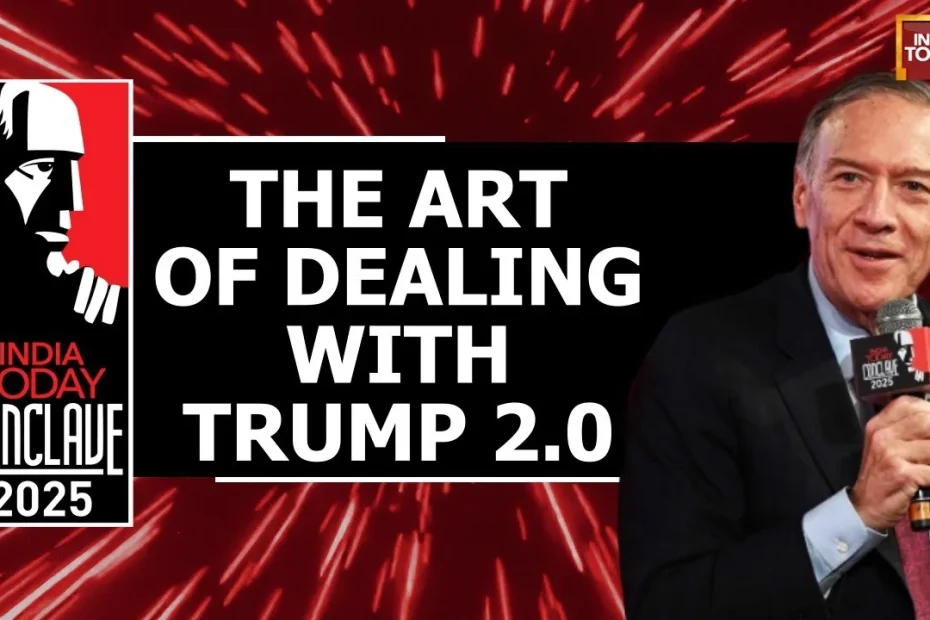
Read the full transcript of a conversation with Former US Secretary of State Mike Pompeo at India Today Conclave 2025, premiered March 7. 2025.
Listen to the audio version here:
TRANSCRIPT:
Introduction
[INTERVIEWER:] As someone who covers foreign policy for the network, I sleep every night knowing the world a certain way, and I wake up to a new world order. That is US President Donald Trump for you. We wake up to decisions. We have no idea about why he’s doing what he’s doing. We’re far away from America, so the time difference doesn’t really help much.
But we have one person over here, Hamidstas, who understands Trump very well. Welcoming our star speaker for the evening, former Secretary of State, Mike Pompeo. Can we have a very warm round of applause, please?
The tough-talking Kansas-bred political has a knack of navigating power corridors saying, “I’ve got this.” He’s done this with Donald Trump, a naysayer in the beginning, became a Trump loyalist later, only to become his CIA chief and then head the State Department as the Secretary of State.
They did many a thing from the Abraham Accords that was a historic decision by the United States of America normalizing ties with Middle East as also the tough decisions on Iran.
Trump 2.0: Different or the Same?
[INTERVIEWER:] But let’s begin with what’s happening now. Secretary of State Pompeo, this is one of those moments where everybody wants to understand how has Donald Trump, the US President, become so different in Trump 2.0 from what he was in his first term. And let’s begin with what happened only recently. We saw the Zelensky-Trump interaction.
It was not an easy one to see or to watch. In fact, most of them were wondering whether if this is going to be the norm rather than the exception.
[MIKE POMPEO:] Well, goodness. First of all, thank you for having me here. It’s great to be back and be with you again. I did make it through four years of the administration. I was the only one on the team that made it all four years.
Two thoughts in response to how you began. First, I’m not sure it’s so different from the first four years. The first six weeks here have been pretty noisy. President Trump did come in in this term with a deeper understanding, more prepared, an agenda that he didn’t have as he began the first term. So, more action, more activity.
You’re certainly seeing that and all the noise that comes with that. Big changes from where the Biden administration was on many things, some of them related to national security, many of them not related to domestic issues, and some of them that crossover, right, tariffs and economic policy. And so we’ll see as things settle up. But when I watch President Trump today, I still see the same person and how he thinks about the world that I knew from my time serving him both as CIA Director and Secretary of State.
Second, look, I think that meeting with President Zelensky, who I know pretty well, I think it was very unfortunate. Those of you who are in business or government, know National Security Advisors here, we’ve all had tough meetings where we had very different views. And people go at it hard, and I have no trouble with that. The fact that it happened out in the open in the public, I think, is just very unfortunate for Ukraine, Europe and frankly, the United States as well, for the world, right? To see that and the risks that’s associated with that, I think, is just very, very unfortunate.
I don’t, however, think it changes much of anything in terms of how the United States will interact with the conflict in Europe. President Trump campaigned saying, we need the Europeans to take this on. We need them to lead. We need them to invest. We need them to stop buying Russian natural gas, right? These are the things that he talked about all throughout his campaign.
And as I listened to him, even as recently as yesterday or the day before, that’s what I hear him continuing to say. The U.S. Media at least likes to gaslight about NATO and the like. If you go back and look at what they said, they’re, “Oh, he’s going to walk away from NATO.” He never did. And I suspect that set of commitments that the United States has had, that engagement we’ve had for a long time, will remain with our allies. It’ll be noisy. He will ask more from our partners across the world, including this country. He will ask every one of them to do more for the part of the world that they live in.
But I think that’s very consistent with how he operated in his first four years as well. Always looking for a deal, always looking for leverage, but pretty consistent in the continued support of our partners and friends.
Understanding Trump’s Mindset
[INTERVIEWER:] You know, you said, Mr. Pompeo, that always looking for a deal. Take us into the mind of Donald Trump as someone who’s worked so closely with him. Is he the consummate dealmaker above all else? Is he someone always looking for a deal without necessarily looking at the long-term vision? Is it about short-term immediate benefits? Give us a sense of the man, Donald Trump.
[MIKE POMPEO:] Yes. I don’t know that I’d say it’s always about short term versus long term. He does love to shake hands and cut ribbon and say we had this successful outcome, right? That part, he appreciates a good outcome, a good deal that he can tell people, “Yes, I did that” or “We did that,” mostly “I,” but “We did that.” That’s certainly true.
I remember, you’ll appreciate this. I was the CIA Director, and I briefed him almost every day, which was unusual for the Director to actually give the briefing. And I brought professionals with me, but he did it when I was there. He wanted me to be in the room. And one day, he kicks everybody else out, and he says, “Mike, you walk in here and you talk to me about submarines and guns and electronic communications, who’s got the money?”
And what he meant by that, I think that was really telling. And I think he’s right about this. So much conflict in the world is driven by economics, is driven by relative commercial activity as between nations. And when you see it, people are fighting sometimes over scarce resources. They’re fighting over who’s going to control a particular set of assets in the world. What partners can they find to make life better, more prosperous for their own people, and so that focus on economic outcomes as an imperative for national security is something that is and was, during my time, always at the very top of his mind. And so a good deal fits that model.
Trump and Multilateralism
[INTERVIEWER:] You’re saying he’s a good dealmaker, Secretary Pompeo, but a lot of what the Trump administration has been doing and saying in its second term feels like neo-imperialism, the return of the law of the jungle. The mighty do what they will and the weak suffer what they must. After the Second World War, the United States helped create the Bretton Woods institutions. Now it seems determined under President Trump to take that apart. Why is he destroying multilateralism, and how do you justify it?
[MIKE POMPEO:] Well, first of all, I’ll give you my thoughts on that, and then I’ll tell you how I think he thinks about it. Many of those institutions, he’s not taking apart. They’re broken. These institutions, these post-World War II institutions that served us so well.
I was a young soldier. I patrolled the East German border, right? So the Cold War idea, these multilateral global institutions, whether it was the World Health Organization or the United Nations or you could go through the dozens and dozens, maybe hundreds of them, many of them are broken. And when I say broken, they are no longer serving their own stated purpose. They’ve walked away from their charters, and they’ve now largely, in many cases, become dominated by the Chinese Communist Party.
And they are no longer serving the objective. If you go back and look what in early 1950s or 1960s, they were aimed at doing, they’re broken. And so what I think you actually see, President Trump is recognizing that and saying, “Goodness gracious, why would we pretend that these structures, these institutions are still delivering, delivering for the United States’ interest, but even more broadly, delivering the things that they say they’re supposed to do? Let’s go rethink them.”
So we leave the World Health Organization. I advocated for that during Trump one. I think left again in Trump two already. The UN Human Rights Council. I mean, anybody who actually cares about human rights can’t stare at the UN Human Rights Council and think that has anything to do with actual things we actually care about, decency and protecting the innocent and providing resources for the poor. It’s just become the ground where the Russians, the Chinese, and the Iranians run roughshod.
And so I just think this is important because President Trump gets accused of breaking these things. And I think in fairness, it’s a recognition that we all have to build other structures. And we tried to, the Abraham Accords, the Quad, what President Biden and his team did with AUKUS, right, other structures, other multilateral institutions that actually can deliver in the technological space that the world finds itself in today.
Trump’s Appointments and Elon Musk
[INTERVIEWER:] Secretary Pompeo, is it broken, or is he disrupting institutions? And I ask this because look at his appointments. His billionaire friends are the top appointees in the administration, which includes Elon Musk. What do you make of Elon Musk’s DOGE appointment, DOGE as a department in itself? And do you think that friendship is going to last long?
You’ve been on the receiving end of not so happy ending with relations with Donald Trump one. And secondly, if I may ask, who was the Musk in Trump 1.0? Was it Ivanka? Was it Jared Kushner?
[MIKE POMPEO:] There was no Elon Musk in the first Trump event. I know him enough. He is a very unique character. But look, this is a guy who’s built three amazing businesses that are going to change the world. I mean no one can deny what SpaceX has delivered for the world and will deliver over the next thirty years for the world. And no one can deny what Neuralink is on the cusp of doing for the world as well. These are genius engineering and crazy great entrepreneurship.
Now he’s serving in this role as this thing called DOGE. It is a noble objective. Our government is way too big for the size of our economy. With thirty-six trillion dollars in debt, I worry that someday, the Indians won’t buy our treasury bills, right? The whole world depends on the dollar depends on us getting this right. And so it’s going to be a tough slog for the DOGE team to begin to put us back, put our fiscal house back in order. But I hope that they’re successful.
And here’s my last thought on this. When you do that, you have to recognize there’s a reason we run deficits of two trillion dollars a year. There’s a political reason. It is very hard to reduce spending. People become used to it. And when you take it away from them, whether that’s the farmers in my home state of Kansas or health care programs or whatever, people go, “Oh my gosh, you’re taking my stuff.”
And that is politically difficult to do, but very necessary to reprioritize and spend only what it is you can afford. And we haven’t done that. And I hope President Trump and his entire team, not just DOGE folks, are successful at getting us closer to a spending level that we can continue to do all the things in the world we need to do.
[INTERVIEWER:] But when you choose someone like Mr. Musk, a man is judged in a way by the company he keeps. I remember speaking to Bob Woodward of Washington Post and “All the Presidents” spent two months ago, and he said the one distinctive feature of Donald Trump is he loves the company of billionaires. He loves big money. So therefore, even in his choice of Musk as a potential disruptor, someone who seems to want to speak out on foreign policy on X, is that a wise decision? Does that suggest to you that Donald Trump chooses the right people for the right job?
In his first term, there was this revolving door. People came in and left every six months. Is he the kind of person who likes to have flamboyant businessman billionaires around him? Is that good? Is that the way you believe America should be seeing its place in the world?
[MIKE POMPEO:] I don’t focus on people and noise. I focus on outcomes. What gets delivered? What are the outcomes that result? I look at the first Trump administration and say, well, there were many things that we didn’t accomplish. We didn’t get Chairman Kim to give up his nuclear weapons. That was my file. We failed. We didn’t accomplish the mission for President Trump. There were many things we didn’t get done.
But I look at it mostly and think, man, America was better off, and I think the world better off. I think we’ll find the same here as well. But that’s what they should be judged by. Don’t judge—I know we had Secretary Lutnick a little bit earlier that you heard from. We’ve got Secretary Rubio. We’ve got not a billionaire, right? So it’s not all billionaires. Don’t mislead, right? It’s not all billionaires that are around him.
[INTERVIEWER:] It’s a mix of billionaires and sycophants is what Fareed Zakaria told me too. Either you’ve got to be a sycophant or a billionaire.
[MIKE POMPEO:] No. I don’t believe that’s true at all. I disagree with that. As much as I like Fareed and as much as I dislike Bob Woodward, I just—if Bob was sitting here, I’d say the same thing.
Trump Administration and International Relations
[INTERVIEWER:] I think Bob Woodward’s books fundamentally are biased and aimed at destroying things that are really important. And so that’s I just think that’s unfortunate. I’ve seen that at the Washington Post for years and years and years. They attacked the Trump administration relentlessly. They said that the president of the United States was a Russian asset, and we now all know that was false.
[MIKE POMPEO:] And Bob Woodward was at the center of it. It was a lie, and he knew it. And he has not apologized for that, and he did enormous harm to the United States of America. So he can have his opinions, but he’s just flat out wrong. I would urge everyone, don’t watch the noise, don’t listen to the sound bites, don’t follow tweet by tweet.
Look at the things they actually do and deliver. If you don’t like them or you want to debate them, that’s completely fair game. But watch the through lines because there will be many of them, and they will prove to be remarkably consistent over time. I’m convinced of that. There’ll be all the noise that you see on tariffs over the last weeks, on trying to reduce the size of the U.S. Federal workforce, that will all be out there. Watch the through lines. I’m convinced it’ll put America and our partners, places like India, in good stead.
Concerns About Conflicts of Interest
[INTERVIEWER:] Secretary Pompeo, the United States is supposed to be one of the world’s great democracies. If the Indian prime minister were to invite a big billionaire to a call with an international head of state, it would lead to a major scandal. Are we seeing during the second Trump presidency the end of the idea of conflict of interest, you know, the emergence of crony capitalism at the centrifuge of this new American government and the fear that he’s trying to dismantle one kind of deep state, which is those funding, say, transgender clinics in Hyderabad, but the potential takeover of a corporate deep state, which puts its business interest first in the hope of a payout four years from now. How real is this concern? How do you look at this, sir?
[MIKE POMPEO:] I think that’s overblown. We’ll see, I suppose. But my sense is fundamentally different than that. If you look at the right, many of these billionaires have lost tons of money in the last week as a result of the tariffs that have been put in place. So if you’re looking just to monetize, that’s a bad way to do it, right? They are deeply invested.
Look at Tesla’s stock price, right? Elon Musk lost more money in a minute than this entire room’s net worth. And so if they’re trying to do that, it’s an epic fail at this point. My sense is that’s not what they’re trying to do. If you look at the tax policy President Trump’s trying to put in place, very important for U.S. economic growth to get that right to extend the marginal tax rate reductions that were put in place. Those aren’t remotely about corporate cronyism. Those are about flatlining for America’s small and medium enterprises so they can grow and invest and so that foreign direct investment will flow into the country.
So I’m untroubled. We’ve had wealthy people come into our government many times before. One of the reasons for that is those wealthy people are often very hardworking, very successful and smarter than hell. And I am very hopeful that he’s done the same thing again here. And again, proof’s in the pudding. Two years, three years from now, we’ll know whether the folks he chose this time to build his team around, will have been able to deliver on his behalf. If he lives up to the commitments he made during the campaign, I think the people of India and the United States and the whole world will be happy.
India-US Relations Under Trump
[INTERVIEWER:] Speaking of India, mixed signals from President Donald Trump and White House. On the one hand, he really appreciates Prime Minister Modi. On the other hand, he held a press conference, announcing reciprocal tariffs just ahead of his meeting with Prime Minister Modi. How does India deal with a Trump administration? What are the nos when you go into a room with Donald Trump? Because we’ve seen that, during the Zelensky meeting. There are so many experts who’ve come, pontificated. He should not have done this. He should have done this. So tell us what are the nos, and how does India deal with Trump?
[MIKE POMPEO:] I wouldn’t begin to tell Prime Minister Modi how to deal with Donald Trump. He’s done way better than I might suggest. They do have a lovely personal relationship, and that matters. But these are big countries, both of them. Thriving economies, each of them. Amazing partners, each of them.
I think the relationship actually, I credit the Biden administration in some ways, right? There were many things the Biden administration did on the US-India relationship that I think were very good as well. I’m often critical of the Biden administration, but I credit them there. I think they built on some of the work that was done during the first four years of President Trump, and I’m hopeful President Trump will continue to build that out.
Couple of thoughts. One, you’ve mentioned tariffs. I can’t believe we’re, what, we’re twenty minutes in, and that was the first mention of tariffs. Maybe other than I might have mentioned it. President Trump calls himself tariff man. We should all, you should all, the world should take seriously that he believes tariffs are a powerful tool to accomplish a number of different ends.
One of those ends for him is he believes that bilateral trade deficits are bad. He would look at India and he would say, you have too many of your industries that you have two big barriers, both tariff and non-tariff barriers, to protect local domestic industries. And he’d say, that’s not fair. He would believe that. And he’d say, so we ought to fix that. We ought to right that ship. Let’s both get rid of our tariffs. Let’s both get rid of our barriers, and let’s be great commercial partners together. That would be his theory of the case. And he is untroubled by saying, and if you don’t do that, I’m going to impose tariffs on your products, your goods, even potentially services.
And so you can expect that conversation. I know that your Minister of Commerce is in the United States, I think, still today, having that conversation with our new U.S. Trade Representative and I’m sure with Secretary Letnick as well.
Future of US-India Cooperation
Here would be my thought on this economic piece in terms of how to engage. This isn’t about human interaction. This is about how the nations ought to interact. There’s legacy things. There’s energy issues. There’s agriculture issues. We’re going to all slug our way through those things. The real place that our two nations ought to be just determined to go keep the free flow of trade and ideas of innovation, I would call it in the new tech and these new innovative places where the West, India, the United States, Japan, South Korea, Europe, where we have to succeed as against the model that the Chinese Communist Party has are in those spaces.
And so what does that mean? That means real academic exchange. And that’s people coming to study, people coming to work, American businesses investing here, Indian businesses investing in America in those new technologies. We need to make sure that there are as few barriers as possible in that space. That alone would be an amazing outcome for the United States and India. And I think President Trump is wide open to that.
The second one that I would mention is on defense and security and the commercial elements around that. If we can get those right together, this will create lasting set of relationships. We’re already training more together. We’re already sharing more intelligence than it was even being shared during my time as the CIA Director. I think those all lead us down the right direction. If we can now get the defense, commercial, technical folks wide open, capable of working together, we can all be more prosperous and a hell of a lot more secure as well.
India’s Priority in US Foreign Policy
[INTERVIEWER:] But is India a priority? Very direct. Is India really a priority for this administration, particularly given the fact that there seems to be some kind of an obsession at one level with this great power game with China. That China is the real focus of Donald Trump 2.0. India is not a focus.
[MIKE POMPEO:] I don’t know how you think about from an American perspective, I don’t know how you think about China without thinking about India. I just wouldn’t see those as separate in any material way. There’s elements that are purely bilateral between the United States and India. But when you think about America’s efforts to ensure that the basic property rights, human dignity, all the things that the Chinese Communist Party disdains, for us to get those right is deeply connected to the success of you here in India. It’s deeply connected to the success between the relationship between the United States and India. It is absolutely central. You are pivotal to that. So if you say it’s not a priority, I just don’t see how one can get at A without having a successful B.
[INTERVIEWER:] Is that Secretary Pompeo speaking or Donald Trump? Does Donald Trump want to do either a deal with China, which doesn’t necessarily include India at all? Donald Trump’s priority is to somehow engage China first.
[MIKE POMPEO:] Engage and compete. No. Donald Trump doesn’t use the language that President Biden used, talked about them as a quasi competitor. He understands China. He understands this presents an enormous threat to the American way of life. I think he deeply gets that. Secretary Rubio certainly does. The National Security Advisor, Mike Waltz, certainly does. Or my successor’s successor’s successor at CIA, John Ratcliffe, certainly gets that. That team understands that we have to get that right. And equally understands that without partners and allies, whether it’s you here in India, whether it’s the Australians, the Japanese, the South Koreans, we can’t be successful to things that matter to the United States.
I must say, I tried not to be annoyed when people took umbrage about with America first, right? President Trump uses that language of America first. I’m pretty sure Prime Minister Modi puts India first. I’m pretty confident. He certainly ought to. The people of India will demand that from him, right? And properly so. And so don’t take offense when we put America first. It doesn’t mean we’re going to do this alone. We didn’t. We built the quad. We worked diligently with our South Korean and Japanese brands to try and get them to talk to each other and share information between each other and build out an alliance, a structured strategy to protect the first island chain and the second island chain. It wasn’t going to happen just with the United States. President Trump knows that. The team knows that.
Beyond Tariffs: The Broader Relationship
[INTERVIEWER:] Secretary Pompeo, India and the United States have a very deep and wide relationship. Since the inauguration, the focus has relentlessly been on tariffs. And the concern is, given the frictions on the issue of tariff and the constant barrage of attacks that we’re seeing from different elements of the Trump administration, whether that takes away from the larger dimensions of the larger relationship between India and the United States on security, on critical technologies, on economy. Because it’s really come down purely from a businessman’s perspective to the issue of trade and tariff. It’s almost as if that’s the only issue around which this relationship hinges at the moment.
[MIKE POMPEO:] It get more attention today than the others, but I don’t think for a moment that there’s not a full range of relationships. I am very confident that when the Indian counterparts for the new administration have met, they’ve talked about every one of those issues, whether it’s Foreign Minister Jaishankar or your National Security Advisor or your legal team who’s working on all kinds of complicated issues or the intelligence sharing folks. I get it. The headline is this, but you should know in the United States, it’s really not just that.
Think about what President Trump inherited. I mean, think about he walks in with an economy that’s got massive inflation and a war in the Middle East, a war in Europe, none of which existed when he left four years earlier, right? He’s got some other things that are probably modestly better than they were when he left, right? When we left, we were knee deep in COVID. And so that too. But much of the legacy, the hangover from COVID is still out there.
And so he has inherited a broad spectrum of challenges, and he is—give him a break, Greg, it’s forty something days at this point. He is trying to sequence these things in a way that delivers on the commitments that he made. By the way, add to that all of the domestic issues that he’s got to confront. An education system that is not delivering outcomes that are satisfactory for the American people. He’s got—there’s a lot of work to do.
And so I got it. The headline news on the newspaper every day is tariffs, but make no mistake about it. He is trying to tackle six or eight major challenges, each of which he spoke to during the campaign and on which he made promises to the American people.
[INTERVIEWER:] In fact, not one, but there are two very important issues. Apart from tariff, it’s the illegal immigration issue, how he’s handled illegals. Nobody in India says that illegals should be welcomed in any country, Secretary Pompeo, but the way they were sent back is also a question. Was there a need to handcuff and shackle them? And even if that is done as standard operating procedure, for security reasons, was there a need to make a video and put it out? What is the messaging over there?
[MIKE POMPEO:] I’m sorry. A need to do what?
[INTERVIEWER:] Handcuffing and shackling the illegals who were sent back to the—
[MIKE POMPEO:] How would you take a violent criminal back? They were.
Trump Administration’s Immigration Policy
[INTERVIEWER:] Which is why I said, even if they were, was there a need to videotape them and put the videos out there? What’s the messaging? What’s the modus operandi over here?
[MIKE POMPEO:] I think that question’s unfair. How would you handle turning over violent criminals? I’ll bet you handcuff them here in India as well.
[INTERVIEWER:] But they’re not violent criminals. They were just really… No. Most of them were just farmers.
[MIKE POMPEO:] No. No. That’s not true. That’s not true. No. Most of the folks who went back initially were in our prisons. They were convicted criminals. Many of the first trips back were made up solely of those. And so I’m untroubled by that.
And by the way, if we hadn’t videotaped it, the world would wonder why they’re not showing us what’s going on. What mystery? It must be some Donald Trump trick. Right? And I lived this.
Having said that, there’s no doubt about this. I’ll concede this way. President Trump is absolutely trying to send a message. He is absolutely sending a message to anyone who’s contemplating coming to the United States illegally, do not come. You will be returned to your home country. This is a different model than we had for four years. And so I concede this point.
Donald Trump tweets it. I don’t have to tell you. He deeply believes that our immigration system fundamentally was broken for four years, that it was the choice of President Biden to allow all these people to enter our country illegally, making it damn near impossible to come to our country lawfully. And he wants to fix that. And by the way, he will fix this.
President Biden said, you can’t do it. You need a new law. It’s impossible to protect our border. In days, President Trump shuts this down. I mean, it’s stunning.
And nobody says to President Biden, why did you lie to the American people and tell them it couldn’t be done? Like, go talk to President Biden about that. We knew. We built out a model in the first term, and it took us two and a half years. And President Trump was able to grab that same model early on here because we’d seen it.
And we now have good, not good enough, but better control of who’s coming in and out of our country. And that’s important for every nation. You do this here in India. There’s by the way, there’s no other country in the world that will take as many lawful immigrants this year as the United States of America. And so, I get how the world stares at this and says, oh my gosh. This is so mean. This is necessary to protect American sovereignty, and every nation has that responsibility. And President Trump’s going to deliver on that commitment.
On Khalistan Investigations
[INTERVIEWER:] Let me turn then from there to another sensitive issue. Secretary Pompeo, there are investigations underway on murder-for-hire charges against Indian officials in the United States as we speak. As a CIA director and the former Secretary of State, you work closely on such matters. How do you see this case pan out? Khalistanis are a real concern for India. Will the Trump administration crack down on Khalistanis, or will you continue with Biden’s policy? Because that’s an issue that concerns Indian sovereignty. Just as you said, illegal immigration concerns American sovereignty. How do you see a sensitive case like this panning out now?
[MIKE POMPEO:] I don’t want to say much about this, but my guess is the policy will be different. And I’ll literally leave it at that. I know a little bit about it.
[INTERVIEWER:] Will there be a crackdown? What’s your sense?
[MIKE POMPEO:] I don’t want to say anything. I want to leave them a chance to sort of evaluate this on their own. It’s a very sensitive political issue, and I’m just a civilian.
[INTERVIEWER:] So when a former CIA director says the policy is likely to be different, but I don’t want to say very much about it, I think all of us need to start looking and reading between the lines. So we’ll take our cues from that.
[MIKE POMPEO:] I’d be careful in over-reading that, but knock yourself out.
Russia, Ukraine and Trump’s Foreign Policy
[INTERVIEWER:] We want to pivot Secretary Pompeo to Russia and Ukraine. Now since the time of the USSR, Russia has been the mortal enemy of the United States. And yet somehow we see President Trump treat his country’s enemies as his friend or being on friendly terms and friends virtually as enemies. Now whether this is Mexico or Canada or friends in the European Union or Zelensky in Ukraine, he’s tougher on his friends than he is on his enemies.
[MIKE POMPEO:] I’m not sure that’s true. I do have some differences from President Trump on this view. Personally, I have done some of these things differently. But I’m not sure that statement is true.
By the way, I remember I had a boss one time who I thought was being unfair to me, and he says, “I’m always meanest to my best employees.” The people who I actually think I can impact, I can change them, I can make them even better, and they kind of write off some of the others. So careful. May want to be close to President Trump because he does value engagement and people who actually will interact with him in a serious way. And Vladimir Putin is not going to do that.
Let me give you two thoughts on this. One, if I were Vladimir Putin, I would not be counting on the fact that you’re going to have a friendly President Trump. I would not be building my strategy around that.
And why do you say that? Go look at the first four years of President Trump. The story was he was a Russian asset. Right? CNN would tell you every morning on live TV, “Oh my gosh, he was in a hotel room.” It was a fraud. It was a complete fraud. That same story is now rising again. “He’s friends with Vladimir Putin.” Careful. It didn’t turn out that way.
We put more sanctions on Russia. We unleashed American energy, crushing the Russian energy economy. We provided defensive weapon systems to the Ukrainians, which President Obama had refused to do.
And here’s the best evidence that we were tough on Vladimir Putin. How much Ukrainian real estate did Vladimir Putin take on our watch, on our four-year watch?
[INTERVIEWER:] But that’s in the past. What matter now is Vladimir Putin is laughing.
[MIKE POMPEO:] You can’t walk away from the history. You can’t pretend you wouldn’t have said the same thing to me seven years ago. You would have. You would have said, “Oh my gosh, he looks like he’s cozying up with Vladimir. Didn’t you see he trusts him more than he trusts the American intelligence services?” I know because you wrote it. Right? Just don’t over-read.
[INTERVIEWER:] So weapon supplies and aid have been frozen to Ukraine. Vladimir Putin and his generals and oligarchs are laughing saying, “Thank you, Donald Trump for what you’re doing. This helps us in the battlefield.”
[MIKE POMPEO:] We’ll see. I wouldn’t be laughing if I were them. Who saved Ukraine? Barack Obama or Donald Trump? Just someone answer that for me.
[INTERVIEWER:] But you’re talking of the past. When did he take Ukraine? When did he do it under Donald Trump? Did he take Crimea under Donald Trump?
[MIKE POMPEO:] No. He did not. You have to acknowledge that. You can’t pretend that away and just get all fantasized about some tweet. I regret that the whole world misunderstands the model. And I’m convinced that in the end, President Trump will completely deliver exactly on what it is he said he would do. Go look at the first tweet he said about Russia after he was inaugurated. He reminded Vladimir Putin that there could be real cost. That hasn’t gone away.
[INTERVIEWER:] How does Trump then see Putin? Does he see him as a political strongman who deserves his sphere of influence in Europe? There’s much talk that America is returning to some kind of a nineteenth century Monroe doctrine, isolationist at one level, expansionist when it comes to Greenland, Panama, areas in and around America. How does he actually see leaders like Putin? Does he, from your experience, secretly admire political strongmen who the rest of the world will see as dictators and autocrats?
[MIKE POMPEO:] The question misses the point. I have enormous respect for Vladimir Putin too. I have respect for lots of leaders who I just despise and are evil and who kill people. I sat with Chairman Kim. I still respected him. He was the leader of North Korea. He was a very powerful person with nuclear weapons. One must respect that.
It doesn’t mean I admired him. I thought he was indecent. As a Christian, I knew he was inhuman and evil. But you still can acknowledge that Vladimir Putin is the leader of that nation with a powerful nuclear capability, a military that is still, in spite of all that they have suffered, is still a pretty powerful military force on a global scale.
And President Trump’s model – I’ll never forget. He talked about love letters between him and Chairman Kim. That’s the guy who put the harshest sanctions on North Korea in all of recorded civilizational history. I get it. It looks like you’re struggling to get your mind around this. Be creative. Acknowledge that you can both say, “Yes, he’s a nice guy,” and then crush them. It is simple.
[INTERVIEWER:] But I have to take out from what Rahul said. That’s not actually happening. Actually, what we see on the ground at the moment is Russia getting an advantage from what’s happened in the last couple of weeks.
[MIKE POMPEO:] No. No. No. That’s unfair. Let’s be very clear. President Biden epically failed. NATO epically failed. This is a failure of NATO. You allowed an invasion by Vladimir Putin into Ukraine. President Trump did not allow that invasion. This is unfair.
President Biden then for months – and by the way, President Biden is the one who withdrew from Afghanistan and created the debacle that was Afghanistan, not President Trump. And that emboldened Vladimir Putin. Those are the kinds of things that signal to world leaders that you’re weak and that you’ll allow this to happen.
Only the grace of God kept Kyiv from being the frontline for the Ukrainian-Russian battle. And that’s because of a failure of NATO and President Biden, not President Trump. And so when you say, “Oh, these last two weeks,” I’m like, where were you for four years criticizing President Biden for refusing to provide F-16s, which I think they should have done, for telling the Ukrainians, “Yeah, you can have our weapons, but you can only fire them on your own soil.”
That is, “You can have a missile, but you can only land it in your country.” That’s essentially the proposition that the Biden administration put forward for four years. That’s until the last months where he said, “Yes, now you can fire one in only one hundred meters, but I want to be really careful, and I don’t want anything to do with it.”
I mean, come on. People lose their minds with Donald Trump. Look at the reality, actions, and see the outcomes that were delivered, and I have every expectation we’ll continue to deliver.
[INTERVIEWER:] Secretary Pompeo, it’s a matter of fact that it is Vladimir Putin and the Russian generals that took the infantry and tanks into Ukraine. Vladimir Zelensky and the Ukrainian army did not start the Russia-Ukraine war. If we hear from some of what has been said by the Trump administration in the recent days, it would almost seem as if Russia entering Ukraine was Zelensky and Ukraine’s fault and not Putin’s fault.
[MIKE POMPEO:] I completely agree. This is one man or one man and his leadership team. They invaded. They are the aggressor. They are the evil forces. They’re the ones that have killed scores and scores, thousands of civilians.
I don’t believe for a second Vladimir Putin’s story that “Oh my gosh, NATO got too close. I got nervous and had to invade.” He’s had NATO on his border for an awfully long time. So that’s not why he did it. Vladimir Putin no more thought NATO was going to invade Russia than a man in the moon. So I don’t buy that narrative. By the way, some in my party do.
So even not to forget Trump. Many Republicans have that same narrative that says NATO expanded too far too fast and caused Vladimir Putin to have to do this. I simply disagree with that. Vladimir Putin has wanted to restore the Soviet Union since he was a young man.
[INTERVIEWER:] By the way, even as the conversation is going, we’ve just had a tweet from Donald Trump.
[MIKE POMPEO:] There you go. This is a great example. I have no idea what’s in this tweet, but you all can’t put your phones in your pocket for twenty minutes without getting nervous about a tweet. So knock yourself out. Go ahead. Read it to me.
[INTERVIEWER:] Donald Trump has just said, “Based on the fact that Russia is absolutely pounding Ukraine on the battlefield right now, I am strongly considering large scale banking sanctions and tariffs on Russia until a ceasefire and final settlement agreement on peace is reached between Russia and Ukraine. Get to the table right now before it is too late.” Is this serious? Is he just simply trying to grab attention? How do we interpret tweets like this from the U.S.?
Trump’s Foreign Policy Approach
[INTERVIEWER:] Press release? Can I just add here? I think you’ve just validated Pompeo’s remarks. Must say. Secretary Pompeo just said that.
[MIKE POMPEO:] Couldn’t. Couldn’t. That timing is killer. I’m going to have to write him a note. Thank him.
[INTERVIEWER:] Yeah. By the way, I said to you before we came out here, while we’re on stage, there’ll probably be thought. Who knows? Look. You told him what to say before you came here.
[MIKE POMPEO:] I never told President Trump what to say. No. But is this noise? I don’t know. I’ll have to go—we’ll have to go—here’s how you’ll know if it’s noise.
Will sanctions be put in place that don’t follow the tweet? Watch the policy line. Right? So he’s signaling. He’s speaking. He’s negotiating. But what you need to watch is what do they actually do.
I’ll give you the classic example. This is what’s different. President Biden would literally say, we’re going to put on sanctions. And does anybody think that the Russian economy has suffered? The GDP of Russia grew faster than the American GDP for the last two and a half years, maybe three, right?
So President Biden would talk about “I’m going to be tough,” and he’d go to Brussels and say it, but nobody believed it. Did you believe it? Did anybody fear President Biden? Because he had “trusted partners.” Russia has trusted partners in China.
My point would be, if President Trump says he’s going to put on sanctions, we do. We took the Iranians down—by the way, your government wasn’t particularly happy. We told you you had to stop buying Iranian oil. And my guess is that’s going to happen again as well. But put the Iranian file aside for a second.
When President Trump did that, put those sanctions, because we actually enforced them. We meant it. And my guess is if you watch the policy line here, the through line here, it won’t surprise me about what he’ll actually do. And Putin will have to contend with that. Not a tweet. He doesn’t have to contend with tweets.
He’ll have to contend with the fact that now it is harder for them to move money. I don’t know what will fall through the SWIFT system, right? The logical follow on to a statement like that—through SWIFT will be more difficult.
Understanding Trump’s Communication Style
[INTERVIEWER:] And this all goes real fast on Donald Trump. Give everyone sitting here, scratching their head, tearing their hair apart some tips. How do you know when Donald Trump is serious and when he’s not?
[MIKE POMPEO:] I don’t do psychology. That’s silly. Everyone wants to talk—stop. Stop. Just watch the actions that get taken. This is the thing that gets missed. Everyone wants to do psychoanalysis instead of doing rational policy planning. And it’s possible to do.
And the way you do it is you watch the actual—look, the tariff thing is disturbing to people because he has moved one forward and one back and then forward and then back. So I get how that’s created enormous volatility in markets, enormous geopolitical uncertainty. I appreciate that. And I regret that. I think a more consistent through line there would have been better.
But what I think you’re witnessing is he’s trying to gauge how far and how fast he can achieve the change that he’s seeking to get as a policy matter. So I would just suggest, watch the actions that get taken. Commerce will take actions. In this case, it’d be State, Treasury and Commerce that will take the actions. Watch the actual actions that they put into place. They’ll come pretty fast. You don’t have to wait long.
[INTERVIEWER:] Can I give you an example?
[MIKE POMPEO:] When I don’t know. Can you?
Trump’s Middle East Statements
[INTERVIEWER:] When US President Donald Trump stunned the world in the morning by saying, Gaza should become like the Riviera. We should all have—you know, the world should come to Gaza. “I want it to be the new Riviera.” Should Palestinians across the world, Middle East countries all look at that statement and wonder which world is Donald Trump living in. Is that the way to look at it? Is he playing some kind of a giant rope trick on the world when you say, “don’t psychoanalyze it”?
[MIKE POMPEO:] The world will analyze a US president.
[INTERVIEWER:] Of course.
[MIKE POMPEO:] Of course, they can’t help themselves. But stay busier on more productive things. That would be my wisdom. What was he communicating there? In Trumpian fashion, will concede, not Pompeo fashion. I would do this differently.
What was he communicating there? This place is terrible for the human beings that live there and has been since 2006 since the Israelis left. And I don’t like that. I want it to be different. I want them to have a better life.
The people that live in Gaza, right? That’s what he was communicating. He’s like, “You all have lived under the jackboot of the Iranians. They call themselves Hamas, but they’re funded by the Iranians. And you’ve lived in poverty, you’ve lived in squalor, and you’ve lived without governance, and you’ve lived under the threat of terror. And your life isn’t as good as it ought to be, and I want it to be better.”
[INTERVIEWER:] Without any empathy about people who have been bombed for the last twelve months.
[MIKE POMPEO:] How is it not empathetic to say, I want their life to be better? How’s that not maximally empathetic? I don’t understand.
Gaza Policy Discussion
[INTERVIEWER:] Can I just talk about policy over here? In Gaza or the decision and policy in Gaza.
[MIKE POMPEO:] Uh-huh.
[INTERVIEWER:] There are very specific statements that have come on how they want to turn it into a Riviera and how their beach houses can be sold. Palestinians are not buying those homes. They can’t—they will not be able to afford it even if they wanted to, one.
Secondly, you’re talking policy decision. I want to know how is President Trump conducting himself as a businessman, looking at balance sheets of what your allies are doing, how much are they paying, how much are they not paying, or purely geostrategically. Because if it’s geostrategic, even in Ukraine, it doesn’t seem geostrategic. It seems transactional. He wants minerals of Ukraine.
Gaza is resource rich. We’re looking at gas, not just the land. So there is a lot that is beyond just land. And he’s been imperialistic in his policy, in his statements when it comes to Denmark, when it comes to Greenland, so much more. How can his allies since World War II, American allies, really trust him? This is the first time you’re seeing Europe not being able to trust America.
[MIKE POMPEO:] Just covered the whole world. I’m not sure where to begin to unpack it. President Trump does view the world through an economic lens. He views the connection between the economies of nations and the interaction of those economies as an absolute imperative to deliver geostrategic security.
He doesn’t see them as separate spaces. By the way, I mostly agree with him on that. That is absolutely true. So I don’t know where you want me to begin. I’m happy to begin with what he’s thinking about in the Middle East.
Here’s what he’s thinking in the Middle East. He’s thinking Iran is bad. Israel is a close ally and partner. The Gulf Arab states are really important. And the poor Palestinians have been trampled on by the Iranians for decades, and we ought to try to fix that.
There’s the model. That’s how the Abraham Accords developed with the same model, put enormous pressure on the Iranian economy. We took a strike on one of their senior leaders to protect American interests. Iranians are still trying to kill me as a result of that. It was absolutely a righteous thing to do.
Was the right thing. The whole world took note of that, that the United States was no longer going to do what President Obama had done and said, “I might strike in Syria, I might not. Let me go talk to seventy-four people and then wander around the Oval Office a little bit.” He just made a decision, and we did the right thing for the world and made the world a safer place. I think that’s still what he’s trying to do.
And so he stares at Gaza and says, let’s understand this. On campuses in America, they say that it’s been occupied. This is occupied territory. There hasn’t been an Israeli in Gaza in twenty years, and it’s not occupied. And it’s hell on earth for the human beings that are living there.
Let’s go try to make it better. We have this opportunity now. They committed a massacre on October 7. The Israelis have responded to that. They have diminished Iranian capacity to influence Gaza.
Now let’s see if we can’t make it better. That’s what he—and by the way, maintain Israeli security, maintain Gulf Arab state security, both in Gaza, in Syria, where the regime has now fallen, do the same thing in Judea and Samaria in the West Bank. That’s the mission set. So I’m guessing he will go back and do, I think, Trump’s second term with respect to Middle East policy will look the same, all aimed at what I view as an incredibly empathetic outcome. You said there was no empathy.
That’s indecent of you to suggest such a thing. No. It truly is. It’s indecent because there’s nothing empathetic about allowing Hamas to reestablish authority there. There—that is—you talk about no empathy for those human beings to allow those terrorists to destroy the lives of the people, the Palestinians living in Gaza, that’s the most indecent thing a human being could possibly imagine in my view.
China and Taiwan
[INTERVIEWER:] Secretary Pompeo, we have seven minutes left. I want your reading of Xi Jinping’s mind and the military posturing of the People’s Liberation Army and Navy. Several military officers at very senior levels in the United States have spoken of 2027 as being the year when the PLAN makes a go for Taiwan. Do you think that during the second Trump presidency, there is a high—how would you evaluate it on the scale of probability that the People’s Liberation Army will make a military offensive on Taiwan? And as you best understand it, if this were to happen, given that you worked with Donald Trump, will Donald Trump and the United States live up to its commitment of coming to the military aid of Taiwan, or will they just sit back because they’re more interested in Greenland?
[MIKE POMPEO:] So I can answer the second one more easily than the first. The second one is yes. There’s no doubt the United States will assist in the defense of Taiwan. There’s—I’ve seen this play out too many times. Japan will immediately be involved. This gets big, fast, ugly. By the way, there’s no winner to this thing.
So anybody knows that if the Chinese actually engage militarily in Taiwan, it is a bad day for the whole world because the entire global economy comes to a halt. Because once TSMC stops delivering chips to India, your economy is done.
And it’s—I’ve seen different versions of this, and some of it’s classified, but suffice it to say, ninety days. And so we all need to be sure that that doesn’t happen, that deterrence is sufficient to prevent this.
Let’s get to the first—I actually think that the risk is far greater than that. Because I think Xi Jinping is smart enough not to do what I just described. Because he needs TSMC too. His economy comes to a grinding halt as well. And so I understand these couple of generals and an admiral who said 2027, and I get their logic. It’s possible. They could be right, by the way. The Chinese invasion of Taiwan could have begun while we’re sitting here. It’s possible. I think Xi Jinping is smarter than that.
I think he thinks he can do there what he did in Hong Kong and use propaganda, political influence, economic shaping, scare off Vietnam, Singapore, even India, right? Say, “No, you guys need to back off. Give me space.” And then he can come to control it politically without having to ever fire a shot.
[INTERVIEWER:] You do that. You think by coercion?
[MIKE POMPEO:] It’s how we all respond. So it’s not—the answer is can he do it. The answer is depends how we all deal with it.
[INTERVIEWER:] How will President Trump likely respond?
[MIKE POMPEO:] I hope that we all respond by making very very clear to him that that is unacceptable, that the United States can’t live with that political outcome. And by the way, one of my great regrets as Secretary of State is that Hong Kong became unfree on my watch. And I think we could have done more and didn’t. Maybe we couldn’t have stopped it forever. Different situation.
Hong Kong and Taiwan are not perfect parallels. I will concede that. But I think we could have kept freedom there a little longer. And we should do all the things necessary to make sure and maintain that. And there’s a long list.
I don’t have time or the clock is running, but there’s a long list of things that we collectively can do, including all the joint military exercises that India and the United States are doing together. They are very important to send signals about political interference, not only in Taiwan, but in the Philippines, in Vietnam, in Malaysia, in Indonesia, all throughout Asia, Southeast Asia, very important.
Trump’s Global Commitment
[INTERVIEWER:] So do you believe that Donald Trump, therefore, is committed to that original vision that America had post World War II in particular, or playing some kind of a global policeman or working with global partners, Quad being an example of it, is he really committed to that, or do you see Donald Trump becoming over time more and more inward looking? You’ve mentioned the domestic challenges that he has, and his entire coalition was built around MAGA, around make America great again. Given that, are we going to see conceptually Donald Trump becoming over time more and more inward looking or committed to these strategic alliances?
Trump’s Global Engagement and Leadership Style
[INTERVIEWER:] He’s walked out of the climate change accord, out of Paris. He’s taken America out of WHO. Could he take America out of certain strategic alliances, or is he still committed to that vision of America as a global policeman?
[MIKE POMPEO:] I don’t see them as you described them as A or B. I don’t see it remotely that way.
You can’t make America great again without our successful partners around the world. And I think President Trump demonstrated in his first term, he understood that as well and still does. He has a deep Jacksonian streak to him, and that may not mean as much to an Indian audience. But a deep streak, which says, we’ve got to get this right—without the American economy cranked up, I can’t be a good partner to the world. And I think that’s largely true.
There is this—and you have to be a little careful with the language—but there is this populist streak to what he’s doing. And I have a definition of populism that might be a little bit different. I’m proud to say I have a populist streak in my own thinking as well, so I don’t view this as a cuss word.
But if you look at his first days—how much time he’s worked, how many foreign leaders he’s met—I mean, he’s met more foreign leaders in his first six weeks than President Biden did, I think, in the first year. So when you talk about being engaged with the globe, President Trump, by the way, he met with more foreign leaders before he took office, which I actually am a little troubled by, deeply outside of the American tradition, but he did. Because we frankly had a president who wasn’t engaged in the world for the last six months.
[INTERVIEWER:] Does he take advice? And who does he take advice from? Is he a lone ranger as some seem, a populist political strongman? Or is there a team that he takes advice from?
[MIKE POMPEO:] He listens to everyone.
[INTERVIEWER:] Is he a good listener?
[MIKE POMPEO:] No. But neither am I.
[INTERVIEWER:] Is he a good listener?
[MIKE POMPEO:] Wait. I don’t even know what that means. President Trump will always be communicating. But if you’re asking, does he take on board thoughts and ideas from other people? The answer is I saw it every day and always.
By the way, it didn’t mean he agreed with me. I’d say, “Here’s what I think.” And he’d say, “Yeah, that’s a good point. That’s not what we’re doing.”
[INTERVIEWER:] Does he have a strong attention span?
[MIKE POMPEO:] He is at least in charge, unlike President Biden for the last two years.
[INTERVIEWER:] Does he love flattery? As we are told, he loves to be flattered.
[MIKE POMPEO:] Do you love flattery? Rajdeep loves flattery.
[INTERVIEWER:] Really? I do. I’m guilty.
[MIKE POMPEO:] No, I don’t.
[INTERVIEWER:] I’m told the way to Donald Trump’s heart, as Starmer showed in his meeting, is keep praising Donald Trump. True?
[MIKE POMPEO:] I don’t know. Again, I don’t do psychoanalysis.
China’s Military Strategy and India Relations
[INTERVIEWER:] I have a question which I want to ask you. Given what you’ve seen and what you know, what do you make of the fact that the People’s Liberation Army amassed in great numbers against the Indian Army along the Line of Actual Control? What do you make of the military mind and the thinking of the PLA? Because so much has been debated in India about why they did it, why they pulled back and what happens next.
[MIKE POMPEO:] It’s a good question. I don’t think there’s any doubt that the PLA and the senior strategic security apparatus inside of China is following Xi Jinping’s model intently, which is to test and to probe and to see who’s going to respond and how they’re going to respond. Are they prepared to commit their own forces? The skirmish in the Himalayas happened while I was the Secretary of State. And so I think they’re testing and they’re probing.
I think they’re doing that along the land-based boundaries with you all. I think they’re doing it in the sea-based boundaries with nearly every nation. I think you’re seeing them press in Africa, not just commercially. We’ve seen greater Chinese military presence in South America. So not just commercial, which was for fifteen, twenty years—it was political commercial, right? Influence leverage through commercial. Now you’re seeing generals show up and arms sales take place.
[INTERVIEWER:] So really what happens next between India and China?
[MIKE POMPEO:] I don’t know. It depends upon how India responds.
If India is strong and bold as they were in that moment, I think Xi Jinping will take that as “these folks are serious.” By the way, I’m counting on there continuing to be U.S. support for that mission set as there was during that time. And if we get that right, I’m convinced we can push back against not only the PLA.
But remember, the primary tools of power that Xi Jinping uses—we see the military stuff, we see the ships at sea—what are they? They’re economic and they’re propaganda, right? The United Front is operating here inside of India and inside the United States to convince the people of India that you all ought to just give up, that we’re going to rule the world anyway, so just why fight it? Just start speaking Mandarin. Right? That’s the same storyline they’re telling all across the world, and we have to resist that. And we can.
[INTERVIEWER:] Time’s up. But my final question to you, Secretary Pompeo, what’s next for you? Are you looking at being part of the administration, part of Trump 2.0?
[MIKE POMPEO:] We’ll see. That’s obviously President Trump’s decision.
He made a choice not to pick me at this point. He made that pretty clear, which is fine. He picked an all-new team this time. But for me, when if you get called to serve and someone says, will you come help solve something or help America, you say yes to that.
[INTERVIEWER:] We’ve come to the end of what I’m sure all of you feel has been a very captivating session.
And before I thank Secretary Pompeo, I just want to acknowledge the fact that one of the most important people in India, one of the sharpest military and intelligence minds we’ve seen, our National Security Adviser, Mr. Ajit Doval, is here in the hall. We tried very hard as we have for many years to convince Mr. Doval to be on the stage and to speak. He’s so much smarter than that. But in just the way that Doval Saab is, he said, “I will come and I will listen and I will see and I shall absorb,” which is what he’s done. But he’s been here very patiently listening to this conversation.
But the fact that you’ve made the effort of taking out time still means a lot. Thank you. Thank you for joining us here. And I hope at some point in time, you’ll change your mind. We can have you going from there and joining Secretary Pompeo and being here.
But ladies and gentlemen, at the India Today conclave, join me in raising a very warm round of applause as we thank Secretary Pompeo, who’s flown in, especially from the United States. And I want to tell all of you, he’s expecting a grandchild, which is supposed to be breaking news and could literally happen anytime soon. So despite that personal situation, he’s made this effort to come here, and that means a lot to all of us here at India Today for your time and for your insights and being so combative and candid in your responses, Secretary Pompeo. Thank you so much.
Thank you, sir.
Related Posts
- Transcript: Vice President JD Vance Remarks At TPUSA’s AmericaFest 2025
- AmericaFest 2025: Tucker Carlson on America First Movement (Transcript)
- Prof. John Mearsheimer: Unintended Consequences of a Meaningless War (Transcript)
- “It’s Really Not About Drugs” – Max Blumenthal on Mario Nawfal Podcast (Transcript)
- Erika Kirk’s Interview on Honestly with Bari Weiss (Transcript)