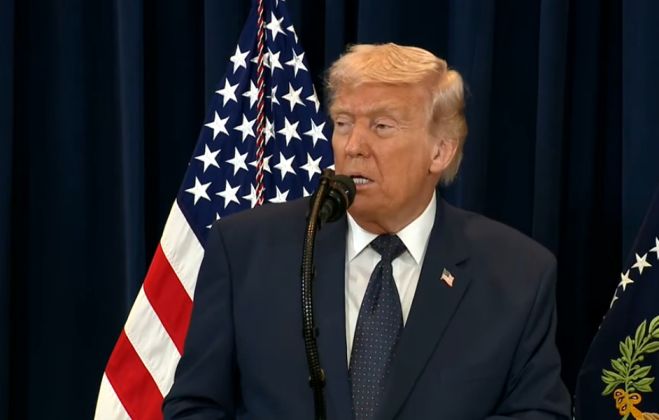
Editor’s Notes: In this press conference from March 9, 2026, President Trump provides a sweeping update on the progress of Operation Epic Fury, reporting that U.S. and Israeli forces have successfully dismantled the majority of Iran’s naval and missile capabilities. He highlights the strategic success of Operation Midnight Hammer in neutralizing Iran’s nuclear threat and details a significant decline in Iranian drone and missile launchers. Throughout the briefing, the President discusses the broader regional impact, including partnerships with neighboring Middle Eastern nations and the administration’s efforts to ensure global energy security by keeping the Strait of Hormuz open. (Mar. 9, 2026)
TRANSCRIPT:
Operation Epic Fury Update: Opening Remarks
PRESIDENT TRUMP: Hello, everyone. Thank you very much. It’s been a very big two days, I have to say. And we’ll be heading back to Washington, D.C., right after this. And I’d like to wish everyone a very good evening.
And over the weekend, the United States military and the Israeli Defense Forces continued Operation Epic Fury very successfully. Over the past nine days, we’ve carried out some of the most powerful and complex military strikes and maneuvers the world has ever seen.
Now, you add that up to all of the other things — Midnight Hammer, getting rid of the nuclear threat from Iran, which was a big moment in history, in my opinion, and the great success we’ve had in Venezuela and all other places. Every place we’ve gone, we’ve had tremendous success.
Military Objectives: Progress and Achievements
But while we’re doing all of these things, we’re achieving major strides toward completing our military objective. And some people could say they’re pretty well complete.
We’ve wiped every single force in Iran out very completely. Most of Iran’s naval power has been sunk. It’s on the bottom of the sea. It’s almost 50 ships — I was just notified it’s 51 ships. I didn’t know they had that many. It didn’t last very long. And these are fighting vessels. They’re meant to fight, but they’re not meant to fight against us.
Targeting Iran’s Drone and Missile Capabilities
We continue to target Iran’s drone and missile capabilities. Their drones are way down. Their drone manufacturing has been hit, starting today. You know all of the places they manufacture the drones, and they’re being hit one after another. Their missile capability is down to about 10 percent, maybe less. We’re also hitting where they make missiles and where they deliver missiles.
We’ve struck over 5,000 targets to date, some of them very major targets. And we’ve left some of the most important targets for later, in case we need to do it. If we hit them, it’s going to take many years for them to be rebuilt, having to do with electricity production and many other things. So we’re not looking to do that if we don’t have to. But they’re the kind of things that are very easy to hit, but very devastating if they are hit. We are waiting to see what happens before we hit them. We could take them all out in one day, but it’s all resulting in a 90 percent decline in various things.
In particular, there’s been an Iranian missile launcher decline of 90 percent and an 83 percent drop in drone launchers, as you know. The drone launchers are pretty well shot, but we’re at over 90 percent decline in the Iranian missile launchers, which is very hard to reproduce and very hard to get.
And usually, what we were able to do through great equipment, a lot of smart people — as soon as they sent a missile up from a launcher, we were able to knock out that launcher within a period of five minutes or less, accurately, right on the noggin.
So now we have low-cost interceptors effectively combating Iranian drones, and our B-2 bombers recently dropped dozens of 2,000-pound bombs to destroy missile launchers all over Iran and very deep under Iranian soil, in many cases. The soil was no match.
Ahead of Schedule: Dismantling Iran’s Manufacturing Base
And we’re also annihilating the manufacturing base that the regime uses to build drones and missiles at a rate that nobody thought was possible. We’re knocking them out. We know where they all are. We’re knocking them out very quickly. We’re ahead of our initial timeline by a lot.
I would say that we probably would not have thought after a month we’d be here, in addition to the fact that we’ve taken out the leadership twice and maybe three times. And we, as you know, we want to be involved. We don’t want another President that maybe wouldn’t be willing to do what I’m willing to do for the good of the world, for the good of our nation, to be stuck with this situation in five years or 10 years from now.
So we think they should put a President in, or the head of the country in, that’s going to be able to do something peacefully for a change. They’ve been doing this for 47 years, killing people for 47 years. Whether it’s the barracks or even the SS Cole, where they were involved very strongly, they always denied it. But they were very strongly involved. And all of the people that died through the roadside bombs died and are right now walking around with no legs, no arms, a face that’s been so badly damaged.
## The Iranian Regime’s 47 Years of Terror
The Iranian regime has been attacking Americans and spreading terror for 47 years. And despite these countless opportunities to renounce their nuclear ambitions, which they had just a short while ago, they told Mr. Whitkoff, who is standing right over here, they said — they actually said, “We want to keep building” — essentially, in a real nutshell, “we want to continue to build nuclear weapons.”
If we didn’t knock out Midnight Hammer, if we didn’t knock out their Iranian potential, if we didn’t do that with Midnight Hammer, they would have had a nuclear weapon.
They would have used it long before now. And at a minimum, Israel would have been annihilated.
I was very lucky that we had the courage to do that, that we had the talented pilots and the great equipment. The B-2 bombers are unbelievable. We ordered 25 more, by the way. The newer, better version. We have the greatest military in the world. We have the greatest equipment in the world, by far. You see that no matter where we go. You still need the people, though, to operate it and to use it. And those are the people that we cherish.
## Regime’s Refusal to Negotiate in Good Faith
Even after we obliterated their key nuclear sites in Operation Midnight Hammer, they never negotiated in good faith. They still continued to say, “We want to build nuclear. We want enrichment at levels that were unacceptable.” And they even turned down an offer for unlimited free nuclear fuel forever for civilian purposes. We had people offering them free nuclear fuel. They weren’t interested in that because they wanted to build a nuclear weapon.
So instead, the regime was trying to reconstitute its weapons program at a different site. They couldn’t go back to where they were, the three sites that we obliterated. But they were starting work at another site, a different site, different kind of a site. And that was protected by granite. They wanted it protected. Granite is pretty good, but they wanted it protected by a lot deeper. They wanted to go a lot deeper. And they started the process while rapidly building conventional ballistic missiles. They were going to do it all at the same time.
It threatened our overseas bases and soon could have reached even our homeland. The regime’s intention was to use this exponentially growing ballistic missile threat to make it virtually impossible to prevent them from obtaining a nuclear weapon.
## Ballistic Missile Threat and America’s Defense Technology
So as you probably saw, they had a tremendous number of missiles, most of which are now being used or destroyed, and very unsuccessfully used because we have been able, for the most part, to shoot them all down. What incredible technology. The Patriots have been unbelievable, and other things. And the laser technology that we have now is incredible. That’s coming out pretty soon, where literally lasers will do the work of, at a lot less cost, do the work of what the Patriots are doing or what other things they’re doing.
The situation was very quickly approaching the point of no return in the United States found it intolerable, in my opinion, based on what Steve and Jared and Pete and others were telling me, Marco was so involved, that I thought that they were going to attack us. I thought they would. If we didn’t do this at the time we did it, I think they had in mind to attack us. And if you notice, they did something which was very foolish, very stupid, I would say. They attacked their neighbors.
And their neighbors were largely neutral, or at least weren’t going to be involved, and they got attacked. And it had the reverse effect. The neighbors came onto our side and started attacking them, and actually quite successfully. If you look at Saudi Arabia, you look at UAE, Qatar, and others. But they were strong and they were smart. But they got attacked. Nobody — when I first heard it, I said, no, somebody made a mistake. There was no mistake. UAE had over a thousand missiles shot at it, knocked them almost all down.
On the very first day I came down the escalator in 2015, I said, quote, “I will stop Iran from getting nuclear weapons,” and all I’m doing is keeping my promise. Think of that. That was in 2015 I said it. It was a threat then and a much bigger threat now, but no longer a threat — not for a long time, anyway. We want to keep it that way.
Keeping Energy and Oil Flowing
As we continue Operation Epic Fury, we’re also focused on keeping energy and oil flowing to the world. And I will not allow a terrorist regime to hold the world hostage and attempt to stop the globe’s oil supply. And if Iran does anything to do that, they’ll get hit at a much, much harder level. I will take out those targets that were easy and that I mentioned just before. We’ll take them out so quickly, they’ll never be able to recover, ever. If they want to play that game, they better not play that game.
In the long run, oil supplies will be dramatically more secure without the threat of Iranian ships, drones, missiles, nuclear menace, or anything. So the Strait of Hormuz is going to remain safe. We have a lot of Navy ships there. We have the best equipment in the world inspecting for mines. Again, most of their ships are down at the bottom of the sea. But we will hit them so hard that it will not be possible for them or anybody else helping them to ever recover that section of the world, if they do anything.
In recent years, the regime and its terror proxies have launched attacks on hundreds of commercial vessels. We’re putting an end to all of this threat once and for all. And the result will be lower oil prices, oil and gas prices for American families. We’ve done that. We’ve done it. We’ve brought it very low. This was just an excursion into something that had to be done. We’re getting very close to finishing that, too.
Political Risk Insurance for Tankers
In the meantime, during this brief disruption, the United States is offering political risk insurance to any tankers operating in the Gulf. So we’re putting up risk insurance. We’ll perhaps go alongside of them for protection. We don’t think it will be necessary, if it is. And if they do anything, the price will be incalculable. It will be so great that they will have wished they never did it, because you have to keep the straits flowing.
With all of that, it affects other countries much more than it does the United States. It doesn’t really affect us. We have so much oil. We have tremendous oil and gas, much more than we need. We have Venezuela now as our new partner. Great partner. They’ve worked out so wonderful. We’re working with the administration, the President. And it’s a massive source of oil, gas, everything.
But we’re in a very good position, but very unfair to other parts of the world, like China is an example. I mean, we’re doing this for the other parts of the world, including countries like China. They get a lot of their oil through the straits. So we’re doing this. We have a very good relationship with President Xi in China. I’m going there in a short period of time. And we’re protecting the world from what these lunatics are trying to do, and very successfully, I might add.
We’re also waiving certain oil-related sanctions to reduce prices. So we have sanctions on some countries. We’re going to take those sanctions off until this straightens out.
Then who knows? Maybe we won’t have to put them on. There’ll be so much peace. But when the time comes, the U.S. Navy and its partners will escort tankers through the strait if needed. I hope it’s not going to be needed. But if it’s needed, we’ll escort them right through. And we have the greatest minesweeping ability. We have the greatest ships in all of the — we know exactly where they’re placed. We’ll get them out of there very fast. But we hope we don’t have any of that. And again, if they do that, if they play that game, we’re going to hit them at a level that they have not seen before.
So we’re winning very decisively. We’re way ahead of schedule. Our military is the greatest in the world, with the greatest equipment, and the greatest people in the world. There’s — nobody has ever seen anything like it.
Iran is a very powerful country. They were going to take over the Middle East. If we did not hit them, they were going to take over the Middle East. They had thousands and thousands — since their last hit, they had thousands and thousands of missiles and everything else. Most are now destroyed. But they were going to take over the Middle East. Those weapons were aimed at Middle Eastern countries that had nothing to do with this. They were going to take over the Middle East, and they were going to try and destroy Israel. So we stopped it with good timing. And we’re very proud to be involved in this, and it’s going to be ended soon. And if it starts up again, they’ll be hit even harder.
Q&A Session
Thank you very much for being here. Go ahead, any questions? Go ahead. Go ahead. Go ahead. Thank you. Thank you so much. Go ahead.
REPORTER: Do you approve of Iran’s new supreme leader? And secondly, can you tell us more about your call with Russian President Vladimir Putin today? What did you discuss?
On the Putin Call and Ukraine
PRESIDENT TRUMP: Yes, I had a very good call with President Putin. We had a lot of people on the line from our side, from his side. We were talking about Ukraine, which is just a never-ending fight. And when — look, there’s tremendous hatred between President Putin and President Zelensky. They can’t seem to get it together. But I think it was a positive call on that subject. And we obviously talked then about the Middle East. And he wants to be helpful. I said, you could be more helpful by getting the Ukraine-Russia war over with. That would be more helpful. But we had a very good talk. And he wants to be very constructive.
On Iran — How Soon Will It Be Over?
REPORTER: Thank you, Mr. President. On Iran, you called it an excursion. You said it would be over soon. Are you thinking this week it will be over? Are you talking about days?
PRESIDENT TRUMP: No, but soon. I think soon.
REPORTER: Okay. And with respect to —
PRESIDENT TRUMP: Very soon. Look, everything they have is gone, including their leadership. In fact, they have two levels of leadership, and even actually, as it turns out, more than that. But two levels of leadership are gone. Most people have never even heard about the leaders that they’re talking about. So it’s obviously been very, very powerful, very effective.
On Cuba and Secretary Rubio
REPORTER: With respect to Cuba, you said that Cuba wants to make a deal.
PRESIDENT TRUMP: Yes.
REPORTER: What would the United States get in return for that? And why should Americans trust Marco Rubio to negotiate it?
PRESIDENT TRUMP: Well, Marco Rubio is doing a great job. I think he’s going to go down as the greatest Secretary of State in history. Look at what we’ve done as a presidency. Look at what we’ve done as an administration. They trust Marco, and so do the American people trust. He’s been successful no matter where he’s been. He also speaks the language, which is always nice and always helpful. But he’s dealing. And it may be a friendly takeover. It may not be a friendly takeover.
It wouldn’t matter because they’re really in — they’re down to, as they say, fumes. They have no energy. They have no money. They’re in deep trouble on a humanitarian basis. And we don’t want to see that. But they were very, very bad to a lot of people, as you know, and a lot of people living on the Cuban-American vote, which I got at record levels. Very important. Those people are very important to me.
I know what they went through. They went through hell. Some of them have gone on to be some of the most successful people in the country. Cuban-American businesspeople, some of them are, like, the most successful in the country. And a lot of them are friends of mine because I’ve been fighting this battle with them for a long time.
The Castro regime was brutal. But they lived off Venezuela. Now they don’t live off Venezuela. It sends them no energy, no fuel, no oil, no money, no nothing. They lived without Venezuela. They couldn’t have made it. And we cut them off from everything else. So, yeah, they’re going to make either a deal, or we’ll do it just as easy anyway. Yeah. Please. Go ahead.
On the Iranian Girls’ School Strike
REPORTER: There’s footage that shows an American missile strike and a Tomahawk missile likely destroyed that Iranian girls’ school. So will the Americans, will the U.S. accept any responsibility for that strike?
PRESIDENT TRUMP: Well, I haven’t seen it. And I will say that the Tomahawk, which is one of the most powerful weapons around, is used by — you know, is sold and used by other countries. You know that. And whether it’s Iran, who also has some Tomahawks — I wish they had more. But whether it’s Iran or somebody else, the fact that a Tomahawk — a Tomahawk is very generic. It’s sold to other countries. But that’s being investigated right now. Yeah. Please. Go ahead. Yeah. Please.
On the Duration of the War
REPORTER: Thank you. Thank you. Mr. President, you’ve said the war is, quote, “very complete.” But your Defense Secretary says this is just the beginning. So which is it? And how long should Americans be prepared for this war to last for?
PRESIDENT TRUMP: Well, I think you can say both. The beginning — it’s the beginning of building a new country. But they certainly — they have no Navy. They have no Air Force. They have no anti-aircraft equipment. It’s all been blown up. They have no radar. They have no telecommunications. And they have no leadership. It’s all gone.
So, you know, you could look at that statement. We could call it a tremendous success right now, as we leave here, I could call it. Or we could go further, and we’re going to go further. But the big risk on that war has been over for three days. We wiped them out the first — in the first two days.
When you think about it, it’s incredible. We wiped out a big Navy — very powerful Navy. You know, these were ships. These were serious ships. These were ships that you buy when you want to win battles. They’re all — they’re all on the bottom floor. The sailors are all running off their ships. They refuse to get on the ships. The Air Force is gone. Everything is gone.
The missiles are down to a trickle. The drones are down to probably 25 percent, and they’ll soon be down to nothing. We’ll have the — where they manufactured the drones are under fire. As we speak, they’re being hit. So the rest is going to be a determination as to my attitude, along with the people in the Trump administration, what we want to do. Thank you. Yeah, please.
On Oil Sanctions Waivers
REPORTER: Can I ask you — you mentioned you were going to waive certain additional oil waivers or sanctions. Can you talk a little bit more about that and address in particular —
THE PRESIDENT: Well, we’re looking to keep the oil prices down. We went artificially up because of this excursion into a very positive thing. I mean, this was an excursion that a lot of people wouldn’t have done.
I knew oil prices would go up if I did this, and they’ve gone up probably less than I thought they’d go up. But I don’t think anybody thought we were going to be this quickly successful. This was a military success the likes of which people haven’t seen. We have the best military. We have the best equipment. We have, I believe, the best generals. We have the best. And this went very quickly.
We talked about that with President Putin. He was very impressed with what he saw because nobody has ever seen anything quite like it. You know, Iran was a very powerful military country with all of the missiles. Now, you had the double attack. You had the original attack with us and Israel, and that knocked them for a loop. Then you had the B-2 bombers, which took out their nuclear capability, and they would have had a nuclear weapon within two weeks to four weeks. And they would have used it long before this press conference. We might have had a much different press conference if we had a press conference at all. But it’s been amazing. The military success that we’ve had is truly unprecedented.
The Save America Act
REPORTER: You said — you’ve told your congressional colleagues that you will not sign any piece of legislation until the Save America Act is passed. Does that include the confirmation of Senator Mullen as your next DHS Secretary? Does that mean a DHS funding bill? And Senator Thune said today it’s not a matter of whether or not your Republican colleagues agree with the policy. It’s about changing the process — in other words, getting rid of the filibuster to get — So, in order to get it, you’re going to need Democrat votes.
PRESIDENT TRUMP: And what we’re saying is the Save America — not the SAVE Act, which nobody knew what it was — the Save America Act. The Save America Act. And that’s voter ID. We want voter ID. We want a voter — we want to be able to see a picture of the voter. We want to be able to see that the voter is legitimate. We want, very importantly, confirmation that this voter is a citizen of the United States of America. And we want no in — no mail-in ballot scams. So we have exceptions for the military, for sick, for disabled, and for people that are away — business trips or whatever. Even vacations will be very liberal now.
We’ve added two things to it — no men and women sports, and no transgender mutilization of our children. We don’t want our — it’s mutilization of our children. And we don’t want that. So we added those two things. That’s the five points. We have five very good points. It polls at 86 percent with Democrats. Think of that. The overall vote is 86 percent. With Republicans, it’s 98 percent. And the only one opposed to it is Democrat leadership because they cheat. They want to cheat.
So we added those two points. We’re going for the gold, and we’re going to have to fight like hell. Now, certain things will happen. Certain things will take place. I’m here to do a great job for the country. But we don’t have a country, if we’re going to have elections, that are so corrupt and so dishonest like we’ve witnessed over the last period of time.
You know, as an example, virtually nobody has a system of mail-in ballots like we have. No other country in the world. France went away from it. They all went. You know why? And Jimmy Carter, when he had a commission — frankly, I think it’s probably the best thing Jimmy Carter did — he said, “You can’t have mail-in voting because it’s inherently dishonest.” And it’s turned out to be totally dishonest, so we’re going to fight for it.
Iranian Sleeper Cells
REPORTER: Mr. President. Has Iran activated any sleeper cells inside the U.S.? There’s reports that they have pressed that trigger button to activate those cells, at least abroad.
PRESIDENT TRUMP: Well, we’ve been trying for a long time. We’ve been very much on top of it. One of the things we have to do is get the Democrats to stop the Democrat shutdown. Because as you know, the apparatus that looks into that, Schumer and the Democrats have shut it down, which tells you they probably hate our country a lot. But the Democrats have to open that up. But we’ve got very, very good intelligence into that. We know a lot of different things that have happened that have been very bad. A lot of them came in during the Biden open-border period. But we have them under — we’ve got them — we’re watching every single one of them.
Yeah, we know a lot about them. The biggest problem we have is the Democrat shutdown. We know a lot about them. But the shutdown doesn’t allow us to do what we have to do.
REPORTER: And the new Supreme Leader, do you have to take him out? Does he have a target on his back?
PRESIDENT TRUMP: You mean the new Supreme Leader? You mean the son? Well, I don’t want to — I don’t want to say that, but, you know, I was disappointed because we think it’s going to lead to just more of the same problem for the country. So I was disappointed to see their choice.
## On New Iranian Leadership
REPORTER: Thank you. Thank you, sir. You’ve said you have someone in mind to be the new Iranian leadership, if not the Ayatollah’s son. What are you looking for in that person? Are you looking at someone internal, given that you just said that their leadership has been divided and wiped out?
PRESIDENT TRUMP: I like the idea of the — you know, internal and eternal, come to think of it. But I like the idea of internal because it works well. I mean, I think we’ve proven that so far in Venezuela. We have a woman, Delsi, who has been, you know, President of the country, very respected, very — she’s doing a great job. And it’s, you know, no disruption.
We had, as you remember, Iraq, where everybody got fired. The military got fired. The police got fired. The politicians got fired. There was nobody. And you know what they turned into? ISIS. And we don’t want that. We don’t want that.
So I would like to see people that are inside go — now, they talk about the son of the Shah. They talk about other people. But you know, it hasn’t been there in many, many years. We have a formula that’s been very good so far, and I think it will continue to be good.
## The Venezuela Partnership
The relationship is extraordinary with Venezuela — smart country. We’ve taken out 100 million barrels of oil. It’s right now in Houston being taken care of and made so beautiful. You have to see this at work. They have — it’s brought to the refineries. It’s being refined in Houston, which is made exactly for that product.
And so far — but it’s 100 million barrels of oil, and now they have another 100 million barrels coming. And it’s like a partnership. We’re getting along so well with them. It’s great for Venezuela, and it’s great for the United States. Yeah. Please, go ahead.
## On the Tomahawk Missile Claim
REPORTER: Hi, Mr. President. You just suggested that Iran somehow got its hands on a Tomahawk and bombed its own elementary school on the first day of the war. But you’re the only person in your government saying this. Even your Defense Secretary wouldn’t say that when he was asked, standing over your shoulder on your plane on Saturday. Why are you the only person saying this?
PRESIDENT TRUMP: Because I just don’t know enough about it. I think it’s something that I was told is under investigation. But Tomahawks are used by others, as you know. Numerous other nations have Tomahawks. They buy them from us. But I will certainly — whatever the report shows, I’m willing to live with that report.
Yeah. Please.
REPORTER: You said earlier that we’ve already won in many ways, but we haven’t won enough. What do you consider enough? What’s your baseline?
THE PRESIDENT: Where they’re not going to be starting the following day to develop a nuclear weapon. Where they’ll look at that man and some other people from the administration and say, “All right, we’re not going to do it.” They were not willing to say that. And when Steve called up and he said that to me, I said, “Well, here we go. Let’s do it the hard way.”
The hard way, I think, is probably the easy way, when basically I can see that they will no longer have any capacity whatsoever for a very long period of time of developing weaponry that could be used against the United States, Israel, or any of our allies. We have great allies in the Middle East, great countries that are allies. And they were staying out of it until they got hit.
Someday they’ll have to do a story. Why did he do that? Why did they do that? But they were going to hit them. If I didn’t hit them first, they were going to hit our allies first. I believe, upon information and belief, but I believe that they were going to take over the Middle East. They were looking to take over the Middle East.
Operation Midnight Hammer and the Threat to the Middle East
Now, had Operation Midnight Hammer not taken place? That was definite, because they would have had a nuclear weapon within a matter of weeks. But that took place. That was a setback. But look at the number of missiles they were able to buy and make over the last six months. And those missiles were aimed at various countries.
And when you look at a thousand — over a thousand missiles shot at, like, UAE — they were looking to take over the Middle East. We got there first. We’re lucky. I’ll tell you what, the Middle East and those countries, very rich countries, are very lucky that I was President instead of somebody else.
On Disagreements with the Vice President
REPORTER: Mr. President, are there any points of disagreement between yourself and your Vice President when it comes to U.S. action in Iran?
THE PRESIDENT: I don’t think so, no. No, we get along very well on this. He was, I would say, philosophically a little bit different than me. I think he was maybe less enthusiastic about going, but he was quite enthusiastic. But I felt it was something we had to do. I didn’t feel we had a choice.
If we didn’t do it, they would have done it to us. I felt, based on the negotiations that were being had by Steve Woodcuff and Jared Kushner and Marco and Pete, and everybody was involved, I felt that they were going to — that they were looking to tap us along before they hit. And I thought they were going to hit. And if they hit us first, that would have been a very bad thing.
On Keeping the Strait Open
In the back, please. In the back.
REPORTER: [QUESTION INAUDIBLE]
THE PRESIDENT: About the strait, you mean? Yeah, well, I want to keep it open. I want to keep it good. You know, it doesn’t pertain to us so much as it does to China. We’re really helping China here and other countries, because they get a lot of their energy from the straits. But, hey, look, we have a good relationship with China. It’s my honor to do it. Yeah.
On Targets and Assassination Attempts
REPORTER: You have called him an unacceptable choice. So, does he have a target on his back? And how can you say that?
THE PRESIDENT: I don’t want to say whether or not he does, because that would be inappropriate. But, hey, look, I had a target on my back because, as you people wrote pretty well, they caught the assassin that was after me. So, we just got them first. But they caught the assassin. They have him now in custody. That was after me.
So, you know, but people don’t like to mention that. But they did catch him. And I’d like to congratulate our military, Secret Service, FBI, all of the people that worked on that. But they did. Yeah, please.
REPORTER: Thank you, Mr. President. You promised the Iranian people you would help them, but it sounds like you’re willing to end this fight after your military objectives have wrapped up. Is that — isn’t that a betrayal of the people?
TRUMP: Will I help them? I’d like to, if they can behave. But they’ve been very menacing. You know, they’re great people. They have an amazing population. It’s amazing — smart, brilliant, energetic. They have a great — I’d love to help them, but they have to be in a system that allows them to be helped. And right now, they’re in a system that only allows failure. And I don’t want that.
And I want a system that’s not going to be attacking us. We want a system that can lead to many years of peace. And if we can’t have that, we might as well get it over with right now. Yeah, please.
## U.S. Military Fatalities in Iran
REPORTER: Thank you, Mr. President. As of today, there have been eight U.S. military fatalities associated with the war in Iran. How many American deaths are you willing to have in this war?
TRUMP: Well, as I said before, when you have conflicts like this, you always have death. And I was at Dover yesterday. I met the parents, and they were unbelievable people. They were unbelievable people. But they all had one thing in common. They said to me one thing — every single one — “Finish the job, sir. Please finish the job.” And I’ll leave you at that. Thank you very much, everybody. Thank you.
Related Posts