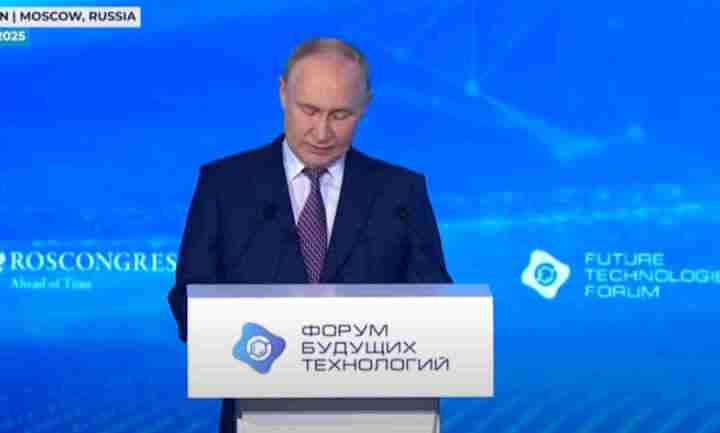
Read the full transcript of Russian President Vladimir Putin’s fiery speech at the latest BRICS summit… Forum of Future Technologies in Moscow on Feb 21, 2025.
Listen to the audio version here:
TRANSCRIPT:
Opening Remarks
VLADIMIR PUTIN: Thank you. Colleagues, friends and ladies and gentlemen, I am happy to welcome the participants of the 3rd International Future Technologies Forum. As per tradition, it is here in this audience that we outline the future frontiers of scientific research by discussing ideas that are just becoming crystallized, waited and nurtured in laboratories and scientific centers. But very soon, and I have no doubt about it, these ideas will reshape the world.
The topic of today’s forum is chemistry and the use of new materials. These are indeed major cross-cutting areas, and they largely define the progress of humanity, the implementation of the most ambitious ideas of engineers and designers. Right now, these areas are going through drastic changes, and they, in turn, lay the foundation and spur on future even more revolutionary discoveries in health care industry, microelectronics, in creation of unmanned systems in all spheres with no exception. It is readily apparent that in order to be among the leaders in key areas of scientific and technological development, that is the task that we are setting for ourselves, we need to achieve, among others, predominance in chemistry and in creation of new materials. That means that we need to offer competitive solutions and products in terms of price and quality, but they must be innovative.
Historical Context
We need to have our own unique technological know-hows that would allow to produce and export to the global markets not just raw commodities but the products of the high standard. I’d like to especially highlight that in our past, we’ve had experience of solving tasks of the same scale and significance. During the ’60s and ’70s of the 20th century, largely thanks to the efforts of Leonid Kostandov. Not many people know this name today or remember it, but the specialists, I guess, do know, and they will have reminiscence about him. He used to be the Minister of Chemical Industry of the USSR.
Back then, hundreds of cutting-edge plants were launched. Specialized scientific institutions and designer bureaus were created. In terms of total output volume, Soviet chemical industry was ranked number one in Europe and number two in the world. However, that heritage was largely squandered, and I say that with great regret. I feel shame about it.
I feel shame because so many people gave all their lives to create the chemical industry of the Soviet Union. They were working for the future generations. They spent their days and nights in their cab in their offices, and they used to live also in harsh conditions in train cars moving around the whole territory of the Soviet Union from one republic to another. They didn’t have enough sleep or food, but they were creating the chemical industry of the USSR. Unfortunately, after the dissipation of the Soviet Union, crucial production was discontinued.
Production facilities were simply destroyed. The equipment was taken out for scrap metal. Along with deterioration of our own chemical industry, we fell into strong external dependence, and we lost a significant part of our industrial and technological sovereignty. Therefore, we know through our own negative experience what kind of systemic issues stem from vulnerability in the sphere of chemistry. In essence, we literally had to reconfigure a new many technological and production chains, build new enterprises to produce independently deep conversion products.
Current Developments
For example, in Tyumen region, Tobolsk Petrochemical plant became the foundation for new capacity. And in 2019, a modern Petrochemical plant, ZapSibNeftekhim, was launched. Underway is the construction of Amur gas chemical facility as well as other enterprises that will help in the nearest future significantly increase the production of polymers, the key product of petrochemicals and gas chemistry. I’d like to add that after cleanup and remediation of the territory of Usolye-Sibirskoye in the Irkutsk region is slated to host Breakthrough Federal Center of Fine Chemistry. For those who might not know that, or are not experts in this sphere, I can say that we’re talking about the production of small volumes, however necessary volumes of specialized chemical products, resins, solvents that are simply crucial for the development of microelectronics, pharmaceuticals and many other critically important spheres.
Another cross-cutting area is catalysts. That is the foundation of chemistry. Substances that define the speed of reaction. It’s important to ensure not only the development but further testing, pilot production, followed by wide industrial use as well as scaling up of domestic solutions. To support such projects, the famous Boreskov Institute of Catalysis in Novosibirsk is becoming a special scientific and technological cluster.
It’s an important step towards development of all Siberian scientific cluster as one of the key centers for the creation of technologies of the future in chemistry. Colleagues, in order not to fall behind the pace of progress in global competition, we need to significantly increase the potential of Russian chemical industry and adjacent sectors. We need to build the full cycle, starting with exploration development of new deposits, including rare and rare earth metals, production and deep conversion of mineral resources, ending with the production of high-tech products with high added value. We have something to work on here. In essence, we have all the necessary components.
Future Plans and Investments
We simply need to set the tasks and provide the conditions for businesses and invest in infrastructure. We still do not produce lithium in Russia, and we cannot develop without it. It is apparent for the specialists here, and we can. We could have done it a decade or fifteen years ago. We need to solve these tasks using a principally new technological level, using achievements in AI and robotics, other tools aimed at increasing the productivity of labor, in science as well.
We have one of the largest grids of nuclear hydrothermal power plants that allows us to build factories in many regions of our country. And naturally, spheres that I’m mentioning here are complex and of utmost importance. Therefore, in the sphere of new materials and chemistry, this year, we’ll launch a new national project of technological leadership. The federal budget alone for the implementation from 2025 till 2030 earmarks about RUB 170 billion. Simultaneously, the investments of the companies of the real sector in economy might stand at about one trillion rubles, and I think that’s very realistic.
I’ve talked to the owners and leaders of the companies, and they have very ambitious plans. I like this sentiment. We’ll support them in their strive and we’ll fine-tune the mechanisms of supporting of private investment, including in R&D. I’ve mentioned many times that external issues and sanctions with all the challenges and complexities for us have played an important role of an incentive. Russian companies now turn more and more often to our scientists, and they receive the consultations from them.
And it turns out that the domestic solutions quite often become more effective and efficient than international counterparts. In order to ensure a modern legal framework for cooperation between researchers and qualified clients, we’ve adopted a law and technological policy will enter into force in the summer of this year. I have already mentioned it. I have set this test that together with the business community, we need to increase the funding of science up to two percent GDP. It’s crucial that we send all the additional resources for the support of promising disruptive areas of scientific and technological development.
Focus on Innovation and Education
For example, in chemistry and new materials, it would be rather myopic and erroneous to be satisfied with simply substituting the technological processes that have already been explored somewhere abroad. It is naturally quite important. We need to keep in mind all the achievements and to make use of them, but we need to develop our own platforms. Right now, we’re looking at the exhibition. My colleagues promised me that they will show me our progress.
As we have agreed, in December of last year, during the Council for Strategic Development National Projects, we need to shape plans on key dimensions that will ensure the predominance of the country in chemistry and modern material sciences as well. It’s important to define the lead scientific organizations that will take on the responsibility for conducting fundamental research. Companies that are to introduce the technologies of the future and fine-tune the talent training in chemistry for the task of technological leadership at all educational levels, starting with school, ending with universities. Unfortunately, the number of chemistry teachers in school is going down, and the number of students who are choosing chemistry as their major is going down as well. Furthermore, the number of chemistry teachers who are older than 65 is increasing.
We need what’s happening in universities and institutions. I would like to ask you for maximum engagement. Russian Academy of Sciences’ entrepreneurs, professional, scientific and educational community, it’s important that you continue to act in concert as true partners and you to be aware of responsibility for results. The implementation of all national projects of technological development hinge on that. Our plans to develop Siberia, the Arctic and the Far East, all regions of the country, naturally, solving the tasks in security and improving the quality of life of people.
National Security and Technological Advancements
Security is a thing of its own. I have already spoken publicly about it. The whole world is talking about a hypersonic missile. What is it made of? The temperature on the payload is about the temperature of the sun on the surface of the sun.
We have been conscious of that. Starting with the 1980s, some gliding block technologies were being developed. It’s called Vanguard today. It has comparable temperatures on the warhead, a bit less than the surface of the sun. We were thinking about that back in the eighties, but it couldn’t be done because there were no materials for it.
That was the issue. It’s flying, and it’s melting like ice cream. But this signal for homing is still coming through. That’s the result of materials science. Back in the day, for no apparent reason, our joint agreements on MS-21-300, all the opportunities were closed down, and that’s for wind.
Yes, we had to postpone the project, but still, we developed our own wind technologies with our own heads and minds. And we need to do that in all other dimensions as well and to work constructively together. I’d like to ask the government to ask to think about the way we can regulate the interaction between our enterprises and enterprises with our competitors in order to ensure certain advantages for our national producers. Yes, as part of the WTO system, but still, certain hindrances were created for us. And so we can regulate that.
For those who would like to come back to our markets, creating the advantages for our own producers, we need to do that, fine-tune that, but it needs to be done. I see that Minister Manturov is here and in agreement, is not in agreement. Well, we’ve spoken about it. Just like in agriculture, agri producers were begging us, “Don’t let anyone in our market. We’ll do it all ourselves except for bananas naturally.”
But now they are producing bananas as well, costly but still. But as for industrial production, we need to think it through and treat it with great attention not to lose the potential that has been created by our ill-wishers who introduced sanctions against us. I have already mentioned it, but I would like to give a few other examples. In order to develop machine engineering, aviation production, missile and space program. We need to composite materials and alloys with unique characteristics.
Future Challenges
I’ve just mentioned it. Plant protection, a different sphere in order to solve the tasks of food security, durable, safe systems for transfer and storage of energy for UAVs or new means of transportation, more durable and energy efficient materials for construction sphere. In order to adapt for climate change, new compounds, biomaterials and prototypes of organs and tissues of human in order to introduce breakthrough treatment methods in health care. I repeat myself that I’ve just outlined some specific directions. However, the lack of results even in a single one of them, and I’d like to highlight that specifically, would create a domino effect and will drag down all other national projects.
I’ve given you an example of MS-21. We had no materials for the fuselage and for the body and the wings. And the whole project was stuck. The same applies to other spheres as well. We’ve seen it all with our own eyes.
Continued Remarks on Technological Development
That is the experience of our work in the past two, three years. As for all key technological spheres, we need to build comprehensive coordination and natural interconnectedness of all of our steps and measures. And I suggest that we ensure a higher level of mechanism for steering technological development. I’d like to ask the government to propose the necessary governance ideas.
Colleagues, all our plans to create the decisions solutions for the future in chemistry, material sciences are based on tremendous potential of our scientific and engineering schools. Their traditions were laid back in the Russian Empire. I spoke about the Soviet Union, but the traditions were created in the Russian Empire in the 19th and beginning of the 20th century, and they were developed in the Soviet times as well. As I have just said, I’m sure that Mikhail Kovalchuk, we have just met with him and had some words, and other participants of the preliminary session will tell you about how today the achievements in chemistry and material science are multiplying that we received back in time of a space and nuclear project.
Honoring Scientific Legacy
Other research for the energy of the future of thermonuclear fusion spearheaded by Yevgeny Velikhov. I believe it’s necessary to dedicate to the memory of this outstanding thinker and citizen a new grant contest by Russian Scientific Foundation for Leading Scientists. The grant for five years will range from RUB 250 million up to RUB 500 million. Largest domestic companies will co-finance these grants or be direct clients of disruptive technologies. As for support, change annually. This year, I suggest to dedicate this contest to creation of unique materials and products thereof for autonomous sources of energy, propulsion and energy units as well as for devices and systems for processing of information necessary for development of artificial intelligence as well. It is absolutely apparent that this technology is defining development of all spheres.
Artificial Intelligence and Material Science
It’s producing a real revolution in chemistry and material science as well. Through introducing artificial intelligence and computer modeling, our country needs and is quite realistic to cut down to five to ten years and in the future to two or three years a time allowing for developing and introducing of new materials. For that, researchers, engineers should have the necessary databank about the existing materials and their components. I suggest we build a mechanism for regulation of operations of them, including collections, storage, processing, transfer and the use of them.
I’d like to add that tremendous body of data, breakthrough knowledge about new elements and materials will be received during the research at domestic installations of mega science class. They allow us to study the matter literally at the level of atoms. But to highlight specifically that some facilities in our country, for example, NICA in Dubna or PIK in Leningrad region, are unique, unparalleled. In the nearest future, we plan to conduct the technological launch of yet another powerful installation called SKIF. We’ll significantly increase the functionality and range of possibilities of Russian research infrastructure. Naturally, we’d like to invite international scientists to work together as well.
International Collaboration
Leningrad region, where I’ve traveled several years ago, was the place for work of specialists from Europe, from those countries where the use of nuclear energy was rolled back. Therefore, they rolled back the research that’s here as well. Here, they were quite happy to work in Russia, and we hope that that will continue. Our door is always open. We’re always happy to welcome our friends and colleagues.
I’d like to highlight that when I said fully well that open and transparent, equal exchange of information in scientific theory is one of key factors for strengthening multipolar world, we’ll continue to facilitate bringing together efforts of researchers and engineers from the East and the South in order to solve large scale experimental, theoretical and naturally practical tasks. BRICS is already a platform for social economic development and technological development of a global level. We do not intend to install barriers for a partnership with the Western scientists, and we hope that the Western politicians will understand how detrimental such actions of limitation in cooperation in science and education is.
Environmental Considerations
It’s important that the global development is just and well balanced. Therefore, we need to ensure further industrial technological progress while decreasing the negative impact for the environment, maintaining the fragile ecosystem of the planet, its fauna and flora. Naturally, we’ll take a look at the need to introduce such technologies. In the center of special attention today are breakthrough solutions in genetics, bio and natural light technologies as well as creation of materials that mimic the processes in life systems. Overall, we are talking about the shape of a principled new phenomenon, a new reality, bioeconomics. This topic is crucial and key from the point of view of global growth and its quality. I suggest that we dedicate the next Future Technology Forum to the matters of bioeconomics.
Conclusion
Naturally, if colleagues believe it possible and interesting, we’d like to invite all scientists, educational community and business community from around the world. We are prepared to cooperate. Friends, I’m very happy that our country is a place for a frank and meaningful discussion of scientists, engineers and entrepreneurs. That testifies to the transparency of Russia and our special attention to the matters of scientific and technological development. I don’t think that any expert would take it upon himself to forecast the new solutions that will be discovered and invented even in the nearest future.
However, there is something that we can do, and we can do it for sure. That is to ensure our efficient support for key technological areas that are especially crucial and useful for the citizens, for society, for economic growth. In this direction, we intend to work. And I’m quite sure that that’s the tone for your discussion today. Thank you.
Q&A Session
MIKHAIL KOVALCHUK: Good afternoon. Mr. President, distinguished colleagues, thank you for this introduction. Mr. President, from the outset, I would like to thank you. We know you’re on a very tight schedule, but still you found the time to participate in this forum, which in itself is a testimony to the attitude towards science and technology in our country. So our forum has been elevated to a whole new level. Thank you. Before I give the floor to the other speakers, I would like to say a couple words. As you’re aware, everything in life is material.
When the special military operation was declared, it was a reminder to the world that it’s material and we are a significant part of that material world. Any human thought arrives in society through material means. If a painter has an idea, then he should put that into practice, make that a reality through a painting or through a sculpture. So through material means, any human thought becomes available to society. So when questions are asked about the priorities about the development of science, there are two priorities.
The first, matter, and the second, energy, which is required to build that matter. You know, once I talked to Mr. President and you said there is another priority, which is soul and intellect, intelligence, and human thoughts. And I think our country has an abundance of all of that, both matter and energy as well as intellect. If we didn’t have that, then we wouldn’t have been able to build spacecraft, which is a testimony to our capability.
Before I give the floor to a representative of Kurchatov Institute, Vladislav Antipov, I would like to say something. We spoke about nature-like technologies, and this is something you mentioned, Mr. President. So we say nature-like, but the very course of life basically resulted in the emergence of these technologies. Our technological world is very simple. We cut everything that is redundant, like we take a tree, we take away everything but the trunk, and then we turn it into hardwood.
And it means that basically eighty percent of matter is not used, whereas nature knows how to save things. You turn one cell into a living being. A seed extends into a plant, and Nature Life Technologies follow that logic. The very development of technology has made us come here. We take a laser and create unique things through powder, which is welded together using these nature-like technologies.
When I was a student, ninety percent of articles were about semiconductors, whereas right now, eighty-ninety percent of articles are on light. So biocompatibility and biocompatible materials, that is another priority. I would like to ask you, Vladislav, could you tell us about the priorities and the forecasts and the prospects of the biggest center for material science?
[VLADISLAV ANTIPOV:] Distinguished program. A lot of materials have been created. So far, no one has been able to replicate the Buran flight for which a unique thermal protection based on quartz molecules was developed, and eighty percent of that was thanks to air because it’s a very good thermal insulator. We managed to protect Buran from temperatures of 1200 degrees. We have other examples like the centrifuges. Not everyone knows that for thirty years, you need a centrifuge up and running, and it creates several thousand rotations per minute. So you need composite materials for that.
Right now, we’ve got a national program, which sets the priorities for the next decades, like nature-like technologies, Arctic, space exploration, clean energy. All of these tasks have to be addressed through developing new materials as well as new technology. As Mr. Kovalchuk has pointed out, Kurchatov Institute is one of the leaders in terms of materials sciences, and we are doing that kind of research. Right now, humanity is entering the era of biological materials. What seemed like science fantasy yesterday is now becoming reality for regenerative medicine.
For other sectors, we create unique things like a framework for a human heart or a hip joint substitute right now. There are other examples like the gas turbine materials. The most important thing there is the turbine blade. And right now, we are working on mono-crystal turbine blades. They’re basically one single crystal thanks to a special coating.
We’ve managed to make it resist almost 1950 kelvin. We have built these materials for PD-14. Let’s take a Montauk gondola, which is sixty percent carbon and ceramic plastics. This is one of the materials that has been developed thanks to the grants from the government. We also use additive 3D technologies for several elements of the combustion chamber.
Also, the 21st century is the era of additive technology. We create new things layer by layer, which was impossible through conventional means. Right now, Kurchatov Institute has a whole series, a whole cluster of these 3D printers, which are used for energy, for cars, for medicine. The efficiency of additive technology can be demonstrated through one single simple example, like the thermal apparatus for PD-191. In the past, it used to weigh seventy kilos, and it took several months to build.
It consisted of twenty-three repairs right now through additive means. We can build this thermal converter, which only weighs nineteen kilos, and we’ve managed to decrease twenty-four times the time required for the creation of that element. So you see how efficient these 3D technologies are. We build more than ten thousand details through 3D means, and Kurchatov Institute is responsible for the technical side, carrying out research, providing these technologies to our partners. And, of course, it’s very good to work together with Rosatom because it’s endowed with a great potential.
So Kurchatov Institute will build the scientific groundwork, whereas the state corporation will help us scale that up. Now as for Arctic exploration, we also need special property materials because these materials have to work in the Arctic conditions, low temperatures, higher humidity, and other things. Kurchatov Institute has come up with cold-resistant steels, which are built, which are used for the hull of the icebreakers, which have to go through ice, more than four meters thick. And also, there are sealing materials and cold-resistant materials and paint coatings. So our technological groundwork has made it so that Russia is the only country that can boast of a fully-fledged icebreaker fleet.
We are also working on underwater gas carriers. Mr. President has pointed that out as well, but Russia requires an interdisciplinary database of materials, properties, which will help us bring down the time required for the development of new technologies. We’ll have more information on properties, on specifics that will help us achieve uniformity throughout different industrial sectors. This will also help us get access to new materials.
Thank you for your attention.
VLADIMIR PUTIN: I would like to thank the Kurchatov Institute for what you’re doing. You have mentioned quite a fraction of research you are carrying out, but, of course, there are many other avenues. It comes as a surprise, but Kurchatov looks into genetics very actively as far as I’m aware.
Underwater Gas Carriers and Technological Advancements
VLADIMIR PUTIN: Our colleague has just spoken about that, but maybe some of you might have missed that. Our colleague has spoken about the possibility of developing underwater gas carriers. When a couple of years ago, Minister Manturov mentioned that in passing to me, I said, nonsense. What about that? What is this nonsense using submarines to transport gas?
Gazprom and Novatek deem that absolutely possible, and they also think that it is economically efficient as well as safe. You know, LNG, immense tankers with liquefied natural gas, which is basically very dangerous, God forbid, an explosion happens. But underwater, it’s absolutely different. And it so happens that it is also profitable, which is incredible. That’s the future, and it can be done.
So the swift decision making as well as the rapid development of new technology, all of that goes up thanks to the use of new technology, thanks to the use of 3D printing as well as AI. It’s impressive. And of course, the Arctic exploration is one of the most important avenues because many countries across the world are willing to work with us on an icebreaker fleet, which is impossible without cutting-edge materials. The same goes for the development of new engines. We still have our work cut out for us.
We still need to do a lot. I’m sorry. That’s the truth. Our foreign partners have gone ahead of us, and there’s much we should catch up with. But it’s a challenge we have to live up to.
I would hate to say too much, but probably I won’t be mistaken if I correct you. You said that the temperature of modern engines for MS-21 reaches more than 1700 degrees centigrade. It’s PD-14, whereas it’s for MS-21. Whereas for the wide-body aircraft, it’s PD-35 engine, and there, the temperature reaches more than 1900 degrees. So I would like to thank you personally and your team, those who work on the production.
I would like to wish them success. We know who is the one responsible for that work. Almost all the stages of work have been completed, but we have to help our colleagues out and support them. Thank you.
3D Printing and Collaborative Efforts
MIKHAIL KOVALCHUK: Mr. President, I would like to invoke my right and draw your attention to the following. When 3D printing was spoken about, we have Gennady Yakovlevich and other colleagues sitting here. I would like to respond right away. We are actively working on a new competition, choosing the right topics to be explored. But I would like to say that the 3D technology was developed in our country in the laser and information technology institute at the initiative of one of our members of the Russian Academy of Sciences. This was one of the first places in the world where the stereolithographs were developed.
They were used to identify the remains of the Romanov family because the genetics was just seeing its first development. And if you don’t mind, you know, Rosatom is working on a machine for these additive technologies, they have enormous capacities and capabilities in the Chateau, and maybe we could build a new center for additive technology. We could band together Rosatom, Kurchatov Institute, and that institute. We could take advantage of that potential which still remains in that institute. But, of course, we have to address that question to Alexey.
VLADIMIR PUTIN: I know that Rosatom and Kurchatov Institute are competing. Either you want to get on this ground or vice versa. But, honestly, I would support anything that involves joining your efforts together, so I would like to ask Alexey to do that. So, you know, it’s an instruction. Right?
MIKHAIL KOVALCHUK: You know, three days ago, together with Gennady and with Alexey, we signed an agreement. And at your direct instruction, we set up the council for the strategic development of Rosatom and Kurchatov Institute. So there are no differences whatsoever, and Alexey could probably confirm that publicly.
VLADIMIR PUTIN: What did you set up? A council on the strategic development. So I wish you to live in good council and have friendship with one another happily ever after, as it were.
Graphene and Two-Dimensional Materials
MIKHAIL KOVALCHUK: I would like to give the floor to Alexander Chernov, head of the working group of the Russian Quantum Center. He’s going to speak about graphene. But before that, I would like to say just a couple of words. The periodic table has a great number of elements, but there are only four elements that stand apart, oxygen, hydrogen, nitrogen, and carbon.
They stand apart due to a number of reasons. First, if you take the biological substance, you’ll see that any biological material necessarily contains these four elements. Inorganics is simpler, but we are very complex. But we all have these in common, yes, oxygen, nitrogen, yes, and also money, but that’s the next stage. First come these four elements, and these four elements are unique.
Hydrogen and oxygen form together water, but on the other hand, they can turn into a very dangerous gas. Oxygen helps burning because it leads to oxidization and also it also explains aging. Whereas nitrogen is involved in explosives as well as fertilizers and heat. Explosive has the great potential, whereas carbon is a unique material because it can bear the form of a diamond, which is the hardest material. On the other hand, it’s a graphite material with a high temperature resistance and also fullerene as well as graphene.
It’s kind of a web. And thanks to that, our compatriots have won the Nobel Prize. So it’s just one atom thin. Right? Yes.
But we are making a step forward because there are several layers combined. That is what you’re going to talk about. Yes. Alexander, over to you.
[ALEXANDER CHERNOV:] Mr. President, distinguished colleagues. Imagine a smartphone that can analyze breathing and identify right away the first symptoms of a disease or there is a sensor which communicates to you that there is a level of pollution in the environment when you’re taking a walk.
It might sound unrealistic, but these technologies have already taken off. And the key to those technologies is two-dimensional materials. We are building 2D materials using graphene on the platform of our quantum center. Graphene is a crystal of carbon one atom thin. And thanks to the innovative research on this material, in 2010, two of our compatriots won the Nobel Prize.
The question makes itself, what else has happened in this field since then? We’re working with graphene. We are also working on other 2D materials. Just one are several atoms thin. We can combine them, fold them, achieving different angles.
It’s like a construction game. And these new materials have new properties, which, most importantly, can be modified to suit a specific task. In our laboratory, we are pursuing fundamental research. We are basically exploring the physics of these processes. We study new effects, and that work has already borne fruit.
Today, at the exhibition, we are to show you at the Gazprombank station the materials, the sensors made of those materials and to talk to you about the possible uses of them. For example, such materials can be used for night vision devices. The main advantage of 2D materials is fifteen times higher sensitivity. That means that in the dark, you can detect an object at a much higher, much higher distance. Such 2D materials can also be used in medicine.
Sensored biosensors with the use of 2D materials made in order to detect biomarkers of disease in your breath as well as in your blood. Thanks to small size and them being flexible, they can be used in wearables or in your clothes. It can monitor 24/7 the human breath. We already have graphene sensors that are very highly sensitive. They detect at early stages such diseases as lung cancer, tuberculosis.
They analyze the breath of humans. Our example shows that studying such new materials and effects that they produce allow us to create principally new technologies, not to repeat or update old technologies, but rather receive innovative devices that are much better in their characteristics of those that already exist. I think it is of principal importance that fundamental science is supported here because it gives the world such discoveries, which later allow us to create such devices. As we say, thanks to their unique characteristics, they can have us bypass at the turn everyone, achieve leadership positions and to have high-tech domestically produced products. Here, I wanted to highlight two things.
Number one, we’d like to have industrial partners to come to us with their own asks and requests so they would give us the parameters and materials that they’re interested in. I think that that way, they would sooner receive such devices that could be introduced. I know that some work is being done in that regard. Well, I also wanted to highlight the way tasks could be solved. We could create a certain digital platform.
I could say it could be a marketplace where scientific teams and industrial clients could meet and try to find common ground. I know that this work is underway, and I hope they get support in the future as well. Number two, the transition from one unique device to the serial production naturally requires fine-tuning some technological processes. Usually, that happens in a clean area of the university or collective use center. In our institute, we have a clean zone.
We could assemble the device, then produce the device. And students and research fellows will be very interested in that because they can easily get a diploma written or a PhD on that. However, if you want to move from just one device that has unique qualities and properties that was created in a lab made by a very talented young researcher that would require to fine-tune and to get in place a whole technological process, I think that this task can be solved and why I’m talking about it. For example, the Russian Quantum Center and the Moscow Physical and Technical Institute, our colleagues are successful in going that way. However, in the scale of our whole country, this could be done if we create certain platforms where these technological processes could be worked out in collaboration between universities or between a university and an industrial partner.
Such centers would help conduct the transfer of technologies and will make it easier to implement your May orders in terms of technological leadership. Thank you.
VLADIMIR PUTIN: I won’t go into details in sensors. Well, this is a very important area. With very wide range of applications, crucial, Thank God, this area this sphere is being covered by you as well.
As for digital platforms, where information exchange could take place between industrial partners and possible researchers and producers as well. That is crucial. That’s for sure. If it’s not in place, it needs to be done. I’m talking right now to my colleagues from the Russian Academy of Sciences and from the government.
It should be done, and please pay attention to that. As for environment pollution, you said that you can have a sensor on your clothes that would beep in case there is pollution around you or something. That is very important, especially if the environment conditions are good. Sometimes our best instrument here is our nose. When people walk around garbage dumps, for example, you don’t need a sensor to tell you that something’s wrong.
However, the application area of what you’re doing is tremendous. When you said that you could diagnose at early stages, as a breathing probe, some cancers, for example, lung cancer, that’s a revolution. It’s simply a revolution. We’ll do everything to help you out. Thank you.
MIKHAIL KOVALCHUK: Thanks to you. Mr. President, sensors are required for something that doesn’t smell that you cannot detect with your nose, for example. I just wanted to say one word about it to remind you. When we are talking about platform, it’s very important. However, our academic model of science I’d like to remind you that Physical and Technical Institute, when it was created, was conceived very simply that each department would have a special organization as a major scientific center.
Academic-Industry Collaboration
MIKHAIL KOVALCHUK: That was the strength behind that institution’s research. And I think what’s important today when we deal with artificial intelligence and digital things, I think we need to not forget about that system and improve it because the fastest way is the contact between the institute and the industry. This is our Soviet experience. It’s very high in demand today. That’s why Moscow Physics and Technical Institute is so highly ranked in the world.
I think it would be quite correct to support that. Now I’d like to give the floor to Natalya Pyatina, Head of Lab for Material Studies of Luch by Rosatom. We are talking about materials and all nuclear technologies. Whatever you mentioned, they stem from materials production. So if we created a material, we managed to implement the nuclear project.
So everything in the future is also connected with materials. Please, Natalya, you have the floor.
Nuclear Materials and Space Exploration
[NATALYA PYATINA:] Thank you very much, Mr. Kovalchuk, for giving the floor to me. Today, we have highlighted that modern material sciences is called to implement the most ambitious and even sci-fi ideas of engineers and scientists. The nuclear sphere is celebrating the 80 years and used to be always the cradle of record-breaking materials.
And from the very beginning, it was the foundation of knowledge of our best scientists. Their heritage is being preserved by Rosatom and Kurchatov Institute thanks to the experience that we have accumulated. And the tasks that are solved by Rosatom’s Industries are not limited to nuclear sphere. Our research is very wide in its scope, and I would like to ask each one of you a question. How long ago have you taken a look at the stars high?
And did you think how high should be the level of technology in order to ensure a long flight to the moon or hopefully to the moon and back to come home or to the moon or to Mars. How durable should the functional materials be? Because the conditions in terms of temperature and mechanical load got very harsh. And propulsion units should also be capable of functioning in such conditions. And our team is dealing with that high resistance metals and their alloys.
These materials can be compared to extreme sports fans. They are reliable in special conditions of functioning temperature higher than 1300 centigrade and great radiation impact. Our materials are at the heart of new types of unique high heat resistance nuclear propulsion units, energy units. We believe that our achievement is the development of technologies and equipment in order to create single crystal slabs of complex shape that ensures their resilience at previously unimaginable temperatures and test their radiation resilience is an advantage for our materials. I have to say that we are not simply sitting idly with our success.
We see the achievements of our Chinese colleagues in terms of heat resistant alloys, and it spurs us on. Because scientists are also, in some ways, athletes, and it’s important for us to maintain our advantage. I’d like to say that already today, our work helped us to create a material in order to be in order to use it in promising energy units for high speed flights in aerial medium. As for high risk heat resistant metals, it was unthinkable previously, And we are working on improving the resilience and durability of such materials. The scientific significance of our work is not just creating a certain type of alloy because the shape or type of product is also very important.
And here, we’re using additive technologies and digital methods as well, just like our colleagues. Maybe, unfortunately, but we think it’s fortunately important. Heat resistant metals cannot use the already existing printing machines. Therefore, we have designed special additive machines that allow us to work with such complex materials. Those developments that I’ve been talking about are not mass produced.
However, the future of the use of heat resistant alloys cannot be cut down to just one single specific sphere in this space. No. We truly hope that the future generation of young specialists will be working on trying to miniaturize energy units. Possibly, such work can be done in close cooperation with the Russian Foundation, with Kurchatov Institute and dedicated institutions. The majority of such ambitious projects are in the hands of young specialists and engineers, and I’m happy to represent such a team today.
What can a young research team dream of? We have we’re still quite young, and what we’d like to have is that something that we pour in our time and sometimes health and our every thought so it would succeed, so that our heat resistant alloys will conquer space, would deliver on there and also be applied in our regular Earthly lives. That’s impossible without the development of commodities for heat resistant alloys without special attention and awe, so to speak, for development and labor for production. And we are sure that unique Russian developments with our heat resistant alloys will absolutely find the necessary response in the global scientific community. Thank you.
VLADIMIR PUTIN: Do you understand correctly that you need such rare and rare earth metals?
[NATALYA PYATINA:] Yes, that is true.
VLADIMIR PUTIN: So what do you suggest? What should be done?
[NATALYA PYATINA:] It should be developed our deposits should be developed.
VLADIMIR PUTIN: Remember about them. Have you studied such mineral deposits? Did you have any did you take any interest in how it can be produced except for Yakutia?
[NATALYA PYATINA:] Yes. Everyone knows about Yakutia.
VLADIMIR PUTIN: What is besides Yakutia?
[NATALYA PYATINA:] I can tell you a secret. I’m a geologist. I come from geological department of MSU of Lomonosov State University. Naturally, we’ve studied them, and we really hope that molybdenum and Thompson deposit will be brought back.
VLADIMIR PUTIN: Our department used to work there a lot. I also mean that as well. So what’s with the flight to Mars? Can a living cell fly to Mars and come back? Please be honest.
[NATALYA PYATINA:] Well, we need to learn what’s out there.
VLADIMIR PUTIN: Yes. Out there. Well, all kind of machines fly to Mars. But can a living cell fly to the Mars and make it back alive?
[NATALYA PYATINA:] We hope that it can.
VLADIMIR PUTIN: So how long can it live there?
[NATALYA PYATINA:] Well, it’s a different question.
VLADIMIR PUTIN: It’s difficult to deal with scientists. It’s hard for you, Mr. Kovalchuk. Some of my colleagues tell me that it’s impossible. Sergei Korolev used to think about that. He said that you need to fly in a water envelope for protection. But it’s impossible because then the craft becomes so large that it’s impossible to propel it first into launch it into space. Could not be done even with the use of the nuclear reactors, nuclear propulsion units for space.
The craft becomes too large as for other materials that would protect the biomaterial, a living cell. Are there any others?
[NATALYA PYATINA:] Maybe it’s our research plan for the future.
VLADIMIR PUTIN: Okay. So you need funding, right?
[NATALYA PYATINA:] Thank you very much. Of course.
VLADIMIR PUTIN: Everything that applies to your sphere of interest, key Brazilian allies is extremely important. And I think that everyone understands that fully well. The government understands it very well and will do everything to help you out and to support you.
MIKHAIL KOVALCHUK: No, Mr. President. Space engines. In that sense, we’re ahead of the whole planet. All of our satellites used to have nuclear propulsion units on board.
And here, together, Rosatom and with the Russian Academy of Science, we’re working on nonelectrode propulsion units. They are of completely different type, and they must ensure the flight to the Mars. As I said, we fly into space today just like Munchhausen used to fly a projectile, on a cannonball. So if we miss the moon, we’ll, well, we’ll just miss it. But we need a different kind of engine that could hover over so we could slow down and hover over an asteroid, for example.
We have prototypes, and we’ve been dealing with that for decades. And together with Rosatom and Russian Academy, we can do such a shuttle and get energy on the moon. We’ll have something to moon on the moon on with, and we have a number of stations there using a completely different principle. It’s very important. So the materials that we’ve been discussing well, since we mentioned it, I would like to circle back to Mr. Likhachev so no one would doubt here in the audience that all matters have been solved. I’d like to remind you that about fifteen years ago, when Rosatom was reformed, Mr. President offered to Mr. Kiriyenko and to me to conduct a reorganization procedure. A high-tech company was being put in place, so they decided to take the science component out as a Kurchatov Institute to create the first national lab in Kurchatov Institute.
Later, what was very important, after that restructuring procedure, we have united back as a very effective modern community. The space project was successful because there was a scientific leader, and they had contact between scientists and industry. I think that was the key to success. We have one last speaker, Valentin Ananikov, head of laboratory of new organic chemistry at the Zelinsky laboratory. I would like to talk I’d like to ask you to talk about chemistry because that’s where Mr. President has started from. So over to you.
The Future of Chemistry and AI
[VALENTIN ANANIKOV:] Mr. President, friends, colleagues, right now, chemistry is heavily impacted by AI and digital modeling. There’s a lot of noise around AI. Maybe there’s too much expectation, but there’s not a single person who hasn’t heard about AI.
We’ve all heard of that on many occasions, but it’s important not to miss the turning point, which is right ahead of us because we are entering into the era of four. When AI ceases to be an end in itself, it becomes but a tool for performing different tools for industry, for medicine, for environmental challenges that need to be addressed. So we are drawing now to a new technological stage when AI turns into an accelerator for industrial development. And I have to tell you that the new state of development has been well prepared. There is a well prepared foundation, the scientific fund, which helped expand our expertise.
It’s very glad it’s very nice to see from the reports that it’s developing on a continual basis, and the professionals are also being prepared. I would like to address the pupils and the students. You can come and work in science because the government is supporting this field. So do not be afraid. Take care.
A lot of questions are being asked about education, especially with regard to high-tech, with regard to artificial algorithms at in Naples and how we see their practical application in Kazan and elsewhere. And we can see that it’s built on a very good foundation, mainly the school syllabus. It can turn into very good pilot projects for preparing new professionals for this field. As far as chemistry goes, it’s an important sector. It’s of paramount importance to humanity, and we would very much like to see the contribution of chemistry to our economy grow year in, year out.
The Future of Chemistry and AI (continued)
[VALENTIN ANANIKOV:] Right now, we see the foundation of a new chemical industry being laid. And right now, there is a national project with the support of the ministry. It’s based on the laboratory of Zielinski laboratory. We are using AI, and we’re developing new chemical technology. We have managed to come up with new catalysts which are required for reactions used in creating new medicines as well as intellectual materials.
For the first time, we’ve managed to develop a neural network which can use photos of a substance to determine the chemical formula, which is of great significance to the chemical industry when I was still a school child. I tried to use my eyes and microscope to understand the chemical structure, which is all but impossible. But thanks to neural networks, it becomes a possibility. And had I had a chance to go back in time, I would have chosen the same path because enormously interesting things are opening up in this field right before our eyes. As far as AI goes, our country enjoys a very good position.
Colleagues from Rosatom, from Kurchatov Institute are heavily pursuing these paths. And Yandex with its LLMs helps this development thanks to chemical applications of its developments. But there is a problem I would like to dwell on. The stumbling block for many chemical projects is the upscaling of chemical synthesis. Our scientific projects are efficient and providing unique materials with very useful properties.
But unfortunately, the volume of materials produced is grams. We have to have the capabilities to scale up the production. Fortunately, we don’t have that. And we need a universal upscaling technology, which can be replicated for a wide range of chemical processes, both for mid-tonnage chemistry and small tonnage, say, when you don’t need a lot but you need a wide range of projects, chemical materials, and it’s important to be able to do that. And AI can play a critical role in that because it’s a unifying technology which helps you model different technologies and catalysts.
You can even create a digital double of a reactor, which can be used for the production of these chemical substances. Small tonnage reactor can even be printed through 3D printing. Usually, those reactors, chemical reactors, used to take ages to build because they comprise so many elements, whereas 3D printing can eliminate this problem. So AI can help us accelerate the introduction of chemical research outcomes in practice, and we’ve got every capability to do that. So I have a proposal to draw special attention to this field.
Maybe we could even come up with a special designated program for addressing the tasks and the goals the chemical industry is faced with to scale up chemical reactions, to be more precise. In conclusion, I would like to say a couple words about the ideas, the projects stemming from AI. I think some ideas might seem as if it were sci-fi, but what used to be sci-fi yesterday right now is the reality. We have to catch up. We have to substitute several processes and technologies and chemistry.
But the most important and the most efficient way of catching up is getting ahead. If we use AI and implement what we have in practice, it’ll help us carry out a technological leap, and it will create a nexus between science and industry. Thank you for your attention.
VLADIMIR PUTIN: Valentin, I’d like to ask you. What exactly do you need to build this digital program, which will allow you to replicate the technology? What concretely needs to be done, because this issue is of paramount importance. It’s of critical importance. Microtonnage chemistry is very…
[VALENTIN ANANIKOV:] We need a neural network which will be able to create the digital double of a reactor. The researchers there, you need to gather a requisite amount of data on reactors on their construction than the neural network, which is a cutting-edge technology as well as a cross-cutting technology. It’ll bring data together and will help you with the design of a reactor.
Usually, the design of a reactor it comes up with is very complex. Usually, it wouldn’t occur to a human being. It’s unique, so it’s a unifying technology. You can make one step from the reaction to the reactor.
VLADIMIR PUTIN: But whom do you need?
[VALENTIN ANANIKOV:] We need chemical engineers as well as coders.
VLADIMIR PUTIN: So the Russian Academy of Sciences is supposed to play the coordinator role. Correct? Do you have a mic? Yes. Can you give the mic to the president of the Russian Academy of Sciences? Thank you. No. No. No. A little farther. Yes. Right there. Correct.
[PRESIDENT OF RUSSIAN ACADEMY OF SCIENCES:] Mr. President, these cutting-edge technologies, they are in high demand, and we are certainly working on that based on the instructions from the government. Together with the scientific fund, we are building a digital database on chemistry, on catalysts, and it’ll subsequently be used to teach neural networks. And then we’ll have to work with Rosatom to create better capacity.
VLADIMIR PUTIN: But I would like to understand how do we launch this process properly because through helping them, we will help ourselves. What does the government need to do? What do you need?
[PRESIDENT OF RUSSIAN ACADEMY OF SCIENCES:] Yes. Funding, of course, but tell me how much and who’s going to participate in the process. Just be specific.
VLADIMIR PUTIN: We need resources. That’s true. We’ll talk with Valery Nikolaevich to channel more resources into this project.
[VALENTIN ANANIKOV:] If you don’t mind, Mr. President, as part of the national project, we spoke with Valery and we spoke about the possibility of introducing a special event into the national project. So, yes, the national project, which is called new materials and chemistry, so it’ll be yet another task.
VLADIMIR PUTIN: I would like to ask you to inform me on what you are doing in practice. Yes, Mr. Likhachev.
[MR. LIKHACHEV:] I would like to say that there is a prototype which will demonstrate to you at the exhibition later.
VLADIMIR PUTIN: Thank you. And you said that had you had a chance to go back in time, you would have chosen the same path of research and science, and that’s great to hear.
Closing Remarks
MIKHAIL KOVALCHUK: Mr. President, thank you. A huge thank you to everyone. But before I wrap up, I would like to say that very often we hear that the age of physics is over it’s the age of biology, which is a mistake. So it was Newton who was mistaken.
Well, it was a long time ago. Maybe he might have been mistaken. But just recently, you held the presidential council on science and education. You spoke about the importance of physical, scientific training. I would like to say that it’s not the new age of biology.
The thing is that physics and mathematics, that’s the universal language of science. I had a very good theoretician friend. Unfortunately, he passed away, but he said that any type of knowledge is zoological because it’s descriptive. Say, you’ll catch a butterfly. You’ll describe it, but only then will your knowledge become science when you join it with mathematics and with physics.
So the first part of physics material science was the science of metals because in the 1930s, you required new metals for aircraft, for submarines, for cars. That was the demand from the civilizational development. Times entered that range and the black metal production got together with mathematics and physics and, hence, everything we have in terms of the ionic aircraft and so on and so forth. Then semiconductors and physics and mathematics came into this field as well, and we’ve seen an explosion of progress as it were. But right now, the third stage is here and that’s pure bio-organics, so that is the bio-organics material science stage that we’re living in.
And if we want to be successful, we have to prepare new professionals with education in natural sciences. Of years ago, we’ve launched scientific classes through Kurchatov Institute in 39 schools under the aegis of the Russian Academy of Sciences as well as the Kurchatov Institute. So we are training young children with a special emphasis on natural sciences because, therefore, if he doesn’t know chemistry, physics, and mathematics, then, he will be of no use in any of these fields. But if they are well versed in these subjects, it’s going to be great. And we have this program across Russia, from the Russian Far East to Sevastopol.
And I think it’s an important component for creating greater emphasis on natural sciences, hence, better material science, hence, Russia retaining its leadership in these fields. To wrap up, to sum up, I would like to repeat what has been said by my colleague to the left. To be successful, you’ve got to get ahead. So I would like to wish you success. Well, you know, we understand what kind of world we’re living in, and we know that Mr. President is in a very tight schedule.
So let’s give him a round of applause for participating in this session and give him our wishes of very good health.
Related Posts
- Transcript: President Trump Remarks at Wheeler High School in Marietta, GA
- Transcript: What It’s Really Like Inside Trump’s World w/ Maggie Haberman & Jonathan Swan
- Transcript of Rolling Stone Interview: Zohran Mamdani
- Transcript of Tucker Carlson Interview: The Mishal Husain Show
- Transcript: President Trump Speaks at FIFA Reception in New York City