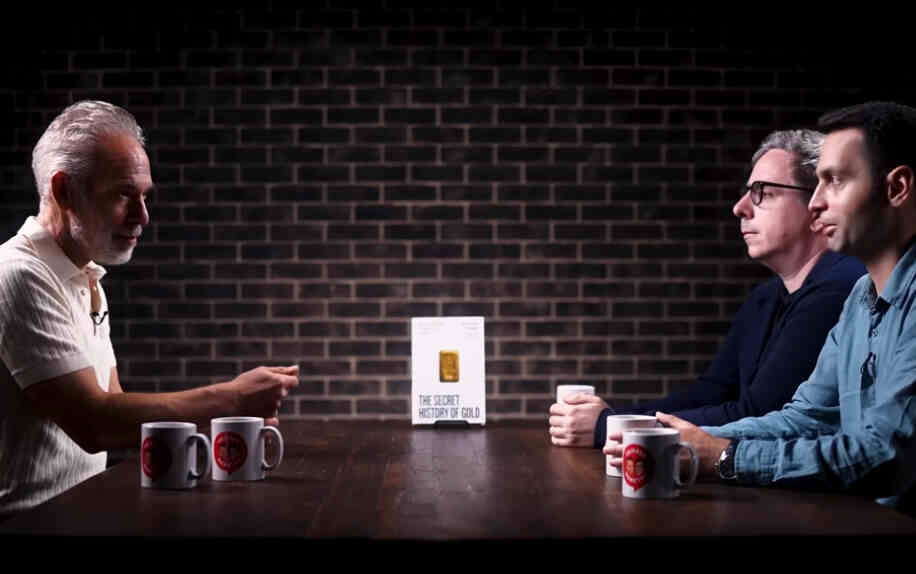
Read the full transcript of author and financial commentator Dominic Frisby’s interview on TRIGGERnometry Podcast with hosts comedians Konstantin Kisin and Francis Foster on “Why Your Money Buys You Less Every Year”, October 12, 2025.
Welcome Back to TRIGGERnometry
KONSTANTIN KISIN: Dominic Frisby, welcome back to TRIGGERnometry.
DOMINIC FRISBY: Thank you very much, Konstantin. Thank you, Francis. Pleasure to be here.
KONSTANTIN KISIN: It’s great to have you back. A third interview with you. We talked about taxes and bitcoin in the first one. I think we talked about something very personal to you and your family in the second one, which was really great. And this one, we want to talk about gold, money, tax. And I saw a perfect quote on my way into work this morning, which I just thought sums up the conversation we’re about to have beautifully. It’s apparently misattributed to lots of people, but I’ll read it to you anyway.
DOMINIC FRISBY: All the best quotes are, a democracy.
KONSTANTIN KISIN: “A democracy cannot exist as a permanent form of government. It can only exist until the majority discovers it can vote itself largesse out of the public treasury.” And it’s attributed to Scottish historian Alexander Fraser Tyler.
But the reason I bring it up is I actually think since we’ve gone off the gold standard, which is really what we want to talk about, partly is it’s actually worse than that. Because not only can we now vote ourselves largesse out of the public treasury, we can vote ourselves to magic money out of thin air and then be converted into largesse out of the public treasury. And that’s kind of where we’re at, isn’t it?
How Governments Create Money
DOMINIC FRISBY: It is. There are two ways by which a government makes money, and one is by extracting it from the taxpayer, and then the other is through various means, printing money effectively, quantitative easing, and so on. I suppose there’s a third way, which is by selling bonds. And when you issue debt, which would be selling bonds, you create money that way. So that’s the third way.
KONSTANTIN KISIN: Yeah. And so how does the history of gold with the Secret History of Gold is the title of your latest book. How does the history of gold and us coming off the gold standard play into all of this?
DOMINIC FRISBY: Well, when gold was money, the only way you could create money or create cash was by mining gold, which is an extremely dangerous and expensive endeavor. But now that money is not in any way tied to gold, there are all sorts of other means by which we can create money.
And so since the sort of the final vestiges of the gold standard were abandoned in 1971, the gold standard actually ended sooner than that. But let’s use 1971 as a date. And if you just look at the supply of money since 1971, it has ballooned and ballooned and ballooned.
And at the same time, the more money there is chasing the same amount of goods or a marginally increased amount of goods, it just means prices go up and up and up. And so if you’re looking to try and understand why it is that things are so much more expensive today than they were 10 years ago or 15 years ago or 50 years ago, the answer is that there is very little stopping money creation.
The Real Cost of Inflation
KONSTANTIN KISIN: And is that actually true, Dominic? When you say things are more expensive, a lot of people will assume, well, salaries have gone up, cost of things has gone up. You know, it’s inflation. Your salary went up, the cost of things went up. You’re kind of where you were. Where are we on that front?
DOMINIC FRISBY: Well, I’m glad you brought that up because there’s a whole chapter in my book on that. And I present a table of prices in 1970 compared to prices today. And if you look at prices in the UK, things have actually gone up by twice as much in the UK as they have in the US. And the reason for that is that the pound has been roughly twice as weak as the US dollar. But it doesn’t matter if you’re in the US or the UK, the price of everything, almost everything, has gone up.
KONSTANTIN KISIN: Relative to earnings.
DOMINIC FRISBY: Relative to earnings? Well, it’s slightly more nuanced than that. But yes, the only thing that’s come down in price, or one of the few areas that’s come down in price is phone calls. If you might remember when you were a kid, you’re too young, but you used to put 10p in the…
KONSTANTIN KISIN: I remember this very well. Thank you for three minutes for a local call.
DOMINIC FRISBY: And now you can have a video call to anywhere in the world for nothing. So what you’re seeing there is the deflationary effects of improved productivity. Because we’ve got so much better at this technology, the price has fallen to practically zero. And the only price you pay is your data, which is a whole new currency in and of itself. Data as a thing didn’t exist in the way it does 50 years ago.
So I’ve got my book here with the stats here. Salaries have more or less gone up by, in the UK by about 20 times since the 1970s. And if you look at a chart of salaries, just salaries go up and up and up every year. So we should be earning more and more money.
But if you look at salaries measured in gold, they’ve actually been falling since 1970. So measured in gold, we’re earning less than we’ve ever earned. And gold is the stable form of money that’s existed since before the earth. And obviously fiat money, the pound, the dollar, is not a stable form of currency.
But so 20 times salaries, 20 times as much.
And that’s why in the 1970s, a guy on an ordinary salary could afford a house. Now it takes two salaries and shed load more debt. And the reason for that is that we use mortgages to buy houses. And mortgages allow for the creation of huge amounts of money.
And if house prices were just a cash market, you couldn’t borrow money to buy houses. They’d be much more closer to what people earn. But with the creation of debt, it just enables way more money to come into this market. And that’s pushed house prices up and up and up.
If you look at a washing machine, for example, that’s only maybe four times as expensive as it was in 1970. And that’s because we don’t use debt for the most part to buy washing machines. And in fact, washing machines have got better and the improved productivity, outsourcing to China, all those things have brought down the price relatively of washing machines. So relative to earnings, washing machines are much cheaper than they were in 1970.
Now you’d think cars, the same logic would apply to cars that it does to washing machines. But cars are actually 30, 40 times more expensive than they were in 1970. Now obviously cars are a lot better. They’ve got five gears and air conditioning and amazing stereos and much better technologically, much better, even if they’re less stylish than they once were.
But the reason why cars have gone up by so much more is we use debt for the most part to buy cars. Finance pays a huge part, especially new cars. And so that means more money gets created and that pushes the price of these things up.
If you look at something like eggs, or maybe not eggs aren’t a good example because of what’s happened with eggs in the U.S., but milk, say, milk is only maybe five, 10 times more expensive than it was in 1970 because we’ve got better at making milk, mass production farming.
KONSTANTIN KISIN: So if salaries have gone up factor 20, milk’s become cheaper effectively, right?
DOMINIC FRISBY: Yes. And what is a pint of milk today? 60, 70p. It’s pretty cheap for what it is given. I bought a pineapple, very good example, pineapples. I bought a pineapple in my co-op the other day for £1.50.
And you just think it takes two years to grow a pineapple in Costa Rica, all that farming, it’s got to be farmed, then you’ve got to ship it, get it all the way across the Atlantic, and at every step of the way somebody’s making money. And I’m buying a pineapple for £1.50. It’s quite incredible.
Once upon a time, pineapples were a symbol of wealth. People used to have them on the top of the Wimbledon trophy. You look, there’s a little pineapple. It’s a symbol of, they’re expensive. But because mass production and everything has brought down the cost of pineapples and it’s a cash market.
So if you want to make a fortune, go into a business where people use debt to buy the product that you’re selling and make more money.
Understanding the Gold Standard
FRANCIS FOSTER: Dominic, I think it’s very important for people who aren’t as okay with these terms that are being used in this interview that we kind of explain it and explain some of these terms and why it is that they’re so significant. So we talked about the gold standard.
DOMINIC FRISBY: Yeah.
FRANCIS FOSTER: For a layman, what is the gold standard? And why was it so catastrophic that we left it? And why did we leave it as well?
DOMINIC FRISBY: So here, I’ve got in my pocket…
KONSTANTIN KISIN: Oh, thank you.
DOMINIC FRISBY: Some gold and silver. There’s a silver dollar that used to be. You can have the silver dollar.
KONSTANTIN KISIN: Why am I getting the silver? I’m the Jewish one. Here, give me the gold. There we go.
DOMINIC FRISBY: There’s a Victorian sovereign, by the way.
KONSTANTIN KISIN: Can I just say, Dominic, before you actually answer the serious question? So I bought some gold recently, right? It is on your advice, by the way, Polly. It is the most disappointing experience ever because you’re like, do you know how this tiny little coin is like £600? Yeah.
And you, in your head, you’re like, oh, I’m going to get some doubloons out of those pirate stories. I’m going to bite into it. It’s going to be thick, it’s going to be meaty. You get this bloody 5p coin type of thing, or 2p coin, more like. And it’s £600.
DOMINIC FRISBY: Yeah, it’s about a quarter of an ounce. There’s one for you, Francis.
FRANCIS FOSTER: Thank you, mate.
KONSTANTIN KISIN: Disappointing.
FRANCIS FOSTER: But this one’s nice, but they’re surprisingly heavy.
DOMINIC FRISBY: Yeah, they are. It’s a very dense metal, but what you’re holding there is the old pound coin.
FRANCIS FOSTER: Wow.
DOMINIC FRISBY: And this was…
KONSTANTIN KISIN: Oh, really?
DOMINIC FRISBY: Yeah.
KONSTANTIN KISIN: This is for our American viewers. The new pound coin is a chunky, chunky, chunky, heavy coin.
DOMINIC FRISBY: It takes 650 pound coins to buy the old pound coin. And that’s how much currency has been debased.
KONSTANTIN KISIN: Wow.
The History of Gold Coins
DOMINIC FRISBY: And the gold sovereign was brought into currency in 1816 after Napoleonic wars, and it was the pound coin. And this is the most successful coin in history. Something like billions of these coins have been printed. And now the biggest market for gold sovereigns is Delhi, India. That’s where the most of them get manufactured.
But yeah, that is the old pound coin. And what I’ve got here, that you can have a look at here. Now, this is a Justinian solidus. So this was the dominant coin of Byzantium, the old Roman Empire, and that was minted in 600 AD. But just look at how similar it is to the…
KONSTANTIN KISIN: Yeah, to the gold. It’s a little thinner, but it’s…
DOMINIC FRISBY: A little thinner, it’s a little lighter.
KONSTANTIN KISIN: Yeah.
DOMINIC FRISBY: The sovereign would be about 7 grams and that would be about 4 or 5 grams. And the… but the difference, the sovereign has got a tiny bit of copper mixed in it to make it harder. Whereas that one is…
KONSTANTIN KISIN: You can tell it’s soft.
The Eternal Nature of Gold
DOMINIC FRISBY: Yeah, it’s solid gold. And that’s the solidus and Italians call money soldi and that comes from the Roman solidus. And it’s beautiful. Now if you see Olympic gold medalists, when they get the thing, they bite their coin. And that’s because if it was solid gold, you’d bite the coin and you’d use your mouth as a clamp and you could bend the coin slightly and if the coin bent, you’d know it’s solid gold. So that’s why pirates always bite coin. It’s a crude test of the metal’s purity.
And I don’t know if this is going to work, but I’m just going to flip it here. Oh, let me do that again. I’m just going to flip it here and hopefully you heard that there was a very familiar ring. When you flip a gold coin that’s solid gold, it makes that unique ring.
Now here’s, I’ve got sidetracked from the gold standard, but I’ll come back to in a sec. Here’s quite a profound thought. So this is maybe 1,500 years old and you can see it’s still shiny. Now, gold never loses its shine. And then you think, if you argue about when gold was created, one worldview is that gold was created through divine intervention, but the other, the scientific explanation is that gold was created when there are interstellar collisions in outer space. And it was one into the collisions between stars and in the resulting nuclear explosions, the gold dust gets dispersed into the atmosphere.
And then gradually that gold dust compressed through accretion collision, asteroids colliding. And that’s how the planets formed and that’s how gold made its way into the Earth’s crust. Now, you cannot destroy gold. You can’t. The only ways is through nuclear explosions. It is permanent. You can put gold like that, put it in the Earth, dig it up a thousand years later and it will be exactly as it was. No rust, no tarnish, nothing. It will still be shiny.
I can batter it into a leaf that’s just one atom thick. I could stretch the gold in this coin maybe into a wire maybe half a mile long, but you cannot destroy it. So it’s incredibly malleable, but it is permanent. Now, if you cannot destroy gold and gold was made before the Earth was formed in interstellar collisions in outer space, that means that this little bit of gold here, and you can both hold a little bit of gold, as I say this, this little bit of gold here is not just older than the Earth itself, it is older than the solar system.
Do you not find that quite profound? So to touch gold, to handle it, is the closest you will ever come in your entire life to touching eternity. And I find that a very profound thought. And you think, what is eternity? It is this ethereal, this spiritual thing. But what you’re actually looking at is the most analog, physical, immutable, nothing asset in the world. It just is, never changes.
And that’s why gold makes such a fantastic form of money, because it’s permanent, because it’s constant. And when I say money in this sense, I’m talking about the store of value side of money, not the medium of exchange. As it happens, gold is not a great medium of exchange because as you say, you know, 650 quid in a tiny coin like that, it’s not very good for buying milk or something like that. And that’s why as a rule, we’ve tended to use silver and copper and nickel as our day to day medium of exchange.
But as a store of value that, like long after human beings have shuffled off their mortal coil and left this earth, long after digital technology is in the past and Bitcoin is history thousands of years in the future, this piece of gold will be there exactly as it was.
And the other very profound thing to think is every time, like for example, when the conquistadors went into South America and stole all the South American were brilliant artisans and they made beautiful art out of their gold jewelry. And all the people who wrote about it said they were better artisans than the Europeans were. And the Spaniards just melted down the gold and sent it home. And some of the art they sent home and then once it got back to Spain, they just melted it down.
And that’s the tragedy of art made of gold is people always melt it down. It’s not just the Spaniards, it’s everyone who’s ever looted gold throughout history. But it also means that this piece of gold before it was a, this is a Victorian sovereign that’s maybe 150 years old before it was a Victorian sovereign. What, you know, this gold might have been handled by a Roman senator. It might have been, you know, it’s, well actually this gold, it wouldn’t have happened to this gold.
But you know, it’s known that some of the gold that’s sitting in gold bars in central bank vaults was at one point dentures in Jewish people’s teeth in concentration camps. And the Nazis would rip the gold out of their teeth and melt it down and send it off to Switzerland. You know, it’s horrible, but it just, you melt down, once you melt down gold, you don’t know what its provenance is. So you just don’t know. This gold has seen everything and you just don’t know what it’s seeing. It’s quite an incredible metal in that regard.
KONSTANTIN KISIN: So come back to the gold standard because you’ve kind of explained why gold has been a currency throughout history and explain why changing that setup is part of the reason why we are where we are.
The Gold Standard and the Cost of War
DOMINIC FRISBY: So the war was always a very good business model. In ancient times, you would conquer a country and you would take control of the land, the labor, the profit, the produce. You take control of the tax base. So you’d plunder and then you would tax. And it served the Romans very well. It served Alexander the Great very well. It’s just been a brilliant war model, but wars are also extremely expensive.
And so, for example, we were on the gold standard in the 18th century. Isaac Newton, great physicist, it’s not known about him, he also designed the gold standard. And we were on the gold standard, but we were trying, we were sending money overseas to prop up Napoleon’s enemies, to give them money. And it was known as the golden cavalry of St. George because we sent all our sovereigns overseas with the image of St. George and the dragon. You can see he’s on the, it wouldn’t have been sovereigns, it would have been guineas back then.
And we sent so many of them abroad, we had no gold left. And so we actually came off the gold standard in 1798 because the Bank of England could not afford to redeem its notes. If people came in with paper, the Bank of England couldn’t afford to give out gold in exchange. We came off the gold standard, went back on it again in 1816, and that gold standard lasted all the way through the 19th century until 1914.
And if you actually look at consumer prices again, we can show a chart up on the screen now. If you look at consumer prices in the 19th century, they came down by more than half. So over the course of the 19th century, if you were a wage earner by the end of the century, they went up in the Civil War and then they came back down again. Your money bought you more as time went by, unlike now, where your money buys you less and less each year.
So the whole dynamic of working and saving and investing future totally changes when you have sound money, because people know that when you expend energy to get this money’s like stored energy. You expend energy to earn it and it will keep its energy and you can spend it at some later stage. If it loses its energy, the nature of society changes.
1914, First World War, the French and the German governments stopped. When we went to war, they stopped redeeming their paper for gold. So they came off the gold standard. The English actually stayed on the gold standard, but they took gold out of circulation and the Bank of England redeemed a little bit, but we fudged and eventually we actually came off the gold standard, I think 1919.
So it meant that if you had a pound note, “I promised to pay the bearer.” And at one point you could redeem that pound note for gold. They stopped redeeming it for gold. So the money was unbacked. And they printed the money they needed to pay for the World War, that First World War. If those countries had stuck to the discipline of gold, in other words, they could only spend as much money as they had gold in their vaults, that war could not have happened to anything like the extent that it did.
And in my view, the beginning of the end of the west began in 1914 or beginning of the end of Europe. You know, it’s been downhill relative to the rest of the world ever since. And you just think of 50 million, if you include the Spanish flu that followed, 50 million people died. And it was enabled by coming off the gold standard. If we’d stayed to the discipline of gold, there just would not have been the money to pay for that war to go on to the extent that it did. And I find that a profound thought.
Anyway, after the war, everyone thought they could, we could just return to the gold standard and things would be as they were. And Britain was anxious to be the first country that rejoined the gold standard. And the pound was strong for various reasons in the foreign exchange markets. And in 1925, we went back on the gold standard at the pre-war rate and we just issued so much paper by that point, it just was not feasible to go on at the pre-war rate. But it was like a flex. Look at us, we’ve gone back on the pre-war rate and other countries followed.
So that by 1932, most of the world was on a gold standard again, but the gold had been removed from circulation. So we were nominally, Britain was nominally on a gold standard, but there were no gold sovereigns. In the 19th century, gold coins were trading. You know, people were handling gold. There was just no gold in circulation. There was a fake gold standard. It’s like a library. Oh, yeah, but you can’t touch the books, that kind of thing.
Anyway, with the Wall Street crash and the deflation that followed the Wall Street crash, pretty much every country was forced off the gold standard in the 1930s, except for America and what Roosevelt did with his New Deal. And I don’t know if you know this little bit of history, but when he came to power, he hadn’t mentioned gold in his manifesto. When he came to power, it became illegal for Americans to own gold. American citizens all had to hand in their gold. And it didn’t matter if it was monetary gold or like, you know, collector’s item gold. They all had to hand in their gold.
FRANCIS FOSTER: Gold jewelry as well?
DOMINIC FRISBY: Maybe not, I’m not sure.
KONSTANTIN KISIN: I can’t imagine they were like confiscating wedding rings, right?
DOMINIC FRISBY: No. It seems bizarre. Maybe, and I can’t believe Americans didn’t own necklaces all through the 20th century.
KONSTANTIN KISIN: Yeah.
DOMINIC FRISBY: Any rate. So it was all gold. It wasn’t jewelry. But Americans, and it was all believed to be a temporary measure. And so Americans all handed in their gold and then Roosevelt devalued the dollar by 40%. He gave him dollars in exchange and then devalue the dollar. So effectively he stole 40% of his people’s wealth. And Americans were not allowed to own gold again until 1975.
FRANCIS FOSTER: Wow.
The End of the Gold Standard
DOMINIC FRISBY: They just were not allowed to. So America was on the gold standard, but American citizens couldn’t own gold. Now if you go back to ancient Egypt, gold was a royal prerogative. Only the pharaohs and the royal family could own gold. Ordinary citizens couldn’t own it. It was the same in the 20th century. The state could own gold, but ordinary citizens couldn’t handle it, couldn’t own it. And so the gold standards of the 20th century were sort of fake gold standards because, as I say, ordinary people weren’t actually owning gold.
But in any case, the final gold standard, the last vestiges of the gold standard were abandoned in 1971. That was when the U.S., after the Second World War, the U.S. dollar became the global reserve currency. The U.S. dollar was backed by gold and other countries had to tie their currencies to the US dollar. So it gave the US this extraordinary status, what the French called America’s exorbitant privilege.
And ever since then, ever since 1945, America has used its dollar as a weapon of war or a tool, if you like. Money’s become a political tool. And in fact, it’s not just America. Every country in all history has done it. But in the case of America, we print money in the UK to cover a deficit. If the government’s spending more money than it has, it’ll print money to make up the difference or issue debt to make up the difference. So in that sense, it becomes a political tool, as the premise of this conversation.
But America also uses it. Money always gets used as a weapon of war. So for example, in the American Revolution, the British issued loads of counterfeit American notes and spread them throughout Europe. The Nazis created loads of fake pounds during World War II and spread them around Europe to attack the money. When Putin invaded Ukraine, shortly after that, the US confiscated all of Russia’s US dollar assets. So it was used. And it banned Russia from SWIFT, which is the global banking system, the system of transfer.
So it used its dollar as a tool of war against, even though it wasn’t at war with Russia, it used its dollar as a weapon of war against Russia. And in fact, we can talk about this in a minute. That system may backfire against America because it changed the nature of gold flows. But we’ll come back to that in a minute. But yes, so I hope I’ve answered your questions about coming off the gold standard.
FRANCIS FOSTER: So 1971.
DOMINIC FRISBY: Yeah.
FRANCIS FOSTER: America came off the gold standard. Why was that? It wasn’t just Vietnam. Vietnam obviously played a hugely significant part in it because it was a very expensive war, as all wars are, but Vietnam particularly so. But there was another reason, wasn’t there, Dominic, why it came off the gold standard?
DOMINIC FRISBY: Johnson’s welfare?
FRANCIS FOSTER: Yes.
Vietnam War and Welfare Programs
DOMINIC FRISBY: Yeah. Okay. America was basically spending way more money than it had, and it didn’t have the gold to back all the US Dollars that it had printed. And it was spending money on the war in Vietnam and on President Johnson’s expansionary welfare programs. Now why did he do those welfare programs? To win votes, to make himself popular. It’s exactly the thing that we talked about at the beginning of the program.
But eventually countries started going, you haven’t got the dollars to, you have not got the gold to back the dollars that you have printed. And the sort of ringleader in all this was Charles de Gaulle. And at one stage, the French actually sent two warships to New York to collect their gold. Can you imagine sending warships to New York in today? Just wouldn’t happen.
But anyway, it created this run on the dollar. And so America was sending gold over to the UK to redeem against its dollars. The UK London was at the center of the gold markets at this point. And at one point, there was so much gold had been sent to the UK that the weighing room floor of the Bank of England collapsed under the weight of all the gold. And eventually it was like, we can’t keep giving out the gold. So they came off the gold standard in 1971.
Now the big question is America’s supposed to have 8,000 tons of gold, but that gold has not been audited in over 60 years. There’s been internal audits, but there has been no public audit of that gold. So the big conspiracy is that America does not have the gold that it says it does and it says it has 8,000 tons, but who knows if it’s there? And when Trump was elected, both Trump and Musk said we’re going to audit the gold. We’re going to audit the gold. And Elon Musk was talking about having a live stream of the auditing of the gold. Story’s gone. What happened?
FRANCIS FOSTER: And so why is that particularly pertinent when we look at the world now that America doesn’t have the gold that it says it does?
DOMINIC FRISBY: Because, well, originally it mattered because the US dollar was backed by gold.
Understanding Reserve Currency
KONSTANTIN KISIN: Dominic, maybe sorry to interrupt, but you might be worth explaining what a reserve currency is before we go anywhere.
DOMINIC FRISBY: Okay. Well, it’s basically the most important currency in the world and it’s the currency that’s used for major international trade. It’s the major currency of banking. If you look at the money that each central bank around the world holds, roughly, it’s roughly 50%, it’s just slightly below 50% of all central bank holdings around the world are US dollars. So it is the primary currency of the world.
KONSTANTIN KISIN: Putting it simply, if a Sri Lankan wants to trade with a Moroccan, they’ll use US Dollars. They’ll convert both their currencies into dollars and trade and then convert them back. Well, I’m simplifying. Yes and no, but effectively they will use the dollar to do business in because it’s the most relied upon currency in the world. And partly that’s because it’s supposed to be sound and it’s backed by the U.S. government.
DOMINIC FRISBY: And it’s backed by the U.S. military as well. But it gives America enormous power. But every great empire in history, whether it’s, here I’ve got the coin of Alexander the Great, that’s a silver tetradrachm, that’s several thousand years old. And that was even before they were putting, that’s Hercules on the back. It’s not even Alexander the Great, they weren’t even putting ruler’s heads on coins at this point.
But every, whether it was the Greeks or the Romans or the British or every major empire in world history, their money has been the global reserve currency. And now obviously America is the world’s great superpower and China is rising and we’ve got this big rivalry and at some point there will be some kind of currency war between the two.
The Importance of Gold Reserves
FRANCIS FOSTER: So that being the case, why is it so important that America doesn’t have the gold that it says it does? Why is that potentially catastrophic?
DOMINIC FRISBY: Because even though the gold doesn’t actually back the US dollar, it is America’s primary, America doesn’t have any minimal amounts of foreign currencies. It doesn’t hold. So something like 70 or 80% of US foreign exchange holdings, its entire bank reserves are in gold. They’re in no other currency. Whereas the UK, I don’t actually know what the UK’s allocation is, but we have a tiny amount in gold and huge amounts of US dollars, US Treasuries, Euros and other currencies.
But it basically means that America has been lying for the last 65 years. And there’s a very important, we were talking before the interview began about, if a government can print money, why does it need to tax people? If it can print money, why does it need to collect taxes? And there’s a very good reason. It’s called money illusion. Even if there’s nothing actually backing the money, we have to think that there is something backing the money for it to work. And so money illusion affects us all.
And if America does not have the gold that it says it does, the illusion of the US dollar is dramatically shattered. And if at the same time China comes along and says we’ve got five times as much gold as we said we did, then suddenly China has a real tangible backing to its money, just as America has none.
And there’s a joke that I like, the head of security goes to the US President and says, “Mr. President, there’s no gold in Fort Knox.” And the President says, “What do you mean there’s no gold in Fort Knox?” And the head of security says, “There is no gold in Fort Knox.” And the President says, “Double the guard.”
FRANCIS FOSTER: Sure, go for it.
DOMINIC FRISBY: No, you go.
FRANCIS FOSTER: No. So I think it’s very important as well that you raise China. Because let’s say if America are bluffing and let’s say we don’t know that they have more gold than they’re pretending and they say they do. China has taken the opposite tack, haven’t they?
China’s Gold Strategy
DOMINIC FRISBY: Yes, potentially. Not potentially, certainly. By the way, my own view of what America’s gold situation is is that I think America has most of the gold that it says it does, but it is not of good delivery quality. So today gold bars have to be of a certain weight and a certain purity to be traded on the metals exchanges. And most of America’s gold, if they remelt, you need to re-smelt it every so often and check for purity, most of America’s gold will be the gold coins that it confiscated from its people in the 1930s. And that is only about 90% pure. So it just won’t be of what would be called good delivery quality. So that’s another issue in itself.
But then China says it has 2,000 and several hundred tons. And this is every month China declares its gold holdings, and they’ve increased by 50 tons or something or 20 tons each month. And it says it has 2,000 tons compared to America’s 8,000 tons. I’m using round numbers. It’s slightly more than that.
But China has been the world’s largest producer of Gold since 2007, okay, overtook South Africa to become the world’s largest producer. And almost well over 50% of Chinese gold production is state owned. And it is illegal to export gold from China unless it’s jewelry. But if you look at jewelry, it’s a net importer of jewelry, so it doesn’t export any of the gold that it mines.
So we know that from geological records that some 7,000 to 8,000 tons of gold has been mined in China since 2000, and it says it only has 2,000. We also know that China has been buying vast amounts. It’s also the world’s largest importer of gold, as well as being the world’s largest producer. And it has been the world’s largest importer for maybe 20 years.
And if you look at the Shanghai Gold Exchange, most of those gold imports are not transparent. They go through Dubai, go through Switzerland, they go through London. They’re private. They’re not declared. Some of the stuff that goes through Hong Kong gets declared. But you can look at the Shanghai Gold Exchange and look at withdrawals from the Shanghai Gold Exchange and you can get a rough idea of how much gold has gone to China. Even though not all the gold that goes to China goes through the Shanghai Gold Exchange. The gold that the People’s Bank of China buys through Switzerland and Dubai does not get declared.
But we know that over 22,000 tons of gold has been redeemed through the Shanghai Gold Exchange since it was formed in 2007. So that’s 22,000 tons redeemed there and 7,000 to 8,000 tons of production. That’s 30,000 tons compared to America’s 8,000 tons. Now, let’s just say for the sake of argument, that 50% of that gold has gone into state hands. That would mean that China has 15,000 to 16,000 tons of gold.
KONSTANTIN KISIN: Hold on, Dominic. Presumably a lot of this gold is being used in manufacturing production, all of these other things. No, but there’s gold in everything, isn’t there?
DOMINIC FRISBY: No, gold has some industrial use, but it’s just minimal. It’s like 3%. And unless you include jewelry, which, okay, so I accept you. But in terms of industrial uses of gold, it does have them. Outer space, in your teeth, nanoparticles in medicine, there are a few. But it’s just in the context of most people buy gold to either wear it or hoard it. Okay. That is the main reason.
KONSTANTIN KISIN: The Chinese do love jewelry, though.
DOMINIC FRISBY: They love jewelry, right? They love. So.
KONSTANTIN KISIN: So I think the numbers are probably not entirely as extreme as well.
DOMINIC FRISBY: No, they are. I’ve said 50%. I’ve said at least 30,000 tons of gold has made its way to China. It’s probably more like 40,000.
KONSTANTIN KISIN: Okay.
DOMINIC FRISBY: Has made its way to China. And I’ve just said just assume that half of that has gone to the state and half of that has been accumulated by citizens. But even if you just say it’s a quarter. So if it’s a quarter of 30,000 tons, it still means that China has more gold than the US does. And it means that China has understated its gold reserves by a factor of four.
KONSTANTIN KISIN: Why would it do that?
DOMINIC FRISBY: Because the way that China operates, it’s basically like we know how ambitious China is and its rightful places at the top of the world, because Chinese people are better than you and is very, very ambitious. And part, it’s not just that it wants its currency to be the global reserve currency. It sees it as its destiny, its right, its rightful place in the world.
And there has never been a global reserve currency that did not start out backed by gold and sometimes silver. It has just never happened in history. They all got debased into oblivion. But they all started out backed by gold and silver and right from Alexander the Great and wherever right through to the pound and then the dollar. They all started out backed by something tangible because that’s what makes the currency a real thing in the first place.
China’s, and it’s not just China, but it’s all the countries along the Silk Road. The accumulation of gold by those central banks accelerated in the months after America confiscated those Russian assets. So all those central banks looked at what happened. They looked at how overweight they all are US Dollars. They’re not necessarily enemies of America, but they’re not allies of America either. And they’re going, we are in, when we’re using US dollars and we’re beholden to US banking system, we are beholden to the US so we need to diversify.
Now, it might just be simple diversification that they’re increasing their gold holdings. That’s the Occam’s Razor explanation. Or it might be that they’re planning something bigger, or it might be a bit of both. But in any case, China has understated its gold holdings by it could be as much as 10 times. It’s probably more like three, four, five times, something like that. But for sure they have not declared all their holdings.
Now you ask why would they not do that? Because to turn around and China and go to the US, “Oh actually we’ve got more gold than you,” and America is the biggest holder of gold in the world, “We’ve got more gold than you and you haven’t audited your gold.” That’s, it’s tantamount to a declaration of financial war. It’s a hugely aggressive thing to declare.
And the Chinese modus operandi is we must not shine too brightly. And it’s quite happy to let the west destroy itself as it carries on doing. Doesn’t need to get involved in a conflict. It just keeps making stuff and selling it and its empire grows. So that is its modus operandi.
But if they ever go into conflict, you can be sure that China will use money as a weapon of war, just as America does. If those two ever get into conflict and China goes, “Yeah, our gold holdings are 10 times what we said we were. We’re going to back the yuan with gold. Anyone can exchange their yuan for gold at any time. The US dollar doesn’t have the gold that it says it does.”
You know, if China makes those declarations, the US dollar, the value of the US dollar falls rapidly and the value of the yuan increases rapidly. It’s an extremely aggressive thing to do. The price of gold goes through the roof means that it’s more expensive for China to accumulate. It’s just not ready to do that yet. It will happen at some point, but it’s just not ready.
And by the way, I think this is the biggest story in world finance and China’s accumulation of gold and nobody is looking at it. It’s that big. Why is China accumulating all this gold? It’s obvious what it’s doing and why are you just turning a blind eye to it? Because we’re too busy with all our various infighting about this, that and the other issue.
But at a certain point it will matter. And he who has the gold makes the rules. And China will have the gold. China already does have the gold. And America meanwhile, won’t even have a public audit of its gold. The most likely explanation is that it’s not because gold is not of good enough quality to have that public audit.
China and Russia’s Gold Accumulation Strategy
FRANCIS FOSTER: And what’s also interesting is China is not the only one hoarding gold. I think Russia is as well. You mention it in your book.
DOMINIC FRISBY: Russia accumulated extraordinary amounts up until maybe 2019, 2020, and then it’s, I don’t quite know why, but it stopped accumulating. But Russia’s production is huge. I think it’s third or fourth largest producer in the world. Maybe second. No, Australia’s second. So China will, like Russia, will likely have more gold than it says it does.
And interestingly, some hackers discovered two or three years ago, and this was, you know, a story in the Telegraph and so on, is again one of these stories that’s right there for everyone to see and everyone ignores it. It bought drones off Iran to pay to use in the war with Ukraine. And it paid for them in gold because both Russia and Iran, you know, they’re shut out of the financials, they shut out of Swift.
So it flew several tons of gold to Iran to pay for those drones. I mean, that’s, you know, that shows how gold is, you know, money of last resort. It’s totally impractical to be flying tons of gold every time you want to make purchase, but, you know, that’s a last resort kind of purchase. But it shows you know what is going on behind the scenes.
KONSTANTIN KISIN: Imagine having a personalized health blueprint, a plan built just for you based on exactly what your body needs. That is what Superpower delivers. Their goal is to help you reach your full hundred year potential. Here’s how it works. A licensed professional comes to your home or you visit a nearby lab for a single lab test that looks at over 100 biomarkers. Heart, health, liver function, thyroid, hormones, metabolism, vitamin and mineral levels, and even environmental toxins.
Check it out at superpower.com. Have you ever left a doctor’s appointment feeling like you got nothing useful? Maybe they just said you’re fine or told you to drink more water. No real data, no game plan, just a pat on the back. That is where Superpower comes in. The results are not just numbers on a page. Superpower turns them into a personalized action plan with targeted supplements, nutrition and lifestyle changes. You can start right away.
You will even learn your true biological age and how to improve it. Each year you build on your data, seeing exactly how your choices are shaping your long term health. Normally it’s $499 but right now it’s just $199 for the full test and plan, which is far less than what other services charge for less comprehensive results. Visit superpower.com to learn more and lock in the special $199 price while it’s still available. When you sign up they will ask how you heard about them, so just say trigonometry. That site again is superpower.com.
Gordon Brown’s Gold Sale Disaster
FRANCIS FOSTER: And what’s really interesting is at the time China is hoarding gold, Russia until recently is hoarding gold.
DOMINIC FRISBY: It hasn’t sold. It’s not selling its gold, it’s just not accumulating at the same rate.
FRANCIS FOSTER: It’s not accumulating fair. Then I read about Gordon Brown and I’m going, well then why did Gordon Brown sell our gold reserves? And I’m looking at the league table of gold reserves. I think we’re 18th. I’m going, well, I’m not an economist but this seems demented, doesn’t it?
DOMINIC FRISBY: Oh, it was one of the worst decisions ever made in all history. You know, we have a long history of financial blunders in the UK made by our leaders but that ranks up there with the top of them. And he sold it right at the bottom of the market. And in fact he’s, and there’s again some say he sold it to, there’s various conspiracy theories, some say he sold the gold to bailout Goldman Sachs and various other banking things.
The more likely explanation is, and the given explanation at the time, it was done to diversify our assets and he failed to, he thought the Swiss were about to sell their gold and he wanted to sell before the Swiss did because he was front running the Swiss. As it turned out, the Swiss never sold their gold.
But yes, I mean he sold two thirds of our gold right at the bottom of the market and, you know, every time the gold price goes up, somebody is tweeting, “This is how much Gordon Brown lost us by selling us.” You know, it’s lived to haunt him for the rest of his life. But it was a terrible decision and a strategic, a short term strategic decision. You know, he didn’t need to do it, he was under no pressure to do it. So why did he do it?
The other countries by the way, that are in, you know, you mentioned that we’re 18th on the league table. I’ve got the league table somewhere in the book. But you look at the country 16th, 17th, it’s like Kyrgyzstan and Tajikistan and countries like that. And it’s all countries in the Shanghai Cooperation Organization, which is this trading block set up. China, Russia and basically most of Asian countries, they are all increasing their gold holdings and they are at the same time de-dollarizing is the expression. So reducing their US dollar holdings.
Now, again, it might just be diversification, but I think there’s something bigger at play. And all these countries are trying to create a payment system that bypasses the US dollar. They haven’t quite cracked it yet.
The Impact of De-Dollarization
KONSTANTIN KISIN: And what would be the impact on that for the ordinary person in Britain and America if actually these countries are attempting to effectively stop the US dollar being the world’s reserve currency, what would that mean for us?
DOMINIC FRISBY: In my newsletter, for years I have been urging everyone to accumulate gold and bitcoin. I know a lot of people don’t like bitcoin, particularly the over 50s don’t like it. But they are two proven non-government forms of money, non-government currencies. And you know, governments can debase the dollar, they can debase the pound, they can debase the euro, they can print it, they can do whatever inflation. It’s, you know, they say it’s 4 or 5%, but we all know it’s much higher than that, real inflation.
And in fact, inflation used to mean you inflate, you blow up the money supply with the consequence of higher prices. Now it just means higher prices and they cut out what caused it in the first place, blowing up the money supply. But gold and bitcoin are both forms of money that they cannot debase.
And I cannot help thinking they’re both going to have a very important role to play in the future, not just as speculative assets, but, you know, gold will be your lifeboat. And bitcoin is obviously a digital asset. There are advantages to digital assets. Gold is as analog a physical asset as you could ever have.
But you know, if our currencies lose their purchasing power, and I don’t, I’m not one of these guys who goes, “You’ve got to protect gold. The dollar’s going to collapse.” There is maybe a 20, 25% chance of that happening. There’s a very real chance. And particularly if we ever get into some kind of conflict with China, they will attack the money. And gold and bitcoin, monies they can’t debase, will protect you.
And so I urge people, readers, I urge everyone to accumulate gold and accumulate Bitcoin for those. You’ll be very glad at some point in the future that you own them.
The Real Rate of Inflation
FRANCIS FOSTER: You said something very interesting there where you said inflation is at 4%, but we know it’s much higher than that. Why do we know it’s much higher than that? And what do you think is a real rate of inflation?
The True Rate of Inflation
DOMINIC FRISBY: Well, I think a much fairer rate of inflation is just look at global money supply and it’s 7%. Money supply growth around the world is about 7%. It got up to about 10% during COVID with all the stuff they printed. I think even 12% at one point. But so I would say it’s more like those figures.
Now, the reason that they understate inflation, that they’re able to understate it, is inflation is measured by looking at the price of certain consumer items like washing machines, petrol, car prices. Now, many of these items, as I say, we don’t use debt to buy and they are prone to the deflationary forces of improved productivity, as we talked about already.
So consumer price inflation, which is the measure the bank uses, makes it enable them to say our inflation’s only 3, 4%. It enables them to say it’s lower. But if you actually look at money supply and where money goes, I think it’s only 13% of new money supply goes into consumer goods we buy and consumer prices. I’m recalling this figure from a long time ago. I was going to get it slightly wrong, but I think it’s something like 40%, 35, 40% goes into financial assets, goes into the stock market.
Now you look at the S&P 500, it’s growing at 10, 15, 20% a year at the moment, the last few years. That’s not 4% inflation, that’s much higher than that. You look at house prices, you know, even with all the downward pressure on house prices in the UK and the housing market in the UK is right up the Swanee at the moment. You know, last month house prices normally went up. And because 40% of something of new money supply just goes straight into the housing market.
Because, you know, you come to me, you want to buy a house for 100 grand or a million. Say you want to buy a house for a million pounds and I’m the bank and you’ve got a hundred grand deposit. The other 900 grand is mortgage. I, the bank, create that 900 grand and issue it to you as debt. And I use the house as collateral. That 900 grand did not previously exist.
So there’s 900 grand of new money that gets created in the form of debt and it makes its way into the housing market and from there into the broader economy. And so that 900 grand, that is how money gets created. People don’t understand money is debt. I think 1% of 2% of actual money exists in physical form. The rest of it is debt.
It’s a debt based fiat money system and it’s just extremely vulnerable. One of the only reasons it survives is the architecture around money. There’s just such a vested interest in it surviving. All the payment systems, the banking systems, the fintech around money is just so brilliant that there’s just too much vested interest in it surviving. But it will become extremely vulnerable if conflict between, you know, Russia, China and the US escalates.
The Impact on Ordinary People
FRANCIS FOSTER: And the worrying thing about this is the ordinary person who has a regular salary, I mean it’s really tough for people, the average person, let’s be fair, just about gets by. If they get to the end of the month with paying their rent, their bills, everything else, that’s a win. It’s hard and it’s really hard.
And what you’re talking about with this volatility of money is that those regular people who are, let’s be honest, the backbone of society, they are the backbone of society and without them nothing works. Well, we’re just going to wipe them out, aren’t we?
DOMINIC FRISBY: They’re going to have, if we have another crisis, we saw in COVID, the default position in a crisis and we saw it in the financial crisis. The default position is to print. That is the default thing. And so they will print and then money will lose its value.
KONSTANTIN KISIN: The problem with all of this, Dominic, that I see is during my lifetime alone, not that particular long period of time really. We’ve taken that, we’ve gone to that drug, let’s say to that medicine time and again. And now it feels like to me, well, the medicine cupboard might be empty the next time we reach into it.
DOMINIC FRISBY: It just gets less and less powerful with each print.
KONSTANTIN KISIN: Right. Like drugs. Yeah, so, but the problem is that I also think in addition to that there comes a point when you actually, the drug dealer won’t sell you any more drugs because you don’t, you’re not actually offering them something that has any value. Like we can’t, we are already at 100% debt to GDP. Can we go to 200?
DOMINIC FRISBY: What?
KONSTANTIN KISIN: Japan has, Japan, I know Japan has, but I don’t, I don’t know, it doesn’t, it doesn’t seem like, I mean, at some point this idea that we can just create money to buy things, that seems like an unviable strategy long term.
The Bond Market as the Drug Dealer
DOMINIC FRISBY: Well, in this case, I would say, to continue your analogy, the drug dealer is the bond market, right? And if the bond market says, you know, I’m not letting you, you’re going to have to pay 8, 9, 10% to borrow money. That is the bond market’s way of saying, you know, you’re going to have to pay a higher price and that we have a lot of the UK bonds, gilts are inflation linked.
So that’s why the UK is in such a fiscal pickle. One of the reasons why we’re in such a pickle at the moment is the amount of interest keeps going up as inflation goes up and it becomes a bigger part of government.
KONSTANTIN KISIN: Liam Halligan, he had an article on his Substack Diary, tweeted the other day, 80% of the money we borrowed last month went to paying off the money we’ve already borrowed in the past.
DOMINIC FRISBY: It’s nuts.
KONSTANTIN KISIN: That’s basically like you’re taking out a credit card to pay off another credit card. Now, if you were doing that as an individual, people would say you’re being irresponsible and you’re headed for a very bad financial outcome. When we do it as a country, everyone just likes, like, nothing’s going on.
DOMINIC FRISBY: I know the rule. Like, I’ve been looking at this Konstantin for 20 years now. I bought my first gold in 2005, 2006, and I don’t understand why it hasn’t already gone tits up. And yet it just sort of carries on trundling along and you’d lurch from one crisis and they seem to print their way out of it and the money gets debased by a little. I can’t understand why it hasn’t already gone tits up. And it mystifies me, but it sort of trundles on.
So I’m very cautious. That’s why I get very worried when I say it’s going to go tits up and I just say, you know, there’s a good expression. I thought this was an old Wall Street expression, but I actually googled it and it turns out the person who coined it was me. But the expression is “put 5% of your net worth in gold and hope it doesn’t go up.” And so that, that’s a sort of insurance attitude.
But yes, I don’t understand why it hasn’t already, you know, at what point. And I just think these things have gradually, gradually, gradually, then suddenly. And you look at, it’s different when you look at Zimbabwe or Venezuela or Argentina or one of these countries that’s had huge hyperinflation because they didn’t have the same status as Western Europe or the UK or US going into it. So maybe they had to be a bit, behave a bit more, a bit better, and their bond markets were a bit crueler.
But the rules for the government are different to the rules for the individual. That’s one thing we have to understand. And so when you apply the logic of the individual to the government, it doesn’t work. And when one body in a society has the power to create money at no cost to itself or at very little cost to itself, which is the power the state does under a system where there’s no gold, it is inevitable that that body will have disproportionate power within that society.
And that is why, in my opinion, just government has got so bloated. And it’s just we have this endless bureaucracy. And I think we’re now 40, 50% of GDP is the state. And it’s because it doesn’t have to live by the same rules as the rest of us. It doesn’t have to tighten its belt. And it has the money printer that it can always resort to.
The Political Pressure Problem
KONSTANTIN KISIN: And it’s under tremendous political pressure. This is the other problem, and this is a huge problem for all Western countries in particular that I see, which is, look, if you look at what Milei has done in Argentina, he’s come in and slashed budgets left, right and center. But I don’t see, look at, Nigel Farage is a good example of this right. Reform are crushing it in the polls at the moment.
But when you look at their economic policies, they are redistributionists, just like Labour and the Conservatives, from what I can tell, because nobody in this country actually can say and then get elected or stay in power. We actually need to reduce our spending because we’re spending more money than we have.
DOMINIC FRISBY: Yeah, he’s doing like what we saw the Tories do a lot of the time is they would occupy Labour policies and own the Labour policies and leave Labour nowhere to go. And Farage is doing the same thing. He’s kind of occupying Labour policies in order to win, you know, the Red Wall vote and all of that. But it means more spending.
KONSTANTIN KISIN: Right.
DOMINIC FRISBY: And, you know, he’s a great tactician. He knows. And he’s ultimately, he cares more about getting elected than he does about, you know, and I think he’s a Thatcherite.
KONSTANTIN KISIN: He is, yes. I mean, he was in this very studio talking about inflation being a disease of government.
DOMINIC FRISBY: Yeah. And he used to be a metals trader. He understands gold.
KONSTANTIN KISIN: Right. So I guess what you’re saying, you think it’s a political move to get elected. But my worry is, well, then he’s committed to it. Right. What do you then do? Because if you’ve committed yourself to massive public spending in advance and you’ve got elected on that basis, you’re going to have to do the massive public spending.
DOMINIC FRISBY: I know. I mean, they’ll cut foreign aid and those kind of things. I know, I know foreign aid.
KONSTANTIN KISIN: People like talking about foreign aid because it makes them feel like we’re not giving our money away to foreigners. I’m in favor of not giving money away to foreigners, but that’s not going to solve our fiscal issues. It’s the same. This is my big worry about Reform, which is at the moment, seems to me like the best chance we have of changing things in the, the issue that I’ve got with it, that I don’t understand is, you know, I’ve said this to people within Reform, you know, once you’ve achieved our great British dream of, you know, removing the illegal immigrants, which I’m down for, I think it’s really important to reinstate the idea of fairness, to make sure we have a border, to deal with the fact that we are spending lots of money, that we shouldn’t be on that issue.
DOMINIC FRISBY: That’s going to cost a lot of money in itself.
FRANCIS FOSTER: Fine.
KONSTANTIN KISIN: I’m fine with paying that money because you deal with the crime, you deal with the unfairness, and British people, frankly, have had enough of it. But then where’s the economic growth going to come from if you are still using the government to spend a ton of money? Because you’re going to have to keep taxes high. Right. So I don’t really see the answer there.
The Need for a British Milei
DOMINIC FRISBY: I don’t know what the answer is. I mean, the purist in me wants our own Javier Milei, and I think, but I think Farage is, you know, he has enough nous to know that he can’t, for example, turn around and go, the NHS doesn’t work, it’s needlessly expensive, it’s hopelessly inefficient, it’s a total drain on capital. It needs to go and we need to replace it with something else. And it might involve direct payments or something.
You know, that’s, the media would just crucify him, they’d smear him, his political enemies would smear him and he would jeopardize the position he’s negotiated himself into where it looks like he’s going to be the next prime minister. So he’s not going to do it.
KONSTANTIN KISIN: But what is the, I really, I don’t want to, like, criticize Reform unnecessarily, but I also want to be fair. And the question for me is, what is the point of being prime minister if you’re just going to do Labour policy?
DOMINIC FRISBY: You’d have to ask Nigel, and I’m sure he’d have a good answer. And I rather expect he would say, look, I’ll just get me in the seat and then I’ll deal with it. But…
KONSTANTIN KISIN: And what, you’re going to sell out the Red Wall?
DOMINIC FRISBY: I don’t know.
KONSTANTIN KISIN: Sorry, I have to put you on the spot here.
DOMINIC FRISBY: I don’t know what the answer is. Like I’m praying for our own Javier Milei. Right.
KONSTANTIN KISIN: These are just questions in my head because every time we’ve interviewed Nigel and I’m sure we’ll interview again and I’m sure we’ll talk about this because it’s an important conversation. He’s been on your. He’s been like you.
DOMINIC FRISBY: Yeah.
KONSTANTIN KISIN: He’s been saying the stuff that you’re saying, and to my mind, that’s really important. But then you get Matthew Goodwin and he’ll say, well, look, the right answer is you want to be right on culture and left on economics, and that’s where they’ve ended up, more or less right from a political perspective, because Matthew is about how do you watch polls?
FRANCIS FOSTER: Right.
KONSTANTIN KISIN: How do you get elected? Which is really important because you want to get elected. But ultimately I just worry about this country’s economy growing, and that’s something that I don’t think you can do while increasing public spending the way we are at the moment.
Britain’s Golden Age and the Tax Question
DOMINIC FRISBY: Well, the glory age of Britain was probably, you know, the second half of the 19th century. That’s when we were the industrial might of the world. We had the greatest inventors in the world. We had the greatest artists in the world. It was the kind of Britain’s golden age, if you like, and the military. And the military that helped.
It also helped that there were gold rushes all around the world in Australia and South Africa, and we own them. So the gold came to us. That was a big factor that never gets talked about. And how the gold rushes of the 19th century changed the world is a whole subject in itself.
But that was the golden age of Britain and it was probably the golden age of Western Europe generally. And if you look at tax as a proportion of GDP in that age, it was around about 10%, slightly lower in Sweden, maybe 11 or 12% in France, but it was around about 10% of GDP, which is a number that goes all the way back to the tithe. You know, we got 10, the tithe comes 10 fingers. One finger goes to the, you know, the church or the ruler, as the church often was.
But now we’re at 40, 50%. It’s more than 50% if you include currency debasement or inflation. And if you said to me we’re going to get it down to 30%, I’d be like, yes. But the greatest societies in history, the most inventive, the most innovative, the most progressive, not in the left wing sense of the world, but progressive in the sense of bringing humanity forward, have always been low tax societies.
And tax is a measure of freedom and you need freedom of thought and freedom of speech and the, you know, tax. You police speech by increasing taxes and having the censor in ancient Rome collected taxes. He was also the guy who moderated speech.
You know, if we need to be a free speech low tax, low this inventive and so that people need to go and invent stuff and be encouraged to be entrepreneurs and take risks and get the reward of their risk taking and so on, you can’t do it at 50% of GDP. Why do you think all the tech growth is in the States and not here? It’s all because of our tax structures and how on earth that happens, how he changes our tax structure to turn us into a high growth society again.
You know, this Brexit was supposed to do it. We were supposed to become Singapore after Brexit. And you know, we haven’t become Singapore, have we? We’ve become. I don’t know, words fail me. But yeah, somebody needs to do it because otherwise it’s not. Otherwise we’re just going to stagnate.
The Affordability Crisis
FRANCIS FOSTER: And this is really important because going back to the ordinary people, if ordinary people who do a job that, you know, takes up all of their time, majority of their time, they work really hard at it, they can’t make it through to the end of the month, they will feel cheated, and quite rightly so.
And when people feel cheated, ugly things start to happen. So it’s really important that we talk about this and we solve this because we’re getting to a point now where life is becoming unaffordable for the ordinary person. And we’ve seen in previous societies what happens when that becomes the case.
DOMINIC FRISBY: Yeah, it already is unaffordable. And you know every summer there’s a riot. You know, people are very discontent and you know, we talked about money and gold. It is related, it so much starts with it.
And the huge issue that I relates to what you were just talking about Francis, is family size. People are having smaller families and they are having them later and later in life. And the most commonly given reason for why people aren’t having bigger families is expense.
Yeah, and you know I would have a, I would have 10 kids if I could afford it. I can’t. Maybe they wouldn’t because you know the practicalities but, and so it tends to be the people who have huge families are either the super rich, the Elon Musks of this world who can afford to have loads of kids or they’re the super poor who on benefits. But either way one or whether the family is being paid for by, by, you know, it can, it is affordable.
But you’re the middle class. We’re below two, we’re below two people per family. And the number one reason is expense. Now if the salary people always go, when you debase the currency, when you have inflation, it’s savers that get robbed. But the biggest loser is people on salaries because not only are you having to pay huge amounts of tax, income tax and so on, the money that you are paid in is losing its value all the time as well. And meanwhile the house that you want to buy is getting more and more expensive.
So you’re constantly squeezed and strung and you know, it now takes two people and a lot more debt to have the middle class lifestyle that was affordable on one salary a generation ago. And this is why we’re having smaller families.
And then the government comes along and says, oh we’re not, we have, you know, we’ve got a demographics time bomb. We need to import loads of workers. Oh and they’re very cheap. So they’re going to boost the GDP as well. And you replace the population and you destroy the entire civilization.
And this is why inflation destroys a civilization. And if you want to fix it, fix the tax, fix the money and the rest will take care of itself, hopefully.
Final Thoughts on Money and Education
KONSTANTIN KISIN: Dominic, it’s great having you on. We’re going to ask you questions from our supporters in a second. But before we do, what’s the one thing we’re not talking about that we really should be?
FRANCIS FOSTER: Before Dominic answers the final question at the end of the interview, make sure to head over to our Substack. The link is in the description where you’ll be able to see this. Why the government so hell bent on taxing working people to within an inch of their lives? Please give us two minutes on gold versus Bitcoin.
KONSTANTIN KISIN: This show is living up to his reputation, mate. Just us slagging off different ethnic groups.
FRANCIS FOSTER: Yeah, well, it’s what people want, it’s what the public want.
KONSTANTIN KISIN: I mean, hurry up already.
FRANCIS FOSTER: Jesus Christ, I’m enjoying myself. Leave me alone.
DOMINIC FRISBY: Money.
KONSTANTIN KISIN: Well, most people are talking about money because none of them have any. Yes.
DOMINIC FRISBY: Yeah, I remember coming last time, two times ago we came and you asked me that question and I talked about race and, and it was just at the beginning of COVID and, and I said, we’re not talking about racism and we’re not defining what racism is. And about a month later, Black Lives Matter kicked off.
I remember you were really, really awkward with what I was saying and then the whole Black Lives Matter thing happened. And I think that’s a huge subject and I should have prepared an answer for that. But yeah, I’m going to. If people. There’s a Ford quote that I’m going to misquote now, but if people understood money and banking and how it really works and what really goes on, there would be a revolution tomorrow.
So I’m going to say we need to talk about money and tax and how it works and how it’s created and what the consequences are and why we need all need sound money in our lives. Because if we don’t have that conversation, we’re going to have a revolution and we’re going to end up with something even worse.
FRANCIS FOSTER: Is that why we’re not taught about money at school? Because I always thought about this when I was teaching. I was like, why am I teaching kids how to use a protractor and I’m not teaching them about APR on a credit card?
DOMINIC FRISBY: It’s insane. Why, like the education systems designed about an industrial age 150 years ago, we should be teaching them the effects of compound interest. Just basic financial literacy, the most powerful.
KONSTANTIN KISIN: Force in the world. Not just with money, with anything compounding incremental gains. The fact that if you do the same thing for 30 years, good or bad, after 30 years, these two people are going to end up in completely different places.
DOMINIC FRISBY: Yes. 1% improvement.
KONSTANTIN KISIN: You teach that to kids over how to use a protractor, you’re going to get very different outcomes for those children. Anyway, head on over to triggerpod.co.uk where Dominic is going to answer your questions with gold, Bitcoin and other assets. Often pitch as hedges against state overreach. Where do you see the most realistic opportunity for ordinary people to protect their wealth over the next decade?
Related Posts
- Michael Saylor Responds to Bitcoin Critics @ Coin Stories (Transcript)
- Why Multilingual Human Support Still Matters in Digital Banking
- To Buy Or Not To Buy Cryptocurrency? That’s The Question On Everyone’s Mind
- Ajay Banga on India, Migration and a Youth Jobs Time Bomb (Transcript)
- A Global Monetary Crisis Is Coming & AI Could Make It Worse – James Rickards (Transcript)