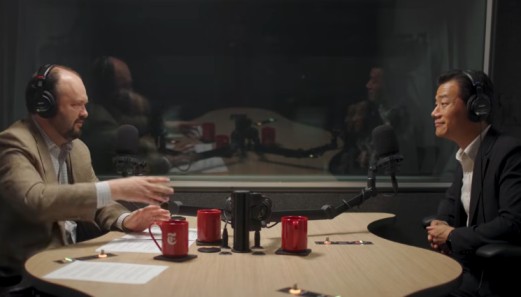
Read the full transcript of China AI expert Kyle Chan’s interview on Interesting Times with Ross Douthat, May 14, 2026.
Editor’s Notes: In this episode of Interesting Times, Ross Douthat is joined by China and AI expert Kyle Chan to unpack the complex technological rivalry between the United States and China. The conversation explores the diverging strategies of the world’s two superpowers, contrasting the American quest for Artificial General Intelligence (AGI) with China’s focus on efficiency, robotics, and the practical deployment of AI in daily life. From the impact of semiconductor sanctions to the looming threats of cyber warfare, they examine whether the real danger is falling behind or rushing headlong into a future without guardrails. This deep dive offers a fascinating look at how energy grids, labor markets, and geopolitical distrust are shaping the global race for machine intelligence.
Introduction
ROSS DOUTHAT: Kyle Chan, welcome to Interesting Times.
KYLE CHAN: Great to be here.
ROSS DOUTHAT: So at the moment, there are really only two countries that matter for the AI future, the United States and China. Their leaders are meeting in Beijing and the atmosphere is sort of similar to a kind of Cold War atmosphere where people think and argue and talk about them being in a kind of arms race.
You are an expert on China and AI, and we’re going to talk about that race, who’s winning, what winning even means, whether it even makes sense to talk about the US and China in terms of a race. But I want to just start with a basic question. How is China’s current approach to AI different from the American approach?
China’s Different AI Strategy
KYLE CHAN: It’s quite different, actually. So in the US, there’s a particular focus on AGI, artificial general intelligence, and to create something approaching an artificial superintelligence, some kind of almost machine god that can do virtually everything that any human can do, at least on a computer. And more and more.
ROSS DOUTHAT: That’s right. You want to get more, right? That’s the super part.
KYLE CHAN: Absolutely. And you can see that the amount of spending, the amount of investment, the amount of effort that the American big tech companies and their startups like OpenAI and Anthropic, which are now close to $1 trillion each, are pouring into this is an indication that they’re making a big bet that they can get there at some point, maybe in the near future. That’s the race to AGI in the US.
China is running a different kind of race. I would argue they’re running multiple races. On the one hand, they are trying to produce better and better AI models. They do want to try to keep pace with their American competitors, but that’s not all they’re focused on. They’re also focused on efficiency, making these models smaller, cheaper to run, easier to deploy. That’s one area.
Another area they’re focused on is diffusion, trying to get AI into the hands of as many users as possible. And part of that strategy involves open source, right? So this involves giving away your models for free, and that allows other people around the world, including in Silicon Valley, to download Chinese models and to also customize them and tweak them based on their own data and to make them work in a way that’s more tailored to their own needs. So that’s the advantage of open source.
And another major area that China’s focused on is applications. Specifically, robotics is a huge area of focus, both for the government and for Chinese AI companies. But you don’t really hear so much about AGI. You might hear some of the Chinese tech founders talk about this, and they sometimes sound a little similar to their counterparts in the US. But overall, they’re much more focused on these sort of nuts and bolts uses and applications of AI in people’s daily lives. That’s the key priority.
AI in Everyday Chinese Life
ROSS DOUTHAT: So if I went to Shanghai or Beijing right now and spent a couple weeks there interacting with physical reality and digital reality, do you think I would notice a big AI-driven difference versus life in the United States? Just describe the everyday experience of this strategy to the extent that it makes a difference in how people are living.
KYLE CHAN: Yeah, so in the larger cities in China, you might see autonomous delivery robots dealing with package deliveries, food deliveries. You might see in a restaurant a waiter robot bringing your food. This is not super widespread yet, but it’s starting to come about. Hotels, rather than having room service be delivered by a person pushing a cart coming up the elevator, it might be a delivery robot. You have, of course, the self-driving cars. You might even have drone delivery for coffee or food, but it would be a subtle but probably surprising difference to what most Americans experience in terms of their interaction with AI in the physical world.
The Role of the Chinese State in AI Development
ROSS DOUTHAT: So let’s just pause for context because you talked about the government versus the Chinese AI companies, right? And I think most viewers and listeners are accustomed to the American situation where you have a set of big companies. They have been extremely lightly regulated by Washington, D.C., and just in the last year, we’ve started to get into dynamics where the Pentagon especially seems concerned about their national security implications. There’s talk about regulation, screening of models, and so on, but basically it’s been a very traditionally American capitalist environment, not a Manhattan Project or anything like that. To what extent is China similar or different just in the relationship between the companies and what is obviously a much more powerful and often repressive state?
KYLE CHAN: Yeah, so in China, the state is in charge, or specifically I should say the party state, right?
So that’s sort of the overarching relationship, but that doesn’t mean that the Chinese AI labs themselves are just in lockstep following whatever Beijing says. Ironically, China tried a more top-down model to technology in a previous era, and that failed miserably. It did not produce the kind of innovation and flexibility and agility in the marketplace that you would need to have cutting-edge technology.
ROSS DOUTHAT: What era are we talking about with the more top-down approach?
KYLE CHAN: I would argue going back to the Mao era. This is the classic—
ROSS DOUTHAT: So pre-Deng, pre-1980s.
KYLE CHAN: Exactly. Yeah. That’s sort of almost Soviet command economy style approach. So what you have is sort of a hybrid model in China, if I could characterize it in a single word, and that would be this sort of broader direction and guidance and certainly support from the central government in China as well as local governments on the one hand, but then also trying to create space for competition and innovation from the Chinese AI labs themselves, whether you’re talking about China’s equivalent of the big tech like Alibaba or Tencent, the maker of WeChat, the popular super app, or you’re talking about China’s own AI startups like Z.AI or Moonshot, which have become actually quite popular around the world.
China’s Key AI Players
ROSS DOUTHAT: So what are the Chinese equivalents, to the extent there are, of an Anthropic or an OpenAI right now?
KYLE CHAN: That’s a good question. So maybe Deepseek would be the closest. And then you have the smaller startups, and by smaller I mean on the order of $40 to $50 billion market cap. And those are some of the more successful ones. But it’s hard to find that kind of middle ground. Deepseek now is preparing to take in outside investment. Remember, they were actually not originally an AI company. They were part of a hedge fund actually that was trying to use AI to develop more sophisticated financial models. So they’re sort of a category unto themselves.
The Chip Constraint: How the US Is Limiting China’s AI
ROSS DOUTHAT: And all of these companies though are operating under some basic constraints that don’t apply to US companies right now. Mostly around chips. So can you describe the landscape of constraint in China and what it means?
KYLE CHAN: Yeah, so I had mentioned earlier that Chinese AI companies are trying to run different races. One of those was efficiency. And part of that is in response to the constraints that they’re under, in particular around compute and chips. So remember, right now the US has export controls on our most advanced semiconductors made by basically NVIDIA, and we stop those from officially being sold in China. We allow the sale of watered-down versions, but the idea is that we keep the best and the most advanced chips for American AI companies in the United States and for allies and partners.
For China, that means that they don’t have access to the most cutting-edge AI chips. They have some Chinese domestic alternatives, and this is a big part of the story, right? One of the leading players in this space is Huawei, right? The heavily sanctioned Chinese tech giant that rose first in the telecom space, branched into smartphones, and is now in pretty much every other industry, electric vehicles, clean technology, and certainly now AI and chips. So China’s trying to build up their own capacity for developing AI chips on their own, not just designing them, but actually producing them. But the problem is they’re just not quite as good as the NVIDIA chips. And without that, it does put a lot of constraints on what they can do. So they’re trying to squeeze more out of very limited compute.
ROSS DOUTHAT: Why aren’t their chips as good? I know this is a simple-minded question, but is it just that NVIDIA is so awesome at engineering and China’s engineers, even if they have a NVIDIA chip, can’t quite get there themselves? Talk to me like this is a non-chip specialist.
KYLE CHAN: This is the $5 trillion question, which is currently, I think, roughly the market cap of NVIDIA today. There are a couple of different aspects to this. One is actually the chip fabrication, that is producing the chips. Remember, NVIDIA doesn’t make their own chips. TSMC in Taiwan, they’re the ones that make the chips, conveniently located—
ROSS DOUTHAT: Not that far from China.
KYLE CHAN: That’s right. That’s right. To the consternation of probably a lot of folks in Washington and maybe other folks dependent on those supply chains. But TSMC has been pushing the boundaries for increasingly advanced semiconductors in a whole range of areas, and that includes AI. And NVIDIA, by partnering with TSMC, can combine some of the best design work out there with some of the best production capabilities.
For example, ASML, a Dutch company that maybe some people have heard of, it’s actually one of the biggest tech companies in Europe now. They make these extremely precise, extremely expensive lithography machines for basically printing chips, and they’re the only ones in the world that can make this kind of machine. They sell those to TSMC. TSMC can use that cutting-edge technology combined with their own cutting-edge manufacturing processes and work with NVIDIA to produce these incredible state-of-the-art chips that keep getting better and better.
ROSS DOUTHAT: So essentially, when we talk about the US not allowing NVIDIA to sell to China, we’re effectively talking about the US cutting China out of just a larger supply chain, right?
KYLE CHAN: Absolutely.
ROSS DOUTHAT: That runs through Taiwan, through the Netherlands, through all around the world.
KYLE CHAN: That’s right.
China’s Strengths: Energy and Infrastructure
ROSS DOUTHAT: Okay. That’s interesting and very helpful. What does China have going for it then in terms of AI buildout that the US doesn’t have?
KYLE CHAN: Energy is absolutely huge in China. And this is something that if you’re thinking about the broader AI stack, that is not just the chips or the models themselves, but deeper down on the layer, energy is perhaps the most important and least talked about.
For the US, this is a major bottleneck. It’s very hard now for data centers to build out the power capacity to power all those chips that they’re putting together. In China, interestingly, they’ve been building out energy at a very rapid pace. Clean energy, solar, wind, batteries, and they’re trying to leverage that ongoing energy buildout to feed into their compute buildout, which then feeds into their AI development.
And so you see really interesting strategies that the Chinese are taking. For example, they have this effort to try to build data centers out in the western provinces away from the high-population urban areas in China. And at first, that might not make any sense, right? Don’t you want to have your data centers close to where people are actually using them? Don’t you want to have that low latency, high response time? And what China’s trying to do is they’re trying to leverage a lot of their renewable energy resources out in those further-off regions. They’re also trying to just do sort of good old-fashioned geographical redistribution, concerned always about having these poorer provinces remain poor while the high-tech Shenzhens and Shanghais speed on ahead. So this is another area where they’re trying to leverage some of their strengths to feed into maybe areas where they’re weaker.
How Far Behind Is China?
ROSS DOUTHAT: So then China is, to sort of simplify, imagining a future where they’re only a little bit behind the US. And actually, say what that means. People talk about the best Chinese models being 3 months behind the US or 6 months behind the US. How far behind are they and what does that mean in practice?
China’s AI Anxiety: Falling Behind vs. Being Replaced
KYLE CHAN: Overall, I think the consensus is Chinese models are somewhere between 3, 6 to 9 months depending on the time of year and which was the latest model that just came out. What that means is that when you look at specific benchmarks, specific evaluations for trying to understand how well these perform on, say, math or coding tasks or even sort of new agentic tasks, the Chinese models that are released today are starting to get close to the American models that were released a couple months back. So that’s what that lead time means.
But the thing is, it’s not just about having the absolute most cutting-edge model because you can have very, very strong models that can do a lot, that can do a lot of agentic useful tasks, like maybe create a whole PowerPoint presentation for you based and do all the research and analysis that goes into that, or answer your emails. So there’s this strategy, I think, right now in China where they’re hoping that it’s not just all about having the very best models, that it’s about trying to figure out where to make this work and to build kind of the broader ecosystem for deploying these models, to integrate them into more and more services, like into food delivery or into ride-hailing or into, again, much more practical sort of real-world applications.
ROSS DOUTHAT: So in the US, obviously there’s just a lot of anxiety around AI to a greater degree than any sort of big technological change in my lifetime. Certainly there’s apocalyptic fears, there’s economic fears about job displacement, there’s social and cultural fears, there’s people who just don’t want data centers built in their backyard. So there’s a whole range of different moods. If you were going to try and distill the mood in China, the public mood around AI, how would you describe it and how is it different from the US?
Public Mood Around AI in China
KYLE CHAN: I think the biggest anxiety right now in China is an anxiety around falling behind on technology. So I think in the US, there’s a lot of worries about job displacement, of AI being a net negative force in society. In China, there are some of those concerns, and I can come back to that. But I think right now, the fear among individuals and companies and workers is that they’re not keeping pace with AI, that they’re not using it enough, and they’re not savvy enough with this new technology, so that they won’t be competitive enough in the labor marketplace.
So it’s interesting, this sort of anxiety at the individual level kind of mirrors China’s anxiety at the national level. When ChatGPT first came out, and in fact, you can even go back to when AlphaGo first defeated the world champion, human world champion in Go.
ROSS DOUTHAT: Wow.
KYLE CHAN: Wow, wow, wow. There was a lot of anxiety in China, among China’s AI industry and among policymakers in Beijing, worried that China was also falling behind, that they were not making the most of this new transformative technology. So it’s interesting to see this kind of mirroring where it’s not about how do I keep out this technology from my life? It’s about how do I bring in even more and integrate it and give myself that edge in a very, very crowded marketplace. And does that—
ROSS DOUTHAT: So I see that attitude in the US, but it is a very Silicon Valley tech and tech adjacent attitude, right? It is spreading, but you see it in a pretty confined zone of the American economy. But are you saying that in China it is just much more widespread, right? That you don’t have to be working for DeepSeek or working for Alibaba or something to have this “am I falling behind? I must add AI protocols” mindset.
KYLE CHAN: That’s right. Yeah. So it’s interesting that AI is hitting at a time when China was already experiencing a whole bunch of anxieties around labor markets, especially for young college graduates. So for example, the unemployment rate for young people in China is basically double what it is in the United States. It’s something close to 17%, which is extremely high. The number of new college graduates hitting the job market this year alone is 12 million plus in China. These are all people competing for many of the same jobs. They don’t want to work in the factories. They don’t want to have those blue-collar jobs or delivery jobs. They want, in their minds, the good jobs. And they’re worried that if they don’t keep up with AI, they might not be able to get those.
So it’s a longer-standing concern about this hypercompetitive environment in China that has been there since as long as I’ve been going to China. But AI really sort of amplifies and accelerates those anxieties.
The Welfare State Debate and AI Displacement
ROSS DOUTHAT: And part of the debate in the US has also been about the welfare state. And you have tech leaders talking about sort of how the welfare state has to adapt if there is AI-driven unemployment. You have Elon Musk promising not universal basic income, but universal high income. I just like saying that. China does not have a safety net to any degree like the United States or like Western Europe, right? Is there a welfare state debate in China, a UBI debate, anything like that?
KYLE CHAN: Increasingly so. I mean, the great irony here is that was the era of the iron rice bowl, of the idea that you were a worker at a state firm, at a state organization, and you basically had your job for life. And this idea of job security is no longer there in China unless you’re working for, again, a state-owned enterprise or within the government. And so that concern is coming back and there’s actually more discussion now, including among policy folks in Beijing, about the potential issues related to AI job displacement and what China should do about it from a welfare and policy standpoint.
ROSS DOUTHAT: How far? I mean, are there like sort of actual policy ideas sort of in the wind? Is there a UBI under communist conditions?
KYLE CHAN: It’s still early stages.
ROSS DOUTHAT: “From each according to his ability, to each according to his needs.”
KYLE CHAN: That’s right.
ROSS DOUTHAT: It’s a comeback.
KYLE CHAN: “To get rich is glorious,” but also they are the Chinese Communist Party after all. Yeah, I think it’s still early days for that discussion. And there’s still a pivot that’s happening from the sort of all-in, hit the gas pedal on AI progress, including from the policymakers where they were emphasizing all the new jobs that would be created by AI. Don’t worry about those other jobs that might be affected. That’s part of the industrial revolution that’s happening now, Industrial Revolution 4 or 5.0. But now that conversation is starting to shift.
China’s Social Concerns: AI Companions and Birth Rates
ROSS DOUTHAT: And what about the central government’s concern about social effects of AI? Because one notable thing in China, you mentioned earlier the crackdown on internet companies. There was and has been a deep anxiety about the internet’s effect on social life. You’ve had attempts to crackdown on video gaming among young men, all of the things that sort of American commentators worry about at a sort of speculative level have actually sometimes been actual policies in China. And this is connected to the reality that China has a bigger problem than the US with falling birth rates, falling marriage rates. Are China’s leaders looking at AI through that lens and worrying about, the AI girlfriend, AI boyfriend future?
KYLE CHAN: Definitely. They are very worried about that. And in fact, they are already rolling out policies and regulations around AI boyfriends and AI girlfriends. It’s funny, they have a very sort of negative view of wasting time, basically, of what they see — the folks in Beijing — what they see as sort of nonproductive activity. And in that earlier era of a tech crackdown, they saw video games as not really part of the Chinese vision for a high-growth, technologically powered future when everyone’s at home playing video games. And they also cracked down on the education market. So there was a lot of private tutoring, edtech startups were sort of sprouting up. And they saw that as also kind of wasteful because it was sort of a race to the bottom in terms of preparing for exams and feeding into that kind of cutthroat academic environment.
So I think right now we’re seeing something similar happen again with worries that AI companions could end up being a big time sink for Chinese youth when they should be engineering the future and building out the startups and the future Chinese versions of SpaceX, for example.
ROSS DOUTHAT: But is there also a sense that this is the solution if China never fixes its birth rate, that robots are just the way that aging low birth rate societies compete? Is that also part of the theory or the mindset?
Robots as the Answer to China’s Shrinking Workforce
KYLE CHAN: Definitely. That’s a big part of the story. So China has a shrinking workforce. I think their labor force size peaked actually over a decade ago. And they’re heavily dependent on manufacturing. They don’t want to let that go. They see that as the engine for the whole economy. So how do you reconcile those two factors when people don’t want those factory jobs anymore and young people want sort of different jobs and there’s just not enough people to fill the factories? One solution is robots. One solution is to increasingly automate factory production, to put robots of many different kinds, whether they’re your classic 6-axis industrial robot arm.
ROSS DOUTHAT: The classic, the classic 6-axis robot arm.
KYLE CHAN: You know, that can lift up a car in one go. Or now this big push with humanoid robots is seen as being yet another potential solution, if not a perfect solution, to this ongoing labor issue. So China wants to continue to become more and more competitive, to move up the value chain, and to make better and more high-value stuff, but they don’t have the workforce. So AI and robotics is seen as the way to fill that in.
ROSS DOUTHAT: Yeah, it’s interesting just thinking about — you mentioned like robot waiters, right? So one thing that has been sort of encouraging, I think, to people worried about job displacement in the US is the extent to which robotics in restaurants, fast food places, supermarkets, and so on has not so far radically displaced human workers. And in fact, places like McDonald’s and Starbucks that have tried to sort of really move to kind of automatic ordering and so on have often found themselves sort of maintaining human staff beyond what they expected or expanding human staff even.
In a context, though, where like the Chinese birth rate is maybe two-thirds the US birth rate at this point, depending on which stats you look at, you’re just in a different landscape, right? Where you’re maybe worrying less about whether the robot waiter displaces workers and more about whether you have a waiter at all. And so the robot waiter is welcome and necessary. I mean, that seems like it could be a big point of sort of the divergence ultimately between how the US and China relates to robots.
KYLE CHAN: Yeah, definitely. It’s like you’re going to have to err on one side or the other. You’re going to have to err on the side of going too slow, and then you may not have the ability to do all these things because there’s not enough workers there. Or you might err on the side of going too fast, and I feel like that’s the concern in the US more.
How China Views the AGI Race
ROSS DOUTHAT: Let’s pull back to the AGI superintelligence question. How do you think China’s leaders actually think about the American fixation, or the tech world, Sam Altman, Dario Amodei fixation on AGI. And two options, you can tell me if there’s a third, right? One option is that the Chinese basically think that our tech companies are high on their own supply, that there is not going to be some insane return to superintelligence and it’s always going to be fine to be 3 to 6 months behind, but then you have catch-up. Another option would be that China is actually worried about superintelligence and is basically trying to figure out what are our contingency plans if the Americans seem to be pulling much further ahead. Do either of those describe China’s mindset to the extent that you can sort of read the tea leaves in Beijing?
KYLE CHAN: So one sort of interesting corollary question is, is China trying to do an AGI Manhattan Project somewhere buried underground in a bunker with data centers that can’t be seen by satellites and powered by—
ROSS DOUTHAT: Yes. Yes.
KYLE CHAN: Are they? And my inclination is no.
ROSS DOUTHAT: And you don’t think they could do something like that without the US being aware of it?
China’s Strategic Approach to AI: Not Racing for AGI
KYLE CHAN: So I don’t think that they would be able to do that without the US being aware. I think that it would require such a scale of production, of amassing resources and construction, that we would detect something and we would start to wonder what is going on. And I mean, we’re already watching everything about the nuclear buildout, for example, in China, nuclear weapons buildout. So I would be very doubtful that we would miss something of that scale because you really would need massive scale in terms of compute and energy to power something that would be like a Manhattan Project for AGI.
ROSS DOUTHAT: So they’re not secretly trying to win the race. Whatever they’re doing, they are sort of accepting this position of being in our draft on the racetrack or whatever metaphor you want for now, right? But is that just making a virtue of necessity, or do they think that we’re deluding ourselves in our race to superintelligence?
KYLE CHAN: I think they just see the technology quite differently, and they just don’t have that kind of transcendent view of technology. I think that you can see this in other approaches that they’ve taken to the internet or to the IT revolution, which they were obsessed with as well. They were really focused on just trying to integrate the internet and IT infrastructure into just basic services, education, healthcare, government services. I think they see something similar with AI now.
One kind of thought experiment I often think about is what would be the signs that they were trying to do a secret AGI program? One of the signs I think would be about those NVIDIA chips that I mentioned earlier, where right now Trump has relaxed some of the export controls and allowed H200 NVIDIA chips to be sold to China. Those are better than what China had gotten before, but not the very best. And China has basically said, “Thanks, but no thanks.” The AI companies, to be sure, in China really, really want those chips. But here’s the divergence, because Beijing doesn’t necessarily want to be dependent on the US, right? And they want to bolster their own semiconductor program. So if they were really sprinting today for AGI, I think they would have gobbled up those chips as quickly as possible, not knowing when that window might close. So that is one sort of indicator that they are kind of seeing this as a medium to long-term bet.
ROSS DOUTHAT: So there might be people at DeepSeek who believe in the superintelligence future more strongly than people in Beijing.
KYLE CHAN: Yes. Yeah. I think the AI—
ROSS DOUTHAT: The closer you are to the machine god, the more its voice whispers in your ear, right?
KYLE CHAN: That’s right. Yeah. I don’t think Beijing is AGI-pilled.
Espionage, Distillation, and the AI Arms Race
ROSS DOUTHAT: What about espionage, which obviously played a big role in the early Cold War arms race with nuclear secrets? Is there an equivalent sort of spy-based solution for China if the US seems to be pulling too far ahead?
KYLE CHAN: So there is something called distillation, and that’s where you take a weaker model and you actually train it on the outputs of a stronger model. And distillation is a common practice for AI developers when it’s done with full knowledge and full disclosure and total authorization. What seems to be happening now is some of the Chinese AI labs seem to be distilling on American AI models without authorization. And they’re using, it seems, a number of different sort of proxy accounts so that they can get around efforts to block these campaigns. So it’s sort of—
ROSS DOUTHAT: But they’re not— that doesn’t require stealing secrets from Anthropic. It just requires using the Anthropic model in a way that you’re not supposed to be able to use it.
KYLE CHAN: That’s right.
ROSS DOUTHAT: Right.
KYLE CHAN: It’s sort of its own category. It’s not quite like outright IP theft. It’s not like taking the source code from Anthropic or OpenAI. It harkens back a little bit to an era where Microsoft was always trying to cut down on black market copies of Windows and Microsoft Office.
ROSS DOUTHAT: Does it work in the sense that, can you just have a Chinese Claude distilled that works as well as Claude?
KYLE CHAN: So it can help somewhat, but you need to have that foundation to start with. So I think that this is probably one area where it’ll be hard still to get concrete data on exactly what the net effect is. But I would say if you or I were building a model from scratch, we would not be able to use distillation as a way to catch up to the frontier. If you were one of the better Chinese AI labs, you might be able to use some of this to improve your model, especially on areas where you’re weaker, like on coding, for example, you might be able to use Anthropic’s Claude models to support your long-term coding capabilities. So there is that aspect to this whole AI race.
The Taiwan Question: Would China Invade if Falling Behind?
ROSS DOUTHAT: In a world where there is some kind of takeoff, and I should say, one of the theories that animates the American AI companies is the idea that at a certain level, the AIs start training the new AIs, and you get this kind of acceleration where suddenly being 3 or 6 months behind, it becomes impossible to catch up. Again, this would be the theory. Suppose that starts to happen. Does China just invade Taiwan? Like, well, seriously, right? Like, you have— I mean, it’s just a kind of fascinating circumstance that you have a kind of arms race. Maybe China doesn’t think of it as an arms race, but it is sitting next door to a central hub in the supply chain that makes the arms race possible, right? Like, is that the natural Chinese move in the event that they seem to be falling incredibly behind?
KYLE CHAN: So I think ironically, if that were really starting to happen, taking over TSMC would be a move too late because the chips are already made and installed and are already running and training the models and feeding into this feedback loop in the United States. So at that point, all bets are off and you’re kind of out of options for what to do.
The big question here is how fast that can happen and whether this could happen without being detected. You know, there’s always speculation about, is there a version of the latest AI models that hasn’t been shared or even disclosed to the public in, say, the US, or maybe even in China, where they have gotten the inkling of this recursive feedback loop that will lead to this superintelligence explosion. So that question is sort of hard to know. And then how quickly can you actually get there?
What Should US Policy Look Like?
ROSS DOUTHAT: But I want you to be prescriptive for a moment because we’re having a summit. We’ve been talking about sort of what China is doing, how China is thinking, and so on. What does all of this mean for the United States in terms of our policies? Does it mean that we should treat China as a fundamentally more benign actor than our current policy treats them as? Or is it an indicator that in fact our policy is working by shaping a Chinese perspective that is not as engaged in the race as it could be?
KYLE CHAN: Yeah, I think at this point what we should do is take a step back from this all-out race framework, because I think right now that race mentality is driving a kind of recklessness, I would argue, from the American side to bring up the threat of Chinese AGI. We should think about that, but I don’t think that that’s what they’re so focused on. But if we’re only focused on that, that means we need to get rid of the guardrails. We need to not bind ourselves. We need to not have any kind of regulation or restrictions. We need to have as many data centers as possible everywhere.
And I think right now that approach is starting to run into some problems in the United States. Whether you’re talking about the backlash to data centers or you’re talking about now some of these models getting so capable that they might not be at whatever AGI level, but they are at the level potentially of causing greater damage, either in terms of cyberattack capabilities or maybe even in terms of augmenting what a relatively unsophisticated group could do with bioweapons. So there are all these sort of questions that the AI community has been talking about for a long time.
But certainly for the Trump administration, if you recall, J.D. Vance’s speech last year where he said basically we should not have hand-wringing over AI safety slow down the progress of American AI development. In other words, in this trade-off, and he viewed it as a trade-off, we should err on the side of going faster rather than putting on a seatbelt. And I think now we’re reaching that point where we need to think about still making progress as fast as possible, competing with China, making sure we do have the best AI models so that we can keep, but does it have to come at the expense of wearing a seatbelt or having some basic safeguards?
Deployment, Open Source, and a Different Vision for the Race
ROSS DOUTHAT: Would you also suggest that the US should adopt a more Chinese vision of the goal of diffusion and sort of building the best possible AI-enabled technology right now? Because I mean, a different way to frame this is that the US and China are in a race, but China thinks it’s running a race to build the self-driving cars and the robots that every single country in the world will use. And the US will be stuck sitting here with its pretend machine god while China sells to India, Africa, and Latin America successfully. Do you think the US, in being less breakneck, should also be pivoting to a strategy of essentially integration and sales?
KYLE CHAN: Yes, I think we need to focus a lot more on deployment. One of those areas is actually open source, which because of the commercial incentives is not a high priority for the top American AI labs, right? They’re focused on selling access to their models through subscriptions, through APIs. And the thing is that open source approach has been really, really powerful for these Chinese AI models to gain adoption, not just in China, but around the world. And so it feels like right now the US is seeding a really important channel of competition. When it’s so expensive, it can be the most powerful AI model, but you don’t want to pay for it. That can put limits on your growth.
ROSS DOUTHAT: Do you think you get that shift organically if there is a slightly stronger regulatory hand? Like, because again, the US does not, we have industrial policy, I’ll put it in “quotation marks,” right? But we don’t have the kind of steering of economic strategy that China has, right? So it’s not like you can say, oh, the United States should be more focused on deployment and there’s a button to push in Washington, DC that makes that happen. But do you think it would happen naturally if it was a little bit harder and a little bit more challenging just to sort of maximize compute and capacity for existing AI companies?
KYLE CHAN: I think there’s a way to tweak the incentives in a way that is not like the Chinese approach, that is not about a top-down steering of the whole industry, but is more about trying to maybe open some of that commercial or even research space for, say, open-source models. I just think right now, you can think about a number of different markets where this is happening, where there’s a focus on the high end of the market, on consumers or businesses that are willing to pay a lot, but there’s less focus on sort of mass adoption and sort of that broader marketplace.
And we’re seeing some of this, right? Like, I should be clear that Nvidia is trying to release open-source models. They have a commercial incentive because the more AI gets adopted, the more their chips are needed, right? So there’s that closed loop there. And Google DeepMind, they have some relatively good open-source models, but the commercial incentives as they stand are not quite there.
Should the US Sell More Chips to China?
ROSS DOUTHAT: Do you think we should sell more chips to China? Like as a sort of token of a different model?
KYLE CHAN: It’s a very difficult topic because anyone who tells you yes or no on chips to China is really flattening the whole story. On the one hand, you do have real near-term effects on China’s ability to produce the most cutting-edge AI models. So by limiting chips, that does slow down China’s AI development in the near term. And that can be useful, for example, for giving our companies that edge in cyberattack capabilities, right? With Mythos coming out, even a few months of being able to test on our own systems first is very useful. Versus a Chinese model having this capability and they’re testing on our systems.
ROSS DOUTHAT: Right.
The AGI Timeline Debate and US-China AI Competition
KYLE CHAN: So that’s important. But at the same time, there’s the other side of this whole equation, which is accelerating China’s own chip development. And that’s an area that they’ve been really focused on, and they’ve been focused on because of our export controls. So it cuts both ways. In the near term, it will slow down their AI development. In the longer term, it could speed up at least their ability to have a more resilient, self-reliant semiconductor supply chain that is not as affected by US actions. So somewhere in there is a sweet spot, and it’s really about where you draw the line rather than just saying more chips or less chips.
ROSS DOUTHAT: And also how short timelines are overall, right? Absolutely. And I’m just going to make the hawk’s case against your case and see how you respond. Because the hawk says, look, we’ve been at this for an incredibly short amount of time. Since ChatGPT appeared in the pandemic, there’s been tremendous acceleration. The people who have predicted acceleration keep being vindicated. And yes, if you’re talking about like a 20 to 25 year time horizon for the point at which you sort of hit maximum superintelligence capacity, then yeah, you have a lot of room to sort of figure out the optimal regulatory balance and all of these things.
But if you’re talking about 2 to 4 to 6 years, then maintaining a 3 to 6 month lead over your leading rival, who by the way is an authoritarian government, seems like it may be really, really, really important. And the slowdown that you’re advocating is one that could give up that advantage. So how would you respond to that kind of argument, which seems to be the mindset that certainly not just people at the Pentagon, but a lot of people in Silicon Valley have?
KYLE CHAN: Yeah. So that timeline comes up again and again in so many different debates within the US as it relates to the US-China AI competition. Fundamentally, it’s impossible to say how that timeline will play out. And that is what I’ve discovered in interviewing people — people will squirm on the timeline question. It really boils down to what your views are about this AGI timeline and how likely this is to happen.
Another factor that I will throw in there is, as a thought experiment, imagine that China did have access to the most cutting-edge American AI chips. Would they be more AGI-pilled? Would Beijing be more AGI-pilled? Forget about DeepSeek or the actual tech founders themselves. And even on that, I’m not so sure that they would be so AGI-pilled. My guess would be that they would try to deploy certainly better models and goals, but basically run their current playbook, just amped up a whole bunch. And I think it goes back—
ROSS DOUTHAT: But even their current playbook includes cyber warfare, includes — like you just mentioned the fact that just a 3-month advantage in the deployment of a cyber warfare capable model like Mythos makes a big difference.
KYLE CHAN: Yeah.
ROSS DOUTHAT: So it’s not as though the current Chinese playbook is innocent of conflict with the US.
Balancing AGI Risk Against Cyber and Biosecurity Threats
KYLE CHAN: That’s right. Yeah. So that’s why I see it as different sets of risks. One is this AGI risk that you’re talking about, and I would argue that has been sort of overblown. But what I don’t think has been overblown — and in fact maybe even underestimated up until recently — is the cyber risk and the biosecurity risk. These are sort of more, and it’s kind of crazy to say this, but those are sort of like more medium risks relative to the AI catastrophic specific, like total takeover by superintelligence.
So those sort of more intermediate risks I do worry about, and I do worry about US competition vis-à-vis China. And so I think that would be, in my mind, a reason for maintaining the export controls that we currently have and not fiddling with them and not agreeing to these side deals with Xi Jinping, for example. So that’s why I try to find that balance. But in terms of the AGI question, that’s where I’m just less convinced that we’re really all in this sprint towards AGI, or that China’s really all in the sprint for AGI.
ROSS DOUTHAT: But even on the medium risks, which I agree seem to me to be the most plausible risks — you are then making a calculation where you’re saying, what am I most afraid of? Am I most afraid of China with the capacity to do unprecedented cyber warfare against the US, or a rogue AI or disastrous AI model that crashes the entire US power grid for some inscrutable AI-related reason? It’s that balance that you’re worrying about.
KYLE CHAN: Yeah, exactly. And it comes to this question too about how the US should engage with China about AI, because if we are focused just on China’s cyberattack capabilities relative to our own, then you might say, don’t bother engaging — we’re both in this arms race essentially on cyber capabilities.
But if you’re thinking about the rogue agent, or say a non-state actor using either a set of American models, a set of Chinese models, or maybe they even do sort of arbitrage across — and this is sort of like maybe 4D chess — but they deliberately are playing this geopolitical competition against each other and trying to distribute an attack across all these different models in order to disguise their origins. Those are areas where I do think that, one, it would be useful to talk to the Chinese side about these, and two, where I think it would be in the US national interest. It wouldn’t just be about binding ourselves and slowing ourselves down relative to China. It would be about this extra third factor that we want to take seriously.
The Possibility of US-China AI Control Negotiations
ROSS DOUTHAT: And this is a good place to end, because a lot of people in Silicon Valley will say, oh yeah, in theory we could engage with China and negotiate a sort of mutual AI slowdown. But in practice, either it’s not clear that China wants that kind of negotiation, or it’s just unimaginably complex to verify some sort of AI control agreement in the way that we did with nuclear missiles during the Cold War. Do you think a kind of Cold War-style ongoing AI control negotiation with China is possible?
KYLE CHAN: I think we should not have high expectations, and I certainly don’t. I think that we should start by talking. We should start by sharing our approach to AI safety and AI risk mitigation. We should try to convince the Chinese to take this more seriously, and they are starting to take this more seriously. We should also have a discussion about open-source models, actually, because as those get better, on the one hand we want those to diffuse more, but on the other hand they could also pose a risk if they get into the wrong hands.
So we can talk about all those areas, but I would be very hesitant, certainly at this stage, to even think about binding constraints, verification agreements, a kind of arms control treaty for AI between the US and China. At this stage, it’s way too early. Let’s just start talking.
ROSS DOUTHAT: If it’s too early for that, is it just because of the sheer difficulty of imagining such a thing? Or is it a dynamic where precisely because Beijing’s attitude is that we’re not in some Cold War-style race, they’re actually less interested than they otherwise would be in that kind of negotiation?
KYLE CHAN: I think overall, it really boils down to one thing, which is an extremely low degree of trust between the US and China and an unwillingness for either side to subject ourselves to invasive verification, monitoring, and surveillance by the other party. And yeah, there could be interesting technical solutions that would make that more feasible, but it boils down to this geopolitical reality where we don’t trust them and they don’t trust us.
So we might be able to make progress on areas that affect both of us, but when it comes to letting, say, Chinese regulators come into the US or letting American regulators go inspect data centers in China, I think that is pretty far out there at this stage.
Could a Disaster Force US-China Cooperation on AI?
ROSS DOUTHAT: And do you think that that only changes on the far side of some disaster, conflict, some sort of event? Because one theory that I sort of — I don’t just toy with, I guess I hold — is that a lot of the negotiations around nuclear weapons were only possible because they’d been used and people were aware of how destructive they are. Is there a world where the only way that the US and China come to terms is a world where something tragic has to happen first?
KYLE CHAN: Yeah, that’s a scenario I think about too. I think about what would be the level of incident and what could the response be. You can think about a most extreme case where you have some major cyberattack incident or even a bioweapons incident related to AI, where there are real lives at stake. That could cause both countries to just unilaterally put a pause on all their AI development because they realize that this is such a big issue with such huge risks. That is possible.
So I do wonder and I do worry that we might be waiting for that incident to happen before we take action in advance, before we even start to talk to each other about how to take action.
ROSS DOUTHAT: All right. Awesome. On that somewhat dark note, Kyle Chan, thank you for joining me.
KYLE CHAN: Thank you.
Related Posts
- Transcript: UN Security Council AI Hearing w/ Sam Altman, Dario Amodei & Clément Delangue
- SparX Interview: w/ Paras Chopra – Can Indian IT Services Survive AI? (Transcript)
- Transcript: Marc Benioff Interviews Sam Altman at Dreamforce 2026
- Transcript: Salesforce CEO Marc Benioff Keynote at Dreamforce 2026
- Transcript: Mark Zuckerberg Interview on Meta’s Muse AI Agent – Sources Podcast