Full transcript of writer and editor Mattie Bamman’s TEDx Talk: Words, Not Ideas: How to Write a Book @ TEDxSpokane conference.
Listen to the MP3 Audio: Words, Not Ideas_ How to Write a Book by Mattie Bamman @ TEDxSpokane
Mattie Bamman – Writer/Editor
I grew up in an isolated fishing village on the coast of Maine. And as a kid, I used to help my neighbor with yard work.
My neighbor was Theodore Enslin, a poet. One day, I was stacking some firewood and Ted said, “Judging by the way you stack firewood, you’d make a good poet.” Ted didn’t know it, but I had written a few poems at the time, I was around 11 or 12.
And so I took his words straight to heart, they were very encouraging. There was just one problem. I had no idea what he was talking about. Theodore Enslin was a prolific poet.
Poetry Foundation estimates that he wrote around 60 books of poems, but I’m pretty sure it was closer to 100. He knew people that I consider legends: Allen Ginsberg, William Carlos Williams, Martin Luther King Jr.
Importantly, he also studied beneath the French composer and teacher, Nadia Boulanger. She taught the likes of Philip Glass and Aaron Copland.
“Judging by the way you stack firewood, you’d make a good poet.” Sounds like a Buddhist koan, doesn’t it? And to some extent, that’s what has become for me.
I did pursue a career in writing; I write poetry, I’m the Editor of Eater Portland, I write culinary travel articles for Northwest Travel Magazine. I’ve contributed to 11 books on culinary travel, and I’m a developmental editor, which is a fancy way of saying, “I help people write books.”
This one thing I’ve learned is that writing is harder than I ever thought. I’m not alone. Anyone who’s tried to write a book has experienced the same thing. That includes great authors who we love: George Orwell, for instance, once said that, “Writing a book is a horrible, exhausting struggle.” He says some other stuff.

More to the point, Philip Roth said, “The road to hell is paved with works-in-progress.”
So what makes some people write great books, and other people fail to finish a book at all?
As a developmental editor, I get to work with a lot of inspiring people. I work most with psychologists, people have brilliant ideas. Unfortunately, a brilliant idea does not equate to a brilliant book. In fact, ideas get in the way of writing. This is one of the hardest things to learn when you’re starting out as a writer, because we all start out as readers.
And we don’t pick up a book to look at a bunch of words, we pick up a book to be inspired by that beautiful stories inside of it and the enlightening ideas.
But this isn’t how you need to think about writing, as a writer; it’s not the full story. Words and writing are their own animals, and they operate by their own rules.
Fortunately, these rules are shared by other trades; like stacking firewood, log by log. But before I offer a few examples of how to piratically write a book, I want to offer one more example to show why books are made of words, not ideas. It should show how words are objects, and you can see them that way.
It’s also just really cool. So we’re not exactly sure when humans started writing, but our earliest evidence comes from around 3,000 BC with the Ancient Sumerians and Ancient Egyptians. These are serious words that were carved into stone. Examples are the Rosetta Stone; another example is Egyptian tombs.
These are words from when Kings and Pharaohs thought words were magic. They thought words can bring things to life. You write down the word ‘bird, ‘ someone comes along and reads it, and it comes to life inside of their mind. Suddenly, they’re thinking of a bird flying, or roasted for Thanksgiving, whatever.
So Kings and Pharaohs knew that writing was so powerful that they couldn’t just let everybody do it, so they only allowed scribes to do this.
That meant everybody else in society was illiterate. However, archeologists have found proof that they still loved words. So they found these vases that have nonsense words written across them. These are nonsense words owned by people who were illiterate, and they were worth more than regular vases. If you think about it, not much has changed.
A lot of us continue to get tattoos of words in foreign languages that we can’t read. Whether a Chinese character or Sanskrit, people love words for words. So, let’s build a book using words, not ideas.
Let’s treat writing like the physical process it is. A great way to start writing a book is to envision it already written in a bookstore. That means you’ve already finished writing it, you’ve sold it to the publisher, they’ve printed it, and it’s out there for sale, just imagine.
So, what section in the bookstore is the book in? What other books are located next to it on the bookshelf? See?
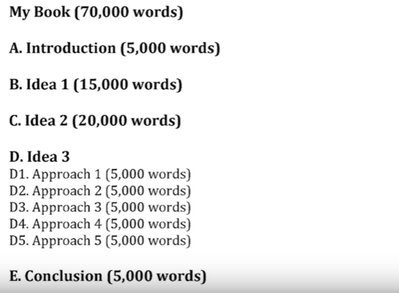
By envisioning your book already completed, you’ve pinpointed the genre and your competition. Since we’re talking about making a book, we should look at what it’s made of. The average of non-fiction books is around 70,000 to 90,000 words. It has an introduction, a conclusion, and a middle. These are the fundamental building blocks for writing a book.
The next step is to see how long your book is going to be. And you can actually use the firewood metaphor for this. In Maine, a lot of people actually heat their homes exclusively using firewood. That means that you need to judge at the beginning of the winter how much wood you’re going to need to last you.
If you picked poorly, you risk freezing to death. The same can be said about books, although not quite as dire, assuming you’re not George Orwell.
So, as though you’re preparing for a Maine winter, try to estimate how large your idea is.