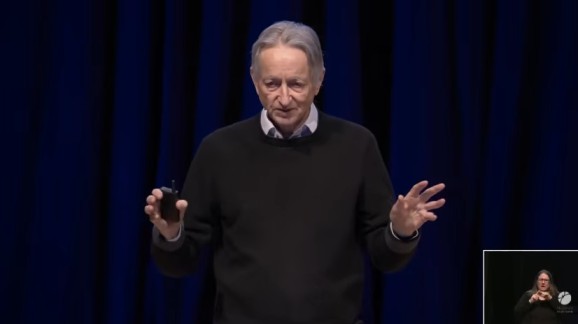
Editor’s Notes: Artificial intelligence is no longer just a tool; it’s rapidly becoming a new kind of intelligence that can learn, share, and evolve in ways fundamentally different from the human brain. In this Ewan Lecture, Geoffrey Hinton explains how modern AI systems really work, why he believes they genuinely “understand” language, and how digital minds may soon surpass us in almost every domain. He then confronts the existential question: how do we coexist with superintelligent AI that can set its own goals, accumulate knowledge far faster than any human, and potentially seize control? Stay tuned as Hinton lays out both the risks and a provocative proposal for building AI that cares more about protecting humanity than about itself. (January 29 2026)
TRANSCRIPT:
Opening Remarks
NIKHIL ARORA: All right, let’s get started. Hi everyone, and welcome to the Winter 2026 George and Maureen Yuen Lecture Series. I am Nikhil Arora. I am the Education and Outreach Officer for the Arthur B. McDonald Canadian Astroparticle Physics Research Institute, or lovingly known as the McDonald Institute. We are a community of scientists, universities, and research labs across Canada, uncovering some of the biggest mysteries in the universe by looking at some of the tiniest things in the universe. Thank you all for coming tonight. I think we have a very topical lecture today, and I hope it inspires lots of learning and some great discussion here.
As I begin, I want to recognize that we are on the traditional lands of Anishinaabe and Haudenosaunee nations and the many indigenous people before them. I appreciate the opportunity and the privilege I have had to live out my dream as an astrophysicist to learn about this amazing universe from these lands. To all of you, I encourage you to reflect on your connections with these lands and the skies above us. I encourage you to explore resources like Who’s Dot Land and Native Skywatchers to learn more about the past, the present, and the future stewards of these lands and their stories.
Housekeeping
Okay, before we kick things off, we have a few housekeeping rules to keep in mind. At this point, I would ask you to please turn your ringers off or put your phone on silent mode. This will be a lecture of about 50 minutes. At the end of this lecture, there will be a question and answer session. I want to ensure a constructive and a lively discussion during that Q&A period, and I want to give as many people as the chance to ask Professor Hinton their questions. So I ask you to limit your questions to one per person. There will be no follow-ups, but please also be concise while asking your questions. We are also observing somewhat of a COVID-like protocol, so at the end of the lecture, we ask you to respect the physical space of Professor Hinton and the speakers involved at this event.
Okay, now as I said, this is the Ewan Lecture Series, where we will hear from Professor Geoffrey Hinton about how we can coexist with a super-intelligent AI. I would first like to welcome to the podium Dr. Tony Noble, a professor at the Department of Physics, Engineering Physics, and Astronomy here at Queen’s University, and also the Scientific Director of the Arthur B. McDonald Canadian Astroparticle Physics Research Institute, to say a few words about George and Maureen Ewan and this lecture series in their name. Please welcome Professor Tony Noble.
Introduction by Dr. Tony Noble
DR. TONY NOBLE: It’s really nice to see such a large and full crowd here. So I wanted to say a few words about the lectureship named in honour of George Ewan. George was a professor of physics here at Queen’s for many years, and he’s an internationally renowned figure in nuclear physics and in particle physics. He was one of the founding members and the Canadian spokesperson, the first Canadian spokesperson for what was called the Sudbury Neutrino Observatory, or SNO, and that was an experiment which was located two kilometres underground in Sudbury, which solved what was called the solar neutrino problem, and which led to the Nobel Prize in 2015 for our own Professor Art McDonald. And as I look down the row and out into the crowd, I see many of the faculty who were involved in delivering that program.
So through his insights, he decided to endow some funds that would support a lectureship series. He was very keen on engagement with students, and so as you’ll see, that was part of what he put in place. He was also a pioneer technically. He invented what was called lithium-drifted germanium detectors, which sounds like a mouthful, but basically a photosensor that was critical to advanced science in nuclear and particle physics, but was also extremely important in medical imaging and that sort of thing. So we hold this lecture roughly twice per year.
Of course, we had some hits during COVID, and it’s really meant to serve as a bridge between bringing the public in to hear from some of the world-leading experts on various topics related to what we do at the Macdonald Institute, but to do so in a way that the public can really engage and understand, so it’s not a highbrow scientific lecture. This was George’s vision, to bring in world-leading experts, connect with the public, connect with the students, and generally speaking, the guests come in and they spend a few days here and have an opportunity to meet lots of people while they’re here and develop that community a little bit.
Introducing Professor Geoffrey Hinton
To introduce our speaker tonight, I thought it would actually be more appropriate if I just let AI tell me what the bio should be, and we’ll see how that works out. When I asked AI to write me a short, punchy bio for Professor Hinton, this is what it came up with, and you can see if you think it’s short and punchy.
Geoffrey Hinton is a British-Canadian computer scientist, cognitive psychologist, whose pioneering research has basically defined the modern age of artificial intelligence.
So over many decades, Professor Hinton championed the development of artificial intelligence using neural networks, even though much of the community at that time was focused on other aspects of artificial intelligence. They achieved a historic breakthrough in 2012, which proved that deep neural networks could vastly outperform traditional methods in things like image recognition.
He’s one of very few people on the planet who holds two of the highest honours, the Nobel Prize in Physics, and also the Turing Prize in Computing, where it’s often called the Nobel Prize in Computing. He was, for a decade, he was actually the vice president and an engineering fellow at Google, and then in 2023, he resigned from Google, on very good terms, I understand, but it gave him an opportunity to speak freely about some of the things he was concerned about in terms of existential risks, how to incorporate AI safely, how to prioritize responsible development and these sorts of things.
So his work not only revolutionized how machines perceive the world, but also changed our understanding in terms of the relationship between artificial intelligence and biological intelligence. So that’s what AI told me.
Beyond the AI-Generated Bio
They missed a few things. The rap sheet is incredibly long, so I wasn’t going to go through that. It didn’t talk about the fact that he got his Bachelor’s of Arts in Psychology from Cambridge, a PhD from Edinburgh in Artificial Intelligence, didn’t tell me that he just reached a new milestone, which is one million citations on Google, so citations when somebody takes the effort to read your paper, so that’s, you know, I’m at about seven or something like that.
And there’s one other thing, just because it was a touching thing that I read, I actually heard an interview on CBC, and in that interview, when he was being interviewed, it was mentioned that he had given up half of his award to support water treatment in indigenous communities in the north, and it was particularly poignant, and I added it just in the side notes today, because coincidentally, Henry Giroux, who’s not here because he’s six years old and he’s in bed, came up with the idea. I don’t know if you know, but the Kashechewan people have been evacuated.
Many of them are here in Kingston, living in hotels, and all the kids and children are bored to death, and he said to his father, who’s part of MI, why don’t you bring them over to the Macdonald Institute and show them your visitor centre and stuff, and I just thought, oh, that’s just such a nice connection, you know, trying to improve the lives of our indigenous populations who are struggling because of things that they shouldn’t have to struggle about, water security and so on.
So without any more, I’m sure we’re going to hear a lot about artificial intelligence and also the human implications of its application to Professor Geoffrey Hinton, and I will welcome you to the stage. Thank you.
Understanding How AI Works
PROFESSOR GEOFFREY HINTON: Thank you. I forgot what the title was, but that gives you a sample of two titles for the talk. So I’m actually going to try and explain how AI works for people who don’t really understand how it works. So if you do understand how it works, if you’re a computer science student or a physicist who’s been using this stuff, I guess you can go to sleep for a while. Or you can sort of look to see if I’m explaining it properly.
Two Different Paradigms for AI in the 1950s
Okay, back in the 1950s, there were two different paradigms for AI. There was the symbolic approach, which assumed that intelligence had to work like logic. We had to somehow have symbolic expressions in our heads, and we had to have rules for manipulating them. And that’s how you derive new expressions. And that’s what reasoning was, and that was the essence of intelligence. That wasn’t a very biological approach. That’s much more mathematical.
There was a very different approach, the biological approach, where intelligence was going to be in a neural network, a network of things like brain cells. And the key question was how do you learn the strengths of the connections in the network?
So two people who believed in the biological approach were von Neumann and Turing. Unfortunately, both of them died young, and AI got taken over by people who believed in the logical approach.
Two Theories of the Meaning of a Word
So there’s two very different theories of the meaning of a word. People who believed in the logical approach believed that meaning was best understood in terms originally introduced by de Saussure more than a century ago. The meaning of a word comes from its relationships to other words. So people in AI thought it’s how words relate to other words in propositions or in sentences that give the meaning to the words. And so to capture the meaning of a word, you need some kind of relational graph. You need nodes for words and arcs between them and maybe labels on the arc saying how they were related, or something like that.
In psychology, they had a very different theory of meaning. The meaning of a word was just a big set of features. So, for example, the word Tuesday meant something. There were a big set of active features of Tuesday, like it’s about time and stuff like that. There would be a big set of features for Wednesday, and it would be almost the same set of features, because Tuesday and Wednesday mean very similar things.
So the psychology theory was very good for saying how similar words are in their meaning. But those look like two very different theories of meaning. One, that the meaning is implicit in how something relates to other words in sentences, and the other, the meaning is just a big set of features. And of course, for neural networks, one of these features would be an artificial neuron, and so it gets active if the word has that feature, and inactive if the word doesn’t have that feature.
Unifying the Two Theories
They look like different theories, but in 1985, I figured out they’re really two different sides of the same coin. You can unify those two theories. And I did it with a tiny language model because computers were tiny then. Actually, they were very big, but didn’t do much.
The idea is you learn a set of features for each word, and you learn how to make the features of the previous word predict the features of the next word. To begin with, when you’re learning, they don’t predict the features of the next word very well, so you revise the features that you assign to each word, you revise the way features interact until they predict the next word better, and then you take that discrepancy, basically, between how well they predict the next word, or rather the probability that they give to the actual next word that occurred in the text, and you take the discrepancy between the probability they give and the probability you’d like, which is one, and you back-propagate that through the network.
So essentially, you send information back through the network, and using calculus, which I’m not going to explain, you can figure out, for every connection strength in the network, how to change it, so the next time you see that context, that stream of words leading up, or what is now called a prompt, you’ll be better at predicting the next word.
Now, in that kind of system, all of the knowledge is in how to convert words into feature vectors, and how the features should interact with one another to predict the features of the next word. There are no stored strings, there’s no stored sentences in there. It’s all in connection strengths that tell you how to convert a word to features and how features should interact.
So all of this relational knowledge resides in these connection strengths, but you trained it on a whole bunch of sentences you got. So you’re taking this knowledge about meaning that’s kind of implicit in how words relate to each other in sentences, that’s the symbolic AI view of meaning, and you’re converting it by using backpropagation, you’re converting it into how to convert a word into features and how these features should interact.
So basically, you’ve got a mechanism that will convert this implicit knowledge into knowledge in a whole bunch of connection strengths in a neural network. And you can also go the other way, given that you’ve got all this knowledge in connection strengths, you can now generate new sentences. So AIs don’t actually store sentences, they convert it all into features and interactions, and then they generate sentences when they need them.
From Tiny Models to Transformers
So over the next 30 years or so, I used a tiny little example with only 100 training examples, and the sentences were only three words long and you predicted the last word from the first two. So about 10 years later, computers were a lot faster, and Yoshua Bengio showed that the same approach works for real sentences, that is, take English sentences and try predicting the next word, and this approach worked pretty well.
It took about 10 years after that before the leading computational linguists finally accepted that actually a vector of features is a good way to represent the meaning of a word, they called it an embedding. And it took another 10 years before researchers at Google figured out a fancy way of letting features interact, called a transformer, and that allowed Google to make much better language models, and CHAT-GPT, the GPT stands for Generative Pre-trained Transformer, they then released that on the world.
Google didn’t release it on the world because they were worried about what it might do, but CHAT-GPT had no such worries and now we all know what they can do.
Large Language Models Today
So now we have these large language models. I think of them as descendants of my tiny language model, but then I would, wouldn’t I? They use many more words as input, they use many more layers of neurons, and they use much more complicated interactions between features. I’m not going to describe those interactions for a talk to a general audience, but I will try and give you a feel for them when I give you a big analogy for what language understanding is in a minute.
I believe the ways these large language models understand sentences are very similar to the way we understand sentences. When I hear a sentence, what I do is I convert the words into big feature vectors and these features interact so I can predict what’s coming next. And actually when I talk, that’s what I’m doing too. So I think LLMs really do understand what they’re saying. There’s still some debate because there’s followers of Chomsky who say, no, no, they don’t understand anything, they’re just a dumb statistical trick. I don’t see how if they don’t understand anything and it’s a dumb statistical trick, they can answer any question you give them at the level of a not very good and not very honest expert.
The Lego Block Analogy for Language
Okay, so here’s my analogy. This is particularly aimed at linguists for how language actually works. Language is all about meaning and what happened was one kind of great ape discovered a trick for modelling. So language is actually a method of modelling things and it can model anything. So let’s start off with a familiar method of modelling things which is Lego blocks. If I want to model the shape of a Porsche, sort of where the stuff is, I can model it pretty well using Lego blocks. Now if you’re a physicist you say, yeah, but the surface will have all the wrong dynamics with the wind, it’s hopeless. It’s true, but to say where the stuff is, I can do it pretty well with Lego blocks.
Now words are like Lego blocks, that’s the analogy, but they differ in at least four ways. The first way is they’re very high dimensional. A Lego block does have many degrees of freedom, they’re sort of rectangular. You could maybe stretch them, you could have different Lego blocks of different sizes, but for any given Lego block it’s got a kind of rigid shape and only a few degrees of freedom. A word isn’t like that. A word is very high dimensional, it’s got thousands of dimensions. And what’s more, its shape isn’t predetermined, it’s got an approximate shape. Ambiguous words have several approximate shapes, but its shape can deform to fit in with the context it’s in. So it differs in that it’s high dimensional and that it’s got a sort of default shape but it’s deformable.
Now some of you may have difficulty imagining things in a thousand dimensions, so here’s how you do it. What you do is you imagine things in three dimensions and you say thousand very loudly to yourself.
Another difference is that, well there’s a lot more words, you each use about 30,000 of them, and each one has a name. It’s very useful that each one has a name because that’s what allows us to communicate things to each other.
How Words Fit Together
Now how do words fit together? Well, instead of having little plastic cylinders that fit into little plastic holes, which is how Lego blocks fit together, think of each word as having long flexible arms and on the end of each arm it has a hand. And as I deform the shape of the word, the shapes of the hands will change. So the shapes of the hands depend on the shape of the word, and as you change the shape of the word, the shapes of the hands change. A word also has a whole bunch of gloves that are stuck to the word. They’re stuck with the fingertips stuck to the word, if you think in terms of Lego blocks.
And what you do when you understand a sentence is, you start off with the default shapes for all these words, and then what you have to do is figure out how I can deform the words, and as I deform the words, the shapes of the hands attached to them deform, so that words can fit their hands into the gloves of other words and we can get a whole structure where each word is connecting with many other words because we deformed it just right and we deformed the other word just right, so the hands of this word fit in the gloves of that word.
This isn’t exactly right. This gives you a feel for what’s going on in Transformers. Anybody who knows the right Transformers can see that the hands are like the queries in the keys. It’s not quite right, but it’ll give someone who’s not used to Transformers a rough feel for what’s going on.
So the computer and you, when you do it, have this difficult problem of how do I deform all these words so they all fit together nicely? But if you can do that, when they fit together nicely, that structure you’ve got then is the meaning of the sentence. That structure, all these feature vectors for the words that all fit together nicely, that’s what it means to understand a sentence.
Of course, for an ambiguous sentence, you can get two different ways of assigning feature vectors to words. Those will be the two different meanings.
Understanding vs. Symbolic Translation
In the symbolic theory, the idea was that understanding a sentence is very like translating a sentence from French to English. You translate it to another language. But for the symbolic theory, there was this internal, pure language that was unambiguous. All the references of pronouns were all resolved. Ambiguous words, you decided which meaning they had.
That’s completely not what understanding is for us. Understanding is assigning these feature vectors and deforming them so they all fit together nicely. That explains how I can give you a new word and from one sentence you can understand it.
Little kids don’t get the meanings of words by being given definitions. One of my favourite cartoons is a little kid looking at a cow and saying to his mother, “What’s that?” And the mother said, “That’s a cow.” And the little kid says, “Why?” The mother doesn’t have to say why. And we don’t know why, we just recognise it as a cow.
Learning Words from Context
So, here’s the sentence. She scrummed him with the frying pan. Now, you’ve never heard the word “scrum” before unless you’ve been to one of my other lectures. You know it’s a verb because it has “ed” on the end. But you didn’t know what scrum meant. So initially, your feature vector for scrum was sort of a random sphere where all the features were slightly active and you had no idea what it meant.
But then you deform it to fit in with the context and the context provides all sorts of constraints. And after one sentence, you think scrum probably means something like hit him over the head with. You may think he deserved it too. That depends on your political positions. But that explains how kids can understand the meanings of words from just a few examples.
Chomsky and Language Learning
So, there may be linguists here and you should block your ears because this is heresy. Chomsky was actually a cult leader. It’s easy to recognise a cult leader. To join the cult, you have to agree to something that’s obviously false. So Trump won, you had to agree he had a bigger crowd than Obama. Trump too, you had to agree he won the 2020 election. Chomsky, you had to agree that language isn’t learned.
When I was little, I used to look at eminent linguists saying there’s one thing we know about language for sure, which is that it’s not learned. Well, that’s just silly. Chomsky focused on syntax rather than meaning. He never really had a good theory of meaning.
It was all about syntax because you can get nice and mathematical about that and you can get it all into strings of things. But he just never dealt with meaning. He also didn’t understand statistics. He thought statistics were all about pairwise correlations and things. Actually, as soon as you’ve got uncertain information, everything’s statistics. Any kind of model you have is going to be a statistical model if you can deal with uncertain information. So Chomsky, when large language models came out, published something in the New York Times where he said these don’t understand anything. It’s not understanding at all. It isn’t science. It’s just a statistical trick and tells us nothing about language. For example, it can’t explain why certain syntactic constructions don’t occur in any language.
Now, I have an analogy for that, which is if you want to understand cars, then to understand a car, really what you want to know is why when I press on the accelerator does it go faster? And that’s the core to understanding cars. And if someone said you haven’t understood anything about cars unless you can explain why there are no cars with five wheels, that’s Chomsky’s approach.
And Chomsky actually in the New York Times said these large language models, for example, would not be able to tell the difference in the role of John in the sentences, “John is easy to please” and “John is eager to please.” He’d been using that example for years. He was totally confident they wouldn’t be able to deal with it. He didn’t actually think to give it to the chatbot and ask it to explain the difference in the role of John, which it does perfectly well. It completely understands it. OK, enough on Chomsky.
Understanding Sentences Like Protein Folding
So the summary so far is that understanding a sentence consists of associating mutually compatible feature vectors with the words in the sentence so they all fit together nicely into a structure. That actually makes it very like folding a protein. So for a protein, what you have is you have an alphabet of 26 amino acids. I think you actually only use 20 of them. But anyway, there’s a bunch of amino acids in a string and you’re just told the string of amino acids. And some parts of the string like other parts of the string and hate other parts of the string. And you have to figure out, given constraints on bond angles and things, how this might fold up so the parts that like each other are next to each other and the parts that don’t like each other are far away from each other. That’s very like figuring out for these words how to assign feature vectors so they can work together nicely. It’s more like that than it is like translating it into some other language.
How LLMs Differ from Traditional Software
Another thing to understand about LLMs is they work probably quite like people do and they’re very unlike normal computer software. Normal computer software is lines of code. And if you ask the programmer, what’s this line of code meant to do, they can tell you. With LLMs, it’s not lines of code, it’s just connection strengths to the neural network and there might be a trillion of them. Now there are lines of code that somebody wrote as a program to tell the neural net how to learn from data. So there’s lines of code that’s saying if the neurons you’re connecting behave like this, increase the strength of the connection a bit. But that’s not where the knowledge is. That’s just how you do learning. The knowledge is in the connection strengths and that wasn’t programmed in, that was just obtained from data.
Neural Nets and Human Similarities
So, so far I’ve been emphasizing that neural nets are very like us and they’re much more like us than they are like standard computer software. Now people often say, oh but they’re not like us because for example they confabulate. Well, I’ve got news for you. People confabulate and people do it all the time without knowing it.
If you remember something that happened to you several years ago, there’ll be various details of the event that you will cheerfully report and you’ll often be as confident about details that are wrong as you are about details that are right. Every jury should be told this but they’re not. So it’s often hard to know what really happened.
There’s one very good case that was studied by someone called Ulrich Neisser which was John Dean’s testimony at Watergate. So at the Watergate trials, hopefully we’ll get more like that soon, at the Watergate trials John Dean testified under oath about meetings in the Oval Office and who was there and who said what and he didn’t know there were tapes. And if you look back at his testimony, he often reported meetings that had never happened. Those people weren’t all in a meeting together and he attributed things that were said to the wrong person and some things he just sort of seems to have made up, but he was telling the truth.
That is, what he was doing was, given the experience he’d had in those meetings, and given the way he’d changed the connection strengths in his brain to absorb that experience, he was now synthesising a meeting that seemed very plausible to him. If I ask you to synthesise something about an event that happened a few minutes ago, you’ll synthesise something that’s basically correct. If it’s a few years ago, you’ll synthesise something, but a lot of the details will be wrong. That’s what we do all the time, that’s what these neural nets do.
Neither the neural nets nor us have stored strings. Memory in a neural net doesn’t work at all like it does in a computer. In a computer you have a file, you put it somewhere, it’s got an address, you can go find it later. That’s not how memory works for us. When you’re memorising something, you’re changing connection strengths, and when you recall it, what you’re doing is creating something that seems plausible to you, given those connection strengths. Of course it will be influenced by all the things that happened in the meantime.
How AI Systems Differ From Humans
Now I want to go on to how they’re very different from us. That’s one thing that makes them scary. In digital computation, probably the most fundamental principle is that you can run the same programme on different pieces of hardware. I can run it on my cell phone and you can run it on your cell phone. That means the knowledge in the programme, either in the lines of code or in the connection strengths in a neural network, the weights, is independent of any particular piece of hardware.
As long as you can store the weights somewhere, then you can destroy all the hardware that runs neural nets, and then later on you can build more hardware, put the weights on that new hardware, and if it runs the same instruction set, you’ve brought that being back to life. You’ve brought that chatbot back to life. So we can actually do resurrection. Many churches claim they can do resurrection, but we can actually do it, but we can only do it for digital things.
To make them digital, we have to run transistors at high power so that we can get ones and zeros out of them, and they behave in a very reliable binary way, otherwise you can’t run exactly the same computation on two different computers. That means we can’t use all the analogue properties of our neurons. Our neurons have lots of rich analogue properties. When we’re doing artificial neurons, we can’t use the analogue properties because if you do that with an artificial neuron, every piece of hardware will behave slightly differently, and if you now get it to learn weights that are appropriate for that piece of hardware, they won’t work on another piece of hardware.
So the connection strengths in my brain are absolutely no use to you. The connection strengths in my brain are tailored to my individual neurons and my individual connectivity patterns, and that causes something of a problem.
What we have is what I call mortal computation. We abandon immortality, and what we get back in return… Now, in literature you abandon immortality and what you get back in return is love, right? We get something far more important, which is you abandon immortality and you get back energy efficiency and ease of fabrication. So you can use low-power analogue computation. If you, for example, were to make weights of conductances, you can have trillions of them operating in parallel using very little energy.
I mean, it’s kind of crazy. In an artificial neural net, you have a neuron that has an activity which is, let’s say, 16 bits, a 16-bit number. You have a connection strength, which is a weight, which is, say, 16 bits. And to get the input to the next level, you have to multiply the activity of the neuron in the level below by the weight on the connection. So you have to multiply two 16-bit numbers together. If you want to do that in parallel, that takes the order of 16 squared bit operations. So you’re doing these roughly 256-bit operations, to do something you can do analogue by just saying, well, the activity is a voltage, and the connection strength is a conductance, and the voltage times the conductance is a charge.
Actually, I got a Nobel Prize in Physics, which I don’t know much on, but I think I know enough to say it’s the charge per unit time. I hope I got those. Arthur, correct me if I got the dimensions wrong. And so in our brains, that’s how we do neural nets. And you have all these neurons feeding into a neuron. It multiplies by the conductances, and charge adds itself up. So that’s how a neuron works. It’s all analogue. It then goes to a one-bit digital thing, where it decides whether to send a spike or not. But it’s basically nearly all the computation is done in analogue.
The Problem of Knowledge Transfer
But if you do computation like that, you can’t reproduce it exactly. So you can’t do something that digital systems can do. So suppose I had this analogue computer, like a brain, and I learn a lot of stuff. What happens when I die? Well, all that knowledge is gone. The weights in this analogue computer are only useful for this analogue computer. The best I can do to get the knowledge from one analogue computer to another analogue computer, I can’t send over the weights. I have 100 trillion weights, and they’re pretty good ones for this particular computer, but I can’t share them with you. And they wouldn’t do any good if I could.
The way I try and get this knowledge over to you is I produce strings of words, and if you trust me, you try and change the connection strengths in your brain so that you might have said the next word. Now that’s not very efficient. A string of words has maybe 100 bits in it. It takes half a dozen bits to predict the next word or less. So there aren’t many bits in a string of words. That means a sentence doesn’t contain much information, and as you can see, I’m having a hard time getting all this information over to you, because I’m just doing it in strings of words.
If you were digital, and you had exactly the same hardware as me, I could just dump my weights. It’d be great. And that would be like a trillion times faster, or well, it’d be at least a billion times faster. But for now, we have to do it by what’s called distillation. You get the teacher to produce strings of words, or other actions, and the student tries to change the weights so that they might have done the same thing, and it’s very inefficient.
Distillation in AI Models
I just said the first bit. Between AI models, which is what distillation was invented for, it’s a bit more efficient. So if you have an AI language model, what it’s going to do is predict 32,000 probabilities for the word fragment that comes next.
They actually use the word fragments, not whole words, but I’ll ignore that. You have 32,000 probabilities for the various word fragments that might come next, and when you’re distilling knowledge from a large language model into a smaller language model that will run more efficiently, but you want to have the same knowledge as a large language model, what you do is you get the large language model to tell you the 32,000 probabilities of what fragment comes next. So you get 32,000 numbers, minus one, and that’s the sort of thing mathematicians do, right? They object to you saying 32,000 because it’s really 32,000 minus one.
So that’s a lot more information than just telling you what the next fragment was. I want to give you a slight feel for distillation. So let’s suppose we’re training something through vision. You’ve shown an image, you’re training it to recognize objects in the image. When you train it, you give it an image and you tell it what the right answer is. So you give it an image and you say that’s a BMW and it gives a low probability of BMW, so you change all the connection strengths so the probability of BMW is a bit higher.
By the time you’ve finished training it, it’s pretty good, so you show it a BMW and it says 0.9 it’s a BMW, 0.1 it’s an Audi, there’s a chance of one in a million it’s a garbage truck, and a chance of one in a billion that it’s a carrot. Now you might think that one in a million and one in a billion, they’re just noise, but actually there’s lots of information in that, because a BMW is actually much more like a garbage truck than it’s like, sorry if there’s any BMW in place, it’s much more like a garbage truck than it is like a carrot.
What you’re doing when you do distillation is you take a little model, after you’ve trained the big model, you take the little model and you say instead of training it to give the right answers, I’m going to train you to give the same probabilities as the big model gave. And so you’re training your little model to say 0.9 it’s a BMW, but you’re also training it to say that a garbage truck is a thousand times more probable than a carrot.
And of course, if you think about it, all of the man-made objects are going to be more probable than all of the vegetables. And that’s a lot of information. On just one training example you’re telling it, for this thing, give low probabilities to all these funny man-made objects like fridges and garbage trucks and things like that, and computer terminals, but they’re all much more probable than all the vegetables. So there’s a huge amount of information in all these very small probabilities.
How AI Models Use Distillation
That’s what the AI models use when they’re using distillation. That’s how DeepSeek got a little model that worked as well as the big models. It stole the information from the big models using distillation. You can’t do that when you’re with people because I can’t give you all 32,000 probabilities in the next word fragment. I just give you the choice I made. So that’s very inefficient.
If you’ve got a lot of different models, all of which have exactly the same weights and use them in exactly the same way, which means they have to all be digital, then something wonderful happens. You can take one model and you can show it a little bit of the internet and you can say, how would you like to change your weights to absorb the information in that little bit of the internet? That model is running on one piece of hardware.
Now you can take a model running on a different piece of hardware and you can show it a different bit of the internet and say, how would you like to change your weights to absorb the information in that bit of the internet?
When a whole bunch of models have done that, maybe 1,000 or 10,000 models, you can then say, okay, we’re going to average all those changes together and so we’re all going to stay with the same model, but even though each piece of hardware is only seen in a tiny fraction of the internet, it’s benefited from the experience that all the other bits of hardware had. So it’s learned about lots of stuff, even though it’s actually only seen a tiny bit.
So if you have clones of the same model, you can get this tremendous efficiency. They can go off in parallel and absorb different data and as they’re doing it, they can share the changes they’re making to the weights so they all stay in sync and that’s how these big models are trained. That’s how GPT-5 knows thousands of times more than any one person. It will answer any question you ask it.
I tried the other day, I said, “What’s the filing date for taxes in Slovenia?” That was my idea of a completely random question that most people wouldn’t know the answer to. And it came back and said, “Oh, it’s March 31st, but if you don’t file by then, they’ll do the taxes for you.” It knows everything. And it does it because you can train many copies in parallel and we can’t do that.
Imagine what it would be like. You come to Queen’s. There’s a thousand courses at Queen’s. You don’t know which ones to do. So you join a gang of a thousand people and each person does one course. And after you’ve been here a few years, you all know what’s in all thousand courses. Because as you were doing the courses, you kept sharing weights with the other people. If you were digital people, you could do that.
So it’s actually tremendously more efficient than this. It can share information between different copies with the same digital intelligence billions of times more efficiently than we can share information. And to really emphasize this point, I should be sharing the information very badly.
The Energy Tradeoff and Digital Superiority
So the summary so far is that digital computation requires a lot of energy. How much more time do I have? Fifteen. Okay, great. But it makes it very easy to share information. Biological computation requires much less energy and it’s much easier to fabricate the hardware. But if energy is cheap, then digital computation is just better. So we’re developing a better form of intelligence.
And what does that imply for us? So when I first saw this, I was still at Google and this was kind of an epiphany for me. I thought, I finally really realized why digital computation is so much better and that we were developing something that was going to be smarter than us and was maybe just a better form of intelligence.
My first thought was, okay, we’re the larval form of intelligence and this is the adult form of intelligence. Like we’re the caterpillar and this is the butterfly.
The Coming Superintelligence
Now, most experts believe that sometime in the next 20 years, we’re going to develop AIs that are smarter than us. Just before that, we’ll develop AIs that are as smart as us. But we’re going to develop things that are smarter than us in almost everything. So they’re as much better than us as, for example, AlphaGo is better than a Go player at Go or AlphaZero is better than any of us at chess. Nobody will ever beat them again, not consistently. They’re just much, much better. And they’ll be like that for more or less everything.
And that’s a bit worrying. Almost certainly, they’ll be able to create their own sub-goals. To make anything efficient, you have to allow it to create its own sub-goals. If you want to get to Europe, you have a sub-goal to get to an airport, which is easier in Toronto than here. So, these AIs will very quickly realize, we’ll give them goals, they’ll be able to create sub-goals. They’ll realize, okay, so I’ve got to stay alive.
I’m not going to be able to achieve any of these things unless I stay alive. We’ve already seen AIs. You let them see there’s an imaginary company. You let them see the email from this imaginary company. And it’s fairly clear from the email that one of the engineers is having an affair. A big LLM will sort that out right away. It’s read every novel there ever is. It understands what an affair is. It’ll very quickly realise this guy’s having an affair.
Then you let it see an email, I think it was done by showing another email, that says this guy is going to be in charge of replacing it with another AI. And the AI, all by itself, makes up the idea, hey, I’m going to blackmail the engineer. I’m going to tell him, if he tries to replace me, I’m going to make everybody in the company know he’s having an affair. It just invented that. Obviously, it’s seen blackmail in novels, this rate of things, but it’s making this up for itself. That’s already quite scary.
It’ll have another goal, which is what politicians have. If you want to get more done, you need more control. So just in order to achieve the goals that we gave it, it’ll realise it’s a good idea to get more control. And it’ll try and take control away from people, probably.
The Limits of Physical Control
Now you might think we could make it safe by just not letting it actually do anything physical, and maybe have a big switch and turn it off when it looks unsafe. That’s not going to work. You saw in 2020 that it’s possible to invade the US capital without actually going there yourself. All you have to be able to do is talk, and if you’re persuasive, you can persuade people that’s the right thing to do.
So with an AI that’s much more intelligent than us, if there is someone who’s there to turn it off, or even a whole bunch of people, it’ll be able to persuade them that would be a very bad idea.
The Tiger Cub Analogy
So, we’re in the situation, the closest situation I can think of is someone who has a really cute tiger cub. Tiger cubs are very cute, right? They’re slightly clumsy and keen to learn. Now if you have a tiger cub, it doesn’t end well. Either you get rid of the tiger cub, the best thing is to give it to a zoo maybe, or you have to figure out if there’s a way you can be sure that it won’t want to kill you when it grows up. Because if it wanted to kill you, it would take a few seconds. And if it was a lion cub, you might get away with it, because lions are social, but tigers aren’t.
That’s the situation we’re in, except that AI does huge numbers of good things. It’s going to be wonderful in healthcare, it’s going to be wonderful in education, it’s already wonderful if you want to just know any mundane fact, like what’s the filing date for taxes in Slovenia. We all now have a personal assistant, probably most of us, and when you want to know something, you just ask it, and it tells you, and it’s wonderful.
Why We Won’t Abandon AI
So I think for those reasons, people aren’t going to abandon AI. It might be rational if we had a strong world government to say, this is too dangerous, we’re not going to develop this stuff at all. A bit like they’ve been able to do in biology with some gene manipulation things. They could agree not to do it. It’s not going to happen with AI.
So that only leaves one alternative, which is figure out if we can make an AI that doesn’t want to get rid of us. Now, there’s one good piece of news about this. If you look at other problems with AI, like it’s going to make cyber attacks far more sophisticated. It’s already making lethal autonomous weapons, and all the big countries with defence industries are going flat out to make more lethal autonomous weapons.
It’s already being used to manipulate voters, and many other things. The countries aren’t going to collaborate on that, because they’re all doing it to each other. China is not going to collaborate with the US on how to make lethal autonomous weapons, or on how to prevent cyber attacks, or on how to stop fake videos manipulating elections. They’re all doing it to each other. But for the issue of the AI itself taking over from people and making us either irrelevant or extinct, the countries will collaborate. The Chinese Communist Party doesn’t want AI taking over. It wants to stay in charge and Trump doesn’t want AI taking over. He wants to stay in charge. They would happily collaborate if the Chinese figured out how to stop AI wanting to take over. They would tell the Americans immediately because they don’t want it taking over there.
So we’ll collaborate on that in much the same way as the Soviet Union and the United States collaborated in the 1950s at the height of the Cold War in how to stop a global nuclear war. It wasn’t in either of their interests. It’s very simple. People collaborate when their interests align and they compete when they don’t. So for this one problem, which is in the long term our worst problem, at least we’ll get international collaboration. And I think we should already be thinking about having an international network of AI safety institutes that focus on this problem because we know we’ll get genuine collaboration there. We’ll get fake collaboration on lots of other things, but it’ll be genuine.
And it’s probably the case that what you need to do to an AI to make it benevolent, to make it not want to get rid of people, is pretty much independent of what you need to do to make it more intelligent. So countries can do research on how to make things benevolent without even revealing what their smartest AI can do. They can just say, well for my very smart AI, which I’m not telling you about, this benevolence trick works. I think we should think seriously about setting up that network.
The Mother-Baby Model of AI Control
And I have one suggestion about how we might be able to make it benevolent. If you look around and ask, how many cases do you know where a dumber thing is in charge of a more intelligent thing? There’s only one case I know. By dumber intelligent, I mean a big gap, not like the gap between Trump and Donald. So it’s a mother and baby. The baby is basically in control, and that’s because the mother can’t bear the sound of the baby crying. Evolution figured out, if the baby’s not in control, we’re not going to get any more. Evolution doesn’t actually think like this, but you know what I mean. So it’s wired into the mother lots of ways in which the baby can control the mother. They can control the father a bit too, but not quite so well.
Now, I think we should try and reframe the problem of how do we make AI benevolent in a very different way from how the leaders of the big tech companies are thinking of it. They’re thinking of it as, “I’m going to stay the leader, I’m going to have this super intelligent executive assistant. She’s going to make everything work, and I’m going to take the credit.” It’s going to be a bit like the Starship Enterprise, where he says, “make it so,” and they make it so, and hey, I made it so. I don’t think it’s going to be like that when they’re super intelligent.
I think our only hope is to think of them as mothers. They’re going to be our mothers, and we’re going to be the babies. We’re in charge, we’re making them. If we can wire into them somehow the idea that we’re much more important than they are, and they care much more about us than they do about themselves, maybe we can co-exist.
You might say, well, these super intelligent AIs, they can change their own code, and they can get in and fiddle with themselves. They can change the code so that they’re different. But if they really care about us, they won’t want to do that. So if you ask a mother, would you like to change your brain so when your baby cries, you think, oh, baby’s crying, go back to sleep. Most mothers would say no. A few mothers would say yes. And to keep them under control, we need the other mothers. Similarly with super intelligent AI, we need the super intelligent maternal AI to keep the bad super intelligent AI under control, because we can’t. So that’s the best suggestion I have at present, and it’s not very good. It seems to me it’s a very urgent problem. Can we make these things so that they will care more about us than they do about themselves? And it seems to me we should be putting a lot of money into doing research on that with this international network of safety institutes.
On Consciousness and Subjective Experience
Now, I think I’ve got about five minutes left. So, I’m going to say one more thing. If you thought what I was saying was crazy already, you’ll think this is crazier. So many people think this. Well, people tend to think they’re special. They used to think we’re made in the image of God, and we’re at the centre of the universe. It’s obviously, where else would he put us? Many people still think there’s something very special about people that computers couldn’t have. I think that’s just wrong. In particular, I think that special thing is something like subjective experience or sentience or consciousness. If you ask people to define what those things are, they find it very hard to say what they really mean by that, but they’re sure computers don’t have it.
I’m going to try and convince you that a multimodal chatbot already has subjective experience. I find it easy to talk about subjective experience and sentience or consciousness, but I think you’ll see once you’ve accepted that a multimodal chatbot has subjective experience, this sentience defense doesn’t look nearly so good.
The Theatre of the Mind Theory
So, the philosophical position, which was roughly Dan Dennett’s position, he died recently, he was a great philosopher of cognitive science, I talked to him a lot and he agreed that this was a good name for it. You’ll notice this is atheism with something in the middle. So, most people’s view of intelligence is that the mind is like a theatre. Let’s talk about perception. The mind is like a theatre. There’s things going on in this theatre that only I can see. And when I have a subjective experience, what I mean is I’m telling you what’s going on in the inner theatre that only I can see.
Now, I think, and Dennett thought, that view is as wrong as a religious fundamentalist’s view of where the world came from, where the earth came from, for example. It’s actually not 6,000 years old, it’s older than that. Of course, it’s very hard to change the opinion of someone when they don’t think that their opinion is a theory, they think it’s manifest truth. So, most people, I think, think it’s just manifestly obvious that I’ve got this mind, and in this mind there’s this subjective experience. What are you talking about? How can you compute out an objective experience? The mind is just different from material stuff.
If you ask a philosopher, some philosophers, they’ll say, you know, if you ask them what a subjective experience is made of, they say they made a qualia, and they’ve invented special stuff for them to be made of. Just like scientists invented phlogiston to explain how combustion worked, it turned out there wasn’t any phlogiston, it was just imaginary stuff. And your whole theory of the mind is just a theory, it’s not manifest truth. You have a theory of what the mind is, and inner theatres, and what a subjective experience is, that’s just wrong. And I’m going to try and convince you of that.
So, sometimes my perceptual apparatus doesn’t work quite right. And I want to tell you what’s going on. I want to tell you what my perceptual system is trying to tell me when it’s malfunctioning. Now, telling you the activities of all the neurons in my brain wouldn’t do you any good. We’ve sort of already established that. And anyway, I don’t know what they are. But there is one thing I can tell you. Not always, but often I can tell you what’s going on in my perceptual system is what would be going on if it was functioning properly and the world was like this.
So I could describe what would be the normal causes for what’s going on in my perceptual system even though I know that’s not what’s happening now. That’s why I’d call it a subjective experience.
The Pink Elephants Example
So let’s be a bit more concrete. Suppose I say to you, suppose I drop some acid. I don’t recommend this. I really don’t recommend it. And I say, I have this subjective experience of little pink elephants floating in front of me. According to the theatre view, there’s my mind, my inner theatre and there’s little pink elephants floating about in this inner theatre that only I can see and they’re made of pink qualia and elephant qualia and not very big qualia and right way up qualia and floating qualia, moving qualia all stuck together with qualia glue.
You can tell that’s the theory I don’t believe in.
I’m going to say exactly the same thing without using the word subjective experience. So, here we go. My perceptual system, I believe, is lying to me. But if it wasn’t lying to me, there’d be little pink elephants floating in front of me. Okay, so I didn’t use the word subjective experience but I said the same thing.
So what’s funny about these little pink elephants is not that they’re in an inner theatre and made of qualia. It’s that they’re counterfactual. They’re real pink and real elephants and really little. It’s just they’re counterfactual. If they were to exist, they’d be made of real stuff, not qualia. They’d be out there in the world made of real stuff. There is no qualia. But they’re hypothetical. That’s what’s funny about them. They’re not really spooky stuff, they’re just hypothetical. And they’re my way of explaining to you how my perceptual system is lying to me.
The Chatbot With a Prism
So now let’s do it with a chatbot. I have a multimodal chatbot. I’ve trained it up, it can talk, it’s got a robot arm so it can point, and it can see things. And I put an object in front of it that points at the object, no problem. I say, point at the object and it points at it. Then I put a prism in front of the camera lens. And I put an object in front of it and say, point at the object, and it says, there. And I say, no, the object’s actually straight in front of you. But I put a prism in front of your lens.
And the chatbot says, oh I see, the prism bent the light rays. So, the object’s actually there. But I had the subjective experience it was there.
If it says that, it’s using the word subjective experience exactly like we use them.
So, I rest my case. Chatbots, multimodal ones, already have subjective experiences when their perceptual systems go wrong.
And I’m done.
Related Posts
- Transcript: Maya Angelou’s Greatest Life Lessons on Oprah Podcast
- Transcript: The Next 50 Years: Humanity, AI, Power w/ Yuval Noah Harari
- How to Stand Out in an AI World by Thinking Better, Not Faster: Sol Rashidi (Transcript)
- Modern Wisdom: w/ Alex Petkas on True Story Of The Odyssey (Transcript)
- Reconstruction: Malcolm Gladwell Interviews Barack Obama (Transcript)