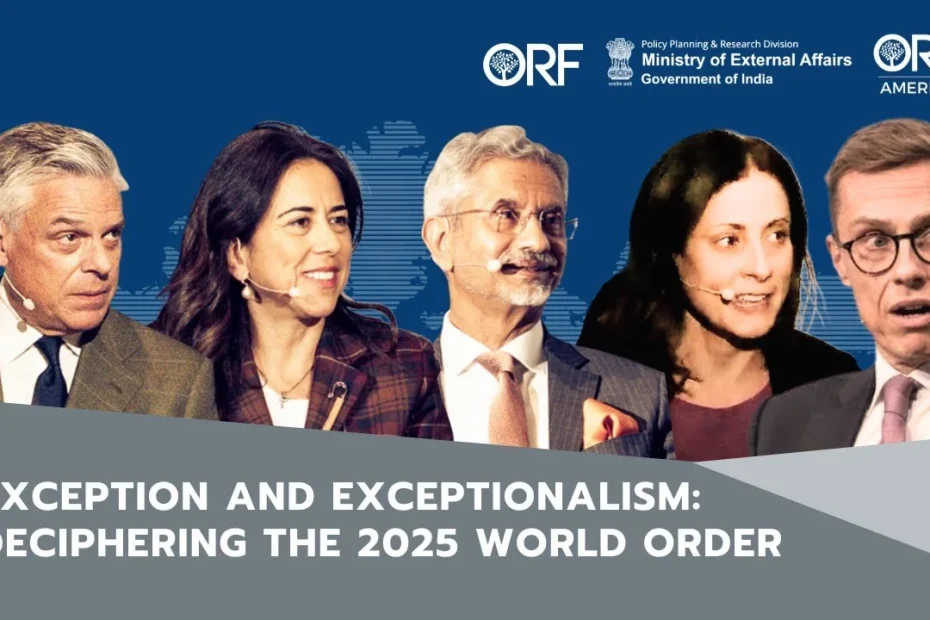
Read the full transcript of a panel discussion on “Exception and Exceptionalism: Deciphering the 2025 World Order” at MSC 2025. Speakers in this discussion include: Alexander Stubb, President, Finland; S. Jaishankar, Minister of External Affairs, India; Lana Nusseibeh, Assistant Minister for Political Affairs and Envoy of the Minister of Foreign Affairs, United Arab Emirates; Jon Huntsman, Vice Chairman and President, Strategic Growth, Mastercard; Dr. Nathalie Tocci, Director, Istituto Affari Internazionali, Italy. Premiered Feb 16, 2025.
Listen to the audio version here:
TRANSCRIPT:
Welcome and Introduction
SHARON STIRLING: Good afternoon, thank you once again for joining us for today’s lunch titled “Exception and Exceptionalism: Deciphering the 2025 World Order.” My name is Sharon Stirling, I’m the Chief Operating Officer of ORF America, one of the hosts together with the Observer Research Foundation of today’s lunch, and this is done in partnership with India’s Ministry of External Affairs.
Distinguished panelists need no introduction among this group, but let me just go ahead and do that. Starting from the far right, His Excellency Alexander Stubb, President of the Republic of Finland; His Excellency S. Jaishankar, Minister of External Affairs of the Republic of India; Her Excellency Lana Nusseibeh, Assistant Minister for Political Affairs and Envoy of the Minister of Foreign Affairs from the United Arab Emirates; Ambassador Jon Huntsman, Vice Chairman and President of Strategic Growth at Mastercard; and Dr. Nathalie Tocci, Director, Istituto Affari Internazionali, Italy.
Our moderator today will be Dr. Samir Saran who is the President of the Observer Research Foundation. But before I turn it over to him to kick things off, please welcome the Ambassador of India to Germany, Ambassador Ajit Gupta, for a few words of welcome.
Welcome Remarks
AMBASSADOR AJIT GUPTA: Excellencies, dignitaries, and dear friends, it gives me immense pleasure to invite all of you for the fifth edition of the ORF forum lunch. This has become a much anticipated tradition of the Munich Security Conference.
The USP of this forum is that it brings together diverse voices, perspectives, and intellectual acumen from different parts of the world to discuss the most challenging and thought-provoking contemporary issues.
Excellencies, the long-standing India-Germany relationship has grown from strength to strength in the last few decades. Last year was particularly momentous. We had the seventh intergovernmental consultations in New Delhi in October 2024. Our bilateral trade reached a new high of 33.3 billion dollars. Investments grew both ways and defense and security cooperation gathered renewed momentum.
The Indian diaspora is growing rapidly and you can see them in different parts of Germany. They are making an important contribution to the German economy. In the 25th year of our strategic partnership, we look forward with optimism to even greater engagement particularly in the field of security cooperation and new and critical technologies.
The panelists don’t need any introduction. In particular, our External Affairs Minister is able to condense entire encyclopedic work books into a couple of witty comments which are then quoted time and again. But I look forward to hearing the panelists. Thank you.
Panel Discussion
DR. SAMIR SARAN: Thank you Ambassador. Okay, so let me start with this panel now. I had earlier described this panel in slightly more verbose terms: Economic exceptionalism, fraying multilateralism, the normalization of sovereign action. But I thought maybe the world order today can be broken into an easy definition: People who like J.D. Vance’s speech and people who don’t like J.D. Vance’s speech.
I think that’s the world order today, and in some sense it might not be a bad point of departure to have a conversation on where we are and in some ways how are we going to respond to those big questions of connectivity, of climate action, of trade that lifts the four or five billion who are still to benefit from globalization, discovering peace in Europe, discovering peace in the Middle East, in Africa, in many other parts of the world.
How are we going to respond to it in this new mood that prevails? And let me start with President Stubb. You had a book coming out and you still have a book coming out which in some ways put the world into three easy containers as it were or three corners, and the interplay between them in your view was the future of the world order. Does that theory still hold?
PRESIDENT ALEXANDER STUBB: Yeah, well, thanks. Thanks, Samir. Thanks for having me here. To summarize, the name of the book is “The Triangle of Power, Rebalancing the New World Order.”
I started writing it when Donald Trump finished his first term and I finished writing it when Donald Trump began his second term. So the world has changed in between quite a lot. The big thesis is that there are three spheres of power: the global west, the global east and the global south and various variations thereof.
The global west used to be driven by the United States wanting to maintain the current world order, multilateral institutions, norms and rules. The global east, about 25 countries led by China and Russia, wants to break them, change them at least. And my big thesis is that the global south, 125 countries unfairly lumped into one, will be the decider. The global south is going to be the one that changes it and inside the global south you have a few swing states, big powers like India—and I don’t say this only because the two of you are here—Saudi Arabia, Nigeria, Kenya, South Africa, Argentina, Brazil, Mexico.
Now my big thesis is that the world can tilt in three different directions because my thesis is that this is our 1918, 1945 and 1989 moment when a world order is changing. It will take about 10 years and it can tilt in three directions. One is a multipolar transactional world without any kind of clear set rules. We form these unholy alliances between different players which are not very often values-based or interest-based. That’s one possibility and of course if we look at say the United States at the moment, that’s the direction in which they might be taking it.
The second option is the regionalization of power.
And then my third option, which is my preferred one, is that we see a rejuvenation of multilateralism because I believe that multilateralism leads to order. But in order for that to happen, the west especially needs to understand that we need to rebalance the power. We need to give an agency and more power to the global south starting from the UN Security Council and so on and so forth.
Why do I suggest this? And this is my final point because this is what you asked. Precisely at a time when we probably need cooperation more than ever, we are rejecting it. Global goods such as technology or artificial intelligence, such as energy, such as demography or information in general, climate change—you cannot solve that without common rules and standards. So this is my sort of quick take on the book I guess.
DR. SAMIR SARAN: So President, let me ask you a quick follow-up. In this scenario that you’ve just vividly painted for us, why do you suppose—and I’m giving you an anecdotal experience, anecdotal-based experience—why do you suppose that there is far greater acceptance of the Trump 2.0 phenomena in the global south than there is in Europe? It’s anecdotal but I travel across.
PRESIDENT ALEXANDER STUBB: I think you’re right. I think you’re absolutely right. It is because it is in the vested interest for some in the global south, correctly, to try to play ball directly over the institution. So my argument is that what we’re seeing now from the global west is power nostalgia of a system that doesn’t really exist anymore. Whereas from the global south we’re seeing, “Great. You know what? We don’t always necessarily want to play ball with China. We don’t always want to play ball with Russia. But now if we’re interesting, we can start playing ball with the United States.” So it’s much more direct. But of course anecdotal evidence—let’s be quite honest—I didn’t see too many applause when President Trump suggested that Gaza should become a Riviera.
DR. SAMIR SARAN: True, but you know the world order today, very early days of the new world order.
PRESIDENT ALEXANDER STUBB: Very much so.
DR. SAMIR SARAN: But it also can be defined as those who have met Trump and those who have not met Trump till now. One of them is here with us. Dr. S. Jaishankar, Trump in his second term, coming back from DC, having traveled Europe extensively in the last few weeks, having been to the Middle East a number of sites there. How do you assess what’s happening today?
DR. S. JAISHANKAR: Well, clearly a lot of new things, some of which was predictable if we were tuned in to what was coming out of the US for the last year or before that, perhaps even longer. Obviously a lot of anxieties in some parts of the world. A lot of opportunities for many.
I think what’s important is to kind of assess it without getting too emotional or have, you know, attached to your habits. You know, understand that this is a change which is upon us whether we like it or not. It’s happening. By the way, we do like some parts of it definitely. So and then look to see where are the openings and the possibilities out there.
So, you know, there are to my mind—I mean if I could pick up on what President Stubb said—one of the issues we have struggled with in a way is a kind of hegemonism of the global West. And you know, I hear a lot of talk today about say external interference or political interference. But in a way the same thing was happening in the name of human rights and values and so on.
So when we look at it, there are now possibilities of evening out this conversation. That many practices which were supposedly universal, which were not. We have now a greater ability to push back to say that, well, it may work that way where you’re concerned but that isn’t so for everybody. So I would argue in a way there’s a greater opportunity in a more diversified world, differentiated world to have more democratic conversations.
DR. SAMIR SARAN: So the persistent push for universalism, that moment you believe is now perhaps facing a severe pushback.
DR. S. JAISHANKAR: I think that kind of globalization, there was an economic foundation to it and there was an ideological superstructure to it. I think the superstructure definitely is challenged if not discredited. I think the foundation is being contested.
So today when we say, okay, let’s have more resilient reliable supply chains, that’s a polite way of saying I contest that model of globalization where all roads lead to one geography. When you say that, you know, let’s have an active debate, you’re challenging the view that there is one truth and it has to come out of people in New York.
DR. SAMIR SARAN: I’m going to come to someone from New York but just in a bit. But let me first turn to Natalie. Natalie, I could not help but read your tweet last night and it kind of provoked some thoughts in my head. And you know, I was like, I could see European anger against what J.D. Vance said yesterday in the hall. And I was like, you know what? This speech could have been given to any global south country by any person from Europe, America at any given point of time in the last 80 years.
We have heard such speeches given to us in our auditoriums by folks coming from this part of the world all the time. A democracy as large as ours is told by barely surviving democracies that you need to learn our model of bringing collectives together.
So I, by the way, I took some pleasure in seeing something that some people felt when they were lectured to. And I love that line that if Greta Thunberg can lecture the world on energy choices, you can possibly hear Elon Musk lecture the world on technology choices. So just your view, since you have tweeted about it, I want a fair European assessment of where you think this relationship, the transatlantic partnership, is headed in the next year.
DR. NATHALIE TOCCI: So let me perhaps sort of start with where we are in this journey on order or disorder and end with J.D. Vance in Europe.
So it seems to me that there are sort of three steps in this journey. Step number one, we’ve been at this for a while, the end of the unipolar order and the unipolar system and with it the end of the liberal international order, right. With increasing contestation of that order, we went through a phase of debating about how to reform institutions and all the rest of it, and that was kind of step one.
We then enter step two. Okay, so what’s the new shape of the international system? Is it bipolar? Is it multipolar? Is it tripolar? So what is it? And especially after Russia’s largely invasion of Ukraine, we start getting—and the US-China competition leading to the debate on decoupling—we start getting this feeling that perhaps what this is doing to order is leading to a multi-order world, right, of separation. There are still rules and norms but basically different parts of the world subscribe to different norms and rules.
I think we’re entering now stage three in this journey, right, and stage three in this journey is actually a world which is non-polar. And by non-polar what I mean is, firstly, there is no real ideological glue tying different countries or regions together and that where transactionalism is on the rise and where basically it’s kind of law of the jungle, right. And of course if you’re down that food chain, you’re kind of increasingly in trouble. And this is where we get to J.D. Vance.
So to me the troubling aspect of that speech was not so much—I mean, you know, the whole freedom of expression thing, this is a bit weird frankly speaking, but okay fine, you know, let’s have a conversation about it. But it’s the freedom of expression and you are moving away from your values conversation followed by “well, eight days before an election” and followed by a meeting with the leader of a far-right sort of neo-Nazi party, right.
That kind of suggests that the aim is not that of having a debate about freedom of expression, but the aim is that of deliberately not just weakening but perhaps even destroying the foundations of liberal democracy in Europe and European integration to the extent to which these far-right parties are explicitly euro-skeptic and nationalist. And so, and this is why I come to the law of the jungle and the non-polar system, right, because a poll presumably is not just a country. I mean, a poll has a sort of series of partners and allies and friends that it works with. And here we have the very deliberate attempt at prevaricating and indeed possibly destroying what those partners and allies were all about.
# Panel Discussion at MSC 2025
Global Perspectives on Partnerships and Power Dynamics
DR. SAMIR SARAN: I want to ask you something about Ukraine but I’m going to hold that piece right now. I’m going to come back to Ukraine. I think that’s an important issue, but I do want to leave a thought with you that if I was to make a list of envoys from Europe and America who have gone and met quasi-anarchist in my country, that list would be endless. And the global south that you mentioned may not find that really odd behavior. It doesn’t make it right. I’m not saying it’s right, I’m just saying it is not an odd behavior.
S. JAISHANKAR: I think Samir is getting kicks out of this. I can sense it. We are good friends.
Why is Europe so upset with something that was so predictable? I mean that speech was written a long time back and it was only delivered yesterday and you’re surprised. You never heard it, but I’m going to come to Ukraine.
DR. SAMIR SARAN: I want to come to both of you on Ukraine. Let me turn to Lana and finally you’re going to defend America, but I’m going to first come to Lana. Lana, you’ve spent a lot of time in New York and you understand the power of collectives, of collaboration, of building partnerships especially on projects that are long-term by definition.
Peace, connectivity, infrastructure, energy transitions. These are long-term projects that require sustainable partnerships in a world that is in many ways thriving on short-termism, on transactionalism, on in some ways convenience of the opportunity that is available. How do you build something sustainable especially from the gaze that you have sitting in the Middle East which requires—which is actually witnessing all of this at the same time?
Energy transitions, economic transitions, search for peace, new partnerships and connectivity projects. How do you look at the world?
Middle East Perspective on Global Partnerships
LANA NUSSEIBEH: Thank you and I’d like to just quickly refer to the President’s comment on how we reacted to President Trump’s Gaza Riviera statement. I’d say we’d welcome Gaza becoming a Riviera of the Middle East, but a Riviera of a Palestinian state is the Arab position. So I think there’s some agreement there but it’s just about what the end point is in terms of the political horizon for the Palestinians.
More broadly to your question and New York and where Dr. Jaishankar has said power has sat for so long where the rules have been given and taken by a different configuration of countries—and many of us have spent some time with Dr. Kissinger there. I remember the book he wrote on trust and mistrust in the transatlantic partnership that he spoke about in one of our discussions. His agent was quite surprised by how well the book was doing until he found out that it was in the marriage and divorce section of most of the libraries and bookshops.
The reason I turn to that is because a lot of these issues in terms of partnerships that you’re talking about are about not putting the kind of effort that goes into a relationship when it’s taken for granted. I think that’s to answer your question on the UAE position and many countries in the global south position. Effort needs to be put in in a regular way into a marital relationship, and it needs to be put into the partnerships that we have developed over the years with our strategic partners including the great powers.
So that’s the first point and when we don’t find the return on that investment, I think as Dr. Jaishankar has said, we are looking for the right to diversify our portfolio of investments, our economic bridges, our partnerships with other countries in terms of defense and security. I think that is the world order we are moving to. It’s not necessarily transactional but I think it’s clear-eyed and pragmatic about the state of the world as it is today.
So that would be the second point for the UAE. We’re an economic hub. We managed to become that way by being agile diplomatically and economically.
We’ve signed over 20 free trade agreements. We negotiated one with India most famously in 88 days at the directives of Dr. Jaishankar and our foreign minister. We’ve been trying to negotiate one with Europe for 30 years.
We are 23. I’ll let that sink in as the mood music in Europe is about competitiveness, economic competitiveness, strategic autonomy and independence, increasing defense spending. You need to create an agile bureaucratic structure and diplomatic structure that responds to the needs of today’s world and that goes to your connectivity point.
Yesterday Prime Minister Modi and President Trump came out with a joint statement from Washington. It referred to two really interesting initiatives that came out of India and the UAE, the IMEC and the ITU. That’s the kind of connective tissue today that countries are looking for in their partnerships.
So we want to connect through trade. We want to connect through rail. We want to create jobs and opportunities for the 140 million youth in the MENA region who are looking for stability and economic prosperity and security.
We won’t be able to provide that necessarily through the traditional platforms but we shouldn’t give up on the traditional platforms. The norms exist whether we’re in a 1945 moment or a Cold War moment or a 1930s moment where we’re looking at the signs and worrying about what comes next. The mood music in this two days has clearly been quite downbeat.
I think we have to respond to this moment with some agility, with some flexibility and with some creativity. Those are things that smaller countries who are not so trapped in the bigger bureaucratic structures can do and I think that’s to the point of bringing in different size powers to see what kind of leverage they can bring to the table in terms of keeping some of the very good rules of the road in place.
DR. SAMIR SARAN: Now I’m going to come back to the Middle East in just a bit. I want to have a little bit of a conversation on what could be the road, the pathway ahead, but Ambassador Jon Huntsman, let me turn to you. As you explain what’s happening today, are we seeing an America which is becoming expansive rather than retreating or is it choosing the spaces that it wants to be present in and forfeiting some of its overheads in other domains where it had little returns that it calculated over the past few years? So what is really happening here? Is it an expansive America, a retreating America, an isolationist America? What is America today? Please explain to us.
Understanding America’s Current Position
JON HUNTSMAN: Well first of all it’s a pleasure to be here and let me just say this is a topic that lends itself to heavy drinking so we’re in the right place. I’m always amazed at how often people misread the United States. I think there’s a lot of hand-wringing, unnecessarily so.
So the United States is made up of 50 sovereign entities called states. They all have their own constitution. They all have their own legislature.
They all have their own economic development plans and educational strategies and they determine the cycles of success in the United States. Washington is largely irrelevant. Now that may sound strange because we’re all fixated on the—but that’s the way the United States works and because of that the cycles of politics in Washington will continue sometimes appearing as if it were a 1964 Ford Fairmont running off the side of the road ready to kill the driver.
But we have to take a step back and say okay what really makes America run? And every one of the states in America have their own trading relationships. They have their own international strategies. I know because I was governor of a state and we in this room make a mistake by not reading America as it was designed to operate.
So that’s point number one. Point number two is the Trump phenomenon is an expression of the American people. We’ve seen a massive diminution of trust in politics.
I think everywhere including the global South. That’s why you see a lot of people who have glommed on to Trump’s message because the voters have been failed by their sovereigns. Institutions are increasingly seen as irrelevant even though I think they’ll be recharged over time.
And right now the American political zeitgeist is playing to the hometown crowd. So yes we heard J.D. Vance’s speech yesterday and for those who were shocked by it I would say shocked by what? Were you not following the campaign? Did you not hear the rhetoric? And many thought well the rhetoric would discontinue upon the inauguration. That’s not how the Trump machine operates.
So J.D. came and he gave a speech and I think it was largely tailored for a certain constituency and audience, not here. So this is kind of the new kind of rhythm of Washington and I think the rhythm will continue in a transactional nature. I think Trump is very much based on personal relationships.
So you say well how will trade policy go? Well the trade policy function in Washington is way different than it’s ever been. USTR used to call the shots. I was there at one point as the deputy U.S. trade representative and negotiate trade deals.
During this administration you’re going to see something different. I think you’re going to see Trump develop relationships. If he likes relationships, if he gets along well with somebody, if he sees common cause and the extension of America’s interests, he’s going to negotiate deals.
I think India is a perfect example of that. So I think we’re in this mode. Call it whatever you want.
Ten terms come to mind but I don’t think any of them are necessarily fitting because we’re running up against the cycles of American politics which I think we lose sight of and that is Trump has one term which means he has not four years but because you’ve got the midterm elections that strike it less than two years from now and the House of Representatives is likely to be lost because you’ve got the House up by one and the midterm cycles generally will favor the party out of power. The Senate may be shaken. It’s hard to know and then you’ve got a lame duck status and the race for 28 has begun.
So I think in looking at and analyzing Trump, I think we need to understand that yes conservatism of some kind might prevail unless there’s massive overreach and a blowback which is not unusual in American politics and we’ll be back to kind of a more identifiable familiar pattern but right now we’re not there.
America’s Changing Role in the World
DR. SAMIR SARAN: I want to ask you and Dr. Jaishankar to respond to this particular aspect that you actually very lucidly described. The American people have spoken. American elections are an expression of the people. I would suggest that over the last few cycles including the election of Biden, you would find that certain changes in America are definite irrespective of the party that is in power.
For example, exclusive economic policy, IRA, Inflation Reduction Act was a muscular industrial policy that was serving its own industrial aspects. The China policy, bilateral consensus, the decision to invest in certain relationships, for example, the US-India relationship, bipartisan consensus, the Middle East transformation, bipartisan consensus.
The point I’m trying to make here is that while the elections may be in two years, America may have changed dramatically and some of its cousins across the Atlantic are not getting that message. It does not matter. Trump is not the problem here. They are not reading America right and what you were mentioning—and do you think is that the problem? That America has changed and the world is still negotiating with the 1945 America and that’s my question to Dr. Jaishankar but first to you Ambassador.
JON HUNTSMAN: I would say that America is changing somewhat. I think it’s changing based upon a number of things. I think it’s changing based upon COVID which I think shell-shocked the American people and when you look at the private sector’s response to COVID, every boardroom in America is having the same conversation. How do we redesign and rebuild supply chains because they all collapsed during COVID which had a massive implication on employment, for example.
I think we were dumbstruck by the 08 financial crisis and you keep layering things upon each other. The rise of China has shaken many people in the United States and the net result is an inward look at rebuilding the fundamental building blocks of the American nation. Some people call it isolationism.
Trump calls it rebuilding from within and I think that is a trend that is likely to continue. So the idea of Bush internationalism or Reagan internationalism, I think we get back to at some point because I think we need to interact with the rest of the world. Economies will have to expand beyond their own borders but for the time being it will be a moment of domestic rebuild and whether that’s Trump or somebody who runs in his place, I think a message will be similarly tailored to that cry out by the American people for one reason, rebuilding trust which no longer exists in politics.
S. JAISHANKAR: Two notes of dissent. The first one about something Natalie said. Look, I think calling it, calling the change saying this is your alternative or else it’s the law of the jungle is a kind of scaremongering tactic.
It isn’t the law of the jungle. I mean, it’s from a very cozy room. Everything looks like the law of the jungle. Out there, it’s a more competitive world. It’s a world where more countries have the freedom and the choice to pursue their interests. I mean, if that’s the jungle, I’ll take my chances on it because I’d rather be in that jungle than be in the pen which a few people control.
That’s one dissent. I like dissent. The second dissent. Look, I take John’s point, but I think he’s underestimating Washington. I think you’ll get enough things in those two years or less, which will profoundly change the world. So the 50 states may carry on with the model.
# Panel Discussion at MSC 2025
Perspectives on Global Democracy and International Order
JAISHANKAR: But because the president of the United States holds such exceptional power and the country has so much influence that within this period, in fact, I would predict much earlier that you’re going to get policies which will reshape the international order as we have got used to. So I’m not saying it’s good or bad. I’m just predicting what is to come and something big, I think, is coming at us.
My third point is where I agree with him is, look, I do think around the world, politics and politicians have generally got discredited. I think there’s a loss of trust. I would again argue we are a bit of an exception.
It’s not. It’ll be very tough today in a really democratic society for anybody to get free continuous terms, which is what has happened in India. But we are an outlier in this respect.
But it’s not just politics which has got discredited. I think, in a way, diplomacy has got discredited. The international economy has got discredited.
The kind of model which we have touted as being universally good is seen by many people as being built on their jobs, which were taken away from them. In India, for example, if you look at small and medium producers, I mean, they are very angered at the kind of dumping of goods which is taking place in the Indian market, we all know from where. So I think we are dealing today with a much more disillusioned, unhappy world, which is ready for change, which says that, look, I don’t believe all that non-law of jungle stuff which I’ve been hearing for so many years.
I am now prepared to take my chances in whatever lies out there, because I think it will definitely be better than what I have today.
On Democracy and Polarization
DR. SAMIR SARAN: And, you know, since you mentioned democracy in your intervention, are we now reaching a stage that we are perpetually polarized democratic societies, which means unless our side wins, democracy is not good? Have we reached that stage that unless your team wins, democracy is bad? We see that in the US. We see that in India, to some extent.
We see that in different parts, that unless who you vote for wins, the elections are not good.
JAISHANKAR: Well, sorry, I know. I’m coming to Ukraine very soon.
No, but look, I’ll put it to you this way. I know people will say that. But if by the next election, they’re not saying it, democracy is fine.
You know, they will say it in the aftermath of a loss. You know that. Okay.
You know, the system wasn’t good. That’s why I didn’t win. But if they gear up for the next election, I think we are underestimating the strength of power and the habit of democracy and actually the attachment which people have to the exercise of individual choices.
I think we are too quick to dismiss it because somewhere politics has not gone the way some people would like it to go.
ALEXANDER STUBB: Yeah, I think on democracy, misconception is sort of linked to this whole end of history thesis of Fukuyama, which I firmly believed in myself that all nation states of the world, 200 of them would revert to a combination of liberal democracy, social market.
JAISHANKAR: Only an American would have believed that.
ALEXANDER STUBB: Exactly. Well, no, I’m a Finn. I’m a Finn.
JAISHANKAR: I’m a Finn. I know. But I think there but this is again, you know, we come.
ALEXANDER STUBB: Yeah. Yeah. And but I mean, again, that is not my point.
My point is that the fallacy and the mistake that people like myself made at the time was to think of democracy as an end state or something static. Democracy is never that. It’s always messy and complicated.
The thing that makes me believe in democracy, apart from, you know, free speech, open society, institutions, rule of law, protection of minorities, human rights and fundamental rights, is the self-correcting mechanism that democracy has because autocracies don’t have that. Now, then we have to ask ourselves the question, what do we need to avoid getting into this cycle where, you know, democratic change is basically constant every two years or every four years? I think what has happened is that democracy has not adapted to technology. Democracy originally, as crafted, say, by John Locke and his likes, was supposed to be slow, messy and compromise seeking.
But now we have a new instrument that has come into play, which is technology. In the beginning, many of us thought that technology was going to work only for good and everyone will be liberated to free speech and the rest of it. But now we have suddenly seen that as a matter of fact, technology doesn’t necessarily adapt to democracy.
So I remember, I’m not that old, but in the olden days, politicians had about three months to answer to the media. Then they had about three weeks. Then suddenly it was three days.
Then it was three hours. Then it was three minutes. It was 30 seconds.
And now, unless you put out something on X within three seconds, that something has happened. And then we get into this cacophony of information. And I don’t think democracy has yet understood that information is not wisdom.
So that’s what I’m trying to say, that democracy needs to adapt all the time. And we have to understand that right now, it’s in a certain direction, which some people don’t like. But at some stage, it will adapt back.
UNIDENTIFIED SPEAKER: I think they’re all making the case for stable monarchies.
UNIDENTIFIED SPEAKER: Well, yeah, philosopher, philosopher, king, philosopher, king. Eventually, you will agree with her.
UNIDENTIFIED SPEAKER: Exactly. I will agree. But can I, can I also? I will respect your people’s vote on that.
On Ukraine and International Rules
DR. NATHALIE TOCCI: Yeah, I mean, I just wanted to come back to the jungle business. I mean, I think we would all also want you to give me a quick prognosis from where you’re sitting on what could be the future of Ukraine.
Okay, quick. But on the jungle business, I mean, I think we would all agree that it is right that the rules of the road are determined by not just one power and that different players should be able to shape the system and use the system for their benefit. I mean, I think there’s kind of, you know, there would probably be broad agreement on this.
I think when we get to the jungle territory, and I think we would also all agree that, including Minister Jaishankar, that it would not be such a good thing if there are no such rules at all. And if me and President Stubb sign a contract, I assume that there is some sort of institution out there that will make sure that he respects the contract. And if he doesn’t, I can sue him, right? Now, if those institutions are destroyed, if those rules are eroded, if nothing does anything about them, then we are in that jungle territory where if you are down in the food chain, you’re in big trouble.
And surely that is the situation that no one really wants to be in, because indeed, if you are down that food chain, you’re in immediate trouble. But presumably, even if you’re up there, sooner or later, you are going to run into trouble. So to me, it should be a conversation about those rules, about what we think about them, and especially about how we collectively are going to do something in order to ensure their respect, which gets me to Ukraine.
So, I mean, who knows what’s going to happen? You know, I mean, I think we basically are into two possible scenarios here. Scenario number one, so I would tend to exclude a peace agreement scenario. I think what at most we can think might happen is a scenario in which there is some sort of truce.
And then the question, and it becomes a very European discussion about what we can do to ensure that that truce becomes more or less sustainable. And this is where we get into conversations about defence, both European defence more broadly, but also continuing military support for Ukraine. Deterrence troops, I kind of, you know, I’m reluctant to define them as peacekeepers, because I don’t really think there is going to be a peace to keep.
Anyway, so that’s sort of one scenario. Then you have a second scenario in which negotiations begin, and they continue, and they continue, and they continue. And in the meantime, war continues, and continues and continues.
And in that scenario, which actually, I think is more likely than the first scenario. Well, I don’t know, but I’d love to hear Ambassador Huntsman’s sort of views on this. What would Donald Trump do? Would he basically just kind of get feel slighted and get annoyed and double down magically in supporting Ukraine, or I fear, get bored and look for his Nobel Peace Prize elsewhere?
DR. SAMIR SARAN: Okay, I’m going to come to you, Ambassador.
ALEXANDER STUBB: Sorry. Yeah, it’s okay. I mean, so okay, I come from a country which has 1340 kilometres of border with Russia.
I come from a country that fought, went to war and the war of continuation with Russia, and fought about the three key principles of statehood. One is independence. The second is sovereignty, and the third one is territorial integrity.
We retained our independence, the only bordering country to the Soviet Union at the time to do that. The rest of them became Soviet satellites. We lost our sovereignty, our right to choose where we wanted to be, European institutions or otherwise.
And we lost 10% of our territory, including the land where my grandparents and my father was born. So this is the prism through which we look at Russia’s war of aggression in Ukraine. And I, you know, Dr. Jaishankar’s legendary comments from GlobeSec in the olden times is that…
UNIDENTIFIED SPEAKER: Olden times.
ALEXANDER STUBB: Because it’s like three years ago, right? Something like that. But he was completely right to say that we do a lot of naval gazing in Europe, and we only care about our wars and expect everyone to care about our wars, whereas the other way around, it doesn’t work. My thesis on Ukraine, given the situation, so we need to look at it in three phases.
The first phase is to strengthen Ukraine militarily, and try to be as tough on Russia as possible with sanctions, frozen assets, and increasing military in Ukraine to give Ukraine a position of strength to begin the negotiations. Second phase, and here’s perhaps where I unusually disagree with Natalie a little bit, is a ceasefire, not a peace process. There’s a bit of an Italian vibe there, right? You were in Florence at some point.
DR. NATHALIE TOCCI: I was, I was.
ALEXANDER STUBB: So we need a ceasefire, and that ceasefire basically needs to have a demarcation of the border. And then after that, you start talking about the agenda of the peace.
And of course, there needs to be some kind of security arrangements in place. The third phase is the long phase, which we don’t know where it’s going to end. That is a peace process.
And that means that you start looking at territory, you start looking at…
DR. SAMIR SARAN: My question is, this is what you want it to be?
ALEXANDER STUBB: Yeah.
DR. SAMIR SARAN: What do you think it is going to be?
ALEXANDER STUBB: That’s what it’s going to be. You know, So the question here is, do you think if the US has a different view, Europe is ready to walk alone to make this happen? I don’t think it’s a binary question, because Europe is not going to walk alone.
But if you want a conceptualization thereof, on the security arrangements, basically Ukraine stands up and keeps it. Europe supports and gives the backup, and the US gives a backstop. So the trade-off there is that the US doesn’t put boots on the ground, but Europe does in one way or another.
But obviously, this is a long haul. And what people need to understand, and believe me, we in Finland know Putin, and we know Russia. He is an imperialist. He is a colonialist and revisionist. The only thing that he understands is power.
Anytime you give in to Putin, he will hit you back twice harder.
So therefore, you need to put Ukraine into a position of strength. And I think already the fact that Zelensky didn’t, you know, approve the mineral deal, or said that we cannot have negotiations between the US and Russia on this is an indication. There’s no other choice.
DR. SAMIR SARAN: Ambassador, do you want to comment on this?
JON HUNTSMAN: I’d love to. Because it scares me to death. I think we’re terribly naive in the West about Putin.
The President is absolutely right. I think this is an opportunity, however it plays out, for a number of leading countries of the world to come together to find a solution. Because I don’t think it’s just the United States that should be part of this endgame.
My fear is this. Putin is a master at dirty tricks and malign activity. We’ve seen it in Georgia, 2008 and beyond, annexing what now were Abkhazia, South Ossetia.
I’m concerned deeply about Moldova. He’ll take the land in Ukraine. However, this deal is cut.
That will likely be part of it. The security guarantee will have to be negotiated. I think that will be probably the most difficult part.
Some sort of peacekeeping arrangement. But what I fear most is this is a holding pattern for Putin. He’ll claim victory and move on.
And he’ll wait. Wait for the next election in Ukraine. And he will hope for a 2010 outcome.
And hope to control whomever wins that election. He’ll flood the field with propaganda, disinformation, and cut out candidates. And I think his goal long term will be not just the land, the 20% that he’s already succeeded in getting, but ultimately finding a political subsidiary in Kiev that he can control.
And that will be his victory.
DR. SAMIR SARAN: Lana.
LANA NUSSEIBEH: Yes.
DR. SAMIR SARAN: A sustainable, durable vision for the Middle East. How do you see it play out? Early days. I don’t think we can reach a conclusion now.
# MSC 2025 Panel Discussion (Continued)
Regional Perspectives and Global Integration
LANA NUSSEIBEH: But how do you sense the mood now in that region? So the mood is obviously a little bit pessimistic about the broader trajectory of the last two years. But I think there have been some openings in the past month that we need to build on. The big picture, obviously, is how US foreign policy in the region plays out vis-a-vis two hegemons, Israel and Iran, as well as Saudi Arabia and other regional actors.
The tactical questions are how we resolve crises. And that goes to your point on, is the international system today able to cope with the current crises? Dr. Jaishankar says we should see what’s coming and understand that change needs to come in order to take stock of these conflicts and actually resolve them. And I think we agree with that.
Under 60 conflicts currently across the globe, more than any time since World War II. However much we are all attached to the international system and the way it works, it’s been broken. And it’s been broken by a number of conflicts over the past two decades.
And it’s been broken by the fact we haven’t been able to resolve those conflicts we’ve been managing them. So whether it’s Ukraine, whether it’s Gaza, whether it’s October 7th, whether it’s the broader Middle East, we have a moment of opportunity today. We have a possibility to build a stable future for Lebanon for the first time in years.
We have engagement with a complex Syrian government today on the ground. Nonetheless, it’s giving out the right signals and statements about what it sees for its future in Syria. Inclusivity obviously being a core tenet of stability across the region.
And we have what is coming in terms of where Iran fits in the region and where Israel fits in the region. As you well know, the UAE’s perspective as a pragmatic and I think clear eyed investor in stability and the forced protection of stability in the region, we believe in the integration model. So we think all of these countries need to be integrated and that economic partnerships are the way to arrive at that integration.
But it is going to take a lot of work. It comes back to that really popular term today, which is regional burden sharing. But I think it’s a very good point.
I think that the regions have to come forward with their own solutions to some of these issues and they have to be bolstered by the presence of an international community. That’s what we’re looking at. I think your example on COVID was a really good one for why diversification has happened in the last few years.
We all believe, we all bought into the globalization theory that we are now connected, that borders the nation state as it traditionally was, would not affect the equitable distribution of vaccines, of medication, of sharing knowledge on health systems. I think COVID was a rude awakening for a number of countries in the global south that had to suddenly self-invest in these industries in their own country. So that independence, I don’t necessarily think is a bad thing.
I think it was a good shot of adrenaline to the system. We needed a geopolitical shot. We needed a geoeconomic shot and we’ve had them.
And for the Middle East, we plan to work together in a like-minded collection of countries with those who want to partner with us to try and create a future that is stable and prosperous and built around integration of all of these countries in the region. We need to make the case for that integration and we will make that case.
Audience Q&A Session
DR. SAMIR SARAN: So we’re going to take three questions from the audience. We have 11 minutes, 10 minutes. I know you have to leave at 2:45, President. 2:50? So we’ll try to get you first.
So we have a hand here. We have Michael here. Can we have a mic to Michael? We’ll go to Michael first. Then we’ll go to my friend from Portugal. And let me go to, and let me go to, there you are. Let me turn to Peter then from Slovenia.
So we have our three questions. Michael, first to you.
MICHAEL: First compliments to Samir and the panelists. I think this has been the most interesting panel of the weekend. So thank you very much.
My question is to Dr. Jaishankar. You said, Dr. Jaishankar, you dissented from Ambassador Huntsman’s point about the importance of states. And you said, because of the importance of the great power of the Office of President of the United States, and because of the power of the United States in the world, the next two years or even less than that, I think you said, is going to bring forth changes that will change the international system. And I felt the bar mom tears sort of reverberating at that point.
And I feel you teased us by saying that and not going a little further. So you have to give us a bit of a spoiler alert, Dr. Jaishankar, and tell us the nature of these changes that you foresee. A permanent seat for India on the Security Council.
DR. SAMIR SARAN: I think there was a mic there. Go ahead. Anna, go ahead.
ANNA: Good afternoon. I just want, being a former member of the European Parliament, I just want to highlight, and a former member of Portugal, of course, to highlight what Mr. Lana said, because of the time that Europe deal, trying to have an agreement. You spent 88 days negotiating a trade deal with India and 30 years with Europe.
So this is our biggest mistake, and I am totally in support with this idea. And I’m more with you about the idea that we need, I like the idea of the shock. This is a shock for us. I’m always thinking about that. And I’m sick of the poetic speeches in Europe. I just want to highlight this because this is very important for us in Europe.
DR. SAMIR SARAN: Okay, so that’s a statement. But I do know that negotiating an FTA is an end in itself. It doesn’t need to lead to an FTA. The process is the end itself. Okay, you have to understand the idea behind it. Go ahead, Peter.
PETER: Peter Gorka, Bled Strategic Forum. It was interesting for me because basically for the whole panel, nobody mentioned China. So probably this is the only panel where China, as one of the global powers, was not mentioned.
So my question is pretty simple. Where does China fit in what Natalie was saying and also Minister Jaishankar in this new reality that we are finding ourselves in? Are they going to play the ball? Are they going to try to have an agreement on new rules which they would abide by? How is their connection with America going on and so on and so on? Thanks.
DR. SAMIR SARAN: There’s a famous saying that if the world is a casino, China is the house and the house always wins. No matter who shakes the world, it’s the house that takes the winnings. So I think that, thank you, Peter, for asking that. How is China going to respond to many of these developments? So maybe let’s go down the panel. Let’s start with you, President, because I know you have to leave a little earlier. So let me start with you, President.
ALEXANDER STUBB: Yeah, I’ll just make two quick remarks. First one was the trade issue. I fully agree with you that Europe is way too slow in forging its trade agreements. Having said that, I think it has over 40 trade agreements with over 70 countries out of the 200 nation states in the world.
So it does have the widest web of free trade agreements. But the way in which it behaves in these free trade agreements, it’s simply unacceptable. You know, it just doesn’t and shouldn’t be like the way in which it is.
The second point is on China. I had the privilege to spend three and a half hours with President Xi Jinping on a state visit last October. I knew him from before. We spent two hours, basically, tête-à-tête discussing the world order. My starting point is obviously that China is the key player together with the United States. My point is that China always plays the long game.
You know, for China, a century is only a page in a book, whereas, you know, we in the past three weeks have been shocked about the result of the US elections. He’s probably looking there, come on, guys, this is only four years. Got nothing to worry about.
What China has done is strategically extremely wise. So instead of taking the moral high ground, as we have in the West towards the global South and elsewhere, it has created strategic relationships, which are finance and infrastructure based. It is now the biggest creditor to 120 countries out of 200 in the world.
China is also quite wise at playing the multilateral game. It does talk about multipolarity, etc. And of course, it always maximizes its own interests.
The negative side of China, apart from the fact that, you know, I don’t share many of the values portrayed by the Chinese leadership, but in my values-based realism, there’s space for dialogue because you can’t solve the world’s big problems without China. For China, the main problem is going to be demography. The demographic curve of China is really, really bad, whereas the demographic curve for India is very, very good.
And that means that they are actually going to be in a weaker position. But then I think a lot of this is then, and I’ll stop here, a lot of it is going to depend on, you know, who gets the technological oversight on it. But yeah.
S. JAISHANKAR: Just on the FTA part, if you count the top 10 largest trading relationships, none of them are based on an FTA. EU, US, India, you know, US and China, China and Japan, Japan and US, you go across the world, look at the 10 biggest, 15 biggest trading relationships, they tend to operate outside FTAs. What I mean to say is we should try for an FTA, but let’s get trade going.
That’s what I’m trying to say. Just a final point. In my mind, of course, the WTO should be the center of it. And actually trade is on the up, not on the down, as many people think. What I think will eventually happen if the Trump administration continues to threaten with trade barriers, tariffs, etc., etc., not only is it going to hit the American general public and actually stock markets, but what’s going to start happening is the rest of the world trading around the United States. So, you know, it will go in different directions.
DR. SAMIR SARAN: Nadia, are you?
DR. NATHALIE TOCCI: Well, I mean, it’s actually a segway to what President Stubb was saying, and just adding a more specific European angle to the China question. I mean, I think, you know, sort of prior to last November, the general direction of travel in Europe was indeed aligning with the United States, no longer being starry-eyed about China, realizing that indeed the economic security agenda, etc., had to be taken seriously. And this was the world of, you know, perhaps not decoupling, but de-risking.
I think now, because of everything that we’ve just been talking about, there is a growing sense of we can’t really afford to have kind of three wars at the same time, right? And if we have one with Russia, and we are increasingly in conflict with the United States, we may not like China, but perhaps this is a time to look at ways in which to cooperate with it. And I thought it was fascinating listening to Minister Wang Yi’s statement yesterday, after J.D. Vance. And if you were to just take the snapshot, right, of yesterday, and of course forget, you know, sort of months and years before, indeed, you know, all of a sudden, China kind of comes across as Europe’s best friend, right? Now, I’m not saying that we’re going to, again, forget those months and years before, but I think, again, because of this growing transatlantic rift, there’s going to be greater openness, provided that China plays well the game, and I think it is playing well the game, to actually look for ways of working with China.
S. JAISHANKAR: But let me just inform you that your China addiction predates J.D. Vance. Europe has a China addiction which is far older, and you need to fix that irrespective of who’s in the White House. And we are in Bavaria.
DR. SAMIR SARAN: Ambassador.
JON HUNTSMAN: Well, Jay and I used to be neighbors in Beijing, where we first became friends. I would just say a couple of things. One, it was interesting that J.D. Vance did not mention China in his speech. So process that one for a moment. Number two, notwithstanding my vast disagreements with much of what China does and what they promote, it’s a smart country.
And they thrive on a world full of ambiguity. And they do so because there is zero ambiguity in their national strategy. They know exactly where they’re going. And they task and implement and execute with precision.
So a world of ambiguity plays to their strengths, which is shoring up relationships. I mean, the speech by Wang Yi, who I first got to know when he was head of the Taiwan Affairs Office, I’ve heard for 30 years. It’s the same basic talking points, but it’s a reassuring set of points about China’s role in the world and where we’re fair play, level playing field and all of that. So China will be a factor in everything we’re talking about. They need to be drawn out in terms of problem solving around some of the major issues of the day.
So let me just take you to the end point where I can imagine a summit with Trump and Xi Jinping. And I’ve heard from Trump personally about his relationship with Xi Jinping. He thinks he has a good relationship with Xi Jinping, likes the man.
So you can imagine them coming up, at least for the holding pattern, a formulation for coexistence. But you can imagine the coexistence drawing China into maybe a Ukraine rebuild scenario or something like that. In other words, the U.S.-China relationship has always operated better when there’s been a large strategic construct to pursue, keeping us out of trouble.
So I imagine that that could be in our future. It’s a projectile relationship. I’m somewhat optimistic about where that goes.
# Panel Discussion at MSC 2025
Perspectives on Global Partnerships and the Changing World Order
LANA NUSSEIBEH: I agree with much of what you just said. I think for a country like the UAE, we need a managed detente between China and the United States in the coming period, both for geopolitical and geoeconomic reasons. I think we need to avoid the Thucydides trap scenario.
That is also something that has been a little bit of a clarion call for a number of countries and analysts recently. For us, we’re the biggest trading partner for China in the Middle East and the re-export hub. We’re also the biggest trading partner for the United States.
But for us, the United States is an indispensable strategic partner in the region, and we are always looking for ways to solidify that partnership. And China will always be an important economic player and partner. And I think we need both for economic growth, which is the buzzword of European reports this month.
So I think this is good net-net for everybody. I think, you know, big picture, if we can work with the United States and with China in also increasing the stake they have at these various tables in terms of peace and security, that would be a good net outcome for everyone. So that’s the position of the UAE, and that’s how we see the two countries.
The last point would be on AI, which we’ve touched on briefly. Was DeepSeek a Sputnik moment? I don’t know. The tech companies in the United States would say not.
But our investment has been upward of $100 billion in American AI, because we believe that we’re going to be moving from a period of geoeconomics to geotechnology, and that will define, and it should define in a good way, whether we all continue to economically prosper or not. So for the UAE, it’s about everybody getting access to that, getting access to the data centers and being able to exponentially grow. That’s a target for us.
Challenging Perspectives on Global Relations
DR. SAMIR SARAN: Mr. Jaishankar, you have a direct question from Michael, but also maybe on the rest of what you just heard. You know, I was kind of marveling at what I heard. So we have this values-based Europe very upset with Trumpian America.
And because it’s upset, guess what? They’re going to turn to China. So there must be some great value-based connect between Europe and China. Don’t look at me.
I mean, look. I mean, I’ve invested in this. And then let’s take this further.
So there’s this terrible law of the jungle out there. OK, we can’t deal with it. So let’s stay with the law which we have.
Now, what’s that law that came? It’s been gamed by China. So the laws, the law abiding the rule-based order, the multilateral institution, which all of us, by the way, said that China is getting the best out of it. And we say, oh, by the way, we must defend that because the alternative is worse.
So I’m left scratching my head a bit. That a flawed democracy is not as good as an efficient authoritarian regime. I think that’s the bottom line.
S. JAISHANKAR: Stable monarchies, I’ve said this before. Stable monarchies is where we’re all reverting to.
DR. SAMIR SARAN: Exactly. That’s what we’re getting to.
S. JAISHANKAR: Having said that, let me turn to Michael. Look, let’s just reflect on life since November.
And it’s less than a month of this administration in office. So I think there are another 20 odd months to go, at least. So what has been the conversation? Ukraine, Gaza, Greenland, Panama, tariffs.
And you think the world order isn’t changing? And this is less than a month in office. But why Greenland? I mean, sorry. Don’t ask me.
I neither said it nor own it. So the look, the point is that at the end of the day, if there is, you know, I think you used the word, Samir, about overheads. I found it very interesting that the first foreign policy engagement of this administration consciously was the Quad.
What’s so nice about the Quad? It has no overheads. It’s a kind of a, it’s going Dutch. Everybody comes, pays their bill.
And, you know, it’s fair, right? So look, if we are looking actually at a different vision of architecture, a different sense of the power of the United States. If there is a, you know, I don’t know. I know Fatih Birol, who’s left the room, was there.
But some of you may have been at the earlier J.D. Vance speech in Paris on the AI Action Summit, or may have at least read it. You know, there is a belief today in circles which count apparently in the United States, the best that I can make out, that U.S. creativity, power, innovation is actually hamstrung by its commitments and relationships abroad. But if America was really unbound and allowed to, you know, do its fullest, it would serve its interests much better.
You may disagree with it or not. But there is such a belief and it’s a very dominant belief today out there. So that’s the belief.
And if diplomacy is significantly shaped by overheads, if these are the kind of issues which are being addressed or at least put on the table fairly early on, tell me the world’s not going to change. The point is that you all have to watch out where you are in the American diplomatic budget sheet. Are you in the overheads or not? And I think that will decide your future in the next two years at least.
Closing Remarks
UNIDENTIFIED SPEAKER: But let me first invite Joint Secretary Raghuram to come and close this particular panel. This is the mic for you. Thank you very much.
JOINT SECRETARY RAGHURAM: A quick word of thanks is in order, I guess. I would like to thank Honorable President Stubb who has to leave us for another engagement. And Madam Minister, Ambassador John Huntsman and Dr. Nathalie for your participation and wonderful insights.
This week has been a very busy one for Indian diplomacy. Dr. Jaishankar was at two important summit level engagements in France and US. We are very happy and glad that he was able to come and participate.
Thank you very much, sir. I would like to thank Dr. Nathalie and his team at ORF for organizing this. I would like to thank all of you for joining us.
I hope you enjoyed the conversation and the lunch. Thank you very much.
DR. SAMIR SARAN: So let me close this by making an announcement that some of you like last year would be joining us at Raisina next month.
It’s the 10th edition. The good news of all that is happening in the world is that when Dr. Jaishankar happened to be in Marseilles a few days ago, they have announced a Raisina Mediterranean in Marseilles itself, which will take place in 2025. It’s been I’ve been informed that we have to do it this year.
But the idea is that we are betting on this continent. We truly believe that the India, Europe and the Middle East bridge is going to be the center, which is going to keep us all centered. And our definition of Mediterranean is from the Gulf to the Baltic.
Correct. So with that new definition and the new mental map in your minds, thank you so much for joining us and have a good conference. Thank you.
Related Posts
- Tucker Carlson Show: w/ Russell Brand (Transcript)
- Transcript: Denmark and the Future of NATO: What Comes Next for Western Security? @ Today’s Battlegrounds
- Transcript: President Trump Remarks on Tax Week in Las Vegas – April 16, 2026
- Transcript: The Real Puppet Masters of America – Tulsi Gabbard @ Modern Wisdom
- Tucker Carlson Show: with Tulsi Gabbard – March 26, 2024 (Transcript)