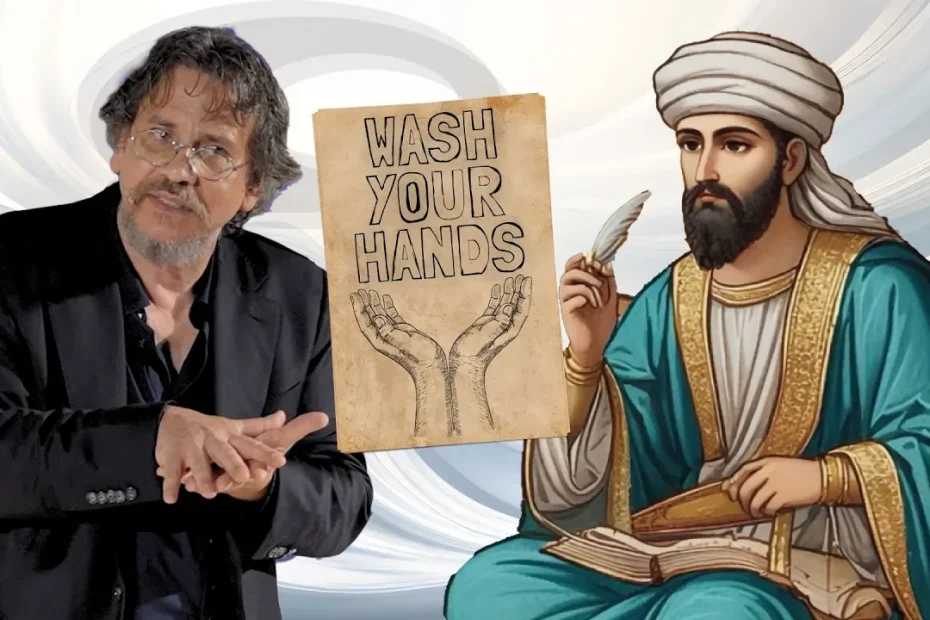
Read the full transcript of historian Dr. Roy Casagranda’s lecture titled “The 1,000-year Legacy of Ibn Sina” for the Museum of the Future’s Lessons from the Past (2025).
Setting the Historical Stage
DR. ROY CASAGRANDA: So the topic tonight is Ibn Sina. And the reason why I wanted to start with Ibn Sina is he wrote his opus magnum, the Canon of Medicine in 1025. So this is the one thousandth anniversary year for that book. And I just felt like we have to start there. To do this though, I have to give you a background.
I can’t just throw you in and then you figure it out. So let’s start with the background. The time period that Ibn Sina lived in is a turbulent time period. There’s enormous political upheaval because the Middle East is actually reshaping itself. But to understand that, I need to put the clock back a little bit.
In 632, the prophet Muhammad dies and when he dies, he’s replaced by Khalifa Abu Bakr. He becomes the leader of what will become the Arab Empire. In 632, his biggest problem is he has to put down the apostates that have popped up and that becomes the Ridda wars. It takes about a year. So by 633, he’s done it.
The amazing thing about that is it means that in 633, for the first time in history, there is a single state that ruled the entire Arabian Peninsula that had never happened before. The Arabian Peninsula parts of it had been conquered, but it had never been conquered as a single entity by anybody. The Romans had the northwest corner, the Persians the northeast corner, and by the way, the southeast corner. At one point, they even grabbed Yemen so they even had the southwest corner, but nobody had ever conquered the whole as a single state.
The Rise of the Arab Empire
The shocking and incredible thing that happens next is Abu Bakr sends a letter to his general Khaled ibn Al Walid who was in Yamama at the time and said, don’t stop. And don’t stop, well, there’s only one thing past where he was and that was the Persian Empire. The Persian Empire was in its fourth iteration, but was 1,200 years old. So you can imagine that if you’re a person living in that world in that moment, you couldn’t conceive of a world without the Persian Empire. I mean, 1,200 years – how would you be able to imagine a world without it?
The Roman Empire as an empire had been around for 600 years, but Rome had already been imperial as a republic for about 300 years. So imperial Rome, not necessarily the name, was nine centuries. So that was also probably hard to imagine the world not having.
To make the long story short, Khalid ibn Al Waleed and then subsequent Arab armies will conquer an empire that stretched from Pakistan on one side to Spain on the other side. By 711, they had Spain and they actually invaded Central Asia. The Greeks called it Bactria. So if I say Bactria, that’s what I mean. And that meant they had the largest empire that had ever existed to that day. There have been subsequent empires that were bigger, but nothing had ever been that large before because you got to remember they had conquered the entire Persian empire plus a little bit extra on the east side and then they conquered about 70 percent of the Roman empire, the southern 70 percent. So Rome survived this, but not in especially great shape.
Three Key Inheritances
In the process, they ended up with three things that are kind of important for our story’s purpose. Obviously, they ended up with a lot more than that. But three things for our story:
1. One was this pull to go towards Rome, to be a Roman style empire, to use Rome as its model. 2. The other was to use Persia as its model.
And there was a split and in a way the first fitna kind of represents that split. Muawiyah from Damascus, Ali ibn Abi Talib from Kufa. Kufa is in Iraq. Damascus is in Syria. Syria was Roman. Iraq was Persian. So even in that moment early on in the history of the Arab empire, there’s this pull which direction it’s going to go.
The Umayyads’ Muawiyah wins and Damascus becomes the capital and the pull goes in that direction to the point where Muawiyah almost captured Constantinople. And then subsequently, another Umayyad leader almost captured it a second time. So within a very brief period of time, the Arab state almost finished off the Roman Empire twice. By the way, it was a Syrian refugee who saved the Romans the first time and then they used that. He invented a flamethrower, which is really cool. They used the flamethrower to save them the second time.
The House of Wisdom
The third thing was this: In a city called Gondishapur, it was built by Shapur the first, the Persian emperor. There was an academy and that academy had books from all over the world in it. The great library was bigger. It had a lot more information in it, but it was destroyed in 391 or 392 by a mob. So Gondishapur became the largest still functioning academy on the planet at that time.
So when the Arabs conquered the Persian Empire, they’ve now inherited this academy. And at first, they weren’t really sure what to do with it. The Umayyads were not really tapping into it, but they left it alone. So there’s a period of time where it’s like on pause.
But then comes the Abbasid revolution. So the Abbasids go into revolt against the Umayyads and it’s not looking great for the Umayyads. By that point, by 750, the Umayyads were having trouble with their leadership. They had a few good Khalifa, but not that many and it was starting to break down. So the Abbasids talked the Umayyads into negotiating.
In 750, they then decide to move the capital to Iraq and eventually they’re going to move it to the city of Baghdad, which was the name of a Persian village. They renamed the Persian village Madinat al-Salam, the city of peace. And then they built what they thought was going to be an impenetrable city that nobody would ever be able to capture. It had two rows of walls in a circle. The first row was short. The second row was tall. That way if the enemy breached the first wall, you could still be on the second wall and shoot down on them. And then they had dividing walls in between that were in between height so that you could also use those.
And the thinking was nobody will… by the way, have you noticed the Titanic design was shockingly similar? It had these compartments inside so that if the side was breached, it would fill that compartment, but then it wouldn’t continue. Oh, if only the Titanic guys knew history, they wouldn’t have done this.
So they build the city and then after a while, they go “all that material in Gondishapur, let’s bring it here.” And they make the House of Wisdom and that triggers the Islamic golden age. That’s the point when there’s a whole new set of philosophy being generated and it’s being generated in the Middle East. Again, because when you think about it, the first round of philosophy was generated in the Middle East too. Because really, is Greece not the Middle East? I’m pretty sure Greece is the Middle East.
The Origins of Philosophy
But it’s also worth pointing out philosophy started in what is today Turkey. It was started by a guy named Thales. Thales was ethnically Phoenician. He was living in a Greek city. It was a colony. So he wrote in Greek and he spoke Greek, but it’s blurry which is how everything is. Isn’t that cool? Can’t really categorize it at that moment.
And by the way, wasn’t his student, but she was like generations – a couple of generations later, there was a woman named Aspasia who moved from Miletus, the city where philosophy originated. Hecateus, Anaximander, Anaximenes were philosophers from that city that followed in Thales’ footsteps. Aspasia got on a ship because her sister married an Athenian, she moved to Athens and started a school and taught Socrates. And Socrates credits her as his teacher. And when you think about it in a way then, philosophy got transmitted to Socrates by Aspasia.
By the way, she also ended up becoming Pericles’ lover and Pericles the younger is her son. So she’s a real person in case you were thinking, “oh, but this is a myth.” It’s not. We’ve tried to delete her. We’ve done our best. It’s just the problem was how do you explain Pericles the younger. Right? It’s tricky. If he didn’t exist, it would have been a lot easier to delete her.
The Challenge of Aristotle
So the House of Wisdom brings us in and we see this explosion of new philosophers, new information coming around. But there were some problems. One of the problems that they kept running into was Aristotle. Aristotle, parts of it was easy to read and they were having no trouble getting into it. But then there were books like the Metaphysics that were driving everybody crazy. They were like tearing their hair out. They couldn’t understand what was in the Metaphysics.
The Fragmentation of the Arab Empire
I want to set up the political situation a little bit. I told you there was this pull that you go towards Rome or towards Persia. In the end, the Abbasids make it, so the pull is towards Persia. It doesn’t take long, but the Persians begin to disassemble the Arab Empire from within.
To be clear, the very act of switching from Umayyad to Abbasid triggers the first breakup. They missed one of the Umayyads. He escaped. And he went across North Africa and he went to Spain. And in 756, six years after his family members were massacred and he had escaped Syria, he broke Spain out of the Arab empire and ruled it on his own. And the Umayyads will rule Spain from 756 until 1031.
So in a really weird way, the Abbasid revolution triggers the beginning of the end for the Arab Empire. In 819, the Samanid area breaks out of the Arab empire. It’s right in the middle of Central Asia. It’s where Kazakhstan, Uzbekistan and Turkmenistan are. And it just keeps going. In 890, the Hamdanids break Northern Iraq and Syria out of the Arab empire. In 931, Tabaristan basically goes into rebellion. That’s the area just in the northern part of Iran, just south of the Caspian Sea. It’s mountainous.
There were Daylamite soldiers that were being used in armies as mercenaries. They were really good soldiers. And they basically start to look at, “well, why are we letting other people rule us? We could just rule ourselves.” And Ziyarids are the first to break away in 931. And then by 934, the Buyids break away. And little by little, the eastern part of the Arab empire just breaks up.
In 946, the Buyids captured Baghdad. And then if there was any doubt up until that point, if the Arab empire was going to recover or put itself back together, it was erased. Because at that point, one of the breakaway Persian states now has the capital of the Arab states. But the Abbasids are still the Khalifa. They’re still officially in charge on paper, but they don’t have any real political power. Every once in a while, an Abbasid would stand up and he would start to exert himself and then the warlords in the area would fight him and put him back down.
So that’s it. The Arab Empire, if 946 is the latest date you can give it for existing, but really by the 890s, it’s pretty much finished. So it didn’t have a long run necessarily, but it obviously has a massive impact depending on how you count first and second language speakers. Arabic is the third or fourth most widely spoken language on the planet today. It covers a huge chunk of the world. And so there’s an impact there, but then there’s also an impact on philosophy and technology and science that I want to get into a little bit using Ibn Sina.
Ibn Sina’s Origins
So Ibn Sina was born right around 980 AD in the Samanid states in a village near Bukhara. Bukhara is in Uzbekistan. It’s almost in the middle of Uzbekistan. He was Persian. So some of you are thinking, “oh, I thought Uzbekistan is Turkish.” It totally is today. It wasn’t then.
So there’s a really interesting feature about the Persians that I think still kind of carries on, but it’s been changed a little bit. There really were two Persian societies. There was the civilized Persians that lived in what is today Iran and then into Afghanistan and Western Pakistan and also a little bit into Iraq and Turkey. And then there were the Saka, the guys in the north.
And they ruled an area that stretched from Romania to the very northwestern tip of Pakistan. So Romania, Moldova, Ukraine, Southern Russia, Kazakhstan, Uzbekistan, Turkmenistan, Kyrgyzstan, Tajikistan. That was their area, the Saka. In English, we say Scythians. They were the crazy Persians. They were the guys that would dye their hair starched so it stood straight up. They would cover themselves in tattoos. They would take ephedra, you know, like pseudoephed, but the actual stuff. Pseudoephed is a stimulant because you feel sick. “Oh, take a stimulant. You won’t feel sick.”
# The 1,000-year Legacy of Ibn Sina
The Samanid State and Ibn Sina’s Early Years
You’ll still be sick, but you’ll anyway, is that a good idea? Anyway, they could take the actual ephedra. They would boil it so that they could get to this stimulant and then they would pour wine in it. And what they would do is they would pour it into a skull that they had taken from a person they had killed. And they would drink it and then they would go into battle.
That was those guys. And they were amazing. I would have loved to have seen it from a distance. Yeah. Love to have seen that from a distance.
In any case, by the time my story gets to where it is, Turkish peoples have been moving into the area and have been actually crossing all the way into what is today Turkey for a few centuries. And there is a rival state, a Turkish rival state, the Karakhanids who are just to the east of the Samanid state. So in other words, in many ways, this is the end of Persian rule in that area, this story because it corresponds with it. What happened was before the Samanid state unravels, it became a center of learning. There was this explosion of philosophers and thinking that was taking place in Bukhara and just generally in the Samanid state.
And so Ibn Sina being born at that moment in this place positioned him really well to get the kind of education he was going to need to become the person he will become. By age ten, his father was a minor bureaucrat. So his father didn’t have any real special connection to anything. So this wasn’t one of those stories where he leveraged connections. This is a story where people recognized his brilliance.
Ibn Sina’s Extraordinary Intellect
At age ten, he had memorized the Quran. So he could—you could flip the Quran open, tell him the page, say third paragraph down and he could recite that paragraph from there. I can’t even comprehend what that kind of information that is, like that just blows my mind. I had a professor who could memorize text and we would do this with him. We would go, okay, John Stewart on liberty, seventh page, second paragraph and we flip it open and look and he would recite.
It was bizarre, freaky. So by ten, he’s already shown that there’s something special about him because he can do this. His father went, okay, I need to nurture this and he went and hired an Indian grocer because India had invented the numbers that we call incorrectly Arabic numerals. The reason we call them Arabic numerals is there was a Persian. See how complicated this is?
Like India invents numbers and then there’s a Persian. His name was Khurazmi. That Persian took those numbers and then advanced math. He’s the guy who did algebra. He’s the guy who wrote the world’s first ever algorithm.
But as a result, when Europeans first made contact with those numbers, they got it through his works and not being able to differentiate between Persians and Arabs, they went, oh, Arab numerals. And so that’s why. And by the way, in case you were wondering—because in the Middle East, there’s one set of numbers and then North Africa, Europe—the entire rest of the world uses the other set of numbers. They were both from India.
Like there’s not that one was and one wasn’t. I don’t know why the Indians made two sets of numbers, but that’s what they did. So and then, of course, the really important thing was zero. But honestly, even if they hadn’t done zero, it still would have been amazing having the digits because do this as an exercise later. Make a number like forty-eight, but write it the way the Romans did and then multiply it by three.
You’ll just don’t want to live. Like, what were the Romans even thinking? So what the Indians did revolutionized everything. That’s why you hire an Indian grocer to teach your kid math.
Ibn Sina’s Education
So that’s what he did. And of course, Ibn Sina absorbed math instantly. He loved it. And then his father went, okay. I’m going to get him into a jurisprudence school.
And so at age thirteen, he’s become a master of jurisprudence, Islamic jurisprudence. And so it becomes really clear this kid is going somewhere. So his father hires a guy named Al Natale to teach him philosophy. And Al Natale was living in Bukhara. He was a famous philosopher at the time and they started going through books together.
They did Isagoge by Porphyrios. They did Almagest by Ptolemy, the Alexandrian scientist who tried to figure out how to make the earth be the center of the universe. So if you’ve ever seen these really big complicated models showing planetary motions from that time period that they’re all trying to prove the earth is the center of the universe, which obviously, I know we think it is still, but it’s not. You should let go of that idea. And then he read Euclid’s geometry.
He read Aristotle. And at some point, Anatoli went to Ibn Sina and said, “You’ve passed me. You’ve eclipsed me. There’s nothing more I can teach you. You’re on your own.”
He’s sixteen at that point. So he has taken off. Al Natale was a physician. And so Ibn Sina was just like, okay, I’ll learn that too. So he teaches him what he knows.
By sixteen, he had become so amazing that the physicians in the area would come to him for advice. At age seventeen, the emir of the Samanid state, his name was Nuh the second, came to him and said, “I need you in the court. You’re going to become my physician.” And at age seventeen, he’s in the royal court as a physician.
Ibn Sina’s Approach to Learning
By this point, in his autobiography, he wrote, “Anything that came my way, any book that came my way, I would just read it. I would absorb it.” And what he says is he would find the hardest piece that philosopher was working on. The most complicated part of it. And he would open the book up to that piece, and then he would start to read it. And if he thought it was easy, he wouldn’t bother. He’d walk away. He only wanted to read that philosopher if that piece was a challenge to him and it stumped him.
And he got stumped. The metaphysics by Aristotle that I mentioned earlier. He gets stumped. He can’t figure it out. And he says, “I read it forty times.” Now, we don’t know how many times he read it. He says, read it forty times because the thought was if you read the Quran forty times, you could memorize it. It became an idiom. “I read something forty times” meant I’ve memorized the text.
And he says in his autobiography, “I still had no idea what it said, but I knew there was some powerful wisdom in there. I just couldn’t figure out how to extract it. It drove me nuts. This is the first time I’d ever been stopped like this.”
The Influence of Al-Farabi
So one day he’s in the marketplace, and he’s in the book seller area. And the book seller says, “This is the book you want.” And Ibn Sina looked at it and says, “How much?” And the guy tells him the price and Ibn Sina goes, “I don’t need this book.” And he refuses to buy it.
So then the seller says, “Look, the guy selling it really needs money. I can lower the price. He told me what the bottom line price was. You need this book, buy it from me.” And so, Ibn Sina buys the book.
The book was written by Farabi. Farabi was a Persian philosopher from the previous century. Farabi was another polymath on a different scale than most of us can imagine. So Farabi had decided that he wanted to be able to criticize everything and anything. He wanted to be able to have commentary on politics and religion, which of course gets you killed.
So he decided not to publish anything while he was alive. He refused to take any patronage money, so he refused to have a patron. He would just get simple jobs like a guard or a gardener. He would just get any kind of job to keep himself alive and he’d move around and he’d study under philosophers and write and write and write and then in his will, he published all his books. And then that way, he could say whatever he wanted and not get killed for it.
So Farabi really believed in Aristotle. He was an Aristotelian. He thought this was the key to understanding what needed to come next. Right? That it would become the basis for all the philosophy that would follow.
I’m not quite as sold on Aristotle, but I love what they end up doing. I’m more of a platonist. Just for the record, whenever you walk into a philosophy department, almost everybody’s Aristotelian. I find these conversations really silly in part because, dude, that was two thousand three hundred years ago. There wasn’t an update. It’s like, how are we still having this argument? Surely, there’s been an update—there has. There’s been a bunch of philosophy since. You don’t have to be Aristotelian or Platonist anymore. We can move on now.
Like you can be a Heideggerian, for example. It’ll get you in all sorts of trouble because people hate him. But it doesn’t matter. You can still be that.
Reconciling Philosophy and Religion
Farabi goes through and he’s working on Aristotle. And one of the things he’s trying to do, and everybody had been trying to do it up until this point as well was reconcile it with Islam. So al-Kindi, many people refer to him as the first Arab philosopher. I’m not sure that’s technically true, but he’s maybe the first big name Arab philosopher. That might be the clearer way to say it. He spent a lot of his time saying, “Look, wisdom can come from sources that are not Muslim, and it’s just fine. God is much bigger than we are. There’s no reason to think that there’s only one source of wisdom.” And so there was a lot of that going on. So by the time we get to Farabi, he’s still working on this. This is still an issue for him.
Having said that, there’s like at that point, there’s a hundred and fifty years of trying to reconcile the two. Ibn Sina isn’t actually all that interested in doing this reconciliation because in Ibn Sina’s mind, there is one science, one important science and it’s logic. So Ibn Sina was the first Vulcan. He was the first Spock from Star Trek where he worshipped logic. He thought logic came before everything else.
So biology is great, but you know what’s better? Logic. And his reasoning was—it’s funny that I use the word reasoning. His logic was—I should write that makes more sense. That once you have an observation, you have to verify the observation with logic.
It’s not enough to simply accept that the observation is correct. In other words, logic is the necessary ingredient in everything. Today, I think our attitude is the different fields of science are somehow above logic. You use logic to get there, but it’s not the tool that gets you there. For Ibn Sina, it wasn’t the tool that got you there. It was the end all be all and that the sciences served logic.
Cracking Aristotle’s Metaphysics
So his interest in the metaphysics gets really interesting because of the way it was translated into Arabic. In Arabic, it was considered divinity. But Aristotle isn’t talking about divinity in the metaphysics. Right? He’s talking about metaphysics. So there was a translation issue that I think was also messing people just in the title.
The real problem with Aristotle’s metaphysics though was it was written idiomatically. So if you say an idiom, the words in the idiom don’t make literal sense. But people in the culture at that time period know what the idiom means because they know what it means because they were taught it.
So “I read Aristotle forty times.” You think, oh, he read it forty times. That’s not what it means. It means “I memorized it” because in that period, everybody around him knows what it means. Today, we might not know what it means.
My favorite idiom is “a stitch in time saves nine” because I keep trying to imagine a needle and thread going through a clock. A stitch in time saves nine. Nine what? We don’t know, like nine dollars, nine lives and it means—does anybody know? Perfect. He got it.
Okay. So what he said was if you do a stitch now, so my button here, I put a stitch on it now, my button won’t fall off and then I’ll have to do nine stitches to sew it back on. So “a stitch in time saves nine” means maintenance is better than letting the thing break and replacing it. But you don’t know that from the words because it doesn’t make any sense. There’s no literal thing.
So what Farabi did was he went through the metaphysics trying to figure out what all the idioms really meant. So he would take a shot like a guess and then he cracked it like a code. And then he made a book and that’s the book Ibn Sina bought. So in that moment, Ibn Sina could unfold Aristotle in his brain because he had the idioms from the metaphysics. By the way, there were idioms that they had run into in other texts as well. They just went, “I just won’t know what the sentence means. I’ll skip it. I’ll go to the next one.” But now they know what those sentences mean too because Farabi had figured it out. Farabi was the kind of guy who liked to challenge the convention.
Religious Tolerance in Arab Society
And one of the things that he said, and it’s one of the things that was sort of baked into Arab society, was that God simply wouldn’t abandon the non-Christians, non-Jews, non-Muslims, and for that matter, the non-Zoroastrians. Because most people in the Muslim world at the time believed if you’re a Zoroastrian, Jewish, or Christian, you did have a pathway to salvation. You didn’t have to necessarily be a Muslim to get to heaven. It was easier if you were because you have the full instruction manual, but those other three religions had enough of the instruction manual that they could get to salvation. Al-Farabi went, well, what about the Hindus and the Buddhists and the animists and the polytheists?
And then he said, “There’s no way all merciful, all good God who only does the truths would have abandoned them. So there must be a path for them too,” meaning that there are multiple ways you can gain wisdom from the world. And of course, this ends up influencing everybody afterwards, but it builds on the tolerance that had already been baked into the system.
Political Turmoil and Ibn Sina’s Travels
So Ibn Sina has figured out Aristotle. He’s thrilled out of his mind. He’s like this really—he must have been so annoying to be around. He’s like seventeen, eighteen years old and he’s working for the Emir, things are looking great and then the Emir died. He died in 997. There’s two years of political turmoil where they have four different Emirs. By the way, three of them were the sons of Nuh the Second.
And then the Turks finish off the Samanid state. The Karakhanids conquered Bukhara in 999. And we don’t know the exact year that Ibn Sina left Bukhara, but it was probably 999 because his connections to the state would have gotten him in trouble. He escaped to Gorganj.
So Gorganj is in Amudaria river delta as it goes into the thing that used to exist called the Aral Sea that no longer exists, which is to me personally a heartbreak, but I guess who cares. Right? It’s just the only planet we can live on. We might as well destroy it and exploit it and ruin it for our children and grandchildren. We’ll be fine because we’re just old enough. We’ll probably make it to our life expectancy.
Is that too cynical? Anyway, he goes to Gurganj. And in many ways, Gurganj, it was still Samanid ruled. So the Samanids that lost Bukhara, the state had basically collapsed, but the Turks hadn’t yet captured it. It sort of replaced Bukhara for a brief period of time and a lot of intellectuals moved there and there was like another little burgeoning of philosophy and he seemed to do okay for about thirteen years.
Continuing His Journey
And then in 1012, the Karakhanids captured Gurganj. So he began traveling through Khurasan heading west until he got to Gurgan. Gurgan is—it still exists as a city. It’s in Iran. It’s just southeast of the Caspian Sea. The Caspian Sea has this nice little corner there. It’s just a little—it’s inland from there.
And when he got there, he was hoping to have the ruler, a guy named Kaboose, be his patron. But shortly after getting there, it turned out Kaboose had died. So he decided to move and he moved north to Dahistine. Dahistine is the land in between the Aral Sea and the Caspian Sea. He gets sick. He’s not finding a future for himself there. So he abandons it and he goes back to Gurgan. He stays there for maybe a year and then he felt like he was getting in trouble politically.
Ibn Sina as Physician and Treasurer
So he decides to leave again and he moves to Rey. So Rey was controlled by the Buyids. I told you there were these two Persian groups from Tabaristan that created states and they had been in fight with the Ziyadids who had Gurgan. So he’s now kind of switching sides. Right? He’s moving from one rival to the other.
He gets to Rey and the ruler of Rey, Majd al-Dawla, this Buyid ruler had depression—like really severe bad depression. So Ibn Sina basically gets hired as the physician to treat this guy for his depression. Majd al-Dawla’s mother, her name is Sayida Shirin. Shirin, by the way, means “sweet” in Persian. So it’s a good name to have. She is the de facto ruler of Rey. Her son is just laying on a sofa all day, staring at the ceiling going, “Woe is me.” And so she’s actually running the state.
So in addition to Ibn Sina serving as the court physician, he also takes the role as court treasurer and reports to her. He basically becomes a glorified accountant.
Philosophical Debates and Conflicts
So he goes to Hamadan. And the reason he goes to Hamadan is he wants to see if he can learn more from some other philosophers. And the tradition in Western Iran at the time was when a philosopher comes and visits a town, that philosopher has to debate one of the local philosophers.
So it’s like the sports match. When you think about it, it makes a lot of sense because then the audience will hear new ideas that are coming from this other place. But also it’s a way to say, “Oh, look, our philosophy was better than your philosophy.” So there’s a little bit of competition as well. It’s not just for the sake of spreading ideas.
And in the debate with this guy—I’m trying to remember his name. It’ll come to me if I stop trying to think of his name. Anyway, in the debate with this guy, Abu al-Qasim, that’s his name. In the debate with Abu al-Qasim, it got personal and it got really heated. And Ibn Sina threw at him the biggest insult he could conceive of. It’s like 1015 and he says, “You don’t know logic.”
At that point, that guy loses it and they’re fighting back and forth. Long story short, Ibn Sina isn’t satisfied after the debate and keeps going after the guy. So then the guy says, “You know, I might not know logic, but I think you took the style of the Quran and then used it for your writings, which in my mind is immoral. You shouldn’t be doing that. It’s kind of like plagiarism and it also makes you look like you’re trying to pretend you have divine inspiration.”
And so now, Ibn Sina feels like he’s in really big trouble because he may have crossed some kind of boundary there. It’s not true. It doesn’t matter. The accusation has happened. To make things worse, Abu al-Qasim gets a job now working for Sayeda Shirin. So he’s now moved to Rey. So Ibn Sina goes, “You know what? I’m going to move to Hamadan.” So the philosophers switched towns.
Service to Shams al-Dawla
When he gets to Hamadan, he starts working for Shams al-Dawla, who’s the brother of the depressed guy Majd al-Dawla, but he’s not depressed. Shams—his name is “Sun,” of course, like Sun as in the thing in the sky. Of course, he’s not going to be depressed. How could you be depressed if your name is big star in the sky?
So he starts working for him. Things are okay in Hamadan. They’re looking like he’s going to be alright. And then disaster strikes. In 1023, Shams al-Dawla dies. When it happens, Ibn Sina is then asked to stay on as wazir.
Oh, I forgot a little detail. Shams al-Dawla forced Ibn Sina to become his wazir. Ibn Sina was actually kind of tricked into it. Shams al-Dawla, when in battle, got injured. He asks the court physician to come treat him, and then when he’s there, he forced him into the wazir-ship that he didn’t want. He wanted to do philosophy and research. He wanted to do medicine. He didn’t want to advise the ruler on how to rule.
Imprisonment and Rescue
So when Shams dies in 1023, his son says, “Stay on.” Ibn Sina grabs his patron and says, “Look, we gotta do something else.” They go into hiding.
And while they’re in hiding, they get contacted. So there’s this guy. His name is Mohammed ibn Rostam Dushmanziar. So Rostam is an old Persian name. Like, it goes to the Shahnameh. It’s this deep—he’s—it’s think Gilgamesh style character. Big muscles, big man, likes to fight, that sort of stuff. So this is this guy’s name. And I am a firm believer that names have the ability to shape you. There’s been studies. Some of the studies say no. Some of the studies say yes. So like turns out people named Dennis tend to become dentists and people named Lawrence tend to become lawyers. So there really is some evidence that this is a thing.
Anyway, so I’m going to call him Dushmanziar because I just really like that name. Dushmanziar figures out where Ibn Sina is hiding. I don’t know how. And he sends a note to him. And basically, it’s “How are you doing? I’m a big fan of your work. I’d love to make contact.” Right? It’s that kind of stuff. And they start writing each other letters back and forth.
The new Wazir for Sama al-Dawla, the son of Shams al-Dawla, becomes suspicious that that’s in fact what’s happening, that Dushmanziar is making contact. We don’t know exactly how they figured it out, but somebody ratted Ibn Sina out and said this is where he’s hiding. And so the army comes, they break into his house, they search it, they arrest him, and they put him in prison in 1023.
Word gets back to Dushmanziar that his idol is in prison. Now just to clarify, Dushmanziar is Sayeda Shirin’s nephew. In other words, Majd al-Dawla, the depressed guy, and Shams al-Dawla were Dushmanziar’s first cousins. Right? Because Shirin is their mom. So this is like a family affair at this point. So in other words, Sama al-Dawla, the new ruler, is his first cousin once removed.
The Kakuyid State and Ibn Sina’s Writings
So Dushmanziar takes his army, he marches to Hamadan and he attacks. And he captures Hamadan, he overthrows his cousin and he releases Ibn Sina from prison. Ibn Sina then goes to Isfahan. That’s where Dushmanziar was the ruler. And at this point, the Buyids get into a little bit of trouble. There’s a little bit of chaos going on.
And Dushmanziar starts conquering chunks of Buyid territory. He was put in charge by the Buyids. In fact, his dad was rewarded a title and then he just takes off and now he’s conquering land from his own state. And he basically creates a breakaway state. Usually, it’s referred to as the Kakuyid state or the Kakuyid dynasty.
So while this is happening, the Ghaznavids who are over in Afghanistan get interested in what Dushmanziar is doing, and they’re wondering if this isn’t an opportunity for them to expand west. So in 1030—so Ibn Sina by this point has been in Isfahan for about seven years. The Ghaznavids attack and they defeat Dushmanziar. They capture Isfahan. Ibn Sina and Dushmanziar escape.
They escape to Khuzestan. They wait there for a few months. The Ghaznavid ruler dies while in Isfahan waiting for Dushmanziar to come surrender, and Dushmanziar grabs his army, goes back and takes Isfahan back and reestablishes his state.
The Loss of Ibn Sina’s Works
The problem was that while the Ghaznavids were in Isfahan, they plundered the library. So I told you in 1025, Ibn Sina wrote the Canon of Medicine. Well, that was in Isfahan. He had been in Isfahan for two years. Under the patronage of Dushmanziar, Ibn Sina starts writing prolifically, and he’s actually writing whole encyclopedias. He’s writing treatises on philosophy. He does the Canon of Medicine.
Well, those books now get taken to Ghazna, the capital for the Ghaznavids. And my stories usually end badly, so this will be no exception. There’s a Ghurid ruler named Ala al-Din Husayn. The Ghurids were north of the Ghaznavids, north and east. So they had a big chunk of what is today Pakistan.
And the Ghurid leader was really mad at the Ghaznavids because two of his brothers had gone and fought the Ghaznavids and were killed in 1150. So we’re fast forwarding a hundred and twenty years. Ala al-Din Husayn takes his Ghurid army to Ghazna, captures the city, and then there’s an attempt to retake it by the Ghaznavids, but they failed to retake it.
So to punish them, he sets the city on fire, and he brings fuel into the city, and he burns it for seven days. Goes and burns another random city called Bust just to do it, just to bring it home. And they burnt the library, and the only copy of Ibn Sina’s encyclopedia was in that library. So we have a lot of Ibn Sina’s work, but that got rid of some of it. And he became known as Jahan-suz, which means “world burner.” So anyway, so world burner is on my bad list. Don’t like that guy.
Ibn Sina’s Final Years
In any case, they recapture Isfahan. They’ve lost the library, right, because it got plundered. But Ibn Sina goes back to work, and he’s producing more works again. And he and Dushmanziar become really good friends to the point where Ibn Sina actually travels with Dushmanziar when they go to war.
And in 1037 after a battle, Ibn Sina gets really sick, and they’re really close to Hamadan, and he dies. And they bury him in Hamadan, which I’m sure he wouldn’t have liked because he desperately wanted to get out of that city. He would have rather been in Isfahan, but, you know, you have to bury quickly, so they buried him in Hamadan.
So that’s his story in a nutshell. What I want to do now is I want to show you what he did because I’ve left out his philosophy and I’ve left out his major achievements. I just wanted you to see kind of the chaos of the world that he lives in.
The Canon of Medicine
Let me take the time to time this a little bit. Alright. So his big piece, his opus magnum, of course, is the Canon of Medicine. Here’s what happens. When he was a teenager still, he noticed that what most people were calling medicine was just quackery.
And by the time he gets to the point where he’s writing the Canon of Medicine—Canon comes from the Arabic word just means law. So it’s literally a law of medicine. So, you know, when you’re in the university, they go, you have to read the Canon. You have to read the law. You have to read the books that inform you about that subject matter.
By the time he writes the Canon of Medicine, he notices something that was driving him nuts and he spells it out. And that was the concept for disease in the world at the time was that there was disease. It was a singular thing. So, you know, you eat fish and you drank milk and a black cat walked in front of you and Jupiter was in alignment with Mars and now you bleed from the eyes. But if the cat hadn’t walked in front of you, just had a little cough.
That was the understanding, and so it didn’t matter what your disease was because it was just disease. There was no concept that there were different diseases and there were different ways of getting these diseases and they would affect you in different ways.
So Ibn Sina says, okay, this is completely ludicrous. There are diseases. This is plural. They have different transmission vectors and then they affect you in a different way.
And then he says, you know, there are things that could be at stake. It’s not whether you drank milk and ate fish. That’s not it. But your health might matter.
And then he says, look, here’s a thousand cures. He says cures are great. Everybody loves them. But you know what’s better? Intervention.
Stop you from getting sick. Interrupt the transmission vectors. Don’t allow yourself to get sick to begin with. If you can do that, that’s a lot better than having a cure. And that’s the foundation for modern medicine.
The goal is prevention. The goal is interrupt the transmission vectors. Secondarily, you go to cures because you have to. Really, that’s not ideal. That’s not the goal.
And then the other part of it is there are diseases. And that’s why he’s the father of modern medicine. I find time people go, looked it up and it said it was Hippocrates. That’s the father of medicine. He’s the father of modern medicine in case you do this.
The True Origins of Medicine
By the way, I disapprove of Hippocrates being the father of medicine. I think it should be like Pesachet and then it would be the mother of medicine. She was a physician from about four thousand five hundred years ago in Egypt. She was actually the director of the medical academy.
She feels like a much better candidate for the person who started medicine than Hippocrates. Hippocrates was two thousand years later—more than two thousand years later. Like, it’s not even close. But, of course, you’re going to always make it a Greek if you can.
By the way, have you noticed that you can’t tell Greeks apart from like Persians and Turks either? Her skin’s too brown too. I think it’s just people are used to looking at the marble statues that aren’t painted anymore and they look white. They go they must have been white. Look, they did marble white statues. But just throwing that out there.
Ibn Sina’s Contributions to Philosophy and Physics
Ibn Sina did something else that I think is mind blowing. So he was a polymath, and he did astronomy. He did mathematics. He did philosophy. He did medicine. Like, he was all over the place. I wish there was a way to figure this out, but I would bet ten dollars he had ADHD. Maybe eleven, eleven dollars. I’m feeling really edgy today.
One of the things that happened was from the metaphysics. So the Greeks were really interested in being and what it meant to be. And Ibn Sina dove into this headlong. He fell in love with this. And so he talks about categories of being and all these different ways of thinking about being.
I don’t want to get into all of that. What I want to get into though is this one piece that he came out of with being. I find it really interesting.
So he said, look—I kind of have to tell you what Plato and Aristotle said to make it make more sense. So Plato said that the thing that exists… My boots. Okay. These boots are imperfect and they are. Right?
Because there’s no way for humans to make anything that’s perfect except for Persians when they make rugs. Those are obviously perfect which is why they’ll intentionally put one stitch in that’s incorrect because only God can make something perfect. So that imperfection that they intentionally put into the carpet, I feel is arrogant. Anyway, it’s also really beautiful at the same time, but it also shows the level of skill that’s possible. “Oh, no. I might accidentally make a perfect Persian rug here.”
So except for Persian rugs, nothing can be perfect. So my boots. Let’s take them for an example. So at some point, somebody made them. That’s the reality that we experience. But before they made it, it was an idea in somebody’s head. Alright?
According to Plato, that’s actually a real level of reality that’s more real than my boots. And then where did that idea come from? Plato said there was a plane of existence called the ideos. Translated in English, we usually say the forms. And what he believed was that the mind reaches up into the ideos, grabs the boot, pulls it into the mind, and then that becomes the idea for it and then uses your hands to make the idea real.
So this boot is a copy of the thing that was in my head, which is a copy of the thing that was in the ideals. And so that’s the real reality. This is the copy of the reality and this is the copy of the copy.
Aristotle comes along and he goes, what? Nonsense. What are you talking about? And then he says, look, a thing is a collection of essences.
So my boots are brown. Well, there’s different shades of brown. So it’s essence of all those different colors. There’s leather. Right? There’s stitching. So there’s the essence of whatever material was used for the stitching. There’s a shape to it. Right? It’s a cowboy boot shape and there’s patterns on it. All of those essences when combined make the boots.
So this platform that I’m walking on is made up of essences. There’s the essence of this curve. There’s the plastic material that’s in it. If there’s wood underneath it for support or aluminum, I can’t tell. It’s not banging. So it’s really well made because usually when I get on a stage, it’s like bang bang. So I’m really thrilled with this one. Whatever those are the essences. And then combined, that’s what makes the thing the thing. I’m a series of essences.
Ibn Sina’s Theory of Information and Entropy
Ibn Sina goes, what is essence? So if I were to try and figure this out, I could actually do it as an information studies event because that thing can be described as a series of pieces of information. But as time goes by, the information will be added to. Right?
For example, the sole on the bottom of my boot is slowly getting worn down. So to describe that wear and tear, I would be adding information. That boot, there’s a scratch that I will never fix on it because I was in the battlefield of Yamama and I hit a rock and it scratched my boot. So it’s my Yamama battlefield scratch. And so it’ll be there forever. So that would be information I would have to describe.
And then right as time goes by as my boot gets older and more scratched and more damaged, I’m adding information. You can take you as an individual. When you were born, there wasn’t a lot of information. Right? It was a lot easier to describe you then than now. Because now you have some broken bones and some scars and some mental issues. There’s some trauma, some personal trauma. You have a history. You have memories and lost memories too.
And I’m starting to get weird spots. I think they’re called youth spots. And I’ve checked. They’re not dangerous. It’s just I’m getting old. Right? And so that’s information.
And what Ibn Sina realizes then is time and information are correlated. As time goes forward, information is generated. Period. And there’s no way to undo this.
Because think about it, when you die and your body breaks down and decays, talk about how hard it will be to describe you. As your atoms are being scattered and digested by worms and whatever else that happens, it becomes even harder to describe you that information only increases with time and there’s no way to reverse it. That’s the principle of entropy. One thousand years ago, Ibn Sina described entropy.
Isn’t that cool? Then he said, what if we did this for the whole universe but ran backwards? What if I took the whole universe and ran backwards in time? Well, there should be less and less information. And then he said, what would happen is at some point in an unimaginably far past period of time, I would be reduced to a tiny packet of information, but just enough information that the entire universe could unfold from it.
He described a singularity. That’s Big Bang. One thousand years ago, nine hundred and fifty years before this contemporary period was working on Big Bang, he did it. I mean, he didn’t say it was an explosion. He didn’t talk about atoms and helium and being generated from hydrogen. None of that, but that’s effectively what it is. Isn’t that crazy?
Ibn Sina’s Legacy
So his legacy is a really weird one because for the most part, at some level, we kind of lost a little bit of it. In part because of the struggle between the Middle East and Europe and the way that we frame things. But parts of it, we didn’t. For example, the Canon of Medicine was required reading in Europe. So there was a sort of a selective way in which some knowledge was lost on purpose and then some knowledge was retained on purpose.
Hand Washing and Medical History
I actually was thinking about this as I was talking, so let me drop this. I’m backing up to the Canon of Medicine. So when I was taught this stuff, I was taught that Ignacio Semmelweis is the guy who said wash your hands. And he is. I don’t want to take any credit away from Semmelweis. What he did saved millions of lives, but I think it’s important to understand it in a broader context so that you get the full picture.
For the record, the way he figured it out was also kind of interesting. He was a doctor working in a hospital, and he noticed a weird phenomenon that when women would go in to give birth, the women who saw the expensive doctors, the doctors with lots of experience had a really high mortality rate and the women that were too poor for the expensive doctors were surviving just fine.
It was completely counterintuitive and he couldn’t figure out what was going on. Nobody could figure out what was going on. And so one day, decided to just trail the interns because that’s who the poor women were going to. They were going to the guys who were still becoming a doctor. They weren’t actually a doctor yet.
And, you know, they would go and they’d work on a cadaver and then afterwards they’d wash their hands. Whereas the old doctors who didn’t have any training weren’t working on cadavers and weren’t washing their hands and that’s when Semmelweis went, oh, maybe we should wash our hands.
The thing is that’s not the first time that kind of protocol was introduced into a hospital. In ancient Babylon, they had that protocol. There were multiple times in human history where there were some kind of protocol. Hospitals in India two thousand years ago had a protocol for disinfecting before you would do surgery or before you would treat a patient.
And of course, Ibn Sina spells it out in the Canon of Medicine when he says interrupt the transmission vectors. That’s exactly what that is.
So in a weird way, one of the things that happened to Europe was because of its biases against non-European culture, there was this mistake made where there were already cultures that had been working on disinfecting protocols. By the way, soap had been around for millennia and were part of the disinfecting protocols. But because of that, it wasn’t until about two hundred and twenty years ago that it got introduced into Europe.
And so one of the mistakes of, I think, the sorts of biases that we bring into it is, especially when we don’t know history very well, is you have to keep reinventing the wheel. And at some level, I think we should just stop reinventing the wheel and just go with what we already have.
And it’s something to think about because all civilizations are doomed to collapse. So the chaos and confusion and collapse that Ibn Sina was witnessing, that he was a part of is something that will happen again. There’s no exceptions in history, and it’s really arrogant to think this is it.
Preserving Knowledge for Future Generations
This is the final thing. I think the thing that we have to remember is as we go forward and we build really amazing societies—because there are some really amazing societies on this planet—is we need to be humble and we need to think about the future. And one of the ways that we think about the future is not just we start paying attention to global warming, because that’d be great. But it’s also as our civilization unravels, which it will at some point, it looks like it’s starting to already. My alarm bells are going off.
Maybe we should think about how we transmit that information that we’ve already acquired into the future instead of making future generations start over again. I mean, this is weird, but they’re trying to figure out what kind of symbol they can put on Chernobyl so that in a thousand years when there’s no Russian and Ukrainian speakers because those civilizations are gone, human beings will know not to go to that spot. We need to start thinking about the future in those ways because we owe it to the future.
And so anyway, I think there’s a lesson in Ibn Sina beyond just, you know, “Oh, wasn’t he a brilliant scientist, polymath, and figured all these crazy things out.” And it is how do we frame what we want to see the future looking like as opposed to “I’m just going to live now for me and not care about anything else.”
Anyway, I think I’m out of time. At least I’m close. Yes, okay. I’ve got the signal to stop, so I’ll stop there. Thank you so much for letting me talk to you.
MODERATOR: Thank you so much, Dr. Roy. If anyone has any questions that they would like to ask Dr. Roy, please raise your hand. Anyone has any questions, just please raise your hand.
A Piece of History
Actually, before you do, I just remembered I brought show and tell. This coin was minted by Deshman Ziyar in 1034 while Ibn Sina was living in Esfahan. So if you want, I’ll let you look at it closer. But I just felt like if I brought a little piece of history, would be weird because there’s a distinct possibility that Ibn Sina touched this at one point, right?
He’s not… Who knows? Deshman Ziyar definitely did because he touched every gold coin he minted. He’s like, “Oh, that one, that one.”
Anyway. So thank you so much, Dr. Roy, for the session. Please note that throughout the whole year we’ll be having these sessions with Dr. Roy himself and the next session inshallah will be in April and you’ll find all the details on our website.
Thank you so much.
Related Posts
- Diary Of A CEO: w/ Ian Bremmer on 2026 Top Risks Report (Transcript)
- Transcript: How America Recovers From All This – Yale Conversations w/ David Brooks
- Transcript: Tucker on the New Religion of Trump’s America @ Tucker Carlson Show
- StarTalk: w/ Andy Weir on the Science of Project Hail Mary (Transcript)
- Transcript: Everything You Know is About to Collapse w/ David Friedberg @ Modern Wisdom