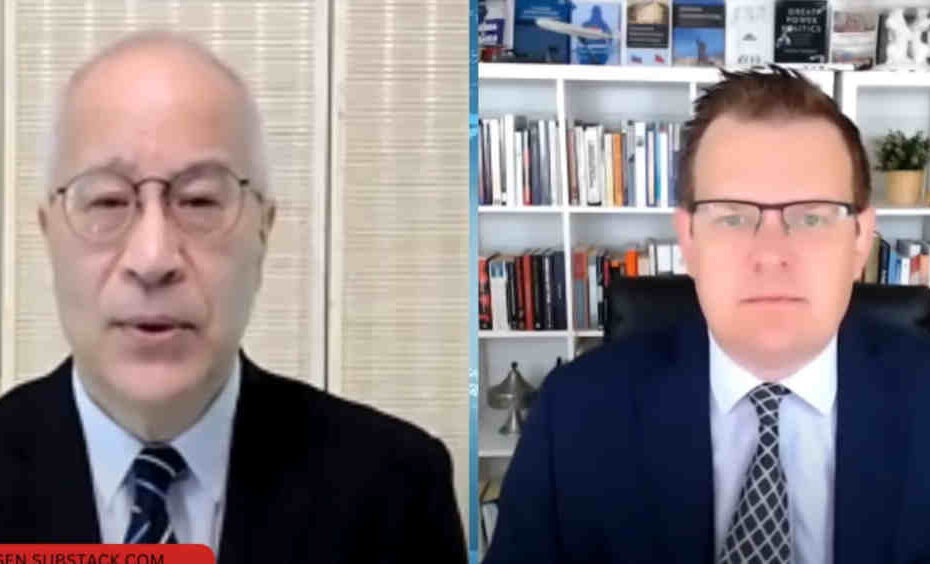
Read the full transcript of CIGI senior fellow and an international geopolitics commentator Einar Tangen in conversation with Norwegian academic, writer and politician Prof. Glenn Diesen on “Economic Tsunami Is Now Unavoidable”, August 7, 2025.
Introduction
GLENN DIESEN: Hi, everyone, and welcome back. We are joined again by Einar Tangen, a senior fellow at the Teihe Institute in Beijing. So welcome back to the program.
EINAR TANGEN: Thank you very much. I’ve added another fellowship. I’m a senior fellow now at CIGI, which is a Canadian institute founded by somebody who founded RIM, which was your BlackBerry. It’s all about the Center for International Innovation and Governance.
Trump’s Threats Against BRICS
GLENN DIESEN: Great. Well, what I want to discuss with you is Trump’s threats against BRICS, because, as always, when it doesn’t work, he tends to double down.
Now, I do recognize that the US is evidently concerned that the international economic system is no longer working towards its benefits in terms of sustaining hegemony. But in an effort to reverse this decline, this tariff war against the world is seemingly not going well. And as I said then, the response is always to double down.
One case which is obviously grabbing the headlines, but also stands out in other ways, is the tariffs and the threats against India. So this was supposed to be 25% tariff on India, but then now it’s being doubled to 50%.
And I guess what makes this strange is that the US attacks on China and Russia over the years, both economic and in terms of military threats, pushed these two countries together. Do you see the same possibly happening with India, or how are you assessing this standoff?
The BRICS Challenge to US Hegemony
EINAR TANGEN: Well, I think you’re right. I mean, you talked about BRICS. Trump was not that concerned about BRICS initially. If you look at his first campaign, it was “China, China, China.” But then in 2024, he started changing his tune. He started talking about BRICS, and he said they’re a threat to the US dollar.
Now, he had plans, if he was elected, to devalue the dollar to bring US manufactured goods more into line with international prices. I don’t think it works. It would take a massive devaluation – literally like 40, 50, 60% to do that. But that would be at odds with this idea of keeping the US dollar as the trade currency of the world.
So you can have one or you can have the other, but you can’t really have both. He’s trying to do both.
Obviously, BRICS, in reaction to all the shenanigans that were being played by him and others in terms of weaponizing SWIFT, the bank settlement system, immediately everyone said, “Look, they seize Russian assets, maybe we’re next.” And quite frankly, the dollar is not as stable. There’s this massive debt.
So countries are starting to retreat to say we have to de-risk from the United States not only in terms of our trade, because as this trade war has shown, but also in terms of trade settlement. And this is a direct threat to US hegemony. Trump understands that, although he doesn’t seem to understand much else about economics.
Brazil and India’s Cautious Stance
So what do we have? We fast forward to now. All of a sudden, it’s less about China directly in the last couple of months and more about BRICS.
Now, here’s what’s interesting. During the most recent BRICS meeting that was held in Brazil, it was Brazil and India who were holding back and saying, “Look, we don’t want to get into it with the United States. Let’s leave some room here. We have to make a statement about unilateral tariffs, but let’s not name the US. We don’t want to look for trouble. We want to be somewhere in between. We don’t want to have to choose.”
And now look what’s happened. Both Brazil and India have been hit by these 50% tariffs. South Africa is still smarting from the humiliation Ramaphosa got when he visited the White House. And it’s very clear that Trump sees BRICS as the problem.
Trump’s Domestic Troubles
But there’s another issue, and this is completely unrelated, and that is the fact that right now within the United States, social media is going off the hook about the Epstein case files, which I call “Epgate.”
There are three things that Donald Trump cares about. He cares about his MAGA base and how they perceive him. He cares about the markets and how they’re doing. And he cares about his media profile. Right now, all of those are in the dungeon. His popularity is falling. The markets, obviously, we can see what’s happened to them. And his MAGA base is divided.
About half of the people who used to vocally support him in these different things – and we’re talking about literally Loomer, Bannon – these were stalwarts. These were the people who would die for Donald Trump. I think Bannon has actually said, “I’ll take a bullet for him,” that type of thing. And now they’re saying, “Whoa, what the heck’s going on? You got to release those files.”
Obviously, I don’t think anyone is confused or wondering if Trump is in those Epstein files. The question is how deeply does it mention money, does it mention videos, does it mention foreign countries? And if it does any of those things, it would be absolutely caustic. It would be the end of his presidency as we know it.
Even without the midterms, there would be moves to impeach him, even by his own people who, remember, the Republicans in the main don’t like him. He’s been a bully to them as well as everybody else.
Speeding Up Foreign Policy to Change Headlines
So you have this situation where Donald Trump seems to be speeding things up simply because he is having a really tough time domestically, and he’s hoping that these types of moves will change the headlines.
Problem is the people on social media, especially the people he fanned this conspiracy theory that the Democrats were involved in pedophilia and that they didn’t release the Epstein files because they were afraid that they’re all going to be named.
Already people very close to them are saying there’s no way out of this. If you release, they see your names, they see what happened. If you don’t release, it will just continue to build and be this force against you, and you’ll start to lose your base anyway.
The Irrational Actor Problem
GLENN DIESEN: You know, that’s an interesting point, that the domestic politics of the United States is probably having some heavy influence in terms of how Trump manages foreign relations. Indeed, when we hear Trump speak of how he solved the war between Pakistan and India, and no one in India would take this seriously, but it seems to be aimed for a domestic audience.
So, again, but this is in, I guess in the academic lingo, one would begin to then refer to this as an irrational actor. That is, rational actors should act in accordance with the balance of power or the international system on its own. Once domestic politics begin to shape how you act with the rest of the world, this would usually be defined as an irrational actor. So this is a reason for concern, especially when you’re a big power such as the United States.
Trump’s Counterproductive Rhetoric Toward India
But how are you interpreting the rhetoric towards India? Because if the goal is to put more pressure on India for it to detach itself from Russia, accept to follow the trade rules, or, well, not rules, but do as they’re told by Washington, it would be one thing.
But the mockery, the attempt to ridicule India, its economy, the humiliation – this would be very counterproductive if the only objective was to convince the Indians that America is a more important partner than Russia. “Turn your back on Russia and we will take care of you.”
Instead, it seems as if they’re offering India the status of a vassal, and otherwise they will be punished. How are you reading this very rude rhetoric, or is it just common practice by now?
The Psychology of Trump’s Negotiation Tactics
EINAR TANGEN: Well, I mean, when Donald Trump is pushed to the end, he doubles down. He doesn’t know anything else. He was taught by Roy Cohn, who was the… And he acknowledges that his major mentor in life was Roy Cohn, the disgraced lawyer for the House UN-American Activities Committee that ruined the lives of many people. Roy Cohn died disgraced, disbarred, and broke.
But he taught Donald Trump that when you’re up against the wall, double down, don’t give in. That’s the most important thing. Double down. And somehow you can face your way out of it. Sort of the way he did with a number of his bankruptcies, where he was actually going to the banks and saying, “You have to give me $200,000 a month to maintain my lifestyle. I need my private jet, I need my yacht. I need all these things, because if I fail, there’s nothing.”
So in the past, he’s used these types of tactics, and they’ve been successful. One thing you know about people is if they use patterns that have been successful, they will continue to use them even when they don’t necessarily work or they’re not applicable to the situation, which, as you pointed out, this is geopolitics. This is not New York real estate.
India’s Growing Frustration with US Interference
So let’s take a little look at India. This is just new. I mean, Narendra Modi is scheming for the fact that he believed the United States interfered in the general election, where he did not get the majority he was anticipating. Modi has been trying to reform India from a strong province kind of governance to a strong central government. He looks at what China is able to do and says, “Look, we need to be able to do that.” But he would need a super majority in both the lower and upper houses to push that through. So when he perceives that the US interfered, he’s not happy.
Then we get to Bangladesh. After he got humiliated in the elections, he went where? To Russia. Smiling, hug, embrace of Putin. That did not make Washington happy. He was playing a card. He says, “Look, I always have my friend Russia for you guys. Come at me.”
So what happened next? All of a sudden, there’s a color revolution in Bangladesh, a country that was very, very close to India, despite being Muslim. It had always maintained these ties and kept distance to a certain extent from Pakistan. Obviously, there’s historical conflicts there. Well, that did not make Modi happy.
He certainly was not happy when recently Donald Trump announced that he was going to do a deal on energy with Pakistan. Where? In Balochistan. What’s important about that is that this is an area where there are a lot of insurgents who have been involved in anti-Pakistan movements. They want separation. The US moves in there, it’s probable they’re going to take their military. I don’t think India is really happy with the idea of having a military base on their borders.
Modi’s Strongman Image Under Threat
Narendra Modi has always been a strong man of India, and that depends on being able to tell people, “India stands alone, we are powerful. We can do… no one tells us what to do.” Doesn’t help that Donald Trump has repeated over 30 times that he settled Pakistan and India conflict. And as you pointed out, the Indian officials have said this is just patently not true. On the other hand, Pakistanis said, “Oh, we’re going to nominate him for a Nobel Peace Prize.”
Well, this shows that the US is moving in a different direction from India. It used to be India was going to be the doorstop to China’s expansion. Now all of a sudden, it’s thrown to the winds. Why? No one is particularly clear about that. This goes beyond putting economic pressure and tariffs on them.
So when these tariffs come through, India is absolutely incensed. And I was on Indian TV a couple times yesterday and they were just like, “These guys are bad. We were supposed to be friends. We’re supposed to have a relationship. Now we’re being treated like dogs.”
The Agricultural Red Line
Why? What was the problem in the trade negotiations? Donald Trump says, “You have to lay down and open up all your markets to whatever I want, especially agriculture.” Why is this important? Well, there’s a huge base of farmers in India and they control who is going to be in the seat of power if you alienate them by allowing foreign companies to come in and undercut their prices.
These are farmers who have a lot of children. So the farms get very, very small after a few generations. They’re just eking by. There are many suicides because they take on debt. They have terribly hard, difficult lives. They’re currently getting subsidies from the Indian government. But if this were to happen, all bets are off.
So it is an absolute red line for the BJP and Modi that they’re not going to open these things up. But it seems that this incensed Trump says, “Well, what are you doing? I told you what to do. You’re supposed to do it.”
Trump’s Bullying Strategy
So in essence, he thinks of India as the sick man of Asia, because although it has a huge population, nominally a huge economy, the fact is it doesn’t have all the apparatus necessary to compete in a developed world. So he sees it as somebody he can push around. And the same thing is true with Brazil.
So he’s going, as a bully always does. Go after the weaker ones, try to get them on your side and isolate anybody who can possibly challenge you. So, I mean, it’s just so predictable, unfortunately, the way he does this.
But like I said, the current… This is huge numbers. Once you get past 25%, Glenn, you and I both know there is no trade. It’s too much. So when you take it to 50%, take it to 500%. How about 5,000%? Or like Donald Trump’s math, he says, “I’m going to reduce pharmaceutical costs by 1,000%.” I always try to figure that one out. You’re going to pay people to take medication? I don’t understand this. How can you do something by a thousand percent? It’s like a 150% effort. What does that mean? 100% is all you got.
The Desperation Factor
So this is the kind of bombast that he throws around. It just means that he isn’t paying attention to details. He wants to create buzz, get people from talking about the ills that he’s having. The fact that his trade war has fizzled… A lot of this was to go after China. China’s the only one he’s tiptoeing around. “Well, I think we can make a deal. Yeah, give him another 90 days. Well, TikTok… Well, we’ll see what happens.”
So all the tough talk turned to nothing when it came to somebody who could stand up to him. Anybody he perceives as weaker, he will just absolutely murder. And we saw this with Zelensky. We saw this with the African leaders who came. Remember the thing: “Oh, I’m so surprised. You speak really good English.” Well, it’s our national language, but you wouldn’t know that, would you?
Anyway, this is a situation where you have somebody who is really desperate, and that is the real danger here, Glenn. Here’s a guy, you don’t know what he’s going to do if he continues to double down. And his options are going to get fewer and fewer. He has to do something bigger than is necessary.
You saw the moving nuclear submarines into, quote, “position.” I don’t know what that means. They’re always in position. They’re always under the Arctic ice cap and they’re always there. Moving in position is meaningless. But he did that to try to get people thinking about a nuclear war. Why? Because he doesn’t want them talking about Epstein.
The Flawed Premise of Maximum Pressure
GLENN DIESEN: Yeah, this was always my concern. I remember I said it even during the campaign: if he positions himself as this great negotiator. That is the premise here, is, yes, America is in deep trouble, which I agree with. But the reason it’s in trouble, which I don’t agree with, is simply that the leaders were too weak. They gave away everything. They were foolish.
Everything that’s needed to put the pieces back into place and restore the natural order of US hegemony would be a very strong leader who’s able to stand up to the world and really push back hard. This was always a strange premise, because what happens then, I always wondered, when he doesn’t get his deals? There is no… Because all he has then is this maximum, maximum pressure. But when he comes up against countries who can’t give in as India, they can’t do this. They would become the new Europe that is bowing to anything the United States says.
EINAR TANGEN: That’s kind of harsh.
GLENN DIESEN: Yeah, I beg my apologies to the Indians. This is not enough.
EINAR TANGEN: I don’t know if it’s harsher for India or harsher for Europe, but we’ll figure it out.
Europe’s Political Imagination Crisis
GLENN DIESEN: I become so much more pessimistic lately when the political leaders refer to Trump as “Daddy.” They give away these trade agreements which on their own, which they admit makes no sense at all. I mean, there’s a lack of political imagination. That is, if America can’t dominate the world, then Europe is not sure what its role would be. We all effectively now can only imagine being the junior partner of the United States.
But I see the same with Russia. You mentioned the nuclear submarines is the idea that he can solve the war in 24 hours or then 100 days. The problem was always that the Russians, they can’t give in on this. They see that they invaded because they have to restore Ukraine’s neutrality. This is an existential issue.
And now they fought for three years winning the war, and now Trump is asking them to essentially stand down and no political settlement is required. Just stop the war. We’ll freeze it, we’ll make a Korea deal out of it and arm the hell out of western part of Ukraine to have this drag on for a few more decades. It’s not going to happen.
And it’s very frustrating to see him only double down on threats because Russia’s not going to stand down from this. They want the neutrality. If they can’t have it, I think they will destroy Ukraine as an alternative, which is a horrible, horrible option. But my point is he doesn’t have any other solution. It seems to double down. And this is what we seem to see in the trade agreements as well.
The BRICS Alternative
But yeah, I want to ask, because you mentioned that America now tiptoes around China because they did push back. And one of the reasons China is able to do this is they reduce their dependence on the US and that’s the great irony though, that Trump is only able to bully countries that still have significant reliance on the US market and are interested in continuing to grow this, which is why the Europeans are so exposed to bullying, because America is for them the only game in town.
But this is the purpose of BRICS, isn’t it? To diversify, not to be excessively dependent on the United States.
The BRICS Response to Trump’s Economic Threats
EINAR TANGEN: Well, that’s an excellent point. And what I would say to that is let’s say that, I mean, remember Brazil and India were the ones who were trying to say, “Hey, look, don’t, you know, as I said before, don’t name the US, don’t get into a fight with them. Come on, just let things be. We can figure out something in between,” kind of being non-aligned.
I think if you get them in the room right now between Lula and Modi, I think the tone of conversation changes dramatically. And I’m not talking about coming up with a new trade dollar, although they are definitely looking for alternatives. I’m saying if the collective, you know, BRICS come together and they say enough is enough. We’re 40% of the world’s GDP. That’s more than double the US. We are in a situation where, you know, we have the majority of people manufacturing resources and land. It is time to stop the nonsense.
The ten countries come together and they invite other countries and said, “We are now going to tell the United States that we’re going to put tariffs not only on your export goods” – remember the United States, the United States is the second largest exporter – “but we’re also going to put tariffs on your services.” This would have a huge impact. And if they do that and they stand firm, Trump has no choice but to chicken out. And I say that because it would be overwhelming.
It would be saying, “Look, we’re not going to accept it. Anything that comes in, if your people come in and they want to sell something here, look, we’re going to add reciprocal tariffs. Anything you put on will be slapped on them.”
The American economy is already hurting because Donald Trump is out there negotiating with other countries about how much American consumers are going to pay. I mean, does anybody find that a little bit odd? I mean, he’s not, you know, yes, he’s taking money from American people. He’s taking it out of one pocket. And he says, “Well, I’ll give you a little bit back.” But that is not helping the majority of Americans who, through their anger and disappointment at the American political system, voted for him because they thought he was somehow God’s appointed, if flawed vessel to change America, to make it great again.
They love the sound of that. You know, they think we can go back to some time when it was easy to make money and, you know, and there was plenty of it around and we were respected and everything. But this isn’t the path.
Investment Uncertainty and Global Economic Impact
So there’s already – Lula has called for an emergency meeting of the BRICS. I think you could see some action coming out of them. People have given up on this idea that Trump will calm down. He’s just looking for something. We can give it to him, wait about for three and a half years and be done with it. They’re all concerned about the damage that he’s doing.
I mean, right now, you look at investment around the world, it is plummeting. No one is willing to invest. Where do you invest? What do you invest in? If America’s building capacity, industrial capacity in the US – which isn’t happening, but if they did, right – should I build there? Or what happens three and a half years now from now when somebody else comes in and they decide to flip the switch and say, “No, all that stuff Trump did, we’re getting rid of it, we’re going to go in a different direction.”
Businesses don’t like that. They like certainty or at least predictability. They like reliable partners. So do countries, so do people. And Trump is showing that America is rogue state that is unreliable, unrepentant, and bent only on its own benefits, and screw the world in terms of everything else.
The Problem of Unpredictability in International Relations
GLENN DIESEN: This is the strange thing. I mean, that’s one of the weaknesses, I think, in terms of the ability to transfer his skills from the real estate market and I guess reality TV to politics and economics. Because in politics and economics, trust and predictability is of core importance. You can’t do really without it.
But he seems to have very openly stated that the way, what makes him a great negotiator is the ability to be unpredictable. So strategic ambiguity, max pressure, some threats, you know, easing it. So you know, one day you know, threaten 50% tariffs, the next day say how wonderful and you know, how you love the people.
I mean this, it’s very – if it was only, if it was at least clear in the belligerent approach then it would be some predictability to it. But it’s exactly that there is no predictability.
In terms of India though, the ability to push them away is quite remarkable. I once in a recent podcast I referred to India and Brazil as the weakest links in BRICS. Now this, I saw some upset commentary afterwards like “you know, they have good economies,” blah blah blah. And I think it was misunderstood.
Like my point was that whenever it comes to further economic integration and developing BRICS further, it’s usually Brazil and India that hits the brakes as you said. So at a conference I talk to some Indian ambassadors or military leaders. They always make the point that “oh well, India could never join a common currency for example.” Or you know, there’s a lot of limitations of how far it would be willing to go down the BRICS integration.
And simply the reason is it goes back to India’s position as being a non-aligned power. If it would be seen as taking an anti-American stance, then it’s ruled out. This is not something they would do. They refuse to choose one great power over another. This is again the whole point of being not aligned. But America seems to be making that choice for them.
Again, it’s always silly to force an ultimatum on the country if they’re not going to choose what you want them to choose. But why is BRICS such a huge threat to the United States? Because Trump doesn’t – well he made the point that he would put high tariffs on Spain because they’re in BRICS. But you know, Spain isn’t in BRICS. So it gets, begs the question how much does he understand about BRICS given that he sees it as such an immense threat. Or what is the threat of BRICS?
Trump’s Contradictions and BRICS Solidification
EINAR TANGEN: Well, you know there are questions now about things. I mean, you know he’s lied in the past and it’s been shown that he is not telling the truth but lately he seems to getting worse and worse, whenever he’s asked a tough question. “Oh, I don’t know about that.”
Well, this is the same guy who ran on the thing that “I’m the smartest guy. I have the best memory, I have the best negotiating skills. I’m best, best, best, best, best, right. I never forget anything. I know everything that’s going on. Nothing happens without my say so.” You know, the man in charge now, you know, he’s reduced to sitting there. “Oh, I don’t know, maybe somebody did something. I don’t know. Whatever happened.”
Yeah, I mean, this, you know, we could talk a long time about that. The issue now though is, you know, what happens when they attack two members who said, “Let’s not make BRICS into a political entity by taking sides, let’s just keep the trade.” And now he’s attacked them, savaged them.
I mean, we’re talking about India, but can you imagine? Trump says, “I’m going to put 50% tariffs on you. Why? Because my friend, right, who tried to, who was accused of trying to subvert the election process is in jail and you got to release him.”
I mean, is there any more blatant attempt to interfere in the internal politics of a country? Imagine if it was reversed. Somebody was saying that about Biden or somebody else or even Trump. I mean, America would go wild.
So he’s really creating hard, hard edges which cannot be done. I mean, Lula is not going to release Bolsonaro. He doesn’t even have the power to do that. I suppose he could try to pardon him, but, you know, the same thing with the Indian farmers. These are non-starters. These are red lines that can’t be passed.
The Unintended Consequences of Trump’s Strategy
So I do believe Donald Trump is doing exactly the opposite of what he intended. His idea was try to break BRICS. He said, “Oh, BRICS is nothing.” That was just a few months ago. “Oh, it’s nothing. No one’s paying attention. I can break it up whenever I want.”
Now instead, in breaking it, he has solidified it and it’ll be very interesting to see what happens at that meeting. You know, obviously Russia was pushing for a more aggressive stance. China was somewhere in between. But they said, you know, “We have to stand up and if we stand up together.”
All right, look what we have done as one country, standing up to the United States. Now, they didn’t say this explicitly, but it’s clearly there. If China can stand up to the US, if it is then joined by the most powerful other populous countries, the major middle powers, United States doesn’t have a chance. If they’re sitting down a negotiating table with those 10 members. They are outmanned, outgunned, they don’t have the cards, as Donald Trump likes to said.
And he would be in a very, very difficult position. He would have literally transformed the US and the most powerful nation into a nation not among equal. Because if they’re successful, the BRICS might start pushing the United States on a number of issues, saying that, “Oh, we now understand you don’t have the power. Collectively we do.”
And that would be extremely dangerous for his political career, for his legacy. These are the things that he cares about now. So yes, he’s definitely afraid what it would do to the dollar, what it does to the balance of trade and power.
The Risk of Military Escalation
And interestingly enough, if the BRICS are able to do this, I have no doubt that the Europe would run to them because it would be the only safe passage available to them. Clinging to the U.S. is it going to work? And if they see the US is weakened, they will look for another strongman or strong group to go in.
Imagine the EU saying, “Yes, it’s time that we join BRICS” or Mexico or Canada. These are all possibilities now because Donald Trump has alienated everybody. And if they see daylight by banding together, it literally will bring about the decline of the United States as it’s in terms of its hegemony.
The danger though is the military card. What happens if Donald Trump becomes so desperate that he decides to embark on some sort of military adventure in order to try to solidify the American population, justify his own things and because he has no other resolution? This is what keeps me up at night.
Tariffs as Political Extortion
GLENN DIESEN: Yeah, the military option is again something he began now. Well, not just in the Middle East and also with Iran, but now with this new rhetoric of nuclear weapons in his little spats with Dmitry Medvedev, it’s quite concerning. But this is always the problem when economic war, it doesn’t work out. It’s always the option of escalating into the military.
It does appear though that a lot of Trump’s bluffs were, I guess, the art of low hanging fruits. That is, you know, in his own words he said, you know, “I warned all these countries and now they’re lining up to kiss my ass and sign any deal we put in front of them.” This was kind of the – yeah, of course it wasn’t true, but it is still is interesting because it reveals some of the, his ideal scenario, how this was intended to play out.
And as you said, often it is bluff because when you have countries like China who has their supply chains well in order, and they know that America’s more dependent on them than the other way around, then they can always put the screws on, for example, with the rare earth minerals in which the United States would have to walk back its economic caution.
There’s the tariffs, though. It’s how they’re used that is also concerning because tariffs have always been used. That is, if country A would like to give some competitive advantage to its own agriculture, country B would like to have competitive advantage for its own, the domestic level, for its own car industry. So everyone has their own strategic industry, which is important for different reasons. And you sit down with the country, you may make a trade agreement where you recognize where you intervene in the market and this is normal.
But not only is this unilateral and pushed through threats instead of talks. It’s the whole idea of re-industrializing. He’s moved so far beyond that. I mean, now it’s “do not leave BRICS or you will have tariffs.” They say “drop the charges against President Bolsonaro or you will have tariffs.” “Russia must accept a ceasefire without a political settlement, otherwise you’ll get tariffs.”
This is now the hammer to just knock countries on the head for political extortion or with Europeans effectively accept full subordination. This is not how tariffs are supposed to work.
Economic Instability in the United States
I guess it takes me to my last question, which is how sustainable is this? Because if it was just some foolish tariff, United States could maybe absorb the cost. But it seems to expose some deeper problems in the, not just in the U.S. economy, but across the west and in U.S. now you see, you know, stocks go down, the dollar go down, bond go down. It’s happening at the same time, which is quite unusual.
Usually, you know, if you flee the stocks, you put it into the dollar, for example, but now all of them are going down. I was wondering how you’re reading the economic developments within the United States.
The Economic Tsunami Warning
EINAR TANGEN: Obviously it’s an economic disaster. I was an investment banker and I dealt with both bonds and also structuring of large deals involving public and private partnerships. So I’m well versed in that. I mean, when you have something like that, that’s like when the tide suddenly runs away. You know, it goes out to sea, like way beyond anything you see. It’s a warning sign. It means that there’s a tsunami coming.
And this is just something that Trump doesn’t see. He thinks he can bluff his way through it, but there are underlying issues. It’s not just about what Trump’s doing or the damage he’s done. You have to start looking around the world.
I mean, you have TPP. What do they do? They said, “Well, look, we’re going to band together and we’re going to within ourselves we’re going to deal with this issue about set asides and tariffs and things like that.” You have the regional RCEP which allows countries, about 5% developing countries, they need this. China did this, India does it. All developing countries do it because they don’t want their local industries to be overwhelmed by developed countries and businesses. They don’t want to be beholden to IBM.
So they develop these things and it’s important, but they do it through these natural trade groups. The US had its opportunity be part of TPP. They engineered it so they protected all their industries and interests that they wanted, from tobacco to pharma. But then they withdrew under Donald Trump. Why? There’s no clear reason other than he wanted to make a statement that he’s a better dealmaker than anybody else.
China’s Belt and Road Investment Surge
Then that’s all the damage side, let’s look at the other side. The first six months of this year, China had a record investment in the Belt and Road Initiative, $225 billion, literally doubling many of the investments they made in green energy, infrastructure businesses.
So on one side you have us erecting these nonsensical tariff barriers which are going to hit Americans very hard, result in him losing the midterm elections and tremendous amount of pain for American, especially poor people. And then on the other side you have China saying, “Look, we care about poverty and we got rid of extreme poverty. We’ve been working on the Belt and road initiative for 12 years. We put in over a trillion dollars. This year we’re doubling down in terms of our investment.”
We have it tough in China. They do. I mean, there is a lot of people that are hurting in China, especially small, medium sized business entities because of the uncertainty of what has happened. If I make Christmas tree ornaments, I mean, I don’t know what the heck is going to happen in terms of tariffs and whether or not people just say, “I won’t buy any Christmas ornaments this year,” or they simply say, “You know, look, I’ll buy them from somewhere else.” As if the Christmas ornament factory can move somewhere else within a couple of weeks, months.
The BRICS Alternative Model
So on one side you have a different development. And this is really what I think BRICS and other countries are looking at. They’re saying, “Oh, come on, let’s take a look at this. There is a better way of doing it, all right?” There’s a way in which we can cooperate based on non aligned principles, where it’s about security. Every country needs to be secure.
And this applies especially to Russia right now, but other countries as well. They don’t want to have missiles on their doorstep. Surprise, surprise. They had promised that that would never happen. Howard Baker. I mean, it’s documented. And that promise was broken.
So you need security, you need a path to development. You want to help your people. You cannot stay in power even unless you can do something for your people. And that is the purpose of government, to maintain order, to deliver a safe society. Right. And then create opportunities.
And the last point is respect for sovereignty, for the cultures, for the countries that have been created mostly by colonial nations who deliberately cut up the countries to put a minority in charge of majority so that they would be reliant on the colonial powers even after the colonial powers left. So a lot of the damage we’re looking at today in terms of countries that are hurting, they all trace back to these colonial roots.
But it is what it is now. Now we have to figure out how we can accept each other both in countries and then between countries. I think China has a far better and more attractive model than Donald Trump is offering with his unilateral extraction tech tariffs, his, as you put it, blunt instrument of “give what I want when I want it.” It’s literally like an 11 year old on the playground insisting that he wants the ball and you better give it to him to bloody your nose. This is not sustainable. It’s not helping America. It’s not helping.
GLENN DIESEN: Yeah, the irony here is this is in this trade war with China, even the Chinese doesn’t want to see this. I mean, it would be in everyone’s interest, collapse in US. That would be devastating to them and the world economy.
China as the Adult in the Room
EINAR TANGEN: It would take years to dig out from that. So, you know, this is the problem. China is under attack by a country that it has to be the adult in the room and kind of guided away from this cliff that seems to be wanting to run off.
I mean, can you imagine, your enemy is attacking you and you have to say, “Well, you know, there are consequences of this and we have to look long term.” It takes very long foresight to do that. And hopefully, as I said, BRICS will recognize that, recognize that they don’t want the US to fall off a cliff, but nor do they want it to act like a spoiled child demanding that everyone give candy.
There has to be a balance between those. US is a big power, it’s a big economy. It’s not going away real soon. It could be hurt. It has resources, it has land, it has people and it is going to be there. It’s not going to disappear between Canada and Mexico. It will continue to be there. So you have to find a way of dealing it.
But has to be a change in attitude in Washington away from this American exceptionalism. “Everything we do is right, no matter who we kill, maim, or whether we support a genocide in Israel.” Those days have to stop. But the only way we can do that, and America has a long history of this. Only way we change, fortunately, is through crisis.
So if BRICS can bring a reasonable crisis and a solution to the United States, I think that’s really the only way it can be settled. Question is, is Donald Trump the person recognize this and accept it?
The Trust and Predictability Dilemma
GLENN DIESEN: Well, the dilemma always for China, it seems, is that the U.S. giving up on trust, predictability with the world, you know, this was one of America’s greatest resources, the that the world could rely on it. And as the US Gets rid of all of this, China kind of almost have to sit back and offer trust and reliability in order to win over these markets.
And I guess the dilemma often for the Chinese though would be as the United States use all economic dependence as a weapon. It’s the strength of China is the fact that it’s predictable. But on the other hand, at some point it does have to respond as well, such as it did with the rare earth minerals.
China’s Prepared Response Strategy
EINAR TANGEN: They have their response prepared. You know what, four or five months ago I mentioned this before, they had a white paper, five points on it. One of them was why phase one deal where China agreed to buy billions of dollars worth of energy in agriculture for the US Why it failed mostly to do with COVID and things like this.
But you don’t talk about, if you have five points in your major white paper, the last thing you could do is talk about a failure unless there’s some reason behind it. So if I interpreted that to clearly mean that they’re looking at a phase two, it’s transactional. Donald Trump can declare victory. “This is what I was always intending.” All right, but from Beijing’s point of view, it’s transactional. If he breaks the deal, the money stops. They don’t stop, they don’t buy anything.
So it kind of keeps Donald Trump tethered to the reality that if he breaks the deal, he’s ruining it for himself and other industries. But, well, the problem is that I think Beijing looked at this and they said, “We have three and a half years of this guy. Should we be in a hurry to make a deal? Because we know for certain the moment the ink has dried on that agreement, he will be back with some other issue saying that’s not covered by that agreement. You can’t sell this to them. We’re going to try to get countries to stop trading with you and this type of thing.”
We see this, I mean, you see it clearly with Russia right now. At the same time they’re meeting and supposedly making progress on these big issues. They’re attacking India for buying Russian oil.
The Oil Supply Reality
Well, let me put it this way. If India hadn’t bought that oil, all right, the world would be in crisis because the oil prices would have been jacked up enormously. And this was all with the acquiescence of the United States and Europe because they realized they couldn’t wean themselves off of was really the gas where they destroyed the pipelines. How did that happen?
Well, sure, we’ll never know exactly who destroyed those pipelines. The one thing I’m certain of, it wasn’t a bunch of guys at a in a power boat planting tons of explosives that were necessary to blow this thing up. That’s a little weak and thin, doesn’t bear the test of truthfulness.
But at the end of the day, I mean, the amount of oil that’s out there, it’s a supply and demand game. If you remove a huge chunk of supply, the prices in the United States, in Europe, everything would go crazy. And they would remain crazy because to put that kind of additional capacity on Russia is one of the major producers, produces oil and gas would be almost. It would take years, many, many, many years to do that. Meanwhile, everybody would suffer.
So India was playing a role at that time to kind of pretend that “we put sanctions on Russia, we’re going to limit their income.” But on the other hand, we cannot stand the kind of price increases that would result if we actually, you know, a cordon around.
The Nord Stream Mockery
GLENN DIESEN: Well, on the Nordstream issue, there’s a video of Tucker Carlson interviewing the U.S. secretary of Treasury, Scott Besant, in which they sit there going, “Well, what destroyed Nordstream? Maybe it was a Norwegian fishing boat” and they break out in laughter. You know, they as openly. You can pretty much mock the, you know, mock the Europeans that, “Yeah, you destroyed their energy infrastructure. But, you know, so what.”
EINAR TANGEN: Yeah, despite the fact that Biden said “if there’s a war, we will destroy Nord Stream 2” and then it happens just by coincidence, I’m sure.
The Vassal State Warning
GLENN DIESEN: But I think this is the lesson for countries like India because as you said, the Americans will come back if they do as they’re told. It’s not as if, “Okay, we’ll cut ourselves off Russian energy. We’ll take the huge punishment economically, we’ll accept the cutting ourself off from a historical reliable partner. And you know, but at least this will be the lesser evil.”
But they know that the more dependent you then if you cut yourself off the Russians, you’ll become more dependent on the US Then the US will have an even stronger hand in the next round when they come and say, “Well, you can’t really trade with the Iranians and Chinese either.”
And suddenly you end up in this unfavorable asymmetrical interdependence with the United States where the US can then dictate trade terms, extract political concessions, and at one point you’ll be a vassal again not to pick on the Europeans. But yeah, this is what happened to Europe and it ran in this direction. It was quite predictable how this was going to end.
The Path Forward: Unity and Diversification
EINAR TANGEN: And you know, the recent conflict between Pakistan and India highlighted that. Here you had Pakistan that was relying on Global South suppliers – Turkey, China, et cetera – to defend itself. And then you had India relying on what the very colonial powers who took it from 24% of the world’s GDP before the British came in to 4% when the British left. They’re dependent upon them for their arms and weapons increasingly to us.
I mean, the amount of weapons that they were getting from Russia used to be way up there, way past 70%. This time it’s half that amount. So they seem to be, they were, I think, kind of saying, “Well, we can play both sides and we can depend on the west with this.” I think this is a wake up call.
And having sampled the Indian television stations, which are pretty much in line with where the government is, they were very adamant. Their talking heads were saying, “We cannot trust these people. They have humiliated us, they have insisting on terms that we cannot…” Maybe the oil, but not the farmers. I mean, if you toss the farmers into the mix, that means you’re planning to lose next election. And that’s not something that Modi’s going to give up.
Plus that personal humiliation of having Trump keeps saying that he settled everything – that grates on Modi every time he says it. You’ll note every time Trump says that, the Indian Foreign Ministry issues a statement denying it.
GLENN DIESEN: Well, they also thought that buying American fighter jets would win over the love of Trump and put them on the good side of Washington. But again, my point was shown weakness.
EINAR TANGEN: To Trump and will be literally his dog.
GLENN DIESEN: Yeah, well, again, it’s seen as a weakness and this could be exploited. So I think the lesson is go the path of India – that is secure your supply chains, your vulnerability by diversifying and push back when someone imposes ultimatums and threats on you. And I think this is back together.
EINAR TANGEN: Don’t think you can do it alone. It has to be a united BRICS, or at least nine-tenths of them coming together and saying, “This is our position.” It would be better if it’s on a consensus driven body like that. They say it is enough. We need to be the adult in the room for the U.S. and if they want to destroy their economy, they’re welcome. But we will not be bullied anymore.
Conclusion: Trump as BRICS’ Inadvertent Promoter
GLENN DIESEN: So there you have it. Trump inadvertently became the main promoter of BRICS and its main function of diversifying your economy. So, Einar Tangen, thank you so much for your time. I always look forward to speaking with you. So thanks again.
Related Posts
- Tucker Carlson Show: w/ Ken Silva – Attempts on Trump’s Life (Transcript)
- Pod Force One Interview: w/ Donald Trump – June 2, 2026 (Transcript)
- Jimmy Dore’s Interview on Tucker Carlson Show, June 5, 2026 (Transcript)
- Transcript: Trump Remarks on American Agriculture at Wisconsin Roundtable
- President Trump Remarks on Beautiful, Clean Coal – June 4, 2026 (Transcript)