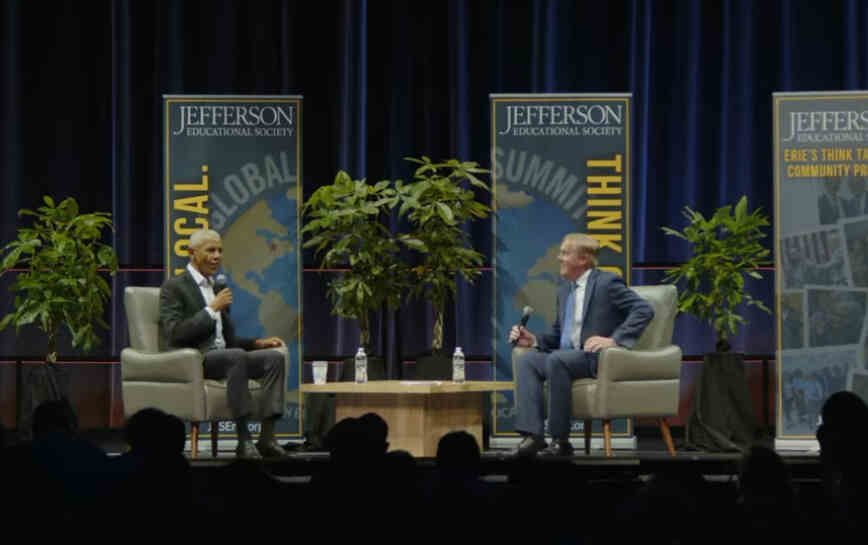
Read the full transcript of a conversation between former President Barack Obama and Steve Scully on Tuesday, September 16, 2025 at The Jefferson Educational Society in Erie, PA.
Welcome to Erie, Pennsylvania
STEVE SCULLY: Welcome to Erie, Pennsylvania.
BARACK OBAMA: It is good to be back in Erie. I was telling Steve that whenever I come up here, you forget how beautiful it is up here. Flying over and all the… You got the lake and the tributaries and rivers. It’s nice up here. Now, I have to say, as a Hawaii kid, coming here in the summer may be a little different than the winter, but I’m sure it has its own beauty that I simply will not partake.
STEVE SCULLY: They call it lake effect. You know that from Chicago. Hey, before we start, the playlist, these were all your songs that they were listening to.
BARACK OBAMA: You know what I have to say. I recognized that some of these tunes were mine. Forgive me if there were some explicit lyrics in a few of them. I would have tailored it a little more carefully. But yeah, people have been skeptical that I make my own playlists. They’re all like, “Oh, that’s just your staff.” I said, “No, no, check out my phone. It’s on there. That’s what I’m working out to.” I do get recommendations sometimes from Malia.
STEVE SCULLY: And Sasha, and they’re both doing well.
BARACK OBAMA: They are doing fantastic. They are doing great. They are now 27 and 24. Yeah, that’s right. Time has passed. People just want you to know.
Life After the Presidency
STEVE SCULLY: So, Mr. President, we have a lot of serious things to talk about, but let’s just talk about you for a moment. You are writing part two of your memoirs. You are working on your library, the foundation, trying to figure out where to put that third Emmy. Congratulations. You look great. How are you spending your time? There’s no typical day. You’re in Erie, but give us a sense of what life’s been like.
BARACK OBAMA: Well, since I left office, I have spent over eight years now trying to dig myself out of a hole with Michelle, and that’s been challenging, but I feel like I’m making progress. I’m almost breaking even at the moment.
There isn’t a typical day, as you mentioned. A lot of my energy is around the foundation, which our focus is how do we develop the next generation of leaders, not just here in the United States, but around the world. And so we have a range of programs. Some of them are focused on very young people. Some are focused on people who I consider young, but are in their 30s. Some are in government. We have legislators, members of parliament, chiefs of staff for presidents.
But we also have doctors who are setting up clinics in sub-Saharan Africa. We have human rights activists in countries where human rights unfortunately aren’t being observed. We have people who are working on climate change. We have entrepreneurs who are trying to increase economic opportunity in places that don’t have it.
And so we spend a lot of time trying to help connect these amazing young leaders all around the country and all around the world so that they don’t feel like they’re alone, so that they have resources and mentors and training so that they can maximize their impact and make the world better. And so I spend a lot of time on that.
We’ve got the presidential library that was slightly delayed because it broke ground right as Covid happened, which you remember was a drag. But it’s going to be opening next year, and we are thrilled with that. And so that will be sort of the epicenter of a lot of the work that we do.
I am writing hopefully only part two. Part two only. Hopefully only until the end of this year. I am a slow writer. I write this stuff myself, and that’s a bad habit I got into as opposed to hiring somebody to write it for me. But, you know, it’s interesting, obviously, looking backwards at sort of the journey I was on as president and then trying to connect that to some of the events and challenges that America and the world face today.
Political Violence and Democracy at an Inflection Point
STEVE SCULLY: Well, speaking of the events of the world, you are in Pennsylvania, as you know, earlier this year, the governor’s mansion, the subject of an arson attack, the tragedy in Minnesota back in June, the horrific murder in Utah of a conservative activist. Are we at an inflection point in our country? Where are we today?
BARACK OBAMA: Well, we are certainly at an inflection point, not just around political violence, but there are a host of larger trends that we have to be concerned about. I think it is important for us at the outset to acknowledge that political violence is not new. It has happened at certain periods in our history. But it is something that is anathema to what it means to be a democratic country.
And regardless of where you are on the political spectrum, what happened to Charlie Kirk was horrific and a tragedy. What happened, as you mentioned, to the state legislators in Minnesota, that is horrific. It is a tragedy. And there are no ifs, ands, or buts about it.
The central premise of our democratic system is that we have to be able to disagree and have sometimes really contentious debates without resort to violence. And when it happens to somebody, even if you think they’re, quote, unquote, “on the other side of the argument,” that’s a threat to all of us and we have to be clear and forthright in condemning it.
Now, that doesn’t mean that we can’t have a debate about the ideas that people who were victims of political violence were promoting.
And so look, obviously I didn’t know Charlie Kirk. I was generally aware of some of his ideas. I think those ideas were wrong. But that doesn’t negate the fact that what happened was a tragedy and that I mourn for him and his family. He’s a young man with two small children and a wife who obviously and a huge number of friends and supporters who cared about him.
And so we have to extend grace to people during their period of mourning and shock. We can also at the same time say that I disagree with the idea that the Civil Rights Act of 1964 was a mistake. That’s not me politicizing the issue. It’s making an observation about who are we as a country.
I can say that I disagree with the suggestion that my wife or Justice Jackson does not have adequate brain processing power. I can disagree with some of the broader suggestions that liberals and Democrats are promoting a conspiracy to displace whites and replace them by ushering in illegal immigrants. Those are all topics that we have to be able to discuss honestly and forthrightly. While we still insist that in that process of debate we respect other people’s right to say things that we profoundly disagree with, that’s how we should approach this.
Leadership in Times of Crisis
Now, the last point I’ll make on this, or building on a point I made earlier, I’ve been very impressed with Governor Cox in Utah and how he’s approached some of these issues. I suspect Governor Cox and I disagree on a whole bunch of stuff. He is a Republican, self-professed conservative Republican. But in his response to this tragedy, as well as his history of how he engages with people who are political adversaries, he has shown, I think that it is possible for us to disagree while abiding by a basic code of how we should engage in public debate.
I think your own governor here, Josh Shapiro, has done the same thing. When I was president, in the aftermath of tragedies, when Dylann Roof went into a black church and based on his own words, shot a group of folks who were engaged in Bible study and who had invited him in, and according to him, it was for racist reasons. As President of the United States, my response was not, “Who may have influenced this troubled young man to engage in that kind of violence? And now let me go after my political opponents and use them.”
George Bush. Again, I don’t agree with him on a lot of stuff, but he is a good, gracious man. And one of the, I thought most commendable things that he did after 9/11, the most horrific thing to happen to the United States during the course of my lifetime, in my memory, in the aftermath of this terrible tragedy, made a point, “We are going to go after the people who perpetrated this.” But he explicitly went out of his way to say “We are not at war against Islam” and systematically and repeatedly talked about how we can’t use this as a way to divide and target fellow Americans.
And so when I hear our current president, but his aides, who have a history of calling political opponents vermin, enemies who need to be targeted, that speaks to a broader problem that we have right now and something that we’re going to have to grapple with. All of us, whether we’re Democrats, Republicans, Independents, we have to recognize that on both sides, undoubtedly there are people who are extremists and who say things that are contrary to what I believe are America’s core values.
But I will say that those extreme views were not in my White House. I wasn’t embracing them, I wasn’t empowering them. I wasn’t putting the weight of the United States government behind extremist views. And that is, when we have the weight of the United States government behind extremist views, we’ve got a problem.
And so your original question is, are we at an inflection point? We’re at an inflection point in the sense that we always have to fight for our democracy and we have to fight for those values that have made this country the envy of the world. And I often say democracy is not self-executing. It depends on us as citizens, regardless of our political affiliations, to stand up for certain core values, because otherwise we may not have them.
The Role of the President as Uniter in Chief
STEVE SCULLY: A lot there to unpack. But Mr. President, let me follow up on one point. I recall being in the briefing room after Sandy Hook, one of the most horrific tragedies of your presidency. And you spoke not only as the President of the United States, but you also spoke as a dad. It was a horrible situation. Isn’t the job description of a president to, among other things, be a uniter in chief?
BARACK OBAMA: Well, I think so. Sandy Hook was, I’ve said before, was probably the worst day of my presidency. It was two days after these beautiful six-year-old kids were shot and killed that I was with their families. And it was wrenching. It’s the only time I saw a member of my detail cry while they were standing guard during my speech.
But my view was that part of the role of the presidency is to constantly remind us of the ties that bind us together. And we live in a big, complicated, raucous, diverse nation. I’ve said before, I believe it is what makes us exceptional. There’s never been an experiment like this where you have people from every corner of the globe show up in one place and say, based on these ideals, “We hold these truths to be self-evident, all men are created equal.”
That based on that and a Constitution and a Bill of Rights and a democracy, that we can somehow figure out how to get along and maintain our private beliefs and pray to God in our own ways and retain aspects of the cultures that we bring from wherever it is that we’re coming from and yet still decide that we are all Americans who can salute that flag and believe in a certain creed and defend this country and try to make it better for each successive generation.
And I’m not alone in that belief. As I said, I think George W. Bush believed that. I believe that people who I ran against, I know John McCain believed it. I know Mitt Romney believed it. So what I’m describing is not a Democratic value or a Republican value. It is an American value.
And I think at moments like this when tensions are high, then part of the job of the president is to pull people together. Now, that does not mean ignoring very real differences, serious, deep divisions those will always have, and we can talk some about some of those and why it is that I think the country right now is going through sort of a political crisis of the sort that we haven’t seen before.
STEVE SCULLY: Well, you talked about Governor Cox at…
BARACK OBAMA: At least recently in post-World War II period.
Social Media as a Societal Challenge
STEVE SCULLY: Well, let’s dig down into that because Governor Cox called social media “a cancer in our society.” Is that part of the problem?
The Post-World War II Consensus and Its Erosion
BARACK OBAMA: All right, I’ve got to be careful about getting too professorial here, so bear with me. And if there are some actual history professors here, I know I’m painting with broad brush here, but here’s my take on where we are.
Everybody in this auditorium more or less grew up in a post World War II era in which the United States and the world had just come through a succession of world altering crises. You had had World War I and the Great Depression and World War II and 60 million people had been killed and the Holocaust.
And because of the extraordinary sacrifices of the greatest generation, people stepped back and they said, “We have to do something different. We have to rebuild our institutions to prevent and avoid that kind of madness again.”
And so we strengthened the social welfare state so that we reduced income inequality, and we put in place regulations so that the stock market wasn’t just a Ponzi scheme. And we recognized, having witnessed the consequences of blood and soil nationalism in places like Germany, and the consequences of targeting people on the basis of race or religion, consequences of the Holocaust. We said, “We have to dig deeper here and recognize that those words, all men are created equal. That’s not just a moral sentiment, it’s also a practical way of thinking about how we organize the world so that we don’t find ourselves descending into that kind of war again.”
And so then we pass civil rights laws and once we do that, people start saying, “Well, by the way, Rosie the riveter who was helping us out in that war effort, why is it that she can’t have a seat at the table?” And so women just announced themselves as full participants.
And so what we saw, 50s, 60s, 70s, terrible things happened during this period. We had Vietnam and we had assassinations and we had riots and terrible tragedies happened all around the world. But we kept on overall seeing standards of living rise. And we saw America become more inclusive and basic principles of equality and justice and human rights became the benchmark for the world.
The Breakdown of Bipartisan Consensus
And so I think all of us, Democrats and Republicans and folks in between, we had disagreements, but we agreed on the basics. We agreed on rule of law and we agreed on independent judiciaries and we agreed on, particularly after Watergate, “Hey, let’s have some oversight in terms of how the federal government and the executive branch operate.”
And we agreed that here in America, the military is not going to be involved in domestic politics because that’s dangerous. And we said that the Justice Department has to be scrupulously non political so that people trust the FBI and they trust the Justice Department. And we put in inspector generals to make sure that we rooted out corruption and we protected whistleblowers and we held up free speech as an example for the world. This is what happens when the marketplace of ideas can actually operate and we don’t go around punishing people for what they think and what they say.
But there was broad agreement on those issues, and for a host of reasons. Globalization that disrupts our economy increases inequality. And for a lot of working people in America and also in Europe and some other places where they had seen steady rise, suddenly their standards of living aren’t going up quite as quick, and people start feeling like they’re losing ground, and they get frustrated.
And you start seeing changing demographics. Because I used to talk about the fact that when I first got to the Senate, people forget this because I’m not that old. I mean, older. But when I got to the United States Senate, I was the only African American in the Senate. And there was one Latino. Two, actually, two. Two came in with me. Mel Martinez, a Republican, and Ken Salazar, a Democrat. There were still not a lot of women.
So that, like the Senate gym for men was this had a swimming pool and all these facilities. And then I think the women were like a modified closet for the handful of women senators. So the point is that we’d gone. Bipartisanship worked pretty well in Washington when everybody looked the same. And it was harder to do when people started seeing that, “Hey, those folks are now here, too.”
The Impact of Technology and Media Changes
So changes in the economy, changes in demographics, and then changes in technology and media. And this brings us to the question of social media. Part of that Post World War II consensus was a certain way of understanding facts and the difference between facts and opinions and journalistic standards. That said, you had to check twice. You have to have two sources. And there were flaws with mainstream media, but I don’t know, Walter Cronkite got it right most of the time.
And there were some voices that were left out, but we all had kind of a basic shared vision of how do you discover the truth? And what began, by the way, not just with social media, but what began with talk radio and a certain news station that shall remain nameless.
STEVE SCULLY: You’re among friends.
BARACK OBAMA: Yeah. What happened was, is that how we got information changed, and it was turbocharged by social media. And suddenly you have a big chunk of the country who the reality they’re receiving every day is entirely different than the reality I’m receiving.
And so that combination of forces, I think, created huge political tensions. And it also got the government stuck because of the filibuster, because of gerrymandering. It made it very difficult to move forward and get stuff done in a divided country in which each side has completely different views of what’s true and what’s false.
And so we are. We’ve been in the midst of that. That was true during my presidency. It predates me. We saw that dating back to Bill Clinton’s presidency. But. And I warned you I was going to get kind of wonky here. But despite those tensions through the 80s and the 90s and 2000s, despite all that, the one thing that both parties still held to were certain principles of democracy.
So there were fierce battles between Gingrich and Clinton and fierce battles between Democrats and Republicans during the Bush era. And Lord knows there were some fierce battles during my presidency.
STEVE SCULLY: Really?
BARACK OBAMA: Yes. I was surprised because I feel like I’m a pretty nice, sensible guy. But look, there were profound disagreements on a whole bunch of issues. But you know what more or less held during this period was the sense of we still don’t politicize the military, we still don’t politicize the Justice Department. We still abide by the results of elections, we still respect judicial rulings. So the rules of the game held.
Breaking the Rules of Democracy
And I think what distinguishes us at this moment is a decision that’s been building for a while, but a decision in this White House and within the party that controls both the White House and Congress, that we’re okay with just breaking the rules, just breaking the system in certain ways.
So let’s take something like the national guard in Washington, D.C. right now you have National Guard folks deployed who are setting up checkpoints and they’re working with ICE. And you have ICE agents who are checking people’s IDs and stopping traffic. That’s not something that we’ve seen before in a non emergency situation in Los Angeles.
These ICE agents, in terms of who are we going to stop? Recently were engaging in practices that involved stopping people who were Latino and deciding, “Well, that justifies you being stopped and checked” in some cases by somebody who’s masked and does not feel obliged to identify themselves.
You then have a Supreme Court that said that was okay, although they didn’t write a written opinion, used something called the shadow docket to say, “Well, for now we think that’s okay.” So under current Supreme Court law, it is permissible for ICE agents to stop people who look foreign, meaning they’re Latino or some other ethnic group. Although I think Justice Kavanaugh clarified in a small Concurrence. “Well, it’s not just race or ethnicity. It’s also that they have low income jobs.” No, no, I’m not making this up. Look it up. I mean, this was just a couple of weeks ago.
So what you’re seeing, I think, is the sense that through executive power, many of the guardrails and norms that I thought I had to abide by as President of the United States, that George Bush thought he had to abide by as President of the United States, that suddenly those no longer apply. And that makes this a dangerous moment. That’s why citizens have to pay attention. That’s why those who are in positions of power need to stand up on behalf of these norms and these rules.
So. All right, I should catch my breath. I’m sure once a senator, always a senator, you just filibuster. You talk too long.
STEVE SCULLY: So a very quick follow up because I recall George W. Bush reflecting on his presidency and getting advice from his predecessors. Has Donald Trump called you? I didn’t think it was that funny.
The Challenge to “We the People”
BARACK OBAMA: No, no, no, no, he has not looked. I want to say this, that these tensions in America are longstanding. There’s always been a debate in America about how to define “we the people.” There’s always been a view that, and I mentioned earlier, blood and soil nationalism. Recently you’ve heard from people like the Vice President of the United States currently making the argument that the idea that America is just a creed is wrong. America is also the people who’ve been here and their traditions.
And essentially the argument is not a new one. I mean, this is an argument that was made from the start, which is there are certain people who aren’t part of “we the people.” That we have a caste system in this country. And for a long time that was explicit and it was legal and it said people. Black people aren’t part of “we the People.” Women are sort of half kind of part of the “we the people.”
And through great struggle and mobilization and sacrifice and people standing up with moral clarity and through a civil war, we change that. And what’s happening right now is that that consensus that we thought we had gone through, that in fact “we the people” applies to everybody. I think that’s being changed, challenged directly. And that’s a dangerous set of ideas. This idea that somehow we can go back to a system in which just some of us count or some of us count more than others, they do.
Well, now here’s the thing we have to do. Would you like to come up and take the mic? I’m not making light of this. Right. But here’s the. I’m happy to talk about this if it’s, if it’s a part of the question. But again, some rules around how we talk. Well, yes, there are disasters and catastrophes everywhere. Sir.
STEVE SCULLY: Please, please, please, sir.
BARACK OBAMA: I’m not the president of the United States currently, so there’s no point in shouting at me. There’s no point in shouting at me about it. I’m not in charge of foreign policy. Currency. Well, there you go.
The Global Impact of Dehumanization
But now, listen, by the way, what’s happening, I think we’re going to have some time to talk about overseas, and I’m happy to address that as well, because these things are actually connected. I’ll just go ahead and talk about it now. Part of what you see in the Middle east is the consequences of a mindset that some people are worth more than others, that we’re each part of a tribe and that it’s a zero sum game and that my tribe is better than your tribe. That mindset, at some point, if you look at history, results in conflict. Terrible things are done on behalf of that idea.
And so those who carried out October 7th had something in their minds that said that these families, these women and children that we are going to slaughter in cold blood are less than us. We are justified in perpetrating that kind of brutality. And those who are now saying we’re going to withhold food and medicine and shelter from millions of people as a consequence of those awful events, that also is dehumanizing the people in Gaza who are suffering right now.
Now, I’m not, I want to be clear. I’m not drawing equivalences. This is because this is part of the. How our debates get bogged down. What I’m saying is, is that when we don’t see people as people, bad things happen. When we dehumanize people, bad things happen. And America at our best stands for the idea that everybody counts and that everybody is equal under the law and has an inherent dignity and respect.
And that idea, when we, that idea, when we lose that idea here, the whole world gets dimmer. And we’re seeing it right now. Autocrats feel like, “Oh, we’ve got license now, because America, they seem to be okay with it. In fact, they’re kind of doing some of the same things we’re doing.”
And one of the things that struck me when I people sometimes would ask me what surprised you about being president? And I said, “Well, I knew we were going to be paying for our groceries, but I didn’t realize, like we had to pay for, like, toilet paper and stuff.” And so we got to kind of budget this thing, make sure, you know, basic household goods are taken care of. Still a good deal, you know, free rent. Plane, right?
STEVE SCULLY: You missed a plane.
Technology and Global Leadership
BARACK OBAMA: The helicopter was even better than the plane. But the thing that’s surprised me about the work of the presidency is just how much the United States underwrites the global system. Like, when there’s a tsunami and people are in desperate need of aid, the United States is who they call. It’s not Moscow, it’s not Beijing.
When there’s a global economic crisis or a pandemic, it’s the United States that is expected to help mobilize resources and come up with a cure. And so when we decide, “well, that’s not our business, that’s for suckers to help the rest of the world,” well, then other countries start thinking, “all right, well, we might as well let’s call Putin or let’s call Xi.” And they may not be able to help us as much as the Americans can, but at least they seem to be paying attention.
STEVE SCULLY: Let me put a couple of other issues on the table. You’re the Walkman generation, right? You had a Walkman growing up, didn’t you?
BARACK OBAMA: You know, I’m actually… I think I’m embarrassingly… I think I… Maybe I was too old for a Walkman. I think I kind of skipped the Walkman thing.
STEVE SCULLY: Well, here’s why I asked.
BARACK OBAMA: But you clearly were. I can picture you with your Sony, jamming to your tunes. What were you listening to on your Walkman? Fess up, Steve.
STEVE SCULLY: I’ll tell you backstage. In the interest of time, though, AI is the whole new frontier. A lot of potential, but a lot of downside. What are your concerns? What are the possibilities from your standpoint?
The AI Revolution: Opportunities and Challenges
BARACK OBAMA: I’ve been spending a lot of time thinking about this, talking to people who are developing it. People forget those gadgets that you carry around in your pockets and your purses, the smartphone. I mean, I was two years into my presidency before that thing was even really sold. It’s only been around for 15 years now. So the transformation that’s taken place technologically, I sort of tracked. Right. I was the first digital president.
Effectively, AI, based on what I’ve seen and heard, is going to be more disruptive than social media or the Internet, and it’s going to happen much faster. And I talked to somebody who works for one of the large frontier companies that are developing this, who’s a thoughtful person and brings real human values to it. Not all of the people who are developing it seem to be as focused as he is on it.
And I asked him, “well, what do you think this is going to be like? What’s the analogy?” And he said, “you know, I sat with a group of our engineers to discuss what this technology could mean. And the best analogy we came up with was this is likely to be like electricity.” Really? Now that’s a pretty heavy thing, electricity. The difference is electricity kind of developed and was introduced into our lives over the course of several generations. And this is coming over the next few years. It’s already here, actually.
So let me describe very quickly what I think we can say with some certainty. This is going to be a big technology and it’s going to be a disruptive technology. It has enormous potential to jumpstart discovery and innovation at speeds and at levels that we have not seen before. And that could improve everybody’s lives enormously.
If the most powerful models of AI, artificial general intelligence gets developed, let’s say, over the next five to 10 years. It is possible because the definition of that is that it can do some things that humans can’t do. We could get a cure for cancer. We could get nuclear fusion. We could come up with zero emission carbon mechanisms that would slow the warming of the planet and be good for everybody. So it has this enormous potential for good.
The Risks and Downsides
Here are the downsides. There is the sort of science fiction risk that we’ll all be bowing to our robot masters. There is a non-zero chance that that happens, by the way. I don’t think it’s likely, but people who develop it, I think we should make sure we know how to turn off the switch.
STEVE SCULLY: Good idea.
BARACK OBAMA: If HAL gets out of line, goes haywire. For those of you who are younger, that’s a reference to a Stanley Kubrick movie, 2001 Space Odyssey. Worth checking out.
The more likely risk is that these tools get weaponized. So let’s say a rogue state or a terrorist group gets a hold of AI and says “develop a new strain of smallpox that we can release, you know, in a major city.” Or “find a way to insinuate yourself into the critical infrastructure of a target and bring down air traffic control.” Those are serious risks that our national security teams need to be paying attention to.
Economic Disruption and the Future of Work
The thing that is certainly going to happen, although we don’t know exactly how and how it plays out, but we should be having a democratic conversation about right now. This will be economically disruptive. We are in Erie, Pennsylvania, an amazing community that went through wrenching change. When the manufacturing base of this region and much of the Midwest, including Chicago, where I first started organizing around communities that had been devastated when the steel plants left. We know what that feels like.
When it comes to blue collar work, AI can potentially do similar disruptions to white collar work. And you’re already starting to see some evidence that it’s happening because college grads, who typically have not been as subject to volatility of the business cycle, you’re starting to see new college grads have tougher times finding employment or getting re-employed if they leave a job, even though the overall economy on the surface looks healthy.
So we have to prepare ourselves and our kids for a situation in which potentially a lot of existing jobs that we know of are going to be done by AI and they’re going to be done really efficiently. Look, radiology, if you are, there are some doctors probably in the audience. That’s a specialty that required enormous training, enormous experience. You’re basically reading patterns so that you can decipher what’s wrong with somebody looking at X-rays and so forth. That’s something AI can do really well. And so that’s just one aspect of a really highly skilled discipline that is going to be challenged.
Now there are always going to be people who are really good at using these tools, the very best of the best, and they’ll be even more effective because it will augment the skills that they already have. But there are going to be some folks who sort of the average person in those occupations where they’ll be replaced. And so we’re going to have to prepare for that. And we’re not even having that discussion. And this is going to happen quickly.
And we should, this should, rather than some of the debates that we’re having, like we shouldn’t have to debate not militarizing or politicizing our military. We shouldn’t be debating that because it shouldn’t be happening. We should be debating what are we going to do when some of these economic disruptions take place because we should start preparing for them.
Information and Democratic Discourse
The second thing that I think is almost certain to happen, all the challenges that we talked about earlier, Steve, about social media are going to be turbocharged. If you think it’s hard right now to figure out what’s true and what’s false. It’s going to be harder when, and it’s already almost here, but it’s just going to get better and better. It’s hard to distinguish not just whether what you’re reading is true, but what you’re seeing is true. And that also can be weaponized in ways that divides our countries.
And so we’re going to have to give more thought to how are we going to educate ourselves and educate our children to be able to sort through opinion and fact, sort through what’s true and what’s false. And we’re going to have to have these conversations in a more democratic way because we have not seen technologies this powerful being developed by essentially five companies, plus a handful of companies in China that are going to determine all of our fates in a lot of ways, and our kids’ fates and our grandkids’ fates.
And we’re not having a public conversation at all about, “well, should there be some guardrails around how that gets developed.” And so I’m hoping that in the midst of all this other stuff that that is a topic that our elected officials start paying a lot more attention to. I think that it is possible for us to get the benefits of AI and guard against some of these risks. And I think the US can still win the competition in developing the most powerful models, but still do it in a way that is consistent with democracy and consistent with public input and public values.
Acknowledgments and Lightning Round
STEVE SCULLY: Before we get to our final few minutes, Lightning round, you have given us, you’ve given us a lot to think about. And I just want to, on behalf of the citizens of Erie, the Jefferson Educational Society, the sponsors, and the people who have traveled far and wide, thank you. Thank you for your insights, thank you for your voice, and thank you for challenging us because we need to be challenged. So with that, we have a little lightning round. I think the next best thing that happened in Chicago with your election was Pope Leo. We have a picture.
BARACK OBAMA: There he is.
STEVE SCULLY: He’s also a Sox fan.
BARACK OBAMA: Well, that’s actually me. That’s not him. I am a White Sox fan. That’s a tough thing, right? It’s been a tough thing for about 15 years now. But the new Pope is not only from Chicago, but also a White Sox fan. Now, I’ll point out that picture was when I threw out the first pitch. Well, maybe not. What I was going to say is the last time we won a World Series, I threw out the first pitch at the Conference Championship ALCS. And so maybe there was some direct correlation there. I’m not sure. It’s also when the Blackhawks won repeatedly while I was in office, so I feel like I made a contribution.
STEVE SCULLY: But Pope Leo, south side of Chicago.
BARACK OBAMA: Love that guy. In all seriousness, I haven’t had the pleasure of meeting him. What impresses me about him is he is pastoral. He devoted his life to directly helping and caring for people in very difficult environments. And if there’s one aspect of Christ’s teaching that I feel most deeply about, it is the notion of caring for the least of these. And he reflects that he practices that, doesn’t just preach it.
Reflections on Unity and Division
STEVE SCULLY: Photo number two, 21 years ago, Boston. And your speech about not a red America, not a blue America, but a red, white and blue America. How did that come about?
BARACK OBAMA: I… Well, I…
STEVE SCULLY: Nice tie, by the way.
BARACK OBAMA: Yeah, look, I just look so young. I can’t… Sometimes I’m shocked that anybody voted for me. It’s like, look at that baby. But no, look, I had been campaigning. I wasn’t even a US Senator at the time. I was a state legislator, but I’d been campaigning for the US Senate and I’d won the nomination.
And I had traveled all across Illinois and Illinois, like Pennsylvania, to a large degree, it’s a microcosm of the country, right? There are big cities, but there are also rural areas and suburbs, and you got every kind of group of people. And so traveling around the state and just being in conversations with people at VFW halls and Friday night football games and county fairs, you get a sense of who we are.
And I deeply believed, and I still do, that we’re just, we’re less divided than our politics would indicate. And that, you know, if… But what’s happened is that this nationalized ideological struggle that profits media of a certain kind to promote has seeped into us through our phones and addled our brains so that it used to be you could go to Thanksgiving or stand on the sidelines at a soccer game and you’re not worrying about like, “are you a Democrat or a Republican?” Because it’s like we’re here to see the kids or pass the mashed potatoes.
And that, I think, is what prompted that speech. I wrote it while I was still campaigning and I was still in the legislature. I confess, I wrote it longhand while most of the time in the hotel where I stayed at in Springfield, Illinois, the state capitol, while watching the Chicago Bulls. So there you go. That’s the story.
The Tan Suit “Scandal”
STEVE SCULLY: Your administration, sad to say, was not without at least one major scandal. I’m going to ask if we can put the photograph on the screen. Do you know there’s a wiki page that said Obama tan suit scandal?
BARACK OBAMA: You know what? I’m rocking that suit.
STEVE SCULLY: Do you still have it?
Final Thoughts on Community Service
BARACK OBAMA: You know, I don’t. We for the library. They wanted it. And I think I gave it away, it turns out. Even though it was very stylish at the time. Suits were baggier then. And so, you know, I never wore big, super baggy suits.
But when I left the presidency, I’m going through the closet because I’m not wearing suits as much, and I’m never wearing ties except funerals or weddings or if head of state comes to visit or something. So I was going through the closets, and I tried on a couple of these suits, and, man, they were. I was swimming in them.
And so I gave them away. And I don’t know where that is, but that was kind of crazy, wasn’t it? I mean, people being mad about that was like. And the weird thing was that there were all these pictures of, like, Ronald Reagan in a tan suit and George Bush in a tan suit. And, you know, I thought I looked better than them in it. And I don’t know. It was interesting.
STEVE SCULLY: Anyway, so this has been a lot of fun. Mr. President, you met a handful of Erie school students.
BARACK OBAMA: I did. They were very impressive young people.
STEVE SCULLY: In advance of your visit here, and thanks to the superintendent and the Erie school district, they had two days of community service to feed the homeless, to clean the graffiti, to help clean the streets of Erie, Pennsylvania. How about a round of applause for those students in the Erie school district?
BARACK OBAMA: Fantastic.
Message to the Next Generation
STEVE SCULLY: So my final question from the hope and change guy. What’s your message to those students and to this generation?
BARACK OBAMA: Well, look, this is the work that we do at the foundation. This is what I spend my time thinking about. I said earlier, I’m not that old, but I’m getting older. When you look at history, change, innovation, change. And—
STEVE SCULLY: Please, please, ma’am. People came to hear the 44th President of the United States. We want to afford him the opportunity to give some final comments to the students of the city of Erie and the Erie school District. So, please.
Hope in Young People
BARACK OBAMA: So change comes from young people, their passions, and their ability to see things as they weren’t before. And I saw that in these young students that I met with backstage.
And so oftentimes, because we’re in such fraught times, because sometimes the world feels like it’s on tilt, people will come up and say, “You’re the hope guy. Give me some hope. Where do I find it?” And I say, you know, in this next generation, this next generation, they are smart. They feel and care deeply about people. Their instincts are to steward our environment. Their instincts are to reach out to people who aren’t necessarily exactly like them and they’re sophisticated.
And part of our job is to just get to give them some lessons from our experience, to give them a hand up as they’re coming up and then get out of the way. And so what I saw with those young people is something that I’ve seen around the world, by the way, not just here in the United States.
What advice would I give them? Be nice to your parents. They’re doing their best. I know sometimes we seem like we’re idiots, but there are some things you can still learn from us, and we really do love you.
Developing Your Convictions
Yeah, hear that? You know the thing, I’ll say a couple of things. One is learn what you really believe in and what you care most deeply about. Develop a code. Now, in your twenties, you have to test that out. And that’s part of why you want to put yourself into unfamiliar settings and try hard things and travel and talk to people who come from different perspectives and take risks because you’re trying to figure out what your life experiences tell you are the things that move you most deeply that you believe in.
The thing that ends up, I think, distinguishing people who are happy, satisfying, purposeful from those who aren’t is a set of convictions and a North Star. And we don’t spend enough time, I think, talking to young people about what are values and morals and convictions that you care about. And that doesn’t mean that anybody has the perfect answer, but it does mean that just buying stuff and getting as much money as you can is not the thing that at the end of the day is going to give your life a sense of meaning and purpose.
And so spend some time on figuring out what those convictions are. Because when you ask me what’s most needed right now from each of us, and I don’t exempt myself from this, is knowing where to take a stand on things we believe in.
Taking a Stand
And each of us are in different situations and have different influence. You know, if you are a Republican in Congress right now, you don’t have to—you can agree with all kinds of stuff that the President is doing. But then there maybe are some things, if you don’t agree with them, say so, don’t just go along with it.
If you are a Democrat and you see somebody in your own party that seems to be trying to silence people or cancel them for just expressing their opinions, maybe you say, “You know what? I believe in free speech. I’m going to stand up for that.”
More than anything I think each of us have some sense of agency and power because the most important office in democracy is the office of citizen and our capacity to say, “You know what I believe in free speech I believe in rule of law I believe in open debate I do not believe in violence against people who I disagree with or because they are of another race or they’re of another religion.”
Having those convictions particularly at a moment where we are bombarded constantly with distractions and diversions I think is a useful thing.
Be Kind and Be Useful
And last thing I guess I’d say would be be kind. Kindness is underrated. We used to tell our daughters if you summed up all the advice that Michelle and I gave to Malia and Sasha you could probably summarize it by saying “be kind and be useful” and they’re both and they turned out pretty good.
STEVE SCULLY: So we’ll send our best to—
BARACK OBAMA: The first lady. Will do. Thank you Erie, thank you. Good to talk to you.
Related Posts
- Tucker Carlson Show: w/ Ken Silva – Attempts on Trump’s Life (Transcript)
- Pod Force One Interview: w/ Donald Trump – June 2, 2026 (Transcript)
- Jimmy Dore’s Interview on Tucker Carlson Show, June 5, 2026 (Transcript)
- Transcript: Trump Remarks on American Agriculture at Wisconsin Roundtable
- President Trump Remarks on Beautiful, Clean Coal – June 4, 2026 (Transcript)