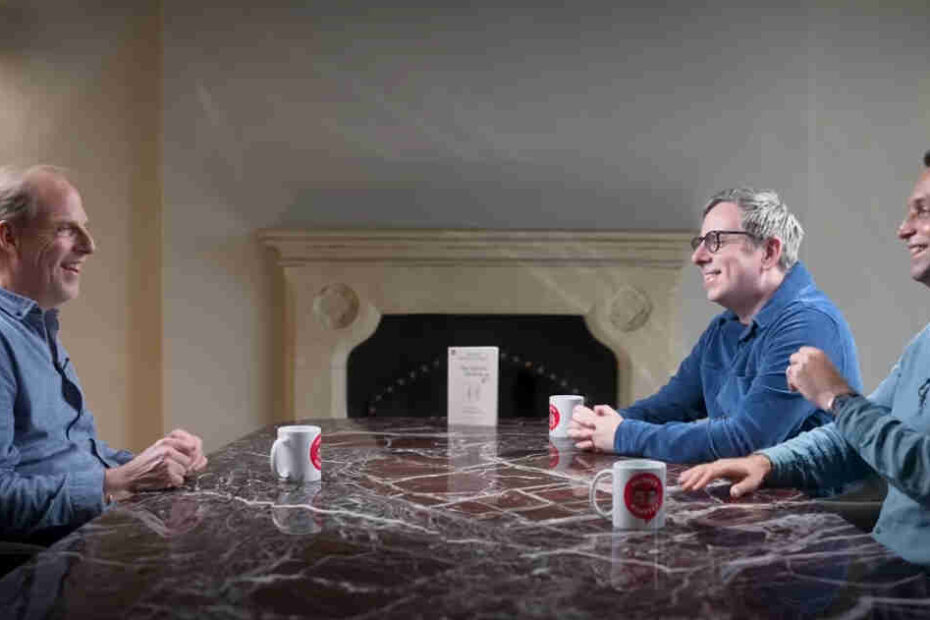
Read the full transcript of British clinical psychologist and world-renowned autism expert Professor Sir Simon Baron-Cohen’s interview on TRIGGERnometry Podcast with hosts Konstantin Kisin and Francis Foster, October 8, 2025.
Introduction
KONSTANTIN KISIN: Dr. Simon Baron-Cohen, welcome to TRIGGERnometry.
SIMON BARON-COHEN: Thank you for inviting me.
KONSTANTIN KISIN: It’s great to have you on. You are, this is no exaggeration to say, you are the world’s leading expert on autism. It’s a growth industry. Given that autism rates are skyrocketing, it’s something that lots of people have questions about, trying to understand, wrap their head around personal experiences as well. Let’s start with the basics. What is autism?
Defining Autism: Disability and Difference
SIMON BARON-COHEN: It sounds like a very basic, straightforward question. I work at the Autism Research Center. We’ve got a team of about 50 people. If you ask that apparently simple question, “what is autism?” to any of our researchers, they’d probably scratch their heads, so I can have a go at giving you my definition.
So autism for me is a disability and a difference. So the disability tends to be in social relationships, communication, adjusting to unexpected change. So autistic people struggle with those things.
The differences tend to be, I would say, mostly positive things like excellent attention to detail, excellent memory for detail, very strong pattern recognition. So we might talk about that because that was the topic of my recent book. And some of those differences are strengths, as I said, even talents.
So that’s why when I think about autism, the old view was it was a disorder, even a disease. Quite kind of pejorative language. Today we use, I’m quite keen to hold onto the disability element. So when you get your diagnosis of autism, it should be a signal that you need support because you’re struggling in some way, but we don’t want autistic people to be defined just by their disability.
Those differences are often an advantage. People even talk about the autism advantage. And if you put both of those two sides of autism together, disability and difference, these days we think about it under the heading of neurodiversity, the idea that brains develop differently.
We’ve thrown out the old view that there’s a normal brain and there’s an abnormal brain. That was how I was trained. But this is like back in the 80s or 90s. Today, we think about there are just lots of different kinds of brains. None is better or worse than another. They’re just different. And autism is one of those varieties.
Autism vs. Asperger’s Syndrome
KONSTANTIN KISIN: And what’s the difference between autism and Asperger’s syndrome?
SIMON BARON-COHEN: Right. So the term Asperger syndrome is no longer used in sort of academic or clinical circles.
KONSTANTIN KISIN: Because we found Asperger was a Nazi, basically.
SIMON BARON-COHEN: That didn’t help. That was in 2018, and I was the editor in chief of the journal where we published the article by a historian of medicine who had uncovered that Asperger, the pediatrician Hans Asperger, had collaborated with the Nazis during World War II.
So imagine having a diagnosis named after someone who is now recognized to be a Nazi collaborator. So that’s one reason why that’s no longer used. But actually, even before that, back in 2013, the American Psychiatric Association had proposed to remove Asperger’s syndrome from the psychiatric classification system because it wasn’t being used in a consistent way by different clinicians.
But to answer your question, Asperger’s syndrome is basically autism without any learning disability. So it leads us onto this point that autism is often accompanied by other things. You can be autistic and have a learning disability. In the US they call it intellectual disability, or you can have autism without.
So that’s what we used to call Asperger’s syndrome. Today it all just goes under this umbrella called autism, which is sort of confusing because it means you could have an individual who has very significant needs, maybe they’ll never live independently, perhaps can’t make it through mainstream education, may struggle for employment independence, but you can also have autistic people who have university degrees, are living independently.
It’s a very broad spectrum just covered by this single word, autism. And some people find that that’s actually not helpful.
The Challenge of the Autism Spectrum
KONSTANTIN KISIN: Well, I was going to ask you, I mean, if a spectrum includes somebody ranging from Elon Musk on the one hand, and someone who’s non-verbal and incapable of living by themselves, is that a spectrum or is that a kind of almost too wide a range? That’s not necessarily that helpful. If I say my son is autistic, he’s not, but if I said that, you don’t know which of these we’re talking about.
SIMON BARON-COHEN: Exactly. So this is a very live issue within the autism community and within researchers and clinicians who work with autistic people. You know, whether we should lump them together, they’re called the lumpers, or whether we should split them, they’re called the splitters, into two subgroups or more than two subgroups.
And at the moment, you know, they’re all lumped together. But I think scientifically we probably make more progress if we have subgroups and, you know, we do that with other areas of medicine. You know, we have, I don’t know, diabetes, type 1 and type 2 or different kinds of cancers. We don’t just call everything a single form of cancer.
So I think scientific progress is made when you have fine-grained distinctions. And that’s the same is true, I think, for services, support services. You know, if autistic people, they’re so different to each other, we might need different types of services for different types of people. But at the moment we have a single sort of umbrella concept.
Celebrating the Autistic Mind
FRANCIS FOSTER: And Simon, I really loved your book because it seemed to me that it was a celebration of the autistic mind.
SIMON BARON-COHEN: Yeah.
FRANCIS FOSTER: And you wanted to actually talk about the positives of autism because as somebody who used to teach, everyone can now drink.
SIMON BARON-COHEN: Yeah, I’m glad you read it that way. That’s how it was intended because for the longest time in the history of autism research, we’ve defined autistic people by the things that they have difficulty with. And we’d sort of not put into the spotlight the things that autistic people can really flourish and shine at.
And the focus I took in that book was about pattern recognition, hence the title, the Pattern Seekers. And the idea is that pattern seeking or pattern recognition itself lies on the spectrum. So you could take groups of people in the population and you could measure this skill and you’d find some people are just kind of average, some people are below average, some people above average. And this seems to be where you find autistic people.
So it’s kind of shifting the focus onto things they can do, not things that they struggle with. And by doing that, the intention, obviously, is to kind of revisit autism in terms of not only what can they do, but what role could they play in society?
Because we know a lot of autistic people are excluded in society. High rates of unemployment. Something like 85% of autistic adults are unemployed. A lot of dropping out of high school, so not leaving with high school qualifications. So, you know, it’s kind of a bleak picture.
But actually, if we focus on their strengths, I’m hoping that readers of this book might include employers, for example, who might think, well, I could give that guy a job. He could really help me in my bicycle shop. Because you need a good attention to detail for assembling a bicycle and fine tuning it.
Pattern Recognition and Systemizing
And part of what I try to do in the book is talk about pattern recognition as systemizing. So being able to take any system, could be a bicycle, it’s the example I started with. But it could be anything. It could be a computer, could be a mathematical equation, could be a piece of music.
All of these things are systems because within the system, there are lawful regularities. There are laws or rules or patterns that repeat. And autistic people might be just very quick at spotting the patterns. And once you’ve spotted the pattern, you can either control the system or you can refine the system.
And that’s why the subtitle of the book is about invention. How autistic people have played a key role in human invention. And this is really kind of moving autism away from disability and into what some people would say is our crowning glory as a species that we can invent.
We’re the only species on the planet that currently or has ever lived that can invent generatively. And that word generatively is kind of important because it’s the idea that we don’t just invent once, we can invent over and over again.
And it could be something small like this coffee cup. Somebody had to invent it. Here’s another tool, you know, that someone invented these things to help me see better. But we just look around us. We’ve got cameras here. All of these things are inventions, and they all have patterns or laws that govern them.
And when you systemize, you’re kind of trying to analyze the system, to really understand and predict how the system works. And then invention comes in when you just play with the components in the system and think, well, I could take this one out and put something else in and get a better outcome. And that’s the essence of systemizing.
And autistic people just seem to be drawn to systems. So even if they’re struggling with relationships, they’re kind of scanning the world in terms of, that’s interesting. There’s a pattern there. You know, I’ve seen that before. Kind of repeating their observations and sort of taking things apart, putting them back together again, but maybe in new ways.
The Case of Thomas Edison
FRANCIS FOSTER: Absolutely. And one of the people that you talk about is, you call him Al in the book.
SIMON BARON-COHEN: Yeah.
FRANCIS FOSTER: And I was a very special person. Let’s talk about Al first of all, and then we can go on to what, everybody knows who Al is by another name.
SIMON BARON-COHEN: Yeah, sure. So, you know, I talk about this man who as a child was fascinated with patterns and kind of just understanding the world, the physical world. Always kind of building things in his workshop.
As a young man, Al was fascinated by Morse code, which is another set of patterns, you know, either visual or auditory kind of sounds or dashes and dots. But Al grew up to be Edison. And Thomas Edison, who was an inventor, a prolific inventor. Not just known because he invented the first electric light bulb, but actually he had loads of patents to his name. He was just constantly inventing.
His obsession with Morse code kind of lasted well into his teens and young adulthood, so that he called his first two children Dot and Dash.
KONSTANTIN KISIN: Good inventor, terrible father.
SIMON BARON-COHEN: I don’t know what he was like as a father, but you can sort of see, you know, what his preoccupation was. His wife, according to his biographies, his wife moved his mattress into his workshop so that he could basically sleep there and just be in his workshop day and night.
He was always just dragging things in from around the house and wherever he went in life, dragging in things that he could perhaps use. I could use a bit of that or a bit of that to build a contraption.
And you get this sense of someone who is maybe obsessive. And that’s a word that is often used with autistic people. Very kind of laser focused. Could spend all day and all night trying to work out the system to really, you know, get it to work or to invent something new.
And obviously, someone like Edison is just one person. It’s kind of an anecdote. So some of the book talks about these, you know, inventors who may have had a lot of autistic traits. But as a scientist, I also like to go to the data.
Population Data on Autism and STEM
And so what we do in Cambridge, where I’m based, is look at population data, for example, so looking at the general population, giving people a questionnaire which measures how many autistic traits you have. We all have some autistic traits.
And what we find is if you divide the general population into those who work in STEM, science, technology, engineering, or maths, or those who don’t work in STEM, the people in STEM have more autistic traits. So it’s kind of evidence that an aptitude or a talent in systems thinking, understanding how systems work, also goes hand in hand with more autistic traits.
Understanding the High Systemizing Mind
FRANCIS FOSTER: And what’s interesting is you talk about the high systemizing mind, but let’s talk, which is, and just explain to the audience what you mean by that term. And also, and for want of a better way of putting it, the term that you use at the opposite end of the spectrum as well, because I think that’s a very effective way to understand the autistic mind or people who have very high level autistic traits.
Understanding Autism Beyond Diagnosis
SIMON BARON-COHEN: Yeah, so the idea is that we don’t just have to be limited by having a formal diagnosis. You know, something like 3% of the population now has an autism diagnosis, much more common than it used to be, which is what you said at the beginning of our conversation, but that’s still a minority.
Whereas an aptitude in systemizing might extend beyond people who’ve got an autism diagnosis. You know, Edison didn’t have one. You know, people talk about Isaac Newton, maybe he had a lot of autistic traits and he was a systemizer, analyzing light and sound, for example, in this physics too, and gravity, famously.
So there might be lots of people out in the world who are very good at systemizing, but don’t have a diagnosis of autism, maybe don’t need one. Because a diagnosis is only needed if your autistic traits are resulting in difficulties.
And that could arise perhaps because you’re in the wrong environment, that your kind of mind may be very well suited to the world of mathematics or music or engineering. But if some, you know, if you find yourself in a very sociable environment where you’re expected to be able to switch quickly from one conversation to another and cultivate relationships and understand humor and, you know, non-literal language, suddenly your autistic traits, which kind of drive you to look for patterns, turn into disability.
So it’s all about the kind of fit between the individual and their surroundings. And again, the book is all about making sure that when we identify autistic kids at the earliest age, we create the right environment for them to flourish.
The Causes of Autism
KONSTANTIN KISIN: And how much do we know about where autism comes from? Like what causes it, if you might say?
SIMON BARON-COHEN: Yeah, we know a lot. So you know, the biggest part of the cause of autism is genetics, and that’s because autism runs in families. That’s how we know that. But also these days, the field of molecular genetics is thriving. And a month doesn’t go past without new genetic evidence coming through linking autism to genetics.
So we now know, for example, that there are over 100 genes that are associated with autism. So autism isn’t the result of a single gene. There’s lots of genes involved. The genes that have been found are mostly what are called rare genetic variants or mutations. And they’re only seen in about, I don’t know, 5 or 10% of autistic people, but they’re much more common. Those mutations are much more common in autism compared to the general population.
But that’s not the whole of the genetic element because there’s also common genetics involved. So genes that we all carry in the population, but which come in different versions of the gene, and increasingly scientists are finding many of these common genetic variations are also linked to autism. And it’s all about the combination of these common genetic variants that may be more common in autistic people.
So there’s genetics, it’s not 100% genetic. You can have two identical twins where one is autistic and one isn’t. So if autism was 100% genetic, then given that identical twins are like clones of each other, if one is autistic, then the other one should also be. But the fact that you can find pairs of twins who are, they’re called discordant, means there must be a non-genetic element as well.
And we’ve been looking at the role of hormones, particularly sex linked hormones like testosterone. And we started looking at that partly because autism is diagnosed more often in boys. And the male fetus produces twice as much testosterone as the female fetus. And that this hormone changes brain development during pregnancy, changing the way that the baby’s brain is developing.
So we looked at that, and through collaborations with Danish scientists, we found indeed that kids who go on to have a diagnosis of autism had elevated levels of testosterone and estrogen in the womb. So their brains were exposed to higher levels of these hormones. And these hormones can interact with the genetics. So the genetics are still important, but the hormones come in and change the genes, change gene expression. So it’s quite a complex story. You asked me, you know, what seemed like a straightforward question, what causes autism, but it’s quite complex.
KONSTANTIN KISIN: Well, we have lots of, lots more stupid questions that require complicated answers.
SIMON BARON-COHEN: It wasn’t stupid.
KONSTANTIN KISIN: I’m kidding.
Vaccines and Environmental Factors
KONSTANTIN KISIN: One question, obviously, currently you just wrote an article responding to some of the things that the American administration is doing in relation to autism. And is there any evidence for environmental factors or vaccines or anything like that causing people perhaps activating genes that were already there or in some way leading to autism?
SIMON BARON-COHEN: Yeah. So I didn’t write the article, but there was an article with an interview with me in the Daily Telegraph just this week. But this is referring to the fact that Trump and RFK Jr. in the US made kind of big announcements about autism, about the causes of autism, but also about treatments for autism.
And, you know, you mentioned vaccines. I think after I’d say 30 years of research, we now know that vaccines do not cause autism. I’m saying that quite strongly because there has been a lot of research, but, you know, Trump is bringing it back into the discussion.
Personally, I think that’s a bit of a backward step because there’s been so much time and money spent on research in many different countries, in Europe, in the States, in Japan, showing that autism is not linked with this very specific vaccination, the MMR vaccine, even though it was proposed, I think, back in 1997. But here we are in 2025. I think we can say that that’s not the cause, but it doesn’t stop some people believing it.
KONSTANTIN KISIN: Welcome to the Internet. Yeah. What about other environmental factors?
SIMON BARON-COHEN: So I think, because I said that, you know, autism isn’t 100% genetic. It means that there is, you know, some space for environmental factors. I’ve mentioned hormones in the womb as one environmental factor. That’s the kind of uterine environment. But there might be other environmental factors, and we do need more research into those.
But I suppose what I would say is I would caution people from just suddenly announcing it’s microplastics or it’s pollution, because unless we’ve got strong evidence, you can easily cause anxiety in parents. For example, am I exposing my baby to the wrong environment?
And the MMR vaccine was a good example of how a scientist rushed too quickly to make a big claim about this vaccine causing autism based on quite a small sample. And all the big data that’s come later has refuted it, but it didn’t stop a lot of people becoming very anxious about it. Not vaccinating their kids against measles, for example.
Prevention vs. Support
KONSTANTIN KISIN: Well, I guess it’s kind of what I’m driving at with my question is, I suppose at the core of it for a lot of parents, you know, I know that, and I have autistic people in my family, so I’m aware of that. It has many advantages.
SIMON BARON-COHEN: Yeah.
KONSTANTIN KISIN: On the other hand, a lot of people might be wondering, well, is there anything I can do that, you know, doesn’t activate this predisposition in my children?
SIMON BARON-COHEN: Right.
KONSTANTIN KISIN: But it sounds like we don’t have any kind of evidence either way on that. Is there anything we can do?
SIMON BARON-COHEN: Right. Well, I might just go back one step at the very assumption which Trump and RFK Jr. are bringing back into the discussion of preventing autism. Because it kind of implicit in your question was, should we be trying to prevent autism?
KONSTANTIN KISIN: Some parents, in place of my question is, some parents might want to prevent.
SIMON BARON-COHEN: Yeah, exactly. And on our website, you know, we’ve thought deeply about this, and on our website, we’ve put a statement of our values, you know, which is kind of unusual for scientists to get into the whole realm of values. But we felt it was important to say we are, you know, we value autistic people. We don’t want to prevent autistic people.
And prevention, that word, prevention, kind of takes us back to actually the Holocaust and the world of eugenics, you know, where people with disabilities were put into the concentration camps or were exterminated. They were prevented along with other minorities. You know, that was the view back in the 1930s that we should prevent disability rather than, you know, today we think of ableism, you know, this idea of that we shouldn’t be discriminating against people with disabilities.
We should be inclusive in our society because disabilities are very common. We should be providing support for people with disabilities. And you could argue we should be providing treatment for conditions or disabilities that cause human suffering. But autism by itself, I don’t think it causes human suffering. I don’t think we should be trying to prevent it.
KONSTANTIN KISIN: I’m certainly not suggesting that we should be trying to prevent it. And I’d like to make it clear I do not want to put autistic people in camps. And the reason I’m asking you this is, this is why the conversation about the range of the spectrum was kind of important. Right. Because I don’t think the people who want their child to prevent their child from becoming Thomas Edison or Elon Musk.
SIMON BARON-COHEN: Right.
KONSTANTIN KISIN: But there are forms of autism or people who are autistic with a bunch of other things.
SIMON BARON-COHEN: Yeah.
KONSTANTIN KISIN: That really do suffer a lot. And I have seen it with my own eyes.
SIMON BARON-COHEN: Yeah.
KONSTANTIN KISIN: And so the reason parents might be asking that question is they may want to help their children avoid that more extreme version of autism that really does not only make the child suffer, but everyone around them suffer.
Treating Co-Occurring Conditions
SIMON BARON-COHEN: So it brings us back to the first question you asked, which is, what is autism? Right. And I was struggling to give a concise answer. But, you know, the reason I’m bringing it back is because I would say autism in a pure sense involves the social communication difficulties, the differences we talked about with excellent attention to detail and so forth.
What you’re referring to are more like learning disabilities, maybe language difficult, like language delay and a lot of other things. And autism often co-occurs with these other things and treatments, even prevention. You know, epilepsy, for example. Wouldn’t it be great if we could prevent or treat epilepsy, even though that’s quite common in autism. Yeah.
So it’s all about separating autism itself. You know, autism isn’t defined by epilepsy, but it’s, epilepsy is more common in autism, so that could be a target for treatment or prevention. And it’s just about being careful about, you know, what are we trying to treat or what are we trying to prevent.
KONSTANTIN KISIN: But if autism clusters with all these things and if there’s that more disabling version of it.
SIMON BARON-COHEN: Yeah.
KONSTANTIN KISIN: That’s where some people might have questions about, is there anything environmentally that we can do.
SIMON BARON-COHEN: Yeah.
KONSTANTIN KISIN: To avoid that. Yeah, I think that’s a fair question.
SIMON BARON-COHEN: It is. And, you know, amongst treatment researchers, we’re just very careful to really spell out what is it we’re trying to treat? And so again, another statement on our website under our values is we don’t try to treat or cure autism, but treatments might be very relevant for the co-occurring conditions that cause distress, like anxiety, for example, very common in autistic people.
Why should autistic people have to live with anxiety? So if we can find a treatment for that bit, that would probably be welcomed by autistic people. And the way we check ourselves actually is not to think that we researchers have got the answer to what we should or shouldn’t do. We talk to the autism community. So we co-design studies with autistic people, with parents, with families to really check that the research we’re doing is actually in the interests of the autism community.
KONSTANTIN KISIN: Sorry if I’m being difficult. All I’m trying to get is, let me, let me put it in simple language if I can. If I have a three month old baby.
KONSTANTIN KISIN: And it’s really, you know, if I don’t want them to be severely affected by autism and all it has, all I have to do is not feed them carrots. Exactly. Then maybe that would be useful information irrespective of, you know, our love and appreciation for and non discrimination. Do you see why I’m getting that?
SIMON BARON-COHEN: I do, I do. I mean, I think you used the word severe and again, you know, we have to decide what is severe and what isn’t. If we’re talking about say a learning disability, maybe that is something that we do need to kind of provide intervention for.
KONSTANTIN KISIN: So do we know any of that? Do we know if there are environmental factors that are actually avoidable for parents, for example, with young children?
SIMON BARON-COHEN: I don’t think we’re there yet. I think the US government has just released a lot of money to investigate this and I think some good science will come out of it.
The Challenge of Autism Spectrum Diversity
FRANCIS FOSTER: I think one of the challenges that comes with this debate, and as somebody who’s worked with autistic kids I was teaching for over a decade, is again, it comes back to, I would argue Trump’s imprecise use of language, the term autism. So as Konstantin said, if somebody is very high functioning like Elon Musk, incredibly talented, I don’t think most people would have a problem with that. Well, maybe Democrats, but we’ll turn to one side.
But if like I used to, I used to work at the start of my career with non verbal autistics who essentially are going to have to be supported for the rest of their life. I remember there’s a footballer, Paul Scholes, his son is non verbal autistic. And I saw an interview in which he, I mean, he’s not the most emotional man, but he was on the point of tears where he said, I worry about my son when I’m gone. Because at the moment we’re the only ones who can look after him.
SIMON BARON-COHEN: Right.
FRANCIS FOSTER: And this is a man of great financial means. Most parents don’t have that. So I think that’s really what we’re talking about, is a non verbal, the autistic children that will never be able to live independently.
SIMON BARON-COHEN: Yeah, yeah. And we like to think we live in a civilized society where people who may never live independently, they should have the right to support, to high quality support. And the reason why that parent is probably worrying is because the reality is that our society doesn’t necessarily provide high quality support either for those individuals who have very high support needs or even for autistic people. We called it Asperger’s Syndrome earlier.
But autistic people who don’t have a learning disability, but who might really struggle even with everyday tasks like getting the laundry done and going shopping and cooking and looking after themselves, you know. So there’s a real need for better support services. Yeah, I think it’s very common. It’s not just that one football player. A lot of parents kind of worry who’s going to be looking after my autistic son or daughter when I’m not here. So it’s a real worry.
Bullying and Social Isolation
FRANCIS FOSTER: It is a real worry. It’s a real challenge because when I was teaching, I always felt a real pang of empathy for those kids because you’d see them on the playground and they’d be at times isolated whilst other kids would be playing around them, all because they weren’t as socially, you know, deft as the other children they would be, you know, made fun of. You told this horrible story about the child getting bullied.
And so as a parent or as a teacher, as an educational professional, it’s that balance of realizing that the individual has to learn to fend for themselves and they have to be prepared to enter the real world. But also you want to protect and support them.
SIMON BARON-COHEN: Yeah. I mean, that’s why, again, the first question, what is autism? I started off with disability, because autism does entail some disability. It’s not the full extent of autism, but it’s there. And if someone’s got a disability, then they have a right to safeguarding or to, you know, anyone with a disability has vulnerabilities.
So we think of autistic people as vulnerable and that vulnerability could be bullying. You know, a lot of schools say that they have a policy of, you know, zero tolerance for bullying. We know it goes on when the teachers are not. You were a teacher. Yeah, but when the teacher’s back is turned, there’ll be bullying, or outside the school gates, there’ll be bullying.
And it’s tragic actually to kind of talk to autistic people and ask them, what was your experience like back at school? And a lot of them give this account that they were bullied, they were excluded, they were mocked, they felt very isolated, they weren’t invited to other kids birthday parties or, you know, and the result actually we need to talk about it, is poor mental health.
That the majority of autistic people are not only autistic, but they end up becoming depressed, anxious, just feeling quite lonely and isolated. And some of our research now is focused on suicide prevention. You know, that we discovered through our research that one in three or one in four autistic people have planned or attempted suicide. It’s incredibly high rate.
And we published that work in 2014, almost as a wake up call to the government saying if you leave autistic people without the right support, whether it’s kids at school or teenagers or adults, this is what happens. I think two thirds in our study, two thirds of autistic people had felt suicidal, but one in four had gone even further to plan or attempt suicide.
So it’s kind of, it’s a sign that things aren’t working for them. It’s a sign that our society, even though there’s talk about neurodiversity and acceptance and respect for difference, it’s not, it’s not there yet. We can, we can go a lot further.
Understanding Empathy in Autism
FRANCIS FOSTER: And also I sometimes think the way that we frame or this people, they go, well, they’re very low in empathy. You go, they’re not. I’ve taught autistic kids they’re not low in empathy. What they struggle with is understanding people’s emotions. So I think we also need to kind of reframe the way we describe them. Because sometimes when I hear people describe autistic people, I’m going, this is someone with autism. They’re not a sociopath.
SIMON BARON-COHEN: Yeah, I’m glad you’ve mentioned that because we’ve talked about the kind of pattern recognition systemizing skills. And we then did also touch on the social difficulties. And underneath the social difficulties, one thing that we’ve been looking at in our research is the ability to imagine what someone else is thinking or feeling. So that is one part of empathy. In technical terms, it’s called cognitive empathy.
But being able to sort of read people’s faces, interpret people’s tone of voice or their body language, kind of read between the lines in a social situation to imagine what someone is thinking or feeling. That’s an area that autistic people struggle with. But there’s another bit of empathy which is once you know that somebody else is feeling something, do you have a response, an appropriate response to how they’re feeling? Autistic, that’s called affective empathy. And autistic people seem to be absolutely fine at that.
So, for example, if an autistic person hears that someone else is suffering, it upsets them, they’re having the appropriate response and they want to rush over and help them. So they’re not psychopaths, as you say. And in some of our work, we’ve actually contrasted psychopaths who are also known as antisocial personality disorder and autism. Almost like mirror opposites.
You know, the psychopath is very good at the cognitive empathy. That’s how they can manipulate their victims. But they don’t have the affect of empathy. They don’t have the appropriate emotional response. They don’t care about how the victim is feeling. And autistic people, it’s kind of the other way around that they have trouble reading people. So they don’t tend to manipulate other people or deceive other people. But once they know, if it’s pointed out to them, you know how the other person is feeling, they care about other people, so they are caring. I think that’s what you were trying to say.
Gender Differences in Autism Presentation
FRANCIS FOSTER: Yeah. Like all of these conditions, they present very differently in both male and female. Could you talk a little bit about that because, again, I remember we, it’s far easier to diagnose a boy with autism than it is with a girl. So let’s talk about that a little bit.
SIMON BARON-COHEN: Yeah, so a number of things to bring out. You’re right, that for the history of autism, which goes back to the 30s or 40s, boys have been diagnosed more often as autistic. So clinicians have got used to sort of seeing boys in the clinic and they tend to be things like lining things up in patterns or finding, getting upset if things change in their routines. It’s a whole set of kind of characteristics or symptoms that seem to kind of pick out someone who’s an autistic boy.
And the question is, now that we’re starting to be better at diagnosing autism in girls, things are changing. More girls and women are seeking a diagnosis. Does autism look differently in them? And you see the same sort of traits like an obsession or a very strong interest in a particular topic. But with a boy it might be trains or vehicles. With a girl it might be reading, reading literature where they’re just immersed in the world of books, but they’re doing it all the time, you know, so you still have this kind of laser focus, but it’s showing differently in girls and boys.
You know, girls might become, or women might become more interested in, I don’t know, animals, for example, not just their own pet, but maybe lots of pets or rescuing injured animals or, you know, so they kind of. The very strong interest is there, but it’s coming out differently in an autistic girl compared to an autistic boy.
Masking and Mental Health
FRANCIS FOSTER: But it’s also as well, because what part of, as teaching autistic boys, there’s a certain, you can see when there’s a frustration they act out. You know, the probably the politically incorrect term is, you know, they meltdown or the, you know, they just, they get so angry and frustrated. Yeah, you don’t see that with girls because girls are far better at masking.
SIMON BARON-COHEN: Yeah, absolutely. And that seems to be a mixed blessing because if you can mask that you’re autistic, that might mean that you’re included more, you know, that, you know, girls who are masking, or it’s sometimes called camouflaging, they might be sort of invited into social groups because they seem like everybody else. Whereas for someone who’s not masking, they seem so different that perhaps they’re excluded or ostracized.
But the double edged part of this is that by masking you’re not really being yourself. You’re kind of pretending that you’re not autistic when you are. So under the surface that person might be feeling high levels of stress, but on the surface they’re acting like they’re fine. And that could actually lead to poor mental health.
And you know, interestingly, we find very high rates of poor mental health in girls and women who are autistic, even higher suicide rates or suicide attempts in autistic girls and women than autistic boys and men. So masking, you know, I don’t think I would encourage people to mask. You know, I think it’s really important that people should feel comfortable being who they are. And by masking, in a sense, we’re almost sort of going along with this idea that autism is something bad that you need to hide and we want to destigmatize autism.
Employment and Autism
KONSTANTIN KISIN: Well, one of the things about that is actually, you know, I feel that awareness is a term that’s brought way overused for lots of things. But actually when it comes to autism, if you know autistic people, one of the things about them is they’re actually fundamentally really, really decent people.
Yeah, there’s a kind of, I call it Asperger’s pureness, which is they are maybe because for the reasons you gave, that they struggle to read people’s emotions, therefore they can’t manipulate. But I don’t think it would occur to an autistic person to manipulate someone. That is just not how they think.
Generally, in my experience, they’re very principled and moral people. If there’s some kind of moral panic going on in society, the first people to say “this doesn’t compute” literally will be autistic people because they’re like, well, this just isn’t true. I don’t care about your feelings.
SIMON BARON-COHEN: Yeah.
KONSTANTIN KISIN: And that’s a really important thing to have in society.
SIMON BARON-COHEN: No, I agree.
KONSTANTIN KISIN: And I think if we have that awareness of the way that autistic people are different and actually really good, that will make it easier, I think, for people to relate and to make them included. And that certainly has been my experience.
SIMON BARON-COHEN: Yeah. So I think if you were an employer, for example, and you’re thinking, who should I employ? This autistic person or the non-autistic person? I think what the autistic person brings is that honesty. You know, they like to know what is the job and they like it to be very well specified, not ambiguous in some way. And then they can just get on with it and do it in a kind of perfectionist way because of that attention to detail.
But they’re not going to be lying and cheating and pretending that they’re working or getting into office gossip or playing those sorts of mind games. You know, that is the refreshing part about having autistic people in our community is that they are very honest.
And you’re right, that hand in hand with that is morality. They tend to tell the truth. They tend to expect others to tell the truth and are a bit surprised when the non-autistic world seems to be full of deception and white lies or cheating.
That can also leave the autistic person quite vulnerable. Again, many autistic people will report that in their lives they’ve been exploited or deceived by others. You know, you were a teacher, but I think I describe in the book an example of a child where the other children in the playground say, “Can I see your wallet?” And the autistic kid thinks, okay, here’s my wallet. And they run off with it.
You know, a non-autistic person would see the trap that they’re walking into and they’d be a bit more wary. And autistic people can be manipulated and exploited and for that reason, again, we need to think about safeguarding.
Workplace Accommodations and Hiring Practices
KONSTANTIN KISIN: Well, on the point of employment, it’s actually something that’s great because you’re the world’s leading researcher in this area. We know that autistic people really struggle to find and maintain employment. And not just employment, but from what I know, also often struggle to run a business for various reasons. They struggle in the world of work, let’s say.
And I’m sure a significant amount of that is to do with employers not understanding how to employ them properly. And they’ll probably be part of that, which is also to do with certain handicaps or they have certain things that do hold them back.
But if you are to look at what the strengths autistic people tend to have in general and how they might be used by employers and also the challenges they face and how those might be compensated by someone who is an employer listening to this, what would be some of the tips and tricks that you’d give?
SIMON BARON-COHEN: Well, if I could start with the fact that a lot of autistic people struggle to get into work, that probably means that even unconsciously, there’s a kind of discrimination going on. So imagine you two are on the hiring committee and I’m the candidate.
Often, traditionally, we expect applicants for jobs to make eye contact, to have fluent communication skills, to be a good team player. All the qualities that you might list in the job description, they turn out to be a lot of the areas of difficulty or disability. So it’s almost like saying, we don’t want this kind of disability in our workplace.
So one implication is we need to change the way we hire people. And there are some companies who are now, in order to be fair to autistic applicants for jobs, they’re giving them tasks to do in the interview. It’s not about, the emphasis isn’t on social skills and communication, but it might be on, here’s a problem, can you solve it?
And autistic people might be very good at that. And maybe that problem is related to the job that they’re applying for so that the employer can actually see their problem solving skills, which often include logic, for example, being very logical about things. But I think you’re sort of saying that what’s the benefits of having an autistic person in the team and also…
KONSTANTIN KISIN: What are the adjustments employers can make? Because I think there is some nuance to your point about eye contact and all these other things. Because if you’re hiring an IT engineer…
SIMON BARON-COHEN: Yeah.
KONSTANTIN KISIN: Then shaking hands and looking people in the eye really doesn’t matter.
SIMON BARON-COHEN: Exactly.
KONSTANTIN KISIN: If you’re hiring someone who’s a salesperson, actually, those skills do matter.
SIMON BARON-COHEN: Yeah.
KONSTANTIN KISIN: And the fact that an autistic person finds those things more difficult actually is disqualifying for that particular job.
SIMON BARON-COHEN: Yeah.
KONSTANTIN KISIN: But if someone is very good at the core element of their job, what are some of the other things that might need to be worked around?
SIMON BARON-COHEN: So the message I would give to employers, but also teachers, going back to the educational setting, it’s not just at work, but it’s in education, is ask the autistic person what they need. It’s a very simple thing because it’s going to be different for each person.
Some autistic people might find the lights are too bright so they can’t get on with their job or their work because fluorescent lighting is aversive to them. Some autistic people might say, can I sit at the same desk every day? Because they need predictability and routine.
And if you’re in an open plan office, maybe there’s too much kind of background chatter. The autistic person might say, can I wear headphones, noise canceling headphones whilst I’m doing my programming or whatever. Because a lot of autistic people have sensory issues, are very easily distracted and they just want to be able to focus.
So a lot of these adjustments or accommodations are not expensive. It’s just about taking the time to ask the person, what do you need? And companies or educational settings should be able to provide it.
I’m very pleased that in my university in Cambridge we now have 900 autistic students. So that’s a big change from the old days. It means that autistic students are applying to a top university, they’re getting in, and there’s a disability resource center in the university who meets the student even before they start just to say, what do you need?
And that was a kind of a pathway that we put in place because if you make things a bit more of a level playing field, autistic people should be able to achieve just as much as a non-autistic person or better.
Autism in Academic Settings
FRANCIS FOSTER: You know, it’s funny that you say that because I watched this documentary about, and I want to touch on the savant because that’s a kind of a hack trope, shall we just say, when people think of Rain Man and whatever else. But touching on what you said, I watched this documentary on a very talented mathematician who was a young boy, he was 15.
And you know, the professor came around, I think it was from Cambridge actually, I can’t remember which college. And his dad went, look to the professor, I’ve got no doubt that the lad can do the work. That won’t be, that’ll be fine. He goes, I’m just worried that he’ll be able to cope at university being autistic. And the professor smiled and went, “We’re all autistic.”
SIMON BARON-COHEN: Right.
FRANCIS FOSTER: You know, and I mean, but there is, you’ve touched on before, you know, there is that kind of, when you go to the mathematics department in Christ College Cambridge, for instance, I’m sure it’s going to be having higher than your average percentage of autistic people there.
SIMON BARON-COHEN: Yeah. You know, going back to one of the studies I mentioned earlier, when we measure autistic traits amongst mathematicians, they do score higher than non-mathematicians. So that’s kind of evidence both that there’s some sort of connection between mathematical ability, maths is another system, and autistic traits.
But it also means that if you go to work in a maths department, you know, people don’t think you’re unusual if you’re also autistic. If you’re not comfortable with eye contact or chit chat, but you’re happy just being left to your own devices solving maths problems, you’re valued, basically.
And so it comes back to this idea that if somebody can end up in an environment in which they feel they belong, it’s good for their mental health, it’s good for their sense of inclusion. It’s almost like their disability reduces and the person can just shine.
Understanding Savant Syndrome
FRANCIS FOSTER: Absolutely. And let’s talk about the savant idea because, you know, we’ve all seen the movie Rain Man and that tends to be our image of people who have savant level power. So let’s talk about what does that mean? How common is it?
SIMON BARON-COHEN: Yeah.
FRANCIS FOSTER: Et cetera.
SIMON BARON-COHEN: Yeah. So savant, you know, savant syndrome, sometimes it’s called, it’s people who’ve got an unusual talent that is out of keeping with the rest of their abilities. So I’ve met, and it’s more common in autistic people than in the general population or even amongst other disabilities.
So I’ve met autistic people who can just hear any song and they can play it on the piano straight away. So it’s just kind of taking auditory information and turning it into motor skills and they can just see the patterns, you know, that’d be one example.
There’s a young man called Derek Paravicini who is autistic. He’s got a learning disability as well. He doesn’t live independently, but he can listen to any jazz song and play it instantly. But if you then say, can you transpose that song into a different key? He can do that instantly. So he’s taking the patterns. He’s obviously able to kind of recognize the algorithms, if you like, and do that transformation. Or if you could say, can you play that song in the style of, he can do that instantly, but he wouldn’t be able to go to the supermarket and be able to figure out if he’s got the right change or not.
There’s another autistic young man called Max Park who is minimally verbal. He is the world champion for the Rubik’s Cube. So the Rubik’s Cube is all about patterns, but these are visual patterns, unlike Derek, where it was auditory patterns. But he can solve the 3 by 3 Rubik’s Cube faster than anyone. But also the 4 by 4, the 5 by 5. There doesn’t seem to be any limit to his ability to compute. What do I need to do to solve the problem?
But you know, he’s not living independently. He’s still very dependent on his parents. He’s now an adult, still the world champion. No one’s beaten him. So it’s all about how do we support individuals like that and channel those skills.
KONSTANTIN KISIN: And I mean, look, being the Rubik’s world champion is a great thing, but also, is there perhaps a monetizable version of that skill that, you know, I’m sure there’s other patterns that that person can recognize. Right. That’s how you convert that uniqueness into a job or into employment or business.
SIMON BARON-COHEN: Right? Yeah, I know what you mean by monetizing it. I think you meant it in the positive, of course, of how can you…
KONSTANTIN KISIN: Help the person make a living and making a living and an impact on the world.
SIMON BARON-COHEN: I mean, I suppose some autistic people might worry are our sort of strengths going to be monetized in the sense of are we going to be exploited? So it’s just, you know. Yeah, I mean, I take it in the first sense, you know.
KONSTANTIN KISIN: Well, if you monetize someone’s skill, you pay them for that skill being used or they get the benefits of that. Right. Because you can’t really have one without the other. In the sense of you can’t say, well, autistic people are discriminated against, unemployment, and then also recoil at the idea of monetizing the skill because that’s what employment is.
SIMON BARON-COHEN: Yeah, right.
KONSTANTIN KISIN: Is that fair?
SIMON BARON-COHEN: Yeah. Yeah. Well, I mean, I guess the word monetize just has these different connotations. Yeah, but I think, but I completely agree with you.
Autism and Success: The Elon Musk Example
SIMON BARON-COHEN: Today you’ve mentioned Elon Musk a few times and I sort of wonder because he came out on television as autistic. This is a few years ago, which I thought was a very positive thing because, you know, we need more role models, highly successful people who are autistic.
But actually, when you look at Elon Musk from a distance, I don’t know him personally. Does he have a disability? Should we really be using that word, autism? If he doesn’t have any recognizable disability? He seems to be coping absolutely fine in the world. He’s monetized his skills in engineering, you know, putting rockets on Mars and, you know, Tesla cars.
And so, you know, but obviously he identifies as having a lot of autistic traits. So I sort of see that this is good for raising awareness. But I would still reserve the diagnosis for someone who needs extra support, you know.
KONSTANTIN KISIN: Well, we don’t know what he needs and we don’t know the struggles. I mean, I’ve heard him talk about, like, you do not want to live in my head as well. And so we don’t know him personally. Yeah, but, yeah, I think there was one other question as we’re heading towards the end that I wanted to slight sidestep and don’t feel like you are under any obligation to talk about it in detail, but one of the ways you conceptualize autism is the extreme male mind. Is that accurate?
SIMON BARON-COHEN: Yeah.
The Extreme Male Brain Theory
KONSTANTIN KISIN: Can you explain that a little bit?
SIMON BARON-COHEN: Yeah. I mean, it relates to what we’ve been talking about throughout the conversation. Because when you look at skills like systemizing or pattern recognition in the general population, you find gender differences, that males on average are more interested in patterns and systems, taking things apart, putting them back together again.
And girls and women on average have better social skills and communication skills, better empathy, just much more comfortable in the world of social groups and keeping track of who knows what and how everyone’s feeling.
So, you know, if you then look at autistic people, they seem to be an extreme of the typical male profile because they’ve taken the pattern recognition and systemizing to an extreme. They haven’t done it consciously. That’s just how they work. And they struggle with some of the things that are kind of easier for females in the population.
So it’s in that sense that I sometimes talk about autism as an extreme of the typical male pattern of development. And that’s also why we started looking at these hormones that are sex linked, like testosterone and estrogen, to understand the biology of these gender differences, but also of autism.
KONSTANTIN KISIN: And in fact, I’ve heard you talk about a study which kind of indicates that much of this gender difference is visible in newborn babies. You know, the male baby reaching for mechanical toys, the female baby reaching for humanoid shapes. And even with monkeys. Is that right? Female monkeys and male monkeys are different in that respect?
SIMON BARON-COHEN: Yeah. I mean, I don’t. We haven’t done the monkey work, but we have done work with newborn babies, and it’s not so much what do they reach for, because they can’t really control their movements when they’re at birth, but they can control their eye movements.
So we present newborn babies with a human face or a mechanical object, and just look at which one do they look at? And what we find is that boys at birth spend more time looking at the mechanical object, and girls spend more time looking at the human face.
So it’s not to sort of diminish the role of social experience later and culture and socialization, but it looks like some of these gender differences might be present at birth and therefore partly biological.
Autism and Gender Identity
KONSTANTIN KISIN: So putting those two things together, here’s the real reason I’m bringing this up. As I’m sure you’ll be aware, gender dysphoria and transgender issues have become quite prevalent as a talking point in the culture. Something we’ve talked to lots of people favor, you know, all sorts of different sides on it on the show.
And when you talk about they effectively being, on average, not in every individual, but on average, a male way of thinking and a female way of thinking, or a male brain and a female brain, and particularly when it comes. We know that autistic girls are much more likely than the average girl to have a diagnosis of gender dysphoria.
Do you have any thoughts on the male brain and its interaction with gender identity, as we now call it, and gender dysphoria and so on?
SIMON BARON-COHEN: Yeah, I wasn’t aware that girls and women are more likely to have gender dysphoria.
KONSTANTIN KISIN: Autistic girls are more likely than average girl to have gender dysphoria. Autistic people, and girls in particular, are very overrepresented in gender issues.
SIMON BARON-COHEN: And that may also be true for autistic males, too.
KONSTANTIN KISIN: Could be.
SIMON BARON-COHEN: So we did a big study of 36,000 autistic people. It was online asking them about their gender identity. So, you know, do they. Does their current gender identity match the gender that they were assigned at birth?
And we found autistic people were disproportionately more likely to say that they’re either non-binary, gender non-binary. So they don’t feel either male or female or trans, so that they currently identify as the opposite to the gender that they would assigned at birth. I think it was like six to nine times more likely.
So there is something there to do with. If you’re autistic, you’re more likely to have gender. Well, I would say divergence, let’s call it not necessarily dysphoria, because we didn’t ask, are you unhappy with your, you know, with the gender that you’ve got, or. But certainly kind of, you know, not falling into just the binary categories.
And we don’t know the reasons for that. You know, you could imagine both social factors, but also biological factors might contribute. It needs more work because, I mean.
FRANCIS FOSTER: That is very true. Because I think one of the things that we kind of assume with autism is that we know everything about it.
KONSTANTIN KISIN: I don’t know if Simon assumes that.
FRANCIS FOSTER: But in a lot of, you know, you know, autism is this. It’s this. And it’s. The reality is, is this is an ongoing conversation. This is an ongoing study. You know, neurodiversity is something that I really think is important to accept. And, yeah, you know, the fact that people are different, we think in different ways, we see the world in different ways. That is a good thing.
SIMON BARON-COHEN: Yeah.
Future Research and Support
FRANCIS FOSTER: And so I guess my question really goes is, what do we not know yet about this condition? And that you hope. What are the breakthroughs that you hope we make in the next few years?
SIMON BARON-COHEN: Right. I mean, I would say that autism’s only been known about since the 30s or 40s, you know, so, you know, we’re sort of, I don’t know, 70 or 80 years into autism research. That’s a relatively short amount of time in the history of science. There’s a lot more to still discover.
And we work at multiple levels. When I say we, it’s the whole community of autism researchers. Some of it is neuroscience, you know, so now we’ve got the tools for brain imaging, for example, you know, really understanding that diversity in the brain, which we don’t have, you know, a full picture of yet. We talked about the genetics. It’s not really a sort of complete picture yet. We’re still learning a lot.
But I suppose much more relevant is what can we be providing for autistic people? Because there’s. It’s all very well studying autism in terms of its causes or its nature, but much more relevant is are we providing what autistic people need?
And as an example, we’re looking at music therapy to see whether that’s something that autistic people might benefit from. Anecdotally, a lot of music therapists will say, yes, this works. We’re doing a trial, a randomized controlled trial to see.
So I think we just need a lot more kind of evidence about what works and for whom, so that we get to a point in the future where a parent, their child gets diagnosed and we can say, no big deal, there’s all these different options available, all with evidence behind them to kind of match it to each individual child.
Advice for Parents
FRANCIS FOSTER: And just touching on the parents, because that’s actually a very important point. What should a parent do if they’re looking at their child and thinking to themselves, there’s something a little bit awry here. This they’re not developing. Could they be autistic? What are the classic signs and how should this person go to get help, essentially, and get more support?
SIMON BARON-COHEN: Yeah, I mean, it depends on the age of the child, you know, so we’ve developed different screening instruments for toddlers where you’d look at certain behaviors, like whether the child is pointing at things or not, because that’s even before they can talk. It’s a communicative gesture, whether they’re looking at the face and following where people are looking. So they’re kind of screening instruments that look at that.
But there are screening instruments right through childhood and teens and adolescence. So the one that we’ve developed is called the AQ, the Autism Spectrum Quotient. Parents can find it online. They could, even if they’re instead of being told by their doctor, by their GP or family physician, your child’s fine, stop worrying. They could go online and start filling in one of these checklists.
And if the child is. If the person is scoring high, they could go back to the doctor. And it kind of empowers them to say, look at my child’s score. I want my child to be given a full assessment.
But, you know, again, talking about how our society is still not providing what people need. The waiting lists to get a diagnosis are shockingly long. You know, we hear around different parts of the UK, but the same across the world, that waiting lists can be not just months, but years long, just to get the diagnosis.
And then when you get the diagnosis, there may be nothing beyond that, though. No pathway, no support services. So, you know, that’s down to the government, I think, in countries that have, you know, socialized social care and health services. But the funding is not sufficient at the moment.
Rising Autism Rates
KONSTANTIN KISIN: One other question I was going to ask you, just following the logic of a number of the things you said. So you mentioned that it’s significantly genetic at the very least. We don’t know how much and to what extent and which environmental factors affect it.
And then we also know that autism rates, as we’ve acknowledged, are rising very rapidly and have risen very rapidly. Logically, if it’s mostly genetic and that’s happened, you would say that’s because of better diagnosis. Is that the only reason that we’re now seeing so many more autistic people?
SIMON BARON-COHEN: It’s one of the reasons. Better diagnosis and greater awareness. So, you know, podcasts and interviews like this, it’s kind of hopefully is educated.
KONSTANTIN KISIN: We’ve made a thousand autistic people in this conversation.
SIMON BARON-COHEN: Well, it’s certainly, you know, there will be people out there who are thinking, could I be autistic? Or could my son or my brother or whatever. And that’s a good thing, you know, because it’s kind of raising awareness.
Another factor is we’ve broadened the definition of autism so to include not just autistic people with learning disability or intellectual disability, which is what it used to be, but also autistic people without learning disability. So that suddenly opens up the diagnosis to anyone in the population.
And then there’s also obvious things like social media, you know, that there are autistic people going online and talking about their experiences. And, you know, that also spreads the word. And, you know, there are more clinics on the ground, so we’ve trained more professionals to be looking for it.
All of these factors kind of combine to increase the numbers. And I think since the year 2000, there’s been a 700% increase in the numbers of people getting diagnosed. So back then it was like one in a thousand. Today it’s one in thirty. So it’s really skyrocketed.
But I think that’s a good thing because it probably meant that there were lots of people who were just sort of coping, muddling along without a diagnosis who actually needed it. And if they’d got their diagnosis early enough, it might have prevented the deterioration in their mental health and that sense of isolation we’ve talked about.
KONSTANTIN KISIN: Absolutely. And something I’ve seen, as I say with my family. Dr. Simon Baron-Cohen, it’s such a pleasure having you on. Thank you for being here.
SIMON BARON-COHEN: Thank you.
KONSTANTIN KISIN: Before we head over to questions from our supporters, the last question we always ask is, what’s the one thing we’re not talking about that we really should be? And that could be related to autism or not at all.
Human Rights and Autism
SIMON BARON-COHEN: Totally, yeah. Your call. Well, back in 2017, I was invited to give a lecture at the United Nations on Autism Awareness Day. And I thought, goodness, I’ve got this opportunity.
So I chose as my topic autism and human rights. And although it’s now, you know, eight years later, I still don’t think we’re talking about that enough, that autistic people are falling outside of human rights.
We’ve talked about the right to employment and the right to education. There’s also the right to health, including mental health, the right to leisure and dignity. You know, all of the different human rights that exist. Many autistic people are not enjoying, unlike the rest of us.
So I think that’s something that we could look into more.
KONSTANTIN KISIN: Well, thank you very much. Head on over to triggerpod.co.uk, where we ask the kid doctor your questions. How do autism traits and diagnosis vary across different ethnic and cultural groups? And is there a cultural and background dimension to autism?
Related Posts
- Scott Ritter: Russia Threatens Strike on Finland & Baltic States (Transcript)
- PBD Podcast #778: Who Is Sadhguru? (Transcript)
- Larry Johnson: Trump’s Naval Blockade & Ceasefire Collapse (Transcript)
- Prof. Mohammad Marandi: What Really Happened in Islamabad (Transcript)
- Transcript: U.S and China One Step Away from Conflict in Hormuz w/ Lt. Gen. Ben Hodges