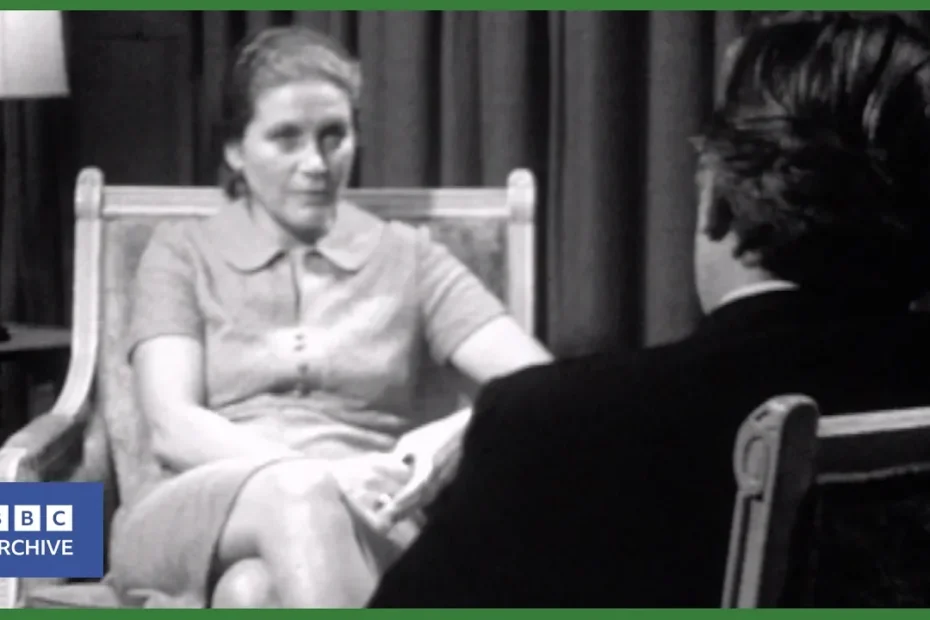
In this remarkable 1969 BBC interview, Robin Day speaks with Svetlana Alliluyeva, the only daughter of Soviet dictator Joseph Stalin, just two years after her dramatic defection to the United States via India. She recounts the emotional journey that led her to leave the USSR, including the forbidden love affair with Indian intellectual Brajesh Singh and the political pressure surrounding his death and ashes.
Svetlana offers a rare, intimate portrait of life inside the Stalin family, calling her father “a moral and spiritual monster” while reflecting on the terror, censorship, and inner conflicts she witnessed. She also discusses her best-selling memoirs, her struggle for freedom, her faith, and the personal cost of leaving her children and homeland behind.
A Different Perspective on America
SVETLANA ALLILUYEVA: You know, Americans criticize their own country and their own society very strongly. But my point of view is different because I compare all I see here with the country I have come from. And this is absolutely different point of view.
And when I compare it, then I see that it’s much better than everything I knew before. You see, I had a feeling that life in Russia was bad, horrible in many ways. It didn’t occur to my mind that I could leave. I simply didn’t think about that.
Because at the moment when I was leaving Russia in December 1966, I was leaving with one purpose: to bring the ashes of Mr. Singh to his native village and to meet his brother and his relatives. And I really had no chance to think about anything else.
And believe me, if I would imagine that I never come back, I would at least take the most, the dearest to me photographs from my house. I would probably give some hint to my children about that, that I will not come back. I will do something to at least for them not to experience this shock which they had in spring. I haven’t done anything like that.
ROBIN DAY: You referred to Mr. Singh. This was Brajesh Singh. And this was the Indian intellectual with whom you fell in love in Moscow. And you wanted to go and marry him and live in India, didn’t you?
SVETLANA ALLILUYEVA: No, no, no.
ROBIN DAY: Well, you wanted to marry him anyway, so that you could go to India with him.
The Plan to Stay in Moscow
SVETLANA ALLILUYEVA: No, no, no. The idea was that he came to Moscow and he had a contract with the publishers in Moscow which enabled him to work as a translator for the publishing house, translating from Hindi to English and from English to Hindi.
And the contract gave him right to live in Moscow, to renew his contract after every three years. And we hoped that after each three years we would be able to travel, to go with him to spend his vacations in India or somewhere in Europe where he also had friends.
We really had no idea to leave Russia and to go to India. Because as he always used to tell me that India is very difficult place to live. He was not very fond of the situation in India himself. But we just thought that we could get married and we could travel on our vacation time. But we were deprived even of that.
ROBIN DAY: Why would Mr. Kosygin not allow you to marry him?
SVETLANA ALLILUYEVA: That you should ask him. What he told me was that if you marry a foreigner, then he will be able to take you with him abroad. And no matter, I tried to prove that we didn’t plan such thing. I think they didn’t believe me.
ROBIN DAY: He also, you tell us in your book, objected to being associated with what he called “an old sick Hindu who would take you to a poverty-stricken, backward country.”
SVETLANA ALLILUYEVA: Oh, well, I think this is the way he… yes, this is the way he talked to me. “Why you couldn’t find some young man here in Russia instead of this old sick Hindu?”
ROBIN DAY: But he did give you permission to take his ashes?
SVETLANA ALLILUYEVA: Yes, he did.
Arrival in India
ROBIN DAY: And when you got to India, what did you find was the attitude of the Russian embassy officials who met you at Delhi airport?
SVETLANA ALLILUYEVA: Well, when I reached India, from the very beginning I felt that I entered the atmosphere of deceit because I was promised one thing in Moscow. And here they met me with quite different conditions which were put before me immediately. And I couldn’t agree to that.
ROBIN DAY: Stay only for a week?
SVETLANA ALLILUYEVA: Well, they didn’t want to let me go to the village, which was my aim. You know, I came, but it was my purpose. I came for that. They wanted to send me back in two weeks instead of one month visa which I had from the Indian government. And they just didn’t allow me to contact even those few Indians I knew in Delhi.
ROBIN DAY: And how did you manage to have your way and to get to the village of Kalakankar, 600 miles from Delhi, where the ashes were to be taken?
SVETLANA ALLILUYEVA: Well, I had to begin arguing from the very first moment in Delhi. I argued with officials in the embassy and I succeeded to convince them that I must go to the village because that was my purpose.
So I was allowed finally, but only for one week. But the moment I reached the village, I just decided I will stay there, at least for a month, because I had this legal Indian visa for a month.
ROBIN DAY: You’re a very determined person, aren’t you, when you want to be?
A Simple Thing Becomes Political
SVETLANA ALLILUYEVA: Well, you know, I didn’t understand. I couldn’t understand why such a simple thing as visiting of the late husband’s relatives, why it was considered to be a kind of political crime.
And that made me very determined. I was sure that I was doing the right thing. So I really, I became very determined.
ROBIN DAY: And you were determined enough to send away the lady from Moscow who’d been sent to watch over you, didn’t you?
SVETLANA ALLILUYEVA: Well, I never asked her to accompany me and her presence was absolutely useless and she knew that herself. I had great sympathy for her because she felt very unhappy in the whole situation. So I think she was happy when she left.
ROBIN DAY: In India, where you were so happy for that period, what gave you for the first time the idea of not going back to Moscow?
SVETLANA ALLILUYEVA: Well, I think that it certainly came to my mind that I just would love to stay here and not to go back. Just because after all these first days of the most cynical deceit which I met there and most inhuman treatment, and there was no reason for that. I mean, from the embassy.
I think that made me completely… brought to some… you know, it was the last straw, as you say, in your feelings. And of course, I knew that Soviet bureaucracy is always like that. But at the moment they showed themselves in the most inhuman way.
The Influence of Chester Bowles
ROBIN DAY: You were reading, you tell us, a book by Chester Bowles, who was then the American ambassador to India. But this began to put certain thoughts in your mind. How was that?
SVETLANA ALLILUYEVA: You see, that was a very slow process. I cannot really tell you exactly when it crossed my mind that I would go to the American Embassy. And of course, in this process, the book of Chester Bowles took its important place because I realized that, well, probably this ambassador would be kind and nice enough to understand my problems. Actually, I didn’t meet him in Delhi.
ROBIN DAY: Why didn’t you think of staying in India as opposed to eventually thinking of going to America?
SVETLANA ALLILUYEVA: I thought about it in the beginning. I thought my only idea was just not to go back. My feeling was not to go back to Moscow, not to go back to Soviet Union. If I could do something better than coming to United States Embassy, I would try this. But there was no chance.
I tried to talk to Indian officials. I told them that I would love to stay and not to go back. And they were terribly frightened for political reasons.
ROBIN DAY: It would be an embarrassment.
SVETLANA ALLILUYEVA: Yes, they were frightened that would cause a lot of trouble between India and the Soviet Union.
The Precious Manuscript
ROBIN DAY: And where was your precious manuscript, the manuscript of “Twenty Letters to a Friend” at this time?
SVETLANA ALLILUYEVA: Oh, well, at that time, my manuscript was locked somewhere in the desk of Ambassador Kaul.
ROBIN DAY: And he gave it back to you?
SVETLANA ALLILUYEVA: Well, much later. Much later. In the beginning, I didn’t even ask him about it.
ROBIN DAY: And then when you got it back from him, where did you keep it?
SVETLANA ALLILUYEVA: I was in the village at the time. I was in Kalakankar village. And I asked him to mail it to me, and he did.
ROBIN DAY: And where did you keep it?
SVETLANA ALLILUYEVA: I kept it in my suitcase.
ROBIN DAY: Around the bed?
SVETLANA ALLILUYEVA: Yes.
The Final Day in Delhi
ROBIN DAY: And when the return arrangements to Moscow were finally made and you got back to the Russian hostel in Delhi on the afternoon of March 6, what was your state of mind that afternoon?
SVETLANA ALLILUYEVA: Well, my state of mind was very uncertain because I was missing my children very much. And really I bought a lot of presents for them. And I was just not sure myself what I was going to do.
I could probably easily take my bags and go back to Moscow just to see them. And at the same time, I felt that going back to Moscow, going back to my usual Soviet life, would be a kind of suicide for myself. I wouldn’t be able to continue the same life there.
I would have to join some protesters in the most radical way. And that wouldn’t make good for my children either. So I was just torn to pieces that morning, that last day in Delhi.
I had to join the lunch with the Soviet ambassador, which was the worst impression for me after two months of free life in India, because the moment I entered the Soviet embassy again and saw all the Soviet officials around me with their way of talk and their way of, you know, the way how they treat each other and me, I felt very unhappy and I felt how strongly I do not want to go back to that.
And the lunch with Ambassador only made my decision stronger, that I will not be able to continue to live that way of life again. So after lunch I came back to my room and for two or three hours I was just torn between which suitcase have I to pack, my big one for Moscow or my small one for going away. And finally I took the smaller one.
ROBIN DAY: But before leaving that lunch with the Russian ambassador, you had managed to do one very important thing, hadn’t you? To get your passport?
SVETLANA ALLILUYEVA: Well, that was after the lunch.
ROBIN DAY: How did you manage to get that? Because that was a big mistake they made.
Retrieving the Passport
SVETLANA ALLILUYEVA: Well, there is a very strange rule that the Soviet citizen, the moment he… his passport is taken away from him, not left in his hands, I believe, just for that purpose, that he wouldn’t run away.
And I knew that my passport would be given back to me only in the airport, such are the regulations. And I wanted to have it in my hands now because this was the only document I could prove that I know who I am. And I had no papers otherwise.
So I have asked the ambassador to give it to me. Now, I was not sure at all he will do that, but to my great surprise, he did. And so that was very good for me.
ROBIN DAY: And instead of packing the big suitcase to go back to Russia, you packed the small suitcase to go around the corner. And in the small suitcase was your manuscript.
SVETLANA ALLILUYEVA: It was my manuscript. And few things I had with me from Russia and few things, presents I got in India for myself. And really, I don’t know what, I didn’t really think much what I took with me.
ROBIN DAY: And how did you get away from the Russian Embassy, Russian hostel?
SVETLANA ALLILUYEVA: I just asked for the taxi because I thought that to walk all the way on the street with suitcase and overcoat in my hands towards American Embassy would look rather strange.
ROBIN DAY: But it wasn’t very far, was it?
SVETLANA ALLILUYEVA: It was not very far to walk. But in that case I thought that if I take the taxi then nobody cares where am I going? Probably to see my friends or Ambassador Kaul or somebody. So I just thought that the taxi will take me safely right to the doors of the embassy.
ROBIN DAY: You just said to the taxi, “American Embassy, please.”
SVETLANA ALLILUYEVA: Yes, yes. And we were there only in few minutes because it was very near.
At the American Embassy
ROBIN DAY: And when you got to the American Embassy, what did you say? You say “I’m Stalin’s daughter”?
SVETLANA ALLILUYEVA: Oh, no, there was no point to say that. I entered the embassy and it was late in the evening, so nobody was there except the marine guard. And I asked him whether I can see anybody and he said, “No, the day is finished. Everybody went home.”
And then I just took my passport and showed it to him. And the moment he saw the Soviet passport, without even saying anything, he realized that something serious. And he invited me to this small room near the entrance and he invited me just to wait there. And then he asked for some officials, embassy officials to come.
The Defection: Arriving at the American Embassy
And you, did they believe you when you said you were Stalin’s daughter and you wanted to—
MARK ROBER: Well, I didn’t refute. I didn’t begin with that. I haven’t begun with that. First of all, I gave them my passport. I said that I—well, they looked at the passport and I really cannot remember now what were the first words, but I think I have to explain to them that I am a Soviet citizen, so and so and gave my name that I don’t want to go back to the Soviet Union.
Well, then they began to ask me questions and I had to explain who I am and why I am in India. And well, as they told, they were very much surprised and didn’t believe. But at the moment I couldn’t guess they didn’t believe because they were very nice and very polite.
MEL ROBBINS: And then how was it that they managed to get you out of India on a plane that very night?
MARK ROBER: Well, there was a plane, Australian Airlines, Qantas that very night via Delhi to Tehran, Rome and London. And so the embassy took decision that it would be the safest way just to help me to go out from India as soon as possible because I had my passport and really there was no legal problem about that.
MEL ROBBINS: Now, how was it the Russians weren’t out and about keeping an eye on you and following you to the airport and so on? Why weren’t you spotted? Why wasn’t there a diplomatic incident?
MARK ROBER: I think Russians couldn’t imagine at the moment that I was in the American Embassy instead of my room. And then it was planned that this evening I had to visit Ambassador Cole and somebody else next morning. So I think they really had no idea till the next morning when the radio brought news that I came to Rome.
MEL ROBBINS: Will you ever go back to India, Sveta?
MARK ROBER: I would love to visit India again. And to see my hospital, which is built now in the village, and to see this nice, kind family who were my hosts there. I would love to go for a visit.
The Hospital and Financial Matters
MEL ROBBINS: Your hospital you’ve spoken of now, that is the hospital which has been built with the money you’ve sent from your book.
MARK ROBER: Yes.
MEL ROBBINS: And when is that being opened?
MARK ROBER: It is—the building is ready now, and they are buying the equipment, and I hope that they have found the doctors. And it was supposed to be opened on the end of October.
MEL ROBBINS: How many beds?
MARK ROBER: Thirty beds. And this is not bad for the village.
MEL ROBBINS: It’s a village hospital?
MARK ROBER: Yes.
MEL ROBBINS: Is this what your money is mainly gone to of the hundreds and thousands of dollars you’ve earned from your book?
MARK ROBER: Well, I would say hundreds of thousands.
MEL ROBBINS: Do you know how much you’ve earned altogether? I’m not asking you how much, but you know.
MARK ROBER: Well, I certainly have it somewhere in my papers, but I don’t remember. I am very bad about arithmetics.
MEL ROBBINS: But is it your intention to give it all to a charitable purpose, apart from what you need to maintain your standard of life in Princeton, which is pleasant but not extravagant?
MARK ROBER: Well, I have to exist. I have to live on something because I want to be independent. But the main purpose of charity is, of course, this hospital in India and then three or four other organizations, children organizations and so on.
MEL ROBBINS: Have you found it bewildering and startling to have so much money under your personal control suddenly?
MARK ROBER: Yes. I would say that I felt many times that it’s much better not to have money.
Citizenship and Identity
MEL ROBBINS: Are you still a Russian citizen?
MARK ROBER: By the Soviet law, I am, because it’s not in my power to renounce it. I can only express my feelings that I do not feel myself the Soviet citizen anymore. But it’s only the Soviet government who can decide to renounce my citizenship.
MEL ROBBINS: Are you asking them to do so?
MARK ROBER: I have begun with my lawyers this long and difficult legal process, and I hope we shall reach the end one day.
MEL ROBBINS: Why did you burn your Russian passport?
MARK ROBER: I did it on the spur of moment. And that was really just my own emotional expression, you know, just expression of my feelings, which was important for me and had some symbolic meaning for other people. But from the point of view of law, it didn’t mean anything.
MEL ROBBINS: Do you hope to be an American citizen?
MARK ROBER: I would love to be an American citizen.
MEL ROBBINS: What do you miss most about Russia?
MARK ROBER: I miss my friends and my children.
Family Left Behind
MEL ROBBINS: How old are your children now?
MARK ROBER: My son is twenty-four now and my daughter-in-law is twenty-three and my daughter is nineteen. And I think about all three of them as my children. And of course I have a lot of friends and I miss them, I do.
MEL ROBBINS: Any grandchildren?
MARK ROBER: Not yet. Well, I hope I’ll have them.
MEL ROBBINS: In your book, Svetlana, you describe how you talked to your son when you got to Switzerland from India. What was his reaction?
MARK ROBER: You see, when I made a telephone call to my son from Switzerland, I thought that he had received my letter. I wrote to him from Switzerland in long fifteen-page letter in which I explained all my reasons and motives why I cannot come back. But I understood from the talk that he has not received it.
So he couldn’t understand anything what was going on. And he was certainly shocked by this unexpected news. And he understood immediately that I was quite serious not to come back. And because we were very close to each other, he certainly felt unhappy. He couldn’t feel, he couldn’t certainly approve my actions because it was a personal shock for him.
MEL ROBBINS: Do you think he and your other children and your friends, do you think they think badly of you now or do you think they understand?
MARK ROBER: I have full confidence in my friends and in my children. And I know that they not only understand me, but that they remember me and love me. And I absolutely don’t care about any statements or, you know, what they can make against me. Because I know how these statements are done in the Soviet Union.
MEL ROBBINS: Do you hear from them at all or can you contact them?
MARK ROBER: I had a letter from my son last summer, 1968, and I had a Christmas card from him in December. I was very happy to have it. And I write to them also on the occasion of Christmas or birthday, not more.
MEL ROBBINS: Do you think you’ll be able to see them again one day?
MARK ROBER: I only can have hope for future that one day everybody in the Soviet Union would be allowed to travel. And then they might come and spend their vacation with me in Princeton, or my friends might come and visit me.
The Two Books: A Transformation
MEL ROBBINS: Everyone will find your second book very different from your first. They’re both fascinating in different ways. How would you describe the difference between the two? The difference between “Twenty Letters to a Friend,” which you wrote in Russia, and “Only One Year,” which you’re now publishing?
MARK ROBER: Of course, these are two absolutely different books. And the first one was not a book at all. It was really twenty personal letters which were published the way as a diary can be published or personal notes can be published.
The second book was really a book. I knew that I was writing the book. I tried my best. And the second book was addressed really to all, to the whole world where I found myself. And there are five long years between two books and a lot of events and a lot of changes in myself. I might say that I am a different person now. And, you know, it took me these five years, brought so many changes to my life that the author has changed.
MEL ROBBINS: You know, you didn’t write “Twenty Letters to a Friend.” You didn’t write them with any thought of publication in mind at all.
MARK ROBER: I couldn’t possibly have any thought of publication those days. I could only hope that twenty letters will become a piece of underground literature in Moscow. There are many things like that, and people read many works of poetry and prose and which have no hope for publication.
MEL ROBBINS: Why did you have it smuggled out of Russia by the Indian ambassador in—when was it? The winter of 1965, 1966, I think.
MARK ROBER: Winter of 1966. January 1966.
MEL ROBBINS: Why did you have it taken out?
MARK ROBER: It was the time when, you know, Sinjavsky and Daniel—Sinjavsky was my friend. They were arrested and we were all—
MEL ROBBINS: Sure that these are the two writers who have been tried and sent to prison.
MARK ROBER: Yes. Later in February, there was a trial and they were sentenced to prison. But with their arrest, we all felt in Moscow that the time has begun when writers will have very difficult time. And everyone could imagine that, you know, you can be searched at home and whatever manuscript you have, good or bad, important or unimportant, it can be confiscated by police.
So I think it was just a very simple feeling of fear to have something to be safe somewhere. And the Indian ambassador at that time proved to be a very good friend. And really he only agreed to take it away and to lock it in his desk.
Reflections on Russia and Change
MEL ROBBINS: Now, reading your second book, “Only One Year,” which is just being published, I couldn’t help but remember a passage in your “Twenty Letters,” which I’d like to read because it’s a very beautiful passage. You said this: “No matter how cruel and harsh our country may be, no matter how often we stumble and are hurt, no matter how many undeserved wrongs we may endure, no one who loves Russia in his heart will ever betray her or give her up or run away in search of material comfort.”
And you say of your country, you say, “You comfort me and light the way. Nothing will ever blacken you in my eye.” You’ve changed a lot since you read that.
MARK ROBER: First of all, I would love to say that this is not very good translation.
MEL ROBBINS: It sounds well, even said.
MARK ROBER: Oh, well, it’s not very precise translation and not very good one. But nevertheless, that was written in the year 1963, at the time of Khrushchev, when everybody in Russia, including myself, lived with hope that something better will happen and some kind of liberalization will come.
And I would say that at that time, we all felt very patriotic. And certainly there was no idea in my mind that something might happen, that I might leave. But, you know, one can never plan. I don’t believe in planning, and I never plan my life. So five years—well, no. When was it? Three years later, it happened that I was in quite different circumstances, and then I decided not to go back.
MEL ROBBINS: Also in the same passage, Svetlana, you refer to your thirty-seven years, who were then thirty-seven—thirty-seven years of foolish, double, pointless, hopeless life. Was this one of the phases when you were depressed about yourself? And if so, why? Why was your life pointless and hopeless and double?
MARK ROBER: Well, it was not very much. My life was not very much different from the life of all my friends and from many Soviet Russian intellectuals, because this is the way everybody felt that you cannot do what you would like to. And there is really rather isolated life from the people, from the world, from everything.
And I must say, I was used to that life. I lived many years like that. And this habit to that kind of life makes one thing that makes one feel paralyzed, you know, as if you never will be able to live again. So I feel so much, so much different now.
The first book, those “Twenty Letters to a Friend,” had different purpose. It was a very personal—well, you can call it personal memoir or family chronicle. And the subject of that book was really a family and family life and the tragedies in the family, which, as I felt, and many readers felt, too, was—I mean, the story of the family had its political significance, but it was—I didn’t intend, in the twenty letters to give a full explanation of political life of my father. And the way I understood it, it was not the purpose.
Stalin as “A Moral and Spiritual Monster”
ROBIN DAY: But nonetheless, your attitude does seem to have changed. I mean, in your new book, you describe him in your own words as “a moral and spiritual monster.” But there’s nothing, nothing as harsh as that in the first book.
SVETLANA ALLILUYEVA: If you read attentively “20 Letters to a Friend,” you will come to the same conclusion, but not the same word. But if you read it attentively, you will see that. You will see that.
I think that the story, the tragic story of our family only confirms that he was a really moral and spiritual monster. I haven’t said that because I thought I showed it. I was surprised that it was not understood.
ROBIN DAY: Well, I think probably the reason the other impression was given was because you gave him a lot of letters that he wrote to you affectionately as a little girl and calling you his little sparrow and saying, “I’m sending you apples.” And little joke letters you used to write.
SVETLANA ALLILUYEVA: But why are you surprised about it?
ROBIN DAY: No, I think saying that’s probably why the impression got about that you looked upon your father rather affectionately.
SVETLANA ALLILUYEVA: But don’t you think that the person who is very cruel to his political rivals can be very tender to his child? I think it’s very natural. And why I am accused for that.
ROBIN DAY: It has happened throughout history. Well, certainly. When did you first begin to realize, Svetlana, that your father was not merely a dictator, but was a man who presided over a bloodbath of terror and was responsible for the death, one way or another, of perhaps 20 million people? But when did that first sink into you? Or did it gradually come?
The Shadow of Her Mother’s Suicide
SVETLANA ALLILUYEVA: Well, it came very gradually because certainly even in our family, apart from all political books which I could or could not read in our family, there was always this shadow of my mother’s suicide which was done not for nothing. And everybody felt it and knew that.
So this was the beginning for me. When I learned. The moment I learned about it, I was 16 years old. That was the moment which gave me the first shock and first thought that not everything is right.
ROBIN DAY: Are you convinced that your father was to blame for your mother’s suicide?
SVETLANA ALLILUYEVA: Well, this is what everybody’s opinion in the family was. And then gradually, you know, I think mostly after his death, when there was a… when people began to talk more freely.
And I wouldn’t say that books or speeches made by different leaders would help me. But there were mostly talks of my own friends and my own relatives. And just, you know, the whole truth about the 30s and 40s in the Soviet Union came gradually on the surface.
And you begin to realize that it’s a very long process. I wouldn’t try to tell you definitely when, on what day it began and on what day it was completed. It is probably not at all completed for me. But I think I was probably one of many people of my generation who never knew the truth and then slowly began to realize it.
The End Does Not Justify the Means
ROBIN DAY: What do you think about the argument which one often hears that. Well, summing it up is that the means, the end, justified the means in the sense that the terror over which your father presided, however brutal, was the means of making Russia an industrially advanced nation and strong enough to resist Hitler during the war.
SVETLANA ALLILUYEVA: Well, that kind of opinion I have heard while I was still in Moscow. And I felt that sometimes even the party takes such position, point of view, saying that we had a lot of difficulties and mistakes, but after all, we have reached something.
I cannot agree with it. Why not? Because I think that it’s the most important thing. To reach the good purpose, you have to use good means.
ROBIN DAY: Do you agree with that version of Russian history which tends to idealize Lenin and to revile Stalin?
SVETLANA ALLILUYEVA: No, I cannot agree with it because I came to rejection of the Communism totally. And so for me, Lenin is not much better than Stalin or anyone else. I absolutely don’t agree with that.
Beria’s Role and Influence
ROBIN DAY: One distinction which does occur to me in your two books. In the first of all, the impression I get is that you seem to suggest that Beria, the secret police chief, that he had a very strong influence on your father and that he was, as it were, the evil genius behind him. Whereas in your second book, you tend to move away from that idea and get your father the main responsibility. Which is, do you think, the truth of the matter?
SVETLANA ALLILUYEVA: Well, I would like to explain, because it was the misunderstanding about my first book, and many people and critics felt that I just put the whole blame on Beria and all responsibility for the purges of 1937, 38 and so on, which I never did, and I didn’t feel that way.
What I have said in my first book was that certainly Beria was very closely connected with our family, and certainly he had his own personal, very strong influence on my father. And in that process of, you know, when most of the members of our family were arrested and ruined, Beria took a very important part in doing that.
But I didn’t talk. You cannot find me a page in my book. I haven’t never talked about responsibility of Beria, of all those events.
ROBIN DAY: Well, you do say this. You say that your father was, and I quote your words, “astonishingly helpless before Beria’s manipulations.” You give the impression that it wasn’t really your father that was doing all the bad things. But Beria was.
SVETLANA ALLILUYEVA: But what was I talking about? I was talking about the members of the family. I was talking about those aunts and uncles. And in this connection, I was talking about Beria. I didn’t even touch the problem about the purges.
ROBIN DAY: What reaction did you have when Khrushchev made his celebrated speech…
SVETLANA ALLILUYEVA: I’m sorry, condemning. I’m sorry, we have lost the second half of this question. I’m so sorry about the Beria in the second book.
ROBIN DAY: Yes, please, please go on. I’m sorry.
SVETLANA ALLILUYEVA: I thought you’d finish. This was the first book. And then you ask that. You said that in the second book. I put it in different way because the second book has a different dimension.
And I tried to explain events in the Soviet Union from broader point of view. And it was not a family anymore, but the history of the party. And there you could see I said very definitely that my father, being the leader of the party and of the state, needed people like Beria and Yagoda and Yezhov and other people because they were helpful in his policies.
So it is not that I have changed my mind and not as if I have changed my opinion after five years. My opinion is the same. But this is a different subject talk about and just a different dimension of the event.
ROBIN DAY: Take a specific point. The murder of Kirov in 1934. In your first book, you suggest that the logical conclusion is that that was Beria’s deed. Do you still take that view?
SVETLANA ALLILUYEVA: I never suggested that it was Beria’s deed. I only offered a quotation from the words of my friend in Moscow, who was an old Bolshevik, and she spent 17 years in jail and camps and everything.
And I only quoted her words when she said that once during the civil war, somewhere in the Caucasus, Beria was caught and Kirov ordered to shoot him. And since that moment, Beria had some personal… you know, he remembered that these were her words, and she knew things of those days better than I did. So I only repeated that. And I. That’s all I did.
Khrushchev’s Denunciation Speech
ROBIN DAY: When Khrushchev made his celebrated denunciation of your father’s regime and exposed certain facts, but not all the facts about the terror. What was your reaction? Were you surprised? Were you shocked? Were you ashamed? What was your reaction?
SVETLANA ALLILUYEVA: Well, first of all, I knew from the talks of all my friends that something like that is going to happen and the party is going to… to say. To have some official saying about the party’s history of the previous years.
So I was not surprised that that kind of speech was delivered. And it didn’t really bring much new to me, much news to me, because all these things were talked about. Since the moment my father died, all these things were talked about.
And I was given the text of the speech to read, you know, to read privately, so I could think about it as much as I could.
ROBIN DAY: Mikoyan gave it to you?
SVETLANA ALLILUYEVA: Yes, he gave it to me, but I believe he gave it to me maybe not by his own decision, but maybe it was a decision even of Khrushchev himself, just to make me, to give me opportunity to think about it quietly.
And then Mikoyan offered. He said that he would like to explain to me something if I don’t understand. But I really didn’t… didn’t need any explanations about it.
Her Mother’s Name
ROBIN DAY: Why, as a matter of interest, do you use your mother’s family name as your surname instead of either your father’s name or either of those, the names of your two ex-husbands?
SVETLANA ALLILUYEVA: First of all, my mother’s name is Alliluyeva.
ROBIN DAY: I apologize for the inaccurate nonsense.
SVETLANA ALLILUYEVA: You see, it’s a… it’s quite. It’s maybe something unusual for the west, but in the Soviet Union, many women preferred to… to still have their maiden family name after marriage. And so did my mother. She never had my father’s name.
And even my school friends, after marriage had their own maiden names and gave it to their children. So it was nothing unusual that my mother had this name. And according to the Soviet law, I could also choose father’s name or mother’s name. And I preferred my mother’s name. I thought it was closer to me.
And even my son has the same name. This is all absolutely all right with the Soviet law.
Personal Questions About Marriage
ROBIN DAY: Your books are intensely personal, and they inevitably raise personal questions. Could I ask you this? Your two marriages which you describe as unhappy, did they end for reasons for which any marriage ends, or was it part of the psychological cloud which hung over you and the emotional shocks you had suffered in your youth that hurt you in a way, made you difficult?
SVETLANA ALLILUYEVA: I don’t know. I think there are very personal reasons why these two marriages couldn’t last. But we felt no bitterness to each other. And I could meet my first husband later and my second husband, and because we had children. So there was nothing so terribly upsetting about it.
ROBIN DAY: You had suffered a great emotional upset, hadn’t you, at the age of 17, when your father stopped you seeing a man who had fallen very much in love with him and had him sent away to prison?
SVETLANA ALLILUYEVA: Well, it was quite a shock because it was really for me. I was very young. I was 17 years old. And it was the first time when I was a witness of the fact that innocent person was sent to prison by the order of my father. It was so obvious that it was absolutely shocking.
ROBIN DAY: And why did your father want to send him away? Because he was much older than you or because he was a Jew?
SVETLANA ALLILUYEVA: Well, I think. I really don’t think what… what were his reasons? I think he just wanted to get rid of him in a way.
Stalin’s Anti-Semitism
ROBIN DAY: But why was your father against Jews? Like a lot of that Russian hierarchy, the communist hierarchy. What’s the reason for the anti-Semitism?
SVETLANA ALLILUYEVA: I thought always that. And I think I’m convinced that his own anti-Semitism was based on personal hatred and rivalry with Trotsky in the party. And because Trotsky was one of the serious rivals. And those who were Trotskyites were mostly Jewish people.
So out of that struggle, which took many years, I think he had always the feeling that all Jewish people were against him or something like that.
Life Under Khrushchev
ROBIN DAY: How did life in Russia change under Khrushchev?
SVETLANA ALLILUYEVA: It became different because there was no terror. People could meet each other without fear. There were contacts with abroad, People began to travel. It was really the time of some comparative freedom.
I’m saying comparative because of course it was not full freedom. And nothing has changed basically in the structure of the society which remained basically the same. And probably we felt how free those years were after it was all finished.
ROBIN DAY: In other words, it is less free now. And when you left.
SVETLANA ALLILUYEVA: Oh, it is incomparable. It cannot be compared.
ROBIN DAY: Of the men who ruled in the Kremlin when you were in Russia, you appear in your books to have liked Khrushchev the most. Is that a fair impression to have?
SVETLANA ALLILUYEVA: Well, comparatively, what was it that you…
ROBIN DAY: Liked about him compared to the others?
Khrushchev’s Legacy and the Conservative Turn
I think from just from the human point of view, he was a human person. And he really tried his best to bring some changes in Russia, to make it a more liberal country, more free country. Of course, in those strict frame of society which he wasn’t able to change. And I think that everybody felt it and appreciated his efforts.
ROBIN DAY: Why was he—I know you don’t set yourself up as a political expert, but why do you think he was deposed?
SVETLANA ALLILUYEVA: Well, I am certainly not a political expert and all my opinions and judgments are purely personal and based on personal observations and experiences. Well, as I thought, as many people thought, he was just ousted by the conservatives who couldn’t agree with the trend, the line which he took.
ROBIN DAY: Do you think that now in Russia, or certainly when you left Russia, the conservatives, as you call them, have held sway in the Kremlin?
SVETLANA ALLILUYEVA: Well, yes, I had such impression that it was like that. But maybe I shouldn’t exaggerate, because last year we had events in Czechoslovakia, and at the time of Khrushchev we had the same events in Hungary. So probably there is not much difference.
The Daniel and Sinyavsky Trial
ROBIN DAY: You were, of course, still in Moscow when Daniel and Sinyavsky were tried and sentenced and sent away. What did you think about that yourself?
SVETLANA ALLILUYEVA: Well, as I remember, it was a terrible shock for all intellectuals and of course for us, for those who knew Andrei Sinyavsky personally. I never knew Daniel. We just couldn’t believe that the person who worked side by side to us, a very talented critic, was arrested and got such a cruel sentence only because he has written several books and published them abroad.
It was absolutely shocking and unbelievable, but it happened. And that was the beginning of a new era of oppression.
ROBIN DAY: You made a personal protest about this yourself, didn’t you?
SVETLANA ALLILUYEVA: No, I made no personal protests.
ROBIN DAY: But I remember in your book you say that you were at a meeting.
SVETLANA ALLILUYEVA: Oh, that was a discussion. There was a discussion in our Institute for the World Literature. But that was after the sentence, after the trial. And that was the discussion about those who were working in the institute and somehow expressed their sympathy to Sinyavsky. So they were accused in all kind of political crimes. So I tried to protest against that.
ROBIN DAY: What did you say? Was this at a meeting?
SVETLANA ALLILUYEVA: Oh, yes, it was a party meeting.
ROBIN DAY: And what did you say?
SVETLANA ALLILUYEVA: Well, I said that I couldn’t understand what is going on in the Institute when people are so easily accused in political crimes for no reasons.
ROBIN DAY: And what was the reply?
SVETLANA ALLILUYEVA: Well, the reply was that many people supported me, supported my opinion and shared my opinion, and we were all accused to be politically immature people.
Discontent in Soviet Society
ROBIN DAY: Is discontent in the Soviet Union with the system confined to intellectuals, artists, writers, people like you used to know in the upper class? Or is it more widely spread?
SVETLANA ALLILUYEVA: I’m absolutely sure that it is widely spread, but on different grounds, because of course we have mostly ideological—intellectuals are mostly ideologically opposed to the system. But of course, workers and peasants, they have their own economical grounds to be displeased, which are probably much more serious.
And I believe, I always felt it, and I know that there was no reason for changes, that millions of people feel very much discontented with the regime.
ROBIN DAY: You mentioned Czechoslovakia a moment ago and before the Russians invaded. I went to Prague for a time and saw how the Czechs were excited and enthusiastic about what they called the idea of combining communism with freedom. Now, do you think that makes sense? Do you think there can be a liberal form of communism, or do you think that the very nature of it is that it can’t operate without a police state?
SVETLANA ALLILUYEVA: I don’t believe in combination of freedom and communism as much as my experience can tell me. Some liberal time, some liberalization can take a short while. But generally these two things do not go together.
A Pessimistic Outlook
ROBIN DAY: You say in your new book, Svetlana, towards the end of it, you say this, and it’s a very pessimistic sentence. You say, “At present there is nothing in the USSR that holds a promise of a better and freer life. Perhaps just the contrary.” Why do you say such a pessimistic thing?
SVETLANA ALLILUYEVA: Well, I wrote it almost a year ago, and I think I was right because it seems to me that events showed only more oppression of freedom and writers and intellectuals. And for that reason I feel pessimistic because I feel, after all, very sad about all my friends there in Russia.
ROBIN DAY: But with the changing mood of younger people and the feeling of the intellectual class and the discontent of the mass of the people, do you not see an occasion when these might come together and create a situation which even the state machine can’t hold down?
SVETLANA ALLILUYEVA: I can have only hope that sometime in future the situation will change and people in the Soviet Union will at least have basic freedoms for speech and travel and expressing of their opinions and freedom to write. But this is very vague hope of mine.
Dealing with Attacks and Criticism
ROBIN DAY: Since you became a celebrity in the west following your departure from India, have you suffered much by the attacks which have been made on you in various quarters and unfair things which have been said about you? Has it wounded you and hurt you, or have you taken the rough with the smooth, as we say in England?
SVETLANA ALLILUYEVA: Well, I wouldn’t say that I suffered much from the attacks of those who were supposed to attack me—Communists and pro-communists and journalists and writers who wrote and said about me all kind of things which I was prepared to hear from them, probably.
More probably I suffered sometimes from unexpected fact that people whom I supposed to be friendly shared the opinions of those pro-communists about me. That was a little bit surprising, but I didn’t really—I think I was—
ROBIN DAY: What personal things, that you had wrong motives, that you were after money, that you were unstable and all this kind of thing. Were those the things?
SVETLANA ALLILUYEVA: Well, I really thought that something like that will come out from the Soviet Union. I only know too well how propaganda begins from Moscow and then goes all over the world. Well, I can only prove by my life that it’s not like that. And really I don’t think I should suffer much from all these things.
ROBIN DAY: But at least you must have derived some humor from one of the comments. Didn’t somebody suggest that you’re taking the Romanov diamonds with you?
SVETLANA ALLILUYEVA: Well, that I read in some Russian emigre newspaper published on the west coast here, all kind of things. But they are so ridiculous that this cannot even hurt me.
Faith and Religious Awakening
ROBIN DAY: I would like to ask you one question about your religious beliefs. You were baptized into the Russian Orthodox Church in 1962. You were brought up an atheist in the very citadel of atheism. What process brought you to religion? Was it a reasoned rejection of communism and materialism? Was it a personal revelation? Or was it perhaps emotional hunger after all the stresses and trials and agonies your family experienced?
SVETLANA ALLILUYEVA: It’s very difficult to explain because it’s very personal. It’s very personal thing. And for me it was certainly a very emotional thing, which was mostly my feeling and certainly not reading the books and certainly not rationalistic decision.
And I tried to explain it in the book as much as I could because it was a long process too. And I think it was based on some inheritance of religious feeling which I had from my grandmothers. And then the conditions of life when life becomes difficult and then the inner life becomes very important for human being.
And the moment comes when you feel that you just cannot exist without something to hold on. I would say you just feel that there is God. I cannot explain to you how do you feel that at the moments of—
ROBIN DAY: Difficulty such as you’ve mentioned. Have you ever felt like committing suicide, as your mother did?
SVETLANA ALLILUYEVA: Well, I probably had some moments of despair in my life in Moscow, which is rather hopeless and useless life. But I don’t think I could really seriously think about that. Probably because I always remembered what she has done. Maybe that was good example not to do this.
Plans for the Future
ROBIN DAY: What are your plans, personal plans now for the future? You’re rich, you’re youthful, you’re attractive. Are you going to travel? You’re going to live in America? Are you going to write more books? What are you going to do?
SVETLANA ALLILUYEVA: I definitely am not going to write another book immediately because I have nothing to say at the moment. And probably after my second life, which began in the West, I will be able to write something again in many years. But that will be not very soon.
What I want is just to learn more about life, about people. I am interested in people, in human beings and their lives and relationships. I’m not interested in politics and I would love to travel and to see more countries. I haven’t seen Europe. Switzerland is not enough.
So I hope I will be able slowly to do that and I hope I will enjoy the freedom.
A Message to Her Children
ROBIN DAY: If your children and your friends are happening to hear of this interview, perhaps hear the soundtrack on the radio or something like that, you knew they were listening, what would you want to say to them?
SVETLANA ALLILUYEVA: Well, I will be not surprised at all if my children and their friends and my friends will hear it on BBC in Moscow because myself when I was in Moscow I was used to listening to BBC broadcasting.
Well, I think they will be glad to hear that I remember them and that I love them. They certainly have no doubt in it.
Related Posts
- Andrew O’Donohue’s Graduate English Address – Harvard Commencement 2026 (Transcript)
- Zohran Mamdani’s BMCC 2026 Commencement Address (Transcript)
- ‘I Am The Son Of Immigrants’: Astronaut Jonny Kim At Harvard Alumni Event (Transcript)
- Hamza Masoud’s Speech: Harvard Class Day Ivy Oration 2026 (Transcript)
- Daniel Pink 2026 Commencement Address: Columbus College of Art & Design (Transcript)