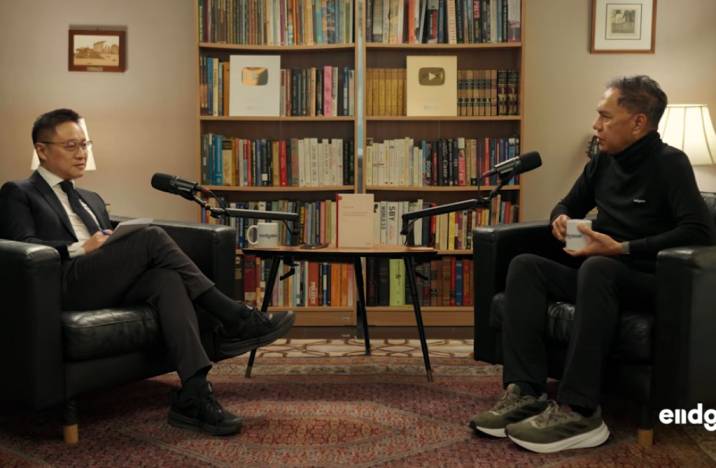
Editor’s Notes: In this compelling episode of the Endgame podcast #253, host Gita Wirjawan welcomes Eric X. Li, a prominent venture capitalist and political scientist, to discuss the shifting dynamics of global power and the rise of a pluralistic world. Li offers a provocative critique of the “liberal credo state” and explores why China’s unique developmental path—rooted in its own cultural and moral traditions—has succeeded where many transplanted Western models have failed. The conversation delves into the future of “reglobalization,” the impact of AI and biotech breakthroughs, and how China’s affordable technology could redefine the growth of the Global South. (Feb 4, 2026)
TRANSCRIPT:
Early Life and Education
GITA WIRJAWAN: Hi friends. Today we’re honored to be graced by Eric Lee, who’s a venture capitalist from China. He’s also the chairman of Chengwei Capital. Eric, thank you so much.
ERIC X. LI: Thank you.
GITA WIRJAWAN: You went to school in the US to pursue your bachelor’s and master’s. Then you decided to go back to Shanghai, to Fudan, right? Tell us why you chose to go to the US and why you chose to pursue your PhD in a field that was completely different from your earlier scholastic journey.
ERIC X. LI: Well, look, I didn’t choose to go to the US because there was no choice. Everybody wanted to go to the US at that time. That was the goal of every young man and woman, not only in China, but everywhere in the world. Wouldn’t you say so?
GITA WIRJAWAN: Yep. Guilty as charged.
ERIC X. LI: Because at that time we thought, everybody thought that the entire world would just become a giant America. So if you could have the real thing, why stay where you are if you’re not in America? So everybody that had a way of making it to America did that. That’s an exaggeration, of course. I know. I’m just trying to make a point. But so I did that.
GITA WIRJAWAN: And then you decided to study political science.
ERIC X. LI: I studied PhD, yes. So, and then I went back to China. I’ve always been interested in political science, but I didn’t know how to make money with it. So I did economics and MBA. But then later in life, I wanted to study and read things that really interested me.
The Path to Venture Capital
GITA WIRJAWAN: You found capital allocation to be something that’s close to your heart.
ERIC X. LI: Well, not really. I got into venture capital by accident.
GITA WIRJAWAN: I—
ERIC X. LI: When I was young, I always wanted to be an entrepreneur and industrialist. And then after university, I got a job in a company and I discovered I couldn’t manage people, so I almost gave it up. I said, how could you be a businessman if you can’t manage people? But I had gotten into business school already, so I went. And then I discovered this business called venture capital, where you can feel like you’re an entrepreneur, but you don’t have to manage people. So it really suited me. So that’s the only job I’ve ever had for my entire career.
GITA WIRJAWAN: But you still have to manage people, though.
ERIC X. LI: A few.
GITA WIRJAWAN: Right, right. Yeah.
ERIC X. LI: Yeah.
GITA WIRJAWAN: But do you find that you find it problematic to get into the portfolio companies that you’ve been managing?
ERIC X. LI: I wanted—okay, so if we’re managing a portfolio company, that means we’re in trouble.
GITA WIRJAWAN: I see. Good.
ERIC X. LI: We wanted to back companies with great entrepreneurs, great leaders, so that’s our role.
GITA WIRJAWAN: So you just put the gasoline in the tank and let the driver take the truck to where it needs to go, so to speak.
ERIC X. LI: But of course, we try to be helpful. We add strategic values to the companies, especially on finance and capital markets these days, a lot of networking in science and technology.
Universalism vs. Pluralism
GITA WIRJAWAN: You wrote a book which I thought was really profound.
ERIC X. LI: Thank you.
GITA WIRJAWAN: And it resonates to somebody like me from the Global South, the way you’ve described a number of things, one of which is the contrast between universalism and pluralism. Talk about that.
ERIC X. LI: Well, we had a period when I was growing up, and we’re same generation where, as you know, after the Cold War, everybody thought that there was only one way to go in every aspect, of course. Which was the amazing thing—it’s all encompassing and universal. One set of moralities, one kind of political system, one set of economic rules, all of it. And every country, every people, every culture, every economy, every region, no matter what your backgrounds, what your original roots are, you need to adapt to that universal vision.
We all thought that humanity was moving towards that inevitably, but it turned out the last few decades that this kind of approach had done much more harm than good to vast number of countries and peoples, including the people in the countries where this idea originated from—the US and the West. That’s why you see these revolts in Western countries.
So I think we’re at a juncture where that universal bubble has burst. And I for one, think the future world will be more interesting because pluralism is fundamentally more interesting than a singular way and singular vision. So I think we’re moving towards a more pluralistic world where people have different values, different religions, different communities, different economic systems, political systems, and hopefully they can coexist. I’m sure there will be conflicts, but it’s a much more interesting world and it’s more conducive, especially for countries of the Global South to develop.
Post Cold War, what’s interesting is that the vast majority of countries in the Global South, vast majority, gave up whatever politics they had before and whatever economic systems they had before. They adopted the Western universal outlook and Western universal institutions. Many countries copied their constitutions from Western countries.
GITA WIRJAWAN: We’re doing it every five years.
ERIC X. LI: Yeah. You know what I mean? So vast majority of developed countries did that. And they all thought once they adopted these rules, once they took these medicines, they will become rich just like Western countries very soon. But they did not. Most of them did not succeed. Many of them were still mired in civil conflicts, poverty, very unsatisfactory.
The one country, fortunately, I’m from that country, China, said no to that. Yeah, amazingly, yeah. They said, we’re going to adopt some of the stuff, but not the other stuff. We’re going to pick and choose based on our own circumstances and our own cultural heritage and our own political system and our own values. So we did that. And I believe I fortunately belong to the generation that witnessed a great success of that path.
So I would, based on that experience, recommend this to other Global South countries and say, look, the medicine you took after 1990 didn’t work for you. You look as sick as ever, if not sicker. And by the way, the doctor that prescribed the medicine to you has now fallen ill. Look at them. So try something different.
The Cold War and Its Aftermath
GITA WIRJAWAN: Why do you think it looked a lot more appealing during the Cold War? And it just came crashing down ever since the end of the Cold War. Right. I mean, one could argue that the West kind of embarked on this ill approach to spread liberal values ever since 1991 or early 90s. Why did it look a lot more appealing before then?
ERIC X. LI: During the Cold War, in fact, the West, in order to struggle against the Soviet Union, it was a hard struggle, okay? Naked struggle. I mean, just watch James Bond. I mean, no kid stuff. It was serious, serious business. They did not try to spread these things in their own camp. If you look at the Western camp against the Soviet Union, there are all sorts of political systems. There were so-called dictatorships. There were religious regimes, there were—right. They were left just across the board. It’s a diverse set of countries with a diverse set of regimes and values and politics.
But once they sort of won the Cold War, they went on a different path. But before the end of the Cold War, actually the Western camp, just the Western camp itself was pretty diverse.
GITA WIRJAWAN: You’ve alluded to this as the Maidanocracy, right? In terms of the kind of paralysis that resulted.
ERIC X. LI: The Maidan movement.
GITA WIRJAWAN: Yeah, the Color Revolution, the Arab Spring, you name it. Right. Do you see an end to that by way of the self-paralyzing element that we’re seeing in the West now?
ERIC X. LI: Well, it’s already ended. I think of the countries that undertook so-called color revolutions or regions that undertook color revolutions, you could hardly find one single example that they ended up better off than before. So this was the most destructive fraud that was imposed on peoples around the world in the last several decades. It’s amazing. I think when historians look back, they’ll see this period for what it was. So it’s unfortunate.
China vs. Southeast Asia: A Comparative Analysis
GITA WIRJAWAN: One of your main appeals is that you can say things that a lot of people in the Global South probably would not want to say. Right. And that I think is on the back of the strength of China. And I want to put this in the context of the comparison between China and Southeast Asia.
Just in the last 30 something years, China’s GDP per capita has gone up by a factor of 10 times. Southeast Asia is on average 2.7 times. It’s on the back of four or five identifiable attributes in my view. First is the underinvestment in education. Second, underinvestment in infrastructure. Third, governance or lack thereof. Fourth is lack of competitiveness. You issue 10 business licenses on a per 1,000 adult people basis. We in Southeast Asia only one. And then the fifth is I think a bit paradoxical because you democratize or decentralize economic activities much better than most democracies around the world. What’s the root cause for—
ERIC X. LI: For this again? I think every country, every culture is an organic being. It’s an organic entity. When you transplant something to your country, especially something as fundamental as a political system, it kills the patient. Okay. So I think a large number of countries in the Global South, in Southeast Asia too, they got, they now have—it’s kind of like you know, these countries in the former British Empire, right, they have these artificial borders, they’re drawn by some British bureaucrats when they were rushing out. And these things, they get stuck with them and they never get settled because it’s artificially imposed on them. It’s not organic, it’s not real.
So I see many countries among the developing countries in Southeast Asia too, are stuck with political institutions and social institutions and legal framework that are not the outgrowth of their natural cultural and moral conditions. I think that’s where the fundamental problem is.
We all know where we want to end up. We want vibrant economies, we want people living in harmony. We want to achieve advanced countries’ living standards. We want to educate our people. But how do we do that? We need to build roads, we need all these things. We need to build schools, we need to raise the number of STEM graduates in our countries. But to do these things, there’s only one route to doing these things. It’s called politics. It’s how we organize our societies, how we fundamentally organize our collective activities. It’s called politics.
And if your politics is fundamentally flawed, it’s built on transplanted foundations. These things cannot be carried out effectively. I mean, not to say that the original thing is going to succeed. It has problems too. So if you stick to your original form, without reforms, that’s not good either. But at least you have a chance. Yeah, but if you’re building your countries based on transplanted constitutions, you have no chance of success.
The Three Stages of China’s Development
GITA WIRJAWAN: Yeah. You referred to the three stages of China’s Communist Party. The first was the revolution took place 1949, then the infusion. Then what we’re seeing right now is the consolidation. Right. Are you surprised that the infusion took as little time as it did for China? When I talk about infusion, it resonates to me in the context of how institutional building took place by way of the mandate directive from the party into the various dimensions of the society. Talk about that. Yeah.
ERIC X. LI: Well, look, the revolution was the key.
GITA WIRJAWAN: Yeah. Okay.
The Price of Revolution and the Path to Success
ERIC X. LI: Which is what China went through at a heavy price. Of course, every revolution in history has been partially destructive. You know, a couple years ago, I have a media company in China and I interviewed—I do this leadership series interview just by myself. I interviewed President Lula of Brazil and I asked a very simple question like you asked me today.
I said, look, President Lula, at the end of the Cold War, we all had great hopes of all the developing countries that there’s now a playbook to success. There’s now a winner strategy like these books, “How to Get Rich” books. We got a really good one. It’s called the U.S. Constitution. So we all had great hope that if we adopted liberal politics, capitalist economics, and just follow the examples of America and Western countries, we will very soon become prosperous and rich.
But how come so many countries that did that, Brazil included? In fact, if you look at all the BRICS countries, China was the only one that really succeeded. The rest were kind of just, you know, got a little stuck one way or another. How come?
And I was really surprised President Lula answered me so fast and so emphatically in Portuguese. But I could see he was speaking emphatically and fast. And then I read the transcript. Well, I got simultaneous translation. He said, “I’ll tell you exactly why. Because you had a revolution. We didn’t. You had a revolution and the revolution gave you the political institutions and the DNA that allowed you to chart your own course. We’re stuck with the DNA and the institutions that were imposed on us, and we’re still stuck with them. The special interests, all the so-called checks and balances. The checks and balances are there to protect special interests.”
When I was growing up, I go to America, I study politics, they talk about check and balance as if it’s the panacea. I mean, it’s just BS. The check and balances are there to check their own peoples. So there you go. So we had a revolution. And again, revolutions are dangerous. Revolutions are risky.
GITA WIRJAWAN: Right.
ERIC X. LI: It could turn bad. But we were lucky. We had a revolution. We survived the revolution.
The Revolution’s Completion and Geopolitical Collaboration
GITA WIRJAWAN: So would you argue that on the basis that you had your revolution completed in 1949, despite the fact that you went through difficulties during the Great Leap, Cultural Revolution, and the fact that you chose to geopolitically collaborate with Nixon, that was actually a reflection of the infusion that already started happening. Is that the right way of thinking?
ERIC X. LI: Yeah. Well, I mean, I think the revolution succeeded in establishing the People’s Republic in 1949.
GITA WIRJAWAN: Right.
ERIC X. LI: But of course it had momentum. It continued on for another decade or two through the Cultural Revolution actually. So it was kind of a revolution and then a pseudo-revolutionary phase after that. At least we talk about, you know, but history is so long, so big.
GITA WIRJAWAN: Yeah.
ERIC X. LI: A decade, two decades, half a century. If you really look back, these things—
GITA WIRJAWAN: Yeah, it’s nothing. Pass fast. Yeah, okay.
The Two Fusions: Socialism and Chinese Tradition
ERIC X. LI: But if you could focus on the big scheme of things, I think the most important thing is that the Chinese were lucky enough, although having paid a heavy price, but they were lucky enough to have survived and succeeded in a revolution that gave them a set of institutions that ended up working for them and also allowed enough space for reform.
And we’re now beginning—have begun a process of rejuvenating past traditions within the Chinese culture that were compromised and sacrificed through two periods. We had two periods. We had one period which was the communist revolution. And that period, we had foregone a lot of our own traditions in order to just survive. We were almost getting exterminated, by the way. So we had to do something drastic.
And then after the revolution, we had the reform period, which we absorbed these Western practices like market economics that also in many ways are contrary to Chinese traditional values. But we survived that too. Now we’re in the process of reincorporating our traditional ethos back into the game. And I think we’re just at the beginning of that phase.
In Chinese political lexicon, it’s called the “two fusions.” The first fusion has been around for a long time, which is essentially fusing socialism with Chinese circumstances. The second fusion, I think, was brought forward just a few years ago as fusing socialism and Chinese traditional values. And we’re just at the beginning of that process.
GITA WIRJAWAN: Wow. Now, early 90s would have been really tough for you to decide on sticking with the gun. Right. I mean, on the back of—to what extent was the failure of perestroika and glasnost in the Soviet Union a factor for you not to go the Russian way in the early 90s? Or was it a lot more of the pre-existing institutional building on the back of this infusion that’s taken place for decades since 1949?
The Soviet Collapse: Destiny and Fate
ERIC X. LI: Well, the Soviet case is an interesting one I talked about in the first chapter or two of my book. It turned out there was a lot of luck involved. So it’s not a chance. History is like that. History—
GITA WIRJAWAN: Serendipity plays a part.
ERIC X. LI: There’s destiny and there’s fate. Destiny is necessity, you know, inevitability. Fate is random. So in the fall of the Soviet Union, the collapse of Soviet Union, there were many elements of fate, many elements of chance involved. If somebody was not away on holiday, they had that vote and that vote, maybe a certain leader would not emerge to become the leader and someone else would have made totally different decisions.
And certainly I think the Soviet collapse was—I think most historians would agree that that particular collapse was in many ways self-inflicted. Not to say they won’t collapse in the future, but you know, for that particular event, so there’s quite a bit of fate in there. But there were also deliberate decisions, which is, like I said, they were enamored by the material successes of the West at the time and concluded that what led to those successes were those political institutions and those liberal values. It turned out, I mean, that’s a classic mistake of mistaking, you know, correlation for causality.
GITA WIRJAWAN: And the Soviets, they started, as you aptly pointed out, becoming a credo state.
ERIC X. LI: Well, that too because, you know, the Soviet Union was an incredible experiment, by the way. Yeah. I always talk about everybody, you know—
GITA WIRJAWAN: Kind of.
ERIC X. LI: You know, talk about the Soviet Union as a great failure. It eventually collapsed, of course. But let’s not forget it was the greatest success story, one of the amazing success stories too of the 20th century. I mean, if you read Tolstoy and read Dostoevsky, you know what Russia was like—
GITA WIRJAWAN: Absolutely.
ERIC X. LI: In the 19th century. Even as late as 19th century, the serfdom, the backwardness, all of that. And the Soviet Union in one generation turned into a modern superpower.
GITA WIRJAWAN: Wow.
ERIC X. LI: I mean, modern in every way, from science to everyday life in one generation.
GITA WIRJAWAN: They were first to put something in the orbit.
The Credo State: Soviet Union and Modern America
ERIC X. LI: It was a miracle almost. The West industrialized and modernized over a 300-year period, 400-year period. Soviet Union achieved superpower status. If you go to Soviet Union in the first part of the 20th century, you see Soviet people living totally modern lives. From what we read about Russia in the 19th century, it was a miracle in many ways.
But there’s one characteristic about the Soviet Union was that it was a credo state. It was not, you know, the modern modernity, one big important unit in modern world. It’s called nation state, states based on nations. And nations have a set of cultural and moral heritage and traditions and norms and customs. And the Soviet Union was a transnational entity and it was based on socialist ideology. So it’s an ideational ideological state. I call it a credo state.
So it doesn’t matter what your cultural heritage is, doesn’t matter where your nationality is. If you subscribe to the set of ideologies, then you’re Soviets, which was an experiment and didn’t succeed. And I would argue that the United States in recent decades had become a credo state, had gone from a nation state with fairly distinct cultural lineage—
GITA WIRJAWAN: And—
ERIC X. LI: Religious and moral heritage into a liberal credo state. And the ideology is liberalism. It’s about essentially extreme individualism. So it doesn’t matter what your values are, what your traditions are, what your cultural norms are. You subscribe to this abstract set of ideology, ideological values, then you are America. And I think that’s a risky approach.
GITA WIRJAWAN: And the U.S. was not like that 100 or 200 years before.
ERIC X. LI: Of course not. Yeah, of course not.
GITA WIRJAWAN: The fact that it wasn’t—it was actually what propelled the major—
ERIC X. LI: Industrial revolution. The industrial revolution in the West, at least not in China, but in the West were part and parcel with their cultural and religious and moral traditions. So it worked for them. So I think the United States today has become a liberal credo state. Which are now leading to the internal revolts within the U.S. And by the way, EU is the same thing. European Union is essentially a credo entity, a credo state, an ideological state.
The Metastasis of Extreme Individualism
GITA WIRJAWAN: What do you think could have gone wrong with the West as for them to become much more of a credo state? Europe and the U.S.—what could have gone wrong? What do you think would have made it go wrong?
ERIC X. LI: I think Western modernity was a package. It had many elements to it. If you, you know, any freshman textbook on Western Civ, and those books are banned, by the way, now. When I was going to school in America, I read them and then it became politically incorrect, I think. So you don’t do Western Civ anymore, I think. I think in America, most universities had ditched the core curriculum, except very few like Columbia or something. So you don’t read these things anymore in American universities. I read them because I went there before this happened.
So any freshman year Western Civ textbook will tell you that the mainstream Western civilization that led to industrialization were of course, the classics, the Greeks and the Romans, Christianity, extraordinarily important. And at the time, they called barbarians, which is basically Germanic tribes. So religious tradition was a major part of Western modernity. I mean, the United States was built on Puritans that moved from Europe to U.S. So it was about religion, about values.
And Christianity, of course, is about community. Of course, in that package, there was individualism. The worth of the individual was always part of the Western modernity, but it was not the only thing. Traditional and religious values and community were always major components of Western modernity, both traditional societies and modern societies, the communal element.
But then this one strand, because of liberalism, this one strand of the Western modern package overtook the rest of it. It’s a virulent strand that somehow just metastasized like a cancer. And it’s now all-encompassing in Western societies. It’s all about the individual. It’s so much about the word individual. It’s gone—
GITA WIRJAWAN: Totally woke up, big time.
ERIC X. LI: Woke is the end result of extreme individualism. Yeah, identity politics also. I mean, some people say, you know, identity politics is against the individual because they group them together. No, identity politics is about—the goal of identity politics is to maximally empower the individual. In order to maximally empower the individual, you have to somehow recognize the group.
So the group politics, whether it’s ethnic groups or whatever, in Western societies, it’s not about the group, it’s about the individual in that group. Whether it’s a group based on race or based on sexual orientation or based on gender, it’s all about the maximal amplification of the individual.
Economic Inequality and the Loss of Community
GITA WIRJAWAN: You made reference to something, to the following in the book. The atomized individual with divinely endowed rights corrodes a community. And the creation of the Frankensteins of capital especially, they’re concentrated in certain oligarchs. Right. At the expense of the majority. Now, could we argue that economic inequalities, structurally, I think, drove woke liberalism?
ERIC X. LI: Well, they go hand in hand. They drive each other.
GITA WIRJAWAN: Right.
ERIC X. LI: The loss of community and the maximal expansion and amplification of the individual lead to basically rules of the jungle. So those who win, win big and they keep winning. I mean, it’s basic economics. Right. If you get bigger and bigger, you become monopoly. The monopoly gets extremely competitive because of the size. So those individuals become oligarchs.
The rest of the people, because they had lost their community, don’t have the power to respond because they have no community. They’re all alienated individuals. They’re outcasts out there. They’re disorganized. So that I think that’s where—that’s the conditions of the West today.
GITA WIRJAWAN: Well, you funnily mentioned that Wall Street and Silicon Valley, they don’t employ any more than 2 million people, but they seem to control—
ERIC X. LI: Including their nannies and waitresses. Yeah, exactly.
China’s Political Economy and Global Strategy
GITA WIRJAWAN: And they control pretty much. And this is what oftentimes gets described as a plutocracy. Right. We don’t see that in China. No, I mean, policymakers are way above capitalism.
ERIC X. LI: Capital is subservient to political authority in China, of course, because China is fundamentally a collective society. But I think things are changing in America, in many parts of Europe, where people are saying no to that. I think part of the MAGA movement is driven by that. Where it’s headed, we don’t know yet. We’ll have to see. We’re still at early stage.
GITA WIRJAWAN: The rhetoric seems to resonate to the earlier, you know, Puritanism, you know, or.
ERIC X. LI: At least a desire to recapture a sense of community, to rejuvenate collective values that have roots and customs and norms that have roots instead of totally uprooted individuals.
Consolidation and China’s Role in the Global South
GITA WIRJAWAN: Yeah, so we’ve talked about revolution, we’ve talked about infusion which has resulted in tremendous institutional building in China. Right. The next phase is really consolidation which really is underpinned by three pillars, the anti-corruption drive, friendliness towards the environment and reduction of inequalities. It just intuitively seems to me as a great foundation for China to help globalize, particularly to the Global South. Talk about that.
ERIC X. LI: China is a developing country, of course, and also China’s future development depends on continued interconnectedness with the rest of the world. So basically two things are happening, two trends in the world that are happening today. I call it deglobalization and reglobalization.
So deglobalization is mostly driven by the US-led western camp for their own reasons. I’m not judging them here. I think the US and the west made many strategic mistakes during globalization, that all of the fruits of globalization, all of the rewards went to very few people. And their interests are not in line with their own people anymore, not with their nations. That’s how they deindustrialized.
So now they’re going through political changes trying to correct that. And unfortunately one way to correct that as they see it is to deglobalize. So that’s happening. But the other trend is I think that the biggest growing, the most significant country that’s growing is China, of course. And China’s continued growth, like I said, depends on interconnectedness because you know, we’re the biggest trading nation in the world and biggest trading nation in the history of mankind. No one traded, no country traded more than China is trading today. Okay, and I think.
GITA WIRJAWAN: There’s only one country in the world that doesn’t have China as its largest.
ERIC X. LI: Trading partner or something like that.
GITA WIRJAWAN: It’s Bhutan. But you’ve covered the other 193.
ERIC X. LI: Okay, so, so needless to say, we, in order to continue to prosper, we need to keep that going. But the west is retreating for their own reasons. Nothing, it’s wrong for them. Okay? So they’re doing their thing and we’re at a different stage where we have different conditions. Right.
I always joke, I say look, you know, America could do just fine without the rest of the world. They got two big oceans on both sides of their country. Nobody could ever invade them. It’s too hard. And they got so many natural resources. Right. And if they really get Canada and Greenland as they say they want. That’s enough natural resources for 500 years. Okay. And then they got, you know, Mexico, where they could, you know, work to re-industrial, help re-industrialize North America maybe. And then there’s Latin America. I mean, they got so much going. They don’t need that. They don’t need interconnectedness as we do. We don’t.
GITA WIRJAWAN: We.
ERIC X. LI: China doesn’t have as nearly as many natural resources. We have to trade and we’re a manufacturing power, so we have to make things and trade with the rest of the world. So the second trend is I call reglobalization, where China is the main proponent, one of the main drivers. Where are they going to drive this? Of course, only with the Global South. Mainly with the Global South, because like I said, the west is retreating.
So China must find ways to reglobalize, to continue interconnectedness with the entire Global South in mutually beneficial ways. And that’s the only way to go. Otherwise, why would people trade with.
The Monroe Doctrine and America’s Strategic Shift
GITA WIRJAWAN: The US Government under Donald Trump came out with a new national security document some weeks ago. It makes specific mentions of certain things, one of which is reestablishing strategic stability with Russia. And the other obviously is making reference to the Monroe Doctrine. And this ties into what you’ve just said, Canada, all the way down to the very end of South America. Right. What are the implications to Europe, China and the Global South?
ERIC X. LI: I mean, I’m not in a place to make judgment on the Monroe Doctrine and where the US wants to do. I could see why, because simple accounting as I just expressed, 500 years of natural resources, everything, security, supply. I would hope that they wouldn’t do it in such a crude way like the Monroe Doctrine, but it’s really their strategic imperative. Okay. And I think we can understand where that’s coming from.
I don’t think it’s smart for them to do it aggressively like what they’re doing in Latin America. Okay. But it’s really, it’s up to them. It’s their, their thing. Okay. The implication of it, I think, is that it doesn’t pay for them to keep maintaining this global empire that they built post-Cold War. It’s not a good deal to them, it’s not a good deal to America, it’s not a good deal to the American people.
You know, I’ve always said that the American empire was built at the expense of the American nation. Okay. The way they built this global system is that, you know, the people at the very top. Yeah, okay. Wall Street, Silicon Valley, and Hollywood, the Holy Trinity, made almost all the money. Okay. And the rest lost their social safety net, lost their community, lost their good paying manufacturing jobs while piling up $38.
GITA WIRJAWAN: Trillion worth of debt.
ERIC X. LI: Lost their local church, lost their religion, lost their morality too. Woke. Okay, so, so I mean I can understand why the American people, or at least a large segments, large segments of the American population are saying no, no, no, we don’t want maintain this global empire for the benefits of these few people. We want our communities back, we want our industry back, we want our values back.
So I see that. I think we should understand that and the implication of it. I believe, I think that this national security document is not a random thing. It didn’t just come out of blue. I think that the undercurrents, the forces.
GITA WIRJAWAN: That has been visible for some time.
ERIC X. LI: For many, many years, for at least a decade.
GITA WIRJAWAN: Yeah.
ERIC X. LI: And I think will continue regardless with what political leaders they produce. So I think what the rest means to the rest of the world is that I think this America-led global sort of system, global empire is going to retreat much faster than people think. And of course that carries significant implications to the Global South.
Europe’s Recalculation
GITA WIRJAWAN: If the US were to seriously reestablish strategic stability with Russia, intuitively Europe, we just have to look at China more favorably. Do you see that as a collective or more individual type of posturing?
ERIC X. LI: I don’t know. I mean, I think, you know, we trade, China trades with many European countries in a big way. I mean our, our economic relationship with Germany was enormous. Okay. We got German companies, all the big companies in China, all, I mean, Audis, Volkswagen, you know, making electric cars in China. And so we have deeply intertwined economic and other relations with European countries. And of course we now have the difficult situation.
GITA WIRJAWAN: Yeah.
ERIC X. LI: In Europe and with the military conflicts that had complex reasons and complex roots. And if the US is less inclined now than before to be, let’s say an active actor in those conflicts for their own good, for America’s own interests, then I think everybody needs to recalculate.
And certainly I think European countries have much to gain by increasingly improving interconnectedness with China. It’s unfortunate. I read, you know, some in Europe are so afraid of, for economic reasons that they’re not giving up, they’re not ditching their climate goals because they’re afraid of Chinese EVs. It’s unbelievable. I mean that was like last time I read the FT, that was their religion, you know, energy transformation, energy transition, to address climate change was Brussels religion. That was, that’s, that was as politically correct as it gets.
GITA WIRJAWAN: Yeah. Actually, an argument could be made for the decline of Germany’s competitiveness or manufacturing competitiveness would have been by way of some element of embracing climate change narrative as a religion.
ERIC X. LI: What I would say to many European countries and the US included, is when things are not working out for you, don’t just blame other people. Look at the kind of reforms that you could do. At the end of the Cultural Revolution, we had a lot of troubles. We didn’t say, oh, it was the US fault that our planned economy didn’t work out. Only if they could do planned economy too, and get on a level playing field. We do better than them, so we need to resist them.
No, we said, okay, parts of our political economic system are not working, so we need to reform and actually learn from what’s working elsewhere. And we did import many aspects of market economics from the west and we competed on that. So. Right.
Institutional Building and Meritocracy
GITA WIRJAWAN: I want to drill down on this institutional building. Right. You’ve mentioned to me in the past about the 15 five-year plan that was announced in the early 50s, and for a little bit it was displaced by the Great Leap, then it reverted back. Right. And I want to tie this to what you had alluded to in the book called X. Right. I mean, it’s really technocratization, Right. It’s meritocracy.
ERIC X. LI: It’s technocratization with ideals.
GITA WIRJAWAN: Yeah. Talk about that.
ERIC X. LI: Well, the tradition has been with us for 2,000 years, really, since Confucius. It’s about common people. So we did away with aristocracy many, many centuries ago, millenniums ago. Okay, gradually, of course, but fundamentally, we did away with landed aristocracy. When Ching Shu Huangdi unified China, we began to ditch that and established what some political scientists called modern state. At that time, of course, there wasn’t modern yet, but that possessed many elements of a modern state.
And then of course, one core element of that state is a creed, is a group of the belief that commoners, through learning, you could go from nobody to sky’s the limit, except for the emperor. But the learning had the purpose. It’s not technocratic, just technocratic learning. Learning had a purpose of serving the civilization, serving the state, serving the collective, and to serve the values that undergird the collective. And of course, at the time was Confucian values. Okay.
So that ethos, I think, continues to this day and continue through the revolution too. The revolutionaries were Siddharthus because they cared about the country and they were mostly all common people. I mean in Europe, up until maybe Napoleon a couple hundred years, 300 years ago, only aristocrats could go to war. It was a privilege to go to war. Right? Peasants are not good enough to go to war.
Mao’s 75-Year Vision
GITA WIRJAWAN: The 15 five-year plans, I mean Mao had already this vision that within 75 years China could overtake the US right.
ERIC X. LI: He said that at the announcement of the first five-year plan. That was crazy. We’re now starting the fifth, 15th five-year plan. And he wrote something to the effect that, hey, you know, we’re starting our first five-year plan. Let’s work hard and look, our goal is not to mess around and just put food on the table. Our goal is to catch up and surpass at the time the most advanced country in the world, the United States.
He says, how many years is it going to take? 5, 10, 20? Probably too soon. That’s too optimistic. He said. I don’t know, he said maybe 75 years. How about that? That’s just 15 five-year plans. He actually wrote that at that time, it was 1950.
GITA WIRJAWAN: He was pretty prescient. I mean, you’re up there now when it comes to a bunch of stuff, EV, for sure.
ERIC X. LI: We’re now AI. Pretty soon we’re embarking on the 15th Five-Year Plan. And I’ll tell you what’s happening in China. Okay? Amazing stuff. So we began to engage in globalization 30 some years ago and it of course began to. We joined the WTO in 2000 and the way we engaged globalization at the time was through manufacturing because that’s our strength at the time.
And we went from single digit share of the global industrial capacity to today our industrial capacity is the biggest in the world. Bigger than the US, Germany, Japan, India and the next five, six countries put together enormous. 35% of the industrial output, I think going up maybe to 40% more. Yeah, okay. And so, so we kind of cleaned up industrial capacity on manufacturing and very successful. Okay. But at that time, 2000 plus minus, we weren’t in the room in terms of science and technology.
GITA WIRJAWAN: Right.
China’s Science and Technology Breakthroughs
ERIC X. LI: And the US was undisturbed in this, beautifully the leader. So we just followed Silicon Valley. Whatever they did, we followed and we see the enormous territories like semiconductor and they were leading the way. But we didn’t just lay flat like the current popular Chinese term is tamping. We didn’t lay flat. They worked very hard on education, on science and technology infrastructure, all that.
So it accumulated over decades and we are now at the cusp of major science and technology breakouts and breakthroughs across multiple sectors and I predict we’re going to have 5, 10, 15 deep seats in different sectors in the next generation. 10 years. Nonlinear, nonlinear, nonlinear.
I’ll just give you an example. I would say that this process began in 2020, and the first sector that it affected was renewable energy. And in 2020-2025, today, in those five years, not just solar and wind and all of that, the Chinese were very successful globally, also in automobiles.
And let me kind of explain how big that is. The auto industry is a pillar industry of the world. A pillar industry. And Post World War II, it took three countries 75 years to dominate that pillar industry. Germany, Japan and the US. In five years, we uprooted the entire thing. And it’s never going back, hands down. Five years compared with 75 years in a pillar industry in the world. That’s auto.
So from right now 2025 to 2030, in the next three, five years, I would say it’s going to happen. Same thing is going to happen in three industries. Biotech, which is already happening. AI and robotics, or advanced manufacturing, let’s say, not just robotics alone.
The Biotech Revolution
In biotech, I began to invest in biotech 7, 8 years ago. Never in my wildest dream did I anticipate the current situation. I mean, China is quickly becoming a biotech superpower. Seven, eight years ago, our share of the global novel medicine patents was maybe low teens, 11, 12%, 14%. Today is 44% or going up to 50% very soon.
Of all the clinical trials that are taking place globally, our share is 35% and going up. That’s bigger than the US, Europe put together. The entire world is here in China shopping for novel medicines. I always said in the year 2000, if you want to get a picture of globalization, you go to Guangzhou, to the Canton Fair. Everybody in the world is in Canton Fair. If you own a little gift shop in Seattle or you own whatever factory in Barcelona, you’re there buying whatever you need for your home markets.
Today there’s a Canton Fair happening in China on biotech. All these companies are entertaining potential customers from America, Europe, Russia, you name it, buying novel medicines, IPs from China. And that’s happening already. So in the next five years, I think it will continue.
China’s Open Source AI Approach
Second, AI. Of course, everybody’s saying US and China, of course there’s competition, but China takes a totally different approach and it’s very relevant to the Global South. Let me explain. So we take an open source approach. US takes the closed source approach. It also has to do with political system and political DNA. Will take hours to explain this, but let me.
GITA WIRJAWAN: I’m with you.
ERIC X. LI: So the US approach is essentially invest, innovate and seek rents.
GITA WIRJAWAN: That’s right.
ERIC X. LI: Like all these companies, all these big techs, we’ve been paying them rents for the last 20 years. You know that. The Chinese approach is different, is invest, innovate and compete and scale up and make things affordable, that everybody gets it. Like what we did with manufacturing.
How come, you know, how come everybody in America, I mean, you think all these Americans and Europeans could afford to buy these Christmas toys 30 years ago without China?
GITA WIRJAWAN: No, dude, you go to Amazon, you go to Walmart, 99% of the goods are made in China.
ERIC X. LI: Of course that has an issue. There is an issue. I understand where I think President Trump said maybe too many dollars is not a good thing. Maybe two is enough. Maybe he’s right. I’m not judging that. I’m just saying we make things massive scale and affordable. And same thing’s happening in AI.
I mean, I know the US is stronger on computing power because the chips, but it doesn’t. It’s not. That’s not where it’s at. I think where I know companies around the world, including major American companies, are kind of secretly, they’re not advertising, they’re using Chinese AI because they’re using Q1, they’re using, you know, Kimi, whatever it is.
I mean, because look, the Chinese AI companies are selling a million tokens for 38 cents US, disproportionately cheaper. ChatGPT, I think, sells them for 5.5 US dollars. I mean, that’s so big, but the difference is so big.
I tell you, without Chinese AI, Global South and AI will never meet. They will have nothing to do with each other other than the Global South paying rents to American AI companies like they’ve been paying rents to Apple and Google and everyone else. All the big techs.
But Chinese AI, open source, they are affordable. If you’re an Indonesian company, you want to use AI, 38 cents, maybe going down to 25 cents a million tokens, you can actually use them as a tool to help your business. It’s actually affordable. You’re not paying rents. So I think AI very important, especially in the Global South. It may even be in America, but especially in Global South.
And the third is Advanced Manufacturing Robotics. I mean, that’s already happened. So that’s the next five years, 2025 to 2030. And look beyond 2030, 2035, I see future. I can name two. Quantum and nuclear fusion.
GITA WIRJAWAN: So you’ve already announced the thorium, right?
ERIC X. LI: Nuclear, but still early. I see tremendous amount of capital, human resources, government policies going into these sectors. And I think we’ll bear fruits five years from now. So we will be. China will be at the forefront of science and technology across the board. All of that will be made to be shared with the Global South. Think about that.
The Economics of Chinese Innovation
GITA WIRJAWAN: Two fundamental observations that just keep on staring at me. First is the US economy is just too bloated. You take a DD, Kwai Cheng, right, in Shenzhen, there’s no tipping and on a per mile cost, it’s cheaper. And the marginal productivity for China, I mean you can get an Apple Watch equivalent in Shenzhen for $12. It functions, it looks just as good when you’re paying about $450 in Palo Alto for an Apple Watch.
I mean for somebody in Africa, somebody in Papua, somebody in any village in the Global South, those are just going to resonate, right? The way you open source everything. So what could stop this? I mean, well, let me also share that. You produce 4 to 4.5 million STEM products per year. Southeast Asia only 750,000, of which Indonesia 250,000. The US only 800,000 STEM products per year.
Your marginal productivity is only going to keep going up and beating the rest unstoppable. I think your struggle is the degree to which you can democratize capital to the Global South.
ERIC X. LI: Yeah.
GITA WIRJAWAN: Would you agree with that?
The Next Phase of Globalization
ERIC X. LI: So if you go to China, the buzzword today is called chuhai. Chuhai means, literally means going overseas. But what it means are Chinese companies, mostly technology companies, some are manufacturing companies too, but manufacturing companies with heavy technology content, going to globalize, going overseas.
And a lot of these companies, including EV companies, I mean, I think BYD manufacturing here in Thailand, in Indonesia. Chinese drone company, robotics companies. So all these battery companies, all these companies.
GITA WIRJAWAN: CATL is opening a factory.
ERIC X. LI: That’s right. That’s right. So I would say that, look, I say I just throw this out. I mean, I really haven’t thought this through, so I could be wrong. I think the first phase of globalization, which is ending, has three main drivers. American capital and technology, Chinese production and global market.
I think the next phase of globalization will also have three drivers as Chinese capital and technology, world production and global market. And the Chinese have to spread their production and spread their industrial and technological footprint around the world, especially in the Global South. And the challenge is how to make it mutually beneficial, how to bring up the development of the entire Global South with that. And I think the political desire is there, the geopolitical necessity is also there, and the commercial incentives are there too.
GITA WIRJAWAN: Yes. You know, I tell my Western friends, you know, they keep thinking that the reason why BYD is building factories in Thailand and Indonesia would be that it’s geopolitical. And I tell them it’s not geopolitical. It’s pure economics. You know, they got to compete with 98 other EV makers in China, whereas in Southeast Asia, they’re the only boy in town, they’re going to make more money in Southeast Asia.
But I think the long game as it relates to the Global South, or call it Southeast Asia, is technological transfer. And if we take a look at the FDI that comes to Southeast Asia, it takes place at a rate of about 200 to $230 billion a year, of which Singapore gets about 100, 140. Indonesia gets about 30 to 40. Thailand, Malaysia, Philippines, Vietnam, each gets about 10 to 20.
But the structural limitation in capital allocation relates to, I think, rule of law and translational wherewithal. So if we want to see China help with reglobalization, I think China could take a view on how rule of law could get better in the destination countries and how the translational wherewithals. The translational wherewithal is really correlated with the number of people that get educated in STEM, whether you bring in Chinese professors to Southeast Asia or we send a bunch of Southeast Asians to the Tsinghuas of the world.
Educational Partnerships and STEM Development
ERIC X. LI: And my idea is that I think Chinese universities are first. Right. And there are many of them. I got number two. And they’re particularly good, particularly good at STEM. So I think our top 50 universities should, I think the government should encourage them, go around the world and set up campuses. STEM campuses don’t have to include philosophy, but STEM campuses in different subjects are partnering with the best educational institutions locally to train people, to train young people in the Global South and have them come to China and go back and forth. And then we build a network of people and talents.
I mean, I think that many of them are doing it. I see some of the best universities working on setting up campuses overseas, mostly.
GITA WIRJAWAN: In the Global South. Not enough.
ERIC X. LI: Yeah, not enough.
GITA WIRJAWAN: I think it needs, I agree, needs to scale. And the beauty about the educational system in China is that you can be pretty indiscriminate about it because you don’t game the system there. You can send your kid to Chengdu, Chongqing, Dalian, Shanghai, Beijing, you get pretty much the same quality education, whereas in other countries you got to be rich to be able to get your son or daughter to get a better education. Right? Because you can game the system.
That I think is going to bode well for, look, my thesis for Southeast Asia is to look to China increasingly more for technological capital allocation and to the West for economic capital because they’ve been printing a lot of money, but that money is not coming to Southeast Asia because of their perception of perhaps lack of rule of law, lack of translational wherewithal that I think could be the recipe for reglobalization, as you aptly pointed out.
Building Institutions That Work
ERIC X. LI: And we have to like China and the Global South and other countries in China’s main part of Global South. China and other countries of the Global South need to work together to establish rules and standards that are conducive to our common development. That work for us, you know, not the so called rule of law, that doesn’t work for us, that’s imposed on us.
So that’s why a lot of the, you know, a lot of the so called rule of laws or other political institutions, you know, they used to say that for many decades. They used to say that, you know, if you just did this in Indonesia, you’ll get rid of corruption. And they did. All the corruption got worse. There are many, many studies.
So that, I think, you know, China at that level has something to contribute as well, because China had the experience of building institutions that work for them. Not perfect case study. There are many flaws, many problems. I mean, China has a corruption problem too, but they’re cracking down. They’ve been cracking down, but China does have the experience of building institutions that more or less work for them and continue to reform them.
The Climate Change Advantage
GITA WIRJAWAN: I want to go back to climate change. If you charge your Tesla in Palo Alto, it’ll charge you about 48 to 55 cents per kilowatt hour. You charge your Xiaomi or BYD in Shenzhen, it’s only 4 to 5 cents per kilowatt hour per capita. So I mean, I can only deduce that it’s because of the massive supply chain capabilities. Right?
So I don’t think that’s easily replicated onto the Global South. But I think what works is the political economy argument. Right. I think capital allocation from China will take place in the Global South if China understands a little bit better about the political economy argument.
ERIC X. LI: Right.
GITA WIRJAWAN: I would argue that if China does enough to educate the Global South, whether it’s STEM or others. Particularly STEM. If the EV in a Global South gets charged at a cost of $0.07.
ERIC X. LI: Yeah.
GITA WIRJAWAN: Not necessarily five, because of the lack of supply chain. They will still pay, of course. You know what I mean?
ERIC X. LI: I read, I mean for Indonesia, you know, I read that Indonesia has the on its agenda, energy transition. Okay. For a country of this size, of so many islands. Okay. This is an amazing country. I look at the map and like, wow, Indonesia. Okay. I was, I came to see you, so I looked at the map. Okay.
For a country like Indonesia with this kind of population, energy transition. I mean, come on, you got to have. I mean, China is the only, allow me to say this. I’m not saying it in a, in a, in any, in an arrogant way or anything like that. Okay. I say in the most humble way. China is your only viable partner. China is the only country that could produce the hardware, the equipment, the infrastructure at affordable costs.
GITA WIRJAWAN: Right.
ERIC X. LI: And scale them up. Okay. And can execute on a timely basis. And they’re fast. So we, I mean, you need to partner with the Chinese.
GITA WIRJAWAN: Yeah.
ERIC X. LI: Figure out a way to, particularly for technological capital and the Chinese. China is, is just by sheer size, is a big presence everywhere. I know sometimes that could appear threatening.
GITA WIRJAWAN: Yeah.
ERIC X. LI: But it’s a soft one.
GITA WIRJAWAN: Yeah.
ERIC X. LI: Okay. I mean, think about it. I mean, don’t believe these people will tell you the Chinese are big. That’s why they threatened the Chinese. Never go around the world telling them how to run their countries. Never. Never.
GITA WIRJAWAN: Yeah.
ERIC X. LI: Okay, so just by that alone.
Affordable Technology and the Global South
GITA WIRJAWAN: We’re not discounting Western technology. I’m only making the point that Western technology might be more zero to one, but it’s just not as affordable as Chinese technology. And I do believe China in the near foreseeable future will be able to do more zero to one, of course. Right.
ERIC X. LI: We’re doing zero to one.
GITA WIRJAWAN: And it’s a lot more affordable for people in Africa, Southeast Asia and the, you know, the Global South.
ERIC X. LI: No, I think, you know, for medicine, you know, biotech. I mean, in the last decades, Western companies dominated medicine. And it’s not cheap. Some countries have just have to ditch IP and just do generics. But we’re not doing that. Okay. So the current trajectory persists. I think in five years, China, Chinese, affordable Chinese novel medicines are going to spread around the world to the benefit of hundreds of millions of people.
GITA WIRJAWAN: Yeah. Do you see this as an incentive for the West to reduce the bloat?
ERIC X. LI: The West has its own myriad complex issues to deal with. They are deeply rooted issues and we’re not in the position to make judgments on them. They must make tough choices. And like any tough choices, China made tough choices over decades that, you know, sacrifice certain interests for others. Right.
The West is having to do that, I think, and we have no idea how, but it’s their decisions to make. It’s their decisions to make.
Multipolarity and Southeast Asia’s Strategic Position
GITA WIRJAWAN: So, you know, we’re sort of like living in a much more structured multipolarity.
ERIC X. LI: Yeah.
GITA WIRJAWAN: And revisionism is inevitable coming from countries that used to be really tiny. Now they’ve gotten much larger. And I think it’s high time, and I sense that Southeast Asia is one of the very few that can actually toggle between China and the West because of scale and I think geopolitical and geostrategic relevance. Would you agree with that?
ERIC X. LI: I think it’s possible. I happen to think that if the current trend continues, China will be able to deal with America directly very well. I think America is possibly, the United States is on a trajectory of acting in its own best collective interests instead of the interests of the liberal elites at the expense of national interests to maintain this global hegemon status.
So if that trend continues, I think China and the United States will be able to, of course they will compete, but I think they will be able to avoid harmful conflicts and act in their own respective best interests.
Food and Energy Security for Indonesia
GITA WIRJAWAN: Eric, I want to ask you two more questions. The national security narrative for Indonesia is underpinned by essentially food security and energy security. You, as a capital allocator, what would you advocate for Indonesia?
ERIC X. LI: I would advocate, like I said, partnering with China on energy transition so that you have affordable, scalable and executable infrastructure built for renewables that you can chart your own course on energy. China’s charting its own course on energy. You can chart your own course. Energy in the long term, it takes time.
But second, agriculture. I mean, Indonesia is a major agricultural country. It’s your pillar. Industry and agriculture also had a lot to do with social fabric. And that’s how you incorporate technology. I mean, China is also at the forefront of agricultural technologies. For instance, robotic and drones. I have a drone company. We have a drone company. It’s one of the largest agricultural drones in the world. And we manage huge farmlands with no human being. Maybe one.
GITA WIRJAWAN: Smoking cigarette, looking at the screen.
ERIC X. LI: Active in Thailand, active in Brazil, all these agricultural countries. And robotics on the ground, cotton fields, robots picking them. But how you incorporate technologies in a way that helps you improve productivity but also doesn’t hurt your social cohesion. And the benefits are shared. That’s what Indonesia needs to really consider. But technologies are there. China has them affordably. Again, wow.
Mangroves and Carbon Sequestration
GITA WIRJAWAN: You know, Southeast Asia has about five to six million hectares of mangroves.
ERIC X. LI: Right.
GITA WIRJAWAN: Mangroves, I think, is one of the more under narrated, decarbonizing narratives, because with one hectare, you can sequester about it.
ERIC X. LI: They suck up a ton of carbon.
GITA WIRJAWAN: Right. So just imagine if Southeast Asia could plant up to ten million hectares.
ERIC X. LI: It’s amazing.
GITA WIRJAWAN: This region could suck up, could sequester a quarter of humanity’s carbon emission, which is about forty gigatons. So that’s ten gigatons. And I think drones could play the role of planting because the productivity is orders of magnitude more than just a fisherman planting one by one. Right. You can just shoot it down and then plant.
ERIC X. LI: Yeah, absolutely. That is what the Chinese and the Chinese leader called a shared destiny.
GITA WIRJAWAN: Right.
ERIC X. LI: Think about that. Mangroves of this size suck up amazing carbon emission. China is a major manufacturing power.
GITA WIRJAWAN: You know, building nuclear reactor takes years. Right. But planting mangroves with the help of drones, it’s instantaneous. And you can sequester within a couple of years or whatever.
Risks to China’s Growth
Last question. It’s about an hour and a half already. What do you think could slow down China’s engine? I mean, you know, I think there’s two risks. Yeah.
ERIC X. LI: One is we have a demographic challenge in the horizon. It’s not immediate, but it’s in the horizon. And I hope we address that, you know, in sometime in the distance in the future. That we have a lot of retirees and fewer young people working. That’s always a problem. Okay. It’s not the total population problem. It’s the structure of the population.
We are addressing it through technological means. Of course. All the robots got to make them work. Right. But we may also need to address that through policies and social policies and education and values. So that’s something I think we need to address. It’s a risk.
Second risk, of course, is that in this emerging multipolar world, there are a lot of uncertainties, a lot of geopolitical tensions is that we somehow get dragged into some kind of unwanted military conflict. I think the Chinese don’t want that, but there are many other forces in play, so we need to really be extra careful about that.
GITA WIRJAWAN: Anything we might have missed?
ERIC X. LI: No, I think.
GITA WIRJAWAN: That was pretty exhaustive.
ERIC X. LI: Yeah. Yeah.
GITA WIRJAWAN: Great. Thank you so much.
ERIC X. LI: Thank you so much. We’ll have, we need a beer.
GITA WIRJAWAN: Yes. All right.
ERIC X. LI: Thanks.
GITA WIRJAWAN: Friends. That was Eric Li, chairman of Chengwei Capital from China. Thank you.
Related Posts
- Bialik’s Breakdown: w/ Channeler Lee Harris -Part 2 (Transcript)
- Scott Ritter: Russia Threatens Strike on Finland & Baltic States (Transcript)
- PBD Podcast #778: Who Is Sadhguru? (Transcript)
- Larry Johnson: Trump’s Naval Blockade & Ceasefire Collapse (Transcript)
- Prof. Mohammad Marandi: What Really Happened in Islamabad (Transcript)