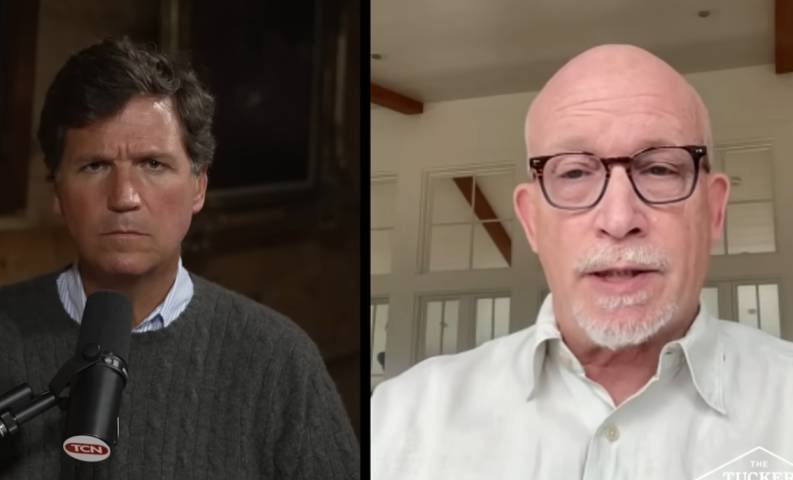
Editor’s Notes: In this interview, Tucker Carlson sits down with Academy Award-winning filmmaker Alex Gibney to discuss his documentary, The Bibi Files, which features over a thousand hours of leaked police interrogation footage of Benjamin Netanyahu. Gibney details the corruption and bribery allegations against the Israeli Prime Minister, ranging from receiving luxury gifts to orchestrating multi-million dollar deals for favorable media coverage. The conversation explores how Netanyahu has allegedly leveraged judicial reforms and wartime leadership to maintain power and avoid prosecution. Gibney also shares the challenges of producing the film in secret and the resistance he faced from mainstream American media outlets. (March 27, 2026)
TRANSCRIPT:
Introduction: Netanyahu’s Domestic Troubles
TUCKER CARLSON: Alex Gibney, thank you very much for doing this. So for all the years that Benjamin Netanyahu has been in the American media, I think there’s very little sense in the US about his domestic troubles in Israel. We keep hearing he’s been charged, and the President of the United States keeps saying he needs to be pardoned. You’ve made this documentary that explains why. What is at the core of this controversy? What are the charges? What is he accused of doing? Did he do it? So I’m going to stand back and just let you, if you would, outline what Benjamin Netanyahu has been accused of doing.
The Corruption Charges
ALEX GIBNEY: Well, roughly speaking, you’d say it was bribery or you’d say it was corruption. And I can detail the charges. This is a film that I produced, and it was directed by Alexis Bloom.
Back in 2023, I got a strange message on Signal from somebody who said that they had all of the police interrogation videos from the Benjamin Netanyahu investigation, and they had been investigating Netanyahu since 2016 for charges of corruption — that is to say, trading on his position as Prime Minister to get money in all sorts of favors, jewelry for his wife, very expensive Cuban cigars, hundreds of millions of dollars in forgiveness of certain loans in order to be able to get favorable coverage on a news website called Walla.
So it was a pretty interesting case. And it went from the very small — meaning very expensive Cuban cigars from a rather famous movie producer named Arnon Milchan — to something very big, which is effectively a $250 million financial arrangement in exchange for coverage, good coverage for Netanyahu. So it was a pretty big deal.
The Source of the Tapes
TUCKER CARLSON: What did it — so you got the tapes. Let me just ask, to the extent you can say, where did they come from?
ALEX GIBNEY: I can’t say where they came from. I can’t say anything about the source. But what I can say is we got over a thousand hours of tapes, and these were interviews with Netanyahu himself by the police. Also Netanyahu’s wife Sara, his son Yair, also with a number of key people close to Netanyahu.
For example, Nir Hefetz, his former head of communications, Sheldon Adelson — who we know in this country as a billionaire, now deceased — his wife Miriam Adelson, Arnon Milchan, a famous Israeli businessman, arms dealer, who also became a very famous motion picture producer. So it was a kind of an extraordinary array of evidence. And while some of this evidence had been published in Israel in written form, nobody had seen the tapes.
And the tapes are very revealing, particularly for Netanyahu, because Netanyahu tries to cultivate this image of the grand vizier, the great statesman of Israel. Here you see a rather petty, corrupt man desperately lying to save his skin. And his wife, who is a deeply entitled woman, trying to claim that, “So what if we got stuff? I mean, we deserve it because we’re doing so much for the nation and for the world.” And his son Yair, who is also extremely entitled, screaming at the police, yelling, “You’re like the Stasi.”
So it was an illuminating look at the actual character behind the facade. Sort of like that moment in The Wizard of Oz where Toto pulls back the curtain and the wizard says, “Please pay no attention.” And it was really revealing.
What the Tapes Reveal About Netanyahu’s Character
TUCKER CARLSON: And I think people watching this will watch the film. But I’m interested in your take. Having watched a thousand hours of this, what is it? Can you go more deeply into what do you think it reveals about the Prime Minister and his character?
ALEX GIBNEY: Well, I think it reveals a kind of deep-seated corruption, a willingness to do almost anything to save his skin. I think that he became possessed after the election in 2015 of a sense of enormous arrogance — that he was now the man, because he came back from what seemed to be a defeat to an enormous victory. And now he had this sense of entitlement. Interestingly, he then began to cash in on that entitlement and he was caught.
But what happened then was that rather as he heard the sound of the possibility of the jail door slamming shut on him, he began to start to do things that really took Israel in a very dark direction. The first thing he tried to do was to essentially fix the Department of Justice. He tried to engage in a series of — this is before October 7th — he tried to engage in a series of reforms of the judicial system which would weaken the power of the judiciary in Israel, most likely because that would undermine the case against him. That’s the most direct likely outcome.
But the other thing was that by this time he had formed a government with an extremely right-wing coalition with a guy named Ben Gvir, who is head of National Security, and a guy named Smotrich who’s head of Finance. They are extremely right-wing, extremely anti-Palestinian, and their designs were to expand illegal settlements in the West Bank. And in some cases, while it was already a dire situation for Palestinians on the West Bank, nevertheless there would be judicial orders which would sometimes get in the way of that.
That was another aspect of this.
Well, when Netanyahu tried to fix the judiciary, the country rose up and it was in a huge uproar over these changes which were fundamentally undermining Israel’s democracy. Not too long after, of course, there was the terrible attack by Hamas on October 7th, which shocked Israel.
What people began to learn was that for years, Netanyahu — again, I think as part of the way he sees the world and as part of a kind of more generalized sense of corruption — had been trying to modulate the relationship with Hamas and indeed had been allowing millions and millions of dollars to flow to Hamas from Qatar, sometimes in bags of cash traveling through Israel. And the reason he was doing that was to undermine the Palestinian Authority on the West Bank in order to be able to allow for his right-wing coalition to get more and more territory via settlements. So all sorts of strange corrupt deals were happening.
But then I think that post October 7th — which was a terrible moment, I don’t want to minimize it in any way, it was a horrific attack and we show some of that attack in the film — he then launched an attack on Gaza which was so beyond any sense of proportionality. Now we have at least over 75,000 people dead. Of course, now we have an Iran war and a Lebanon war and so forth and so on.
But one of the goals — I’m convinced, and not me, but all of the witnesses who are very reputable members of the security establishment in Israel in the film — indicate that part of the enduring ferocity, savagery of the war was due to becoming a wartime president who could then not be prosecuted, or successfully prosecuted, for the crimes he had committed. The trial — not only the investigation, but now there’s been a trial — the trial is still ongoing. This is 10 years after the investigation started. So so long as he’s the commander in chief and he’s waging war, how dare you attack the president?
So in a way, this kind of venal personal corruption that starts with cigars and pink champagne — for which they had code names — and then evolves into corrupt deals relating to the media, becomes a mechanism by which slowly but surely the corruption got greater and greater and greater until it became a moral corruption in which the world is now engulfed.
October 7th: What Did Netanyahu Know?
TUCKER CARLSON: There were people in Israel in public right after October 7th — which clearly was committed by Hamas and was clearly terrible, I want to be clear — but there were a bunch of people, including people I knew, who said, “Wait a second, this couldn’t have happened if the government of Israel had really tried to prevent it.” Okay, so there’s something very strange about the ability of Hamas fighters to, on motorbikes and gliders and on foot, come across the most heavily guarded border in the world, and the delay in the response of the IDF to this. And it’s almost forbidden to say that, as you know, in the United States. But tell me what people you spoke to in Israel now believe about that attack.
ALEX GIBNEY: I should point out that when you say I spoke to, I mean the person who directed the film was Alexis Bloom. I got the footage.
TUCKER CARLSON: Alexis, of course. I’m asking you to speak for the film.
ALEX GIBNEY: Sure, sure, no problem. In any event, I think there were a lot of people who felt that a proper investigation into what Netanyahu knew about the possible impending attack by Hamas should be commenced. However, that got rolled under the carpet because of the fact that he’s now in a war with Hamas. I mean, Hamas doesn’t really have an air force. You can’t properly call it a war. But I think there was a lot of talk about how much and what advance warning Netanyahu may have had about the October 7th attacks. I’ve never seen prima facie evidence of that fact, but there’s certainly a lot of talk about it in Israel.
Did Netanyahu Know the Attack Was Coming?
TUCKER CARLSON: Okay, so it’s not just crazy people on the Internet who think it’s possible or likely that Benjamin Netanyahu knew this was coming, had some sense it was coming, didn’t do his best to prevent the damage within Israel because he was in this politically tough spot, and the ensuing war would take the attention off him and allow him a pass on the charges. Is that a fair summation?
ALEX GIBNEY: Yeah. I personally think it may be a bit too cynical to think that he literally engendered an attack in order to be able to counterattack. But I do think that he had deluded himself — in part because he thought of the world as a series of deals — he had deluded himself into the idea that he had manipulated Hamas and all the money that was flowing to Hamas.
TUCKER CARLSON: Yeah.
ALEX GIBNEY: You know, wasn’t going to go to weapons and preparing an attack. I mean, he kept saying — what was the phrase, it’s in the film — that he could control “the height of the flames” by the introduction of money. And he also, like the Godfather, when he’s talking to the police, he says, “Keep your friends close and your enemies closer,” as if he was the Don and sort of able to manipulate events. But he clearly was not able to.
The War as Political Cover
TUCKER CARLSON: That seems like a smart interpretation to me. Of course, I don’t know, but that sounds plausible, entirely plausible. So then October 7th happens. I think most Israelis are genuinely shocked that it happened, and they’re horrified. And a lot of the world is genuinely shocked and horrified, including me. But then this war begins in Gaza — or this leveling of Gaza, this mass murder in Gaza — and then it expands to a lot of the region in the Levant and now into Iran. Is it too cynical to think that one of the motives there from the Prime Minister is to just keep moving forward because if he stops, he gets arrested?
ALEX GIBNEY: Well, it may be a little bit too cynical. I mean, maybe Netanyahu has wanted to attack Iran for years — for sure. They did another film about that subject called Zero Days. But I do think that once the momentum of war began, and I would say also that to some extent the momentum of war began to have a certain popular impact among the populace in Israel too, that now there was an opportunity to go after more enemies.
And it had the byproduct, of course, of — as long as there’s war, as long as there’s permanent war — Netanyahu will never be held to account. So once again, I think it may be a bit too cynical to say he attacked Iran so he wouldn’t go to jail. But I think it had been a long-standing desire for Netanyahu to want to really go after Iran, and now — both once he had started the war in Gaza, but also I think with the Trump administration coming to power in 2024 — suddenly he had an opportunity.
Netanyahu’s Standing in Israel
TUCKER CARLSON: Yeah, that sounds right to me. So how has he regarded the Prime Minister in Israel? It’s hard to know if you’re not there. What’s your view?
Netanyahu’s Popularity and the Politics of War
ALEX GIBNEY: I agree. I think it’s fair to say that there is a robust group of people who are vehemently anti-Netanyahu and believe he’s destroying Israel and destroying democracy in Israel and indeed making the country a pariah worldwide. I would agree with that point of view.
However, I would also say that war has a peculiar effect on people and can engender a sense of nationalism, which I believe is rising. Not only a sense of nationalism, but that nationalism undergirded by the undertow of victimhood. So Netanyahu is very much using that. And I think it would be a mistake to think that he’s unpopular. We’ll find out very soon when elections happen.
But I think that as long as you’re waging war, people tend to rally around the Commander in Chief, which I think is both a cynical ploy by Netanyahu and also a long standing goal of his to be able to wage war across the Levant and expand Israel’s power and influence.
Netanyahu’s Religious Views
TUCKER CARLSON: Did you get a sense of his religious views? I think of Netanyahu as, well, honestly, pretty American and Western and secular. But in his — I mean, the first statement he gave after the war in Iran began, he began with today’s Torah portion and he’s been saying things like that a lot. Do you have an opinion on what he thinks, what his spiritual views are?
ALEX GIBNEY: It’s hard for me to say. I think that to some extent I see him more as a politician now. I don’t have access to what his real views are. But when you hear politicians quoting scripture, in effect, it tends to be for the reason that they’re trying to undergird their policies with the force of God. It’s an old script, and I think Netanyahu knows very well that it’s an effective one. That would be my gut. I really don’t know or have any insight into what he believes when he’s alone in a room, what his relationship is with God.
TUCKER CARLSON: Yeah, well, we can’t know. But it does seem like the country is changing fast. That’s my perception as a visitor.
ALEX GIBNEY: It’s not a good thing. And we can also see that this hard right-wing faction has wreaked havoc on the West Bank and settlements are expanding apace in a really reprehensible way. It’s sort of out of the public eye. But that, I think, was one of the goals from the beginning, with this reckoning with Hamas and all of this stuff.
Because Netanyahu, in order to stay in power — another corrupt deal — he makes a deal with the hard right and then goes very hard right. It’s not like he was ever a peacenik, but now he goes very, very, very hard right. And at the great expense of the lives and livelihoods of many Palestinians.
Violence Against Palestinians in the West Bank
TUCKER CARLSON: Yeah, I don’t know if it’s right or not. I’m on the right and I hate this. I hate violence. And there were reports this morning in the Israeli press of mass rapes of Palestinians by settlers in the West Bank. So I think that’s just the degree —
ALEX GIBNEY: — of violence by settlers on Palestinians in the West Bank is rapacious. And it goes on day after day after day after day.
Making The Bibi Files in Secret
TUCKER CARLSON: So since you’re the producer of this film, do you mind if I ask you about your experience? So you come into possession of 1,000 hours of tape, which is not public. You’re not saying, understandably, exactly how you got it, but it’s real. I mean, probably a lot of people don’t want you to make that into a documentary and air it. So what was your experience of that?
ALEX GIBNEY: That’s fair to say. And indeed, when we tried to produce the film in secret, I had some able helpers. Not only was Alexis Bloom, an extraordinarily talented woman, directing it, but in Israel we were aided by a guy named Raviv Drucker, who is a noted journalist in Israel, who helped us to contextualize some of this stuff. But we had a sense that we had to keep it secret while we were making it.
And then we sort of launched an event at the Toronto Film Festival in 2024. It was a work in progress because we felt at that moment this kind of thing needed to be seen. Now, Netanyahu himself went to court in Israel to try to stop the premiere of the film at Toronto. He was utterly unsuccessful.
But I should note also that the American media played a kind of unseemly role in the sense that we went to NBC first and we were going to do a rather big piece in advance of the premiere in Toronto. And then we were told at the last minute that NBC had decided that they’re not going to do the story because it would probably upset Netanyahu and that would limit their access to the Prime Minister.
NBC’s Decision Not to Cover the Film
TUCKER CARLSON: They said that?
ALEX GIBNEY: Yes, they said that to me. That’s correct. Not what I would regard as a deeply courageous move by a journalistic organization.
TUCKER CARLSON: Yeah, I mean, I think “journalistic” is probably too strong, but wow. I’m just — I mean, I’ve worked at that company. I’m just surprised that they were as blunt as they were to you. What did you say?
ALEX GIBNEY: I was just shocked. I mean, because I was ready to do an interview. I believe it was Andrea Mitchell. I was shocked. And part of the reckoning was it was both craven and bad journalistically, but also sort of corrupt in the sense that they suggested that they might have gone with it if they themselves had discovered the police interrogation videos. But they weren’t going to risk their capital with Netanyahu for something that they themselves didn’t discover. The idea of the public good or the public reckoning didn’t seem to be part of the equation. It was a very disappointing moment.
The Decision to Move Forward
TUCKER CARLSON: Probably not that surprising. I mean, in general, the coverage of what happens there is, well, non-existent or not consistent with reality in the United States. But did you pause at all before embarking on this? Once you got the tapes, did you think maybe it’s not a good idea long term for me to get involved in something like this?
ALEX GIBNEY: No, I felt it was really important because those tapes, once I was able to verify them and to understand them better, I felt they shed a really important light on a vital figure in world politics, and that’s Netanyahu. And so it seemed to me that that’s my job. And when I find out important information about public figures that shed light on wars and how we reckon with the world, it’s my job to get that story out.
So I actually didn’t pause, but it took a while to figure out because I’m not a network — I’m an independent filmmaker — and it took a while to figure out how to raise the money, and also to do it in secret so that nobody would subpoena the tapes or prevent me from getting to the end. So Alexis and I had to proceed for some time in secret. But I felt it was really important material and really important to get it out.
Raising the Money
TUCKER CARLSON: Good for you. How hard was it to raise the money?
ALEX GIBNEY: It was hard, but not, as it turns out, impossible. And there were a number of people who, once they were able to see a little bit of what we had, came forward and helped. So yeah, we were able to do it. But it was mining a different source. It wasn’t the traditional way where you go to your bureau chief and you say, please give me the resources of the corporation and let’s go get this story.
Distribution Challenges in the United States
TUCKER CARLSON: Do you expect any consequences going forward? I mean, presumably you hope to make other films. Will this make it harder?
ALEX GIBNEY: I don’t know. I think that we live in a moment where people all over the world, including in this country, are making it difficult for independent voices to be heard. So yeah, I reckon with that. But I feel like — and I’m glad that TCN is showing The Bibi Files on its network and it has had pretty good international distribution — the distribution here has been somewhat handicapped. But can you tell us about that?
TUCKER CARLSON: What I mean is, it seems like even if I disagreed with your views — which I don’t know that I do, I don’t think I do — I would just stop at: you have relevant information that’s real about one of the key players in global politics. So that alone justifies this, in my opinion. And so the idea that you would have distribution problems in the United States is a little scary. And I’d love to know more about what those problems are.
ALEX GIBNEY: I think one of the problems is that the market in general is controversy-averse. You have a number of streamers who don’t want to upset their viewers. You have news organizations which, in this case, as I’ve documented, also didn’t want to be on the wrong side of an issue that might upset people.
It seems to me that — because I do think that four years ago, roughly speaking, if I had gone out into the marketplace with The Bibi Files, there would have been a bidding war. But now it’s kind of just the opposite. It’s like, we don’t want to do anything that might upset people because then they won’t buy sneakers or they won’t buy iPads. So that’s part of it.
And I think part of it is that controversy has become problematic. And also powerful political figures are exerting influence on broadcasting outlets to toe the line. And sometimes if you don’t have a regular show, you don’t get a hearing. So it’s a problem. It’s a really big problem.
I think while I’m critical of the mainstream press, particularly in this instance, I believe strongly in the idea of a free press and am deeply upset about the way not only Netanyahu did it in Israel, but the way the Trump administration is trying to suppress a free press in this country. So it’s a dark time for this.
A Career Built on Independent Journalism
TUCKER CARLSON: How long have you been doing this kind of thing?
ALEX GIBNEY: Well, that’s a good question. I guess I’ve been doing it — I’ve been an independent, a freelance since, geez, since the 1980s. So somehow, some way, I’ve been managing to scrape by and I’ve never really worked for an organization except for the small company that is Jigsaw Productions, which is my company.
TUCKER CARLSON: Have you ever seen an environment this difficult for someone who wants to present newsworthy, inherently newsworthy material like the tapes in this documentary?
The Struggle for Independent Voices
ALEX GIBNEY: Not really. There was another period in the late 90s in this country I remember trying to do a film about it was critical of Henry Kissinger. And I had an easy. The BBC was actually heroic in that instance, but I could find no finders here. And it was only by going to, I think we played at the Film Forum for something like three months that finally it allowed, because it was then entertainment, it allowed a broadcaster to show it. It was difficult then, but it’s much more fraught now. I think it’s very, very, very hard to get independent voices hurt. It’s really unprecedented in my experience, this moment.
TUCKER CARLSON: Yeah, well, thank you. That’s certainly my feeling, but I don’t have the 40 year perspective that you do, so. But I admire your dedication to a free press, your bravery in doing this and your willingness to explain it to us and to our audience on TCN. So thank you very much, Alex Gibney.
ALEX GIBNEY: Thank you, Tucker.
Related Posts