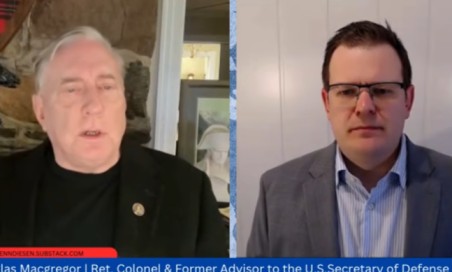
Editor’s Notes: In this detailed discussion, Colonel Douglas Macgregor joins Glenn Diesen to provide a critical assessment of the ongoing conflict with Iran and its broader geopolitical consequences. Macgregor challenges official claims of a quick military victory, arguing instead that the war has destabilized the U.S. empire, fractured the NATO alliance, and placed Israel in an increasingly vulnerable position. The conversation also explores the severe economic fallout, including the near-total shutdown of trade through the Strait of Hormuz and the potential shift away from the U.S. dollar toward a gold-backed currency. Ultimately, Macgregor suggests that the strategic initiative now lies with Iran, leaving Washington with difficult choices regarding its future presence in the Persian Gulf. (April 2, 2026)
TRANSCRIPT:
Introduction
GLENN DIESEN: Welcome back. We are joined today by Colonel Douglas Macgregor, decorated combat veteran, author, and a former advisor to the US Secretary of Defense. As always, thank you very much for taking the time.
DOUGLAS MACGREGOR: Well, happy to be here.
Mixed Messages from Trump and the State of the War
GLENN DIESEN: So we’re getting some mixed messages from President Trump. That is the—
DOUGLAS MACGREGOR: That’s a big change.
GLENN DIESEN: Well, no, yes, good point. Well, we heard here that the US already won the war, but if the Iranians don’t agree to a ceasefire, they will destroy all of the infrastructure in Iran if they don’t open the Strait of Hormuz. At the same time, he also argues that the US is ready to leave and the Strait of Hormuz should be the problem of the Europeans and the regional states.
So how are you assessing the state in this war? Because I understand there’s a lot of different audiences to communicate to, and one wants to put pressure while at the same time have something offered on the table. But how do you make sense of the current position now?
DOUGLAS MACGREGOR: Well, I’m not sure a decision has been made or if it has, he’s not sharing it. I think it’s a very strange set of circumstances. I mean, you have the claim, this incessant drumbeat: “We’ve already won. We destroyed everything that could be destroyed. They’re down to nothing. They can’t keep up, they’re running out of missiles, their back is against the wall,” et cetera, et cetera, et cetera.
Well, if that’s true, why is it that every time he makes some sort of statement along these lines, a wave of missile attacks comes out of Iran — tactical theater, ballistic missiles, drones that do enormous damage to Israel and to, frankly, the Gulf Emirates? I mean, if that’s really the case, why hasn’t Iran already hoisted the white flag?
I think that those claims have to be dismissed up front. What I am hearing from people who are on the inside that I trust is that we have perhaps reduced Iran’s ballistic missile capability from 100% down to perhaps 70%, that their air defense is being very effective against the unmanned surveillance aircraft, selectively against other kinds of aircraft, but has not performed as well as they’d hoped. But they have always been willing to absorb the strikes. They’ve always known that their infrastructure would be brutalized, and they think the payoff is worth the trouble.
So that’s the first thing. Second thing is, if things are going so well and we’ve had so much success with the air and missile campaign, why do we want to introduce ground troops into the equation? That doesn’t seem to make a lot of sense.
The Truth Behind U.S. Claims of Success
So I don’t think you’re getting a truthful assessment from the US side. I think the President is desperate. I think he faces public humiliation inside the United States as well as overseas if he admits the truth.
And when he starts talking about, “Well, maybe I’ll just leave and dump all of this into the laps of Europeans,” we ought to stop and consider a few things. First of all, commercial traffic through the Strait of Hormuz has fallen by about 95 to 97%. 15 million barrels of oil a day have been taken offline. The physical shortages have already hit so hard that right now, Singapore jet fuel is selling at $231 a barrel.
And as long as the war persists, the real people who shut down the Strait of Hormuz — who are not Iranians — they’re sitting in London. They’re called Lloyd’s of London. The insurance brokers aren’t going to insure anything that goes through the strait right now because it’s a war zone. So if you really want to open up the strait, you’ve got to stop the war.
Simply passing an ultimatum to the Iranians and then turning to the Europeans — who were really never consulted on this whole business — neither were the Japanese, neither were the South Koreans. I mean, frankly, we ignored all of our allies and simply acted independently in a way that we decided to act, and it was never really in our interest to do so.
When you turn to a friendly country like India, you discover the Indians are apoplectic. They do $180 billion of business in trade a year with the Emirates. Suddenly that’s gone. And if we continue to destroy infrastructure in Iran, the Iranians have said, “Fine, if you hit our desalination plants, if you hit our oil infrastructure, we’re going to turn around and obliterate everything in the Persian Gulf.”
Military Challenges and the Question of Ground Troops
So what does he plan to do? He wants to land troops on some islands, presumably. Right now, the United States Navy sails 500 to 800 miles away from the Gulf and stays on the move, cutting giant squares in the ocean, because it doesn’t want to be sunk. It doesn’t want its ships on the bottom.
How do you get the troops in there?
All of these questions are never really answered. It’s the big hand wave: “Oh, we’re successful, we’re brilliant. We’ve done everything right. These pesky Iranians are too dumb to surrender, but we think we’ve done enough damage now.”
Israel’s Role and the Neocon Agenda
From whom have we not heard, who is really in charge? Israel. Why are we in this war? Because we suddenly decided that Iran was this satanic evil element in the international system that had to be purged for anyone, anywhere in civilization to be safe? No, that’s a lot of nonsense. We’re there because Israel wants Iran taken off the board — which is the phrase used by the neocons in Washington.
This whole thing was sold from the very beginning on the assumption that, first of all, this will be a short campaign. “We would be surprised if they didn’t fall apart in 96 hours.” That’s what I was told. Secondly, once we’ve taken Iran off the board, Israel is safe. It has no worries. It can bully the region, it can push its power and influence to the limits. And, “Oh, don’t worry about the Turks. We’ll keep them under control. We’re close with the Turks. Turks don’t want trouble with us. They’ll do what we say.”
So the attitude in Israel was, “Fine, then we just need to obliterate Iran. And, by the way, if we do this right, we and you can move in and take control of the oil fields. Never mind Iraq, don’t mind Syria, don’t mind Turkey. Forget those things. They’re not important. And the Emirates, they depend on us for everything, so they’ll do what we say.”
Well, the Emirates have discovered that depending on us is not a very good idea. We have been woefully unprepared for the attacks that have been launched against them, and they paid a terribly heavy price for our bases and their support to us.
Where Things Stand Today
So where are we today? There is no trust between the United States and Iran. Zero. The Chinese have offered to mediate through the Pakistanis. We have not really responded to that, and we have given no evidence that we’d be interested. Because the worst thing that could happen to us, in the minds of people in Washington, is that the Chinese supplant our power and influence in the Gulf. And the Chinese are well on their way to doing that. So you’re not going to take anything that’s on offer from the Chinese.
Well, what about the Russians? Well, we’re still trying to harm Russia. We haven’t given up. We’re still doing everything in our power to sustain this fiction in Kiev called a Ukrainian government. We keep helping MI6 and other countries in Europe to put standoff attack weapons in there so that periodically they can wake up the international community to the realization: “Look at us, we have powerful drones that can reach just outside of St. Petersburg and destroy an important oil terminal.”
For Russia, well, that’s about all they can do. And inside Russia, as you know, there is tremendous discontent right now with the way the war is being handled. Russians want an end to the war. They’re sick and tired of the nonsense. So it’ll be interesting to see what happens in two weeks when the ground dries out in eastern Ukraine. Will the Russians push ahead and finally put an end to this war? Or will they sit there as they’ve sat for months and months and months now, behind this defensive line? They take some casualties, certainly not on the scale of the Ukrainians, but nevertheless, it’s a constant irritant.
Trump’s Dilemma and Israel’s Predicament
So all of these things seem to be coming together right now. And I think President Trump realizes he’s got to make a decision. Can we do everything? Probably not. Then what can we do? How much longer can we keep this up in the Persian Gulf?
Everybody forgets we’re visiting, we’re not a resident. We’re very dependent on other people’s harbors, other people’s air bases. How much longer can we do this? How many missiles can we produce in a particular day — 5, 7, 6, 8? How many can the Chinese produce? And how about the resupply from China? Where does that figure into all of this? We haven’t even talked about the space-based intelligence that’s been on loan to the Iranians.
So he’s got to answer this question. And I think tonight he recognizes he’s got to go one way or the other. He’s got to say, “It’s over, we’ve won, we’re leaving.” In which case Israel is in trouble, because Israel hasn’t won. And Israel must have us backing them unconditionally to win anything. So I don’t think the Israelis will approve of that.
And it’s very hard for me to believe that the immensely powerful Zionist billionaires in the United States — who are really the foundation for the Israel lobby’s influence and power — are prepared to throw Israel under the bus, as they say. So I find that hard to imagine.
And perhaps President Trump will say, “Well, we’re going to continue to support Israel.” Well, that’s like saying, “I have all these dead cats, but I’m going to continue feeding them as long as possible,” because that’s what Israel looks like right now. It’s in ruins. It’s not getting any better. We don’t know how many people have died, but certainly a lot more than the Israelis were prepared to accept. I think that’s pretty obvious.
What Iran Wants
So what do the Iranians want? Well, the Iranians want us out of the Persian Gulf. What have we done? For decades, we’ve surrounded Iran, placing bases wherever we could from which we could threaten Iran. The Iranians have said, “No thanks, not anymore.”
The Sykes-Picot states that were created at Versailles in the aftermath of World War I — gone. “We don’t accept that anymore.”
So what do they want besides us out of the Gulf? They want change in Israel. They’re not going to accept a peace with the Israelis or us as long as we continue to back Israel’s campaign of mass murder and destruction in Gaza and on the West Bank. They’re not going to come to peace terms with the Israelis as long as the Israelis are expanding into Lebanon and killing people there by the thousands, or expanding into Syria. So how do we deliver on Israel? Are we really in control? I don’t think we are.
The Impact on NATO and the Transatlantic Partnership
GLENN DIESEN: Yeah.
DOUGLAS MACGREGOR: No.
GLENN DIESEN: I spoke to an Iranian as well who made the point that if they go up the escalation ladder, they can do a lot of different things. Most of them I would have predicted. But one of them I thought was interesting — that is, to reward Iraq for its assistance. They could also change the borders of the region. Since you mentioned the Sykes-Picot, that is, Kuwait could go to joining Iraq, essentially. So there’s a lot of surprises which seems to be outside our control at the moment in terms of how the region will be impacted by this.
What I wanted to ask as well, though, was how do you see the region beyond the Middle East being affected? That is, especially the NATO relationship. I find this to be interesting. On one hand, Trump has been arguing that NATO is now a paper tiger. Marco Rubio said, “Perhaps we should just — we have to reconsider this relationship. They’re only there when we need to help them, not the other way around.”
And I can understand from both sides. That is, from the European perspective, the Americans never told them, never informed them, never cared, and then now they want them to go on the suicide mission into the Strait of Hormuz. On the other side, the Europeans blocked the access to military bases and airspace. Poland was asked to hand over some Patriot batteries to help out the United States in the region, and they declined.
So I can understand where the mutual frustration comes from. But what do you think this war will do to the transatlantic partnership?
The Strategic Trap in the Persian Gulf
DOUGLAS MACGREGOR: Several years ago in 1991, during the air campaign, while most of us that were prepared to invade Iraq were sitting on the sidelines watching the air campaign unfold in front of us, we were literally up on the Saudi border watching all of the sorties every night that went in with bombers and various kinds of aircraft.
And one night, this was very early in the morning, actually this would have been about 4 in the morning. I was trying to get some rest and I was suddenly awakened by a soldier. He said, “Sir, quickly get to the CP, we need you right now.” I said, “Okay, what’s happening?” He said, “Well, we have a report that we’re under fire.” I said, “Really?” I thought that was interesting. I didn’t think the Iraqis during the air campaign would risk an attack, but all things are possible.
So I got up, walked into the command post and I said, “Now what’s going on?” He said, “Well, Ghost Troop, that was G Troop, has an observation post up here.” That meant a couple of Bradleys up on the border, and they say they’re under fire. I said, “What? Get this man on the phone.” Well, this man on the phone said, “We have air to ground bombs falling on our location.” Well, I’ve never heard of anything other than air to ground bombs. I haven’t heard of any anti-gravity bombs. And I said, “What the hell.” This man, sober, of course, there was no liquor to consume, so I assumed he was.
And the next thing I get is, “We need help, we need help.” And one of the sergeants that was there was a very smart non-commissioned officer. He said, “Yeah, that’s a great idea. Let’s all get under the artillery fire with Ghost Troop.” In other words, if everybody up there is under fire, why are we going up to join them? Why don’t we do something intelligent and try to find out where it’s coming from? Anybody who thinks that American soldiers are stupid is wrong. They’re actually very intelligent people.
So finally I got the executive officer on the phone and he said, “Look, I’m sorry about this.” This man had been watching flares that were dropped by A-10s and others, and these flares were dropped to distract air defense weaponry so that the missiles ended up being diverted by the flares instead of striking the target.
I think that’s kind of what Donald Trump is asking the Europeans to do. Hey, we did something immensely stupid. We’re sending the United States into a recession, and most of the world is at risk of going into a depression, all because we went into the Persian Gulf for Israel, and we’ve set back the world for God knows how long, 10 years before we recover. Because food, fuel, feedstocks, fertilizer — the big ones right there, the four Fs — are screwing us. We’re screwed.
Thank you so much. Yeah, let’s all go down to the Persian Gulf and contribute to this catastrophe. And Trump said, “Well, if you’re not going to help us, we don’t need you.” This goes back to the false assumption that the North Atlantic Treaty was designed for anything other than defense, and the defense was against the Soviet Union, period. That’s it.
And ever since the Soviet state system collapsed, we’ve been trying to repurpose it. And repurpose the famous statement: “If NATO is not out of area, well, then it’s out of business. We don’t need it.” And I told everybody in NATO, “Get smart, get out. You don’t want to go to all of the hellholes that we have identified for invasion and occupation.” But Europeans said, “Well, you know, we’re afraid. And we really need the Americans here. It’s vital to our security.” Okay, fine. Here we sit.
Now the Europeans are saying, “This is a dumb idea. Don’t really want to participate in this. And why aren’t we talking to the Iranians?” Because the Iranians have said, “Look, the Strait of Hormuz is closed to countries unfriendly to Iran.” That’s all. Which means even though the numbers of tankers used to average 75 a day going through the strait, now it’s three to four. But that number can rise, provided the tankers and their destinations are not to places unfriendly to Iran.
So many people are saying, “Let’s talk to the Iranians.” And the Americans are saying, “That is unacceptable. You can’t talk to those people. If you do that, you’re going back to Munich. You’re negotiating with Hitler.” Yes. Here you go. So we’re in a bit of a pickle.
And I think the Iranians hold the strategic initiative. They are not at the end of their rope. I think Trump has got to make a decision. Do I bail on this? It’s a stinker, I made a mistake, find a way to get out and blame it on other people, which is the standard Trump approach. Or do I say, “No, I’m going to obliterate you. You refuse to negotiate with me, the great marketer, the great salesman, then I’m going to wage a war-winning air and missile attack, and I’m going to bring in ground troops and I’m going to cut you off from the Gulf and force the Gulf open.”
And I think the Iranians are sitting there saying, “Okay, go ahead.” Because if you’re going to put ground troops anywhere in that area, you have to neutralize all the strike weapons, neutralize the intelligence surveillance reconnaissance network, stop all potential air defense including shoulder-fired missiles. Because if you can’t do that, first of all they may never reach the destination. They’d be shot out of the sky before they get there, because they’re going to have to fly in.
I don’t see a massive amphibious assault working. That means that they have to get there without already being identified in Kuwait or Bahrain or the UAE, and I don’t see that happening. So I think the Iranians hold the strategic initiative, and we stand an excellent chance of ending up like a giant 14, 15, 16, or 18-wheel truck headed down the side of a mountain for a concrete wall. We’ll just end up battering ourselves against a concrete wall one more time.
The Illusion of Coastal Control
GLENN DIESEN: I heard many commentators argue that if the US could just control the coastline, then they would be able to control the Strait of Hormuz. They don’t seem to recognize that there’s a vast amount of territory behind the coastline of Iran which can also be used to target. But either way, the coastline would be a vast area, so it doesn’t really make much sense, especially if one hasn’t planned for this in advance.
DOUGLAS MACGREGOR: Well, what about Bandar Abbas? That’s a city of 580,000. They also have a uranium mine that’s not far from the city where they harvest yellow cake. They also have a desalination plant there. The desalination plant could be destroyed. That would harm the people that live in Bandar Abbas. But I think they have some backup plans for that.
But the bottom line is, what are we going to do about that? The islands all sit in proximity to Bandar Abbas. Basically, if you can’t control Bandar Abbas, what makes you think you can control these little islands? In other words, it’s damned if you do and damned if you don’t. And the Iranians may take the position: let them all land. And then we just erase the islands.
This has been a problem that we’ve been dealing with in all of our war planning for years. You have the Marine Corps and the Navy that want to repeat World War II. They talk about island chains. Well, unless the island is about the size of Borneo, the island is going to be annihilated from the air. Top-attack ballistic missiles, cruise missiles, drones — they’ll all land on top of you and kill everybody on top of the island. And we have attached so much significance to little islands without understanding they no longer hold the strategic value that they did 80-plus years ago. They’re just an invitation to lose people.
And that’s the other issue. Assuming you get on there and you can survive for any length of time, how do you feed yourself? How do you evacuate wounded? And then ultimately, how do you get out when it becomes clear this is a dumb idea? At least the British in the Dardanelles were able to pull vast numbers of ships into the Dardanelles and systematically evacuate the 500,000 troops that were there. That’s not so easy in the Persian Gulf. If you stand above Kharg Island and look down, you’re on top of an escarpment. All of the terrain is very high and it’s very, very steep. So what are you going to do on those islands?
The other thing is, the notion that all of the oil will cease to move at that point is false. The Iranians have other means of exporting oil now. They’re making a lot of money right now. That’s obvious. They’re charging a toll. But again, you listen to the Chinese, the Russians, the Indians and others. They’re very intelligently saying, “Look, we need to end this. We’ll get together, we’ll have a commission, maybe we sign a treaty that guarantees access to the Strait of Hormuz.” We did that after World War I for the Dardanelles. We have a treaty. The Turks control the strait, but it’s all carefully measured, it’s all carefully managed. The Turks do not arbitrarily say, “You can come and you can’t.” They haven’t done business that way. That can be organized as well.
But the key thing is, we can’t be in the Gulf. Our time there is now over. And if we can’t be in the Gulf, I don’t know where else we’re going to be.
Israel, Trump, and the Limits of American Power
GLENN DIESEN: Well, this could have fit within Trump’s wider plan. If the goal was really to pull out of Europe and the Middle East, then this is really the time he can clearly argue that the Europeans weren’t reliable, that the Middle East should look after their own problems, and then focus on the Western Hemisphere and East Asia, if this is the main objective.
But a key problem, though, is Israel here, because the US and Israel do appear to be joined at the hip. And Israel, of course, has been pushing hard for this war for several decades. Now it finally has the war. If Trump now decides, no matter how he wants to end it, even if he just declares victory — “We don’t need the Strait of Hormuz, we’ll go home” — where does that leave Israel? Because if they’re locked in a war with Iran, which they don’t want to end, is the US still able to leave? And if the US is able to leave, what do you do with a vulnerable Israel armed with nuclear weapons, which is not ready to give up this fight against Iran?
I mean, one doesn’t want to be hyperbolic, but on the other hand, this is a very strange situation to be in, and there’s a lot of desperation, and a lot of countries have bet all or nothing on this conflict.
DOUGLAS MACGREGOR: No, Glenn, you’re absolutely right. The key thing to remember about NATO is that once you leave the Beltway, you drive across America, the vast majority of people don’t even know what it is. And if you ask people, “Do you know that we have US Army ground troops in Germany?” they’ll say, “Really? I didn’t know we had any troops in Germany.” And some people who are moderately smart and educated will say, “Why, after 80 years, do we still have troops in Germany?”
So I don’t think that’s a big deal here at home. Now you’ll have all sorts of people in Washington who will hurl abuse at Donald Trump for destroying NATO, “the greatest alliance there.” It’s all crap. Nobody cares. The electorate does not care about that. But they care about the economy, and this is accelerating very bad trends.
If you talk to someone like Alistair McLeod, he says this is the end of fiat currency, and all you have to do is point to the rise of the value of gold. And as gold goes up, the value of the dollar goes down, down, down. We are seeing in real time the petro yuan take shape. In other words, instead of a petrodollar, you get the petro yuan. I think that’s coming. And the interesting part is it’s going to be backed by gold. China has been hoarding gold, purchasing gold, buying gold. It has a vault in Riyadh, a vault in Hong Kong. It’s real. That’s the future of BRICS. That’s where they’re headed.
Now, will it ultimately encompass a basket of precious metals or something? I have no idea. But it’s going to be based on some tangible, concrete value. And right now, that’s gold. Now, we can’t do that. We just can’t. So what do we do? Do we watch our currency go down the toilet? A lot of people think that’s where we’re headed.
And Nassim Taleb — you know him, the man who originated this idea of the black swan — he’s been saying for months, and I agree with him, that frankly speaking, gold is now the reserve currency. It’s not the dollar. And if the yuan is backed by gold, well, I guess the yuan will become the petro yuan.
I think we’ve lost. We’ve actually lost by this stupid action. All because of Israel’s Greater Israel imagination and aspirations, and because the Israelis hate all of their neighbors, think all of their neighbors are inferior and deserve to be essentially exploited, bullied, and run and governed by them. It’s not going to happen.
The Path Forward: Options for Washington
GLENN DIESEN: So how does this end, then? I mean, if Trump doesn’t pull back? Again, it’s hard to say. He made some reference to this, but again, he pretended to do peace negotiations during two surprise attacks. So, again, I do think at some level he doesn’t want this war, that his intentions from not just the first presidency, but the second, was to avoid these kind of things.
But now that it’s in this war and he can’t really well afford to pull out, it seems, what are the options for Washington here? Can they — I mean, do they put boots on the ground? Do they try to invade Yemen? Because, you know, if Yemen shuts down the Red Sea, I know it’s a huge country. It’s like, what, 34 million people? I wouldn’t want to enter this country. But again, desperate situation results in foolish policies. So what do you expect to happen from here on?
A Train to Hell
DOUGLAS MACGREGOR: Well, one of two things. Either he announces, “I’ve decided unilaterally to end our involvement in this war. And I welcome the opportunity to negotiate with the Iranians and to assist in any way possible to return the Persian Gulf to normalcy.” That’s an admission that he made a mistake, which is fine. He made a mistake. I don’t know if that’ll happen or not. Personally, I would welcome that development, but I think the Israel connection really makes it impossible at this stage.
We don’t understand the connection that Israel has to Trump. I don’t understand all of it, but I understand enough to know that, yes, you’re right. When I spoke to him in April of 2020 in the Oval Office, it was supposed to be short, turned into a longer session, and I was enormously impressed with the things that he had to say. And one of the things that was very clear to me is he didn’t want a war with Iran. In fact, he was looking for some sort of negotiated agreement, and I’m sure he felt that way when he was elected.
However, these Zionist billionaires were very instrumental in his winning that election, not only because of the money he was given — his campaign — not only because of the many ways in which his family and he have been enriched by the Zionists, but also by what they didn’t do. They didn’t provide any support whatsoever to his opponent. And the last time around, when he lost the election or lost his bid for re-election, they invested heavily in his opponent, so he knew they could deliver the goods. In other words, if he had them on his side, he could win. But when he did that, he had to make some promises, and I think one of those was that he would back Israel’s attack on Iran.
Whether or not he was aware that Israel’s plan is to turn most of the region into the facsimile of Gaza, I don’t know, but that’s really Israel’s answer for Iran — Gaza. And whereas we started out with this decapitation nonsense, and I think a lot of that goes back to Israel — “we can get the leadership, if we get the leadership, this will encourage internal upheaval” and so forth — so then they lied about 30,000 people being killed. That wasn’t true. It was about 3,000. And they had a very important role in stirring up that violence, passing out weapons and encouraging people to shoot at police and so forth. It failed.
So then the decision was, “we’ll try the decapitation, that’ll probably work.” It didn’t work. So what is the goal now? Well, since Lloyds of London shut down the Strait of Hormuz and the Iranians can now charge people to move through it, the idea is that you have to destroy Iran, period. The destruction of Iran, the disintegration of its society — and after all, that’s what we wanted to do to Russia. That’s what the Europeans don’t understand. That’s what we wanted to do. And when I say “we,” I’m not talking about the average American. I’m talking about the same people that are backing Trump now. We were very interested in the same thing in Russia — destroy Russia, rape it, divide it, fragment it, steal its resources. Well, now we’re turning to Iran with the same purpose in mind.
And I just don’t know that Donald Trump can get off this train to hell. And that’s what he’s doing. He’s riding a train to hell.
Russia’s Response and the Limits of Diplomacy
GLENN DIESEN: Just as a last question, how do you see Russia responding to this? Because I always make the point — the Russians were genuinely very optimistic when Trump got reelected, because with the Russiagate thing being over and Trump seemingly having the genuine objective of improving bilateral relations with Russia, be it either for common views on the world in terms of conservatism or just pragmatic great power politics — that is, getting Russia on our side of the ledger instead of pushing it towards Iran. Nonetheless, whatever the reason was, it seemed genuine.
And now, of course, we’re one year into this. The US, much like the Europeans, are still participating in the proxy war. And the surprise attack on Iran appears to have shook the Russians a bit — that is, the willingness to throw out a rule book, kill leaders, attack nuclear power plants across the board. They also lost some faith in the whole diplomacy.
How do you see Russia, though, responding to this? Because on one hand, I see the disappointment, but there’s many who also seem to have a hope that there won’t be another Trump, someone who really actually wants peace with Russia, if he does want peace. Of course, as you said, even though it’s Trump behind the wheel, nonetheless, it’s the same objective — nonetheless, it seems to destroy Russia, break it up, and seize its resources.
DOUGLAS MACGREGOR: Well, first of all, the Russians do not understand how the American government works. Very few people beyond the borders of the United States do. The most astute observation that Putin has made is that he’s spoken with several presidents and then discovered that nothing really changes because others are in control. Now, some people call it the deep state. I call it Zionist billionaires — people that are among the wealthiest in the world. They dominate Wall Street. They are financial capitalists. These are not people who made money from building anything, from creating anything. These are the kings of financial transaction, and they have enormous quantities of money, and they’re willing to employ that money in pursuit of their agenda.
We talked about what the agenda in Russia originally was. Now we’re looking at the same agenda. The good news for them is that if this works, then Israel will be in charge of the entire region in their minds. And that means that they, from their positions in New York and London and the banks, they’re controlling everything, because ultimately that’s what they want to do. They want to control the region’s resources.
Now, my view is that’s not going to happen. And I think that the Russians are now figuring out it probably won’t happen. If anything, we have demonstrated not our brilliance and our supremacy in every field — we’ve demonstrated that our superiority isn’t that great, that our effectiveness is not what they thought it was, that there are more chinks in our armor than either the Russians or the Chinese or anybody else really thought. That’s the danger of using military power when you don’t need to. There was no pressing reason for us to attack Iran.
GLENN DIESEN: None.
DOUGLAS MACGREGOR: And when you have to go back to Netanyahu talking points into 1982 and the bombing of a building that contained Marines where the Marine guards had not even been issued ammunition — what a disaster. That’s your justification for destroying a nation of 93 million people? Or that they simply say things you don’t like, but they’re a threat to Israel?
I think the biggest threat to Israel, other than Israel itself at this stage, is probably Turkey. And in fact, that’s what Naftali Bennett has said, and even Netanyahu has admitted that. Which means, I guess, the expectation is, as long as they control us and our armed forces, that if we’re successful at utterly destroying Iran, then we can turn our attention to do the same thing to Turkey. Disaster. Insane.
NATO Is Finished
So NATO is finished. NATO died on the battlefields of Ukraine. It’s over. The Russians need to wake up and discover that they — not anyone else, but they — are going to have to settle this war. The only way I think they can do that is by advancing. So we’ll see in two weeks when the ground is thoroughly dried out, whether or not President Putin is willing to finally end the war. And he can do that. He has the military power to do it. There’s nothing really standing in his way. He can obliterate all the opposition, but he’s got to do it. No one is going to help him. No one is going to offer him a good deal. Doesn’t exist. And Trump, no matter what he privately thinks, has demonstrated he can’t deliver.
Now we’re dealing with the Gulf, and the Russians are watching this. And I think the Russians have always advised the Iranians to be conservative, to cooperate, to negotiate. Whether or not they continue to do that at this stage, I don’t know. But I think that now more than ever, the Russians and the Chinese will back Iran. So I see no evidence that whatever we do is going to result in the outcome that the Israelis want.
Europe’s Strategic Dilemma
GLENN DIESEN: Well, sorry, let me squeeze in one very brief last question.
DOUGLAS MACGREGOR: Wait a minute now, you said that was the last. Glenn, it better be a short one. I’ve got to go.
GLENN DIESEN: Well, I know you hate this word when — well, what is the strategy here of the Europeans, you think? Because, well, they seem to have bet everything on backing the US, hoping to win over the love of the Americans. But now suddenly they have this — Iran is essentially the conflict where they decide to turn their back on the US. Well, what do you think? Is it a strategy now because they don’t have energy from Russia, from the Middle East? Their American backup is kind of gone. Ukraine is falling apart. The Middle East again, the mess. How do you make sense of the current positions?
DOUGLAS MACGREGOR: Keep in mind that in 1964, 65, Prime Minister Harold Macmillan was approached and asked whether or not the British would support the Americans if they intervened in Vietnam. And he said in a very straightforward manner, “Absolutely not. We have no intention of involving ourselves there.” Did that destroy our relationship with Britain? No, of course not. But in those times, people understood the limitations of treaties and alliances, and the alliance with us pertained primarily to the Soviet threat.
So I think you’re still going to have bilateral relations between us and the Europeans, regardless of what happens. They buy a lot from us, we sell them a lot, we buy a lot from them. That’s still unchanging. But the energy question is critical, and they are not prepared to go on the same path to extinction that the Gulf Emirates are on.
The Gulf Emirates are finished. I don’t see those being rebuilt at all. We are not coming back. That was very clear from Trump when he said, “Well, we’ll just leave, and that’s it. We’ve done as much as we can,” or “We’ll do whatever we can to obliterate Iran, after which we will leave, too.” So the Gulf Emirates have been on the wrong horse and they have cultivated hostility for their big neighbor. They’re paying a terrible price for it.
The Germans, the Poles, the French, the British have done the same stupid thing towards Russia. They have cultivated an enemy in the big neighbor to the east. Huge mistake, unnecessary. You know that. I know that. Russia has no interest in invading or threatening Western Europe. That means you need new governments. You’ve got to get rid of Scholz, for God’s sakes. I was so happy to see the AfD announce quite recently, “We stand, we support the complete removal of all US forces from Germany.” Absolutely should have happened 30 years ago. We should never have stayed in that country. There’s no justification for it whatsoever.
And I think others are going to reach that conclusion. De Gaulle was right — we should remember that. Orbán has been right. The British need a new government badly, and so do the French. And before they get that, or when they get it, they may end up fighting an internal rebellion of various types and sorts, as David Betts has pointed out. I don’t know if you’ve had David Betts on your program or not.
GLENN DIESEN: I did.
DOUGLAS MACGREGOR: But he is absolutely right. So these are things that have to be dealt with, that have to be addressed and can only be addressed by the Europeans. And while they do this, put an end to the hostility with Russia and tell these maniacs — I like them, they’re wonderful people — Lithuanians, Latvians, Estonians, and the Baltic states: stop. Stop the stupidity. You’ve got to live with your neighbor and get along with your neighbor. It’s not that scary an idea.
And by the way, that’s what Bismarck told them back in 1879: “Knock it off. Get along with the Russians. Whatever you think you’re suffering from, it’s not as bad as you think it is.” And he was right. It wasn’t. It got a lot worse under the Soviets — that’s a different era — but that was catastrophic. We’ve got to get out of this business of treating Russia as this perpetual Stalinist threat. They’re not.
Closing Remarks
GLENN DIESEN: Well, thank you for accommodating my second last question. And as always, thank you for your time.
DOUGLAS MACGREGOR: You owe me, Glenn. You owe me.
GLENN DIESEN: I’m going to get up to you someday. Thank you.
DOUGLAS MACGREGOR: See you. Bye. Bye.
Related Posts
- Transcript of Elizabeth Lane Interview on Propaganda Network: Tucker Carlson Show
- Transcript of Justice Ketanji Brown Jackson Interview: IMO Podcast
- Transcript: Mary Talley Bowden Interview on Tony Fauci’s Diary @ Tucker Carlson Show
- Transcript of CIA Whistleblower Jim Erdman Interview: Tucker Carlson Show
- Transcript of Shawn Ryan Interview: Trump’s Betrayal – Tucker Carlson Show