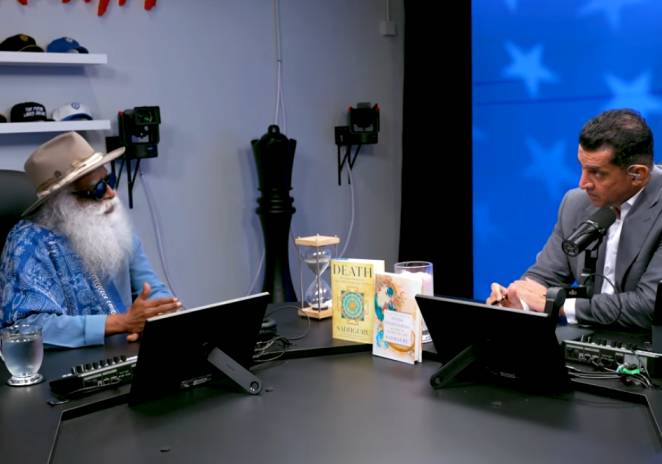
Editor’s Notes: In this episode of the PBD Podcast, Patrick Bet-David sits down with the world-renowned mystic and yogi, Sadhguru, for a deep dive into the essence of human potential and inner well-being. The conversation spans a wide range of thought-provoking topics, including why Sadhguru considers himself a “blissful failure” and his unconventional perspective on why we should never look up to or down on anyone. From the mechanics of “inner engineering” to the true nature of success and peace, this episode challenges traditional beliefs and offers a scientific approach to experiencing life at its peak. (April 16, 2026)
TRANSCRIPT:
Opening Reflections on Life and Death
SADHGURU: Life doesn’t die suddenly. When we are born, we got our death sentence. We are only trying to kick the can around a bit.
PATRICK BET-DAVID: You’ve been a rebel since day one, since you were a kid.
SADHGURU: I know I will die a failure in my life, no matter what I do. My blessing is you die a blissful failure.
PATRICK BET-DAVID: If life goes as quickly as we know it does, what is the most important thing in life?
SADHGURU: When it’s such a brief life, if you want to do little things, there’s lots of time. If you want to do something big, there’s not enough time. In the middle of nowhere, this planet is floating around and you and me sitting here and blabbering like this, not knowing a damn thing. If both of us are peaceful, this room is peaceful. As simple as that.
PATRICK BET-DAVID: This place is peaceful right now. Yes.
SADHGURU: Depends.
On Peace, Business, and Experience
PATRICK BET-DAVID: Can a successful, ruthless businessman be at peace? What would you say I should dedicate my life to?
SADHGURU: See, you are trying to drop like Ten Commandments from whatever I’m speaking. Don’t do that. What is true is only what you have experienced. Rest is all imagination and belief.
PATRICK BET-DAVID: Yeah, what a boring life though, no?
SADHGURU: Very wrong approach, really.
PATRICK BET-DAVID: You make it seem like it’s easy. It’s not easy to do for most people.
SADHGURU: Something you should know only by experience.
PATRICK BET-DAVID: Do you think you know? — So a lot of students from Iran in southern India.
SADHGURU: They used to study there because, I think that’s when the revolution happened.
PATRICK BET-DAVID: Pre-revolution, you’re thinking, or post?
SADHGURU: When that happened, when the Baha’i people, mostly Baha’i people, were all studying in India, like thousands of them.
Introduction and Background
PATRICK BET-DAVID: My sister married a Baha’i guy. Yeah, Baha’is, they believe you can get to heaven from 8 different prophets or 8 different ways, and they have a— it’s a very interesting community.
But Sadhguru, it’s great to finally do this with you, sitting down having a conversation. We’ve been trying to do this for a while, and I’m glad. I know, for the audience, the audience who knows you, they know you. For the audience that doesn’t know you, your students, your reach is all over the world. I mean, we were talking about the location you have in southern India, 10,000 square miles. Your location in Tennessee, 23,000 acres. You guys have that beautiful statue of 112 feet in India, which we were just talking about a minute ago, which people visit. You get billions of views. A lot of people call you rebellious a little bit, like you’re a rebel. I don’t know why you’re a rebel. Interesting people follow your teaching. Will Smith, Matthew McConaughey, Logan Paul, and others.
But it’s great to finally have you here with us. So I got a simple question for you, okay? I’m 47 years old. We just celebrated my dad’s 84th birthday, okay? And we know how life is. Life goes by fairly quickly, okay? I feel like just yesterday I was 23 years old, like an hourglass, right? If life goes as quickly as we know it does, what is the most important thing in life, in your opinion?
The F1 Mindset: Living at Full Potential
SADHGURU: You must have a vehicle like that.
PATRICK BET-DAVID: Say that again.
SADHGURU: You must have a vehicle like that.
PATRICK BET-DAVID: Yes.
SADHGURU: To move fast enough.
PATRICK BET-DAVID: Well, that one doesn’t have an engine. I need an engine in that one to go fast.
SADHGURU: I know that, but I’m saying you must be F1.
PATRICK BET-DAVID: Do you really believe that? To move fast, you need F1?
SADHGURU: If you value your life, because for what potential a human being carries, even if you live for 100 years, it’s just not enough for the potential— if you want to explore the potential of being human. If you live in a limited way, 100 years may be too much. But if you explore the full depth and dimension of what it means to be human, 100 years is just nothing. So you need to be like an F1 machine.
PATRICK BET-DAVID: Really? So for you, the most important thing is to seek what your biggest potential is, like what your capacity is, get close to it?
Confronting Mortality
SADHGURU: No, I’m not saying I’m in a race or something. What I’m trying to say is, if you’re conscious that you’re mortal, which I think everybody should be, unfortunately they’re surprised always. Surprise means so foolishly surprised. The most obvious thing in our lives is we are mortal, we will die one day. But most people believe that other people die. They never think they will die. The other people die, they’re dying people. No, no, you and me will die. So they always think—
PATRICK BET-DAVID: It’ll never happen to me. I’ll never get sick, I’ll never get cancer, it’s the other guy that’s going to happen to, but not to me. I get it.
SADHGURU: So—
PATRICK BET-DAVID: How do we deal with that?
SADHGURU: I’ll tell you, just 2 years ago, there was a sage in southern India in Karnataka, and he was 111 years of age. That man spent his entire life in service, he did so much work all his life. He became a monk when he was 17 years of age and he lived a dedicated life. And he was still working hard and doing things, but unfortunately he slipped and fell and broke his hip.
PATRICK BET-DAVID: Which is the worst thing to do at 111.
SADHGURU: Yeah, but out of that he didn’t recover, within a few days he died. So all the newspapers reported, “He suddenly died.” They came and asked me, “What do you think, this was such a great man.”
I said, “Man, at 111, how does somebody die suddenly? What are you guys made of? At 111, you die suddenly? No!” A full life and well, you need some reason, something has to break to die. Either your heart has to break, liver has to break, head has to break, something has to break. Well, fortunately for him, without spending too much time hanging around in a hospital, he died within 3 days after the fall.
So I’m saying life doesn’t die suddenly. When we are born, we got our death sentence. We are only trying to kick the can around a bit. So when it’s such a brief life, for the intelligence invested in us, for the potential invested in us, if you want to explore something, then you have to move fast.
Time, Big Goals, and the Blissful Failure
PATRICK BET-DAVID: So you’re— there are two mindsets. And I’m having a conversation with one of my friends. His name is John. And we’re talking about the statement about time is running out. We don’t have a lot of time left. And he says, Elon Musk told me something. He says, Elon told me time is running out, but we also have a lot of time left. Which one do you believe in?
SADHGURU: I don’t believe anything. The fact is time is running quickly, depends on what you want to do with your life. If you want to do little things, there’s lots of time. If you want to do something big, there’s not enough time.
PATRICK BET-DAVID: Wow.
SADHGURU: Wow.
PATRICK BET-DAVID: And what’s the difference? Because not enough time, the big things require more diligence, more focus. Why do you say that?
SADHGURU: Well, it means it needs more effort and time. It’s like this, shall I tell you my sob story?
PATRICK BET-DAVID: Please.
Sadhguru’s Transformative Experience at 25
SADHGURU: This happened when I was 25. One afternoon, I’m sitting somewhere and I’m fine. By that day’s standards, I’m extremely successful. I’ve started about half a dozen businesses in about 5 years and all of them doing well. Everybody clapping their hands. When everything that you’re doing is working well and you’re young and everybody clapping their hands, slowly you’re beginning to think the planets are going around you, not around the sun.
So I’m saying, I’m not arrogant, but I’m a bit cocky and there, enjoying everything that’s happening around me. And I just sat there in one place and suddenly I did not know which is me and which is not me. All that— all that till then my life was, this is me, that’s you. I have no issues with you, but that’s you, this is me. Suddenly I did not know which is me, which is not me. I was sitting on a hill, everything felt like me. Like what was me was just all over the place.
I thought this lasted for 10-15 minutes, but when I came back to my normal consciousness, about 4.5 hours had passed. I didn’t realize the time. For the first time in my adult life, tears were coming. Me and tears were impossible. But here I was, and then every cell in my body was dripping with ecstasy.
I was a super skeptical person. I’m skeptical about everything. And when I shook my head and asked myself, “What am I doing here? What’s happening?” The only thing my mind could tell me was, “Maybe you’re going off your rocker.” 25 years old.
Then I asked my closest friends, “Hey, something is happening to me, I’m just blissed out. If I sit here, I think it’s 2 minutes, 6, 7 hours are gone. I’m just completely smashed out within myself.” They said, “Hey, come on, what did you drink? Did you find mushrooms in the hill?” This is the kind of thing, I knew there was no context for me.
So I experimented with this. Then I discovered, if I simply sit here, if I remove my hands off my psychological process, every cell in my body bursts out with ecstasy. Today we have proven this in the laboratories. Some of the top scientific laboratories in this country, we have proven this, that if you do this, the bliss factor is up in a huge way. The endocannabinoids in the brain are up by 70% in a matter of 6 weeks of practice.
So when I realized there’s nothing to be done, if you just simply sit here without touching your physiological process or your psychological process, every cell in the body bursts out with ecstasy. Chemistry itself becomes ecstatic. Today we have substantial scientific evidence for this.
Then I thought, who wouldn’t want to be blissful? Free, no drug, no alcohol, no nothing, you don’t have to go to heaven, sitting here you are ecstatic, who doesn’t want it?
So I was 25 and I sat down and made a plan. I had the world’s geography in front of me and I made a plan. In 2.5 years’ time, on that day the world’s population was 4.82 or 4.84, somewhere there. And I said, “I will make the whole world blissful, entire humanity blissful in 2.5 years’ time.” See, it is 44 years now.
PATRICK BET-DAVID: Since that— since ’25.
SADHGURU: Yes, it’s nearly 45. Now, well, people say I’ve touched over 2 billion people. That’s not my idea of the world. 8.4 billion, they’ve increased, the population almost doubled since then.
Well, I know I will die a failure in my life, no matter what I do, but I will die a blissful failure. So I’m saying a whole lot of people are setting up petty goals for themselves, and then I say, “I did it, I did it like this.” What’s the point of this? Human imagination, human capacity to think and project is such that if you really apply yourself, what you want to do cannot be done in one lifetime. So my blessing is you die a blissful failure. If you think you’re a great success, that’s because you had petty goals.
PATRICK BET-DAVID: You have petty goals.
SADHGURU: Yep.
PATRICK BET-DAVID: Small goals.
SADHGURU: Yes.
On Core Principles and the Nature of Life
PATRICK BET-DAVID: Got it. So no matter what, if somebody is pursuing big goals, you have to accept the fact that that person is going to probably end up being a blissful failure, you’re not going to fully reach your potential.
SADHGURU: You cannot. It’s just that if you take 2 steps, next generation may take 2 more steps or 10 more steps.
PATRICK BET-DAVID: You don’t know. At this phase of your life, by the way, when you’re saying all this stuff, what is your core principle? Like if somebody asked me, “Pat, you spent time with Sadhguru for a couple of hours.” I said I did. “What is his core 3 principles?” What would I tell that person?
SADHGURU: I don’t have any principle, life is my only principle. Everything else is made up in your head, isn’t it? My principle versus your principle, we can have a fight. But if you ask this life and that life, it’s the same thing.
PATRICK BET-DAVID: Tell me more.
The Nature of Human Potential
SADHGURU: I’m saying the nature of life on this planet is such, whether you take an ant, or an elephant or a human being, fundamentally all life wants to do the same thing. It wants to become a full-fledged life. With an ant, we know what is full-fledged. He is always striving to be a full-fledged life. Just try to restrict him and see how he will fight for it. Little guy. Elephant, of course he will fight. Everybody will fight. Even including a plant is fighting to be a full-fledged plant. Or a tree.
Only problem with a human being is, a human being does not know what is a full-fledged human being. He is always confused about it. Because in nature, nature has drawn two lines for all the other creatures. Between these two lines, they live and die. But for a human being, the top line has kind of faded away. So what is full-fledged human being is not defined.
So essentially a human being is free, but he’s struggling with his freedom. It’s like if you put a bird in a cage and feed it nicely, he becomes a fat bird. Then one day you take away the door, but he won’t fly. Most human beings are in this condition. Though evolution has removed the top line for us, we could be anything we wish to be, we don’t do that. We try to live like animals, identifying with limited things because we’ve gotten used to the comfort of the cage that we don’t mind giving up the flying.
PATRICK BET-DAVID: Cage where we feel like we are locked in and we can’t be free.
SADHGURU: No, no, not like that, not like that. People are always trying to bind themselves to something or somebody or whatever, because freedom is a scary thing.
PATRICK BET-DAVID: Sure, I agree.
SADHGURU: All the identities that people are taking up, whether a family or nationhood or religion or race or whatever else, essentially they’re trying to bind themselves, to define themselves. But the whole process of evolution was to get us to a place where you could be beyond definition.
All other creatures are defined, they are creatures, that’s why. But you are the only one who’s called a being, right? We don’t call an ant an ant being, an elephant an elephant being, we don’t do that because they cannot choose how to be. They can only respond or react to the stimuli that comes to them. To some extent they can decide. But it’s very limited.
But once you’re a human being, irrespective of what’s around you, you can choose how to be within yourself. So that is why you’re a human being. Too many human beings are trying to defy that possibility and act like creatures reacting like every other creature.
Raising His Daughter
PATRICK BET-DAVID: You have a 35-year-old daughter, right? We were talking about family earlier, I think you said, if I’m not mistaken. What are you telling your daughter when she’s young? Are you telling her, “Honey, you can grow up to be anything you want to be,” or how are you shaping her mindset when she was younger?
SADHGURU: When she was very young, when she was 3 and a half months old, she started traveling with me. So always we are traveling different places, and every other day we are in a different home because I always stayed in many people’s homes. So she grew up without too much identity like that.
And as a rule, I told everybody, “Don’t teach her anything.” Don’t teach her anything? Yes, don’t teach her ABC, 123, Mary had a little lamb, because I don’t care whether Mary had a lamb or not, okay? Just leave her alone. Because a child’s intelligence is a certain kind, they are drinking in life, let them drink in life, why are you corrupting it with your ideas and nonsense?
So I told them, “You can play with her, you can be with her, you can chat with her, but no teaching anything. No nursery rhymes, no ABC, no 123, no nothing.” So she just grew up because I treated her like I would treat any other adult. So she never realized that she’s a child. She went about doing things. When there are big issues and problems, I said, “Hey, this is what the issue is, what shall we do?” She would come up with her own wacky answers to those situations, which is way beyond a child normally.
But a child has a certain intelligence. A child is much closer to life than most adults are. Instead of learning from a child how to be life, adults are busy teaching their rubbish to them all the time. So, let me skip those things and then I wouldn’t have sent her to school but my travels were too crazy, I had to send her to a school where there’s minimum amount of schooling.
When she was around 13 years of age, something happened in the school which upset her. She came home and—
PATRICK BET-DAVID: At 13?
SADHGURU: Yeah. And then she said, “You’re teaching everybody so many things, you’re not telling me anything.” I said, “See, I don’t do anything unsolicited. Now that you’ve come, sit down.”
Then I said, “This is all you have to do in your life — never look up to anybody.” Then she looked up, you know, eyebrows went up like this, “What about you?” kind of expression on her face. I said, “Especially me. If you look up to me, probably you’ll nail me to the wall. It’s no use.” You must see me how I am, the way I am. It is of immense value because I’m here, there, everywhere at the same time. You must look at me just the way I am. Don’t look up to me.
Never look up to anybody. That’s powerful. Never look down on anybody. If you look up to somebody, you will exaggerate things in a positive way. If you look down on somebody, you’ll invent negative things about them. If you don’t look up or look down, you look level at life the way it is, effortlessly you will navigate your life.
PATRICK BET-DAVID: Yeah.
SADHGURU: She is a living manifestation of that today.
PATRICK BET-DAVID: What does she do today?
SADHGURU: She’s a classical dancer.
PATRICK BET-DAVID: She’s a classical dancer. Oh, that’s right. And her husband’s a top 5 classical musician, which is pretty amazing. So never look up, never look down. If you look up, you exaggerate. If you look down, you will look for negative things.
SADHGURU: Yes.
Never Being Influenced — Even as a Child
PATRICK BET-DAVID: That’s interesting to be thinking about. Now, your parents, mom and dad, who had a bigger influence on you as a child?
SADHGURU: I never was influenced by anybody. They tried, but they couldn’t.
PATRICK BET-DAVID: Even when you were a kid?
SADHGURU: Yes.
PATRICK BET-DAVID: So you’ve been a rebel since day one, since you were a kid?
SADHGURU: The thing is, these words, these are all clichéd words people say. You’re a rebel, you’re this, you’re revolutionary, whatever. Essentially, it’s like this. For me, when I was just 4-and-a-half years of age, one day I suddenly realized I don’t know anything. Don’t know anything means I don’t know anything at all.
So if somebody gives me a glass of water, I’m staring at this water for 3, 4 hours at a stretch because I don’t know what the water is. I know I can drink it, I know how to use it, but I don’t know what it is. Actually, even today you don’t know what it is. If you find one drop of water somewhere, in another planet we say life is possible. Yes? 72% of your body is water. So with all this scientific knowledge, we still do not know what one atom really is. We know how to use it, we know how to fuse it, we know how to break it, we know how to explode it on somebody else. But we don’t know what it is. That’s how fantastic this creation is. But we want to draw conclusions all the time.
So if I found a leaf, I’m just staring at it 5, 6 hours. If I sit up in the night in my bed, I’m just staring at the darkness for the whole night. My father, my dear father being a physician, he started thinking I need psychiatric evaluation.
PATRICK BET-DAVID: At 4 and a half?
SADHGURU: Yeah, from 4 and a half onwards. So I’m just staring at something like this, I can’t take my eyes off because I still don’t know what this is. I can’t shift my attention to something else. When I don’t know what this is, how do I go to this?
So in this condition, they sent me to school. My mother said, “You don’t stare here and there, pay attention to the teacher.” I went and paid attention to the teacher, the kind of attention they would have never received in their life. So initially they’re talking something, I kind of understood what they’re trying to say. Then after some time I realized they’re just making noises. I’m making up the meanings in my head.
See, if I start speaking in any of the South Indian languages right now, it’ll be just sounds for you, isn’t it? Or if you can speak Farsi, it’s just sound for me. Language is a conspiracy between both of us. I make one sound, you make up the meaning. So when I realized — I was just four-and-a-half — I realized they’re just making sounds, I’m the one who’s making meanings in my head. Hour after hour, different teachers come, they make noises, noises and go.
So I decided not to make meanings out of it, just listen to it full attention. I’m listening, listening, listening, the funny sounds they’re making, making, making. It was so amusing that a big smile spread on my face, but they were not amused.
So my schooling went like this, most of the time I got lost on the way. Sometimes I went when they caught me, otherwise mostly I got lost.
Returning to His Old School
And about 17, 18 years ago, I think, this school where I studied over 55 years ago, they came and said that it is their 125th anniversary and I must come. I said, “Please.” The trustees had come. I said, “See, I am not a good example for your students. I am not just a not good student, I was not even a student.” I only came there when it was absolutely necessary, otherwise I never came there. Why me?
They said, “Our school has produced federal ministers, our school has produced film stars.”
PATRICK BET-DAVID: So you went to a very good school, it was a good private school?
SADHGURU: It was reasonably, yes.
PATRICK BET-DAVID: Okay. I don’t know whether it’s good or not, I was not a judge of that school.
PATRICK BET-DAVID: Produced you, federal ministers, so it’s like a—
SADHGURU: Federal ministers, film stars, cricketing stars.
PATRICK BET-DAVID: Private school.
SADHGURU: Private school? Yeah, private school.
PATRICK BET-DAVID: Okay. How many students total?
SADHGURU: That school must have been 1,500.
PATRICK BET-DAVID: Okay, so it’s a good-sized school.
SADHGURU: Yeah. So, “You are the only mystic, you must come.” I said, “Okay,” and I went there. So the same quadrangle, the same oppressive buildings all around you, I just looked around. Couple of big trees which was there when I was a student there, that was also gone, they built something else up there. Then I looked around, what to say to these people?
Then I saw this classroom and I suddenly remembered, I was 12 years of age. One afternoon the teacher is asking me some question. By then I’ve come to a place, if I look at you, I know your past, present and future, but I don’t hear what you’re saying. I can see so many things, but my attention is such, that the sounds that you utter are just going somewhere, but I know everything about other things that are happening within you.
So the teacher is asking some question. I’m full attention, I’m not distracted, full attention, but I don’t hear what he says. So for about 35 minutes, he makes effort to get some response from me. Those are times when I did not speak for days on end. Because when you don’t know anything, what do you say? I played, I went to the field and played every day, but classroom I escaped because they want me to talk this and that, I don’t want to talk something that I don’t know.
So after 35 minutes, he got so mad with me, he held me by the shoulder, shook me violently like this.
PATRICK BET-DAVID: Teacher?
SADHGURU: “You must be either the divine or the devil.” I think you are the latter. Till then, my problem was, what is this, what is that, what is — I have a billion questions, a cloud of questions around me because I don’t know anything. One thing I was sure of, this is me. This guy confused me about this also. Is this divine, is this devil, what the hell is this?
Then I tried to look, stare at myself, it didn’t work, so I started closing my eyes. My journey began. Initially minutes, hours, days, I closed my eyes, closed my eyes, closed my eyes, and here I am.
The Intensity of Life
PATRICK BET-DAVID: Got it. So meditation was a big part of your life?
SADHGURU: It — I wouldn’t call it meditation because the English word meditation doesn’t mean anything. It’s just intensity of life.
PATRICK BET-DAVID: Intensity of life?
SADHGURU: Yep. See, all you got is just life. Rest is all made up in your head. Have you been to anybody’s funeral? Many. What happened to you?
PATRICK BET-DAVID: I’m in the insurance business. We sold a lot of policies.
SADHGURU: I thought it happened in Iran.
PATRICK BET-DAVID: No, no, Iran military insurance business, you know, you get clients that pass away. But yeah, I’ve been to many.
SADHGURU: Okay.
PATRICK BET-DAVID: Have you been to many?
Life, Death, and the Drama of the Mind
SADHGURU: No, I mean— okay, so if you go to this thing, the funeral, that guy is lying down there properly dressed and proper posture, that guy never had such a good posture in his life. Now he is proper like that. You go and tell him— yesterday he was hopping around for many things— tell him, “You won the Tennessee State Lottery, $130 million.” You think he is going to sit up? No. Why is he not interested? You tell him, “We found a huge diamond in your backyard.” Will he sit up? No. When you were a young man, whatever you were interested in, underclothed young woman, you talk about them, will he sit up? No.
What happened to him? He lost only one thing— life. How come he’s lost interest in all these things? Because that’s all you have, rest of it is goddamn imagination, isn’t it? You’re misunderstanding your psychological activity as an existential process. This is the biggest problem with human beings. Your drama, your thinking is life. Drama that’s happening in your head in the form of thoughts and emotions. You’re thinking it’s life itself. It’s not life, it’s your drama. You can conduct it whichever way you want. Because you’re such a bad director of this drama, you think life is going wrong.
PATRICK BET-DAVID: Because you’re such a bad director of this drama, you think life is going wrong.
SADHGURU: Tell me if your thoughts and emotions just happen the way you want, will you be blissed out every moment?
PATRICK BET-DAVID: If it’s the way—
SADHGURU: You want.
PATRICK BET-DAVID: Yes.
SADHGURU: Why don’t you do that? That’s all I did. I have not fixed the whole world, I have fixed myself.
PATRICK BET-DAVID: Yeah, but it’s a very hard thing to— you make it seem like it’s easy, it’s not easy to do for most people. Well, tell us how simple it is, because 95, 99% of the world has a hard time with this.
SADHGURU: See, do one thing. You are in Miami, you see only sunrises probably. But you do one thing, tomorrow you face west and try to watch the sunrise. Maybe you’ll break your neck, it’s very hard. So if you try to do something the wrong way, it’ll be very hard. How you do things outside, if you try to employ the same method to do the subjective thing, of course it’ll be very hard.
Intelligence vs. Intellect
PATRICK BET-DAVID: What, from your experience, having dealt with as many people as you have, what do we waste most of our lives thinking about that we shouldn’t be?
SADHGURU: Thinking itself is a waste of time.
PATRICK BET-DAVID: Tell me more.
SADHGURU: See, a human being has intelligence and intellect.
PATRICK BET-DAVID: Intelligence and intellect?
SADHGURU: Yes.
PATRICK BET-DAVID: Okay.
SADHGURU: There is intelligence, there is intellect. What did you have for lunch or breakfast today?
PATRICK BET-DAVID: Alper, my Turkish chef, made me some Turkish food. It was good salad, good soup. And whatever the meat was, it was tender, it was good.
SADHGURU: Somebody died for you, all right.
PATRICK BET-DAVID: So I can tell you.
SADHGURU: So whatever you eat, whatever that is, plant, animal, this, that, are you using your intellect and digesting it? Or there’s a deeper intelligence which is doing all this and making this into human body?
PATRICK BET-DAVID: I’m not using intellect.
SADHGURU: There’s a deeper intelligence which is doing that.
PATRICK BET-DAVID: Sure, yeah, for sure.
SADHGURU: So there is intelligence and there is intellect. Intellect works only with the limited data that you have gathered. Yes or no? Can you think of something that you’ve never encountered?
PATRICK BET-DAVID: Can I think of something I’ve never encountered?
SADHGURU: Never encountered, never heard of, you were not conscious of it. Can you think about that?
PATRICK BET-DAVID: Can I think of something I’ve never— can I imagine a life I’ve never encountered? Yes. Can I think of something I’ve never encountered? No.
SADHGURU: No, you cannot imagine. You will imagine something which is an exaggeration of what you already know. You cannot think of something which is simply not— for which there’s no data inside.
PATRICK BET-DAVID: Well, maybe I got to find the mushrooms you took 40 years ago, because maybe—
SADHGURU: Maybe I didn’t take the mushrooms.
PATRICK BET-DAVID: I know you were— you were telling me you thought you were on mushrooms.
SADHGURU: Others taught us that mushroom. See, your intellect works only on data. Your intelligence is not of that sort. Your intelligence is life itself. Life is an intelligent process. So instead of being that intelligence, you’ve given too much value to this intellect.
This entire thing has happened because— I don’t know, people may think it’s controversial. But this human thought has become very important only because of European influence on the world. Otherwise, in India, we don’t attach any importance to what you think. You can think whatever you want because we know you can’t think anything beyond your data. Can your computer operate beyond its data? No. Then why are people so insecure about AI? Because they know it’ll handle data better than them.
PATRICK BET-DAVID: It’s the fear. Some people are fearing that.
SADHGURU: Yes, because it’ll handle data better than them.
PATRICK BET-DAVID: Sure.
SADHGURU: See, we have created a world where if you read 3 books, you can become a school teacher and screw up the next generation of people. You read 10 books, you become a professor and bore the hell out of people. You read just 1 book and you become an agent of God. I read nothing and people accuse me that I’m a mystic. This is a strange world. So with little data, people have been running businesses for a long time. Now, a simple machine, your phone, can carry a million times more data than your brains. So people are feeling insecure.
PATRICK BET-DAVID: Do you think there’s any benefit to math?
SADHGURU: To mathematics?
PATRICK BET-DAVID: Mathematics.
SADHGURU: Well, that’s the only thing which is— which human beings have kind of come to which can connect with the physical realities of the existence if you take it to a certain level.
PATRICK BET-DAVID: Is there a benefit to it? Because you’re saying don’t think, so if you’re saying you’re in school, you’re not listening to the teacher. Do we need math? Do we not need math?
SADHGURU: Mathematics is not because of your thinking. Because of observation. These 10 fingers are there because you’re thinking you have 10 or because it is there?
PATRICK BET-DAVID: It is there.
SADHGURU: It is there, right? So we just learn to count it in a certain way, right? But it is already there, isn’t it? Sure, yes. So we didn’t invent it, it is there, we observed it, right?
PATRICK BET-DAVID: But you are taught mathematics— as if you’re saying at 25 you had half a dozen businesses, you had to be good in numbers.
SADHGURU: No, of course, because I had 10 fingers too.
PATRICK BET-DAVID: But I hope you made more than $10.
SADHGURU: A lot more.
PATRICK BET-DAVID: Okay, so then you don’t have a million fingers. I know you’ve done well.
SADHGURU: It’s just, see, we’re Indians, we invented the zero. We know how to add zero to 10.
PATRICK BET-DAVID: Sure.
SADHGURU: How many zeros is the question, that’s all, right?
PATRICK BET-DAVID: Right, right. So when you say the idea of not needing to learn—
SADHGURU: No, no, no, I’m not saying there’s no need to learn. All I’m saying is, there is no distinction between intelligence and intellect. Intellect, let’s say intellect is in one part of your head and it’s like your phone. There are a lot of people who are addicted to the phone, they can’t keep it down, they’re going into rehabilitation.
PATRICK BET-DAVID: Sure.
SADHGURU: So this is the same condition, you don’t know how to keep your intellect aside and just employ the other aspects of your life. All the time it’s on. From what? From the limited data that you have, same things it’s repeating in permutations and combinations. It cannot come up with anything new. But your intelligence is not like that. If you give it necessary focus, it’ll penetrate into anything and open doors in the universe.
Teaching Only the Receptive
PATRICK BET-DAVID: You said something to your daughter. You said, “I won’t teach anyone unsolicited.” Why is that? Why is that a—
SADHGURU: Because it won’t work.
PATRICK BET-DAVID: Because it’s like the whole concept of when the student is ready.
SADHGURU: Unless one is receptive, what is the point pouring things on them? You go and pour water on a rock, will a tree grow out of it? No. No, you have to wait for it to melt down to become soil.
PATRICK BET-DAVID: When do you know that the student’s ready?
SADHGURU: Huh?
PATRICK BET-DAVID: When do you know the student’s ready?
SADHGURU: I can see the eagerness in their face.
PATRICK BET-DAVID: Purely based on the eagerness?
SADHGURU: The people ask me, “Sadhguru, how long will you live?” I said, “The day I see any boredom in your faces, I’ll be gone. If I don’t see thirst in your faces, I’ll be gone.” Who do you think you are?
Who Is Sadhguru?
PATRICK BET-DAVID: Who do you think you are? If the mirror is put in front of you, who do you think Sadhguru is?
SADHGURU: Just pure life. No mess up with anything. No philosophy, no ideology, no belief system, no nothing. I have not been messed by the world in which I live. I’m just the way the Creator intended life to be.
PATRICK BET-DAVID: A lot of siblings?
SADHGURU: Huh?
PATRICK BET-DAVID: A lot of siblings? Brothers, sisters, or no?
SADHGURU: Brother, one, two sisters. One passed away.
PATRICK BET-DAVID: And where are you at in the— sorry to hear about one of your sisters, but I’m the last one. So you’re the youngest?
SADHGURU: Yes.
PATRICK BET-DAVID: Which makes sense. Have you ever seen these videos when it’s four kids and the youngest one is the most vibrant, craziest one out of all of them? We have four kids. And our youngest one is very different than the other three. You think there’s something there where you kind of watch your siblings or no?
SADHGURU: No, I didn’t pay attention to them. I knew them very well, but close, but I was close, very close to the family and friends, but I was aloof too, very aloof. I just spent a lot of time in the jungles. Forest areas around the city. If I found 10 rupees at that time, I bought 2 loaves of bread and a couple of eggs and I disappeared into the jungle. When I ran out of food after 3 days, 4 days, I came back. So there would be searches all over, police complaints and everything. But after some time they realized wherever he goes, he comes back.
PATRICK BET-DAVID: Even till today? Even till today, you find yourself going back home?
SADHGURU: Now there are too many homes all over, so wherever I go, I say it’s my home. So no problem.
Accomplishments and Challenges
PATRICK BET-DAVID: That’s interesting. What would you say, for someone like you— I’m curious what how you would answer this. What do you think is your biggest accomplishment in life?
SADHGURU: I have no accomplishments.
PATRICK BET-DAVID: You said you don’t have any accomplishments?
SADHGURU: I don’t think so. I’m just doing my best. That’s about it. I don’t make big deal about what’s happened because I know I— in my perception, I’m not even doing 2% of what I can do. Because to create situations which are conducive to create what you can do is very difficult in the world. Why? Because to convince everybody that it’s— this is possible, to make them see this is possible to do this. I told you, I thought I will get everybody blissed out in 2.5 years’ time, but everybody is so invested in their miseries, you can’t get them out of it, though they want to be blissful. It’s not that they don’t want, they want to be, but they can’t make up their mind.
PATRICK BET-DAVID: That’s interesting. What’s been the most difficult thing you dealt with? Even today, do you have challenges with anything in your life that you have a hard time with?
Overcoming Challenges and the Fear of Failure
SADHGURU: There are many, many challenges every day. There’s no day without challenges, and I don’t have a hard time with it because I don’t give myself a hard time, and I’ve not given this freedom to anybody that they can give me a hard time.
PATRICK BET-DAVID: So you don’t give people the freedom to give you a hard time?
SADHGURU: No.
PATRICK BET-DAVID: Okay, so how does one do that?
SADHGURU: This is possible because I am not a vested interest in any way. Right now I get 100 people together and start doing this. If 50 people in that just go the wrong way or don’t do it, drop it halfway, I will try to inspire them, get it done. But whether that’s done or not done is not of any consequence to me personally. It’s useful to people. If it happens, it’s good for the world. If you are the world and you don’t want to do it, that’s about it.
So wherever I see any possibility, I start something. People are always scared, “Sadhguru, if it doesn’t work, what to do?” I said, “If it doesn’t work, what? What’s the problem if it doesn’t work?” We made an attempt, it didn’t work. So just about anything, whether it’s agriculture, environment, health, education, you name it, in every field I’m there. Now many things have come to such a scale that we have become global leaders in some of those things. But many other things have not worked, but I don’t think they’re failures. At least we made an attempt, maybe somebody else will carry it on tomorrow.
But the important thing as a human being, if you do not do what you cannot do, no problem. But if you do not do what you can do, you’re a disastrous life in my perception. I don’t want myself or anybody around me to be that kind of disastrous, because this is the problem with most human beings — they’re not even doing what they can do, because they have fear of failure.
What is failure in this life? You’ll die one day. Hello? Everything that you think must happen, you attempt. It may happen, it may not happen. Because for anything to happen, the situations have to be conducive. The world has to receive you. The world may reject some things that you say. Gautam Buddha was poisoned, Mansur was poisoned, Jesus was nailed. You can say they are failures. They are not failures — they did what they could do. People were who they were around them.
Reading, Self-Education, and the Library Year
PATRICK BET-DAVID: Do you read a lot? Are you a big reader or no?
SADHGURU: One time, way back, but I don’t get much time to read anymore.
PATRICK BET-DAVID: One time way back?
SADHGURU: See, what I did was, after I finished my high school, I took a year’s break. Because I decided I’ll educate myself. I didn’t want to go through the education system because it was quite silly for me to go sit in a classroom where they’re talking some stupid stuff for 1 hour, which in 5 minutes you could know. So I took a break, and this was a time when my family — in India, education is valued as the most sacred thing in that generation.
PATRICK BET-DAVID: In a big way.
SADHGURU: Huge way.
PATRICK BET-DAVID: In a big way. I mean, you guys have IIT, the whole culture is about —
SADHGURU: Especially if your father is a physician, you have to become a physician. It’s compulsory.
PATRICK BET-DAVID: Did any of the kids become — any siblings?
SADHGURU: All three failed. They didn’t go. So everything came on me. So my father is academically a very top guy in his time. He studied with a lot of hardship. And he has preserved his textbooks, medical textbooks, his notes, handwritten notes, piles and piles of notes. He someday wants his children to take up all this stuff. So he’s telling me all this. I said, “See, I’m not going to be a doctor, that’s for sure. Don’t pin this on me.” I said, “I’ll educate myself, I don’t want to go to college anymore. I’ll finish my high school and then I’ll go to college.”
Then I decided I’ll go spend time in the library. Mysore University had a fantastic library, it still has I think. Morning 9 o’clock it opens, closes at 8 in the evening. At that time, I was so physically active, I was all over the place doing all kinds of things in the jungles, climbing mountains, all kinds of stuff. You won’t believe what all I did.
PATRICK BET-DAVID: This is what age?
SADHGURU: From the age of 11, 12 onwards. So now I’m 18 and I’ve just cleared my high school and I don’t want to go to the university, which is unbelievable in my family — that you don’t want to educate yourself is like a crime. It’s not just a simple sabbatical as it is seen today. At that time, if you don’t go to the university, your life is finished. That’s the understanding.
So I went and sat in the Mysore University library. At 9 AM when it opens, I’m there. I eat a big breakfast at home and go because I’m such a big eater at that time. I would eat almost 10 to 12 times of what I’m eating today.
PATRICK BET-DAVID: Stop it.
SADHGURU: Really. I never put on weight because my metabolism was like that and my activity was like that. So I’m not somebody who can bear hunger, I have to eat. But that one year I ate only one breakfast and came back in the night and ate dinner. It was huge suffering physically, but I sat there and read just anything and everything — from Popular Mechanics to Homer to National Geographic, literature, philosophy. Particularly geography caught my attention, I read a lot about world geography. That one year I gobbled up lots of books. Lots.
PATRICK BET-DAVID: How long ago was that?
SADHGURU: Huh?
PATRICK BET-DAVID: How long ago was that?
SADHGURU: I was 18.
PATRICK BET-DAVID: So you have not read anything since then?
SADHGURU: Not much. I read some literature because I found a taste for literature. But in the last 20, 25 years, I can hardly even read a newspaper. When I’m in India, I get to read a newspaper. Here, even getting a newspaper is tough. I can’t read on those iPads and all. I don’t feel like it’s a real thing to read.
PATRICK BET-DAVID: Do you think reading is a waste of time? Do you think there’s benefit in reading? How do you view reading?
SADHGURU: See, I never read anything spiritual ever.
PATRICK BET-DAVID: Not the Bible, not Buddhism, none of it?
SADHGURU: None of it.
PATRICK BET-DAVID: Nothing?
SADHGURU: I read literature. I loved literature. I read a lot of poetry. I wrote a lot of poetry. And I also read a lot about world geography.
A Passion for the Land and Motorcycle Journeys
PATRICK BET-DAVID: Why geography? Why the interest in geography?
SADHGURU: Land always took me. I cycled across South India just to see the land. Then I crisscrossed India on my motorcycle many times over at that time. Not going anywhere in particular, simply end to end till I hit the border. I go and again turn back and ride another direction. Like that I rode. Because for me, drinking up the land — even today, I just do those kind of rides. I rode across Canada, I rode to Tibet last year.
PATRICK BET-DAVID: I know you’re big on motorcycles, you definitely like to do that.
SADHGURU: It’s not about the motorcycle, it’s about the land.
PATRICK BET-DAVID: It’s not about the motorcycle, it’s about the land.
SADHGURU: The very many features of the land, the way the world is — this is the planet we live on, all right? If you’re not interested in that, then what?
Family, Children, and Children of the Spirit
PATRICK BET-DAVID: Why did you only have one kid?
SADHGURU: Huh?
PATRICK BET-DAVID: Why one kid?
SADHGURU: “Only one mistake I make, I never repeat my mistakes.” Is that really why? Actually, I never wanted to have children, but my wife said she felt that she may feel that she had missed that experience of having a child. So I said, “Okay.” Now my daughter decided not to have children.
PATRICK BET-DAVID: Why didn’t you want children?
SADHGURU: Hmm?
PATRICK BET-DAVID: Why didn’t you want children?
SADHGURU: I had a lot to do, and everybody’s mine. All the people who are with me, they are more than my children.
PATRICK BET-DAVID: But you didn’t want to have more kids? You didn’t want to have 5, 10 kids?
SADHGURU: I have millions of them.
PATRICK BET-DAVID: But your own blood — that didn’t do anything for you as a man growing up, that you wanted more kids?
SADHGURU: It’s up to you whether you have children of your blood or of your spirit. For me, children who are of my spirit are more important than blood.
PATRICK BET-DAVID: Tell me why.
SADHGURU: Because it’s more significant.
PATRICK BET-DAVID: Children of your spirit are more important than the children of your blood?
SADHGURU: Yes.
PATRICK BET-DAVID: More significant?
SADHGURU: It is.
PATRICK BET-DAVID: So you’re saying you could have a child of your blood that is not of your spirit?
SADHGURU: No, no, no. It can be of your spirit also, but for that you don’t have to be of your blood.
The Biggest Accomplishment in a Man’s Life
PATRICK BET-DAVID: So what do you think is the biggest accomplishment in a man’s life? You hear different proverbs — a man should do 3 things in his lifetime: have a child, plant a tree, write a book. What do you think is the biggest accomplishment for a man?
SADHGURU: Well, plant a tree — it’s not an accomplishment, it’s a sensible thing to do. Have a child — well, not a must now because we are already 8.4, 8.5 billion people.
PATRICK BET-DAVID: So you think we have plenty?
SADHGURU: Huh?
PATRICK BET-DAVID: You think we have plenty?
SADHGURU: We are more than plenty. In the beginning of the 20th century, we were 1.6 billion people. Today we are 8.5 billion people. We are wonderful, but we are just too many. There are a whole lot of people who will start a campaign against me, “Oh, he is a depopulation person.” Hey, it’s not about depopulation, it’s about sensible living. The only problem we have on this planet is the human footprint, isn’t it?
PATRICK BET-DAVID: The only problem we have is the human footprint?
SADHGURU: Human footprint is too large.
PATRICK BET-DAVID: You think that’s what it is?
The Human Footprint and the Planet’s Future
SADHGURU: Suppose you were an ant, you would understand what I’m saying. If you were a microbe, you would understand. If you were a bird, you would understand. If you were any other creature on this planet, you would understand. Human footprint is too large.
In the last 70 years, 74% of the vertebrate population on the planet has disappeared. 82% of the insect population has disappeared. 92% of the freshwater life has disappeared. We’re just working towards our own extinction because without us they can live, without them we cannot live. So when will we come to our senses?
If you talk about this, now there’s competition between religions — this religion is producing more children, so another religion wants to produce more children. This debate is going on big time in India. All of it will go towards destruction like this.
One thing is, the individual human being’s footprint is too large compared to what it was 100 years ago. What 10 men used to consume, today one man is consuming. Just look at this — your grandfather, how many sets of clothes he had and what you have? You have 20 to 25 times more than him, yes or no?
PATRICK BET-DAVID: No, no, true.
SADHGURU: So our footprint as it is, is larger. Our aspirations are larger. You can’t curtail human aspiration, but you can manage or plan human population. But we are in competition — my blood versus your blood. Well, both the bloods will spill one day.
The Purpose of Life and Human Consciousness
PATRICK BET-DAVID: Yeah, I wonder, because if somebody asked me right now and said, okay, what did you pick up from the conversation? I would say, one, pursue your potential. If you want to do something big, you don’t have a lot of time. If you want to do a lot of small things, you have a lot of time. Take your time. You’re fine, right?
That’s one thing I took away from you. Accomplishment is, hey, what should I dedicate my life to? What would you say I should dedicate my life to? Is the answer going to be to each his own, whatever you want to dedicate it to? Is there anything worth dedicating my life to?
SADHGURU: See, there’s only one thing that human being or any other creature seeks— its own well-being. His well-being is in its becoming a full-fledged life, isn’t it? A tree, if you go beneath the earth and see how the plants are fighting among themselves to become full-fledged life. So is an insect, so is a bird, so is an animal, so is a human being. Only thing is, human potential, as I said, is not defined. It’s left to you how far you want to go.
So when this is the case, if we think of doing everything physically, inevitably we will be in conflict. Let’s look at it this way. See, whoever you are right now, you want to be something more than who you are right now, isn’t it? Everybody, I’m saying.
PATRICK BET-DAVID: Sure, yeah.
SADHGURU: So if that something more happens right now, then what?
PATRICK BET-DAVID: Then more.
SADHGURU: Something more.
PATRICK BET-DAVID: Sure.
SADHGURU: Okay, that happened, what?
PATRICK BET-DAVID: More.
SADHGURU: Something more. So how much more will settle you?
PATRICK BET-DAVID: Nothing.
SADHGURU: Oh, you already know this, you’re enlightened.
PATRICK BET-DAVID: No, it means I don’t think we ever will.
The Limitless Nature of Human Consciousness
SADHGURU: That’s what I’m saying. If I make you the king of this planet, will you settle down? No, you will look at the moon. If I give you the moon, will you settle down? You look at the rest of the solar system. If I give you one galaxy, will you settle down? You look at the next one. Because there is something within a human being which doesn’t like boundaries.
So you want to expand boundlessly. If you want to expand boundlessly, you and me will naturally become conflict if you try to do it physically. Physically if you try to become boundless, is there a conflict or not right now? If you try to occupy this whole room, is there a conflict between the other people who are here in this room or not? Immediately there is.
PATRICK BET-DAVID: Not right now, I mean, maybe not for me, but—
SADHGURU: No, no, no. You want to expand physically.
PATRICK BET-DAVID: Sure.
SADHGURU: So you want to occupy all the space.
PATRICK BET-DAVID: Right.
SADHGURU: Naturally there’s conflict with somebody else because I also want to expand.
PATRICK BET-DAVID: Yes, competition.
SADHGURU: Yes.
PATRICK BET-DAVID: Yes.
SADHGURU: So I’m saying, once you realize your fundamental goal is to expand limitlessly—
PATRICK BET-DAVID: Wow.
SADHGURU: You must understand it cannot be done physically. The moment you realize that, that is when you turn spiritual.
PATRICK BET-DAVID: Cannot be done physically, cannot be done physically because you’re limited.
SADHGURU: No, physical is a defined boundary, right? You call something physical only because it has a defined boundary. If I take away all the boundaries of your body, you don’t have physicality left, isn’t it? But the longing to expand is limitless. So obviously it cannot be done physically.
PATRICK BET-DAVID: Is that a bad thing to be that ambitious? Is there— is there a certain time where—
SADHGURU: No, no, no, you’re not getting me. This is not about ambition. This is the fundamental nature of our consciousness. It wants to expand limitlessly. What you call as ambition is a constipated condition of your consciousness.
PATRICK BET-DAVID: Constipated ambition of your consciousness?
SADHGURU: Your ambition is a constipated expression of your consciousness. Your consciousness wants to expand limitlessly. Your ambition wants to do it little by little. Because it understands life only physically.
PATRICK BET-DAVID: It only understands life—
SADHGURU: See, everything that’s physical about you, where did you get this from?
PATRICK BET-DAVID: Everything that’s physical about me, where did I get it from? Where did I get it from?
SADHGURU: The Turkish guy today, right?
PATRICK BET-DAVID: That’s right.
SADHGURU: The food that you’ve eaten, right? Yes, the food that you’ve eaten. So from this being this big baby, you became like this. Just the food that you’ve eaten, where did that come from? From the soil that you walk upon. So what you call as myself physically, physically is just a piece of this planet. You picked it up, but suddenly you’re thinking, “This is me.”
See, it’s like this, there is water in this glass. This is not me right now. If I drink it, does it become me or not?
PATRICK BET-DAVID: I don’t know if it becomes you.
SADHGURU: 72% of your body is water.
PATRICK BET-DAVID: I know, but I don’t—
SADHGURU: Where did it come? You picked it up from Mars, is it?
PATRICK BET-DAVID: You drink it.
SADHGURU: Of course.
PATRICK BET-DAVID: Sure.
SADHGURU: So that’s how this will become me if I drink it?
PATRICK BET-DAVID: It’ll become you temporarily until you go to the bathroom.
SADHGURU: Not everything will go to the bathroom.
PATRICK BET-DAVID: Not all of it, yeah.
SADHGURU: Yes. Some of it will become me or no?
PATRICK BET-DAVID: Sure, absolutely.
SADHGURU: What we drank yesterday, 10 years ago, has become us or no?
PATRICK BET-DAVID: Sure.
SADHGURU: There’s blood in your body, I think so. What do you think?
PATRICK BET-DAVID: Sure.
SADHGURU: It’s so. I’m saying what you eat and drink all came from the planet.
PATRICK BET-DAVID: Yeah.
SADHGURU: You borrow something, you eat and make it a part of yourself.
War, Peace, and the Human Problem
PATRICK BET-DAVID: But let me ask you this, you said something about boundaries, competition, physical, all of that. On the physical side, there’s a lot of wars going on right now.
SADHGURU: There’s a lot of conflict. Don’t go there, we’ll come there. First, let’s address the human problem. Because if you don’t understand the human problem, you think war is political. No, it’s human.
PATRICK BET-DAVID: Oh, I know that. And I think the part I’m trying to qualify with you is, you know how they say, “Let’s do a peace deal. Sadhguru, let’s do a peace deal, let’s do a peace deal.” Is there such a thing as peace in a world when everybody has different beliefs and different ideologies and different religions?
SADHGURU: They’re saying, “Let’s enjoy this weekend.” They’re just saying, “Let’s enjoy this weekend.” Instead of, “Let’s go back to war on Monday.” Pass our problem to our children and go away.
PATRICK BET-DAVID: Huh. And what would you say to them? It’s—
SADHGURU: It’s inane, if not insane. I didn’t say insane, I said inane way of handling life. Because, you know, there was a time when people were inviting me to all kinds of world peace conferences. I genuinely believe these people are working for it, and I went for a few global ones. Then I realized, for a whole lot of these people, conference hopping is a profession by itself.
Then one very big one where 42, what do you say, Nobel laureates are attending this, they invited me to speak there, I went. Day one I sat there and heard everybody, everybody reading out their speeches. All Nobel laureates, Nobel laureates. And day 2, post-lunch, there’s one Nobel laureate speaking and then I’m speaking. I’m in the front row listening to every word thinking, “Really we are working for world peace.”
Then this man comes and puts his file down on the podium and he never looked up. He just read, read, read. I just sat there counting pages and listening to every word. 42 pages he read. Then I looked around, the whole hall except the hotel security people and the staff who were standing, everybody is asleep.
PATRICK BET-DAVID: Asleep? Ah!
SADHGURU: I thought this is really world peace, eno mo. It is world peace.
PATRICK BET-DAVID: He was that bad.
SADHGURU: And then my turn to speak. I went up, most of them were like this. Then with my bullhorn voice, “Ahhh!” I chanted. Then everybody sat up, “What is this?” Then I said, “Here we are talking about world peace. How many of you can genuinely put your hand on your heart and say your mind is peaceful?” They were at least honest enough, they said, “No, our mind is not peaceful.” I said, “If you can’t make your mind peaceful, how the hell are you going to make this world peaceful?”
Where are there millions and millions of minds working at once on every aspect. You can’t keep your mind peaceful, but you want to make the world peaceful. Making the world peaceful essentially means we can make 8 billion people’s minds peaceful one way or the other, isn’t it?
PATRICK BET-DAVID: How do you do that though, when the mind thinks in a different way?
SADHGURU: Then after the session was over, I enquired, “How come uniformly everybody was sleeping?” They said, “No, Sadhguru, yesterday evening there was a Bacardi festival.” “Oh, free alcohol!” Free alcohol was flowing and everybody is peaceful. That is how people are trying to be peaceful now, soak your brains in alcohol in the weekend, or there are more potent things in Florida. I’m sure, to make them peaceful.
PATRICK BET-DAVID: Florida have more than alcohol, you got to think bigger than that.
SADHGURU: That’s what I’m saying. They have more potent stuff to make them peaceful.
PATRICK BET-DAVID: For sure.
SADHGURU: See, if you knock out your brains, you will be peaceful. If we remove half your brain, you will be always peaceful like this? So essentially, you do not know how to handle your own intelligence. That’s the only problem human being has, isn’t it? If you had the brain of an earthworm, you would be quite peaceful. You wouldn’t need anybody’s help.
PATRICK BET-DAVID: If you had a brain of who?
SADHGURU: Earthworm. And you would be eco-friendly too.
PATRICK BET-DAVID: Interesting. So, so then the question—
SADHGURU: It’s not interesting. It’s a fact.
PATRICK BET-DAVID: But I want to stay on this, though. What do we do? Is it more to accept the fact that if we all have different values and principles and things and religion and God and whatever you want to say it, are we forcing people to get along? Is that like an impossible thing? Because more these guys talk about peace, the more I’m hearing force than I see peace. Because peace means freedom is out. You better listen to me to be at peace. How do we do that?
The Pursuit of Inner Peace and World Peace
SADHGURU: I must tell you this. I was to speak at Tel Aviv a few years ago. Before all these situations happened, I’m flying from Atlanta. Some technical issue with the airplane and it got delayed. I was supposed to land at 11:00 in the morning, speak at 6:30 in the evening, but I landed at 6:00 in the evening. I’m flying an American airline. You know, there’s nothing edible on the plane. They’re throwing some dog parts to you, which I don’t eat. So I’m famished by the time I land there.
6 o’clock I land. I have no time, so I change quickly in the airport and rush. And this never happens to me, but on that day I’m speaking in a fine restaurant in Tel Aviv. I thought, “This is a great place. When you’re this hungry, this is the best place to come,” but I have no time to eat. I can at least imbibe the smells.
As I walk in, people have already come in, many of them, and they’re greeting me. And one guy comes and says, “Shalom.” I ask him, “What does it mean?” He says, “This is the highest way of greeting.” I said, “That’s your opinion. Tell me what does it mean?” He said, “No, no, it’s really the highest way of greeting.” I said, “It’s all right, what does the word mean?” He said, “It means peace.” I said, “See, in South India where I am from, in the morning I go and tell somebody, ‘Peace.’ He will ask, ‘What’s wrong with you?'”
Whatever you’re denied of for a long period of time will become the highest goal in your life. If I deny you food for 5 days, then — you know, there’s a joke in India, if you go and ask a beggar, “How much is 2+2?” he says, “4 chapatis.” Your consciousness gets filled with those things you’re deprived of.
So you come to America, everybody is saying, “Love is God, God is love.” Love is a human emotion. Human beings need it to be pleasant to each other. Whether people are saying the core of universe is love — why the hell does the core of universe need to be loving? It has enough gravity to hold things together, I’m glad. I’m not expecting the core of universe to be loving to me.
You as a human being, if you’re loving, you feel pleasant and wonderful within you. Your emotions are pleasant. Or let me put it this way — being pleasant is important for a human being, experiencing being pleasant. If your body is pleasant, we call this health. You want it? Say yes or no, man. Health. Yes. Every cell in your body must hear it. It’s very important.
PATRICK BET-DAVID: Oh, listen, I definitely want health, especially after I tore my ACL 2 days ago.
SADHGURU: Tell all the cells in your body, I want health, because those guys can mess up your life so badly. If they misunderstand you — suppose they don’t understand what you want.
So pleasantness in the body is called health. If it became very pleasant, we call it pleasure. You want it? Yes. If your mind becomes pleasant, we call it peace. You want it? Absolutely. If it becomes very pleasant, we call it joy. Absolutely, all day. If your emotions become pleasant, we call it love. All day, twice on Sunday. If it becomes very pleasant, we call it compassion. If your very life energies become pleasant, we call this blissfulness. If it becomes very pleasant, we call it ecstasy. If your surroundings become pleasant, we call it success.
Only to create pleasantness in your surroundings, you need the cooperation of many forces around you. But pleasantness of body, pleasantness of mind, pleasantness of emotion, and pleasantness of energy is 100% your business. If this one thing everybody gets, them being wonderful human beings is a reality.
Right now, somebody thinks it’s in a bottle, somebody thinks it’s in heaven, somebody thinks it’s in a philosophy, somebody thinks it’s in a man or a woman. Everybody is trying to squeeze it from somewhere. But a simple reality is this — human experiences are manufactured within yourself. Human experiences are caused from within.
What is within, if you try to squeeze it from outside, what will happen? Let me tell you this story. A potato farmer one day had a desire to eat apples. So he went to the apple tree. But out of sheer habit, he started digging for apples. He dug quite a bit and no apples, so he dug furiously. Then the tree came down on him. This is the reality of the human being right now. For what is inside, you’re digging up the whole goddamn world, turning it upside down. In pursuit of human happiness and well-being, that is what is destroying the world, isn’t it?
PATRICK BET-DAVID: It is. So I’m trying to see what I took away from what you said.
SADHGURU: “In is the only way out.” You want to write that down? In is the only way out.
PATRICK BET-DAVID: In is the only way out. If you’re looking for well-being. So you haven’t answered my question yet though. So world peace —
On World Peace and Inner Peace
SADHGURU: We’ll come to world peace. You haven’t even handled a human being yet.
PATRICK BET-DAVID: I understand that, I understand that. But what I’m —
SADHGURU: World peace is just a slogan, okay? It’s just a slogan and it’s a profession for some people.
PATRICK BET-DAVID: I agree, that’s what I agree. My impression is that they’ve made it into a business.
SADHGURU: I told you, conference hopping itself is a big business.
PATRICK BET-DAVID: Well, I mean, it’s just a guilt factor, right? You know, well, let’s do this and let’s do that.
SADHGURU: And if you want to create a peaceful human being, or if you want to create a huge peaceful society — see, all these are words. Let’s get to this: society, world, global, family — all these are just words. Actually, there’s you and me here. If both of us are peaceful, this room is peaceful. As simple as that.
PATRICK BET-DAVID: This place is peaceful right now.
SADHGURU: Yes? Depends. I can cause some havoc if I want.
PATRICK BET-DAVID: We don’t want that. We want peace.
SADHGURU: I’m saying if you and me are peaceful, this is peaceful. If like this, a million people are peaceful by themselves, the town is peaceful.
PATRICK BET-DAVID: It’s easy with two, it’s hard with a million, it’s even harder with a billion.
SADHGURU: No, no, it is not even easy with two. Two people, you know how much violence happens between them verbally and stuff? More violence than two nations — much more happens within families, okay? So it is not possible to have peace between two people or ten people or a million people or a billion people. It is only possible that you can be peaceful. You. So 1v1, you. Yes, because human experience is caused from within, not from outside. In is the only way out.
On Success, Ruthlessness, and Integrity
PATRICK BET-DAVID: Let me ask you, can a successful, ruthless businessman be at peace? Can a ruthless, successful businessman who’s a winner be at peace?
SADHGURU: Only if he is at peace, he can win. Otherwise, he’ll make a fool of himself. Are you the guy? Depending on that, I’ll choose my words.
PATRICK BET-DAVID: Would you say you were like that back in the days, like when you were running a business?
SADHGURU: See, the word ruthless is not something that I would associate myself with, but am I always seeing how to make things work? Yes. See, you’re successful not because you want to be successful. You’re successful because you do things the right way. This is something we must understand.
You know, I was talking to somebody in a conversation and at that time — now the Pakistani teams have broken down very badly unfortunately, but at that time India-Pakistan cricket match means it’s a big deal.
PATRICK BET-DAVID: Biggest in the world. Like the World Cup is one, sometimes you guys are even more than the World Cup.
SADHGURU: Yeah, now that the Pakistani teams have collapsed, for whatever reasons. But at that time, this guy asked me, “Sadhguru, last question, how to beat Pakistan in cricket?” I said, “See, if you want to beat Pakistan, you must send the Indian Army.” Cricket means, don’t beat Pakistan, hit the goddamn ball! Why are you trying to beat Pakistan? You just have to hit the ball right. In this emotion of wanting to beat Pakistan, you will do something stupid.
So I’m saying, for you to be successful, it’s not because you’re ruthless or because you want to win that you will win. It is because you do things right. If you want to do things right, you need insight, inspiration, and integrity. If you’re a loner in your business, inspiration and insight will do. But if you have to inspire 1,000 people around you, you need integrity. If there is no integrity, you can’t inspire anybody. People will not be inspired or trustworthy if they don’t see you as an inspiration. And you will be an inspiration only if they see you with the very highest level of integrity, otherwise people will go away.
PATRICK BET-DAVID: So you think that’s the highest value of a man? A man of integrity?
SADHGURU: No, no, I’m saying to make things happen in the world. See, you are trying to drop like Ten Commandments from whatever I’m speaking. Don’t do that.
PATRICK BET-DAVID: No, that’s not what I’m doing. I’m trying to see, for you — because I’m very comfortable with who I am as a man. I’m not somebody that’s uncomfortable.
SADHGURU: I didn’t say that.
PATRICK BET-DAVID: No, but listen, at one point in my life you’re in search, and then you get very clear with your life and you pursue. But I love talking to other people who have clear philosophies to see what —
SADHGURU: What if somebody doesn’t have a philosophy but they have clarity?
PATRICK BET-DAVID: I think clarity is a byproduct of having a clear philosophy.
On Philosophy, Clarity, and Belief
SADHGURU: Philosophy means you become a one-track mind, and with a one-track mind, you look like you’re clear. But you will collide with something. All fanatics are very clear. They’re even willing to die because they’re very clear where they’re going. It’s very dangerous. Those people will not let you make the world peaceful.
PATRICK BET-DAVID: What clear belief system do you have? What is — what do you believe in that nobody can contradict you? Like, where you can’t go and say, man, I never thought about it that way.
SADHGURU: I don’t believe anything, nor do I disbelieve anything. I just look at life the way it is. If you want to navigate through this life, you must see things the way they are, not the way you want to see. The moment you believe something, you will see it the way you want to see it.
PATRICK BET-DAVID: Then how do you know between right and wrong?
SADHGURU: Well, if it works for this life and every life around you, that’s the right thing to do. If it doesn’t work for life around you, it’s not the thing to do. Not about right and wrong. What is appropriate to the life around you right now, that’s what you do.
PATRICK BET-DAVID: What is appropriate for the life around you right now, that’s what you do. So you’re saying what may be right today could have been wrong 100 years ago?
SADHGURU: Oh yes, of course. See, right now, in Tamil Nadu where I come from — a great hero 1,000 years ago meant “Aayiraa aane kunnavanu,” this means one who has slain 1,000 elephants, he is a heroic man. Because at that time, the guy did it with a spear or a sword and there were elephants everywhere. So if you killed 1,000 elephants, you were honored as a great hero. Today if you touch one, you will be in prison. Things have changed. Situation has changed. Elephants have not changed. Elephants are the same elephants, their life is valuable to themselves, but the situation has changed. What we think is right and wrong has changed, isn’t it?
PATRICK BET-DAVID: So if a hundred years from now —
SADHGURU: In the United States, I see there are lumber competitions — I think, hopefully they’re gone now, but they were there even a few years ago — lumberjacks with an axe, how quickly can you knock down a tree?
PATRICK BET-DAVID: They still do it till today, it’s very competitive. Even today?
The Right Thing to Do
SADHGURU: Yeah, on ESPN, till today. So that would have been a great thing. When people came from Europe or England or wherever, so who can cut the tree quickly, that guy only could build his house first, his family would be safe, you know, things like this. But today you want to cut down and cut down all the sequoia trees because you got a big axe and you got big muscle. It’s stupid to do that.
At that time, it meant something if you’re a man, if you can cut down a tree quickly, you could build a house, you could do this, you could build a bridge, you could build a boat, so many things were there. So I’m saying what’s right today may not be appropriate tomorrow. So that’s why it is very important that you’re looking at life for what it is and do the right thing for that, not some fixed idea.
PATRICK BET-DAVID: You don’t think there’s 100% right things to do today, 100 years ago, 1,000 years ago? I mean, you can’t be saying that—
SADHGURU: Anything that nurtures life around you is the right thing to do. Anything that destroys life around you is not the right thing to do, all right? Because we are life. We didn’t drop from somewhere else, we are life. The highest value that we have is life.
So if you have one philosophy and I have another philosophy, inevitably we will fight somewhere. Philosophy is one thing. You believe one thing, I believe another thing. We will fight somewhere, it’s just a question of time. Why are we creating such divisions and trying to patch up? As human beings, we breathe the same air, we come from the same soil. If you and me are buried in the same place, the worms eat us and make us the same soil once again. Why are we not getting the point right now?
Marital Advice
PATRICK BET-DAVID: Let me ask you, what do you tell people when they ask you for marital advice? What do you tell them?
SADHGURU: Marital? Yes. Don’t mess it up.
PATRICK BET-DAVID: What do you tell them? What advice do you give?
SADHGURU: See, two people come together. Initially, when you come together, you have a need for the other person. The other person has a need for you, right? The need is physical, psychological, emotional, maybe economic, maybe social. So many aspects. When you come together, you come because you need it. But after some time, you think only that person needs it. This is the problem.
You always remember, “I have made this relationship for my fulfilling my needs,” then you will approach it with little humility. But if you think, “I’m fulfilling that person’s needs,” then you will do things which are unfortunate and unpleasant to each other.
PATRICK BET-DAVID: Do you think marriage is a good thing? Like, do you think men should experience marriage or to each his own?
SADHGURU: See, if you do not know how to allow another person to walk all over you a little bit, you may be in your own illusion of who you are. So marriage is that place where— it need not necessarily be marriage, it could be even your own choice of how you do things. But you’re allowing another person means some part of you should go.
See, this is why the English term “falling in love” is a good term. You don’t rise in love, you don’t climb in love, you don’t fly in love, you fall in love. Something of you must fall. You’re willing to take a part of you and throw it away so that the other person is accommodated, which is a very good thing because this is what yoga means. Yoga means union. The word “yog” means to yoke or to unite.
So right now, union is not my philosophy or your philosophy. Do you breathe? Do I breathe? Yeah, of course. So what you exhale, the tree outside is inhaling. What it exhales, you’re inhaling. Are we in yoga or not? Sure. We are, but we are not conscious, that’s the problem.
I started a whole movement in southern India just by making people experience this. Made them sit there and said, “See what you’re exhaling, trees are inhaling. What they exhaling, you’re inhaling.” Today we planted 138 million trees, living trees, because of this one experience.
PATRICK BET-DAVID: Did you say 138 million? Wow!
SADHGURU: Don’t say, “Wow, it’s not enough, it’s a drop in the ocean.”
PATRICK BET-DAVID: Yeah, I mean, that’s more than the average person, you know? The average person I don’t think has planted one.
SADHGURU: See, that’s the problem. Why are you an average person? Nobody is an average person. Everybody thinks he’s special, but when it comes to contributing, he becomes average. When it comes to getting, he becomes the big guy. Nobody’s average. In his mind, he’s special. Why doesn’t he do that? It’s just we’ve been curated like this.
PATRICK BET-DAVID: Rob, did you get that? We got to go plant some trees, Rob. We’re doing the wrong thing right now, man. We got to stop the podcast and go out there and do—
SADHGURU: I’ll plant for you. You tell me how many you want.
PATRICK BET-DAVID: Oh, no problem. Yeah, no problem.
Sexual Desire and the Human Body
PATRICK BET-DAVID: Crazy question for you. When I was building my sales team, we built a good-sized insurance company nationally. We licensed 60,000 insurance agents. We had a lot of young guys. And a conversation of sexual desire would come up for men. And some of them, you know, you’re married. You’re like, hey, so how do you manage the sexual urge that you naturally have? What would you say to them?
SADHGURU: See, if there are— as I said, relationships happen because of physical, psychological, emotional, and social needs, sometimes financial needs also. Right now, I’m not trying to make a statement on this culture or whatever. But it’s a fact that we have overly exaggerated the physicality of what a human being is, particularly in these societies, especially in United States of America.
I must tell you this because you have this Inner Engineering book. I was talking to— we have never hired a marketing agency or a PR agency, we can’t afford it. It’s just our volunteers working. I have over 19 million volunteers, everybody is a PR for me. So I never could afford, but one guy, one PR guy who’s supposed to be maybe fourth or fifth company in the country, he came and did the program. Then I asked this guy, free consultation. I don’t pay anybody anything, this is my expertise.
PATRICK BET-DAVID: Of course, everybody comes to you.
SADHGURU: So I asked him, “See, we’ve made this Inner Engineering online program new at that time,” I said. I said, “See, a few thousand people are doing it, why aren’t millions of people doing it?” Because whoever comes and does it, they say, “Wow, wow,” but millions are not doing it. He told me one thing, “Sadhguru, you need to understand United States. If you are willing to say, you will become rich or your weight loss will happen or your libido will multiply 10x, if you’re willing to say these 3 things, I will sell millions of your program. If you’re not saying this, I have been through the program, I know how valuable it is, but millions will not happen in this.”
PATRICK BET-DAVID: What was the second one? You’re going to be rich?
SADHGURU: Weight loss will happen.
PATRICK BET-DAVID: And your libido is going to 10x?
SADHGURU: 10x. Then I will sell millions. I said, “Okay.”
PATRICK BET-DAVID: Did you try? Did you start saying it?
SADHGURU: I’m willing to say this. To my course, your libido is going to 10x. I am not willing to say those things. I’m okay the way I am.
PATRICK BET-DAVID: Yeah, so what would you say? What would you say for desires, for men to control their desires?
SADHGURU: See, desire is there in human body. There is desire. If this desire was not there, you and me wouldn’t be born. All right, unless you believe you dropped from heaven or something. You’re born natural birth, right?
PATRICK BET-DAVID: Natural birth. Yes.
SADHGURU: So somebody had desire. If the desire is not there, we wouldn’t be born. Who would take the trouble of bearing a child and then bringing it up, all this nonsense? It’s not easy. All this is happening because there is a desire. The desire is there because there is a certain amount of pleasure or satisfaction instituted in that whole system.
But how much of it is there, if you look at it? If you just take it as a physicality, it’s a certain percentage of one’s life. But right now, socially, we are pushing it into people’s minds. See, it’s like this, if you have money in your pocket, it’s a good thing, it makes your life comfortable. If there is no money in your pocket, today you have to see, “Where is my bread?” You can’t do anything creative in your life. So your bread is assured, your shelter is assured, things are assured for you, this means you can think of your activity raising to a different pitch.
Similarly, money should be in the pocket. If it gets to your head, you’ll get sick. Similarly, sexuality should be in the body. It’s gotten into the head, it’s a kind of perversion. Too much in the head. People are trying to read sexuality everywhere because everybody is following that fraud guy, Sigmund Freud. Well, he himself was quite sick. Full fearful of death, you know that? He wanted to go to Egypt, he couldn’t travel because he’s scared of seeing the mummies. He was a weird guy. And that guy was giving all solutions to you, all the best.
PATRICK BET-DAVID: And a lot of people followed it.
SADHGURU: Yes, even today. Lot of principles are from him.
PATRICK BET-DAVID: You think so? On the sexual side? Wow.
SADHGURU: He’s the one who said everything is libido, right?
PATRICK BET-DAVID: Well, isn’t he the guy that he had fantasies with his mother or something? Like, a little weird. You know the story with this, with Sigmund Freud? He talked about every—
SADHGURU: Yeah, everything is libido, right? So I’m saying it is not in the right place. If it’s in your body, it’s a limited sphere of life. Right now it’s entered your head, it looks like everything is like that. This is something you must cure the society of.
Right from childhood we are cultivating our children like this and they will suffer this, they will not enjoy this. Most human beings, I’m telling you, even in America where there is so much promiscuity or openness to sexuality, even here, most people are suffering the urge rather than enjoying the urge because it’s like that. If it’s not in the right place— if it’s in the body, it has its own beauty. But if it enters your head, it’ll become a kind of perversion, it rules you. I’m not even saying promiscuity, it’s individual choice what people do. But it should not be in your head, it should be in your body.
Sexuality in Society
PATRICK BET-DAVID: Yeah, I had a husband and wife that worked with me 20 years ago. Harmeet and his wife, Singh. If his wife was around other wives, all she wanted to talk about was sex.
SADHGURU: It’s become a—
PATRICK BET-DAVID: Socially, it’s become that kind of thing. It was, have you read this book? Have you tried this with your husband?
SADHGURU: She is a senior vice president in a law firm, which is one of the top firms in the country. She says, “Sadhguru, you don’t know, in the lunch hour if you sit there, the only thing— all these men who are over 50, 60 years of age, the only thing they discuss is the woman’s body parts. Throughout the lunch, every day same thing. You just go sit near a window, facing the window I eat, I can’t eat with the people, with my own colleagues, and if they go offsite somewhere, it just goes crazy. Like schoolboys they are.”
PATRICK BET-DAVID: What do you think about that? Too much obsession on that?
SADHGURU: It’s cultivated.
PATRICK BET-DAVID: Well, I mean, nowadays, you know, you’re talking about— forget about porn, it’s gotten to a point that you got OnlyFans, you got girls trying to break records. There’s a girl that slept with, I think, 1,000 men. And what was it, 1,000 men in 24 hours? You know, and it gets so much attention. Yeah, this girl right here, she said she slept with 1,057 men in 12 hours. Forgive me, I don’t want to ruin her record. It was 12 hours, not 24 hours. I don’t want her to get upset. My God, what do you think about when you read stories like this? Because this— they write about this, they’re like, hey, look at this, look what she did, and gets hundreds of millions of views, and she’s not even a guru.
On Pornography and the Sexual Instinct
SADHGURU: It’s unfortunate because many people come and talk to me about how at an early age they were exposed to pornography and what happened to their minds after that. They couldn’t think of anything. Whether they look at their sisters or mothers, they can’t think of anything else, and they feel sick. There have been people I know who committed suicide because they just couldn’t bear it. Very early age, they saw these things, and it just ruled them from inside.
See, the sexual instinct is there. Without that, as I said, we wouldn’t be born. We’re here because of that. So it’s not a question of right and wrong. It’s a question— see, anything it is, food, how much to eat, there is a certain consciousness about it, isn’t it? Because there is food, if you go on eating, you know what will happen. This is also just like that. These are all physical needs which need to be satisfied, not to be pursued like as if it’s the ultimate goal of life.
On Religion and the Limits of Belief
PATRICK BET-DAVID: You brought up Pakistan earlier with cricket, right? And then obviously right now some of the stuff that’s going on, they’re negotiating in Islamabad. I think it is over 21 hours, nothing happened with it. But just out of curiosity, how do you look at these religions around the world? You got Islam, you got Christianity, you got Judaism, you got Catholicism. How do you look at all of this?
SADHGURU: See, instead of handling those religions, let us look at it like this. Do you believe you have two hands?
PATRICK BET-DAVID: I do. You believe?
SADHGURU: I see it. I know.
PATRICK BET-DAVID: You know you have two hands? I know, yeah.
SADHGURU: So if I argue with you and try to prove to you that you have no two hands, you know how to make the point to me, right? But so many other things you believe, why? Because you are not sincere enough to admit, “I do not know.”
“I do not know” is a tremendous possibility. When you say “I do not know,” the longing to know, the seeking to know, and the possibility of knowing becomes a living reality for you. Everything that you do not know, if you just believe— well, you believe one thing, that guy believes something else, somebody believes something else. As long as we are separated, we are okay. If you come together, we’ll kill each other. What for?
Why can’t we be straight enough to say, what we know, we know; what we do not know, we do not know? Right now, the simple thing is this. See, this cosmos is such that so-called men of science have openly admitted, “We do not know where it begins, where it ends.”
PATRICK BET-DAVID: Science, yes, that’s what they’ll answer.
SADHGURU: Men of science have admitted, “We do not know where it begins, where it ends.” Even the people who claim to be men of God, even they do not know where it begins, where it ends. Some of them still believe the earth is flat and whatever is going on, okay? So even they do not know.
In such a vast cosmos, this planet Earth is a tiny little mud ball, microscopic actually it is. In that, Florida state is a super micro thing. In that, Miami is a super, super micro thing. In that, you are a big man. This is a serious problem. This has happened only because of what you believe.
What you know, you know. What you do not know, if you see “I do not know,” you will walk gently upon this planet because you do not know a damn thing actually. In the middle of nowhere, this planet is floating around and you and me sitting here and blabbering like this, not knowing a damn thing. If we know that we do not know, we will walk gently. Right now, everything that we do not know, we believe, and this is it. You should not talk about peace. Why can’t we be straight enough? What I do not know, I do not know. What’s the problem?
On Faith, Death, and the Unknown
PATRICK BET-DAVID: That’s part of faith though. That’s part of faith because man is trying to answer one question that nobody has a 100% answer for, and it’s what happens when you and I die. Because who knows?
SADHGURU: Do you know what happened? Some people are very sure where they’re going.
PATRICK BET-DAVID: They have faith. That’s what I’m saying. Do you know where you’re going when you die?
SADHGURU: I’m not going anywhere. I figured out my life fully.
PATRICK BET-DAVID: What do you think happens when you die?
SADHGURU: Something you should know only by experience. Some things you should know only by experience. Are you ready? Tell me. By experience, I’m saying.
PATRICK BET-DAVID: I don’t want it by experience. I want it to be when it’s my time, I’m ready. When he wants to take me, he can take me. But do you know? Do you think you know?
SADHGURU: I’m very clear.
PATRICK BET-DAVID: Of where you’re going to go? Where do you think you’re going to go?
SADHGURU: It’s not that you’re going to go somewhere. This is all foolish stuff that you will go somewhere. At least the physical body, you put it back here. Into the earth. If you’ve not done anything eco-friendly, that’s— at least that much you must do. I heard in California they’re putting it in boxes and putting in multi-story buildings. No, no, please put it back into the soil. That’s the only eco-friendly thing probably you’re doing in your life. So you’ll go back to the soil, your physical part of you.
PATRICK BET-DAVID: So, but the spiritual part of you?
SADHGURU: See, spiritual part of you is still a fiction, isn’t it? Have you seen anything beyond the body and mind?
PATRICK BET-DAVID: But that’s what requires faith.
SADHGURU: No, no, it’s fiction, I’m saying.
PATRICK BET-DAVID: You’re saying it’s fiction?
SADHGURU: Right now, if it’s not in your experience, it’s just fiction, isn’t it? I will say something, it may be true, but it’s not true for you, so it’s not true yet. That’s why I said it’s the appropriateness, because what is true is only what you have experienced. Rest is all imagination and belief.
PATRICK BET-DAVID: Yeah. What a boring life, though.
SADHGURU: No.
On Faith Versus Trust in Life’s Decisions
PATRICK BET-DAVID: If I don’t— marriage is about faith. Having kids is about faith. Moving, really starting a business is about— it’s because of faith you got married, having faith that it could work, having faith that it’s the right person. Having faith that you’re going to be a decent dad and you’re not going to be a failure. Having faith that if I build this business, it could work.
SADHGURU: Very wrong approach.
PATRICK BET-DAVID: Really? Tell me why, because about 7 billion people live that way.
SADHGURU: You take a woman into your life with the trust that you will do the right thing with her and make it work, not with the faith that it will work. It will not work like that.
PATRICK BET-DAVID: Yeah, you don’t know if you’re going to do the right thing. Are you—
SADHGURU: You believe that you’ll do the right thing?
PATRICK BET-DAVID: I believe, because you try to do the right thing. Yeah. But many times you can’t figure out what’s the right thing.
SADHGURU: Let me tell you a joke. Are you okay? You’re getting too serious.
PATRICK BET-DAVID: I like jokes.
SADHGURU: Shankaran Pillai, you heard of him?
PATRICK BET-DAVID: Who’s this? Shankaran Pillai?
SADHGURU: You’ve not heard of him?
PATRICK BET-DAVID: No. Can you pull it up?
SADHGURU: Famous guy, okay? So one day he was sitting in his backyard grumpy, and his neighbor looked at him and said, “Hey, what’s the matter with you? Why are you sitting like this?” He said, “No, you know, one of those womanly questions she asked me and I got the answer wrong.” “Well, what did she ask you?” He said, “Well, she asked, ‘When I get old, unattractive, and fat, will you still love me?'” The neighbor said, “That’s easy, man. You should just say, ‘Yes, I will.'” “Yeah, I know, but I said, ‘I do.'”
“I said, ‘I do’?” What does that mean? See, now is the problem because too many beliefs you have.
PATRICK BET-DAVID: Because I do.
SADHGURU: And the wife says, “When I get old, fat, and unattractive, will you still love me?” She said, “I do,” meaning I love you today, but I don’t know if I’m going to love you in the future? When he says, “I do,” what does it mean? That means he’s already that way.
PATRICK BET-DAVID: Okay. Meaning it doesn’t matter.
SADHGURU: So in the house there’s a hurricane, so he’s sitting in the backyard, waiting for the hurricane to settle.
So I’m saying, you need to figure your life out. You will not do everything perfectly well. You’ll do some things right, some things wrong, but the important thing is if you have love in your heart, you will try to do the best. Your best, not the best, always understand this. Your best, you’re doing your best. You can’t do the best because nobody knows what is the best. Only people who have religious beliefs, they think they are the best. Nobody knows what is the best. My best I can do today. I don’t know if my best is the best.
On Comparison and Doing Your Best
PATRICK BET-DAVID: It’s a good point because sometimes you’re constantly comparing yourself, right? And if you compare the best versus your best, as long as you’re doing your best—
SADHGURU: Where is the best to compare yourself to?
PATRICK BET-DAVID: There’s statistically in business and life and sports, you know, you can always compare to somebody who has done better than you financially, subscribership, viewers, more people, more followers, more this, more that. We all follow numbers. You gave a bunch of numbers today. You said you have 19 million volunteers earlier, 10,000 square miles in South India that I want to go visit.
SADHGURU: No, 10,000 square miles of forest, not our land.
PATRICK BET-DAVID: 10,000 square miles of forest. Forest behind us. Got it. And that’s where the 112-foot statue’s at, right? I want to see that. I’d like to come one day, come visit and see it. Is the food good over there? Because the food was phenomenal in Mumbai.
SADHGURU: Once you taste our food, you may not leave.
PATRICK BET-DAVID: Okay, well then I look forward to that.
On the Books
PATRICK BET-DAVID: But what could you tell us about these two books? Rob, can we put the link below as well for the two books?
SADHGURU: Well, Inner Engineering is like a little bit of introductory for the program itself. The program is a 7-step program which is life-transforming, which millions of people have done around the world. It is not a philosophy, it is not a belief system, it’s not an ideology, it’s not even a teaching. They are tools, or let’s say technologies for well-being.
PATRICK BET-DAVID: That will increase your business, make you rich, lose weight, and your libido will 10x?
Closing Thoughts and Farewell
SADHGURU: You’re saying it either to say that. It’ll enhance you as a human being, okay? If your idea of a human being is being a lecherous fool, it’s up to you. But it’ll enhance you as a human being, that means all aspects of your life will enhance. Above all, you will learn to do your life better. It is not that somebody is going to enhance you. These are like tools.
See, there is a screw in this furniture, if I ask you to remove it, if all your 10 nails go in your 10 fingers, still the screw is right there. You can also try your teeth, you’ll lose a couple of them. You would. But if I give you a screwdriver, in 1 minute you’ll remove this. So this is how important a tool is. We must understand this. Human beings are dominating this planet right now only because of our ability to use tools, isn’t it?
As there are tools in the world, technologies in the world, as there is a science and technology to create what we want around us, to create what we want within us, there is an entire science and technology. It is this science and technology that we refer to as the yogic sciences. But unfortunately, in United States of America, yoga means Lululemon pants and twisting and turning and looking like a leftover noodle.
No, yoga is an entire scientific system. When Adiyogi, the first yogi whose image you will come and see, when he gave the yogic system, he gave 112 methods. Not asanas or practices, methods, entire sciences, 112 ways in which a human being can seek their ultimate well-being. 112 ways. One method may suit you, but that guy may not be willing to go that way. So for him there’s another method. For me there’s another method, 112 ways.
Why 112 ways is, we recognize there are 112 junction points in the body energetically. So we can work on each one of them in a different way and change the very chemistry of the system. Today we have a center in the, you know, in Beth Israel Hospital, which is a teaching medical hospital for Harvard Medical School. Where we have identified, proper studies have been done, 70% enhancement of endocannabinoids in your brain. That means you just blissed out within 6 weeks of practice. Simply if you sit here, you blissed out. Who wouldn’t want it? Everybody wants it, but they are not willing to do it because they think it’ll happen from somewhere else.
This is one thing that humanity needs to understand. Human experience is caused from within. Is it so? Is it so, 100%? Yes. When it’s caused from within, why is it not happening the way you want it? Because you’re in compulsive reaction to something else. So your numbers, your money, your grades, your— are you better than somebody, worse than somebody is not the point.
See, when you begin with life, you want pleasantness of experience. If you are continuously pleasant, you will feel that’s insufficient, then you want profoundness of experience. These are the only two things you’re seeking. Whether you seek a bottle or drug or God or heaven or temple or meditation, this is all you’re seeking— pleasantness of experience and profoundness of experience. So this is a scientific approach to that aspect of human longing.
PATRICK BET-DAVID: I love it. Rob, let’s make sure we put the link below.
SADHGURU: Sadhguru, you have a great sense of humor. You don’t say those three things, okay?
PATRICK BET-DAVID: No, you don’t say those three things, but I said it earlier though, so make sure—
SADHGURU: You can say it, I can’t say it. I said it earlier.
PATRICK BET-DAVID: I said that earlier. Our next campaign is going to be, if you come to this conference, you’re going to be rich, you’re going to lose 40 pounds, and your libido is going to 10x. We’ll see you next Friday at the conference. We’re going to see if we can sell more tickets with that.
But, sir, truly, I genuinely enjoy talking to you. And I’ve been watching your stuff for many, many years. I’m glad we finally had to sit down and talk. Then what I love most about you is your energy is so smooth and you are sarcastic and you have a sense of humor. And I learned a lot today, so I appreciate your time.
SADHGURU: I tell you a lot of jokes, but you didn’t get my joke.
PATRICK BET-DAVID: Well, that one I do. It took me a minute. It took me a minute. I had to get a little bit more clear on what “I do” means instead of “I will.” Big difference between the two, right? But thank you so much for coming out. Truly, I appreciate it. Thank you so much for your time. This was great.
You know, this whole thing with Valuetainment and PBD Podcast started with a phone call, me and Mario. That’s it. And it grew today to, you know, 15 million subscribers almost and 164 full-time employees. And that relationship where you watching us and supporting us wouldn’t happen without you. But did you know 51% of you that watch the content are not subscribed to the channel? And it would mean the world to us if you could press that subscribe button and notification. Why? It allows us to grow, hire more, do bigger interviews, have a bigger team, and deliver a better product to you. So if you haven’t yet, if you don’t mind, press that subscribe button. It would mean the world to us. Thank you so much.
Related Posts
- Peter McCormack Show: AI’s Five Kings and Their 8 Billion Tenants w/ Liberman’s (Transcript)
- TRIGGERnometry: w/ Sir Antony Beevor on Russian Mindset (Transcript)
- Transcript of John Kiriakou’s Interview: This Past Weekend #661
- PBD #812: w/ Mehdi Hasan – Iran War, Qatar/China DARK Money (Transcript)
- SRS #310: w/ Josh Duhamel – Survival Skills, Off-Grid Living, Billionaires Building Bunkers (Transcript)