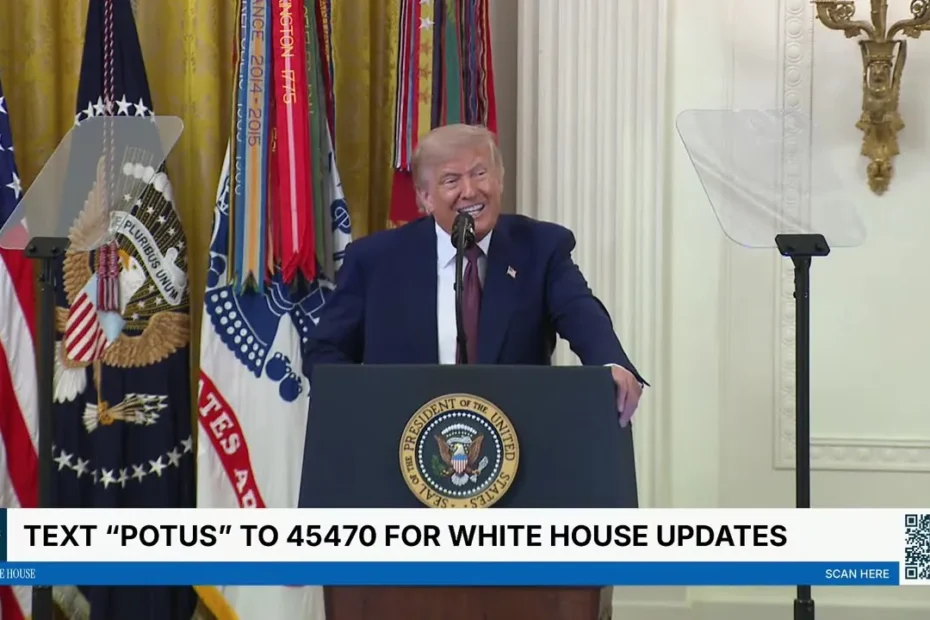
Editor’s Note: In this ceremony, President Trump honors three American patriots with the Congressional Medal of Honor, the nation’s highest military distinction. The event pays tribute to the extraordinary courage and sacrifice of Major James Capers, Colonel John W. Ripley, and Major Nicholas Dockery, recognizing their heroic actions in defense of their country.
Opening Prayer
SPEAKER: Ladies and gentlemen, I invite you to pray with me. Almighty God, you are our rock, our fortress, and the sustainer of this nation. Every perfect gift comes from your hand, and we give you glory for the courage you have woven into the soul of our armed forces. You teach us that true devotion is proven in sacrifice, and today we honor these three patriots who on the field of battle proved their devotion to their comrades and their nation.
Father, we thank you for Major Dockery, who braved a ferocious ambush and at times shielded his men, for Major Capers, who despite grievous wounds refused to yield, and for the enduring legacy of Colonel Ripley, who through a hail of gunfire halted a massive advance by the enemy. In their heroic actions, we see the living truth of your word. “Greater love has no one than this, that they lay down their life for their friends.” Their profound sacrifice in moments of extreme peril blesses us still today.
Now, Lord, we ask you to move in our hearts, pour your abundant strength into our service members and their families, guide our Commander-in-Chief and military leaders, and bless the United States of America. Unify us in spirit, and keep us forever grounded in your grace. In your name I pray, amen.
President Trump’s Remarks
PRESIDENT TRUMP: Well, thank you very much, everybody. And we’ll be seated. We have some very important business to take care of. I just do want to say, though, the stock market just hit a new all-time high. The 401Ks just hit a new all-time high. And oil is dropping like a rock. Other than that, it’s another day in paradise.
Thank you very much, Chaplain. And I have no higher privilege than serving as the Commander-in-Chief of the U.S. Armed Forces. I’m so proud of them. A 250-year tradition of the bravest and greatest heroes ever to walk the Earth. But only a few have received our highest military distinction, the Congressional Medal of Honor. I wanted to give it to myself, but I was informed I couldn’t do it. And I couldn’t find anything where I was actually worthy. So here we are. You understand that?
But today we present this award. It’s the greatest of awards to three new recipients. Marine Corps Major James Capers, Marine Corps Colonel John W. Ripley, deceased, and Army Major Nicholas Dockery. Thank you.
Distinguished Guests and Medal of Honor Recipients
We’re pleased to be joined on this occasion by the Secretary of War, Pete Hegseth. And he’s had some good victories lately, I will tell you. He’s going to have a lot more. Ambassador to the United Nations Mike Waltz. Mike, thank you. Chairman of the Joint Chiefs of Staff Dan Koehn, Acting Secretary of the Navy Hung Kao and Commandant of the Marine Corps Eric Smith, thank you very much.
With us as well are Senators Lindsey Graham, Todd Young, and Jim Banks, and members of Congress Morgan Griffith, Ralph Norman, Jim Baird, Victoria Sparks. All great people. All great fighters, every one of them. Know them all.
I also want to salute 11 former Medal of Honor recipients. Barney Barnum, Kyle Carpenter, James Livingston, Joe Marm, Jim McLuhan, Dakota Meyer, Patrick Payne, Earl Plumlee, Ed Byers, Will Swenson, and Brian Thacker. Thank you all. It’s great to be with you again. Thank you. They’re great people.
Tribute to Major James Capers, Jr.
The first hero we pay tribute to today is one of the finest warriors to ever wear the uniform of the United States Marines, Major James Capers, Jr., sitting right here. Thank you, James. In Vietnam, the Corps promoted him from Staff Sergeant directly to Second Lieutenant, unusual, making Jim the first black Marine in history to receive a battlefield commission in the middle of a war.
In 1967, deep in the jungles of Vietnam, Jim and his nine-man Force Recon Team, known as Team Broadminded, attempted to locate a suspected enemy base camp near the village of Phlu Lac.
Jim’s Heroism: Four Days of Brutal Combat
Over the course of four days, under Jim’s leadership, Team Broadminded repulsed brutal attacks, as brutal as they’ve ever seen, cleared trails of bloody traps, and killed more than 200 of the enemy. The enemy was going down quickly. They never really knew what the exact number was.
On the fourth day of battle, a numerically superior force of Viet Cong soldiers launched a truly devastating ambush. Explosions shredded the air, sending Jim into a tree, ripping open his abdomen and breaking his leg — badly, badly broken leg. Shrapnel peppered his body in 17 places.
I hope this isn’t giving you some bad memories, Jim, but I’ll tell you, everybody admires you — what you went through, believe me.
Every one of his fellow Marines went down wounded, but Jim rose, pushing forward on a leg that shouldn’t have been able to carry any of his weight. After a shot of morphine, Jim asserted command of the firefight he took over like nobody has ever seen before. Barely clinging to consciousness, he called in close air support for an entire hour. Very dangerous. It was sometimes a little bit too close. And it was the only force strong enough to repel the onslaught of a lot of very tough soldiers on the other side.
Once an extraction helicopter reached his team, Jim loaded his wounded men first before finally loading himself. When the helicopter groaned under the weight of his entire team — too many people — he attempted to deplane, but his team physically held him back, refusing to leave their leader behind.
A Long-Overdue Medal of Honor for Jim
For his incredible valor, Jim was recommended for the Medal of Honor in 1967, and everybody knew he should get it.
But life is life. His commanding officer, who was his biggest fan, was tragically killed before the paperwork was signed. That’s a bad break, but now you’re doing it. Maybe this is better. You had to wait a little while, didn’t you, huh?
Jim, the nation kept you waiting far too long. So I say to you, congratulations. You made it. Thank you. Congratulations. Thank you, Jim. And thanks as well to your niece, Renee, and her son, Eric, who I just met — what great people — and brother-in-arms Joe Rodriguez, a big fan of yours. Thank you very much. Congratulations.
Honoring Colonel John W. Ripley
Next we honor another legend of the United States Marines who is sadly no longer with us, Colonel John W. Ripley.
In the spring of 1972, the North Vietnamese prepared their Easter offensive, the largest ground invasion since the Korean War. It was a big, big invasion. Over 30,000 North Vietnamese soldiers and 200 tanks, lots of other equipment, high-level, began to penetrate deep into South Vietnam and collapse the embattled republic. The only thing standing in their way was a bridge across the Chu Viet River and the extraordinary courage of then-Captain John Ripley. Everybody knew he had that.
The Bridge at the Chu Viet River
As North Vietnamese forces surged to the North River Bank, it became clear that the assault could only be stopped by destroying the bridge. Vietnamese Army engineers had stockpiled over 500 pounds of explosives that needed to be personally placed under the bridge. As the only soldier with sufficient demolition experience, John reached for the first load of explosives.
Everyone said, “Don’t do it, John. Don’t do it.” He grabbed the steel girders above his head, and hand over hand, he climbed, dangling beneath the bridge and over the rushing water with a lot of very angry people watching him. Completely exposed to withering enemy gunfire, John completed not one, not two, but five such trips. He was a strong guy, a very strong guy.
At one point, John remembers a tank round blasting into the bridge and knocking him temporarily unconscious. For five straight hours, he hauled explosives, placed charges, and ran a primer cord to each one of them. He later recalled reciting a simple prayer, “Jesus, Mary, get me there, just get me there.”
When John detonated the explosives, the bridge collapsed into the river, crushing the advance and saved the hope of a free Vietnam for Easter morning.
Posthumous Medal of Honor: Captain John Ripley
For his heroic deeds, John Ripley was given the Navy Cross, and today we posthumously award him the highest of all awards, the Congressional Medal of Honor. And we’re grateful to be joined by his sons, Tom, John, and Steve, grandson Stephen Lewis and Francis, and his beautiful daughter-in-law, Alexandra.
And so I want to thank you all for being here, and congratulations. You have extremely good genetics. So congratulations. Please. Thank you. Thank you very much. Congratulations. He’s looking down on you. You know that, right?
Medal of Honor: Major Nicholas Dockery
Finally, we honor a hero of the war on terror, Major Nicholas Dockery. On October 2nd, 2012, Nick’s platoon was guarding the compound of the governor of eastern Afghanistan when they were ambushed by 150 Taliban fighters swarming in from multiple directions. They came from all over the place.
The enemy unleashed overwhelming torrents of fire from machine guns and rocket-propelled grenades without concern for his own life at all. Nick raced across the open ground to rally his scattered team. They were all very concerned, very nervous. There was not a lot of hope.
When word came that Sergeant Eric Mitchell was wounded and pinned down inside the compound, Nick went after him without even hesitating. He personally spearheaded the rescue, kicking down doors and clearing room after room. He was looking for him. He was going to find him. At one point, he killed a Taliban fighter and detained two others.
As he reached Sergeant Mitchell, a grenade came raining down without thinking. Nick tackled Sergeant Mitchell, likely saving his life. When the smoke cleared, every man was wounded, but none were dead.
Nick did a quick headcount and realized one of his team members was still missing, Sergeant Jack Hansbrough. Nick rushed through the compound until he found the sergeant being dragged unconscious through an alleyway by two Taliban fighters with very bad intentions. Nick eliminated both terrorists in close quarters, then pulled Sergeant Hansbrough back to cover but found he was not breathing. So urgently, Nick administered CPR until the sergeant’s heart kicked back in.
As mortar fire thundered down all around them, Nick covered his incapacitated teammate with his own body, shielding him from further injury. In his final act of unbelievable valor that day, Nick climbed his way to the open roof where he was again vulnerable to Taliban gunfire at highest levels. He signaled enemy positions with smoke grenades, allowing American gunships to come to the platoon’s rescue.
Major Dockery, you were the last man to depart the battlefield that day, and you left it a legend and a hero. We proudly award you the Congressional Medal of Honor. Fantastic. Please. Fantastic. Please. Thank you very much.
Joining Major Dockery today are his younger brother, Blake, his partner, Jennifer, grandmother, Mary. Oh, Mary is something. I like Mary. Where is Mary? Where are you, Mary? Where are you, Mary? I love Mary. She said, “I’m a big fan of yours.” You know, I like people that are fans of mine. Thank you, Dennis. Great to be with you, too.
A friend and colleague, Chris, and five members of his unit on the day of the attack. John, Morgan, Will, Joey, and Roshan. Would you guys stand up, please? Wouldn’t you do that? Wow. And we’re going to get them some of those coins, Nick, okay? We’re going to get them some of it. It’s not the Congressional Medal of Honor, but it’s pretty good. So you have to remember that. They’ll take care of that.
Closing Remarks
As we approach the 250th anniversary of our founding, we remember that we owe everything to heroes like those we celebrate today, men who went willingly to the darkest and most dangerous corners on Earth to defeat evil so we could live free. That’s exactly what happened. These are great men, great people. We thank you, and we will never, ever forget you.
And now I’d like to ask the military aide to come forward and read the citations, please. Military Aide, James Capers, Jr. Military Aide, James Capers, Jr.
Medal of Honor Presentations
The President of the United States, in the name of the Congress, takes pleasure in presenting the Medal of Honor to Second Lieutenant James Capers, Jr., United States Marine Corps.
The President of the United States, in the name of the Congress, takes pleasure in presenting the Medal of Honor to Second Lieutenant James Capers, Jr.
The President of the United States, in the name of the Congress, takes pride in presenting the Medal of Honor posthumously to Captain John W. Ripley, United States Marine Corps.
The President of the United States, in the name of the Congress, takes pride in presenting the Medal of Honor to Second Lieutenant Nicholas Dockery, United States Army.
The President of the United States, in the name of the Congress, takes pride in presenting the Medal of Honor to Captain John W. Ripley, United States Army.
The President of the United States, in the name of the Congress, takes pride in presenting the Medal of Honor to the world. In your name, I pray. Amen.
The President of the United States, in the name of the President of the United States, in the name of the Republic for which it stands, one nation, under God, indivisible, with lidable power. Until it is done.”
Related Posts