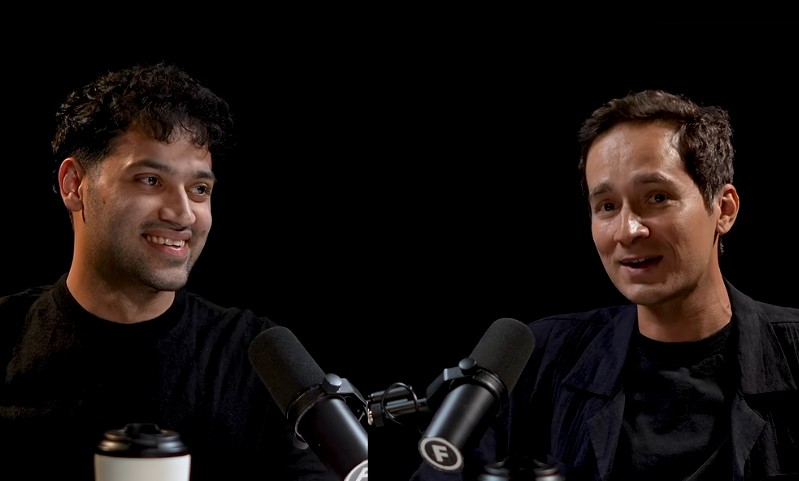
In this episode of Figuring Out (FO571), Raj Shamani sits down with neuroscientist and self-described “molecular philosopher” Nikolay Kukushkin to explore how memories are formed, why we forget, and how repetition, surprise and dopamine shape who we are. Kukushkin explains the science behind flashbulb memories, the memory palace technique, earworms, childhood amnesia, sleep and motivation, and shares practical ways to forget bad memories, beat procrastination and rewire your brain. Read the full transcript of this interview below:
Who Is Nikolay Kukushkin?
RAJ SHAMANI: (00:01:58 – 00:04:40) You’re one of the top memory scientists. You study brains and minds. You study evolution. You have studied so many different species’ brain and mind and how memories get formed. So, you understand at this point, what are we thinking, how are we thinking, and how do we remember things much better than probably most of the people. Right.
Welcome on Figuring Out, Nikolay Kukushkin. It’s an honor to have you. If somebody is watching you for the first time and they have no clue what you do, they don’t understand what memory scientist is, how would you explain them what do you do and why should they watch this podcast for next couple of hours?
NIKOLAY KUKUSHKIN: (00:04:42 – 00:05:37) Well, I like to call myself a “molecular philosopher,” which sounds like a joke, But I say this because those are the 2 extremes of brain, life on Earth, reality that I’m interested in. I’m interested in the smallest material components of what makes us ourselves, and I’m interested in the biggest, most abstract, most philosophical things like memory, consciousness, motivation.
What I’m most interested in is how one transitions into another, and that is what I study in the lab. I want to understand how the smallest, most basic components of living matter, molecules, cells, create those features of our mind that we consider almost magical, like memory and consciousness.
RAJ SHAMANI: (00:05:37 – 00:05:44) Nice. And if somebody is watching this podcast and they’re going to finish it, what are they going to learn?
NIKOLAY KUKUSHKIN: (00:05:45 – 00:06:25) Well, I think what they might learn is how we think, what motivates us to do the things that we do, what decides what memories we retain and what memories we discard. And I hope that it gives them a more peaceful way to live with themselves by recognizing which parts of our human nature we can’t change and what we need to do to have a peaceful relationship with them.
Can You Force Your Brain to Change?
RAJ SHAMANI: (00:06:26 – 00:06:29) Tell me, can I force my brain to change?
NIKOLAY KUKUSHKIN: (00:06:30 – 00:06:44) Well, anytime we’re learning something, we’re forcing our brain to change. That’s what plasticity is. You’re forcing new information into that brain. I think what you are asking is, can you force your brain to remember things better.
RAJ SHAMANI: (00:06:44 – 00:06:47) Or can I force my brain to become a different person?
NIKOLAY KUKUSHKIN: (00:06:48 – 00:06:57) Well, again, there is no such thing as repetition. If you’re repeating something, you’ve already modified it.
RAJ SHAMANI: (00:06:58 – 00:06:59) What do you mean by that?
NIKOLAY KUKUSHKIN: (00:07:00 – 00:08:05) Any new experience is written over a new brain. Any time you’ve experienced something, you’ve changed something in your brain. People are worried about this or that changes my brain. They think of that as something bad, or in this case, it’s something that you want. But There is no avoiding that. You are constantly changing. Every experience that you’re encountering changes your brain, and not just your brain, your entire body changes.
That’s what my work shows, that actually the kind of mechanisms that our brain cells use to register events that are happening to them, those same mechanisms work in every cell of the body. Kidney cells are registering kidney things, gut cells are registering gut things. Brain cells are registering brain things.
So there is no way that you can avoid changing who you are and what your body is. The question is, how do you route it where you want it to go? You can’t stop this process. You can only trim it, direct it, adjust it, work with it like with a garden.
Repetition Without Repetition
RAJ SHAMANI: (00:08:06 – 00:08:26) But wait, you just said 2 things right now. And they both are very contradictory in my brain. First is you said every time, even if I’m remembering the same thing, it’s new. It’s not the same thing. It’s not repetition. There’s nothing like repetition. Is that what you’re saying?
NIKOLAY KUKUSHKIN: (00:08:27 – 00:09:26) You’re repeating it, but it’s not the exact same thing as what happened before. This is the phrase by, I believe, Russian physiologist Vygotsky, “repetition without repetition.” When you’re learning a skill, every time you’re repeating it, you think that you’re repeating it. By the time you’ve repeated it, your body has already changed, your muscles have changed, your brain has changed, and you’re adding on to that change. You’re solidifying that change. You are directing that change. You are restricting possible movements.
When you’re learning a skill, for example, the first thing you need to do is block out the movements that don’t lead you to that productive action that you are trying to achieve. First, you block that out, you restrict the paths that lead to that action. And then you optimize what are the movements that might lead to it. But every time you’re practicing that skill, your brain adds a little layer of learning. There’s just no avoiding that.
RAJ SHAMANI: (00:09:27 – 00:09:41) If I meet you today and we hug each other, we shake hands, and then we do this one week later, and then 3 weeks later, and then one month later, every time that handshake is different. Of course.
NIKOLAY KUKUSHKIN: (00:09:41 – 00:10:23) Well, the next time you will remember me, we’ll be better friends.
Every experience is different, even though it doesn’t seem like this to us. It’s very hard to believe that you are a different person, because we inhabit this body. We look from these same eyes into the mirror, we see this object, with the face, with the hair, and we think that it’s static. We think that it’s the same thing as it was yesterday. But that’s just not true. We’re different every day and every minute and every second.
RAJ SHAMANI: (00:10:23 – 00:11:05) When did you find this, that there’s nothing like repetition? Because as someone who loves practicing a certain craft or actually becoming better, my whole brain and my everything in my practice just goes like, okay, if I repeat something for n number of times, I’m going to get better. So I’m repeating the way I talk, the way I’m breathing, the way I do a certain exercise, the way I’m actually writing, everything I’m repeating.
And that’s the concept that repetition makes you better. And you’re saying there’s nothing like repetition because you’re a different person. So when did you find this out? It makes sense, though, whatever you’re saying.
How a Neuron Knows What Is “Again”
NIKOLAY KUKUSHKIN: (00:11:05 – 00:14:29) Don’t get me wrong. I’m not saying that there’s no point repeating anything. No, repeating something is the surest way to get better at something, to learn something. That’s the pattern that tells our brain that something is important. Really, our brains memorize important things and repeated things. And if you want to memorize something that your brain doesn’t naturally think is important, the way to convince it that it’s important is to repeat.
All I’m saying is that in order for this repetition to work, the first event, the first repeat has to modify something in your brain, in your body that has to carry over to the second repeat. And that second repeat has to land on that. Somehow your neurons, your body, your cells need to know that it’s not just one more. It’s not just an isolated event, but it’s again, it’s something that’s layered on top of a previous repeat.
And that’s been my longstanding interest in how does a neuron know what is “again”? Yeah. What is retained that is not the memory itself, but something else that is retained within that cell? Because we see it in single cells in a petri dish. What is it that is retained in that cell that then plays out when the second event lands to cause something that the first event didn’t? How do we get from 1+ 1+ 1+ 1, and that doesn’t equal 4, But it equals more than 4. That’s the real question about this again versus not again, repetition versus not repetition. Explain me how and why.
Well, for example, in one of our studies, we showed that there are 2 molecules inside of a neuron that cancel each other out, that interplay with one another, and you activate those molecules to a different extent depending on the strength of the stimulus and depending on how much you activate them. Their activities remain in the cell for a long time or a short time, and one of them wins over or another one wins over. It’s a fine dance between these 2 molecules.
And what it means in practice is that if you stimulate that neuron in an escalating pattern, if the repeats become stronger every time, then those molecules play out in such a way that the activating one will eventually win over and the memory will form. If you do the opposite, if the repeats wane, if the first one is the strongest and then it goes weaker, weaker, weaker, weaker, then the deactivating one ends up winning and no memory is formed.
And that makes total sense because anything in nature that escalates, well, it’s more important than anything that wanes. And you have to prioritize. You can’t remember everything. You have to choose what to remember. And that’s what really memory is about. It’s not just storing, piling information into your brain. It’s prioritizing. It’s recognizing patterns. It’s selecting patterns that are relevant. And escalation is a more relevant pattern than dissipation or waning.
So that’s an example. You have this dance of these 2 molecules, and that is what retains the trace of repetition and determines what kind of pattern you will remember or not remember. Interesting.
Mental Hygiene: Tending Your Brain Like a Garden
RAJ SHAMANI: (00:14:29 – 00:14:51) So how can I actually train my brain and every cell to remember the good things, the positive habits, the things which are difficult to do, and not the bad things? Because my body automatically remembers the bad thing, even though if I’ve done one time, it just remembers it somehow. But the good things, it doesn’t.
NIKOLAY KUKUSHKIN: (00:14:51 – 00:18:58) Well, first of all, I bet that in your case and in my case, there’s plenty of bad things that we simply don’t remember about, and that’s why it seems that they never happened. But what I always find is that bad memories actually fade a lot faster than good memories. That’s what keeps me sane when I’m traveling somewhere and I have all these stressful experiences, and that might be stressful in the moment, but I know that eventually that will fade and what I will remember is the good things, and that gives me comfort.
So how do you make that happen artificially? Well, I think that there is no trick to remember good things or bad things. The trick is to perceive the right things, to filter through your brain what you want to remember, how you want to remember it, and in the frame that you want to remember it.
I don’t think we talk enough about mental hygiene. We understand that there are certain healthy habits that we have to apply to our body. You need to wash your hands, you don’t eat too much junk food, you have to eat plenty of fiber, drink water. We’re all familiar with these ideas that mainstream, it’s indisputable. But there’s a lot less discussion of doing the same thing with your mind.
We’re consuming a lot of mental junk food and it seems that it just disappears and it doesn’t do anything. And one day it’s here and another day it’s gone, but it’s not. Everything that we’re consuming mentally or physically leaves a trace. So in order to ensure that long-term your memories are healthy and happy and point you to the right direction, you have to tend to your brain like a garden. I’m going to keep repeating that line because that’s really how I think.
We like to think that everything in our memory just happens in one moment, that you can dump some memory into it and it gets stored in there and that’s what it is. But memory is a constructive process. It evolves, it changes depending on who you are and how you think. So memory is constructive. It’s what you project onto it.
The 9/11 Flashbulb Memory Study
There are famous studies into false memories, for example. Maybe you’ve heard about the 9/11 study. This was the one case where you could track a memory across large populations of people because everybody had experienced— everybody who was alive at that point experienced 9/11. And they all formed what’s called a flashbulb memory, something that you can vividly recall and you’re 100% certain in what it looks like, where you were. I have that image.
So researchers talked to people a day after the event, then a week, a month, and about a year afterwards, and they interviewed them about that same memory and they tracked how much it changed and how much confidence people have in that memory. And what turned out is that the confidence stays exactly the same. For this flashbulb memory, you ask a person and they say, “I’m sure. Yeah, this is exactly what happened. It’s right in front of my eyes.”
But the details that they recall from that memory, a third of them disappears by a month and even more by a year. I’m not exactly sure of the exact numbers, but that’s the scale of it. So what does that mean? It means that there’s a disconnect between what we perceive to be the accuracy of a memory and what it actually is.
Any time you are recalling a memory, you are rewriting that memory and it becomes a little bit your imagination. And every time you keep doing that, this imagination is introduced into the memory more and more and more. And you don’t feel that. You don’t know that something has changed about your memory. So think about that and think about everything else that you remember about your past, your entire autobiography. We have no idea how much of this actually is true. It’s a confabulation in large part. It’s a story that we keep telling ourselves.
RAJ SHAMANI: (00:18:59 – 00:19:11) So you are telling that half of the things, or more than half of the things that I remember about myself or the past version of myself or a certain experience that I’ve gone through, it’s all my imagination. It never happened.
NIKOLAY KUKUSHKIN: (00:19:11 – 00:20:02) It might be. If you are like most people, then it probably is. And I think it’s fascinating that we as a society now have ways of checking. We have writing, we have photography, we have the internet. But go back a few thousand years ago and that just wasn’t a reality. There wasn’t a way to check whether or not your memory is true or not.
And so history moved at a much faster pace. Without writing, everything changes within a generation. All the shared memories basically are replaced with imagination. So it’s very difficult to go back in time, even today, to societies, to cultures that don’t have writing and think about the past.
Why We Forget Once a Task Is Complete
RAJ SHAMANI: (00:20:02 – 00:20:18) Are there certain things that people make up more versus certain things that people don’t make up more? There are probably certain experiences where there’s more accuracy in remembering, And there are certain events where majority people are just imagining things up.
NIKOLAY KUKUSHKIN: (00:20:19 – 00:22:53) Well, so the same 9/11 study also tracked everyday memories, just your regular memory of what happened today. And what they found was that actually the rate at which this flashbulb memory, the 9/11 salient memory, I imagine it just as it was, the rate at which it decayed was exactly the same as the rate at which everyday memories decay. It’s actually really remarkable how closely they tracked each other.
What was different is the impression that people have about the accuracy of the memory. So I think it is likely that most of our memory dissipates at a more or less even pace. And what is different in our imagination is how much accuracy, how much confidence we attribute to this memory or that memory.
That being said, for example, there is well-known literature on the fact that you forget things faster if the task is complete. If you decide for yourself that I’m done with this, I no longer need to remember this, even if you really want to remember it, but if your brain decides that the task is over, the memory is gone.
I experience this all the time with my students. I think that I’ve trained myself to remember student names fairly well. I usually have 3 sections of 25 students, so 75 people per semester. It’s a pretty sizable memory task to remember, but I know that in 2, 3 classes, all of their faces will become salient. I will attribute all the names. Embarrassingly enough, it is a little bit slower for students from other cultures, which I think everybody experiences, but it will happen.
But then, When I’m done with the semester, poof, it’s gone. And I want to remember all my students. I want to remember their names when I see them in the street, but it’s almost like a wall that I’m hitting. What’s especially interesting to me that’s unrelated, that when I see a student later in the street and I think, “Oh, I lost the name, I don’t remember it,” I will think about it and I’ll think about it and I’ll think about it and then it will pop back in.
What I’m most interested in, and I really don’t know the answer to this, is What is happening in my neurons when I’m doing this that later, sometimes hours after that, will cause them to boop and produce that memory? That’s what I’m really deeply interested in.
RAJ SHAMANI: (00:22:53 – 00:22:55) And you don’t have an answer for that?
NIKOLAY KUKUSHKIN: (00:22:55 – 00:23:26) I don’t have an answer. My guess is that there are some biochemistry, some genes are getting turned on, some proteins are getting produced. What’s fascinating to me is that it takes time. It doesn’t happen instantly. It doesn’t happen in that moment when I’m straining. It’s not like something breaks through a wall in that moment. It’s some slow process that requires time to fully unfold, and then it just delivers that memory to me as if it was always there. That is just magical to me, and I wish that I understood exactly what was going on.
The Memory Palace Technique
RAJ SHAMANI: (00:23:26 – 00:23:30) Is there a trick to remember everyone’s name when you meet them?
NIKOLAY KUKUSHKIN: (00:23:30 – 00:25:56) A lot of people use a technique called memory palace. All the people who competitively memorize something, there are real competitors out there, people who do this for a living, they pretty much all of them use this technique called memory palace. What is that? It was actually invented by ancient Greeks, ancient Greek philosophers who put a lot of emphasis onto memorizing.
It’s interesting, we think of the internet and AI as things that we outsource our mind to and that makes us dumber. They thought of writing the same way. If you’re writing things down, you’re not a proper Greek philosopher. You got to be memorizing things. So they put a lot of value onto it.
So what it is is basically creating a visual scaffold for your memory. You have to cultivate it, you have to work on it for a while. You have to imagine this elaborate space like a palace or castle or just a big room or something with closets and cupboards and corners and objects. And then when you’re trying to remember something, you are mentally placing that into a particular shelf or cupboard or onto an object or somehow visually placing that in that memory palace.
And that just associating this new information with something that you already have in your brain, that helps you tie it to your existing mental model because that’s really how we add new information to the brain. We like to think that memory is just this hard drive to which we can dump anything and it wouldn’t matter. That’s how we deal with computers. A computer doesn’t care what kind of file you place on the hard drive.
But we need to think about our own memory not so much as a hard drive as much as modifying the thinking paths, modifying the thinking machine. That’s what our memory is. And so it is a lot more efficient if you’re modifying something that’s already there rather than just trying to add something that’s completely irrelevant to anything else in your life.
So if you can find some association, it doesn’t need to be smart, just some visual or auditory association between a name, something else that it reminds you of. Put that into a corner of that memory palace and then remember to get back to it whenever you see that person again. That will improve your memory.
RAJ SHAMANI: (00:25:57 – 00:26:21) Yeah, I’m just thinking about the things that I do. Every time I meet a new person, especially let’s say in my team, and there are hundreds of people And it’s very difficult to remember everyone’s name because you don’t meet them on an everyday basis. And whoever I meet, if I know their hometown, then I immediately associate that person from that particular town and then remember their name.
NIKOLAY KUKUSHKIN: (00:26:21 – 00:26:59) That’s exactly right. You’re constructing a tiny memory palace by simply doing that. It doesn’t have to be a physical space. I have a big memory palace for biology. I already have a lot of base for that. So it’s easy for me to read a paper and just attach it to what’s already there. I can’t do that with music. A musician would hear a melody and would parse it in ways that would make sense to them and attach it to their model, to their memory palace. By thinking through those details that you associate with the name, you are growing that name deeper into your brain, and that makes sense that it would be easier to remember.
Why Forgetting Matters: The Story of Mr. S
RAJ SHAMANI: (00:26:59 – 00:27:16) Interesting. It makes sense, but there are some people who remember bad memories and they can’t move away or just move on from those bad memories. Why some people remember bad memories more than good memories? Is there a reason?
NIKOLAY KUKUSHKIN: (00:27:17 – 00:30:32) Well, our ability to memorize is separate from our ability to forget, and both of them can be at different levels. And the temptation is to assume that the important one is the remembering and the less important one is the forgetting, that we want to remember as much as possible and we don’t want to forget anything. But your example illustrates that forgetting is just as important, is just as much a part of this process of learning.
An even more vivid example is people with photographic memory, with extreme memory. It’s very rare, but there are cases described in literature of people who have this astonishing memory that is impossible to even imagine for us normal people where— well, there’s one famous one in Soviet science, Solomon Shereshevsky or Mr. S as he’s known in English.
Mr. S had the kind of memory that you could read him a foreign language Divine Comedy in Italian. He didn’t speak Italian, but you would read him Divine Comedy in Italian unprompted. You don’t tell him to do anything. Years later, he would recite entire pages of that or mathematical equations, just numbers, pages of numbers. He would be able to recall that from memory.
And a lot of us might think, great, that’s what I want. That’s amazing. I will never forget anything. But it wasn’t a gift. It was a disability because his life was basically unlivable. Everything that happened to him ignited this explosion of associations. He couldn’t focus on anything because everything caused anything. Anything that he tasted tasted like everything that he had ever tasted. It all came into these different— every kind of food that he’s ever put in his mouth.
He couldn’t understand anything metaphorical. Because a metaphor is an abstraction. You need to remove yourself from specifics and you see a big picture. You need to see a generalization. He couldn’t do that. He remembered everything specific, but he couldn’t abstract himself because that requires forgetting.
Yeah, he had trouble remembering people because he remembered how their face looked from this side, how their face looked this side, but he couldn’t compile that into this generalized image of this is that person. He remembered each side of their face separately, and it was very hard for him to compress that into a knowledge of an individual person.
So that kind of life where you remember everything, it is far from pleasant. We need to forget as much as we need to remember to maintain sanity so that we forget the bad memories, like you said, but also so that we could think, so that we could process reality in real time, so that we could see patterns in it rather than just specifics.
How to Forget Bad Memories
RAJ SHAMANI: (00:30:33 – 00:30:35) How can I learn to forget bad things easily?
NIKOLAY KUKUSHKIN: (00:30:37 – 00:33:24) Well, most things in our brain fade over time. And most things that we hold on to, we recreate. So I think the number one advice is step out of the recreation and allow the forgetting to take its course. Even addiction. Addiction is a form of memory, whether it’s addiction to a drug or addiction to social media. It’s a memory that we decided is bad for us. Really, there is no line that separates addiction from non-addiction except a doctor says that’s really a problem for you and you should not do it.
So how do we get rid of it? Well, social media is probably the easier example. But if you step away from it, it’s going to be hard for a few days. But the dopamine system that draws you into it, it gets recalibrated on a scale of days. A couple of weeks, and well, maybe you won’t return exactly to the baseline where you were without knowing what social media were, but you will get most of the way there, and your brain will recalibrate, and you will be able to perceive the same social media freshly and see them in a different light.
So I think that applies to most memories. You need to find a way in which you yourself don’t bring that back. Refocus on something else. Don’t talk about it. If you’re talking about it, you are recreating that memory in your own mind. You think that you’re talking it through, and in some cases that’s important if the memory is unresolved, or there’s something about it that still occupies your mind.
If that’s the case, if it tries to resolve itself, find the solution and you can’t quite find it, then it will be there until you find the solution, then you do want to talk through it. But if it’s purely something that was a bad experience that you don’t want to hold on to, then talking about it won’t help. And the best that you can do is focus your attention somewhere else, occupy your brain with a different task, find something that’s totally different that will make you forget about it, go and travel for a couple of weeks, and that will naturally let that memory fade away.
So I think the thing to remember is that everything is always in flux. It’s not just sitting there in a hard drive. It’s more like a feed in social media. Things that you don’t interact with, they will eventually drop to the bottom of that feed and will get forgotten. And it’s the things that keep getting comments added and keep getting likes that will stay on top of it. And they can stay there forever if you keep doing that.
Rumination vs. Productive Discussion
RAJ SHAMANI: (00:33:24 – 00:33:39) But don’t you think a lot of people say, and a lot of experts, they say that “Talk about your bad experiences. Talk about what you’re thinking. If you won’t talk about it, if you won’t relive it, you won’t be able to heal it. You should talk everything that you’re going through.”
NIKOLAY KUKUSHKIN: (00:33:40 – 00:33:41) Yeah. Well, I think that—
RAJ SHAMANI: (00:33:41 – 00:33:55) but if you do that more often, according to your theory, then it’s bad because you’re technically reliving it. And every time you relive it, you recreate and you add a little bit of your imagination and story to it. So you’re making it worse because every time you’re reliving the same emotion.
NIKOLAY KUKUSHKIN: (00:33:56 – 00:36:09) I think that we need to distinguish between reliving an emotion and talking through the unresolved. Because I think that, at least for me, a lot of my negative emotions, they come from this repeated engagement with something that I can’t change. Something that is on my mind because there’s nothing that I can do about it. And if I talk about it, it only escalates that emotion. And that’s what gets written into my brain. And that’s what keeps me coming back to it. And because there is nothing in the end of that loop, I don’t think that talking more about it helps.
I watch people talk about politics, which I prefer to avoid. And a lot of times I see that people dig themselves into a hole. They know that they can’t change anything. But they still try to do that with their mind. And I think there’s value in stepping away from that attempt to resolve a pattern and instead refocusing on something else.
But there are other cases where you refuse to engage with a problem that does have a solution. When you are stuck in a pattern in your life that requires you to overcome something, to make an effort to get to a new place, to change something about your relationship or to find a new job. And in those cases, it is talking about it that will get you there, that will get you over that ledge, that will allow you to push yourself somewhere where you will end up feeling better.
So I think the key distinction is consciously, rationally deciding before you even attend to the emotion, rationally deciding, is there something in the end of this conversation that I’m having with myself, or am I just ruminating? Because rumination is what you don’t want. Rumination is what leads to more stress, to digging yourself deeper into that memory hole and then having a harder time digging yourself out of it. So is it rumination or is it productive discussion? I think that’s the first question to ask to decide, am I attending to it or am I not?
The White Bear Experiment
RAJ SHAMANI: (00:36:09 – 00:36:12) What experiences are really difficult to forget?
NIKOLAY KUKUSHKIN: (00:36:14 – 00:36:33) What experiences are really difficult to forget? Well, the experiences that you are told not to think about, they’re usually the hardest ones to forget. You probably know about the white bear experiment. That’s this famous—
RAJ SHAMANI: (00:36:33 – 00:36:33) No, tell me about it.
NIKOLAY KUKUSHKIN: (00:36:34 – 00:38:00) There’s this famous study where participants were asked not to think about the white bear. Of course, yeah. And what usually you hear is that, well, if you’re asked not to think about it, you think about it more. More. Yeah, it’s not quite how the study worked.
What’s interesting is that you can actually suppress a memory during the experiment if you’re actively trying not to think about it. You can redirect yourself to a different memory, sort of whack-a-mole that white bear, and avoid thinking about it. But then the moment you said, “Okay, you no longer have to do that,” all you can think about is this— the white bear— it rebounds, and then it comes back to haunt you. So the lesson is not that we can’t suppress a thought— we can— but the more you suppress it actively, the more it might come back to bite you in the future.
So I’m not suggesting— when I say don’t think about a negative memory, I’m not suggesting whack-a-moling that memory that keeps popping up. I’m suggesting finding something else that will engage you and will allow you to not think about that thing that keeps sucking you in, because whack-a-mole is not productive. That will make things worse. So make yourself busy doing something else. Exactly, exactly. One term for just a life strategy that I really like is slow motion multitasking.
Slow Motion Multitasking
RAJ SHAMANI: (00:38:00 – 00:38:03) Slow motion multitasking.
NIKOLAY KUKUSHKIN: (00:38:03 – 00:39:44) Slow motion multitasking. What is it? Well, we know about normal multitasking is when you have 15 tabs open and you’re doing multiple jobs at once. And we know that that’s not good. That leads to distraction. You end up not doing anything, any of those jobs productively. Slow-motion multitasking is having different domains of your life into which you can refocus when the current thing that you’re doing is giving you some trouble.
That’s what I genuinely live by. I have my research, I have teaching, I write books, I love to travel. There’s lots of different things that are not connected to each other that I can isolate in my mind and do just that. And one time or another, I will run into some problem in research, I’ll hit some wall, and it will seem like there’s nothing that I can do about it, and it will occupy my brain, and it will get me really stressed out.
And what I do in those moments is I just set it aside, and I focus on my teaching or my writing, and I try to just completely forget about that research. For maybe a few days. And then when I come back to it, I look at it with fresh eyes and my brain has removed that thing that was causing me stress. And without it, I can see clearly the problem and sometimes I immediately find the solution.
So I think it’s a good strategy for anybody. Find your things where you can refocus. Don’t just drill down on one thing because you will inevitably hit a wall. And you will want something to refocus. Interesting.
Can You Change Your Personality?
RAJ SHAMANI: (00:39:45 – 00:40:16) When you are trying to forget certain things in order to become a better person or change yourself, there are parts of personality that you don’t like, and there are parts of your personality that you like. So, you’re trying to focus on the liking part, you’re trying to avoid the bad parts, and you’re trying to change and become better as a person, right? Mind. Because you study mind, what are the things about my personality that I can change, and what are the things that I can’t?
NIKOLAY KUKUSHKIN: (00:40:17 – 00:44:01) Personality is a complicated thing. As a memory scientist, I tend to think that most of what we are is plasticity. That’s what I study. I like to believe that you can change anything in your brain, that you can adjust yourself to any circumstance and change your character in any way.
But then I look at my nieces growing up and I remember them, how they were at 3 months old and how they now are at 10, 13. And it’s the same person. And you can clearly, at least in hindsight, see how what you watched in a baby who couldn’t talk yet plays out in very clear ways in this adult. So this makes me think that, well, maybe most of our personality is genetically predetermined.
I can’t give you a single answer to which of these perspectives is the true one. I think that all that we can do is to strive for a better self, to do our best to improve ourselves within the constraints that we have, but also understand that there are features of our personality that come to us with our parents, with our genes that we can’t easily overcome.
It can even be difficult to separate when I think about my parents, for example. How much of my personality comes from my genes versus just my parents being around and teaching me and bringing me up? It’s extremely difficult to separate those parameters. Even if you’re looking at twin studies, that’s probably the cleanest way to do that. If you have identical twins that are separated into different families and at birth, then you can really tell how much of their personality is genetic and how much of it is acquired through education. But even that can vary between individuals and between different pairs of twins.
So we know for sure that there are genetic factors on our personality. For example, sensitivity to dopamine, the quantity of dopamine or serotonin, a lower dopamine person will tend to have less motivation, but also be less neurotic than a person with more dopamine. And there are some preset genetically determined factors that decide that.
But none of those factors is set in stone. Each one of them has a degree of freedom. So, even if you are born with low dopamine or if you’re born with high dopamine, It doesn’t mean that you can’t nudge that variable in one direction or another. If you ask my intuition about this, I would put it at 50/50. I would say that 50% predetermined, we can’t do anything about it. 50% comes from culture, education, society, everyday experience. So you can’t hope to change 100% of what you are. But you can always change some.
RAJ SHAMANI: (00:44:02 – 00:44:10) So you’re telling me that 50% of who I am probably was decided even before I was born?
NIKOLAY KUKUSHKIN: (00:44:12 – 00:46:26) Yeah, probably. Probably. I mean, certainly a large amount was decided before you were born. A lot of it was decided before the human species was born. That’s what I really study. The real material foundations of things like memory and motivation and consciousness. And what our studies show is that all of those things are there even before there’s animals and brains and humans, long before that.
Those are all things that cells have. And it’s not just metaphorical memory or motivation. It’s the same process that later gets— later in evolution gets co-opted by our brains, by these complicated neurons that use those same tools that were already there just for more complicated purposes.
So a lot of what we are, for example, the fact that we are drawn to uncertainty, anything that’s unpredictable draws us in. It’s not you or me or our parents. This is built into the fabric of life on Earth. So a lot of those things precede even human society. A lot of them happen at the stage of our parents. It comes from their genes. A lot of it happens at the point when the egg meets the sperm because that’s 50% of dad’s genes meeting 50% of mom’s genes. It’s also a lottery.
And then a lot of it is decided when that embryo develops and when it’s born and when it learns and acquires its own habits and lives in a society. And there is no clear line that separates what happened before with what happens later. I think the unifying read is that it’s the past. Everything about the present moment contains a trace of everything that happened in the past. Everything from the origin of life. There’s been layers and layers and layers and layers that never got replaced, never got eliminated. They just kept layering more and more and more and more without ever discarding what was there in the first place.
Why Every Animal Needs to Sleep
RAJ SHAMANI: (00:46:27 – 00:47:12) See, as what you said right now, the fascinating thing, I’m going to point it out is you said a lot of things that we do today is because evolutionarily we were designed that way, or we’ve been doing that since thousands of years. It’s not because of me or my environment or my dad or my mom or their parents or ancestors or anything of that sort, right? So tell me, what are the things that I do today, which was programmed because of evolution? Or what are the things that we’ve been doing since we were animals? Well, for example, sleep.
NIKOLAY KUKUSHKIN: (00:47:14 – 00:52:33) It’s one of the most universal things about the animal kingdom. Everybody who has a nervous system sleeps. Even sea slugs, they don’t have much of a nervous system compared to ours, but they still need this state in which they basically disconnect themselves from the environment and do nothing. If you think about it from the evolutionary standpoint, it’s an insane idea. Yeah, it’s extremely dangerous. It’s the single most vulnerable point about your entire life. And yet everybody has it.
So, there has to be something about sleep that you just cannot escape, that it’s this hard constraint on having a nervous system that just can’t be bypassed. There’s still debate about what it is. What the consensus seems to be is that it’s about memory, that if you want to accumulate information in your brain, you also need time with that information fades, dissipates.
In our human example, most of the time when we are awake, we’re strengthening synapses between neurons, we’re strengthening connections. So it’s sort of like imagining water flowing down a mountain. It carves its own paths, and depending on how it flows, it carves them in new ways. And next time it flows down that mountain, it flows through those same paths. So experiencing something is carving those paths in your brain.
But you can’t just be carving and carving and carving and carving. If you just keep doing that, eventually everything will be flat and smooth, and there will be no distinction between this memory or that memory. And that’s what we really need. So you need something that pushes against that carving and restores the bedrock. That’s what sleep does. It counteracts the strengthening of synapses by this average weakening.
So during the day, you are mostly strengthening some synapses, the ones that you use. You’ve done something, you strengthen those synapses. You’ve done something else, you strengthen those. But you haven’t used this, this, and this one. And while you sleep, all of them get reduced in strength. So the ones that you haven’t used go below where they were the day before. The ones that you have used, they return to some sort of average value, but they’re still stronger than the ones that you haven’t used.
So, the differences are preserved, but the overall average strength is rebalanced to the same average value. That’s called homeostatic scaling. That seems to be why all animals need to sleep. If you want to form memories, you also need to forget them, and for that, you need to stop experiencing. And allow for that process of scaling.
There are other things that sleep does as well. We have different phases of sleep. It’s a complicated process, and it’s not just everything gets weakened. We also see dreams, for example, and dreams are also about memory. But that is a little bit different. It’s about finding unexpected combinations of memories that you’ve formed, integrating newly formed memories into your mental model, consolidating them with previously existing information. So, that part of sleep is not something that every animal does. It’s something that’s more specific to more advanced animals like ourselves, but that’s also required because of evolution.
Why Our Eyes Move During REM Sleep
One of my favorite facts about our evolution It’s sort of creepy if you think about it as, we have the stage in our sleep of rapid eye movements, REM sleep. Why is it that we are moving our eyes during sleep? It’s not that there’s some particular functionality in moving those eyes. It’s that when you’re dreaming, you are experiencing the world from within. Your brain doesn’t know that it’s in this virtual reality. It’s doing everything that it would normally be doing in live experience.
But if you allow the brain to control your body in that moment, and you imagine you’re in a jungle somewhere, well, you’ll immediately get eaten. If you move any body muscle, your hands or your legs while you’re dreaming, you’re sleepwalking basically. That is extremely dangerous and that will not survive for a long time in the jungle.
There’s only one muscle in the body that you can move with no threat of being detected. And that’s the eye muscles. So evolution just leaves them alone. It’s not that there’s some special significance in moving the eyes, it’s just that it’s important to suppress everything else and the eyes are left alone. That’s why we move them. So our immobility during dreaming, that’s evolution telling us don’t move or somebody will eat you.
Why Do We Remember Some Things and Forget Others?
RAJ SHAMANI: (00:52:34 – 00:52:48) See, you are a memory scientist and I have too many questions. Okay. And one of them is, why do I remember certain things from 15 years ago, but I don’t remember something from last week?
NIKOLAY KUKUSHKIN: (00:52:49 – 00:53:16) Why does that happen? Well, we like to think that our memory is like a camera, that it doesn’t care what to snap. It just takes a photo and stores it on the hard drive. But that’s really not how memory works. So I’m going to show you my credit card number. Hmm. What do you remember?
RAJ SHAMANI: (00:53:17 – 00:53:18) Last four digits.
NIKOLAY KUKUSHKIN: (00:53:20 – 00:54:37) If you’re like most people, you probably remember the beginning. You might remember the end. Hmm. But almost nobody remembers the middle. Middle. That’s not how a camera works, is it? This is called the primacy and recency effect. There’s 2 psychological effects there. You remember beginnings because they’re first, and we focus on the beginnings, and you remember the endings because they are the most recent thing that you’ve read, and almost nobody cares about the middles.
It doesn’t matter if it’s a sequence of letters or numbers. It’s also not exactly my credit card number, just in case, or pictures. It doesn’t matter. Middles always fall through. It’s very simple, but it already shows you that our memory is not a camera. It remembers things that are relevant to you for specific reasons why your brain might pay attention to them.
Now let’s try the second experiment. Okay. So what I want you to do is I want you to look in the middle of the screen and it will show you some images and some numbers. And I want you to remember as many as between the image and number as you can. And in the end, I’ll ask you, I’ll show you some images and I’ll ask you about the number. Okay. Ready? Let’s go.
RAJ SHAMANI: (00:54:57 – 00:54:58) Okay. Yeah.
NIKOLAY KUKUSHKIN: (00:54:59 – 00:55:28) Do you remember the number for the wrench? No. Do you remember the number for the puppy? No. Okay. Yeah, I’m sorry. This is why it works better in an audience because there will always be some people who will remember the puppy one and then they won’t remember the wrench. Yeah, that’s why it’s hard with I remember the door one. The door one? Yeah. Well, see, that’s interesting because maybe for some reason the door latched in your memory.
RAJ SHAMANI: (00:55:28 – 00:55:39) Because in the last exercise we spoke about door and I was trying to find some pattern like, okay, door and window and there must be something. So I was like, this time I’m going to hold on and get it right.
NIKOLAY KUKUSHKIN: (00:55:39 – 00:57:59) Okay. Well, that’s very interesting because there’s some thought that came from just a few minutes ago that influenced how your brain formed this memory in the 1 second that I showed you that door. And in most people, that would be the puppy, because I found that the puppy works better than a kitten for whatever reason.
But regardless, whatever that stimulus is, there’s something about your brain that injects this extra chemical. In the case of the puppy, it’s probably dopamine. In your case, maybe it’s something else. It could be glutamate that— or sprays on a neuron that forms that memory. But regardless, it’s a biochemical process that is ignited in your brain because of something that is relevant to you. And that strengthens the connection between neurons that represent a number and neurons that represent the image. It is happening during that 1 second, and that then produces a memory. That’s not how cameras work, again, but this is how we form memories.
So, the bottom line of what I’m trying to say is that no memory is just a standalone object. Each memory is how your brain responds to its experience. It is passed through the lens of your perception, and your perception is constructed based on every single thing that has been happening to you up to this point. Your experiences, your love of puppies, or maybe not love of puppies, our conversation about the door versus not having that conversation. About the door. Every single thing, near-term or long-term, leaves some kind of imprint that will influence what you remember.
Why do you remember something that happened 15 years ago? Because it was especially relevant to you. It would happen to another person and they would forget about it the following day. But to you, that experience was particularly important and it resulted in a chemical process that solidified the connection between that cue and that result. So point is, each memory is about a person. It’s not about what is happening in the outside world.
How the Brain Decides What Is Important
RAJ SHAMANI: (00:58:00 – 00:58:06) But tell me, how does my brain decide what’s important and what’s not?
NIKOLAY KUKUSHKIN: (00:58:08 – 01:01:20) Well, there are many different things that we consider important or not. Some of them are hardwired. Like, we all think that eating is important. Yeah. You can’t really get around that. But how do I forget what I’ve eaten? You might forget what you’ve eaten if it wasn’t very interesting. But if it was something that you’ve tasted for the first time and it made a big impression on you, well, you’ll probably remember that and you will want to try that again up to the point when it starts becoming just your everyday food and you stop reacting to it.
How about taste preference? Taste preference is actually a good model for how our other memories are formed. We have this pre-existing desire to eat. Babies have it, but babies only crave very, very simple flavors. That’s what’s hardwired, sweet or umami like an avocado. You don’t have to have a very complicated brain to enjoy that.
But as we grow, as we experience the world, we layer more and more associations onto those primary flavors. You start with, “I like sweet,” and, “I like salty,” but then you layer what your mom has fed you, what your grandma has fed you, or what you’ve been eating with your friends, and that association becomes baked into that very same sense. It’s not a separate sense. It’s not that you would taste something more complex later in life and you think, “Hmm, that’s tasty, but not in the same way as sugar is tasty.” No, it’s all the same thing. It’s just tasty.
So it’s not a separate feeling. It’s just that gradually, as we experience life, we layer more and more of our own personality onto those pre-existing hardwired desires and motivations. So, anything that we want, anything we crave, and by extension anything that we remember better than other things has some kernel that has been baked into us, built into us by evolution from our birth with our genes. But that kernel is very small and everything else that comes on top comes there because we have experienced it.
The example that I like to give is a baby, an infant, it might have an existing motivation to eat, but it doesn’t know at first that food comes out of my mother’s breast. That needs to be learned. But the moment that the baby realizes that that’s what’s happening, now it starts craving the mother’s breast. And that never stops. We keep adding more and more and more and more and extending the reach of our desires and motivations and our memories as we carve our own path through life’s experience.
The Brain Doesn’t Want to Be Right, It Wants to Be Self-Consistent
RAJ SHAMANI: (01:01:21 – 01:01:40) But because you’re talking about desires, there’s one thing which is probably universal and everybody desires is this desire to be right. Right. So why does it happen that the brain keeps replaying old arguments in the brain and makes you to win it.
NIKOLAY KUKUSHKIN: (01:01:43 – 01:09:11) It’s interesting that you say right. I would rephrase this. I don’t think that the brain wants to be right. I think the brain wants to be self-consistent. And we think that we are being right, meaning objectively right. But really, all that the brain wants is that there are no contradictions, no internal contradictions. And you can build up an internal eternally uncontradictory model based on completely flawed premises. That’s what most religions do. Or you can continue expanding that model by adding more and more facts to it.
So the way that it works is we need to realize something about our perception. We like to think that our perception works like a calculator. You input data, the data moves up the chain, it gets processed, gets analyzed, and then the result comes out. There’s this one-way street of information. But that’s really not how our perception works.
Our perception involves 2 streams of information. One is this input of data from the outside world that does get analyzed and processed and becomes more and more complicated. It moves through the brain. But then there’s this opposing stream of information that comes from within the brain that contains our expectations, our predictions of what the world is supposed to be, our internal preexisting, preinstalled model of what this world is.
And what our brain really wants is not to ensure that those expectations are objectively correct. It wants to ensure that whatever is incoming matches those expectations. And you can achieve that by different ways if they somehow contradict— your data doesn’t quite match your expectations. There’s a few things that can happen.
One is that, oh, you change your mind in response to the data. The data forces you to reconsider how the world works and you say, “Okay, I was wrong. Actually, it’s this way.” That’s one way that can happen. You adjust this top-down prediction as a result of this bottom-up data. Bottom-up wins, top-down adjusts. That’s one. Way.
Another thing that can happen is your perception changes. There’s this famous illusion called the hollow mask illusion. You have this mask that on a video that’s facing you, and then it starts rotating. And you know that eventually it’s going to turn to you with this concave shape. But our brains are really not used to seeing concave faces. That’s a prediction that is really, really strange to us. Yeah, it is much easier for the brain to see a face like this.
So when you’re watching this video, it turns, it turns, it turns and turns, and then your brain flips it and it starts looking as if it became like this again, but it’s rotating in a different direction. That’s called the hollow mask illusion or the hollow face illusion. So that is a case where the bottom-up data is saying one thing, but your prediction says, “No, there’s no way, it is actually this.” So your expectation changes the percept. So top-down wins, bottom-up needs to be adjusted. That’s the second thing that can happen.
The third thing that can happen is your prediction is so strong and the data doesn’t support it, but your prediction also controls your muscles. It controls the world. You can go and you can fix the world and you can bring that world in accordance to your expectation. You see that something is misspelled on a page, you go and correct it. And now all the data, now the bottom-up supplies the correct predicted information, and now everything is back to normal.
So either you adjust the top-down or you adjust the bottom-up or you adjust the world and it starts supplying a different bottom-up. But one way or another, what your brain wants is to reconcile the two. It wants to find a consensus between the two, and that is really what we perceive.
So you can achieve that by, for example, ignoring any evidence. You can just cut out anything that’s contradictory, just wall yourself off, never look sideways, and your opinions will always be confirmed. And you’ll be comfortable with that until somebody points out some uncomfortable truth. And then you will either have to explain that away to say that, “Oh, that person is wrong because of that and that, so I don’t have to include that in my model,” or you will have to adjust your model in one way or another.
The goal of the brain as a whole is not to be objective, it’s to explain away reality. I really like this phrase, “explain away.” There’s no equivalent in Russian. So, when I was writing the book in Russian, that was something that I had to kind of break down for a Russian audience, but the English phrase “explain away” is really pointed here. It’s not just explain as in find an explanation. We’re not satisfied with that. We need to make sure that nothing is left unexplained. When that happens, we are settled and we don’t perceive anything extra.
An example that I give to my students is imagine that you just locked the door to your apartment. You walk a foot away and it’s hard to remember, did you just do it or not? It’s so consistent with your expectation. There’s nothing new about it. It’s so fully predicted, you barely register. You barely use your consciousness to register that fact. But if there’s the slightest change in how your key turns, if there’s a millimeter of difference, you will immediately feel it and you will get jolted into consciousness. Because that’s unexplained. And then you’ll start searching for an explanation. What happened to my lock? Why was it unlocked when it’s supposed to be locked? And you won’t settle until you find an explanation, until you explain that away. That’s all that our brains are trying to do.
Religion is very good at plugging that explanation with a pre-made worldview. It says everything is explained by this. Science is different because science has the built-in mechanism for resolving these unexplained things. It says whenever there’s something unexplained, here’s a method of how you can find an explanation and how you can expand your model. It doesn’t ever claim that this model is settled. It just says that there’s a way that you can explain away anything that sticks out.
And that’s why science is not necessarily always correct, but it has a built-in mechanism to achieve infinite self-consistency. Any religion will eventually break down on this consistency. There will be something that contradicts it and it won’t be able to absorb that. But science can absorb any inconsistency and expand the model. Interesting.
Dopamine vs. the Cortex: Surprise and Consistency
RAJ SHAMANI: (01:09:11 – 01:09:37) So you’re telling me, my brain is constantly fooling me because it wants to match the current story that I’m living. No matter what I’ve gone through, the reason why I keep bringing the old arguments or old things in my brain again and again, because my current story or current perception is not matching it, and my brain wants to match that. Yeah, absolutely. Because all my brain needs is to be consistent.
NIKOLAY KUKUSHKIN: (01:09:37 – 01:12:52) Yeah. That’s what— well, when I say that’s all that it wants, I’m sort of contradicting myself because earlier I said that all that you want is surprise. Yeah. All that you want is to find surprises. And now I’m telling you that all you want is consistency. So that seems like those are two opposite things. Exactly. And I think that this is really a tension of our life that we have built into our brain, those two motivations that are directed in different ways.
What I described about surprise is really a feature of our reward system of dopamine. It’s an ancient system in the brain that pushes us to explore the unexplored, to investigate this patch of grass where we found something surprisingly good. And all it wants is more surprises. And once the surprise is extinguished, it pushes you to find the next surprise. That’s dopamine, that’s the reward system.
But then on top of that, there’s this thinking part of the brain, the cerebral cortex. That’s the smart part. That’s what contains that world model. That’s what understands things like music or money, human things. And that brain part, the cortex, what it wants is self-consistency. That’s what has those top-down flows and bottom-up flows, and it wants to align them to one another. Achieve this explaining away.
We contain both of those forces. We have this dopamine system that tells us, get out of your comfort zone, find new surprises, don’t get satisfied with what you have. And we have this cortex that looks at the reality and tries to align everything, all the expectations with all the data. So we simultaneously want comfort, we want predictability, we want consistency. And we want surprises. And I think this contradiction is really what animates our life. How do you find this balance between what your cortex wants, what your thinking part of the brain wants, what your model of the world wants, and what your motivational system wants?
The motivational system, dopamine, the midbrain, that’s the part that produces it. It has no idea about our human life. It doesn’t understand where we source our pleasure. It doesn’t understand what’s happening in a movie. It can’t give you pleasure based on that. It’s the cortex that understands all of those things, and it needs to tell the midbrain, “Hey, there’s something unexpectedly good in the environment.” And then the midbrain says, “Okay, well, if you say so, here’s dopamine for you.”
And dopamine makes the cortex then look for, well, actually my expectation and reality are not quite aligned. There is this gap between them. How can I align them closer to each other so I always have this reward? So it always comes to me and it tries to close that gap between surprise and expectation. Dopamine accentuates the gap between what you expect and what is really there.
What Happens to a Brain Without Dopamine?
RAJ SHAMANI: (01:12:56 – 01:13:14) But is that then good way or healthy way of living? Because my brain is always fighting and it’s always unsatisfied, always looking for something new, something craving, some pleasure. Isn’t that a very taxing way of living?
NIKOLAY KUKUSHKIN: (01:13:15 – 01:13:17) It is taxing. I agree with you.
RAJ SHAMANI: (01:13:17 – 01:13:20) Is it the only—
NIKOLAY KUKUSHKIN: (01:13:21 – 01:14:06) But well, here’s an example. You can breed mice that are deficient in their dopamine production, that just don’t make dopamine. They have the cortex, but they don’t have enough dopamine. And there are some clinical conditions where similar things happen to humans. Unfortunately, it’s a rare condition, encephalitis lethargica, but it does happen.
So basically, we can say that your dopamine is turned off, all you have is the cortex. And you can watch videos of those mice and it’s just scary, it’s creepy because what happens is this mouse, it’s not paralyzed, it can move. You can hold it on your finger, it will cling to that finger, it will hold on. You put it in the arena and it just sits.
RAJ SHAMANI: (01:14:08 – 01:14:09) Doesn’t want to do anything at all.
NIKOLAY KUKUSHKIN: (01:14:09 – 01:18:01) Doesn’t want to do anything. It doesn’t want to flick its tail, just sits. You put a little piece of food in front of it, and it’s hungry, it hasn’t eaten for a while, it doesn’t move towards it. You put it in its mouth, it chews it. It’s a reflex. At that point, it can chew and swallow and it’ll be healthy. But even when it’s just in front of it, it doesn’t have motivation to make that action and to grab that piece of food.
So, anything that we do on top of knee-jerk reflexes and then basic reflexes like chewing or swallowing, anything we do on top of that requires this dopamine system to push us out of the state of complete inactivity. So, yes, it sounds like it would be great to just remove dopamine from the picture. We would have Buddhist enlightenment and we wouldn’t have any desires. That’s a terrible way of living. That is a terrible way of living.
And I mentioned that there have been some patients, some humans who’ve experienced that kind of condition, and it’s terrifying. You can bring them back to life temporarily. That has been done famously by Oliver Sacks, who later became a famous neuroscience author. Many people have been introduced to neuroscience through Oliver Sacks. But he was also a neurologist in the 1960s, and he was the person who came up with the idea of giving patients with this condition L-DOPA, which is a drug used against Parkinson’s disease. It restores some dopamine which is depleted in Parkinson’s and even more so in this encephalitis condition.
So he gave patients this drug that’s normally used against Parkinson’s disease. He thought there’s some similarities, maybe it will help them, and it did. For a short amount of time, this restored their function so you could talk to them, you could ask them what it was like. They woke up from this state of torpor in which some of them were for 30 years. Suddenly they could talk, they were in a good mood, they would strike conversations, but the stories that they would tell were terrifying.
It’s not that they were completely asleep. It’s not that they just didn’t remember anything. It sounds like this state of being stuck in a loop. This one woman recalled a particular melody that played in her mind for all of those years over and over and over and over again. It’s as if she was walking in some sort of square room in circles for all this time. That’s what happens when you don’t have dopamine to push you out and push you to look for that next patch of grass.
So yes, it is what makes us unsatisfied, but it is also what keeps us going and living life in a human way. So I think the only thing that we can do is find the balance between those constraints, find a way that you can sustain motivation even after you reach your immediate goal. Don’t focus so much on the goal as on the process of getting to that goal. Understanding that there will be more of getting to goals in the future that just never stops.
And at the same time, acknowledging that what your cortex wants, what your thinking brain wants, is stability, is consistency. And so you need to give it some of that too. You need to balance novelty with familiarity, with stability. I think that’s what we’re all trying to do in one way or another. But maybe knowing how that works from the brain point of view, just gives you a little bit more control over it.
Dopamine Is Not the Pleasure Molecule
RAJ SHAMANI: (01:18:01 – 01:18:08) Tell me what’s worse, no dopamine or a lot of dopamine?
NIKOLAY KUKUSHKIN: (01:18:09 – 01:18:14) Well, based on those clinical cases, I think no dopamine at all is much worse than a lot of dopamine.
RAJ SHAMANI: (01:18:14 – 01:18:26) So this constant craving of more dopamine, which majority of people have gotten trapped into, I would say, is better than having no Dopamine at all?
NIKOLAY KUKUSHKIN: (01:18:26 – 01:19:50) Well, what makes you crave things, but craving things is what makes you excited. We know today, it used to be thought that dopamine causes pleasure, that it’s a pleasure molecule. We know now that that’s not the case. Just pure dopamine molecule does not produce a pleasurable feeling. Amphetamines are basically artificially elevating dopamine. They make people more erratic, they make them more goal-directed, more tunnel-visioned, more focused on the goal, but it doesn’t give them euphoria. So that’s out of the question. Dopamine is not the pleasure molecule.
But this sense of wanting something, the sense of there is something towards which I’m working, towards which my life is gravitating, that sense in itself is very valuable. And I think it is a component of what we call pleasure. It’s not pleasure itself, but it’s part of it. And I think that if we learn to understand that there’s no resolution, it’s just a thing that we need to live with, I think that you can derive pleasure from motivation, from being motivated to do something.
RAJ SHAMANI: (01:19:51 – 01:19:58) Just that process, that instinct to keep doing should be enough to make us happy.
NIKOLAY KUKUSHKIN: (01:19:58 – 01:20:07) The instinct to keep doing is a very good way to characterize the entire functioning of the reward system. That’s what it is. It’s the instinct to keep doing.
RAJ SHAMANI: (01:20:08 – 01:20:12) And that should motivate us more than the reward? Ideally?
NIKOLAY KUKUSHKIN: (01:20:14 – 01:20:31) Well, we’re never really motivated by the rewards. We’re motivated by trying to figure out where does this reward come from. Like with those pigeons, what motivates them is trying to crack the pattern. And if the pattern is uncrackable, they get stuck.
RAJ SHAMANI: (01:20:32 – 01:20:39) And brain is always trying to crack a pattern, at least mine. Always, in every little thing.
NIKOLAY KUKUSHKIN: (01:20:40 – 01:21:09) You can’t escape this. Anything that you’ll like, anything that brings joy to your life will cause this dopamine release. And that’s basically telling the brain, “Why don’t I have this unexpected thing all the time? Why is it unexpected? Make it expected. Make it so that I have access to it all the time. Make it so that this window which opens with the reward, I can open at any time.” That’s what it wants. And once you can do that, you no longer care.
RAJ SHAMANI: (01:21:10 – 01:21:13) True. Yeah. True. Once you have cracked the formula, it’s not fun.
NIKOLAY KUKUSHKIN: (01:21:13 – 01:22:14) Yeah, you have to move on to the next thing. But the catch is that if you then stop doing this, you’ve cracked the pattern, you don’t abandon it. No, you have to continue doing it because if you stop accessing that window, well, your brain will tell you, “Hold on, there was this reward that we had all the time and where did it go? No, bring that reward. More and find something else.”
So it’s always an escalation. It’s never that you abandon something before and move on to the next thing. You incorporate that as now your expectation and you keep looking for more rewards. That’s why it always feels like we are insatiable. I think it’s true as we grow older, the things that motivate us grow in size and cost and complexity. And when you’re little, there’s not much that you need to be excited. And as you grow older, it becomes harder and harder to find something unexpected and surprising. True, true.
Why a Smell Can Bring Back a 20-Year-Old Memory
RAJ SHAMANI: (01:22:15 – 01:22:27) Another unexpected thing which bothers me sometimes is one random smell can bring back a memory which happened with me 20 years ago.
NIKOLAY KUKUSHKIN: (01:22:27 – 01:25:22) Yeah, yeah. How? There’s something special about smell. Smell that is unlike any other senses. And I think that it must have to do with how ancient smell is in the functioning of our brain and with what I mentioned that mammals as a group come from this nocturnal environment where they had to hide and smell was the primary sense that they could use to navigate this dark space.
It is well known that smell can ignite memories more vividly and more efficiently than any other sense. Something about the wiring of olfaction is just closer to our emotional centers or our memory centers for one reason or another, and I’m sure it’s an evolutionary reason that transports us to the memory more efficiently than anything else.
I’ve recently had this incredible flashbulb memory based on the faintest of smells. They remodeled something on our department floor and they laid out these new carpets. And I think it was a smell of maybe some of the plastic in that carpet. I’m pretty sure nobody else would even notice this. But as I walked through the small patch of this carpet, it’s just a meter long, and I walked through it and I caught a whiff that transported me to this extremely specific place.
I was in, I think, 5th or 6th grade, and I was in the summer camp, and there was a computer room. Back in the day, there were computer rooms, and you would play video games in those computer rooms. It’s not like everybody had a computer in their pocket. So we used to play Warcraft II in that room, and it transported me to that computer room where I was playing Warcraft II. I could hear the music, I could remember the fun of playing this game that I haven’t played for, I don’t know, 20-plus years.
It was incredible how just this one whiff, I don’t know, a few molecules of whatever that piece of plastic was takes me back to a memory that I didn’t know was there. And why? Probably because when our ancestors were tiny shrews trying to decide where to move and where not to move, smell was the primary thing that gave them that impression. A smell can compress a lot of information into just a small pattern of chemistry in your nose. So I think it’s just an efficient way to memorize your environment, compressing a lot of variables into one momentary stimulus.
RAJ SHAMANI: (01:25:23 – 01:25:31) Is it because of sensing danger, or is it because of sensing food, or friend, or a foe?
NIKOLAY KUKUSHKIN: (01:25:31 – 01:26:16) That’s a great question. I don’t know the answer to it. I would suspect that both are true. You can smell blood and be scared of it, and that could come with a whole host of connotations that you want to avoid. Avoid. And you can smell a lot of delicious things, and they also transport you to good places.
So just because I don’t personally feel that my smell memories are biased one way or another, I assume that that’s how it also was for those ancient shrews. But it’s possible that something has changed over time, and what used to be biased towards negative emotions later became extrapolated into the rest. Interesting.
Why Songs Get Stuck in Your Head
RAJ SHAMANI: (01:26:16 – 01:26:28) Because we’re talking about senses, there’s another sense, hearing, right? That is also problematic sometimes. Why does a song get stuck in my head even though when I don’t want it?
NIKOLAY KUKUSHKIN: (01:26:30 – 01:29:02) I love that topic because I have very strong earworms. There’s basically always something playing in my head. There’s always one song or another. They just get displaced with other songs, but there’s always something circulating. In my brain. And I’ve noticed, I don’t know if that happens to everybody else, but I have a very specific time when that happens.
An earworm appears in my brain later than 24 hours, but earlier than 48 hours after I hear the song. So it’s somewhere between 36 hours or so, and suddenly the song that I heard 36 hours ago, it pops in my head and I just start singing it. Again, I’m very curious what is happening during those 36 hours, what sort of protein synthesis or gene activation happens in what cells that later it produces this earworm.
What I’ve noticed from personal experience is that what creates an earworm is a moment in a song to which I pay special attention. If, for example, there’s some lyric in a song that I previously didn’t hear very well, but suddenly I realize what it’s about. I have this aha moment. 100%, in 2 days I will be singing that song for the next week. So it’s some moment of resolution that boosts this memorization of a particular moment in song. So some moment in a song that creates resolution And that is what boosts your memorization of it.
And if you think about it, music in general, it is all about creating tension and then resolving it. Yeah. And that aligns very well with what we talked about with us seeking uncertainty. Uncertainty draws us in, we try to crack it, we try to find what’s the pattern here. Music does that. It gives us uncertainty, and then we crack it, and then it gives us uncertainty again, and then we crack it again. It’s this constant cycle of uncertainty and resolution, uncertainty and resolution. And some of this uncertainty, it’s resolved in this new way that is especially salient. And at least in my mind, that’s what is most likely to create an earworm. It’s this especially juicy resolution that gives us that.
RAJ SHAMANI: (01:29:03 – 01:29:17) So you’re saying that subconsciously our mind is always trying to solve something. And if I hear something, some music which resolves that problem somehow, we don’t know how, and that aha moment gets stuck in our brain.
NIKOLAY KUKUSHKIN: (01:29:18 – 01:30:42) That’s what I believe. I can’t say that I am basing this on some existing science. I’m mostly basing it on my own impression of my earworms. But I also know I can be confident saying that everything that we’re thinking about, all the processing of information in our cortex, is about matching data and patterns. It is about finding what pattern to fit the data into.
And music is structured around that. It gives you the data and it makes you search for the pattern and you find it because it’s not that complicated and you’ve heard it before and you will find it. And that’s what makes it pleasurable. If it’s not patterned, if you can’t find that pattern. Well, then it doesn’t sound like music. True.
The premise is that it lives in this gap between familiarity and surprise. If it’s fully predicted, it’s boring. You don’t care. If it’s completely something that you’ve never heard and the harmonies that you’ve never experienced, it doesn’t sound like music. So it needs to have both components. It needs to hinge on something that you already expect predicting, but then give you enough surprise to support your desire to listen to it again. And if you listen to it 10 times in a row, you fully predicted it and you no longer want to listen to it. You want to listen to something else.
Why Can’t We Remember Being a Baby?
RAJ SHAMANI: (01:30:42 – 01:31:34) See, every time we are trying to solve some pattern and if there’s a very strong emotion attached to it, we remember it. And that’s where we keep playing these kind of things in our head and repeating these things, right? So, we’re trying to solve something unexpected, it gets solved, we like it, there’s an aha moment, and then the brain remembers it. And if it happens again and again, it becomes a memory, it becomes repetition, right? Yeah, yeah.
Then, was I not doing anything in childhood? Because my question is, why can’t I remember being a baby? And I asked so many people this question, and they don’t remember how they were as babies. I remember, I have some memory of me being a teenager, or maybe earlier than that. But I don’t remember how I was when I was 1 or 2 or 3. Why?
NIKOLAY KUKUSHKIN: (01:31:37 – 01:35:31) That’s called childhood amnesia. And most people have it until about the age of 4. And after that, it starts to subside, and most people have their first memories around that age. I don’t know what would you say was your first memory that you can remember? Yeah, something around four or five. Something around that.
Mine is literally my fourth birthday. I remember getting this little coin. We used to live in Sweden at that time, and I was given for my birthday this ten kronor coin. I remember receiving it, so I know that it was my birthday. They saw, it aligns with what I remember.
Why is that? Well, for whatever reason, evolution installed that time limit into our brain. Other animals also have it. The reason is probably the fact that you need the initial installation of all the patterns into your brain to then start detecting those patterns in the outside world and matching the outside world with those patterns. When you’re born, your cortex doesn’t know anything about the world. It’s just a tangle of neurons, and they have to be tuned to the environment.
They have to learn how physics work. Things fall if I push them, and liquid things flow if I pour them. All of that has to be learned. The sensation of time, the relationships with your family, all of that has to be built into brain. And I suspect that evolution gives the brain this time to install the software before it starts remembering what happens with the software, because it wouldn’t be productive to start recognizing patterns before the patterns are fully established in that model.
So I think, and I might be wrong about that, it might be some hard physical constraint trained, rather than this evolutionarily programmed decision. But I suspect that it’s similar to why we don’t remember dreams. There are specific neurons in the brain that actively suppress a memory of a dream. Because if we didn’t distinguish between dreams and reality, it would be a mess. We would be remembering crazy things and we would be able to tell what was real and what is not real.
So sometimes when a dream finds some useful combination of memories, that needs to get exported into the brain and saved. And there is good evidence that dreams help you, for example, develop a skill. If you dream after you practice some motor skill, your brain will find ways to integrate that skill into various locations during your dreaming, and that will help you with that skill when you’re awoken.
So you can export things from a dream into the brain, but mostly you don’t want to do that because in most cases you won’t find a useful association, you will find crazy associations. That’s what our dreams usually are. Most of them are gibberish. And so the brain disconnects that memorization. Essentially, dreaming is like a sandbox. Developers use that language for a system that’s disconnected from the internet when they are not worried about making some mistakes. Dreaming is like that. It’s a sandbox for our memories.
So I think that those first 4 years of life are probably similar to that. It’s the period when we don’t want interference between incoming data and pre-existing patterns because there’s not enough pre-existing patterns yet to meaningfully analyze that’s incoming.
RAJ SHAMANI: (01:35:31 – 01:35:36) But genetically, do I not have pre-existing patterns in my brain installed?
NIKOLAY KUKUSHKIN: (01:35:38 – 01:37:55) Some, yes. But think about this, we only have 20,000 genes and we have 100 billion neurons in the brain. Even if you had a gene for each neuron somehow describing where that neuron connects, you just wouldn’t have enough genes for that. True. So everything that comes to us with genes has to be packaged into a sperm and an egg. That’s it. There’s no more information. And then from there, you need to develop this extraordinarily complicated machine. There is just no way that you can pack into genetics everything that it has to learn. It has to develop in a conversation with the outside world.
Sometimes it’s not even the outside world, There’s this— what I find really fascinating in how the visual system in the brain develops is before you’re even born, your eye, your retina connects to some neurons deeper within the brain, the thalamus, and then those connect to even deeper neurons in the cortex. There’s this pathway from the eye to the brain, but it needs to get set up. All the neurons need to get wired together in proper combinations. For that, you need some signal to move through your eye. You need some test signal in your eyes to be pushed in the brain, and then those signals will set up the neurons correctly.
So what happens is before we are born, before we open our eyes for the first time, there’s this traveling wave that moves across the retina, this fake signal. It’s like a TV, those tests, those test images that they use to calibrate TVs. It’s like that, just the signal that is not representing anything, it just moves there so you could install the neurons downstream of that eye.
So, you need experience, even if it’s fake experience, even if it’s just this pre-installed test signal, you need something to wire the neurons in your brain correctly. So, that just shows me that you have to have real life essentially to set up your brain. Just have it pop out of the egg and be ready to go. You need time for it to interact with the world.
RAJ SHAMANI: (01:37:56 – 01:38:14) Interesting. And it’s so fascinating that when you come in the world, you need so much time to actually build those patterns. But then there are certain patterns and emotions and certain things that we do which have been there since millions of years.
NIKOLAY KUKUSHKIN: (01:38:14 – 01:39:45) And it has just come to us. Yes, I think you really put your finger on a deep and beautiful problem that somehow, even though we are constructed from our own experience, there are patterns in what we are that go all the way to the past before there was this crazy tangle of neurons. There are these ideas that are just in the air, in nature, that are continuous from billions of years ago.
And I think that is beautiful. I think that that’s my equivalent of religion. What other people might experience when they think about God, I experience this sort of divine trepidation when I think about these nature’s ideas that just exist in atoms, in cells, and that connect what we think is personal to us, what we think is just constructed by our minds, that connect us to the entire history of nature. That’s why I study memory because it’s this process that has been around since there were cells, but we still experience it viscerally as if it’s unique to us.
Motivation, Unpredictability and Skinner’s Pigeons
RAJ SHAMANI: (01:39:46 – 01:39:52) What are the other things? What are other things which are there since the time we were animals? Well, motivation.
NIKOLAY KUKUSHKIN: (01:39:56 – 01:44:26) Our simplistic model is that we experience a pleasurable thing, we like it, and then we memorize it, and then we want to come back to it. And that’s how our motivation works. It’s not actually how it works. What draws us in is not a reward. It’s not the fact that something pleasant happened. It’s unpredictability.
This amazing experiment from B.F. Skinner that I always cite, but it’s just so vivid. It’s originally been done on pigeons, but you can do it on any animal, it will work the same way. You give those pigeons a button to peck in their cage and you set the parameters such that, say, they peck 50 times and a window with reward opens. So they have to do this job of pecking the button. They peck it and they peck it and they peck it. They peck it 50 times, the window opens, they get their reward and they have tired. They walk around, they don’t do anything for a while. There’s this pause. And then they come back to their job and start pecking it again.
Now, you set this reward to 100 pecks, the job is harder now. They get more tired in the end. The delay when they’re resting becomes prolonged. They really don’t want to go back to this job again. But all you need to do is make this amount of pecks that they need to get the reward unpredictable. Make it random. And then they don’t stop. They just keep pecking and pecking and pecking. They get it, they keep pecking because they’re trying to figure out the pattern. And there is no pattern to figure out. You’ve set it in such a way that it’s purely random.
That is what draws us in. That is what produces that dopamine that motivates us to continue doing something. And that’s what sucks us into social media, into gambling. It’s set up deliberately in such a way so that you can never figure out a pattern. When you’re at a slot machine and you keep playing and you keep playing, what your brain really wants to do is understand the pattern, understand how it works. What is the overarching mechanism? What is the algorithm? That’s what you’re trying to get to. If you got it, you would be very happy in that moment. But you can’t. And so you keep doing it, you keep doing it, you dig in and you never dig yourself out of it.
So that is something that existed way before humans. That’s something that animals apply to foraging. When they find something surprising in their environment, well, that’s motivation for them to explore that patch of grass. That’s foraging. You start looking for what else is there. And then when you get a complete picture of that patch of grass, when you found everything that’s to be found in there, you get bored of it and you move on to something else.
Now, we’re applying it to much higher-order things in our life than just a patch of grass with some food in it. But the logic is the same. You explore it, then you get bored of it, then you move on to somewhere else where you might find more surprises. We’re always looking for more surprises. It’s not because we live in this hedonic world. It’s because surprises is what draws our brains in fundamentally. That’s what provides motivation rather than just a reward.
Because if you just motivated an animal with reward, well, the moment it got enough food and enough water, it’s good, it’s satisfied, and it doesn’t need to do anything and it just sits and eats and drinks and doesn’t move anywhere. That’s not what you want. If you have an animal that does that versus an animal that gets bored the moment it understands how this patch of grass works and moves on to look for something else, that second animal will survive much longer than the first one that’s just satisfied with everything that it has.
We need to be unsatisfied evolutionarily. So our unsatisfaction, our impression that there’s something more to be had, that there’s always something else to be chasing, that is built into us by evolution and way, way, way precedes humans. And I would argue even precedes animals. I think that that’s something that even single-celled organisms would be motivated by. Explain this.
Why Evolution Designed Us to Be Unsatisfied
RAJ SHAMANI: (01:44:27 – 01:44:45) You’re telling me that evolution has designed me in a way that I’ll always be unsatisfied. I want more because evolutionarily I’m just like this and every living organism is designed like that.
NIKOLAY KUKUSHKIN: (01:44:46 – 01:45:40) Yeah, evolution really doesn’t care about how you feel about yourself. Yeah, it cares about your survival. And the tormented, the unsatisfied, the ones who always seek more, well, they survive better than those who are satisfied with whatever they have, who don’t need much, who just need a little bit.
Because philosophically, this is a bet on inevitable change. What evolution says is that, “Okay, well, now you’re good, but it won’t last forever. Everything changes. The world will always change. Your food, yes, now you have a lot of it, but it will run out. Your water will run out. Something will happen in the environment. And then what?” If you preempt that by being unsatisfied, well, then you’ll be better off in the long run, even if that torments you and even if that makes you feel like there’s something more to life, that is something that evolution can live with.
RAJ SHAMANI: (01:45:41 – 01:45:45) Wow. It really did something to me because I’m not satisfied ever.
NIKOLAY KUKUSHKIN: (01:45:47 – 01:47:24) Well, I think the practical lesson from that is by design, there is nothing in the end of this goal-directedness. We always direct it towards a goal. We always have something towards which we’re moving. But no matter what it is, the moment we get there, there’ll be something else. That’s just how we’re wired. Yeah. So we need to live with that. We need to accept that as a fact and just ride that ladder. You don’t think that this next thing will be the end of it. Think about how you can continuously keep moving along that ladder.
A good image that I have is a waterfall. There are some creatures that like to hold on to a piece of moss in the waterfall, and that’s where they spend most of their life. What about the waterfall? A waterfall moves. It brings you fresh food, it brings you fresh oxygen, fresh water all the time. You don’t have to do anything because the environment moves along and you get this novelty, you get these surprises just come to you.
So, I think that the secret to happiness is finding that kind of waterfall in our life, finding what can provide you with more surprises, with more things that will unexpectedly give you pleasure. You can’t plan for pleasure. It has to happen spontaneously.
Why Do Humans Crave Status?
RAJ SHAMANI: (01:47:25 – 01:47:34) But people crave pleasure. People crave validation. People crave status. Is that something which is also evolutionarily designed?
NIKOLAY KUKUSHKIN: (01:47:36 – 01:48:06) Well, there’s a few questions in there. Status is one thing that humans crave. Why do we crave status? Because we’re a social species that have been organized in such a way so that It’s very important to us where we’re placed on the social ladder. It’s very important for us to see that I am at least as good as most of my society, and maybe I’m better in this way or another. That’s also hardwired into us.
RAJ SHAMANI: (01:48:06 – 01:48:13) But is it human thing or is it since the time we were animals, we had this need to have a higher status?
NIKOLAY KUKUSHKIN: (01:48:16 – 01:50:38) That’s a good question. There are different animals and not all of them necessarily have this sort of social stratification that we do. Even within primates, the closest to us, there’s a lot of variation in how primate societies are structured. Some of them are more hierarchical with one leader and usually a male with sort of a polygamous harem. Others like gibbons, for example, They have smaller families, more or less egalitarian females and males, more or less similar roles. So that’s a little bit closer to how we humans are.
It’s hard to put your finger on exactly where the human social instincts kick in, and also on just how hardwired they are. So much of it is clouded by different historical narratives. Narratives which fall into usually 2 extremes. Either, what were we like when we were hunter-gatherers? Some people say, “Oh, it was paradise, we were just carefree and there was no hierarchy and no abuse and we were just eating nuts and berries and everything was great.” Other people say, “No, it was war of all against all, all there was was violence. And until civilization and laws came about, it was just blood and gore.”
Probably neither of those are true. And I think that what is most evident about ancient human societies, the more we learn about them, the more we recognize that there were all kinds of societies among hunter-gatherers and Neolithic humans. And some of them were more hierarchical. Some of them were more egalitarian, some emphasized violence more, others emphasized play more. So I think the only thing that is obvious in that social domain is that we have a great degree of flexibility, that the human brain can accommodate many different types of societal organizations and get used to them and accept them as the right way to be.
Dinosaurs, Primates and the Origins of Our Social Instincts
RAJ SHAMANI: (01:50:38 – 01:50:43) But where did this need for status and validation come from?
NIKOLAY KUKUSHKIN: (01:50:45 – 01:58:01) I think it comes from the need to protect yourself. That’s where all of our social instinct fundamentally comes from. And it’s not necessarily something that has to be that way. For example, dolphins are also social, but their social instincts are structured around different things. They’re social because they hunt together, mostly orcas and dolphins. So it’s more of an offensive sociality. Ours was originally structured around collective defense.
The reason is that even before there were primates and monkeys, mammals as a group started as this hidden nocturnal group of animals that was hiding from dinosaurs mostly. We’re talking the Mesozoic era, large raptors ruled the world. Dinosaurs are mostly daytime creatures. And so mammals evolved for 150 million years in their shadow. Meaning mostly at night. They were small, stealthy creatures, very developed smell and hearing, anything that’s not visual, because that’s what you need to use to get around at night. That’s the genesis of mammals hiding from dinosaurs during the night.
Then the dinosaurs die out. And so in a span of very short time on evolutionary timescale, 10-15 million years, suddenly those mammals that were hiding all this time, they burst of hiding. They expand and they fill every niche that the dinosaurs left behind. They go into the water and the trees, in the sky, everywhere. So where we used to be dinosaurs everywhere, now we have mammals everywhere except birds. Birds is the leftover from dinosaurs, and they still occupy that daytime flying niche. You can’t really think of many daytime flying mammals. There are some bats that fly during daytime, but it’s pretty rare. That’s the one niche that birds occupy. Everything else is taken over by mammals.
But mammals to this day remain mostly nocturnal. 80% of mammal species are still active during the night. The one group that almost completely moves from nighttime to daytime is primates. So that’s this one branch of mammals that decides, okay, we’re going to abandon this nocturnal lifestyle that we’ve been living for 150+ million years. We’re going to move into daytime.
The reason is that primates’ specialty is trees. Primates live on trees. That’s what monkeys do. That’s their specialty. Dolphins swim in the water, monkeys climb trees. But trees you have to see. You can’t smell the difference between the different trees. You can’t echolocate them. It’s too dense. Whisker sense is another mammalian sense, like mice use their whiskers to feel out narrow spaces, but you can’t use that for trees either. Really, the only thing that you can do with trees is see them. So, you have to move around during the day. That’s what pushes primates from the nighttime into daytime.
And now we have these monkeys whose specialty is climbing trees, and they can only do that during the day. And now we are facing the same problem that existed during the dinosaurs. Everybody can see you. Any predator that wants to hunt those monkeys has a much easier time doing that. So, what happens? Monkeys start banding into groups. And that is the source of all of our social instincts. It’s this need for collective defense.
I think it’s a very deep insight into where our social instincts come from. Fundamentally, we need friends because we’re scared, because we want to defend ourselves against monsters, against these threats. And I think a lot of how we function on the social level points us in this direction.
Oxytocin: Love Hormone or Tribalism Hormone?
There’s this hormone called oxytocin that is usually presented as a love hormone that you get a jolt of this oxytocin, it makes you love everybody. It’s partially true. And oxytocin is elevated, for example, when 2 people or 2 monkeys are hugging each other or monkeys like to groom each other, close contact, eye-to- face-to-face conversation, all of those things elevate oxytocin. And yes, it does make you trust people or monkeys within your group more, makes you maybe love them more, gives you that soft plushy feeling.
But what gets ignored a lot of times that that same jolt of oxytocin also makes you more distrustful of outsiders. So it’s not so much a love hormone as much as a tribalism hormone. It reinforces this bond within a tight-knit group that needs it to protect itself. And it says everybody else is an enemy. Everybody within this group is my tribe. That’s what this chemical system is designed to do. I think it tells us— this takes us back to this moment when we needed sociality to protect ourselves.
And oxytocin is actually a very interesting molecule because it existed in animals, invertebrate animals, slugs, worms, way before they start really doing anything complicated on a social level. So, it apparently did something in the animal kingdom, in the animal body before it acquired this additional role in reinforcing human societies. For example, it stimulates egg-laying in bugs and beetles, and it also promotes contractions during birth in humans. That alone is just the crazy fact that basically the same hormone causes egg-laying in beetles and childbirth in humans. And Additionally, in humans, it also makes us love our tribe more.
And there’s this extra tidbit about oxytocin that I don’t have an explanation for, but it appears that the theme in evolution is reproduction. That makes sense. And social functions later. Reproduction and sociality make sense together. But then there’s also kidneys, water, salt excretion. What does that have to do with it? I have no idea. There’s some ancient connection between excreting salts and laying eggs, I guess. What exactly that connection is, I can’t tell you, but it just points us to somehow sometimes evolutionary ideas don’t make total sense to us because there’s been so many millions of years since the beginning till implementation in our brain.
RAJ SHAMANI: (01:58:01 – 01:58:41) So, you’re telling that a lot of our social instincts came from our desire to defend ourselves, and that’s why we all came together. And do you think that can be a probable reason why we crave status? Because whoever will be higher status will be probably killed in the end. So, the lower status will be out there first, and the higher status will save themselves. Amongst, let’s say there are 100 living beings coming together trying to save themselves. And then whenever the attack happens, we want the less powerful to be killed first because you want to be saved.
NIKOLAY KUKUSHKIN: (01:58:42 – 01:59:35) I think there’s a lot of logic in that. I think that whether or not we consciously think that, “Oh, I’m going to be the last one to be killed, or I’m going to be the first one on the line,” subconsciously, we’re really scared of being social outcasts because if your group sheds you, then you’re unprotected. If you’re pushed out and you’re in the jungle, forget about it.
So being ostracized, being incongruent with your group is a big fear and maybe it’s not as much a physical threat in a modern society, but we still perceive it as an existential threat. And I think that does take us back to the jungle and to where we evolved and where those threats were very real and physical.
Are Personality Flaws a Product of Evolution?
RAJ SHAMANI: (01:59:37 – 02:00:13) Interesting. Tell me, are there things then which are probably personality flaws? Do you think that is also because of evolution? For example, there are personality flaws in you and I and almost everyone, which are like jealousy, anxiety, comparison. Do you think all of this is also— or people pleasing— are they because of evolution, or is it because of our experiences in the social human world?
NIKOLAY KUKUSHKIN: (02:00:15 – 02:03:18) I think it’s because of both. We have to remember that evolution proceeds in a much slower scale than society evolves. Ever since we’ve discovered language, our society has been changing at a pace that our bodies and our brains just can’t keep up with. So, I think that anything that we experience as flawed is nature misaligned with the most recent changes in our society.
We were not meant to be living in 20-story buildings in these dense cities. That’s not what our brains have been designed to do. We were not meant to eat grain, which is the basis of what we eat as an agricultural civilization. We can adapt to many of those things, both mental and physical, but there probably are limits to where nature allows us to deviate from what’s built in. And I think that what you’re describing, personality flaws, are cases of this kind of misalignment.
Anxiety, it is probably there because it was designed to respond to real threats, but now we scroll through social media and we perceive every single thing that happens in the world as a personal threat. That’s not how evolution designed it to be, but yes, it designed the fact of anxiety and the fact that there are situations that make you anxious. So context has changed. The biology has changed a lot less, even though I shouldn’t say that it didn’t change at all.
I think that in a lot of cases we underestimate how fast biology can change. For example, there are studies from Iceland that show that even within a single generation, the average intelligence can shift, for example, genetically speaking. And people who tend to have more kids, and also in that particular Iceland example, also tend to have lower intelligence. And that can meaningfully have intelligence coefficient, IQ, and that can have a meaningful effect on IQ across just a single generation.
So we know cases when a short period of time can adjust our genetics, and it’s possible that in a few generations from now, we’ll be more adapted to cell phones or to whatever causes anxiety today. But in general, anything social, anything about our environment changes much faster than our bodies brains can adapt.
What Is Memory?
RAJ SHAMANI: (02:03:18 – 02:03:33) Everything you’re saying, it’s just fascinating. And I am going spiraling down into 500 different questions after questions after questions. But let me come back to where we started, okay? Where the point is that you’re a memory scientist. What is memory?
NIKOLAY KUKUSHKIN: (02:03:36 – 02:08:20) I have a few favorite ways to describe what memory is. I’m trying to think of which one is the best. I think the most universal way to put what memory is, is “memory is a change that outlasts its cause.” It might seem a little too general because this kind of memory also applies to non-living systems, like a financial market or even a physical system like a spring or a piece of dough. You knead that piece of dough, you’ve modified it, you’ve put some sort of change into it, then you stop doing it and that change persists, the dough is a little more elastic. I would call that memory.
And I am maybe extreme among memory scientists in that I wouldn’t even put that memory in quotation marks because what my studies and the studies of other people who look at memory in simple systems show is that there is no line that separates what we call memory, this memory that I think about when I close my eyes and think about yesterday. There’s no line that separates that from the memory of a kidney cell about 5 pulses of a chemical. That memory works on the exact same molecules that the memory in the brain does.
From the perspective of a neuron, of a brain cell in your brain, all that it sees is chemicals coming from other cells and the chemicals that I send out to yet other cells. So the memory of that neuron is, how do I change in response to what I receive so as to produce more or less of my chemicals. That’s all that it knows. It doesn’t know anything about the world. It doesn’t know anything about where those chemicals come from. It just registers a pattern of chemicals in time, changes, and then that change continues to act even after what caused it has ceased.
There is no line that separates that experience of a neuron from exactly the same experience of a kidney cell. Yes, a kidney cell doesn’t have billions of partners that send it intricate patterns of chemicals. Yeah, it receives simpler signals, salts and nutrients and hormones passing through. There’ll be fewer of them, but still a lot. And what it does is uses the same internal circuitry, the same internal mechanisms, to then produce a change that outlasts what caused it. And that modifies the kidney cell, it modifies the brain cell, and then it modifies our life.
So when you start trying to drill down on what is the difference between proper memory and memory memory, you find that there is no such line. It’s a gradual progression from less complex things memorized to more things and more complex things memorized, but there is never a cutoff that separates one from another.
So that used to be a sticking point for me after we published that big paper a couple of years ago about memory in kidney cells. Every reporter wanted to put that memory in quotation marks and I would fight by saying, “No, that’s the whole point, that it is real memory. It’s just as real as the memory in your brain.”
Mike Levin used a great example that I thought was really relevant. He said it’s like, Imagine when Newton put out his theory of gravitation, somebody came to him and said, “Newton, why are you calling this force that holds planets together the same thing as the force that causes things to fall? They’re clearly different things. Why don’t you just use 2 different terms for them?” The whole point of that theory is that it’s the same force.
And in the same way, the whole point of our research is that it’s the same process. It’s the same kind of thing that’s evolutionarily doing the same thing in brain cells and in any other cell. And so, I am radical in that to me, a memory is a very simple thing. It’s a change that outlasts its cause.
What Changes the Human Brain the Most?
RAJ SHAMANI: (02:08:22 – 02:09:07) So, if memory is a change, if you have certain strong memories and if you keep repeating it in your brain, it can change your current life and future life, and it can change the way you think, see, perceive, act in your life, right? Of course. So we’re saying that if you want to change your present, if you want to change your future, you need to change your brain. And memory is a very strong way to do that, right? Sure. But what changes a human brain more? Is it an emotion? Is it information? Is it repetition, or is it a powerful accident which changes?
NIKOLAY KUKUSHKIN: (02:09:10 – 02:11:57) What we humans find most salient is not information by itself. It’s how much that information contradicts our internal model. And so in the psychology of persuasion, it’s a famous finding that the trustworthiness of a speaker depends on how much you perceive that speaker is arguing against their interest, because that is what’s surprising.
There was this famous study about a prosecutor versus a convicted criminal arguing either for stricter prosecution or for more lenient prosecution. So you have a 2 by 2 matrix. You have this criminal, Joe “the Shoulder,” I think his name was, versus this professional prosecutor arguing for 2 things. And in general, other things being equal, we humans tend to trust people with expertise more than people without expertise. However, if Joe “the Shoulder” counterintuitively argued for more prosecution, that made him more trustworthy than the prosecutor arguing for the same thing.
Because what we register is not so much the content of the message, but how much that deviates from what we expect from that person. We construct a model of that person, we think, “Oh yeah, yeah, he’s going to say that, that, and that, and that.” And if they say that, I already know it. I don’t need to memorize anything. Your brain just doesn’t process it. But if it sticks out of that model of that other person. That’s what really penetrates into memory and then that’s what you remember.
So I think the key is recognizing that incoming information matters just as much as the model that’s already there. And what you’re trying to do is not just push more information in but find ways in which they don’t align because that is an opportunity for learning and for change So you’re telling me that if I go up on the stage, or if I go in a party in front of a group of strangers, they like me more if I surprise them?
Why Surprise Builds Trust
RAJ SHAMANI: (02:11:58 – 02:12:12) Yeah. Even— and not— isn’t it counterintuitive? Because a lot of people say that people like you more when they can predict your actions.
NIKOLAY KUKUSHKIN: (02:12:13 – 02:13:12) Well, maybe there’s a difference between people liking you and people trusting you. And people trust you when you surprise them. People trust you more when you surprise them. I think that’s also counterintuitive because our intuition is that I shouldn’t argue against my interests because then people will doubt what I’m even about. But it turns out that if you argue against your interests, maybe in some small thing, you will establish more credibility for the bigger thing that you want to then advocate.
So that is counterintuitive, but that’s how our perception works. We register when somebody is doing something unexpected, and if it plays out in the way that they say, we say, “Oh, wow, that is meaningful. That’s something that they said that we didn’t predict, and that turned out to be true. Therefore, I can trust this person.” That is the most efficient way to get people to believe you. Yeah.
RAJ SHAMANI: (02:13:12 – 02:13:33) So, the best way to change a human brain, or rather, let me rephrase it. A human brain changes maybe because of information, maybe because of repetition, maybe because of emotion, maybe because of accident, but whatever will have the maximum pattern disruption, that will cause them to change.
NIKOLAY KUKUSHKIN: (02:13:34 – 02:14:55) That is exactly right. And I think it goes beyond human-to-human interaction. When we say surprise, it’s more than just something that we didn’t expect about the human world. It’s also senses that we don’t usually experience. For example, how do you protect yourself against dementia? God, for a bit. And of course, we can’t completely control it, but what can we do to lower the chances of that? Use your brain to the maximum and use it in unexpected ways like barefoot walking, for example.
Barefoot walking has a neuroprotective effect. Why? Because usually we don’t experience stimulation at the soles of our feet. We wear shoes all the time, so that part of our sensory experience is just not engaged. You engage it, that’s the same as surprise. That’s something new that flows into your cortical model that your brain doesn’t naturally expect, and it forces it to recalibrate, to incorporate something new. So even that can be a surprise. I guess the point is that if you want to change, you have to find things that are different. And that surprises you.
RAJ SHAMANI: (02:14:55 – 02:15:21) Yeah. And I’m connecting dots with what you said. So you said, so every time, and tell me if it’s wrong or right, if you have to be in front of people and every time you have to, let’s say, deliver a speech or just impress a room, what you can do is A, be very unpredictable.
NIKOLAY KUKUSHKIN: (02:15:21 – 02:15:23) That will probably make them remember you.
RAJ SHAMANI: (02:15:25 – 02:15:34) People will remember you. Surprise them and surprise them in the beginning and in the end because primacy and recency.
NIKOLAY KUKUSHKIN: (02:15:34 – 02:15:35) That’s a good way to do it.
RAJ SHAMANI: (02:15:35 – 02:15:55) Right. In the middle, you can be likable, you can be the predictable one. But if you want them to trust you more, in the primacy, you can actually do something unpredictable and do something predictable. And in the end, you want them to remember. So you do another unexpected thing. And that’s how you can just frame your entire talk every time doing something.
NIKOLAY KUKUSHKIN: (02:15:56 – 02:16:54) Yeah, I think that’s a great technique. I think that people can use that. I think what’s also important to remember is that surprise by itself is not enough. You need to have a payoff for that uncertainty that you’ve created. If you just have uncertainty, that’s like infinite scroll, or that’s like being on a slot machine. You want that to resolve, but it never does.
It’s the payoff. I was surprised, but then it made sense. That’s what will then establish trustworthiness. Well, since that paid off, whatever that person will tell me, that’s got to be true since that was unexpected and yet it turned out to be true. So I think that it needs, like in music, it needs both the tension and the resolution. But I think it’s a good idea to put it at the front end, put it in the end, and then fill the rest with just comfort food.
Why Couples Remember the Same Experience Differently
RAJ SHAMANI: (02:16:55 – 02:17:13) Interesting. And tell me, can 2 people who are together, can they experience this thing differently? For example, let’s say, can a couple go through an exact same experience and have different memory of it?
NIKOLAY KUKUSHKIN: (02:17:13 – 02:17:27) Of course. Even a very close couple are 2 different people. They see the world with different eyes, they bring different emotions into it, and they will certainly remember things differently.
RAJ SHAMANI: (02:17:28 – 02:17:30) But they’ll have different versions in their head of the same thing?
NIKOLAY KUKUSHKIN: (02:17:31 – 02:19:21) Of course they do, because your memory is not a snapshot. It’s about how you channel that through your own perception. So thankfully, we have language. Language, which is really an incredibly magical system in which you can pack any thoughts in your brain, however complicated and tangled they are, you can pack them into those modular pieces of sound that you can put into the air, fly to the next person, get unpacked into frequencies in their ear, get projected into their cortex and modify their model of the world. That is an incredible level of synchrony between brains. Other animals don’t have anything like that.
So, I think with language we can achieve much greater synchrony between people than any other animals can hope for, and that’s really what makes us humans distinct from any other species. But that being said, even what we mean by different words could be different for different people, so you’re never going to achieve the exact replica a memory.
There is no such thing as my memory being transported to you. Even if we had some futuristic technology of downloading a memory, we would not be able to transfer it between 2 brains just because you and I don’t have the same neurons and the same synapses. It all is installed individually from a tangle that gets adapted to our own experience and modifies itself to make sense. But what my tangle evolves into is not at all what your tangle evolves into. And so there’s just no physical space where you can take this memory and put it into the same space in another person. You can just try to recreate something similar.
RAJ SHAMANI: (02:19:23 – 02:19:36) So then every time a couple is actually going through something, they’re going through different things. And no matter how hard they try, they have to accept the truth and live with it. Yeah. It’s a good thing for good couples, bad thing for bad couples.
NIKOLAY KUKUSHKIN: (02:19:37 – 02:20:46) I think that we can still rely on the assumption that another person experiences similar feelings than we do, just because emotions and motivation and memory are more ancient than the distinction between you and me and any other person. So, just because we know that we belong to the same species, just because we know that everything in the world evolves in this branching tree that we’re all part of, I think we can rely on the assumption that there is something similar between us.
There’s no proof that you are experiencing anything at all from my perspective. Maybe I’m the only person who has consciousness. Yes, there is a philosophical position that claims that too. But I think that if you accept evolution as the source of all living things, that gives you confidence that there are similarities between us and that I can assume that you are experiencing something similar to me when I feel that we’re on the same page.
From Survival Mode to Winning Mode: Beating Procrastination
RAJ SHAMANI: (02:20:46 – 02:21:51) See, this gets me to the— it circles in my head. It gets me back to those thoughts. Starting point, right? Where you said, if we believe that evolution is the source of probably everything, then according to evolution, our brains are designed to survive. And everything since then, whoever’s been able to survive, they’ve passed on those genes to another generation, another generation. And today, whatever we have, it’s probably because of the survival instinct and survival genes, right?
Then if my brain is designed to survive, can I turn it and change it and make it into or design it into to win? Today we are in a world of abundance. There’s everything. You’re comfortable, right? You don’t have to go out and hunt. So you’re lazy. You’re just at your home watching this podcast and just not doing anything At all, right?
NIKOLAY KUKUSHKIN: (02:21:54 – 02:21:54) Okay.
RAJ SHAMANI: (02:21:54 – 02:22:09) So can you turn this person who’s become lazy and not motivated at all by doing something to their brain and get them back to survival mode where they enter this winning mode again?
NIKOLAY KUKUSHKIN: (02:22:10 – 02:22:19) I think the question is, what is this procrastinating person actually doing? Nothing at all. Well, you said they’re watching podcasts. I meant they’re watching Netflix, they’re binge-watching stuff.
RAJ SHAMANI: (02:22:21 – 02:22:29) Stuff. They’re just eating, drinking, living on their parents’ money. I don’t know what they’re doing, but they’re just definitely not doing something productive.
NIKOLAY KUKUSHKIN: (02:22:29 – 02:22:49) Evolution doesn’t have a problem with that. As long as you can survive, evolution doesn’t care. When the money of the parents runs out, well then maybe that person will be motivated to do something else. And then you enter your survival mode. To enter survival modes, you have to think that your survival under threat.
RAJ SHAMANI: (02:22:50 – 02:23:14) Can you design that artificially? Because today, I doubt a small minority of people who are privileged, they’ll ever get into the survival mode. And what if they want to change? There’s little motivation. There’s something inside them that it tells them that, “Hey, enough is enough. I want to change.” But they’re not motivated enough to do it.
NIKOLAY KUKUSHKIN: (02:23:14 – 02:23:26) If they already have that motivation, it has to come from somewhere. Then it means that they’re not quite comfortable with being a procrastinator. That means that somewhere deep down, they are already in that survival mode. So, it’s not about— And yet they’re not changing.
RAJ SHAMANI: (02:23:27 – 02:23:31) Can they do something to their brain where they create this artificial survival?
NIKOLAY KUKUSHKIN: (02:23:32 – 02:25:35) Well, if the motivation exists, but they can’t quite get there, I think the problem is not that they don’t want to get there, but that something from the current situation is preventing them from pushing themselves over that ledge that they realize that they have to push themselves over. So I think it’s a question of what’s holding them in that old mindset rather than what would drag them into the new one.
And what is holding them there? It must be those comforts. It must be the podcasts. It must be the social media or whatever else they might be doing. It must be that their motivational system finds enough motivation in that. Nobody has no motivation. If you had no motivation, you’d be like that mouse. You would just be motionless and doing nothing, and that would feel horrible.
So you do have motivation to do something. It’s just not directed towards the things that you consciously decided are important. So it’s a misalignment between your rational decision, between what you have constructed in your mind is important for you, and what your reward system says is important for you. Your reward system thinks that scrolling is important, and you’re saying, “No, scrolling is not important. It’s XYZ that is important.” So that’s what we’re really talking about.
How do you get yourself out of this? Well, at some point, you have to put away the social media and let your brain recalibrate and put away that thing that you are currently doing, or cut off that funding from your parents that makes you comfortable. If you want to do that, if you already decided that that’s what needs to be done, there is some kernel of that motivation that exists in you, and it’s a question of finding enough strength to start gradually removing the things that hold you back.
I think the most optimistic thing that I can say is that brains are plastic. They can recalibrate. Whatever it feels like it will never change, this is how I am, might change in a couple of weeks if you just let it, give it space to do that. Interesting.
RAJ SHAMANI: (02:25:35 – 02:26:05) You’re saying just if you are stuck at some position, you’re a procrastinator, you’re not able to change, you’re addicted to some kind of validation, drug, porn, mediocre life, whatever you’re going through, the way to change that position is to find a new reward system. The moment you find a new reward system, probably you’ll be more motivated to do that because at the end of the day, your brain need reward.
NIKOLAY KUKUSHKIN: (02:26:06 – 02:27:00) Yeah, I think that’s a good way to put it. Maybe a transitional point, if that’s really impossible and you can’t find strength to do that, you can bundle what you already want with what you think you should be wanting. Maybe you have your favorite podcast but you want to go to the gym, and you really can’t get yourself to go to the gym, but you love listening to that podcast. What you could do is tell yourself, “I will only listen to that podcast when I am in the gym.” Do that a few times and you will feel that going to the gym becomes a lot more attractive.
So, that’s maybe a way to hack that system a little bit so that you don’t have to just cut off an entire motivational schema and replace it with a new one at once. Maybe you can bridge by bundling some things together. Interesting.
The Advice Nobody Should Follow
RAJ SHAMANI: (02:27:00 – 02:27:09) Well, here are my last 2 questions, which I ask almost all my guests. One is, what is one advice nobody should follow?
NIKOLAY KUKUSHKIN: (02:27:11 – 02:29:15) What is one advice nobody should follow? I have to think about this for a second. Well, maybe I can say this. What my research shows is that every cell of the body registers what’s happening to it on the scale of minutes. A cell can distinguish a pattern of 3 minutes, 10 minutes, then 3 minutes again, 4 times, from just 12 minutes at once. These are very short intervals. So what that means is that your entire body is constantly retaining those fine patterns of your experience.
And where that can take you is obsession with what your body memorizes. This can lead you to a dark place if you consider every single thing that is happening to you and what consequence it might have in the future. This might become a way worse obsession than obsession with healthy lifestyle. We can take this healthy lifestyle to such an extreme that our lives will become unlivable.
So, the advice that follows from my research is that you should listen to your body and think about all those fine patterns so that your life gets optimized in the future. But I don’t think that’s advice that anybody should follow because that is just too much control over your own body and mind, and that would just not be human. Surrender? Well, there’s different levels of surrender, but I think we have to have some level of surrender to live a happy life.
The Personal Cost of Becoming a Memory Scientist
RAJ SHAMANI: (02:29:16 – 02:29:29) Interesting. And here’s something that I love asking people is, what is the personal cost that you have paid in order to become a memory scientist?
NIKOLAY KUKUSHKIN: (02:29:33 – 02:30:19) Probably missed out on a lot of parties. That’s a good cost. No, I’ve had plenty of those too. I love being a scientist. I don’t know any other way to be. It’s not a profession. It’s a way of thinking, and I can’t think in any other way. Way.
So if I weren’t a memory scientist, I would be some other scientist and I would be digging as deeply into problems of quantum physics or atmospheric science as I am digging into the problems of memory. So I think that one came to me for free. Perfect.
RAJ SHAMANI: (02:30:19 – 02:30:23) Thank you so much. It was a pleasure to have you. It’s always an honor.
NIKOLAY KUKUSHKIN: (02:30:23 – 02:30:24) Thank you so much, Raj.
RAJ SHAMANI: (02:30:24 – 02:30:42) Thank you for watching this episode till the end. We would love to know what you liked or disliked about this episode and which guests you would like to see on the show. Let us know in the comments. Your feedback helps us improve and make every episode a little better. I’ll see you next time. Until then, keep figuring out.
Related Posts
- FO565 Raj Shamani: w/ Robert Greene on Power, Influence & Human Behavior (Transcript)
- Mel Robbins Podcast: w/ Oprah Winfrey – How to Find Your Unique Purpose (Transcript)
- Transcript: Dr Sahar Yousef Interview – Guide To 10X Your Focus & Memory – FO559
- Transcript: Why Working Harder Won’t Make You Rich – Codie Sanchez on Modern Wisdom
- Transcript of Communication Coach Vinh Giang Interview: On Purpose Podcast