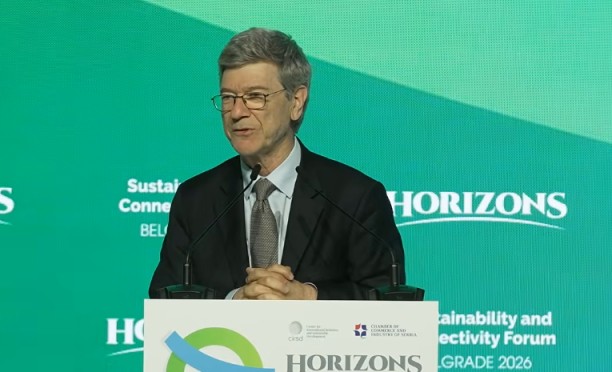
At the Horizons Sustainability and Connectivity Forum 2026 in Belgrade, economist Jeffrey Sachs traces today’s shifting world order back to four pivotal events of 1776: James Watt’s steam engine, Adam Smith’s The Wealth of Nations, Gibbon’s The Decline and Fall of the Roman Empire, and American independence. Sachs argues that the rise of China and the end of a Western-led world mark the arrival of a truly multipolar era, and that East-West connectivity and clean energy are the keys to achieving the Sustainable Development Goals. He also praises Serbia’s role as a bridge between Europe and Asia. Read the full transcript of this keynote address below:
Opening Remarks and Gratitude to Vuk Jeremić
JEFFREY SACHS: Vuk and Marco, Chairman Zhang, Patrick Zhang, my riding partner you’ll hear about, and ladies and gentlemen, first, it’s wonderful to be together in Belgrade as always and wonderful to be together under Vuk’s auspices and Horizons’ auspices. I’m most grateful for that award. It’s very meaningful because as Vuk says, we’ve been having fun for a quarter century, and I really appreciate all that fun.
Vuk is amazing. He’s the kind of student you dream of because he is so creative, so decent, so clear sighted that he really is bridging the world, and watching him in action is a tremendous joy and inspiration.
He was a great president of the General Assembly and made it possible indeed for the world to agree on a set of objectives that we assemble here today to discuss, to understand, and to achieve. So this award is my joy of luckily crossing paths with He would have been outstanding no matter what, but I’m thrilled and honored and delighted to be able to say I taught him a little bit. Somewhere along the way, maybe, but in any event, I’m going to claim it that I did. And we’re so proud of you, Vuk, for all that you’re doing.
Serbia’s Role as a Connector
And we’re very proud of Serbia because Serbia is finding the right path in a complicated world. That’s not easy to do, and it’s not easy to do when everyone’s yelling at you one side or the other. “Don’t do this. You mustn’t do this. You must do this. You’re on the wrong side. You’re on the wrong side.”
And Serbia understood fundamentally, maybe because of its long and complex and rich history, as a connector and borderland of so many civilizations, empires, cultures, histories, battles also, that Serbia’s true role and vocation in the world today is connectivity, just as Horizons announces.
Let me say at the outset that Horizons’ creativity in establishing a new forum on sustainability and connectivity is great. It’s going to work. It’s very important. Congratulations to you.
Horizons: The Best Journal in International Relations
Horizons, ladies and gentlemen, if you don’t know it, you should. You should know it both for what it is and you should read it each issue. It is simply the best journal that there is today in international relations. It is the very best.
It is the very best because as Vuk said, it’s looking at all sides. It’s engaging all sides of a debate, and it’s connecting all parts of the world. We have a journal that looks something like Horizons called Foreign Affairs in the United States. It’s a well known journal, but it is being left in the dust by Horizons, I have to say.
Because unlike Horizons, which is opening up the debate and the discussion, Foreign Affairs is only trying to convince Americans, “You’re okay. You’re still number one. It’s okay.” And I regard it almost as a psychological Rorschach test for a very neurotic country that I live in right now because it’s only trying to reassure Americans. “Yes. Number one.”
But what Horizons is doing is trying to understand the world, and so this is a phenomenal contribution.
Four Pivotal Events of 1776
We’re in an extremely interesting moment in the world. As you know, even hours and days are fascinating as we try to understand events because they are spinning our minds. And to understand them, I want to take us back, if you’ll permit me, to gain a little perspective of two hundred fifty years ago.
And interestingly, two hundred fifty years ago, this year, because this is the two hundred fiftieth anniversary of four very important developments, and we need to understand them. And if we understand them, we’re also going to understand sustainability and connectivity.
So what was the most important thing that happened in 1776? Well, it was that James Watt patented his modern steam engine because the steam engine was the most decisive game changer of the last two hundred fifty years. A surprising statement. But the steam engine made possible modern economic growth, the modern economy, industrialization, and climate change as well.
Because what James Watt did in 1776 was take an invention that was around a 100 years old by that point. He improved it to make it commercially accessible by adding a condenser to an older model of the steam engine, and he enabled Britain to become the first industrial power of the world, and that changed everything.
Of course, in the nineteenth century, it made Britain the most powerful hegemon of the world that ruled the seas. Britain went and beat up everyone it could around the world and created the largest empire of the day, a subject of relevance as I’ll come to in a moment. But it changed the world by making economic development on a sustained basis possible, something that the world had never seen before.
The second most important event of 1776 was that Adam Smith published The Wealth of Nations, inventing my profession, economics. So the great founding book of economics, very relevant for us today, as I’ll show you, was written two hundred fifty years ago, and we should celebrate that fact.
The third relevant historic occasion two fifty years ago was a companion volume, The Decline and Fall of the Roman Empire, which, as you know, was the place where Edward Gibbon described the two thousand year history of the rise of Rome and ultimately the fall of the Eastern Roman Empire to the Ottomans, so the great saga of Western history.
And he helped us understand that geopolitics changes in fundamental ways, the greatness of Rome, followed by the decline and the ultimate fall of Rome.
And a fourth thing happened also. My country was born. The United States declared independence in 1776. We’re celebrating kind of a birthday party this year, but I have to tell you, everyone’s a little puzzled of whether we should be celebrating because the mood in the United States is just a little bit strange these days.
Adam Smith, Empire, and the Cost of War
But when Adam Smith wrote The Wealth of Nations, he actually has a long part telling the British government, “Just let them go. We’ll trade with them. We don’t need empire and colonies to succeed. We just need trade and connectivity. We need international connectivity in order to be prosperous.”
They didn’t quite believe him. Britain went to war to hold on to its colonies. France intervened. Because of French intervention, the United States won the War of Independence in 1781. Five years later.
Interestingly, France spent a lot of money on helping the American colonies win the war, so much money that they went bankrupt by the end of the seventeen eighties and had a little event called the French Revolution in 1789, which was due to a large debt accumulated in war fighting.
So one thing I would say to Brussels is watch out about your joy for remilitarizing Europe. It’s expensive, and you’re going to go broke if you try to do it. It’s not worth it.
The Best Paragraph in The Wealth of Nations
But I want to turn to Adam Smith for us to understand these four pivotal events and how they relate to us today. And to do so, if you’ll permit me, I want to read to you my favorite passage from The Wealth of Nations. And maybe I’ll spare you several hours or days of reading the book because I’ll give you the best paragraph in the whole book. And let me just read it to you. It’s very interesting.
Adam Smith, writing in 1776, writes the following. “The discovery of America and that of a passage to the East Indies by the Cape of Good Hope are the two greatest and most important events recorded in the history of mankind.” The history of mankind. “Their consequences have already been very great. But in that short period of between two and three centuries, which has elapsed since these discoveries were made, it is impossible that the whole extent of their consequences can have been seen.”
So Smith was writing 1776. The discovery of America was 1492. The discovery of the sea route around the Cape of Good Hope was 1498. So it was about two hundred seventy five years later that Smith was writing. And he says, we still can’t say all that happened.
He says, and I’ll just jump quickly, he says, “By uniting in some measure the most distant parts of the world, by enabling them to relieve one another’s wants, to increase one another’s enjoyments, and to encourage one another’s industry, their general tendency would seem to be beneficial.” In other words, now we have connectivity of the newly discovered Americas, of Europe and Asia by sea route. This should be good, says Adam Smith.
“However, to the natives, both of the East and West Indies, all the commercial benefits which can have resulted from these events have been sunk and lost in the dreadful misfortunes which they have occasioned.” He says Europe was so powerful, it beat up the natives rather than globalization lifting up the natives.
But then he says, skipping ahead, “Hereafter, perhaps the natives of those countries may grow stronger or those of Europe may grow weaker, and the inhabitants of all the different quarters of the world may arrive at that equality of courage and force, which by inspiring mutual fear can alone overawe the injustice of independent nations into some sort of respect for one another. Nothing seems more likely to establish this equality of force than that mutual communication of knowledge and of all sorts of improvements, which in extensive commerce from all countries to all countries naturally or necessarily carries along with it.”
What is Adam Smith saying? He’s saying that as of 1776, the connection of the world, which should have lifted everybody up, helped Europe, but it hurt the rest of the world. They were facing superior force. Even more force would come in the nineteenth century with industrialization. Europe colonized almost all of Asia after all.
By the end of the nineteenth century, Europe imperialized almost all of Africa. It wasn’t a pretty sight for the native inhabitants. But Smith says international trade and exchange will eventually spread knowledge, ideas, innovations, improvements, which we call technological advances, so that all parts of the world will rise.
Well, was about equidistant from us and from Christopher Columbus, writing just in the middle. And I conclude Smith got it exactly right.
The Rise of China and the East-West Rebalancing
And we’re living just in those times right now. We’re living in the times when what had been an advantage of Europe for a few hundred years has ended, rightly so and mercifully so. And the reason it’s ended is that there is talent everywhere, and there is technology everywhere, and there is capacity everywhere.
And the most decisive rebalancing of the world today, a fact of life of the last forty years, is of course the rise of China. And this is one of the most important and one of the most beneficial developments of modern history. This is not something to be bemoaned or feared in Europe and the United States, but something to be celebrated.
China is a great and ancient civilization. Chinese civilization has contributed massively to the world. When Marco Polo reached China in 1275, he saw a world that was dazzlingly ahead of his native Venice. So when he brought back the stories, the paper currency, something unheard of in Europe by that time, and other advances of China, he was not believed, as Marco rightly noted just a few minutes ago.
This East West rebalancing that’s underway is a wonderful thing for the world. Because after a period in which Europe made major technological advances, but used them aggressively, militaristically, and prejudicially against the rest of the world, we are now at a time when the world can share in the advancement of technology, when literacy and technological skills are reaching all parts of the world, every part of the world, by the way, including even remote villages in Asia and Africa, so that we are in a moment of change that is in a way as fundamental as those events of the fourteen nineties when the sea routes to the Americas and to Asia were found by the Europeans.
It’s potentially a glorious time. It’s driving the leaders of my country absolutely nuts. Why? Because if you’re number one and think you’re number one and believe you deserve to be number one and think that it is somehow your exceptionalism to last forever, then the rise of other parts of the world are seen as a threat, as a hindrance to your primacy, not as the wonderful achievement of hard work, innovation, and contribution of capacity to the rest of the world.
Clean Energy Solutions From China
What Chairman Zhang is bringing to the world in clean energy is a gift for the world, and the capacity that Mingyang has developed and many, many companies in China, including BYD, which brought me on time as expected to the moment to Sava Center today on a drive across from Venice to Ljubljana to Zagreb to Belgrade, and as we continue on in our voyage. These are solutions for the world that will raise well-being for everybody.
They are not somehow against the United States or against Europe. They are the rise of an ancient and great civilization after two hundred years of being beaten up, I would say, and especially a hundred and fifty years from the nineteenth century to the middle of the twentieth century of being beaten up by superior powers in not superior morally or culturally or fundamentally, but more powerful countries in Europe, and then later Japan, which also industrialized early in Asia.
We’re at that moment of rebalancing. We’re at a moment when many parts of the world are now adding to our know how and to our solutions. And this brings us to sustainability and connectivity. It also brings us to those pivotal events two fifty years ago.
The Steam Engine, Fossil Fuels, and Climate Change
Because when the steam engine was perfected by James Watt in 1776, thereby unleashing the world modern economy and the industrial process. He not only unleashed industrialization and unleashed British imperialism for the next hundred, almost hundred seventy five years, but he also unleashed the human impact on the physical environment.
That was the moment when we started using fossil fuels to an enormous extent. And suddenly in the nineteenth century, coal, which had been used in tiny amounts for heating huts and homes in England and other places with easily accessible coal.
And then by the middle of the nineteenth century with the invention of the internal combustion engine by Daimler and Benz in the eighteen seventies and eighteen eighties to start harnessing petroleum, and then with the invention of the jet turbine, the gas turbine in the early twentieth century, we were set on a path not only of rapid global economic development and growth, albeit uneven, but we were set on a path of human induced transformation of the physical earth, and increasingly in a very dangerous way.
Now, I come from a country with an octogenarian president who thinks climate change is a hoax. I apologize. I can also tell you he never had a class in climate change, obviously, growing up. He’s too old to know and to understand, and he’s too well remunerated by the oil industry to care understand.
But if there are any doubters here about climate change, I want to let you in on one basic fact, and that is that in 1896, pretty much all that we need to know was already known when a brilliant Nobel winning Swedish chemist named Arrhenius, who was recuperating from a broken romance, sat down for many months and with paper and pencil invented a climate model and worked out the fact that when carbon dioxide in the atmosphere would double, the Earth’s temperature would rise by about five degrees Celsius. And he did it by paper and pencil in 1896.
There is no doubt of what we’re experiencing, and this year, we will hit the hottest temperature in probably the last ten thousand years. And if not this year, it will be next year because of the giant El Niño that’s taking shape.
Connecting Connectivity With Sustainability
Why is this relevant for us today? Because we have to stop using fossil fuels. The invention of the steam engine was the greatest transformation of the following two hundred fifty years. It set in motion everything.
But now, Chairman Zhang’s wind turbines are even more important for us. BYD’s electric vehicles are even more important for us. LONGi’s solar panels now selling for 8¢ a watt, having fallen by about a thousand fold in cost in the last twenty years are even more important for us. Because we’ve had connectivity for millennia, but now we need to connect the connectivity with the Earth’s sustainability.
And the idea of Vuk, of joining China and Europe, and all in between, let me add, in doing this is absolutely spot on and you are very smart to do this. This is the first of many important conferences that will follow because this is absolutely the moment when the connectivity of East and West needs to be harnessed in order to achieve the goals of sustainable prosperity, in order to achieve the Sustainable Development Goals that Vuk also did so much to help bring to the world.
The Sustainable Development Goals in Practice
The idea of those goals that he launched by coordinating the international negotiations is we want to have the benefits of a modern economy. We want to have the benefits of transportation. We want to have the benefits of our automobiles, which we love and rely on. We want to have the electricity that powers everything in our society.
We want that, but we cannot continue with the technologies of 1776 or even the technologies of 1884. Daimler and Benz were magnificent in inventing internal combustion engine, But we absolutely need to move to the all electric vehicles if we’re going to have the kind of world that we want.
Those 17 Sustainable Development Goals give us the orientation. But what this forum is doing is making the practicalities. Because the way that this will happen is not only setting goals, but actually making the business connections and the business investments and the openness to a world that is a new world that of multiple powers and multiple centers of the world that are cooperating with each other today.
The End of a Western-Led World
Let me say that as we enter this new era, Serbia figured this out a decade ago, two decades ago. You’ve been on the right path. You’ve been inviting Chinese investment. You’ve understood not to be scared away by the threats of sanctions or EU pronouncements of China’s threats and so forth or American sanctions on China.
What we’re observing in the United States and Europe, in my opinion, is the last gasp of that five hundred year period that Adam Smith talked about. We’re at the end of a western led world, and we’re at the arrival of a truly multipolar world.
It’s not that Europe loses its prosperity, not at all. It is that prosperity is now shared around the world, and that the ability of one rather small part of the world to dictate the terms to the rest is over. And thank goodness it’s over.
The G7 Versus BRICS
Yesterday, my president said to the G7 assembly, “I’m the boss.” I don’t know what he’s the boss of, but no one paid much attention to the G7 meeting anyway because the BRICS of China, Russia, India, South Africa, Brazil, and the other BRICS members overshadows the G7.
The BRICS is 41% of world GDP and nearly half the world population, And the G7 is about 28% of world GDP and perhaps 12% of world population. So even though Donald Trump is the boss and he will be the boss, we should sit him down and let him be the boss.
But he is obviously not the boss of the Strait of Hormuz. He is not the boss of the South China Sea. He’s not the boss, in fact, of much of the world right now. But he is representing a kind of reaction that both the United States and Europe are experiencing right now. There’s a little bit of nostalgia for power. And watching that dominance slide away is not so simple.
A Fairer World Is a Richer World
But the important point, ladies and gentlemen, is a fairer world does not mean a poorer world. It actually means a richer world. It means a more peaceful world.
It means a world where we can absolutely address the great challenges that we face, like the transformation to green and digital industry, the ability to ensure that every child and every household has access to quality education and health care, all the goals that were established in the Sustainable Development Goals. Working together, there’s nothing that we can’t accomplish.
There actually are no technological barriers between us and the future that we promised to achieve in adopting the Sustainable Development Goals in 2015. Our problem is a bit of a mindset problem. It’s understanding that what is crucial today is sustainability and connectivity.
Thank you, Serbia. Thank you for getting it so clearly. Thank you very much.
NOTE: The Horizons Forum on Sustainability and Connectivity took place on June 18–19, 2026, at the Sava Center in Belgrade, Serbia.
Related Posts