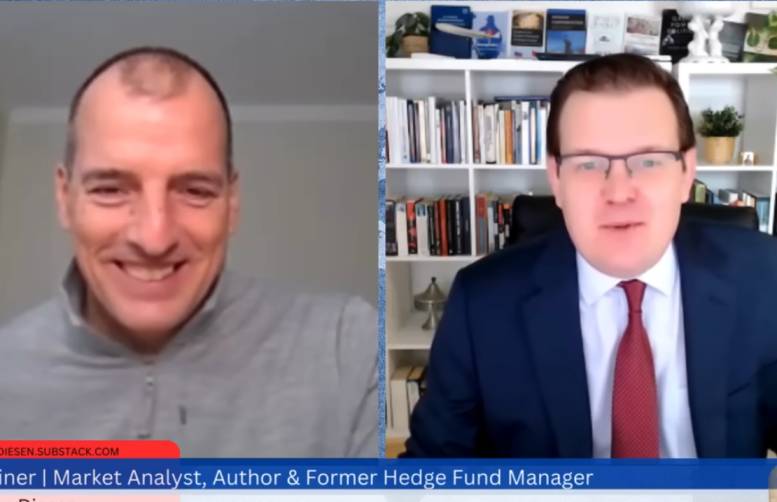
The United States was still there, was still, how do you call it, Biden administration or whatever, Blinken and Sullivan administration. So completely in the grip of the neocons and they dispute Nicolas Maduro’s government’s legitimacy and reject the results of the elections. So they issued a formal statement about this, which I thought was very interesting. It doesn’t say much, but it just says about that much.
The Nobel Prize and Hidden Agendas
And then the Nobel Committee gives a Nobel Peace Prize to Maria Corina Machado, which is a strange thing in itself. And that one, I was certain from the start that it didn’t come from Trump, meaning it wasn’t Trump administration that leaned on the Nobel Committee to say give the reward, give the award to Maria Corina Machado. So it came from elsewhere.
And to my mind it could have come only from one other side and that is the globalist rules-based order, however we want to label it. Is it the Davos set? Is it the City of London? Is it Great Britain and European powers? But it’s there and it’s probably very closely linked to the European banking oligarchies.
And so I think that there was a chance that they were going to stage a similar kind of regime change process as they have just done in Iran, a color revolution, because Venezuela was and probably still is full of CIA, MI6 assets and so forth.
The Organization of American States: A Globalist Trojan Horse
And then the third data point about this is the thing called Organization of American States that nobody really pays much attention to. They try to remain under the radar, but it’s actually a massive behemoth which has been extremely active and increasingly active in South America and the Caribbean, pretty much implementing what you would call the Global Goals, the SDG, Sustainable Development Goals, Agenda 2030 of the United Nations, the Great Reset with great involvement of the big tech from the United States: Microsoft, Facebook, Jeff Bezos, Washington Post, New York Times, Wall Street Journal.
The ideas were to implement things like Internet connectivity, digitization of government, implementation of central bank digital currencies. They had a massive initiative there called “Better than Cash” which was trying to promote adoption of digital currencies for everyone. Electoral reforms, gender issues, climate change issues, energy transitions.
So basically all of these initiatives that we kind of got into in the West that had to do with this globalist agenda. Climate change, LGBT ideology, digital IDs, central bank digital currencies, surveillance, smart cities, all of that was being increasingly pushed into South America and the Caribbean with billions of dollars.
And this Organization of American States is a special kind of thing because it works in conjunction with the United Nations, but it’s not part of the United Nations. So they work together, but OAS is autonomous. And then Organization of American States enjoy immunity, complete legal immunity.
GLENN DIESEN: So—
The Hidden Infrastructure of Global Control
ALEX KRAINER: They’re not at all liable to US laws or laws of any of the nations involved. And their headquarters are in Washington D.C., but they enjoy a special status, meaning the United States law enforcement cannot go to their premises. They cannot take their documents, their computers—basically there’s nothing they can do. They’re completely outside of the law.
And so having said all that, and there’s a lot to it, you know, we go back to the US national security strategy. And when they say dismantling the infrastructure of the adversarial powers, this to me seems like a far, far greater threat to the security of the United States and particularly to the Trump administration and any administration that would like to extricate the United States from the global empire than anything that Russia and China are doing there. Because the Russians and the Chinese are doing straight up business and security type of cooperation with Venezuela and other Latin American nations.
Here we have basically an incubator of all these dystopian globalist ideas that the Trump administration has rejected for the United States. And then part of that whole equation is flooding the United States with uncontrolled immigration. And part of it is flooding the United States with drugs, which are not coming from Venezuela in large amounts, if any. They’re largely coming from Mexico, Ecuador and Canada.
And then a bigger problem, a much bigger problem is the money laundering. Because without the services of money laundering banks, you know, the drug, weapons and human smuggling cartels would splinter and become easy to deal with. But because they have money laundering banks services, they are robust hierarchical organizations that have massive amounts of money at their disposals with which they buy things like heavy weaponry.
They have troops of commandos, they have whole brigades, they have armored personnel carriers, helicopters, submarines, heavy weaponry. All of this is a threat.
The Venezuela Puzzle
And then with all of this insight, we go back to statements by Donald Trump, by Marco Rubio and others, and you see that they’re talking about tackling the drug smuggling networks, which Maduro isn’t really anywhere near the top of the list of suspects. So the whole thing seems extremely strange and I don’t think that we have a clear explanation, but the range of plausible explanation is so broad that I think we’ll just have to wait to see what happens.
But I think that one of the plausible explanations is that the whole intervention in Venezuela was actually Trump preempting a regime change operation. Because, you know, if these globalist forces, this, let’s call it UN Agenda 2030 Great Reset, if these forces took over Venezuela, then Venezuela becomes possibly a really dangerous beachhead in the region that could threaten to destabilize the United States. So the idea was maybe preserve the regime, but do a token action by removing Maduro.
The Organization of American States and Legal Immunity
And I also have to say I then went, when I did a bit of research about the Organization of American States and what they do and who they are, because they’re working with literally hundreds of non-government organizations and let’s say civil society, things like George Soros’s Open Society and so on. And they have this deal where their legal immunities are automatically transferred to their agents and representatives.
So let’s say if Alex Krainer becomes a contractor with Organization for American States, I get their immunity. So now if I go across the border, you cannot search my luggage, you cannot search my documents, you cannot take my phone, my computer, and you cannot sue me. You cannot take any legal action against me.
And so, you know, Microsoft, Facebook, Wall Street Journal, Washington Post, Open Society, George Soros’s Open Society Institute—all of these NGOs and civil society organizations enjoy that immunity as they’re pushing the Great Reset Agenda 2030 practically through the whole region, through the whole Western hemisphere, south of the United States borders.
Venezuela is the only country in that region who is no longer a member of OAS. Which is why I thought, okay, in that case, you know, at least from the ideological point of view, they shouldn’t be in an adversarial relationship with the Trump administration because since Chavez came to power, the relationship between Venezuela and the Organization of American States has started to deteriorate to a point where the OAS became kind of the same as IAEA, you know, where it was set up with one set of ideas, but then it got completely co-opted into these globalist agendas and they became one of the champions of disputing the legitimacy of the Maduro regime.
But at the same time, ideologically, they are the greatest and most, maybe most dangerous enemy to the United States, plus legal immunity, plus tax exemptions and all kinds of other privilege that the Chinese and the Russians don’t have themselves.
Trump’s Withdrawal from International Organizations
So I think it’s very, very hard to know what the Trump administration knows about all this. And I think that they know a lot because very soon after they abducted Maduro, Trump announced that they were withdrawing from 66 of these international organizations. You know, the OAS wasn’t one of them, but they did put OAS under review and they did apparently suspend some of OAS programs in the United States and US funding for some of the programs.
And you know, these are all—there were a total of about 76 of these international organizations that enjoy legal immunities and tax exemptions and so forth. And Trump withdrew the United States from 66 of them.
So that tells me that this is the infrastructure that they are really targeting. It’s not necessarily China, it’s not necessarily Russia. It’s not necessarily about the oil in Venezuela. I think it’s really what George Soros said: clash between two systems of governance. And this globalist system of governance is using all these international organizations that have immunities. They get to do whatever they like.
Which is why we wonder, why is Bill Gates a free man? Why is Anthony Fauci a free man? Why are they spraying our skies? And nobody is held accountable. You know, it doesn’t seem that anybody is ever held accountable. And it’s because they all enjoy legal immunities. And the United States law enforcement cannot go after them anyway.
The Canadian Connection
It’s long, it’s very convoluted, it’s very complicated. But if you focus on some case studies, let’s say trafficking of fentanyl, methamphetamines and marijuana, and other drugs from Canada to the United States, you realize great source of danger to the United States. And then you realize that a lot of these organizations are immune. They are simply out of reach of the United States law enforcement. And it’s a source of great frustration to the United States.
For your viewers, there’s an online publication called The Bureau, which in March of this year published an extensive interview with a man named David Asher. David Asher was a high level official of the US State Administration and is an important part of the Trump administration’s Drug Enforcement and Financial Crimes Task Force. And he gave an interview in which he explains a lot of these things that neither Marco Rubio mentions nor Trump mentioned.
Well, Trump did mention after the kidnapping of Maduro that a lot of the drugs are coming from Canada. But then the media is not interested. They don’t say, oh, wait, did you say Canada? What do you mean exactly? Could you elaborate? Nobody asks. It’s like nobody wants to know. And he didn’t elaborate.
But if you go back to that interview with David Asher, he explains a lot. And he makes it very clear that the United States has a massive frustration with the Canadian government, which is completely uncooperative. Even when they bust these massive fentanyl labs in Canada and they get proof about colossal scale money laundering by Canadian banks, there’s no arrests. There’s no charges, there’s no investigations. Nothing happens.
These people just simply continue. They change their telephone numbers, they change their addresses, they change their operations around a little bit, and they continue to smuggle drugs into the United States.
A Different Kind of Warfare
So I suspect that the action in Venezuela had to do with all this. How exactly, I’m not sure, because Venezuela doesn’t seem to fit the list of suspects very well. And then again, you know, the risk to reward from that action just doesn’t seem to make any sense at all.
So it’s a different kind of warfare, and it’s obviously being waged covertly and by deception. And so even what we know, you know, through public statements and press releases, doesn’t tell us the truth. It doesn’t give us the full picture.
US Strategy: Direct Control Over Alliance Systems
GLENN DIESEN: It does seem that the United States now attempts to change the rule of the game a bit. That is, its power is weakening. They would like to have more direct control, that is less reliance on alliance systems. So they tell the Taiwanese the semiconductor industries should be moved to the United States. They tell the Danes Greenland has to be under our control to have these key corridors. Latin America has to be well subordinated to the United States to prevent it from being, well, to have China as the leading economic power in its backyard. So you see all this reshuffling.
But how do you make sense of the deteriorating relationship between the United States and the Europeans? Because it seems as if it would be, you know, the Europeans are willing to go to a great extent, even look the other way and pretend as if the US isn’t threatening to take European territory over Greenland. And they’re still willing to back the US on everything from Venezuela to Iran, whatever they want to do.
But the US seems very dismissive. That is, it’s not good enough, essentially. They would like to, it seems, push for some splits within the European Union as well. What is it that’s driving this relationship? Because the Europeans, they don’t seem to understand why the US isn’t embracing them, given that they’re offering their complete loyalty.
The European Question and Trump’s Strategic Calculus
ALEX KRAINER: I think that Trump perceives—Trump administration perceives—the Europeans as adversaries. I think that China is easy to lambast in the United States publicly because there has been so many years of demonizing China. In the public mind, China is the enemy. Europeans good, Europeans allies. Russia bad. China bad.
So, you know, Trump doesn’t want to rearrange this. He doesn’t want to go to the American public and tell them, hey, look, you know, the British, the French, the Germans, they are our enemies, because people will not understand this. But I think that all of these great resets in global goals and United States providing for the security of European nations, all of that has been kind of depleting the United States. Exhausting.
I think that the Trump administration perceives the European oligarchies as the parasite that has turned the United States into a globalist power, into an empire, when it was always meant to be a republic. This is, if we go back to the national security strategy, the reassertion of the Monroe Doctrine, it doesn’t necessarily mean we’re going to bludgeon everybody in our neighborhood into submission.
The Monroe Doctrine meant to keep European colonialist powers out of the American hemisphere because that was their chief source of threat. The British Empire, the French and Spain were actually a security risk to the United States because they had colonialist imperialist ambitions on the American continent, North America, South America. The British still control Canada.
And so I think that reasserting the Monroe Doctrine actually means kicking out European colonialist interests from the hemisphere. I think when it comes to China, it’s much simpler. You know, it’s not a China—China is there to do straight up business. It doesn’t behave like a parasite that infiltrates everywhere and looks to Balkanize nations and undermine the legal system and undermine the political systems and just turn everybody into a third world colony for pure resource extraction.
China comes in with development plans. They build nuclear power plants, they build dams and railroads and bridges and ports and so forth. And so I think, you know, if you’re going to raise living standards of a region, if you’re going to make them affluent consumers, then America, United States and China may be adversaries, but their agendas could be compatible.
Because ultimately, if Trump wants to make the United States an industrial superpower, they’re going to need markets. And markets that are affluent are better markets than markets that are just like Bantustans, where people live on one dollar a day.
So I think that, and I’ve heard this from people who, let’s say secondhand testimonials that Trump in cabinet meetings says, you know, quote unquote, “our supposed enemies” and “our perceived enemies,” referring to countries like Iran and China and Russia, which means that he believes that there are those supposed or perceived enemies and then there are the real enemies.
NATO and the Greenland Gambit
ALEX KRAINER: And so what I would say Trump is using now—Greenland as a pretext to extricate the United States from NATO, because that’s what a very, like, you know, for Trump to get the United States out of NATO, let’s say the legal way, it’s a treaty, right? So it would have to go to Congress. I think it would have to get a two thirds majority, which Trump cannot even dream about. So it would never happen that way.
So what Trump now has to do, if he wants to effect real changes, he has to break the rules. He has to go like an elephant into a china shop and break a whole lot of things and then cause the Europeans to say, like, well, okay, we will withdraw from NATO or we want you out of NATO, or, you know, to create a conflict that’s going to ultimately lead to a dissolution of NATO.
And then Trump gets his goal without having to go to Congress and through the whole political process that they already know will fail. So this all makes it very difficult to—how do you call it?—to interpret what Trump is doing.
But I think that when you take the whole—when you kind of take the whole year of what Trump has been doing, I think that a method to the madness emerges, which means he’s not just randomly doing ugly, greedy, violent things on random impulse, that he’s actually driving the United States down a certain road towards certain goals, which means that there’s an agenda, even if there’s no published strategy of “here’s what we’re going to do and this is how we’re going to achieve.”
Seems that there is a mission. And I believe that that mission is, as Marco Rubio announced a year ago in January of 2025, dismantling the post World War II global order, embracing the multipolar integrations, in which case China and Russia are your number one and number two partners, not adversaries, but partners.
And a lot of these organizations, like NATO, even United Nations, has to be reorganized, like the European Unions, they become adversarial. And then what the Organization of American States is doing in Latin America and the Caribbean, where Britain has the permanent observer missions. So they are very, very deeply involved. That could be the infrastructure of adversarial power that the National Security Strategy document is referring to.
The China Question
GLENN DIESEN: But it seemed as if much of the strategies of the United States was aiming at China, because China is really the main rival of the United States. It seems a lot of things were organized around this idea. That is, even the idea of getting along better with Russia would be to make sure that it doesn’t lean too heavily towards China and Iran.
Cutting Iran off from China could create some more energy pressure there. Same as Venezuela. I’m not saying that China is the key consideration, but it is peculiar, though, that the United States seems to have it focuses on everywhere else now except for China.
As you know, the whole pivot to Asia was supposed to mean reducing presence in the Middle East, Europe, but the US is still very much engaged in the war in Ukraine, not as much as under the Biden government, but also—
ALEX KRAINER: But also.
GLENN DIESEN: In the Middle East by getting disengaged with, well, provoking possibly yet another war with Iran. How do you see their approach towards China here? Because they seem to be the main piece in order to strengthen or restoring the US hegemonic position, if that is indeed the goal.
Iran and the Cost-Benefit Analysis
ALEX KRAINER: I don’t, you know, I don’t know that the United States can restore their hegemonic position on Eurasian continent. You know, it would be very complicated. If we look at Iran, for example, which is the minor of the three powers, if we talk about Iran, Russia and China, the cost benefit analysis of any conflict between the United States and Iran is so staggeringly lopsided in favor of cost.
I don’t see what would be the benefit for the United States even if the regime changed Iran, even if they achieve that. Why, I have to ask myself, why on earth would they want to do this? I don’t think that anybody can coherently formulate some kind of a benefit to the United States.
I could see the benefit to Great Britain, to France, to European powers, to, you know, remove the one obstacle they have to full control of the Middle East and to—because, you know, it’s Europe’s trade that goes through, how do you call it, through Suez Canal. Ninety, 90% of all merchandise that goes through Suez Canal is going from Asia to Europe. It has hardly anything to—I think it’s about maybe 3% of American trade that goes through Suez Canal.
Europe is much more dependent on Middle Eastern oil than is the United States. So it’s very clear why this is very, very important to European colonial power. The British have been wanting to reassert themselves, you know, east of Suez to control.
ALEX KRAINER: Their old colonial dependencies. And then Iran, there is an obstacle, and they definitely do not want the Arctic route to be developed because they control—the old British geopolitical setup was controlling all the trade choke points. So that would be the Suez Canal, the Red Sea, Bab el-Mandeb, the Gates of Hormuz, the Malacca Straits and so forth. So all the trade between east and west flows through where, you know—
Through the choke points that Britain used to control. Now the Russians are developing, together with Indians and Iranians and the Chinese, the north south transport corridor, which is cheaper and faster. That goes from India right across Iran Caspian region all the way up to St. Petersburg and can reach northwestern Europe. And it’s cheaper and faster than going through Suez Canal.
And then there’s the Arctic route, which is another alternative. Trump administration has already set the development of the Arctic as one of their strategic objectives in the Middle East. They would be going to Iran for the benefit of the European powers and at a huge cost to themselves, at a massive, possibly catastrophic cost to themselves.
Israel itself, you know, there’s this sentimental ideological attachment to the state of Israel in a significant segment of the US population, but regarded as an actual strategic interest of the United States, Israel is actually a liability rather than a benefit. So it’s all downside. Potential war, potential escalation, potential loss of their foothold in the region, all to defend something that’s a net cost to the United States.
Whereas doing business with Iran, doing business with China, doing business with Russia, doing business with Ukraine once Ukrainian government changes, and all of that carries a lot of upside and very close to no downside at all.
So, you know, I have to close my ears when Trump talks about Iran, but I do not believe that he intends to actually go to war against Iran. He has to kowtow to his, you know, Zionist donors and Zionist Jewish voters and Christian evangelical voters, who are still a very large, very active, very passionate bloc in the United States elections less than one year before the, how do you call it, the midterms.
But as far as the US actual national interest, I think that they’re ready to just simply distance themselves from Israel. We will know soon, because at the moment, Israel, in a kind of an alliance with UAE, I suppose, supporting a number of these separatist and terrorist movements in the horn of Africa, Somalia and southern Yemen. And they’re looking to Balkanize these nations. They’re looking to turn them into basically chaos like Libya.
And at the same time, this has put UAE on a collision course with Saudi Arabia. And also in Syria. Sorry, also in Syria, UAE and Israelis are supporting, arming and financing separatists. So they even want to Balkanize Syria and turn Lebanon into chaos and so forth. And so UAE and Israel are cooperating there.
On the other hand, the Saudis are now feeling very threatened by this, because if Yemen, if Somalia, if Syria collapses states, then this jeopardizes Saudi security. So now we see that Saudis have taken it as far as taking military action against the UAE. They didn’t bomb the UAE, but they did bomb ships that were transporting weapons for the Yemeni Southern Transition—STC Southern Transition Council, I think, is like an alternative government in Aden, in Yemen, but the southern point of Aden. Right.
And this is in direct conflict with the internationally recognized government in Aden, the Yemeni government that’s actually in exile in Riyadh. Right. And then they’re also supporting military groups in Somalia.
And so MBS, Mohammed bin Salman has been trying to influence Donald Trump and his government to declare these groups as terrorist organization. And so now you have a conflict shaping up between the strategy that’s being pushed by Israel together with the UAE, which is kind of typical British geopolitics pitting everybody against everybody and balkanizing nations and rendering them weak so that you can control them. And so this is one side.
The other side is nations like Saudi Arabia that wants to preserve its integrity and its sovereignty and its security, and it wants to work with Russia, with China, with Iran, and they’re asking Trump administration to support them.
The Saudi-Israel Crossroads
ALEX KRAINER: If Trump says, yes, we will support you. We will declare these Somali militant groups as terrorists and so forth, well, then that puts them at loggerheads with Israel. The United States versus Israel. Extremely complicated situation for Trump administration to navigate.
But ultimately, the way Trump chooses to act will tell us where he stands. Because if he puts his weight behind the Saudis, then that means that he’s adopting this multipolar integration strategy and that he’s actually taking interests that are compatible with those of Iran, Saudi Arabia, Russia, China, India, and so forth, and that he’s turning his back on Israel.
And I don’t think that Trump will come out and declare that openly, at least not before the midterms. But he might talk a big game and then do nothing. And I think that the June action that they took against Iran was exactly that. Trump was talking a big game. He launched a bunch of Tomahawks at preannounced targets. He dropped a few bombs. He gave 48 hours pre-advice to the Iranians to prepare.
Iranians responded in kind, pre-announcing their retaliation and basically, you know, destroying a radar station and zero casualties on both sides. They shook hands, they thanked one another, and then he said, “We obliterated the nuclear program. We don’t have to go to war anymore. That’s all done and dusted. And let’s focus on other things.”
I think this is where we’re going to see where Trump stands. But if I were to make a bet today, I would say either Trump will not get involved in a war against Iran or they will again do a fake World Wrestling Federation type of fight, which is going to raise a lot of dust, but do nothing. And then again he’s going to say, like, okay, well, we showed them. That’s it, it’s over. We’re leaving. That’s the best that I can interpret it.
The Suez Canal and America First
GLENN DIESEN: Now, when you spoke of the Suez Canal, it reminded me of J.D. Vance, because he was saying the same thing. Why are we protecting the Suez Canal? This has nothing to do with us. This is all European trade.
But again, he seems to be, I think Trump’s administration is a bag of mixed nuts. There are some crazy neocons. But there’s also the likes of J.D. Vance, which seems to be very genuine about this America First principle, which then questions very basic stuff such as the Suez Canal. There’s nothing to do for us. We can’t do everything if we’re going to put America first. Otherwise it just becomes an empty slogan.
It just seems as if all of these efforts to throw all the pieces in the air and reshuffle the whole global chessboard, that there’s so much room for miscalculation and failure in one area could spill over again. I hope someone there knows what they’re doing, because that seems to be spinning a bit out of control.
The Maduro Abduction and Russian Coordination
ALEX KRAINER: I suspect that they do, Glenn, because I think that it’s inconceivable that Trump went into Caracas and kidnapped Nicolas Maduro and his wife without having discussed it with the Russians, to explain what they’re doing, why they’re doing it, and getting Russians to go ahead.
But then, once I’ve looked into this Organization of American States, the network of 14 offshore financial centers where they have between $50 and $75 trillion sloshing around in the Caribbean. The petrodollar market, another maybe it overlaps, but $22 trillion that circulates outside of the United States, outside of the control of the American government, almost completely under control of the City of London and their 14 offshore centers in the Caribbean.
The Modern Opium War
That the Opium War, because America’s southern border drug cartels smuggling lethal drugs and handling the logistics and illegal border crossings for practically all of South American immigrants. Millions and millions of crossings. Trump clamped down on this. But this was going on for a long time. Probably 30 million illegal immigrants entered the United States over the last 20 years.
And the drug cartels, weapons, illegal immigrants and illegal drugs from the southern border, Canada, the same thing plus money laundering through Canadian banks and through all 50 large global banks are active in the Caribbean. So that reeks of Opium War. Something that the British Empire has a very long tradition with, very well developed, advanced skills at, with the HSBC bank which got busted in 2012 for money laundering for Mexican drug cartels and terror organizations.
They got off practically scot-free by Obama administration and Eric Holder with basically a parking ticket. I think 5 or 10% of their annual profits is the fine that they paid. And then they got a deferred prosecution agreement, meaning if you don’t do anything illegal in the next five years, everything’s forgotten and carry on as usual. No executives ended up in prison. And then HSBC got to police themselves, that is they appoint a person and then they give them money and credit and everything. And then they say, “Oh yeah, HSBC is clean as a whistle.” Five years is up, business as usual.
The Real Enemy: The Parasitic Global Order
So the United States rightfully feels itself under siege. But it’s not China, it’s not Iran, it’s not Russia. It’s exactly this amorphous, parasitic, rules-based global order that really is headquartered in the City of London and it’s really European oligarchic families linked to the banking system. And so this is the enemy.
And I think that once you look at it from this prism, and also you ignore Trump’s public statements because that literally causes brain injury, you just ignore Trump’s statements and you look at the results of what his administration is doing, then it kind of begins to make sense.
And so I think from that prism we can arrive at some plausible explanations. But it’s nothing, it’s not about Venezuela’s oil, it’s not about regime change in Iran. I think it’s about dismantling the entirety of the post-World War II global order.
International Law as an Enslavement Matrix
And also when we talk about international law, we have to remember that the international law is what entails these 76 international organizations that operate worldwide with no transparency, with no accountability to any government in the world, full tax exemptions, full legal immunities.
And then when you look into what they do, it’s climate change, it’s gender ideology, it’s digital currencies. It pretty much looks like an enslavement matrix that is being slowly built and developed around the world, and that is going to be sprung upon us at one point, and there’s not going to be a way out of there.
And if I’m right that the method in Trump’s madness is actually directed at dismantling all this, then I have to say I’m encouraged by that. Whether I’m right or not, I think time will tell.
Reading the Signs
But watch the conflict between Saudi Arabia and UAE and what side the United States is going to stand on. And that we may not know from public declarations. Whatever Trump says, just ignore it for your own mental health. But when you see what’s actually getting done, look at Israeli officials because they’ve been going quite hysterical about Tom Barak in Syria, the new Trump’s envoy in Syria. They’re not very happy with him.
I think we’ll know from Israeli statements. I think we’ll know from British officials like Alistair Campbell, the former chief of staff to Tony Blair, Rory Stewart, people like David Rothkopf, John Bolton, Mike Pompeo, former CIA. I think that they’re talking a lot these days and they are giving away a little bit of their frustration and they’re immensely frustrated with Donald Trump.
And then also, what are the Russians saying? What are the Chinese saying? When he kidnapped Maduro, they gave a token condemnation of the action, but it wasn’t really strong. It was very strange. And then Putin disappears. Putin becomes invisible, because I think he doesn’t want to say anything about any of this in public, so he doesn’t want to be asked. So he just doesn’t appear anywhere.
It’s all very strange, but I think it’s very different from what it appears on the facade, at the surface of what things look like.
GLENN DIESEN: Yeah, well, they don’t do much of the megaphone politics in general out of Russia, but it seems like we’re sleepwalking into something, at least that is, yeah, some miscalculation appears to be coming. But thank you for taking the time. I think we went a little bit over there, but thank you.
ALEX KRAINER: Thank you for the invite, Glenn. Always a pleasure to talk to you, and I hope that before this year is over, we’re going to know what’s going on.
Related Posts