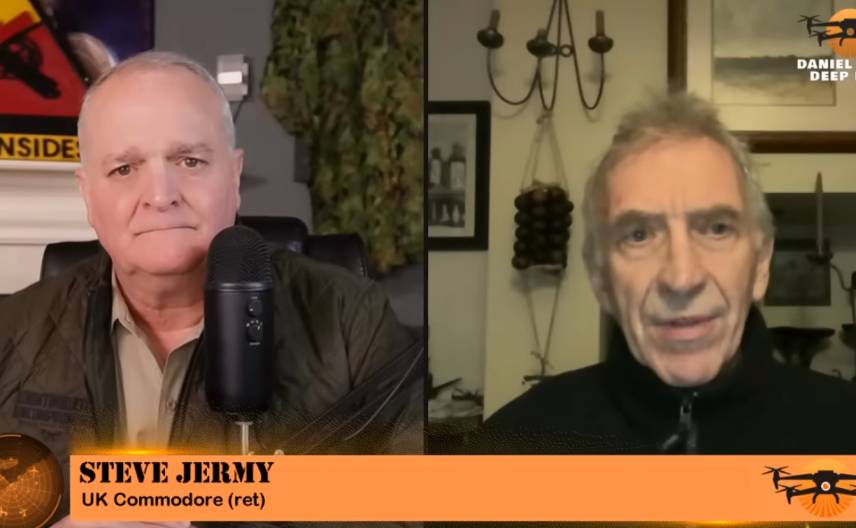
Editor’s Note: In this episode of Deep Dive, Lt Col Daniel Davis and retired Commodore Steve Jermy provide a sobering expert analysis of the military capabilities and strategic risks surrounding the “massive armada” signaled toward Iran. The discussion highlights critical limitations of a single carrier strike group, noting that while powerful, such a force may only sustain a strategic bombardment for a few days before facing significant replenishment and fatigue challenges. Beyond the immediate firepower, the experts explore the potential for devastating Iranian counter-responses, such as the blocking of the Straits of Hormuz, and warn of the dangerous lack of a clear war termination strategy. This analysis ultimately urges a realistic assessment of the regional and global consequences of an escalation, questioning whether the U.S. currently has attainable military objectives. (Jan 30, 2026)
TRANSCRIPT:
VIDEO CLIP BEGINS:
TRUMP: And by the way, there’s another beautiful armada floating beautifully toward Iran right now. So we’ll see. I hope, I hope they make a deal. I hope they make a deal. They should have made a deal the first time that have a country…
VIDEO CLIP ENDS:
Trump’s Warning and the Armada
DANIEL DAVIS: That was President Trump just three days ago warning about this big armada that was heading towards Iran. It is now on station and everybody’s kind of holding their breath wondering what’s going to happen next. And we are going to try and figure out what may happen next or at least the range of possibilities here.
We are delighted today to have Commodore Steve Jermy, retired commodore from the UK, from the Royal Navy, who has combat experience, naval combat experience and a lot of other experience throughout his career in the naval aviation stuff. So all those things are going to come into play here if conflict breaks out between the United States and Iran. And I couldn’t think of anybody better to have this conversation with. So, Steve, welcome to the show.
STEVE JERMY: Yeah, great to be back, Danny. I’d love to have been a US Navy guy operating for American carriers, but ours were a bit smaller than yours. So it would have been fun, but…
DANIEL DAVIS: You had the advantage of us. I can’t remember, I think the last naval engagement that we had was like during the Vietnam War or something. So you got a leg up on all of my compatriots in the Navy. So I’m really interested in hearing some of the things you have to say here.
But just kind of to set the stage, here’s what President Trump has said in his Truth Social, which we kind of thought was basically saying, all right, it’s game on and it’s just now a matter of when I’m going to pull the trigger.
He wrote that a massive armada is heading to Iran. It’s moving quickly with great power, enthusiasm and purpose. It is a larger fleet headed by the great aircraft carrier Abraham Lincoln than that sent to Venezuela. Like with Venezuela, it is ready, willing and able to rapidly fulfill its mission with speed and violence if necessary.
Hopefully, Iran will quickly come to the table and negotiate a fair and equitable deal, no nuclear weapons, one that is good for all parties. Time is running out. That’s the key there. Time is running out, he said. It is truly of essence, as I told Iran once before, make a deal.
And then he says, they didn’t. And there was Operation Midnight Hammer. And we will talk a little bit about what that was. A major destruction of Iran. The next attack will be far worse. Don’t make that happen again. And then the weird “thank you for your attention to this matter.” And then he identifies himself on his own post. President Donald J. Trump.
Lessons from Operation Midnight Hammer
Let’s look first of all, and before we even get to what may happen next, what did happen last time with Operation Midnight Hammer. Are there any lessons that we can draw from that, Steve, about what we might can expect here?
STEVE JERMY: I think the interesting lessons, Danny, was as far as we know, that no American aircraft actually penetrated into Iranian airspace. And I suspect that was because they’re extremely cautious, same with the Israelis, extremely cautious about both the S-300 and S-400 missile suites that were there and unwilling to lose aircraft over Iran.
I think the other key thing is that it had all the look of a presentational attack, if you like, where the Americans had a tacit agreement with the Iranians that they would make an attack, but there wouldn’t be too much of it. The Iranians would respond, I think they responded against one of the UAE air bases, but again with forewarning. And so as a result, there was not a huge amount of impact, although there was a lot of noise about it politically.
So to me it felt very much like a presentation attack. Of course, it was presented as a destruction of the nuclear facilities. So it’s curious that people seem to think that we should now be going back to something where we were promised that it had been obliterated. But I don’t think it was obliterated. And I think Ted Postol has talked very convincingly about the unlikelihood of that.
Iran’s Defensive Posture
DANIEL DAVIS: So, yeah, let me ask you something for the moment. Let me put you in the IRGC Navy commander seat for the moment. And you see that. So you know what happened to Midnight Hammer in June of last summer. You see Trump also cited in that same Truth Social, given the example of Venezuela, because we had this big, huge military operation, the most amazing military victory maybe in military history going into Venezuela.
So President Trump says then, and that and Midnight Hammer are cited as your examples that you better be aware because we’re coming in much bigger, he said, in separate communicating this time than the last time.
Now, you just said that this Midnight Hammer looked like it was maybe not quite what it was. It was a demonstration kind of situation that had some telegraphing going on back and forth that everybody knew kind of what was coming. And I think that we can charitably say that the Venezuela operation was also kind of a made for TV operation which had substantial insider help and I don’t think provides much of an example at all for what we could force on Iran here because they are definitely not going to be caught with their pants down like they were in June and like apparently Maduro himself anyway was probably physically in this last operation here.
So as the IRGC navy commander here, or really just the IRGC leader at all, because it’s going to be an air and sea issue probably if it comes. Are you as worried about the possibility based on what happened, based on those two examples as Trump wants?
STEVE JERMY: I think I’d be prepared to defend myself and I think because I think they’re much less likely to be surprised this time around, I think that the chances would be much better. We remember that the attack, the first of the attacks was actually during, as we all know now, negotiations. So it’s not surprising that the Iranians were caught out. But actually what’s interesting is how quickly they recovered their situation.
So I think that I would be prepared to take damage, but I would like to think, I think whether I was in the air or the sea or the missile batteries or whatever, that I would actually be able to give as good as I got and that I think I would like to think that I’d be able to make things much more difficult for my attackers and make it not really worth their while to actually proceed with an attack for any extended duration.
We can talk about the size of the carrier group, but actually it’s a single carrier group. And as indeed was the case in Caracas. But let’s face it, in Caracas, you know, everything was on America’s side. You know, you’re in the Caribbean, close to all of the assets you might need from continental USA with landing with air rights from a couple of the Caribbean islands. And right next door, Caracas is very, very close to the sea.
So it’s almost a perfect location if you’re going to do a quick strike operation like that, especially if you can manage to turn off the air defense systems. It’s completely the reverse in Iran. Tehran is hundreds of miles away from the coast, almost on the other end of Iran. So it’s a much more difficult situation. And there is not the same overflight rights nor the likely support from other nations. And then we know that some are against it. We know that, you know, for example, I’m sure that Pakistan is an open question. The Saudis do not want…
DANIEL DAVIS: Yeah, they’re a no, UAE is a no.
STEVE JERMY: Yeah. So I guess that Iraq there probably will be overflight to Iraq, but it will be without the Iraqi’s permission, I suspect. And even Israelis curiously seem to be cautious about an operation. I think I can understand why that might be and we might talk about that as we get into what might happen.
Iran’s Military Objectives
DANIEL DAVIS: Yeah, and we’re going to get to that in a second. But before I get into that, keeping your IRGC hat on, what would be the objective of a military strike in the event that the US initiates? What would be the objective of the Iranian side?
Because when you look at it on paper, the power disparities are just almost off the charts between the United States of America and Iran by itself in terms of all the combat power. Now of course you have to look at what’s in the region, but even then there’s a substantial power imbalance, I think, between the United States and you can just see some of them right there.
So it doesn’t seem like you can think, well, I’m going to defeat the United States in any kind of classic military sense. But what kind of attainable military objective, war termination conditions could Iran plausibly seek after if we initiate combat operations? How could they succeed?
STEVE JERMY: I think they succeed by not being defeated, Danny. And I think that’s reasonably straightforward. I mean, the objective is to survive initial attacks and make sure that I do as much damage to the attackers as possible. And I think that I’d be working on the basis if I could do that and I start to actually put the Americans in a situation where American forces are taking significant losses but little perceivable gain, then actually I will probably prosper. And I’m sure that’s a calculation which is being thought through on both sides.
So my objective is to defeat the attacks as best I can and survive in a way which allows me to keep the operation going for as long as possible. Because the longer that I keep going, then the less likely, I think, that the American forces that are in the region will be able to achieve their own objectives.
And it’s an open question, Danny, what those objectives might be. Because what’s clear to me is that there aren’t the forces in the region to do anything other than what I can best call a relatively short period strategic bombardment. You and I both know that to do anything significant in somewhere like a land like Iran, you need land forces. There are no significant land forces and nor prospects, I would have thought, politically of them being deployed.
So this essentially is a strategic bombardment. And the open question is, what is the White House? What are the Pentagon trying to achieve in that bombardment? It might be nothing more than a short term strategic win that can be presented as a win, even if it’s not. We’ve seen that before. But I find it quite difficult to work out what those objectives might be.
Lessons from the Houthi Campaign
DANIEL DAVIS: And let me ask you a question. Is there a potential template for Iran in what they observed with the United States and the Houthis in the Red Sea? Because we and the Israeli side fired tremendous number of missiles and blew up a bunch of targets on the ground in Yemen, blew up some of their assets, especially some of their missile assets, et cetera, hit them a lot.
I don’t think that other than shooting down some of our drones and causing some of our ships to have to maneuver pretty dramatically, I don’t think that they hit anything. But we got tired after about a month because we saw the expense was just really high. And then we ended up just calling it off and saying, oh, they begged us for a peace. And so we gave it to them. All right, let’s go. And then we left.
Now, this is not the same situation there, because the stakes are a lot higher. But are there any similar categories of things that the Iranians could do based on what they saw the Houthis survive?
Strategic Limitations of a Single Carrier Strike Group
STEVE JERMY: Yeah, I think the Iranians could do rinse and repeat, a very similar type of approach. It’s a different maritime circumstance and it’s a different geographic circumstance. So what the problem with the Red Sea is that it’s very constrained waters and you lack what’s known in the naval circles as serum, which means that you’re close to the land and you don’t have huge amounts of time to actually get used to things.
I mean, we’ve got the campaign area up here, and thanks for that, Gary. And what you can see is that with a carrier operation, the Red Sea, you’ve got very, very little water to actually operate in. Whereas actually operating in the Indian Ocean, sort of south of Oman and those sort of areas, then there’s a lot more sea room and there’s a lot more area in which you can actually deploy a naval force and sort of maintain it reasonably, with a reasonable degree of certainty that you will not suffer significant attacks, although there are one or two open questions on that.
What you can see, though, from this chart, Danny, is that actually your ways in and out of Iran from either the Sea or from the likely operating base in Cyprus and Jordan are pretty constrained. So if, because if you haven’t got overflight rights in Saudi Arabia for example, then you probably will get over rights I suspect in Oman, you won’t get them in Pakistan but your only ways in are either north from the north sort of corridor from Jordan over Iraq.
Probably against Iraq’s wishes, but there will not much they can do about it into Tehran or alternatively from the south from the Indian Ocean. You can see that it’s fairly constrained for your operations in terms of your air operations. I mean this essentially, although we’re talking about naval forces, it essentially is air operations conducted either from land bases in Cyprus and around Cyprus or from the Lincoln at sea. And when you look at those, let—
DANIEL DAVIS: Let me ask you from the number of forces that are being shown there on the screen. The, you know, the Abraham Lincoln, the Spruance, the Frank E. Peterson and then the Murphy, Michael Murphy. That doesn’t seem like it. Also there’s a couple of other two or three ships there, Delbert B D Black I think they’re in the, in the other, in the Red Sea portion, two ships up also in the Mediterranean. Is this enough combat power to really do some serious damage to Iran?
Combat Power Assessment: A Short-Term Force
STEVE JERMY: I think it’s enough combat power to do some serious damage in a short operation. So you know, and the damage would be done predominantly I would say by surplus missiles most obviously Tomahawk because all of those DDGs, the destroyers are guided, have what’s known as the Mark 41 launcher which is a flexible launcher, it’s a vertical launcher and allows you to buy just about anything from it.
I’ve no idea at all why the British didn’t actually acquire it from the Americans. It’s such a good idea. I can remember doing operations in withstanding NATO Force Mediterranean when the American destroyer that we had us have with us got taken out of the force, sent off to, I think it was somewhere in Italy and had the air missiles that were in the launches actually replaced with Tomahawks went off to conduct attacks in Syria.
So it’s a very flexible launcher and you can launch quite a range of. You can launch torpedoes from it, you can launch headway missile surface wear missiles both short and long range. So it’s that flexibility is terrific but it, but there are limited silos so once you fire the weapons then you’re going to need to go and replenish.
DANIEL DAVIS: So based on, based on how much combat power we have and on that previous slide we were showing we’ve also surged a lot of air power to some of our other bases, the land bases in the area, in the region. We’ve sent a lot of air defense. There’s a no THAAD system has recently gone over as well. We have thinned out some of our bases. I think nearly all of our combat troops in Iraq have been withdrawn. Nearly all of them in Syria have been withdrawn as apparently in operation to lessen our vulnerability, but only lessen it because a lot of those bases you’re seeing on the screen right now are still fully manned or at least partially manned.
Definitely a target in an Iranian potential counterattack. So if you could, I guess, walk us through maybe a couple of scenarios that you see based on the ships that you see in the area, based on your combat experience in the Falklands War and your training in the Royal Navy, what do you think is possible for us to do and what are the limitations that we might not be aware of?
Strategic Bombardment: Two Days of Sustained Operations
STEVE JERMY: I mean, I think what’s possible is what I call a suite of strategic bombardment, which is essentially using air and, air and missile forces. I think it’s worth. I haven’t calculated the overall number of Tomahawks in the force. My guess would be in the sort of somewhere between 300 and 500. I’d be surprised if it’s as high as 500.
But a thing to consider is the way that the Russians are using overnight attacks with a range of weapons against Iraq. So you’ve probably got about, I would guess, in the force. It might. So Ukraine. So the Russians probably. If you think about the Russian attacks in Ukraine, what sorts of numbers are we talking about? We’ve been talking about 750, combination of drones, missiles, hypersonic missiles and so on, all of which is saturating your air defense systems.
So I would guess that actually you might have enough a combat power in that force. And it is a guest. Annie, to. To achieve two days of sustained, sustained bombardment. Wow.
DANIEL DAVIS: Or you, you would correct me if I’m wrong, but then you would. Otherwise, if you want to spread it out over a week or something, you just have to reduce the amount you use. But, but that’s, that’s quite a statement that, that, that, that limited in terms of onboard missiles.
STEVE JERMY: Yeah, it’s, it’s a. What I’m guessing is that I haven’t done the calculations, but what I’m guessing is that to meet the level of bar power that’s being deployed by Russia in Ukraine on a nightly basis, it’s those sorts of levels of missiles that you would need to be firing from that force because the great advantage that Russia has is that, you know, it’s firing from its, it’s firing from not very far away from where the ammunition depots are.
Whereas actually if you’ve got them at sea, it’s a different situation. It is a guess, but I’d be surprised if they could sustain much more than four to five days, possibly more with the aircraft. Because with the aircraft you’re actually talking about something different which is using different weapons. So it’s air to surface missiles and bombs. You know, there might be dumb bombs, there might be JDAMs, those sorts of things.
So I think what strikes me about that force is that it’s a force which is capable of doing quite a lot of damage over quite a short space of time. But if there’s any extended operation, I just don’t see the combat power there might interest if I tell you.
DANIEL DAVIS: So let me ask, okay, so it’s day six. Now let’s say they spread it out over a five day, it’s day six. What do we do? Because we’re out of the majority of those missiles and what if on day seven Iran starts saying, all right, now it’s our turn and we start firing back. What are we going to do?
STEVE JERMY: Well, I think the thing to do is before day seven is to say on day six that you’ve won and deploy and tier medals for everybody rather than trying to get them to say day seven and beyond, assuming that they—
DANIEL DAVIS: Play along with that. But if they don’t play the script, we have a problem.
Lessons from the Second Gulf War
STEVE JERMY: I mean, that works in the Red Sea. I mean we all know that the Red Sea was, was, it was one of those things where, where you know, the, the American and other forces, including the Royal Navy, the Dutch Navy and Danish Navy I think decided that discretion was a better part of valor in a very limited serums. And they were using not only huge amounts of self defense weapons, missiles and, and whatever, but also they were using them at a much higher price than those weapons with which they were being attacked.
So I think it’s an open question, but in terms of what’s going on, I’d be, I would be surprised if the campaign could be kept going for much longer. Let me, let me tell you a story from the first goal, the second goal. Danny. Well, I was just taken over command of the Fleet Air Arm in the middle of 2022 and we were getting rumbles, rumblings that the second Gulf War would start.
So we got out a pair of dividers, worked out when we thought it would have to be complete after the forces would have to start deploying and worked out that it would be about March 2003. And we felt that this was a personal thing with the Fleet Air Arm Team. We felt that actually as soon as you got into the hotter times, that actually would make our combat capability of the Western forces much, much less.
Anyway, soon after we began deployment, we began. We began starting to tell our squadron. I was instructed to tell this, to begin beginning preparing the forces for war. But I was told I couldn’t tell anybody. So I put my melsonic eye on and ignored that and we began preparing them. But soon after that I went across to NAS Fallon Naval Air Station Fallon in the States. It was a I’ll sort of get to know you visit. I was meeting my equivalent who was the. Who was running Fallon.
Van Fallon, for those who don’t know, is Top Gun. It’s the Top Gun school. It’s a fantastic place. That was great fun to be there. But I remember very early on in the conversation because we weren’t talking about what each other might be doing, but I remember him talking to him about the whole system. The way that the system works, Naz Fallon, is that you get not only the carrier air wing there, but also the likely destroyers and their missile teams there as well.
And they’re preparing the whole team so that they can actually start working in very integrated way in which the way use air power and missile power. But soon in the conversation I was talking to my one star colleague, said how many of these carrier air wings do you get through? So on average about once every. Once every two months or once a month. And I said how many have you got coming up to do? He looked at me and said none.
And I realized that actually he had none because he’d trained them all up. So he’d trained six carrier air wings and indeed six deployed to the second Gulf War. So that’s six US strike carriers. And that gives you a sense of the sort of combat power that’s needed for a very, very significant operation. It wasn’t just six US strike carriers. There was probably double twice as many aircraft operating from the land.
So to give you a sense of what you need to do if you’re really going to run a significant air campaign in preparation for a land campaign, one carrier strike group is not going to cut it. Not that it’s not a very powerful force. It’s an extremely powerful force carrier strike group and can do many things, but in terms of a sustained operation against a significant land opponent, then, you know, it’s can do little more, I suspect, than a demonstration.
Iran’s Strategic Calculus: Calling the Bluff
DANIEL DAVIS: That is a profound statement there, especially in the contradict contrast to how many, how many carrier strike groups were necessary for what was going to be a big operation. What everybody understood could last some period of time. That’s pretty substantial because going back to this earlier when I asked you to put on your IRGC hat, they are not fooled by any of that.
Now, Americans and a lot of Western people can be impressed by this carrier strike of this massive armada as President Trump keeps talking about it, but that’s not going to fool anybody over Iran because, correct me if I’m wrong, if, because I’m just based on what you’re saying right now, if I put my IRGC hat on, I’m thinking, dude, launch your, launch your missiles because I’m going to humiliate you.
We’re going to suck down some missiles and we’re going to hit some strawberries, some trouble here. But you’re going to be, you’re going to shoot your wad in about five days and I’m not. And I’m going to have plenty to keep going on after that. And then what are you going to do? I mean, so to me, I’m like, I’m going to call your bluff. Do you see that, that risk on the Iranian side?
Assessing the Armada’s Capabilities and Limitations
STEVE JERMY: Yeah, I think that’s the way I would be thinking. I would be thinking that actually if I can sort of prevail in the first sort of four to six days whilst at the same time carrying out the attacks that I promised, then the longer that I can prevail, then the more likely I am to prosper.
I think prospering doesn’t mean that I’m going to end up destroying lots of American stuff and sinking carriers and stuff. But actually, even if I can get one or two attacks in them, I will. But actually, I think what matters is that if I’m still prevailing and nothing’s happening, it’s difficult to explain, I think, to the Western population why this is a success and what the objectives are.
Indeed, the objectives to me are unclear. You and I both get sort of quite fixated on what are the objectives and quite right, too. But I’m unclear at the moment what the U.S. objectives are on this, in this mission. And you know what it’s like when you don’t know what your objectives are.
I do remember reading one of the, a really good American colonel who was writing about the Vietnam War and he said that of the Vietnamese generals or the American generals operating in Vietnam, 71%, I think it was, didn’t know what the strategy objectives were. And so without clear objectives then open question. This is the time I can tell.
DANIEL DAVIS: You in our operation of common that we both served in Afghanistan. One of my big frustrations at the time was when I was going around talking to all the different, my job required me to talk to the commanders of nearly all the American brigades that were operating in Afghanistan in 2010 and 2011 is that they knew what their tactical operations were, they knew what their deployment was, what they’re supposed to do while they’re on the ground.
But in terms of what those tactical operations were supposed to accomplish nationwide, no one had any idea. They just knew what they’re going to do during their 12 month deployment and then they were going to hand it off to the next guy and he was going to get his briefing and he’s going to know what he’s going to do for 12 months. But nobody knew. How is this, where is the war termination strategy? What are you shooting towards?
That’s then when you had a pretty robust infrastructure in both the United States and NATO itself. This situation is one aircraft carrier battle group and then a number of land based capabilities there. And I, like you said, the only thing I’ve heard the President say and the only thing I’ve seen anybody from the Department of War say is that we have a lot of firepower. But what is the attainable military objective? I haven’t heard it.
The Need for Clear Strategic Doctrine
STEVE JERMY: Me neither. I think this is where we really need, we need either Casper Weinberger or Colin Powell to actually come up with, called the Weinberger Doctrine, the Powell Doctrine, which reminds us of, you know, this was designed specifically by Weinberger and then adapted by Powell to make sure that America didn’t get into future Vietnams.
And you know, what’s the obtainable objective? Is military force the last option and so on. I won’t go through all seven, I haven’t got in front of the principles, but the principles were clear and we, you know, this is one where I would love to see somebody working through those seven principles and saying, saying yes, this is the right thing to do because it’s not clear to me what the objectives are other than some sort of political, you know, political demonstration of force. But much more, not much more than that.
DANIEL DAVIS: Let me ask you another practical question since it’s something that you dealt with. Let’s say that the order is given and that this battle group, this whole carrier group and all the associated land power and they shoot their watt after four or five days and they get down to whatever. I’m guessing anyway, you can tell me if this is right or not. There’s some critical level that you’re not going to get below that in terms of ammunition and then you’re going to have to reload. How long and how hard is it to reload the aircraft carrier battle group so it has another four or five days of full load?
Replenishment Challenges and Operational Constraints
STEVE JERMY: Yeah, the carrier battle group is probably, the carrier itself is probably not as difficult to reload as others because of course a lot of the weapons that it carries can be reloaded from fleet supply ships. And we did this in the South Atlantic War. It will be the same for the Americans. So you can do quite a lot of that. And carriers are used to actually taking on weapons.
The much more challenging thing is to take on weapons to the destroyers for the Mark 41 launchers because those need to be done alongside. As far as I know, I don’t think it’s ever been done. It may have been done at sea, but I’d be extremely surprised. So those ships will need to shoot off to wherever the closest base is and reload alongside.
My guess is that the first place for them to go because I wouldn’t expect they wouldn’t want to actually be in the Gulf. So their closest option is probably Diego Garcia, the Chagos Islands, which is about 1,500 miles. So that’s not an insignificant distance. So for the carriers it’s an easier job than it is for the destroyers and the cruisers.
DANIEL DAVIS: When you said the carriers, you’re talking about the air wings, right? In terms of air to ground missiles.
STEVE JERMY: Yeah, yeah. Because the fleet supply ships, you know, most of the fleet supply ships are oilers, but also there are fleet supply ships with British provide dry stores and a range of things in sort of ammunition stores as well. And you replenish those by coming alongside the replenishment ship. You put wires across for what’s known as replenishment at sea. And then with the heavy stuff you can jack, stay it across from one ship to the other. And that’s not unusual. So it’d be easier for the carriers.
I think the issue for the carriers is not so much the replenishment of the weapons, but actually if you’re doing sustained operations, it’s keeping, you’ve got limited amount of aircrew and jets, not so much the jets, but it’s the aircrew and it depends on what the carrier operations are looking like.
But if you’re maintaining for example combat air patrols, and I suspect they will want to maintain combat air patrols, you know, a couple of hundred miles out threat from the carrier, then that’s too, let’s say you’ve got two CAP stations with two jets per CAP station, then you can imagine that the rotation to get to keep those combat air patrols running is significant.
And you know we, we had, I think we maintained three combat air patrols over the Falklands during the Falklands war from two carriers with smaller numbers of aircraft. But that was, the boys were full out actually to maintain those combat air patrols. It’s a bit easier with American aircraft because you can in flight refuel, which we couldn’t do. But even so it’s the fatigue that you get on the carrier. So that’s why having a single carrier with four strike attack squadrons or one F-35C and the other F-18, there’ll be significant pressure on those aircraft and on the aircrew.
Iranian Naval Threats and Defensive Capabilities
DANIEL DAVIS: Let me ask you a different question now. So we’ve talked about the sustainability and how long the ammunition stockpiles could last in a sustained operation. What about the defensive capacities of the ships or more specifically what about the offensive or anti ship capabilities of the Iranian side?
One of those slides you had a second ago showed some of the Iranian bases, the naval bases on the coast, they also have small missile boats. Can you tell us a little bit about. And one of the examples in fact, if you could go there, where you had the potential operating areas.
STEVE JERMY: Yeah, thanks Gary.
DANIEL DAVIS: Yeah, yeah, put that one up. And then also where you would show the aircraft carrier group operating from a couple of different possibilities. And what is the threat from these missiles or any other land based anti ship missile capacity that they have to our fleet?
STEVE JERMY: Well, the one thing about this is that those are the Iranian naval bases and those naval bases that are actually in the Gulf are not really hugely relevant apart from Bandar Abbas. And Bandar Abbas is the one just above the straits for Hormuz, because there are I think between three and four Kilo class conventional submarines.
So I wouldn’t worry too much about the ones actually in the Gulf. And those could actually be, you know, I could imagine those being military targets. The issue I think is that surface to surface missiles can be fired from alongside. You do get quite a lot of range. We’ll have a look at the next slide in just a second, but before we do, it’s just worth talking a little bit about those Kilo class submarines.
They’re Russian submarines, built in the 90s. They’re effective submarines. And although they’re not nuclear, that’s their disadvantage. The advantage is they’re very difficult to detect. So I spent a lot of my time in the Falklands War hunting for submarines which we didn’t actually find, but just trying. We were doing it in a defensive way. If you go to the next slide, Gary, this just looks. And you can see how the water drops off. So those are. This is a bathymetric.
DANIEL DAVIS: If you can tell us what we’re seeing right here, by the way.
Underwater Topography and Submarine Operations
STEVE JERMY: So what you’re seeing is you’re seeing the underwater topography, Danny. So you’re seeing that it gets quite quickly deep quite quickly. So we go from quite shallow 50 meters into very, very deep waters quite early on.
Now, why that matters is that actually deep waters is not really the operating territory of conventional submarines. They prefer to be in shallow waters, whereas for nuclear submarines, that is the operation territory. So those areas which are quite close are actually places where, in those deep waters, the places where I could comfortably operate Americans, nuclear submarines, SSNs, they’re known because I would expect that there’ll be very little threat to them from the Iranians.
The question mark, though, if you go to the next slide, Gary, the question mark just is the extent to which I have to defend against these. This is just purely for interest, but actually for carriers, wind matters. So the carrier to launch generally turns into wind, makes its launch and then turns back. Fortunately for this operation, the winds are coming from the north to the south. This is predominant winds at this time of year.
If you go to the next slide, please, Gary. And here I’ve just put in, you see, we’ve talked about those areas, Danny. You can see SSN stands for the nuclear submarine. So that could be an operating box for the nuclear submarine. And I put two possible boxes. And this is very, very quick and dirty, Danny, but the possible box with carriers carry either in box A or box B.
And either box A, I’m a little bit closer to Iran and I don’t have to fly over Omani airspace. It depends. And whereas box B, I’m a little bit further away, but I can fly over Omani airspace, so I’m a little bit further away, more difficult to attack.
What I want to have in box A is I want to have forces ahead of me, so I’ve got a picket. So to make sure that I’ve got E-3 aircraft up giving me long range air detection so that I won’t get, I’ve got early warning of anything that’s coming at low level over the horizon. And also I want CAP stations, so a couple of jets on probably two CAP stations which allow me to get that early warning and to do something about it.
Some reasons they don’t have to worry about air attack, of course. And I don’t think that the forces that are available to the Iranians really, really material there. But you can see what a limited place area you’ve got to attack into Iran with that carrier group, Danny, and also how far away Tehran is itself.
It’s, I don’t have worked it out, but it’s probably about 750 miles. So going feet dry, which means as you go over the coastline, you’ve still got probably the best part of half of Europe to fly over Iran before getting to Iran, if that was one of your targets. So you can see there’s a limit there.
And what you certainly would, I would certainly not want to do it without clear objectives and a willingness in those objectives to risk American naval aviators. You certainly wouldn’t want to go that deep over land, if at all, without actually increasing your chances of losing aircraft. And again, as soon as you lose aircraft, you’ve then got the difficulties with recovering the air crew and so on. So I’d be pretty reluctant unless I had.
Air Component Analysis: Payload, Range, and Risk
DANIEL DAVIS: Let’s look at the air component of this. Can you tell us a little bit about what the payload is that the F-18s and the F-35s can deliver, how far the ranges of the missiles once they’re launched, and then really also what is the risk to the aircraft of the Iranian air defense systems throughout the country from those carrier launch sites?
# Military Capabilities and Strategic Risks
STEVE JERMY: Well, the bombs, I’m not an expert on the missiles, but I would imagine the standoff missiles are probably between 1,600 miles. The bombs, which are JDAMs, which is a guided bomb, I would guess the range you need to be at high level, but I guess the range is between 10 and 30 miles.
With the JDAM, it’s a bomb which drops off the aircraft and is then guided. It’s a dumb bomber which is guided to the target. But the key thing I think is that I’d be very nervous about the S-300s and the S-400s. That’s where the aircraft that really matter. Here are the Growlers. The Growlers actually carry significant electronic warfare capability for jamming.
And the Americans are very good at this in a way which I’ve admired. The British used to think it was a very good idea to go in low levels, so you’d miss all the air defense missiles. That didn’t go so well in Iraq. Six of them got shot down, the Tornadoes. And then they very quickly realized that getting back up to high level and using jamming, which the Americans pretty much perfected during the Vietnam War, was the best way to do it.
But even with jamming you get to the stage where you can be saturated. So I’d be worried that with significant, unless I’d taken out those S-300s and S-400s, I’d be worried that sooner or later I’d start losing aircraft.
DANIEL DAVIS: And what is the capacity for offensive to take out the S-300, S-400? Like is your primary target initial targets? Obviously that’s what anyone would want to do. But what are the limitations to that? And how does the defender mitigate against having all of their air defense missile batteries taken out right away?
Suppression of Enemy Air Defense
STEVE JERMY: I mean, this is known as SEAD, suppression of enemy air defense, and a number of ways to do it. But generally, I mean a good example is that used to be called the HARM missile I think it was that Americans used to use. But as soon as you get to a position where actually air defense radar is operating and as soon as you can see the air defense radar operation, you’d fire an anti-air defense missile which tracks down the air defense radar and takes out the battery. And that’s a terribly simplistic way of describing what actually happens. But that’s the sort of general principle.
And of course the other way you can do it is if you know the latitude and longitude of the missile even without it. And so let’s say you’ve got other means of targeting, it could be laser from special forces or something like that. Then that’s another way of doing it.
But again I would expect the Iranians to be ready for this. You know, they’ve been through this once before. They know that they’ve had special forces types of forces involved from Israel actually engaging Iranian batteries which surprised them and engaged them at quite low levels. So I would expect those to be much better prepared and also to be able to do two things: firstly to move, and the second thing is to actually have them undercover and then take them out when you need.
So open question, but I would not think it’s a done deal that you can slowly but surely take out all of the air defense and then assume you get to a situation of air superiority. I would think it would be, you know, if you could achieve that even with much more significant forces in six to 12 days, I think you’d be doing well.
So this feels to me, certainly on the southern side where the carriers would be operating, it’s a force which is on the margins of being able to achieve, or to be achieved with a high degree of certainty, proper suppression of enemy air defense in the southern parts of Iran.
Risks to American Naval Forces
DANIEL DAVIS: And so whether that is successful or not, what is the risk to American sea power, to the aircraft carrier, to the destroyers? How good are the ship defenses and how good are the Iranian anti-ship missiles?
STEVE JERMY: The Iranian anti-ship missiles have generally been from Russian missiles. Russians may be more recently developed, but generally reasonable is what I would say. But I think there is a big open question. So those missiles which are operating in the way that classic Russian missiles have, either low level or medium level, are well within the capabilities of the forces that you’ve seen.
I think the open question is the ballistic missiles that the Iranians have been developed and whether or not they’ve got hypersonic missiles. I often hear people say, “Oh, we’re going to lose carriers because the ballistic missiles against which they have no defense, or hypersonic missiles against which they have no defense.” I still think that’s an open question.
Because what a carrier has, which a land airfield doesn’t, is the ability to move its location and it moves its location at speed. So you know, with a ballistic missile you fire it at a latitude and longitude and if it gets shot down, it gets shot down. With a carrier you have to know much more cleverly where you’re shooting at. So you need initial location to be shooting at and then you need probably mid-course guidance to make sure that you’ve adjusted to any changes that the carrier made in the few minutes after you’ve fired it.
And then there’s what’s called terminal guidance. So terminal guidance needs some sort of means of allowing the missile to home onto the carrier or to the ship. Now I think there’s an open question about whether the Iranians can actually do that. It’s certainly clear to me that the first version of the Russian missile couldn’t. It’s coming at high speed, but it’s coming at a high speed for a piece of latitude and longitude where there is no ship there, then so what? Whereas if it’s coming and it’s being terminally guided in those final phases, that’s a very different thing.
My guess is that they can’t do this at the moment. I would guess that they probably can’t do it with any of the ballistic missiles that the Iranians have, but I don’t think anybody would know for sure. And so it’s a big question mark that I would have as a carrier strike commander. I would expect that I would have in my force that which is terminal high altitude air defense from amongst the destroyers and the cruiser.
The Lack of a Clear War Termination Strategy
DANIEL DAVIS: If I can just kind of sum up here, because all the things you’ve been telling me, I’ve been processing this 100 miles an hour since you started telling about a lot of this stuff. If I’m interpreting correctly, and please correct me anywhere that I’m wrong, it sounds to me like we have generally speaking the capacity to go in and create a lot of chaos and we can have a big demonstration, I think was the phrase that you used, and hit lots of targets.
Maybe some would get through, maybe some would get shot down by the air defense or the anti-missile defense inside of Iran, but not everything. And so some things are going to get hit. We may also suffer some losses from either the ships or the air power, or maybe we won’t, maybe we’ll operate from far enough outside, who knows.
But in any case we have a window of four or five days if we’re judicious on using especially our primary missiles. And then once that’s done then we have to say, “And then what?” Because we’re likely not going to decapitate the complete regime even if we kill some of the important people. But we may not because of all the things that have been done before and they have learned TTPs, tactics, techniques and procedures, how not to allow themselves to be hit like that.
So after we’ve shot this wad for four or five days then, and they’re not subdued and they decide, the Iranians decide that they’re going to fight this time, then we’re going to be vulnerable after those four or five days until we can get reloaded again. And I just don’t see any conflict termination strategy or a path that’s going to end up better than wherever we are right now. Do I have that captured right?
Iranian Counter-Response Options
STEVE JERMY: Yeah, I think that’s right. I think the other thing to consider is that we’ve assumed what we’ve been talking about really is how Iran would defend itself in the circumstance that we’ve talked about. What we haven’t talked about is how it might respond offensively.
And there are three obvious things that it would do. We’ve talked about attacks on American air bases in the region, and I think that remains on the table. Although curiously, for reasons which I’ll explain, I would not be surprised if the Iranians chose not to do it.
The second, though, I think is much more concerning for Israel, is to repeat what they did in the 12 Day War, because I think what we saw in the 12 Day War is that strategic bombardment from Iran against Israel had a significant impact on Israel. And I think I’ve heard one or two discussions where people have been saying the Israelis do not want this attack. And it would not surprise me if it’s for that reason.
The point about Israel is that it goes back to my latitude and longitude point, Danny, which is that Israel is small, so it’s a relatively small target, but so missiles fired into Israel have a much more proportionately bigger impact than they do in Iraq. I think from memory, I calculated that Israel’s about a 20th at best of the size of Iran, and yet there’s a very big strategic bombardment capability in Iran. So that’s a huge card to play.
And if the Iranians were to play that card immediately, it’s difficult to know what the forces that are in place could actually do about it, either offensively against the bombardment forces from Iran or defensively against Israel.
And the third significant thing for the world, of course, is the Straits of Hormuz, because those are narrow straits and it’s well within Iran’s capability to block those straits, if you mine those straits, or use weapons against vessels transiting those straits. The impact on the world energy supplies would be, I would hesitate to use the word catastrophic, but it would be extremely significant. I’d expect that the oil prices would certainly go up significantly and in the way that the world currently is in terms of the global economy, which is not looking great at the moment, it would not surprise me if it catapulted us into a recession or indeed something worse than that.
Global Economic Implications
DANIEL DAVIS: By the way, it just bears pointing out here, if that happens, who would be the biggest winner of that? Russia. Because all of a sudden they would be flush with cash. We’ve been trying to block them and all this stuff, but that would actually help them out. So if we want to really help Russia out in its war with Ukraine, then we need to launch an attack here. And then if, and of course that assumes that Iran would take that course of action, but man, if they do, that could backfire quickly across the board for us.
STEVE JERMY: Yeah, yeah. You’ve got really weird things going in the economy at the moment. You’ve got trouble with the Japanese bonds. There is a lot of pressure within what’s known as the Euro dollar market. I think you’re doing better in America than we are in Europe. But in Europe, you know, a lot of the countries in Europe are on the edge of recession or just have tiny bits of growth or in early recession. In Germany, I think it’s a recession and the idea of actually suddenly having an increase of the price of oil above that which we’ve already taken is very concerning.
I mean Russia would be a winner from it. I think the people who would be dead concerned about it though would be the Chinese because the Chinese actually really care about Iranian oil. So you know, it’s a little bit more subtle than just “we’ll block the straits.” And certainly that’s something which the Saudis and the Qataris, who produce a lot of Europe’s gas by the way, would be extremely concerned about.
So it’s for these reasons that I’m arriving at the conclusion, although there’s a lot of noise about an operation, if I had to bet which way it would go, I would bet that it’s, and it would be about a 50/50 bet, long odds. But I would bet that it won’t happen. My bet is that there’ll be some sort of walk down or some sort of show of force which doesn’t actually result in a full operation because the risks to my own forces that I would run by running the operation to achieve objectives which are unclear to me versus the risks of the counter attacks from Iran. You know, the latter seems to me far outweigh the potential relatively limited gains.
DANIEL DAVIS: You know, here’s the problem with that. The good side of that 50% is that President Trump with his confident, if not cocky, statements that we showed at the top of this about, yeah, I’ve got this big, beautiful armada going in there. They better make a deal. We’re running out of time. We’re going to be a lot bigger than it was before. Then he has that truth social, et cetera.
If he now and he says that, you know, you have to have this deal and you have to do all these things. No, no enrichment capability, all limit your nuclear or your missile program and get rid of all of your allies and assets in the region, and there’s no chance that they could do that. Iran could never agree to any of those terms, much less all of them.
So Trump has set up a situation to where, look, either you do what I say or we’re going to have military operations and then you’ve asked them to do something they can’t do and definitely won’t do or very unlikely would do. I’ll say can’t do. I’ll say they definitely won’t do that.
If then Trump doesn’t get those terms, if Iran doesn’t do what he says and he doesn’t attack, then he is seen as, you know, the thing everybody talks about here, Taco Trump, that he chickened out and decided not to do it. And of course that’ll, he’ll lose credibility and he’ll lose face.
And that worries me that he may worry about losing face and may do something that you have just laid out here beautifully and painfully that to launch this has so many possible calamities for our side, and I don’t see any pathway to anything good if we start firing missiles and try to take the regime out. But he may do it anyway, even though it makes no sense. That’s what worries me, that he’s boxed himself into a corner.
The Diplomatic Path Forward
STEVE JERMY: Yeah, I’m worried about that as well, which is why I’m 50-50 at the moment in terms of which way this goes. I guess there is a third way out there, which is diplomacy. And I can imagine if it has been presented to the President that actually the risks, the political risks are much higher than the benefits.
But also that we’ve heard that the Iranians have said that they’re open to negotiations, that actually if the third path, which is the path, or let’s start talking about this, this then allows people to just calm down a bit and sort of starts to settle back into it, and who knows, we might eventually get back to where we were before the arrangement, the P6, I think it was called. I can’t remember what that stands for now, Danny, but we might get back to the P6, which ironically Trump actually pulled out of in the first place.
So who knows. But it’s, that sort of thing would actually, it would mean there was much less risk to the global economy, much less risk to the state of Israel because I do believe this time around that if actually, if the Iranians are attacked that they would go for the jugular and who knows what the other states around Israel might think.
You know, we know that relationships between Turkey and Israel are not great. And you know, there’s, I remember once listening to one of our generals, who’s next? Special Forces, who wants it? He remember it was one of the Chiefs of Star Committee. He said never in war, never lose the opportunity to kick a man while he’s down. And you know, if Israel’s down, you know, who knows what’s going to happen with Hezbollah, with, yeah, who knows.
DANIEL DAVIS: You know, in Iraq because they’re all talking about that they may join into this. If they see Israel start to stumble, if they see the US start to stumble, then I think that they are the chance of them getting involved is even higher.
Whereas if all of a sudden it was a US strength or Israeli strength and I think like before they’d stay out. But that’s the risk you run is if you take a chance here and you start to stumble, then you could find yourself with even more ankle biter enemies on top of this. Everything to lose, Steve. Nothing to gain here unless you see it differently.
The Role of the APAC Lobby
STEVE JERMY: I know and I would guess that the people who have, who could make a difference here. This might sound sort of perverse, but of the APAC lobby, because if I was in the APAC lobby, no matter how passionate I was about Israel and I heard what we’ve been talking about, which comes basically from logical operational analysis, I would be thinking twice and I might want to have a word with those in the White House and say we’re not really, you know.
DANIEL DAVIS: What, you know, we’ll get a pretty good idea of if that’s happening or not. Because right now the biggest advocates for this and the United States side is Mike Pompeo, who is huge inside the APAC circle. Jack Keane and Lindsey Graham, and they are, they have just been beside themselves in advocating that this, it’s got to be.
Oh, there’s no question Mark Pompeo said a couple of days ago. Definitely have to be a regime change. No diplomacy is possible. You can’t negotiate with these guys as strident as anybody has ever been.
Now, if he starts coming out and saying, but, you know, diplomacy isn’t all bad, or some of these other guys, then I think that we have a good shot that your good 50% may predominate and maybe we won’t do this. So that’s the, the day the, I guess the things I’m going to be watching for that could show which 50% we’re going to get.
The Need for Operational Analysis
STEVE JERMY: I mean, the question for all of those three, and as I’m listening to them equally, I’m thinking, goodness me, has anybody ever done any operational analysis amongst these guys? But it’s not hard. I would just like to think that they would actually be able to. Somebody will be able to explain to them.
Because actually, at the moment, you just get the sense of ideological warmongering. You know, Iran are bad people, so therefore we need to take it out. And, and, you know, the first principle in any military intervention, if you’re thinking about, is first do no harm and the amount of harm, potential harm that we can done in this, this.
I mean, how many successful military operations, interventions have we done over the last 25 years, Danny? I can’t think of any. The only thing that I can think.
DANIEL DAVIS: Is that we successfully blew up a bunch of speedboats in the Caribbean and they didn’t get back any of us. If you want to call that a success, that’s humiliating. But that we, the whole armada of the United States Armed Forces, successfully destroyed and killed everybody in those boats. And that’s more a shame than it is a success.
But other than that, tactical success, everything else has fallen in the other category. So let’s don’t add this to the bad category. But listen, I cannot thank you enough for coming on. The crystal clarity you provided here is analysis that we’re just not getting anywhere else. And everybody in the White House needs to get this. I’m hoping that somebody’s going to pass this along to them before it’s too late. But thank you so much for coming on. This has been fantastic.
STEVE JERMY: Yeah, that’s a pleasure. And keep up the good work, Danny. It’s so important.
Closing Remarks
DANIEL DAVIS: Appreciate you guys. And also be sure and like and subscribe. If you haven’t done this, let your friends know. By the way, we are unintimidated, uncompromised to share this information. I’m telling you folks, this kind of information, you just aren’t getting anywhere else.
Share this on podcasts. People want to hear it on podcast. Share that with them. They want to hear it on Substack. Share that with them any way that you need to or send this video. Make sure we get this word out, folks, because everybody needs to know the stakes are much, much higher than just this, you know, jingoistic kind of yeah, we are great and they suck and we’re going to throw a bunch of missiles and they’re going to die and everything’s going to be fine.
Not quite how it is. And you’ve seen the analysis here. It’s very sober. It’s very clear on how much risk we’re taking here. We have to hope that this doesn’t happen. Thanks very much, folks and we’ll look forward to seeing you tomorrow on the Daniel Davis Deep Dive.
You know, I don’t try to talk you into buying gold or tell you how to run your stock portfolio, but there is a way you can help us subscribe. Hit that like button and share this with somebody you love.
Related Posts
- Transcript: World’s First AI Actress Interview on Piers Morgan Show: ft. Tom Conti, Tom Bilyeu & Prof Jiang
- In Vivo Podcast: w/ Cathy Tie and Prof. Jiang on Editing Embryos (Transcript)
- Transcript of Evy Poumpouras Interview: Read People, Spot Lies & More – FO563 Raj Shamani
- DOAC AI Emergency Debate: ft. Ed Zitron, Andrew McAfee, Nate Soares & Roman Yampolskiy (Transcript)
- Transcript of Norman Finkelstein Interview: Tucker Carlson Show