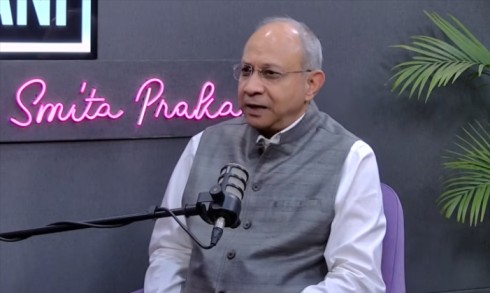
Editor’s Notes: In this episode of the podcast with Smita Prakash, former Deputy National Security Adviser Pankaj Saran provides a deep dive into the strategic complexities of the ongoing conflict in West Asia. The discussion explores India’s “strategic silence” and whether its current posture reflects a calculated necessity to protect energy interests and the diaspora or a compromise of long-held diplomatic values. Saran also shares fascinating historical context, drawing parallels to the internal decision-making processes during the 2008 Mumbai terror attacks and the evolution of India’s national security apparatus. (March 31, 2026)
TRANSCRIPT:
Introduction
SMITA PRAKASH: Namaste. Jai Hind. You’re watching or listening to another edition of the ANI podcast with Smita Prakash. Today my guest is the former Deputy National Security Advisor Pankaj Saran. Pankaj Saran has also been former Indian envoy to the Russian Federation and Bangladesh.
At the time of recording this conversation, the West Asia War seems to be increasing its footprint and with that, the risk for India increases — to Indian workers, the diaspora, trade routes and diplomatic ties in the Gulf. Not to mention rising oil and gas prices impacting the Indian economy. What will the world look like when the war ends? All this and more in this conversation with Pankaj Saran.
Joining me on the podcast today is my colleague Ishaan Prakash. Ambassador Saran, thank you so much for coming on the podcast. Very happy to have you here. Ishaan is joining me in the podcast today so that we get another perspective.
Basically, I wish it had been under more happier circumstances that we were discussing, but with this West Asia war — and I think it’s time to call it a war and nothing less than that — I want to know from your perspective what you think about the current situation. Is ground troops going on the ground? Is there an invasion which is going to happen? Ground invasion, the talks, are they actually happening or not? Because America says it is happening. Israel says no ground troops, Iran says no talks happening. This fog of war — or what is it that is going on? How do we make sense out of it?
The Fog of War: Making Sense of the Crisis
PANKAJ SARAN: Smita, that’s the easiest question I’ve been asked. So thank you very much for beginning on this very easy note. Look, I think the last time we met was we were in the middle of another crisis. But what I would just say is that no one has the answers. We’re just passing through a very, very unprecedented time. I think in contemporary history, 21st century, we’ve never seen anything like this.
And so all of this is very much part of the today reality where everything is fog, it’s social media. I mean, I just checked the latest tweet of President Trump before coming to tell you what the current situation is, because basically, at the end of the day, that’s the only information we have — what he tweets. So we have to keep checking in the morning, afternoon, evening.
SMITA PRAKASH: The markets are doing the same.
PANKAJ SARAN: Yes. And to keep pace with. And I think he loves shock and all. And talking to the media and kind of tweeting. So it’s incredible. I mean, the methodology of what is going on, the objectives, where we are headed, how bad it is, where is the truth and where is the falsehood.
But broadly, at the end of the day, I think this is really a serious crisis for us in any metric that you want to examine it. Much more serious than Ukraine and much more serious than what we’ve seen in the past — for example, the Iraq or the Syria or Libya — because of obvious reasons which we can discuss.
I mean, effectively, the war, as you called it — I wouldn’t call it a war, I would call it an invasion — through the air. And now let’s see what happens tomorrow on the boots on the ground. But it’s as close as you can come to India. I mean, remember, till 1947, we shared a common border with Iran. And even today, you know, you have these links with Iran which are never going to go away. And the Qatari — I think the foreign minister said, “Look, we’re going to live here forever and ever. We’ve lived here for millennia, we’re going to live here forever.” So we have to find a way out.
So I think we are actually faced with a very serious crisis. It’s come to our doorstep. We have to handle it very carefully because the stakes are high. You’re talking energy, you’re talking Indian diaspora, you’re talking of remittances, you’re talking of the global security and the regional security architecture, you’re talking about your relations with Israel, with the United States. Trade routes. I’m also, you know, you would be aware that Hormuz is not just a choke point for oil, but also for digital and submarine cables. So all of these are very critical.
So I think once again, with every crisis, you kind of come bang in the face of a vulnerability that we have. And I think for us as a nation, we have to be honest about these vulnerabilities and deal with them. The only thing you can do is to take away lessons from these challenges and be prepared, better prepared. Can you forecast? I mean, could we have forecast — like in Ukraine? You know, we learned some lessons from the COVID pandemic. We learned lessons. Now this time, again, we’re learning lessons. The question is, when are we going to stop learning the lessons and steel ourselves for the next big crisis?
And frankly, President Trump has already said that today it is Iran. He’s already named Cuba and Greenland, God forbid, as his next targets — and maybe something else, who knows?
India’s Policy Making: The National Security Apparatus
SMITA PRAKASH: So you’ve been in the national security apparatus, you’ve been in the PMO, worked in both in these kind of situations.
PANKAJ SARAN: No, so we have a pretty robust system of this kind of reactions, which are on a day to day basis and which are more of a strategic, more long term or medium term basis. So what would happen, of course, is — as you know, we discussed — the National Security Council has been beefed up since 2018. It is significantly stronger than it used to be.
And in fact, one of the reasons for the reform was precisely to be able to deal with simultaneous threats of a strategic nature emanating in the whole realm of national security, which go beyond, let us say, the remit of the Defense Ministry or the Home Ministry or the External Affairs Ministry. So the understanding was that national security today is much more complex and cannot be dealt with by one single individual ministry.
And I think from 2018 till now, it’s been eight years, it has matured. I mean, there have been like, let’s say, one or two generations of leadership and the NSCS at the second level. And so that institution is maturing. So you have committees which are set up at, let’s say, the level of the secretaries, level of the ministers, level of the Joint Secretaries, which are more working — and they meet every day, they exchange notes, meetings are convened. They could be convened either by the Prime Minister or by the National Security Adviser. And then duties are farmed out to the Defense Minister, to the External Affairs Minister, or in this case, to the Petroleum Minister.
But there is actually a very deep sense of what is required to be done. And of course, I think there is a communication problem — that the government is not able to communicate very well. I think in reality, it is actually doing much more than it appears to the outside world.
The Communication Gap: Deliberate Silence or Sarkari Mindset?
SMITA PRAKASH: Is that deliberate — not to speak to the public about these decisions? Because it could cause panic. I mean, it’s an old mindset, of course, where information is held onto. It’s a Sarkari mindset. I’m sorry to say this, I know you’ve been in Sarkar for a long time, but it’s this thing that if we share too much information, it can lead to panic. Is that the reason?
PANKAJ SARAN: It could be. I mean, it depends on the crisis. For example, two days ago, the Prime Minister convened a meeting of all chief ministers. The Defense Minister is chairing a committee — a group of ministers. There have been statements made by our government in the Parliament. So that has been that outreach.
But of course, in today’s day and age, where social media runs the roost and rules the whole narrative and the landscape, maybe they need to do a much better job. Be quick on their feet. But no one wants to create panic. On the other hand, it’s a balance — it’s a judgment call that you take, how much to put out, how much not to put out.
War Gaming the Hormuz Crisis
ISHAAN PRAKASH: Ambassador Saran, did India ever war game a situation like this where the Hormuz Strait would be shut and we would suffer this choke point essentially of our energy needs? And if a war game like that was set up where the decision makers are aware of what to do in case of a crisis like this, what happens when there are disruptions within that own war game — essentially a surprise? And you talked about social media — things are changing with each tweet. So in that scenario: A, was there a war game in place? B, what happens when that war game is rendered obsolete?
PANKAJ SARAN: No, there is war gaming. It’s happening. It depends what term you give it. But the idea that you are thinking constantly of your — let’s say, in this case, your energy vulnerability — is there at the back of everyone’s mind.
I’ll give you an example. The whole issue of whether India should have a Strategic Petroleum Reserve was a decision to be taken. Now, that decision was taken in 2008, in the previous government. And you actually set up three underground storage facilities. Why did you do that? I mean, you clearly had something in mind — that if you are dependent for 90% of your consumption on imports of oil, then you have to cater. And you owe that to the country and to the nation. You have to have a strategic reserve.
So in that sense, you’re all the time looking at what you need to do, looking at where you’re weak and strengthening it. I mean, even in Operation Sindhu, for example, last year — you prepared, and it wasn’t as if you ratcheted up in 10 days. Your preparations took many, many years. I mean, today, let’s say you are buying 114 Rafale jets. Why are you buying them? You are planning for the next 30 years, next 40 years.
So the idea that a crisis could occur is very much part and parcel of what the NSCS and other wings of the government all the time keep doing. So the question is not whether you are war gaming, but the question is, are you able to steel yourself and make yourself strategically resilient and kind of firewall yourself — and then accordingly decide what you have to do domestically and also what kind of relationships, friends, allies you need outside in the external world who can actually either stand by you or contribute to your national resilience or who might come to your use at some stage.
LPG Vulnerability and the Complexity of Gulf Relations
ISHAAN PRAKASH: Just personally speaking, when you’ve been part of the top decision making body, security body of India — you talked about strategic oil reserves, that’s one dimension of this. But say something like LPG, the supplies of which we are dependent — a lot of it from that same Hormuz choke point over there. Was it ever war gamed that in case hostilities between Israel and Iran were to break out, that countries like Qatar and other LPG producing nations would also be affected and that would in turn downstream cause disruptions in India? Or did you always foresee a sort of one to one conflict between these nations?
PANKAJ SARAN: No. When it comes to this region, the defining feature of the Gulf and the West Asian region is its complexity. There is actually no binary or a black and white. There are layers and layers of fault lines within them — among them, within them and external powers.
So everything that we do in terms of our relationships with each of these countries is geared to somehow reducing your risk or hedging your bets, depending on your needs — let’s say from Qatar, from Iran, from Saudi, from UAE. And so you actually have a very sophisticated mosaic of relationships which are issue based, sector specific. And what you’re trying to do is to ride on all these horses at the same time. And you’re doing it for the good day, but also for the bad day, as you’re seeing today.
Now on the LPG vulnerability — look, some of it is beyond your control. I mean, if for example, India was sitting on oil, we would be in a different place today. But having said that, it’s also important to realize and to give credit where it is due that we are the fourth or the fifth largest nation in terms of coal reserves.
ISHAAN PRAKASH: Right.
PANKAJ SARAN: Today, what I’m told is people are already switching to coal and Gitis in the rural areas. But the amount of coal reserves — you have about 10% of the global reserves. It’s a ready source of energy. Now in the climate negotiations, when there was this huge push by some of the countries to sort of outlaw the use of coal, we did not agree.
ISHAAN PRAKASH: Right.
PANKAJ SARAN: And we stood out as this single country which said, “We will not remove coal from our energy mix.”
India’s Strategic Autonomy and the Changing Nature of Warfare
ISHAAN PRAKASH: Yes, the carbon targets.
PANKAJ SARAN: Yeah. So why? Because we know that when it comes to the crunch, I have something with me. I can’t forsake that energy source. It would be criminal. Similarly. So I’m answering your question in a slightly different way.
On the nuclear, for example, why do you think we went out of the way to do the nuclear deal? You see, when it comes, since we’re discussing energy largely, your objective always has been how can I make myself less vulnerable to my energy dependency? You know, the United States, not this president, but the earlier presidents, used to talk and pronounce that America has to become energy independent. We also have to become energy independent. That’s one way of handling this choke point.
And that’s not the only choke point. I mean, if tomorrow, for example, it spreads to the Red Sea, right, and Yemen and the Houthis and then the
ISHAAN PRAKASH: Bab-el-Mandeb gets choked. Yeah.
PANKAJ SARAN: So the choke points are always inherent in any supply chain of which you are a part of. Now the big question is, can you do everything yourself that you don’t need the rest of the world? I mean, for example, the United States doesn’t import oil. But they’re heavily dependent on the Chinese for critical raw materials, for semiconductors and so many other high tech items.
So we have gamed, in the sense that we know. And another proof of this, you don’t have to take my word, is why do you think we spent so much money and effort, at least in the last 10 years, on the Indian Navy? Because you realize that for too long you had somehow paid less attention to the Indian Ocean than you should have. That is as important for your survival as the continental space.
And therefore, I would say at least definitely in the last 10 years, there’s been a massive increase in your naval presence, in your naval buildup. And that’s because you know that for these reasons, whether it is trade, whether it is energy, you need to be there in the Indian Ocean when you need to.
And one of the things I would say is it’s quite interesting to me that the Indian Navy so far, and our people are so silent, but we have seen in the last one or two years our ships have gone right up to, and sailed right up to, the Red Sea and to the Strait of Hormuz when we were facing the Houthi rebels and we were out there handling piracy and so on. So that was a demonstration of capability. So the question about the process of the war game is one, but more important is what is the takeaway and the outcome of that war game? I mean, what have we learned from it and how are we steeling ourselves?
Asymmetric Warfare and Iran’s Strategy
ISHAAN PRAKASH: Did we ever game for the asymmetric nature of the warfare that Iran has now employed and is hitting our allies, which is in turn hurting us as well again — Qatar, Saudi Arabia, etc.?
PANKAJ SARAN: Look, I think so. I mean it doesn’t require a genius to understand that if you’re going to bomb Iran out of existence, they’re going to retaliate and they will hit whatever they can. They can’t hit the United States, they can’t hit Europe, but they will hit the neighboring region and they will hit American assets and bases and facilities and interests there.
SMITA PRAKASH: But did those countries actually think that that would happen? To most of us, it seems like they were caught unawares completely.
PANKAJ SARAN: No, I think they definitely knew. Because if you’re hosting a U.S. military base or if you’re a proclaimed ally of the United States and you have taken certain positions vis-à-vis Iran over the last five, ten years, then you are right in the firing line. I mean, I’m sure they knew they would be the first line of fire when it came to retaliation by Iran. And Iran has been preparing for this — not since today.
SMITA PRAKASH: And yet the military bases were like sitting ducks. Missiles have landed out there and people have vacated those military bases, the families have gone out. Who vacates military bases when a couple of missiles fall on you?
PANKAJ SARAN: So if you want to prevent body bags, prevent coffins from going back to your mainland, then you take all the precautions you can. And so the whole war is a most unconventional war because the entire initial campaign was through the air. It was on a humongous scale. And I think they just went for broke, and we haven’t at all seen the end of it. It’s going to get worse.
The Changing Nature of Military Conflict
SMITA PRAKASH: You spoke about buying fighter aircraft, Rafales, that this kind of planning is done. And now Iran brings down the F-series aircraft with a couple of thousand dollar drones. It attacks West Asian neighbors, as we were talking, who were considered part of this Islamic community. What are these new war games which are happening? How was there ever any kind of planning which took this into consideration? We are also buying drones. We are manufacturing drones out here. But we are buying Rafales too. How does this work? What is this happy mix that one would need?
PANKAJ SARAN: No, you need everything in your quiver. You need everything. You need all the arrows. You can’t just rely on one. And this is the lesson from this. It’s a lesson from Sindhur, it’s the lesson from Ukraine. It’s a lesson from 2020 Galwan.
Look, if you are going to assert yourself and function as a state which is getting increasingly more systemically relevant to the global stage and you’re enhancing your own national power, you have no choice but to prepare yourself for every front and for every eventuality. And that’s what you’re doing. So the only decision point is what is the mix of your both defensive and offensive capabilities.
As far as I can see today, because of all these wars which we have seen — starting from 2022 Ukraine, or starting from Galwan 2020, 22, 25 and this one, 26 — the lesson you’re learning is that the nature of military conflict or war is changing really rapidly. And the issue is, are we ahead of it? Are we just managing to keep pace, or are we lagging behind?
I think we have to ask ourselves — the challenges in front of us. I mean, today everything is getting weaponized. What did you learn in 2020? Just to go back a little bit and ask ourselves. You learned you couldn’t make a face mask. You learned you couldn’t make a ventilator. You don’t have the medicines, life-saving medicines. You woke up and said you don’t have the manufacturing base for it. That was 2020, Covid.
2020, China — you had done a lot of work on military infrastructure, border infrastructure, roads, this, that and the other, but you didn’t have tanks which could actually run on Ladakh and the Tibetan plains. So you did all of that.
Ukraine — what did you learn? That energy today is completely weaponized. Financial institutions are weaponized. The system of international settlement of transactions is weaponized. Basically there is nothing that is not weaponized.
SMITA PRAKASH: Diplomacy too.
PANKAJ SARAN: Yeah, diplomacy is weaponized because, you know,
SMITA PRAKASH: Dare I say media too?
PANKAJ SARAN: Of course. I mean it’s a tool of war. We are living in the media age and it’s people like you who are going to decide victory or defeat on a battlefield. Because who’s seen a battlefield? I mean, if you look at Ukraine, for example, who does one believe? You believe the Western media, you believe the Russian media, and we are facing the same issue out here.
Should India Have Mediated in the Iran War?
SMITA PRAKASH: In which case, if diplomacy is also weaponized, have we missed a chance to be the mediator in this war? And having left the field open for Pakistan?
PANKAJ SARAN: How am I not surprised by this
SMITA PRAKASH: question that I asked you?
PANKAJ SARAN: Look, I’ve been following the social media. I don’t think it’s giving you the right answers to this question because it’s not the right medium to understand this issue.
But mediation was an issue discussed extensively even during Ukraine — whether India should get in because of our relationship with both sides, with the Russians and the Ukrainians and the Europeans and the Americans. So you have to basically ask yourself, do you want to function as a mediator? The last time I think we did it was in the 50s in the Korean Peninsula. But after that we’ve not really got into mediation. We haven’t even mediated between Bangladesh and Myanmar on the Rohingya issue. We haven’t even mediated between Nepal and Bhutan on the return of refugees from Nepal to Bhutan or vice versa.
So it’s a self-image issue. You know, Norway — a country like Norway, on the other hand, you’re talking about diplomacy — their diplomats revel in mediation, between the LTTE and the Indian government and so on. So there are countries which do this kind of stuff. Pakistan, before I do that — Qatar, great mediator. Oman, great mediator.
You know something about the DNA of a country or a nation — is China a mediator? I don’t think so. Russia used to be a mediator in its own neighborhood, but it abdicated that role to the Americans and the Europeans — Armenia, Azerbaijan and so on.
As far as Pakistan is concerned, look, they have a history starting from 1971 where, if you don’t have many cards to play, you are going to leverage your geographical location, your identity as an Islamic nation. So both Islam and geography are working in your favor. And so you use that to the extent you can. So they did it in 1971 between the United States and China. Much more recently, they did it right
SMITA PRAKASH: up to Afghanistan also.
PANKAJ SARAN: Exactly. Right up to the agreement in Doha between the Taliban and Trump 1.0. Imran Khan in 2020 — they actually played a very critical role and we were pretty much out of it because the Americans were talking to the Pakistanis and to the Qataris, and the Pakistanis were bringing the Taliban to the table. And so that’s what happened.
But guess what — today you are in a situation where the Taliban and Pakistan are at war. So yesterday’s allies and protégés have today become enemies. So I think it’s okay. Let them do it. I mean, it’s not an easy field to mediate. It’s far more complicated than the Ukraine one because at least there the number of actors is slightly less. I mean, you just have, let’s say, the United States, Europe and Ukraine on one side. Turkey, for example, tried in 2022 — they did the grain deal, but then it failed after that.
Pakistan’s Nimbleness and the Trump Connection
ISHAAN PRAKASH: Another dimension about the Pakistan angle is — do you also think that Pakistan’s leadership was very nimble in trying to figure out the way Trump is and the interlinking of all of Trump’s businesses? I mean, there’s a story today in Bloomberg about this so-called Pakistan crypto bro — a 35-year-old Pakistani man who’s based in Washington D.C. who linked all the players of the whole crypto world with the Pakistani crypto exchange as well as World Liberty Financial, which is owned by the Trump family and Steve Witkoff, etc. And the effects of that can be seen later with Asim Munir having multiple lunches in the White House and becoming President Trump’s favorite field marshal.
PANKAJ SARAN: Yeah, so true. I mean, look, they moved in very early. I think they realized that in Trump 1.0 they had developed very close links with the U.S. administration, with the Trump people because of the Taliban deal, and they had actually delivered the Taliban. So if you look at that experience, obviously they used that very much.
It also kind of merged nicely with the U.S. plan to fix the Iran problem. And that’s where Munir and the Pakistanis stuck their neck out and offered their services as far as Iran is concerned. And I think that’s what happened in the middle of last year. So a lot of the discussion, we should presume, between Munir and Trump was not so much about us, but about Iran and what Trump was planning to do. Because after this lunch and everything else, that’s when all the bombing of Iran took place and so on, and
India’s Role, Mediation Prospects, and Regional Dynamics
ISHAAN PRAKASH: The role of India as a mediator. Ambassador Saran, realistically, we mentioned all these Gulf states, right? They made trillions of dollars of investment in America to essentially become an American protectorate. All those investments have come to naught because in the end America went ahead with the Israeli view about Iran and went ahead and launched this operation.
So in a situation like that, and there have been instances where mediation efforts have failed spectacularly, with Oman being an example, where even Omani assets have been targeted by Iran — in a situation like that, which country would want to stick their neck out and try and mediate between America and Iran, and at the same time having Israeli interest also to keep in mind?
PANKAJ SARAN: You’re right. I mean, look, if you want to dissect the complexities, you can. It’s like an onion. You can keep peeling one layer after the other and you will still not. I mean, American presidents, legions of them, have spent their full terms trying to find a resolution to the Israeli-Palestinian conflict dating back 25 years, starting from Bill Clinton, starting from Bill Reagan. I mean, the whole — they’ve just spent their — and every president. It’s almost like our prime ministers trying to fix the Pakistan problem.
ISHAAN PRAKASH: Yes.
PANKAJ SARAN: They’ve all failed. Right.
ISHAAN PRAKASH: Anwar Sadat tried to do it, got assassinated.
PANKAJ SARAN: Right. So the Israelis are actually — they think that was the biggest victory for them. I mean, they actually say, “You know what, we managed to defeat Arab nationalism because of what happened in ’79 with Anwar Sadat.” So it’s easy to have a meeting. Let’s look at the players involved. It’s Saudi, Egypt, Turkey and Pakistan. Right. This business that you can bring the strengths together and four becomes 40. But it’s not going to happen.
SMITA PRAKASH: It’s also a Sunni grouping.
PANKAJ SARAN: It’s also a Sunni grouping.
SMITA PRAKASH: So Iran will not necessarily accept that grouping. So.
ISHAAN PRAKASH: But if you talk about the OIC, the irony over here is that this idea of an Islamic grouping was completely silent when the Gaza Board of Peace was constituted. The rights of Palestinian people were completely put to the side, and they were part of this grouping when the resolution was passed.
SMITA PRAKASH: The Arab street has already aligned itself with the US, is what I think. I don’t know about you. What do you say?
PANKAJ SARAN: No, what I have been told and what I hear through anecdotal and so on is that on the streets of the Gulf, the level of anti-Americanism is running very high. And you have to separate the street from the monarchs.
SMITA PRAKASH: Right.
PANKAJ SARAN: So the monarchs have the stakes that you talked about. That doesn’t necessarily translate. I mean, look at Bahrain or anyone else. So the street does not reflect the — if everything was so good, you wouldn’t have had a problem of this kind where there is anti-Americanism. For example, even in Egypt, when 9/11 happened, there were celebrations on the streets. So there is this complexity of the Gulf states.
Pakistan’s Mediation and India’s Strategic Ambiguity
SMITA PRAKASH: You know, even when we talk about the thing about it being complex, Pakistan seems to have a solution to this.
ISHAAN PRAKASH: This was an opinion piece that came in a prominent daily, the New Indian Express. The author writes, “As a fatal consequence, it has alienated traditional partners in the global south and even within BRICS” —
SMITA PRAKASH: — it being the Indian way of strategic ambiguity and being silent rather than being a —
ISHAAN PRAKASH: — “modern mediator, leaving India isolated precisely when its leadership was most needed. Pakistan’s mediation coup has re-equated India with its neighbour in global perceptions, something New Delhi has fought for years to avoid.” Agree, don’t agree?
PANKAJ SARAN: I mean, this is an opinion. On the surface, it looks a very attractive kind of piece of literature, but it’s not so simple. I mean, by any metric, are you trying to say that India, for example, is not going to be a systemically significant player on the global stage? I mean, how much money can the United States or the Trump family or the administration earn from Pakistan?
I mean, in the days to come, in the years to come, the asymmetry of the relevance of India and Pakistan is going to grow. It’s not going to — now, it’s another matter if you’re comparing every step of Pakistan, and if you want to compare yourself to Pakistan, you can do that. But that’s hardly the template, or the litmus test, by which you should check whether you’re doing well or you’re not doing well.
So we are at that phase, I think, from a historical sense, of graduating. We are not also, by the way, very comfortable to be described as a middle power. You know, there is this thing about — is India a middle power? So there is a school of thought which says that you are obviously not a major power, but maybe you’re not even a middle power, you’re somewhere in between. And so what you do has to be done by yourself.
SMITA PRAKASH: The Canadian prime minister said that Canada is a middle power. And he says, don’t think that — when you talk about India and Canada being middle powers — “We are a middle power, we accept it. But India has greater aspirations and they don’t want to be referred to as a middle power.” And I was kind of surprised because I was comfortable being a middle power. I, as an Indian, think of India as a middle power and am skeptical of this Vishwa Guru aspiration — that we are not yet ready for that. But obviously other countries expect more out of India.
PANKAJ SARAN: They do, actually. The expectations from us are far more than what our own expectations are of ourselves.
SMITA PRAKASH: Yes.
PANKAJ SARAN: And you hear that wherever you travel out of India, and they all say that you’re punching below your weight, or that they are betting on you from a strategic sense, from a geopolitical lens.
SMITA PRAKASH: Even now, during the war?
PANKAJ SARAN: Yeah, I mean, in the sense that they’re asking what Ishaan is saying — why are you not on the table? Why are you not leading the — and there are good reasons why we are not. I mean, why is China not getting into this? Why is Russia not getting into this? Why is Europe not getting into this? I don’t understand. Why is Turkey not getting into this as they did in Ukraine? Why are they riding on Pakistan’s back?
SMITA PRAKASH: If I’m a devil’s advocate, I’d say China is not living in this region. Europe doesn’t live in this region. We live in this region. So shouldn’t we be involved?
PANKAJ SARAN: Well, it’s a strategic choice you make. We have made phone calls. We’ve got lines open with everyone. Mediation also requires the right tipping point. I mean, you want to get into mediation when missiles and aircraft are flying left and right, and you say, “I’m going to sit and mediate”? And number two, who’s asking you? You can’t insert yourself into a war and say, “Look, I live here, so I must mediate.” It doesn’t work that way. I mean, Iran is not waiting for you or asking you or saying, “Can you please come and mediate?”
So if they’re asking the Pakistanis, or Pakistan is inserting itself, I would just say, best of luck. I mean, let’s see what comes out of it. And frankly, if they succeed, good for us. I mean, at the end of the day, we get our oil, we get our trade, we get our diaspora, we get our remittances, and we benefit and we carry on with our own business as we were doing before.
I mean, despite the fact that they are Muslim, they’re Sunni, and this, that and the other, our relationships, I think, with each of the Gulf states is actually pretty good. And if you look at the numbers, they’re way ahead of the Pakistanis. We are talking hundreds of billions of dollars. I mean, in the last three weeks, the amount of food we have sent to the Gulf because of the war. So why are they still investing here? Frankly, we are the second largest energy market in the world. Whether you mediate or you don’t mediate, it doesn’t matter, because the numbers speak for themselves. You can’t sell oil to Pakistan of the nature and the scale that you can sell to us.
So I don’t think we should start beating our breasts and say, “Oh, we are not there.” Of course we are there. We’ve been there longer than Pakistan has existed. I mean, Pakistan is like 70 years old.
Iran’s Position and the Prospects for Negotiation
ISHAAN PRAKASH: Okay, for a second, let’s look at this from the eyes of those sitting in Tehran. For any mediation to succeed, you need the party to also be amenable to such a mediation. Do you think Iran, as it stands, is having good faith negotiations?
Before the start of the war, they controlled some 5% of the world’s oil reserves. Now, with effectively shutting down Hormuz, they pretty much control about 20% of the world’s oil supply. Plus they have direct negotiations with countries priced at a higher dollar rate per barrel. So they appear to be stronger now than before the war. Would they actually want to have such good faith negotiations?
PANKAJ SARAN: See, look, Ishaan, that’s the million dollar question, right? I mean, the answer to this question is going to play out, or is going to become visible, in the next few weeks. Now, we don’t know. I mean, there is an assessment that you can’t vanquish Iran as a nation, as a civilizational state, that you can’t bomb them out of existence. There is resilience. There is this whole ethos of martyrdom — that they will be ready to withstand the most severe pressure.
And when they come out of all of this, are we going to go back to a pre-1979 Iran or are we not? That’s the real issue. And so as of now, whether Iran is going to sit at the table to negotiate is something which is hidden behind closed doors. We really don’t know what is the nature of the negotiation, who is negotiating, and how sustainable this negotiation or the outcome of this negotiation is going to be. I mean, if we take President Trump’s Truth Social posts on face value, it seems they are negotiating and he’s happy that they’re making some deals.
SMITA PRAKASH: But they got a few ships of oil.
PANKAJ SARAN: They got a few ships. But how much of it is going to be because of Pakistan’s miraculous diplomacy or stellar diplomacy? We don’t know. I mean, we have to look at Pakistan for what it is. And remember one more thing, just to complete the thought — Pakistan was representing Iran in Washington, D.C. from 1981.
ISHAAN PRAKASH: Yes. Their embassy is used — you’re right. Yeah, yeah.
PANKAJ SARAN: They have an intersection inside their embassy, and the Swiss were doing that for the Americans in Iran. So the history of Pakistan representing Iran in the United States is an old one.
The fault lines between Iran and Pakistan are also very complicated because of the religious factor, the Shia-Sunni issue, and the land border between the two of them. It’s a known fact that Iran has accused Pakistan of hosting and supporting terror groups like the Jaish-ul-Adl to promote terrorism inside Iran. In fact, Iran launched missiles on Pakistan.
ISHAAN PRAKASH: Yes. 2024.
PANKAJ SARAN: Yeah, yeah.
Russia and China’s Strategic Calculations
SMITA PRAKASH: You briefly mentioned Russia and China — why are they silent, is what you asked. Russia benefits from higher oil prices. China, America’s biggest rival, would love it if America is busy in these prolonged wars. And it’s also looking at how the military might of America is being absolutely blown to smithereens by a small country like Iran. So if they are going to get ambitious about Taiwan, they know that they can beat America if America comes to Taiwan — or probably think that they can do it. Explain to me Russia and China’s mindset right now.
Russia, China, and the Geopolitics of the Iran Conflict
PANKAJ SARAN: Very interesting. Look, let’s look at Russia again. I’m sorry, you were posted there. But I’m sorry to complicate the answers all the time, but that’s the world we live in.
So where is Russia’s position since President Trump came to office? The best thing that has happened to Russia is the opening of a direct channel between President Trump and President Putin, between their two offices. And that negotiation has been going on. It hasn’t stopped. I mean, it’s a bit of waxing and waning, but the channel exists, the conversations are on. And the people who are the most unhappy about it are the Europeans. They are fearful, they are scared, they don’t know which way it’s going to go. And of course, President Zelensky feels he’s been had.
And so at one level, Russia has a great thing going with the Americans, which it never had in the previous administrations. And I feel that they would like to keep that and preserve that positivity in the relationship, because I think Russia desperately needs some kind of a peace deal, or at least a ceasefire, and so they will maintain that relationship with the Americans.
If you just wind back a little bit on Syria, when Assad was removed — who was a great friend of the Russians — the Russians didn’t do anything at all. They kept quiet. If you look at the peace deal between Armenia and Azerbaijan last year, Russia’s periphery, that peace deal was made because of Trump and Armenia, Azerbaijan and a bit of Turkey. Russia had no role to play. So what we are seeing is that Russia is also strategically contracting, or let’s say consolidating itself. And it seems to be choosing not to pursue any major expansionist diplomatic agenda.
SMITA PRAKASH: They didn’t do it with Venezuela either.
PANKAJ SARAN: And they did not do with Venezuela. Yeah, so it’s a very interesting phase. Russia seems to be maintaining silence.
On the other hand, on the battlefield, Russia clearly is benefiting from the weaknesses which Ukraine is now experiencing because of the diversion of attention globally — resources, financial, military. So Russia is feeling itself more emboldened, more powerful on the battlefield with Ukraine.
And now when you come to China, for the reasons you mentioned, when you look at the history of China and the way they have behaved on the global stage, even on the Cambodia-Thailand problem and the mediation — the Chinese actually allowed the Americans to handle it. And it’s something, it’s a lesson for us. They’re not rushing in. They’re not saying, “This is my periphery, I’m going to do it.” They allow the Americans to do it. A few of the Chinese themselves told me that, and that’s really interesting. It’s a case study of how you want to tailor your cloth according to the size. You’re not rushing in everywhere.
And above it all, both the Russians and the Chinese are actually pretty happy to see the Americans getting bogged down in the region, for what they believe is not going to end in like two weeks. So you’re once again going to have the Americans kind of sucked in militarily, financially, and losing the goodwill of the broader international community. So you lose that moral high ground which you always proclaimed.
So they are allowing the American administration to say whatever they are saying, which is pretty brutal on television. If you bomb a school and kill 168 children, who is holding the Americans responsible for that? So they are also allowing America, in their opinion, to make yet another mistake, because you’ve had a series of military incursions over the last 20 years in the Middle East, and all of them have been very messy, very destructive. And it’s a moot point whether you achieved your objectives, starting from Iraq 2003. So there is that element also of saying, “Let them dig their own grave.”
For these reasons they are staying away. The only thing they’ve actually done, if you come to think of it, is they vetoed a resolution in the Security Council.
SMITA PRAKASH: As if it matters.
PANKAJ SARAN: As if it matters.
Iranian Missile Precision: Russian and Chinese Support?
ISHAAN PRAKASH: Going one step ahead, Ambassador, do you think the lethality and precision of these Iranian missiles, or these pinpoint attacks on bases, would be possible without any active support of Russia or China in the form of satellite coordinates or something else?
PANKAJ SARAN: Well, what I was told was that the Iranians — and this is all based on what is coming out publicly — in terms of the satellites they were using, basically three constellations: the GPS, the BeiDou, and the GLONASS. And obviously the GPS is not functional for them, but maybe these two are functional to some extent. So who knows? They could be using those because they don’t have their own indigenous capabilities.
But the interesting thing is when President Trump was asked about the Russian role, he actually said they are not playing a role. He didn’t confirm that there is a Russian participation or role in the Iranian missile attacks, which is interesting. So I am not sure whether all of this is emerging from Iran’s own indigenous capabilities built up over a period of time. Because if, for example, there was concrete evidence of Chinese satellite constellations helping to guide Iranian missiles, I’m sure by now we would have heard about it.
SMITA PRAKASH: Wouldn’t President Trump have — if he has a hotline with President Putin — wouldn’t he have spoken about it with President Putin? And is the delay in meeting with President Xi because of this information?
PANKAJ SARAN: I don’t know. Look, they were supposed to meet in April, now it’s May. The China relationship stands on its own. Iran is a sideshow. He’s not going to allow the US-China relationship, and the way he wants to shape it, to be affected by Iran.
But the message is not lost on China or Russia — that you first fix Venezuela, then you go for Iran, then you are planning to go for Cuba, and at the same time you’ve announced officially that the United States is going to ensure that the western hemisphere —
SMITA PRAKASH: Yeah, Mr. Hegseth’s remarks — it’s going to be —
PANKAJ SARAN: — free of both the Russians and the Chinese.
SMITA PRAKASH: Yeah.
PANKAJ SARAN: So I think when it comes to China, that relationship has a much greater strategic significance than the US-Iran conflict as we are seeing it. And that goes to the heart of the US-China relationship — it goes to the heart of how you are going to shape the geopolitical architecture or the security architecture of the world. And so we are going to see much bigger games, much more serious application of mind in that relationship than we are seeing in this one.
Pakistan’s Role: Mediation or Political Theater?
ISHAAN PRAKASH: I want to just circle back to the Pakistan mediation thing. I don’t want to let go of that so easily. We are recording on Monday, 30th March, and we are seeing this huge sort of armada of American manpower — ships were already there, now manpower heading over there. And history has taught us with President Trump that whenever he positions all this military hardware, he does use it.
So now we have boots on the ground, options being given, it’s being leaked out to the press as well that the objectives could be getting the uranium, or taking some island, or anything. So my question on the Pakistan angle is — do you think that there is a certain element of Pakistan being co-opted by President Trump to sort of play this political theater of mediation and talks, before real on-ground operations by America — America and Israel, or just America in itself — are launched against Iran?
PANKAJ SARAN: Yeah. Look, what we know so far is what has come out from the Americans — they are saying that the Pakistani role so far is only to pass messages.
SMITA PRAKASH: Not actually to negotiate — just to shovel the messages.
PANKAJ SARAN: Pass messages from one side to the other. Now if there is a ground attack or a ground offensive, I don’t think the Americans are going to allow the Pakistanis to come in the way of, or ask them to help, the American military action. I don’t think that’s going to happen. They’re going to tell the Pakistanis, “You stay away.” So as of now, I’m not sure how much of the talks —
ISHAAN PRAKASH: Is it political theater? Is that what I’m saying?
PANKAJ SARAN: It’s theater. Because if Pakistan was so confident about its capability to bring peace, they would not have co-opted the other three countries. They would have done it on their own. After all, you would like to take the limelight and not share the stage with anyone. But here, countries like Egypt, Turkey, Saudi — they are experienced. And we basically have no problems with Egypt, we have no problems with Saudi. We have pretty friendly ties with both of them and they have a very healthy regard for us.
So it could be part of theater. The fact is that this is pretty much part of the strategy. We have seen that President Trump says many things in terms of stretching to the limits of any given situation and then backing off. So whether this ground offensive — I mean, it’s possible, he may go in. But I would only say that what strikes me is what the Iranians have said: “Welcome to hell.” Because it’s not going to be so simple, of course.
SMITA PRAKASH: And it’s a very large country. It’s not a small country if you’re sending in your troops.
ISHAAN PRAKASH: And Iraq was a quarter million American troops when they took over the country.
SMITA PRAKASH: There are mountains there, caves there. The terrain is not conducive to —
PANKAJ SARAN: But it’s also — if you do manage to exercise control over a certain piece of territory, how long can you keep it for? How long can you sustain occupation, replenish it? Just the Kharg Island — how long can you hold it? How much weight —
ISHAAN PRAKASH: — do you give to the —
PANKAJ SARAN: Because you can. Yes, but then you’re sucked in. Yeah, of course, for a few years.
Gulf States Pushing for Full Invasion
ISHAAN PRAKASH: How much weight do you give to the reporting that’s happening — that Saudi Arabia and UAE are now lobbying Trump to, now that we’re in it, might as well finish it and go the whole hog and actually go ahead with an invasion? Because they’re staring at an existential crisis where, if there’s any American retrenchment from this war, they are stuck with an Iran that is probably more powerful now than before the war.
PANKAJ SARAN: Yeah. There are different voices coming out of both Saudi and UAE saying, “Finish it.” In fact, from an Indian point of view, for me, the worst is that you’re neither throwing the thing out of your throat or swallowing it. We are also in pretty much a similar situation — how long can you live through this uncertainty? So either you finish this thing off, or the war drags on and they are hurting. The UAE is badly hurting, the Saudi economy is badly hurting, and that will hurt us.
So you could advocate finishing it. But then the question will be — how much force is enough and what kind of force? He mentioned to the Japanese prime minister about Pearl Harbor and so on. These are bad images. So how far are you willing to go to finish this off? And what happens when you walk away and when you have nothing left but the ruins?
I’m not sure whether we can have a situation where, after all this beating, Iran — or any Iranian regime — can come and shake hands with these countries and say, “Let’s make up, let the bygones be bygones, and we will live peacefully and go back to where we were.” I think there is no going back in this situation to the kind of relationship that existed.
And Israel is really the joker in the pack. Once you — assuming you deal with Iran, which I don’t think is actually possible — you’re still left with Israel. And then the very same Gulf states have to take a decision on what they do with Israel.
SMITA PRAKASH: An empowered Israel or an empowered Iran — what suits them?
ISHAAN PRAKASH: And they bought the American thing with the Abraham Accords. They went ahead with the normalization of Israeli ties.
India’s Strategic Silence: Taking Sides?
PANKAJ SARAN: So, on the one hand you have Israel, on the other hand you have Iran. Who’s your bigger enemy? Where are your interests? So they are also conflicted and within them. Remember what we see in the last three weeks, two countries have generally been absent from this coalition — Oman and Qatar. Right. And Oman is just opposite Iran. And Qatar has links, and Qatar was a pivotal state in the Taliban negotiation. So it’s basically the Saudis and the UAE. So they face a huge, much more —
SMITA PRAKASH: — than US Ambassador, I want to ask you this. We spoke about Russia’s silence and China’s silence. Some foreign policy mandarins in India feel that the silence or the strategic ambiguity that India is doing, it’s interpreted as consent to the hegemony of US and Israel. Would you say that? Would you concur with that view?
PANKAJ SARAN: To some extent. I mean, this is an issue where you have interests and you have values. And this debate is not surprising to me because it kind of is an affront to everything which international law stands for.
So on the one hand you have the European approach, which is purist human rights, international law — this is wrong, this is not our war, you didn’t consult us. You have the Spanish view, which is extreme. So that’s one approach that you have.
But honestly speaking, if you take a survey, a global survey, I don’t think people are applauding what has happened in terms of the American military action on Iran. No one is saying, “Serves them right. Good, well deserved, well justified.” So there is a backlash of public opinion against the United States — in terms of what it stands for. What it did in Venezuela was in its backyard. But what it is doing here is something different. So that’s on the values part.
But our interests dictate otherwise. I mean, our interests lie with the Gulf states. They also lie with Iran. The idea that if you have a problem with Pakistan, you should always try to maintain reasonably good relations with both Afghanistan and Iran — that has been a constant feature of Indian foreign policy. You cannot in one swoop alienate Pakistan, Afghanistan, and Iran. And so there has been this element in our policy of playing Iran and Pakistan against each other. That’s why we maintained, among many other reasons, always a channel of friendly relations with Iran.
So this is a balance issue. It’s a judgment call. It’s a political decision of what the government wants to do. I think they have chosen to — I mean, the Prime Minister went to Israel two days before. So there is that element here of showing — so the silence that we have maintained is obviously helpful to the Americans and the Israelis, let’s put it that way, and to the Gulf states.
SMITA PRAKASH: So we have taken a side.
PANKAJ SARAN: In some senses, yes. In some senses, yes. You have taken a side. Now, does that militate against our perception of ourselves, of our values? I think it does. But you’ve taken the side. It’ll only be history which will judge whether you took the right decision or not. It’s very difficult at this time when we’re in the thick of it.
But what you could have done — at a maximum, could you have taken the position that Europe has taken? I mean, here you have a situation where the allies of the United States have distanced themselves from the US military action in Iran and have been rebuked and mocked by the Americans. We haven’t seen this before. We are living through unprecedented times. So you have a situation, but America —
SMITA PRAKASH: — will not take punitive action against Europe. If Europe says these things, India says these things, and immediately they turn off the tech button. They won’t give us high tech. We knew that when Pokhran happened, when we did all that, we were punished. Isn’t that something of a detriment?
ISHAAN PRAKASH: The British bases are still being used by American bombers. It’s only France — that’s essentially the more — the bigger ones. Germany as well, that’s done. So they’re divided as well.
PANKAJ SARAN: No, they are divided. But what stands out is that in 2003, France was the one who actively opposed the US invasion of Iraq.
ISHAAN PRAKASH: Freedom fries.
PANKAJ SARAN: Yeah.
ISHAAN PRAKASH: Remember that. Yes.
PANKAJ SARAN: This time, I would say, broadly speaking, France has led Europe and Europe as a whole has stayed away, which is quite a remarkable thing for a NATO alliance. And that’s why you had these flurry of exchanges between Trump and the European leaders — Germany, France, Starmer, Spain. So it’s not as if there is great enthusiasm now.
It’s all boiling down to: “If you’re not going to join my war, I’m not going to join your war.” So there is an implosion within the alliance — if you’re not going to join my war in Iran, you can handle Ukraine on your own and I’m not going to come to your rescue there.
SMITA PRAKASH: So if India has a war, who’s going to be with us?
India’s Fear of American Retaliation
ISHAAN PRAKASH: My apologies for interrupting over there. Back to Ma’am’s question about whether we will be penalized by America for doing that.
PANKAJ SARAN: Look, if you’re going to live in fear as a nation and look behind your back every time, it doesn’t speak very well of you. I mean, what have you done in these 78 years? Have you built up your capacity, or are you still — I mean, in the 1950s and 60s, you were much weaker and you took much stronger positions vis-à-vis the Americans. So I don’t think we should — I think our mind space should be in a better position.
SMITA PRAKASH: We have ambitions on AI. We want to be a developed nation. If we do not side with America, we don’t get that support for our AI dreams. It’s hard, isn’t it?
PANKAJ SARAN: No.
SMITA PRAKASH: To do things without America is fine. China is doing that. “We don’t need your chips. We’ll do it on our own.” Nvidia, go take a walk. He told his team that we’ll do it without them.
PANKAJ SARAN: Right.
SMITA PRAKASH: We can also do that. Sure we can. We did it during COVID. We did it on our own in many respects. Told our pharma companies, “Do it, we’ll do it.” Those are extreme circumstances.
PANKAJ SARAN: Yeah, no, you’re right. We need the Americans. We need the Americans. And hence — yeah, but there is always a balance. There is a balance between how much you’re going to cede.
SMITA PRAKASH: That’s why you are a diplomat and I am a media person.
Signals of India’s Alignment
ISHAAN PRAKASH: Ambassador, just to clarify, on India’s position — you’re saying that we took a position. How do you say that? Was it the delay in condemning Ayatollah Khamenei’s assassination? Was it the delay in signing — not signing the book on time about what happened to INS Dana? What is it that you conclude that India took a side in this conflict?
PANKAJ SARAN: For example, if India on the first day of the attack had issued a statement saying — somewhat like the Europeans did — “We condemn this action, it is violative of every single precept of international law, and this goes against the interests of regional stability,” and so on and so forth. You didn’t do anything of that sort.
On the other hand, you visited Israel like two days before. And when all this happened and when Ayatollah Khamenei was assassinated, you maintained that silence, which spoke louder than anything else. So you took a stand. How else can you signal that you’re taking a stand?
And on top of that, you had multiple conversations with the Gulf Monarchs, and you have also said in those conversations that “We condemn attacks on you.” So clearly, there are people who say, “Why are you exercising strategic autonomy?” This is a case where you have said, “I am going to side with a particular set of countries.” And that also is now criticized — which is a reflection of the fact that, yes, there are people in India, well-meaning people, who actually believe that India ought to not sacrifice principles or values for narrow interest.
But these are judgment calls. I mean, like when Russia went into Ukraine —
ISHAAN PRAKASH: Yes.
PANKAJ SARAN: What happened? I mean, you didn’t condemn.
SMITA PRAKASH: So principles —
ISHAAN PRAKASH: When the guns, when the bullets start —
SMITA PRAKASH: No, we used to — nuclear disarmament. You remember that. You’re part of that generation which has seen for decades together nuclear disarmament. What happened to that? Does anybody talk about CTBT or nuclear disarmament anymore? What is the point?
PANKAJ SARAN: Yeah, so I’m agreeing — if you have to play the real game, you’re playing it. But you also cannot argue convincingly that you can drop Iran.
ISHAAN PRAKASH: Yes.
PANKAJ SARAN: Because there is a certain reality which is also related to the dynamic between Iran, Pakistan, Afghanistan, the Caucasus, your Shia populations, and so on. You have to play the game. You can’t swing to one extreme or the other.
Did India Misread Iran?
ISHAAN PRAKASH: Ambassador, if you were there in this situation — in the month preceding this action, you are seeing visuals of tens of thousands of ordinary Iranians being killed on the streets by the Iranian regime. Do you think our national security apparatus misread the popularity of the Ayatollah? Did they also think that maybe with a decapitation strike like this there could be an actual regime change, just seeing the enthusiasm of the Iranian people rise up? And are those the calculations that came in where we didn’t take a principled stand immediately and we waited for a few days before we eventually did condole the murder?
PANKAJ SARAN: I don’t think people in India would have calculated that the regime would collapse. I don’t think people equated the demonstrations on the streets with the trigger for the collapse of the regime. I think people here see that what happened in 1979 and the Islamic Revolution is not going to go away, and you’re not going to go back to a Reza dynasty because that is not happening either.
I think our understanding of the Iran situation was pretty sophisticated. We actually maintained high-level contacts with Iran even as recently as January. Senior officials from here went and they met Ali Larijani, they met other national security officials in Iran. Of course, all of them have been killed today. But why did we do that?
I don’t think we misread. Was Iran going to fall? Was it like a Mubarak kind of situation where you have a couple of weeks of protests and Hosni Mubarak just collapses? I mean, that’s the end of a dictatorship. I don’t think you can compare the Arab Spring with the situation in Iran. And anyone who thinks that this is going to fall like a pack of cards — I don’t think that’s going to happen. That’s the Indian reading, I think, of the situation.
And right through the last 10 years, we have maintained contacts with Iran. We never were in a situation where we froze them or decided to walk away. In fact, even Pakistan has maintained contacts despite the Shia-Sunni divide.
Why India Did Not Retaliate After 26/11
ISHAAN PRAKASH: Ambassador, another personal question that I wanted to ask you. In 2008, when India essentially went through its worst terror attack, you were in the Prime Minister’s office and you were privy to all the conversations around national security and a possible retaliation against Pakistan. Why didn’t India retaliate?
PANKAJ SARAN: I think it was — these are political decisions. The Prime Minister of the day — just to place 2008 in perspective — till 2007, there was a fairly active channel with the Pakistanis, with Musharraf, to find some kind of a solution on Kashmir. And the Prime Minister of that day believed that you could actually have a deal — or not a deal, but some breakthrough on Kashmir. And there were periodic meetings, etc. 2008, when this happened, remember this was in November —
ISHAAN PRAKASH: Yes.
The 2008 Crisis: Restraint, Nuclear Deal, and Political Consequences
PANKAJ SARAN: But by September, by August, September of 2008, you already had the global or the Western financial economic crisis. The world basically had collapsed. And then you had this. So the Indian growth story was at a serious risk of getting completely destabilized. And then in November, this happened.
I think perhaps one of the reasons was that you were not politically capable or ready to handle both crises at the same time. And so I don’t know what happened in the internal workings of the cabinet and so on, because I was not there. But the strategy used at that time was to use diplomatic means.
And so what I do remember is that in the first one or two months after the attacks, we were deluged with delegations from foreign countries basically pleading, “Don’t do anything, don’t take any military action against Pakistan.”
So in retrospect, in hindsight, you could argue on the wisdom of that decision, whether right or not. But what was clear at that time was that a very difficult choice had to be made. And there were divisions, by the way, within the system, within the government, on the response which we should have had. There was a considered view that you should retaliate and there was the other view. And I think therefore the prime minister of the day prevailed. So you did not go in for a military retaliation.
ISHAAN PRAKASH: And pointedly, was there American pressure on India?
PANKAJ SARAN: It could have been. But the Americans were reeling under this shock of a financial crisis. They had no answer to what had happened to them. Western capitalism had just collapsed. So there could have been American pressure for sure. I mean, there were American congressional delegations, State Department delegations. There were others also from Europe who actually understood that you were just on the edge. And so they tried to provide you the diplomatic comfort of not taking the military action.
But obviously the Pakistanis took a wrong message away from that Indian restraint. And which is why we saw what happened later on. And so therefore, when the Modi government at the BJP was elected in 2014, one of the reasons for that election and subsequent elections was because of what happened in 2008. Basically the Indian electorate said, “We did not agree with the response that you took in 2008.”
And therefore there was a desire for a more robust government at the center with a more robust prime minister to take office and to actually deal with the Pakistan problem compared to the pre-2014 era. So I would say that the election of Narendra Modi as Prime Minister was in fact a response to the inaction, military inaction of 2008. It was the Indian electorate’s response to the sense of weakness — that “I want a much more firm hand at the wheel, both when it comes to the economy but also when it comes to national security.”
And actually it is true, if you look at the litany of terror attacks — and we’ve done a study on that in my organization — it was incredible. And it looked as if you had no control over what was going on. But from 2014 the situation changed. You did have two, three attacks but not like the ones you had before 2014, which went well beyond Kashmir. I mean, they went into all parts of the country — Mumbai, Coimbatore, Hyderabad, all over the place.
So I would say the best answer to your question is the election of Narendra Modi in 2014. The people spoke and they said, “We want a tough government, we want a strong leadership to deal with this.” Otherwise they could have voted the Congress back to power.
The Manmohan Singh Government’s Restraint and Its Political Legacy
SMITA PRAKASH: At that time the Western media spoke about this restraint of Dr. Manmohan Singh’s government as something laudable. It was admired and that was sold by the government of the day to the Indian public at that time. The party in power probably misread the Indian mindset. And 2014 was a result of that. As you’re saying, today when you see movies like Dhurandhar.
PANKAJ SARAN: But just one sec, Smita. I just want to add another very, very important milestone which happened in 2008 — the conclusion of the India-US nuclear deal. So that happened in the middle of 2008. Imagine the picture in 2008: from 2004 to 2007 you have this peace process with Pakistan. Musharraf is sidelined. That’s the collapse of the peace process. You are enjoying the afterglow of the India-US nuclear deal as you enter 2008. You think you’re on top of the world. Sanctions have gone, the uranium market has opened up. You have access to all the technology you ever dreamt of since 1974.
And then you have the financial collapse and then the terror attack. So when we talk of today, that year was also very tumultuous. Just to imagine that year which was full of challenge also. And you had a good story, economically speaking.
SMITA PRAKASH: An attack on Pakistan would have been a disruption of that flow, you feel?
PANKAJ SARAN: I think so. I think the Prime Minister probably felt, “I just opened up the economy. I am really on top of it.”
SMITA PRAKASH: He was willing to stake his government on that. Of course, he said, “So be it.”
PANKAJ SARAN: Correct.
SMITA PRAKASH: When the left said that — I mean, there was this question put to him that the left will pull down the government — he was willing to stake his government.
PANKAJ SARAN: In fact, that brings us full circle to the conversation earlier about the position we’ve taken in this crisis. In 2008, we put our bets on the Americans. That was the single biggest transformation of the India-US relationship.
SMITA PRAKASH: Yeah.
PANKAJ SARAN: It was historic. And by a coalition government, by a Prime Minister who was considered weak. But he staked everything on that, as you’re saying.
SMITA PRAKASH: Yeah.
ISHAAN PRAKASH: So hopefully more takeaways this time, because that nuclear deal — not a single contract was actually executed — that led to the amendment of the Shanti Bill.
PANKAJ SARAN: Well, the Americans didn’t have the capability to either have a company or the experience to help you with the nuclear generating capacity. Europe did, the Japanese did, the French did, the Russians did.
SMITA PRAKASH: But it ended our apartheid.
ISHAAN PRAKASH: My thing is, it’s such a big gambit.
SMITA PRAKASH: Yeah.
ISHAAN PRAKASH: But no takeaways. Actual, tangible takeaways.
SMITA PRAKASH: That is not the US Government’s fault. Their industry didn’t measure up.
PANKAJ SARAN: But what it did do to you was to put you in the mainstream of the Western world.
ISHAAN PRAKASH: Yes.
PANKAJ SARAN: I mean, you were there — G7, G20. You were invited, by the way, when the financial collapse took place. I was there. The call came from President Bush to the Prime Minister, Manmohan Singh. And it was a joint decision taken by him and the Saudi king that India should be part of the G20. That was an arbitrary decision. But why do you want India? I mean, there was no election to the G20. It was nomination. And it was a reflection and a manifestation of their combined faith and belief in the India story. And that is why they invited India.
SMITA PRAKASH: And it was also the personality of Dr. Manmohan Singh, because he’s an economist. They felt that he had solutions to the crisis that they were all facing. They would make a beeline to Dr. Manmohan Singh and ask him for solutions during that time.
India’s Integration into the Global Order: Strength and Vulnerability
PANKAJ SARAN: Absolutely, absolutely. And you were in the PMO. You’ve seen that. I was there for the first G20 summit in Washington D.C. And then you had, in 2008-09, a summit every six months or every year. And those were real things because it was an eerie atmosphere — everything you believed in and the world believed in. That was a time when the Western capitalist system simply collapsed, and there was no one to turn to because everything that you had banked upon, whether it was your currency or investment, your financial flows, capital flows — gone in a matter of two, three months. The bubble just literally burst.
And luckily at that time, we were not as integrated as we are today. So again, to your point, at one level, while we are stronger today, more powerful, we are also more integrated. And the moment you are integrated, the flip side is vulnerability. I mean, you can’t be autarkic and live in a stone age and say, “I’m not going to do anything with anyone.” That’s a model. You can’t be a North Korea.
SMITA PRAKASH: Very pertinent. Yes.
PANKAJ SARAN: But if you integrate, you’re betting, you’re taking the risk and you take the good with the bad. And today we’re taking the bad. I mean, what do you do?
Dhurandhar and the Realism of Indian Spy Cinema
SMITA PRAKASH: True. So coming back to what I was asking you — since you are a practitioner of both national security and diplomacy, when you see a film like Dhurandhar, what is your takeaway? Is it like most people are saying, that this is a realistic version of what actually happens, as compared to those where the RAW spy and the ISI spy fall in love and try to resolve India-Pakistan issues?
PANKAJ SARAN: Look, I love the film. I love Dhurandhar 2 more than Dhurandhar 1.
SMITA PRAKASH: Seriously?
PANKAJ SARAN: Okay. I mean, minus the violence, which I thought was a little over the top. But in terms of cinema, in terms of production, in terms of skills, in terms of quality, I think it sets a new benchmark for the Indian film industry. I think it’s going to be very difficult for anyone to match up.
We’ve grown up seeing all kinds of war movies, but they were so amateurish. This one is really professional. Now when it comes to the actual film — look, a lot of these incidents, names, people, are real, are true. And we’ve grown up in an era when we were fed with Hollywood films which would make caricatures of Nazis, of the Russians, and create that enemy image and really challenge your imagination, and you’d buy it all.
So I think it’s fine. If the director has decided to use artistic license to exaggerate a particular story and it’s all based on real incidents, I think it needs no justification because it is pretty much in keeping with the culture of movie making globally. I mean, just yesterday on Netflix, I saw a film which depicted the flight of a Jewish family from Iran before 1979. And it says it’s based on a real story, but it’s so obvious that some of the characterization and the picturization is completely over the top. So it’s okay for someone else to do it, but not for us to do it? I don’t buy that argument.
SMITA PRAKASH: Okay.
PANKAJ SARAN: I mean, do you remember seeing this movie called Air Force One?
SMITA PRAKASH: Yeah.
PANKAJ SARAN: Where the President of the United States becomes —
ISHAAN PRAKASH: Jumps out with a parachute.
PANKAJ SARAN: Yeah. And he’s flying a plane.
SMITA PRAKASH: Why not? Yes.
PANKAJ SARAN: So can we believe all of that?
SMITA PRAKASH: Yeah. I grew up on Commando Comics.
PANKAJ SARAN: Yes.
SMITA PRAKASH: So it was as if there was nobody else winning any battle, forget about the war. So all your —
PANKAJ SARAN: All your movies on World War I, World War II — we’ve taken it as gospel truth.
SMITA PRAKASH: Yeah.
ISHAAN PRAKASH: But I didn’t believe Sunny Deol when he went with the bazooka over the sand dune in the first Border movie. That still gives you chills. That water pump that was in Gadar.
SMITA PRAKASH: Gadar. That he could do that. I know.
PANKAJ SARAN: What I believe is it’s becoming increasingly — the film has become so popular in Pakistan. The guys in Lahore just love the movie.
SMITA PRAKASH: Yeah. And it’s supposed to be that many things out there. They say that it does depict Karachi the way Karachi is. Some of it, of course, a little over the top. Interesting to know that Foreign Office Mandarins as well as national security guys also appreciate films. Liked it. Okay. On that note, thank you so much, Ambassador Saran, for being part of this podcast and explaining complex concepts to us. Thank you.
PANKAJ SARAN: I don’t know if I made much sense because it is a complex subject.
SMITA PRAKASH: No, the earlier episode also did very well and I saw the comment section on it. But thank you so much.
PANKAJ SARAN: Thank you, Smita.
ISHAAN PRAKASH: Thank you.
PANKAJ SARAN: Thanks a lot. Thank you.
SMITA PRAKASH: Thank you for watching or listening to this edition of the ANI Podcast with Smita Prakash. Do like or subscribe on whichever channel you’ve seen this or heard this. Namaste. Jai Hind.
Related Posts
- Transcript of Elizabeth Lane Interview on Propaganda Network: Tucker Carlson Show
- Transcript of Justice Ketanji Brown Jackson Interview: IMO Podcast
- Transcript: Mary Talley Bowden Interview on Tony Fauci’s Diary @ Tucker Carlson Show
- Transcript of CIA Whistleblower Jim Erdman Interview: Tucker Carlson Show
- Transcript of Shawn Ryan Interview: Trump’s Betrayal – Tucker Carlson Show