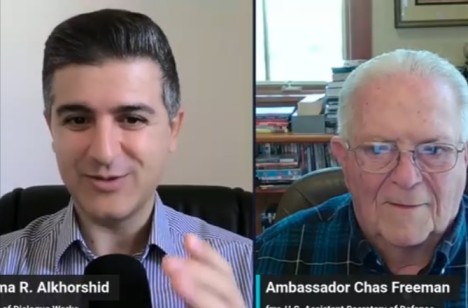
Editor’s Notes: In this compelling episode of Dialogue Works, host Nima Alkhorshid is joined by veteran diplomat and geopolitical analyst Ambassador Chas Freeman to discuss the swift collapse of Israel’s long-term regional strategy. Freeman offers a sobering analysis of how recent escalations with Iran have backfired, leading to a significant shift in power and a reevaluation of security alliances among Gulf states. This conversation delves into the broader implications of these developments, signaling a historic decline in U.S. hegemony and the birth of a new geopolitical reality in the Middle East. (May 1, 2026)
TRANSCRIPT:
The Cost of the War on Iran
NIMA ALKHORSHID: Hi everybody, today is Friday, May 1st, 2026, and our dear friend Ambassador Chas Freeman is here with us. Happy May Day, Ambassador, and welcome back.
AMBASSADOR CHAS FREEMAN: Happy May Day to you, Nima. I’m glad to be with you.
NIMA ALKHORSHID: Let me start, Ambassador, with what was happened 2 days ago. The Pentagon was asked how much did they spend so far with the war on Iran, and here is what was the response from the Pentagon.
VIDEO CLIP BEGINS:
UNIDENTIFIED SPEAKER: We have not yet received from the Pentagon the cost of the war. So just for the record, we’d like to get that as soon as possible, certainly the munitions expended, but also underreported is we’ve had a fair amount of equipment destroyed, including 2 C-130s with the rescue of our downed airmen. So, do you have either A, a cost estimate coming to us anytime soon, or B, a specific supplemental request?
HURST: Thank you for that question. So, approximately at this day, we’re spending about $25 billion on Operation Epic Fury. Most of that is munitions. There’s part of that is obviously O&M and equipment replacement. We will formulate a supplemental through the White House that will come to Congress once we have a full assessment of the cost of the conflict.
UNIDENTIFIED SPEAKER: So you’re saying the full cost at this point is $25 billion?
HURST: Yeah, that’s our estimate for the cost.
VIDEO CLIP ENDS:
NIMA ALKHORSHID: Yeah, here is later on we had US officials telling CBS that the cost of the war so far is close to $50 billion. It’s doubled the one, the number that Pentagon gave us. What is your understanding of that? Which number is closer to the reality?
The True Cost of War: Beyond the Numbers
AMBASSADOR CHAS FREEMAN: I think the higher number is closer, but even that is probably an underestimate, because there’s so many costs connected with war that don’t become apparent until much later. For example, wounded people— there have been a lot of people wounded in this war. The cost of their medical care, and eventually their treatment by the Veterans Administration, which has a separate budget from the Defense Department.
So there are some estimates, I think [Dr. Bill Mays], who’s at Harvard and who works with the Cost of War Project at Brown. She and Nobel Prize winner Stiglitz, economist, have done various estimates of what other wars, for example, the Iraq War, the Afghan War, and so on, have cost. And she’s estimating that the ultimate cost of this war may be as high as $1 trillion when you bring in all the additional costs.
And this is very relevant, not because the Congress— the Congress basically treats the defense budget like a jobs program. It’s not derived from a threat analysis. More is always better. And of course, the Trump administration is asking for $1.5 trillion and probably $200 billion for this war as a supplemental. We don’t know the figures yet, but it’s clearly a great deal more expensive than the Defense Department spokesperson, Mr. Hurst, mentioned.
NIMA ALKHORSHID: Do you think that they’re considering the spending on the part of Israelis as well in terms of ammunition and the interceptors, cruise missiles that they’ve used?
A War of Attrition: The US-Iran Standoff
AMBASSADOR CHAS FREEMAN: No, I suspect that is budgeted separately. Not included. And, you know, essentially where we are now, Nima, if I may, is we’re in a war of attrition, an economic war of attrition. Basically it’s as though the United States and Iran were two wrestlers, each one trying to strangle the other. We have our hands around the throat of the other party. We don’t know who is going to lose consciousness first. Somebody’s going to drop out because they can’t take it anymore.
And there are lots of factors here. The administration, the Trump administration, clearly calculates that— I think on the basis of wrong understanding of the petroleum industry— they calculate that Iran, in 3 weeks or 2 months, depending on which expert you talk to, will begin to lose pressure. It will run out of storage space for its current level of production of oil, and the reservoir pressures will begin to drop. And if they drop far enough, it’s then very hard to restart the oil wells.
I think that’s a misunderstanding. First of all, of course it is a geological reality that if the pressure drops in an oil reservoir underground, it is more difficult to recover oil in the future. It’s not impossible. But I don’t think this takes into account either the geology in Iran or the ability of the Iranian oil company to reduce production without destroying the reservoirs. In other words, they can produce less oil but still produce oil, and they can probably find storage for it somewhere. We know that there is an effort being made now to use the rail connection to China to move oil out of Iran. Iran can also presumably draw on the Russians through the Caspian Sea connection. So I think that this estimate on the part of the administration is essentially unrealistic.
Oil Prices, Inflation, and Global Recession
On the other side, Iran calculates that the price of oil and gas internationally is going to go up very high.
So if it goes to $200 a barrel, then we’re talking oil at the pump of $6, $6.50, much higher in a place like California where there are heavy taxes on fuel. California is already at $6 a gallon at the pump, and the reactions from American consumers will be increasingly strong against the war. In fact, the latest polls show that this war is now less popular than the Vietnam War, when the Vietnam War was at its most unpopular.
So, the Iranian calculation is that the United States is politically unable, will prove unable to sustain this counter-blockade. I think Iran also is looking very closely, as others are, at the situation on the U.S. Navy vessels that are conducting the American blockade, and that is not good. Apparently the logistical support for them is inadequate. We’ve seen what looked like acts of sabotage by sailors complaining about the fact that they’ve been at sea for almost a year with no rest, separated from their families, and deprived of the amenities that they had earlier.
But the other point here, I think, on the Iranian calculation is that in effect, by blockading the Strait of Hormuz, to the extent that blockade is effective— and it doesn’t appear to be all that effective— the United States is basically blockading the world’s oil supply. And it is hurting every country in the world by doing this, and therefore the international opposition to what the United States is doing can only grow.
And the knock-on effects of the reduction in oil supply extend— there have been various things already mentioned. The blockade of the Gulf has curtailed fertilizer supplies globally. Aluminum, which is produced using gas in the Gulf, now can’t get out. Sulfur, which is essential for all sorts of things. Helium, which is important to the microchip industry, and so on.
But in addition, oil and gas are part of the cost structure of virtually everything. Plastics— price of plastics is going to go up. Transportation— trucks driving items to the supermarket is going to be more expensive. The items in the supermarket are going to be more expensive because there will be crop failures and reduced yields agriculturally. Diesel, which powers the tractors and harvesters in large farms everywhere in the United States, in Brazil, in Russia and Ukraine. And all this is going up in cost. So we’re talking about significant inflation and a probable global recession.
Can the US Sustain This War?
So, all of this basically caused by a war that was unprovoked by Israel, a war by Israel and the United States on Iran. Of course, Israel would like to continue this war. The United States, I don’t think, has much stomach for doing so. And Donald Trump has officially made a judgment that the best way to get out of this war is to conduct this blockade and break the Iranian economy and thereby break the will of Iran. I don’t think that’s going to work, but anyway, that’s his judgment.
In the meantime, he’s also asked the military to devise various plans for short, sharp strikes on Iran that might influence Iranian decision makers. Here the record again is we’ve done all that. It has not really brought Iran to any favorable conclusion, so it’s very unlikely that it would work if done again. And this time, we hear on the Iranian side, Iran is fully prepared to retaliate massively to any resumption of attacks on it, and it will also, to the extent it is able, within a 300-kilometer, 200-mile radius, do what it can to sink the ships that are conducting the counter-blockade.
So, we’re in this moment, as I said, in which each side has its hands around the neck of the other, and each side is betting that it can strangle the other before it gets strangled itself. In this equation, I think Iran has the advantage. Not simply because of the factors I mentioned, but because Iran seems to be prepared to take more punishment than the United States is prepared to take.
Lebanon: The Wild Card
We have also, I should add, the wild card, the element of Lebanon, where Israel is not respecting any of the ceasefire. It has ceased bombing Beirut but it is leveling all the structures south of the Litani River. It’s blown up the rivers. It’s trying to make it impossible for people to return. And Hezbollah is still resisting, still killing Israeli troops in Lebanon and firing missiles into Israel. And the Israelis clearly are chafing under the requirement to pay attention to Donald Trump’s ceasefire announcement, which they don’t accept, but which they have to defer to, to some extent, if they’re not to be totally alienated from the Trump administration.
So I think this is a kind of limbo, uncertain period. We don’t know what will happen. Each side is waiting for the other side to be exhausted. In a way, this is an extension of the original Iranian strategy, that is, let the United States and Israel exhaust themselves attacking Iran. Iran will wait for the right moment to act. And so there we are. I think this is unlikely to be— I think we’re all going to experience a great deal more pain before this is over.
NIMA ALKHORSHID: I think many people would be surprised how much Iran is today concerned about the situation with Lebanon. You know, they’re most concerned about Lebanon than Iran itself. You look at the way that they’re talking about the situation in southern part of Lebanon. But the reality is, Ambassador, the Israelis are leveling, just destroying everything in the southern part of Lebanon. But that doesn’t mean that they can stay there. That’s the problem on their part.
Southern Lebanon: Reducing It to the Status of Gaza
AMBASSADOR CHAS FREEMAN: Right, no, they’re trying to reduce southern Lebanon to the status of Gaza. The only difference is that in Gaza, the people have nowhere to go, whereas in Lebanon they have gone north. But there are a million Lebanese who are displaced.
And let me make a— you know, there’s an issue here. Lebanese are present in every country in the world. There is a big Lebanese diaspora. A lot of Lebanese Christians left, but they’re still Lebanese. A lot of Lebanese Sunni left, but they’re still Lebanese. The Shia group in Lebanon, which is the base of support for Hezbollah, is very much in charge in Lebanon.
The Lebanese government cannot make the deal with Israel that it would like to make. The Lebanese government would like to disarm Hezbollah. Of course, any government wants to have a monopoly on the use of force, and the Lebanese government does not enjoy that monopoly. In fact, the only effective fighting force or resistance to Israel is Hezbollah. But the Lebanese government wants to work with Israel and the United States, which is backing Israel, to get rid of Hezbollah, but I don’t think that’s politically realistic, and it hasn’t happened, and I don’t think it will happen.
FPV Drones and the Limits of Israeli Military Power
NIMA ALKHORSHID: And the other point is yesterday we learned that Israelis are withdrawing various brigades from the southern part of Lebanon because FPV drones are making a lot of problems for Israelis. You know, this is the reality. We haven’t seen that in Gaza because Hamas is not that much advanced when it comes to the weapons they have, they possess. But Hezbollah is different from Hamas, and this is the reality.
Hamas vs. Hezbollah: Key Differences
AMBASSADOR CHAS FREEMAN: It’s different in many ways. Hamas is an outgrowth of the Muslim Brotherhood, which is a democratic Islamist movement. They believe in elections. They believe in the power of the people at the ballot box. They believe in the alternation in and out of power of political movements and parties. They were in power in Egypt for a short time. They proved to be very incompetent as governors of Egypt.
But anyway, this is a trans-pan-Islamic movement. It’s present everywhere in the 57 predominantly Muslim countries in the world. It is very influential in Turkey, which is a big factor in the region now. Hamas came to power in Palestine through an election. It was elected as the government. There was a coup d’état mounted against it in Gaza in particular by Israel and the United States, the CIA, but it never was dislodged from power.
And while I think many people in Gaza no doubt regret the fact that Hamas’s retaliation against Israel on October 7, 2023, led to the genocide and the tremendous suffering that they’ve undergone, Hamas still is the effective authority in the Palestinian part of Gaza. Israel has of course taken 60% of Gaza behind its so-called yellow line. Anyway, that’s Hamas. Hamas is an authentic democratic nationalist movement, and it was a political movement before it became a militia.
If you look at Hezbollah, that’s different. Hezbollah was a militia fighting Israeli occupation of Lebanon from 1982 on before it became the effective political movement that it became, and it became that political movement which I think is essentially fascist. I’m not using the term as an insult, I’m just saying this is a state within the state.
If you go to Beirut, I was very struck when I’ve been in Beirut — if you get up in the middle of the night, say you have to go to the airport or something, and you go out, you see who’s doing the street cleaning? Not the government. Hezbollah. It is a popular movement with its own militia, a state within a state, and it doesn’t really believe in elections. It does not have its roots as Hamas does in democracy. It has its roots in armed struggle.
So you can’t tell, if you talk to Hezbollah, as I’ve talked to them, whether they believe in “one man, one vote, one time,” or whether they believe in elections as a source of authority for the government. Of course, they are effectively a majority in the Lebanese parliament, and they would be the government in Lebanon if Lebanon did not have a French-designed constitution which reserved the presidency for a Maronite Christian.
Lebanon’s Constitutional Constraints
The Speaker of the Parliament has to be Shia, and the Prime Minister has to be Sunni. So this is an arrangement the French made which to some extent reflected the distribution of power in Lebanese society in the colonial era. It does not reflect that balance of power anymore, because Christian and Sunni groups have been greatly, relatively diminished, and the Shia are now the majority in Lebanon.
So there’s a constitution that basically delegitimizes the Lebanese government and leaves Hezbollah political space in which to operate, and it does. And Hezbollah is battle-hardened because it participated in the defense of the Assad government in Syria against the international effort to depose that government, which ultimately succeeded.
So they’re very different, Hamas and Hezbollah, and the only thing they have in common is that they are elements of resistance to Israeli domination and expansion, and they are fiercely committed to their cause. They’re separate causes. They have some common interests. They’re prepared to cooperate. But they will not break and run. They cannot be easily subdued because they are both authentic expressions of popular nationalism.
Drone Warfare and the War of Attrition
Hezbollah, as you said, has the other advantage of having been technologically much more advanced. It had access through Syria and through the sea to Iranian technical support. It has developed its own missile production capabilities. It is fairly sophisticated in engineering terms, whereas Hamas was totally cut off from the beginning in Gaza and had only light weapons and was no match for the Israelis.
Every time the Israelis have invaded Lebanon, they have been defeated by Hezbollah. And your mention of the extension of the drone warfare pioneered in the Ukraine war to Lebanon is very, very appropriate. Neither the Israelis nor the United States military are configured to deal with drone warfare at the level that it has developed. Iran has shown that in terms of its skillful use of drones, not only to take out radars and other targets, but to take out the defenses against missiles that are accompanying the drone attack.
Israel and the United States are both configured for short, decisive wars, not wars of attrition, whereas Iran, Hezbollah, and Hamas are all configured for a war of attrition. Now we have an economic war of attrition going on, and we will see whether the same factors operate. I suspect they will. I don’t think Israel and the United States will prove to have the stamina that their opponents, our opponents do.
Netanyahu, Trump, and the Politics of War
NIMA ALKHORSHID: Israel Katz, the Defense Minister of Israel, said they’re ready to get back to the war, as you know, because they feel that the negotiation, the talks would fail, and then Israel can attack Iran again. You don’t see that sort of concern in Iranian media, in Iranian leadership. They’re basically talking about the war between Iran and the United States. They don’t care about Israel because they see Israel cannot go against Iran without the United States.
And how do you see the situation in Israel? We have two parties right now fighting each other, Benjamin Netanyahu on one side and Yair Lapid together with Naftali Bennett. They’re joining to go against Benjamin Netanyahu, and how much change would happen in Israel if, let’s assume, the opposition win in Israel?
AMBASSADOR CHAS FREEMAN: Well, let’s begin by acknowledging that Netanyahu, who put Trump up to this war — Trump, of course, was predisposed to go to this war. He’s been anti-Iranian for many decades. He also does not appear to understand diplomacy as an alternative to warfare. In that regard, he’s like Netanyahu.
But Netanyahu is very frustrated with Donald Trump. Donald Trump wants to end this war. Netanyahu does not. Why does Netanyahu not want to end the war? Well, charitably, one reason is that Israel has not accomplished its objectives. It has not achieved regime change or state collapse in Iran, and it has not achieved the defeat of Hezbollah despite having decimated Hezbollah’s leadership echelon. So there are sound strategic reasons for Netanyahu to be opposed to ending this war and therefore to be at odds with Donald Trump.
So Donald Trump acts unilaterally. Israel is not directly present in the Islamabad meeting, and of course it’s indirectly present through Witkoff and Kushner, who are both devoted Zionists and very close to Netanyahu and his government. But Israel is not directly present there. It has no direct voice. Similarly, Israel had a kind of phony ceasefire imposed on it in Lebanon, which of course it’s gradually unraveled because they never accepted it.
So Netanyahu does not like Trump’s unilateralism, and Trump doesn’t like Netanyahu’s unilateralism. That said, Israeli politics are always very personalized and very chaotic, and always a great battle. And very few people in Israel like Netanyahu. His final motivation for continuing this war is that as a wartime leader, he can continue in office and stay out of jail, which is where he otherwise will end up, due to crimes of corruption.
Israeli Public Opinion and the Coming Elections
So I think we have the odd situation — the Israeli public appears to support the war still, so that you get the opponents of Netanyahu, Naftali Bennett and Lapid, posturing for that reason, supporting the war but against Netanyahu. Netanyahu doesn’t want to give up on the war because if he does, he’s in trouble. And the Israeli public doesn’t like Netanyahu, but they can’t change wartime leaders in the middle of the war, apparently.
So this is a very awkward situation, and I don’t know how it’s going to turn out. There are elections coming up, I believe, in October in Israel, and that may clarify things, although Israeli elections have a way of not clarifying anything, just complicating it. So we’ll see. This war may go on until October.
NIMA ALKHORSHID: Yeah, the new poll in Israel shows that 80% of the Israeli people are supporting getting back to war. And looking at Israel today — do they really understand as a society their limitations? Because right now, with the case of the air defense system, everybody knows what has happened so far with the war against Iran — the radars, interceptors, shortage, as it was reported on CNN, on multiple outlets in the United States.
And you see Israelis willing to go to war again, even not with Hezbollah and in Gaza, in Palestine, but against Iran as well. Where is the society? Because it seems that the society is so much disconnected from the reality of what’s going on. I don’t know the level of information that they’re giving to their society, to the Israeli people.
Israel’s Isolation and the Nuclear Question
AMBASSADOR CHAS FREEMAN: I don’t think there is much information. The military censorship is very effective. Therefore, people may know something about whatever happened locally, but they don’t have the whole picture in Israel. Israel is a society that venerates its military. It’s fairly militarized. And while the military itself is in great trouble, as the Chief of Staff has pointed out, it’s fatigued, it’s overstretched, it relies on reservists who are increasingly reluctant to report for duty.
Still, Israel has a kind of hubris, you know, it has a habit of “winning wars.” Even when it doesn’t win wars, it proclaims success rather like Donald Trump. So we see retreats from Lebanon are covered by statements about how much was accomplished and so forth and so on. So it’s very unrealistic.
And I think the other factor is Israel is internationally isolated and it is now a pariah. And you would think, I mean, Israel says that it is the Jewish state and it represents all Jews everywhere, and Jews should all go to Israel and become Israelis. But the fact is that what Israel has done has caused great danger for Jews everywhere outside Israel. It has revived antisemitism at a level which would have seemed impossible before this recent 4-year sequence of events.
It has— we’re seeing, you know, in lone wolf incidents apparently, like this stabbing in London of a couple of British Jews, and we’re seeing synagogues attacked and so forth. This is not anything that was happening before, but I think frankly Israelis don’t give a fig about Jews outside Israel despite their claim to be the representative of Judaism, of world Jewry. They don’t really care.
In fact, there is a long history of Israeli efforts actually to promote antisemitism because it causes Jews abroad to want to go to the safe haven of Israel. Well, Israel is no safe haven now, and Jews outside Israel in increasing majorities are disgusted with Israel. They don’t want anything to do with it.
So Israel is doing grave damage to its image, to its standing in the world. It’s also doing grave damage to Jews outside Israel, and it’s depriving itself of the political and military support, potentially, that it requires for its survival.
Restructuring U.S.-Israel Military Relations
So there’s talk now about restructuring the American military supply relationship with Israel to end the congressional involvement in it. Privatize it, basically turn, and persuade American defense companies to produce in Israel or jointly with Israel so that political support for Israel is not necessary to continue the military support. Now, this is what is going on. I mean, that is not a stupid maneuver on the part of the supporters of Israel, but it is an indication of how much damage Israel has been doing to its own survival.
And we come back to the point that for the United States, this war with Iran is a war of choice. It’s not existential. The United States is not going to disappear. We may suffer some pain but we’re not going to disappear however this war turns out. But for Iran and Israel, it is existential. I mean, Israel has made it existential for itself. Iran has made it existential for Iran because Iran does not want to return to a situation— will not agree to return to a situation in which it is subject to renewed attack by Israel backed by the United States.
Iran’s Three-Phase Peace Process
The only way this war can end from the point of view of Iran is, as Iran has said most recently, in a three-phase process. First phase, there’s the general agreement on peace in West Asia, and there are guarantees, credible guarantees, against further attack on Iran by Israel and the United States. If that can be achieved, then Iran is prepared to sit down with Oman present, evidently, to talk about the future rules for using the Strait of Hormuz. But it won’t do that until there’s been a general peace agreement. If the Hormuz issue can be resolved satisfactorily from Iran’s point of view, then it was prepared to talk about the nuclear program. But only then.
Iran’s Nuclear Intentions
And here I want to make an important point. The last time any Iranian leader said Iran does not want and will not build nuclear weapons was February 11th. Since February 28th, there has been no reiteration of the pledge not to build a nuclear weapon. Why? Because the people in Iran who want to build a nuclear weapon, who feel that a nuclear weapon is essential for Iran’s deterrence of further attacks by the United States and Israel are now in charge. And so, of course, you’re not hearing this.
And a lot of the discussion that we’re seeing internationally— zero enrichment, the IAEA talking about resuming control of Iranian enrichment programs, moving enriched uranium to Russia, as was under the JCPOA, the Joint Comprehensive Plan of Action of 2015. This was done. This is all extremely unrealistic because there’s a lot of evidence now that if Iran hasn’t actively decided to build a bomb, it intends to do that. It has the motivation to do that. The United States and Israel have deprived the opponents of a nuclear Iran of their arguments.
So now Iran, inspired by North Korea, is, I think, going to produce a nuclear weapon and the means of delivering that, probably not just to Israel but also to the United States. Which is what North Korea has done. So I’m waiting to be refuted by an Iranian government statement repeating the fatwa, which by the way had an escape clause in it. It said that if Iran’s existence, the Islamic Republic’s existence, was threatened, that the ban on weapons of mass destruction building would be lifted. I think it has been lifted.
What exactly is being done underground in Iran, I do not know. But I take very seriously the comments of our friend Ted Postol, who says that Iran is entirely capable of fabricating nuclear weapons in a matter of weeks, not months. Maybe it has already done so, as he suggests may be the case. We don’t know.
But I think the focus on the nuclear program by the United States and the international community is a false focus. I don’t think from the Israeli point of view the Iranian nuclear program was the reason for this attack. I think the reason was the Greater Israel Project, the obstacle that Iran represented to that, Iran’s status as an enemy of Zionism, and a desire to shatter the Iranian state one way or another. The nuclear issue was an excuse, in my view.
The UAE, OPEC, and the Economic Impact of War
NIMA ALKHORSHID: Yeah, Ambassador, we had UAE leaving OPEC, and they were the founders, one of the nations, one of the countries who founded OPEC, and right now they’re leaving OPEC because of the difficulties they’re facing, because recently they were running out of cash in UAE. And many people would argue, they were— people were surprised. And what is happening in the 40 days of war with Iran and the United States? They’re not part of the war. They got hit by Iranian missiles, but they’re not basically part of the war. And how this war has influenced their economy to the extent that they’re running out of cash in UAE.
The Petrodollar, OPEC, and Regional Realignments
AMBASSADOR CHAS FREEMAN: Well, I think the petrodollar is in fact a major factor here. They are running out of dollars, and I think they basically told the United States Treasury that they were going to start pricing oil in Chinese currency and paying in yuan. And that would destroy the petrodollar basically, which is the prop for the American financial hegemony globally.
So this is why you’re seeing talks of dollar swaps and so on with UAE, because there’s a great deal at stake for the Treasury of the United States if the UAE is unable to finance its imports with dollars. And turns to the Chinese currency or other currencies, not necessarily the Chinese currency. Because I don’t think we’re headed into a world in which there will be a dominant currency as the dollar has been dominant. I think we’re going to head into a world in which there are multiple currencies operating, including probably some that are artificially created between different countries. Maybe the BRICS will finally come up with some kind of currency that is in use in trade among their members, voluntarily at least.
So there are other factors here, and let me mention a few of them. Obviously, the UAE and Saudi Arabia are at odds. Saudi Arabia is the big daddy in OPEC, and the differences between the Emiratis and the Saudis on a multitude of issues, whether they’re in Yemen or Somalia or Libya or more generally Syria, are now acute. There’s also the issue of the Abraham Accords, which the UAE seems to be committed to, but which everyone else sees as discredited by this war.
So I think while there’s now a focus on the UAE dropping out of OPEC, and that will have some effect, it will marginally increase the non-OPEC oil production, not enough to counteract the effects of the closure of the Strait of Hormuz, the American blockade. Of course, Iran’s blockade is selective. If you make peace with Iran, you get to go through. The American blockade is absolute, basically, because the Iranians won’t let unfriendly countries through, and the United States will stop everyone — stop Iranian ships from going through, or the allies of Iran from going through. So in effect, there’s a total blockade. It’s not effective, but there it is.
The Gulf Cooperation Council: Fractures and Fragmentation
So I think the bigger issue is the UAE leaving OPEC is in effect also leaving the Gulf Cooperation Council. The Gulf Cooperation Council, the GCC, was established in the wake of the Iranian Islamic Revolution as a counter to Iran, on the principle — sound principle — that collective defense was necessary against the revolutionary zeal of Iran in those early days.
The GCC has never been very effective as a coordinating body, and it’s had problems internally. Oman has always been odd man out in the GCC, maintaining in the Iranian context a position of neutrality. But there are issues, for example, again involving Iran. During the Islamic Revolution, when the American diplomats at the embassy in Tehran were taken hostage and held for a year by Iranian students, the United States mounted a failed rescue attempt from Oman, I think from Socotra, without informing the Omanis. And as a result, for 10 years, Oman and the United States were at odds militarily. Oman condemned Kuwait for its acceptance of American military protection during Operation — I can’t remember the name of it — Enduring Freedom, which was the escort of tankers through the effects of the Iran-Iraq War.
So Oman has always been different. It is structurally different in the sense that while it has oil and gas, it is less endowed with that than others. It is a different society. It has always looked outward toward East Africa and South Asia. It had an empire which included Zanzibar and Mombasa and other places, and northern Mozambique.
Qatar is different also. Qatar shares a gas field with Iran in the Persian Gulf. Qatar has no alternative to maintaining decent relations with Iran. That, among other things, plus Al Jazeera’s presence in Qatar, which annoyed everybody else because it was reporting accurately on their politics, even if it did not report accurately on Qatari politics — that led to a rupture between Saudi Arabia, the UAE, and Qatar within the GCC. And that went on for what, 3 years before it was fixed.
Bahrain has been under great pressure from the Shiite majority. It was part of the Safavid Empire. It has a relationship with Iran that is quite tense, and it’s now garrisoned by Saudi and other troops from the GCC. So the GCC, which gives an appearance of being a big tent, is not, and it is very divided.
I think the UAE’s departure from OPEC and the tensions between the Saudis and the UAE and the UAE and Qatar are very likely to cause the GCC, if not to disintegrate, to lose any effectiveness it has had.
American Bases and Iranian Retaliation
So all of this plays into the basic motif, which is that Iran says to the members of the GCC: “You cannot have American bases on your territory and be safe. If you have bases aimed at us on your territory, we reserve the right to attack them.”
The UAE has two major bases on its territory from the United States, and that is one of the reasons it was so heavily attacked. It was very much involved in the American attack on Iran. So was Saudi Arabia to some extent, although the Saudis didn’t want to admit it and their help was very limited. They also were involved in it, and Qatar was the location of Al Udeid Air Base, the biggest air base of the United States in the region. That is essentially destroyed, as I understand it. Kuwait, several bases. I think the American forces have had to move to Bubiyan Island, which has been under Iranian attack.
The Cover-Up of Damage and the Cost of War
And anyway, a final point here. You were asking about Israeli reaction to the war. I don’t think ordinary Israelis have any idea about the level of damage that Iran inflicted on their country. I think they know whatever they saw with their own eyes or heard about from their neighbors, they know about, but they don’t know the national picture. I don’t think the American public has any idea of the level of destruction that has been wreaked by Iran’s attacks on these bases in the region.
And the level of destruction, which gets back to the question of how much has this war cost — I think if you talk about immediate costs, the estimate you mentioned of $50 billion is probably much closer to the reality than the other estimates. But there’s been a cover-up by everyone except Iran. Iran, perhaps because of the national tradition of Shiism — Shiism celebrates victimhood, it’s all about martyrdom and so forth — Iran has been quite open about the damage it has suffered. Everyone else has covered it up.
And when this war is over, or even if it isn’t over, I think you’re going to see each GCC country adopt a “each for his own, out for his own interest” policy toward Iran. And there will be deals struck by countries in the region, probably by Qatar first, but I think the Saudis and others will have to strike a deal too.
Turkey’s Rise and the Shifting Regional Order
Let me make a final point, and that is Turkey has been greatly strengthened by this war, and not just in terms of its influence in places like Qatar, with which it shares an affection for the Muslim Brotherhood. But more generally, the fact that Turkey is part of this quadruplet — Pakistan, Egypt, Saudi Arabia, and Turkey — is very significant because Turkey has an advanced military-industrial economy, and the countries in the Gulf are going to be looking more actively than ever for alternatives to dependence on the United States, for the simple reason that the United States has not only proven unable to defend them but unable to defend itself in the bases on their territory. And those bases have become a justification for Iranian assault rather than the defense of those countries.
So I think we’re going to see a very active diplomatic phase here following the war, and I’m not sure what will be left of American influence in the Persian Gulf when it’s over. Even Israel seems to be trying to move away from over-dependence on the United States, as I mentioned, with the restructuring of the defense logistical relationship.
Iran, Russia, and the New Multi-Nodal World Order
NIMA ALKHORSHID: Ambassador, what do you make of the Iranian foreign minister going to Saint Petersburg, meeting with Admiral Putin? You know, what is happening, in my opinion, with the war in Ukraine and with the war in the Middle East? You see Russia during the war in Ukraine meeting with Xi Jinping as equals, you know, two partners. With the case of Iran, I see the same thing. You don’t see that sort of — they have the upper hand or they have the leverage — but these are two equal states meeting with each other. On the other hand is the case of what has happened in that meeting and the talks. And later on, we had a phone call between Vladimir Putin and Donald Trump, which was initiated by Vladimir Putin, as it was mentioned by Russian media, or the Russian Kremlin reported on that, that Vladimir Putin called Donald Trump. What do you make of that?
AMBASSADOR CHAS FREEMAN: Well, I think this is very complex. First, let me say that it doesn’t surprise me that Iran and the Russian Federation, or China and the Russian Federation, should meet as equals, because what we’re talking about here is partnerships, not alliances. And the United States network of alliances basically has an imperial quality to it. That is, the United States is always on top. And that was the case when the Soviet Union existed. Its allies were below it. There were no relationships of equality.
But relationships of equality in the new, as I call it, multi-nodal system that is emerging are the norm, not the exception. So I don’t find that remarkable.
Why should Araktchi go to Moscow, to Saint Petersburg? Many reasons. Russia is valuable to Iran as a source of support, not just militarily — and the military supply relationship is now robust — but politically in terms of support in the United Nations, for example. And I suspect more broadly, if Iran’s strategy is to take advantage of mounting international opposition to the American blockade of the Strait of Hormuz and to the war itself, then it may look to be a partner with Russia in organizing an international campaign against the United States.
Finally, of course, it’s well known that Donald Trump, for whatever reason, has a relationship with Vladimir Putin, and it’s in Iran’s interest to energize that relationship to try to persuade Donald Trump to find a mutually convenient end to this disaster, the disaster of the war.
Why would the Russians receive Araktchi? Well, for many reasons. For one thing, they are watching the United States make a huge mistake by attacking Iran. They have every interest in maintaining a position of influence in the south, their south, which is in West Asia. Iran is a key partner in West Asia. That was the case in Syria under the Assad government. It’s still the case in the region as a whole. Russia has many reasons to want to have a good relationship with Iran and basically to be helpful to Iran because it’s storing up obligations on the part of Iran to support it in its time of need. So this is a mutually beneficial interaction.
The same is true, by the way, of the Iranian relationship with China. China has a major interest in restoring the post-World War II international system based on international law and consensus. China is obsessed with its own sovereignty, and it supports the Westphalian concept of sovereignty for everyone else. The United States has abandoned that respect for sovereignty, and the attack on Iran is an effort to destroy Iranian sovereignty. So from the point of view of just general statecraft and interest in the international system, China, and to a lesser extent Russia, have an interest in supporting Iran on the legal front, on the political front.
And of course, one assumes that China is also very wary of offending countries like Saudi Arabia that are not close friends of Iran, and therefore it tries to balance relationships. Russia doesn’t have that concern, so they’re different. But I think what we’re seeing is more evidence of the emergence of an order in which middle-ranking powers — now armed with drone technology and missile technology — have the ability to stand off militarily superior powers and have the diplomatic ability to enlist other major powers in qualified support. So that’s what we see here, I think.
Trump’s Posturing and the Reality Gap
NIMA ALKHORSHID: When it comes to Donald Trump’s briefing, or the way that he mentioned the phone call between the United States and Russia, he said basically he was repeating the same thing that he said. I remember when he was elected, he had a phone call with Vladimir Putin. He said the same thing just yesterday as he said before, in January or in February 2025. And looking at Donald Trump through social media, just checking all these posts, you don’t see any sort of reality. It’s all about making rhetoric. Or somehow — no, it’s frustrating. It’s posturing.
The Collapse of American Statecraft
AMBASSADOR CHAS FREEMAN: And my theory, Nima, is that Iran has somehow sent troops and occupied part of Donald Trump’s brain, and he’s negotiating with the Iranians inside his head. And the Iranians inside his head are very reasonable people from his perspective because they do what he wants.
No, I mean, I think he is detached from reality. He’s concerned only about himself. He’s not concerned— that is part of the reason for the tensions with Israel that I mentioned. He’s really all about Donald Trump and not about Israel, not about Iran. He doesn’t— I’m sure he could find Iran on a map now, but I think after he did that that would exhaust his knowledge of Iran.
So there’s no evidence he’s learning anything from the bumbling he’s doing, and that is very depressing to me. He’s the president of my country, you know. I feel endangered by that.
The Decline of American Diplomacy
NIMA ALKHORSHID: Before wrapping up, Ambassador, you look at the alternative media, they’re basically mostly talking about what is going on with the foreign policy of the United States diplomats. And we had the Biden administration. I remember Antony Blinken going to Israel. He’s just mentioning that he’s a Jew instead of saying I’m the Secretary of State of the United States. I’m here as a Jew. And coming to the Trump administration, everything is getting worse. You have basically two real estate dealmakers from New York trying to do diplomacy, which doesn’t make sense for anybody— Russia, China, and Iran. And they’re so much confused with this sort of attitude on the part of the Trump administration. What is happening with the foreign policy of the United States and diplomacy, diplomats as a basic sort of tool to communicate with other countries?
AMBASSADOR CHAS FREEMAN: Well, the United States is demonstrating that we are not capable of statecraft under this administration at the level that we were previously. I would argue that the Biden administration was also incompetent in statecraft, but we have reached a new low in these capabilities.
Part of statecraft is diplomacy. The institutional base of diplomacy in the United States, which is the Department of State and the United States Foreign Service, in which I served proudly for 30 years, have been destroyed, essentially sidelined. The best people have left. Those who are there are being subjected to ideological boot camp, thought reform, and they’re basically paralyzed.
Donald Trump has no policy process in place to advise him. He has institutions, he brings them into the room, it’s not clear he listens to them. It’s clear that this war with Iran was not supported by the military, and so he makes decisions and he’s the sole decision maker.
That was not true in Iran, even under Ali Khamenei. He had to make compromises with other elements in the Iranian system, which was designed to create checks and balances. The checks and balances are gone in the United States. The Congress is subservient. We’re past 60 days, and the War Powers Act requires the Congress to approve the war. The Republican chair of the committee responsible for this says, well, he’s not disturbed by the law. I mean, what kind of a statement is that? Constitutional government, rule of law, checks and balances are all gone.
The Supreme Court is politicized and reliably supportive of the Trump administration. The Congress is missing in action. The president is on his own. Marco Rubio is mostly absorbed apparently in preparing to take Cuba somehow and not engaged. And even if he were, there’s no evidence that he has any diplomatic skill at all.
So to go back to your point, we are represented internationally by two New York realtors whose only qualifications are their crony relationship with Donald Trump, or in the case of Jared Kushner, relationship by marriage, and their unabashed Zionism. We are never sure whether they are representing the United States or representing Israel. And they are part of the dwindling body of Americans who imagine that Israeli and American interests overlap and are not in conflict. But they are in conflict, and we’re seeing that. This war is demonstrating that. So, as a diplomat, as a student of statecraft, I’m frankly appalled by the current situation in Washington.
Closing Remarks
NIMA ALKHORSHID: Yeah, thank you so much, Ambassador, for being with us today. Great pleasure as always.
AMBASSADOR CHAS FREEMAN: Well, you must be a masochist if you think that was fun.
NIMA ALKHORSHID: Yeah, it’s the reality. We cannot change it.
AMBASSADOR CHAS FREEMAN: We can talk about it. Yeah, that’s right. Anyway, have a pleasant day.
NIMA ALKHORSHID: Thank you, Chas.
Related Posts
- Transcript: Vice President JD Vance Remarks in Middletown, OH
- Transcript: President Trump Delivers Remarks with Technology Leaders
- Transcript: 12 Years of BJP: Progress or Propaganda? – Anish Gawande vs Pradeep Bhandari
- Transcript of Jon Ossoff Speech in Atlanta Rally on August 16, 2026
- Transcript: President Trump Remarks on Lifeguard Ryder Williams