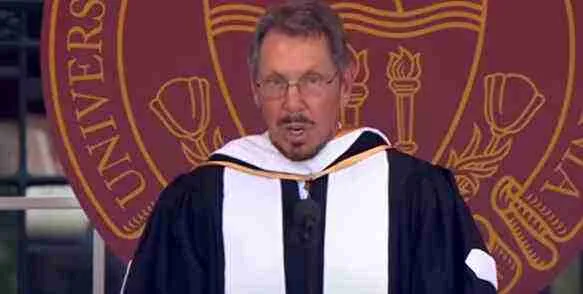
Read here the full transcript of tech tycoon Larry Ellison’s speech at the University of Southern California commencement 2016.
Listen to the audio version here:
TRANSCRIPT:
Good morning, class of 2016. Thank you for inviting me here today. I’m honored to be with you for your graduation from the University of Southern California. This morning I’d like to talk with you about how a few experiences and a couple of ideas taught me some important lessons and helped me discover my dreams.
Early Dreams and Challenges
When I was your age, living and going to school in Chicago back in the 1960s, I used to dream about this place, the University of Southern California. Back then, this is all true, back then my dream was to go to the USC medical school, get married, raise a family, and practice medicine in Los Angeles. Growing up in a lower middle class community on the south side of Chicago, medicine was considered the pinnacle of professions, noble and humane. Virtually everyone important in my life – my family, my teachers, my girlfriend – wanted me to be a doctor.
Over time, their dreams became my dreams. They convinced me I should be a doctor. But as hard as I tried, I couldn’t do it. After a few difficult and unhappy years as a pre-med student, it became painfully clear to me that I did not like the courses I was taking.
I thought my comparative anatomy class was a perversely pointless form of psychological torture, especially the dissection labs. And I just could not make myself study something that didn’t interest me. At the time, I thought I lacked discipline, and that I was selfish, maybe so. But whatever the underlying reasons, I was unable to make myself into the person that I thought I should be, so I decided to stop trying.
A New Beginning in Berkeley
I was 21 years old when I dropped out of college, packed everything I owned – jeans, t-shirts, leather jacket, guitar – into my car, and drove from Chicago to Berkeley, California. I guess one small part of that University of Southern California dream was mine after all, the California part. Berkeley in the 1960s was at the center of everything: the anti-war movement, the free speech movement, the human rights movement.
It was the perfect place for an undisciplined, selfish, 20-something to begin his search for himself, a righteous cause, and a job that he loved. Everyone living in Berkeley in the 1960s opposed the Vietnam War. I was no different. It was the age of Aquarius, but I never had long hair, and I never wore love beads.
I learned to play popular protest songs on my guitar, but I was never a committed, serious anti-war protester. I did find a cause, however, one I still feel passionately about today. A few hours east of Berkeley are the Sierra Nevada Mountains. I fell in love with those mountains and the ineffable, natural beauty of Yosemite Valley.
Finding a Cause and a Career
I cared about the wilderness, and I wanted to help preserve it. I joined the Sierra Club. I became an environmentalist. During my California springs and summers, I spent most of my days in the high Sierras in Yosemite Valley working as a river guide and a rock-climbing instructor.
I loved those jobs, but unfortunately, they didn’t pay that well, so I also got a job working a couple of days a week as a computer programmer back in Berkeley. I learned to program in college. I didn’t love programming, but it was fun, and I was good at it. Computer programming gave me the same kind of satisfaction as solving math problems and playing chess, both things I enjoyed before I became a confused teenager.
At this point in my life, I thought I was making real progress on my journey of self-discovery. I had found a cause. I had a couple of jobs that I loved, and one that was fun and paid the bills. I was pretty happy with my life.
Personal Challenges and Realizations
My wife was not. What she saw was a college dropout who spent too much time in the mountains doing foolish things. She wanted me to work full-time as a computer programmer or go back to college and finish my degree. We compromised, sort of.
I started taking classes at UC Berkeley. I took several classes, but the only one I can remember was a sailing class taught at Berkeley Marina. Once again, I fell in love and began a lifelong affair with the limitless, omnipotent Pacific Ocean. When my class was over, I wanted to buy a sailboat.
My wife said this was the single stupidest idea she had ever heard in her entire life. She accused me of being irresponsible, and she told me I lacked ambition. She kicked me out, and then she divorced me. This was a pivotal moment in my life.
My family was still mad at me for not going to medical school, and now my wife was divorcing me because I lacked ambition. It looked like a reoccurrence of the same old problem. Once again, I was unable to live up to the expectations of others, but this time I was not disappointed in myself for failing to be the person they thought I should be. Their dreams and my dreams were different.
I would never confuse the two of them again. I had discovered things that I loved: the Sierras, Yosemite, the Pacific Ocean. These natural wonders brought me great joy and happiness and would for the rest of my life.
I had an interesting job programming computers and more money than I needed. For the first time, I was certain that I was going to survive in this world. A huge burden of fear had been lifted. I’ll never forget that moment. It was a time for rejoicing.
I bought the sailboat and lived on board, just me and my cat in Berkeley Marina.
In the words of James Joyce, I was “alone and young and willful and unheeded, but I was happy and near to the wild heart of life.”
Silicon Valley and the Birth of Oracle
Throughout my 20s, I continued experimenting, trying different things, racing bikes and boats and constantly changing jobs. It didn’t take me long to discover that the most interesting and rewarding programming jobs were found at a cluster of companies located south of Stanford University and north of San Jose.
Silicon Valley was in its infancy. I was still in my 20s when I went to work for my first Silicon Valley startup, Amdahl, where we developed the world’s fastest mainframe computer, faster than anything IBM had. Next stop was Ampex, where we built the world’s largest digital data storage system. Then on to Precision Instruments, where we built an even larger data storage system, this time using lasers.
I was the vice president in charge of software development. It was all very cutting edge and challenging and cool. I liked my work most of the time, but I didn’t love it. I searched and I searched, but I just could not find a software engineering job that I loved as much as I loved sailing.
So I tried to create one. I put together a plan to start my own company. That way I could completely control my work environment. I would hire the most talented programmers I knew and we would all work together on the most interesting and challenging software projects.
My goal was to create the perfect job for me, a job I truly loved. I never expected the company to grow beyond 50 people. So maybe I really did lack ambition or vision back then. I don’t know.
It was a long time ago and I was very young. Anyway, today Oracle employs around 150,000 people. But when I started, it was not my intention to build a big company. What happened?
Well, at first we did exactly what we set out to do, hire the most talented software engineers in Silicon Valley. We assembled an all-star team of gifted programmers who were among the best in the world at what they did. That team plus one crazy idea gave birth to a giant company. I call it a crazy idea because at the time everyone told me it was a crazy idea.
The idea was to build the world’s first relational database. Several theoretical papers about relational databases had already been published and IBM was building a prototype in their research labs. But back then, the collective wisdom of computer experts was that while relational databases could be built, they would never be fast enough to be useful. I thought all those so-called computer experts were wrong.
And when you start telling people that all the experts are wrong, at first they call you arrogant and then they say you’re crazy. So remember this, graduates: When people start telling you that you’re crazy, you just might be on to the most important innovation in your life. Of course, the other possibility is you’re crazy.
This is one of those times when the experts were wrong. Arrogance and insanity turned out to be innovation in disguise. The Oracle database proved to be a defining technology at the dawn of the information age. The Oracle database also totally upended my plans to build a small, comfortable company, a perfect place for me and a few of my friends to work.
As the information age moved from dawn to the full light of day, technology horizons were constantly shifting, revealing a brave and exciting world of new possibilities and new opportunities. Oracle doubled in size year after year after year for 10 years. I had set out to create the perfect programming job for me. Instead I created a job where I had to stop programming altogether.
I attempted to create an environment that I could completely control. Instead I was running a company with thousands and thousands of people that was growing so fast that it was impossible for anyone to control. It was like sailing in a hurricane. Then we went public.
Oh my God. Maybe I should have been a doctor. I was constantly learning, on-the-job training I think they call it. Every day I learned something new and interesting, something that I did not know the day before.
I liked that. My new job was challenging, captivating, consuming. I worked all the time. Thinking back, I’m pretty sure I didn’t love it, or maybe I was just too tired to even know how I felt.
But I had found a place in the world. My family finally forgave me for not going to medical school, and nobody ever accused me of lacking ambition again.
Lessons from Steve Jobs
Now I’d like to tell you one last story about my best friend, a guy who had lots of crazy ideas and taught me an important lesson. My 30-year friendship with Steve Jobs was made up of a thousand walks.
If there was something he wanted to talk about, and there always was, we’d go for a walk. We’d climb to the top of Windy Hill, hike around Castle Rock, or through the sands on the beach at Kona Village. Over the years, one particular walk stands out. We had a lot to talk about that day, so we jumped in the car, put the top down, and headed out to Castle Rock State Park in the Santa Cruz Mountains.
It was over 20 years ago, back in mid-1995. Steve was finishing up Toy Story at Pixar and running Next, the computer company he founded after he left Apple. Apple was in severe distress. It had gone steadily downhill during the 10 years of Steve’s absence.
The problems were now so serious, people were wondering if Apple would survive. It was all too painful to watch and stand by and do nothing. So the purpose of that particular hike through the Santa Cruz Mountains on that particular day was to discuss taking over Apple Computer. My idea was simple.
Buy Apple, and immediately make Steve CEO. Apple wasn’t worth much back then, about $5 billion. We both had really good credit. And I had already arranged to borrow all the money.
All Steve had to do was say yes. Steve proposed a somewhat more circuitous approach. First, persuade Apple to buy NeXT Computer. Then Steve would join the Apple board, and over time, the board would recognize that Steve was the right guy to lead the company.
I said, “Okay, that might work. But Steve, if we don’t buy Apple, how are we going to make any money?” Suddenly, Steve stopped walking and turned toward me. We were facing each other when he put his left hand on my right shoulder and his right hand on my left shoulder.
Staring unblinkingly into my eyes, Steve said, “Larry, this is why it’s so important that I’m your friend. You don’t need any more money.” I said, “Yeah, I know, I know.” Then I said, “But we don’t have to keep it. We could give it all away.” I was whining. Steve just shook his head and said, “I’m not doing this for the money. I don’t want to get paid. If I do this, I need to do this standing on the moral high ground.”
The moral high ground, I said, well, that just might be the most expensive real estate on earth. But I knew I had lost the argument. Steve had made up his mind right there and then at Castle Rock in the summer of 1995 to save Apple his way.
At the end of the hike, right before we got back into the car, I said, “Steve, you created Apple. It’s your company and it’s your call. I’ll do whatever you want me to do.” I went on the Apple board and then I watched Steve build the most valuable company on earth.
The lesson here is very clear to me. Steve was right. After a certain point, it can’t be about the money. After a certain point, you can’t spend it no matter how hard you try. I know. I’ve tried hard, but it’s impossible. In the end, the only practical option is to give nearly all of it away.
Finding Purpose and Passion
So why did Steve go back to Apple? Why did he devote so much of what remained of his life to his job? Why do I? I believe the answer is that deep inside of all of us, all of us, there’s a primal desire to do something important with our lives. Freud said there are only two things important in life: love and work.
He did not say love and work were the same thing. I’m passionate about my work. It continues to give me great satisfaction and a sense of who I am. But passion and love are different.
At least for me, they are. I love my family, a few precious friends, four cats, two dogs, cherry blossoms in Japan, Pacific Island beaches and bays, and the majestic Sierra Nevada mountains where it all began for me. My feelings about work are very intense, but quite different. There’s a TV advertisement for the United States Navy that says “It’s not just a job, it’s an adventure.”
That’s exactly how I feel about my years in Silicon Valley, an interesting, challenging, all-consuming adventure. Like any ongoing adventure, I have no idea how it ends, but I know it will, for me, and a long, long time from now, for all of you.
Conclusion
But today, graduates, you are beginning your great adventure. Your generation will change the world as every generation does.
You will invent new technologies and create new types of art. Impossibilities will be transformed into possibilities, and unexpected opportunities will present themselves. You will change the world, and the world will change you as you learn and grow and discover more about yourself. Remember this, graduates.
In a constantly changing world, what is possible is a moving target. Don’t be afraid to experiment and try lots of different things, and don’t let the experts discourage you when you challenge the status quo. Like Mark Twain says, “What’s an expert anyway? Just some guy from out of town.”
Each of you has a chance to discover who you are rather than who you should be, a chance to live your dreams, not the dreams of others. Each of you has an obligation to commit to a righteous cause, one that elevates you and improves the conditions of humanity and the planet. Soon many of you will begin a new job. I hope it interests you and challenges you and rewards you with a sense of purpose and satisfaction.
And if it doesn’t, keep searching. It’s out there. It might take a while, but keep searching until you find a job that ignites your passions like I did, even better.