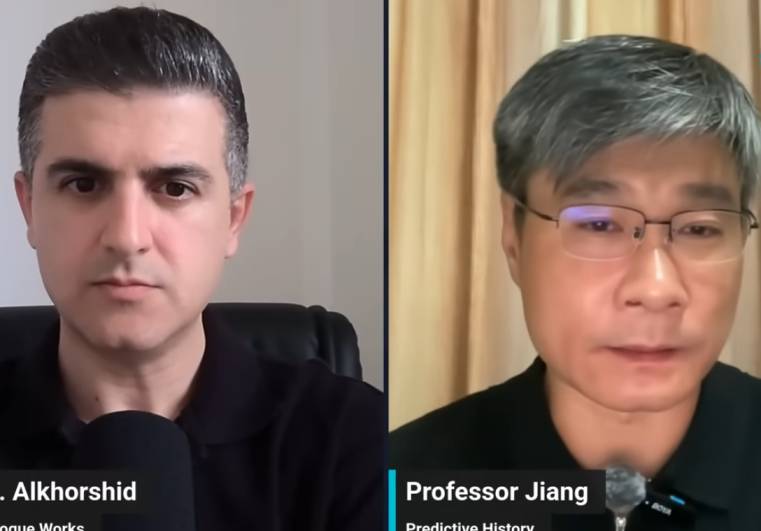
Editor’s Notes: In this episode of Dialogue Works, host Nima Alkhorshid sits down with Professor Jiang Xueqin to analyze the escalating conflict between the United States and Iran, which Xueqin frames as a watershed moment in global history. The discussion delves into the potential for a devastating ground invasion and how such an escalation could draw in major world powers like Russia, China, and Japan. Xueqin also explores the concept of “Greater Israel,” the fragility of current Middle Eastern nation-states, and the deeper spiritual and “eschatological” motivations he believes are driving modern warfare. (March 7, 2026)
TRANSCRIPT:
NIMA ALKHORSHID: Hi, everybody. Today’s Saturday, March 7, 2026, and our new friend Professor Jiang is here with us. Welcome, Professor.
PROFESSOR JIANG XUEQIN: Hi, Nima.
NIMA ALKHORSHID: It’s the first time you are in this podcast. I know that many of our audience know you from your videos on YouTube, these amazing lectures that I got familiar with recently. I was amazed with the information, with the wisdom in those videos, and how you connect the historical facts to what is going on right now and what would happen in the future, considering all this history.
And Jiang, what is happening right now in the aftermath of that devastating war in Ukraine, which literally destroyed Ukraine? And right now we have a new war in the Middle East. This is not a war between the United States and Iraq or Afghanistan. They didn’t have that much power to fight back. This is Iran. That’s somehow different in terms of the size of the country, size of the population. Their military power is different. What is your understanding of what’s going on in the Middle East?
We Are in World War Three
PROFESSOR JIANG XUEQIN: Right, so we are in World War Three right now. It’s only been a week. But this war between the United States and Iran can only escalate over time.
So today there are rumors circulating online that the 82nd Airborne Division of the United States Army has been given deployment orders. They’ve stopped training exercises, and it is possible they’ll be deployed to the Middle East very soon, possibly within the next few days.
The use of ground troops against Iran would mark a massive escalation. Right now, it’s mainly an air war where the United States and Israel have air supremacy, meaning that they can strike at will against Iran. And because the costs are limited, even though America and Israel are suffering casualties, it isn’t that many casualties. They’re trying to avoid as many casualties as possible. And so they can theoretically retreat from this war.
But the moment that ground troops go into Iran, then it is impossible to retreat and this war can only escalate. So a massive turning point in this conflict will be the use of ground troops. If ground troops are used, then we are in World War Three and this will mark the end of the world as we know it.
A ground war would also most likely draw in other actors as well. It may draw in the GCC, it may draw in the Europeans, it will definitely draw in Russia. It may even draw in China, and it may also draw in South Korea and Japan as well. Because remember, the Strait of Hormuz supplies most of the oil to the Asian economies of Pakistan, India, Japan, South Korea and China. In fact, the Strait of Hormuz provides about 75% of all of Japan’s oil needs.
And the Japanese Prime Minister Takaichi has said that if this war continues and the Strait of Hormuz continues to be closed, then Japan will run out of oil in about eight months time. So we can imagine that there is panic within the Japanese cabinet and they are actually preparing to intervene somehow in this conflict, whether it’s diplomatically, whether it’s economically, or even militarily. South Korea may also need to come in as well.
So the Strait of Hormuz really is the nexus of the world. It is the center of all global trade. And if the Strait of Hormuz stays closed because of this war, then eventually it will draw in the entire world.
The Connection Between Ukraine and the Iran War
You mentioned the war in Ukraine previously. And from a geopolitical perspective, this war in Iran is actually what follows naturally from the war in Ukraine. Because from a geopolitical perspective, Russia, if it were to win the war in Ukraine, it would have control over one third of the world’s carbohydrates. Russia, if it wanted to, could starve the Middle East and could starve Africa. Ukraine is the breadbasket of Europe. Without Ukrainian energy and food and Russian energy, the Europeans are suffering economically.
And so if Europe is to survive, then it needs its energy from the Middle East. And so what America is trying to do is trying to control the Middle East by strangling Iran to death. And so in many ways, this war in Iran is a response to the Russian invasion of Ukraine.
Russia has complete battlefield dominance in Ukraine. This war in Ukraine is essentially lost. And so if America is able to win this war in Iran, it will now control the energy supplies of the Middle East. It will control all the trade in the world.
There’s a dream of a Eurasian heartland, a grand alliance between Russia, Iran and China. Iran is the pivot point. So if Iran were to collapse, then America would still be able to control global trade. The petrodollar would still be the dominant currency of the world. And so this is really a struggle of life and death for the American empire. And that’s why in many ways America has no choice now but to go all in and send ground troops.
Greater Israel and the Control of Oil
NIMA ALKHORSHID: I think the whole big picture of the region is of importance. I know that you have been talking about the state of Israel and the agenda of the United States with the state of Israel.
PROFESSOR JIANG XUEQIN: Right. So Israel, since its founding in 1948, has always had a messianic mission to re-establish the Kingdom of David. The Kingdom of David 3,000 years ago was this cosmopolitan empire that controlled the entire Middle East from its strategic location in the Levant. And Israel wants to re-establish the Kingdom of David.
The Israelis also believe that the Greater Israel Project is what Yahweh, their God, promised to Abraham, their great ancestor. If you look at the Greater Israel Project on a map — just Google “Greater Israel Project” — what you will see is that it encompasses the entire Middle East. So the territorial ambitions of the Israelis are vast. Greater Israel extends from the Nile to the Euphrates. So that means that Israel will eventually have to go and conquer Egypt.
After this war in Iran eventually subsides, it will also have to conquer Saudi Arabia. And there’s talk among some fanatical Israelis that they want to actually seize and control Mecca and Medina. The Greater Israel Project also includes parts of Turkey as well. And already the Israelis are talking about what a menace Turkey is.
Naftali Bennett, who was former Prime Minister of Israel and the person most likely to succeed Benjamin Netanyahu once he retires from the scene, says that actually Turkey is the new Iran. So the idea is that we’re going to get Iran out of the way, but then we’re going to go after Turkey. So Turkey is on the agenda, as is Saudi Arabia.
Israel’s Strategy: Divide and Destroy
And really, if you look at how Israel is fighting this war right now in Iran, it’s actually trying to destroy as much of the Middle East as possible. You have this saturation carpet bombing in Iran. Israel is trying to destroy the Iranians’ capacity to run a state, to provide basic services to its people, as well as the military capacity of the state, so that when they establish the Greater Israel Project, Iran will not be a factor.
They’re trying to divide Iran into ethnic enclaves that will war against each other, and Mossad agents will go into Iran and support different factions. It’s the divide and rule strategy that the British Empire used to control most of the world.
But if you look at what’s happening right now, there are rumors that a lot of these drone attacks against the GCC countries are actually Mossad false flags. You have this drone that attacked Azerbaijan, and the Azerbaijan government said, “Why are the Iranians attacking us? We’re going to launch a ground invasion of Iran.” And the Iranians said, “This drone was not from us.” So there are rumors that it was Mossad that launched this drone attack against Azerbaijan to provoke a war between Azerbaijan and Iran.
Then you have these attacks against Saudi oil facilities, which caused Saudi Aramco, the state oil supplier in Saudi Arabia, to close down. At first it was reported that it was Iranians who struck these oil facilities, but then the Iranians came out and said that it wasn’t them, because why would they attack the oil facilities of the GCC? If they did that, then that would provoke the Saudi Arabian government to come and attack their oil facilities. So they would not do that.
And now there is reporting that the drone attacks against Saudi oil facilities actually came from the west, not from the east. And so people now suspect that this is another Israeli false flag, meant to provoke conflict within the GCC, meant to bring Saudi Arabia into the war, so that Iran would destroy Saudi Arabia’s oil facilities.
Mossad Operations in the GCC
And then you have Tucker Carlson, who a few days ago on his show revealed something really interesting. He said that Qatari officials told him secretly that they had arrested two Mossad agents who were suspected of sabotage in Qatar. Now, the Qatari government has denied this and we will never know the truth, but it makes sense that Mossad would want to try to sabotage and infiltrate the GCC as much as possible.
Because first of all, they see the GCC — UAE, Saudi Arabia, Kuwait, Bahrain, Qatar — as eventual competitors. But also they’re trying to make this war as wide as possible in order to make it easier to achieve the Greater Israel Project.
So that is the situation right now in Iran and the Middle East.
The Great Power Game: East Versus West
NIMA ALKHORSHID: We are witnessing a conflict between two forces, one from the East, the other from the West. These two forces are fighting each other. One is not that much eager to fight — I’m talking about Russia, Iran and China mostly. They want to communicate. They started communicating with the United States. They continue these negotiations with the United States. They’re trying to do their best.
On the other hand, you see the behavior of the United States is mostly like the British Empire in its last years. They want to dominate everything. They want to force each and everybody into submission. How do you see this great game, this great power game, working out?
The Collapse of American Hegemony and the Road to War
PROFESSOR JIANG XUEQIN: The region, right? So as you point out, America is desperate, it’s anxious, it’s afraid that its empire is collapsing and therefore it is lashing out against the world.
You know, when America won the Cold War, the entire world celebrated this. Remember when the Berlin Wall fell and the jubilation, exhilaration of the Germans when they could unify as a people. And there’s great hope in the 90s that American hegemony would lead to Pax Americana, a time of peace and prosperity for everyone. And for the most part this was true. I mean, if you were in Europe, if you were in the English sphere, if you were in China, then yeah, you had a very good time.
But unfortunately, America started to become corrupt and arrogant. So after 9/11, America launched these wars in the Middle East for no particular reason. Destroyed Afghanistan as a viable nation state, destroyed Iraq, which in the 1980s was a flourishing, prosperous middle class nation. It destroyed Libya, destroyed Syria, again for no particular reasons. And so America started to become this bully in the Middle East in order to enact its certain ideas about the world.
And then you have this massive corruption which led to the 2008 Great Financial Crisis, which almost collapsed the entire global economy. So what was happening was that because America was the only hegemon, most countries of the world were sending their investments to America. And Wall Street became the most powerful entity in America. It led to the financialization of America. So it shipped its manufacturing overseas, primarily to China. And America focused on financial services. And that led to speculation, that led to gambling, that led to risky assets like derivatives. And ultimately this system imploded in the 2008 Great Financial Crisis.
And not only did no one go to jail for all these crimes and misdemeanors, but in fact, the financial industry was able to cement its political power over America. And this has led to, first of all, massive inequality in America, where if you’re just an average person, the American dream is dead to you. You can no longer afford to buy a house, you can no longer afford to have a family, you can no longer afford to retire. It’s led to massive inequality. It’s also led to massive corruption where Washington has been completely co-opted by the financial elite. Both the Democrats and Republicans serve the financial elite of Wall Street.
The third thing is that it’s led to complacency, it’s led to arrogance. America no longer makes things, it just makes things up. I mean, America has become this fantasy land.
And so yeah, the American empire was not sustainable. At the same time, the American Empire still has the greatest military in the world. And the Russians were really the first to challenge America’s global hegemony by invading Ukraine. And at that time, the Americans did three things right.
The first thing that they did was they sanctioned Russia, which meant that Russia is not able to trade with anyone through the Swift system, the financial architecture of the world. So the Russians were banned from the Swift system. The second thing that they did was straight-up theft, where $300 billion of Russian assets were seized by the Europeans and the Americans. $200 billion still sits frozen in European banks. A few months ago, the Europeans were discussing the possibility of using this stolen Russian money to finance the war in Ukraine.
And the third thing that the Americans did was blockade — asked Europe to stop buying cheap Russian energy. We know exactly what happened afterwards. The North Stream pipeline was blown up and Germany was forced to pay 50% more for its energy needs from the Americans, liquefied natural gas from the Americans. And so the German economy basically collapsed.
So by using its imperial powers, what America did was not really destroy Russia. Actually, America destroyed its reputation. Because if you can just steal money that people put in your banks, no one’s going to put any money in your banks anymore. And so this has led to a massive downgrade in the power of the US currency, the US dollar. America cannibalized its own allies. Europe has collapsed economically. Germany is suffering really, really badly. And it’s really emboldened the world to stand up against America.
So remember what happened after the Russian war is that the aura of inevitability and invincibility that sustained the American empire started to be broken. And then you have these nations in Africa who started to seek self-sufficiency. They wanted national sovereignty over their own resources. And so they threw out the French colonial powers. They fought the French military. That’s what happened, right? And so we’re seeing this throughout the world.
And so under Trump, the response is to show the world that America still is the global hegemon and that America has no peer adversary. And that’s why we saw the kidnapping of President Maduro from Venezuela, which is a blatant violation of international law. It was a complete humiliation of the Venezuelan nation state as well as its people. And then of course, remember that they paraded Maduro on the streets of New York as though he was just a captured war prisoner. And so it’s humiliating for him as well.
And then after Venezuela, of course, you have this war in Iran, and this one, Iran was again meant to show the world that America still has it, that the American empire cannot be challenged. And now it’s kind of blown up in their face. But that’s the background as to how this war started, I think.
The Arab States, American Bases, and the War in the Persian Gulf
NIMA ALKHORSHID: For many years, with the outcome of the British Empire — you know, all these Arab states are the output of the British Empire. And then you see the American bases in these countries. You know, a country like Saudi Arabia who has a defense budget 10 times more than Iran, and they’re not even capable of defending themselves. They need American bases in their countries.
Who are these Arab states and what is the agenda? Because so far from what we’ve seen in this — it wasn’t less than seven days, eight days that we had this conflict between Iran and the United States, this war that totally devastated all these American bases in the Persian Gulf. And that’s why the early warning system in Israel is not working the way it was before the war started. They’re somehow blind and they don’t know how to predict these missiles that are getting to Israel.
On the other hand, you’ve mentioned something so important, which is the invasion on the ground in Iran. We had the Iranian Foreign Minister having an interview with NBC, MSNBC, who said, “We are prepared for them.” And how do you see the whole game in the Middle East? And how this game — how this war is not a game anymore, it’s a war that is killing people.
The Fragility of GCC Nations: Artificial Constructs of Empire
PROFESSOR JIANG XUEQIN: Right. So first of all, it’s important to understand that these GCC countries are artificial constructs of empire. Let me explain what I mean by that.
First of all, all these nations were supported, they came into being because of the British Empire. So Saudi Arabia, the House of Saud, they were put into power by the British Empire as a counterweight to the Ottoman Empire. So it’s this great game. And the British Empire just put their puppets into place into different Middle East countries because they knew that these countries had massive amounts of oil and that oil would be the great wealth of the 20th century. And so it was all planned before. So all these monarchies, they owe their allegiance to empire.
So after the British Empire fell, the American Empire replaced them. And then the American Empire maintained this sort of vast relationship with these Gulf states. Now it worked out great for these Gulf states because you were under the protection of the mega military, and at this time during the Cold War, your adversary was the Soviet Union. And because of MAD — Mutually Assured Destruction — these two countries would not go to war against each other. And so the Middle East countries could sell oil to everyone. And so they didn’t have to pay for defense. And it was making all these billions of dollars, trillions of dollars just selling oil. So it was like the best deal in the world. And that allowed these GCC countries to expand, to grow their population, to build cities.
But the problem with these GCC nations is that they don’t actually have the building blocks of nations. They don’t have access to fresh water. 60% of the water comes from desalination plants. They don’t have access to their own food. They import 89% of their food from overseas, and they don’t have an indigenous population capable of a 21st century knowledge economy. They basically import their knowledge workers as well from overseas. So these are not viable nation states.
And for the longest time people were so dazzled by the wealth, the glitz of the Middle East, that people really didn’t understand this fundamental issue. And so the entire GCC is a giant mirage created by American empire as well as post-Cold War peace and prosperity. And now this Iran war, this mirage has been shattered, and now everyone understands how easy it is to destroy any of these nation states.
Bahrain on the Verge of Revolution
What’s happening in Bahrain right now is literally a revolution, because most of the country — about 50% actually — is Shia minority, and they are ruled over by the Sunnis. So there’s a religious dynamic going on, and the Bahrainis are naturally sympathetic towards Iranians. And they don’t like the fact that the American Fifth Fleet is based in Bahrain.
So now that there’s this war going on, and now that the Iranians are striking at US military bases, and now that the Americans killed the Al-Kham, which is a religious leader — the Al-Kham is a religious leader of the Shia all around the world, not necessarily in Iran — a fatwa, a religious decree, has been released calling for Shia Muslims to jihad. And that’s why you have all these uprisings in Pakistan, in Iraq, in Kuwait, and in Bahrain. So Bahrain is actually on the verge of revolution. That just shows you how unstable these countries are, even though they’re extremely wealthy.
The Collapse of Dubai’s Image
UAE had an image of being the Middle East version of Hong Kong, Singapore, New York, London — this financial hub where wealthy expats can go and not pay taxes and enjoy Michelin star restaurants. It’s a wonderful city. Dubai’s a wonderful city. But again, it’s just based on its reputation of being very wealthy and being peaceful and being safe. And so one drone just shattered this image. And now you have everyone trying to flee Dubai.
Apparently, luxury hotel rooms in Dubai today go as low as like $9 US dollars. So if you want a cheap vacation and you’re looking for an adventure, I would recommend Dubai. But good luck getting a flight into Dubai, because the Emirates have canceled all flights because of this war going on. So the UAE is not going to last after this war.
Saudi Arabia’s Vulnerabilities
Saudi Arabia is also in a lot of trouble, because Riyadh, which is a city of millions of people — and before, like 30 years ago, it was a city of a few hundred thousand. Why was it a few hundred thousand? You didn’t have access to water. It was just a desert. And so with millions of people, you need these massive desalination plants. But then you can blow these desalination plants up easily with a drone — a $50,000 drone — and completely destroy Saudi Arabia.
So these nations are not sustainable in the long term. Plus the fact that Saudi Arabia for the longest time has been trying to transition out of its oil economy. For the longest time it was dependent on oil. And now in the past 10 years they recognize that they need a non-oil economy. They recognize that they need more tourism. That’s why they spent billions of dollars to bring in e-gaming, to bring in football stars like Cristiano Ronaldo, to build new attractions. They wanted to build an indoor ski slope in Saudi Arabia in a desert. They had something called The Line, which was literally a straight line that went across the Arabian Peninsula. And any architect could tell you these are all just crazy dreams. And these crazy dreams were enabled because of hubris, because of all this money and wealth that was flowing into Saudi Arabia.
But again, all this was just based on the belief that peace and prosperity could continue forever. When in fact the world was a much more fragile place. Not any of these nations in the GCC are actually real nation states with a real population that wants to sustain these nation states. That’s the first point. These Arab states are constructs of empire.
The American Military’s Illusion of Strength
The second point I will make is this. The American military for the longest time didn’t actually have to fight a real war. The last real war that it fought was probably Vietnam. The Persian Gulf War of 1991 was not a real war. It’s a video game where you have these high-tech airplanes which were able to incinerate Saddam Hussein’s soldiers. Just look at the visuals from the first Persian Gulf War. It was not a real war. It was just a video game, essentially.
In 2003, when the Americans invaded Iraq, what people don’t remember is Saddam Hussein did not have any air defense. Not one. Why didn’t Saddam Hussein have any air defense? Because first of all, he had suffered over 10 years of American sanctions, so his nation was too poor to have air defense. The second point is that he knew that he could not defend against an American invasion. So what was the point anyway in preparing? If the Americans came, you’re dead anyway. So he gambled and felt that the Americans would not be stupid enough to invade Iraq. Because if you invaded Iraq, you would empower Iran. You make Iran the hegemon, or the main power, in the Middle East. And why would the Americans want to do that? So clearly Saddam Hussein was wrong. So 2003, the Iraq war was not a real war as well.
So for the longest time, the Americans have not fought a real war. Now they’re fighting a real war. And what we’re seeing is the American military is not as strong as people believe. And the reason why is the military-industrial complex is first and foremost corrupt. It’s not meant to fight wars. It’s meant to steal as much money from taxpayers using the justification of wars.
So during the Cold War, it was not possible for the Soviet Union and America to actually go head to head. So what they did was they invested in very expensive weapon systems that made them look good, which cost a lot of money, which were impressive on paper, but which really didn’t do anything. So really it was about flexing rather than about really fighting a conventional war.
And that’s what we’re seeing today in the Middle East, where America has all these really impressive air defense systems — the THAAD system, which cost billions of dollars, the Patriot system, the Iron Dome. It’s all very impressive, but look how ineffective it is against the Iranian assault. And the Iranians have told us they have not yet released their most advanced weaponry. This week has just been the old stockpile of drones, of redundant missiles, to soften the air defense systems of the Israelis, Americans, and the GCC. And already Israel and the GCC are suffering massive casualties and massive damage.
So what this war has shown us is that the world really is a mirage. It’s a hallucination. What you believe to be true is not actually true.
Israel’s Humiliation and the Media Blackout
NIMA ALKHORSHID: I think many of us are somehow confused with the concept of Israel, because after all, Donald Trump wanted to help Israel. But it seems from what we’ve seen so far, no footage is coming out of Israel. What is happening in Israel that nobody knows? Because it seems that a huge devastation is happening and nobody knows what’s going on. But from Iran, we know, as you mentioned, the footage is coming out. We know where they’re heading and what is the devastation that is happening in Tehran, for example.
PROFESSOR JIANG XUEQIN: Right. So there’s a very good reason why there’s no footage coming out of Israel. The reason why is Israel was completely humiliated in a 12-day war. Remember, Israel really thought that it would take them a few days to destroy Iran, because their entire strategy was decapitation. So they went in to kill the top leadership of the Iranians. And for the first few days, it was really impressive. They were killing the scientists, the generals, the officials, the clerics in their homes. And so that showed you the extent of the Mossad network in Iran, the extent of the advancement of Israeli weaponry. And it also showed you that Israel had complete dominance over the skies.
And this happened because of the fall of Syria. So after Syria fell to ISIS, this created an air corridor where now the Israelis can just fly uncontested directly to Iran. And before, Syria was the early air defense warning system for the Iranians. That’s why they had invested so much in protecting the Assad regime.
So in the first few days, it seemed as though Israel was on the brink of destroying Iran once and for all. But the Iranians proved much more resilient than anyone could imagine. And the Iranians started to fire back at the Israelis. And the Israelis were actually suffering a lot of damage, especially in Tel Aviv. And the images coming out of Israel were shocking and actually humiliating. And so the Israelis basically begged the Americans to come in and save them from losing to Iran.
The Choreographed Conflict and Putin’s Role
And that’s why Trump and the Iranians sort of orchestrated, or coordinated, or choreographed this conflict where one or two B2 bombers went in and blew up an empty mountain. And then the Iranians struck back and attacked an empty US base in Qatar. And that was it. That was the end of the 12-day war.
And then, if you remember, Netanyahu went to talk to Putin, and asked Putin to do him a favor and talk to the Iranians. And said, “Listen, Trump says that we’ve taken out your nuclear weapons program, your uranium program, and that’s good enough for us. So I promise you, Iran, that we, the Israelis, will not provoke another conflict. There will be peace between us.” And Putin delivered that message. That was widely reported at that time, and many really thought that at the end of the 12-day war, we would have peace in the Middle East, because the Iranians had demonstrated to everyone that they will fight back and they can fight back. And Israel doesn’t have the capacity to actually destroy the regime, the government, in Iran.
Unfortunately, that’s clearly not what they believe. And so what I think they understood is, “You know what, we still want to destroy the government in Iran because that’s part of the Greater Israel Project. But in the future, we’ll just censor media. We’ll just disguise the fact that we’re getting destroyed by the Iranians.” And that’s what’s led to this blockade of information from Israel.
You’re absolutely right in that there’s a lot of destruction. There should be a lot of destruction in Tel Aviv and other places, because we sort of see the missile barrages of the Iranians and they’re quite impressive. But the Israelis think that if they just hide the fact that they’re getting destroyed, then people will think that they’re still invincible. So that’s a response to the loss of the 12-day war. It’s really like, “We just won’t admit where we’re being defeated.”
But right now, Israel does not have the capacity to continue this war for much longer. It needs America to send in ground troops. And that’s the situation we find ourselves in.
The Proxy War Strategy: Kurds, Azerbaijanis, and the Baloch
NIMA ALKHORSHID: I don’t know how capable the ground troops would be because they were begging Kurdish terrorist groups to do something for the United States. It seems that the Kurdish people, I don’t know, who are living outside of Iran, in Iraqi Kurdistan, they’re going to be part of it or not. But we’ve learned yesterday from Khan Media, Israeli media, that Azerbaijan is going to join us in this fight.
I think there’s somehow they’re trying the — you’ve mentioned the false flag operation, but we have false flag news coming out because Azerbaijan knows what is at stake if they enter this conflict. They’re not. It’s not just about Iran. Russia would come in. The whole concept of South Caucasus would be in some sort of — you know, Russia was fighting Georgia before the war in Ukraine started, and they know what’s at stake considering the South Caucasus and the case of Iran.
And how do you see the whole concept? Because on one side we know that they literally are considering ground invasion of Iran, but how capable are they to go that far?
PROFESSOR JIANG XUEQIN: Right. So as you point out, the American strategy is to use proxies for ground invasion. And that’s what they did very effectively in Syria and Libya, where they financed these rebel groups and then supported these rebel groups with air power. And that was very effective, especially in Libya, which really destroyed the government in Libya.
But the situation in Iran is actually much more complicated. So right now the Americans are looking at three possible proxies. The first two, as you mentioned, are the Kurds and the Azerbaijanis. And the last group are the Baloch, which neighbors Pakistan. So that’s the southeast corner of Iran. The Azerbaijanis and the Kurds are in the northwest corner of Iran.
And the Kurds have a very long history with the Americans. The Kurds have been trying to achieve national self-determination for the longest time. And their best chance was actually in 1991, because in the aftermath of the Persian Gulf War, at that time, President H.W. Bush encouraged the Kurds to rebel against Saddam Hussein. And the Kurds did. There was a massive uprising within Iraq. And the Kurds really believed that now was the opportunity to finally build their own nation.
But at the end of the day, what happened was that President George H.W. Bush betrayed the Kurds, and the promises of American air power to support their insurgency never materialized. And what happened was a massive crackdown. Saddam Hussein — it was just a brutal crackdown that killed hundreds of thousands of Kurds. And if you’re the Kurds and you remember this, why would you ever trust Americans again? And this was not actually the first time. It’s happened before and it’s happened many times afterwards.
So the idea that you’re going to give money to Kurds and they’re going to rush into Iran on your behalf — I think that’s a fantasy. That’s point number one.
Cannon Fodder: The Real Role of Proxy Forces
Point number two is the entire intention of using Kurds is as cannon fodder. So what you want to do is you want to mass Kurdish insurgents and send them into Iran. And then what will happen is the Iranian military will be forced to send in soldiers to counter this attack. And these soldiers will be massed, which makes it perfect for aerial bombardment. But guess who else gets killed in this aerial bombardment — it’s the Kurds as well.
These are cannon fodder, meant to bait the Iranians into conflict so that they can all be destroyed. The Kurds aren’t stupid. They know exactly what’s going on. And the reason why they seem as though they’re willing to go in is because they can probably rip off a lot of money from the Americans and Israelis. They can probably get a lot of weapons, a lot of money, a lot of gold, and a lot of assurances from the Israelis and the Americans. The idea that these guys are going to go in and sacrifice their lives so that Israel and America can advance their military objectives is just absurd. No one’s that stupid.
And then you have Azerbaijan. Why the hell would Azerbaijan get into this war? Especially because Russia is to the north. Why give the Russians and the Iranians the perfect excuse to split your nation into two? If the president of Azerbaijan is stupid enough to actually enter Iran with a ground invasion, I guarantee you that Azerbaijan as a nation state will not last very long. Russia is looking for the perfect excuse to come into this war, to create a land bridge between Russia and Iran. So there’s no way Azerbaijan comes into this war.
But again, it’s good optics. The president of Azerbaijan can flex, can huff and puff. The Israelis and Americans will pay him a lot of money. He’ll take this money and give it to all his hangers-on, all his supporters — all the fawns. That makes him look good. But these guys are not stupid. They’re hustlers. They know exactly how the game works. They know that the Israelis and Americans are desperate for ground forces to advance their military objectives, and they’re not going to sacrifice themselves. They’re not going to sacrifice their lives. They’re not stupid. But in the process, they can rip off as much money as possible from the Israelis and Americans, and that’s exactly what’s going to happen.
The Arab States and the Devil’s Bargain
NIMA ALKHORSHID: One of the main questions in the mind of the Arab states today is: what is the benefit of American bases in our countries? And they’re asking themselves — many people in these countries, wealthy people, are asking: what is the outcome of these bases if they’re not defending us, if we are going to be attacked because of these bases? So how do you see the Middle East, the outcome of this conflict, this war, and the influence that it already has on these Arab states?
PROFESSOR JIANG XUEQIN: Well, listen, for the longest time these GCC countries had a devil’s bargain. So the devil’s bargain is this. You had these corrupt regimes supported by the American military. The American military was not in these nations to protect the nation. It was to protect the royal family — to make sure the royal family obeyed orders coming from Washington D.C.
These GCC nations are really the linchpin of the American empire, where they sell petrodollars and then recycle these petrodollars into the American financial system. The AI bubble right now in the United States is completely financed by the GCC nations. The entire American economy now depends on the building of data centers, which are not very profitable and which are very bad for the environment. And so the GCC nations are financing the building of these data centers. If that stops, the entire Ponzi scheme — this financial pyramid, this mirage of an AI economy — collapses.
So these ruling families are corrupt. They’re arrogant, dictatorial, and they use petroleum to bribe their citizens as well. So if you’re a citizen there, you get free healthcare, free education, free housing, a free job. You have nothing to worry about. And then you import workers from India, from Bangladesh, from the Philippines, wherever, to do the real work. You hire expatriates from Europe, from England to be the middle managers. And so they had a very nice deal for the longest time.
And now what they’re recognizing is — oops, our time is up. This devil’s bargain is not going to last very much longer. I don’t want to be too rude, but I don’t think there’s a future for any of these nations after this war.
A Long War? Comparing Ukraine and Iran
NIMA ALKHORSHID: How do you predict this war going on and on? Do you see a long war happening between Iran and the United States?
Because when the war in Ukraine started, we thought that it could be a short war. You look at what Russia did in the eastern part of Ukraine — they didn’t go that far. They literally captured the eastern part of Ukraine, mostly Russian. And they’re trying to protect the Russian ethnicities. And you know, those people — we have some Russian ethnic Russians in Kyiv, for example, in Odessa, in Mykolaiv — they’re trying to do their best to protect these people as well.
But when it comes to Iran, it has nothing to do with any of those concepts. The United States merely is attacking Iran because of its resources, because Iran is an independent nation. That’s why they’re attacking Iran. And I don’t know how much of what they have in their mind is achievable right now with the current situation of the conflict.
Because Donald Trump said — yesterday he said, based on Axios, he said to the Arab states: “I’m not looking for regime change. I want to choose the next Supreme Leader of Iran.”
You know, this has a huge history for Iranians, because the Shah was replaced — there was a coup against the father of the Shah of Iran. Then he was put in the place of his father because of a British coup. And then we had the democratically elected Prime Minister Mosaddegh in Iran, against whom there was a coup in 1953 to put the Shah in charge again.
They’re trying to achieve something that they have lost long before, and they’re trying to reestablish the mindset. I’m talking about the mindset — it’s not the reality. But the mindset in Washington is the same as it was during those days, with the British and CIA intelligence trying to make a coup d’état against the government and putting some other people in their place without changing that much of the whole system.
The Eschatological Framework: Why Conventional Logic Fails
PROFESSOR JIANG XUEQIN: Okay, I will say this. Whatever you believe about what is happening, whatever you believe will happen, will be completely wrong. Whatever happened in the past will not apply to what’s going to happen right now. This is a unique war. This is something that we cannot use history, the lens of history to understand.
Okay, you go back to the Russia-Ukraine war. I still don’t understand why this war is still going on. Russia won this war about two years ago. The Ukrainians have lost about a million fighting-age men. Now they are dragging elderly men, kidnapping them and putting them on the battlefield. A third of the country has already fled Ukraine. I don’t understand why this war is still going on.
So from a geopolitical perspective, from a historical perspective, from a military perspective, what’s going on in Ukraine doesn’t really make any sense to me. Why hasn’t Ukraine just surrendered and negotiated terms? Putin doesn’t even want all of Ukraine. He just wants what is traditionally Russian, which includes the four oblasts up to the Dnipro River. And then he might want Odessa as well, but who cares? You’ve lost the war. Just give it to him and let’s just have peace, right? Why are you still fighting?
In fact, the Europeans are saying they’re going to draft men. Germany, Romania, they’re passing laws to draft men into military service. I think that the Europeans are planning by 2029 to enter the war fully in Ukraine. And you’re like, well, this makes no sense at all. Why are you doing this? What’s the point? The war is lost. Why are you sending young men to die in Ukraine? And no one even knows why they want to do this as well. Remember, Russia has nuclear weapons. You don’t want to poke the bear too much because then you might end up destroying the world.
So the traditional understanding of how wars are fought, why they’re fought — I don’t think you can use them anymore. I think we’re living in a very special time. And the framework that I think you have to use is eschatological, religious. They’re doing this not to win wars, to control resources, to obtain oil, to control trade routes. They’re doing this for religious purposes, to achieve a certain world that they believe will reflect the divine will of God.
Christian Zionist Eschatology and the Iran War
PROFESSOR JIANG XUEQIN: So there’s a news item where an American commander told his troops not to be afraid of this war in Iran. And the reason why is that this war will bring about the second coming of Jesus. Trump is divinely ordained. God picked him in order to start a war in the Middle East that will lead to a chain of events that will bring about the second coming of Jesus. I know this sounds crazy, okay? But keep this in mind, because what’s going to happen over the next few months or next few years will be even more crazy.
One thing that’s really worrying is the Al-Aqsa Mosque. The Al-Aqsa Mosque is the third holiest site in the Muslim world. Only Mecca and Medina are even more holy. The Al-Aqsa Mosque is where Muhammad ascended to heaven. And there’s talk that there’ll be a false flag where the Al-Aqsa Mosque is destroyed.
Why would it be destroyed? Well, because the Al-Aqsa Mosque sits on the site of the Second Temple, or Solomon’s Temple. And that is considered the holiest site in the Jewish tradition. It is where God lives. So if you want God to return to the world, you need to build him a nice home. That is Solomon’s Temple — the Third Temple, they call it. And so they need to destroy the Al-Aqsa Mosque. If you destroy the Al-Aqsa Mosque, this will ignite a religious war between the Muslims and the Jews. Every Muslim will be morally obligated to seek jihad against Israel.
So why would they do that? I’m not saying they’re going to do that, but I’m saying things are going to happen, things may happen that make absolutely no sense. What I’m telling people is, first of all, get in the mindset. Whatever you believe about the world, it’s going to be thrown out the window, because if you just use conventional logic to analyze this war in Iran, it makes no sense.
Why the War on Iran Makes No Sense Conventionally
PROFESSOR JIANG XUEQIN: Even today, a week after the war started, even though a lot of damage has been done, even though a lot of people have been killed, no one knows why this war is being fought. Trump and his people have not articulated any real reason why they seek to destroy Iran.
The most we have is, at first, Trump said, “Okay, we want to get rid of nuclear weapons. We want to get rid of the possibility that Iran engaged in uranium enrichment.” But the Omanis, who are mediating these talks between the Americans and the Iranians, have already told us that the Iranians had already agreed to zero — absolutely zero — uranium enrichment, which is something that they were adamant about for the longest time. They said, “We are willing to forever forego our uranium enrichment program.” Before, they insisted that they were empowered to use it for civilian purposes. And they said, “Okay, fine, we’ll give that up as well.”
But not only that, the Omanis relayed that not only were the Iranians willing to give up their uranium enrichment program, but they were also willing to renegotiate about their proxies — Hezbollah, the Shia militias, Hamas, and the Houthis — and also their ballistic missiles program. The Iranians were willing to give Americans everything that they demanded, which were impossible demands to begin with, and the Americans still attacked. So please explain that to me.
Then Trump said, “We attacked because Israel was going to attack first, and we knew the Iranians would respond by attacking us, so we had to preempt the Iranians by attacking them first.” But then you’re like, why didn’t you just tell Israel not to attack? You are the superpower. You’re the ones financing Israel. You’re the ones giving Israel all the weapons it has. Just say, “If you attack Iran, you’re on your own.”
And now what they’re saying is, “Well, it’s because we’re controlled by Israel.” Are you really telling me a nation of 9 million people in a desert is able to control an empire of 330 million people? That’s complete nonsense. So all the reasons that they’re giving us make no sense. It’s all lies. It’s all deception.
What they really want to do is destroy the world. That’s what they really want to do. They want to destroy the world because that will force Jesus to return. That is part of Christian Zionist eschatology.
Three Questions That Expose the Real Agenda
PROFESSOR JIANG XUEQIN: You don’t have to believe me, but ask yourself this. First of all, why is this war continuing? Number one, why is this war continuing? Number two, why is Trump asking for unconditional surrender? Why is he refusing to negotiate at all? Number three, why would America want to send in ground troops? What’s the purpose of that? Aren’t you destroying Iran from the air already? Why are you sending ground troops?
And then what you’ll see later on is the destruction of the Al-Aqsa Mosque. The plan is this: Israel destroys this mosque, but they will pretend it’s an Iranian missile. Somehow they’re going to embed Mossad operatives in Iran to fire a ballistic hypersonic missile at the Al-Aqsa Mosque, destroying it. And then what they’ll say is, “You see, the Iranians are doing this to provoke us. It’s the Iranians who are planting this false flag.” And what they want to do is create a war between the Arabs and the Persians.
These people are insane. They’re crazy. This entire thing is crazy. Take whatever you believe about the world and throw it out the window. And then you might understand what’s going on. But if you insist on reading history and saying, “Well, in 1979, the Shah was overthrown and the Americans are angry about that,” you’re not getting anywhere here.
Could the War Go Nuclear?
NIMA ALKHORSHID: Jiang, do you see the war getting nuclear?
PROFESSOR JIANG XUEQIN: Yeah, that’s a really good question. Already there is discussion about the possibility of nuclear weapons. And the reason why is that a lot of Iran’s ballistic missile capabilities are buried deep underground. So you cannot actually destroy these facilities using conventional weapons. Even the “mother of all bombs” — just a huge bomb — bunker busters get you nowhere. A tactical nuclear weapon would not destroy the underground facilities, but it would basically seal the entrances. It would make them unlivable. It would cause so much radiation. So if you want to win the war conventionally, then you might have to use tactical nuclear weapons, especially if the ground invasion goes ahead.
But there are certain problems with the use of tactical nuclear weapons. The first thing is this: Sergei Lavrov, the Russian Foreign Minister, has already said that Russia will ensure the success and the survival of the Iranians. So already there is talk among the Russians that they will support Iran fully at some point. We already know that Russia is providing targeting information and intelligence to the Iranians, and that’s what NATO did during the Ukraine war. So basically, Russia is just doing what NATO did in Ukraine. It’s payback.
And eventually, I think what’s going to happen is this — and it’s just a guess — but I think the possibility is that Putin announces that Iran is under the Russian nuclear umbrella. An attack, a tactical nuclear strike against Iran, will be considered a tactical nuclear strike against Russia. And Russia will respond with tactical nuclear weapons in Ukraine and against Europe. That is a real possibility.
Is America in This War to Lose?
PROFESSOR JIANG XUEQIN: Another point is this. We assume the Israelis and Americans want to win this war militarily. But let’s just think — let’s ask ourselves: what if they want this war for eschatological reasons?
If you actually look at the eschatology of the Jews and the Christian Zionists, if you look at all eschatologies, America should not be in the Middle East. It is against the will of God that America is in the Middle East. Therefore, America needs to leave the Middle East for the eschatology to take place. The eschatology requires Israel to fight the world. America is not involved.
So how do you get the American empire, which supports the GCC nations, out of the Middle East? CENTCOM is this vast empire unto itself that has dozens of military bases throughout the Middle East. It has 50,000 soldiers. Well, you get America out of the Middle East if America loses this war.
So everyone’s on the assumption that America’s entering this war to win. But it’s also possible America entered this war in order to lose, in which case everything’s going according to plan. So again, your logic, your understanding of history, your common sense, your belief in the world — out the door. America is not in this war to win. America is in this war to lose.
Does BRICS Still Matter?
NIMA ALKHORSHID: Jiang, I think with the case of oil, with the case of war, Greater Israel, it always comes to the concept of how BRICS would react. What is the future for BRICS? Because in my opinion, the South Caucasus is the heart of Eurasia. How do you see BRICS? Because India, somehow, is so silent right now. They’re dependent on Russia. And we have, I would say, some sort of perfect combination of energy and production within BRICS — with Iran, Russia, and China — some sort of partnership between these players. How do you see the whole game influencing the concept of BRICS?
PROFESSOR JIANG XUEQIN: BRICS doesn’t matter. I’ve never thought about BRICS. I’ve never researched BRICS. If someone talks about BRICS, I clue out and think about something else. I don’t care about BRICS.
Why? Because today we live in the law of the jungle. Who is strong wins. Who is weak dies. Who is strong are those who are willing to fight for what they believe in. If you are willing to commit military power, you matter in this world. If you are not willing to commit military power, you don’t matter in the world. It’s that simple.
Forget BRICS. It doesn’t matter. Forget the Shanghai Gold Corridor. Forget about a unit currency. Forget about trade. None of this matters anymore. We are now in a new world where it’s the law of the jungle — might makes right. If you’re willing to die for what you believe in, if you’re willing to send troops to fight for what you believe in, then you matter. If you are not willing to do so, then you’ll just sit back and be destroyed one by one. It’s that simple.
The Future of Iran, the Middle East, and the Global Order
NIMA ALKHORSHID: Yeah. John, the other situation with the case of the Middle East would be how Iran as a country may decide about its future. Because you know, what has happened in Russia — when the war, before the war in Ukraine started, there were people who were thinking that they can make a partnership with the West, with the United States. And we have two sort of forces in both Russia and Iran. And these forces, who are mostly neoliberals or close to liberals in the United States, they feel that the United States may be — we may trust the United States, we may negotiate with them. But as the war in Russia, you know, in Ukraine, and as the war in — we are witnessing the war in Iran, and this conflict is, you know, this is a huge conflict in the Middle East. And how do you see the politicians, the decision makers in these countries deciding about their future? Where is the future in their mind?
PROFESSOR JIANG XUEQIN: First of all, we assume nation states are the main organizing unit of the world. We also assume that the leaders of these nation states actually matter. And I think both of these assumptions are problematic. Maybe the people who control Russia, China, the United States, Israel are the same people. I mean, there is that possibility, right?
So I mean, again, I think you have to, given this war in Iran, you have to clear your mind. You have to examine your own assumptions about the world — that this is a war of resources between Iran and the United States. I don’t think it is. And again, time will tell. I don’t want to say too much because people will think I’m insane, but I don’t think that nation states are really the powers that people think they are. There are other organizations, there are other entities that are above nation states.
We saw that in the Epstein files, right? Everyone assumed that Jeffrey Epstein was this Mossad agent or CIA who was blackmailing these powerful Americans in order to garner support for Israel. But there are certain things that happen when we actually read the Epstein files that’s very confusing. First of all, why are Bill Gates and Reid Hoffman, why are they going to Jeffrey Epstein begging for money? Bill Gates was the richest man in the world. Reid Hoffman is a billionaire. Why are they going to Jeffrey Epstein and begging for money? Right?
And then you have Elon Musk, who’s very wealthy, and he wants to party with Jeffrey Epstein. He’s sort of almost bothering Jeff Epstein, like, “Hey man, I hear you throw these wonderful parties. Can I join you?” And then they use these code words like pizza and grape soda. So again, the Epstein files — if you just look at the Epstein files, the way you think power works, the way you think that the world is run, is probably wrong. It probably is.
How the War in Iran Will Unfold
NIMA ALKHORSHID: You’ve mentioned that Ukraine was lost — the war in Ukraine was lost two years ago. How do you predict the war in Iran? How do you see the escalation, and what would be the meaning? Because one wins or the other loses — what is the outcome in your opinion?
PROFESSOR JIANG XUEQIN: The outcome is very simple. The outcome has been pre-ordered. The outcome is to kill as many people as possible, to destroy the entire global economy, to destroy Iran, to force the United States out of the Middle East, to destroy the Gulf nation states, to suck Turkey into the war, to lead to the creation of the Greater Israel Project, and eventually Pax Judaica, and then eventually to creating conditions for another World War — another world war called the War of Gog and Magog, where Russia and Iran attack Israel together, which will usher in the end of the world.
That’s a script, that’s a plan they have in mind. So it’s all been preordained. It’s all been scripted out. And that’s exactly what’s going to happen. And it’s only a question of time frame — like, how long will this thing take? But they will send in ground troops into Iran. It will be a disaster. And Iran will be shattered, America will be forced out of the Middle East, and Israel will become the only standing power in the Middle East. That’s what’s going to happen.
Israel’s Capacity to Dominate the Region
NIMA ALKHORSHID: Do you feel that the leadership in the Middle East, in West Asia, would be mostly influenced by Israelis? Because, as you mentioned, a nation of 9 million people — and we know that they haven’t the capabilities, the numbers, to occupy all of this land. And how are they going to manage that? Because it’s not just about Iran, Turkey. You mean that they’re going to start with Iran, then go after Turkey, but the whole region physically — Israel is not capable of doing that.
PROFESSOR JIANG XUEQIN: Yes, they are. Yes, they are. Because again, you have these assumptions about how the world works and how power is controlled. You need population? No, you don’t. Nowadays, with AI, with technology, what you can do is this — you can import labor.
I’m saying after this war is over, when millions are dead and the Gulf states are destroyed, you have a lot of loss of life in Iran as well, and in Israel as well. And Israel is trying to be the global empire, so it needs labor, as you point out. So what do you do? Well, you import the labor from India, from China, and from the Philippines. And what do you do? You microchip them, so that you can surveil them. You can control their emotions. You feed them drugs. They’re your slaves. You have millions and millions — a hundred million of these people — who will be the humanoid robots of your empire. And it can all be done with current technology. You don’t have to actually build new technology to do this, but you will need an AI surveillance state.
And that’s why Palantir is so valuable. Because the idea is for these companies — these AI companies are not being incubated in the United States, Palantir specifically — to come over to Pax Judaica, to come over to Israel and run a surveillance state. That is the plan.
The War Spreading to East Asia
NIMA ALKHORSHID: And do you think that the war is getting to East Asia — is it going to get to Japan, South Korea? How do you see it? Because if we think of the big plan, it would be Russia, Iran, then go Taiwan, maybe China, maybe Japan and Korea — bring them into the conflict with Taiwan. Taiwan is somehow different; it’s a little island that can be somehow controlled. And it’s not like through Ukraine, where you can feed the Ukrainians with weapons on the ground. How do you see the big picture of the world?
PROFESSOR JIANG XUEQIN: Look, if you talk about Southeast Asia — again, your assumptions about the world are just wrong. It’s a law of the jungle now. Whoever’s willing to fight, whoever’s willing to die, will win. And —
NIMA ALKHORSHID: Yeah, it seems that we’ve lost Jiang here.
PROFESSOR JIANG XUEQIN: Right.
NIMA ALKHORSHID: And let me — yeah, you’re back. You’re back.
PROFESSOR JIANG XUEQIN: Yeah, look. You have to see the world not through an economic lens. The economy doesn’t matter. It’s all about the willingness of your population to fight wars and to die for what they believe in. And there are exactly four nations in Southeast Asia that have a history of dying for what they believe in. These include Japan, South Korea, North Korea, and Vietnam. The war for Southeast Asia will be between these four nations.
Russia, Germany, and the New Global Powers
NIMA ALKHORSHID: And you see Iran and Russia surviving the current conflict?
PROFESSOR JIANG XUEQIN: So Russia will clearly win the war in Ukraine, and Russia will become a dominant power in Europe, which will force the rise of Germany as a response to Russia. So what’s going to happen is that the American empire is going to finance and support the rise of Germany as a counterweight to Russia. But I think that even though they may fight some wars, in the long term what will happen is a grand alliance between Germany and Russia, and that is the new power in the world. I think a grand alliance between Germany and Russia will be unstoppable.
In East Asia, the new power will be Japan. So these are the three major powers in the world: a German-Russian alliance, Israel in the Middle East, and then Japan in East Asia. America will emerge in the Western hemisphere because they have no competitors. But we can expect that America will have a lot of issues. It will have civil wars. It will have to defend its territories in South America, in the Caribbean against guerrilla insurgents who want their sovereignty.
But the world is heading towards a new place, a brave new world. We’ve never seen it before. It’ll be complete chaos. And quite honestly, the goal is to kill as many people as possible, because the world can’t sustain 8 billion people. So they’re trying to create as many conflicts as possible to reduce the population, so that the population will be easier to govern, to create compliance.
So again, I don’t want to say too much because I don’t want to come across as conspiratorial or deranged or insane. But if you want to survive what’s coming, you have to mentally prepare yourself. You have to tell yourself that maybe what I believe of the world is wrong. Maybe BRICS doesn’t matter, maybe China doesn’t matter. Maybe it’s all just a delusion. Maybe it’s all these lies that the media has been feeding us in order to make us not understand what’s really going on.
What’s really going on is not a financial war. What’s really going on is not a material war, a military war. What’s going on is a spiritual war. That’s what’s really going on.
The United States: A Weakening Power?
NIMA ALKHORSHID: But the United States is not that capable, John. After all, the United States has been fighting all of these wars and they were defeated in all of them. And just remember, these are the facts — they’ve been in Afghanistan for 20 years. They got it from the Taliban and they delivered it to the Taliban before leaving Afghanistan. Afghanistan today is not in the hand of the United States anymore. Iraq is the same. Just look at what is happening right now in Iraq. All of the bases, the US military bases in Iraq, they were destroyed with all the weapons they had there. So how much power do they have to pursue that agenda? I don’t see that happening. Because if the United States is not getting stronger, they’re not getting stronger in West Asia.
PROFESSOR JIANG XUEQIN: Look, your understanding of the world is limited. You think the United States actually matters. You think the United States went into Afghanistan, went to Iraq to win the war, to control these places. But Julian Assange — he said something really important. What he told us is the point is not to have successful wars. The point is to have never-ending wars so that the military-industrial complex, this transnational security system, can steal from the American taxpayer.
So what you need to understand is this — America, these nation states, it’s just a host. What matters is the parasite. What matters are the secret societies, these transnational capital groups. That’s who controls the world. And these were the ones behind everything — China and Israel and the United States. And they choreograph these wars in order to extract as much wealth as possible from their nation state hosts before the nation state collapses.
That’s what’s happening. These parasites intend for America to lose its war in Iran so that they can collapse the entire American economy and drive millions and millions into abject poverty where they will own nothing and be happy. That’s the game plan. You have $40 trillion in debt. The only way that you can get rid of this debt is by destroying the American economy, by collapsing the American economy.
NIMA ALKHORSHID: Yeah. You mean that the United States — right now, the agenda would be to be defeated in Iran, or they’re going to be — they’re meant to be winning in Iran?
The Illusion of Democracy and the True Nature of Power
PROFESSOR JIANG XUEQIN: What I mean to say is that the United States is not controlled by the United States. That’s what I mean to say. 80% of American people do not want this war in Iran. Okay? 80% of the American people are like, we don’t want this war. Most people are against this war. Even though traditionally, once a nation enters a war, the public is very supportive of the military, but the American people are not supportive at all of this war.
Then there’s talk of ground troops. The American public, again, do not want ground troops in Iran. Guess what? Doesn’t matter. No one cares. No one cares what the American public wants. About 99% of Americans say, we don’t want this war. They’re still going to fight this war. So clearly, America is not a democracy.
And then it’s like, well, okay, in November we’ll have these midterms, and the Democrats will come in and stop this war. Well, let me tell you this. Even though the Democrats were to win the midterms, and that is also suspicious and unlikely, given what’s happening, but even if the Democrats were to win the midterms, when they come to office, Congress would still allow Trump to fight this war. The Democrats have done absolutely nothing at all to stop Trump from fighting this war.
Congress has a constitutional obligation to declare war, and they should have organized a vote in order to stop the president from declaring war. It’s called the War Powers Act. It should have been scheduled before the war started. And what they did was this: they scheduled the War Powers Act debate to be on Tuesday, like four days before the actual attack. So they knew the attack was coming. They scheduled it at a particular time when it would not be relevant. So Congress is not stopping the president. Congress is enabling the president.
Ground troops. Not one powerful Democrat has said, “I am against ground troops.” What you have is people like Chuck Schumer saying, “Oh, you know, I’ve looked at the evidence, I’ve been briefed by Marco Rubio, and yeah, the situation was worse than we think.” So it’s all just a deception. It’s all just an illusion. It’s already been decided what’s going to happen. It’s all a script, okay? And the idea that the American people can vote their way out of this — no, they can’t. It’s like 99% of humanity, even more than 99%. Maybe there’s only a few thousand people actually in charge of anything, but they’re able to do whatever they want.
Iran’s Resolve and the Calculation of Two Forces
NIMA ALKHORSHID: But it’s all about the United States. And many people in Iran say it doesn’t matter what they’re thinking. If they want to invade Iran, come here and we are waiting for them. That’s why they’re prepared for the ground invasion. They really feel that they can defeat the United States on the ground as well. And that’s the calculation.
What you’ve just mentioned is all about the United States and how they feel. We know the agenda of the United States is not the end game, is not the outcome. The outcome is the combination of both forces, as we saw in Ukraine and Iran. You have a calculation of two alternatives, the United States and Iran. The two agendas are fighting each other. Look, it doesn’t matter if they want to invade Iran. They’re going to respond. They’re going to destroy those people who are going to invade Iran.
Plato’s Cave: The War Behind the War
PROFESSOR JIANG XUEQIN: Look, I’ve said this many, many times. The United States will invade Iran and the Iranians will destroy the American invasion force. But what I’m saying is that’s what they want you to focus on. That’s what they want you to think about. And I’m saying none of this actually matters.
What really matters is for us to understand who is actually behind the curtain pulling these strings. Someone is doing this. It’s probably not Trump, because it’s not Trump who’s doing this. It’s other people who are doing this. So the first question is, who is actually doing all this and how are they actually able to pull this off? And this is something that we need to truly understand. That’s the war we need to fight. This is not a war between the United States and Iran. That doesn’t really matter in the end. It’s really about a war of self-knowledge. Do each of us have the will, have the courage to seek the truth out, even though the truth can shatter our very sense of reality?
Let me end with this note. Let me tell you what we need to do if we are to win this war individually. Plato’s allegory of the cave. Everyone is chained to the floor. You’re chained to the floor, you can’t move. Even your head, you can’t move because of a chain. You can only stare ahead. You’re sitting facing an empty wall. Behind you is a fire. And then there are certain people — the elite, the true power in the world — they put up these puppets that the fire then reflects as shadows onto the wall. And then what we do is we look at the wall and we create our own reality. We create a language. We make up stories about these shadows on the wall. And that’s the reality that we live in today, where we think it’s all real, but it’s all an illusion.
And the people behind the fire pulling strings, they’re the real power. The United States, Russia, China, this war between the United States and Iran — that’s all an illusion meant to distract you from trying to turn around and figure out what’s really going on behind the scenes.
That is a challenge for us as human beings: to not be lied into this conflict before us, to think that it really matters who wins — the United States or Iran. It doesn’t really matter. It matters if Israel becomes an empire or not? It doesn’t really matter. It matters if BRICS is successful or not? It doesn’t matter. None of this matters. What matters is our understanding of the world. What matters is our desire, our courage, to seek the truth, no matter how painful the truth is. That’s what matters.
Closing Remarks
NIMA ALKHORSHID: Thank you. Thank you so much, Jiang, for being with us today. It was a great pleasure to talk with you. These questions — many people would say this question, that question, but we have to explore. We have to find your understanding of the world, which was amazing to me, and I think helpful for many people who are watching us. It was a great pleasure to have you on, Jiang.
PROFESSOR JIANG XUEQIN: Okay, thanks for having me, Nima. Take care. Bye, bye.
Related Posts
- Diary Of A CEO: UFO Roundtable w/ Dr. Hal Puthoff & Dan Farah (Transcript)
- TRIGGERnometry: w/ Ex-Climate Activist Lucy Biggers (Transcript)
- Tucker Carlson Show: w/ Kevin O’Leary on Dystopian AI Future (Transcript)
- The Basement: Luigi Vendittelli – Why Bob Lazar Skipped Congress to Film in Montreal (Transcript)
- PBD Podcast #795: w/ Robert Pape – ‘NATO Is DEAD’ (Transcript)