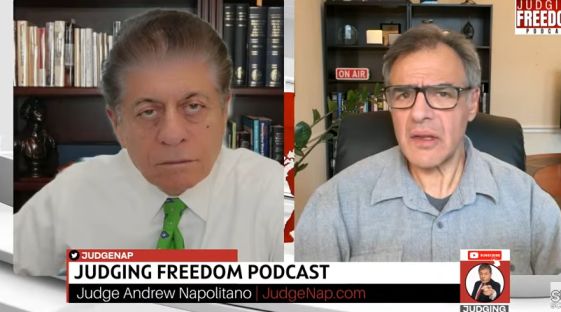
Editor’s Notes: In this episode of Judging Freedom, Judge Andrew Napolitano welcomes former CIA officer John Kiriakou to discuss the escalating conflict between the United States and Iran. Kiriakou offers a critical analysis of the CIA’s role in the hostilities, highlighting recent reports that the Agency provided the targeting intelligence used to assassinate Iran’s Supreme Leader and other top officials. The conversation explores the potential fallout of this “undeclared war,” the historical parallels to the Iraq invasion, and the fragility of current diplomatic efforts. Together, they examine the long-term consequences of these high-stakes assassinations and the risks of misjudging domestic support within Iran. (March 2, 2026)
TRANSCRIPT:
“Undeclared wars are commonplace. Tragically, our government engages in preemptive war, otherwise known as aggression, with no complaints from the American people. Sadly, we have become accustomed to living with the illegitimate use of force by government. To develop a truly free society, the issue of initiating force must be understood and rejected.”
JUDGE ANDREW NAPOLITANO: What if sometimes to love your country you had to alter or abolish the government? What if Jefferson was right? What if that government is best which governs least? What if it is dangerous to be right when the government is wrong? What if it is better to perish fighting for freedom than to live as a slave? What if freedom’s greatest hour of danger is now?
Introduction
JUDGE ANDREW NAPOLITANO: Hi, everyone. Judge Andrew Napolitano here for Judging Freedom. Today is Monday, March 2, 2026. John Kiriakou will be with us in just a moment on Iran and the CIA. What has been the CIA’s involvement in bringing us to this war?
A Congressionally Undeclared War
JUDGE ANDREW NAPOLITANO: John Kiriakou, my dear friend. A pleasure. Thank you very much for joining us today. Before we get to your understanding of the role of intel in this war, what is your view, big picture, of this congressionally undeclared war of choice that Donald Trump started on Friday night?
JOHN KIRIAKOU: Oh, I’m utterly, utterly opposed, for a number of reasons. First of all, it’s congressionally undeclared. The Constitution is very clear. There should be a congressional declaration of war, and that hasn’t happened. Not only has that not happened, Congress hasn’t even been briefed. And so our elected officials have no idea what the policy is.
Is the President telling us the truth when he says that this is going to last a few weeks? Because later in the afternoon today he said that this could go on for months. And what’s the goal? It’s easy to start a war. It’s easy to overthrow a government. It’s very, very difficult to stabilize a region and then pull out safely. Did we learn nothing in Iraq or Afghanistan? So I’m gravely concerned about this whole thing.
Ceasefire Overtures and Regional Missile Shortages
JUDGE ANDREW NAPOLITANO: There are reports in European media today — I haven’t seen any of them over here — that over the weekend, the Trump administration reached out to the Italian Foreign Ministry and they asked them to reach out to the Iranian Foreign Ministry, excuse me, and offer a ceasefire. If true, what does that tell you about the American thinking? If they want a ceasefire 48 hours after they started, that tells me that —
JOHN KIRIAKOU: — they thought the entire Iranian government would collapse as soon as hostilities were initiated. That hasn’t happened, and they’re starting to worry about a plan B. Also, I learned just in the last couple of hours that the United Arab Emirates has seven days worth of surface-to-air missiles left and Qatar has four days worth of surface-to-air missiles left. Both countries have reached out urgently to the United States asking for replacements, and there are no replacements. So something’s got to give.
JUDGE ANDREW NAPOLITANO: These are countries that house American military personnel. And Iran is not attacking civilians or even government in those countries — that’s attacking the American bases. Do I have that right?
JOHN KIRIAKOU: For the most part, there have been a couple of Iranian suicide drones aimed at the Burj Khalifa, the tallest building in the world. That’s in Dubai, at the Jebel Ali Free Port just south of Dubai. And then, oddly, at the port of Oman and a small town outside of Muscat. I’m not sure exactly what the reason for that would be, especially because it was the Omanis who were trying to negotiate a deal between the US and Iran.
But for the most part, the Iranian targets are American military installations, specifically in the GCC countries — Saudi Arabia, Kuwait, Bahrain, Qatar, Oman, and the United Arab Emirates.
Casualties and the Absence of Clear War Goals
JUDGE ANDREW NAPOLITANO: Well, we know of 18 casualties, among whom are four fatalities. I don’t know the status of the three American pilots whose jet planes were shot down, supposedly by mistake by the Kuwaitis. I believe that they bailed out and landed safely. If they landed in Kuwait, they’re probably safe by now. I mean, Kuwait is not going against the report or detained them.
JOHN KIRIAKOU: Right.
JUDGE ANDREW NAPOLITANO: Have you heard publicly, from President Trump or Secretary of State Rubio or Secretary of Defense Hegseth, a clear delineation of the goal of this war or a clear articulation of a feasible military goal?
JOHN KIRIAKOU: I have not, Your Honor. And I’ll tell you, this reminds me very, very much of the run-up to war with Iraq in 2002 and early 2003, where all anybody in the policy community wanted to talk about was initiating hostilities. And there was no plan to get out. There was no plan to try to encourage a stable, popular government. It was just move in, overthrow, and see what happens next. And it’s like history repeating itself.
The CIA’s Role in the Strikes
JUDGE ANDREW NAPOLITANO: What does the CIA have to do, if anything, with the initiation of these hostilities? For example, on Friday when this war started — I guess it was Friday evening Iran time, or maybe it was Saturday morning Iran time — were there CIA agents on the ground in Tehran?
JOHN KIRIAKOU: You know, 24 hours ago I would have said that’s ridiculous.
But it’s actually not ridiculous. The New York Times reported that the truth of what happened on the ground is the opposite of what we were led to believe. We were led to believe that the Mossad had the Iranian government utterly infiltrated from the top to the bottom.
But the New York Times reported yesterday that it was actually the CIA that had the Iranian government infiltrated, and it was the CIA that passed locational targeting information on the Iranian leadership to the Israelis, that the Israelis then used to kill Supreme Leader Khamenei and former President Ahmadinejad, and virtually the entire military and nuclear leadership. It was a CIA operation, not a Mossad operation.
JUDGE ANDREW NAPOLITANO: How did the CIA know that the Ayatollah and his family were in his house at one time, in one place?
JOHN KIRIAKOU: Well, I think they knew in a couple of different ways. First of all, Ayatollah Khamenei was actually pretty public with a statement that if the Iranian people didn’t have bunkers to run to, that he would not run to a bunker. And so it was pretty likely that he was going to be either in his house or his office, which were both in the same compound.
I don’t think anybody could have guessed that his family would be there. I would have assumed his family had run into hiding. But when the Israelis bombed the compound, they killed everybody. And it turned out to be Khamenei, his daughter, his son-in-law, and a grandchild.
You know, you have to wonder. The Israelis have bragged for years about the number of people that they’ve recruited in Iran. And most of them — at least many of them — were Afghan refugees. Refugees in Iran get nothing. They get no food, no shelter, no medical care, no nothing. And so if you approach these people and you say, “Look, I’ll give you $100 a month to stand on this corner and write in a little book how often General so-and-so leaves his apartment, and what time, and what time he returns, and what route he took when he left” — well, that’s $100 he didn’t have yesterday. That’s $100 that you can use to feed yourself if you’re a penniless refugee.
And I think now that it wasn’t just the Israelis that had these operations underway — it was also the CIA. When I was at the CIA, it was virtually impossible to recruit an Iranian, but the CIA was trying to recruit those people at the top — somebody in the Ayatollah’s office, or the Ministry of Foreign Affairs, the Ministry of Defense, the IRGC. Maybe they learned a lesson that you should start at the bottom and collect the information from the bottom and use it for targeting, because that’s apparently what they did over the last three days.
Israel’s Passion for Assassinations
JUDGE ANDREW NAPOLITANO: How do you explain the Israeli passion for assassinations?
JOHN KIRIAKOU: Yeah, it’s pretty incredible, isn’t it? Going back to the 50s, the Israelis were very happy to assassinate anybody that they deemed to be a potential threat to the stability of the state of Israel. And after the 1972 Munich Olympic massacre, it took them years to track down and hunt down every single Palestinian terrorist who was involved in that operation and kill them one at a time. Well, they’ve continued to do that.
The Iranian military and the Iranian nuclear program were rather easy for them to target because many of those scientists would travel overseas for academic seminars, and the Israelis would knock on the hotel door and say, “We’re with Mossad. You’re going to either work for us or you’re going to die.” And I’m going to assume some said, “Okay, I’ll take the deal.” But most others died.
And another thing with the Israelis — they don’t have a bureaucracy that the United States has. There’s no Gang of Four, Gang of Eight that you have to inform. There’s no Executive Order 12333. You just do it. You want to kill somebody, you just go out and kill them.
Israel’s Vulnerability and Shifting Public Opinion
JUDGE ANDREW NAPOLITANO: You mentioned one of Ronald Reagan’s greatest mistakes — Executive Order 12333 — which the intelligence community has interpreted as, “Forget about the Fourth Amendment, just spy on everybody, take down whatever they say from whatever source they have.” And even Donald Trump, who was himself victimized by that mentality and that executive order, has failed to change it.
How vulnerable is Israel to a continuous pounding by the Iranians? I mean, last time around, at the 12-day war, we understand Prime Minister Netanyahu begged the President to call everything off so the Iranians would stop attacking Israel.
JOHN KIRIAKOU: Yeah, this is going to be a problem for the Israelis. The Israelis, I think, were the ones who actually convinced the Americans that as soon as the first strikes began, the Iranian government would collapse. And it hasn’t collapsed. And so I think the Israelis today are saying, “Oh no, what have we gotten ourselves into?”
Another problem that the Israelis are having — and we’ve already begun seeing it here in the United States — is that only 27% of Americans, according to the latest polls, support this conflict. In Europe, it’s even worse. And for the very first time here in the United States, since polls began being taken on this issue, more people support the Palestinians than support the Israelis. Couple that with the unpopularity of this attack, and you’ve turned global public opinion against yourself.
JUDGE ANDREW NAPOLITANO: Right.
JOHN KIRIAKOU: So maybe it would have been a better idea to negotiate in good faith, rather than to just pretend to negotiate, drag it out as long as you can, tell the Iranians that they have 10 more days to make concessions, and then just hit them on day two.
The Lesson of North Korea and the Iran Nuclear Lie
JUDGE ANDREW NAPOLITANO: I mean, who would negotiate with the United States again after this? This is the second time in eight months that they, figuratively speaking, killed the negotiators. They attacked the country with which they were negotiating, as the negotiators were literally on their way to the next session.
JOHN KIRIAKOU: And may I add something as well. We’re not talking about North Korea today, and there’s a reason why we’re not talking about North Korea — because North Korea has a nuclear weapon. And so nobody wants to mess with North Korea.
Well, the Iranians weren’t building a nuclear weapon. There are two CIA National Intelligence Estimates that concluded that there was no nuclear weapons program, besides the fact that Ayatollah Khamenei issued a fatwa decades ago saying there will be no nuclear weapons program. But Benjamin Netanyahu came to the United States dozens upon dozens of times to try to convince whoever happened to be president at the time — and we’re going back four or five presidents — that Iran was an existential threat and that there was indeed a nuclear program, and so Iran had to be destroyed.
Well, that was a lie. And now here we are in a hot war, wondering how we’re going to get out of it.
The Danger of Underestimating Iranian Support
VIDEO CLIP BEGINS:
JUDGE ANDREW NAPOLITANO: Here is our friend and colleague Larry Johnson on this show this morning on A, the absurdity of killing the ayatollah, and B, the number of Iranians killed by the US government. Chris, number 23.
LARRY JOHNSON: The one man that had blocked that was the spiritual and actually political force keeping Iran from going ahead with a nuke was Khamenei. We killed him. Now that he’s out, I cannot dismiss the possibility that his replacement will come in and say, “Look, for the benefit of protecting the Iranian people, to protect, like these little girls, this 150 little girls between the ages of 6 and 12 that were murdered by the United States. We got blood on our hands. That’s why they call death to America, because we were responsible for a minimum of 300,000 dead Iranians over the course of the last 46 years.” Makes sense to you?
VIDEO CLIP ENDS:
JOHN KIRIAKOU: Yeah. Larry’s correct. Larry’s correct. There was no nuclear weapons program. And killing Ayatollah Khamenei is like killing the Pope. You’re not going to bring down Catholicism by killing the Pope. There’s just going to be another Pope appointed. And it’s the same situation in Iran. There’s going to be another grand ayatollah or ayatollah elevated to grand ayatollah, to Supreme Leader.
It very well could be the Ayatollah Khomeini’s grandson, who is one of the senior clerics and an insider and who’s far, far more conservative than Ayatollah Khamenei was. So we’ve opened up a Pandora’s box here, and I’m not sure that there’s a way to close the lid.
Tulsi Gabbard and the Intelligence Dismissal
JUDGE ANDREW NAPOLITANO: Should Tulsi Gabbard stay in her job? I mean, they obviously don’t listen to what she says. She testifies under oath about the CIA assessments. When she testified, she’s got all the written material in front of her in case the members of Congress want to see it. And Trump just dismisses it and says, “I don’t care what she says.” What he means is Netanyahu doesn’t want to hear this.
JOHN KIRIAKOU: That’s really exactly what it means. And if there is an assessment published that he doesn’t like or approve of, he’ll fire everybody that was involved in the assessment.
One thing about the CIA — and I was taught this in my very first week — the CIA does not have the protections of the Civil Service Act. CIA employees serve at the pleasure of the President. And so if the President doesn’t like your face, or doesn’t like the tie that you’re wearing, or doesn’t like what you wrote in the President’s Daily Brief, he can fire you and there’s literally nothing you can do about it.
JUDGE ANDREW NAPOLITANO: And officers and analysts know this.
JOHN KIRIAKOU: Oh, yes. But the thing is, every other president since the creation of the CIA has wanted unbiased analysis. No other president has wanted a rubber stamp of his own policies, whatever they happen to be.
I remember as a young man — I was still in my 20s, 28 years old — getting into a written argument with Bill Clinton over the Iraqi no-fly zones. And then finally his briefer said, “The president just gave up. He admits you’re the expert. He’s not. He’s just going to go with your analysis.” Well, that’s what would happen in a normal situation. Not that everybody’s fired and then you just do what you want to do anyway.
Where Does This End?
JUDGE ANDREW NAPOLITANO: Where do you see this ending, John?
JOHN KIRIAKOU: I don’t think this is going to take weeks, and I don’t think we’ll bring down the Iranian government. One of the things that I noticed, one of the things that I rued the last couple of days, was watching CNN, Fox, MSNBC — or MS, as it’s called now — and these repeated references to this tiny demonstration in Los Angeles between 200 and 300 people jumping up and down and dancing and singing and applauding the attack.
Well, these are mostly Iranian Jews, most of whom settled in Southern California, many of them in Beverly Hills. These were pro-Shah people who fled in 1979, took their wealth with them. That’s not the average Iranian. There are demonstrations in Tehran that are pro-government that have had hundreds of thousands of people. And so I think we’ve grossly underestimated the support, the domestic support, that this Iranian government has. And I think that we will not see a quick collapse.
JUDGE ANDREW NAPOLITANO: Wouldn’t the murder of the ayatollah reinforce that support?
JOHN KIRIAKOU: Absolutely. This was something that we miscalculated at the start of the Iran war. I remember being in — I was the note taker in a Principals Committee meeting the night before we attacked Iraq. And one of the National Security Council senior advisors, as we got up to walk out of the room, said, “When we cross that border tomorrow, they’re going to throw flowers at us.”
And I went back to the office and I said to the Deputy Director of the CIA, “Do these people know nothing about history?” And he said, “No, they know nothing about history.” And here we are repeating that same mistake that we made 24 years ago.
Closing Remarks
JUDGE ANDREW NAPOLITANO: John Kiriakou, thank you, my dear friend. Pleasure. Pleasure to interview you. I hope we can see you at the end of the week.
JOHN KIRIAKOU: Thank you so much. I look forward to that. Good to see you.
JUDGE ANDREW NAPOLITANO: Thank you. All the best. Coming up tomorrow, Tuesday, at 8 in the morning, Ambassador Chas Freeman; at 9 in the morning, Professor John Mearsheimer; at 10 in the morning, Aaron Maté; at 12:45 in the afternoon, Scott Ritter; at 2 o’clock, Matt Ho — these are full days — at 3 o’clock, Colonel Karen Kwiatkowski. Thank you for watching Judge Napolitano — Judging Freedom.
Related Posts