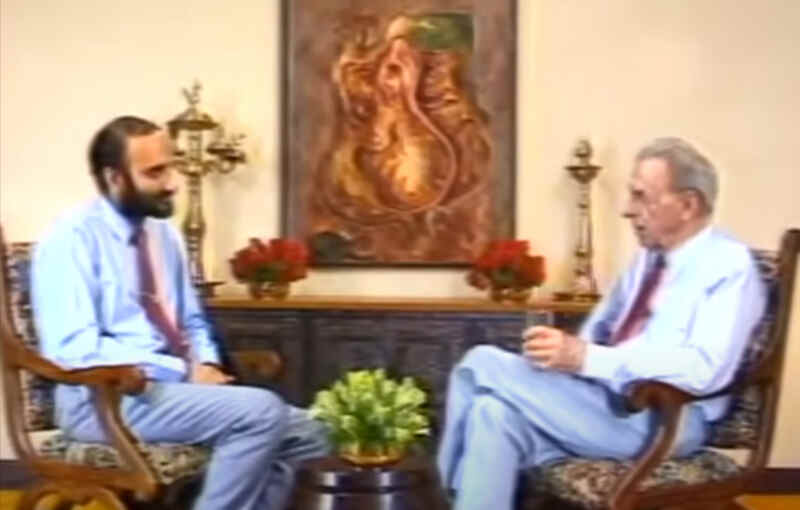
The following is the full transcript of French born Indian industrialist JRD Tata (Jehangir Ratanji Dadabhoy Tata) in conversation with journalist Rajiv Mehrotra in the spring of 1987.
A Conversation with JRD Tata
RAJIV MEHROTRA: Well, Mr. Tata, welcome to conversations. It’s a convention, almost a cliche for a host to introduce his guest as one who needs no introduction. In your case, this is something that’s quite literally true. Have you felt that a liability to need no introduction?
JRD TATA: I’m very happy. Please don’t introduce me. I don’t think there’s any need for this conversation at all. But anyway, I agree too, and I’m doing it. And because I’ve admired or I’ve appreciated the two conversations I’ve seen, I thought at least this fellow is fairly kind to his victims and makes things easy.
RAJIV MEHROTRA: Have you felt inhibited about the fact that you’re easily recognized? That you’re a well known personality? Does that intrude upon your life?
JRD TATA: Yes, but only in Bombay. I’m not known anywhere else really. At least not visibly or not by being seen in Bombay, yes, but you get used to it. And what can one do? The main thing, most of the people who recognize you and come to you or address you without knowing you mean well, our friends, they mean to be friendly.
Sometimes it goes to rather ridiculous extent. It’s quite often for me in Bombay, in the car, another car is by the side and suddenly hand comes out and said, Mr. Tata, may I shake hand with you? And I said, of course. And then I talk to them, whomever I can. No. So it doesn’t intrude in a. In a. In an objectionable way. If people think more of me than they should or any justification for, then it’s their fault and they are wasting their time.
Self-Assessment and Leadership Philosophy
RAJIV MEHROTRA: What do you think of yourself? How do you evaluate yourself?
JRD TATA: I certainly estimate myself on a much lower level than seems to be extended to me. I don’t think that I quite deserve the friendship. The. Not the friendship is the wrong word. The admiration, the regard that I get. Because after all, all that I’ve done in my life, except perhaps in creating Air India from scratch from a little male airline. I haven’t done personally anything of any. I’ve never created anything entirely new.
It happens that I inherited the situation. I got into Tatas in 1926. And on the death of my father and thereafter from then on to now, until now, men I had always. There was always a good team, Tatas. And when at a rather young age for being the head of a group, namely in 1938.
RAJIV MEHROTRA: And you were what, 34 years old. And you were appointed by people who were your seniors.
JRD TATA: Who were seniors. Well, because. Yes, I was. I was made a director by Sir Dorab, the chairman And. And when. When. When, sir. When the. The man who succeeded Sir Dorab, namely Sir Nowroji Saklatwala, died, the director to appoint a chairman. And so they appointed me, I thought somewhat prematurely, and I described it as a piece of mental aberration. But it seems to have lasted.
So I use that only to explain in answer to your question, that starting with something that existed, led by a team, a good team of people, experience and capable. A team to which I only added in the course of years, choosing the best people I could find to join us, those that didn’t grow from the. From within. So therefore it was a question of keeping things going and growing. Only a few things were added. Well, one, of course, was Air India. That was the one thing I may feel that I had, I was wholly responsible for.
The Air India Experience
RAJIV MEHROTRA: Was it a wrenching, anguishing experience for you to relinquish control of Air India?
JRD TATA: Yes, of course, but. Of course, but at the same time. You mean nationalization, you’re talking 19. We are going from that event to February 1978. When Mr. Morarji Desai fired me. He didn’t inform me for about 10 or 12 days later when I got a letter thanking me for my services to aviation. But I learned it from the man whom he appointed as my successor.
RAJIV MEHROTRA: How does it feel to be fired?
JRD TATA: Well, look, maybe I can’t say the how. I think the answer cannot be a sensible one because I had never been fired before. So if you mean how did it feel to be fired for the first time or never having an experience, well, it was not unexpected. Mr. Morarji Desai was the Prime Minister of India. He’s a man with whom I’d had a whole life almost of love, hate. We were friends and at the same time the man was quite impossible to deal with. I think everybody knew him, so it didn’t surprise me. And I thought that something. All things must end sooner or later. The way it was done was not very pleasant to me.
RAJIV MEHROTRA: Have you done a lot of firing in your term as chairman of Tata Sons?
JRD TATA: I think my leadership, if you can call it that in Tatas or in business, therefore has been one of always thinking of colleagues as a team. If one didn’t agree, there are ways. I took part in firings, but not in any way that involved me very deeply. It must eat deeply because I do approve, but generally I avoided that. There are other ways of dealing with situations and firing the man. So I can say, on the whole, rarely; it’s not a very pleasant thing to do if you have to.
Leadership and Team Management
RAJIV MEHROTRA: The Tata Sons and the Tata group of companies have evolved a reputation for excellence. And you’ve mentioned that how you have been the leader of a team.
What are the qualities of a good leader?
JRD TATA: Well, one of the things he must be, I would imagine he must be. His leadership must be respected by the team. As I’ve lasted so long, I must assume that my leadership has been respected and generally approved.
Second point I want to make is that I believe where there are team, I believe in working on the basis of a consensus. Obviously, when human being, an intelligent human being who are themselves in their own field, leaders of those, of those in those fields and of the companies that are part of the group but are separately and independently managed. We do have differences of opinion with the chairman of the group. There could be and there should be.
But generally, unless it’s something that is a matter of principle, I always found that it’s that one can work on the consensus either convince them and if it’s not something very serious and I can’t convince them and they are very, very sure of themselves, I let them accept their view. It’s never done like say in a battle, in a war. So I find that working on a consensus is a good way of leading a team and it makes things easier.
There are always problems. We are full of problems in business somewhat less now than we have been for many years when under the pressures of alleged socialism. But there are always problems and difficulties and sometimes also losses. Losses also of not only financial loss, but a loss of a purpose. But if one is prepared to look at things in a. I don’t know how to say it in a human way, understanding that most of the decisions of others, even if they are adverse decisions, they are done in their belief that it’s the right thing to do. Now, whether Mr. Morarji this I thought it was the right. Must have thought that it was the right thing to do, to fire me, that is maybe an exception.
Views on Socialism and Capitalism
RAJIV MEHROTRA: Do you in some senses feel vindicated that globally it’s almost as if socialism is on the retreat and capitalist free enterprise, the system of incentive, is triumphing.
JRD TATA: In a sense, I think one can. I believe that Tatas in most of their companies are following socialistic principles. Anybody who visits Jamshedpur, for instance, Tata Steel, sees how the thing is run for whose benefit? Right from the Mr. Jamsetji Tata was a socialist. He must have been, because otherwise he wouldn’t at that time think in terms of what was far, far from what was thought of in other countries in regard to labor relations. Human relations.
A man who created, he and his successors and we created, made decisions between management and labor that had. That were not adopted even in the advanced countries of the world. For years. It was Tatas who introduced the first eight hour day, the first leave with pay, the first. A number of firsts. Now this. This could only be conceived and accepted if, starting with Jamsetji Tata, there was to me that was socialism. In some ways it has turned out. It may be. It may turn out to paternalism, as people think it’s paternalism. But anybody who goes to Jamshedpur and studies the situation, who thinks it’s paternalism ought to have his head examined.
RAJIV MEHROTRA: But that may well be sort of the exception to capitalism. Because capitalism has seen its aberrations too.
JRD TATA: But they were aberrations. They were the wrong kind of capitalism. It was a way of life totally, totally free of any social feeling, of social responsibilities. In some cases they were.
Political Inclinations and Business
RAJIV MEHROTRA: You started your career when India lacked those very freedoms. Did you feel the impulse to participate actively in India’s freedom struggle?
JRD TATA: I even was stupid enough at one stage to think that maybe I should give up the idea of becoming a businessman or an industrial leader and join the Congress Party. I was immensely impressed by Jawaharlal. There was a great love and admiration for the man. But I soon realized I didn’t go too far in that thought.
Because having attended one or two meetings and having seen people in action, I realized that all that would mean is to get myself arrested, go to jail, where I didn’t think I could do very much for the country or for the party. But the main reason I didn’t, apart from that, was to feel. It was the fact that I’m almost in apolitical or apolitical. I never know how to pronounce the word animal. I cannot. I cannot. I don’t understand. I dislike and I don’t react except adversely to almost all politics, pure politics. And there’s been so much of it that I’ve blessed. The fact that I never decided to be both a businessman and I knew also that if I was, I’d have to leave industry and develop and devote myself to the other, to the political side.
RAJIV MEHROTRA: What excited you about being a business person or an industrialist, a leader of industry?
JRD TATA: Industry didn’t excite me. But the only thing that excited me is the opportunities to create. That’s something new. See a new factory created, a new plant being built, seeing employees, seeing new work being done. And of course, because I believe thoroughly that India must industrialize if it’s got to find employment apart from the agricultural opportunities which I knew were very there. So therefore the excitement was in. In seeing things done.
Wealth and Personal Philosophy
RAJIV MEHROTRA: Were you ever excited by the creation of wealth?
JRD TATA: No. And that is something I’ve never quite understood. I’ve never. I’ve never. I haven’t acquired wealth myself. My father died fairly heavily in debt because he had a large family and his habits of traveling between India and Europe were rather expensive. And so I didn’t start with any wealth except the right of having some shares in Tata Sons.
But to be. I’ve missed. I miss wealth in the sense that I think that if I had a real wealth not. Not the few lakhs of rupees that I might. I would be. I’d be able to do more not for myself but even for. Even for. And particularly for others. But that hasn’t worried me and. And I’m in We. I’m glad that I have no wealth that and perhaps that’s one of the reasons why I’m well considered People perhaps have discovered that really it’s only the foreigners who seem to refer to me as the richest man in India.
Business and Politics
RAJIV MEHROTRA: You mentioned the aspect that you were apolitical. But is it practically possible for someone in business to be divorced from the political process particularly in India where there is so many decisions or political decisions influence.
JRD TATA: No, you’re quite right. But one can still. When I meant that I was apolitical is in the. The operations of politics. I was a friend and a great admirer of Jayaprakash Narayan. I was a friend and admirer naturally of Jawaharlal Nehru. But even though I think both of them went wrong or made mistakes and Jawaharlal particularly in being the man who introduced and kept in India for so long even after his death. This socialism to which I. Which I consider the wrong types of socialism bureaucratism, etc. But I don’t. I think I can. You can still be a political. In regard to the way in which politics are operating and also and oneself being prepared to participate in those operations.
RAJIV MEHROTRA: Have you felt the imperative to influence the political process in the sense of persuading governments to your point of view? Lobbying?
JRD TATA: No, I never lobbied. Yes. I don’t call it. I’ve never done any lobbying. But I’ve been an outspoken if not sometimes critic but proposal of policies that should be done and are not done and not been done. For instance, nationalization of industry. The way it is done. For whose benefit has it improved them? Will it lead to more wealth for the country? Will they be better managed? All those considerations made me opposed to nationalization of industries. Just blind in nationalization of industries though quite accepting the fact that some industries or some activities must be done by the state. But I forget what the question was.
Political Influence and Parliamentary System
RAJIV MEHROTRA: Is that have you felt the imperative to influence the political process?
JRD TATA: I felt more and more concerned with the fact that we in India had adopted the British parliamentary system. I was convinced that it wouldn’t work in India or it would result in the kind of way that it did.
RAJIV MEHROTRA: At the end of the day, are you despairing of where the political processes in India might be leading us?
JRD TATA: No, you know, I’m perhaps only because I’m. Well, I mean I’m a pessimist in the long term about what’s going to happen tomorrow or at the elections or whatever happened. But I’m a long term optimist because I know, I know, I understand or have learned to understand what is the people that are the Indians, even the, even the most, the most primitive of them.
The basic soundness of these people, be they tribals or be they Harijans. And therefore, and India has overcome so many, so in over the centuries, so many reverses, so many difficulties, conquests by outsiders and all that that I can’t believe, I refuse to believe that they would allow the country to be, to be got to a stage that some of the countries in the world have been and are.
The Resilience of Indian People
RAJIV MEHROTRA: Could you even begin to define what this quality was that makes India survive despite its politicians perhaps or some industrialists too?
JRD TATA: Very difficult. This is a question like most questions are not simple to answer and I don’t have also the education to understand. I’m not, I mean I’ve not studied history except in small bits and local history, say of France. And so therefore I have. I do not, I consider myself quite incompetent.
But the fact that we are a conglomeration of such different kinds of people and yet amongst them there are always enough of them who are, who have, who seem to have inherited over the, perhaps over the centuries or even the millennia a certain common sense that makes them resist to, to pressures, makes them revolt when they have to, make them disciplined when there is no other way. One wouldn’t think it was so.
Leadership and Independence Era
RAJIV MEHROTRA: Now it’s frequently argued that at the time of independence and then that whole period of struggle and immediately after independence, the leadership of Gandhi and those around him were able to draw international life people, people of enormous stature, of vision, of education, of commitment, of integrity which isn’t happening at the present time, just.
JRD TATA: Leadership is not enough devoted leadership. If one has to be a leader in such a difficult environment as the Indian one such a mixed one there must be total devotion to the deed. Sometimes just devotion is not enough.
Jaya Prakash, whom I mentioned, was a case in point. He said he was a totally motivated, totally devoted man of high intelligence. Couldn’t make up his mind, for instance or who was so good, so good a human being that he was prepared always to consider the views of others, including his opponents, beyond the needs of it. He could have been, I think he could have been a great leader. After Jawaharlal, of course, a great leader.
The kind of leader we needed and got at the time was Vallabhbhai. I often say to myself, think, suppose that Vallabhbhai had been the young man and Nehru had been the older man and Vallabhbhai would have been, obviously would have become the prime minister of India. Certainly in the economic plan, there would have been a totally different situation than the one that exists today.
Disagreements with Nehru
RAJIV MEHROTRA: You frequently disagreed with Pandit Nehru. When you articulated or shared those disagreements, what was his response?
JRD TATA: I tried. He liked me. I loved him, admired him. But when you. On this kind of thing, economics, which of which he knew very little, in my opinion and certainly. And certainly on socialism and how socialism could be established without. Without the loss of. Loss of economic freedom for the majority of the people anyway, the. I’m going to be careful what I say. Repeat your question.
RAJIV MEHROTRA: When you spoke to Jawaharlal Nehru and articulated your disagreements and his economic policies what was his reaction?
JRD TATA: Very simple. No, I’ll tell you what his reaction was. I thought that means mentioned somewhere. I’d go and see him sometimes. He’d invite me even to have a meal to see the giant panda that he had, you know. And then I would try to bring the conversation to economics, nationalization, bureaucracy. He was not only not interested, but he wasn’t willing even to talk.
And yet he had invented a little trick was that when I started, we sat fairly near each other and there was a window not too far. The moment I began something like that he’d turn around and look out of the window and I got the message.
In the case of Mrs. Gandhi, it was a slightly different way of doing it. When she began to lose interest in what you were saying namely arguing against something she was doing she would begin to pick up some of the letters and start opening envelopes and pulling out practically hinting that, look, I’ve got other things to do. So I take the message.
Encounters with Mahatma Gandhi
RAJIV MEHROTRA: Did you have much to do with Mahatma Gandhi?
JRD TATA: No, very little. I saw him and I saw him a number of times. I called on him maybe personally three times in my life. So no.
RAJIV MEHROTRA: What was that interaction like?
JRD TATA: Was it, oh, wonderful. The man was immediately smile at you and talk to you and even crack a joke. Also the feeling, the wonderful feeling. In fact, it makes me think that if only we would learn to smile at each other more often and treat the other as a friend, even when you have no. No reason to be friends, but you have no reason not to be friends, I think we’d be better off.
And I find that because you were asking whether intrusion in my private life, people coming up may be the reason that I am responsible for the fact that I’m inclined instinctively to like people or to, you know, if somebody comes to me, unlike most parts of the world, and particularly in the urban world, in the big cities of the world, if you come up to somebody on the street, man or woman, and you’ve only got to ask them the time, the first reaction is one that you can feel he’s saying, what does he want? He wants something from me or he’s attacking me.
And I find that funny enough. I can digress. But I find that abroad and here you look at people and you look at. And when you look at them, you smile and they respond at once. There’s an extraordinary capacity for response that one never exploits in the street. Your driver. Most people, when they take to driving and they are not professional drivers, become monsters at the wheel and then they become aggressive and hostile. Now you drive and somebody is either in the way or not. You smile at him and let him go. You get such a surprised and delighted and friendly look back it quite extraordinary.
Aviation Adventures
RAJIV MEHROTRA: Well, that reminds me of the incident when you were driving, when you were sort of piloting a plane at Paris airport without any brakes. That couldn’t have got you a smile. What happened?
JRD TATA: Oh, what happened? I crashed into. Into the.
RAJIV MEHROTRA: When you.
JRD TATA: And what were you in 1930 in a little plane, the one I’d flown. The one I’d flown from India to England for the Aga Khan Prize, which I hadn’t got and there was nothing I could do because there was no way. There was no brake to apply. And I belted myself. I could have. I tried to jump out and hold the plane being very light and instead of that, the man, the French airline that had started ascensions and that gave me a blast on the.
I just went round and round and crashed into this poor Argosy and broke some cables of it and they were furious and I was. I could well understand. How could I be angry with them? I had. And the passengers were waiting to. To embark. So they, however they. They were British and reasonable. They charged me 25.
RAJIV MEHROTRA: You were to fly again in 1982 to repeat the flight from Karachi to Bombay. Do you still fly? Does it excite you?
JRD TATA: It would but a. I haven’t got. We have no airplane to fly. The only aeroplane Tatas have are in Jamshedpur. And I don’t live in Jamshedpur. But until recently when going to Jamshedpur, I used to fly from Calcutta to Jamshedpur. Fly in the airline to Calcutta and then. And back again the other way.
On those occasions I used. With a professional pilot by my side. I used to enjoy flying the plane just between Calcutta and Jamshedpur. But I think that at the age of over 80, the time to forget that kind of thing. And I wish if I were younger and if I had had an aeroplane, I would. Yes, it has been, after all, the greatest joy of my life. Is flying.
Population Control and National Priorities
RAJIV MEHROTRA: One of your many current concerns, passions almost is your commitment to family planning, controlling India’s population. It’s something that seems to have drifted away from the headlines, drifted away from apparently from the political agenda. Do you think that it is in fact feasible in the context of liberal democracies, a capitalist system, to impose the kind of controls and disciplines, the imperatives that might help us bring about to the level of population control that we need?
Or is your argument the economic one, that as is believed and practiced in many developed countries, that economic development will inevitably lead to a lowering of population growth rates? What is the strategy that you recommend or urge?
JRD TATA: Both. I think ultimately what you say is quite right. As the standard of living, other people increase and they want their children educated, etc. It’ll be here, it’ll happen here. But too late, can never be too late because India will still survive. But it’ll take too long. And therefore one must find some ways of accelerating the process.
And that can be done in two ways, a negative way as well as a positive way. Much of the difficulty in India is this obsession that the people of India have, particularly, particularly in the rural areas, obsession to have boys.
Political Agenda and National Priorities
RAJIV MEHROTRA: You’re an apolitical figure. This is an election year. What would be your sort of. What would be the political agenda that you would urge the political parties? What are your. What are the national priorities? Apart from.
JRD TATA: Yeah, but the national priorities are not necessarily the priorities of the political parties. The political parties want to oust Rajiv Gandhi and the Congress, that’s all and take their place. They did it once, they made a mess of. May happen again. I doubt it. But it may happen again. If they succeed in ousting the Congress which I, as I say, as an apolitical animal, I don’t. I’m not the judge. But if it does, then I think the same thing will happen.
So therefore I can’t just urge. I know what I want any government in part to do what all the things that we all know that you know. Continue to of course concentrate on agriculture, concentrate on employment because employment is what is needed in this country. Concentrate on things like population, the population problem which very little has been done in spite of all the money that is being spent.
Industry and Political Nexus
RAJIV MEHROTRA: But as a leader of industry, a popular perception amongst many Indians, many of us is that industry is responsible in its nexus with politicians with the perpetuation, the creation of black money, the exploitation of labor, the supplying of poor quality goods, of not responding sufficiently to foreign competition. In terms of the initiatives of opening up the economy of the government. What would you urge your colleagues in industry and do you in fact see this nexus between industry making payoffs to political parties to get policies changed to its disadvantaged? There’s a whole universe of.
Leadership and Industry Transformation
JRD TATA: Look, I have no, I’m not a leader. I have no colleagues in industry generally only in my own group that I can influence or help or advise. But first of all there is a change. I think that from a technological point of view, management point of view, Indian industry, at least big industry today is a very different animal to what it was when I first became a director of Tatas.
There is a quality consciousness that didn’t exist in the old days. We mustn’t forget that it’s not so long ago, perhaps a hundred years ago when nobody would touch a Japanese product. Now they are the leaders perhaps in most products largely on the basis of quality. So first of all there is a big shift.
Labor Relations and Union Power
Then labor. What are you talking about? With the dominance of the unions backed by the politicians there is no opportunity to exploit labor. In fact I believe that probably the only labor that is being really exploited in our country is those who are employed by small sector. Small sector industry which is greatly encouraged by government. Rightly because I want the small sector to become big sector. I don’t want a few big groups.
And with that power of the unions, as I say, backed by the, supported by the, or not opposed by the politicians, there’s no chance of exploitation. In fact, it is the other way. Today you cannot modernize. You cannot make good products cheap or cheaper than they would be otherwise, except with modern equipment and modern processes.
The unions do not want any change. Yes, modernization, they will accept. The days are gone where they wouldn’t allow even a typewriter, but they still oppose computers or the full exploitation of computers. But you can’t reduce, you can only modernize. And you can only cheapen the cost by using modern processes which need less and less and less labor.
But how do you introduce a new process if you’re not allowed to retrench? By retrench I mean really pay off. There are very large amounts that industry would be prepared to pay and is prepared to pay, but the unions don’t accept it at all.
The Rise of Black Money and Government Control
Black money. Look, when I was young and joined business, there was no black money. I never heard of black money. There was no corruption. Because whom were you to corrupt when you did not have a system of government control where you had to get a permit for everything? I’m surprised you didn’t have to get a government permit to change the position of the chairs in this room.
RAJIV MEHROTRA: This is a Tata hotel.
JRD TATA: Well, maybe if it had been a government hotel, you probably wouldn’t have been allowed to do that without consulting a joint secretary somewhere in Delhi. But anyway, therefore, then also in those early days, taxes were either non-existent or very low.
You may not know that. Say, take 90 years ago, hundred years ago, the salary of the highest government official, who in those days would be either a high court judge or the secretary of the government, they were the highest. And I think the black money will always be there so long as the taxes are high and the controls are high.
Living with Bureaucratic Constraints
I look, I often have to go abroad, but every time I go abroad, although I’m supposed to be a leader, a dwarf, not a leader, a dwarf industry. If I want to have a little cash money to spend in London or in New York for my hotel bills, if somebody else doesn’t pay for the hotel, for buying anything, I’ve got to go to the Reserve Bank and they will give me as little as they do it.
Well, they do it, they are kind, they are reasonable. But still you got to go to a bureaucrat and say, may I have a little money? Then when I come back, if there is any left, any traveler check or thing, you have to hand it over. All these kind of rules and regulations will be considered just not acceptable anywhere else.
But we have to accept at least so long as there are good intentions and so long as administration is better, so long as business is getting better, so long as the monsoon is better. I think we’ve got to live with what there is and cooperate.
The Pursuit of Happiness
RAJIV MEHROTRA: What is it that makes you happy, excites you, exhilarates you? Now, not that you’re not flying, you’re not driving fast cars.
JRD TATA: Nothing I haven’t got. I have none of these. The pursuit of happiness is one that would have to be defined in detail first. But the pursuit of happiness in my case doesn’t involve, first of all, even if I wanted to, like other people might want, travel abroad more, spend money, live exceptionally well by car, which I’m in Europe if I want to, all these ideas have totally gone.
So I do the best of what there is available. And I’m happy that, I’m happy that on the whole, I tell you this is important, that one should feel that those you’ve dealt with, and even now, practically the public, or somewhat. What is it? A man who suffers an aberration, what would you call him? An aberrated man.
RAJIV MEHROTRA: Yes.
JRD TATA: Well, like you think well of me, something that at least brings happiness, that if other people think that you brought happiness to others and that you’ve been useful and continue to be useful, that’s a form of happiness and I think it’s worth cultivating. So I have no intention of breaking loose.
Related Posts