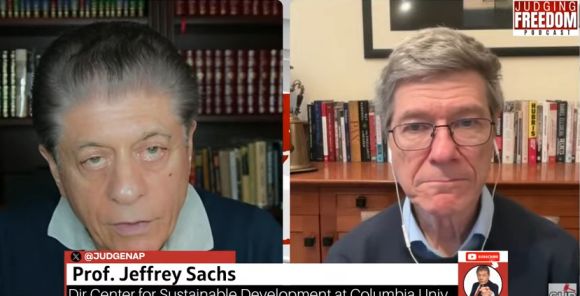
Editor’s Notes: In this timely episode of Judging Freedom, Judge Andrew Napolitano is joined by Professor Jeffrey Sachs to discuss the Supreme Court’s landmark decision to strike down President Trump’s tariffs, reaffirming that the power to tax lies solely with Congress. The conversation explores the constitutional implications of “one-person rule” and the economic misunderstandings driving recent trade policies, while also addressing the growing tensions and potential for conflict with Iran. Professor Sachs provides a critical analysis of American foreign policy, the history of the Iran nuclear deal, and the dangers of a lawless, interventionist approach on the global stage. (Feb 20, 2026)
TRANSCRIPT:
“Undeclared wars are commonplace. Tragically, our government engages in preemptive war, otherwise known as aggression, with no complaints from the American people. Sadly, we have become accustomed to living with the illegitimate use of force by government. To develop a truly free society, the issue of initiating force must be understood and rejected.”
Introduction
JUDGE ANDREW NAPOLITANO: What if sometimes to love your country, you had to alter or abolish the government? What if Jefferson was right? What if that government is best which governs least? What if it is dangerous to be right when the government is wrong? What if it is better to perish fighting for freedom than to live as a slave? What if freedom’s greatest hour of danger is now?
Hi, everyone. Judge Andrew Napolitano here for Judging Freedom. Today is Friday, February 20, 2026. Welcome to this special late-in-the-day Friday afternoon edition of Judging Freedom with Professor Jeffrey Sachs.
The Supreme Court of the United States of America crushes President Trump’s tariffs. Professor Sachs, I want to ask you questions about Iran, but we’ll put them aside and get to the news of the day, which is that the Supreme Court finally and publicly proclaimed what school children know — which is that a tariff is a tax and only Congress can impose taxes, much to the President’s chagrin.
The Supreme Court’s Decision: A Constitutional Reckoning
PROF. JEFFREY SACHS: It says very clearly in Article 1, Section 8 of the Constitution — that is the article that deals with the powers of the legislative branch, Congress — that the powers to impose duties are congressional powers, not presidential powers.
And the opinion today is good law, and it is a good relief for the American people, because during the past year, Congress played dead and we have been in the hands of one-person rule. It has been unstable, erratic, self-defeating, based on profound economic ignorance. And today the Supreme Court stood up and did the right thing, which is to say that the President of the United States must abide by the law.
We then saw a rant from the President of the United States. He also clearly did not understand much of what he was talking about. But that’s part of the problem — we have one-person rule by somebody who doesn’t understand very much.
But the decision is an important one. It was not made on small print and on the details. It was a clear, bold decision that this is a constitutional issue, that there was nothing in the International Emergency Economic Powers Act, IEEPA, that gave the President the power to overrule the clear text of the Constitution. And we’re in safer ground this evening because of that.
I have to say that the Constitution — the same document — gives Congress the sole power to declare war. And President Trump, in his usual completely irresponsible and unconstitutional way, is just on the verge of declaring war with Iran. This is the same kind of issue. Are we under one-person rule, or are we ruled by the Constitution?
Trump’s Angry Response: A Manifestation of Ignorance
JUDGE ANDREW NAPOLITANO: A great summary and a great observation. Here is President Trump angrily manifesting profound economic and constitutional ignorance.
VIDEO CLIP BEGINS:
DONALD TRUMP: But I am allowed to cut off any and all trade or business with that same country. In other words, I can destroy the trade. I can destroy the country. I’m even allowed to impose a foreign-country-destroying embargo. I can embargo. I can do anything I want, but I can’t charge $1, because that’s not what it says and that’s not the way it even reads.
I can do anything I want to do to them, but I can’t charge any money. So I’m allowed to destroy the country, but I can’t charge them a little fee. I could give them a little 32-cent fee, but I cannot charge — under any circumstances — I cannot charge them anything. Think of that. How ridiculous is that?
I’m allowed to embargo them. I’m allowed to tell them, “You can’t do business in the United States anymore. We want you out of here.” But if I want to charge them $10, I can’t do that. It’s incorrect. Their decision is incorrect. But it doesn’t matter, because we have very powerful alternatives that have been approved by this decision. They’ve been approved by the decision, for those that thought they had us.
VIDEO CLIP ENDS:
JUDGE ANDREW NAPOLITANO: He finished that manifestation of ignorance, forgetting that he does have some emergency powers. But there is no emergency.
Dissecting Trump’s Economic and Legal Confusion
PROF. JEFFREY SACHS: That’s correct. This is really an astounding rant that should give all of us real pause and cause for concern.
No, the President cannot destroy any country or do what he wants. He’s referring to the ability to declare an emergency under US law — of an international emergency. There can also be domestic emergencies. But that is not the same thing as the power to “do anything I want” or to “destroy any country.”
He’s a very confused man, and he does think that he can do whatever he wants — that he can destroy any country that he wants. He doesn’t even understand the basic idea of the International Emergency Economic Powers Act, which does not give him the power to do anything he wants.
It gives the President some powers under the law to declare a national emergency. That has to be a substantive national emergency, and then to take actions because of the emergency.
Trump did nothing of this sort, and then abused the law by claiming powers that the law does not grant him — that is, the right of one person to remake the international trade system.
The fact of the matter is, everything that Trump observed — that we have a trade deficit, for example, which we’ve had for 20 years — is not an emergency. It is not the meaning of “emergency” under US law. Or the fact that Canada ran an ad that Trump didn’t like, showing that President Reagan didn’t like tariffs. So Trump used the same emergency powers to put extra penalties on Canada. No, you can’t do whatever you want like a 3-year-old in a tantrum and say that that’s what the law allows.
So there’s a very basic misunderstanding here. There’s also some very primitive economic misunderstanding. Trump continues to say “we’re taking in their money” — that the other countries are paying the tariff. These are taxes on Americans. These are taxes on American consumers. And yes, you’re taking in the money of taxes that were imposed single-handedly, against the law, by the President. That’s not taking in the money of other countries. He doesn’t seem to understand that most basic fact either.
And incidentally, there was a study that just came out a few days ago by economists at the New York Federal Reserve showing that in fact the tariff rates that were imposed were added to the pre-existing prices from abroad, raising the prices to consumers — rather than what could have been the case, that foreign exporters to the US cut their prices to keep the tariff-inclusive price unchanged. No, that’s not what happened. The domestic prices rose because the Americans were paying those tariffs.
So Trump is charging taxes on Americans. Now he’s going to try to charge them in a different way. Then he fantasizes that this is charging money to other countries, which is false. And then he also somehow believes that this is helping the United States economy and rebuilding American manufacturing — which is absurd.
The fact is that American manufacturing had a loss of 83,000 jobs from January 2025 to January 2026, since he came into office. So the whole thing is fatuous. The whole policy twisted every country out of shape for a year, based on powers that he didn’t have and economic ignorance that he did have.
The Cost to American Consumers
JUDGE ANDREW NAPOLITANO: The same study that you cited showed that 92% of the tariffs were paid by American consumers — a sales tax. The other 8% were eaten by either the foreign manufacturers or the middlemen, as you know, so many middlemen between the foreign manufacturer and the American consumer.
The only interesting point in the dissent is: how is this going to be paid back? A lady goes to Walmart to buy a toaster. Instead of costing $25, it costs $35. Is she entitled to her $10 back from the Treasury? This is going to be…
PROF. JEFFREY SACHS: Governor Pritzker, late in the day from Illinois, sent an invoice — I think it was for something like $8.6 billion — that Illinois consumers had paid in tariffs. Of course, how this is going to be repaid is a real issue, but it will be repaid, yes.
The Economic Damage: Small Businesses and Jobs
JUDGE ANDREW NAPOLITANO: Are economists able to calculate the economic damage caused by the tariffs? The small businesses that went out of business, the employees of those small businesses that lost their jobs, the investors in those businesses that lost their investments — because they simply couldn’t afford the raw materials that they use to produce their products, which they get from foreign countries because of the tariffs that Trump imposed?
PROF. JEFFREY SACHS: It’s very hard to make precise numbers, especially for small businesses and individual sectors. But one can say that Trump created a tremendous mess — a lot of uncertainty that was extraordinarily naive, never justified remotely by sound understanding of the economy, that did not create any return of manufacturing to the United States or a return of manufacturing jobs, as I just indicated.
And the entire premise — aside from the violation of the law — was that the fact that the US is running a trade deficit means, Trump claims, that other countries are ripping off the United States.
Why the Trade Deficit Argument Is Profoundly Wrong
JUDGE ANDREW NAPOLITANO: Can you explain why that statement, which he persistently makes, is profoundly ignorant and untrue?
PROF. JEFFREY SACHS: Yes, I can. I went into the store earlier to buy something, and I ran a trade deficit with that store. They didn’t buy any of my services, but I bought something from the counter. That’s a trade deficit. If you end up spending more than your income — which is not always prudent to do — you run a trade deficit over the period of a year with all who you deal with.
The reason the United States runs such a large deficit with the rest of the world is that our government budget is like a credit card for the country. The government respects no budgetary principles. It has a deficit of about 7% of our national output, our so-called GDP. And because of that, it’s giving tax breaks and making payments and transfers that it doesn’t cover by government revenues. And that’s why, as a country, we spend so much more than we produce. That’s what the trade deficit is — that you’re spending more than you’re producing, or you are importing more than you are exporting. It comes out to exactly the same thing.
And it is fundamentally not because anyone else is cheating us, but because we’re on a spending spree. That’s a trade deficit. We’re on a spending spree. It doesn’t mean that the store cheated me because I bought something from the store. I bought something from the store because I wanted to buy it.
In the case of our country, we spend more than our income because our government — not in a very clever way — runs huge deficits. And Trump has added hugely to those deficits because he was so desperate to give big tax cuts to his donors. That was the main purpose of his government in the first year — give enormous tax cuts to rich people. And then, lo and behold, the budget deficit goes up.
The trade deficit did not go down in this first year, despite all these tariffs. Jobs did not come back to manufacturing. And the entire premise that Trump had — that these deficits show that we’re being ripped off — shows the most primitive misunderstanding of what’s going on imaginable. By the second week of a course in international finance, you would get that clarified. But nobody has clarified it to him, because he’s surrounded by people who are grifters. They’re just on the take. Nobody around him seems to know what they’re doing.
The Coming War With Iran
JUDGE ANDREW NAPOLITANO: I want to take advantage of having you on air just for a few minutes, if I may, Professor Sachs, to address what is probably the war coming. The government has been engaging in a massive propaganda campaign to acclimate Americans to hating Iran. I don’t think it’s working — the polls certainly show that. But here’s their best argument. I feel sorry for the Vice President because I don’t think he believes this, but whatever — here’s their best argument.
VIDEO CLIP BEGINS:
JD VANCE: Well, the President has been very clear with the Iranians — and actually, I just talked to Steve Witkoff and Jared Kushner this morning about some of their negotiations. The United States has certain red lines. Our primary interest here is we don’t want Iran to get a nuclear weapon. We don’t want nuclear proliferation. If Iran gets a nuclear weapon, there are a lot of other regimes — some friendly, some not so friendly — who would get nuclear weapons after them. That would be a disaster for the American people, because then you have these regimes all over the world with the most dangerous weapons in the world.
And that’s one of the things the President has said he’s going to prevent, whether it’s through diplomatic options or through another option. That means that the Iranians cannot have a nuclear weapon. That has always been the main focus. If you go back to the campaign that he ran in 2015, the Republican primary campaign that he won, he said Iran cannot have a nuclear weapon.
VIDEO CLIP ENDS:
PROF. JEFFREY SACHS: I think it’s very important for the…
Iran, Nuclear Agreements, and U.S. Foreign Policy
JUDGE ANDREW NAPOLITANO: American people to appreciate it’s one of the most hostile and also one of the most irrational regimes in the world. There are a lot of ways in which they endanger America’s national security, but the most important way they could is if they acquired a nuclear weapon. And that is the red line.
The President of the United States has consistently said, yes, of course, the Iranians say that they’re not after a nuclear weapon. We know, in fact, that’s not true. They have shown a number of things that make it clear that they’re interested in acquiring a nuclear weapon. Why can the most dangerous, irrational, genocidal regime on the planet have a nuclear weapon without signing the Non-Proliferation Treaty and without permitting inspections?
PROF. JEFFREY SACHS: Israel. Yes, but aside from Israel breaking every rule in the book. Aside from that, the fact of the matter is that the claim that Iran wants a nuclear weapon and is just about to get a nuclear weapon has been false propaganda, literally for 30 years. Netanyahu, who is a war criminal, has been saying for 30 years, since 1996, “They’re just about to get a nuclear weapon. They’re just about to get a nuclear weapon. They’re just about to get a nuclear weapon.”
I’m pleased that Vice President Vance said one bit of truth, which is that Iran says it doesn’t want a nuclear weapon — and it does not want a nuclear weapon. And what Vice President Vance might have explained to the American people in that moment was that not only does Iran not want a nuclear weapon, it signed a treaty in 2015 with the five permanent members of the UN Security Council — that is the United States, France, Britain, Russia, and China — and Germany. So it’s called the P5+1. An agreement called the Joint Comprehensive Plan of Action, the JCPOA, and it was signed in 2015 and immediately ratified unanimously by the UN Security Council, to put Iran under the strictest supervision by the International Atomic Energy Agency to confirm that there was no development of a nuclear weapon.
This is the whole point. Iran has said that it has agreed in negotiations. The whole UN Security Council agreed. The International Atomic Energy Agency monitored Iran and said that Iran was in full compliance with this treaty.
Then what happened? It’s Mr. Trump listening to his Zionist donors — by Zionist lobby, I mean, whether it’s Adelson or others — to rip up this agreement. The agreement that made it impossible for Iran to get a nuclear weapon, which they said they did not want, and put themselves under strict scrutiny to prove it. And it was Trump in 2018 that ripped up the agreement. This is really a strange world.
JUDGE ANDREW NAPOLITANO: Right. And —
The Red Line and the Broken Agreements
PROF. JEFFREY SACHS: And the red line that Mr. Vance talked about is also Iran’s red line. If we had newspapers in the U.S. and mainstream media that actually reported things rather than propaganda, we would be hearing every day, as I hear and know every day, that Iran is saying the same thing: “We don’t want a nuclear weapon. We want inspections, verification. We just don’t want the United States to bomb us, to overthrow us, to violate the UN Charter. We want an agreement.”
And it’s the United States that has ripped up the agreements and that has pretended to negotiate, but then bombed Iran in the midst of the negotiations. That is the reason why there isn’t an agreement right now. So maybe a subtext — if there’s a glimmer of honesty in what the Vice President said — is we’ll reach an agreement, because the red line of the United States is the same line as Iran. We could have had that 10 years ago secured. We did have it 10 years ago.
JUDGE ANDREW NAPOLITANO: Isn’t the nuclear argument just a smokescreen for what Netanyahu really wants, which is the dismemberment of Iran? And before you answer that, here’s Senator Cruz on that issue, and it’s terrifying. It’s very short. It’s from Sean Hannity last night, but it’s terrifying. Chris, number 17.
VIDEO CLIP BEGINS:
SEN. TED CRUZ: It is entirely possible, Sean, that in the next six months, we will see the regimes fall in Iran, in Venezuela, and in Cuba.
VIDEO CLIP ENDS:
Regime Change, Not Nuclear Weapons
PROF. JEFFREY SACHS: Yes, that is American foreign policy, which is very sad and very dangerous for us as Americans. It does nothing for us as Americans. It is Israel-led and CIA-led foreign policy, not a foreign policy for America. And Cruz said it straightforwardly — it’s about regime change. It’s not about the red line of nuclear weapons.
It’s about Trump thinking, like he said, “I can do anything I want. I can destroy the country.” Somebody whispered that to him. He seems to think that’s true, not just about tariffs, but he could —
JUDGE ANDREW NAPOLITANO: — show up at the State of the Union on Tuesday night and wave a piece of paper and say, “President Pezeshkian and I have agreed to no nuclear arms and we’re going to start inspections next week.” And Netanyahu would not approve it.
PROF. JEFFREY SACHS: Well, that’s exactly what happened 10 years ago. That’s not a hypothetical. We had that. We had the treaty. We had the monitoring — not just the treaty. We had the International Atomic Energy Agency monitoring thoroughly, and the United States reneged on its agreement.
This is something that it’s so important for Americans to understand, and so important for people all over the world to understand. The United States has not kept its word on core issues for the world, repeatedly. One of the things that got us into so much trouble — that led to the Ukraine war — was the United States unilaterally abandoning the Anti-Ballistic Missile Treaty in 2002. It just walked out of the treaty. The United States unilaterally abandoned the agreement with Iran, the Joint Comprehensive Plan of Action. The United States overthrows governments in a way that is completely illegal and completely reckless.
And by the way, in his rant today, Trump says about the person in power in Syria, “I put him there.” Yeah, he says, “I put him there.” Well, people should understand that it was Obama, in fact, that signed a CIA order to overthrow the government of Syria. It took 14 to 15 years to do that. It was illegal. It was devastating. Hundreds of thousands of people died. Trump says, “Yes, I put him in,” because the final steps happened under Trump. But that’s what we call the deep state policy.
We’re run in a lawless, reckless way, and we have a leader who is completely out of self-control and out of any kind of understanding of what he’s doing. And that makes it all the more dangerous.
Closing Remarks
JUDGE ANDREW NAPOLITANO: Well, Professor, we could go on and on and on. It’s late in the day. It’s Friday. Your first time with us earlier this week had an enormous audience. I suspect this one will as well. Thank you, Jeffrey Sachs — thanks for all you do in explaining to the world a profound understanding of economics and geopolitical realities. And thanks for joining us today.
PROF. JEFFREY SACHS: Have a great weekend. We’ll see you next week.
JUDGE ANDREW NAPOLITANO: Sure. You as well, Jeff. Thank you. And of course, on Monday — Alistair Crooke at 8 in the morning, Larry Johnson at 9 in the morning, Ray McGovern at 10 in the morning, and at some time in the afternoon, Scott Ritter — on the question: should the American government, should the Pentagon, attack Iran over the weekend? We’ll come up for you and talk to you about it in real time. Thank you for watching. Have a nice week, on Judge Napolitano — Judging Freedom.
Related Posts