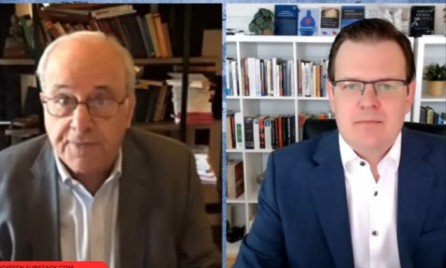
Editor’s Notes: In this episode, Glenn Diesen is joined by Professor Richard Wolff to examine how the decline of the petrodollar is signaling a broader unraveling of the U.S. empire. Wolff breaks down the “economic fury” of sanctions against Iran and explains how shifting global oil dynamics and debt cycles are forcing Gulf States to reconsider their reliance on the U.S. dollar. The conversation also explores the domestic fallout for the Trump administration, linking international economic shifts to rising inflation and a tightening job market at home. Ultimately, Wolff argues that these developments are symptoms of a declining superpower struggling to reconcile its historical image with a rapidly changing multipolar world. (April 26, 2026)
TRANSCRIPT:
Economic Fury: Richard Wolff on the Petrodollar Decline and U.S. Empire
GLENN DIESEN: Welcome back. We are joined today by Professor Richard Wolff to discuss Economic Fury, which is the new arm of the US war against Iran. So thank you for coming back on the program.
RICHARD WOLFF: Glad to be here, Glenn.
The Inconsistency of U.S. Policy Toward Iran
GLENN DIESEN: So the name given to the war against Iran, Epic Fury, it filled Trump with great pride that he picked this name. He mentioned it in quite a few speeches, but Scott Bessent has now complemented it with Economic Fury, which is the economic war or sanctions policies against Iran.
Well, my first thought is it’s been a bit confusing because first there’s a sanction on all Iranian oil, then they open up the Iranian oil to help stabilize the markets, then there’s a blockade on Iranian ports. So the consistency is not always clear. How do you assess this new effort to strangle Iran, which is this Project Economic Fury?
RICHARD WOLFF: Well, I know this may be a troubling thing to hear me say, but I really don’t know anything else but to tell you, along with others, I know I’m not the only one. We have stopped following the kind of herky-jerky, on-again-off-again statements because they are so often the way you just described them, inconsistent one with the other.
You don’t know whether the earlier one is true and the second one an exaggeration, or the second one is the correction of the first one. And before you can resolve that, he has a third one, and then it becomes crazy. And so I don’t know how to answer basically your question. It’s a perfectly good question, but I don’t know how to answer it.
It is inconsistent. Either you are going to take the steps that make oil supply more plentiful and drive down the price. Or you’re not. And anything you do can be interrogated as to which way it is on balance, which way it goes. But if he does almost at the same time allow there to be less oil and then at the same breath more oil, well, you don’t know. You don’t know what’s going to happen.
Dollar Swaps and the Gulf States
By the way, there are other examples too, not so well attended to. Mr. Bessent is now going to have to decide, he may already have done it, on the request of the Gulf states for what are called dollar swaps. This is not unimportant.
A dollar swap is usually an agreement between the United States, either the Treasury or the Federal Reserve on the one hand, and foreign central banks on the other. And the reason you establish it is you have reason to believe that the global supply and demand of dollars is going to be disturbed. And mostly there’s going to be a shortage of dollars.
If you worry about a shortage, you will enhance, you will increase your swaps. All the swap means is that a foreign central bank doesn’t have to go into the market and buy dollars if it’s short of them, it can simply grab a bunch from a swap agreement. It used to be that this was done on a weekly basis. Now it is done with these latest ones on a daily basis, which is already a warning sign. Somebody’s very worried about access to dollars.
So the minute you start looking into this, you discover who’s worried. Which shouldn’t surprise you, the Gulf states, the United Arab Emirates, all of them. Many of them have now put pressure on the United States to give them, when they don’t have them, credit swap facilities, or if they do have them, to make them much larger.
Now why would they do that? The only reasonable answer is that they depend on receiving income in dollar form from selling oil and natural gas. They have borrowed over the years to invest in many countries. So they have dollar-denominated debts. Well, they expected to be able to pay off their dollar-denominated debts around the world with the dollars coming in from oil and gas.
But there are no dollars coming in because the Strait of Hormuz is shut. And the blockade, if anything, makes it worse. So they don’t have the dollars. So they can’t pay off their debts. They can’t pay the interest. They can’t pay whatever the portion of the principal is.
The Risk of a Treasury Fire Sale
Which means — here’s my guess. I don’t know what I’m about to say, but I’m going to guess. They have informed the American government, Mr. Trump, that they must pay off their debts, they cannot sell the oil, they’re going to start selling their ownership of American assets.
What does that mean? It means two things. Number one, they’re going to sell Treasury Securities. That’s going to, if you understand, a fire sale of Treasury securities brings their price down and that raises the interest rate. We are on the edge of a recession right now. If the Gulf States en masse were to sell lots of Treasuries, and if that were to stimulate others around the world who don’t want to see the price of their assets as Treasuries go down, you’re going to see a dangerous spike in interest rates in this country at a time when the Trump administration wants everything other than that.
Number two.
You’re going to see the American ruling class that invests in the stock market see a significant player in the American stock market, the Gulf States, selling whatever it is they have to get the dollars, just like they need to sell the Treasuries to get the dollars to cover their debts.
Okay, this is a tangential story, and I’m sorry to bother you with the economics of it, but the bottom line is you’re beginning to see why a significant number of commentators are waving their fingers, warning that this event, which seems to be localized in the Persian Gulf and the Sea of Arabia, is in fact dangerous for the whole world economy. And this swap problem is the surface manifestation of this global problem, which has a particular salience for the United States because so much of the Gulf dollar business is here in New York with the stock markets and with the Treasury.
The Unraveling of the Petrodollar
GLENN DIESEN: So essentially the petrodollar is being unraveled to some extent because if oil is priced and sold by the Gulf states in US dollars, well, the Gulf states aren’t making the money, they’re not exporting, which means they’re not getting the dollars, which means they’re not reinvesting them into the US. Now they have to, instead of buying the Treasury bonds, they have to sell it.
Where exactly is this going though? I mean, how long can the United States hold on to this position? Because, well, I know you don’t have a crystal ball, but a lot of this is unprecedented. We haven’t seen this. But this isn’t just a speed bump. This is something hitting deeper into the system, isn’t it?
Trump’s Eroding Political Base
RICHARD WOLFF: Absolutely. I have no crystal ball. I don’t believe in it. No one else does either. But having said that, with that caveat, let me tell you what I think is likely now going to happen.
Mr. Trump has lost a great deal of his mass base. What do I mean? Two things. People who voted for him because of one or two or three issues, those people he has now lost. The two or three issues, in case your audience is interested, is the Epstein file. The government is exposed as having not released most of that relevant information. Holding it back, redacting it in ways that are protecting the president, and so on. So people who expected him to deliver on the promise to open everything about the Epstein files right away because he’s committed to transparency, he’s lost those people.
Number two, the economy, the availability of jobs for young people, and the level of inflation for everybody else. It’s a disaster. The job market here is awful. Young people, my students who are getting master’s and PhD degrees in university here, are talking to me about a lifetime being an Uber driver or a Lyft driver. And not because they are simply excitedly upset, but seriously in somber tones, there are no jobs.
And the inflation is not over for Americans. He promised to bring prices down. He explicitly played with the ambiguity that economists, when they talk about inflation, are talking about the rate of increase. Whereas the common people, when they talk about it in the media, are really more talking about the level. And because we had a serious inflation during this decade, people want the prices to come down. That’s not happening. He’s unable to do that. In one or two sectors with lots of fanfare he does it, but meanwhile the cost of living keeps rising, currently between 3% and 4%. Average wage increases are not even that high. So the mass of people are upset about the economy.
And the Democrats, who have no courage on the Iran issue and not much on the Epstein either, are able to make affordability the big issue. So they’re beating him up with that.
The Iran War and Political Fallout
And then finally, Iran. The war in Iran means he loses the people who wanted him to be the president who doesn’t have war. He coined, remember the phrase, “forever wars.” Well, he’s still stuck in Ukraine. Now he’s added Iran, and it’s clear to the American people, more clear than I’ve ever seen before, right from the beginning, that this is not a good idea. This war is not going well.
And when you have even little things like the strange firing of the head of the US Navy just at the time when the Navy actually has a major task in front of it, the blockade, that doesn’t look good. And who knows what this ex-head of the Navy, who by the way is not a naval career person — he’s a wealthy donor to the Republican Party who got that job as a gift — may be speaking soon in a way that the Kelly, the senator from Arizona, does and so on.
So all of these things are bad for Mr. Trump. And why am I telling you this? Because he cannot afford a spike in interest rates. He cannot afford it. He is at this point, in my judgment, relying on two things to survive politically. Whatever remains of the MAGA base.
And notice Tucker Carlson and Marjorie Taylor Greene, two of his former stalwart promoters, are now referring to him, and I quote: “He is insane. I am very sorry I ever supported him.” Those are quotations from Greene and from Tucker Carlson.
GLENN DIESEN: Yeah.
The Stock Market, Iran War, and Political Desperation
RICHARD WOLFF: Carlson. So his base is really in trouble. So what has he got left? The answer is the richest 10% of the United States. People who look to the stock market are happy. The stock market is very high. It’s even high in the last few weeks. It took a momentary dip with the Iran war. But it basically presumes that this war will be over soon and it will not cost any rich person anything. So they can keep their money in the stock market. They can continue to buy and to sell and to borrow money and invest that money in the market.
Therefore, Glenn. Here’s the closest I’m going to come to a prediction. If the stock market starts to tank, and could an exodus of the Gulf countries, if they didn’t have an access to the swap, could it do that? The answer is nobody knows. It could. Therefore, my guess is the government will give the Gulf states all the swaps they want. Basically give them an advance access to as many dollars as they need to pay off as many debts as they have without selling treasuries or disinvesting in the US stock market because it’s too dangerous. His ability is too small.
Yesterday, Mr. Stephen Bannon, a former advisor pretty close to him and a far right-wing personality in this country, was begging for the war to be over because otherwise, and I’m quoting, “we will lose power in November.” In other words, he’s so worried about it, and there are enough people around him who are, that whatever Mr. Trump says, I don’t care, we’re fine. None of that should be taken seriously. They are now worried that they are in a fight that they may lose, and they are very anxiety-ridden about it.
They clearly — I mean, footnote — and the evidence now is really pretty overwhelming — they told themselves that they could go into Iran and decapitate, they love that word, decapitate the Ayatollah and kill a few other leading generals and advisors, and that the system would collapse. There would be no, whatever glue held the country together would be gone. And the United States could then dictate terms for a new government, regime change, and a new Shah of Iran replicating more or less what the Shah of Iran used to do for the United States.
The Vance Clip and the Failure of the Iran Strategy
That was a — and that would be a glorious — it would allow them to say what, by the way, Vance — there’s a clip of Vance a year ago talking about war in Iran. I don’t know if you’ve seen it, but it is going around in this country like, what do they say, viral. It’s a viral clip. It has Vance explaining why going into the war with Iran is a wonderful, good idea. A very strong endorsement by the vice president, in which he says the following: previous presidents all knew that Iran was a disaster for the United States, but they were, I’m quoting now, “too dumb, too dumb to do anything about it.” The difference is Mr. Trump isn’t too dumb and we’re going to do it when Obama didn’t and Bush didn’t and Clinton didn’t and we’re going to do.
That was their plan, and that’s why when Tulsi Gabbard and other intelligence officials told them they were wrong about Iran, it was too beautiful a story, too wonderful an encapsulation of how they want to appear to the American voting public that they just didn’t listen. It was too attractive.
And now the herky-jerky that we began this conversation with, the on-again, off-again oil management — this is a desperate government whose plan is shot. Whose opportunities in that direction are all gone, and it’s trying desperately to figure out how to get out of this. And the person that I know you interview from time to time, and I caught him recently on one of your programs, John Mearsheimer, he puts it very, very well. It’s a desperate effort to get out of here with minimum damage at this point. And even that is proving to be harder than they can figure out how to do.
GLENN DIESEN: Yeah, I saw that speech by Vance. I thought that was extraordinary. I was hoping for some deeper analysis why all former presidents did not do it and this one did, in terms of how the economic situation had changed or something. But instead it was just, well, those, they were dumb. Trump is smart and this is why we’ve done it. I mean, it’s hard to believe this is really — it belongs on some Saturday Night Live or some parody, but yeah, that was real. If I would have just seen the quote, I would have to fact-check it because it sounds so over the top.
The Limits of Power and the Erosion of Legal Norms
RICHARD WOLFF: Exactly. My students, Glenn, my students raised their hand and said, a speech like that proves that the dumb one is the one who says it. No analysis, no nothing. They were all dumb. And then now that it’s proven that the hesitancy noted in the earlier presidents sounds now like they were brilliant, that they understood the limits of what they could do. And this one doesn’t. It’s extraordinary. And it looks very bad.
You know, it’s another one of the thousands of misstatements. You know, the shooting of the boats in the — Americans have taken that to heart. Very interesting. For several months they would kill 2 or 3 people in a boat near Venezuela. They would shoot the boat with rockets and kill the fishermen. No arrest, no trial, no lawyer, no nothing. Just kill them.
That lost Mr. Trump all kinds of support. I remember being on a television program explaining to the American audience that when we arrest people for drug traffic, which we do, inside the United States, they automatically are entitled to a lawyer. They automatically are entitled to a trial. They are automatically entitled to defend themselves. And even if we find them guilty, it’s not a capital crime in this country. You don’t get executed for drug traffic. You can get in prison.
So here we have a complete negation of the entire legal apparatus of it. And that is too much for a significant number of people who otherwise would like Mr. Trump, but they can’t go with this.
No Good Outs for Trump
GLENN DIESEN: Yeah, well, a bit like Tucker Carlson, I was a bit happy to see a person like Trump come along and talk about peace again, because none of our politicians in Europe talks about peace anymore. And so I was a bit optimistic, but I think all that optimism has been shattered.
But I just want to go back to the Iran War, because it seems as if the war continues, the US will suffer immensely, as you outlined very well. However, if Trump leaves as well, and the Strait of Malacca is under Iranian control, which doesn’t seem like it can do much — then Iran has already now announced its measures. It has already now set up a toll, which it will get its reparations from so it can rebuild from the US attack. And we’re told that those who have attacked or sanctioned Iran, they will pay an extra bonus on top of that in gold, and they won’t be accepting dollars.
So it appears that no matter what the US does now, there’s no going back to the way things were. And I’m wondering if this is what’s setting off the desperation in the White House now, because I don’t see any good outs anymore for Trump. I mean, I would probably advise him to just adjust to the new world. Some things you can’t change. But politically, especially for a person like Trump who always have to claim victory — you know, you can have a plane shot down, it’s a great victory. Everything’s a victory. One gets chased out of Yemen, oh, we won. He has a skill for this though, selling everything as a victory. But I don’t see this happening this time around.
Trump’s Strategy: Selling Victory to the American Public
RICHARD WOLFF: I wish I agreed with you, Glenn, but I don’t. So let me tell you why. He succeeds because that’s what the American people, or at least a large part of the American people, that’s what they want to hear. They want their leader to be a great victory.
Americans participate in sport not very much. But they are absolutely entranced by watching major sport events. The NFL, the Hockey League, the basketball, they are enormous businesses here with billions and billions of dollars involved because the American people are passionate about their team. They want their team to win. The spectator who is ennobled by the victory of the team he is a spectator of is the way Americans deal with sports. It’s also the way they’ve come to deal with politics.
Mr. Trump will declare a victory. He already has. He has declared that the assassination of the Ayatollah equals regime change. He’s made that simple equation so he can repeat over and over again because the people know that their religious and political leader was killed and dead. And you know, that was popular, just as the abduction of Maduro was popular because we won, we prevailed, we, you know, the rest of it. Is murky and disputed.
So I don’t think he has to worry. He is going to win no matter what. He is going to overwhelm the media, which it turns out he still can do. Again, not because of him, but the media itself does not want to be thought of as unpatriotic, uninterested in victory. You will, for example, you will not see any expression of sympathy or empathy for anything Iranian. The Iranians are bad. The Iranians are negative. The Iranians have been killing people.
I appeared recently on a debate. There was an American, ex-American diplomat, and he was going on about the awful things the Iranians have done over the last 47 years, you know, since the mullahs took over. Okay. For an American, where 47 years includes Vietnam, Afghanistan, Iraq, to be an American diplomat, to be finding fault with Iran because it has killed so many people. It’s just, for me, you know, I know the numbers. This is an achievement. You are the ambassador of the country that is the rogue nation of the world. That has 700 military bases killing people all the time, and you’re going to attack little Iran who hasn’t killed very many people at all. It’s extraordinary.
So here’s what I think he’s going to do. He’s probably going to have some dramatic maneuver that he can sell as a victory. There’ll be some Marines who take over an island somewhere in the Persian Gulf. There’s lots of islands. Go take one. Doesn’t matter if there’s nobody on it. Just go take it. Photographs, landing troops, raising the flag, whatever. At the same time, you and Israel bomb something, bomb another part of Tehran or bomb some region you haven’t hit before, knock out a few bridges, maybe an electric plant, maybe a desalination plant, who knows? And then say the Iranians have asked us to have peace. And now that there’s a new regime, we changed the regime. And we punish them. They better, or else we will come right back and finish the job. But, you know, we are decent people. We’ve won what we came here to do, and so we’re leaving.
And that will be the best he can do. He will be attacked. Tucker Carlson isn’t that stupid. Nor is Marjorie Taylor Greene, nor are all the others who are critical. So he will suffer, but that will be the comic book story that will be told, and it will be told to large numbers of people, even those who don’t like him, because it conforms.
America’s Selective Historical Memory
Let me give you the proof. When I travel around the country, and I sometimes do, and I’m asked to give a talk about, you know, the 20th and 21st century U.S. economic development. And I mentioned the war in Vietnam. And then I use language like this. And then in 1975, the war ended, the United States lost. And the Communist Party of North Vietnam won. And how do you know they won? Because they’re the ones in charge of Vietnam now. And that’s a big clue.
The students laugh, but I would bet my money that more than half of the students in the room, if asked by questionnaire in the next 10 minutes, who won the war in Vietnam, they would answer the United States. And that’s what they think. And it’s not because they ever studied the war. They didn’t. And it’s not because no one ever talked to them about the war. People probably did. It’s just that in the United States, America wins and everybody else doesn’t win.
When the president — and so it’s important for your European audience — when the president of the United States says, as he has repeatedly, that ever since World War II, the European nations have taken advantage of the United States, cheated it at every turn and that he’s tired of it and he’s not going to allow that to continue. That’s what most Americans probably believe. And I say probably only because I want to admit, of course, there are people who don’t believe that, but that is, you know, we won World War II. Then the Marshall Plan was our extraordinary kindness in helping you over there rebuild after the war. And some of those debts you haven’t even paid back.
And, you know, when I explained to people that the Marshall Plan required that the dollars given to Europe be spent on American exports, and therefore it was a kind of Keynesian stimulus. They know what I’m saying, but they don’t want to go there. They resist.
So that’s what I think he’s going to do. He’s going to play to the one hand he has left, the American desire for a victory. He has to end that, so he’s going to have a victory. And I’m afraid, let me push you further. If I’m wrong, then the way I’m going to be wrong is he’s going to actually make a serious military effort against Iran, and that will make everything worse. Then he’s gone. Then he’s gone for broke. He will lose the American election overwhelmingly.
You should be aware that there’s a sizable group of Democrats and even a handful of Republicans who have committed themselves. If they take the lower house of the parliament, the House of Representatives, in the November elections, they will take power on the 20th of January, and their first act on the first day will be the impeachment of what will then be — not ex-president, sitting President Trump will then face his third impeachment.
GLENN DIESEN: Well, I think history in Europe isn’t always — well, historical memories tend to be manipulated over time as well. There’s a very interesting polling which is found in France, where they looked in 1945, this is when they asked people, you know, who was mostly responsible for defeating Nazi Germany. And this again at the end of the war, and you have an overwhelming majority of French saying, well, that was the Soviet Union. You know, they took out between what is 85% of German casualties was on the Eastern Front. So of course it’s the Soviet Union, rooted in facts.
They did this polling every few decades. And in 2018, that was the last time I think they ran it. And then only 15% of French believed that it was the Soviet Union who contributed the most. 15. I mean, so history has no impact on reality anymore. And I think it was 11% of Americans who recognized it was the Soviets. So we’re living in a very post-reality world.
But historical memories are supposed to serve current realities. And, you know, Walter Lippmann wrote a lot about this. The basic foundations of how we see the world, the heuristics. If you challenge this, people will go to great lengths to ignore it so you don’t shake up their perception of reality.
Uncle Sam and Uncle Joe: Forgotten Alliances
RICHARD WOLFF: There’s a famous, just a footnote, Glenn, there’s a famous photograph, which I wish I had, but I have seen it. It’s a photograph of a little window in an American post office. And it must have been, I don’t know, 1943 or something like that. And there’s a person there buying stamps and giving money and getting the stamps. And over the counter where the worker, the postal worker is giving the stamps, are two stylized — they’re not photographs, they’re sketches. One is of Uncle Sam. You know, with the top hat and the image that we’ve had of him with the stripes and all that. Uncle Sam arm in arm with someone labeled Uncle Joe. It was Stalin. Looked like Stalin. Big mustache. Uncle Joe.
And then I used that photograph. I explained to my students, we were allied with the Soviet Union in the war. They look at me, my students, they look at me wanting to see if I’m about to tell a joke. Then they nod, then they listen.
We have a famous senator from Alabama. Tommy Tuberville is his name. He ran for the Senate and won, having been the coach of the football team that all of Alabama love. Okay? When he ran for office, he gave a speech where he talked about his grandfather and his father and they struggled and that he was mostly proud of his father who fought so valiantly in World War II against the communists. And he had to wait until the reporters, two days later, because no reporter on the spot said a word. Two days later, the reporters went back to him and said, did you mean? And of course the poor man said, yes, yeah, fought the communists. Had to be explained to him. Communists were our allies, fascists were the enemy. Oh, he said, that was it. He sits in the Senate, Mr. Tuberville, and orates. He’s a specialist on military affairs.
Is the Petrodollar Beyond Rescue?
GLENN DIESEN: The same in the Canadian Parliament was celebrating a Canadian who fought against the Soviets in World War II. And you have to ask, well, which Ukrainians were fighting the Soviets in World War II, like, which ones? Did they — are the ones who are backing now, the ones screaming Slava Ukraini and, you know, dressing up in swastikas. So this is, I don’t think people remember the history well at all in terms of, you know, who was on each side.
But just to, yeah, as a final quick question here, do you see there any ways of saving the petrodollar where we’re now, or is this now beyond rescue?
The Decline of American Empire and the Petrodollar
RICHARD WOLFF: Well, again, I’m not going to predict the future, but yeah, as you and I have discussed on more than one occasion, I believe the way I make sense of the larger context of what’s going on is the decline of the American Empire. And that means the decline of American capitalism. And part of that story is the decline of the role of the dollar. The rise of China is part of that story. The BRICS alliance that the Chinese have worked so hard to create is part of that story. The American deal — Kissinger, Saudi Arabia — that set up the petrodollar system back in the ’70s is part of what is now falling apart.
And so yes, I think all you’re seeing here is an acceleration of the decline. I think the war in Ukraine has accomplished that partly by exposing the ineffectiveness of sanctions. And I think what you’re seeing now is one of the great lessons of unintended consequences. You go to war in Iran, you think it’s a lark, it’ll have no more effect than snatching Mr. Maduro and his wife from their bedroom. You’re making unbelievable mistakes. And in my judgment, those are the mistakes a declining empire makes, and those are the mistakes that then accelerate the decline, which generates more mistakes, et cetera, et cetera.
The Dollar’s Diminishing Role
The dollar is not playing the role in global reserves that it once did. The percentage is clear. The Iranians are accepting payment not in dollars anymore, for oil. I don’t see any reason to suspect that other countries won’t do that. I don’t see any strategy in the United States that can cope with that or is even being put forward as a way of coping with that. There are proud statements that the dollar is still strong. By the way, that’s true. The dollar is still an important part of the world economy. The United States is an important part. I would never say otherwise. I don’t say the empire is dead. I don’t say American capitalism is finished. I say it’s in decline, and I’m watching that decline now year by year by year.
You know, the promise of the last 10 presidents was to reverse the decline of American manufacturing. Everyone promised it. None of them delivered it. Mr. Trump is not delivering it either. Manufacturing keeps going down, and that’s because it moved. It didn’t die. That manufacturing is being handled by China and a few other places. They’re doing it, and they’re doing it very well. And they’re developing new technologies every day and new products every day. They are doing the job and they’re very conscious that they’re the leader and they have to keep their prices down.
China’s Economic Strength
Look, we worry here in the United States about inflation and what is inflation? 3 or 4%. In China, inflation for the last several years has been less than 1%. You never read about it in the United States, but for obvious reasons you don’t read. They don’t have the problem. They are producing enough material that they can go on and on. That’s why they can produce drones forever and missiles forever. They have an immense border with Russia so that they can share all of that with Russia. And Russia has the Caspian Sea, which allows it to share it with Iran. Of course Iran isn’t going to run out if Russia and China help, which they are. You got to face that. We don’t.
We have destroyed their army and their navy and yet none of this is true. None of this makes any sense. None of this takes into account the support they have. Venezuela had none of that. Even Cuba doesn’t have that. Iran has it. It’s just fundamentally incapable here.
Symptoms of a Declining Empire
And since Americans, being one, are just as smart and just as careful and just as thoughtful as anybody else, you have to explain why they would be doing what they’re doing, why they would elect a character like Trump, why it would be possible for him to talk the way he does, destroy a civilization, go out there and kill the people that are laying mines. What is this? What is this? Childish, but desperate. And that has to be explained.
And for me, these are symptoms of a declining empire whose people have never to this day been prepared to imagine that their empire would decline and to ask themselves the question, what is the appropriate foreign policy towards Europe, towards China, towards the Global South, if you’re a declining empire? We are a hegemon. We deal with these issues as a hegemon. It’s as if history had stopped. Like Fukuyama, right? History is over. The United States is at the top, and so it will be forever. The decline of every other empire the human race has known will stop here, and ours won’t decline. I mean, once you lay it out, it’s so crazy that you realize the denial is also a part of the decline.
GLENN DIESEN: Yeah, no, that’s a great point. One often sees this common trend in the decline of empires, even decline of civilizations, the refusal to accept decline itself, this retreat into delusions. Something we’re not lacking at this side of the Atlantic either in Europe. So we can address that topic at different times. So thank you very much for taking time.
RICHARD WOLFF: My pleasure. And I would like to address particularly something that strikes many of us here, Glenn, as a bit of a mystery. It looks to us as a kind of hysterical demonization of Russia in a way — you know, it would have been inappropriate when it was the Soviet Union, but now just Russia. What in the world is going on? What? I need an explanation. I would like to explore what makes so many in Europe so clear about something which here looks like you’ve lost your marbles here with what we hear. And listening to Macron or Starmer or Merz or Kallas, wow, you know, something terribly went wrong. Anyway, thank you very much and I look forward to our next opportunity.
GLENN DIESEN: Me too.
Related Posts