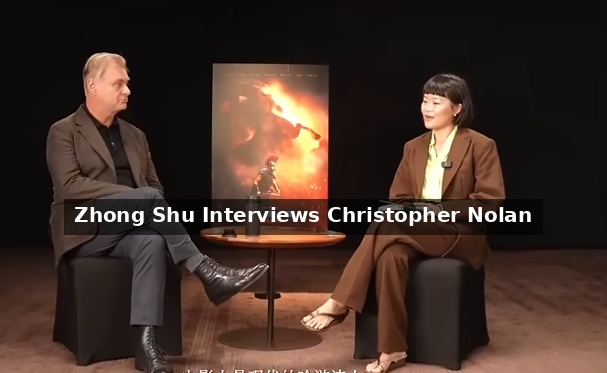
Read the full transcript of filmmaker Christopher Nolan’s interview with political philosophy lecturer & doctoral student Zhong Shu in Beijing, China, on 30 July 2026.
EDITOR’S NOTES: In this engaging interview, filmmaker Christopher Nolan discusses the narrative and philosophical complexities of adapting The Odyssey. He explores themes of civilization’s collapse, ancient theology versus modern audience expectations, and how filmmakers utilize the universal language of cinema.
Introduction: Bard of a Civilization at Dusk
ZHONG SHU: All right. Hello, Mr. Nolan.
CHRISTOPHER NOLAN: Hello.
ZHONG SHU: Nice to meet you. Well, filmmakers are bards of the modern age, just like the Greeks know of Odysseus, Achilles, Agamemnon because of Homer’s narratives. We know of the Batman, the Joker, and Oppenheimer because of your narratives. And Homer tells stories of distant past. You too. The Trojan War happened between the 12th to 11th century BC, but Homer lived in the 8th century BC. So that’s a long time ago.
But Homer’s time was a time of rise. It was a time of civilizational rise. The Greeks were prospering as a culture, the economy, the books, the thinking, everything is on the rise for a couple of hundred years, really until the 5th century BC. So Homer’s tone was celebratory. It was victorious. He celebrates the victory of the war, and your tone is emphatically not.
So I guess my first question is, does that say something about our age? Are you a bard for a civilization at dusk?
CHRISTOPHER NOLAN: I think that’s a really interesting point, a really interesting question. I mean, underlying the main part of the point is this 400-year or so gap between the events that Homer’s describing and when Homer’s story was written down or first received by readers and audiences. That’s a pretty interesting gap.
And for me, I don’t think I’m completely at odds with the way Homer’s telling the story when you look at it from a sort of historical perspective. And the reason is, and what I got interested in as I adapted it, is that Homer’s writing about an era before his. He’s writing about an era hundreds of years before that his audience viewed as being more advanced than theirs. So they were a civilization on the rise, but they were trying to get back to where they’d been 400 years before.
So that idea of a cycle, that idea of, as you say, a civilization at dusk, I think it’s there in the poem. It’s subtle. But when you look at the history as well and you look at the idea that when they would unearth these walls of old palaces that were crumbled, they called them Cyclopean walls because they thought only a giant could have built such grand walls. They had this idea of the greatness of this past civilization.
And so I became interested by that collapse, what they call the catastrophe, the Bronze Age collapse, what happens between the events of the Trojan War and Homer. And so yeah, I think it’s something that, from a modern perspective, is frightening and interesting and intriguing. And I think for me, it partly comes out of having worked on Oppenheimer before this, which is very much a film about the end of the world, about the end or collapse of civilization, ultimately. So I think, yeah, I definitely carried that sensibility into this adaptation of The Odyssey.
Atonement, Xenia, and the Greek Worldview
ZHONG SHU: I mean, one thing that captured me was that the concept of atonement doesn’t exist in Greek culture. It doesn’t exist in the Greek language. It doesn’t exist in Homer’s Odyssey. It exists in your Odyssey. So I guess a natural question that I had when watching the film was, did you Christianize the Odyssey? Do you think that atonement — why did atonement become important for the coming of catastrophe?
CHRISTOPHER NOLAN: I think it’s a really good question. I wasn’t too conscious in how I was approaching it philosophically other than I really honed in on the idea of what’s termed xenia. In the film, we call it Zeus’s Law for simplicity, but it’s that idea of mutual respect — that I treat you the way I want to be treated. And in their theology, it’s because you might be a god in disguise. So I really drilled down on that and I started to realize that for me, a lot of what’s interesting about the interaction of history and mythology is this idea of the Sea Peoples, is the idea of the people from the sea who were thought to have precipitated the Bronze Age collapse. It’s one of the great mysteries of history, of like, who were they?
But the idea that really a violation of xenia, a violation of Zeus’s law, which is what the suitors are doing in the palace, that really it’s that break of Zeus’s law that is causing this difficulty and this damage. I think the idea of atonement, in a way, is what we bring as viewers to the story. I don’t know whether there really is atonement in the film, or whether we just feel that that’s the catharsis, or that’s the process we’re seeing in the final meeting that we’ve waited for between Odysseus and Penelope.
But I think in a way, we may be bringing our more modern sensibility to that. But it’s — I think it’s a very interesting question. And insofar as it’s there, it’s not a deliberate attempt to, for example, Christianize it, but it’s an outgrowth, or it’s a natural conclusion of it. Borrowing in on this philosophical idea of what happens when you break Zeus’s law.
ZHONG SHU: I guess from what you were saying, the connection between atonement, which is the perspective of a Christian world, and xenia, which is the perspective inherent in the Greek world, what connects them is the fact of war.
What is the response to war? And you still want to say that the presentation is inherent in the Greek mythology, mythological worldview that war happens when hospitality or xenia is broken?
CHRISTOPHER NOLAN: I think so. And I think that it sometimes is difficult to draw a line. And I think academics often maybe are too dogmatic in drawing a line between different philosophies and as they evolve historically, because I think I was more interested in the commonalities.
Because one of the things I found is that once you ignore the theological underpinning of xenia, what you realize is that it is what we in modern terms call the Golden Rule. This idea of treat others as you would be treated has never really changed over time. The reasons that we try to hold people to that might have changed, but the idea itself hasn’t changed.
And what I came to think is that what the poem to me is saying or inspiring me is the idea of civilization depends on this rule and possibly is even defined by it. And that to me was a really interesting thing to realize. This ancient text to me speaks directly to the modern world because I think we live in a world where the concept of xenia, the concept of mutual respect, is more challenged, I think, than it’s ever been in more obvious ways than it’s ever been. And I think we see the negative effects of that in terms of what defines civilization, what binds us together.
Hubris, Greatness, and the Demand for Apology
ZHONG SHU: Right. Here’s another Greek concept that is challenged in our world — hubris. You’ve already started to complain about academics, and I feel like the next question will expose me even more. There’s another great book written by another great man. Thucydides’ Peloponnesian War also has a central theme on the hubris of the Athenians. He blamed the fall of the greatest civilization in the world, Athenian democracy, on the hubris of the Athenians. Your film centralizes on the hubris of one man, the human pride of one specific man. My question is, should Odysseus repent for his human pride? Maybe pride appropriate for a great man?
CHRISTOPHER NOLAN: I mean, I suppose the question could be asked, what difference would it make if he repented? I mean, that’s the interesting thing about these philosophical approaches — his repentance would be purely internal. It would purely be for his own spiritual self. It wouldn’t necessarily affect anything outside it because the damage is done. Xenia is broken, maybe for all time.
I mean, that’s the interesting thing. I think that is the thing about hubris. That is the thing about — it’s tragic because it’s irreversible, essentially. And that’s where Christian theology looks at it in a different way, but in a practical sense doesn’t necessarily change what’s happened. And therefore, in storytelling terms, isn’t necessarily relevant.
That’s when I say we bring our understanding to it. So we feel that there’s catharsis because there’s confession, because there’s honesty and intimacy between Odysseus and Penelope. And that was very important to me. And I’m very invested in that emotionally. But if it has no practical effect and the collapse is coming anyway, the catastrophe is coming, what difference does it make if he repents? That’s the interesting thing. Are we concerned with his spiritual wellbeing? Or are we concerned with the world that he lives in and the world that in some sense he feels he’s damaged?
ZHONG SHU: We live in an age that demands apology from greatness.
CHRISTOPHER NOLAN: Yeah.
ZHONG SHU: Great storytellers, when they portray greatness, Homer celebrates it. We circle around it, we dance around it, we turn greatness into privileges and we demand apologies for it. That’s a fact of Hollywood. And I’m just wondering if, as one of the greatest storytellers of our age, how do you approach greatness? Is it still a story of apology and that demands repentance and reflection and self-criticism?
CHRISTOPHER NOLAN: Well, I think that when you’re talking about storytelling, you’re always in conversation with the expectations of the audience. And so it really is an energy that’s brought from the audience as well as an energy that’s put forward from the story itself.
So when you’re characterizing somebody, and the trite version of this, or the criticism that’s often leveled at movies in general is, “Oh, the character has to be made sympathetic.” So the character is manipulated in different ways or changed in different ways. And that’s a fundamental flaw of film criticism in a way, or storytelling criticism, because to be able to identify the mechanism does not invalidate the mechanism. And that’s a real problem in criticism today, because people have this idea that because I can understand why the story affects me the way it is, therefore it didn’t work. That’s not how storytelling works.
So when we create a heroic figure in a story as storytellers, we have to be mindful of the energy that the audience brings to that story and the interaction between our intention and the way the audience receives that. And the fact that that mechanism is identifiable to people doesn’t invalidate it.
And part of that mechanism is saying, are we going to treat greatness as an absolute or coming from a democratic, coming from a more idealized philosophical state that we live in in today’s world where we want to view people as equal? Do we have to apologize for that greatness? And the answer is yes, we do. Or the audience rejects the greatness. And that is part of the mechanism. Once again, the fact that the mechanism is identifiable doesn’t mean that it’s invalid or shouldn’t be used.
And so for me, as we talk about it, none of these things are things that I try to be conscious of when I’m writing or self-conscious of. But as we talk about it, we will of course realize that my attempt to do that is to retain it within the philosophical surrounding of the breaking of xenia that I have found interesting in the story. So I’m trying to be true to the thematics of the story as they create a character that the audience can invest in and can feel satisfied by.
Film as a Universal Language: Tradition and Innovation
ZHONG SHU: As you were speaking, first of all, I like how you dragged film critics down the water as well as academics. But I just realized filmmakers in a way have it much harder than poets because poems can only be read in a language that is the culture in which it is written. You can’t read Shakespeare really, not in English, or Goethe, not in German, but filmmakers have to speak to audiences outside of his polis, people who don’t speak their language. And you come to a place with people of different nomos and different customs, and you don’t put them into consideration.
CHRISTOPHER NOLAN: No, but the interesting thing about film — and this is, when I was talking about film criticism, I was talking more about amateur film criticism than professional film criticism because professional film criticism tends to understand the necessity for the mechanisms. So you’re looking at a lingua franca of storytelling created by Hollywood for the last 100 years that is very effectively universal. And so it is its own language, and that language is understood by people all over the world, which is what’s incredible about it.
And it is a very, very accessible modern language of storytelling, and it has certain rules, it has conventions. You can break those conventions, you can bend them, you can move them, but you have to be aware of them the whole time. And as I say, I’m thinking more of amateur criticism when I say that people who, because they feel they’ve identified the mechanism, they feel that it invalidates it.
That can be true of certain elements, and film grammar, film language evolves with that. So when a trope becomes too familiar to an audience, then it has to be changed. But we do, as filmmakers, avail ourselves of that common language. We build on that understanding — our audience has seen many films and they understand that language. And so you’re playing with that language. It’s the language of genre. It’s the language of audience sympathy. It’s the language of clarity and of narrative direction and how you guide people through a story.
ZHONG SHU: You’re talking about a relationship to tradition and innovation because at some point the mechanism becomes trite or unusable. But without the mechanism, you can’t really build. You have nothing to point to.
CHRISTOPHER NOLAN: Exactly. You can’t completely have a tabula rasa. You can’t throw everything away. You have to make your choices in terms of how am I orienting a story.
So for example, one of my first films, Memento, was a story that I structured in reverse chronologically. But what I retained was a very, very clear and simple 3-act structure. So the structure of the film as it’s received by the audience is very, very conventional, but the chronology is unconventional.
And so those are the choices you make. That’s one example where you say, okay, I need this to be extremely familiar underneath so that I can change what’s on the surface. And that’s a continual mechanism that’s evolving and that you’re working with the whole time.
The Odyssey and Creative Liberty
ZHONG SHU: I’m again thinking like a nerdy doctoral student who has to write a dissertation. I mean, writing on Plato or Aristotle is the most difficult thing to do. Just like making a film on The Odyssey, it’s been done for thousands of years. And making Memento, you can make it whatever you want. Nobody knows — the character, they won’t have a complaint about your adaptive choices.
And I’m curious, you’ve said before, after Oppenheimer, with the success of Oppenheimer, you felt like you’ve had a kind of liberty to do whatever you want or actualize what you want to do. And you chose the most difficult dissertation to write if you’re getting a PhD.
CHRISTOPHER NOLAN: I mean, in some ways, but in other ways, I do think your question is slightly missing something, which is that what I’m trying to say is that when you make Memento, yes, it’s a character I’ve created, and people won’t criticize it on that, but it’s in a tradition of noirish, amnesia-based noir fiction, and people judge it by those terms.
So even though on the surface of things, nominally, a film is a different or an original creation, the audience and critics tend to judge it in relation to previous examples of the genre, which is an advantage and a disadvantage.
And so, yes, when you adapt Batman, for example, there are a lot of people who are going to say, “Well, hang on, why is it this way? Why is it that way?” And everything else. But even with an original story, it’s the same thing. It’s like, “Well, hang on, why have you used the protagonist in this way? Why has this character done this? Why have they done that?” And they’re judging it relative to the overall cultural flow of the movement of cinema and the conventions of cinema.
And as I say, it’s not a complaint. It’s just something you have to be aware of as a filmmaker. It’s an advantage and it’s a disadvantage.
The Gods in The Odyssey
ZHONG SHU: Yeah, but with The Odyssey, you’ve dragged the classicists too as hounds behind your back. I guess final question for me — what are the gods? Are they figments of imagination or are they necessary noble lies?
CHRISTOPHER NOLAN: They are, to the characters in the story, they are reality. And what I found interesting about looking at the idea of gods and how to address it — the way I got interested in addressing this from the point of view of people who would have lived in that time, for whom, in a pre-scientific era, evidence of divinity is everywhere. And so the existence of gods is not an article of faith, it’s simple reality.
So thunder and lightning is God speaking to them. The state of the ocean is moved by the gods. They have no other explanation for it. And so just as we accept things from science as absolute fact — the Earth is round, we travel around the sun — we can’t know these things. We take them as faith because they’re presented to us as facts. The same would be true of the theological structure that explains nature to people at that time.
And so for me, the gods are real, but they are inside the people. They are being projected by the people.
ZHONG SHU: Oh, that’s cool. Just like superheroes for we moderns.
CHRISTOPHER NOLAN: Yeah, in a way.
ZHONG SHU: Thank you very much, Mr. Nolan.
CHRISTOPHER NOLAN: Thank you.
ZHONG SHU: Yeah. Thank you.
CHRISTOPHER NOLAN: Very interesting conversation.
ZHONG SHU: Yeah.
Related Posts