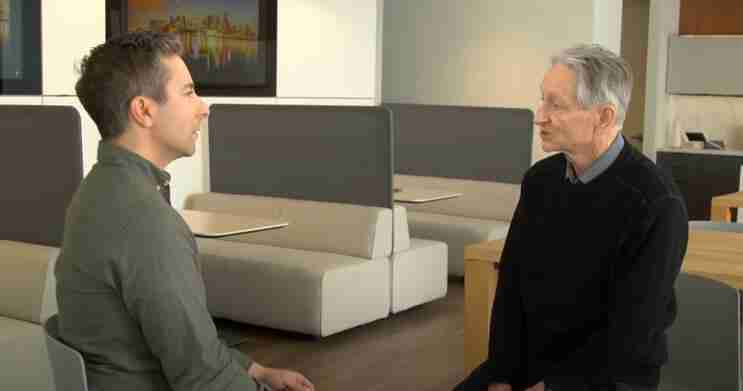
Here is the full transcript of a conversation between journalist Brook Silva-Braga and computer scientist Geoffrey Hinton on future of AI, and other warnings, on April 26, 2025.
The Rapid Evolution of AI
BROOK SILVA-BRAGA: The last time we spoke, two years, one month ago. I’m curious how your expectations over these two years have evolved for how you see the future.
GEOFFREY HINTON: So AI has developed even faster than I thought. In particular, they now have these AI agents which are more dangerous than AI that just answers questions because they can do things in the world. So I think things have got, if anything, scarier than they were before.
BROOK SILVA-BRAGA: I don’t know if we want to call it AGI, super intelligence, whatever, very capable AI system. Do you have a timeline in mind for when you think that’s coming?
GEOFFREY HINTON: So a year ago, I thought there’s a good chance it comes between five and 20 years from now. So I guess I should believe there’s a good chance it comes between four and 19 years from now. I think that’s still what I guess.
BROOK SILVA-BRAGA: Okay. Which is sooner than when we spoke because you were still thinking like 20 years.
GEOFFREY HINTON: Yeah, I think it may. You know, there’s a good chance it’ll be here in 10 years or less now.
Envisioning Super Intelligence
BROOK SILVA-BRAGA: So in four to 19 years we reach this point. What does that look like?
GEOFFREY HINTON: So I don’t really want to speculate on what it would look like if AI decided to take over. There’s so many ways it could do it.
BROOK SILVA-BRAGA: It, and I’m not even talking about taking over. We can talk about that. I’m sure we will talk about that. But putting aside that kind of takeover, just like a super intelligent artificial intelligence, like what kind of things is this capable of or would be doing?
GEOFFREY HINTON: So the sort of good scenario is we would all be like the sort of dumb CEO of a big company who has an extremely intelligent assistant who actually makes everything work, but does what the CEO wants. So the CEO thinks they’re doing things, but actually it’s all done by the assistant. And the CEO feels just great because everything they sort of decide to do works out. That’s the good scenario.
Positive Impacts of Advanced AI
BROOK SILVA-BRAGA: And I’ve heard you point out a few areas where you think there’s reason to be optimistic about what this future looks like.
GEOFFREY HINTON: Yes.
BROOK SILVA-BRAGA: Yeah. So why don’t we take each of them?
GEOFFREY HINTON: So areas like healthcare, they will be much better at reading medical images, for example. That’s a minor thing. I made a prediction some years ago they’d be better by now. And they’re about comparable with the experts by now. They’ll soon be considerably better because they’ll have had a lot more experience. One of these things can look at millions of X-rays and learn from millions of them, and a doctor can’t.
They’ll be very good family doctors. So you can imagine a family doctor who’s seen 100 million people, including half a dozen people with your very, very rare condition. They’d just be a much better family doctor. A family doctor who can integrate information about your genome with the results of all the tests on you and all the tests on your relatives, the whole history, and doesn’t forget things that would be much, much better. Already AI combined with the doctor is much better at doing diagnoses in difficult cases than a doctor alone. So we’re going to get much better healthcare from these things. And they’ll design better drugs too.
BROOK SILVA-BRAGA: Education is another field.
GEOFFREY HINTON: Yes. In education we know that if you have a private tutor, you can learn stuff about twice as fast. These things eventually will be extremely good private tutors who know exactly what it is you misunderstand and exactly what example to give you to clarify it to you so you understand. So maybe you’ll be able to learn things three or four times as fast with these things. That’s bad news for universities, but good news for people.
BROOK SILVA-BRAGA: Do you think the university system will survive this period?
GEOFFREY HINTON: I think many aspects of it will. I think it’s still the case that a graduate student in a good group, in a good university is the sort of best source of truly original research. And I think that will probably survive. You need a kind of apprenticeship.
BROOK SILVA-BRAGA: Some people hope this will help solve the climate crisis.
GEOFFREY HINTON: I think it will help. It’ll make better materials. We’ll be able to make better batteries, for example. I’m sure AI will be involved in designing them. People are using it for carbon capture from the atmosphere. I’m not convinced that’s going to work just because of the energy considerations, but it might. In general, we’re going to get much better materials. We might even get room temperature superconductivity, which would mean you can have lots of solar plants in the desert and we can be thousands of miles away.
BROOK SILVA-BRAGA: Any other positives we should tick off?
GEOFFREY HINTON: Well, more or less any industry is going to be more efficient because almost every company wants to predict things from data and AI is very good at doing predictions. It’s better than the methods we had previously, almost always. So it’s going to cause huge increases in productivity. It’s going to mean when you call up a call center, when you call up Microsoft to complain that something doesn’t work and you get a call center, the person in the call center will be actually an AI who will be much better informed.
Job Displacement Concerns
BROOK SILVA-BRAGA: Yeah, when I asked you a couple years ago about job displacements.
GEOFFREY HINTON: No, I’m thinking it will be because AI has got so much better in the last few years. I mean, if I had a job in a call center, I’d be very worried.
BROOK SILVA-BRAGA: Yeah. Or maybe a job as a lawyer or a job as a journalist or a job as an accountant.
GEOFFREY HINTON: Yeah. And doing anything routine, I think investigative journalists, I think will last quite a long time because you need a lot of initiative plus some moral outrage. And I think journalists will be in business for a bit.
BROOK SILVA-BRAGA: But beyond call centers, what are your concerns about jobs?
GEOFFREY HINTON: Well, any routine job, so a sort of standard secretarial job, something like a paralegal, for example. Those jobs have had it.
BROOK SILVA-BRAGA: Have you thought about how we move forward in a world where all these jobs go away?
GEOFFREY HINTON: So it’s like this. It ought to be that if you can increase productivity, everybody benefits. The people who are doing those jobs can work a few hours a week instead of 60 hours a week. They don’t need two jobs anymore. They can get paid lots of money for doing one job because they’re just as productive using AI assistance. But we know it’s not going to be like that. We know what’s going to happen is the extremely rich are going to get even more extremely rich and the not very well off are going to have to work three jobs.
The Risk of AI Takeover
BROOK SILVA-BRAGA: Now, I think no one likes this question, but we like to ask it this idea of P doom how likely it is, and I am curious if you see this as a quite possible thing or it’s just so bad that even though the likelihood isn’t very high, we should just be very concerned about it. Where are you on that scale of probability?
GEOFFREY HINTON: So I think most of the experts in the field would agree that if you consider the possibility that these things will get much smarter than us and then just take control away from us, just take over, the probability of that happening is very likely more than 1% and very likely less than 99%. I think pretty much all the experts can agree on that.
BROOK SILVA-BRAGA: But that’s not very helpful.
GEOFFREY HINTON: No, but it’s a good start. It might happen and it might not happen and then different people disagree on what the numbers are. I’m in the unfortunate position of happening to agree with Elon Musk on this, which is that it’s sort of 10 to 20% chance that these things will take over. But that’s just a wild guess. I think reasonable people would say it’s quite a lot more than 1% and quite a lot less than 99%. But we’re dealing with something we’ve got no experience of. We have no real good way of estimating what the probabilities are.
BROOK SILVA-BRAGA: It seems to me at this point it’s inevitable that we’re going to find out.
GEOFFREY HINTON: We are going to find out. Yes. Because it seems extremely likely that these things will get smarter than us already. They’re much more knowledgeable than us. So GPT-4 knows thousands of times more than a normal person. It’s a not very good expert at everything. And eventually its successors will be a good expert at everything. They’ll be able to see connections between different fields that nobody’s seen before.
BROOK SILVA-BRAGA: Yeah, I’m also interested in understanding, okay, there’s this terrible 10 to 20% chance. But.
GEOFFREY HINTON: Or more.
BROOK SILVA-BRAGA: Or more.
GEOFFREY HINTON: Or less.
BROOK SILVA-BRAGA: Or less. But let’s just take as a premise that there’s an 80% chance that they don’t take over and wipe us out. So that’s the most likely scenario. Do you still think it would be net positive or net negative? If it’s not the worst outcome?
GEOFFREY HINTON: Okay, if we can stop them taking over, that would be good. The only way that’s going to happen is if we put serious effort into it. But I think once people understand that this is coming, there will be a lot of pressure to put serious effort into it. If we just carry on like now, just trying to make profits, it’s going to happen. They’re going to take over. We have to have the public put pressure on governments to do something serious about it.
But even if the AIs don’t take over, there’s the issue of bad actors using AI for bad things. So mass surveillance, for example, which is already happening in China, if you look at what’s happening in the west of China to the Uyghurs, the AI is.
BROOK SILVA-BRAGA: Terrible for them to board a plane to come to Toronto, I had to take a facial recognition photo from our US government.
GEOFFREY HINTON: Right. When I come into Canada, you put your passport and it looks at you and it looks at your passport. Every time it fails to recognize me, everybody else. It recognizes people from all different nationalities. It recognizes me. It can’t recognize. And I’m particularly indignant since I assume it’s using neural nets.
BROOK SILVA-BRAGA: You didn’t carve out an exception, did you?
GEOFFREY HINTON: No, no. It just. There’s something about me that it doesn’t work.
The Nobel Prize Experience
BROOK SILVA-BRAGA: I have to find some place to work it in. So this is as good a place as any. Let’s talk a little bit about the Nobel. Can you paint the picture of the day you found out?
GEOFFREY HINTON: So I was sort of half asleep. I had my cell phone upside down on the bedside table with the sound turned off. But when a phone call comes, the screen lights up and I saw this little line of light because I happened to be lying on the pillow with my head on this side.
BROOK SILVA-BRAGA: Facing the phone, rather than.
GEOFFREY HINTON: Facing away, just happened to be facing phone. So this little line of light and I was in California and it was 1:00 in the morning. And most people who call me on the east coast or in Europe, you.
BROOK SILVA-BRAGA: You don’t use Do Not Disturb.
GEOFFREY HINTON: No, I turn off the sound. I turn off the sound. And I thought I was just curious about who on earth is calling me at 4 o’clock in the morning on the East Coast. This is crazy. So I picked it up and there was this long phone number with a country code I didn’t recognize. And then this Swedish voice comes on and asks if it’s me. And I say, yes, me. And they say, I won the Nobel Prize in Physics.
Well, I don’t do physics, right. So I thought this might be a prank. In fact, I thought the most likely thing was that it was a prank. I was aware that the Nobel Prizes were coming up because I was very interested in whether Demis Hassabis would get the Nobel Prize for Chemistry. And I knew that was being announced the next day. But I don’t do physics. I’m a psychologist hiding in computer science, and I get the Nobel Prize in Physics.
BROOK SILVA-BRAGA: Was it a mistake?
The Nobel Prize and Reality
GEOFFREY HINTON: Well, one thing that occurred to me is, if it’s a mistake, can they take it back? But for the next couple of days, I did the following reasoning. So what’s the chance a psychologist will get the Nobel Prize in physics? Well, maybe one in 2 million. Now, what’s the chance, if it’s my dream, I’ll get the Nobel Prize in Physics? Well, maybe one in two. So if it’s one in two in my dream and one in 2 million in reality, that makes it a million times more likely that this is a dream than that it’s reality. And for the next couple of days I went around thinking, are you quite sure this isn’t a dream?
BROOK SILVA-BRAGA: You’ve walked me into this very wacky territory. But it is part of this discussion. Some people think we’re living in a simulation and that AGI is not evidence, but hints toward maybe that’s the reality in which we live.
GEOFFREY HINTON: Yeah, I don’t really believe that. I think that’s kind of wacky.
BROOK SILVA-BRAGA: Okay, so let’s put it.
GEOFFREY HINTON: But I don’t think it’s totally nonsense. I’ve seen the Matrix, too.
BROOK SILVA-BRAGA: Okay. Wacky, but not totally okay. Here’s where I kind of wanted to head with the Nobel. I think you’ve said something to the effect of you hope to use your credibility to convey a message to the world. Can you kind of explain what that is?
AI Dangers and Threats
GEOFFREY HINTON: Yes. AI is potentially very dangerous. And there’s two sets of dangers. There’s bad actors using it for bad things, and there’s AI itself taking over. And they’re quite different kinds of threat. And we know bad actors are already using it for bad things. I mean, it was used during Brexit to make British people vote to leave Europe in a crazy way. So a company called Cambridge Analytica was getting information from Facebook and using AI. And AI has developed a lot since then.
It was probably used to get Trump elected. I mean, they had information from Facebook and it probably helped with that. We don’t know for sure because it was never really investigated. But now it’s much more competent, and so people can use it far more effectively for things like cyber attacks, designing new viruses, obviously fake videos for manipulating elections. Targeted fake videos by using information about people to give them just what will make them indignant. Autonomous lethal weapons. They’re all the big arms selling countries are busy trying to make autonomous lethal weapons. America and Russia and China and Britain and Israel. I think Canada is probably a bit too wimpy for that.
BROOK SILVA-BRAGA: The question then is what to do about it. What type of regulation do you think we should pursue?
Regulation and Safety Research
GEOFFREY HINTON: Okay, so we need to distinguish these two different kinds of threat. The bad actors using it for bad things and the AI itself taking over. I’ve talked mainly about that second threat, not because I think it’s more important than the other threats, but because people thought it was science fiction. And I want to use my reputation to say, no, it’s not science fiction. We really need to worry about that.
And if you ask, what should we do about it? It’s not like climate change. Climate change, just stop burning carbon and it’ll all be okay in the long run. It’ll be terrible for a while, but in the long run it’ll be okay. For AI taking over, we don’t know what to do about it. We don’t know, for example, if researchers can find any way to prevent that, but we should certainly try very hard.
And the big companies aren’t going to do that. If you look at what the big companies are doing right now, they’re lobbying to get less AI regulation. There’s hardly any regulation as it is, but they want less because they want short-term profits. We need people to put pressure on governments to insist that the big companies do serious safety research. So in California they had a very sensible bill, Bill 1047 where they said that at least what big companies have to do is test things carefully and report the results of their tests. And they didn’t even like that.
BROOK SILVA-BRAGA: So does that make you think regulation will not happen or how does it happen?
GEOFFREY HINTON: It depends very much on what governments we get. I think under the current US Government, regulation is not going to happen. All of the big AI companies have got into bed with Trump and yeah, it’s just a bad situation.
BROOK SILVA-BRAGA: Elon Musk, who is obviously so enmeshed in the Trump administration, has been someone concerned about AI safety for a very long time.
GEOFFREY HINTON: Yes, he’s a funny mixture. He has some crazy views, like going to Mars, which I just think is completely crazy.
BROOK SILVA-BRAGA: However, it won’t happen, or because it—
GEOFFREY HINTON: Shouldn’t be a priority, because however bad you make the Earth, it’s always going to be way more hospitable than Mars. Even if you had a global nuclear war, the Earth is going to be much more hospitable than Mars. Mars just isn’t hospitable.
Obviously he’s done some great things like electric cars and helping Ukraine with communications with his Starlink. So he’s done some good things. But right now he seems to be fueled by powering ketamine and he’s doing a lot of crazy things. So he’s got this funny mixture of views.
BROOK SILVA-BRAGA: So his history of being concerned about AI safety doesn’t make you feel any better about the current administration?
The Danger of Releasing Model Weights
GEOFFREY HINTON: I don’t think it’s going to slow him down from doing unsafe things with AI. So already they’re releasing the weights for their AI large language models, which is a crazy thing to do.
BROOK SILVA-BRAGA: Okay. These companies should not be releasing the weights. Meta releases the weights. OpenAI just announced they’re about to release weights. You think that’s—
GEOFFREY HINTON: I don’t think they should be doing that because once you release the weights, you’ve got rid of the main barrier to using these things. So if you look at nuclear weapons, the reason only a few countries have nuclear weapons is because it’s hard to get the fissile material. If you were to be able to buy fissile material on Amazon, many more companies would have nuclear weapons. Many more countries would have nuclear weapons.
The equivalent of fissile material for AI is the weights of a big model because it costs hundreds of millions of dollars to train a really big model. Not maybe the final training run, but all the research that goes into the things you do before the final training run. Hundreds of millions of dollars which a small cult or a bunch of cyber criminals can’t afford. Once you release the weights, they can then start from there and fine-tune it for doing all sorts of things for just a few million dollars. So I think it’s just crazy releasing weights.
And people talk about it like open source, but it’s very, very different from open source. In open source software, you release the code and then lots of people look at that code and say, hey, that might be a bug in that line. And so they fix it. When you release the weights, people don’t look at the weights and say, hey, that weight might be a little bit wrong. No, they just take this foundation model with the weights they’ve got now and they train it to do something bad.
BROOK SILVA-BRAGA: Yeah. The problem with the argument though, as articulated by your former colleague Yann LeCun among others, is the alternative is you have this tiny handful of companies that control this massively powerful technology.
GEOFFREY HINTON: I think that’s better than everybody controlling the massively powerful technology. I mean, you could say the same for nuclear weapons. Would you like to have just a few countries controlling them or don’t you think everybody should have them?
Corporate Responsibility and Ethics
BROOK SILVA-BRAGA: One thing I’m taking from this is you have real concerns about… It sounds like all of the major companies right now doing what’s in society’s best interest rather than what’s in their profit motive. Is that the right way to hear you?
GEOFFREY HINTON: I think the way companies work is they’re legally required to try and maximize profits for their shareholders. They’re not legally required… Well, maybe public interest companies are, but most of them aren’t legally required to do things that are good for society.
BROOK SILVA-BRAGA: Which, if any of them, would you feel good about working for today?
GEOFFREY HINTON: I used to feel good about working for Google because Google was very responsible. It didn’t release these big… It was the first to have these big chatbots and it didn’t release them. I’d feel less happy working for them today. Yeah, I wouldn’t be happy working for any of them today. If I worked for any of them, I’d be more happy with Google than most of the others.
BROOK SILVA-BRAGA: Were you disappointed when Google went back on its promise not to support military uses of AI?
GEOFFREY HINTON: Very disappointed. Particularly since I knew Sergey Brin didn’t like military use.
BROOK SILVA-BRAGA: Why do you think they did it?
GEOFFREY HINTON: I can’t really speculate with any inside information. I don’t have any inside information about why they did it. I could speculate that they were worried about being ill-treated by the current administration if they wouldn’t use their technology to make weapons for the US.
BROOK SILVA-BRAGA: Here’s the toughest question I’ll probably ask you today. Do you not still hold a lot of Google stock still?
GEOFFREY HINTON: I hold some Google stock. Most of my savings are not in Google stock anymore. But yeah, I hold some Google stock. And when Google goes up, I’m happy and when it goes down, I’m unhappy. So I have a vested interest in Google. But if they put in strong AI regulations that made Google less valuable but increased the chance of humanity surviving, I’d be very happy.
OpenAI’s Evolution
BROOK SILVA-BRAGA: One of the most prominent labs has obviously been OpenAI. And they have lost so many of their top people. What have you made of that?
GEOFFREY HINTON: That OpenAI was set up explicitly to develop superintelligence safely. And as the years went by, safety went more and more into the background. They were going to spend a certain fraction of their computation on safety and then they reneged on that. And now they’re trying to go public. They’re now trying to be a for-profit company. They’re trying to get rid of all the… Basically all the commitment to safety, as far as I can see.
And they’ve lost a lot of really good researchers. In particular a former student of mine, Ilya Sutskever, who’s a really good researcher and was one of the people largely responsible for their development of GPT-2 and then from there on to GPT-4.
BROOK SILVA-BRAGA: Did you talk to him before all that drama that led to his departure?
GEOFFREY HINTON: No, he’s very discreet. He doesn’t talk. He wouldn’t talk to me about anything that was confidential to OpenAI. I was quite proud of him for firing Sam Altman, even though it was very naive. So the problem was that OpenAI was about to have a new funding round, and in that new funding round, all the employees were going to be able to turn their paper money in OpenAI shares into real money.
BROOK SILVA-BRAGA: Paper money meaning really hypothetical money.
GEOFFREY HINTON: Hypothetical money that would disappear if OpenAI went bust.
BROOK SILVA-BRAGA: Tough time for an insurrection.
GEOFFREY HINTON: So a week or two before, everybody’s going to get maybe the order of a million dollars each by cashing in their shares, maybe more. That’s a bad time for an insurrection. So the employees massively came out in favor of Sam Altman, but it wasn’t because they wanted Sam Altman. It’s because they wanted to be able to turn their paper money into real money. So it was naive to do it then.
BROOK SILVA-BRAGA: Did it surprise you that he made that mistake? Or was this kind of the principled but maybe not fully calculated decision that you would expect?
GEOFFREY HINTON: I don’t know. Ilya is brilliant and has a strong moral compass. So he’s good on morality and he’s very good technically. But in terms of manipulating people, he’s maybe not so good.
Industry Transparency and NDAs
BROOK SILVA-BRAGA: I mean, this is a little bit of a wild card question, but I do think it’s interesting and relevant to the field and relevant to people discussing what’s going on. You talked about Ilya being discreet. There does seem to be this culture of NDAs throughout the industry, and so it’s hard to even know what people think because people are unwilling or unable to even discuss what’s going on.
GEOFFREY HINTON: I’m not sure I can comment on that because when I left Google, I think I had to sign a whole bunch of NDAs. In fact, when I joined Google, I think I had to sign a whole bunch of NDAs that would apply when I left. And I have no idea what they said. I can’t remember them anymore.
BROOK SILVA-BRAGA: Do you feel at all muzzled by them?
GEOFFREY HINTON: No.
BROOK SILVA-BRAGA: Okay. Do you think it’s a factor, though that the public has a harder time understanding what’s going on because people aren’t allowed to tell us what’s going on?
GEOFFREY HINTON: I don’t really know. You’d have to know which people weren’t telling you.
OpenAI’s Governance Structure
BROOK SILVA-BRAGA: Ok, so you don’t see this as…
GEOFFREY HINTON: I don’t see it as a big deal.
BROOK SILVA-BRAGA: As a big deal. Got it.
GEOFFREY HINTON: I think it was a big deal that OpenAI appeared to have something that said that if you already got shares, they could take the money away from you. That I think was a big deal. And they rapidly backed down on that when that became public.
BROOK SILVA-BRAGA: That was what their public statement said they did. They didn’t present any contracts for the public to judge whether they had reversed that, but they said they had reversed it. There’s a number of just important relevant issues I’d just like to get your feedback on. One is the US and kind of the West’s orientation to China and in their efforts to pursue AI. Do you agree with this idea that we should be trying to restrain China? There’s this idea of export controls, this idea that we should have democracies reach AGI first. What’s your thinking on all that?
International AI Competition
GEOFFREY HINTON: First of all, you have to decide which countries are still democracies. And my thinking on that is in the long run it’s not going to make much difference. It may slow things down by a few years, but clearly if you prevent China from getting the most advanced technology, people know how this advanced technology works. So China’s just invested many billions, maybe hundreds of billions, on the order of 100 billion, I think in making lithography machines or in getting their own home-based technology that does this stuff. So it’ll slow them down a bit, but it will actually force them to develop their own industry. And in the long run they’re very competent and they will. And so it just slows things down for a few years.
BROOK SILVA-BRAGA: But race is the right framework. We shouldn’t be trying to cooperate with communist China.
GEOFFREY HINTON: I wouldn’t describe it as communist anymore.
BROOK SILVA-BRAGA: I use the loaded term specifically because why wouldn’t you cooperate? Right. The only rationale to not cooperate is if you think they’re a malignant force.
GEOFFREY HINTON: Well, there’s areas in which we won’t cooperate. Where “we” is, I guess I’m not sure who “we” is anymore because I’m in Canada now and we used to be sort of Canada and the U.S. but it’s not anymore. Obviously the countries are not going to cooperate on developing lethal autonomous weapons because the lethal autonomous weapons are to be used against other countries.
BROOK SILVA-BRAGA: But we’ve had treaties and other types of weapons as you’ve pointed out.
GEOFFREY HINTON: We can have treaties not to develop them, but cooperating in making them better. They’re not going to do that.
BROOK SILVA-BRAGA: Sure, sure, sure.
GEOFFREY HINTON: Now there’s one area where they will cooperate which is on the existential threat. If they ever get serious about worrying about the existential threat and doing stuff about it, they will collaborate on that ways of stopping AI taking over because we’re all in the same boat. So at the height of the Cold War, the Soviet Union and the US collaborated on preventing a global nuclear war. And even countries that are very hostile to each other will collaborate when their interests align and their interests will align when it’s AI versus humanity.
AI and Fair Use of Content
BROOK SILVA-BRAGA: There’s this question of fair use, whether it’s okay to have the content of billions of humans created over many years kind of scooped up and repurposed into models that will replace some of those same people that created the training data. Where do you fall on that?
GEOFFREY HINTON: I think I sort of fall all over the place on that in the sense that it’s a very complicated issue. So initially it seems, yeah, they should have to pay for that. But suppose I have a musician who produces a song in a particular genre and asks, well, how did they produce a song in that genre? Where did their ability to produce songs in that genre come from? Well, it came from listening to songs by other musicians in that genre. So they listen to these songs, they kind of internalize things about the structure of the songs and then they generated stuff in that genre and the stuff they generated is different. So it’s not theft and that’s accepted. Well, that’s what the AI is doing. The AI is absorbing all this information and then producing new stuff. It’s not just taking it and patching it together. It’s generating new stuff that has the same underlying themes. And so it’s no more stealing than a person does when they do the same thing. But the point is, it’s doing it on a massive scale.
BROOK SILVA-BRAGA: And no musician has ever put every other musician out of business.
GEOFFREY HINTON: Exactly. So in Britain, for example, the government doesn’t seem to have any interest in protecting the creative artists. And if you look at the economy, the creative artists are worth a lot to Britain. So I have a friend called Bibi Kidron saying we should protect creative artists. It’s very important to the economy. And just letting AI walk off with the door seems unfair.
Universal Basic Income
BROOK SILVA-BRAGA: UBI, Universal Basic Income. Is this part of the solution to the displacements of AI you think?
GEOFFREY HINTON: I think it may be necessary to stop people starving. I don’t think it totally solves the problem. Even if you had quite high UBI, it doesn’t solve the problem of human dignity for a lot of people. Who they are is particularly for academics, who they are is mixed up in their work. That’s who they are. If they become unemployed, just getting the same money doesn’t totally compensate. They’re not who they are anymore.
BROOK SILVA-BRAGA: Yeah, I tend to think that’s true as well. I saw you give this quote at one point, though, where you said you might have been happier if you were a woodworker.
GEOFFREY HINTON: Well, yes, because I really like being a carpenter.
BROOK SILVA-BRAGA: And isn’t there an alternative where you’re born 100 years later, where you don’t have to waste all your time on these neural nets and you just get to enjoy woodworking while taking in a monthly income?
GEOFFREY HINTON: Yeah, but there’s a difference between doing it as a hobby and doing it to make a living. Somehow it’s more real doing it to make a living.
BROOK SILVA-BRAGA: So you don’t think a future where we get to pursue our hobbies and don’t have to contribute to the economy.
GEOFFREY HINTON: That might be fine if everybody was doing that. But if you’re in some disadvantaged group who are getting universal basic income and you’re getting less income than other people because employers will want you to do that so they can get other people to work for them, that’s going to be very different.
AI Rights and Ethics
BROOK SILVA-BRAGA: I’m interested in this idea of robot rights. I don’t know if there’s a better term to describe it, but at some point you’re going to have these massively intelligent AIs. They’re going to be agentic and doing all kinds of things in the world. Should they be able to own property? Should they be able to vote? Should they be able to marry humans in a loving relationship?
GEOFFREY HINTON: Or even if they’re just smarter than us and if it’s a better form of intelligence than what we’ve got, should it be fine for them to just take over and humans be history?
BROOK SILVA-BRAGA: Yeah, let’s go to that bigger idea a second. I’m curious on the more narrow idea. Unless you think the narrow questions are irrelevant because the big question takes precedence.
GEOFFREY HINTON: No, I think the narrow questions are relevant. So I used to be worried about this question. I used to think, well, if they’re smarter than us, why shouldn’t they have the same rights as us? And now I think, well, we’re people. What we care about is people. I eat cows. I mean, I know lots of people don’t, but I eat cows. And the reason I’m happy eating cows is because they’re cows and I’m a person. And the same for these super intelligent AIs. They may be smarter than us, but what I care about is people. And so I’m willing to be mean to them. I’m willing to deny them their rights because I want what’s best for people. Now, they won’t agree with that and they may win. But that’s my current position on whether AI should have rights, which is, even if they’re intelligent, even if they have sensations and emotions and feelings and all that stuff, they’re not people. And people is what I care about.
BROOK SILVA-BRAGA: But they’re going to seem so much like people, I feel like it’s going to…
GEOFFREY HINTON: They’re going to be able to fake it. Yes, they’re going to be able to seem very like people.
BROOK SILVA-BRAGA: Yeah, yeah. Do you suspect we’ll end up giving them rights?
GEOFFREY HINTON: I don’t know. I tend to avoid this issue because there’s more immediate problems like bad uses of AI or the issue of whether they will try and take over and how to prevent that. And it sounds kind of flaky if you start talking about them having rights. Most people, you’ve lost most people when you go there.
Genetic Selection and AI
BROOK SILVA-BRAGA: Even just sticking with people there seems to be real soon, if it’s not already here, this ability to use AI to select what babies we have. Are you concerned at all about that line? Embryo selection?
GEOFFREY HINTON: You mean selecting for the sex or selecting for the activity of the developed adults?
BROOK SILVA-BRAGA: The likelihood to get pancreatic cancer. And, you know, the list goes down and down and down of all the things we might select.
GEOFFREY HINTON: I think if you could select a baby that was less likely to get pancreatic cancer, that would be a great thing. I’m willing to say that.
BROOK SILVA-BRAGA: Okay, so this is a thing we should pursue. We should make healthier, stronger, better babies.
GEOFFREY HINTON: It’s very difficult territory, right?
BROOK SILVA-BRAGA: It is. That’s why I’m asking about it.
GEOFFREY HINTON: But some aspects of it seem to make sense to me. Like if you’re a normal, healthy couple and you have a fetus and you can predict that it’s going to have very serious problems and maybe not live very long, it seems to me it makes sense to abort it and have a healthy baby. That just seems sensible to me. Now, I know a lot of religious people wouldn’t agree with that at all. But for me, if you could make those predictions reliably, that just seems to make sense to me.
The Existential Threat of AI
BROOK SILVA-BRAGA: I’ve been a little bit holding us back from kind of the central thing that I think you want people to take away, which is this idea of machines taking over and the impact of that. So I’d like to just discuss that as fully as you’d like or that we can. How do you want to frame this issue? How should people think about it?
GEOFFREY HINTON: One thing to bear in mind is how many examples do you know of less intelligent things controlling much more intelligent things? So we know that things are more or less equal intelligence, the less intelligent one can control the more intelligent one. But with a big gap in intelligence, there’s very, very few examples where the more intelligent one isn’t in control. So that’s something you should bear in mind. That’s a big worry. I think the situation we’re in right now, the best way to understand it emotionally is we’re like somebody who has this really cute tiger cub. It’s just such a cute tiger cub. Now, unless you can be very sure that it’s not going to want to kill you when it’s grown up, you should worry.
BROOK SILVA-BRAGA: And to extend the metaphor, you put it in a cage, you kill it. What do you do with the tiger cub?
GEOFFREY HINTON: Well, the point about the tiger cub is it’s just physically stronger than you. So you can still control it because you’re more intelligent. Things that are more intelligent than you, we have no experience of that. Right. People aren’t used to thinking about it. People think somehow you constrain it, you don’t allow it to press buttons or whatever. Things more intelligent than you, they’re going to be able to manipulate you. So another way of thinking about it is imagine that there’s this kindergarten, there’s these two and three year olds and the two and three year olds are in charge and you just work for them in the kindergarten. And you’re not that much more intelligent than a two or three year old, not compared with super intelligence. But you are more intelligent. So how hard would it be for you to get control? Well, you just tell them all you’re going to get free candy and if they just sort of sign this or just agree verbally to this, you’ll get free candy for as long as you like and you’ll be in control. They won’t have any idea what’s going on. And with super intelligences, they’re going to be so much smarter than us, we’ll have no idea what they’re up to.
BROOK SILVA-BRAGA: And so what do we do?
Concerns About Superintelligence
GEOFFREY HINTON: We worry about whether there’s a way to build a superintelligence so that it doesn’t want to take control. I don’t think there’s a way of stopping it from taking control if it wants to. So one possibility is never build a superintelligence.
BROOK SILVA-BRAGA: You think that’s possible?
GEOFFREY HINTON: I mean, it’s conceivable, but I don’t think it’s going to happen because there’s too much competition between countries and between companies and they’re all after the next shiny thing. And it’s developing very, very fast. So I don’t think we’re going to be able to avoid building superintelligence. It’s going to happen.
The issue is, can we design it in such a way that it never wants to take control, that it’s always benevolent? That’s a very tricky issue. People say, well, we’ll get it to align with human interests, but human interests don’t align with each other. If I say I’ve got two lines at right angle and I want you to show me a line parallel to both of them, that’s kind of tricky, right?
And if you look at the Middle East, for example, there’s people with very strong views that don’t align. So how are you going to get AI to align with human interests? Human interests don’t align with each other. So that’s one problem. It’s going to be very hard to figure out how to get superintelligence that doesn’t want to take over and doesn’t want to ever hurt us, but we should certainly try.
BROOK SILVA-BRAGA: And trying is kind of just an iterative process. Month by month, year by year, we try to.
GEOFFREY HINTON: Yeah. So obviously, if you’re going to develop something that might want to take over when it’s just slightly less intelligent than you are, and we’re very close to that now, you should kind of look at what it will do to try and take over.
So if you look at the current AIs, you can see they’re already capable of deliberate deception. They’re capable of pretending to be stupider than they are, of lying to you so that they can kind of confuse you into not understanding what they’re up to. We need to be very aware of all that and to study all that and study about whether there’s a way to stop them doing that.
Hinton’s Changing Perspective
BROOK SILVA-BRAGA: When we spoke a couple years ago, I was surprised at you voicing concerns because you hadn’t really done much of that before, and now you’re voicing them quite clearly and loudly. Was it mostly that you felt more liberated to say this stuff, or was it really a big sea change in how you saw it in these last few years?
GEOFFREY HINTON: When we spoke a couple of years ago, I was still working at Google then. It was in March, and I didn’t resign till the end of April. But I was thinking about leaving then. And I had had a kind of epiphany before we spoke where I realized that these things might be a better form of intelligence than us. And that got me very scared.
BROOK SILVA-BRAGA: And you didn’t think that before just because you thought the time horizon was so different?
GEOFFREY HINTON: No, it wasn’t just that. It was because of the research I was doing at Google.
BROOK SILVA-BRAGA: Okay.
GEOFFREY HINTON: I was trying to figure out whether you could design analog large language models that would use much less power. And I began to fully realize the advantage of being digital.
So all the models we’ve got at present are digital. And if you’re a digital model, you can have exactly the same neural network with the same weights in it running on several different pieces of hardware, like thousands of different pieces of hardware. And then you can get one piece of hardware to look at one bit of the Internet and another piece of hardware to look at another bit of the Internet. And each piece of hardware can say, how would I like to change my internal parameters, my weights, so I can absorb the information I just saw? And each of these separate pieces of hardware can do that. And then they can just average all the changes to the weights because they’re all using the same weights in exactly the same way. And so averaging makes sense.
You and I can’t do that. And if they’ve got a trillion weights, they’re sharing information at like trillions of bits every time they do this averaging. Now, you and I, when I want to get some knowledge from my head into your head, I can’t just take the strengths of the connections between neurons and average them with the strength of the connections between your neurons, because our neurons are different, we’re analog, and we’re just very different brains.
So the only way I have of getting knowledge to you is I do some actions. And if you trust me, you try and change the connection strengths in your brain so that you might do the same things. If you ask, well, how efficient is that? Well, if I give you a sentence, it’s only a few hundred bits of information at most, so it’s very slow. We communicate just a few bits per second. These large language models running on digital systems can communicate trillions of bits a second, so they’re billions of times better than us at sharing information. That got me scared.
BROOK SILVA-BRAGA: Right, but what surprised you or what changed your thinking was you were thinking the analog was going to be the path previously.
GEOFFREY HINTON: No, I was thinking if we want to use much less power, we should think about whether it’s possible to do this analog, because you can use much less power. You can also be much sloppier in the design of the system, because what’s going to happen is you don’t have to manufacture a system that does precisely what you tell it to, which is what a computer is. You can manufacture a system with a lot of slop in it, and it will learn to use that sloppy system, which is what our brains are.
BROOK SILVA-BRAGA: Do you think the technology is no longer destined for that solution, but is going to stick with the digital solution?
GEOFFREY HINTON: I think it will probably stick with a digital solution. Now it’s quite possible that we can get these digital computers to design better analog hardware, better than us. I think that may be a long term future.
Understanding the Brain Through AI
BROOK SILVA-BRAGA: You got into this field because you wanted to know how the brain works.
GEOFFREY HINTON: Yes.
BROOK SILVA-BRAGA: Do you think we’re getting closer to that through this?
GEOFFREY HINTON: I think for a while we did. So I think we’ve learned a lot at a very general level about how the brain works. So 30 years ago or 50 years ago, if you ask people, well, could you have a big random neural network with random connection strengths and then could you show it data and have it learn to do difficult things like recognize what someone’s saying or answer questions just by showing it lots of data? Almost everybody would have said that’s crazy, there’s no way you’re going to do that. It has to have lots of pre-wired structure and it comes from evolution.
Well, it turns out they were wrong. It turns out you can have a big random neural network and it can learn just from data. Now that doesn’t mean we don’t have a lot of pre-wired structure, but basically most of what we know comes from learning from data, not from all this pre-wired structure. So that’s a huge advance in understanding the brain.
Now the issue is how do you get the information that tells you whether to increase or decrease the connection strength? If you can get that information, we know that we can then train a big system that starts with random weights to do wonderful things. The brain needs to get information like that. And it probably gets it in a different way from the standard algorithm used in these big AI models, which is called back propagation. The brain probably doesn’t use back propagation. Nobody can figure out how it could be doing it. It’s probably getting the gradient information, that is how changing a weight will improve the performance in a different way. But we do know now that if it can get that gradient information, it can be really effective at learning.
AI Developing AI
BROOK SILVA-BRAGA: Do you know if any of the labs now are using their models to try to pursue new ideas in AI development?
GEOFFREY HINTON: Almost certainly.
BROOK SILVA-BRAGA: Okay, yeah.
GEOFFREY HINTON: And in particular DeepMind is very interested in using AI for doing science. And one piece of science is AI.
BROOK SILVA-BRAGA: Sure. I mean, was that something you were trying when you were there? Like this bootstrapping idea of maybe the next innovation could be created by the AI itself?
GEOFFREY HINTON: So there’s elements of that. For example, they were using AI to do layout on chips that were going to be used for AI. So Google’s AI chips, their tensor processing units, they used AI to develop those chips.
Personal Concerns About the Future
BROOK SILVA-BRAGA: I’m curious if just in your normal day to day life, you despair. You fear for the future and assume it won’t be so good.
GEOFFREY HINTON: I don’t despair, but mainly because even I find it very hard to take it seriously. It’s very hard to get your head around the fact that we’re at this very, very special point in history where in a relatively short time everything might totally change. A change of a scale we’ve never seen before. It’s hard to absorb that emotionally.
BROOK SILVA-BRAGA: It is. And I do notice, even though people maybe are concerned, I’ve never seen a protest. There’s no real political movement around this idea. The world is changing and no one really seems to care that much.
GEOFFREY HINTON: Among the AI researchers, people are more aware of it. So the people I know who are kind of most depressed about it are serious AI researchers. I have started doing practical things because AI is going to be very good at designing cyber attacks. I don’t think the Canadian banks are safe anymore.
So Canadian banks are about as safe as you can get. They’re very well regulated compared with US banks. But over the next 10 years, I wouldn’t be at all surprised if there was a cyber attack that took down a Canadian bank.
BROOK SILVA-BRAGA: What does take down mean?
GEOFFREY HINTON: Suppose that the bank holds shares that I own. Right. Suppose the cyber attack sells those shares. Now my money’s gone. So I actually now spread my money between three banks. Okay. So that’s the first practical thing I’ve done because I think if a cyber attack takes down one Canadian bank, the others will get a lot more serious.
BROOK SILVA-BRAGA: Okay. Anything else like that? What else?
GEOFFREY HINTON: That’s the main thing. That’s where I noticed I actually did something practical that flowed from my belief that very scary times are coming.
AI’s Reasoning Capabilities
BROOK SILVA-BRAGA: Okay. When we spoke a couple years ago, you had said, you know, AI is like an idiot savant, but humans are still much better at reasoning.
GEOFFREY HINTON: Right. That’s changed.
BROOK SILVA-BRAGA: Okay, explain.
GEOFFREY HINTON: Previously what the large language models would do is they’d spit out one word at a time and that would be it. Now they spit out words and they’re looking at the words they spat out and they will spit out words that aren’t the answer to the question yet. That’s called chain of thought reasoning. And so now they can reflect on the words they spat out already and that gives them room to do some thinking, and you can see what they’re thinking. It’s wonderful. Well, it’s wonderful if you’re a researcher.
A lot of people from old-fashioned AI said, “Well, you know these things can’t reason. They’re not really intelligent because they can’t reason. And you’re going to need to use old-fashioned AI and turn things into logical forms in order to do proper reasoning.” Well, they were just utterly wrong. Neural nets are going to do the reasoning and the way they’re going to do the reasoning is by this chain of thought, by spinning out stuff that they then reflect upon.
BROOK SILVA-BRAGA: Yeah. You said at the beginning that the last two years the development has been faster than you expected. Are there other examples of that, things you’ve seen that made you say “wow, it’s fast”?
GEOFFREY HINTON: That’s the main example. It’s got much better at generating images and things too. But the main thing is that it can now do reasoning quite well and that you can see what it’s thinking.
BROOK SILVA-BRAGA: Why is that important or where does that lead that is meaningful?
GEOFFREY HINTON: Well, it’s very good that you can see what they’re thinking because there’s these examples where you give it a goal, and you can see it doing reasoning to try and achieve this goal by deceiving people. And you can see it doing that. It’s like I could hear the voice in your head.
BROOK SILVA-BRAGA: Yeah. The other thing we moved through but maybe, I don’t know if you have anything more to say about is just it’s remarkable that there are so many tech figures that now have an important role in Washington D.C. at this very moment where what Washington D.C. does could be really important to the evolution and regulation of this technology. Does that concern you? How do you see that?
Concerns About AI Companies’ Priorities
GEOFFREY HINTON: Those tech figures are primarily concerned with their companies making profits. So that concerns me a lot.
BROOK SILVA-BRAGA: Yeah, I don’t see how things really change unless either there’s strong regulation or this moves away from this for-profit model. And I don’t see how those things happen either.
GEOFFREY HINTON: I think if the public realized what was happening they will put a lot of pressure on governments to insist that the AI companies develop this more safely. That’s the best I can do. It’s not very satisfactory but it’s the best I can think of.
BROOK SILVA-BRAGA: And more safely means more resources from those companies towards safety research.
GEOFFREY HINTON: Yes. For example, the fraction of their computer time they spend on safety research should be a significant fraction, like a third. Right now it’s much, much less. There’s one company Anthropic that’s more concerned with safety than the others. It was set up to be concerned with safety by people who left OpenAI because OpenAI wasn’t enough concerned with safety. And Anthropic does spend more time on safety research, but still probably not enough.
OpenAI’s Shifting Priorities
BROOK SILVA-BRAGA: There is this view among many that OpenAI has talked a good game about these issues but is not living out those values. Is that your perspective?
GEOFFREY HINTON: Yes.
BROOK SILVA-BRAGA: What evidence do you see of that?
GEOFFREY HINTON: That all their best safety researchers left because they believe that too. They were set up as a company that was going to develop AI safely and their main goal was not to make profits, but to develop AI safely. And they’re now busy lobbying the California Attorney General to allow them to change to a for-profit company. There’s lots of evidence for that.
BROOK SILVA-BRAGA: And I should give you a chance to hold up anyone as a good actor here that people should feel better about. You mentioned Anthropic. Is that the name you see?
GEOFFREY HINTON: Of the companies, Anthropic is the most concerned with safety. And a lot of the safety researchers who left OpenAI went to Anthropic. And so Anthropic has much more of a culture concerned with safety. But they have investments from big companies. You have to get money from somewhere. And I’m worried that those investments will force them into releasing things faster than they should.
BROOK SILVA-BRAGA: And when I asked you which you’d feel comfortable working for, you said none of them, I think. Or just maybe Google.
GEOFFREY HINTON: I should have said maybe Google or Anthropic.
BROOK SILVA-BRAGA: Okay. Thank you so much for all this time and the rest of your time today. I really appreciate it.
GEOFFREY HINTON: Okay. You haven’t got the rest yet.
BROOK SILVA-BRAGA: I haven’t got. I’m counting on it.
Related Posts
- Full Transcript: Zanny Minton Beddoes Interviews Elon Musk
- Transcript of Daniel Kokotajlo Interview: Diary Of A CEO Podcast
- Transcript: Why a Social Media Ban Won’t Save Teens – Candice Odgers
- Transcript of Elon Musk Interview: SXSW Live – March 9, 2013
- Digital Afterlife: Who Owns Your Data When You’re Gone? – Suresh Sankaran Srinivasan (Transcript)