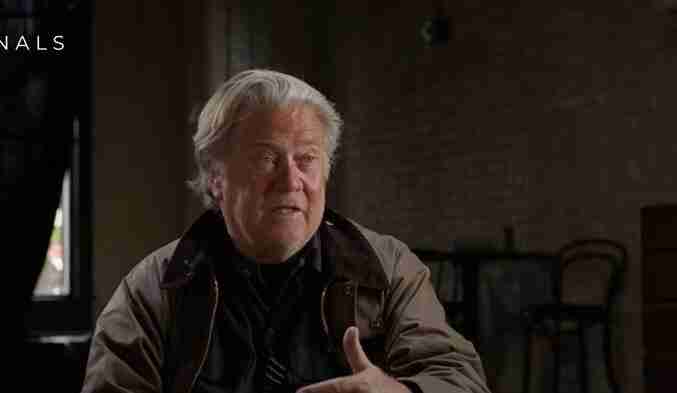
Read the full transcript of a conversation between journalist Steven Edginton and former White House Chief Strategist Steve Bannon on Tariffs, Trump, and Total War, (April 8, 2025)
The interview starts here:
Introduction and Liberation Day Concerns
STEVEN EDGINTON: Will Trump’s tariff Liberation Day harm the US Economy? Is Elon Musk leaving the administration? And is the president deporting enough illegal immigrants? My name is Steven Edginton and I’m GB News US correspondent. Joining me to answer those questions and many more is the former White House chief strategist, Stephen K. Bannon. Thank you so much, Steve, for joining us.
STEVE BANNON: Thank you for having me.
STEVEN EDGINTON: We just had Liberation Day. But many Americans are concerned that prices are going to go up.
The False Narrative About Tariffs
STEVE BANNON: Okay, stop. This is just. The only reason people have any concern at all is because the running dog for the capitalists on Wall Street in the lords of easy money media continues to go on with this false narrative that prices are going to go up, stock market is going to crash, everything’s going to happen over and over and over again without looking at any evidence.
We put some of the strictest tariffs ever on China in 17 and 18, and prices didn’t go up at all on Chinese product. This is just a false, another false narrative put out by the media. It’s the same as all the lies are told about the pandemic, all the lies are told about the Ukraine, all they’re talking about the Seoul election. I could go on, on and on and on.
The only people worked up about did the market crash today? No, it did not. You have a sorting out of things? I didn’t say it was not going to be any turbulence. Didn’t have any crash, didn’t have gold blow through the roof, nothing that was prophesied yesterday.
And look, Trump went hard and it shows you, I think, to the world he’s not a maximalist. I was always for the reciprocity, but the reciprocity has a maximalist side where you just go and match whatever your analysis shows. He was also thinking there was tension around with President Trump to just do tiered at 20%. He did do reciprocity, which I thought was very important to show the American people how people have abused the United States of America and American companies.
This narrative that’s out there by the vested interests in this country who don’t want to see the end of the globalist system. The globalists are sitting here in panic mode because now Trump has gone large and he’s not going to back off. If you notice today, I thought was very important, there was a lot of commentary out there, including his secretary of commerce and even me saying, hey, you know, Trump will be negotiating between now and the end of his current term, before his third term. And he put out the word no negotiations. They are what they are.
So I think you show as he stepped into this decision, this is core Trump. This is something that’s he’s been thinking about for 40 years, but really thinking deeply about with his advisors since the election was stolen, with Mar-a-Lago.
I think this narrative just on and on and on, particularly by people on the left who want to be populist or understand that the reason that they lost is that they abandoned the Democrats, abandoned the working class in this country and they won’t support them or vote for them anymore. You would think that they would try to at least understand the populist economic nationalist policy in bringing massive amount of capital investment in plant and equipment here and bringing plants and bringing high value added jobs back.
The Impact on Prices
STEVEN EDGINTON: But that’s the key point, isn’t it? And isn’t it more honest to say, look, we know that this is going to have an impact on prices if you put at least a 10%, in some cases much higher.
STEVE BANNON: But it doesn’t mean if it’s okay.
STEVEN EDGINTON: But there’s going to be an impact on the price.
The Economic Nationalist Model
STEVE BANNON: It doesn’t mean that. It doesn’t mean the increased costs flow to the consumer. Let me repeat this. We put, okay, you can add everybody combined and we don’t buy as much as we buy from China. I think it’s the net trade deficit with China is 5 or $600 billion dollars.
We are essentially to the Chinese what the colonies of America used to be to Great Britain during the beginning of the Industrial revolution. We’re just shipping raw materials. We send very little finished product because they gutted all our factories and sent them to China.
So in buying that 500 billion and 600 billion is actually more because that’s the net deficit in buying that amount of finished product from China. Prices didn’t go up in 18 and 19. They just didn’t. In 19, in Christmas, we had virtually no inflation, lowest interest rates you ever had. Exploding growth exploded, 3 1/2% growth. We had blue collar wages rising faster than white collar. We had non college graduates raising higher than college graduates. That’s kind of the economic nationalist model of Trump.
And we’re restricting immigration at the time. Since that time, Biden’s exploded, you know, invited in 10 million illegal alien invaders to drive down wage costs among unskilled workers. But there’s no evidence when Trump did this the first time, not a scintilla evidence from the largest partner we buy from on finished goods that there was any price increase. There is no price increase we could see when we put the steel tariffs in. So they try to use this to scare people.
The two reasons for tariffs is, number one I think for people in Great Britain understand, is that this is a premium market. The United States is a premium market. So what President Trump, he thinks about, he says, hey, it’s like buying a box, a skybox at a sporting event or front row tickets to a concert.
There’s two ways to do that. You either stay outside of your manufacturer finished products and you’re going to pay a tolling fee to get in here. I think the reciprocal tariffs are in Great Britain. I think it was 10%, if memory serves me correctly. Or you have an option, you have an option to come and move your manufacturing to the United States. I think you’d rather have the manufacturing come to the United States. But if not, we have an external revenue service.
Now that Peter Navarro says in the auto loans alone. Excuse me, the auto tariffs alone will bring in $100 billion. Remember, just think about this for a second. We sell essentially $800 billion of cars in the United States a year, okay? Of that, only 500 billion of that are made overseas. Germany, Japan, et cetera. Even of the 300 billion, 350 or 300 billion that are manufactured here, they’re really not manufactured. They’re assembled. We take still the high value added finishers, the drivetrain, the engine from either Mexico, Germany, or in Mexico, we’re making it for the Germans, or the Japanese.
That all has to stop. We have to bring, and this is about bringing high value added manufacturing jobs to the United States. And certainly it’s going to cause a little turbulence. I mean, we essentially, I think, went to economic war with the Chinese Communist party yesterday. Those are particularly where Xi is on his economic revival, which they’re in very bad straits. These tariffs I think could put Xi out of business. So it’s both geo economic and resetting the post war international rules based order. But it’s also geostrategic.
Southeast Asian Manufacturing
STEVEN EDGINTON: Lots of companies tried to outsource their manufacturing away from China and into other Southeast Asian countries like Vietnam, Cambodia.
STEVE BANNON: Cambodia had a bad day. Cambodia had a bad day yesterday.
STEVEN EDGINTON: Exactly. So is putting 50% tariffs on countries like Vietnam strategically a smart thing to do when you’re trying to decouple from China, when you’re trying to encourage people to stop building in China?
STEVE BANNON: Decoupling with China, we want to bring those jobs back to the United States. Yes, there’s still going to be product made in Cambodia and these other places. But why? It’s just reciprocal. Remember, President Trump’s adamant if you bring the tariffs down, and particularly on reciprocity, you bring the non tariff barriers, which is really where the juice is. You bring that down, we’ll let bygones be bygones.
The Trade Deficit Question
STEVEN EDGINTON: Right, but it’s not reciprocal though, because the data that they’re relying on is the trade deficit. They’re not actually talking about specific tariffs those countries have implemented or non tariff barriers. They’ve made that calculation and the White House have said this, they’ve admitted this based on the trade deficit in goods with the United States. So how is that reciprocal?
STEVE BANNON: What’s reciprocal to that country? You’ve got to work with us.
STEVEN EDGINTON: To decrease the deficit, but not to the.
America’s Economic Rejuvenation
STEVE BANNON: But you have to do what you have to do to work and make sure that we somehow take care of that deficit the accumulate. Because everybody talks about our debt here, the $37 trillion in debt we’re going to have. I think the Biden, you know, last year is going to be, I think near a trillion dollar trade deficit. We have a cumulative trade deficit, I believe at $25 trillion. They’re kind of inextricably linked with debt. But the globalists never want to talk about trade deficit. They say, oh, it doesn’t really matter. It matters tremendously. That was the wages of United States workers going overseas to pay something or it’s the monetization of certain assets we have to pay for it.
So no, I think each country in its own way will work out some sort of individual deal. President Trump says he’s open right now. He says no negotiations because I think he wants a time for them to kind of realize that he’s serious about this and he is serious about this. His primary focus is the economic rejuvenation of the United States. And I think that’s very powerful.
And for the American people, it’s been an eye opener because remember, one of the reasons for $37 trillion in debt is we have a trillion dollar defense bill. Why do we have a trillion dollar defense bill? Well, we’re underwriting the security of Western Europe, of the Persian Gulf and the Gulf Emirates of around the South China Sea and the Straits of Malacca and then up to Northwest Asia with Japan and Korea. That has to stop.
We’re upside down. We have trade deficits basically with every part of the. You go around the Horn, around the rim of the Eurasian landmass, we have trade deficits everywhere. We can’t continue. He’s trying to bring down the financial deficit. At the same time he’s trying to bring down the trade deficit. And this is the first time in our history, even with Reagan, that any president has stepped up and said, my first priority is American workers and I’m going to show you how it’s going to happen because I’m basically going to lay out a new economic model for the world and the world can think about it, adjust to it and then come to us. I’m sure they have open discussions.
Reagan’s View on Tariffs
STEVEN EDGINTON: You mentioned Ronald Reagan. I’m going to quote from Reagan. This is when he was president, he was massively against the tariffs that occurred in the early 1930s during the Great Depression. He said, “You see, at first when someone says let’s impose tariffs on foreign imports, it looks like they’re doing the patriotic thing by protecting products and jobs. And sometimes that works for a short while. What eventually occurs is homegrown industries start relying on government protection in the form of high tariffs. They stop competing and making innovative management and technological changes. They need to succeed in world markets. And then something even worse happens. High tariffs inevitably lead to retaliation by foreign countries. The result is more tariffs, higher and higher trade barriers and less competition.”
Trump’s Tariff Policy and Economic Nationalism
STEVE BANNON: Okay, Thatcher, I don’t need to be. Okay, I got it. I understand what Reagan and Thatcher were neoliberal neocons, okay, at that time in trying to take on the Soviet Union. I appreciate that. But also remember, Ronald Reagan was coming at the beginning of which we had been a manufacturing superpower and Carter started to, you know, as soon as we started running trade deficits and we stopped protecting American industries from mercantilist systems.
This is not that right there is a fantasy. It’s a fantasy that comes out of the kind of the National Review and all the Intellectual conservatives like the Tory Party that have gotten us into this situation that gutted England, that gutted the United States because they believed in the system of fair trade when it’s not fair. This is complete mercantilist system as reciprocity just showed the American people. The American people didn’t know that all these tariffs and trade barriers were up against our allies.
That we’re underwriting this is the whole thing like with Europe. In Europe, it’s quite frankly, we’ve been underwriting your defense since World War II and we’re kind of underwriting your prosperity. That’s going to end. We’re going to get prosperous here.
President Train is just wrong. The system that worked that when we broke off of the monopolistic power of the British crown and one of the reasons people don’t understand this, we broke off not just for political freedom, but also economic freedom. What drove the revolutionary generation as much as the suppression of their free speech, that we couldn’t even do cartoons about the king in pamphlets or he’d be shut down was also what the Crown did in corrupting the crown and the aristocracy did in corrupting commons and giving monopolistic power to things. Entities like the British East India Company or other industrial combines.
What England had gotten to at that time was kind of how the United States runs today, right? Oligarchic power with state power combined. You have a system. That’s what our revolution broke away from. And what happened, a document that’s just as dear to us economic populists and nationalists as a Declaration of Independence was really a declaration of war against the empire and the Constitution, which try to get this thing organized later is the report on Manufacturers by Alexander Hamilton, who is a true economic nationalist.
That’s the third founding documentary of the United States. And what happened from the American plan, from the beginning of the country, right after the Revolution, all the way up to the early 20th century, and particularly through McKinley we certainly protected and some of the biggest protections of our native industries were not just Alexander Hamilton, but a guy named Abraham Lincoln, right? And then McKinley, they understood and this is what drove us.
Although the Industrial Revolution started in England, we rapidly became an industrial superpower. Why? Because of a smart system of tariffs. Free trade is a masturbatory fantasy. It doesn’t exist in the real world. You’re always there gaming the system. And the Chinese Communist Party, which quite frankly Thatcher and Reagan kind of set the basis for the opening up of both. And the shipping, they didn’t do it. That was Bush and the globalists later. But to ship all the high value added jobs from England and the United States to ship it to China so they could leverage the slave labor of Lao Beijing.
So these people have been called out. The thing I love so much about reciprocity and this, of all the original ideas President Trump has and the build a wall and deportations, all that which by the way, everything he told us he would do, he’s done. And now the southern border is totally secure. 65 days into his presidency, which just shows you how corrupt the Imperial Capital, Washington, D.C. with this huge bill.
But President Trump, the idea that’s burned in him from the beginning, from the 1980s and 90s. Go back and look at the interviews. Is Lou Dobbs on CNN talking about the trade deficit, talking about the time Japan, but ultimately China, you know, ripping off the United States and all of our jobs. Sorry. This has been an obsession of his from the beginning and yesterday. I couldn’t have been prouder.
For your audience that hasn’t seen it. Take time and watch the entire speech. It is one of the most powerful speeches Trump’s ever given. Totally on point. The stagecraft was perfect. They took the Rose Garden, which is right outside the Oval Office, and they put the flags up in between each column. It was so powerful. And the point, the message was on point. It was said with authority and then inspired. He brought up union workers. He brought up union workers to actually talk about how much they loved it and how much this was going to help rejuvenate the automotive industry.
Economic War with Allies
STEVEN EDGINTON: You talk about declaring economic war on the Chinese Communist Party, but these tariffs, these tariffs also impacted or perhaps even declared economic war on your own allies. The European Union, Britain, who are the allies?
STEVE BANNON: Give me the allies again. European Union, Australia. I am so insulted by you using the term allies. Allies supposed to be somebody in something together. The European elites are total and complete deadbeats. I was the guy on point in the first administration. I had to be a supplicant to ask you guys, would you please consider getting up to the 2 and 2.5% that you committed after you forced your way into Ukraine in 2014. You realized you were going to have a fight on your hands. You actually realized we have to get to 2% or 2 and a half percent, which none of you did.
Only the Brits came close. And later the Poles, and if you look at really in particular the Germans, the Italians, some of these people are horrible. The French. If you actually look at where the defense budget goes, it’s not going to combined arms operation, it’s not going to maneuvers, it’s going to pensions. It would go into pensions or women’s health care or climate change. Climate change is a big one. It’s all phony, it’s all fake.
You haven’t been an ally forever. You can’t pull your weight. If you took the United States out of Western Europe today, militarily, the whole thing would collapse. We’re the infrastructure and the backbone of everything. It’s completely unacceptable. This is why they praise Joe Biden. If you read the new books coming out by Joe Biden’s own chiefs of staff, they had to tell him, hey, you’re not the President of NATO. Because he kept sitting there babbling, well, you know, the NATO guys really love me. They love me. Of course, you’re giving them everything.
The Western European people must understand that their elites have not been allies to the United States. You’ve looked at the burden of everything, of manpower, right, of defense. Right now you call yourself an ally. In the Red Sea, right now we have two carrier battle groups. That’s about 24,000 sailors doing airstrikes on the Houthis to keep the Red Sea open, to keep the Suez Canal open, to keep trade going to Europe so your prices don’t explode. And you know what we have down there? Last I saw, you have, I think, one British destroyer, one French frigate, one Italian corvette.
You don’t even take seriously your own thing. So how can we take you seriously? You’re not allies. You don’t act like allies. What you do is you complain and you moan when the United States says, hey, look, we just can’t do this forever. We have a trillion dollar defense budget and we got to cut the defense budget. We’re going to cut spending because we have a $2 trillion deficit every year.
People should understand the signal that President Trump is sending every day about Greenland is about the defense of Europe too. Witness. The Russian army’s your problem. The Russian navy’s our problem. We get some sort of partnership or alliance or something with Greenland, maybe even they become a territory, whatever that form is. We get those naval bases that President Trump, I believe, wants to set up, and we block the Greenland, Iceland, UK gap, so no Soviet submarines cannot come through there, that we don’t track one on one.
And also, I believe, take the pressure off the nuclear base in Faslane in Scotland, which has always been very controversial, very controversial. About Scottish nationalism, I think that’s necessity. I think that’s the core. I don’t think it’s rare earths and I don’t think it’s minerals. About Greenland, I think it’s strategically, I think it’s sending a strong message that in 80 years after World War II, we’re now going to think about the hemispheric defense of the United States.
This has massive implications for Europe. But the EU was the first to start complaining and moaning about the tariffs. They, oh, look how these countries treat us. They don’t treat us as allies and they particularly don’t treat us as people have been underwriting their defense for 80 years. Number one, freed them twice, World War I and World War II. And number two, had then basically paid 80% of it ongoing.
Let me give you a story. When the Germans came in 2017, I was assigned to sit down with a national security advisor and I said, by the way, you know, you’re not meeting your 2%, this is how far you’re missing. And we had done numbers because President Trump’s a real estate guy, you know, back rent. Oh, by the way, you haven’t. This was in 2017. Your four years arrears on that, your number is $50 billion.
He almost had a heart attack in the room. He starts spouting, he starts speaking German again. What can you do? This is not cumulative. What are you saying? I’m saying, hey, you want to be an ally? Then he throws up to me, he says, oh, you don’t understand, we can’t do that. And I go, why? Even he says to me, because we have in the constitution that it has to be a balanced budget.
I go, dude, I know you wrote that part of your constitution later, but let’s be blunt. Till we bombed you into the stone Age, there wouldn’t have been any constitution. You can’t pitch to me that a country that has $2 trillion deficit and at that time $32 or $33 trillion in face amount of debt that we can’t afford to pay off. Please don’t come and make the argument that your constitution so pristine that you can’t have budget offsets.
And duly noted, just a week ago they changed it that they actually can run because these deadbeats have not paid for the defense in 80 years. So don’t throw ally at me. They’re not allies, they’re coalition partners. And I think they have the stuff they want NATO to continue and I mean to convince the American people that it’s worthwhile continuing. The elites of Europe have got to step up and say, okay, we’re going to have real money into the situation. We’re going to have more than two combat divisions.
And this is more than the Brits. The British have been extraordinary. Right. And although your military is very small to what it used to be, quality wise, it’s unparalleled, but it’s just small because you haven’t invested in defense. But the rest of the people have just let the thing go.
STEVEN EDGINTON: Well, it’s ironic because many in Europe, and particularly in Britain feel that Britain’s been a kind of vassal state to the United States for the last 70 years. And the fact you’ve had such a military presence on the continent and in Britain perhaps implies that, well, I’ve said.
Trump’s Vision for America’s Global Role
STEVE BANNON: For years you don’t want to be vassal states. The way you’re not a vassal state is start to pay for your own defense and be a little bit independent. The United States, we don’t want you, the populist nationalist movement. The last thing we want is the British or the Europeans to be vassal states. We’re the big believers in the Judeo Christian west in hanging together. Right. But we don’t want you as vassal states.
Now, I said the very first day I showed up at the White House and started looking through all the analysis and had for years, but then when I had the real classified document, you’re a protectorate. You’re a protectorate. Just like Saudi Arabia in the Gulf. That’s not your heritage. It doesn’t help us, you being a protectorate, because what you have is the elites together, the Atlantic Council, the Atlantic magazine, because remember, in our vast country, it’s still essentially run from Boston to New York down to Washington DC, what we call the Acela, the train. That train corridor with the big Ivy League schools, all the big law firms, the big media is still, I guess it’s still 20 or 25% of the American population, but it’s the credentialed class that’s all there. And it’s very close. The globalists are very close to Europe.
And it’s one of the things I want to break away from. I keep saying we’re a Pacific nation, that the pivot, the strategic heartland of America is actually the Pacific, the vast Pacific. So if you do Trump’s plan, which is brilliant, Greenland and then the Arctic, right. Maybe some partnership with Canada all the way down to Panama Canal.
And if you look at the vast central Pacific, which people forget, the Eurasian land mass, as massive as that, is Mackinder’s whole geopolitical strategy of who controls the heartland of the Earth, the Pacific, that vast central Pacific, is actually the size of the Eurasian landmass. And that’s why Pete Hegseth went. The three island chains, from Hawaii to then Guam to then Philippines, Taiwan and Japan, those three island chains protected by the United States, because most of them are either territories of the United States or in partnership with the United States as allies, naval allies. That vast Pacific is the buffer, is the protection of the United States.
You do that naval strategy, and that’s why I say we get the bases in Greenland. Essentially, the Russian army is your problem. We’ll be there. But if you guys want to get in a shootout, a gunfight with Russia, have at it, right? You know, we saw how Stalingrad and Kursk turned out. So have at it.
In all the big talk, I went on Sky News a couple of a month ago, and the broadcaster was shocked because I was giving her some basis. I said, you talked about talks big, but you guys don’t have the balance sheet. You don’t have the budget to be. He’s talking to putting 30,000 troops in Ukraine. That’s all happy talk. That’s all a guy trying to be Winston Churchill Jr. It’s not going to happen. You have massive financial problems in England that have to be solved now, and it’s got to be solved with him, or the IMF is going to step in. You’re going to have a sovereign debt crisis. He’s going to get turfed out, and Nigel Farage is going to be your next prime minister.
STEVEN EDGINTON: You talk about strategic islands in the Pacific. Now, one of those islands, as we both know, is the Chagos Islands. Now, we talked about this in our last interview. Britain is giving up sovereignty of the Chagos Islands to Mauritius, a Chinese ally, and paying.
The Strategic Importance of Diego Garcia
STEVE BANNON: I don’t understand how the Brits fought for the Falklands. And I was just come off sea duty. It was in the Pentagon at the time. I don’t see how you fight for the Falklands in the South Atlantic and you give away one of the greatest strategic assets in the world today.
People should know this obscure island of Diego Garcia. And if you’re a Pacific Fleet sailor, it’s everything, because that’s where you refuel, that’s where you restore. It’s basically a pier in a runway. It’s not, you know, it’s essentially a tool. It’s only one notch up from the five uninhabited islands that we gave tariffs to yesterday because of the penguins.
Diego Garcia is so important. It is actually the linchpin of the Indo Pacific strategy. And let me be blunt. With two carrier battle groups in the Red Sea, your only alternative is taking around South Africa, which is not if they come from the Atlantic. Well, if you’re a Pacific fleet, you’ve got to go back to the Straits of Malacca somehow. Somebody’s got to refuel or restore at Diego Garcia.
Now, my understanding is that giving it back to Mauritius, who’s up to the neck of the Chinese Communist Party, there is a lease that’s going to be done for 99 years. Now, we saw what happened last time with Hong Kong. I adamantly oppose that. I think that the United States and they’ve come and talked about, I think, I think Lord Mandelson or Sir Keir, I think there’s obviously been discussions with inside the United States because Nigel brought this up as a big deal.
So my understanding is that don’t worry, even if it’s going to go back to the country of original ownership, there’ll be a long term lease that will be helpful. I don’t even like that. But I don’t know all the details behind the scenes. But having been a sailor that’s sailed in the waters of Diego Sea and had ships in my squadron have to go port there and refuel and replenish. It’s not an exaggeration. I tell people when you talk about the Pacific Ocean, you talk about the South Pacific, you talk about the Indian Ocean, you’re talking about vast spaces of ocean that are so vast in these tiny spots that are these atolls. And Diego Sea has been essentially a military base for us since World War II.
STEVEN EDGINTON: It just seems odd because Donald Trump could have vetoed the deal and he didn’t or it looks like he hasn’t.
STEVE BANNON: I don’t know if that’s totally official, but I agree with you. That’s why my understanding, because I’ve been pretty adamant about this, my understanding is that a situation has been laid out that you can give it back, but there’s a long term lease, that you control it. I’m not excited about that. I agree with Nigel. People should know that. I think that may be a bone of contention later.
What the Chinese Communist Party has done is predatory capitalism. What One Belt One Road was, was basically lend vast amounts of money to these South Asian and central sub-Saharan African countries to build massive infrastructure projects. And what happened is that as you can imagine, the projects took longer. Sometimes the quality wasn’t there. Maybe the business model didn’t work. Virtually all of them are upside down.
And what the Chinese Communist Party does is kind of what the British East India Company did in advancing cash. If you can’t pay it, hey, maybe we restructure the deal. And that deal always has more control. I mean, the Brits ran India for 100 years and made it the jewel in the crown, kind of doing the same thing. And so Mauritius and all these countries have a much deeper relationship with the Chinese Communist Party because they’ve actually taken cash.
I adamantly oppose this because I think the area of operations is central. And to me, what I don’t get about it, with the need to have two carrier battle groups to keep the Red Sea open to keep prices from skyrocketing in Europe. If the Suez Canal has any type of closure or you don’t have the ship volume that has to go around Africa, you’ll have pretty dramatic price increases. So it’s not like it’s not important to the people of all of Europe, not just the United Kingdom.
And it has gotten no play really in the media. It’s gotten more play here. And that’s just because Nigel has alerted certain people who are involved in national security here and we’ve made it a big deal. But I agree with you. My understanding is that it has been signed off, but I haven’t seen that sign off. And as you know, it ain’t over till it’s over. So it’s always open to a last minute change.
STEVEN EDGINTON: There are certainly conflicts within the Trump administration and we know that you’re on one side, the kind of MAGA nationalist side, and then you also the maximalist too.
STEVE BANNON: Then you also on any policy, I want to go to the actual maximum.
STEVEN EDGINTON: Right. Then you also have the Elon Musk and the tech pros and the globalists, as you would describe them. There’s been this report in Politico recently that Elon Musk is going to leave the administration in the next few weeks. Have you defeated Elon Musk?
On Elon Musk and Tech Oligarchs
STEVE BANNON: I think I’d say it a different way. I’ve been Elon’s actually biggest supporter. I’m adamantly opposed to the oligarchs in Silicon Valley, the apartheid state of Facebook and Google and Twitter. All these five or six companies that dominate not just social media, but so much of commerce in the United States. They’re all, including Amazon, massive monopolies that control American life. They can make or break smaller companies, or they can make or break media companies.
I’m still banned for life on all those platforms. War Room’s the number two podcast for politics in the country, back of the Obama guys, the Pod Save America. Roughly, you know, you average everything out. And we’re besides being on Apple and iHeartRadio and on Real America’s Voice streaming and all the streaming services they get us on, we’re banned on every major platform. These guys have immense control and they banned us because of our political speech, because of economic populism and nationalism.
So I’m adamantly opposed to that and what it leads to, which is techno feudalism. And you see this in every aspect of your life, particularly in Great Britain today. I’m adamantly opposed to this. These companies must be broken up. The power must be taken from these individuals.
They don’t really support us because outside of Elon, who started to come over a couple years ago with Twitter, but really in the spring of ’24, started to see the mathematics of the coalition we were pulling together and basically had people’s back and wrote a huge check to support, not commercials, but to support the ground game, which is the way that we won the DOGE effort.
I’m the first person to go out and talk about the deconstruction administrative state at CPAC. What DOGE has done I think is fantastic. I think it’s raised the American people’s awareness of waste, fraud and abuse. Here’s the issue. We spend about six and a half or seven trillion dollars a year, our tax base. So everything we bring in is about four and a half. We have a $2 trillion deficit every year. Think about that. Every year, $2 trillion that has to be financed. It’s now up to $37 trillion. And we’re adding right now about a trillion dollars every hundred days.
The model is not close to being sustainable. The gross interest charges now on just our debt is $1.4 trillion. Ray Dalio, one of the most sophisticated hedge fund guys, just gave an interview to CNBC two weeks ago. He says, hey, I see sovereign debt crisis potentially happening in Europe with these governments, he says, but I see a failed treasury auction. Don’t think the United States is immune. I see a failed treasury auction here where you go to market in refinancing these tens of trillions of dollars you have to do of debt where people don’t want to buy it unless you really jack up the interest rate. We are coming to that point.
And so what Elon tried, attempted to do and is trying to do is find the fraud, which he says is about $1 trillion of fraud. If we can find that, he’d be my biggest supporter. I want to put some meat on that bone.
I do know given Wisconsin and given the fact it’s only 130 days and his companies are getting hammered and people should know it’s horrible what they’re doing to his companies. I mean, Tesla, we have an open, violent revolutionary movement that singled this guy out and gone after his customers who are all kind of the super liberals and progressives on electric cars because no MAGA will buy an electric car. It’s kind of progressives have bought them and had these dealerships and now they’re getting firebombed with Molotov cocktails. People are scraping. You can’t drive a Tesla into a parking lot of a restaurant or somebody will attack it or attack you personally. It’s horrible what’s going on.
So no, I don’t look at wins in defeat or if he’s defeated. What I know is that they keep talking about fusionism and what they talk about is the economic populists and economic nationalists fusing with the big tech bros to form a new political entity. And I say that’s never going to happen. What will happen is we can be coalition partners and maybe uneasy coalition partners because we’re going to agree on some things and not agree on the others. You saw in Wisconsin a ton of Trump voters, those low propensity voters did not turn out right. That’s one of the reasons we lost.
STEVEN EDGINTON: Do you blame Elon Musk for that?
Trump’s Perspective on Wisconsin Defeat
STEVE BANNON: I blame a lot of things. Number one, the reality people have to understand—and I hammer on this every day because we’re the tip of the spear of turning people out—our audience… Trump has reformed. Trump has remade the Republican Party. You’re seeing this happen in Great Britain right now where the Tories are actually being remade by a party called Reform on the outside. At some period of time, I think that you would take it over, merge or whatever, but the reform voter is quite different than the Tory voter today.
The Tory voter is more the credentialed class, like kind of the Democratic Party. The reform voter is much more working class, or it’s that middle class that really… Remember, it’s kind of MAGA. Right. Those voters are lower propensity voters. Trump voters are lower propensity. What do I mean by that? If Trump’s on the ticket and we get everybody jacked up in the rallies, they’ll come out to vote for Trump. If Trumpism’s on the ticket and maybe it’s not a great candidate, it’s harder.
And the only way you get that is not through radio and TV. The only way you get to that is through going door to door. And that’s what Wisconsin showed. I also think Elon did make a mistake and made himself too central into the campaign. It can’t be about yourself. It has to be about the cause. It has to be about the movement. Trump can make it about himself because Trump embodies all of it. Right? All the rest of us are kind of servants to that, to the movement, and we have to make sure we’re putting the movement first.
I think the mistake there was, and I also think the mistake is when you go on stage and you have a packed audience, that doesn’t mean it’s filtered out to the hinterland. It doesn’t mean it’s filtered out for what turned out to be a Supreme Court vote. And people should know we got our asses kicked. It was a big defeat. It was almost, I think, eight, nine, 10 points. And there was $100 million spent. They spent an incredible amount of money, but I think we actually outspent them in Wisconsin.
So people can’t whine about, “Oh, the Democrats.” The Democrats outworked us and they had the… They did something very smart. They Alinskyed Elon, but he kind of played into it. They made him the focus point at the end. Trump’s name was barely mentioned. Trump was barely mentioned. So in politics, you got to make sure you can’t do that.
Addressing Fraud and Accountability
But I think it’s a whole host of things that now, I would hope before he leaves, two things have to happen. We start to have to identify real numbers, particularly on fraud, because the American taxpayer is sitting there going, “Hey, I don’t trust the government to do anything, even if Trump’s there. All these guys in the administrative state are stealing from me.” We have to identify the actual fraud, and then we have to prosecute people.
One thing I keep harping about is if it’s all this fraud and we’re now three months into this, or two and a half months into this, how can we haven’t named anybody? If they’re stealing hundreds of millions of dollars, name them. The authorities will have to stop from being the French Revolution and getting guillotined. They’ll have to make sure these people have fair trials, because the citizens are worked up about this, given the fact that they pay so much in taxes and we paid the hidden tax of inflation.
So I hope that in the time he’s here, and I believe he’s still going to be here for a month or two before he goes back and takes over his businesses, and he’ll obviously be a big part of this. I’ve never tried to run him out totally because I understand he did write a big check. President Trump likes him quite a bit, takes his advice. He’s done a good job. DOGE has got to go on. But now we have to make DOGE real. It has to see the real numbers.
Budget Challenges and Executive Authority
Because for your audience, this is the crazy thing. Because the way we finance things here, we actually had to approve a budget that is actually Trump’s first year. It’s Joe Biden, Nancy Pelosi’s budget. This is what we’ve approved. That budget also had a $2 trillion deficit baked into it that we agreed to. And all of the fraud that Elon Musk had found up to three weeks ago is actually none of it got taken out because there’s an up or down vote. You got to vote all or none or it doesn’t pass.
So even War Room, who’s the most adamant deficit hawks—our audience said just to get things forward and to move President Trump, so eat it now. However, we were promised impoundments, we were promised rescissions. We were promised that all this money in DOGE has been found and we’re not going to end up paying for it. We’re going to pound it. You know, I love Russ Vought like a brother. But I keep asking every day, where’s our impoundments?
And people should know right now in America, this fight between the judiciary and the presidency is between this battle between the executive branch and the judicial branch, where the judiciary is basically saying, you’re not chief executive because you really can’t cut personnel and you can’t cut spending. She’s tried with DOGE. You’re not with DOGE.
Number two, you’re not really the commander in chief because although as commander in chief you send terrorist criminals on a plane to Central America or back to Venezuela, you can’t do that. We have to know the manifest. Were they given due process?
So federal judges—and the last, he’s chief magistrate and chief law enforcement officer—they’re freaked out and he walked over to the Justice Department to give a speech. They don’t want any contact between the Justice Department and the president and they certainly don’t want the FBI talking to the president. That fight—the unitary executive theory—is the big theory that’s driving the ideas. It has consequences driving President Trump’s administration right now in this judicial revolt that you’re seeing, kind of like in a smaller scale you’re seeing in the United Kingdom.
STEVEN EDGINTON: Now you promised in our last interview that a lot of people will be going to jail or a lot of people will be going to prison. And it doesn’t seem that there are any prosecutions of so-called corrupt Democrats.
Expectations for Prosecutions
STEVE BANNON: We’re 65 days into this. You don’t know what’s going on behind the scenes. You don’t know if grand juries have been impaneled. You don’t know if investigations—and I also said I don’t want to target just like the Biden family or things like that, although I think we’ll eventually get there. To me, the corruption, what happened at the Justice Department is tremendous.
I have been told that there’s progress being made and all that. I’m prepared to keep an open mind. But to be blunt, if by this summer or by Labor Day, if there’s not announced investigations going on, I think you have the entire MAGA base upset.
Look, Pam Bondi is the replacement for Matt Gaetz. And Pam Bondi is kind of revered by the MAGA base. Pam Bondi’s been with us, not just attorney general for eight years in Florida. Pam has been with us since ’16 on the campaign, all the time in the first White House, always on media in the darkest days when President Trump had the election stolen from him. Pam Bondi’s always there. Pam Bondi has quite frankly been a player and beloved.
So when she stepped in for Matt Gaetz, people were happy. She gets lit up every day. Now your audience should know the MAGA base lights her up every day because they don’t see arrests, they don’t see the Epstein files. They’ve got 10 things that are priorities for them. They don’t see the guys around J6 getting compensated. They don’t see the trials of people that put… They don’t care about the pardons given to Shifty Schiff in the J6 committee or the staff. They want prosecutions, they want files, they want action.
And I keep telling people, “Hey, you know, folks are going to understand you got too much going on,” etc. But there’s an end date for that and that end date is sooner rather than later. I keep saying sometime in the summer, as you get closer to Labor Day. That’s not our audience. If I mention the show, people’s heads blow up. They go, “No, we want to see them now. Where are the prosecutions? Where are the files? Where are the Epstein files?” And they don’t want to hear that, “Oh, somebody in Southern District has done something and we got to go do it.” That’s all.
STEVEN EDGINTON: So what’s going to happen in the summer if this doesn’t happen?
Trump’s Political Instincts and Base Pressure
STEVE BANNON: I think that first off, President Trump—no one can read a room like Donald Trump, okay? And Donald Trump is… People think that Donald Trump’s driving investigations. He’s not. He’s got the whole world geopolitically, the deportations, the economy, everything he’s trying to get through in his big, beautiful bill. He deputized these people and they’re off to it.
But he will know with feedback from his base pretty quickly, I think, in the summer, if things aren’t going forward on investigations. He’ll read the room first as they have.
Let me be very specific. What would just happen in the last 24 hours? There’s big consternation about the National Security Council and some of the people that President Trump has put into some areas of the administration. Remember, his base is hardcore and there’s an influencer, Laura Loomer, and Laura is very aggressive on her investigations. And, you know, she’s a… She’ll throw a sharp elbow. Right. A lot of people get very concerned in working with her because she’s very aggressive when she’s on a story or in this information, her voice.
And she essentially has no power. She’s an influencer, but independent investigator in this entire thing. In the Signal situation, something’s come up that people are not ecstatic with Waltz’s staff. And it’s kind of seen in the Signal chat that people believe, “Why are we bombing the Houthis? Is this a prelude to getting into with the Persians? Is Saudi Arabia and Israel? Are we getting more drawn into this thing? We just got out of these two wars. We’re trying to get out of Ukraine. President Trump’s trying to bring peace to Gaza. Is this a preamble to military operations in Persia?”
Okay. The War Room audience and the MAGA base is probably 2/3 against that to one third supporting. When Waltz came out in the Signal chat, but also came out more that he had a number of neocons on his staff, Laura Loomer started lighting people up on Twitter with information and documentation of how these people on social media and in the past jobs had not been loyal to the president.
I think it’s, I can say that I think two or three people in the National Security Council after she met with the president have been dismissed—senior level positions. When I say senior level, I mean like deputy National Security advisor positions that run big things in the NSC have been dismissed. I think two or three already and maybe more.
STEVEN EDGINTON: What about Mike Waltz himself? Because he also has a background of being a so-called neocon working in the Bush administrations. But he also seemed to add this journalist into this Signal chat. Why did he have his number? Why did this happen?
The “No Scalps” Policy and Foreign Policy Concerns
STEVE BANNON: I think there’s an open question. Look, I think Mike, I support the president in the no scalps policy. Laura Loomer is different going in. But the original thing, I think you just got to, as I said to Axios, it’s a no scalps policy for right now because we hate the globalist media more than we hate the neocons.
But I don’t think it’s, you know, it’s a pretty open secret. Is Mike Waltz as good a man as he is, a good a guy as he is, he’s under pressure right now to perform. And part of that performance I think is unrelated to the Signal track because they just announced they found 24 more, but more related to the policies you’re advising.
The president of our movement is not isolationist, but our movement does not want to be sucked into more forever wars. They’re very—this is one of the reasons the Houthi situation, the Saudi peninsula in and of itself… And President Trump has announced his first trip is going to be to Saudi Arabia, UAE and Qatar and maybe Israel. So a lot of his base is very concerned right now. Are we getting sucked back in to a broader war on the Eurasian landmass, particularly in the Middle East?
STEVEN EDGINTON: Now you love to talk about this phrase “flood the zone” and Trump is very good at doing this and generating headlines and rage and so on. But my question to you is where’s the long term strategic thinking here when it comes to things like…
STEVE BANNON: Let me just give you three long term strategic thinking. Where are you lost here?
STEVEN EDGINTON: Just give me three examples of where maybe the administration hasn’t succeeded. Ukraine. That’s not working. Putin hasn’t agreed to a deal. You know, Trump said this was going to happen Day One. Please stop on deportations. The deportation numbers aren’t high enough. And the judicial blocking of the tariffs and also other immigration policies that are causing new problems. Those are the three issues.
Trump’s Strategic Approach to Global Challenges
STEVE BANNON: You’re going to take your number two principal out, as I tell the audience, number one, the key to stopping the kinetic part of the Third World War. And your audience understands something. They go back and they think, hey, from September 1939, you know, that’s when World War II started. It was this huge mess. It was very bloody. If you go from September 1, 1939, to when the German armies turned on their ally Russia in June, I think, 21st of 1941, right? For those couple of years, there was essentially very little killing. There was some. France fell, you had the blitz. Don’t get me wrong. You took casualties.
You’ve lost a million, 1.2 million and 1.5 million people in Ukraine. This has been every bit as bloody, if not bloodier, than the start of the Second World War in the first couple of years. President Trump, and this is why the rapprochement with Russia, which is a reset, takes precedent over everything else. Everything will fall out of that. What’s happening in Persia, in the Middle East, Ukraine.
So when you sit there, oh, nothing’s happened in 60 days. I said from the beginning, if you include Zelensky, you try to give Zelensky a seat, particularly if you ask his opinion on anything, of which I wouldn’t ask it on anything because I could care less. He’s already made a big deal about the economic plan not working, wants to do this and do that. It’s a process. I adamantly oppose getting involved in that process.
I think you ought to say, hey, we’re not sending any more arms. We’re not sending more economic aid. If the Europeans want to send it, let them send it, because you’re not going to send it. You don’t have the money, and your people will overthrow these governments and they keep funding Ukraine at the levels that need to be funded. If the Americans walk away, everything’s Russia.
And I think there, they’re making true progress. There’s going to be a meeting in Saudi Arabia. You know, his Witkoff and his lead team are all over that with the Russians. And it’s not going to be perfect. Some days President Trump comes out and says, hey, if Putin doesn’t agree to stop bombing, you know, he’s going to feel the might of the United States. It’s all a process, but it’s engaged. It’s a high level and it’s a rapprochement that takes care of many, many problems, particularly in the Middle East and Ukraine.
Border Security and Immigration
On your second, he shut down the border in 60 days. There’s no crossings. We were told for years this was a natural law of physics, that hundreds of thousands of people had to come across every month. Just understand something. Between January of 2021, when Biden took office, and January of 2025, when Trump returned, 10 million illegal alien invaders came across the border.
Now, he started with the criminal element, but if you go to the southern border, they had a picture the other day on CBS News of the southern border being totally not one person coming across. And I headline it all quite in the southern front, nothing’s going. We still need to build the wall. But there’s nobody coming into the country now.
Now, the deportations, particularly the 10 million in this reconciliation bill that still has to be passed, it’s $170 billion to do that. My first question is people that allowed that to happen should go to jail. If we need $170 billion to deport these people, how did that happen and who’s held accountable for that, number one?
Number two, he’s been very aggressive on the terrorist and criminal element. And there, that’s where in performing his role as commander in chief. And that’s where the federal judge steps in and says, hey, these guys should have due process rights. And the president says, hey, I’m doing this as a military necessity to get these terrorist criminals out of the country, and you’re not going to stop me.
Judicial Battles
And that’s why we should be in the Supreme Court. I think in the Supreme Court on the emergency docket within the next day or two won’t be argued, but this one’s going to the Supreme Court first because you have to have clarity. Can a federal judge step in the middle of the president performing his task as commander in chief and so on.
Every aspect. The last one is about these federal judges. And remember, this is all coming from the Democrats with no power. They have no political power. Right. The protests in the streets, I think, are fairly weak, although they’re getting more and more violent all the time. They have had a good show in Wisconsin, I’m the first to admit that. But I would think a lot of that’s because Elon put himself front and center.
So what they’ve done is used the judiciary and this is the way they shut it down. There’s hundreds of lawsuits right now. They go to Rhode Island and a guy gives a TRO for a nationwide thing. Every aspect we tried to do, from shutting down VOA to shutting down USAID to firing people to try to carve back money because hey, it’s a $2 trillion deficit and somehow we got to close it.
We’ve been stopped in federal courts for everything from stopping $2 billion in payments to the contractors of USAID to deporting people that clearly have criminal records. So that has to be worked out in the courts. But this fight is about judicial supremacy. In our Constitution, it’s a co-equal branch. It’s not senior to the executive. That’s what’s going to be fought out.
Trump’s First 60 Days
And he’s doing it every day. So to say there’s no strategic plan. If you think what he’s done the first 60 days of start of securing the border, securing our national sovereignty in the New York Times reports that the tariffs on Mexico alone, the first tranche of tariffs, cut the fentanyl traffic by 50%. He’s also pre-positioning military effort.
And you can tell in Mexico we have reporters down there, the Mexican military is starting to look like with the American military interdict the fentanyl trade with taking, physically taking down the cartels in combat, just like we took down ISIS in 2017, the ISIS caliphate.
So I look strategically whether it is Greenland, Panama, the discussion with Canada, the new strategy, the use of the Pacific, the three island chain, the tariffs, all of this is in 60 days. These are all massive issues and massive verticals. No president’s ever attacked one. And if you look at the Republicans, this is what I think has changed the Republican Party fundamentally. People are going, my God, all this stuff could have been done in the past. We just went along with it and figured it couldn’t be done.
Trump is every day, it’s days of thunder. It’s 10 and 12 executive orders now. That’s because we had four years to get ready. You had Project 2025, you had Brooks Rollins, America First Policy Institute, you had Stephen Miller’s America First Law Institute, you had Russ Vogt, and I’m naming people that are senior members of the administration because they ran think tanks that thought all these policies through.
Russ Vogt had Center for Renewing America, the Project 2025 was kind of an umbrella group that got it all together. And if you look at 25, but if you look at AFPI, the Law Institute, CRA, if you go back and look at their conferences, if you look at their white papers, if you look what they put out there, their donors, it’s essentially what you’re seeing every day in the Trump. So I think that’s pretty damn strategic.
STEVEN EDGINTON: Last question. This is about Europe. Now I know that you’ve taken a massive interest in the populist movements in Europe over the last few years. Now, we’ve talked about this before where I’ve said these populist movements haven’t really achieved much so far. Giorgio Meloni in Italy, for example, hasn’t restricted migration. In other countries like France and Germany, they’ve failed. In France, they’ve just tried to ban Marine Le Pen from standing as president in 2027. In Germany, they’re looking to ban so-called far right parties. I want to get your reaction to that and just comment on my point that these populist movements have basically been a failure.
The Global Populist Movement
STEVE BANNON: Basically been a failure. But they’re trying to put them all in jail, isn’t it? Okay, let’s go talk about the failures in a second. Let’s go back to hearing President Trump. Remember, we’re in court every… I could do four hours of war room every day and just go through these amazing court fights. And they’re all important because it gets to the core of what he’s trying to do as chief executive, as commander in chief and as chief magistrate. Everything they’re fighting and these are intense on every action he’s trying to take.
They’re in federal court and they have great lawyers. So you have, it’s at the highest level. These are being argued. But Bolsonaro, and remember Trump comes through being indicted 92 times for 372 years in prison of which they wanted him to not imprison him, they wanted him to die in prison.
Bolsonaro is up I think 15 or 20 points on Lula. In Brazil they have Bolsonaro’s on trial for his life in a show trial that’s every bit as bad as Moscow in 1935. You have him because he was in Disneyland at the time, but because they had a protest about the election, they’ve got him right now being the candidates up on a trial that could send him to prison for 20 years of which they intend to assassinate him in prison.
In France on what was an administrative thing, this is being a European Member of Parliament like Nigel was. For years, Le Pen and some of her people were. Instead of having people in Strasbourg or in Brussels, they let some of the staff work in Paris, where their political operation was. She was, you know, this is the big fraud and everything you see, it’s fraud, it’s fraud. It’s really a personnel issue.
They found her guilty. And here’s what’s important. I talked to all the players I know in France before the thing, because I’m saying this thing’s as bad as Trump’s. And as Bolsonaro, they go, yeah, but it’s really administrative. Nothing’s going to happen. They don’t have the balls to put her in jail and to eliminate her in the campaign. I go, guys, you have no earthly idea how radical these judges are.
You can go to each different kind. Look, in Romania, they are absolutely radical, and they’re the last bastion of the defense they have. On Monday, they put her. They sentenced her to four years in prison and banned her from running. Now, that’s all still to be adjudicated in appeals, but in Brazil, the leading… And she’s up by… She’s up by 12 points. The candidate that’s up by 12 points is basically sentenced to four years in prison and banned from running. The candidate’s up by 15 points, is on trial, basically for life imprisonment.
Okay, if he loses in Trump’s on trial, would they… Trump, they tried to put in prison on five different elements. And people have to understand, in our movement, I preach this every day. We are not out of the woods.
The Ongoing Political Battle
If Hakeem Jeffries… The problem with Elon in Wisconsin is we lost the redistricting of two congressional seats. Think about Commons. That’s right on a knife’s edge with about two seats. And remember, in our coalition, not everybody thinks together. So those two seats, or maybe not two seats, every vote counts. We lost two in Wisconsin.
If our other redistricting hold, and that is not a given, that means in 26, Hakeem Jeffries going to run, raised $2 billion. Essentially, the race will come down to certain House seats in New York and certain House seats in California that will keep the majority by a handful of seats, I mean, three or four seats to President Trump or Hakeem Jeffries does it, and the first thing he’s going to do, because he’s going to raise $2 billion is impeach Donald Trump.
We’re going to be back to the beginning. And if they steal 2028 or for some reason we don’t prevail, which will be them stealing it. Trump… They’re going to put Trump back on trial for prison. They’re going to put me back in prison. I think every day I said, hey, this thing’s all or nothing. Just because we had this tremendous victory in November.
I told her at the time, they’re all partying, oh, this is great. And everybody’s running around and got a MAGA hat now. And I said, hey, it’s fine, but understand, we’re at war. They come in this town. We had here at Butterworth’s, we had four parties during the… And we were low key. We had four parties during the inauguration, packed every night. People in ball gowns were all… I said, guys, tomorrow we got to go to work. We’re at war. It’s now a wake up call.
This… We’re at the top of the first inning of this. This has taken 50, 60, 70 years to get this bad. It’s not going to be turned around. A guy like, even a guy like Donald Trump, as powerful as he is, as focused as he is, as admired as he is, as big as his movement, we struggle every day. And this story is the final chapter in… The story is far from being written.
STEVEN EDGINTON: So what is your message to those Republicans who are still resisting Trump? You mentioned those people in the National Security Council. But also there are certain congressmen and senators, particularly people like Rand Paul, who are opposed to the tariffs, other senators.
STEVE BANNON: Rand Paul’s a libertarian. So I can understand where it comes from.
STEVEN EDGINTON: But there is a… I think I forget the name of it, but there’s a Republican senator who’s currently put a bill forward with the Democrats to try and basically delay these tariffs from happening or block them.
STEVE BANNON: Well, it was Mitch McConnell and Susan Collins and Murkowski and so what’s your…
STEVEN EDGINTON: Message to these people?
The Battle Against Globalism
STEVE BANNON: Those either get on board or you don’t. Look, here’s the reality. There are very few populist economic nationalists in either the House or the Senate. Just like they all kowtow to Trump and worship Trump because they fear Trump and fear the ability of Trump to turn his people to vote against them. But if you get them behind closed doors, there’s not… Like leading up to Liberation Day, my phone was not blowing up every day. “Hey, can we really make sure that President Trump goes full reciprocal? We want total reciprocity.” No, that’s not how the city works.
It’s still a neoliberal, neocon and globalist system. The people that oppose President Trump buy into the globalist system. They don’t mind the factories being over there. They’re making more money than ever. That’s what the struggle is. That’s what the fight in England is going to be. That’s where the fight’s everywhere.
And I disagree with your premise that we haven’t done much. Being out of power and not just having the media or having no institutions on our side, I am stunned of the progress that has been made because why? The lived experience of the people. They see them and go, “I understand this. I’m being lied to here. I’m not going to continue to vote for this. I’m going to vote for another alternative.”
Our strength is continually putting it forward to the people. Your lived experience. Just trust your judgment. Trust your own judgment. Look at, see what you see. Look at your lived experience. What they’re telling you is true back home. If what you’re hearing is something new and different about economic nationalism, about sovereignty, about you as a citizen in any country you’re in should have a better deal than all these foreigners. If you like that, hey, and guess what? It’s not going to be perfect. It’s going to be a bumpy road because the forces arrayed against this are huge.
STEVEN EDGINTON: Steve Bannon, thank you so much for joining us.
STEVE BANNON: Thank you, sir. Thank you for having me.
Related Posts
- Transcript: What to Expect From China w/ Pepe Escobar
- Phil Giraldi: Donald Trump Pulls the Trigger (Transcript)
- John Mearsheimer: U.S. Expands Iran War & Divorces Europe (Transcript)
- Douglas Macgregor: No Peace – U.S. Prepares for ‘Total War’ Against Iran (Transcript)
- Transcript: Is There a Way out of the Iran War? w/ John Mearsheimer