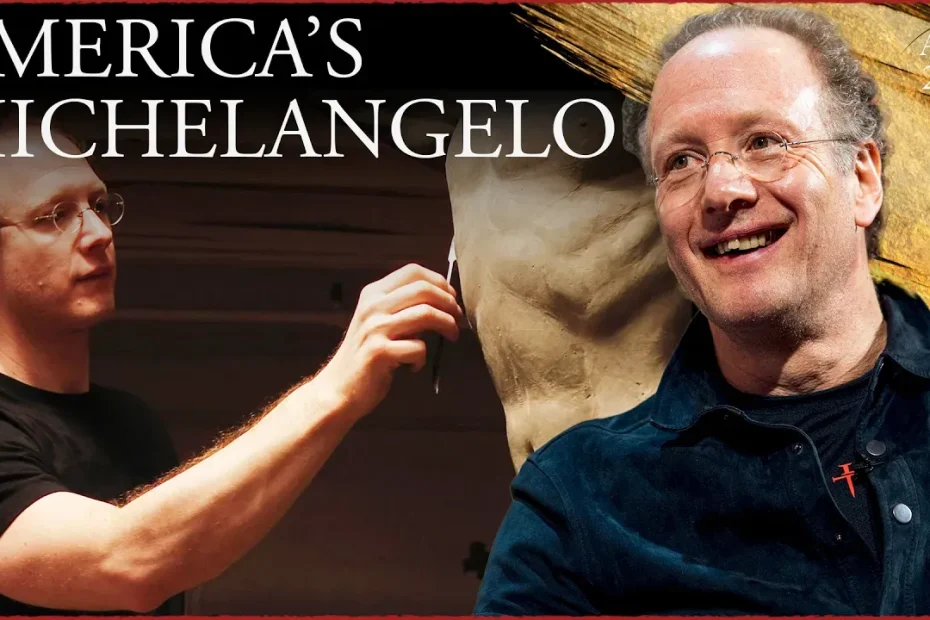
Read the full transcript of Master sculptor Sabin Howard’s interview at ARC conference 2025 [Mar 1, 2025].
Listen to the audio version here:
TRANSCRIPT:
The Birth of America’s Most Powerful War Memorial
INTERVIEWER: Sabin, come and join me. Thank you. I’d love you just to start by telling us the story of that incredible piece of art that we’ve just seen. It took you four years, I believe, to create.
SABIN HOWARD: A Soldier’s Journey is the hero’s journey. It tells the story of a father, a soldier, and an allegory for the United States. Father leaves family, leaves his wife in service to country, and enters into battle. And in that battle, he is transformed, never to return. The final scene is that dad handing his daughter the helmet. She is the next generation. She is World War II.
INTERVIEWER: And I remember us talking about this piece of art, and because it took you four years to create, tell us about the young girl at the beginning and at the end.
SABIN HOWARD: The alpha and omega is my daughter. She was 11 when we first did those original images, and at the end she was 15, or older, almost 16. The same length of the war.
The Sacred Art of Creation
INTERVIEWER: You talk, too, about a connection with the sacred when you’re creating art, and your desire to translate what’s in the universe into a physical reality. How does that work?
SABIN HOWARD: Well, first of all, I work very traditionally. So I’m working with life models. So already, there you have it, we’re made in the image of God. And I’ve done this for now 42 years, and 85,000 hours of working from life. So I have a very intimate translation of life into art because of the way I’ve been educated. It’s not just I’m looking at it and saying, how do I feel about it? It’s no, it’s a deep deduction that’s scientific. It’s spiritual. And it’s based upon proportions and methodologies of design that came out of the Greeks and Romans and the Florentine system in the 1500s.
The Journey to Create the Memorial
INTERVIEWER: And you won the opportunity to create this art. Yes. And was that a straightforward process?
SABIN HOWARD: Yeah, I’m the poor sod that won this, yes. It was a 360 global team competition. And once I won it with Centennial Commission, that was only the beginning, because then I did 25 iterations, 12,000 poses to come up with 38 poses. And from there, then I had to go through the Commission of Fine Arts. And then from there, we also had to raise the money to make the project.
INTERVIEWER: I love the fact that you can win something and then you have to raise the money. That’s quite something.
SABIN HOWARD: It’s brilliant, isn’t it? Yeah. It’s the world of art.
INTERVIEWER: But then was it plain sailing? And did everybody just love what you were creating?
SABIN HOWARD: Well, I took on this project because, doing figurative art in this tradition, there are a lot of walls that you face in the art narrative. It’s like you’re fighting modernity. And so I figured out a way to get through the door. And then once you get through the door, then it’s a different floor. But it’s the same problems, because then you face committees that are bureaucrats in Washington, DC. And their values are not necessarily what my values are.
We’re dealing now with modernists that want to maintain a park because that was a park that was highly contested in terms of what the monument would go in or would they maintain it. So then we have another battle on our hands. And so eventually that wall was broken through as well.
Overcoming Creative Challenges
INTERVIEWER: When I think about creating anything, when I sit down to write or when I sit down to do anything, it always feels like there’s a kind of friction before I even get going. And the effort required to create something and to bring it into being when it didn’t exist before, it’s like, there’s a tension there. And then you have all of these other kind of battles along the way. What is it like for you as an artist to create something into the world now, something where you’re trying to lift people’s gazes higher?
SABIN HOWARD: The obstacle is the way. I mean, I don’t see anything different between life and creating art. They’re very similar. They’re interchangeable. And art doesn’t just come out of the ethers, it comes out of your life. So the actual struggle of being a human being, the daily grind of whatever you have to do sharpens you. It’s like a sword that gets beaten into that sharp point. Art is the tip of the spear.
So, okay, let’s imagine this, you have a composition, it’s 38 figures, all those 38 figures are interchangeable in that hole. You’re making one sculpture, not 38 figures, you’re making one unit. And so the problem-solving is continuous. It’s not like, okay, now we have smooth sailing. It’s all the time.
And so when you get into something like this, I enjoy it because you’re returning to the same larger problem for nine years. You don’t have to deal with other things. You’re dealing with the actual making of art. And for myself, it’s a challenge. And I like being in that place where I’m pushed to a place where I’m not sure if I’m going to actually pull it off. And then you really do rise to the occasion. You call on all your creative abilities to problem-solve then. It’s necessary. You don’t want to do something that’s formulaic at all.
The Deeper Meaning of the Memorial
INTERVIEWER: When you think about particularly this piece of art, you were commissioned to create a World War One memorial that was going outside the White House.
It was telling a story that hadn’t really been told in this form before. There was no memorial, I believe, in DC to World War One. What was the story you were trying to tell?
SABIN HOWARD: I am not the same man today that I was nine years ago. This was an on-the-job training. Look, first and foremost, I learned my biggest takeaway was I’m in service of something larger than myself. And that’s the definition of the sacred.
So here you have a decimation of 22 million people 100 years ago. It’s a forgotten war. The U.S. doesn’t really acknowledge it. Changed the world. Changed how we see us. How we see humanity. And it’s this line in the sand that all of a sudden there is no divine order. Sacredness has gone out the window. I mean, why would you believe in God when 22 million people are gone? And so then now we enter into the age of modernity, which we are living right now. We’re isolated, alienated, fractured, not unified.
And so I’m given this task, and I don’t know all these things viscerally like I do now. And there was another moment. Also, it’s like from the midpoint to the end, I realized the college kids and the actors that I’m using as models, they’re not adequate to tell the story of men that have been in battle and been in hell. And so what happened was I started chatting and looking at veterans that actually had been in combat in Afghanistan, in Iraq, had tried to commit suicide. They told me their story.
INTERVIEWER: The shell-shocked soldier is a ranger. He’s absolutely central, isn’t he?
SABIN HOWARD: Yeah, he is the focus of this whole memorial. He is that moment that we change and are no longer unified. And he’s the only figure that comes out directly at you, the audience. Everybody else is moving forward, interdigitated, like humanity, but he’s alone.
The Final Message
INTERVIEWER: And the story that goes on from there, is there any hope towards the end as you see it?
SABIN HOWARD: Well, you do have a nationalistic moment. The flag is risen after that scene with a parade home, but the return home is not necessarily joyous. It’s the dad, the soldier, returning to his daughter. His gun is in his hand, and in his other hand he hands the helmet. Now it’s face up. Pandora’s box has been opened.
And his daughter accepts that helmet, and if you look at her pose, there’s a lot of stress in her. Her neck is down. It’s not elevated and expansive. It’s compressed, and she holds the load. It’s World War II. It’s the next generation. It’s the war that followed World War I.
The Impact on Art Itself
INTERVIEWER: And when we’ve talked about this, you’ve been able to demonstrate the extraordinary impact that this moment had on the art form itself. In fact, even in the VT, you said we stopped using human figures at that point in time. Can you tell us the impact that you think this had on even the very discipline of art, and then how you think we might move beyond?
SABIN HOWARD: Well, it’s interesting if you look historically. Every period of civilization has a figure that represents its people and that time frame. Baroque, Renaissance, Rodin and the Impressionists, you know, Hellenistic Greece with the Laocoon, they all have a
SABIN HOWARD: Symbol of what we look like. So all of a sudden you come to 1920s and the figure vanishes. God vanishes. I am revolutionary because I am not revolutionary. That is what we looked like a hundred years ago, but it was made today. So it’s pertinent to where we stand at this very moment in time.
INTERVIEWER: So when you say you are revolutionary because you are not revolutionary, this is because you’ve reconnected with the old disciplines and art form. Help us understand that.
SABIN HOWARD: I never disengaged. My vocabulary is not invented out of whole cloth. It comes from the really rich lineage of Western civilization, and that’s how I pick those poses. I didn’t do esoteric poses coming out of the Renaissance that are quiet and still. No, I looked for something that’s vibrant, visceral, dynamic, because dynamism is free will, moving forward towards that which you wish to be. And so all these figures are borrowed from Bernini and the Baroque era out of Rome, except I’m not doing that. I’m looking at that circle, that vocabulary, and I’m taking it and I’m applying it to my life in this moment. And we’re very affected by film. Film is kinetic, it’s dynamic, it moves. It’s not like figures that are still on a dais.
Hope and Future Projects
INTERVIEWER: So you say that you are full of hope moving forward. Can you just, as we bring our time into land, can you just talk us through some of the hope that you feel and some of the projects that you want to work on as you’re moving forward?
SABIN HOWARD: Well, I see this as a Renaissance, an American cultural Renaissance that will be global. And I think one of the things that is amazing about ARC is we plant a lot of seeds and then those seeds go out in the world. And you never know how they’re going to grow. We never know how they’re going to affect others. I’m taking on three other monuments larger than this one, all in the same genre, which are about humanity. Art is the tip of the spear. Art leads the real world. There’s a distinction. For me, art is not part of the real world, but it’s what can be. It’s about rising to the occasion. So it points an arrow directly to upward consciousness. What’s possible? What can I be? What can you be? What can we all be? And how can this art unify us? How can it bring us together?
A Challenge for Healing
INTERVIEWER: I love you and I have chatted about you and Marco, who’s now sitting back down here. And I know there’s an important memorial coming up for the Americans who are here. And I’ve said to Marco, could you not consider mending the Liberty Bell with gold? Would it not be possible to enact the disciplines of Kintsugi on the very concept of freedom in America and use it as a moment to heal and bring people back together again who have been polarized? So can I leave both of you as artists with this challenge to use the art form to point the way and to bring healing and restoration back to the great nation of the states?