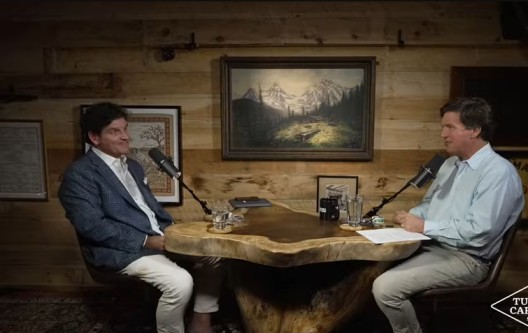
Here is the full transcript of brother Buckley Carlson’s interview on The Tucker Carlson Show, January 12, 2026.
Brief Notes: Tucker Carlson sits down with his brother Buckley Carlson for a long, candid, and often hilarious conversation that moves from airport TSA pat-downs to America’s crisis of speech and courage. Buckley reflects on how he stumbled into internet stardom on X, why he refuses to “play along” with enforced conformity, and why he sees telling the truth as the first duty in fighting tyranny. Along the way, the brothers revisit their unusual childhood, Buckley’s battles with elite school administrators, his love of dogs and nicotine, and his years working with Frank Luntz. This video lets you follow every story, joke, and argument in full, from Buckley’s most viral lines to his deeper worries about America’s future.
The Tucker Carlson Show: A Conversation with Buckley Carlson
TUCKER CARLSON: Uncle Buck, I’m glad you’re here. So you’re on Twitter. I didn’t even know you were on Twitter. And then the ghouls decided to destroy my son, who’s got the same name as you. Because in our family, there are only like four names and everyone’s required to use one.
And I think they mistook your Twitter feed for his. I don’t even know if he has a Twitter feed. And all of a sudden you became really famous. And a couple of your nieces called me, “Uncle Buck’s on Twitter.” I had no idea. I was like, I didn’t know that. How long have you been on Twitter?
BUCKLEY CARLSON: Not very long. Since 2010. But mostly as a reader.
TUCKER CARLSON: Yeah.
BUCKLEY CARLSON: And now that there’s nowhere else you can get news except for UN’s review—are we allowed to talk about UN’s review on this? Other than UN’s review, or Revolver News, the only other place you can get information these days is on X. So if you’re not on it, you’re not getting information. I had never actually rendered many opinions on X. But I started doing that recently.
TUCKER CARLSON: Oh, did that change?
BUCKLEY CARLSON: Yeah, it did. And it’s been so fun, actually. You meet some interesting people on X. There’s a lot of creativity on X.
TUCKER CARLSON: I agree with that.
BUCKLEY CARLSON: There is a lot. I wouldn’t know how to make a meme if my life depended on it, but I sure appreciate them. Other than that, there are some seriously well-researched smart people who’ve got a lot of interesting stuff to say. And it’s addictive. I try not to spend a huge amount of time on it. I actually have work to do. But it will suck me in.
Beating Addictions and TSA Encounters
TUCKER CARLSON: But wait, so you beat alcohol, you beat cigarettes. But Twitter’s hard.
BUCKLEY CARLSON: Thankfully, I’ve got a lot of nicotine with me.
TUCKER CARLSON: Good. Are you armed, by the way? I always assume you normally have a gun right on the table, but I don’t see it.
BUCKLEY CARLSON: Sadly, I had to fly through. I had to be groped by TSA this morning at dawn. It was awesome.
TUCKER CARLSON: What’s your strategy for that?
BUCKLEY CARLSON: My strategy used to be, “Hey, say please and thank you. Because you work for us.”
TUCKER CARLSON: Right?
BUCKLEY CARLSON: They love that message.
TUCKER CARLSON: Yeah, they do. I’ve seen you try to enforce manners. Anglo manners at the TSA station. Doesn’t work.
BUCKLEY CARLSON: No. And actually, recently, since they’ve instituted the real ID and they have you stand and take your picture—I know they have your picture everywhere else, and they have your biometrics—I took a principled stand a few times and said, “Oh, no, I don’t think I want a picture.”
Well, every time that’s happened, they managed to discover that I have a duplicate ticket or no TSA badge, and I have to go back to the front of the line. So I don’t do that. I’m captain compliant. I go through. I’m super courteous when I walk through.
TUCKER CARLSON: So they broke you like Winston Smith at the end of 1984. They just broke you. You’re like, “Two plus two, I think that’s five.” Is it fun?
BUCKLEY CARLSON: You just have to surrender at some point if you want to fly anywhere these days. So, no, I’m not armed, sadly, but I’m in the great state of Florida.
TUCKER CARLSON: I don’t think I’ve ever seen you unarmed. But this is a safe place. Normally you have this little thing on the table, Uncle Buck. What’s that? Backup planner. But so you’ve actually been broken by TSA.
BUCKLEY CARLSON: I don’t really think there’s any other solution to it. I’m still angry about it.
TUCKER CARLSON: Right?
BUCKLEY CARLSON: Oh, for sure. Legitimately, I find it to be one of the most humiliating experiences in American life. And I do still say to everyone around me after I’ve gone through the groping, I say, “Do you feel safer?”
TUCKER CARLSON: You do say that every day. You operate every comment in the line.
BUCKLEY CARLSON: It’s amazing how few people actually will take the bait.
TUCKER CARLSON: They can smell the non-compliance on you and get away quick. Big time. No, he should be deplatformed.
BUCKLEY CARLSON: Boy, there’s a lot of that on X. I had heard that you could say whatever you want. It turns out that’s not true.
TUCKER CARLSON: Oh, it’s not true?
BUCKLEY CARLSON: No. And people have no sense of humor.
TUCKER CARLSON: Oh, they don’t. They don’t like jokes anymore.
BUCKLEY CARLSON: Yeah.
TUCKER CARLSON: Can I just give you my strategy for TSA when I get groped, please?
BUCKLEY CARLSON: Little to the left.
TUCKER CARLSON: Yeah, no, totally. Yeah. Like, “I’m going to touch you around the belt area, sir.” I’m like, “Bring it on, baby.” And then just act like you love it. And it’s so creepy that it’ll abbreviate the experience.
BUCKLEY CARLSON: Do you go the X-ray machine so they can keep the file?
TUCKER CARLSON: I try not to. I’m so paranoid about all of that stuff. I’m getting crazy and I’m like, “Oh, I’m going to get some weird lymphoma from the magnetometer or something.” I just don’t.
BUCKLEY CARLSON: No, I can’t. Although I figured once you’ve surrendered and you can’t do anything in American life without surrendering to some extent, even emailing or texting, you know that other people have it. So at some point you should just adopt an attitude.
TUCKER CARLSON: No, I think you’re absolutely right. I mean, we’ve both been tamed by the women in our lives and just, “Stop making a fuss.” But I always think these are the people who ran the burn pits at Camp Lejeune.
BUCKLEY CARLSON: Yes.
TUCKER CARLSON: Where our father was stationed in the Marine Corps.
BUCKLEY CARLSON: And never joined the class action.
TUCKER CARLSON: Never. He never joined the class action. That’s right.
BUCKLEY CARLSON: Not a litigious man.
A Culture of Non-Litigation
TUCKER CARLSON: I was saying to someone the other day, I’m 56. I’ve never sued anybody. Someone said, “People are slandering you. You’ve got to sue.” And I was like, “I’m committed to a higher principle that in my culture, we’re not into lawsuits at all.”
And I’m never going to—I want to make it to death, and I hope it’s a while from now, without ever suing anybody. That’ll be a personal victory for me and my family. And really only our family will appreciate it. Because the culture we grew up in is just gone. Doesn’t—like it never existed.
BUCKLEY CARLSON: But I’ve noticed. Yes.
TUCKER CARLSON: Oh, you’ve noticed.
BUCKLEY CARLSON: Yeah, I have noticed a little bit.
TUCKER CARLSON: Has it been a net win or loss for the country, would you say?
The Death of Free Speech and Thought
BUCKLEY CARLSON: After we won World War II and we got to luxuriate in our freedoms and all the economic prosperity that has led us to be freer and able to speak our mind? No. No, it’s actually tragic.
And if you have young children, as you do—I guess they’re no longer young—but you really see it with the way our children have grown up and the restrictions they’ve had on thought and speech especially. I mean, we grew up at a time, as you know, where I don’t think anybody’s ever heard this question before.
And in a school setting, one, ask any question you want. In fact, you’re encouraged to ask a question. I was always taught, “Ask any question, you’ll never get in trouble.” And then that silly little ditty, you know, “Sticks and stones will break my bones, but words will never hurt me.” That was real.
And none of our children were taught that. No American child goes through life thinking that they can deviate from the script, that they can offer some opinion that’s counter to the authorities that are in front of them. And that’s tragic. And it obviously has a huge effect. It stifles imagination and creativity, which are why they’ve died.
TUCKER CARLSON: I think actually that slogan, which, if you’re under 50, you may not be familiar with, but it was a staple of, well, England, by the way, and then the United States, its child. “Sticks and stones may break my bones, but words will never hurt me.”
It’s actually been inverted where we’ve endorsed sticks and stones. Violence is no big deal. We’re totally for violence. “Just blow up the drug boats, whatever. Are they drug runners? Who cares? Kill them.” And by the way, “Charlie Kirk got shot. Well, yeah, because he used bad words. He deserved it.” People believe that.
So sticks and stones are fine, but words are the threat.
BUCKLEY CARLSON: It’s terrifying, actually.
TUCKER CARLSON: It’s not a Western orientation.
BUCKLEY CARLSON: No, no, it’s not. But it is prevalent here now in the West. It’s everywhere.
Refusing to Play Along
TUCKER CARLSON: So you’ve—it looks like you’ve decided not to play along.
BUCKLEY CARLSON: I am not playing along. And I’m fortunate because I’ve grown up in an atmosphere where actually I was encouraged to say what I believe. I don’t have a lot of governors in my life, especially now that my child is old enough not to be embarrassed by me daily.
And I don’t have to fight with his various academic institutions that charged me a lot of money and tried to wipe out the boy and wipe out the creativity from my son. And that was a 12, 14-year battle that I had to fight.
And also I—so I don’t really care. There are very few people whose opinion matters to me in the end of the day. I have a constituency basically of one, and that’s the woman I love and live with and my son, and then the slightly expanding circle of you and other family members beyond that.
And every one of those people is perfectly apprised of my deep flaws and my history.
TUCKER CARLSON: And your amazing virtues. And as one of my children said to me, in fact, all of my many children said to me and my nephews, when you made your public immersions on Twitter, “The legend of Uncle Buck is now out there for the public to appreciate.” And by the way, they loved it.
BUCKLEY CARLSON: That’s so nice. I guess the key is just not thinking about it. I don’t think about it. That’s—actually, I was thinking, I thought you might ask me about this only because it’s a new thing in my life. I likened it to shooting rabbits on a sporting clay course. The most accurate you’ll ever be is if you’re just instinctive. You just pull your gun up and you shoot.
TUCKER CARLSON: That’s totally right.
BUCKLEY CARLSON: And so I don’t have a lot of time to think about what I write. I’ve managed not to write anything too embarrassing. I don’t write things that are intentionally provocative. But I also have no trouble expressing myself. And there’s so much absurdity out there that needs to be addressed. I think so.
The Power of Truth
TUCKER CARLSON: And I think that the most important act of defiance is not violence. I have come to believe in my age that violence actually doesn’t seem to solve—I don’t really know when the last time violence solved a problem. It’s also prohibited to us as Christians. So there’s that. But you can’t kill innocents. Sorry.
But I do think they’re right to worry about words.
BUCKLEY CARLSON: Yes.
TUCKER CARLSON: Actually, words do change the world. The New Testament changed the world, period. The Old Testament changed the world. I mean, truth changes everything. And you may not live to see it come to fruition, but it still is the most profound thing you can do to fight tyranny is to tell the truth about tyranny.
BUCKLEY CARLSON: Yes.
TUCKER CARLSON: Do you feel that?
BUCKLEY CARLSON: Very much so. And I think—and there’s a huge amount of people in this country and across the world who do. And it seems like they, aside from podcasts like yours, and there are very few—there are few opportunities for people to express themselves honestly. Unfiltered.
The School Confrontation
TUCKER CARLSON: You talked about growing up. Obviously, we grew up together. We’re the only children in our family. We had the world’s smallest family. It’s like three of us for a while, and then we’ve lived next to each other our whole lives until pretty recently.
And you talked about telling the truth at your kid’s school. I should just say this because it’s one of the things I admire so much about you. We sent our children to the same school. Obviously, I forgive you. Well, my wife convinced me to send yours to the school that our kids went to. And of course, it turned out to be a sub awesome school, very liberal, crazy school. But, you know, it was our neighborhood school. Whatever, we did it, let’s not regret it.
But you were the only person in this rich person school that we sent our kids to to confront, you know, with politeness but firmness, the administration of the school about what they were telling your child, which was totally bonkers. Men can become women and hate yourself if you’re white and all this stuff. And boys are bad, testosterone’s bad, masculinity’s bad.
And everyone else was like, okay, well, it’s a prestigious school. We’ll just go along with it. You were like, I know. And I remember all the moms kind of hated you, but were also sort of attracted to you, just to be honest about it. And they were like, “Oh, I can’t believe your brother’s always making a fuss.” And you’re like, “Yeah, I don’t care.” Why did you do that? You’re the only person.
BUCKLEY CARLSON: My son is the greatest blessing in my life. And it’s the sole purpose. It was my sole purpose for a long time. It seemed it’s the only thing that could be important. It’s the only enduring thing when people ask me when I was a kid, probably because we had such a happy, thoroughly f*ed up childhood, but really happy, thanks to our father, who was so extraordinary in every way and made it very clear that we were the number one priority in his life.
I mean, and he was the busiest guy I’ve ever known, involved in so many things, and yet we were without a doubt his only focus. Or his primary focus. And he would do anything, would do absolutely anything. So literally, there are no boundaries. And so that seems normal to me. That was my reflexive attitude about my son.
I think the first thing I encountered when I took him to that school that pretended to be a nice Episcopalian school with its own chapel, I noticed they were anything but Christian in their attitudes. And it was the middle of the Obama administration when everybody got super empowered about indoctrinating children on a level that I don’t think I’d ever seen. I don’t think that America had ever seen it.
TUCKER CARLSON: No.
BUCKLEY CARLSON: And you pay all this money because there’s really no chance that you would send your children to a public school in Washington. I thought. Didn’t. There’s actually an argument probably for sending your children to something other than what we sent ours to.
Anyway, I remember showing up. It was right after the election. And I’m not a big bumper sticker guy, but I had a bumper sticker. Probably the only other, only bumper sticker I’ve ever owned. And it was a series of four memes. And it was pro God, pro life, pro gun. And then it had the Obama horizon with a cross with a slash through it. That was in the back of my Chevy Tahoe.
And I pulled up and dropped my son off at school. And the visceral reaction from the entire teacher platoon that was outside was obvious. And so actually, I made a commitment right then and there. Again, I was kind of embarrassed to have a bumper sticker on my car. Who does that? But I kept it on there religiously for the next eight years until the car died.
TUCKER CARLSON: Yeah.
BUCKLEY CARLSON: Until one of our friends actually took that car that I had tried to flip and destroy many times and unsuccessfully was unsuccessful. And he flipped it and broke his neck.
TUCKER CARLSON: Yes, he did. He’s okay.
BUCKLEY CARLSON: He is okay. But he was. Yeah.
TUCKER CARLSON: Was sober, too.
BUCKLEY CARLSON: Yes, he is.
TUCKER CARLSON: In his defense, he was dead sober. He was going hunting, and it was in the morning. It was in Maine. And he hit black ice.
BUCKLEY CARLSON: Yes.
TUCKER CARLSON: Yes.
BUCKLEY CARLSON: Even having grown up in rural Maine, he somehow was an expert at dealing with the guys.
TUCKER CARLSON: He took the top of a pine tree off with the vehicle. I know. I drive by it all the time.
BUCKLEY CARLSON: I say a quick prayer every time I go by it.
TUCKER CARLSON: Me too.
BUCKLEY CARLSON: He’s unbeatable on everybody, so he’s going to have us both for sure.
TUCKER CARLSON: What a wonderful man.
Race-Based Indoctrination
BUCKLEY CARLSON: So that set the tone. And then the fact that they have your child captive, you pay all this money, they should have a classical education that in this case was billed as something that was rooted in the Christian church. And yet immediately they adopted and started all these clubs that were race based.
My son went there in fifth grade, so he was 10. And they immediately started not only indoctrinating all the kids there, but making them feel horrible about themselves, segregating kids by race. This is a school where the entire. It’s in the middle of the swamp. So it’s the richest zip code in all of D.C. and so the diversity.
TUCKER CARLSON: One of the richest in the United States.
BUCKLEY CARLSON: Yes. And the diversity that they had. They talked endlessly about diversity. And the diversity they had there was color only. Everybody was in the same industry, Everybody was working. Everybody was driving a f*ing Range Rover. I wasn’t, but you know, they were.
And yet, anyway, so it was stifling and confusing for children. And I just wasn’t going to sit back and allow them to do that. And I tried to be reasonable. I was just persistent. And they. Boy, they didn’t like it. They actually despised me. In fact, I guess I’ve encountered that a few times in my life. But boy, they heartily dislike me. And these are the kind of people who probably do have voodoo dolls back home.
TUCKER CARLSON: Oh, 100%. They’re all Wiccans. No, they were.
BUCKLEY CARLSON: My back pains were not from being overweight or from not having a tough core. It was someone sitting. Some booger eater sitting at home, you know, stabbing me with a f*ing dagger. Excuse my language. Sorry.
TUCKER CARLSON: No, it’s fine. No, you’re right. It was so interesting because I saw it. Obviously, I’m your brother, My wife is your biggest fan. So it’s like, of course we supported you, but I just. But I was not as brave as you. Not even close. And I felt exposed because I had a public job. I didn’t want to get, you know, whatever. I felt a little bit constrained.
But you were braver than I. That’s just a fact. But the reaction from the other parents, all of whom liked you because everyone likes you, but they were. They didn’t want you, even the ones who agreed with you, to keep saying stuff like this. Because I think they wanted to ignore it. They wanted to fit in more than they cared about their own children’s moral and intellectual development. I mean, that’s just a fact.
Cowardice and Self-Loathing
BUCKLEY CARLSON: That. And also, I think cowardice breeds self loathing, which turns into hostility, extreme hostility. I saw this during COVID in the same place. Cowardice breeds self loathing. I think people who are cowardly hate being cowardly. They know they’re being cowardly and they hate themselves for it, especially men or people who claim to be men. And then that manifests itself in extreme hostility.
I mean, I saw everybody’s had their experiences during COVID. But I encountered the most extreme hostility when I never wore a mask. I mean, I was compelled to wear a mask on an airplane. Other than that, I never wore a mask. I just wouldn’t. I refused.
And I would travel a lot, so I would go through Chicago Airport and be the only person that I ever encountered with no mask. And it wasn’t the authorities who wanted to tackle me. It was the other people going past me on the people mover on the escalator, who look like they wanted to f*ing stab me in the face.
TUCKER CARLSON: Right, right.
BUCKLEY CARLSON: And then when I would. I write for a living, and I need to get out in the world and nature and, you know, it’s a tough business. It’s a solitary business. So I take my dogs twice a day and run them in nature.
TUCKER CARLSON: Oh, you have dogs?
BUCKLEY CARLSON: Oh, yes, I have a few dogs. I have five dogs.
TUCKER CARLSON: Which is, I think, actually about the ideal number.
BUCKLEY CARLSON: Is that right? It’s about the ideal number. Yes, of course. I said that every time. 3, 4, 5 is the ideal number.
TUCKER CARLSON: Yes, it’s the best.
BUCKLEY CARLSON: But I would encounter people outside on a windy day in the sun, walking, and I would, of course, didn’t have a mask on, and they would all have their dutiful masks on, and it would inspire. The fact that I didn’t have a mask would inspire in them this kind of hostility that I’ve never encountered anywhere else. And, yeah, it was obvious, I think something like that was going on at the school, very much so.
TUCKER CARLSON: At the little Episcopal day school, because the other parents knew that this was bad. And when their kids started to become trans or get into drugs or whatever, you sort of know it’s not all your fault. You know, you can’t blame parents for everything, but it is partly your fault. And they sort of.
BUCKLEY CARLSON: You can kind of blame parents. I try not to judge people, but I do definitely judge them about their parenthood. That’s about the one thing I judge people on. Right.
TUCKER CARLSON: Although trying to be nice.
BUCKLEY CARLSON: I know. I mean, you don’t actually have total control. There are people who have aberrant children that they’re, I believe, are not responsible for. But I think the majority of the weird child behavior stems from shitty parents or parents who were occupied with other people’s problems rather than their children’s problems. Yeah.
TUCKER CARLSON: What you’re saying is true.
BUCKLEY CARLSON: Yeah.
The Joy of Defiance
TUCKER CARLSON: So I should just say for the record that you were scoffed at for having the pro-life, pro-God, pro-gun, anti-Obama bumper sticker at a Christian school. At a Christian school, right? No pro-God, no pro-life at a Christian school.
But then you decided to take your defiance another click up the ladder by driving your son to school on a big twin Harley in carpool line, which I personally saw.
BUCKLEY CARLSON: He was like a little kid.
TUCKER CARLSON: There’d be all these Range Rovers involved. You look over, be like, there’s Uncle Buck with the ape hangers.
BUCKLEY CARLSON: I had him strapped to my chest with a bungee cord. It was safe.
TUCKER CARLSON: No, it was. I mean, safe as a relative term. And our families, we know there’s no such thing as safety. There’s only destiny and we both believe that. But safe, okay, but it wasn’t even a safety violation. It was like a cultural violation.
BUCKLEY CARLSON: Yes.
TUCKER CARLSON: And all the moms, you could tell, they were a little bit turned on, but also very kind of like, oh, what is this? I saw that with my own eyes many times. What was the thinking there?
BUCKLEY CARLSON: Pure celebration of joy and freedom. That’s it. That’s how I try to live my life. You’re called to be joyful. In fact, you’re commanded to be joyful.
TUCKER CARLSON: Totally agree.
BUCKLEY CARLSON: You are. You are.
TUCKER CARLSON: What is that? Susie has that thing all over our house. First Thessalonians: “Rejoice always, never stop praying.” Yes. It’s my favorite. Right? No, you’re absolutely right.
BUCKLEY CARLSON: And Philippians 4:4, which is “Always be full of joy in the Lord. I say again, rejoice.”
TUCKER CARLSON: Yeah.
BUCKLEY CARLSON: Yeah.
TUCKER CARLSON: That’s just such a wonder. It’s funny that that’s triggering to people. Whatever it was, you were triggering people. And I felt like it was such an act of bravery, because it’s one thing to stand up at the Congress and say something unpopular or even go into battle, but to stand apart from your neighbors at the $50,000 a year Episcopal School in Northwest Washington, where there’s just so much conformity, that takes balls.
BUCKLEY CARLSON: Well, I appreciate it. I don’t think I really thought of it that way. I’m so used to it. I don’t know. I’ve lived my life. We were, as you said, we grew up that way.
A Childhood of Freedom and Creativity
TUCKER CARLSON: What do you mean? Because I did say—okay, so I haven’t looked at a lot of your—I’m not on Twitter that much because it’s too upsetting to me, but I did go and check your Twitter feed, which I thought was amazing. But some of the responses are like, “Oh, of course you feel this way because you had such a horrible childhood.” It’s like, wait a second. What are you—people are very personal that way. Attacking your childhood. What did you think of your—without getting too specific, but like, you described it as happy.
BUCKLEY CARLSON: I actually had the best childhood. I’m really sorry for our children that didn’t have the childhood that we had.
TUCKER CARLSON: I agree with that.
BUCKLEY CARLSON: Because it was just a lesson and adventure all the time. You could define your own boundaries as long as you went to school, you were respectful to your parents, and you showed up for dinner. There were really no other boundaries, nothing. That was it.
And I loved you, and I loved our father, and I loved our mother. So we had a happy home life, and it was creative and interesting. It was in a beautiful part of the world that was, at that time, very well run in California. In fact, I think it was the cleanest, most efficient state in all fifty.
And it was obviously the center of creativity in the country and in the world. And it was fantastically beautiful everywhere. I mean, it has every single climate. We lived near the beach, and we got to go swimming in the ocean, and we had a bunch of dogs, and we got to explore. We got to explore with our friends and experiment.
And we also went—I’m sure you recall, it was a much different time. We could actually walk across the border into Tijuana, Mexico, and engage in all sorts of interesting—
TUCKER CARLSON: It wasn’t the most wholesome place.
BUCKLEY CARLSON: No, it really wasn’t. I was suddenly thinking, is Revolution Avenue still around? Is it still accessible to American kids?
TUCKER CARLSON: I think the whole thing is so different now. I don’t know. I’m not in Tijuana a lot, but I think it’s huge. I think it’s bigger than San Diego. It’s controlled by the drug cartels. I don’t know. I shouldn’t say that.
I’ve never been against Mexico. I’ve always liked Mexico. Obviously Mexico has done more harm to the United States than any other country. Not even close. But I still like Mexicans and I still just have happy memories from Mexico. We’ll never be against it, just for reasons of memory. But I wouldn’t go there to Tijuana. No.
BUCKLEY CARLSON: And I wouldn’t send my twelve-year-old child there either.
TUCKER CARLSON: No.
BUCKLEY CARLSON: But we were.
TUCKER CARLSON: That’s right. We were allowed to do basically whatever we wanted as long as we were polite. And family loyalty was at the center of everything. Of course.
BUCKLEY CARLSON: Yes, yes. And it was interesting. Our father was involved in so many interesting pursuits. He had interesting friends. Yes, our friends were interesting. He included us. He treated us like adults, where it was appropriate, I guess. All the time. All the time. He taught us invaluable things that no one teaches their children anymore.
TUCKER CARLSON: Yes, for sure.
BUCKLEY CARLSON: I mean, yeah.
TUCKER CARLSON: And you’ve used the word creativity a couple times. It felt to me, looking back—I never thought about it until recently as I see the decline in creativity and the awards given to people who are totally non-creative, which is almost everyone in our professional class, like zero creativity. And the creative people are penalized.
And that’s made me think that maybe the saddest change is the disappearance of creativity and the abundance of it in our childhood. Like that was—wait, I never heard anybody, certainly not our father, ever talk about how rich someone was. Who gives a shit?
BUCKLEY CARLSON: Plus, no one noticed. Everybody was pretty much in the same boat. We lived in an expensive area, we had a nice house, but it was not absurd. No one had $5 million houses. No one had $50 million houses either.
TUCKER CARLSON: There wasn’t such a thing.
BUCKLEY CARLSON: No, there was literally not such a thing.
TUCKER CARLSON: So the measure was—and there was much less economic anxiety. Obviously it was a different economy, but still the values were different. And creativity, the ability to create something out of nothing, that was really prized.
BUCKLEY CARLSON: Yes. Especially if your father gave you the—what was the James Bond cookbook? And what was the other one?
TUCKER CARLSON: Oh, yeah.
BUCKLEY CARLSON: I guess they’re illegal. Yeah, they’re illegal now. Sorry.
Our Father’s Library
TUCKER CARLSON: Well, he had a library, first of all. He had a real library, like almost a public library in our house. And he’d read every book in it, and he was very serious about it. And it was—talk about catholic tastes. I mean, broad tastes, universal interests. He’s just like nothing he wasn’t interested in.
And there was a book about every possible thing. And there was a ton of extremist literature on all sides. He didn’t buy any—he wasn’t like—he was an extremist. He was not an extremist at all. But he was really interested in knowing what people thought and why. And this revolution happened.
And he hated the Soviets, but he had tons of Soviet propaganda literature, which was interesting.
BUCKLEY CARLSON: Yes.
TUCKER CARLSON: He had tons of left-wing and right-wing. Mostly left-wing, actually. And he was not left-wing.
BUCKLEY CARLSON: But that was back when they were creative, when people on the left actually were artists and thinkers and they were open-minded.
TUCKER CARLSON: He would always defend people whose politics he hated. If they were creative, he would say, “This guy’s an ahole. I think these ideas are horrible. But, man, look at the songs he wrote or the novels he produced.” Do you remember that?
BUCKLEY CARLSON: Very well. Clearly.
TUCKER CARLSON: Yes. That counted in your favor.
BUCKLEY CARLSON: Yes.
TUCKER CARLSON: And that’s kind of gone.
BUCKLEY CARLSON: It seems like it.
A Nicotine Interlude
TUCKER CARLSON: So I didn’t even know this until you—I can’t believe we’re actually doing this interview. I’m so glad.
BUCKLEY CARLSON: I’m so glad too. Thank you. Could we—could I ask you an Alp question, by the way?
TUCKER CARLSON: Of course.
BUCKLEY CARLSON: Best nicotine product in the universe.
TUCKER CARLSON: Why, thank you, Buck.
BUCKLEY CARLSON: I’m glad you noticed. And yes, I did. And I’m generally—this is the problem I have when I’m talking, I’m generally double barreling or sometimes triple barreling.
TUCKER CARLSON: And those are nines.
BUCKLEY CARLSON: Yes. I’m looking forward to the twelves.
TUCKER CARLSON: So on the question of nicotine, would you say, and I know it’s hard to assess yourself, but would you say you dick around?
BUCKLEY CARLSON: If I like it, I like it. I really like this a lot. Although it’s—so this is the question I have. Where does one tuck it? I know where people tuck the Zyn. I get that.
TUCKER CARLSON: They stuff it.
BUCKLEY CARLSON: Yes, they stuff it. By the way, they should be more upfront on the labeling on the Zyn. I know they should actually tell you that. That’s why it tastes like shit. That’s why it’s like dehydrated. They forgot to tell you it needs mucosa, but a particular type of mucosa to activate. Yeah, they got it wrong.
TUCKER CARLSON: I think they’re expecting the Bangladeshi guy in the convenience store to tell you, to hand you the KY and the surgical glove and just be like, “I think you know how this works.” It’s like when they have those little crack pipes at the counter with the flower in them and like—no, it’s not a crack pipe. I think they’re—it’s an incense burner.
BUCKLEY CARLSON: It’s a whistle.
TUCKER CARLSON: I think they’re expecting like, if you’re using Zyn, you know how this works.
BUCKLEY CARLSON: Yes.
TUCKER CARLSON: You know what I mean?
BUCKLEY CARLSON: That’s a good point. That’s why I actually feel like a bit of an amateur asking this. But I talk to people and all of a sudden I feel like my Biden, my upper palate is like coming out.
TUCKER CARLSON: Your Biden is my Biden.
BUCKLEY CARLSON: You know, like the fake teeth I have up here. Anyway, sorry.
TUCKER CARLSON: I try to rotate them around because there are parts of my gums that get neglected. And I believe in kind of sharing the wealth.
BUCKLEY CARLSON: Yes. Plus there are different taste buds throughout the entire topography of your tongue and cheek.
The Carlson Brothers on Their Father’s Parenting Philosophy
TUCKER CARLSON: Are you surprised? Since we’re only really a year apart. So we grew up and our father always treated us the same. There was never like, “listen to your brother.” It was a fully egalitarian household, like, in a way that also doesn’t exist anymore.
BUCKLEY CARLSON: I’m sure that was frustrating. As the oldest himself, I never even questioned it.
TUCKER CARLSON: It was like we had the same bedtime, same rules. There were never any difference at all in the way that he treated us.
BUCKLEY CARLSON: Same buddies.
TUCKER CARLSON: Which is one of the reasons we’ve always gotten along our whole lives, because he treated us fairly. Yes. By the way, if you want to make people hate each other, treat them unfairly.
BUCKLEY CARLSON: Oh, I’ve noticed.
TUCKER CARLSON: Like, institute affirmative action or DEI and you will have, like, serious race problems. But we never had anything like that. It was a pure meritocracy in our house with equality at the center of it.
BUCKLEY CARLSON: But the most intuitive, accidental father there has ever been. I mean, this was a man who did not strive to be a dad.
TUCKER CARLSON: No.
BUCKLEY CARLSON: And he ended up being pretty much the best father ever.
TUCKER CARLSON: The details of my conception have always been a little bit hazy, but I did get the—
BUCKLEY CARLSON: I don’t think they were legal.
TUCKER CARLSON: I don’t want to know.
BUCKLEY CARLSON: And I’m sure they were creative. Everyone’s probably mobile.
TUCKER CARLSON: I know.
BUCKLEY CARLSON: I can’t listen. Sorry.
TUCKER CARLSON: I can’t even think about it. But my strong impression just from, like, comments picked up over the years is that was not intentional at all. Like, the whole thing was not intentional.
BUCKLEY CARLSON: It was intentional by God. Yeah, it was God’s point.
Their Father’s Understanding of Women
TUCKER CARLSON: I totally agree with that. The closest I ever got to asking Pop about it was he obviously married like a complete lunatic. And he was such a smart person. And he really understood women and loved women and really paid close attention to women.
BUCKLEY CARLSON: Boy, they love him.
TUCKER CARLSON: They loved him. He loved them. Not just in carnal ways, but, like, he thought they were really interesting. I listened to them all the time. And he had such deep wisdom about women.
BUCKLEY CARLSON: And so I once said, boy, isn’t—
TUCKER CARLSON: That he was the deepest on women. And it was out of love. Like, true love. He thought they were amazing, but—and he also loved them in other ways. But whatever.
But anyway, I once said to him, like, given your deep knowledge of women, how could you have married a really crazy one? Like, how did you do that? And he goes, “they’re upsides.” That’s all I said. I was like, I don’t want to hear anymore.
BUCKLEY CARLSON: She was clearly never boring, right?
TUCKER CARLSON: No, I guess that was it. You know, I go with, yeah, well, they’re never boring once you engage with them. They’re like, amazing.
BUCKLEY CARLSON: But she had a lot to say.
TUCKER CARLSON: Yeah.
BUCKLEY CARLSON: Especially in public settings.
TUCKER CARLSON: Yeah. I can’t—
BUCKLEY CARLSON: Yeah, I can’t imagine.
TUCKER CARLSON: Yeah, I can’t even get it. I’m sorry.
BUCKLEY CARLSON: I don’t even know where we were.
Cigarettes, Rebellion, and Family Tradition
TUCKER CARLSON: So one thing I wanted to ask you was when we were kids and like, everyone in our family, I know this is, like, so forbidden. This is more forbidden than Israel. But, like, everyone in our family smoked cigarettes. Like, everybody and everyone they knew smoked cigarettes.
And, like, the question was, filter or non-filter? And of course, our family was strongly on the non-filter side. Gay or straight?
BUCKLEY CARLSON: Yeah, yeah. I mean, come on.
TUCKER CARLSON: We used to call them straights.
BUCKLEY CARLSON: Yes, I remember Camel straights are the best cigarette ever made.
TUCKER CARLSON: Yeah, that’s literally true. And Pop would always say it’s important not to have a filter in your cigarette because when you’re behind enemy lines, you can field strip it. You can field strip it. You can field strip it. You break the butt.
BUCKLEY CARLSON: Done it many times.
TUCKER CARLSON: Roll up the paper, flick it away. Then the enemy will never know you were smoking American cigarettes.
BUCKLEY CARLSON: They’d only know you’re American if you died and they saw your dental work.
TUCKER CARLSON: It didn’t make a lot of sense, but anyway. But the—in our family, they were, you know, people were very strongly in favor of cigarettes and tobacco. It sounds so forbidden now, but—and then we were all convinced this is, like, so bad because America’s killing itself, and if we can only get people off this, everyone’s going to live forever.
Is it a little weird? And I’m not—I don’t smoke. I’m not endorsing smoking that strongly, but—
BUCKLEY CARLSON: I’m considering going back to actually.
TUCKER CARLSON: But whatever. And for this—
BUCKLEY CARLSON: For this, I reached yesterday, I literally stepped over a dog. I was talking to my girlfriend, stepped over a dog to join her in a booth in a restaurant, and I reached in my pocket to grab my Zippo. It’s been 12 years since I’ve had a Zippo in my pocket.
TUCKER CARLSON: Seriously. I was about to light a smoke.
BUCKLEY CARLSON: We’d had a pizza. It was fantastic. And I was like, I know what’s going to cap this off. A Camel straight.
TUCKER CARLSON: Can you even buy them anymore?
BUCKLEY CARLSON: Even in South Carolina?
TUCKER CARLSON: I’m lying. I actually know I brought—
BUCKLEY CARLSON: Even in tobacco states. Do you know how much it costs? Oh, my gosh. For a deck of cigarettes?
TUCKER CARLSON: How much?
BUCKLEY CARLSON: It’s 12 bucks in South Carolina. It’s $21 in the District of Columbia. Yeah. 21 packs for deck of smokes. I walked into a Circle K the other day. My girl still smokes, God bless her. And I walked in and I bought her some cigarettes.
And the guy said, “ID.” And I laughed. I pulled out my wallet and I said, “it’s funny.” “What’s funny?” And I said, that’s what the guy said. I said, “well, I’ve been buying cigarettes since I was 11 and they cost a dollar.” “Do you think it’s funny to make fun of people in the retail business?” Said, “dude, I’m not making fun of you. I’m making fun of the stupid rules.”
TUCKER CARLSON: Yeah, yeah.
BUCKLEY CARLSON: You have no sense of humor. I don’t know.
TUCKER CARLSON: But you can buy benzodiazepines cheap.
The Modern Pariah: Cigarette Smokers
BUCKLEY CARLSON: You can buy weed in any store. You can buy it online. You’re encouraged to smoke pot. You’re encouraged to do mushrooms, you’re encouraged to do mezcal or any other stuff. But you’re the greatest pariah in America. You probably encourage—well, you are encouraged to, like, have touchy feely love with the people in your gender.
But if you’re a cigarette smoker, you’re the literally the dirtiest pariah in America. Actually, that attitude is overwhelming now, but it was still around 12 years ago when I quit smoking. And if it hadn’t been, I would have quit smoking probably 15 years ago. I would have. I mean, I got—I mean, the obvious—
TUCKER CARLSON: So you smoked in defiance? I did.
BUCKLEY CARLSON: I smoked aggressively. With joy. I did. I loved smoking and it made me smarter. It made me nicer.
TUCKER CARLSON: Yeah.
BUCKLEY CARLSON: Made me a lot happier. Not only your constant companion, but also like a self-defense weapon or an aggressive weapon. If you, you know, you’ve got a lit cigarette on you, you’re a force to be reckoned with, I would say. Plus, are you ever alone when you have a cigarette? No.
TUCKER CARLSON: You sound so much like our father because he, of course he did once wield a cigarette in self-defense.
BUCKLEY CARLSON: I had to do that too.
TUCKER CARLSON: You did it too.
Buckley’s Self-Defense Story
BUCKLEY CARLSON: I most certainly did. Maybe not on someone’s cheek, but on their wrist. I held their hand because he was holding my hand. I remember it’s like my second job. And he was a guy who had a married guy, Christian, self-avowed, loudly Christian. And he had cute kids and a nice wife. And he, like, put his hand on my knee. I said, “can you move your hand, please?” And he didn’t.
TUCKER CARLSON: Oh, he’s hitting on you?
BUCKLEY CARLSON: Yeah, at a company picnic, like the first week I was on the job. And I said, “please remove your hand from my knee.” And he didn’t. So I grabbed his hand, grabbed his wrist and put my cigarette out on his hand.
It was a Saturday afternoon and I had had some cocktails, but I also felt completely justified in doing that.
TUCKER CARLSON: I did.
BUCKLEY CARLSON: He pulled his hand away. And I remember—sorry to go down this rabbit hole, but I—the—I thought about it soberly on Sunday and Monday morning as I was going into the office and that there could be real repercussions for doing this. He was like the chief of staff of the organization. It was a political organization and he wielded a lot of power.
And I went in, I remember I was doing some copying some document, and I was standing in the break room next to the Xerox machine, and he came up to me and he said, “can’t believe you put a cigarette out of my hand.” I said, “I can’t believe you touched me. And he wouldn’t let go.”
That was it. And we had like a staring contest. And then he, like, you know, was lip curled and he looked down and walked out. I never heard anything about it. He never told anyone.
TUCKER CARLSON: Right.
BUCKLEY CARLSON: So I think it is fair.
TUCKER CARLSON: I think that’s called gay bashing.
BUCKLEY CARLSON: No, I think you are recklessly or—yeah, you’re—
TUCKER CARLSON: You’re—
BUCKLEY CARLSON: Yeah, you’re without proper defense when you don’t have a cigarette. Should have a cigarette with you at all times, even if you don’t smoke. That’s my attitude. Seriously, I want to bring back smoking because actually smoking without the filter is probably pretty flipping good for you.
TUCKER CARLSON: I have a lot of views on this. I don’t want to articulate because I don’t want to seem crazy, but I tend to—I’m sorry.
TUCKER CARLSON: I mean, we were certainly raised thinking that. And our father considered filters, like a really bad thing. And, you know, smoking does, you know, whatever. Our real mother died of lung cancer. You know, you can—and she smoked unfiltered Pall Malls.
BUCKLEY CARLSON: She engaged in some other activity that may have been responsible for her cancer. I think when you’re in the dark side and you get cancer, it makes sense.
TUCKER CARLSON: What do you mean?
BUCKLEY CARLSON: I think if you lead a life of extreme narcissism—
TUCKER CARLSON: Yes.
The Importance of Dogs
BUCKLEY CARLSON: And you are completely self-focused. One, it’s unhealthy. Two, it’s an unhealthy outlook and the people around you suffer. Yes, but I can’t imagine you as an individual don’t suffer.
And now that I’m 54 and I’m old enough to actually witness people who’ve lived their lives this way, and I mean self-focused all the time, not one of them is healthy physically, mentally. It’s stifled. It kills something in someone.
It’s like, I’m not to attack people who aren’t able to have children, but people who’ve chosen, men who’ve chosen not to have children, they reach a certain age and they are intractable in ways that are damaging to them and those around them. She was not a man, but she had that same problem. And I think she was drowning in—
TUCKER CARLSON: Like me.
BUCKLEY CARLSON: Yeah, drowning in “like me.” Exactly. Totally asphyxiated on herself.
TUCKER CARLSON: So you’ve made reference to dogs. You’ve conceded that you have five. You think five is the perfect number. You were describing your childhood and you pointed out the presence, the omnipresence of dogs. And as a highlight, why are dogs important?
BUCKLEY CARLSON: Well, dogs, I think I’ve thought a lot about this aspect, raising children with dogs. I think it’s important because your children are the center of your universe, as they should be.
TUCKER CARLSON: Right.
BUCKLEY CARLSON: But the last thing you want to do is convey that to your children. So I mean, that’s a good way to f* up your children. So having dogs around instills in them—they have their first—my first loving relationships were with my very small family, which you’re half, and dogs. We had a lot of dogs around all the time.
TUCKER CARLSON: All the time.
BUCKLEY CARLSON: And people, I mean, have written endlessly and talked endlessly about how wonderful dogs are, but I don’t think they talk enough about how wise dogs are and how dogs are clued into a communications channel that most people are not picking up.
My dogs know what I’m going to do long before I do it. They know exactly my intentions. It’s weird. If I’m working in my office and I’ve got four dog beds in my office, underneath the bed, underneath the desk, and if I got up to go—
TUCKER CARLSON: Where does the fifth dog go?
BUCKLEY CARLSON: Three of them are shamefully small, so two of them—anybody else’s brood, I’d say those are pseudo dogs. But actually, one of my small dogs is an incredible, relentless—actually, you know her. She’s a gift from you. Yes, she is a hunting dog.
TUCKER CARLSON: That’s my defense.
BUCKLEY CARLSON: She’s a hunting dog. She’s got autism.
TUCKER CARLSON: Yep. Bad, bad.
BUCKLEY CARLSON: She is the most well-meaning.
TUCKER CARLSON: Yes, she is.
BUCKLEY CARLSON: She means well, 100% good-natured.
TUCKER CARLSON: Pretty good in the quail field, I will say.
BUCKLEY CARLSON: Yep. She also has unerring aim. She will hit you right in center mass every time she sees you. I have more scars from that dog on my face. In fact, in the morning when I wake up, I now have started putting lightning collars on three of the five before I even let them into the backyard.
Which is kind of impressive because it’s dark, I’ve had no coffee, I’m usually naked, and I’m affixing lightning collars to three dogs, one of whom continually bounces up and slams me in the face with her snout. Yeah, it’s amazing. Anyway, dogs are an endless, endless source of joy and affection.
TUCKER CARLSON: Well, actually even today I was telling—because it’s Christmas or everyone’s at the house, or a lot of people are at the house, your relatives are at the house and I—Uncle Buck’s coming. Oh, is he bringing—because I’ve never seen you travel, I don’t think a single time ever in life without at least one dog. You always bring at least one dog, but you’re dogless today.
BUCKLEY CARLSON: She’s kind of vocal and she’s not very respectful to expensive camera equipment or genitals.
TUCKER CARLSON: Yeah, no.
BUCKLEY CARLSON: So if I was a smoker, it’d be great because then I’d keep her at bay. But all she’d need is about 6,000 cigarette burns and then—
TUCKER CARLSON: No, I know, I don’t think that’d work.
BUCKLEY CARLSON: No, I don’t think it would either.
TUCKER CARLSON: But you are surrounded by dogs. You work with dogs. As I just said, you travel with dogs. You are inseparable in the minds of everyone who knows you from dogs. They have great insight. You said that’s one of the main reasons they improve our lives.
The Wisdom and Purity of Dogs
BUCKLEY CARLSON: I think so. I mean, I talk to my dogs and they understand me. My dogs have actually a better understanding of the English language than I think most people I deal with outside of this room. They’re so much smarter than people give them credit for and wise and kind.
And of course, it does remind me of the great little joke: lock your dog and your wife in the trunk of the car, come back after three days and see who’s grateful. The answer to that is always not your wife.
So they’re forgiving. They are actually the essence of purity. I think they’re—even though they’re capable—they’re not capable of artifice. A dog will never pretend to be happy when it’s not. And they have no sense of vanity. They’re perfectly willing to display their immediate and current emotion at all times. And their emotions are almost exclusively loving.
Now, I have a predator. I have a three-legged predator.
TUCKER CARLSON: What a wonderful description. Boy, I couldn’t have matched that.
BUCKLEY CARLSON: Well, it’s true. Don’t you—
TUCKER CARLSON: Oh, it’s so true. I mean, I have five dogs at my house right now too, I’ll just admit.
BUCKLEY CARLSON: So you’re winning the grand dog competition. I would say I’m not about to render an opinion about which is best, but—
TUCKER CARLSON: And can I just say, not to make this into a cultural thing, but—and I know that there are other—I’m sure that there are other cultures that feel the same way. I don’t know what they might be, but the culture that we grew up in, which was a culture, was—I mean, none of these were even questioned. Dogs and other things. Politeness, bravery, loyalty. But dogs were in that list. That was just unquestioned. The dogs were at the center of the culture, not just the family, but the culture we grew up in.
BUCKLEY CARLSON: Very much so. Oh, very much so. I never saw our father cry except when our dogs died. And I’ve gotten a little more emotional as I’ve gotten older. So I’ve occasionally shed a tear about something other than a dog dying.
But I’ve never been as affected by death as my various dogs’ deaths. And I’m also convinced, convinced 100% that my capacity for joy is less than it was before my last dog died. But I’m also convinced 100% that we will see them all again.
TUCKER CARLSON: I am convinced of that too.
BUCKLEY CARLSON: Be reunited. I have a particular dog that, you know, who was—what’s the phrase you use? A lifetime dog or the actual dog?
TUCKER CARLSON: Yeah.
BUCKLEY CARLSON: And you know, now you agree that—
TUCKER CARLSON: Everyone has one of those. If you have enough dogs, there’s always a dog where you’re like, “Ooh, I’m never going to have a dog like this again.”
BUCKLEY CARLSON: Yes. And boy, do I love my dogs. And unlike raising children where you could never indicate which one of your children is your favorite—not that that ever exists—
TUCKER CARLSON: No.
BUCKLEY CARLSON: With dogs, I think it’s completely the opposite. My strategy is to convey to each and every one of my dogs privately that they are my favorite. So every one of my dogs is going around being like, “I’m dad’s favorite.” I know you engaged in a little bit of that. You’ve got to. Anyway, I do that with my children, by the way. I think they all have that impression.
TUCKER CARLSON: I hope so. They are. But, yeah, you had a dog. You had that lifetime dog. I have many pictures of that dog on my phone because I—not my dog, but I did. I felt real love for that dog.
And my favorite picture of that dog was called Bella, was in the dog park in the rich lady dog park directly across the street from her house in Washington that we both used every day. And there are always a million ladies in the park. You know, they’re all nice. I don’t—I’m not mean to attack anybody, but they’re all a little bit uptight.
BUCKLEY CARLSON: Yes.
TUCKER CARLSON: Went to HBS, but now they’re staying home to raise their kids very methodically.
BUCKLEY CARLSON: Let me look it up.
TUCKER CARLSON: Let me look it up. And your dogs have never kind of been with that program at all. They’re off-leash dogs.
BUCKLEY CARLSON: They are off-leash dogs.
TUCKER CARLSON: And that one dog was an amazing hunter. Finnish Spitz.
BUCKLEY CARLSON: Yes.
TUCKER CARLSON: And this dog had killed a squirrel and has in her mouth this squirrel who’s, you know, it was a black squirrel, a black squirrel.
BUCKLEY CARLSON: And she was this deep, beautiful red. And just the contact, the contrast from a photographic perspective was powerful. I had that on my screensaver for years until my son got old enough to notice that his picture wasn’t on there.
The Dog Park Wars
TUCKER CARLSON: Can I tell my one dog park story, which is family lore, which is my favorite story, which I’ve told at many dinner parties about you?
BUCKLEY CARLSON: Which one?
TUCKER CARLSON: It’s not a bad one. No. So you were at war. So in DC, of course, our parks, it’s a federal zone. So our parks are policed by park police. Actual park police.
BUCKLEY CARLSON: Oh, yes, they are, yes.
TUCKER CARLSON: Sometimes on horseback. Yes. And this specific dog park was—I mean, when I say it was across the street from my house, I could see it from my bed, it was right there.
BUCKLEY CARLSON: But it was extensive. It went miles.
TUCKER CARLSON: Actually, we have an amazing park system in Washington. And this was called Battery Kimball Park. It was a Civil War Battery. Beautiful park, beautiful part of the city. And you would walk your dogs in there every day. And you had a million dogs, as always, and you never leashed them because you’re a free man and this is—
BUCKLEY CARLSON: America and they’re well-behaved and they don’t bother other people. Well, generally pretty responsive dogs. Yeah.
TUCKER CARLSON: They cull the wildlife a little bit, but they—oh, that’s for sure. Well, that’s—
BUCKLEY CARLSON: I don’t know. That’s sort of your responsibility when you’re wild. It is the food chain, isn’t it? I’m sorry, if you can’t handle it, get out of the park.
TUCKER CARLSON: Dude, I’m with you. I remember when this happened, but every woman in the neighborhood is probably still talking about it.
BUCKLEY CARLSON: Oh, this isn’t a city rife with all sorts of other crime. So every time—I know it’s not this story, but every time I was accosted by someone and the Nextdoor—that silly Nextdoor online thing—pre-COVID in a city that has overwhelming physical and property crimes, the number, the most prevalent complaint on that listserv: “Oh, I saw someone walking without a leash.”
And this is a terrible thing. And literally that would garner the most commentary from any Nextdoor post.
TUCKER CARLSON: We need better rich people in this country.
BUCKLEY CARLSON: Yes.
TUCKER CARLSON: That’s the number one thing we need.
BUCKLEY CARLSON: Yes, yes. Well, they need some hardship. Because complaining about shit like that is not only picayune, but repulsive.
TUCKER CARLSON: It is repulsive.
BUCKLEY CARLSON: I totally agree.
TUCKER CARLSON: And they have no self-awareness at all. And they’re all like that.
BUCKLEY CARLSON: But anyway, my universal response—I’m sorry, interrupting—my universal response to them and to authorities who would occasionally accost me would be, “I’m so relieved you’ve solved all the other problems in D.C., all the other crimes. There are no rapes, there are no armed robberies. CVS isn’t being ransacked on a daily basis. Thank you. I really appreciate—I’m so glad you solved that problem. Now we can deal with lesser crimes like leashes.” My God.
TUCKER CARLSON: They did not appreciate the lecture.
BUCKLEY CARLSON: No, they didn’t.
TUCKER CARLSON: And after many such lectures from you, they decided to arrest you. And they told you that if we catch you again without a leash, you’re going to jail. “Sir. Sir.” And then you get approached by a couple of these officers, I think on horseback.
The Park Police Confrontation
BUCKLEY CARLSON: I was walking through a beautiful meadow at about 10:30 in the morning, absolutely deserted. And I had four dogs with me. And we got all the way to the end of the meadow and I heard someone say, “Hey, hey.” Someone clearly yelling, not like they needed help, but like they were trying to get my attention. I’m sorry, I don’t respond to that.
And so I turned and I saw it was on a slope, this meadow, and I could see these blue helmets coming up the meadow. So they were—the horses weren’t even visible.
TUCKER CARLSON: Helmets.
BUCKLEY CARLSON: Helmets. So I kept walking and then I was UN Peacekeepers.
TUCKER CARLSON: Exactly.
BUCKLEY CARLSON: So I kept walking. And then I was in the middle of the forest on a small, beautiful path, and I kept hearing this female-male voice, hard to determine, was rather masculine, but also flipping hysterical. So it could only have been a soy boy with a gun or a very masculine chick.
And it was—it turned out to be three cops, three park policemen on beautiful, very expensive horses with tidy helmets on. And they yelled at me for a good half mile. They finally caught up to me. And when they were about—when this trio was about—
TUCKER CARLSON: But you made them just, like, yell at you and chase you.
BUCKLEY CARLSON: Completely ignored them. I’m sorry. It’s my park. I’m a federal taxpayer. I also live in D.C. This is—right. We fund that park. We fund their salaries. I’m sorry. I have a bit of a sense of entitlement about two things: nicotine and dogs. And that’s it.
And this was—so I was minding my own business in our park. And so they were persistent and yelling. And when they got to be about 75 yards away, she lost her cool completely. And she yelled and said, “Stop or I’ll tase your dog. I’ll tase your dog.”
So I’m sorry. That’s just too much for me. So I yelled—because they were so far away—”You’re not going to f*ing tase my dog. You do that, you know the real problem?” And so they were taken aback by it a little bit. And they finally came—
TUCKER CARLSON: They hadn’t met a man in a while in D.C., is that it?
BUCKLEY CARLSON: I guess not. I mean, too busy solving all the other crimes. So they finally got up to me, and it was a very authoritative, squat, muscular woman who was the authority figure. And then two men who were embarrassed.
And I made them further embarrassed because I said, “First of all, don’t speak to me like that. Don’t ever speak to me like that. Don’t threaten my child.” And she didn’t like that, but she backed down a little bit. I actually had the moral authority. I was in the right, and they were absolutely in the wrong.
And I did what you’re supposed to do in a situation like that—I met and exceeded their aggression significantly and to the point where I asked their badge numbers, asked their full names. “Give it to me now.” Pulled out my phone. I was totally obnoxious, but also in the right.
And I said to those men, “How can you tolerate this? She’s your boss. She’s telling you—” Oh, and these guys literally at the end of it, this is probably a three or four minute exchange, and they ended up—they gave up and they walked away.
And I was on this beautiful ledge that had railroad ties every three or four feet going down into the stream, into this valley. You’d have no idea you’re in the middle of D.C. It was such a—
TUCKER CARLSON: It’s an incredible park sanctuary.
BUCKLEY CARLSON: It’s incredible. And they went ahead of me. She in the front, steamed, literally coming off her. And then these two extremely embarrassed men and they started going down. Well, their horses decided this would be a great opportunity to leave some indelible artwork on the path.
And a horse—when a horse goes to the bathroom, it’s not a subtle thing, especially when they’re walking down a hill. So they deposited, I don’t know, 26, 27 pounds of artwork right there on the path. And they had to go slow because it was one of these winding paths with railroad ties. And they were stuck.
So they were slowly trying to go down. And I was yelling at them the whole time, “Hey, pick that up. What’s wrong with you? I can’t believe you’re leaving that behind. Who’s going to clean up after you? Oh, I am so surprised.”
Actually, they did not shoot me. I was expecting it, actually. I really—
TUCKER CARLSON: But it was worth it. It was so worth it.
BUCKLEY CARLSON: And actually, I was enraged. I was still enraged to the point where—excuse me, my Biden’s coming out again. By the time I got back to my car, and that was probably 15 minutes later, I remember this clearly. I had gone to one of the best sandwich shops. I had a meeting downtown, and I was running my dogs first.
And I had stopped and I’d gotten some clam chowder from Blair’s place. I can’t think of—Jetty’s. From Jetty’s. And I had a container of clam chowder.
TUCKER CARLSON: Yeah, they had good chowder.
BUCKLEY CARLSON: So agitated by the time I got even—by the time I got back to my car, which is 15 or 20 minutes later, I opened up the top of the clam chowder and promptly launched it into the air, where it came and landed on my dashboard, directly in the air conditioning unit. In fact, that Chevy Tahoe smelled like clam chowder for literally the next three years. It was discussed—
TUCKER CARLSON: Until Patrick flipped it.
BUCKLEY CARLSON: Until Patrick flipped it and broke his neck. But I was—I don’t normally hold on to anger for very long. I’ve got a reasonably quick wick, and I can get pretty hot, but it dissipates fast. This didn’t. I was still mad 20, 25 minutes later.
And I drove—I think I pushed my meeting back. I had to drive downtown. I think I texted them and was like, “I had a bit of an emergency. I’m going to be a half an hour late.” And I drove around the entire perimeter, at least that western perimeter of that park, looking for the telltale sign of the horse carriage, because I actually really did want to record their names and make a formal complaint. Not that it would have gone anywhere, but—or write a piece about it, I don’t know. But it would have made me happier. I didn’t find them. I looked for them.
On Courage and Conformity
TUCKER CARLSON: So everyone, I should say for the fifth time, in our tiny, little, very cohesive neighborhood where we spent most of our lives and know every single person, almost everybody, disapproved of this kind of behavior from you because it was disruptive and it wasn’t—you weren’t getting in line with everybody.
I never, of course, felt that way because we grew up together with the same attitudes. But now I think that if eight more people in our neighborhood and 800,000 more people in our country had taken that attitude, we’d be in much better shape than we are now.
BUCKLEY CARLSON: Amen. Amen. Three more people would have been able to dominate that town, dominate that neighborhood with that attitude. You’re totally right, because people are—look, I’m not some great student of human behavior, but I do observe it.
And I think that people, again, as we talked about earlier, I think people who are cowardly hate themselves for it.
TUCKER CARLSON: Yes.
BUCKLEY CARLSON: And are hostile towards those who express themselves or embrace their freedom. In America, land of the free, home of the brave. I mean, not anymore, clearly. But I think people are waiting to be galvanized by someone who’s willing to say—not saying I’m that person, but they need someone to rally around, someone.
Trump was obviously that guy. That’s obviously part of Trump’s appeal, that he was that, “Hey, f* you, this is what I believe, and I’m not going to back down” kind of guy. And I think our country used to be full of people like that.
TUCKER CARLSON: Yes, it did.
BUCKLEY CARLSON: And they were real heroes in this country. This country didn’t have an easy time of it for the first couple hundred years. And the only people who exercised real power and authority were men who were courageous and willing to speak their mind and willing to follow through also, and kind to other people. But whatever leadership qualities that you just don’t see in America that often. I mean, I couldn’t agree more.
Remembering Their Father
TUCKER CARLSON: And one of the hallmarks of that kind of society is decency. One of the things you notice about brave men—our father, being the bravest person I think either of us ever met, was—
BUCKLEY CARLSON: Totally. Eighty-four years old. Never saw him one time express fear in any situation.
TUCKER CARLSON: Any situation.
BUCKLEY CARLSON: Physically, intellectually, nothing.
TUCKER CARLSON: I saw a few where he could have and he did, including when he died. Totally unafraid, totally uncomplaining, totally unmedicated, totally undiminished. Totally undiminished. Both of us were there. So yes, no, I agree with that.
But that was the twin—that was the flip side of his decency and kindness. He didn’t hate himself. He had no reason to. And if he made a mistake or did something wrong, which he did, he’d be like, “Wow, I did something wrong. I’m really sorry.”
BUCKLEY CARLSON: And he was genuinely inquisitive with other people and kind and interested. Always. His favorite thing was talking to—I mean, he loved to talk and he told the best stories around, but he loved people.
TUCKER CARLSON: Oh, he’d get back from dinner parties when we were kids. I’ll never forget. It was always a woman, of course, because as a man, you sit next to a woman at a dinner party.
BUCKLEY CARLSON: Thank God.
TUCKER CARLSON: “I met the most amazing woman. She grew up in some weird country and did this and her dad was in the OSS.” And it was all—that was a theme. It was always some intrigue. Always, always.
BUCKLEY CARLSON: But—
TUCKER CARLSON: But he was so interested in other people, and so passionate about it. Their stories were as exciting to him as his story.
BUCKLEY CARLSON: Yes. And he paid attention to the details, very close attention.
TUCKER CARLSON: He was an amazing listener because he was really interested. Anyway, I think his decency, his love of children, animals, his family, his wife, people he sat next to at dinner parties—that was all related to his total fearlessness in a way.
BUCKLEY CARLSON: Yes.
TUCKER CARLSON: Do you know what? I can’t quite articulate it, but I don’t think he did.
BUCKLEY CARLSON: No. No. But he was so self-confident because he used all the talents that God gave him to the extent that he was able. I mean, he never passed up an opportunity ever, anywhere to do anything interesting or adventurous.
TUCKER CARLSON: That is literally true.
BUCKLEY CARLSON: And that was his law. And it’s so attractive.
TUCKER CARLSON: That was his law. Yeah, that was his law. Have an interesting life. That’s the only instruction I got.
BUCKLEY CARLSON: Me too. Yeah.
The French Foreign Legion Story
TUCKER CARLSON: And he constantly—I mean, I remember when you got thrown out of boarding school. And the only family drama I ever remember was, would Pop be able to force you to join the French Foreign Legion? And he was dead set on forcing you to do that, in case you don’t remember.
BUCKLEY CARLSON: I do remember. And I don’t remember being resistant to it.
TUCKER CARLSON: It wasn’t you. No, I’m aware of someone else who was very resistant to it. “You can’t do that to him, man.” You weren’t against it, but you were 17 when you got tossed. How old were you? Seventeen.
BUCKLEY CARLSON: Maybe I was 17. Yep.
TUCKER CARLSON: And he checked at the head office in Marseille. I’ll never forget this. And 17 was old enough to join the French Foreign Legion. And I’ll never forget coming home for Christmas or Easter or some vacation where we were all home in Georgetown.
And he was like, “Well, your brother’s going to join the French Foreign Legion.” And I was like, “Is this real?” You were like, “Yep, he f*ed up at school. He got thrown out of boarding school. He’s going to the French Foreign Legion and it’s a six year commitment, but by the time he gets out, he’ll only be 23.”
And imagine he’ll be able to see all his friends. “I spent six years in the French Foreign Legion. I’ve got a fake name and a new passport and I served in Djibouti. I was in these wars and isn’t that great?” And I was like, “Yeah, that sounds great.” And you’re like, “Yeah, I’m totally fine.”
BUCKLEY CARLSON: Thank God for female wisdom and strength. Actually, I think it would have been great. I probably wouldn’t have survived it, but no, thank God for Mom.
He was so all in. I’ll never forget.
BUCKLEY CARLSON: So all in.
TUCKER CARLSON: He knew people who had done it. Oh, yes. Speaking of, without even getting into it, but I think both of us have taken an awful lot of shit about whatever he did for a living. And it’s not even totally clear. But let me just ask a general question. Not about him, but about sort of the world that you grew up in. You were what, like 14 when we moved to Georgetown? Maybe ish.
BUCKLEY CARLSON: 13.
TUCKER CARLSON: So you spent your entire life in Northwest D.C., like you never left, except to go to Maine, obviously, but like full time. Right. You’re living there and in a world that, I mean, you literally lived in a house that our father purchased from a CIA officer in cash. Yes. Right. And everybody in our world was involved in that kind of stuff. And then you have had jobs where you rubbed up against people in the intel world.
BUCKLEY CARLSON: Yes, a lot of jobs, though common, probably in D.C. but.
TUCKER CARLSON: Yes, that’s the point, actually, that I’m making.
BUCKLEY CARLSON: Yeah.
TUCKER CARLSON: Everybody, I wouldn’t be bringing this up. Well, by this point in the conversation, I think everyone knows you’re not working for the CIA. You’re not compliant enough.
BUCKLEY CARLSON: Have you seen my tax returns? Yes. No. But who has?
TUCKER CARLSON: Who has? But I guess my question is, did you know until relatively recently what a huge role intel agencies, foreign and domestic, played in the life of our country? Not just the political life, but the civic life, the cultural life. Did you know that?
Growing Up Among Intelligence Officers
BUCKLEY CARLSON: No. And it reminds me of what you said a little earlier in this conversation about not being aware of what’s going on around you because you’re steeped in it. Of course. And I worked for a corporate intelligence firm that was founded by all former…
TUCKER CARLSON: Spooks who I knew personally.
BUCKLEY CARLSON: Yes.
TUCKER CARLSON: Good guys.
BUCKLEY CARLSON: Great guys.
TUCKER CARLSON: Excellent shots, too. We hunted with them.
BUCKLEY CARLSON: Holy smokes. Were they?
TUCKER CARLSON: Yeah.
BUCKLEY CARLSON: And also one of them died, like, the best death ever. Had grandchildren. His children were married. Walked out of his, on K Street, walked out of his accountant’s office having received good news and had a massive heart, like, life ending heart attack right there on K Street.
TUCKER CARLSON: Crossed in the prime rib.
BUCKLEY CARLSON: Yeah. Like 76. Yeah. I mean, he was a great man. He was a great man.
TUCKER CARLSON: But intel guy.
BUCKLEY CARLSON: Intel guy.
TUCKER CARLSON: Sorry.
The COVID Awakening
BUCKLEY CARLSON: I think it’s also important to mention my attitude has changed, like so many because of COVID. But even a little bit before that, I just had taken it on faith that we had a good government that was well-meaning, that makes mistakes, but that was answerable to the people. I actually always thought that growing up. I generally didn’t think what I heard from the government was a lie. I didn’t think it was a manipulative lie.
I remember, I mean, the most important thing that went on in our lives as we were growing up, the most important enduring conflict was the Iron Curtain and communism. And I remember talking with you and others all the time about those poor people who live in the Soviet Union who have no access to real news. They have TASS and they have Izvestia. What was the other one? Izvestia, Pravda. And they don’t have the freedom to go to church. And they, obviously their economy sucks because it’s managed by a government and that never works. But really, they didn’t have access to accurate information.
TUCKER CARLSON: Right.
BUCKLEY CARLSON: They had no access to any real news. And further, they had been taught as a society terrible things about America and Americans. And specifically, we used to also talk after the Iron Curtain came down, had the same attitude about North Korea. Like, here are these poor, emaciated captives who can’t leave their own country who think these terrible and untrue things about Americans.
And it was only a couple years ago that I suddenly realized I had this epiphany. We’re f*ing North Korea. We are North Koreans. And so much of what the government has told us throughout our lives about big events and small events are simply not true. Not just massaged, but like 180 degrees from truth and reality.
Once you have that realization, it’s very unsettling and dispiriting, I think, and scary. And obviously the election of 2020 brought it into focus. All of the suppression of Twitter and the New York Post piece from Miranda Devine on Hunter Biden and that’s, and all the false news about masks and the vax and everything else. I mean, the list is endless and could go on and on.
But no, to answer your question, I was not aware of it. I didn’t pay attention to it. I didn’t suspect it, and I really had no reason to suspect it, actually, because life was different even a decade ago in America and certainly in Washington. And now they’ve just, it seems a certain air of desperation or something that they’re clamping down to such an aggressive degree, even with Trump in the White House, which I wish someone would explain to me. I have my theories, but anyway.
And the fact that they used to be good liars, this is the thing I find scariest, is they used to tell compelling, thought out, well fashioned, plausible lies, and they no longer do that. Now it’s just, hey, this is it and you either accept it or shut the f* up and we’ll put you in prison and we’ll take all your liberties away.
And I do think it’s akin to finding, you know, the great debate. Are you going to look under the bed and, or are you going to jump across the room and leave the door? It’s like once you look under the bed, he might actually find the monster. And now it’s clear that our government is the monster and the intelligence agencies are the monster. And once you’ve seen it, you can’t really not unsee it.
TUCKER CARLSON: Yes.
BUCKLEY CARLSON: And that’s really unsettling.
The Realization About Intelligence Agencies
TUCKER CARLSON: So nicely put. That’s so nicely put. Yeah, that has been, I try to talk about it too much because it’s obviously way too personal, but the realization about the intel agencies has been one of the really big things for me. I just, I can hardly even believe it. I can hardly believe.
BUCKLEY CARLSON: I know that sounds stupid, but it doesn’t.
TUCKER CARLSON: But it grows out of a totally different understanding of the U.S. government.
BUCKLEY CARLSON: Yes.
TUCKER CARLSON: And I always thought it was inefficient. And the problem with the US government was there, you know, were a lot of lazy people with guaranteed jobs. And like, big bureaucracies don’t function very well. They’re just, they just don’t work. But the spirit that animates them, which is a spirit to protect and improve the country, is kind of unquestioned. They’re not trying to convert the country.
BUCKLEY CARLSON: That’s what I would think.
TUCKER CARLSON: Maybe at worst, they don’t care.
BUCKLEY CARLSON: Right.
TUCKER CARLSON: And occasionally you have a Soviet or Cuban spy, but that’s like really far out. You know what I mean? Or some drunk FBI agent with having an affair who sells secrets because he needs the money.
BUCKLEY CARLSON: But like human flaws.
TUCKER CARLSON: Human flaws. Thank you. Human flaws, but never that, this whole, that there’d be huge parts of this whole enterprise that are working to destroy the society. Like I’d never even occurred to me.
BUCKLEY CARLSON: No, no, me either.
TUCKER CARLSON: And.
BUCKLEY CARLSON: But it’s clear that that’s what’s going on.
TUCKER CARLSON: It’s clear.
BUCKLEY CARLSON: Yeah.
TUCKER CARLSON: It couldn’t be clearer. And it’s accelerating. It’s not decelerating.
BUCKLEY CARLSON: No, no.
TUCKER CARLSON: So. Yeah.
The Demonic Nature of Evil
BUCKLEY CARLSON: And it’s demonic. It is. And I actually don’t even understand why that obvious observation, that obvious conclusion makes people, I guess it’s a religious question. I don’t know why it makes people not just uncomfortable. It makes people super hostile. If you mention that certain motivations are demonic and that there are demons among us.
I think that I’ve always known that. I’ve just known that. It’s just obvious. I’ve known it my whole life. It is obvious. You don’t have to be around. It’s like being always, as our father always said, trust your dog sense. And you talk about it. Everybody has it. All you have to do is pay attention to. Doesn’t even need to be that finely calibrated. I mean, if you have a weird feeling about a situation or about a person, you know, you’re probably right.
TUCKER CARLSON: Yes. Trust it.
BUCKLEY CARLSON: Yeah, trust it.
TUCKER CARLSON: It’s not random.
BUCKLEY CARLSON: No, not at all. And every human has also had weird out of the blue impulses to do things that go nature. And all the time this happens to me, thank God, it happens to me a lot. Especially when I’m out in nature with my dogs so I can clear my head. It’s where I can relax and think away from my phone. I get all sorts of unbidden, unsolicited thoughts, impulses that I follow. Good things. Call this person, write this, do this.
TUCKER CARLSON: Totally agree.
BUCKLEY CARLSON: And if I didn’t have that in my life, I would be a mess. That would be more of a mess. Whatever I’d be, it would. So it’s not just so, I think, not just demonic. It’s not just dark stuff that acts on us.
TUCKER CARLSON: God acts on us.
BUCKLEY CARLSON: Yes, very much so.
Spiritual Awareness and Maine
TUCKER CARLSON: So I, boy, have I had the same experience, I guess, my whole life, but I didn’t recognize it for what it was until pretty recently. And I certainly would never, you know, as a wasp, I would never mention it because you’re not like, that’s one thing. You’re not supposed to talk about your spiritual views, period.
BUCKLEY CARLSON: In fact, it’s such a rarity. I remember exactly where I was when I first had this conversation, and it was with you. And it was in the state of Maine, which is obviously wonderful, but also something about the state of Maine is very close to whatever’s going on around us that we can’t see. It’s happening in Maine a lot more than anywhere else.
TUCKER CARLSON: The membrane is thinner in Maine between this world and the next. There’s no question about that. It’s not, it’s not a light state. No.
BUCKLEY CARLSON: It’s a heavy state. You know what I mean? There’s a reason Stephen King, when he at one point had talent and one point had a God given talent, because you can’t read his early stuff. You can’t read The Stand without saying, this guy is using God given talent. There’s a reason why all those books actually take place in Maine. And it’s not just because he’s from Maine. It’s because something going on in Maine.
TUCKER CARLSON: And that’s been, I think, recognized for a long time. Yeah. And it exceeds my understanding. I can’t even guess. I do know that the first transatlantic television signal was broadcast from Maine. You know, in a town very close to it.
BUCKLEY CARLSON: Dish is still there.
TUCKER CARLSON: Dish is still there. I hunted next to it.
BUCKLEY CARLSON: I flew over it. Yeah, Patrick, but.
TUCKER CARLSON: But the point is, it’s like there’s something about its geographic location, its geography as well, that I don’t know. There’s something about it.
BUCKLEY CARLSON: Yes. But. Yeah.
TUCKER CARLSON: We grew up in a world and in a culture that did not welcome conversations about spiritual matters. The transcendence. No.
BUCKLEY CARLSON: Yeah, no.
TUCKER CARLSON: That was a huge week.
BUCKLEY CARLSON: Didn’t talk about death.
TUCKER CARLSON: No.
BUCKLEY CARLSON: Didn’t talk about illness. There were no support groups for illness.
Black Church in Georgetown
TUCKER CARLSON: I remember in the 80s, there was this black, because Georgetown had been black or partly black like a hundred years ago or something. And so there were, there was a black church on our street. Do you remember that?
BUCKLEY CARLSON: Wow. Yeah.
TUCKER CARLSON: Like four blocks down on N Street in Georgetown. And of course, I didn’t even know it was there, but our father knew it was there.
BUCKLEY CARLSON: It’s actually the end of Dumbarton.
TUCKER CARLSON: It was the end of Dumbarton. Sorry. One block up. And he was like, he used to love black church. Do you remember getting dragged to black church with him?
BUCKLEY CARLSON: I loved it, actually. I was never resistant to it. You’ll never find nicer people with better music, great food and a super welcoming attitude.
TUCKER CARLSON: No, I couldn’t agree more.
Faith and Church
BUCKLEY CARLSON: As I think church is supposed to be. It’s such a departure from the—I won’t mention the name of the church because I know family members of ours still go there, but I was baptized there and it was just too right. It was beautiful architecturally. And that’s about what it had to recommend it. The pews had a nice patina from, you know, hundreds of years for the frozen chosen.
TUCKER CARLSON: No, there’s no question. But he would drag us to the black church at least once or twice here. Let’s go to Easter at the black church. They were always a little confused by what we were doing there, but he was so into it.
BUCKLEY CARLSON: They were on board, though.
TUCKER CARLSON: They were. No, they were totally on board. No, to give them credit, they were. They couldn’t have been nicer. And they were old fashioned Washington black people. The definition of respectable middle class people. But he liked it because they were just all in. They weren’t beating around the bush—they’re for Jesus.
BUCKLEY CARLSON: Yes. And I think that’s just unabashed.
TUCKER CARLSON: And I think those were the—that was the only contact I ever had in my young life with Jesus at all. Were people talking about Jesus.
BUCKLEY CARLSON: Do you feel that 100%?
TUCKER CARLSON: No. No, no.
BUCKLEY CARLSON: I mean, I’ve had a lot of reasons to have an awakening in my life. It was forced upon me in so many ways. God has come into my life and changed things that needed to be changed, excised certain patterns and behaviors that needed to be that I never could have done on my own, ever.
And yeah, I know we both—I mean, so, yes. No, I didn’t think about it enough. I always had a reflexive faith. I always knew God existed. I never questioned. But I didn’t know a lot about—I still don’t necessarily know a lot about the history of religion or the intricacies of certain scripture, but I read the Bible, I commune with other people, I celebrate God, I celebrate fellowship, and I celebrate Jesus unabashedly. I mean, yeah.
Cocktail Culture and Alcohol
TUCKER CARLSON: So how—I would say the other thing, the feature of the world that we grew up in was, you know, alcohol is part of it. It was cocktail culture.
BUCKLEY CARLSON: Absolutely.
TUCKER CARLSON: My favorite food growing up was tonic water and Camembert.
BUCKLEY CARLSON: So many cocktail parties at our house.
TUCKER CARLSON: That’s tonic water and Camembert rue.
BUCKLEY CARLSON: That’s where that—you remember that? I remember. Wow.
TUCKER CARLSON: Tonic water. That’s when you know your parents were throwing too many cocktail parties.
BUCKLEY CARLSON: Not many 6 year olds drink tonic water. I wonder if any 6 year olds drink tonic water.
TUCKER CARLSON: I don’t think people even drink gin and tonics anymore, but they did in our house growing up anyway.
BUCKLEY CARLSON: Boy, we come from a long line of genoholics of gin and tonic drinkers.
Quitting Drinking
TUCKER CARLSON: But yeah, so we both got caught up in it. And I would see you a little more enthusiastically than me. You were epic, I think is the term people use now. But, and then, you know, as anyone who drinks overly enthusiastically, the people who love them start to worry, and then you just quit. Didn’t go to rehab.
BUCKLEY CARLSON: No. I admire people that do. I think it’s helpful.
TUCKER CARLSON: Oh, I’m not criticizing it.
BUCKLEY CARLSON: No, no, no. I didn’t think you were. I just—actually, I’ve heard some fascinating stories at those AA meetings. It’s been years since I’ve been to one, but I did have some concerned friends who’d gone through this journey themselves and who pulled me in. And I was receptive to listening, not necessarily receptive to stopping, but receptive to learning more. And I was flirting with it. Flirting with stopping.
Because you take those tests that they have and answer 10 of these questions, and if you answer even three of them, then you’ve got a drinking problem. And it was always—I’ve answered yes on all 10. And I could probably give you six more questions to ask. So, and I’d been—I’d had a few run ins with the authorities, quite a few, actually. It had affected my life. Anybody asks you, oh, do you think alcohol’s affecting your life? Oh, gosh, I don’t know. Let me contemplate that.
So, and I’d also reach—but principally what happened was my son was born, and that was a tough pregnancy, an early birth. And the moment I saw that child be born, I’d had a lot of preparation from you because you’d already had a couple of children and from others. And it was an aspiration for me for the entirety of my life to be a father.
But the moment I saw that child be born and they’re purple and unattractive, my son urinated all over the doctors. It was great. Still very proud of him. But I remember unbidden—speaking of unbidden thoughts and emotions—the first thing that I thought when that child was born was, I’d f*ing kill for this child. And I would do it with relish. If someone ever threatened this child, I would—I mean, there’s nothing I wouldn’t do.
So anyway, so he was born and he was young as a baby. My son has never seen me intoxicated, I’m happy to say. He’s 24. I had my last cocktail 23 years ago in March, coming up.
TUCKER CARLSON: Incredible.
BUCKLEY CARLSON: And talked about it and thought about it and had concerned people discuss it with me and had dialed back, but then had really an amazing and epic weekend with my son’s godfather, a great friend of both of ours who came in from New Orleans. And had a three day bacchanalia in Georgetown and got physically ill and so did my wife.
And she had a full on divine intervention where God spoke to her out loud and said, “Enough.” And she—that was it, removed it from her completely.
TUCKER CARLSON: Incredible.
BUCKLEY CARLSON: Completely. And then I was sympathetic, on board with it because not only was I trying to convince myself that I should lay off it for a while, was trying to convince her and most—she was resistant. And so that day I made the commitment, you know, I’m going to join her. But then one of my great friends was having a bachelor party in two days.
TUCKER CARLSON: So I said, okay, well let’s just—
BUCKLEY CARLSON: Get through this weekend and then I’m committed. I’ve been there and I did. I had my last cocktail of the engagement party of—God, a great guy, I’m spacing his name, I’ll think of it in a second. Oh, you know him, he’s a wonderful guy. His marriage didn’t last, but he’s around and he had a great party and I had a couple cocktails, didn’t get hammered. And then I said, that’s it, not doing it again.
But it was divine intervention for me too, because he removed not only the desire to drink, but he implanted a revulsion for alcohol.
TUCKER CARLSON: Yes, I feel that.
BUCKLEY CARLSON: A physical revulsion where I could to this day, 22 and a half years later, summon the taste of a great goose martini or something, summon the taste of a 3 inch glass of Maker’s Mark, and I could make myself vomit in 15 seconds.
And also for that first year, no one ever talks about this, at least I’ve never heard anybody talk about this. That for that first year, I couldn’t sleep, sweating constantly, had horrible nightmares every night. And the enduring nightmare that I still have, occasionally, I would say once a month I’ll be somewhere socially in my dream and I’ll be talking to someone and I’ll just reach and have a cocktail and as soon as it hits my mouth, start sobbing in my dream and wake up really agitated and really upset with myself.
But anyway, God removed the desire completely from me and I’ve had a much better life since. And I’ve never run—interestingly, I’ve never run—I could give you hours of stories about stupid and dangerous and destructive things I did as a drunk person. But I never have hooked up with an old friend that I haven’t seen in two decades. Have a meal and they order a drink and oh, do you want to drink? And I’ll say, no, actually, I quit drinking. I’ve never had someone say, what the f* did you do that for? Really, you quit drinking? You lose your quitter? No, no one’s ever had that emotion.
Close Calls and Dangerous Behavior
TUCKER CARLSON: You’re the only person I know who’s crashed an airplane, a speedboat, a motorcycle, and multiple cars. And that’s literally true. That’s just a fact. And you’re here.
BUCKLEY CARLSON: I think we differ on the definition of crashing. I did not crash the plane. It was—it’s a forced landing, they call it.
TUCKER CARLSON: Okay, okay, well, forced landing, no, I—
BUCKLEY CARLSON: Bear some responsibility for sure. But the plane survived completely.
TUCKER CARLSON: Well, okay. In a clearing in a national forest. I’m just saying. And by the way, I’m not blaming you for whatever mechanical error forced your plane, but again, we could just take the plane out of it and we’d still have the motorcycle, the boat and the cars.
BUCKLEY CARLSON: Yes, yes. I also once fell asleep while flying an airplane from drinking.
TUCKER CARLSON: Yeah.
BUCKLEY CARLSON: Passed out in a really trafficked area. And I was aware that I was—you know, when you’re really, really, really tired, you can’t hide it from yourself. You can slap yourself in the face, you can pinch yourself. I was a smoker at the time and I was chain smoking while flying and I was in a traffic pattern and I just couldn’t keep my eyes open. Could not. In an international airport. In someone else’s airplane.
TUCKER CARLSON: Yeah.
BUCKLEY CARLSON: And I kept nodding off.
TUCKER CARLSON: Was anyone else in the plane?
BUCKLEY CARLSON: No, I was by myself. It was really terrifying. I wrote a piece about it actually for a friend of mine who also subsequently quit drinking and started a webzine when those things were around. And yeah, it was pretty hilarious.
TUCKER CARLSON: Fell asleep while flying an airplane. What?
BUCKLEY CARLSON: Multiple times. Multiple times. I was going on a local trip and I took off. I was tired, I was sleep deprived. I had a friend. You know those friends who come and visit you?
TUCKER CARLSON: Oh yes.
BUCKLEY CARLSON: And they never leave and they’re great company.
TUCKER CARLSON: Amazing. Especially after 5:00pm.
BUCKLEY CARLSON: Yeah, yeah. And well he stayed for two weeks. And so we developed this great strategy where we’d go out, we’d drink all day on the beach and then go out to wildly hedonistic meal and then we’d get back to my apartment at 2 in the morning and then he would stay up smoking and reading so he could make sure that I got up at 4:30 to go make it to the flight line.
I was in flight school at the time and so I did that for—he subsequently got food alcohol poisoning. I think I did too, but I was just exhausted. But I love flying and it was actually the only academic experience I’ve ever had that I was really passionate about. I love flying and I was in a great flight school. I took it seriously. Not too seriously. Not seriously enough to quit drinking but were to sleep. But yeah, I showed up at dawn. Flu, you know, place is prone to massive fog banks everywhere.
TUCKER CARLSON: It’s flat.
The Dangerous Flight
BUCKLEY CARLSON: It’s actually in this state on the Atlantic Ocean. And the flight school itself shares an international airport with like six carriers, big carriers. So it’s got like a 10,500 foot runway. It’s got north and south and east and west, it’s got a lot of traffic. And so I was wary. I’m feeling, you know, tired or exhausted.
But it wasn’t until I took off that I thought this is bad. Like this is dangerous. Like I really can’t focus and I’m falling asleep. And so I went about 10 miles north and came back because I didn’t want it to be super suspicious, just take off. You have to basically declare an emergency to get back in the pattern in an international airport like that.
So I went north for like 10, 12 miles and then called approach and said I was coming back enough to identify why. And it was in the approach with like 737 flying around and other—it was a very high traffic airport and I was on like a 5 mile downwind or crosswind. I’m trying to think. Whatever. I was on a long approach to this airport and communicating with the tower on the radio.
And I would fall asleep in between communication, you know. “Cessna November 678 echo, are you there? Cessna November 678 echo here?” Oh, yeah, it was. And I said a lot of prayers. And as I said, I smoked some cigarettes in that plane and I pinched myself and I landed safely. Excellent landing. And got to the flight line and turned the engine off and promptly took a nap in the plane for like an hour. It was bad.
And then I got—I had a motorcycle at that time too, and I hopped on my motorcycle and I went home. And I was like, you got to go back to your real life, man. It’s like one of my oldest friends. You got to leave. Can’t sustain this.
Political Work and Disillusionment
TUCKER CARLSON: So then you wind up, you’re a blackjack dealer on a riverboat in Mississippi, you work for a couple different political candidates, a presidential campaign and all nice guys. I don’t, you know, can I say one thing? Like, if you name—I’m not going to name them. You can if you want. But like, people you thought were impressive 30 years ago in politics, they’re also discredited now.
BUCKLEY CARLSON: I know, it’s sad.
TUCKER CARLSON: I don’t want to be mean.
BUCKLEY CARLSON: Not only discredited, but actually there was a much better stable of real candidates, real people. For one example, I briefly was a communications director at the Maryland Republican Party for like six months.
TUCKER CARLSON: You were communications director?
BUCKLEY CARLSON: Yeah.
TUCKER CARLSON: Imagine a Maryland Republican Party. It’s like a different country.
BUCKLEY CARLSON: There were like 16 Republicans even then, but they could still raise some money and they could make some noise because there were no other Republicans. And actually it was great for me because I was the communications director, which really means I was writing nasty press releases and trying to generate lots of news.
And, you know, it’s a fully corrupt state. And so there’s a lot to talk about and no one’s looking over your shoulder because it’s Maryland, like, really, right?
TUCKER CARLSON: No, totally.
BUCKLEY CARLSON: So I’d write the most incendiary stuff and occasionally generate some news on it. But I had license to do that. And it was actually a really good—was a really good launch pad. It was a nice brief experience I had with some really good people. They didn’t have, you know, big aspirations. I don’t think. I don’t think you could stay at the Maryland Republican Party.
It’s kind of interesting. Quickly I started then and I’ve written for now in 25 years. I love writing speeches, and I write speeches for—I’ve written speeches for political candidates and aspiring political candidates and corporate heads. I love it. I think it’s so fun and interesting, and I’m sure no one will do it anymore with the AI. But I hope that’s not true. But anyway, whatever. I could write good speeches.
And one of the guys who actually was impressive in Maryland in the mid-90s was Michael Steele. Do you remember Michael Steele?
TUCKER CARLSON: I knew Mike Steele. Yeah. His sister married Mike Tyson.
The Michael Steele Story
BUCKLEY CARLSON: I did know that. I totally forgotten. He’s such a chameleon. He’s such an unimpressive person now. It’s hard to believe that I once thought he was impressive. He was articulate. He was—you know, I wasn’t going to use Biden’s—
TUCKER CARLSON: Was he clean, too?
BUCKLEY CARLSON: Yeah, he was clean. Didn’t smell bad. And he was articulate. I think that was Biden, to quote Joe Biden. Yes. Yes. And he was—he’s impressed me. He’s a tall man and he’s got a lot of energy, and he’s like, in your face. Looks you in the eye.
TUCKER CARLSON: No, that’s totally right.
BUCKLEY CARLSON: A good handshaker. And he was going to be, like, the face of Republican success. And he had a failed senate campaign. Whatever. 10, 12 years go by, and in a much different iteration in my life, I was writing still, but, like, doing more interesting and more lucrative things than the Maryland Republican Party.
And an old friend of mine named Lance Copper who’s no longer around. I don’t know if you remember him. He’s a very, well, great guy. He’s been gone, like, 15 years. He called me and said, “Hey, I’m running Michael Steele’s campaign for the RNC. Will you write some speeches for him?” I was like, hell, yeah. Love to do that. I got paid to do it. And I also believed in Michael Steele.
And so I wrote Michael Steele’s acceptance speech when he became the RNC chair. Not a huge deal, but, like, kind of fun.
TUCKER CARLSON: It was bigger then.
BUCKLEY CARLSON: It was bigger then. And then he immediately, like, became—reverted to type, and by which I mean corrupt politician, and immediately blew, like, $800,000 on, you know, redecorating his personal office.
TUCKER CARLSON: He demanded a private jet because he claimed that Obama was president. He claimed that he was Obama’s counterpart on the Republican side. And Obama had Air Force One and he needed to fly private.
BUCKLEY CARLSON: The incredible nuts on that guy. I mean, he had balls.
TUCKER CARLSON: Yeah.
BUCKLEY CARLSON: But no interesting opinions and no, you know, principles. Zero. No foundation.
TUCKER CARLSON: And then he figured out—he figured out the white guilt lever. Yeah. And he’s like, “I don’t get a plane. Is that because I’m black? Are you saying that I’m lesser?”
BUCKLEY CARLSON: In his defense, wasn’t Terry McAuliffe the DNC guy at the time?
TUCKER CARLSON: Probably.
BUCKLEY CARLSON: So he was probably looking at Terry McAuliffe’s like pretty good deal. Terry McAuliffe hadn’t yet imported, you know, Chinese cars for visas yet, but he was living large, man.
TUCKER CARLSON: I didn’t even understand how corrupt that world was when we lived in it. So then speaking of, you wind up working at, you know, basically the number two for a guy called Frank Luntz. Frank Luntz. For those who haven’t heard of Frank Luntz. He’s still around?
BUCKLEY CARLSON: Oh, very much.
Working for Frank Luntz
TUCKER CARLSON: Yeah. It was the biggest pollster in the Republican party. And more than just a pollster, he was like the message guy. Like how do we communicate that, you know, cutting capital gains taxes for donors is part of the American dream. Yes, whatever. It’s in the Constitution.
BUCKLEY CARLSON: How do we soften all the environmental lunacy and make it palatable? Oh, let’s call it climate change. You mean the f*ing weather? No, climate change.
TUCKER CARLSON: Did he come up with that?
BUCKLEY CARLSON: Came up with climate change. Came up with death tax.
TUCKER CARLSON: He came up with climate change.
BUCKLEY CARLSON: Well, I say he. His team. I was part of his team for like six years. And yes, I helped run that show with a couple of other very competent people. He, as you know, he’s very complicated. He’s—he’s like a walking dichotomy. He is occasionally brilliant, he’s very smart, naturally. He’s lazy, he’s dirty, he’s dishonest.
TUCKER CARLSON: Dirty? What do you mean dirty?
BUCKLEY CARLSON: His favorite food group is Thousand Island dressing.
TUCKER CARLSON: Come on.
BUCKLEY CARLSON: And you just can’t eat Thousand Island dressing without getting it all over yourself. And the biologicals, which are supposed to be unmentionable, but with Frank are ever evident everywhere. It was disgusting. No, no, no, no, no. The personal hygiene is like non-existent. He gets much more graphic. I can’t even tell you what his nickname around the office was. This is a guy who’s walking around with literally a dead raccoon in his head.
TUCKER CARLSON: Yeah, yeah, I know, I’m sorry. So many people don’t skimp on the hairpiece. That’s like rule one.
BUCKLEY CARLSON: I know, I know. But he was brilliant in his business because—or at least the business preposition that he had, which was he understood. I’m not sure if you remember there was a time. Yeah, you really have to actually think back. There was a time in America where there was something called cable news.
TUCKER CARLSON: Yeah, I heard that. Yeah.
BUCKLEY CARLSON: People took it seriously.
TUCKER CARLSON: Yeah.
The Frank Luntz Business Model
BUCKLEY CARLSON: And no one took it more seriously than Frank Luntz. So Frank Luntz aspired not only to hang out with famous people, like, in really close proximity, but to be on TV. And he’s very articulate, and he’s very aggressive, like people say. People occasionally say, “Oh, that guy’s shameless.” No, no, no. You’ve never seen shameless until you’ve met Frank Luntz.
Because he literally has no shame gene. Like, there’s nothing you could do to Frank Luntz in public to shame him. He’s unshameable. But then again, part of the dichotomy is, like, also super socially awkward and socially aspiring. Like, he wants to hang around people, but he’s autistic in his eruptions, which are usually pretty funny.
So he’s very verbal, he’s energetic. He’s got limitless aspiration to make dough and be on TV. And he recognizes, actually, that’s a pretty common thing in corporate America and on the Hill. So he’s very close with Newt Gingrich in ’94. And he got a lot of credit for coming up with the Contract with America.
I think he was maybe a little bit—he was definitely very much involved. I don’t think it was his entire baby. I think it was more Newt’s and the people around Newt. But whatever. Frank weaseled in there, got a lot of credit for being part of the Contract with America.
And then, of course, the Republicans come in, and they’re in power for the first time in my lifetime. And first time in, like, I don’t know, 32 years or something. Maybe 36 years. The first—I can’t remember the ’94 election when Republicans got back into the House. It was the first time in three decades, at least.
And so Frank was there, and his business model was, “I will come up with language and words and speeches for members on the Republican caucus. I’ll do it for free. Then I’ll promote those messages in corporate world and make a ton of money with people who also want to be on television. Corporate heads, excuse me, Fortune 500, Fortune 100, Fortune 50 companies.
And I’ll go pitch them on some research product project that will allow them to understand their customers better, and I’ll incorporate the language that I’m devising and using for the benefit of Republicans.”
So he ingratiated himself with Republicans. At the same time, he’s ingratiating himself with corporate America all around this old antiquated, now defunct medium, cable news. And it was brilliant. So he made it. And he had no overhead because his entire business model relied upon getting people, even though he was incredibly label conscious.
Like, he went to UPenn, he went to Oxford. He had an honorific doctorate that he insisted people call him doctor.
TUCKER CARLSON: People call him doctor.
BUCKLEY CARLSON: Oh, Dr. Frank Luntz. Yes, Dr. Luntz. I didn’t call him Dr. Luntz. I called him—I won’t tell you what I called him. Called him Frank mostly, but this is—so Frank was rolling in the dough and didn’t know what to do with it.
And he’s indefatigable in his entire life. I will—there are things about him that I hugely admire, for sure. His relentless nature, his shamelessness. You’ve never seen a pitch. Ever seen a pitch. People talk about, “Oh, he’s such a great pitch man, and he knows how to go and speak to these prospective clients.” No one does it like Frank Luntz.
And with literally no preparation, because his entire—his entire strategy I would call “Humiliate the executive.”
TUCKER CARLSON: What?
The Humiliation Strategy
BUCKLEY CARLSON: Yeah, humiliate the executive generally in front of his underlings or a sub—like, not a CEO, but like the guys who were angling for the CEO spot, the various vice presidents and stuff who were sycophantic towards the CEO.
He would gather all the executives in one room, either a conference room or sometimes bigger, like an auditorium inside a Coca Cola’s headquarters or Dow’s headquarters, and he would go and he would give a presentation. And like, five minutes into the presentation, he would identify one of the sub executives by name, and he would do everything he could to humiliate that person in front of all of his peers and his boss.
TUCKER CARLSON: Come on.
Working with Frank Luntz: The Brutal Meritocracy
BUCKLEY CARLSON: Yeah. So this is a guy who actually understands the worst part of human nature, because that does actually excite the sadist in certain people. Right. And so who gravitates to those jobs except people who—a lot of them, not all of them, but some of them have that gene. Like, oh, public humiliation. Love to publicly humiliate you and every single person. Like, if you could see the thought bubble above everybody’s head, they’re all saying, “Holy f*, I’m so glad that’s not me.” Right. So everybody. So at the end of his—
TUCKER CARLSON: Well, how would he humiliate when he—
BUCKLEY CARLSON: Oh, the most personal stuff. Their clothing, the asymmetry of their face, you know, big earlobes. No, no. I mean, like, he was predatory, relentless, ruthless and entertaining as hell. Like he’s really fast with the English language. He’s like fast. He’s super fast, I’ll give him that. And very articulate. And man, he would go after them.
And so at the end he’d like softened up the entire—I mean, he would humiliate people, actually. Coke headquarters in Atlanta. Yes, I saw him do it at Pfizer. I saw him do it at Coke. I saw him do it. I mean we were—he did work for some impressive people, some huge companies.
TUCKER CARLSON: He worked for the Sacklers at Purdue Pharma.
The Purdue Pharma Years: A Reckoning
BUCKLEY CARLSON: I’m ashamed to say that I was involved in that. And that’s actually something I think about often. Actually, I bought into the whole line. It’s like you’re talking before. Did you know that the intelligence agencies played such an aggressive role in American life and elections? No, I didn’t.
I also really didn’t know. It turns out I should have listened to a lot of the blue haired, vagina hat wearing crazy women because a lot of the s* they said about the Iraq war, obviously true about Bush administration, obviously true only in hindsight for me at least. And I dismissed them and I dismissed in a lot of the jobs I had because I did end up in a position defending some of the worst corporate interests in America.
And I believe that when people attack Big Pharma, for instance, or the Sacklers, they’re really just against, you know, corporate world, they’re really against capitalism. They’re really, they’re just communists, they’re against America. Right, they’re against America. So I grew up thinking that and it dovetailed well with my job because I ended up—I mean, they’re not all evil, of course, and a lot of them employ tons of people and do good things and we couldn’t survive without them. So I’m not attacking all of them.
Gladly attack the Sacklers and Purdue Pharma though, because that not only—you know more about this topic than most, but you know, it also dovetailed with an entire societal effort that they had, which I was very much a part of, to convince Americans that there is no such thing as acceptable pain. You cannot be in pain. You should be in pain. Someone needs to be responsible for your pain and you need to eradicate your pain.
That was what they were talking about in 2000, in 1999, 2001, 2 and 3. They engaged in a society wide campaign to convince Americans that pain was unacceptable, not just for chronic cancer sufferers or people who’d been injured in war or people who’d had back injury 20 years ago, you should not be feeling in pain ever at all. And there’s a solution for that. And they obviously had the solution.
Further, they’re the ones, as you know, who maybe didn’t pioneer it, but they took it to the next level, attacking the people that they’d hooked on OxyContin when they said—and I said, engaged in a ton of research projects and jury messaging with that company where we’d go in and test messages and arguments, but really sort of like a push pull designed to not just gauge public opinion but to very much influence public opinion. And then we would—
TUCKER CARLSON: To implant messages.
BUCKLEY CARLSON: Yes, very much so. And then of course, because of his business model, he would use those messages and it would be incorporated in thought leaders and elected officials around the country. They would use that same language.
And that, that was in its essence, you’re not responsible for your pain. You shouldn’t have pain. But further, this is a non addictive, this is not an addictive product. And if you are addicted to it, it’s because you’ve been abusing it. It’s because you have some latent, some long dormant addictive thing within you that’s now been released. And you also probably have been abusing the product. Like have you been hitting it with a hammer and smashing it into dust and snorting it? Well, that’s on you. So that s*’s evil. It is evil.
Pain as Necessary: A Broader Truth
TUCKER CARLSON: And I never—you’re thinking about it much more broadly than I ever have. So I have always been focused on the addict, you know, the physical addiction, the societal destruction. You know, you and I both spend a lot of the year in a place that’s been really, really hollowed out, hollowed out by it. And we know people. A very good friend of ours is now in prison because of drug addiction.
So anyway, whatever, we have seen it, both of us. But I have never really thought about what you just said, which is they were making a broader pitch about pain and how pain is always bad. And I think if you—any man, especially in middle age, looking back, has to recognize that the painful moments are the best, some of the best moments, the most important moment is necessary, absolutely necessary.
BUCKLEY CARLSON: Failure is necessary. Pain is necessary. Including physical pain sometimes very much so.
TUCKER CARLSON: To say that our goal is to eliminate all pain, that’s evil.
BUCKLEY CARLSON: Yes, I agree. And I wish I had recognized it as such. I totally—I don’t think I was, I think I was probably smarter back then because I was still smoking cigarettes, so. And I was younger. But anyway, I was—I still didn’t recognize it.
TUCKER CARLSON: Lacking wisdom at that rate.
BUCKLEY CARLSON: Yes, lacking wisdom.
TUCKER CARLSON: Men in their 30s don’t have the perspective that a man in his 50s has.
BUCKLEY CARLSON: Yes, very much.
TUCKER CARLSON: Assuming he makes it.
The Luntz Business Model: Dial Testing and Message Implantation
BUCKLEY CARLSON: Could I say one more thing about the Luntz thing? It was actually—well, the business model was amazing in terms of—it was very profitable. It was effective. He came up with some effective language. So it’s a quasi—it’s a dual track research thing where you do quantitative research, actual polling. Calling polling was long before online polling and then qualitative research with people in a group, a focus group.
But he expanded it to six times the normal size. So your normal focus group has like 8 to 10 or 12 people in it. And obviously it depends who you recruit to be in that focus group. But then he expanded that to like 60 people. And then he had an electronic dial, which was actually a dial, but he called it dial testing, where you could gauge individual words and sentences in real time.
So every single person in the audience is reacting to a speech, a speech which is littered with messages that you’re testing. And they could react in real time to each word and phrase. They could—you know, it’s a visceral reaction, right? Do you like it or are you repelled by it? And it’s pretty effective, actually.
And I think a lot of the language that he came up with was great, but because of his total inability, because of his manic behavior and his dishonesty and his penchant for yelling and screaming and treating people horribly. Didn’t actually treat me horribly. He lied to me a number of times. And I got into some big arguments with him and I was too young and unwise to understand. You’re not supposed to confront your boss in the way you would confront anybody else.
TUCKER CARLSON: Right. He’s not a park ranger.
BUCKLEY CARLSON: He’s not a park ranger. I was more respectful to the park rangers, probably the two men I felt bad for anymore. But anyway, no, but sorry. I was trying to compliment him, which is all he cared about was the product, which was the written word.
And he never gave you enough time. There was no schedule. He was disorganized. And so he would rely upon—there was a period where we were handling like 12 huge clients and it was like three writers or two writers and client handholders interfacing with the client. Because Frank wasn’t good at that. He was very good at humiliating them.
And coming to the crux, understanding human nature to the extent that he could get someone to say, yes, I’m going to pay you a ridiculous amount of money for a research project that will take six weeks and then allow me to understand my customer better. That he was great at, he was not great at allocating, he was not great at planning.
And so the end result was a total beautiful meritocracy. Like you could only survive in that situation unless you produced. And it was like, campaigns are like that too, I’m sure. You know, of course, it’s like, doesn’t matter where you came from, doesn’t matter what you did yesterday or tomorrow, it matters that you f*ing produce now on time. You can’t—it’s like in that old medium, cable news. So you didn’t have an opportunity to be like, I’m not done with my script, it’s seven o’clock and you’re going on the air regardless. Right?
TUCKER CARLSON: It’s the greatest part about it.
BUCKLEY CARLSON: It was the greatest part that was—that’s what I’m saying. It was the greatest part about it because of that job, because you just had no room for failure. And every day was an opportunity to prove that you were up to the challenge.
And then further, silly, cliche, but true that, you know, oh, he’s got an inch wide, mile long knowledge. I feel like that a little bit because I was compelled, as were the other guys I worked with, to absorb the details of something that’s very complex. A particular business that I had never been involved in, or a policy or some capability of a future product or, you know, something initiative. And you had to be able to speak about it, write about it articulately and compellingly on no notice at all.
TUCKER CARLSON: So I think that sounds like the—
BUCKLEY CARLSON: Best training I am. So that’s exactly how I think about it. And despite the weird ending, I wasn’t trying to gratuitously attack. No, I wrote him a letter actually like six years ago and just contemplative letter saying, despite all of our differences, despite the various tensions we’ve had, despite the fact you fired me three times and then hired me back the next day and paid me more money, still not fairly. But despite all of those things, I thank you because it was the best, most satisfying job I’ve ever had.
TUCKER CARLSON: No, no, of course not.
BUCKLEY CARLSON: No. Well, he had a stroke and it changed him, actually. No, no, it actually—he, at his own admission, he had a stroke, that he survived. Like all of us at a certain age, you know, he has a terrible diet and leads an unhealthy life and had a stroke and it changed him. It actually made him more compassionate.
TUCKER CARLSON: From good. Yes. No, he had that attitude.
Frank’s Transformation: The Stroke That Changed Everything
TUCKER CARLSON: So, Frank, let’s—I remember, and I don’t want to—I mean, I feel sorry for Frank, and I love the fact that he’s improved after his stroke, both that he’s okay and that he’s—that it’s made him a better person. I do think that’s common. I mean, as we were saying about pain, it actually can. It certainly improved me.
BUCKLEY CARLSON: And he was aware of it, by the way. Can I tell you how I knew?
TUCKER CARLSON: No.
BUCKLEY CARLSON: I called him five or six years ago about some common interest that we had, and I shot him a text and said, do you have two minutes? I just want to tell you something interesting. Let me tell you something interesting. So he texted me back, said, yeah, call me. So I called him. First words. Hey, how are you? I was like, I’m doing great, man. Let me text you. And he goes, no, how are you?
TUCKER CARLSON: I was like, no. I said, do you have to put a cigarette out on his wrist? No.
BUCKLEY CARLSON: I said, I beg your pardon, Frank. He said, no, I just—I’m genuinely interested. Like, how are you? How is your wife? How is your son? Do you still have dogs? I was like, someone take over your body? Like, are you f*ing serious? I’ve known you for, like, 26, maybe 28 years at that point. You’ve never once asked me a personal question, and that’s just fine. But you’re asking me how I’m doing. Are you okay?
And that’s when he said, actually, I had a stroke. And I said, oh, I’m so sorry. I was genuinely sorry to hear that. But, yes, it had a good effect on him. And as I said, I am eternally grateful, as I have expressed to him.
TUCKER CARLSON: Of course, I feel that way about all my bosses, some of whom, you know, regularly denounce me.
BUCKLEY CARLSON: But I’m always grateful for every experience.
Frank Luntz and the WASP Dynamic
TUCKER CARLSON: And especially when you’re young and you’re learning a lot. I mean, it’s amazing. I know. Of course I know Frank also. He was a fixture in Republican World in DC. He was at the center of Republican World in DC. I always felt like he had weird. He kind of hated the WASPs. Did you get that from him ever?
BUCKLEY CARLSON: I did. I’ve encountered it before, but with him.
TUCKER CARLSON: It was very odd to say it.
BUCKLEY CARLSON: But not just a hate, but an attraction also. Yeah, it was a. Yeah. It was like, let me sidle up next to you, and then let me stick a f*ing dagger in your kidney. That was the attitude.
TUCKER CARLSON: But there was something about that. The fact that you were a WASP triggered him. Right.
BUCKLEY CARLSON: He would talk about it.
TUCKER CARLSON: Oh, actually.
BUCKLEY CARLSON: Are you joking? Oh, he would talk about it all the time. Well, he’d make, you know, derogatory comments or derogatory complimentary comments. It was an attraction and a revulsion or something. It was bizarre.
TUCKER CARLSON: Like, what did he say?
BUCKLEY CARLSON: Oh, that’s. Well, he would just say, nothing hugely creative. But he would say, oh, that’s what the WASP. Oh, you do that. Or you’ve got such. Attack my name occasionally or my dress.
TUCKER CARLSON: Yeah, that’s a big one.
BUCKLEY CARLSON: Yeah. I didn’t wear a dress in the office very often. But only on.
TUCKER CARLSON: Only when you were going out with Frank.
BUCKLEY CARLSON: Yeah, exactly.
TUCKER CARLSON: But he was fixated on that.
BUCKLEY CARLSON: No, evidently. Yes, unquestionably.
Bill Kristol’s Similar Fixation
TUCKER CARLSON: Yeah. Bill Kristol was the same way with me.
BUCKLEY CARLSON: I remember when Bill Kristol. If we may take a moment.
TUCKER CARLSON: Yeah.
BUCKLEY CARLSON: Bill Kristol was a smart guy.
TUCKER CARLSON: Oh, yeah. Not that smart, but not that smart.
BUCKLEY CARLSON: He came across as a smart guy.
TUCKER CARLSON: Yeah.
BUCKLEY CARLSON: A thoughtful guy, a compelling guy.
TUCKER CARLSON: It was weird.
BUCKLEY CARLSON: I used to respect him.
TUCKER CARLSON: Yeah, yeah.
BUCKLEY CARLSON: He’s like a puddle.
TUCKER CARLSON: Yeah. But, you know, I’ve learned so much. Like, yes, he’s clever. He did a fair amount of reading back in the seventies, you know, in school.
BUCKLEY CARLSON: Yes.
TUCKER CARLSON: He went to Collegiate in New York, which is, you know, was a really good school, a rigorous school. They went to Harvard, got his PhD. Forced to do a ton of reading. So he had read, you know, Aeschylus and, you know, he had read a lot in Rousseau and he could kind of remember parts of it and sort of half quote it, sort of.
But what you realize, which was impressive, and I’m not against that, he had, like, three lines of poetry he could probably do. But you realized over time that that was more a party trick than a reflection of his, like, actual erudition and that on the wisdom scale, like, there was none. And he was really mission driven.
BUCKLEY CARLSON: Yes, apparent now.
TUCKER CARLSON: Apparent now. But it was not obvious to me because I was an idiot. And he’s smart, for sure, but he was not that smart at all. And the mission was he hated Christianity and really hated it.
BUCKLEY CARLSON: The mask is off now.
TUCKER CARLSON: Well, the mask is off now. But if I look back on this, you know, he was opposed to American sovereignty. He was opposed basically to the population of America. He just really was hostile a lot. Very hostile. And there were glimpses of it, but I just wasn’t. I wasn’t wise enough to understand what was going on plus I was like, you know, young and he was employing me. And so there were lots of incentives not to notice.
But he was very fixated on the WASP thing with me. And it would bubble up sometimes like, what the hell was that? You know, it wouldn’t occur to me to be like, Well, I never really thought about him being Jewish, to be honest. I really didn’t. He is Jewish, but I didn’t think.
BUCKLEY CARLSON: About it that much.
TUCKER CARLSON: He thought a lot about me being a WASP, though. There’s no question. And it would come out anyway. It’s just interesting. I never have heard anybody mention that dynamic before. But I noticed that in Luntz too, because he would say stuff to me too. WASPs. It was like, well, there’s no meeting. Probably should be. Probably wouldn’t disappeared if there was.
BUCKLEY CARLSON: But things would have turned out a little differently. Get off the golf course.
TUCKER CARLSON: Yeah, get off the golf course. Get some self awareness. Get a defense mechanism. But you know, none of those are visible.
BUCKLEY CARLSON: Respect yourself.
TUCKER CARLSON: Exactly. Yourself.
BUCKLEY CARLSON: What your ancestors built.
The WASP Problem: Cowardice and Self-Loathing
TUCKER CARLSON: And I do think that one. I mean, I don’t deal with many WASPs anymore because they really, really hate me. And I’m sure you probably have the same experience, but don’t you think it’s the same dynamic?
BUCKLEY CARLSON: Self loathing from cowardice.
TUCKER CARLSON: Cowardice leads to self loathing, which leads to hatred of others. I totally agree. If someone will hate himself, he’s probably not going to treat me well.
BUCKLEY CARLSON: Yeah, exactly, I think.
TUCKER CARLSON: And they have a lot to be ashamed of in the cowardice department. I mean, these are the bravest people in the world who went over the top of the trenches. The WASPs.
BUCKLEY CARLSON: Yes.
TUCKER CARLSON: And there’s a lot of lying about that. But their numbers are there. In the First World War, it was all WASPs, including our ancestors. So a lot of them. So yeah, they had a lot of bravery. They seem to have lost that probably through comfort.
BUCKLEY CARLSON: And booze.
TUCKER CARLSON: And booze. And booze. Sorry. And booze. And they kind of know that. And they’re shrinking. Little islands. Well now they’ve almost shrunk to nothing. And they’re mad. Do you take any shit from them when you run into them?
The Neil Bush Encounter
BUCKLEY CARLSON: It’s funny, I took some shit actually from Neil Bush, who was in an unimpressive family. Probably the least impressive of that family. Right. Because the rest of them are charming mostly.
TUCKER CARLSON: There are a couple of them I like a lot. I’m not going to shame them by naming them, but I know them.
BUCKLEY CARLSON: Me too. Well, I don’t mind shaming Neil Bush because Neil Bush, this is George W’s brother. Yes. Attacked me in the most passive aggressive way at a fraternity party that my son’s fraternity put on, which was like a formal cocktail. And I accidentally bumped into him and I backwards. And I turned around and said, oh my gosh, forgive me, I’m so sorry. And then I said, oh, Neil Bush. Hi, Buckley, Carlson, nice to see you. Met you in Washington years ago.
And then he did something he has this affectation about. He’s not very smart, first of all, he has this affectation about him that you encounter occasionally. And it’s. He said something really nasty about you and the content of your show you were on that.
TUCKER CARLSON: I forgot what it’s called one of those channels.
BUCKLEY CARLSON: One of those channels. It was named after an animal that I really admire, but back when that medium actually mattered and he made some offhand comment and I said, I beg your pardon? And this went back and forth a couple times and I was trying to be a gentleman. I had my son next to me and Neil Bush’s son, who was a fraternity brother of my son. And so for the cocktail party, I’m not going to get in some argument with this guy, but I wasn’t going to back down either.
And so I said something about the content of your show and what you’d said, but he wouldn’t be specific about it. And he said, oh, I’m not judging, I just call it like it is. He must have said that six times. I’m not judging, I just call it like it is. And I said, well, Neil Bush, really, you call it like it is, huh? So what exactly specifically did my brother say that you don’t agree with? Well, I haven’t actually seen his show. I read about it in the New York Times. He said that this who’s part of a family that. I mean, I actually. Exactly.
Specific people in the family are quality and nice and deserve kindness. But the policies and the administration of George Bush was disastrous and we’re still feeling the effects of it today. I think about it often and I lived in Texas for a while and I can tell you the people in Texas think about it all the time. They feel completely betrayed by that family and George Bush specifically.
TUCKER CARLSON: They have every reason to feel that way.
BUCKLEY CARLSON: Yes, they do. And so I share that revulsion. But anyway, I’m sympathetic to the fact that he is a sibling, a non public person and a sibling of people and the son of a man who was attacked relentlessly by people who didn’t have specificity in their attacks, didn’t even know what they were talking about and had no trouble attacking family members to him personally. And yet he’s going to engage in the same thing with me.
TUCKER CARLSON: Exactly.
BUCKLEY CARLSON: I mean, I thought this is exactly. That’s actually when it really came home to me that the WASPs have not just lost, but that they’ve lost will and they’ve surrendered totally and they’re unwilling to make a stand. And the fact that he had adopted that leftist attitude without being smart.
The Principle of Individual Judgment
TUCKER CARLSON: Well, it’s part, you know, one of the things that there are a lot of good things about the WASPs. Obviously there’s bad things about the WASPs, but one of the good things was they were totally committed to fairness. And at the heart of fairness is the understanding that we’re born and will die and will be judged as individuals, not as groups. And therefore we do not believe in collective punishment. The country was founded on that premise by WASPs. And you know, to abandon that is to abandon everything.
BUCKLEY CARLSON: Especially when it’s the last country on earth that still believes that. Yeah, that’s exactly right. That’s important in a attack a man.
TUCKER CARLSON: For one of his relatives. I mean, everyone in our family has been attacked for some other member of the family. So we’re all very familiar with that. But you know, I’m proud to say one thing I’m proud about our family is that no one would ever do that.
BUCKLEY CARLSON: No, no, not a chance.
TUCKER CARLSON: No. I’d be happy to have dinner with Amin’s brother and never, you know, attack him for cannibalism because he’s not the one who committed it that I know of.
BUCKLEY CARLSON: Well, Uncle Buck.
Entering Public Life After 54 Years
TUCKER CARLSON: I just got to ask you one final question. You’ve spent your life. I haven’t even. I’m not. I’m not going to violate your privacy by explaining some of the things you’ve done or places you’ve been or people you’ve worked with or whatever. Because it’s nobody’s business. And you’ll divulge it if you want to, but you’ve had a really interesting life. But it’s been very interesting life. But it’s been like our father. But it’s all been very private. Haven’t been in public at all.
BUCKLEY CARLSON: No. Right by design.
TUCKER CARLSON: I know. Oh, I’m aware.
BUCKLEY CARLSON: I’m aware.
TUCKER CARLSON: But now all of a sudden, you’ve just entered full blown into the public debate online after fifty four years of avoiding it. And you certainly have seen stuff you could have added to the public conversation, but you didn’t. And you’ve reserved it for a Christmas dinner at our house. So thank you for that. But now that you’re in public, what’s that like?
BUCKLEY CARLSON: I hadn’t anticipated it. Shockingly, calling Neil Bush dumb, I feel pretty dumb that I didn’t anticipate that. But it’s because I haven’t had a governor. I’ve had the freedom to say what I want to say in the venues that I operate.
I must say I’ve had a lot of fortune in my life, a lot of blessings, but principally in the business world. I’ve been able to work with some people, I have some long time clients who are aligned, who are Christian, who are very smart and very loyal and they’ve allowed me to operate. My job doesn’t demand. I write primarily. I come up with strategic stuff, but strategy.
But I’ve been allowed to lead an independent and private life and I’ve enjoyed it. I don’t have any young children who I can embarrass or under my wing at the moment. So that’s great. But again, I didn’t anticipate it. But the other thing I would say is I’m not a coward. I love this country and I really don’t appreciate what’s happening to it, what’s been happening to it.
And it feels like there’s a lot afoot. There’s a lot going on that I don’t necessarily understand, but I feel like there are. Yeah, there’s a battle. There’s a massive battle. And it does remind me, simple thing ever. Someone said the other day. I don’t mind saying who it was. It was great. Rick Warren, who wrote Purpose Driven Life, started listening to his podcasts and boy is he wise. And boy is he using the tools that God gave him to communicate sometimes complicated things in a very simple way.
And he said at the end, you know, we’re going to have a final exam. And there are exactly two questions on that exam and you can’t avoid it. And it’s “what did you do with my son Jesus?” And “what did you do with the purpose God gave you?” Wow, that’s a pretty sobering thought.
TUCKER CARLSON: Yes, it is.
BUCKLEY CARLSON: And once you have, it’s true. And so I, so I’m not, I guess I’m middle, middle young, middle aged, something like that.
TUCKER CARLSON: Little weathered, but I have. Our father was more weathered than both of us put together and he did a long time.
BUCKLEY CARLSON: Yes, he did. But I don’t know. Every man has an obligation to defend what he loves and to practice that. So I love this country and I. And there’s something going on and I want to play a role. I want to do battle. I want to do battle. That’s that clear. Seriously. Seriously.
The Antifa Incident
TUCKER CARLSON: There’s no one better. If I can just end with one vignette that’s been in our family all this time. But it’s, I don’t know, almost 10 years ago, I was at work because my job, the time I was at work was public. So when I was at work, Antifa came to her house. And of course, as I’ve said, we’ve always lived next to each other our whole lives.
So my wife was home alone and all these people came and tried to bang through the front door and spray painted her house. And you know, Antifa mob came into her house, whatever. I was not even aware this was happening. So my wife is in the pantry of the house. Like people are trying to bark, break down the door, dogs are barking. She does not call the police. She calls you first because everyone in our family would always call you first if there’s a problem.
And then she calls the cops. Well, the cops for some reason got there before you. And then you showed up as the cops were just pulling up, which meant that you couldn’t shoot anybody and that you were mad for weeks after. I’ll never forget the next day when I saw you for lunch. Like, “I just feel bad. I couldn’t shoot anybody. And they were terrifying, Susie and I. But the police were right there, so I couldn’t shoot them. And I’m just, I just feel bad about it.”
BUCKLEY CARLSON: And I was like, it’s okay. It was a justifiable sanction culling. It would have been. Society would have been much improved. I would have declared a tax credit that year. Don’t you think?
TUCKER CARLSON: Oh, I can’t talk about this. But that was so good. It was so good. And everyone in our family’s like, yeah, Uncle Buck got there after the police took him. Antifa was lucky. It was hilarious.
BUCKLEY CARLSON: I don’t think I’ve ever experienced such frustration, actually.
TUCKER CARLSON: Oh, I know.
BUCKLEY CARLSON: Mandated restraint.
TUCKER CARLSON: Oh, Uncle Buck, thank you.
BUCKLEY CARLSON: You, thank you so much.
TUCKER CARLSON: That was awesome. Appreciate it.
Related Posts
- Bialik’s Breakdown: w/ Channeler Lee Harris -Part 2 (Transcript)
- Scott Ritter: Russia Threatens Strike on Finland & Baltic States (Transcript)
- PBD Podcast #778: Who Is Sadhguru? (Transcript)
- Larry Johnson: Trump’s Naval Blockade & Ceasefire Collapse (Transcript)
- Prof. Mohammad Marandi: What Really Happened in Islamabad (Transcript)