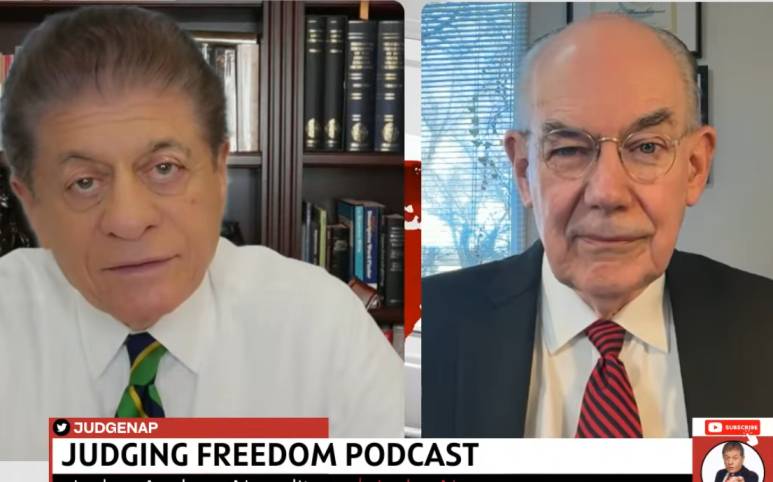
Editor’s Notes: In this episode of Judging Freedom, Judge Andrew Napolitano welcomes Professor John Mearsheimer to discuss the strategic complexities of the ongoing conflict between the United States, Israel, and Iran. Mearsheimer provides a critical analysis of how Iran’s “patient strategy” is effectively countering the Trump administration’s “impatience,” while also examining the broader geopolitical implications for Russia and China. The conversation further explores the 20th anniversary of Mearsheimer’s groundbreaking book, The Israel Lobby and U.S. Foreign Policy, reflecting on how public discourse around these issues has shifted over the past two decades. (March 17, 2026)
TRANSCRIPT:
“Undeclared wars are commonplace. Tragically, our government engages in preemptive war, otherwise known as aggression, with no complaints from the American people. Sadly, we have become accustomed to living with the illegitimate use of force by government. To develop a truly free society, the issue of initiating force must be understood and rejected.”
JUDGE ANDREW NAPOLITANO: What if sometimes to love your country you had to alter or abolish the government? What if Jefferson was right? What if that government is best which governs least? What if it is dangerous to be right when the government is wrong? What if it is better to perish fighting for freedom than to live as a slave? What if freedom’s greatest hour of danger is now.
Introduction: The Israel Lobby’s 20th Anniversary
JUDGE ANDREW NAPOLITANO: Hi everyone, Judge Andrew Napolitano here for Judging Freedom. Today is Tuesday, March 17, 2026, St. Patrick’s Day here in the west and particularly in the US and especially here in New York City. Professor John Mearsheimer will be with us in just a moment on how the Iranian patience is undermining President Trump’s impatience.
Professor Mearsheimer, welcome here, my dear friend. Before we get to your analysis of Iranian patience and Trump impatience, I want to note that this is the 20th anniversary of one of the most groundbreaking books in the post World War II era. Your book that you wrote with Professor Stephen Walt, The Israel Lobby and US Foreign Policy, which really opened up the eyes of the entire world to the influence that the lobby has on American foreign policy today. It seems like a vice, doesn’t it?
JOHN MEARSHEIMER: Yes, it certainly does. I think that the lobby is as strong as ever today.
JUDGE ANDREW NAPOLITANO: Even stronger than when you wrote this book and did all this research 25 years ago.
JOHN MEARSHEIMER: Yeah. I think that it’s important to emphasize that the lobby operates at two levels. One is that it goes to enormous lengths to influence public discourse about Israel and the U.S.-Israeli relationship. And furthermore, it goes to great lengths to influence policy, actual government policy.
In terms of actual government policy, it’s clearly as strong as ever. Where it’s really lost out is in terms of the discourse. The discourse has fundamentally changed. Criticism of Israel, criticism of the US relationship with Israel has become abundant. It was almost unimaginable that we would be where we are today in terms of the public discourse when Steve and I wrote the article and then the book.
So the discourse has changed. And the big question that you have to ask yourself is, how long can the policy of supporting Israel, no matter what, remain in place in a world where the discourse and public opinion has changed so drastically?
The Lobby’s Influence on Political Campaigns
JUDGE ANDREW NAPOLITANO: Can overwhelming public opinion overcome the extraordinary wealth that the lobby has and the manner in which it has used that wealth, funding the political campaigns of two-thirds of the members of Congress?
JOHN MEARSHEIMER: Well, we’re going to see moving forward because there’s been a sea change inside the Democratic Party, and exactly how it plays out remains to be seen. I think it’s hard to imagine someone like Rahm Emanuel or Josh Shapiro, who are both joined at the hip with Israel, becoming presidential or even vice presidential candidates inside the Democratic Party. And you already see Gavin Newsom distancing himself from Israel and from AIPAC. And I think that will be the trend in the Democratic Party moving forward.
And then if you look at what’s happening in the Republican Party, I think that Tucker Carlson is the wave of the future in the Republican Party. So I think that in terms of actual policymakers, you’re likely at some point in the future — hard to say when — you’re going to get a change.
Marjorie Taylor Greene on the War Against Iran
JUDGE ANDREW NAPOLITANO: I usually wouldn’t run a clip of Marjorie Taylor Greene with John Mearsheimer, but she does crystallize the problems in the Republican Party very nicely. This is from yesterday.
VIDEO CLIP BEGINS:
MARJORIE TAYLOR GREENE: Why would an American president lead his political party into the midterms, waging a full scale major war completely unprovoked on Iran on behalf of Israel? And that’s the way most Americans see it. They see this is for Israel, not for America. Why would an American president do that? Which is forcing gas prices to hike right here going into spring break, where families are going to be driving out of town going into summer, declaring and waging a major full scale war that seems to have no end in sight. That is not de-escalating. It’s escalating, escalating every single day. And it just doesn’t make sense. We said on every single rally stage, no more foreign wars, no more regime change. It’s time to put America first. And this is a complete betrayal of those campaign promises.
VIDEO CLIP ENDS:
JUDGE ANDREW NAPOLITANO: To get into domestic politics with you — but she hits the nail on the head, doesn’t she?
JOHN MEARSHEIMER: Yeah, there’s no question about it. I agree with everything she says. It’s quite remarkable. But I often find myself in agreement with Marjorie these days when she’s talking about American foreign policy.
And I would just note to you, going back to what I said earlier, the fact that Marjorie Taylor Greene is making those comments publicly today is really quite remarkable given the context that existed when Steve and I wrote the article and the book back in the day.
Public discourse has just changed in fundamental ways. And by the way, your show is a clear reflection of that.
The War Is Going Badly for Israel and the Lobby
JUDGE ANDREW NAPOLITANO: The lobby can’t be very happy with the way the war is going, can it?
JOHN MEARSHEIMER: No, this is a disaster. And they surely know that. These are basically very smart people who are in charge of the major organizations, and even the individuals who wield influence pretty much on their own are very smart. And they have to know that we and the Israelis have gotten ourselves into a real hole. And all we’re really doing is digging here.
And what’s becoming clear is that this is a war for Israel, that we had no interest, no national interest in going to war against Iran. And there’s just a ton of evidence that President Trump was dragged into this war by Israel and Israeli supporters inside the United States.
And that’s one part of the story. But the other part of the story is that the war is going very badly. And hardly anyone I know can see how we come out of this winning. So if Israel is seen to be responsible for pulling us into a losing war, this will be, I think, disastrous for the lobby.
Defining Victory: What Does Winning Even Look Like?
JUDGE ANDREW NAPOLITANO: How would you even define winning a war like this?
JOHN MEARSHEIMER: Winning the war, as I always say, is largely a function of whether or not you achieve the objectives that you set out before the war started. People like to focus on battles and the assassination of this person or that person. But the key question is, what are your objectives and are you likely to achieve those objectives?
And almost everybody agrees it’s almost impossible to see how we’re going to get regime change, how we’re going to get Iran to give up its nuclear enrichment capability, its ballistic missiles and its support for the Houthis, Hamas and Hezbollah. How do we do that? Nobody could tell a story of how we achieved those particular ends. And if you can’t tell a story like that, you don’t win the war.
Trump’s Advisors and the Miscalculation on Iran
JUDGE ANDREW NAPOLITANO: I just wonder what kind of advice the President got if he’s surrounded by yes men. There was that article — we talked about this — in the Washington Post, very lengthy, very detailed, classic venue for the CIA and military people to leak information, claiming that General Kane warned the President about these very things that are happening now. And the President said
JOHN MEARSHEIMER: it’s not true, it’s not true, it’s not true.
JUDGE ANDREW NAPOLITANO: Nobody believes him when he says these things. But obviously, the people around the President grossly miscalculated the resilience of the Iranian people, the strength of the Iranian government, and the asymmetrical nature of the Iranian military response.
JOHN MEARSHEIMER: Well, I think you have to be very careful when you talk about the people around him. I actually think in this case, the deep state, for lack of a better phrase, told him what was going to happen. It’s now quite clear from press reports that he was told that the Iranians would shut the Strait of Hormuz. He was told that, and he just ignored it because he thought we would win a quick and easy victory, or a quick and decisive victory. So that would never become an issue — that meaning the shutting down of the Strait.
So he was getting, I believe, good advice from General Kane. General Kane was telling him that we did not have a serious military option here. The National Intelligence Council was telling him the same. The problem is that Benjamin Netanyahu and a handful of people who are profoundly tied to Israel — and this would include Jared Kushner and Steve Witkoff — had enormous influence on President Trump. And he listened to Netanyahu, he listened to Kushner, he listened to Witkoff, and he ignored the deep state here.
And we went into this war without clear objectives, without a clear plan. And when you do that, and you’re dealing with an adversary that has a rich history of fighting against Israel and its ally, the United States, and has learned a lot over time about how to wage that war, you’re asking for serious trouble. And that’s the situation we’re in now.
Russia: The Big Winner of the Iran War
JUDGE ANDREW NAPOLITANO: How is this war viewed in the Kremlin, in your view, Professor Mearsheimer?
JOHN MEARSHEIMER: Oh, I think this is wonderful news for the Kremlin. They’re the big winner in this one. First of all, let’s just talk about gas and oil prices because of this war. It’s very important to understand that the administration has a vested interest in allowing as much oil as possible to get out into the market.
Most people don’t understand this, but Iranian oil is being exported around the world in the same amounts that it was being exported around the world before the war started. You just want to understand that Iranian oil is flowing through the Strait of Hormuz. It’s the Gulf states that can’t get the oil through the Strait of Hormuz. Iran can. And why is the administration allowing Iran to sell its oil around the world, send its oil to China and to India? Because we need as much oil as possible out on the international market so that the price of oil doesn’t go too high.
JUDGE ANDREW NAPOLITANO: Right.
JOHN MEARSHEIMER: The same basic logic applies with regard to Russia. President Trump basically took most of the sanctions off of Russian oil because he wants Russian oil to flow out into the international market so that prices stay as low as possible. So Russia is a huge winner in this regard. And Iran, as I pointed out, is in an excellent position to continue the war because it’s not being economically throttled.
Okay, back to Russia. Not only did they get relief from these sanctions, what this also means is that we don’t have weaponry that we can give to Ukraine because we’re using it up in the Middle East. So what’s happening here is that the prospects that Ukraine will lose on the battlefield and that Russia will come out of this smelling like a rose is going up because of the Ukraine war. It’s really quite remarkable what’s happening here.
And just one other point that I believe I’ve made before on the show — you want to understand that we consider our principal goal to be containing China in East Asia. But what we’re doing is weakening our forces in East Asia to deal with this war against Iran. We are not pivoting to Asia. We are pivoting away from Asia because of this crazy war against Iran.
The Economic Consequences for Trump’s Base
JUDGE ANDREW NAPOLITANO: I’m going to ask you about China in a minute, but basically what you have just described is Economics 101. Now, wouldn’t Scott Bessent, Secretary of the Treasury, or someone in Trump’s orbit have explained this to him? “You realize what’s going to happen? You’re going to add a lot of cash to Putin’s treasury because he’s going to be selling more oil and he’s going to be selling it at a higher price. And all your blue collar MAGA guys, when they go to fill up their pickup trucks, are going to say, ‘Why am I paying four and five dollars a gallon for gas? I didn’t fight this war. That has nothing to do with me.'”
The Illusion of a Quick Victory
JOHN MEARSHEIMER: The key point here that’s essential to keep in mind is that President Trump thought that he was going to win a quick and decisive victory. He did not think that we would end up in a long war, and therefore he didn’t pay any attention to these problems.
Remember what I said a few minutes ago about closing the Strait of Hormuz? He was told that the Iranians were likely to close the strait. He ignored that warning because he thought we would finish them off. It would either be a decapitation strategy that brought Iran to its knees, or it would be shock and awe, or it would be a rapid punishment campaign.
But this war in President Trump’s mind and in Prime Minister Netanyahu’s mind was not going to go on and on. It was going to be a quick and decisive victory. So all these issues that you’re now raising were ignored or not even addressed.
Russia’s Windfall from the War
JUDGE ANDREW NAPOLITANO: Well, the Financial Times reports that Russian oil companies are collecting $150 million a day over what they had been collecting during the sanctions period as a result of the increase in the price of oil. That is extraordinary. I’m not familiar with the Russian tax scheme, but somehow that has to be contributing marvelously to the Kremlin’s treasury.
JOHN MEARSHEIMER: I think that’s $150 million. I’m not absolutely sure.
JUDGE ANDREW NAPOLITANO: Sounds more reasonable that it will be $150 million. It’s still a lot of money. $150 million a day.
JOHN MEARSHEIMER: There’s absolutely no question about this. This war is a real boon for the Russians. It’s really quite remarkable.
If you begin to assess what’s happened here, this war is catastrophic on so many dimensions. Just take the Europeans. Our relations with the Europeans were terrible before the war, but now they’re worse than ever. President Trump wanted the Europeans to send naval forces to help the Americans crash through the Strait of Hormuz, and they refused.
And if you look at how the Germans have reacted, it’s really quite remarkable how hard-nosed they have been with us. The Minister of Defense said, “This is not our war.” Friedrich Merz, who is the German chancellor and usually dances to President Trump’s tune, said that NATO is a defensive alliance. It’s not an interventionist alliance. As such, NATO has no role whatsoever to play in this war. Really quite remarkable.
And it’s true of countries all over the world who are our allies. They have refused to come into the fight — the Japanese, the South Koreans, the French, the British, and so forth and so on. And by the way, that’s in large part because they understand this is a lost cause. They don’t want to enter a war that is going to be lost by us.
Trump Laments Allies’ Refusal to Help
JUDGE ANDREW NAPOLITANO: Here’s a very recent clip from President Trump, first lamenting that the United Kingdom won’t help and then saying that we don’t need them. As typical Trumpian —
VIDEO CLIP BEGINS:
DONALD TRUMP: If we ever needed help, they won’t be there for us. I’ve just known that for a long period of time. We have some that are really enthusiastic. They’re coming already. This is a need. Need would be one of the big boys. If we need their mine boats or if we need anything, any piece of apparatus that they may have because of a situation that they have, they should be jumping to help us. We want them to come and help us with the strait. My attitude is we don’t need anybody. We’re the strongest nation in the world. We have the strongest military by far in the world. We don’t need them.
VIDEO CLIP ENDS:
JUDGE ANDREW NAPOLITANO: Where is he on this? I guess maybe he’s lamenting the inevitable. That Keir Starmer has basically said to him, “This is Israel’s war. It’s not ours.”
The Impossibility of Opening the Strait of Hormuz
JOHN MEARSHEIMER: Well, the problem is he’s desperate here. He knows he has to open the strait and that he has to get oil from the Gulf States flowing back into the international oil market. He just knows he has to do that. But he has no way of opening the strait.
Want to remember, the United States Navy is by far — and I’m choosing my words carefully here — it is by far the most powerful navy in the world. And we have a huge chunk of that navy in the Middle East. Two carrier battle groups, for example. But we can’t force our way through the Strait of Hormuz with that incredibly powerful navy.
So he goes out and he asks these other countries to send naval forces to help us. They don’t have significant naval forces. None of these countries do. And even if they take what they have and they send those naval forces to the Middle East and we launch a joint operation at the Strait of Hormuz, it’s going to fail. It’s not going to work. And that’s why we alone have not tried to force our way through the Strait of Hormuz. You just can’t do it.
And the truth is, even if you can force your way through the Strait of Hormuz, it doesn’t solve the problem. Because once you’re in the Persian Gulf, it’s a rich target environment for Iranian cruise missiles, Iranian drones, and Iranian ballistic missiles that can target any ships that are in the Persian Gulf. And furthermore, the Iranians always have the option of just destroying the oil refineries, the oil installations of the Gulf States. So even if the straits are open, there’s no oil to go through them.
Iranians hold almost all the cards here, and it’s hard to see how we can solve this problem, how President Trump — who’s got himself into this war and got us into the war in the process — can figure out how to get out of it. There’s just no way that anyone can see at this point in time to fix this problem.
China’s Strategic Advantage
JUDGE ANDREW NAPOLITANO: How is this war viewed in Beijing?
JOHN MEARSHEIMER: Oh, I think that the Chinese are glad to see the United States shooting itself in the foot. This is going to increase Chinese influence not only in the Gulf in significant ways, but all around the world.
If you ask yourself which country on the planet, among the three great powers — the Chinese, the Russians, and the United States — looks like the responsible stakeholder in the system, and who looks like they are the least responsible? It’s clearly the Americans who look the least responsible. States all over the world look at us and scratch their head and think we have lost our mind. And it’s easy to understand why that’s the case.
The Chinese look like they’re responsible stakeholders, and indeed the Russians look the same. So we have done enormous damage to our diplomatic position around the world, which is to China’s interest. We’ve done damage to our situation, our position in Europe and with the Gulf States. And this is going to work to China’s advantage. So this war is just terrible news.
Trump Cancels China Trip
JUDGE ANDREW NAPOLITANO: Did the Chinese cancel Trump’s trip or did he cancel it?
JOHN MEARSHEIMER: I think it’s quite clear that he canceled it. And I think he at first looked like he was going to use the threat of canceling the trip to get the Chinese to send naval forces or even ground troops to the Gulf to help the United States. This was a laughable proposition.
But then I think he came to realize, quite correctly, that given that there’s a war going on and that he is losing that war, the last thing he can be seen to do is go to China, which in effect would be taking his eye off the ball. And furthermore, it would be a rather nice and jovial meeting between the two leaders, where there would be lots of handshakes and lots of smiling, and that would not look good, given how events in the Middle East are going.
The Nuclear Threat and Israeli Paranoia
JUDGE ANDREW NAPOLITANO: Going back to Israel — is there a danger if the Israeli government’s back is to the wall that they’ll use nuclear weapons on Tehran?
JOHN MEARSHEIMER: I think that possibility only arises if there’s evidence that Iran is developing nuclear weapons, which is not the case at the moment. I think that once this war is over with, the incentives for Iran to get nuclear weapons would be very great. And I wouldn’t be surprised at all if they went down that road.
And if the Israelis even suspect that that’s the case and they don’t have the IAEA inside of Iran inspecting what the Iranians are doing, I would imagine the Israelis will come up with some worst-case scenarios regarding the development of an Iranian bomb. And I think in that circumstance they may think about using nuclear weapons in a very serious way.
It’s quite clear that the Israelis have convinced themselves that Iran is an existential threat. I think for many Israelis, Iran is not much different than Nazi Germany. And they believe that if Iran has an opportunity, it will implement a second Holocaust. I think this is ridiculous. But what I think doesn’t matter. It’s what they think that matters.
And these are paranoid people, and if they lose this war, that’ll just exacerbate their paranoia. And again, if they think Iran is developing a nuclear weapon which it will use against Israel, they’ll use, I believe, nuclear weapons to excise the problem from the Iranian perspective.
JUDGE ANDREW NAPOLITANO: As Ambassador Freeman just pointed out here about an hour ago, when you don’t have the law to protect you, when public heads of states fully recognize that treaties don’t bind them, their own constitutions don’t bind them, international law doesn’t bind them — maybe a nuclear weapon would scare them away. The craziest person in the world that has a nuclear weapon doesn’t get attacked. That character in North Korea.
The Collapse of Diplomacy and International Law
JOHN MEARSHEIMER: Absolutely. I agree with Chas completely. And I would make another point just about international law and what the Israelis and the Americans have done to destroy it — and not only to destroy international law and international institutions, but to do great damage to diplomacy.
Diplomacy has been used as a cover twice now to attack Iran. What kind of faith can the Iranians have in diplomacy, much less international law?
Now, the reason this really matters, that you want to pay attention to, is it’s related to the question of how do we shut down this war. It’s quite clear that there’s going to have to be sanctions relief — and maybe some reparations, but at least significant sanctions relief — to get the Iranians to end the war. But also the Iranians are not going to end the war unless they can get some sort of guarantee that the United States and Israel won’t come back and attack them.
Remember, there was a war last June, and here we are in March, and there’s another war — in less than a year’s time. Who’s to say, if the war ends now, that in less than a year’s time, the Israelis and the Americans won’t attack Iran again? So the Iranians are going to want some sort of guarantee that that won’t happen.
In a world where international law has gone out the window and diplomacy has gone out the window, and you can’t trust the Israelis or the Americans as far as you can throw them — please tell me how you work out a diplomatic solution to this war. How do you convince the Iranians that you won’t pay them a return visit? So all of this behavior on the part of the Israelis and the Americans is just making it incredibly difficult to figure out how you shut this war down in the end.
Trump’s Cavalier Attitude Toward War
JUDGE ANDREW NAPOLITANO: Here’s President Trump using decidedly undiplomatic language, referring to aspects of the war as “fun.”
VIDEO CLIP BEGINS:
DONALD TRUMP: Together with our Israeli partners, we’re crushing the enemy in an overwhelming display of technical skill and military force. Iran’s drone and missile capability is being utterly demolished. Demolished. The navy is gone. It’s all lying at the bottom of the ocean. 46 ships. Can you believe it?
In fact, I got a little upset with our people. I said, “What quality of ship?” “Excellent, sir. Top of the line.” I said, “Why did we just capture the ship? We’re going to use it. Why did we sink them?” He said, “It’s more fun to sink them.” He said, “They like sinking them better.” They say it’s safer to sink them. I guess it’s probably true.
VIDEO CLIP ENDS:
JOHN MEARSHEIMER: That’s just one comment he’s made using the word “fun.” He’s made another comment where he said, regarding the bombing of Kharg Island, after he said that he had basically destroyed all the military installations on Kharg Island, he would bomb it again just for the fun of it.
These are the sorts of reprehensible statements that no leader of a civilized country should make. War is a deadly serious business. Huge numbers of people are killed and wounded in these enterprises. You have to enter a war after trying every way possible to avoid it. And then when you go to war, you have to be very careful not to kill civilians and not to talk the way President Trump does. But he talks in the most cavalier way about war, as if this were just fun — that bombing and killing Iranians is fun.
I can’t imagine any other president we have ever had making statements like that. Can you imagine Abraham Lincoln saying something like that? Or FDR? No. Dick Nixon, George W. Bush — I can’t even imagine George W. Bush making statements like that. These were all people who understood what a deadly serious business war is and how cavalier statements of this sort are just totally irresponsible.
The Danger of Unchecked Military Force
JUDGE ANDREW NAPOLITANO: So you have cavalier statements like this, you have rules of engagement are stupid. Out of the mouth of the Secretary of Defense who calls himself the Secretary of War. Is it any wonder we bombed a girls school and incinerated 170 little girls and their teachers?
JOHN MEARSHEIMER: No. And it’s very important to understand that militaries are giant killing machines. They’re giant killing machines. And when you take a military to war, you send a military to fight a war. There’s a very powerful tendency in that military to use every means possible to annihilate the adversary, to inflict massive pain on the adversary. It’s just sort of a built-in impulse.
And what you have to do is you have to go to great lengths to curb that impulse in particular situations. If you’re talking about two armies crashing into each other on the battlefield, there’s obviously no limits to killing soldiers on each side. It’s the name of the game. We all understand that.
But then there’s the whole issue of collateral damage and the whole issue of whether you directly attack civilians. And what you try to do when you go to war, if you’re a civilized nation, is you try to go to great lengths to kill as few civilians as possible. And you don’t want to have a lot of collateral damage if you can avoid it. And furthermore, you definitely don’t want to directly target civilians and murder large numbers of civilians.
And that’s why you have international law. And that’s why people in the American military actually pay a lot of attention to the whole concept of just war theory. They think long and hard about what you can and can’t do when you engage in combat. And that’s all for the good.
This is not to deny for one second that there are significant limits on a country’s ability to curb the killing of civilians or the killing of innocents. Once a war starts, it’s a really difficult task to put limits on these giant killing machines, but still you work very hard to do that — it’s the right thing to do.
But if you listen to somebody like Pete Hegseth talk, I mean, it’s like he’s thrilled at the fact that we’re just going to go in there and kill anybody that gets in our way and smash things and not pay attention to the laws of war. The laws of war are just a giant encumbrance. They prevent us from winning. What we have to do is just do whatever we think is necessary. And if that involves killing massive numbers of civilians, so be it. Wow.
Closing Remarks
JUDGE ANDREW NAPOLITANO: Professor Mearsheimer, thank you very much. As always, your time and analysis is invaluable to us. And congratulations again on that groundbreaking book, The Israel Lobby and US Foreign Policy, on its 20th anniversary. All the best, Professor. We look forward to seeing you next week.
JOHN MEARSHEIMER: I look forward to being back on the show. Judge, thank you.
JUDGE ANDREW NAPOLITANO: Coming up, if you’re watching us live, in 25 minutes at 10 o’clock this morning, Scott Ritter, at one this afternoon, Aaron Maté, at two this afternoon, Matthew Hoh, at three this afternoon, Colonel Karen Kwiatkowski. Judge Napolitano for Judging Freedom.
Related Posts