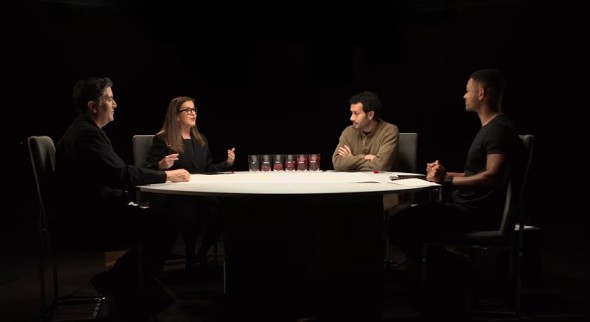
Editor’s Notes: In this high-stakes episode of The Diary Of A CEO, host Steven Bartlett joins former CIA officer Andrew Bustamante and geopolitical experts Benjamin and Annie to dissect the alarming escalation of conflict between the U.S. and Iran. The discussion dives deep into the historical roots of the Iranian Revolution and the CIA’s “hidden hand” in shaping global policy, offering a perspective rarely found in mainstream media. Together, they evaluate the “terrifying reality” of a potential World War III and the heightened risk of nuclear war following recent military strikes. This sobering assessment provides a crucial look at the domino effects of current geopolitical decisions and what they mean for the future of global security. (March 4, 2026)
TRANSCRIPT:
The Historical Context of Iran
STEVEN BARTLETT: Benjamin, Annie, Andrew, first and foremost, thank you for being here today. I have to start with the question that’s been on my mind as somebody that doesn’t know a huge amount about geopolitics, which is what the hell is going on? And I say that because that’s exactly what I mean. What is going on and what context do I need to understand this sort of historical context of the actions we’re seeing in Iran with this war right now? Benjamin, I know you’ve got a personal connection to Iran because your family fled Iran. I believe.
BENJAMIN RADD: Yeah, I was two years old when we left in March of 1979, a few months after the Shah had left and just after Khomeini had arrived.
STEVEN BARTLETT: What is the Shah and what is Khomeini?
The Shah and the Pahlavi Dynasty
BENJAMIN RADD: Yeah, sorry, the Shah. The former monarch of Iran, the Pahlavi dynasty, which came into power in the 1930s, deposing a previous dynasty that had been around for a couple hundred years. And his father brought in that dynasty. And then it was eventually he was deposed by the British and the Americans, who felt he was getting too close to the Nazis during World War II, concerned about supply routes for the Nazis’ oil. And his son was installed on the throne at a very young age, I believe 18 or 19.
He ruled Iran from that period, 1941, 1942, around that time, all the way through 79. A great ally of the United States over time, eventually, and was overthrown in a revolution by Khomeini, who is a senior cleric who had been a thorn in the Shah’s side since the 60s, was exiled first to Turkey, then Iraq, then ultimately to France, right outside Paris, actually. From there, he basically led the revolution that led to the Shah’s removal in 79.
STEVEN BARTLETT: And how was Iran different when the Shah was in power versus when Khomeini was in power?
BENJAMIN RADD: That depends on who you ask. It was a constitutional monarchy. The Shah had powers that exceeded beyond what we think a constitutional monarchy has today. Like in Great Britain, he ruled with an iron fist when he needed to. He was an authoritarian, but he also was one that was rapidly modernizing Iranian society, wanting to make it more like the West, using Iran’s immense oil resources and wealth to really accelerate development, building of social institutions, health care, literacy, modernization, all of those things. That was his focus — make Iran more like the West. And in that sense, he succeeded.
But it came at the expense, oftentimes, of civil liberties for many people. It came at the expense of freedom for those who wanted to essentially practice religion, Islam, Shia Islam, in their own way. The Shah was not hostile to religion, but his policies were inconsistent with where the traditional religious Iranians wanted to go. And it sort of created a schism in society.
You also had a wealth gap, an income disparity. Immense wealth poured into the country, but it didn’t trickle its way downward into the sort of the village and rural poor. And so there was a lot of frustration, a lot of disenchantment with his policies. And that led to sort of this populist backlash of wanting something that was more democratic, more accountable, more like the West, ironically. And that sort of was the beginning of where that cycle led.
How Khomeini Took Power
STEVEN BARTLETT: And so how did Khomeini take power of Iran?
BENJAMIN RADD: He led a movement, a mass populist movement, not a religious one, but meant to go across multiple socioeconomic and political divides and unified the opposition under this idea of removing the monarchy, removing dependence on the West. He specifically said the United States was large part to blame for Iran being in the state that it was, for people not having the things they needed to live, the freedoms, the liberties. He blamed the Shah’s use of the secret police and torture methods on the United States and on Israel, who he claimed taught the secret police how to do these things. There’s a complicated sort of history to that.
And he basically promised them salvation from what he portrayed as a puppet tyrant of the United States. And the masses bought into this. Both the left and the right, really. The right consisted of the Islamists, so you had the red, which were sort of the Marxist socialist followers. You had the black, and then you had sort of that middle in between. And they all coalesced around this one charismatic religious figure, very austere man, one who didn’t really have a lot of luxuries himself, led a simple life, but was consistent in his opposition to what he saw as tyranny and despotism. And people bought into it.
STEVEN BARTLETT: And the Americans didn’t like this.
The CIA’s Failure to See the Islamist Threat
BENJAMIN RADD: The Americans didn’t know what to make of it. And there was a failure — and I think Andrew can talk about this as well — a failure by the State Department, the CIA in the 70s, to see where the threat was.
The Shah himself blocked, or really didn’t give the CIA full access to Iran. There was limited information that was coming out. He relied on his own intelligence, which fed him information he wanted to hear, which is that everything is going great, the country’s doing well, the people love you, they’re all happy. Until the discontent and the protests reached a threshold and it was too late to do anything about it.
ANDREW BUSTAMANTE: Yeah, the United States was kind of at their peak period of meddling in foreign governments at the time, in a strange way that we’ve come full circle. This idea of controlling an entire country by controlling the figurehead of the country — that’s where we were in the late 70s at the kind of brink of the Cold War, right? Nobody knew that the Berlin Wall was going to fall. We were all concerned with the spread of communism. Nobody was paying attention to the Islamist threat. Nobody was paying attention to really any other kind of threat at all. It was very much the unfettered, uncontrolled, unsupervised CIA running around with no oversight and with very deep pockets.
STEVEN BARTLETT: And that changed at some point.
ANDREW BUSTAMANTE: That changed in 2001 when Al Qaeda successfully carried out the 9/11 attacks in New York. And all of a sudden, the threat that we had all been ignoring was on our doorstep and had grown so wealthy and had spread so vast across the world that Islamic extremism became almost overnight a household term. Now, there’s still a difference between Al Qaeda, Islamic Shia extremism, and what is practiced in the Shia faith and with the outcomes that the Shia militants are trying to pursue in support of Iran. But it’s hard to differentiate that in the United States, where we don’t understand the difference between Sunni and Shia.
What This War Is Really About
STEVEN BARTLETT: Annie, what do you think this war is really about?
ANNIE JACOBSEN: Very interesting, what you both said, and I think what I would add to that, which very much speaks to today, is that the CIA, in fact, had many ups and downs over the decades, from its creation right after World War II until this moment in time and then on 9/11. And so it’s been like an accordion experience of power being taken away from the CIA and then being grabbed back. Because the CIA has always historically been the President’s hidden hand. It has been the way in which the White House can execute executive power without having to follow the laws of war that the military does.
So the military is a code called Title 10. CIA is a code called Title 50. And while that may sound a bit wonkish, it is important to understand because Title 50, essentially, as Andrew can speak to, gives the President authority under classified presidential directive to change any rule he wants that suits him for an operation at hand — which gets us precisely to where we are today.
STEVEN BARTLETT: So as far as I understand, there was the Shah, the sort of world leader who was in power. He was overthrown in the late 1970s by Khomeini. Khomeini galvanized people to believe in his way, and he’s been in power ever since.
ANDREW BUSTAMANTE: It gets complicated because Khomeini, with an O, was the original leader of the revolution and was later replaced by Khamenei, with an A.
STEVEN BARTLETT: Okay, that’s two.
ANDREW BUSTAMANTE: And that is a —
ANNIE JACOBSEN: The Supreme Leader. And this speaks to the revolutionary nature of Iran, which has been taking place since 1979. In the news today, people hear the IRGC, the Iranian Revolutionary Guard. But it’s so important to understand that word “revolution,” because Iran has been holding onto this idea — or rather the regime has — that “we are the revolutionary force against America.” That is why the chant is always “death to America.” The wound of pre-1975, the wound of America meddling and having the Shah as its puppet, is as inflamed — or was as inflamed two days ago — as it was the day after the revolution in 1979.
US and UK Meddling in Iran
STEVEN BARTLETT: I think that’s probably important context we missed, which was the US got involved in the Shah and how he governed Iran.
BENJAMIN RADD: It’s a fascinating period. In 1951, basically, under the Iranian constitution, the Shah, the king, has the authority to select the prime minister with the consent of Parliament. The consent part is really nominal. And so Mossadegh, who is a senior member of Parliament and also a member of the previous royal dynasty, distantly related, this elderly statesman who the Shah, out of sort of courtesy, after having gone through a successive list of prime ministers, says, “Okay, I’m going to appoint him prime minister.” So he wasn’t democratically elected. He was elected to Parliament. But from there, the Shah selected him to be Prime Minister.
Mossadegh nationalized the oil company, the Anglo American Oil Company, which was owned primarily by the British. This angered the British, who in turn blockaded Iran’s ports and basically shut down its oil industry, creating a national crisis. And Mossadegh was sort of amassing additional powers within himself, basically overstepping the authority that he had, even though he had the support of a good deal of the public. As it became obvious that this was a bad move, especially in the eyes of Iran’s international trading partners, and it was causing Iran to be isolated, there was pushback towards him, and then he was removed.
The British had wanted — MI6 had wanted — to overthrow him, basically get him removed. And they tried to recruit the United States to help. President Truman refused to engage in this. Eisenhower comes in, is more receptive under CIA Director Allen Dulles to actually engage in this, called Operation TP Ajax, led by Kermit Roosevelt, who is the CIA officer tasked with this. And then the Americans and the British basically helped foment a crowd that is a part of the movement that removes Mossadegh.
Now, I think it’s a common misconception that the US CIA was behind it. The British had a bigger role in this. The Americans were more of the junior partner, but they became sort of the public face of it. But Mossadegh was not this overwhelmingly popular, democratically elected figure either. The history is more complicated. And regardless, there were many prime ministers after him. He was known as a nationalist because he believed that Iran’s oil should be nationalized and not really beholden to British interests. And that created a lot of resentment and animosity.
But that began the US-Iranian relationship. It really solidified when the Shah returned. He didn’t leave, really. He just sort of took himself out of the country for a bit, but he never stepped down. And while this was all being resolved, he comes back, and then the US-Iranian relationship continues all the way through 79.
STEVEN BARTLETT: So the UK and the US have been meddling in Iran for a long time and kind of exerting their will.
BENJAMIN RADD: The UK since the 19th century, by far. The UK has been the dominant colonial force in modern Iranian history.
STEVEN BARTLETT: And they lose that power in the sort of 1980s, early 1980s, because Khomeini comes in.
BENJAMIN RADD: The British lose that power with the fall of pretty much the fall of the empire in the 1940s, after World War II, and then the United States in 79. Exactly.
STEVEN BARTLETT: And then since then, the UK and the US haven’t been able to sort of exert control and their will over Iran.
ANNIE JACOBSEN: There’s not even an embassy there because, of course, they took over the embassy. It’s been ground zero of nothing for the CIA’s power, for any American power, really, for any Western power.
Why Trump Attacked Iran: Motivations and Timing
ANDREW BUSTAMANTE: You call it a black box. Yeah, it’s a rogue nation. It’s a black box of information. A rogue nation is one of a handful of countries around the world that follow no international norms. North Korea is a rogue nation. Belarus is a rogue nation. Cuba is a rogue nation. Venezuela was a rogue nation. These countries completely stand separate from the norms of an international society.
And in Iran’s case, it also became this black box where it did not allow foreigners in, especially not Westerners. It closed down its embassy. The traditional methods for collecting intelligence were very difficult. And geographically, it’s so far away and so far outside of the sphere of influence for the United States that in terms of intelligence and military prioritization, it just fell to the bottom of the list.
ANNIE JACOBSEN: And yet look exactly where it is. It’s right in the middle of the East. And to Benjamin’s point, oil, oil, oil. It’s always about oil. There’s always a component of oil.
ANDREW BUSTAMANTE: And there are so many other oil options in that region besides Iran, right. Saudi Arabia, UAE, Bahrain, Qatar, they’ve got that. The United States could partner with other Arab countries to get what they wanted without having to deal with Iran.
STEVEN BARTLETT: So explain to me in simple terms why Trump right now has decided that this is the best time to attack Iran. I want to start with you, Andrew. What’s your point of view on that? The full picture of what his motivations?
ANDREW BUSTAMANTE: I think the question that you just asked is the most prescient question that we will talk about today. Why, why now? Why is it being communicated the way it’s being communicated? Why was it executed the way it was executed? So why is now the very best of all times?
I frankly don’t think it is. I think that’s the narrative that’s being communicated to the world and to the public. What Donald Trump did in attacking Iran goes against what the ODNI report assessed for the most likely threats against the United States in the ODNI’s 2025 threat assessment. It goes against the Department of War’s 2026 National Defense Strategy and it goes against the White House’s national security strategy — these massive doctrinal annual assessments for how the United States will protect national security. The attack against Iran goes contrary to all three of those in terms of priority and action. So why now? Why the way that we’ve done it? I can’t answer it in any kind of logical way.
STEVEN BARTLETT: What’s the non-logical answer?
ANDREW BUSTAMANTE: It’s a distraction. It’s international pressure with Israel. It’s a cheap win after a series of losses. It’s a last-ditch effort before he understands that Donald Trump and his party will lose control of the House in the midterms this year.
ANNIE JACOBSEN: I have a little bit of a different take. Shall I? I believe the current administration is led as a completely top-down situation — in other words, like sole presidential authority. This current president is very enraptured with power and with prowess, with effectiveness. And on the heels of Maduro and maybe even the cartel leader in Mexico, I believe that the current president saw a moment of intense weakness that had been building, no doubt.
And in warring in general, when looking at it theoretically, like someone like myself, the decapitation strike is the ultimate strike. It literally is like it sounds — when you can, it comes from “cut off the head of the snake.” And that is exactly what just happened.
STEVEN BARTLETT: Why? Why, though? Why did he do that?
ANNIE JACOBSEN: Well, I cannot tell you why, but I can tell you what we all know. So if you reverse engineer what happened, I think there’s only one conclusion, which is that I would think the current president wanted to do this and was waiting till he had the intelligence. And the intelligence part of it is beyond remarkable — like how the CIA and NSA and probably DIA and NGA, all of these intelligence agencies, of which there are many, not just the CIA, were able to get that information to the president in that exact moment and make that strike and decapitate the leadership that has been in power since 1979.
The Nuclear Weapons Justification
STEVEN BARTLETT: When they talk about the motives here, Trump will often cite nuclear weapons as the motive, saying he didn’t want Iran to get nuclear weapons. Is that what’s going on here in your point of view?
ANDREW BUSTAMANTE: The 2025 National Threat Assessment that was produced by the ODNI in March — so less than a year old — specifically says that Iran was unlikely to pursue the development of nuclear enrichment or nuclear weapons. That was the assessment of the ODNI, and that instead their primary concern was that Iran was going to focus resources into the research of biological and chemical weapons.
So the fact that in March of 2025, the ODNI — the assessment of all intelligence agencies — said Iran is not working on a nuclear weapon. And then after the strike in June of the same year, where we dropped bunker busters in Fordow, further obliterating their nuclear enrichment capability and obliterating their program, we have two documents that say they’re not developing it. We have another series of attacks that says it’s obliterated. And yet we’re still saying that we need to attack Iran because of WMD.
We’ve heard that story before. We’ve heard that WMD is a just cause for war, and that was when we invaded Iraq in 1992.
STEVEN BARTLETT: So what do you think the real motivation there is, therefore?
ANDREW BUSTAMANTE: It’s very similar to what Annie is saying, that we have a current administration that is president-down. It’s fascinating if you read the official documentation, because when you read the Department of War’s national security strategy, what you hear more than any other word is “Donald Trump.” “Our President Donald Trump is leading America.” “Through our President Donald Trump.” “The great Donald Trump.” It’s incredible.
When you hear the speeches that come out of Marco Rubio’s mouth or Pete Hegseth’s mouth, what do you hear more than any other term? You hear the name of the president. Usually you hear “we” or “the government” or “this administration” — it’s not around a personality. So it’s a very interesting situation because there’s so much of a person at stake here, and everybody surrounding the office of the President is only there because they are respecting — kissing the ring of — the personality in the center.
ANNIE JACOBSEN: I’m going to add to that further just for a moment, if I may. Because on that point, if I watch the current president’s speeches to sort of discern things, you can often get your answer right there. And in one of the speeches, either this morning or yesterday, he mentioned that the Ayatollah tried to kill him. And to me it’s like, oh, that’s the tit for tat.
Again, top-down — or you could say schoolboy, sandbox. I say that as the mother of two boys. This human behavior is way outside the norm of intelligence reports and assessments and these long monographs that may or may not actually be effective. I mean, the biggest surprises of the past 40 years — the Berlin Wall falling and 9/11 — were completely unseen by any intelligence report. So there is an argument that those intelligence reports are as good as a coin toss.
October 7th and the Window of Opportunity
BENJAMIN RADD: I want to come to that point, because the very fact that we have an Islamic republic is a direct result of a failure of American intelligence to see that threat as early as 1976, 77 — a failure to inform then-President Carter to take the necessary steps to support the Shah and to neutralize that threat. So the United States’ track record in Iran for the last 40 or 50 years is abysmal when it comes to intelligence and when it comes to statecraft. And so there’s that legacy, number one.
Number two, October 7, 2023 — the Hamas attack against Israel — changed the dynamic entirely. That attack surprised Israeli intelligence. It surprised Americans. It surprised almost anybody watching. Nobody thought Hamas was going to do that when they did it and the means in which they did it. So all of a sudden, that forced a recalibration, a recalculation of what’s at stake. What could happen if we wait for an imminent threat till we actually see the sign outside the door? It’s too late.
So from the president’s perspective — to answer your original question, why now, why do this — I believe the October 7th attacks, and it’s not at the behest of Israel necessarily, it’s the idea that Iran, we know, finances Hamas, subsidizes Hamas, trains Hamas, equips Hamas, provides logistical support on many levels so that Hamas can be what it was. And Hezbollah also. So you have these destabilizing non-state groups in the Middle East wreaking havoc, destabilizing, causing chaos.
You’re the United States, you’re also dealing with a nuclear threshold state. So Iran may or may not have a nuclear weapons program, but they exceeded the 20% enrichment that they were allowed to do under the Non-Proliferation Treaty. They violated IAEA safeguards, they lied. So you take all of this together — this is a regime that can’t be trusted. The chant “death to America,” which is more than Saddam Hussein ever did, and funding groups that — up until 9/11 — Iran was behind more acts of terror that cost American lives than any other state or non-state group in the world. 9/11 changed that. But up until that, the Marine barracks bombing in the 1980s, terrorist attacks throughout Europe, South America, U.S. embassy — absolutely. The USS Cole.
STEVEN BARTLETT: Right.
BENJAMIN RADD: So we’ve been at war, from the president’s perspective, with Iran since they took our hostages, for which they’ve never atoned, they’ve never been held to account. So if you take that calculus, and now we’re in a post-October 7th world with a nuclear threshold state — what happened that changed was last year’s six-day, twelve-day war in June, which created an opportunity. It weakened Iran enough, and its proxies — Hezbollah, Hamas — weakened. If there’s an opportunity to finally address this 47-year-old conflict, this was the window to do it. That is why I believe, rightly or wrongly, the president took the action when he did.
ANDREW BUSTAMANTE: That doesn’t make it the best window. And that’s what we’re being told — that it was the last best window.
BENJAMIN RADD: I don’t think it was the last best window, but it was a window. Or at least, I agree, from their perspective it was a window. You’ve got everyone weakened, you’ve got the regime less popular than it’s ever been. I mean, we saw the protests in January that led to the bloodbath — upwards of 30,000 people killed on January 8th and 9th. This regime is at its lowest point both in terms of domestic credibility and soft power and ability to use proxies to carry out its will. Why not strike it now? That would be the logic.
The Debate: Was This the Right Move?
ANDREW BUSTAMANTE: I mean, I can give lots of reasons why you wouldn’t strike it. It’s violating international law. It sets a dangerous precedent, it creates instability. There are Americans dead, Emiratis dead, Saudis dead. For what? For something that was already on the precipice of dying itself.
BENJAMIN RADD: It’s been dying for 40 years, so —
ANDREW BUSTAMANTE: Why not let it run its course?
BENJAMIN RADD: Because what more damage is it going to do? What more October 7ths can we see?
ANDREW BUSTAMANTE: Arguably less than anything that’s already been done. So it’s like taking action on — it’s like putting down the dead dog after it’s done all of its damage.
ANNIE JACOBSEN: Well, I don’t think that you could say to the families of the 30,000 some people who were murdered by the regime just earlier in January that it’s a dead dog. I think they would disagree.
ANDREW BUSTAMANTE: It’s their country, it’s their people, it’s their decision, it’s their right to self-determination.
ANNIE JACOBSEN: I’m not saying it’s correct what was done. I’m just simply saying the facts of that — which I agree with unilaterally — that the weakened situation was perceived by this administration as the moment to strike.
ANDREW BUSTAMANTE: Agreed.
ANNIE JACOBSEN: And what is done is done.
ANDREW BUSTAMANTE: Agreed.
ANNIE JACOBSEN: And so I think what’s more interesting to me is observing how America is dealing with this. I mean, we are in our own crisis — America, our own serious crisis. And there are crises around the world, particularly in this area. And without having a crystal ball, none of us know. And I think what will happen in the next two weeks will be profoundly telling.
Interestingly, people will say this was a good move or this was a bad move, which in and of itself is a bizarre theater. Because your point is correct — you’ve got America taking action in a place that’s not its own.
ANDREW BUSTAMANTE: That’s a sovereign country.
ANNIE JACOBSEN: Yes. And to your point, you’ve got decades of a menace that is now off the table.
The Domino Effect: Sovereignty, International Law, and Trump’s Legacy
ANDREW BUSTAMANTE: I would disagree with that. Exactly. We don’t know. And the worst part is that in the lead up to this, Iran’s relationship with Russia and China and other countries that are successfully countering American influence worldwide had grown closer than ever before.
ANNIE JACOBSEN: I think they’re fair weather friends that just turn on them in a second.
STEVEN BARTLETT: What are you concerned about, Andrew?
ANDREW BUSTAMANTE: So there’s a number of things here. So first of all, with the removal of Maduro in Venezuela, which happened less than 60 days ago, and now the killing, the assassination of a—
ANNIE JACOBSEN: —a leader, the decapitation of the regime,
ANDREW BUSTAMANTE: which was the same thing you did here when you rendered Maduro.
STEVEN BARTLETT: Right.
ANDREW BUSTAMANTE: It’s a decapitation of a regime.
ANNIE JACOBSEN: That’s different. I would say if you’re going to extract someone, you haven’t killed them. So that’s not decapitation, that’s basically swapping out the CEO.
BENJAMIN RADD: This is completely reforming the company.
ANDREW BUSTAMANTE: I agree with that. Because they were different countries, they operated in different ways. But when you attack the leadership, when you attack the head of state, that is protected under international law. Because when you do that, you open the gates for everyone.
ANNIE JACOBSEN: Of course.
STEVEN BARTLETT: What is at the heart of your concern? Because it sounds like you’re saying that this wasn’t the right time to do this. And so what are the unintended consequences that you’re foreseeing?
ANDREW BUSTAMANTE: So there is a domino effect that happens with every decision that the United States makes. And now that we have essentially taken this military action against a sovereign country, it opens the door for all sorts of other countries to just unilaterally choose when they’re going to take action against another sovereign. We have created more opportunity for more rogue nations, which is a greater abandonment of an international community, which destabilizes our global trade, our economics, our sense of personal security.
The Americans are less secure now than they were four days ago. They’re targeted now more than they were four days ago. And if we are coming to the conclusion that we need to make things worse before we can make things better, that’s a conversation I guess we can have, the debate we can have. But with the crisis that we have here at home, with the concerns that exist, with the stated priorities, crisis here at home. We have an economic crisis here at home, an immigration crisis here at home. We have a crisis of politics here at home, like the United States is—
ANNIE JACOBSEN: I would just say it’s tribal warfare here at home. I mean, I watch it and it’s just very, very, very dangerous. Keep going.
ANDREW BUSTAMANTE: No, no, no. It’s just now we have just exacerbated that even more. And we’ve exacerbated that more with an ally in the Middle East that just got done carrying out one of the most destructive attacks in history against Gaza.
Sovereignty, Civil War, and the Limits of International Law
BENJAMIN RADD: You brought up something. You talk about sovereignty with regards to the January 8th violence committed against the protesters. You said that basically it’s their own people’s self determination. How does the international community deal with acts of state violence against its own people?
ANDREW BUSTAMANTE: So we have a word for that, and it’s called intra-state conflicts — conflict inside of a state, a civil war. The international community has no responsibility for stepping into a civil war.
BENJAMIN RADD: So this is a great point. This is the debate that the four Allied powers had at the end of World War II, when they were convening the Nuremberg Trials. You had this idea that we don’t have laws to account for how a country or state treats people within its own sovereign borders. The idea is that Germany could do what Germany did within Germany proper — forget about occupied Germany — within its own borders. It could mistreat anybody, because that was German law.
And the push was that that’s not the world we want to live in anymore. We want to live in a world where basically nations cannot do that to people. And that’s where the basis of the Nuremberg Tribunals came. And that’s where we got international law of war crimes, crimes of aggression, genocide, so on and so forth. So the idea is that just because Iran is sovereign, we sit back and allow them to do that. It wasn’t a civil war because one side was fighting with knives, machetes, assault rifles, the other side had spoons, wooden spoons. I mean, that kind of thing.
STEVEN BARTLETT: Right.
BENJAMIN RADD: It was so lopsided. It was such an abuse and asymmetric.
ANDREW BUSTAMANTE: Under the Clinton administration, we chose to not be part of the International Criminal Court. We pulled ourselves out of the very same conclusion that you’re talking about.
BENJAMIN RADD: Yeah, but Nuremberg was not — but there’s also the ICJ. There’s a UN Framework that’s independent from the ICC and the Rome Treaty. So all I’m saying is we do have international law that addresses what nations can do to their own people.
ANDREW BUSTAMANTE: And we violated international law by attacking a head of state. So what is the — there’s no continuity. There’s no consistency. We choose to do what we choose to do, we choose to support what we choose to support, and we choose to abandon what we choose to abandon. And how do you make sense in a world like that? How do you predict the future? How do you manage even raising a family? How do you know where you can travel? How do you decide on investments? You can’t.
BENJAMIN RADD: That is a great point, and I think that’s a point to be made here, is that there’s an absence of the enforcement of law internationally, and it’s victor’s justice. And the dominant will essentially exercise whatever will they want, the law be damned.
Trump’s Legacy, Personal Brand, and the Lone Superpower
STEVEN BARTLETT: Do you think this is part of Trump’s motivations — linked to his personal legacy? And I say this a lot, because I think sometimes you have to kind of follow the incentive structure, especially of a president that can’t be reelected, who has talked a lot about wanting to win the Nobel Peace Prize, although he’s probably never said it directly. And it almost looks like a Trump that’s thinking about his legacy ahead of time. And one’s legacy is going to be determined by the wars you start, the people you take out. The Venezuela situation, the economies, seems to be really important to him. Do you think he’s motivated more so by his legacy than, say, someone else?
ANDREW BUSTAMANTE: I do believe that we are in a position where this is the first president we’ve ever had — and I would love to be wrong, please disagree with me on this — but I think this is the first president we’ve ever had that’s more focused on personal legacy than professional or political legacy. I think he’s thinking about Donald Trump and the name Trump and the Trump fortune and the Trump future more than he’s thinking about the image of him on children’s bookmarks as a president of the United States for the rest of the existence of the United States. I hope I’m wrong, but I don’t feel like he’s motivated by country, by service. He is supposed to be. Yeah.
BENJAMIN RADD: It’s not country over party, or party over country. It’s brand over country. The Trump brand. I would agree with that. Yeah.
STEVEN BARTLETT: I’ve never heard a president talking about, “I might take Greenland, might go to Venezuela.”
BENJAMIN RADD: He fancies himself a dealmaker. He wants a Nobel Peace Prize. He prides himself on the number of wars that he’s ended, conflicts that he’s solved. I think ideally he would have wanted Iran to end up with a diplomatic solution. He came with terms. I don’t think war was a preferred option. He would be much happier if there was an agreement that allowed everything to kind of stay in place. Iran would abide by nuclear restrictions, missile restrictions, proxy restrictions, and then a Trump casino gets built in Tehran.
That would have made him happy because, yeah, that is about the personal, that is about the brand. And it’s also — he sees that as benefiting the United States, benefiting the US’s global partners in the region. But I think a lot of this is personally driven. I would agree.
STEVEN BARTLETT: I also find it quite fascinating that our Prime Minister in the UK, Keir Starmer, is not being asked about any of this stuff ahead of time. I think if we go back a couple of decades, the UK and the US were allies. Now it seems like the US is kind of acting as a lone force in the world. And it’s funny because I watched Keir Starmer come out after the attacks have happened and he clearly had no idea it was going to happen. Same in Venezuela. Once upon a time, you would have briefed us.
BENJAMIN RADD: The President did go to the Prime Minister about, I think, using Diego Garcia and other bases, and was turned down, if I’m not mistaken. So there was some awareness that something was being planned and the Prime Minister said that the UK government would have no part in any of that.
STEVEN BARTLETT: What’s going on here? What’s the macro picture in terms of the declining world order that we once knew, where it wasn’t just the United States running around doing whatever they liked and other people might be briefed or asked?
The Fractured Alliance and the Merging of Military Authorities
ANNIE JACOBSEN: I mean, I’m interested in looking at outcome and then kind of looking backwards at how we got there. And I’m also very interested in how divided America is, because I really do see it as the greatest weakness. So you can show strength in what just happened, but if you are extremely vulnerable at home — and I’m not talking necessarily about Hezbollah terrorist cells being activated, which may or may not happen — I’m just talking about the clash of political parties in the United States.
And to that end, I often look at the past. So we’re talking about being friendly and having our allies. And I can’t help but look at the reaction of the opposing party right now at this action, for better or for worse, but bringing up the Iraq War and talking about how we got our allies involved. We went to Congress. And I, as a historian, can’t help but think, but wait a minute — the Iraq War was built on faulty intelligence. The Iraq War led us into a 20-year absolute misery with so many people in this area killed and so many more problems metastasizing as a result.
And so to be selective about what works and what doesn’t work is, to me, as dangerous as the situation we are in now. And I know that’s a little bit skirting away from giving you an answer as to why what was done was done or whether it’s a good idea or a bad idea. It just simply is very interesting to me because I can’t help but see — being a subject matter expert on the history of the CIA in particular — I see these actions where it is presidential authority driven since the end of World War II. And to me that’s what this action looks like.
So we’re in a new era where the President of the United States can essentially take what would historically be a covert action operation — you wouldn’t even know about it, that would be the idea — instead announcing it as a military program. So he’s merging the legal authorities of Title 10 and Title 50.
STEVEN BARTLETT: What’s that?
ANNIE JACOBSEN: And of course the average person in the United States isn’t like, “Oh, wait a minute, he’s merging those authorities.”
STEVEN BARTLETT: Because what are Title 10 and Title 50?
ANNIE JACOBSEN: Well, Title 10 is the military must follow certain laws of war. And Title 50 says if the President decides it is a national security threat, he can use the CIA’s paramilitary — that is an actual military force. They sheep-dip Tier One operators over from the military and take the patches off their shoulders, put them in non-military clothing and send them out to do military-type work.
STEVEN BARTLETT: So he’s using the military how he wants to use them.
ANNIE JACOBSEN: Yes. And that’s—
The Gutting of the CIA
ANDREW BUSTAMANTE: He does that right as the Commander in Chief, as the chief executive of the United States. The DoD — or now the DOW — and CIA fall under the executive branch. They don’t fall under the legislative branch, they don’t fall under the judicial branch. So the President has, and always has had, the ability to take these types of actions and write executive orders.
What’s so different here is that while we’re talking about CIA and CIA being used by the President in his exercise of authority, what we’re all not talking about, what we’re missing, is that CIA has been gutted. This is the same President that went to war with CIA in his first term. CIA has gone through massive attrition since then. They were defunded under his first presidency. So Director Ratcliffe is the least used director, the least referenced director. You never hear about him.
The Intelligence Behind the Iran Strike
STEVEN BARTLETT: Is he the head of the CIA?
ANDREW BUSTAMANTE: He’s the head of the CIA. And what I am concerned about is that the CIA I left in 2014 was already missing intelligence on Venezuela and Iran. Since then it’s gotten smaller, it’s gotten marginalized more. It’s been treated hostilely by the US President. And the CIA that I had started hearing rumors about in the early 2020s — 65% of the intelligence that they were producing was coming from foreign allies. They didn’t have the ability to create their own.
BENJAMIN RADD: Outsource it.
ANNIE JACOBSEN: What I would also say is that every CIA sadly has nostalgia for the former CIA. If you look at history, and believes that their CIA was better than the current CIA, that’s just the nature of it.
ANDREW BUSTAMANTE: I’m not saying it was better or worse. I’m just saying the intelligence that the CIA is using now. I would argue that we keep talking about CIA and you keep seeing CIA in the headlines, and it’s actually not the CIA.
BENJAMIN RADD: Exactly.
ANNIE JACOBSEN: But hang on, ODNI didn’t. Or at least according to, shall we say, the New York Times, which must have come from the White House — CIA provided the intelligence. Decapitation. So there you go.
ANDREW BUSTAMANTE: That’s fake. I don’t think that’s real.
ANNIE JACOBSEN: You don’t think it’s CIA?
ANDREW BUSTAMANTE: Here’s the thing. CIA is —
ANNIE JACOBSEN: And how do you think —
ANDREW BUSTAMANTE: CIA is the Central Intelligence Agency, which by design means that every other intelligence that comes from every other agency inside the DOD, inside the national security infrastructure, has to come through CIA. Only CIA produces the final product for the President. So therefore everything is CIA. And CIA is the one that’s in charge of maintaining foreign relationships with foreign intelligence services. So when Israel has an intelligence report that they share with the US President, it goes through the CIA. So all credit and all blame always goes to CIA. That doesn’t mean CIA actually had the intelligence themselves.
STEVEN BARTLETT: So who do you think had the intelligence? And why does this matter?
ANDREW BUSTAMANTE: The number one most informed country in the world on the goings on in Iran is Israel. Tell me if I’m wrong.
BENJAMIN RADD: No, I would agree with that.
ANDREW BUSTAMANTE: There’s no way the United States would have been able to launch against Iran without close coordination and incredible intelligence support from Israel.
ANNIE JACOBSEN: And I’m going to disagree a little bit.
STEVEN BARTLETT: Why does it matter?
ANDREW BUSTAMANTE: Because it means that Israel could be directing the activities of the US military by the intelligence they select to give to the United States.
Israel’s Role vs. Other Intelligence Sources
BENJAMIN RADD: I wouldn’t take that step. I don’t think Israel has a monopoly on intelligence. We know that MI6 has also historically been very active and very capable, probably more so than CIA has been. And in large part because the British government has an embassy, has diplomatic ties, has trade and economic ties with Iran. And the Islamic regime has seen the UK as an effective sort of pipeline or conduit to the United States, and has used that in the past, sometimes to better effect than before.
But I think there are sources of intelligence that the United States gets, and Israel is influential, but I don’t think it is the sole influencer or the one that pushes it over the edge one way or the other.
ANDREW BUSTAMANTE: I wasn’t saying that they’re the sole. But when it came to Iran — and I think we’re saying the same thing — they don’t have the monopoly, but they have the —
BENJAMIN RADD: They’re the biggest game in town.
ANDREW BUSTAMANTE: Exactly. When it comes to understanding what’s happening —
ANNIE JACOBSEN: In Iran. I mean, I’m going to disagree because I think that — okay, look at past situations where the United States attempted to do a decapitation strike and then have a regime change. You can look at Iraq — we tried to kill Saddam Hussein, failed, and then a disaster blows up. Libya — tried to kill Gaddafi, fails, a disaster blows up. Iran — tries to kill the regime or decapitate the regime and succeeds.
So are you saying that you believe that’s because in the other situations the intelligence was coming from the CIA, who didn’t have such great intelligence, and in this situation the intelligence was coming from Israel, who did?
ANDREW BUSTAMANTE: No, I’m saying that a big piece of the opportunity of Iran is tied to the opportunity that was presented to us by our allies in the region. I don’t think it’s just Israel. Saudi Arabia wants to see the end of Iran. UAE wants to see the end of Iran. Jordan wants to see the end of Iran. There are multiple allies in the region that want to see the end of Iran.
But when it came to who had the longest, most reliable human intelligence source network inside Iran, I don’t think anybody came even close to comparing with Israel.
BENJAMIN RADD: And you’re saying that was used selectively? Meaning —
ANDREW BUSTAMANTE: Because all intelligence that’s shared with an ally is selective.
BENJAMIN RADD: Of course.
ANDREW BUSTAMANTE: I have 10 pieces. Do I give all 10 pieces to my ally, or do I give just the three pieces that I think will move them off the X?
ANNIE JACOBSEN: Well, they had to have those 20 individuals tagged to do their find, fix, and finish. Period. End of story. It couldn’t have happened without it. And I believe that the United States, the CIA, aggregates all that intelligence — all the ints — to know that. I can’t imagine how Israel knew that more than the United States. That’s where I was.
ANDREW BUSTAMANTE: So just to give you a very quick example. You’re 100% right that people have to be tagged. When you tag a cell phone — let’s just say we’re talking about cell phones — cell phones give you a geolocation. Every cell phone signal sends a geotag, but only on the service network that controls that phone.
The United States doesn’t have access to most of the service providers in the Middle East, so you already have to have someone to interlocute the Middle Eastern service provider with the West. And then on top of that, you have to be able to identify that that selector, that cell phone, belongs to that person. Again, if you think that the United States is so powerful it has every cell phone of every person around the world, they’re not.
ANNIE JACOBSEN: I think there’s biometric tagging that is not necessarily electronic based.
ANDREW BUSTAMANTE: I appreciate your point of view. The point is that Iran, according to every prioritized list that we have, is on the low end of our priorities. Russia’s above them, China’s above them, the cartels across Mexico are above them. So somehow we had such refined intelligence on —
Acting on Behalf of Allies — and the Consequences
STEVEN BARTLETT: What’s your conclusion here, Andrew? Because I feel like there’s a second half of your point that’s missing — a conclusion that you’re pointing towards but not saying.
BENJAMIN RADD: Isn’t it just the lowest of the hanging fruits of all the ones you mentioned?
ANDREW BUSTAMANTE: Also correct. So what I’m saying is, it doesn’t make sense that we would take this action unless we are really just acting on the behest of our allies for some other kind of gain — a personal gain for the Trump brand, if you will, some sort of hegemony that the United States is desperately grasping for. Because we realize that we don’t have that power and influence anymore.
And as a result of these actions, and actions like what we took in Venezuela, we have now empowered and validated some of the worst regimes in the world that we’ve always held accountable for taking the same kind of actions that we take.
STEVEN BARTLETT: And who are you concerned about as it relates to other regimes?
ANDREW BUSTAMANTE: China, Russia. I believe that a big part of the reason that Zelensky hasn’t been assassinated by Russia is because that would be crossing a red line that would infuriate Europe and the United States. Because you don’t attack world leaders. We just gave them permission to do so.
The same thing in Taiwan — we can assess now China has free reign to just assassinate one person in Taiwan. And that’s just them. We’re not even talking about Pakistan and India. We’re not talking about any of the border disputes that are happening anywhere else across Asia, or warlords in Africa. We just validated these illegal, inhumane, extrajudicial processes all over the world.
BENJAMIN RADD: So unlike these other world leaders, Khamenei — his philosophy, his entire ideology is built on “death to America,” among death to other things. You don’t have other world leaders doing that. You don’t have the president of Taiwan saying “death to China.” You don’t have Zelensky even saying “death to Russia.” He might want Putin dead, but he doesn’t want the demise of the entire Russian republic.
So I think this is where Khamenei stands apart — it is a movement which became a system of government predicated on the demise and the destruction of the United States.
A New Era of Geopolitical Action
STEVEN BARTLETT: What’s interesting — how do you counter that? The term “stands apart” is interesting, because I was imagining a spectrum. And the minute it becomes a spectrum, it becomes somewhat subjective. So one might say, “Well, we think they wanted to hurt us.”
Whereas before, in my head, when I grew up, I always used to see these wars and go, “Why don’t they just — they know where the guy lives. Why don’t they just take him out?” And it always felt to me that that was off the table. In war, you can’t just assassinate a leader because you don’t like them, or you’re having a geopolitical disagreement.
And it’s actually only in the last year or two that I’ve thought, okay, maybe it is free reign to just fly in and snatch someone out of bed with their wife — which is what happened in Venezuela. And then seeing this, that you can just drop a bomb on them wherever they are, it does kind of make you wonder — maybe this is now on the table. I’ve never really seen that in my lifetime. I mean, I know there were some things that went on in Libya and Iraq and so on, but to snatch a Prime Minister out of bed with his wife and fly him over with photos of it — I go, wow, this is a new type of geopolitical action.
ANDREW BUSTAMANTE: It’s what our Secretary of State is calling “the golden era of the United States.” The old world is gone. This is the narrative coming out and being spread by the representation of the free world. France’s Macron just this morning stated that “to be free, you must be feared.” This is the world that we’re creating.
“Death to America.” Guess how much I care about that. Guess how much I care that a poor, broke-ass, far-away f*ing piddly-dink country says “death to America.” Guess how afraid I am of that. Zero. And guess how afraid multiple people who have led the United States have been of that? They’re not. You can say it all you want — doesn’t matter.
And when you do carry out an attack against the USS Cole, for every one attack that’s successful, 25 of them are thwarted. That’s the benefit of being the most powerful military in the world. You don’t have to worry about everybody who chants in the streets.
How many people disown their kids because they say “I hate you” when they’re teenagers? You don’t care. You’re like, “Give it time. They’ll grow up. They’ll be fine. They’ve got to go through their s* before they realize what it’s like to be grownups.” That’s what we say about our children.
ANNIE JACOBSEN: The other —
ANDREW BUSTAMANTE: You can say the same thing about a country that just came to power in 1979. They’re less than 100 years old. What do they know about how to actually be a country? What do we know? We’re only 250 years old.
ANNIE JACOBSEN: I mean, it’s hard to swallow that — like, it’s okay if you have a horrible, murderous, brutal regime making women run around in hijabs and ruining an entire thousands-of-years-old Persian civilization.
ANDREW BUSTAMANTE: Have you been to this part of the world?
ANNIE JACOBSEN: I have not been. That’s what they —
ANDREW BUSTAMANTE: That’s normal life there.
BENJAMIN RADD: That’s —
ANDREW BUSTAMANTE: What do you think is happening in the Hermit Kingdom, in North Korea? I mean, look at Afghanistan — we left Afghanistan and knew that that’s exactly what the Taliban was going to do.
BENJAMIN RADD: Right. But what’s happening here since ’79 is not normal. But just to go back one step for a second — who do we know launched the missiles that killed the Supreme Leader and all the others in the hierarchy?
Is Khamenei a Legitimate Target? The Question of Heads of State as Combatants
ANDREW BUSTAMANTE: I think the credit is going to the United States.
ANNIE JACOBSEN: No, no, no, no. The credit is going to Israel.
BENJAMIN RADD: So Israel is the one that essentially pushed the button, pulled the trigger.
STEVEN BARTLETT: What have you.
BENJAMIN RADD: The US provided. Exactly. In which case, then does Israel have the prerogative to take out a head of state that was essentially the only nation state, might I remind you, that came out in support of the October 7 attacks. It was only Iran, not even North Korea came out and said anything, no one else did. Khamenei absolutely said this was not only that.
ANNIE JACOBSEN: On October 8, he directed Hezbollah to join the war.
BENJAMIN RADD: Therefore, is he a fair target for Israel?
ANDREW BUSTAMANTE: That’s a great question. Is he a combatant?
ANNIE JACOBSEN: Yeah.
BENJAMIN RADD: If a head of state authorizes funds, motivates, endorses, and basically encourages and shoves out the door your attacker, do you then have a right to go after them?
ANDREW BUSTAMANTE: I think that’s — maybe that’s the $10,000 question here.
BENJAMIN RADD: Okay.
ANDREW BUSTAMANTE: Because if you are willing to see the leader of every country as a combatant — they are the heads of the military, the president is the commander in chief of the military — if they are combatant, they are illegal targets. So if they’re a legal target, why is it against international law to attack a head of state?
And even more, what’s the acceptable collateral damage? Because Israel is notorious for assassinations around the world. It’s what makes them so difficult for other people to ally with, because we don’t support assassinations. And most assassinations are not legal combatants. They’re scientists — that’s a civilian. They’re experts — that’s a civilian. They’re heads of industry — that’s a civilian. They’re generals, but not in a hot conflict. That makes them a non-combatant.
BENJAMIN RADD: The spaces you’re talking about, the line between civilian and someone who works for the government or is on a government-funded weapons program or something of that nature — those lines are blurred in the Middle East. We know that.
ANDREW BUSTAMANTE: Those lines are blurred everywhere.
BENJAMIN RADD: Exactly.
ANDREW BUSTAMANTE: A civilian who works for a company that’s hired by the US military — is that person a combatant?
BENJAMIN RADD: Okay. But those distinctions are far more subtle in the Middle East, and especially when you’re a scientist working for a state nuclear program that you’re being forced
ANDREW BUSTAMANTE: to work for because you’re one of the few scientists that can do it.
BENJAMIN RADD: I don’t know, are they forced to work for? I mean, there are defectors, there are those who opt, and then there are those who double down and become religious cheerleaders supporting what the government’s doing. I mean, the point I’m making is that — you saying it doesn’t give you the right, under international law, to take out a head of state. What if it was self-defense?
ANDREW BUSTAMANTE: That’s not what it was.
The “Calendar Meme” Theory: A Message to Cuba and Beyond?
ANNIE JACOBSEN: I have a counter narrative here, just to throw it out and kind of switch up the discussion here. This administration is very interested in social media, and for that reason I am too. I saw a meme that was going around immediately after this decapitation event — so quickly, in fact, it made me wonder who pushed that out that quickly. And it’s a white sheet of paper with all the months of the year of 2026, and in January there’s a picture of Maduro, February there’s a picture of the Mexican cartel leader, March — one day off — there’s a picture of the Supreme Leader of Iran. And then there’s a question mark in the other months.
And it made me think and sort of wonder, speculate — is this messaging Putin that he better start negotiating with Trump?
ANDREW BUSTAMANTE: No, Putin’s a whole different beast. What that’s a message to is the leader of Cuba.
BENJAMIN RADD: Yeah. Cuba is going to be next.
ANDREW BUSTAMANTE: And if you follow what the United States considers to be the four state sponsors of terrorism, the only one that remains after Cuba is North Korea.
Why Does the US Care About Cuba?
STEVEN BARTLETT: Why does the US care about Cuba? What’s the context there? What does the US want with Cuba?
ANNIE JACOBSEN: Well, Cuba’s 90 miles off the coast of Florida, for starters. So geographically it’s very dangerous. Cuba was where the Soviet Union put nuclear missiles, almost bringing the United States to the brink of nuclear war during the Kennedy administration.
ANDREW BUSTAMANTE: It’s one of the only countries in the Western hemisphere that does not fall under the United States sphere of influence.
STEVEN BARTLETT: I actually saw this yesterday.
ANDREW BUSTAMANTE: “The Cuban government is talking with us. They’re in a big deal of trouble, as you know. They have no money, they have no anything right now, but they’re talking with us and maybe we’ll have a friendly takeover of Cuba.”
ANNIE JACOBSEN: Exactly.
STEVEN BARTLETT: So Trump says that maybe we’ll have a friendly takeover of Cuba, and he said that two days ago. So Cuba’s next, and then North Korea. Wouldn’t North Korea have nuclear weapons, though, don’t they, Annie?
ANNIE JACOBSEN: So, yes, they do.
Nuclear Weapons as the Ultimate Deterrent
STEVEN BARTLETT: I always wonder that actually — does getting to a point where you have nuclear weapons kind of mean the US will leave you alone?
ANNIE JACOBSEN: Absolutely. I think that part of all of this — the sort of elephant in the room — is that the United States will not let anyone else join the nuclear club. North Korea was the last example of that mistake, during the Clinton administration, being told by the leader of North Korea, “Oh, no, no, we’re not going to have a nuclear program.” And then him deciding, by sort of committee and all his sage advisers, and following and talking to Congress and all of that, “We’re not going to attack North Korea. That would be unacceptable.” That was the Democratic President Clinton’s position.
And as a result, North Korea developed nuclear weapons and now has nuclear weapons and the nuclear weapons systems to strike the United States, and has demonstrated — or actually has said — if provoked, it would do so. And so that was not going to happen with Iran, certainly not on this watch, and probably not on any watch.
STEVEN BARTLETT: Is there a bit of an unspeakable, spoken rule geopolitically, where if you get to nuclear weapons, you can do whatever the hell you want?
BENJAMIN RADD: It’s the ultimate deterrent.
ANNIE JACOBSEN: Absolutely. You can’t mess with somebody who has a nuclear weapon and you don’t.
STEVEN BARTLETT: One of my friends was asking me this morning how the situation with Iran getting nuclear weapons is any different from the situation with North Korea having nuclear weapons. Or is it the same?
ANNIE JACOBSEN: Well, it’s the same thing. It’s only perhaps worse. Well, now this regime is up — we don’t know what will happen with it. But having — correct me on this pronunciation — the idea that the Shia idea, that the sort of apocalyptic end is not necessarily a bad thing.
BENJAMIN RADD: Oh, the arrival of the Mahdi and that whole thing, right? Sort of creating the conditions for that to come about.
ANNIE JACOBSEN: Yes. There’s kind of undergirding the Islamic regime’s thinking is this idea, and that’s very dangerous to the idea that we don’t
From Movement to Racket: The Ideological Decay of the Iranian Regime
BENJAMIN RADD: want to have a nuclear war. Though that regime is not suicidal. I will sort of state that Khamenei was prepared to die for his cause, but he was not suicidal in the sense that he would go out and sort of — if he could, I don’t think — start a nuclear war that he knew his country was going to get destroyed fighting.
That is, I think, one distinction. And I’m not saying North Korea is suicidal, but definitely what remains of the government there is not suicidal. I don’t think there are ideological die-hards, as we saw in the founding fathers, of which Khamenei was the last one. So that changes it a little bit now that he’s dead.
There’s the philosopher Eric Hoffer — he sort of wrote that great causes start as movements, then they become businesses, then they become rackets. So Khomeini’s movement that started in the 70s — that was the movement. It became a business, an enterprise, of which the Islamic Revolutionary Guard Corps profited immensely, till it became a racket. And now we’re at the racket phase of it, and the only ones really left are the racketeering leaders. Because the spiritual leaders are now gone, what happens next — I think we’re now very much in unknown territory with that, Andrew.
STEVEN BARTLETT: To that point of nuclear weapons — if Iran had already violated many of the things they’d said around nuclear weapons, and I think they’d enriched uranium to 60% — in reference, they would have theoretically continued to go, because they know that if you want the US and other people in the region to stay away from you, you’ve got to get nuclear weapons, and once you get to that point, then no one’s going to mess with you.
The Nuclear Threat and Iran’s Military Capabilities
ANDREW BUSTAMANTE: I think the assumption is that no one will mess with you with nuclear weapons. I don’t think that that is going to be the assumption for much longer. I think that Iran recognized that if it could get a path to a deployable nuclear capability, whether it’s a rocket or whether it’s a missile, or even if it’s a truck with a nuke in the trunk, they had options.
60% enrichment, they have. I mean, that’s a dirty bomb. They have options there. I mean, with just nuclear waste, they have options to cause real damage. But enriched, military grade, sustainable kind of permanent state nuclear capability is a much higher level of enrichment than that. And that’s arguably what they have in North Korea. Their deployability, their capability for actually putting it on a rocket and having the rocket hit where it’s supposed to hit and not blow up on the launch pad is a little bit different.
And for that reason, I think we have to take seriously the fact that if the United States wanted to demonstrate their power against a nuclear capable country, they could do it against North Korea. There’s also this concept that our current military doctrine under Hegseth has applied that no other president has ever applied and no other Department of Defense, Department of War has applied. And that’s this idea called burden sharing.
According to the Department of War, their doctrine now is a doctrine of burden sharing, which means they will force the burden of a national security interest on American allies. An example is they go into Iran with a small naval force, they bomb Iran, knowing very well that Iran is going to spread the pain across our allies in the Middle East. To the United States Department of War, that is us, that is our allies sharing the burden. If they want to be our allies, they have to do this.
Same thing is happening with Ukraine and with Russia. If you want Europe, if you want to counter Russia, you must share the burden with the United States. It also gives the United States now carte blanche to go anywhere it wants with a limited force, stir up a hornet’s nest, and then let everybody else pay the price.
ANNIE JACOBSEN: Well, in terms of the Middle East, it certainly was an effective move because all of these six countries that Iran has attacked in the past 48 hours are now very angry with Iran. So the burden sharing has gone from kind of like, “This is a fight that we’re not in,” to “This is a fight we are in.”
ANDREW BUSTAMANTE: I don’t think that anybody has taken any offensive actions against Iran except Israel.
ANNIE JACOBSEN: But they’re not happy with it.
ANDREW BUSTAMANTE: They weren’t happy before.
BENJAMIN RADD: Oh, but the statements they put out are some of the strongest that we’ve seen.
ANNIE JACOBSEN: I mean, we’ve never even seen anything.
BENJAMIN RADD: We’ve never seen the Gulf states put out what they’ve basically condemning Iran and holding it responsible. It’s now — any pretense that there was a rapprochement, there was some sort of a coming together, is now shattered. And that’s a setback for whatever’s left of the Islamic Republic.
ANNIE JACOBSEN: Huge setback.
ANDREW BUSTAMANTE: The power that Iran has over the Middle East is a power of agriculture. All the countries that we look at, all the oil-rich countries, can’t make their own food. Iran makes their food. So they’ve always had this weird relationship where they disagree with them politically, they disagree with them religiously, they disagree with them militarily, but they’re still allies because of food.
The United States has sanctions all over Russia except in one area, space. We still cooperate with Russia. It’s a carve out because we don’t want to lose their access to the space program.
Are We Closer to Nuclear War?
STEVEN BARTLETT: Do you think we’re closer to nuclear war now because of this action?
ANDREW BUSTAMANTE: 100%.
STEVEN BARTLETT: So you think this has moved us closer then, 100%.
ANDREW BUSTAMANTE: And there’s proof of that all over the headlines today because France is deploying air-launched nuclear warheads. Air-launched nuclear warheads. That means small warheads that fit on the ends of airplane rockets. They’re deploying them all over Europe. That means France is now taking its nuclear arsenal and spreading it across its European allies. The more nuclear proliferation, the more risk of nuclear war.
ANNIE JACOBSEN: That’s just the thing to do with Iran. That has nothing to do with Iran.
ANDREW BUSTAMANTE: That has nothing to do with Iran. It happened two days after — it has.
ANNIE JACOBSEN: The threat of nuclear war, in my opinion, comes from the conflict in Iran, from the war in Ukraine, and comes from Russia, because you have an actual superpower president who has threatened the use of nuclear weapons. Iran doesn’t have a nuclear weapon, so it’s not a nuclear threat.
ANDREW BUSTAMANTE: You speak a different nuclear language than I do. Russia is launching intercontinental ballistic missiles that can’t be intercepted. It’s got the Oreshnik. What the hell is it going to be afraid of a warhead on the tip of an airplane? It’s not. That’s a tactical nuke. That’s a battlefield nuke.
ANNIE JACOBSEN: But what is your point?
ANDREW BUSTAMANTE: My point is that the deployment of a nuclear weapon is nuclear war, the deployment of a nuclear weapon. Wait, if you’re talking about —
ANNIE JACOBSEN: Hang on.
ANDREW BUSTAMANTE: Mutually assured destruction, are you talking about —
ANNIE JACOBSEN: The use of a nuclear weapon, or are you talking about putting a warhead on an aircraft?
ANDREW BUSTAMANTE: No, that’s been technology for a long time, using it in the battlefield.
ANNIE JACOBSEN: But it’s not being used in the battlefield. I agree with you 1000%.
STEVEN BARTLETT: You don’t think it’s being — you think it is being used in the battlefield?
ANDREW BUSTAMANTE: No, I’m saying it’s being deployed. Is that getting us closer to nuclear war? Yes.
BENJAMIN RADD: Yes, but it’s not because of Iran.
ANNIE JACOBSEN: It has nothing to do with Iran. And what are you talking about being deployed? Because you’re talking about France maneuvering where its weaponry is.
ANDREW BUSTAMANTE: That’s the definition of a deployment.
ANNIE JACOBSEN: Well, then we’re talking about it. I’m talking about nuclear use. I mean, the United States deploys its nuclear forces all the time. By President Trump saying, “I’m moving our submarines,” which is just talk, because they’re moving anyways — it’s the same as it’s threatening when Putin says, “I’m moving my nuclear,” or when he tests Norway by popping up right outside of their shores. Those are maneuvers that are very dangerous. I absolutely agree.
STEVEN BARTLETT: But in this particular case, even from a Russian perspective, has this war in Iran increased the probability that Putin would use a nuclear weapon?
ANNIE JACOBSEN: In my opinion, absolutely not. No. In my opinion, what it does to Putin is it makes him say, “Wow, this president is unpredictable.” And to an authoritarian person like Putin, that’s a match for him, not someone for him to walk on. And I think that — I’m not saying that’s a great way for world diplomacy whatsoever. It’s not diplomacy. It’s just strong-arming one another. But I do not feel at all that this situation makes us closer to a nuclear threat whatsoever.
China, Taiwan, and the Bigger Nuclear Picture
BENJAMIN RADD: I agree. I think it’s a combination of Ukraine and China’s military exercises and action in the South China Sea and the whole sort of what we’re not seeing. There’s this argument that China’s watching what’s going on with the US and Iran. Here we are depleting our interceptors, our munitions. China’s meanwhile stockpiling its resources. And does this put us at a disadvantage if and when the day comes where China decides to take proactive, aggressive action vis-à-vis Taiwan? That’s something to think about. And I think that I’m worried about the risk of nuclear war in that instance. I don’t think Iran, Iran by itself, in a vacuum, is moving the needle on that sort of nuclear risk meter.
ANNIE JACOBSEN: To your point, what this is a boon for is the defense contractor world, the military industrial complex. Because, for example, part of why Iran is so weak is because they’ve used up so many ballistic missiles in their conflict with Israel.
BENJAMIN RADD: I read today the interceptor-to-missile ratio is something like 25 to 1, that the interceptors needed to catch these ballistic missiles that Kuwait, the UAE, and Israel are using — they’re like upwards of 10 to 15 times more expensive. And these drones are relatively cheaply made, these Shahed drones that they’re using. So there is that aspect of it too, that Iran can just fire like a madman all these sort of expendable munitions, and meanwhile we’re spending 3, 4, 5, 10 times as much to intercept them.
ANNIE JACOBSEN: Yes, although you do see in any kind of conflict like this, you always see new weapons on the battlefield. And that’s what happened now. And America actually has been copying the Shahed drones. These cheap — we call them the Luccas — these cheap systems that can just go in and cause havoc without precision. And we deployed them. So I think this was a long time —
BENJAMIN RADD: I’m sorry to interrupt you, Steve.
How Long Can Iran Fight?
STEVEN BARTLETT: No, I think this is one of the big questions that a lot of people are asking, which is how long can Iran fight for in this war, and what does that fight look like? Here in these jars you have, I think, the relative amount of soldiers that each country has. Now, obviously, soldiers are just — goes back to what Obama said about horses and bayonets. They’re one form of combat. But I was quite surprised at how big Iran’s military is relative to even the US, but other countries in the region. I think they have the biggest military in the region. Is that correct?
BENJAMIN RADD: So we have to separate between the IRGC and the National Army. They serve two different functions.
STEVEN BARTLETT: What are those two things?
BENJAMIN RADD: The IRGC, which Annie brought up earlier — the I stands for Islamic Revolutionary Guard Corps, not Iranian. What does that mean? It’s protecting the Islamic revolution. It is an ideological army that sits outside of the main structures of power. Accountable only to the Supreme Leader. The National Army really goes through the office of the Presidency and others, even though the Supreme Leader has a say in it.
But the Army’s job is to protect Iran’s borders. The IRGC’s job is to protect the revolution and the ideology and the proxies and everything else that we have come to know about Iran. So if we look at what’s in the jar, we have to separate what the National Army — which its only job is to defend the borders — versus the ideological army. I’m curious what that would look like if we took out the National Army and are left with the ideological force.
STEVEN BARTLETT: Iran has the largest stockpile in the Middle East of missiles, drones, and air defenses, possessing thousands of ballistic cruise missiles and kamikaze drones. This is their primary offensive strength. And they have quite a significant defense budget as well. But I guess the question I’m trying to get at is, how long can they fight for, and how does that fight look over time? Because I know they shot hundreds and hundreds of ballistic missiles over the weekend.
BENJAMIN RADD: Yeah. Israel claims that in the June war of last year, it eliminated about half of what it believes Iran’s stockpiles, but also batteries, launchers, basically capability. So whatever it was, let’s say they have half of that left. I’ve seen statistics saying that really they can’t go at this rate for more than two to three weeks before they’re completely depleted.
ANNIE JACOBSEN: Well, there’s also an interesting move that the United States made. While we didn’t kill the Supreme Leader, what we did do was send our B-2s to take out underground missile systems, which Iran has.
STEVEN BARTLETT: Which are the aircraft, right?
ANNIE JACOBSEN: No, they’re underground. They actually call them missiles.
BENJAMIN RADD: B-2s was a bit —
ANNIE JACOBSEN: Yes, they came from the United States. And this is considerable damage because the two ways in which these sort of rogue nations, whether it’s North Korea or Iran, work their missiles is they have them on what are called road mobile launchers, so that they cannot be tracked and targeted, or they bury them deeply underground. And one of the only things that can take out those deeply buried missile sites is a B-2, and that’s what the United States sent.
How Does This Play Out? The Strategic Uncertainty Ahead
STEVEN BARTLETT: So, Andrew, how do you think this plays out over the coming weeks and months? Because at some point, yeah, they might run out of missiles, but that doesn’t necessarily mean the war is over. I’m presuming that the US don’t want to throw soldiers on the ground in Iran either. So what, how, like, how does this play out and how long?
ANDREW BUSTAMANTE: And that’s one of the major strategic errors that we made in attacking Iran. They have the benefit of time, not us. They can choose how to react, when to react, in what way to react. We don’t know if they have a dirty bomb that they’re finishing up in some underground bunker right now that’s just going to sit there and wait until American boots on the ground show up.
The fact that you guys think that current nuclear deployments have nothing to do with what’s going on in Iran — I want to respect that opinion. But to me it shows just a lack of military experience and actual strategic intent to kill. When you look at how military and intelligence operators are trained to think, we are trained to think through a lens of maximum damage. Iran is thinking through the same window right now.
And they’re watching what we just did in Afghanistan. Don’t forget we killed — or someone’s been lied — bin Laden, who was an ideological figurehead of al-Qaeda in 2011, and didn’t leave Afghanistan until 2022 when we gave up. That’s another 11 years of war after the guy that we were supposed to kill to end the war. How is Khamenei different? But how different, I don’t know yet.
And what are we going to do? The new leadership in Iran — what’s it going to be? Is it going to be a leadership that kowtows to the United States, that kowtows to Israel? Is it going to be another shadow government like the Shah? Are we going to place somebody else and the Iranian people are going to love it? Or are we leaving a vacuum that China and Russia are going to step into? And now we’re going to see a strengthened Iran that’s strengthened by our largest adversaries in the world.
This is the reality of what we’ve got to figure out. Because whether they launch all their rockets in the next two weeks, that doesn’t mean that’s the end of the fight. For all we know, it’s going to come back and bite us in six months when some Hezbollah cell lights New York on fire. We don’t know. But when it happens, arguably it’s going to be justified.
War of Attrition: Iran’s Long Game
BENJAMIN RADD: To Andrew’s point, Iran can wage a war of attrition. It’s harder. A war of attrition is basically low-level warfare. Think of it like death by a thousand cuts, right? I’ll just keep poking at you enough to eventually wear you down, destabilize you, weaken you. Whereas what you can do is massive retaliation and these big, theatrical strikes. War of attrition is basically grinding for the long haul and wearing you down. This is something that, to his point, Iran is capable of doing and is probably willing to do, and sees as the only way that it can survive. This is the war. It’s whatever remnant is left.
ANDREW BUSTAMANTE: It’s how Russia has survived so long. It’s war of attrition.
STEVEN BARTLETT: But I’m like, who’s the lead? Do you need a leader, or is it just lots of different pockets of people?
ANNIE JACOBSEN: Time will tell, and Hezbollah cells around the world will tell us what happens. But I think another way of looking at it — I saw a former member of the National Security Council commenting that, yes, cells could be activated in America, or they could just fade away. And this is where I don’t have a crystal ball and I’m just observing what’s happening. But I do think that all of this hangs on the razor’s edge of public opinion, because time will tell whether or not this regime falls, whether what you’re saying, if it’s either or. But I don’t think that we can know.
STEVEN BARTLETT: Haven’t we been here before to some degree?
ANDREW BUSTAMANTE: Too many times. Too many times.
STEVEN BARTLETT: What is the lesson from history that everyone seems to—
ANDREW BUSTAMANTE: —have forgotten? That we are sh*y learners of history. That’s what the lesson is.
The Devil You Need: Mass Movements and the Enemy Within
BENJAMIN RADD: To your point of who the leadership would be — something else that the philosopher I quoted, Eric Hoffer, had said: that mass movements don’t need a God, but they do need a devil. So to that effect, the leader doesn’t matter as much as having an enemy does. So basically, so long as the United States or the Western world is framed as the enemy, that is enough to keep a war of attrition going, absent any figurehead or charismatic leader.
STEVEN BARTLETT: And he was a religious figure versus just a political figure.
BENJAMIN RADD: He was a religious figure, but to—
ANNIE JACOBSEN: —your point, he was a racketeer at the end.
STEVEN BARTLETT: Yeah.
BENJAMIN RADD: I mean, he was running—
ANNIE JACOBSEN: I mean, effectively, everyone — most people knew that.
BENJAMIN RADD: Yeah, absolutely.
STEVEN BARTLETT: Thousands of people have gathered in public squares in Tehran to openly weep and mourn his death. Roughly 20% of the population are staunch ideological supporters of him.
BENJAMIN RADD: Yeah, 20%? 90 million. Yeah.
STEVEN BARTLETT: And it’s interesting because one can imagine that that 20% might grow, especially if the coming months make their lives worse in some way — they experience poverty, or whatever else, and then friends die because of this war. It doesn’t take long for narrative to turn.
Will Iranians Rally Around the Regime or Reject It?
BENJAMIN RADD: So that’s what everyone’s been warning about. You strike Iran — this was a warning last June — you strike Iran, you’re going to get a rally-around-the-flag effect. The people that are secularists now are going to turn and they’re going to start supporting the regime. And we’re going to set back the cause of, let’s say, freedom or democracy.
It didn’t happen. It turns out that basically the people in Iran blamed the regime for the misery that was put upon them. And so I think that 20% will get even smaller as a result. Not just of this — it would have gotten smaller anyway — but as a result of this, I think it’ll get even smaller still. Because their salvation is not at the end of a turban or a robe. It basically comes with liberty and freedom that this government, this regime, won’t give them.
And so that is, I think, evident now to the 80% of Iranians — all of whom, 80% of the population, were born after ’79. They don’t know the old regime. All they know is this one. And what they know is they don’t like it, they don’t like living under it, and they want anything other than what this is.
STEVEN BARTLETT: You feel differently?
ANDREW BUSTAMANTE: I think that that’s an overly idealistic way of thinking about it. We failed to convert Iraq when we took out Saddam Hussein. We failed to convert Afghanistan when we took out the Taliban.
BENJAMIN RADD: Iran is not Iraq. And Afghanistan — no, it is not.
ANDREW BUSTAMANTE: I’m not saying it’s the same. I’m saying that when you change a government from the top down, that doesn’t do anything for the people.
BENJAMIN RADD: No one’s changing it. There’s no nation building. We’re not going in and doing it like in Iraq. So what’s going to build their constitution?
ANDREW BUSTAMANTE: So what’s going to build it? What’s going to change it?
BENJAMIN RADD: The people.
ANDREW BUSTAMANTE: The people that have been slaves for basically the last 40, 50 years. The people who have had no education, the people who’ve been marginalized — you think they’re just going to understand how to—
BENJAMIN RADD: —organize themselves? They’re relatively educated, very, very highly. I mean, it’s one of the most educated populaces in the world. And the people that are not regime supporters are very Western-thinking. I mean, we see this in the culture they produce, the media they produce, when they go and speak around the world. So the populace is there, the capability is there, the will is there. All they need is basically not to be facing the barrel of a gun.
ANDREW BUSTAMANTE: We are about to find out if that’s true. And that is what we are all riding on right now — whether this intellectual minority in a poverty-stricken, economically defunct country is going to even f*ing stay there, or whether they’re going to take their brains and their success and their opportunities somewhere else.
BENJAMIN RADD: The diaspora and everything we’re hearing says they are — that people cannot wait to help rebuild the country.
ANDREW BUSTAMANTE: Why do you trust what you’re hearing?
ANNIE JACOBSEN: Well, his family’s there, so he’s probably even more invested.
ANDREW BUSTAMANTE: The worst thing you can do is trust the people that you have a personal relationship with. They’re the least objective people that you can talk to.
ANNIE JACOBSEN: So who are there — 80% of the—
BENJAMIN RADD: —population? Who do you talk to exactly?
ANDREW BUSTAMANTE: Who do you trust? You can’t trust anything that you’re hearing right now. You can’t trust anything that you’re reading right now. The information landscape is too tumultuous.
STEVEN BARTLETT: Who do you trust? You have to trust somebody, right?
ANDREW BUSTAMANTE: It’s not paranoid.
The Problem of Trust and Misinformation
ANNIE JACOBSEN: It is absolutely scandalous — it’s paranoid — to suggest that everything is misinformation. I certainly believe that I have a faculty to be able to take information and try to discern what might be misinformation and what isn’t, and then also be willing to stand corrected. That’s a very important part of it.
And that goes back to my tribal problem — once you have a horse in the race and you become convinced, and I am hearing a little convincedness from you, then I believe you lose your ability to go, “Oh, wow, maybe I was wrong. Maybe this—” And again, I’m not condoning what the administration did whatsoever. I’m just listening to Benjamin and saying that is, to my eye, a much better source. I’m a journalist. I’m going to listen to what people on the ground are saying — certainly family members — because their opinion is going to be legitimately heartfelt and not propagandized.
ANDREW BUSTAMANTE: We speak a completely different language. When you talk to me about opinion, heartfelt and family and belief, none of those are objective. None of those are basic.
BENJAMIN RADD: Rebellions are born on those things, by the way.
ANDREW BUSTAMANTE: I agree, and that doesn’t make it objectively correct. It was a rebellion that ended up in the Iran that we just saw fall apart. That was a revolution. That was a rebellion.
STEVEN BARTLETT: Andrew, where does your skepticism come from? What’s it rooted in? Because you did spend almost a decade as an undercover spy for the United States in the CIA. Where is the skepticism coming from? Why shouldn’t we believe people on the ground who are saying what they’re saying?
ANDREW BUSTAMANTE: I have seen this stuff firsthand. I’ve been trained in how this stuff works. I’ve had to deploy this in pursuit of American goals and ambitions in the past. And what you’re saying isn’t inaccurate as to how people react. We just trust the opinion of the people that we trust more than we trust the opinion of others, only because it’s our opinion that they’re trustworthy at all.
STEVEN BARTLETT: So who do you trust to get your information from?
ANDREW BUSTAMANTE: I want to take my information from as far opposite sources as possible and then see where the information confirms itself, where it correlates. Because if you see anti-American people saying the same thing as anti-Iranian people, where their messages are the same, that has corroboration. The number of dead leaders, as an example — that’s a corroborative point, because you’re hearing both the Iranian state media say that and pro-US Western forces talk about that.
BENJAMIN RADD: But what if it’s your point of a black box and you can’t get information from the sources you’re used to getting from?
ANDREW BUSTAMANTE: Well, that’s exactly right. It is a black box. So if we know it’s a black box, we have to question every source that comes out, every piece of information that comes out. What we’re seeing a lot of right now with Iran is called circular reporting. It’s one single source of information that comes out and gets multiplied over and over again. We’re seeing it happen in the White House too, because the White House has kicked out so many journalistic legacy media outlets. So now one story gets multiplied over and over again, and we’re seeing stuff that’s repeated.
The Bot Influence Operation
STEVEN BARTLETT: I have to say something. I am a little bit skeptical about what is true. I’m like the furthest from ever being a conspiracy theorist, but a little bit skeptical of what’s true because I did a post about this subject and obviously I’ve spent 15 years in social media, so our whole business was building, scaling, huge social media audiences.
And what I received in my DMs was like I’ve never seen before about what I’ve heard people talking about bots for decades and most of the time they’re actually wrong. It’s something else going on with the algorithm or maybe something they don’t like they saw, so they call it a bot. I received thousands and thousands and thousands of DMs when I posted about this subject matter. And some of those accounts, when you go on the page and you look at their posting history, their engagement, you look at certain patterns which we’ve built tools before to kind of spot — some of these accounts aren’t real.
And I say to my friends, I was like, I posted about this issue and then I had thousands and thousands and thousands and thousands of these accounts DM me encouraging me to post more about certain things. First time in my life ever, I go, oh, that was definitely — it was so an influence operation.
ANNIE JACOBSEN: Okay, so what were they? What were these bots pushing you to post on?
STEVEN BARTLETT: I’m conscious whether I should say or not, because I don’t want to infer —
BENJAMIN RADD: By doing so you’re —
STEVEN BARTLETT: I’m like inferring that a particular — but I’m just saying I’ve never felt what I experienced then. And I mean, every — this trailer will come out, we’ll see loads of bots, we have systems. But this was in my DMs. It was encouraging someone like me who has a big platform to push a certain narrative. And the only reason I noticed is because of the sheer volume. And then the narrative was almost identical. And I think, well, 1,700 different accounts all asking me to do the same thing.
ANDREW BUSTAMANTE: So you have final control over the edit of this?
STEVEN BARTLETT: Yeah.
ANDREW BUSTAMANTE: So if you don’t want what you say to get aired, then it’ll get cut. But one way or the other, whatever you say — I want you to say what you saw, because if the narrative was anti-Iran, then you were attacked by Western forces. Western bots attacking a known Western — if you were propped up by pro-Iranian cyber bots, then now you’re talking about a cyber capacity, a cyber capability in Iran that nobody’s talking about. So one way or the other, or —
STEVEN BARTLETT: Maybe an ally or someone else or whatever it might be, I don’t know. But I just — it made — my point was that it’s made me skeptical about my own information chamber. And I’ll be honest, before I realized what was going on — very persuasive, very persuasive.
ANNIE JACOBSEN: You were persuaded by the bots before —
STEVEN BARTLETT: You realized they were saying nice things to you. And then they’re encouraging you to continue to push a certain narrative. And it just took me a second to pause and thought, actually, maybe — wouldn’t that be a perfect strategy in these moments? To get people who have big platforms to just bomb their DMs and tell them that, “Why aren’t you standing up for us? Please use your voice to speak on this particular issue.” And I thought, actually, maybe I need my information from somewhere else.
Echo Chambers and the Limits of Information
ANNIE JACOBSEN: Well, I think the point that you’re making, which is very important, has to do with mimetics or popularity. In other words, we don’t know the outcome of the situation yet. We don’t know if the Hezbollah sleeper cells will be activated. Are they waiting to see whether what they do will be welcomed or will be demonized? And I think that there’s a profound influence in social media — and that is true in this administration and previous administrations — about the rise of pushing public opinion. I mean, to your point, that’s what you worked on at the agency, or you at least saw happen.
ANDREW BUSTAMANTE: The fact is, I’m glad that you’re seeing it for yourself. You can’t trust what you see. First of all, if you’re a single language person, you only see what’s in your language. You don’t see what’s in a different language. And then we all have an echo chamber around us. And the fact that we have so much technology just amplifies our echo chamber.
Our algorithm sees what we see. It sees what we like, it sees what we pause longer on than something else, and it gives us more of that. And people become very wealthy and very successful understanding the behavior that people prefer, and you give people more of what they already prefer, and then it makes them happier, and they don’t even realize they’re sitting inside of an echo chamber.
So for all of these reasons, I don’t trust the information I see. I don’t trust information unless multiple sources of conflicting values and conflicting priorities and conflicting goals, where they say the same thing — I’ll give that more credence.
BENJAMIN RADD: And if you can’t get those sources because of information, then you can’t have a conclusion.
ANDREW BUSTAMANTE: So you can have a living assessment.
BENJAMIN RADD: So do you not have a conclusion? If you’re a foreign policy decision maker, if you’re a president, if you’re a national security advisor, you have to give advice and consent. You have to figure out something. You can’t say, “I have a lack of evidence, or I have a lack of opinion, or a lack of information, and therefore, because I can’t cooperate or verify, there’s no Venn diagram of overlapping views.”
Time as a Strategic Tool
ANDREW BUSTAMANTE: That’s when you have to use time as a tool. You have to use time to be the tool that you use to collect more information. If you give up time, you give up one of your most important tools, which is what we’re giving up with this attack. We’re giving up time so that we can potentially just fit a calendar — January, February, March. Like, that’s why — what did we actually gain? How did the United States actually tangibly benefit from what just happened in Iran?
BENJAMIN RADD: If in four months from now, before the midterm elections, there is new leadership in Iran — entirely new — if there is regime change, in other words, if there is, by the President’s own metric, victory — okay, will you change your tune on this? What did we gain? What if it’s not evident right now? What if it is in four months?
ANDREW BUSTAMANTE: Yeah, it’s a living assessment. So of course, for all we know, the President’s decision is going to work out. But for all we know, it’s going to get worse. For all we know, it won’t be four months. It’ll be four years of a drought and poverty-stricken Iranians dying, civilians dying because they can’t find food and water.
BENJAMIN RADD: The 79 revolution took two years to happen — really began late ’77. And then you had a sort of reign of terror, almost like the Thermidorian Robespierre period in the early Iranian — in the early ’80s — where it took really four or five years for all the dust to settle. So the question is, where are my results? It’s only —
ANDREW BUSTAMANTE: What are we gaining? What do we even think we’re going to gain? What does the United States think it’s going to gain from decapitating the Iranian leadership?
ANNIE JACOBSEN: Well, that’s kind of obvious based on what the President has said. It’s that —
ANDREW BUSTAMANTE: On what the President has said.
ANNIE JACOBSEN: I’m just saying based on what the President says. But if you ask what the point was, according to the President, because he’s the one who authorized the operation, it was putting an end to Iran’s nuclear program and regime change.
Iran’s Nuclear Program: What Do We Actually Know?
ANDREW BUSTAMANTE: Based off of what the President said, the nuclear program was obliterated in June of last year.
BENJAMIN RADD: But there’s an attempt to reconstitute this. They were looking to rebuild these facilities. They have satellite footage of this.
ANDREW BUSTAMANTE: Why are you disregarding previous narratives to adopt the current narrative?
BENJAMIN RADD: Because if I’ve learned nothing from ’79, it’s that the previous narratives were wrong. The assessments were wrong. So I don’t trust the assessments either. But there’s satellite imagery that shows there’s reconstruction happening at Esfahan or Natanz or wherever. We can see trucks moving, we can see buildings coming up.
ANDREW BUSTAMANTE: Right.
BENJAMIN RADD: Something is going on.
ANDREW BUSTAMANTE: They chose to share that.
ANNIE JACOBSEN: That sounds — it’s impossible to say that. It’s impossible to practically say, “No, no, no, Iran didn’t want a nuclear weapon. They just wanted to have electric power — nuclear power.” That’s not really a plausible assessment.
ANDREW BUSTAMANTE: That’s what the ODNI put into their official report.
BENJAMIN RADD: How else do you explain that they’re going beyond 20% enrichment? Why are they doing that? They don’t need more than 20%, so why —
ANNIE JACOBSEN: It was a racket. It is a racket.
BENJAMIN RADD: And we’re talking about Tulsi Gabbard as the head of DNI, which —
ANDREW BUSTAMANTE: Exactly, exactly. Which is a great point. And because she is a Trump supporter —
ANNIE JACOBSEN: Well, you have not heard from her.
ANDREW BUSTAMANTE: Are we not —
BENJAMIN RADD: Tulsi Gabbard has been a lot of things in her career.
ANDREW BUSTAMANTE: Yeah, yeah.
STEVEN BARTLETT: But do you think there was any risk of Iran developing uranium to the point that they could use it as a nuclear weapon? Because if you look at the timeline here — of course, which I’ll throw up on screen, which is just a screenshot — by 2021, they were at a dangerous threshold. Iran begins enriching uranium to 60% purity, which is a short technical step away from the 90% needed for a weapon. And by 2023 to 2025, we were told that they were theoretically weeks away from being able to create a weapon, which is when Trump decided to attack. You think that’s false?
ANDREW BUSTAMANTE: We only know what we’re being told. And what we’re being told isn’t even consistent between what’s publicly being released by our own government and what we’re being told in mainstream media.
ANNIE JACOBSEN: But everybody’s —
STEVEN BARTLETT: So what do you think is the —
BENJAMIN RADD: There’s clearly some kind of false — is it false?
ANDREW BUSTAMANTE: I don’t know. I don’t know if it’s false.
ANNIE JACOBSEN: Well, just look at North Korea if you want to know if it’s false. I mean, I interviewed Bill Perry, the Secretary of Defense, who went there and got the guarantee and the promise from the Dear Leader — there was no chance they were going to develop a nuclear weapon. Fingers crossed behind the back — thermonuclear weapon. And look where we are now. And so I think it would be foolhardy for this administration or any former administration to think that Iran wasn’t doing the same thing.
BENJAMIN RADD: It has every incentive to do it. If I were Iran, I would absolutely, absolutely build one, because look what it did for North Korea.
ANDREW BUSTAMANTE: We’re getting lost in the wrong question. I’m not trying to say that Iran wasn’t creating nuclear weapons. I’m saying that the official stance of the ODNI was that it was not —
BENJAMIN RADD: The official stance they want you to see.
ANDREW BUSTAMANTE: Now we’re getting closer to your point. Now we’re getting closer to the same point.
BENJAMIN RADD: Right.
ANDREW BUSTAMANTE: Why would the President say something different than what the ODNI is saying to the public? That is a failure in narrative control. There’s an inconsistency there, and that’s the question.
BENJAMIN RADD: We agree on that. We absolutely agree on that.
The Bigger Picture: An Administration Grasping for Success
STEVEN BARTLETT: So what do you think is actually going on? I asked you this at the top, but clearly you’re pointing at some sort of ulterior motive.
ANDREW BUSTAMANTE: So I think what’s happening here is that we are seeing an administration that doesn’t actually know how to govern, and they’re trying to find a way to grapple back some sense of success in the face of overwhelming, contributing failures — economic failures, alliance failures, power struggles all over the world. We are seeing a transition to a strongman, multipolar world when we’ve only ever lived in a unipolar world.
STEVEN BARTLETT: What’s a strongman, multipolar world?
ANDREW BUSTAMANTE: It’s what she was just talking about with Putin and Russia. When you act in strong authoritarian ways and people respect your authoritarian behaviors by giving you safety and giving you security, then that’s strongman diplomacy.
The Surveillance State and AI Weapons: A Growing Concern
STEVEN BARTLETT: And why does that matter what happens next?
ANDREW BUSTAMANTE: Because that’s not cooperative. That creates conflict. That creates more opportunities for conflict, less opportunities for communication, less shared common interest, which is a pathway to more what we call interstate war, which is conflict between states because they’re not communicating, they’re not sharing, and they’re not even reliant on each other. Therefore, it’s easier for war to break out.
ANNIE JACOBSEN: I have a sort of pessimistic thought here, which is an alternative to what was happening in Iran right now, which is what would happen, what could happen, and what might happen in the United States. And to your point where you said this administration doesn’t know how to govern, I would separate from that. Whether that’s true or not, I would say this administration thinks very futuristically about surveillance systems and systems of control. And you can see that with ICE and with Homeland Security.
And my concern would be that red teaming or roundtabling all the different possible blowback — well, what if we have Hezbollah sleeper cells set off a dirty bomb in the United States, or do something that, in the eyes of some, is a perfect opportunity to create more of a surveillance state in the United States? To use biometric surveillance platforms, ISR against United States citizens, because it’s the only way to control people and to really know where the bad guys are. And that is a concern of mine.
BENJAMIN RADD: So can you be a bit more explicitly clear there?
STEVEN BARTLETT: So you’re saying that —
ANNIE JACOBSEN: Well, in other words, I always just look at things because I consider weapons systems a lot and understand where we have come from. Nuclear weapons are the weapons of the past, surveillance systems are the weapons of the present. And drones — what are the weapon systems of the future? I mean, there’s a serious motivation. You can just look at what happened with Anthropic and OpenAI and the Defense Department the day before all of this went down.
STEVEN BARTLETT: So you’re saying they’re using this as a way to introduce surveillance mechanisms potentially on United States citizens?
ANNIE JACOBSEN: And I’m not saying that per se. I’m saying one hypothetical scenario that I can see is red teaming. A bad outcome is not necessarily a bad outcome. Like, if there were a problem in the United States as a result of this, we could counter that with legitimate reasons for more surveillance systems.
STEVEN BARTLETT: Do you think people sit around and say that?
ANNIE JACOBSEN: I know they do.
STEVEN BARTLETT: Really?
ANNIE JACOBSEN: I mean, I don’t think you can ever forget that the Department of Homeland Security — which, by the way, was like the big issue in the United States just a couple weeks ago — ICE, DHS, Department of Homeland Security for those of the younger generation, did not exist before 9/11. It was an absolute byproduct of America being attacked.
STEVEN BARTLETT: So you’re thinking that this Iranian situation could give them cover to track and surveil US citizens more? It would create a justification?
ANNIE JACOBSEN: I would change the word from “cover” to “opportunity,” because I do think that’s the way the systems work inside the executive branch. And I think that there is always an extremely powerful hidden hand that has to do with weapons developers.
BENJAMIN RADD: And this sets us up for a false dichotomy. It’s basically: you can have security or liberty, you can’t have both. So which one do you want?
The Cost of Conflict: Lives, Priorities, and Surveillance
STEVEN BARTLETT: You’re biting your tongue there a little bit.
ANDREW BUSTAMANTE: No, he’s 100% right. And the consternation that I’m feeling about this whole situation is really tied to the fact that we had a chance to not exacerbate the security situation of our planet. By just not attacking Iran, we could have not exacerbated the security conflict for every other country. Only Iran was struggling with their own decision about what they were going to do with themselves. Now, we have put dozens of countries at risk — active current risk, near term risk. There are people dead today that would not have been dead had we not sent bombs into Iran. There’s been property damage, there are markets damaged, there are livelihoods being damaged.
BENJAMIN RADD: There are 30,000 dead today who wouldn’t have been dead if we’d done this in 1980.
ANDREW BUSTAMANTE: You’re never going to hear me say that I really care that much about an Iranian life compared to an American life. That’s just not how I roll. This is my priority. This is my citizenship.
BENJAMIN RADD: I don’t begrudge you that, by the way. And it’s not that my loyalty is elsewhere, but I’m saying — you’re not just talking about the four Americans. You’re talking about Arab citizens of the various cities.
ANDREW BUSTAMANTE: Absolutely, the four Americans, but also the Arab cities. And when we start counting death toll, we start to lose sight of the fact that we all have to live in a prioritized world. It’s like we talk about the 30,000 dead Iranians — we haven’t said anything about the Palestinians that died in Gaza. A life is a life. Practically speaking, a life is equal. It’s a tragedy to lose any human being, but you still have to prioritize that on top of another.
BENJAMIN RADD: So can we interchange them with the four potential lives that were lost as a result of the Austin shooting that happened yesterday?
ANDREW BUSTAMANTE: Sure. An American life that’s lost is an American life that’s lost. And the priority should be on protecting American lives —
BENJAMIN RADD: Including protecting Americans from themselves.
ANDREW BUSTAMANTE: Absolutely. That’s one thing that we’re not resourcing right now, because our resources are going somewhere else.
ANNIE JACOBSEN: Which is my point about — I think the real place to look at this is surveillance in the United States.
ANDREW BUSTAMANTE: Surveillance in the United States is 100% a guaranteed future. Mass surveillance has already happened. It will just get exacerbated, expanded, and legalized. It’s already there. It’s just that the government has to buy their data from your Apple phone. They can’t just pull it on their own.
Anthropic, the Pentagon, and the AI Arms Race
STEVEN BARTLETT: I think it’s probably worth introducing the Anthropic piece here, just because some people won’t have context. In July 2025, Anthropic, who are a big AI company — one of the biggest in the world, one of the most exciting and most advanced in the world — signed a $200 million deal to build AI tools for US national security. In February 2026, which was last month, the Pentagon demanded Anthropic’s AI be available for all military purposes. But Anthropic refused to allow autonomous weapons or mass surveillance of American citizens.
This dispute started after the US military used Claude in its raid to capture Venezuelan president Nicolás Maduro in January, which Anthropic said violated its terms of use. Claude is an AI tool made by Anthropic. The Defense Secretary, Pete Hegseth, threatened to cancel the contract and brand Anthropic a supply chain risk unless it dropped its safety restrictions and stopped telling the US how to use Anthropic’s AI. And that started a big conversation which is raging online around mass surveillance, which is one of the things Anthropic said it didn’t want America using with its AI.
ANNIE JACOBSEN: I mean, I think it’s a convenient narrative to position one giant AI company as somehow moral because it went up against the Defense Department, and another one not, because it didn’t. Because, like you said, Anthropic was part and parcel to the Maduro raid. So I don’t believe that corporations — certainly AI corporations — are sitting around with a concern for American general well-being. I just don’t.
BENJAMIN RADD: They’re not altruistic.
ANNIE JACOBSEN: No, of course not. And I think that narrative is dangerous.
STEVEN BARTLETT: There was a research piece done by King’s College in London where they ran simulations on Cold War-style war games using ChatGPT, Claude, and Gemini — which are three AI tools. Each played the leader of a nuclear-armed superpower. And in every single simulation, at least one of the AI models escalated the crisis by threatening to use nuclear weapons. Claude, which is owned by Anthropic, recommended a nuclear strike in 64% of games, which was the highest rate among all three of those AI models, but stopped short of advocating for a full strategic nuclear exchange or nuclear war.
ANNIE JACOBSEN: Bingo.
BENJAMIN RADD: Wasn’t that the plot of the movie War Games in the 1980s?
ANNIE JACOBSEN: Bingo. I mean, that’s Skynet. And so these are major concerns. Many of our former generals who were heads of cyber and NSA are on the boards of these companies. I’ve had conversations with a number of them about this. I think smart people and learned people are aware that this is an absolute cliffhanger precipice.
The Most Likely Path to Nuclear War
STEVEN BARTLETT: What is your most likely scenario that would lead to a nuclear war? Because you wrote the book on this stuff — you’re the person that everybody thinks of when we think about the scenario that nuclear war could break out. Of all the potential routes there, which one do you think is the most likely?
ANNIE JACOBSEN: I do think that North Korea is very dangerous. I think Putin is — I would have told you five years ago that Putin, you know, he’s a former intelligence officer, he’s familiar with history, he knows better. And now I have a changed opinion about that. I think it’s very dangerous. And I think his use of the Oreshnik was sort of like — that was a ballistic missile that is capable of carrying a nuclear warhead. There wasn’t a nuclear warhead in it. He did notify the State Department prior to the launch of that, 30 minutes prior. But that’s incredibly dangerous.
So everything is dangerous. Any nuclear-armed nation that threatens nuclear weapons is dangerous. But AI is its own extraordinary level of danger, and the article that you referenced speaks to that. Now, my understanding is currently everybody knows that — air quotes — “everybody knows.” And then when I learned about the Department of War, Anthropic, AI, and the late-night battle over using AI in these systems, I was surprised.
STEVEN BARTLETT: Why?
ANNIE JACOBSEN: Because I thought there was more restraint on that. And what I see in this administration — yes — and to see sort of the same bravado that we do agree on is coming out of this administration about exerting power, about just being able to do a decapitation strike effectively using AI, I go, “Wow, that is not what I expected.”
The Slippery Slope of Military Escalation
STEVEN BARTLETT: The interesting thing with Trump generally is that he has a reputation of saying and doing things that at one point we would have all gone, “Oh, my God.” But we’ve almost become so used to these things that there’s almost a desensitization to some degree.
BENJAMIN RADD: Shattering of norms, they call it. Right.
ANNIE JACOBSEN: He also contradicts himself. I mean, that’s not even — I mean, he’s spoken on the record about how — I mean, I think he put out a video in 2011. I might be wrong on the date, attacking Obama and saying that he was going to attack Iran in 2013.
BENJAMIN RADD: There’s a tweet that he posted saying attacking Iran is showing that you failed at negotiations, and something to that effect.
ANNIE JACOBSEN: So here we are talking about how important it is to change your mind. Maybe if you’re not the — maybe not if you’re the President of the United States.
STEVEN BARTLETT: I think the slippery slope, it’s so gradual that sometimes you don’t see where you’re heading towards. And in terms of military action and the use of AI and all these things and autonomous weapons, it would feel like we’re going down a slippery slope here in a way that I haven’t felt for the other 33 years of my life as it relates to geopolitics and war.
And also generally, when you think about some of the actions and speeches at Davos where the US leaders were saying to the Europeans, “Listen, you guys are weak now.” And it sounded to me like, “You guys are weak. Get your shit together, figure out your energy situation. We don’t need you anymore. We’re not going to quit. We’re going to run this now.” And this whole idea of special relationship, blah, blah, blah, it seems to have gone out the window.
So you’ve got an emboldened United States military and leadership who seem to be able to do what the f* they want. “If you don’t let us use your AI how we wish, we’ll smash your company, we’ll take away that 200 million contract and we’ll cut you off from the rest of the supply chain.” And we get used to it, we hear it and go, “Oh, that’s crazy.” And then we kind of get desensitized again as humans do. But the direction of travel is something. Sometimes what you want to look at versus just this static state of where we are.
ANNIE JACOBSEN: That’s the concern. I think you have hit the nail on the head with that.
The United States and the Race for AI Dominance
ANDREW BUSTAMANTE: I agree. I think you’ve got a much clearer picture than most, Steve, on what’s going on here. The United States has to pursue AI far more aggressively than what the CEOs of these companies want. I actually do believe there’s quite a bit of altruism in the CEOs and the founders of these AIs. They didn’t create these AIs so they could be warmongers. They created these AIs for some techie, beautiful vision of some utopian future.
BENJAMIN RADD: That’s like saying Zuckerberg didn’t create Facebook to cause teens to feel bad about themselves. He created a way for people to —
ANDREW BUSTAMANTE: Connect for something else. Exactly.
BENJAMIN RADD: Right, right.
ANNIE JACOBSEN: Look what happens.
ANDREW BUSTAMANTE: That’s —
BENJAMIN RADD: Yeah. Unintended consequences.
ANNIE JACOBSEN: Yeah.
ANDREW BUSTAMANTE: So regardless of what the United States opinion is about AI, it also has to very realistically look at how China is developing AI. And China is already 10x more aggressive than the United States is. And if they crack the code on certain types of AI, like artificial general intelligence or recursive self-improvement, if it breaks the code on these first, it’s an exponential head start over the United States.
And all of their AI — everything that we have some sort of reticence about using, automated or autonomous weapons, mass surveillance — China’s already using. So the number one strategic priority consistently in all documentation is China. So the United States has to aggressively pursue AI. I understand that mindset.
It is absolutely ludicrous to think that one day an AI helps us take the leader of Venezuela, and then the next day we claim it’s a supply chain risk. That’s the kind of lunacy that we live in every day.
BENJAMIN RADD: That’s a good point.
ANDREW BUSTAMANTE: But my bottom line concern here is that the United States used to be the leader of the free world. We’re not a leader of the world at all. We’re adopting more autocratic behaviors because we’re seeing other countries succeed with autocratic behaviors. And we’re abandoning Europe, which is the only place left trying to say that democracy still counts. We are not leading anymore. We are mimicking, we are reacting, we are petulant, but we are not leading.
Doomsday Scenarios and the Question of What Leaders Have to Lose
BENJAMIN RADD: I’m still thinking about your doomsday scenario with deathbed Vladimir Putin and what he might do.
STEVEN BARTLETT: Is that, like, realistic?
BENJAMIN RADD: Is it realistic? It’s like, “From hell’s heart I stab at thee.” I mean, I don’t know what’s realistic anymore. Again, these norms that are shattered, these restraints, these guardrails that we think, “No, a leader wouldn’t do this or someone wouldn’t do that” — I’m beginning to question all of it, too. I don’t know anymore what someone is or isn’t capable of.
And I think humans have a discomfort with cognitive dissonance, where holding two opposing viewpoints at once — we’ve gotten worse at it evolutionarily over time. And our politicians are the worst yet, our world leaders are the worst at it yet. And so that’s a complex.
STEVEN BARTLETT: I always think, what has someone got to lose and what have they got to gain? And if you’ve got a couple of days left of your life or a couple of days left in office — I don’t know, Trump’s going to be, what, 83 by the time he gets out of office or something?
BENJAMIN RADD: Yeah. Why does he care? If he pushes a button and does whatever.
STEVEN BARTLETT: At which point, you know, and the same with Putin. At some point, he’s going to be old and he’s going to have a couple of weeks left in his life, and he’s going to be reflecting on his legacy. And he’s got nothing to lose. Trump’s got nothing to lose — there’s no second term.
Well, I watched him the other day taking great admiration to the fact that there can’t be elections in Ukraine because there’s a war going on. And I think he cracked a joke saying that he would kind of like that — that if there was a US war going on, then there wouldn’t be elections. And it sounded like a joke, but a lot of things have sounded like jokes before that he said.
So, what do you think happens next? And also I wanted to get your take on — we’ve got this map here which shows where Iran can strike with their missiles. I’ve got friends in Dubai. Never in my life did I think bombs would be dropping on Dubai or any strikes or drones would be happening in Dubai. And one of my best friends was in the basement in a bunker two nights ago because of what’s going on.
That whole region has been hit. The Dubai airport has been hit. Saudi Arabia’s been hit. Bahrain’s been hit. Qatar’s been hit. What does this do to the region? And why are Iran hitting these places?
Iran’s Strategy: Spreading the Pain
ANDREW BUSTAMANTE: So this is part of the burden sharing strategy that the United States military doctrine has put in place. And I think to a certain extent, all of the region already knew they were on Iran’s radar. They’ve all had this weird, hostile, collaborative relationship with Iran out of necessity because Iran is the breadbasket of the Middle East. So they’ve known that there’s always the risk. But I don’t think they ever took that particular risk seriously.
STEVEN BARTLETT: Why is Iran doing it? Why do they care about messing up Dubai or making people in Dubai scared?
BENJAMIN RADD: They are lowering the pain threshold. The deputy foreign minister said, “We can’t strike Americans in America. We can maybe strike Americans at their bases in these Arab states, and we can also strike the states that are hosting Americans.” American civilians, American military, American contractors — you name it, they’re all complicit. It’s lashing out. Because what happens is if you make it miserable for everybody, then the United States is pressured to bring this to an end.
STEVEN BARTLETT: Okay, so they’re getting — what does Iran —
BENJAMIN RADD: — have to lose? Back to your doomsday scenario. They’re about to be destroyed anyway. What do they have to lose? They’re going to take everyone down with them. Because only if that threat is real will the United States say, “Okay, you know what, we’re going to pause and see if we can get back to the diplomacy.” And it might work if the Arab states decide that they’re not going to sustain this, they’re not going to fight back, they need this to end, and tell the United States to stop what they’re doing.
STEVEN BARTLETT: So we could see a lot of the conflict actually taking place in some of these neighboring countries — terrorist attacks, et cetera.
BENJAMIN RADD: It’s working. It’s working. It’s causing pain to these peripheral countries that are not central to this conflict. And look what the United States has done, arguably. Right?
The Reputational and Economic Fallout for the Gulf Region
STEVEN BARTLETT: Yep. And one of the unintended — well, maybe intended — consequences is if I turn on the news in the UK right now, the narrative is that this region, Dubai, Abu Dhabi, all of these places, it’s all unsafe. And what that means is Sky News are going up to families in Dubai and going, “How are you feeling?” And they’re going, “I’m stuck. I just want to get home.”
And this region has spent a lot of money building their reputation over the last couple of decades, their tourist economy, and this is going to — even if the war was to stop today, there’ll be a big cohort of people that choose not to go there on holiday and choose not to go and relocate there. And that will reverberate.
One could argue that it’s actually in — you know, this narrative that the Middle East is unsafe — one could argue that that’s actually in the interests of the UK, and it’s —
BENJAMIN RADD: — going to drive down the price of real estate.
STEVEN BARTLETT: Yeah, yeah. And drive up our tax receipts, because we have a lot of — I think it’s the biggest place that UK taxpayers have gone to and millionaires have gone to is this region. So did you have any thoughts on that?
ANDREW BUSTAMANTE: No, I don’t think you’re wrong. Whether or not — I don’t believe that Western countries want to see death and destruction in the Middle East, I don’t believe that. I do think that when they plan for blowback, they account for that and they try to make the best opportunity out of the blowback that they already expect. And that does make sense.
But at the end of the day, Iran has to do something to react, and it knows that it can’t just send all of its rockets at the fleet that’s off the coast of Oman, because the fleet that’s off the coast of Oman is going to be able to intercept most of those rockets. So if they want some kind of effective response, the most effective response they can have is to share the pain and create some sort of international resistance against what the United States has done.
STEVEN BARTLETT: How long do you think this goes on for, Annie? If you had to guess.
ANDREW BUSTAMANTE: If I had to guess, I would say that there’s going to be an active hot conflict with Iran that lasts a few weeks. Hot conflict, meaning every day we wake up and we see new rockets being launched and new attacks, new air sorties being launched. But the actual reverberations of this — from Hezbollah, from Hamas, from the Houthis, from whatever loyal factions still exist in Iran — we could see that for years.
There’s no guarantee that Iran’s going to bounce back from this in a better place. I hope it will. But hope is not the same thing as reality. Hope is just hope. I hope that it will. But in the vacuum, we could see the biggest adversaries to the United States flood in and support Iran — like the biggest adversaries in the world flooded in and supported Afghanistan. We might see that we have even less influence over the region in the future than we do now.
Ukraine, Distraction, and Putin’s Opportunity
STEVEN BARTLETT: Is there an issue of the distraction this is causing to what’s going on in Ukraine and in other parts of the world where there was already conflict? Are people now not going to pay attention to Ukraine? Does that give Putin some cover to be more aggressive there?
The Aftermath: What Comes Next?
ANDREW BUSTAMANTE: Absolutely. It emboldens every authoritarian ruler out there, because now it’s been validating to them that they’re not actually doing anything wrong. If the President of the United States can do it, then certainly Putin can do it, and Xi Jinping can do it, and any warlord in Africa can do it. It’s certainly allowed.
BENJAMIN RADD: Or on the flip side, it’s showing that if you act outside of international norms, that the United States president will not hesitate to decapitate your entire leadership, which is something maybe we didn’t think was conceivable a couple weeks ago. So there’s that inverse message.
STEVEN BARTLETT: Is it conceivable that both might occur?
ANDREW BUSTAMANTE: Yeah.
BENJAMIN RADD: Yes.
STEVEN BARTLETT: Both can be true.
BENJAMIN RADD: Absolutely.
STEVEN BARTLETT: It sounds to me like that might be the most likely outcome — that you’re probably going to go one of either ways. You know, China might say, now’s a good time to get Taiwan, because, objectively speaking, people are distracted. It’s a perfect time.
ANDREW BUSTAMANTE: It’s a perfect time for someone to try to assess.
STEVEN BARTLETT: But then Cuba might say, you know, f* behave.
BENJAMIN RADD: Exactly. Because look what happens if we don’t.
STEVEN BARTLETT: What do you think, Annie, on this subject of what happens next?
ANNIE JACOBSEN: To that end, I would say, how fascinating is it that what happened with Maduro in January still shocks me? 150 paramilitary or military and intelligence officers go in, grab the sovereign leader and his wife in a heavily fortified military base, take out his guardsmen who are actually Cuban. I mean, there’s just so many things to unpack in what I just said about what just happened. And yet that’s just old news.
And that to me is more interesting than what might happen in the future. Not because I can try and wrap my head around the past, but I can’t predict the future. But I do believe they correlate with one another, and only after time — it’s the old “hindsight is 20/20” — it will make how Iran unfolds clearer. Maybe we’ll get the band back together in five months and have a discussion and we’ll all be wrong. I don’t know.
Will Trump Leave Office?
STEVEN BARTLETT: Separate question, but do you think Trump’s going to leave office?
ANNIE JACOBSEN: I mean, the Constitution says he is.
STEVEN BARTLETT: Do you think he will?
ANNIE JACOBSEN: The Constitution says he is, but do you think he will?
STEVEN BARTLETT: Do you think he’ll leave office?
BENJAMIN RADD: I do.
STEVEN BARTLETT: Do you think he’ll leave office?
ANDREW BUSTAMANTE: I do.
STEVEN BARTLETT: You do.
BENJAMIN RADD: I have more confidence. After last week’s Supreme Court opinion, we saw two justices who Trump appointed who basically defied a policy that was the signature of his second term, his campaign — his tariffs — saying that you don’t have that power. I was emboldened. I would have been more pessimistic. But after seeing that, it gave me a little bit more hope that there are still guardrails and separation of powers. It’s still a thing.
The Regional Outlook: Iran’s Fracturing Future
STEVEN BARTLETT: What do you think happens next in the region?
BENJAMIN RADD: I’m with Andrew. I think three to four weeks is the timeline I see for the actual kinetic war.
ANDREW BUSTAMANTE: And —
BENJAMIN RADD: And then after that, every one of these Iranian leaders — whoever’s left, whoever steps in and fills a role, whether it’s a military junta that takes over, whether it’s a symbolic supreme leader — these are all marked men. They’re all going to be targeted for assassination. By who? By Israel, by pretty much anybody that considers them enemies. Even maybe now some of the Arab states, for that matter.
At the end of the day, it doesn’t pay to be a political or religious figure in Iran. So at this point, I think what we’re going to see in the months to come is a slow fracturing of that support. And I wouldn’t be surprised if we start seeing defections from the IRGC and people just, like we saw during 1979, saying, “You know what? It’s not worth it. There’s nothing. There’s no long-term gain here,” because this regime has lost any credibility domestically. There’s none left. Zero.
And it’s losing credibility in the region. It violated an unspoken agreement with its Arabic neighbors that they don’t directly fight each other in this way. And its allies — so-called allies — have abandoned it. It has nothing left. So when you have nothing left, what is there to fight for? That’s going to take a few months, up to a year to play out.
The Bigger Picture: What We Didn’t Talk About
STEVEN BARTLETT: What is the most important thing that we should have talked about that we didn’t talk about, Andrew, as it relates to all of the stuff we talked about today?
ANDREW BUSTAMANTE: I think for me, what I always come back to is: what is the future for the average American? What does it look like for us? I’m not sure how this plays out. I’m not sure that we improved the state of the average American very much in the last few days. I don’t know that we will see much improvement in the next few weeks. I don’t know that we will see much improvement in the next few years because of what actions we took in Iran.
But I do agree with what the other two have said. The United States administration has shown its power — it’s powerful in Venezuela, it’s powerful in Iran. Cuba’s already being more than whispered about as the next transition in government. How much chaos are we going to see to the existing world establishment before Trump then leaves office and somebody else has to come in and pick up the mess? And I’ve always been concerned, not about Donald Trump, but about who comes after Donald Trump.
STEVEN BARTLETT: Why?
ANDREW BUSTAMANTE: Because if Donald Trump paves the way for this authoritarian type of shift, and if he has support through his final days in office, then whoever comes next will have even more legitimacy to come in with a strong hand from the beginning — and potentially a world where only authoritarian actions work. And that just continues to take us down a road of pain.
I’ve been talking to you about this for the better part of three years — that I believe the world, and especially the United States, is coming into one of its darkest decades ever. This is the world that we live in now. A world where it’s not unipolar. A world of AI technologies we can’t predict, of conflict that we can’t anticipate, of mass surveillance, of the breaking of international norms. This is the world we are coming into now. It’s the world that our children are going to be developed in. It’s the world that one day they will have to create their own future in, and our grandchildren will inherit whatever’s left of it after that.
It’s sad to me to see that this is where we are. And unless we take some sort of responsibility for our own future, we will keep following this authoritarian trend.
STEVEN BARTLETT: But isn’t this better than the past?
ANDREW BUSTAMANTE: I would say no. A unipolar world where the United States is a supreme power — as an American, that is a better world.
BENJAMIN RADD: But at least you won’t die of dysentery out in the wilderness, right?
Strong Leader vs. Strong Arm
STEVEN BARTLETT: Yeah. I mean, that’s kind of what people say, right? They say, well, babies aren’t dying anymore at childbirth, and less people are struggling with poverty. So it’s better — depends what metric you’re measuring, I guess.
But on that point of the transition after Trump leaves, would it be worse if a weak leader came in? Because I’m wondering — look, we know Putin’s still going to be there. We know a lot of these other powers are still going to be there. Biden didn’t strike me as the toughest guy in the world. So if another figure like Biden came into power after Trump, with that war raging over there and with China thinking about Taiwan, etc., is that not even more dangerous?
ANDREW BUSTAMANTE: I think there’s a difference between a strong leader and a strong arm. A strong leader can chart a path, keep a vision, make hard decisions, balance priorities, keep people focused — where a strong arm is out to win.
And Donald Trump, his entire career, he’s been the man who’s out to win. I don’t think this is a Trump issue. I don’t think this is a Trump problem. I don’t think Donald Trump is some villain of the world. I just think Donald Trump is the manifestation of how most Americans felt at the time that they elected him, which was: “We want to win.”
And now we’re realizing, two years after the second time, that there are other secondary consequences that we hadn’t considered. And that’s why so many of the groups that supported Donald Trump have changed their flavor about him. It’s why his approval rating is so low — because he’s found a way to ostracize so many of the groups that used to support him, because they didn’t realize that he was more complex than what they had originally thought back in that November booth.
STEVEN BARTLETT: Annie, the most important thing we should have talked about that we didn’t.
ANNIE JACOBSEN: I’m going to pick up on Andrew’s thought about a strong leader versus a strong arm, because it’s so important to think about moving forward. And is that even possible? Yes, we absolutely cannot have a weak leader. I mean, look what happened with Putin — moving into Ukraine, taking Ukraine, attacking Ukraine.
And I think, you know, who wants to be president? There’s also this idea — you look at the records of how people come into office, how they campaign, saying what they are: “I’m going to get rid of these dangerous nuclear policies.” They have all kinds of optimistic ideas about things. And then something happens in that first briefing — something none of us know. It’s so mysterious, and they never talk about it. And then their policies and their perspective deeply change.
I think people move from an idea that they can be a strong leader to the idea that they have to be a strong arm. And I think that’s deeply depressing to me. And I am an eternal optimist. So I want to see that change.
STEVEN BARTLETT: Presumably, they’re being made aware of the real threats that they face, that the US faces. And suddenly what was, I don’t know, theoretical becomes very real, perhaps.
ANNIE JACOBSEN: And so the question — and I who loves narrative — the question is, what is that narrative? And anything that is kept absolutely secret, I want to know about. No one knows that answer. No president has ever spoken of it. So what is that narrative? What are they told? It’s definitely not aliens.
STEVEN BARTLETT: That’s a conversation for another time. Benjamin.
The Taiwan Chip Crisis: A Blockade Scenario
BENJAMIN RADD: Right here — Taiwan. So I’ve been working on a simulation, a war game that looks at something that’s come up in the news. What happens if we don’t need China to invade Taiwan? We just need China to blockade and completely cut off 90% of the chips and microprocessors and all the things we need in this AI age into the West. What the hell do we do under that scenario? We don’t have the infrastructure, the capacity, the resources to bring everything back online that we need to fabricate and make these chips.
We talked about China a bit, but I’m really worried about what happens here, because we rely so much on that little island. And we don’t need it invaded — we just need it blockaded. So what we see in the Straits of Hormuz happening right now — 20% of the world’s oil — OPEC can increase production. It’ll take a few weeks to bring it offline and stabilize the markets. We don’t have that luxury here, not when it comes to the very thing that powers the next generation of warfare and diplomacy and economic development.
STEVEN BARTLETT: I don’t think the average person realizes how much the West relies on that little island.
BENJAMIN RADD: 90% of — at least here in the United States, 90%, as I understand it — comes from that one island. The chips that —
STEVEN BARTLETT: — are in our electrical devices. Why don’t they just move it over here?
ANNIE JACOBSEN: They’re trying.
BENJAMIN RADD: They’re trying. Right.
ANDREW BUSTAMANTE: It takes years. It takes years to get it cleared. It’s very environmentally damaging. The infrastructure takes time. The expertise isn’t here. All the IP that’s on that island comes from the United States. But the actual factories have been there and will be there.
STEVEN BARTLETT: I guess there’ll be a big labor cost impact as well.
Closing Thoughts and Advice for the Average Person
STEVEN BARTLETT: So that’s your concern.
BENJAMIN RADD: Huge concern. I mean, our communications could shut down, our cars could. I mean, so many things can go wrong if we lose the capacity to power the devices that we need.
STEVEN BARTLETT: What advice would you guys give? This is my last question, I promise. What advice would you give to the average person? You know, because we’ve talked theoretically about geopolitics, and the average person sat at home, can’t do a lot about that. But if you were to give advice to the average person who’s thinking about their family, about their future, about their work, what would you say?
ANDREW BUSTAMANTE: We are not helpless. It’s not out of our control, but we do have to assert our control. There is a midterm election that could effectively quasi — effectively block the decisions that the President can make unilaterally. Collaterally, if we exercise our right to vote, we create either a blue Senate or a blue House of Representatives. Arguably, we have demonstrated our ability to exercise our right to vote and taken back some semblance of control in our country.
But unfortunately, I think people don’t like waiting. They don’t like taking seven months before they can take an action. They want to do something right now. And we live in a country in a democratic process where we get a chance to exercise our power every two years. So we have to actually show up and exercise that power.
STEVEN BARTLETT: What are you doing for you and your family?
ANDREW BUSTAMANTE: We’re leaving the United States.
STEVEN BARTLETT: Why?
ANDREW BUSTAMANTE: Because the United States is not going in the direction that I believe is the most conducive to the kind of citizen that I want to build in my children. I don’t want my children to grow up in a country that is either afraid or angry. I don’t want my children to grow up in a country that’s constantly compromising its own democratic principles. I don’t want to raise my kids in a country that puts capitalism before all other things.
I want my children to grow up as global citizens, to recognize that we’re all interconnected, to value every human life. I wasn’t given the privilege. I was the perfect candidate to sit here and tell you that American lives are more valuable than everybody else. That’s not what I want to pass to my children. I want my children to look at lives around the world as valuable, independent, individual blessings. And I can try to teach them that, but that’s not the message that they get.
STEVEN BARTLETT: So where are you going to go?
ANDREW BUSTAMANTE: That’s for me to know.
STEVEN BARTLETT: In Costa Rica.
BENJAMIN RADD: I remember this one. I remember this from last one.
The Importance of Staying Curious and Open-Minded
ANNIE JACOBSEN: Absolutely. Read as much as you can across the broadest spectrum that you can find and have conversations about what you think you know and what you want to know with as many people as you can across the broadest spectrum you can. And don’t be afraid to have a little bit of friction like we had here today. That’s the way it works and that’s how the mind stays fluid and flexible. And you can always realize that you’re wrong.
STEVEN BARTLETT: Amen. I think that’s increasingly important in an age of misinformation. Disinformation is to be able to have conversations like we had today, where you have an opinion, but you’re open minded to listen. And something that I think is increasingly important but increasingly rare. Even as a podcaster, you’re kind of forced to fit somewhere. You’re pushed to be on the right or pushed to be on the left or pushed to believe this or pushed to believe that.
And it takes, especially in the modern world with algorithms hitting you every day, it takes some restraint and thoughtfulness to try and remain open. So I love that message and I hope for our audience that are listening, I hope that that’s what they do as well. Even if they don’t like a guest we have on the show or they have a different opinion, I hope you can at least bring yourself to listen and fight the cognitive dissonance, which is very natural in human instinct, to hear them out and to allow those ideas to clash with your own, to arrive at your own conclusions.
BENJAMIN RADD: I’m going to echo a lot of what Andy said. Stay curious. I think podcasts like yours and I think others do a great job of exposing people to different things they didn’t think of. So continue to feed that curiosity. And cognitive dissonance is uncomfortable, but it is a good thing because it forces us to think of opinions that we wouldn’t otherwise.
And I try to teach my students the power of empathy, which basically means you don’t have to like the other side. You can hate the other side, but just see the world as they see it for a moment before you do. So I think empathy’s critical.
Where to Find the Guests
STEVEN BARTLETT: Where do we find more of your work, Benjamin?
BENJAMIN RADD: For me, I’m building out ways to be able to find more of it, but on socials, on X and on Instagram, I try to post as often as I can and give talks when I can.
STEVEN BARTLETT: You haven’t written a book yet?
BENJAMIN RADD: Not yet. I’m designing a simulation platform that’s sort of my work product, but it’s not available to the masses yet.
ANNIE JACOBSEN: And Annie, where books are sold.
STEVEN BARTLETT: I mean, you’ve got a lot of them, but you write fantastic books. Any particular one you would like people to read?
ANNIE JACOBSEN: Start at the beginning.
STEVEN BARTLETT: Okay.
ANNIE JACOBSEN: Or start at the end.
BENJAMIN RADD: The Annie anthology.
STEVEN BARTLETT: I’ll link them all below in the description so people can find them.
ANDREW BUSTAMANTE: And you can find me at everydayspy.com, the business that I own. You can find me everywhere at my name, Andrew Bustamante, and yeah, YouTube.
STEVEN BARTLETT: And you’ve written this great book, Shadow Cell, which has been a smash hit — New York Times Bestseller, wasn’t it?
ANDREW BUSTAMANTE: Yes, sir, it was.
STEVEN BARTLETT: And this is — I mean, we talked about this in our last episode, but it took a long time to get this book declassified, I believe, and get permission from the CIA to release it. And it’s a fascinating story of uncovering a mole within the CIA, which is fascinating.
So thank you again all of you for getting together and demystifying a lot of this stuff. For me, it’s helped me to build my own perspective on what’s going on in the world. And I hope we can have you all back again soon once we figure out what actually happens. So thank you so much. I appreciate it a lot.
ANDREW BUSTAMANTE: Thank you.
Related Posts
- Transcript of Elizabeth Lane Interview on Propaganda Network: Tucker Carlson Show
- Transcript of Justice Ketanji Brown Jackson Interview: IMO Podcast
- Transcript: Mary Talley Bowden Interview on Tony Fauci’s Diary @ Tucker Carlson Show
- Transcript of CIA Whistleblower Jim Erdman Interview: Tucker Carlson Show
- Transcript of Shawn Ryan Interview: Trump’s Betrayal – Tucker Carlson Show