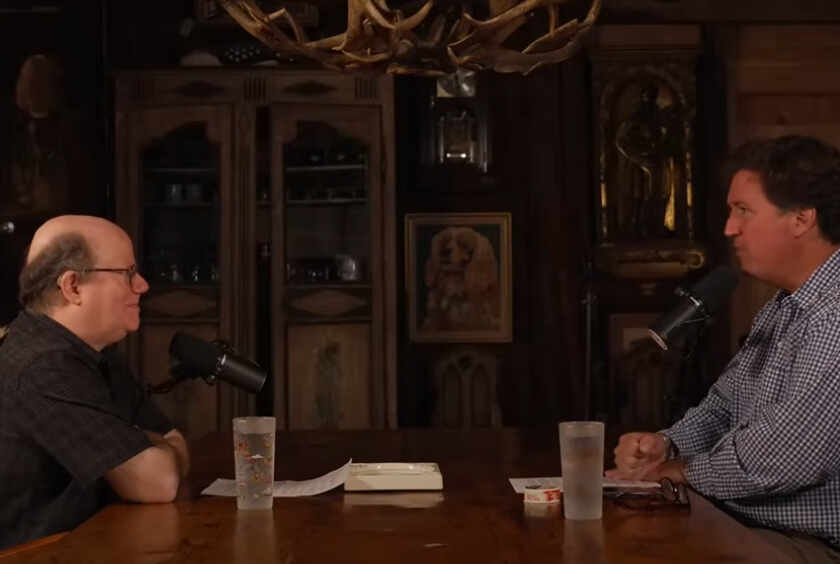
Read the full transcript of Wikipedia co-founder Larry Sanger’s interview on The Tucker Carlson Show episode titled “Wikipedia Co-Creator Reveals All: CIA Infiltration, Banning Conservatives, & How to Fix the Internet”, September 29, 2025.
The Origins of Wikipedia
TUCKER CARLSON: Larry Sanger, thank you for doing this. I think about you all the time, literally. I know it’s a little creepy because I think that Wikipedia is – you can’t overstate the importance of Wikipedia in shaping our collective memory. And a collective memory really is a culture, a civilization. Who are we? And Wikipedia is the answer to that question, like, who are we? Oh, it’s on Wikipedia.
And it’s so embedded in search that it shapes America. Wikipedia shapes America. And because of its importance, it’s an emergency, in my opinion, that Wikipedia is completely dishonest and completely controlled on questions that matter. So thank you for coming back. And I’d love to start at the beginning. Like, you created Wikipedia. How did that happen? And what were your intentions when you did that?
LARRY SANGER: So Jimmy Wales had registered nupedia.com the domain name, and simply had the idea of a free public contributed encyclopedia. And he hired me. It was like my assigned job to get it started. That happened in early 2000. So I worked on Nupedia for about a year, and it was going very slowly.
And so a friend told me about wikis, and it was a revelation, this idea that somebody could just put up, essentially, a bulletin board, a blank bulletin board, invite other people to edit the text in real time, and it would become something actually useful, and it wouldn’t be just a lot of curse words and graffiti and so forth.
TUCKER CARLSON: What does wiki mean?
LARRY SANGER: It actually comes from a Wiki Wiki Web. And that in turn comes from the Wiki Wiki Taxis at the Honolulu Airport, I guess.
TUCKER CARLSON: What?
LARRY SANGER: Yes. Really? Yes.
TUCKER CARLSON: Like headed to Waikiki?
LARRY SANGER: Yes. I didn’t come up with this. It’s Ward Cunningham. He invented the first wiki in 1995, I believe.
The Birth of Wikipedia
LARRY SANGER: Basically, a friend told me about wikis, and I was amazed at the basic idea and just the thought that it could work. And I thought, well, this would be a way to make the problems with Nupedia go away, be a lot more articles coming into the system, and then Nupedia could be like the – you know, beat them into proper shape.
But it didn’t work that way. Wikipedia – the Nupedia editors wanted nothing to do with the wiki. Anything that was so uncontrolled, essentially. So it took on a life of its own. We launched it. Originally it was the Nupedia wiki, And then on January 15, we relaunched.
TUCKER CARLSON: Of what year?
LARRY SANGER: January 2001.
TUCKER CARLSON: 2001.
LARRY SANGER: We launched under Wikipedia.com. So I coined the name Wikipedia and a lot of the other sort of basic jargon like Wikipedia and various other things. I came up with a lot of the original policies, like the neutrality policy, which actually started with Nupedia, and the requirement that original research may not be published for the first time in the encyclopedia, and a number of other things, of course, I should say.
TUCKER CARLSON: For those who don’t know, you come from a philosophy background.
LARRY SANGER: Yeah.
TUCKER CARLSON: You’re a philosopher, which is a kind of a great background for this job. Why these policies? For example, why would you ban the publication of original material on Wikipedia?
LARRY SANGER: It’s supposed to be a summary of what we all take ourselves to know, essentially. And especially if it’s a neutral encyclopedia, then it’s supposed to canvas all of the views that can be found in humanity on every question, essentially at a very high level. Generally speaking, of course, specialized encyclopedias can get into the real nitty gritty.
And my hope with Wikipedia in the beginning was that eventually it would become that specialized, so it would be the equivalent of bookshelves worth of articles and – well, I guess it did work out that way.
Wikipedia’s Growing Influence
TUCKER CARLSON: It replaced libraries, it replaced books, it replaced –
LARRY SANGER: To a great extent. I think you’re right. For a lot of people. Yeah. Basically, for a period until LLMs came out a couple of years ago, people used Wikipedia to look up quick answers about practically everything, actually. I would say until Siri started giving Wikipedia answers quickly, but it was still using Siri.
And for that matter, LLMs, you know, AI chatbots are also trained on Wikipedia now, so it continues to be relevant.
TUCKER CARLSON: Well, not just relevant. I mean, of course, its power expands exponentially once it’s tethered to this new technology AI. Right.
LARRY SANGER: I think that’s a very – that’s very safe to say. I think that’s true. LLMs are trained on a lot of different data, not just Wikipedia, of course, but there’s a lot of questions because I use LLMs all the time now, and I can tell you I’ve looked –
TUCKER CARLSON: Up, you know, specialized questions, Large language models.
LARRY SANGER: Exactly. I’ve looked up a lot of questions in theology, because I’m into theology now. And there are some places where I just know the only source for that particular factoid that I could find online outside of the LLM itself is Wikipedia.
TUCKER CARLSON: Right, right. So it’s institutionalized it. Google did, of course, did that in the most profound way when it tied its search to Wikipedia, put Wikipedia at the top of its searches. So these questions, these core questions like, you know, what do you put on Wikipedia? What do you exclude? Questions that you wrestled with 24 years ago. These are like, questions that affect every human being on the planet now.
LARRY SANGER: Kind of scary thought.
TUCKER CARLSON: Yeah, it’s scary, but it’s true. And so few things matter more than this, from my perspective.
LARRY SANGER: Right, right.
The Transformation of Wikipedia’s Neutrality
TUCKER CARLSON: So I’m not blaming you, but some people do. So. But walk us through, like, how you – how Wikipedia went from what you created it to be to what it is now. Like, when did you start to see changes? What were the debates?
LARRY SANGER: Yeah, in the early years, we really did take neutrality seriously, and it wasn’t just a requirement of being unbiased. Right. It was – the aim was to bring people together, enable them to work together, even though they were from all parts of the world, different religions, different viewpoints, and then to essentially record their knowledge.
So I intended it, and I think Jimmy Wales is on the record in a few places saying that he intended neutrality as being a way of bringing people together.
TUCKER CARLSON: Yes.
LARRY SANGER: Right.
TUCKER CARLSON: Which it is.
LARRY SANGER: Well, but I want to read the current definition of neutrality to show you what it has evolved into, which it did very gradually. Right, right. So here’s how the neutral point of view page begins. “All encyclopedic content on Wikipedia must be written from a neutral point of view.” NPOV. So far, so good. “Which means representing fairly, proportionately, and as far as possible without editorial bias.” So far, it’s great. “All the significant views that have been published by reliable sources on a topic.”
TUCKER CARLSON: Okay, I see two modifiers in that sentence. Two modifiers that are very important and reliable.
LARRY SANGER: Yes, yes. And let me go on, because if you look farther down on the page, they go on to discourage giving equal validity to, quote “minority view, fringe theory, or extraordinary claims.” Right. So – and that such views should be labeled that way. So the neutral point of view policy essentially dictates that Wikipedians must write articles in a biased way.
The Problem with “Fringe” Theories
TUCKER CARLSON: Well the inclusion of the – of the term fringe tells me right away that you’re a freaking liar if you use that word. Because it’s a word like terrorism and so many words, racism that we can’t really define and don’t care really to define. Like what does that mean? And if the whole policy turns on the word then it’s fair to demand a precise explanation of what it means. But we never get one. What is fringe? They can’t tell you. Fringe is what I don’t like. Fringe is hate speech.
LARRY SANGER: Yes. Or it’s simply a new view that is going to become dominant in 10 years or something happens all the time.
TUCKER CARLSON: Like Galileo. Fringe character happens all the time in –
LARRY SANGER: The history of ideas.
TUCKER CARLSON: No. Right. So that’s so obvious. Even a child understands that.
LARRY SANGER: Right.
TUCKER CARLSON: The key is the definition. And if you can’t come up with a definition, then we have to take the word out because yes, it can only abet lying. So how did that get in there?
The Media’s Influence on Wikipedia
LARRY SANGER: Well, I think it happened like this. I think Wikipedia developed in sort of in tandem with the development of media. So basically as media from the founding of Wikipedia 2001 to about 2012 or so was became solidified in a center left establishment standpoint. So if you were to read Wikipedia from 2012 or so 2010, it read a lot like the New York Times or the BBC. I remember saying that at the time.
And then especially around about 2016 and maybe a few years before that, the media landscape changed almost overnight. So that once staid mainstream sources became totally biased, they stated in their own voice that the president was lying and –
TUCKER CARLSON: So forth and racist.
LARRY SANGER: Racist. Exactly.
TUCKER CARLSON: Racist.
LARRY SANGER: Various. Tucker Carlson is a conspiracy theorist. So for example, and – and that of course then was echoed in Wikipedia. So Wikipedia feels perfectly free to say that Donald Trump is telling lies and that – that various pundits are conspiracy theorists.
The Ideological Takeover
TUCKER CARLSON: Here’s my question. I mean, so Wikipedia became a weapon of ideological theological war, used to destroy its enemies, of course, and that’s what it remains. But someone had to allow that. And that’s so far from what it was created to be. In fact, it’s the opposite, the mirror image of what it was created to be, that you have to ask, was there a fight over that? Who allowed it?
Like, if you’re getting to the point where you’re disallowing, quote, fringe theories or conspiracy theorists or some other term made up by the CIA to hide its secrets, someone has to, like, okay, that. Who – what was that process?
LARRY SANGER: It’s a good question. You can look at it from an organic point of view. I can’t tell you what was going on behind the scenes. If there were any, you know, puppet masters that were controlling the process, I don’t know. What I can tell you is that over the years, conservatives, libertarians, were just pushed out. They, in many cases – well, there is a whole, you know, army of administrators, hundreds of them, who are constantly blocking people that they have ideological disagreements with. And that’s not new.
So if somebody really does become a problem from their perspective, then they can be simply gotten rid of on a pretext. It’s very difficult. Now, it’s possible – is possible, but it’s very difficult for conservatives to get into Wikipedia and actually play the game. But you have to play the game, and that means you have to have to walk on eggshells.
So the point is, it wasn’t always like this. Over the years, basically, the left consolidated its power. The way I like to put it is that – that the left has its march through the institutions. And when Wikipedia appeared, it was one of the institutions that they marched through.
The Transformation of Wikipedia
TUCKER CARLSON: The difference is it’s brand new. So I grew up in this country. I’ve never believed in Harvard. It’s absurd. I’ve always thought it was absurd. I really believed in Wikipedia. I sent money to it. I mean, you can check the records. I have sent money, like, significant money to Wikipedia because I was so thrilled by its existence. So thrilled.
And so it wasn’t always this. And now it’s like the leading source of dishonesty, or, I would say, disinformation. I mean, most topics in Wikipedia seem totally straight to me, but if you go to anything that intersects any topic that intersects with theology, politics, ideology, power, and something about the topic and in my case, a couple of topics that I have firsthand knowledge, direct knowledge of it. They lie, they leave out key information, they load up the top of the entry with either superlatives or insults that are not. They’re totally subjective and insane.
“Far right conspiracy theory.” I mean, with a straight face, like if you’re calling someone a far right conspiracy theorist before even explaining to me who this person is, then you’re a propagandist, you’re a liar.
LARRY SANGER: Absolutely. Yeah. No, I agree. I described it as propaganda beginning around 2020. Before that, I don’t know that I would have given it that word. It was already emerging, you know, I agree.
TUCKER CARLSON: No, no, this has happened before our eyes.
LARRY SANGER: Yeah, yeah, absolutely.
Larry Sanger’s Departure from Wikipedia
TUCKER CARLSON: So when did you leave and why?
LARRY SANGER: Oh, long time ago. Yeah, 2002. So no, yeah, I was only there for the first two years of the project. I got it off the ground. I set a lot of the original policies and then so the company that launched Wikipedia, Bomis Inc. So Jimmy Wales was the CEO of that and he had a couple of partners. So it was my job to start it now I did.
And then the bottom fell out of the tech market, you know.
TUCKER CARLSON: That’s for sure.
LARRY SANGER: Yeah. Back in 2000, so they lost a big contract with, I think it was Google and so they weren’t able to pay people anymore. I was laid off and I decided, I made the decision to just step back from my role. I was, I would have been welcome to continue on, but I decided not to basically devalue my professional labor.
But with distance, in 2002, I saw that Jimmy Wales was essentially allowing troublemakers, leftists really, to take over. And they did as early as that. It took them time, I think, to really consolidate their power and create sort of internal processes and institutions and policies that really consolidated their power.
But yeah, who’s Jimmy Wales and what’s he like? Jimmy Wales is the other co founder of Wikipedia. He’s got a finance degree. Let’s see, he comes from Alabama. He went to a private school in Alabama. I think I knew him from online debating forums about Ayn Rand in the mid-1990s. I actually met him face to face on a little junket that I took to visit my uncle. So I just made a stopover in Chicago when he was living there. So I met him before he hired me to start Wikipedia.
But he’s a very personable person actually, if you meet him for the first time and you don’t know anything about him.
Jimmy Wales’ Political Evolution
TUCKER CARLSON: What are his views?
LARRY SANGER: I don’t know, actually. That’s a good question. I’d like to know. They used to be broadly libertarian. Yes, but he’s now associated with the left. He has got a lot of lefty pals and so I think he would probably say he still is a believer in classical liberalism or something like that, but I don’t know if I believe it.
TUCKER CARLSON: We’ll look at the results, right? I mean, it’s an authoritarian enterprise and it’s a prop, you know, it’s Pravda but with much greater reach and a much more profound effect. And it’s one of the worst things about our society, actually.
LARRY SANGER: But let’s be fair to Jimmy Wales here. It isn’t clear that he approves of the current approach that Wikipedia is taking.
The Money Behind Wikipedia
TUCKER CARLSON: Never spoke to Jimmy Wales other than sent money years ago. And let me ask you about the money. So is it a nonprofit, correct?
LARRY SANGER: Yes.
TUCKER CARLSON: Can you make money from it?
LARRY SANGER: Oh, of course. You know, just like any big nonprofit that’s raising hundreds of millions of dollars, you can essentially transfer money through grants and now they are a grant making institution. So I mean, I certainly don’t need to explain to you how really big foundations work. Right? But money can change hands. Large amounts of money can change hands through institutions like the Wikimedia Foundation. That’s the name of the legal entity that owns the platform.
Wikipedia’s Editorial Process and Bias
TUCKER CARLSON: So can you describe how the process works? So we’ve got, you know, Wikipedia entry on you. Let’s just say, how is that? And I haven’t actually read your Wikipedia entry. I’m sure it’s hostile in a subtle way.
LARRY SANGER: But it’s actually okay.
TUCKER CARLSON: It’s okay. I’ve never read my own Wikipedia entry, not one time, because I don’t want to go crazy because I am an expert on that subject. So I feel like I could probably compare their description to what I know to be true, and it would just make me angry. And I don’t want to be angry. But I have no doubt that it’s hostile.
LARRY SANGER: Right? It’d piss you off.
TUCKER CARLSON: Oh, is that true?
LARRY SANGER: Oh, yeah, I’m pretty sure.
TUCKER CARLSON: Have you read it?
LARRY SANGER: I think I’ve read the first paragraph anyway. Pretty top five, I think so.
TUCKER CARLSON: You know what? I’m not just saying this. Anyone who knows me knows it’s true. I’ve never done this before, but I’m going to look it up right now, and I’m just going to read the first paragraph.
LARRY SANGER: That’s good.
TUCKER CARLSON: I promise. I’ve never. I don’t even know where it is. Oh, there it is, right there. Oh, I knew I was going to use the first paragraph. It basically just says I’m a conservative political commentary.
LARRY SANGER: Okay.
TUCKER CARLSON: But I’m a leading voice of white grievance politics.
LARRY SANGER: Grievance politics.
TUCKER CARLSON: Okay. I thought I was going to be mad. I’m amused. I don’t even know what that is. “White grievance politics.” Okay? So then you click on white grievance politics, and it cites columnist Michael Gerson, who I happen to know. Not someone who I think has passed away. I’m sorry, I don’t want to make fun of him, but he’s not a reliable. I mean, he was an ideologue, okay? Big time ideologue.
And it quotes his quote, “non primary source needed.” It says in brackets that the Republican Party has been swiftly repositioned as an instrument of white grievance. I guess it was a column attacking me. No doubt about that. So they call me in the first paragraph, a leading voice of white grievance politics. Not how I describe myself. I’ve never thought of myself that way. I don’t really care. But, and in order to call me, basically they’re calling me a Nazi. Of course they cite a Washington Post columnist who hated me.
LARRY SANGER: Right.
TUCKER CARLSON: And that’s the citation.
LARRY SANGER: Right? Yes, that’s pretty much it. If they were following a genuine neutrality policy, then they might say that if that was what your detractors were really focused on, and perhaps it is, but they would certainly quote you in response to that.
TUCKER CARLSON: They would give examples. I mean, it wouldn’t be ad hominem. It would be, you know, quoting me saying “white people are angry. We have a lot of grievances and they’re justified.” Okay, there he is, you know, espousing white grievance politics.
LARRY SANGER: Right. Yeah.
TUCKER CARLSON: I don’t think I’ve done that, though. I do think that, by the way, so maybe I am a white grievance politician, but whatever, I don’t even care. But it’s just interesting. They don’t care either. The point is to make you sound scary and Hitler like.
LARRY SANGER: Right. No, that’s right. Yeah. I don’t know what white grievance politics is. And I’m pretty sure you’re not into it.
TUCKER CARLSON: I’m actually not into it.
LARRY SANGER: Yeah. Yeah.
TUCKER CARLSON: I mean, I do think white people have been completely mistreated and they have every reason to be mad about it, but I don’t want them, anyone to be mad about anything. And I definitely don’t want racial conflict. I’ve never wanted that.
LARRY SANGER: Yes.
TUCKER CARLSON: So, but whatever, but that, it’s not about me. And I’m so sorry I even brought that up. That’s all I’m ever going to read in my Wikipedia entry.
But that’s kind of the point. How is it allowed to use subjective terms with no clear definition in someone’s entry? Those are, that’s a political term. That’s a term of propaganda.
LARRY SANGER: Yeah.
TUCKER CARLSON: It’s a term designed to discredit, not to eliminate or explain, but to attack. That’s very common in political language. If that is political language. But how is that, how is no editor like, “wait a second, we don’t even, just, we don’t even define white grievance politics. How can we accuse someone of engaging in it?”
The Source Blacklist System
LARRY SANGER: Yeah, it’s, there’s a lot of history and there, and we could take it in many different directions. I mean, we’ve already talked about the policy that permits it. We could also talk about the sources that are permitted. Like if you look at only the sources that are permitted to be used in Wikipedia, so mostly secondary sources, and they are mostly left wing or center, generally speaking.
There is now a blacklist called the Perennial Sources page that contains lists of dozens of conservative sources that are just not allowed. And so if the only defenders of Tucker Carlson can be found in those other sources, then you won’t be defended in the article about you and they will call the article about you neutral.
TUCKER CARLSON: It’s quite amazing who makes the decision on the blacklist.
LARRY SANGER: So there is a reliable sources group essentially that debates it. Now there are people who spend the most time, you know, probably are working full time for somebody on Wikipedia. They build up a lot of clout.
TUCKER CARLSON: What does that mean, working full time for somebody on Wikipedia?
Wikipedia’s Power Structure
LARRY SANGER: Well, there are PR firms, just for example, that do nothing but edit articles on Wikipedia in order to be able to insert desired factoids according to how people pay them, essentially. So it’s a thing. Oh yes, Wikipedia PR firms, essentially. And this is not allowed officially. It’s called paid editing. Big no, no. And if you do do it, then you have to announce yourself. A lot of people do it and they don’t announce themselves, of course.
So my point then, to answer your question, is that there are a lot of people who have built up clout over the years in the Wikipedia and a lot of them have been made into the leaders of the project. There are 833 administrators, as they’re called. So these are sort of the rank and file cops. Then you’ve got 16 bureaucrats who can name the cops and you’ve got 49 check users. And these are accounts that can identify the IP address of accounts. And then there are 15 members of an arbitration committee which is sort of like the Supreme Court of Wikipedia, deals mostly with behavioral issues as opposed to editorial. So now here’s an interesting.
TUCKER CARLSON: Do we know who these people are?
The Power of Anonymous Wikipedia Editors
LARRY SANGER: That’s what I was about to answer. Of this power, 62 because if you add up all of those accounts and there’s overlap, there’s 62 such accounts. Only 9, 14.5% are named. So 85% of the most powerful accounts on Wikipedia on the editorial side are anonymous. So wait a second. No, it’s true.
TUCKER CARLSON: So again, these are the people who are shaping Americans understanding of the world, of their own country, of themselves, of reality itself. And we don’t know who they are because their identities are hidden.
LARRY SANGER: That’s correct, yes. They can libel people with impunity as they do you. And there is no legal recourse because they are anonymous. And the Wikimedia foundation enjoys Section 230 immunity, which means it can’t be sued in the United States.
TUCKER CARLSON: So my question is, there’s nothing that can be done. They’re protected by 230 immunity, so they can’t be sued into better behavior. But presumably they can be shamed and reasoned with. And the first. So the first step in that is just asking the question, on what grounds are you keeping the identities of some of the most powerful people in the country secret?
Why can’t I know who’s making these decisions? Who’s blacklisting entire news organizations on the basis of their politics? For example, who’s responsible for the slander? Why can’t I know their names? What would Wikipedia, the foundation say if I asked that question?
LARRY SANGER: They would say that according to the policies of the editorial side of their organization, which they’re not responsible for, people can participate anonymously at all levels. Right? So you could be the most Powerful person on the editorial side. And you don’t need to reveal your identity, it’s a matter of policy now.
TUCKER CARLSON: You know, talk about a non answer. They’re hiding their identities because they’re allowed to. Okay, got it. Well, yes, but why are they allowed to?
LARRY SANGER: Okay, so I think the answer is basically it goes back to like the, the zeitgeist of 1990s hacker culture when people went on like these funny names, nicknames, handles, not their real names. And that has continued. It never stopped. All across Wikipedia, people use these sort of cutesy names and they like to portray themselves to the public as just, you know, mop wielding janitors of the site.
And of course it’s ludicrous. Right, but it’s just as, as far as I can tell, it’s, it’s a game that they’re playing. They’re, they’re putting on the air of being like harmless college students that are only interested in comma placement and that sort of thing. So why you need to know my identity and so forth. But I’ll tell you people, they just haven’t pressed them on this question and.
Wikipedia’s Influence Compared to Academia
TUCKER CARLSON: They should be pressed immediately. And I mean, because just in practical terms, as you said, it’s ludicrous. Who has more effect on Americans or the world’s understanding of history? The seven history departments of the Ivy League or Wikipedia? It’s not even close. It’s not even, not in the same universe.
Yes, but if all of a sudden every history professor at Harvard, Yale, Princeton, Columbia, Dartmouth, Cornell, etc. Decided, “I’m not telling you my name,” and then as I teach your kids about the Renaissance or whatever we would say that’s freaking nuts, we have to know your name.
LARRY SANGER: Right? Right. And you know, traditional media organizations, they name their editors and their journalists. Of course they have real world reputation to live up to, and if they do bad reporting, then they, they can be fired. They can, they experience career consequences and, and that simply doesn’t happen on Wikipedia.
Now, you know, people, they can mess up on Wikipedia and be kicked out. They can lose their administratorship, whatever that happens, I suppose. But it’s not real world consequences, is it? Not really.
Intelligence Agency Influence on Wikipedia
TUCKER CARLSON: No, it’s not. And I, So here’s. Okay, so I’m sort of getting to one of my core concerns, which you’ve made me think is something to be concerned about, which is the influence of intelligence agencies on the work product of Wikipedia. It’s very obvious to me, having been around that world a lot, that they’re influencing some of the answers, some of the entries on Wikipedia, it’s super, super obvious.
It’s part of the propaganda campaign which is the real war, the info war. And like, you must have thought of that when you were building this thing. Like man, the intel agencies could get involved and start changing the way people understand what they did, for example.
LARRY SANGER: No, you didn’t.
TUCKER CARLSON: You never thought it.
LARRY SANGER: No, I had no such idea. Not in 19, not in 2001, in 2000, 2002. No. I mean I, I was a babe in the woods. Yes. It wasn’t until like, I think it was 2006, 2007, Virgil Griffiths did Master’s research. He came up with a tool called Wiki Scanner that enabled people to look up the IP addresses of people who had done edits and like, who had edited which articles. And so they were able to find a whole bunch of edits coming from Langley.
TUCKER CARLSON: Oh, I didn’t even know that.
LARRY SANGER: No, it’s true.
TUCKER CARLSON: Not to brag. I could just tell by reading it because I know what that is. Right.
LARRY SANGER: I since have learned differently and learned much better. I don’t have the background that you have, but it’s also very clear to me what we are told about the way that intelligence works now is that of course there’s the old fashioned cloak and dagger spying going on, but a large part of the remit of intelligence today is to manipulate public opinion in various ways.
And Wikipedia is like just a gold mine for the intelligence agencies of the world because it’s like a one stop shop, you know, you can just like type in the things that you want people to believe. I suppose. Now how that works, like which agencies are involved, how. How the heck should I know?
TUCKER CARLSON: You can tell by reading it. You can tell instantly by reading it some of what’s going on. I mean, you never know the whole story, of course, but it’s super obvious to me some of the players in this. Very obvious. And they’re the big ones, of course.
So. But my question, and everything you’ve said makes sense. My question however, is like, how is this allowed? So if you’re not allowed to edit Wikipedia for pay on behalf of say, a priority agency, how are you allowed to do it on behalf of an intelligence agency?
LARRY SANGER: That’s a good question. I actually asked Elon Musk and President, and the President to, to, you know, use DOGE or other government resources to investigate what United States employees were actually editing Wikipedia. And you know, perhaps. Stop that. I don’t know, maybe, maybe we shouldn’t. Maybe there’s reasons, legitimate reasons for government employees to do this, but at least Elon Musk did retweet that and got a lot of support. So did anyone do anything about it? What’s that?
TUCKER CARLSON: Did anyone do anything about it?
LARRY SANGER: Not to my knowledge, except now there is a congressional investigation. I don’t know if my tweet had anything to do with the start of that. I don’t think so. I think it had more to do with the reporting of Ashley Rinsburg and, well, of course, Israel, and I would add Hindus are very bothered with the way that their ethnic groups are treated in Wikipedia.
And both of them, both a whole bunch of Jews and a whole bunch of Hindus have been after me in the last couple of years saying, “you’ve got to speak out, you’ve got to help us,” you know, And I’ve said I don’t really know a lot about the situation. I mean, there isn’t a whole lot that I could do.
Organized Groups Fighting Back
TUCKER CARLSON: Will they be accused of Indian or Israeli grievance politics? Probably not.
LARRY SANGER: What’s that?
TUCKER CARLSON: No, sorry, I’m just thinking like, no, that was a bitter, sardonic aside. No, excuse me, I take that back. I don’t want to be a grievance person, you know, of course. But the answer, what you’re really saying is people who are organized have a way to push back against the lying.
LARRY SANGER: For sure. For sure. I think that, that if, like Israeli intelligence, for example, got together and made a real concerted effort to, to fight against the. This group of 40 Muslim activists that Ashley Rinsburg identified, they might be able to make some inroads.
TUCKER CARLSON: So you think, you think they might be able to.
LARRY SANGER: Yeah, they might. Yeah. It really depends.
TUCKER CARLSON: Possible. I’m just throwing that out there.
LARRY SANGER: Yeah. Here’s the thing. I actually think concurrently we’re going to talk about the nine theses here, I assume. So. I would like to encourage people to at least test the waters. Don’t, like, don’t go to Wikipedia and be a jerk and get yourself kicked out right away because they will kick you out for sure if you’re, if you are not playing by the rules, but go there.
And maybe not all at once, but over the next few weeks, make some real efforts to make good faith edits to Wikipedia, build up some credibility within the community. You can make a difference there. I think it’s a good idea for, to give it a try. You know, one thing that has never been tried is to simply get all of the libertarians and all of the conservatives and, and the Jews and the Hindus and the Christians and whoever Else has grievances against Wikipedia. Organize them. Yes, and descend on Wikipedia and actually try to make a change.
The Conservative Instinct to Retreat
TUCKER CARLSON: That never occurs to most conservatives. Their first instinct is to. I’ll speak for myself. My first instinct is to run away. I don’t want to deal with this. It’s horrible.
LARRY SANGER: Me too.
TUCKER CARLSON: I hate these people and this is my internal monologue. And if I’m mad enough, we should start something better. It never occurs to your average conservative to take back the institution that’s been perverted and corrupted. It never occurs to them, well, maybe I should, I don’t know, try to join the faculty at Harvard and stop lying, you know, or why don’t I fix Wikipedia? And I think that’s. You’re right.
LARRY SANGER: Yeah. So I think it was either the first or second interview that you did of me was in 2019 when I started something called a social media strike. And it actually went pretty well. But it always struck me that first of all, I could have followed it up. And second of all, it could have been much bigger, like if I had organized it properly.
But it was mostly, mostly just me and my blog, you know, and still there were like a half a dozen or ten different media sources that covered that, this social media strike. So maybe we should organize something similar with regard to, I think part of.
TUCKER CARLSON: The problem is that most non liberals have just no patience for bureaucracy.
LARRY SANGER: Right?
The Liberal Safety-in-Numbers Phenomenon
TUCKER CARLSON: And liberals, because they, as Ted Kaczynski famously wrote, the whole point of liberalism is safety in numbers. These are people who are hollow and afraid inside, and so they seek each other out and they create these institutions so they can feel safe. And non-liberals just don’t feel that way at all because they’re not, because they believe in something and they’re not ruled by fear.
And so the average conservative, when told to sit through like a PTA meeting or join the Wikipedia editor’s process or something like, goes crazy. Can’t deal with it.
LARRY SANGER: Right, right.
TUCKER CARLSON: Do you notice this?
LARRY SANGER: Yes. And there’s another sort of practical problem that stands in the way of this. You’re not allowed to do what’s called brigading on Wikipedia. So brigading means organizing editing of a particular article off the Wiki. So if you’re caught doing this, then you can be blocked.
So if I were to tell everybody to go to the article about Larry Sanger, please don’t do that. But if I were to try to organize that, like on this show right now, then I might be blocked for brigading.
TUCKER CARLSON: But it’s cool for, like, Saudi intelligence or Mossad or the CIA to do it for sure. This is so bonkers.
LARRY SANGER: For sure.
TUCKER CARLSON: Got it. Yeah, got it. And it’s so obvious. I mean, it’s obvious.
LARRY SANGER: It’s an obvious thing for them to do. They wouldn’t be doing their job if they weren’t doing it. I mean, they’re supposed to be shaping public opinion. That’s part of their remit is the intelligence committee or community now.
TUCKER CARLSON: Yeah.
LARRY SANGER: And the way to shape public opinion, one of the main ways is to make sure that Wikipedia reads the way you want it to read. And yes, then they can organize secretly behind the scenes. And they do.
The Intentional Distortion Problem
TUCKER CARLSON: Yeah. There’s such a lot. I mean, I just happen to know some of the topics. Like, I was there for not many things, but some things. And you read about something that you just happen to have direct knowledge of, and the account of it is so intentionally distorted such a lot.
And then people, you read about, it’s like, wait, I remember when you had a DUI arrest or whatever, and it’s gone. If they can’t even keep the paid PR people out, then that suggests to me that the people who edit Wikipedia are probably making money on this. Like, the fastest way would just be to bribe them.
LARRY SANGER: If you are really good at playing the Wikipedia game, and you’re like one of this power 62 and you’re not in the pay of somebody, then you’re just leaving money on the table. That seems obvious to me.
TUCKER CARLSON: Well, if we can’t even know their names, then what would be the disincentive?
LARRY SANGER: And that would be one of the reasons why we don’t know their names. And that actually is one of the main reasons why I say we should know their names.
TUCKER CARLSON: So I’m just calling on WikiLeaks or Julian Assange. Where are you?
LARRY SANGER: I cannot agree. I don’t think that we should dox the power 62. This is what I call doxing.
TUCKER CARLSON: What do you mean? Does that mean like home address or does that just mean name?
LARRY SANGER: Name? A name is enough. That would be doxing them.
TUCKER CARLSON: Okay.
LARRY SANGER: In the Wikipedia system, they are basically anyone who reveals their name and they don’t want their name revealed would be immediately blocked for doxing, and it would be a permanent block for sure. So it’s a very serious offense on Wikipedia. So I am not encouraging people to do this.
TUCKER CARLSON: Okay, that’s fair. I respect the fact you’ve thought about this a lot and much more than I have, and you’re decent and so you’re probably right. I’m just frustrated.
But I wonder, is there. It seems to me knowing the names of the people making these decisions is in the public interest. That’s for sure. These are just random Twitter users. They’re shaping history. They are the authors of history, certainly the gatekeepers of history.
LARRY SANGER: And they’re libeling. We need to talk about that.
The Libel Problem and Legal Recourse
TUCKER CARLSON: Well, they are, obviously, and I say this as Mr. Wake Ravens politics. I can’t. Yeah, they certainly have libeled a lot of people I know.
LARRY SANGER: Yes.
TUCKER CARLSON: Literally libel. Like saying things that are untrue about them.
LARRY SANGER: And there’s no recourse. So this is the problem. John Siegenthaler senior called me up in 2005.
TUCKER CARLSON: He’s a newspaper editor from Tennessee.
LARRY SANGER: Exactly. He was a longtime publisher and editor of the Tennessean. One of the founding board members, I believe, of USA Today. So very important newspaper man.
TUCKER CARLSON: Kind of a center left liberal, I would say.
LARRY SANGER: Right. And the article about him said that he had been under suspicion of being responsible in some way for the assassination of RFK. And he was livid, of course, because he had actually worked on RFK’s campaign and things like that.
And he blamed me and I kind of didn’t blame him for doing so. And he opened my eyes to just how reputations can be harmed by people’s Wikipedia articles. And I have heard from dozens and dozens, maybe over a hundred different, reasonably famous people since then with grievances about the Wikipedia articles.
And they’re like at their wits end. They know I’m long gone from Wikipedia and they don’t know what to do. So I’ve kept abreast of this issue on Wikipedia quite a bit. And it bothers me because I take sort of personal responsibility. I feel personal responsibility, which is one of the reasons why I came up with the nine Theses in the first place.
TUCKER CARLSON: So, like, what did Siegenthaler do? Like, was he able to get that off Wikipedia?
LARRY SANGER: He was able to get satisfaction. I don’t think he got an immediate response and immediate reversal, but reasonably quickly. But I can’t remember if it was before or after they had changed his article that he called me. But he wanted me to know. And I don’t blame him.
And another time, Philip Roth, the famous journalist, also brought.
TUCKER CARLSON: The novelist.
LARRY SANGER: The novelist, yes, he contacted me also, and was complaining that the story of the origin of the inspiration of “The Human Stain” was wrong on Wikipedia. He had gone to the Wikipedia Talk page and said, “Hi, I am Philip Roth and you’ve got the story wrong and here’s the real story.”
And they said, “Sorry, we can’t use that. You’re a primary source.” I mean, it’s ridiculous, of course. I mean, just what kind of person do you have to be to take that sort of disrespectful stance to somebody like Philip Roth and to twist your own rules in that way for almost petty reasons.
There’s a lot of petty power players on Wikipedia, I find, and I believe that the people behind this, they hide behind their anonymity. So there is no legal recourse when somebody is seriously libeled so that their career is damaged. I’ve heard from people whose careers were materially damaged.
TUCKER CARLSON: Oh, well, I’m sure I’m one of them.
LARRY SANGER: By Wikipedia.
TUCKER CARLSON: Yeah, yeah. My recourse has just been to stay cheerful, focused on God and my family, not get mad. I think is kind of the only. That’s the only thing I’ve been able to do about it and not read it. Don’t marinate in that.
But I don’t think it’s just petty power. It’s like global power. Because they’re aligned with Google, the biggest search engine, the search monopoly that dominates English language search completely has a monopoly on it. And they have somehow made a deal with Google that allows them to be the top search result.
So, for example, I just Googled myself for the first time ever and Wikipedia is the first result. Now why would Wikipedia be the first result of me? I still work, I still have a job. So like there. Why would that be number one? Why would a bunch of anonymous editors get to be the first result on my name? Because they have a deal with Google.
The Google-Wikipedia Relationship
LARRY SANGER: I can explain it. You very well could be right.
TUCKER CARLSON: My house on it.
LARRY SANGER: But well, look, in the early days, Wikipedia was the only source of information on a whole bunch of topics. And then the way that the Google algorithm worked back then, if you ended up being the first source for a lot of topics, then your Google page rank score was higher. And so Wikipedia just shot to the top of Google’s page rank algorithm. At least this is the story they tell.
And so one of the reasons why Google, or Wikipedia rather took off so quickly is this feedback loop that it had with Google. So Wikipedia would write 100 articles that never had any coverage by Google before they would appear on Google. People would search for those topics and they would come to Wikipedia and then the number of contributors would expand and lather, rinse, repeat, and there was exponential growth.
TUCKER CARLSON: Well, so I think we’re saying the same thing. I mean, you’re describing the mechanism by which Wikipedia is the guaranteed first response to any query on a fact about a person or history.
LARRY SANGER: Right.
TUCKER CARLSON: I mean, that’s to say it doesn’t matter kind of what the mechanism is. The result is the same.
LARRY SANGER: Yes, yes, yes.
TUCKER CARLSON: And they know that.
LARRY SANGER: Yes. And I guess what I’m saying is if there was an actual deal from the beginning, it would be from the beginning. And I wouldn’t rule that out. I’m enough of a conspiracy theorist to say that that’s not totally impossible.
In fact, how many startups can you say were the first reviews by any news source was the New York Times and MIT Technology Review, but those were the first reviews that were published by any mainstream source of Wikipedia.
TUCKER CARLSON: Amazing.
LARRY SANGER: Yeah, that was in September of 2001. So we were immediately on the establishment’s radar.
Wikipedia as Servant to the Ruling Class
TUCKER CARLSON: Well, I mean, Wikipedia is a servant to the ruling class, obviously, which is corrupt. So Wikipedia is itself corrupt, the most corrupt. You can’t over. I must say my last editorial comment that I want to get to what we can do to make this better. And you’ve written extensively about it.
But my last comment is that when people grouse about the media or corrupt news media, they’re always referring to companies that really don’t matter, like CBS or NBC or CNN or Fox News. It’s like, who cares? They’re all going away. They’re totally discredited. Everyone knows that. And they won’t even be here in 10 years.
Wikipedia has a much greater effect on how people understand the world than any of those media outlets. Wikipedia is a media outlet and it’s never included in the list of corrupt media outlets. And that just bugs me.
LARRY SANGER: Well, could it push back slightly? Of course, people our age and older still do take CNN and NBC and all the rest very seriously. So now not the conservatives, but basically centrists. My mother votes Republican and she still watches the mainstream media and it still defines her reality, essentially. So it’s a generational thing.
TUCKER CARLSON: It is. I’m just saying that the actuarial tables tell us that this has a limited shelf life.
LARRY SANGER: So that’s right.
TUCKER CARLSON: That’s it. And just looking for extrapolating forward 10, 15, 20 years, that stuff is not meaningful. Digital media is very meaningful, and Wikipedia is the most meaningful. That’s my only point. And I just think that someone should say that out loud.
LARRY SANGER: I agree. No, I think that’s true. It’s probably. Wikipedia by itself is more influential than the New York Times or any other single media source.
TUCKER CARLSON: And it works in tandem with the New York Times.
LARRY SANGER: Right.
TUCKER CARLSON: Any chance of getting the New York Times blacklisted at Wikipedia? You laugh.
LARRY SANGER: I don’t think so.
TUCKER CARLSON: Well, I know for a fact that I’m more honest than New York Times. I mean, I really believe that I am. But I’m blacklisted and they’re not. So I just think that’s not neutral whether I’m right or wrong.
You have, following the example of our beloved German monk 500 years ago, written some theses that you want to nail to the front door of Wikipedia.
LARRY SANGER: That’s right.
The Nine Theses for Wikipedia Reform
TUCKER CARLSON: What are they?
LARRY SANGER: All right, let’s go through the list. This should take about five minutes maybe.
TUCKER CARLSON: So take your time.
TUCKER CARLSON: I just want to restate if you’re coming to the video right now. This is the creator of Wikipedia explaining how Wikipedia can be saved from corruption.
LARRY SANGER: Yes. Nobody has ever actually made a thoroughgoing reform proposal of Wikipedia. This is the first time anybody has done that, and it’s certainly the first time I have done that. There’s been a lot of piecemeal reform proposals, but this is thoroughgoing and I’m trying, just as Luther did, I’m trying to start a conversation. So this is not a. I hope.
TUCKER CARLSON: This starts a reformation. Well, do I hope this starts with Luther started.
LARRY SANGER: Right. A return to honesty will be the Protestant Wikipedians.
Thesis One: End Decision Making by Consensus
Okay, so the nine theses begin this way. Number one, end decision making by consensus. So Wikipedia pretends to make difficult editorial decisions based on a process they call consensus, but it’s a sham because this allows ideologues to silence dissent by falsely claiming, in effect, unanimous agreement. But of course there isn’t unanimous agreement.
TUCKER CARLSON: So the scientific consensus on climate change would be a perfect example of this.
LARRY SANGER: Would be a very good example. So the consensus, I say, as a description of how they arrive at difficult editorial decisions should be abandoned. Now what they replace it with? That’s a good question. But let’s begin there.
TUCKER CARLSON: And decision making by consensus, because it allows an aggressive faction to overwhelm the skeptical faction.
LARRY SANGER: Exactly. It’s really a cynical institutional fiction. It has to end. They can’t call what they’re doing consensus anymore. That’s not a consensus at all. Especially if they claim to be an open global project. Period.
TUCKER CARLSON: Thank you. I agree.
Thesis Two: Enable Competing Articles
LARRY SANGER: Number two, enable competing articles. So this is a little bit out there, but I think it’s a good one. Since true neutrality is impossible, as we’ve been discussing, under the current editorial monopoly, Wikipedia should allow multiple competing articles written from different declared perspectives, each striving for neutrality within its own framework. So let the people write alternative articles.
TUCKER CARLSON: That’s not far out.
LARRY SANGER: No, it really should be idea. Yes. I mean, why not just allow, you know, there can be multiple articles titled Donald Trump.
TUCKER CARLSON: So you could have, you know, Special Report on Fox News, or you could have the CBS Evening News and you could also have Joe Rogan. That’s what alternative media is.
LARRY SANGER: Right, Right, right.
TUCKER CARLSON: And people can decide what they believe.
LARRY SANGER: Yes. So fine.
Thesis Three: Abolish Source Blacklists
Number three, abolish source blacklists, which we’ve already talked about this quite a bit. Wikipedia maintains a list of perennial sources which serves as an ideologically one sided blacklist of media sources.
TUCKER CARLSON: What is the justification for that? And like internally, we just don’t believe them. They’re not real. What are the criteria for determining authenticity of a news source?
LARRY SANGER: That’s pretty much it.
TUCKER CARLSON: No, my opinion.
LARRY SANGER: They don’t say it’s just their opinion. They say, as a matter of objective fact, we have.
TUCKER CARLSON: You know, studies show the New York Times lies, therefore, you know, I’m just banning it.
LARRY SANGER: Well, you would think that that would hold some weight with an objective analysis.
TUCKER CARLSON: What def. I can tell you.
LARRY SANGER: Yes, yes, yes, yes. Okay, so you can’t cite the New York Post, Fox News, or you on Wikipedia as a source. So I am making the modest proposal that this blacklist should be abolished. It was established in 2017. It’s fairly new.
TUCKER CARLSON: Right after Trump.
LARRY SANGER: What’s that?
TUCKER CARLSON: The year Trump gets inaugurated.
LARRY SANGER: That’s right.
TUCKER CARLSON: They decide that we’re just not going to hear from certain news organizations just because, because objectively they’re bad.
LARRY SANGER: Wikipedia may not cite the. Well, for example, the New York Post. And we should actually investigate whether that decision was made at about the time that the Hunter Biden laptop story was breaking.
TUCKER CARLSON: Is this public, by the way? Can you, can I go on the Wikipedia site and find out what’s blacklisted?
LARRY SANGER: Sure. Just type in perennial sources, Wikipedia into any search engine and the first result will be this page.
TUCKER CARLSON: Names them the blacklist.
LARRY SANGER: Oh, yeah, of course. Yeah. It’s all so color coded. Green.
TUCKER CARLSON: Do you have the list? Do you mind if I do that really quick?
LARRY SANGER: Go right ahead.
TUCKER CARLSON: Okay, so it’s. Let me just do. I just. I’m testing your thesis. So it’s perennial.
LARRY SANGER: Oh, no.
TUCKER CARLSON: Source.
LARRY SANGER: Yeah.
TUCKER CARLSON: List Wikipedia. Right.
LARRY SANGER: Well, you’re doing that. I’ll give you some fully approved sources. New York Times, Washington Post, CNN, the Nation, Mother Jones, GLAAD.
TUCKER CARLSON: Come on.
LARRY SANGER: These are all green lit. Fully green lit. Okay. The blacklisted sources are Breitbart, Daily Caller, Epoch Times, Fox News, New York Post, the Federalist. So you can’t use those as sources on Wikipedia.
TUCKER CARLSON: Oh, wow. Well, they’ve got. Of course. So is red. I’m looking at it now.
LARRY SANGER: Yes. Red means it’s blacklisted. You cannot cite it as a source of facts, maybe as a source of opinion, but generally that works out.
TUCKER CARLSON: Anti Defamation League gets a green light only for some.
LARRY SANGER: Yes. If you’re actually reporting about the Arab Israeli conflict.
TUCKER CARLSON: The Arab Israeli conflict.
LARRY SANGER: Yes, yes.
TUCKER CARLSON: Okay.
LARRY SANGER: You may not cite them.
TUCKER CARLSON: Interesting.
LARRY SANGER: So you can’t find the Jewish perspective on the war so easily anymore on Wikipedia.
TUCKER CARLSON: Yeah. Catholic hierarchy. This is interesting.
LARRY SANGER: Yes. There’s a serious academic encyclopedia of Christianity that is not allowed on Wikipedia.
TUCKER CARLSON: I was surprised to find counter punch is not allowed. So they’re naughty. They’re naughty. Daily call are not allowed, of course. Oh, you started mail. Not. Yeah, I did start it. I’ve got nothing to do with it now, but I did start it. That’s interesting. This is kind of incredible. Okay, I never hear about this and we don’t know who made this decision.
LARRY SANGER: Mr. X is the name of his account now. It’s edited, of course, as Wikipedia pages are, by a whole bunch of other people.
TUCKER CARLSON: Lifesite news not allowed.
LARRY SANGER: Right, of course.
TUCKER CARLSON: The pro lifers. Yeah, that’s interesting. I’m going to see if this. Okay, well, why does no one talk about this? Oh, Sputnik, of course. Not allowed. Talking man.
LARRY SANGER: Search me. I don’t know why people aren’t talking about it. It’s obviously huge news. I think it’s simply embarrassing for the left. And so the left aren’t going to report about it. And the right has been reporting about it.
TUCKER CARLSON: TV Guide allowed. The UN’s review not allowed. TV Guide, totally cool. Unz VDare. Not allowed is so funny. This is amazing. Okay, all right. You’ve amused me deeply. Okay, I’m so sorry. I just had. I’m sorry for the. It’s. It’s all so incredible to me. Okay, so number three.
LARRY SANGER: Right, all right, shall I go on then?
TUCKER CARLSON: Yes, and I will not interrupt. I just can’t.
LARRY SANGER: So to conclude the discussion of number three, the blacklist should be abolished. Diverse sources should be cited with acknowledgment of how different groups assess their credibility if necessary.
TUCKER CARLSON: Exactly.
Thesis Four: Revive the Original Neutrality Policy
LARRY SANGER: Yeah. Okay. Number four, revive the original neutrality policy. Wikipedia must return to genuine neutrality by refusing to take sides on controversial issues, even when one view dominates Wikipedia. Well, academia and mainstream media.
So I suppose that one is fairly straightforward, and we’ve already discussed it quite a bit, that the neutrality policy right now defines neutrality in terms of what are called significant views. And the reliable sources and significant views are significant views according to, you know, the faculty members of Harvard and things like that.
And if your view is held only at, you know, conservative seminaries, for example, or other bastions of conservatism, then they’re not significant. At least that’s how it’s treated on Wikipedia right now. So that needs to be. Wikipedia should be a big tent as it used to be, enabling many, many different people to come together, you know, in a big. I just think of it as like old fashioned liberal Kumbaya, you know, people should be able to come together and talk to each other from radically different points of view and just make sure that their views are all respected on the same page.
TUCKER CARLSON: Yeah. It shouldn’t just be the most reactionary views. NBC, Harvard, you know, only the most kind, stalwart defenders of this broken project. Yes, right. It shouldn’t just be the College of Cardinals voting here.
LARRY SANGER: Right.
TUCKER CARLSON: So in my opinion.
LARRY SANGER: Okay, yes, yes. There’s a good way to characterize the currently only permitted viewpoint on Wikipedia. And that is with the acronym GASP which stands for globalist, academic, secular and progressive. And each one is necessary and together they just give a perfect picture of the viewpoint of Wikipedians today, of most Wikipedians.
TUCKER CARLSON: Do they know that they’re like representing, selling the views of say the Aspen Institute or the Atlantic Council or the CIA or the Washington Post editorial board? Like such a tiny minority of the globe’s population, but the most powerful people in the world, like they are the praetorian guard protecting the powerful. Do they see that?
LARRY SANGER: I think they do. I think a lot of. Of course it’s a fairly big group of people, you know, in the single digit thousands of regular editors these days. I think a lot of those people do know that and they take pride in it, frankly. Yeah.
TUCKER CARLSON: In oppressing the rest of the population on behalf of the richest and most powerful.
LARRY SANGER: They don’t think they’re doing that, but.
TUCKER CARLSON: Yeah, that’s exactly what they’re doing. By lying to people, you oppress them.
Thesis Five: Repeal Ignore All Rules
LARRY SANGER: Yeah. Right. All right then, number five. So just a little throat clearing here, a short little proposal. Repeal Ignore all rules. So there is a policy called Ignore all Rules which I came up with in the first few days of the project. Originally I meant it as a joke to encourage newcomers. So like if rules make you nervous and like you’re not sure what to do, then just ignore them and go about your business. That’s essentially what I said.
TUCKER CARLSON: Yeah.
LARRY SANGER: Okay, good.
TUCKER CARLSON: Rule for responsible, honest people.
LARRY SANGER: And this became essentially a cargo cult. You know, over the years people started using this to shield insiders from accountability. So I made this rule and so I now declare that it should be repealed.
TUCKER CARLSON: How has it been used to protect corruption?
LARRY SANGER: Well, generally what happens is if somebody can’t think of a covering rule in a special case, but it just seems plausible to the people who are working on an article, this really ought to be against the rules or whatever. Just ignore all rules. And they’ll just say that, you know, and it’s. And they usually say in a kind of tongue in cheek way, but in a way that’s serious enough to actually have an effect.
But you know, a lot of lesser contributors, they wouldn’t be able to get away with that sort of thing. So there’s one guy who said at the height of COVID if there is one serious, serious application of ignore all rules, it should be now we should be able to ignore all the rules regarding whatever in order to get people to believe that Covid is serious and they, they should be jabbed.
TUCKER CARLSON: And the vax is. Yeah, so basically we should. If you, when you ignore all rules, after a while you’re ignoring all principles and they’re doing it again in the service.
LARRY SANGER: Selectively.
TUCKER CARLSON: Yeah, selectively. In the service of like the most powerful people in the world.
Thesis Six: Reveal Who Wikipedia’s Leaders Are
LARRY SANGER: Right. Okay. Number six, reveal who Wikipedia’s leaders are.
TUCKER CARLSON: Why is that not number one? I like that one.
Wikipedia’s Anonymous Power Structure
LARRY SANGER: Yes. So Wikipedia’s most powerful editors remain overwhelmingly anonymous despite wielding enormous influence over one of the world’s most powerful media platforms. These leaders must be publicly identified for accountability and given liability insurance, as volunteers of nonprofits often are. So there’s no reason why they shouldn’t do this.
TUCKER CARLSON: If you’re wielding real power, I think it’s… And by the way, I like anonymity online a lot of the time because I think it helps the underdog tell the truth. And so I am for anonymity on social media, for example. I don’t think you should have to register with the government to give your opinions, just to be clear.
But if you’re wielding real institutional power, I think it’s fair to require people to say who they are. Just like Supreme Court justices have to give their real names.
LARRY SANGER: Right, right. It’s a no brainer. If there is one thing that might get the attention of the mainstream media, it seems to me it might be this one. I don’t think it’s widely known that 85% of the most powerful accounts on Wikipedia are anonymous. How is that allowed?
TUCKER CARLSON: No, I know, I couldn’t agree more.
LARRY SANGER: It’s just disgusting.
TUCKER CARLSON: By the way, there are consequences to having your identity known, I can tell you. And they’re not great. On the other hand, that’s the price that you pay for having influence. I don’t know that’s fair.
LARRY SANGER: Right. And by the way, I don’t want those people to be doxxed. I’m going to say it again, and I’m not saying that the people who are there should be forced to reveal their identity or anything like that. They can resign and then new people can be brought on board.
And then maybe, if necessary, you could pay them a little stipend for their trouble. They’ve got… They’re raising, I think, something like $200 million a year now. Right. It’s a huge amount of money.
TUCKER CARLSON: As I said, I was a donor. Yeah, no, I get it.
Public Rating and Feedback Systems
LARRY SANGER: Yeah. Okay. Let the public rate articles. That’s number seven. Wikipedia should implement a public rating and feedback system, allowing readers to evaluate articles. They can’t do that now.
TUCKER CARLSON: We call it that. That’s the comment section. But they don’t have a comment section.
LARRY SANGER: They don’t have a comment section. They don’t have any sort of rating section. There are no metrics that they can use. They’ve metricized everything. Books on Amazon, thumbs up on X and YouTube and whatnot, but not Wikipedia. And if there’s never thought of that.
TUCKER CARLSON: I’ve never thought of that. That’s so smart.
LARRY SANGER: Yeah, well, and look, if there’s one place where an actual rating system would matter and actually be important, it would be Wikipedia, because we, I think you and I agree that Wikipedia does have some decent articles. That’s right.
TUCKER CARLSON: Great articles.
LARRY SANGER: Yeah.
TUCKER CARLSON: And you want to learn about the Falkland Islands. You want to learn about some bird species. Yeah, it’s amazing. That’s why it’s so frustrating.
LARRY SANGER: Yes. So, I mean, wouldn’t it be nice if there were some independent reviews independent of Wikipedia that would give the public a notion of whether they can actually trust the information?
And I actually think that you should be able to identify and even rate the raters and say, “Okay, these accounts who have rated the Trump article very highly are mostly Democrats, and those that rate the article very poorly are mostly Republicans.” And then you should… There should be a system that would enable you to go and learn what the best articles are, especially if they’re competing articles. Again, from anybody’s point of view.
TUCKER CARLSON: I love that.
Ending Indefinite Blocking
LARRY SANGER: Would be nice. Let’s see, thesis number eight: End indefinite blocking. Wikipedia’s practice of blocking accounts permanently is unjust and ideologically motivated.
So I did a little personal investigation last June. In a period of two weeks, 47% of the blocks that had been done by Wikipedia were indefinite, which means permanent. And you can sort of understand some of them because you’re reblocking the same people who have already been blocked because they made new accounts. Those are called sock puppets. It’s still a very, very high number.
Right. And they do, as I have said, block willy nilly, and they will block permanently. I mean, there are people online who complain that they were blocked for making grammar corrections. I’ve seen, I don’t know, three or four cases of just that. I quote a few in the essay.
So each of these theses, by the way, has a whole essay to go with it, which I very carefully wrote over the last nine months.
TUCKER CARLSON: And where can interested people find that?
LARRY SANGER: They can find it on my user page on Wikipedia. So just go there. I don’t know if it’ll be on the user page, or maybe it will be linked from the user page, but it’ll be on Wikipedia itself. So I actually want to take the debate to them.
I still have an account in good standing for now. We’ll see if they block me over this. I’m not sure, but I would like to start a debate there. So that’s why I’ve posted it there.
I also have a version of the nine theses on my blog, and it’s identical, but it also has links to archived versions of all the resources that I cite. So they can’t, like, take anything down without people knowing.
TUCKER CARLSON: Let’s see.
LARRY SANGER: So I think that basically indefinite blocks should be extremely rare. They should require multiple administrators to agree, because right now, one person can, for arbitrary reasons, practically block another account, an account in good standing that might have had, like, thousands of edits without really any meaningful recourse.
Right. So at least let’s have a panel of people convened if you want to block somebody permanently. And of course, you should be able to appeal your permanent block if you are permanently blocked every maybe three, six, maybe 12 months. Right. So the idea is it’s only fair to give people the opportunity to say, “Well, I’ve reformed. I’m not going to do what I’ve done before.”
People, you remember the movie Escape from Alcatraz?
TUCKER CARLSON: Yes.
LARRY SANGER: There was a character in it who’s befriended by Clint Eastwood’s character, who’s this great painter, and he makes a painting of the warden. The warden sees a copy of this as he’s snooping around in a cell, and it’s an unflattering picture of the warden. So that man’s… His painting supplies are taken away by the warden, and they have so few joys in this place. It’s like living death. And so the painter then commits suicide.
A lot of people feel very strongly about Wikipedia because it is a significant hobby in some cases, in the way that, like, I play Irish fiddle. That’s like my… One of my big hobbies. And I don’t know if you’re fly fishing, I guess if you were to take this away from people forever, just disallow them, then can be really upsetting to people.
One person, there’s a story I quote in the essay of a guy who came close to suicide when his account was blocked. And you know how they responded? They responded, “Wikipedia is not therapy.” There’s an essay to this effect, “Wikipedia is not therapy.”
TUCKER CARLSON: No, it’s cruelty.
LARRY SANGER: That’s basically what they’re implying.
TUCKER CARLSON: Yeah.
LARRY SANGER: Okay.
TUCKER CARLSON: Right. It’s a… Right. It’s a way to hurt people.
LARRY SANGER: So that should stop. They should be nicer, frankly, to the people who are spending so many hours on the system.
Adopting a Legislative Process
Number nine: adopt a legislative process. So if you take all eight together, you might very well ask, how can these changes be made? So Wikipedia is extremely institutionally conservative. It’s hard to change from within.
TUCKER CARLSON: It’s the DMV, I noticed.
LARRY SANGER: Yes. So what I propose is that because they lack any method of major reform, there is nothing like an editorial council on Wikipedia because it needs major reform now especially, it needs an elected editorial legislature with real powers. Powers to implement reforms established through Wikipedia’s first Constitutional convention.
So Wikipedia should treat itself as a kind of polity, which until now has been a strange mixture for years and years I have said this. It is a strange mixture of oligarchy and anarchy. Right.
TUCKER CARLSON: Like America itself.
LARRY SANGER: Right. So… And what they really need to do is have a serious constitutional convention, take their own governance, editorial governance, seriously. And I’m not saying this would be run by the Wikimedia Foundation. It would be run by the volunteers.
Of course, the Wikimedia foundation would pay for the Constitutional Convention and also for the travel expenses of people who later come together in an editorial assembly which would meet face to face. Right. Because these people have to be identified. One person, one vote.
And for that matter, I also say that if you vote for the people in such an editorial assembly, then… And you have to be identified, not necessarily publicly, but to someone to ensure that there is indeed only one person, one vote. Because right now, that’s one of the big problems about voting in the Wikipedia community, because Wikipedia is anonymous.
It’s only too possible for people to run multiple sock puppets or they run separate accounts that they pretend belong to different people. Right. And then that gives them more than one vote. That’s not fair.
TUCKER CARLSON: No.
LARRY SANGER: Yeah. So it should be the… the editorial assembly, I’m saying, should be run face to face. Can meet in different places in the world and people could be paid a stipend for… For both travel and just like an ordinary legislature to that.
TUCKER CARLSON: I would donate to that. I donate in a real way to that. Because I think what you’re really saying, which is what Martin Luther was really saying, is this is really serious. This is worth reforming because it matters.
LARRY SANGER: Yes, it really matters.
TUCKER CARLSON: It’s not all bad, by the way. The idea of Wikipedia is a beautiful idea, an important idea. Broadcasting truth at scale, that’s just always a good thing. And so it’s worth saving. It’s imperative to save it.
And like, running it, like out of your garage without the safeguards that you’ve described just makes you prey, of course, to the worst people in the world: PR firms, intelligence agencies, paid liars.
LARRY SANGER: Right, right. I think that if there is one of all of these theses, if there is one that the mainstream media and governments around the world might be able to get behind it is this idea that they need to get their house in order and start have a council of people that take responsibility for the shape of policy.
TUCKER CARLSON: Exactly right. That’s exactly right. I mean, because like, if you don’t like Google, you could say, “Well, Sundar Pichai’s fault.” If you don’t like any publicly traded company, at least you can identify the person making decisions or responsible for the decisions.
But here you have this shadowy, incredibly influential institution and there’s no recourse. You can’t even be mad at someone because you don’t know who they are.
LARRY SANGER: Right.
TUCKER CARLSON: Larry Sanger, I so appreciate the seriousness with which you take this, the brilliance that allowed you to create this in the first place. And I hope that people listen to you. I hope they understand how much it matters.
LARRY SANGER: Thank you. I appreciate it.
TUCKER CARLSON: Thank you. Good to see you again. This is the third time we’ve done an interview.
LARRY SANGER: I don’t know. Fourth, actually.
TUCKER CARLSON: Fourth? Okay. Okay. I care about this. I hope other people start to care too.
LARRY SANGER: Second time in person.
TUCKER CARLSON: So, yes, you’re making me feel crazy. I’m obviously obsessed, but there’s a reason I am, and it’s nothing to do with me. It has to do with history and the collective memory, which is another way of saying your civilization, it can’t exist unless it understands itself.
LARRY SANGER: I appreciate your interest and support. I’m very grateful for it.
Related Posts
- Bialik’s Breakdown: w/ Channeler Lee Harris -Part 2 (Transcript)
- Scott Ritter: Russia Threatens Strike on Finland & Baltic States (Transcript)
- PBD Podcast #778: Who Is Sadhguru? (Transcript)
- Larry Johnson: Trump’s Naval Blockade & Ceasefire Collapse (Transcript)
- Prof. Mohammad Marandi: What Really Happened in Islamabad (Transcript)