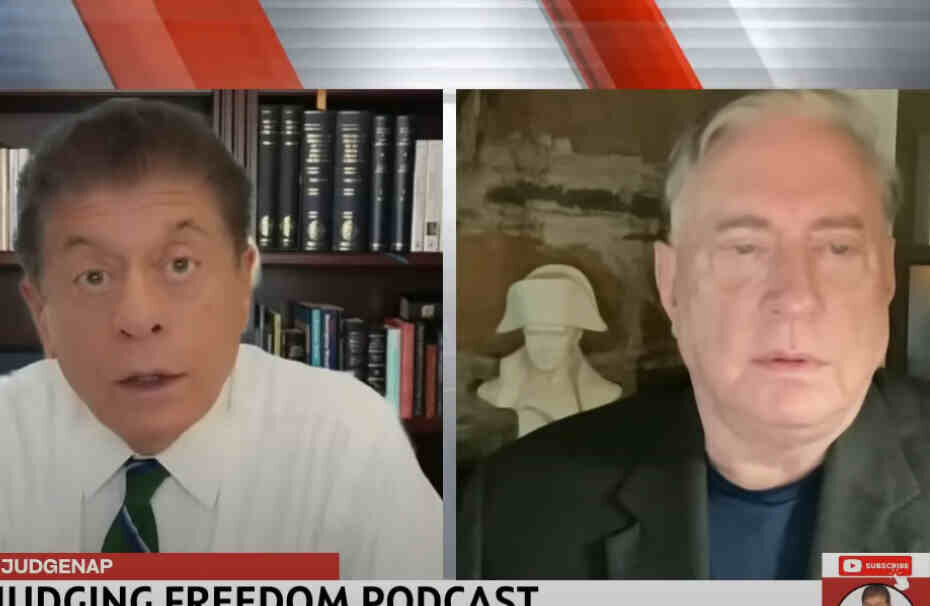
Read the full transcript of consultant, and political commentator Col. Douglas Macgregor’s interview on Judging Freedom Podcast with host Judge Napolitano on “War With Iran Is Imminent”, October 2, 2025.
INTRODUCTION
JUDGE NAPOLITANO: Hi, everyone. Judge Andrew Napolitano here for Judging Freedom. Today is Thursday, October 2, 2025. Colonel Douglas Macgregor will be here in a moment. Just how imminent is war from the United States and Israel against Iran?
Colonel, welcome here, my dear friend. Thank you for accommodating my schedule. Before we get to our discussion about the imminence of war with Iran, why do you think that anybody in Hamas would accept the Jared Kushner, Steve Witkoff, Donald Trump Gaza plan for permanent Palestinian subjugation with Tony Blair, of all people on the planet, as the colonial governor?
The Gaza Plan and Palestinian Subjugation
COL. DOUGLAS MACGREGOR: Yeah, I’m sure that Blair would enjoy that immensely. And it would offer him the opportunity to cash in on the real estate deals that Trump and Kushner and others are trying to develop. I can’t imagine why at this stage. You’re right. It’s effectively surrender, capitulate, throw yourselves at the feet of the Israelis, and you may be allowed to live is effectively what it amounts to.
But the 21-point plan has no chance of working. And I think Mr. Netanyahu has already made that relatively clear. If he hasn’t made it directly, then he certainly implied it. This has no chance of going anywhere.
Secretary Hegseth’s Address at Quantico
JUDGE NAPOLITANO: Colonel, did you get a chance to watch the Secretary of Defense, who calls himself the Secretary of War, speaking down figuratively and literally to 800 Admirals and Generals the other day at Quantico?
COL. DOUGLAS MACGREGOR: Well, I listened to some of it, but I ultimately read his remarks. I did stand by to listen to the President.
JUDGE NAPOLITANO: What did you think of Secretary Hegseth without mentioning it denouncing the Geneva Conventions and concerned more about fat around the waistline than between the ears?
COL. DOUGLAS MACGREGOR: Well, that’s a great way to put it. I love it. I wish I’d thought of that. You’ll have to write that one down. I think, you know, it’s very hard to judge when you read the remarks precisely what he wants in some areas.
Now, there are many things that he said that I fully support. I’m someone who’s always been an advocate for selecting and advancing people on the basis of demonstrated character, competence and intelligence. I absolutely have always disliked the notion that we pick someone on the basis of race or ethnicity or anything else for that matter, or gender.
You know, we went through this process many years ago in the 1970s of putting photographs of everyone into the file. And the reason we did that was we had a fat problem, especially in the officer corps, very serious one, and we had to shame people to get into shape. And in some cases they didn’t, and they were deselected for advancement.
But I think we’ve reached a point now where to whatever extent you can, you need to disguise who this person is when you evaluate them. But then again, that would defeat the whole system because the whole system of promotion is based on cronyism. Let’s be frank about it.
So I certainly agreed with those remarks, and I’m very depressed when I look at the state of the soldiers, sailors, airmen, and so forth who are overweight. There’s no question about that.
Now, beyond that, I was a little disappointed because I thought he would address more strategic issues, give people a feel for where the national military strategy is going. We’ve heard a lot about change in national military strategy, but, Judge, I really haven’t seen any evidence for that. On the contrary, it sounded very much like the Biden era. We have enemies everywhere that all have to be fought and defeated and get on board and we’ll go after them.
That sort of thing is, I don’t think that was very helpful. Now, what did the flag officers think? I think most of them in the audience sat there and said, you flew me halfway around the world to listen to this. Yeah, that is the, I think the response for most of the senior officers.
JUDGE NAPOLITANO: Colonel Wilkerson estimated $100 million in cost for all of them to fly around the world. An outrageous, outrageous number. I’m going to play the clip where, without mentioning it by name, he suggests an abandonment of the Geneva Conventions, which, of course, you know, the US wrote and the Senate ratified, and it’s the supreme law of the land. And then we’ll move on to another topic.
VIDEO CLIP BEGINS:
SECRETARY HEGSETH: Every day, we have to be prepared for war, not for defense. We’re training warriors, not defenders. We fight wars to win, not to defend. Defense is something you do all the time. It’s inherently reactionary and can lead to overuse, overreach, and mission creep.
War is something you do sparingly on our own terms and with clear aims. We fight to win. We unleash overwhelming and punishing violence on the enemy. We also don’t fight with stupid rules of engagement. We untie the hands of our war fighters to intimidate, demoralize, hunt and kill the enemies of our country.
No more politically correct and overbearing rules of engagement. Just common sense. Maximum lethality and authority for war fighters. That’s all I ever wanted as a platoon leader.
VIDEO CLIP ENDS:
JUDGE NAPOLITANO: Again, as you said, you flew us around the world for this. I mean, it’s implied in there that he wants to reject the Geneva Conventions.
The Geneva Conventions and Rules of War
COL. DOUGLAS MACGREGOR: In 1945, after World War II ended, Curtis LeMay, who had orchestrated the air campaign against the Japanese, told all of his staff something that I think we should remember. Had we lost the war, you and I would have been tried as war criminals for what we did to the Japanese.
JUDGE NAPOLITANO: Right.
COL.
DOUGLAS MACGREGOR: And to refresh people’s memories, everybody goes back to the atom bomb. But quite frankly, the atom bomb did minuscule damage compared to the firebombing of Japan. We burned down whole cities. We burned hundreds of thousands of Japanese alive. Was that necessary to win the war? Well, I’ll leave that to be debated by other people.
I’m somebody that doesn’t believe that killing large numbers of the enemy’s population is the way to victory. Usually it stiffens resolve. I don’t know what he meant when he’s talking about rules of engagement. That, frankly, has nothing to do with the Geneva Convention per se.
It strikes me that he’s listened to people complain that they weren’t allowed to kill people in places like Iraq or Afghanistan because of the proximity of non-combatants. Perhaps that’s what he’s referring to. I don’t know. But when you throw the rule book out, then you end up with Gaza. And Gaza is in the same category as firebombing Japanese cities.
JUDGE NAPOLITANO: Correct. Yes. What do you think Beijing and the Kremlin thought of that speech? And every American general and senior non-commissioned officer in one room at the same time?
COL. DOUGLAS MACGREGOR: Well, first, as I said before, I think the majority of the senior officers probably said this man thinks he’s talking to, you know, people in five or six hundred enlisted men in a battalion.
JUDGE NAPOLITANO: Right. In South Carolina.
COL. DOUGLAS MACGREGOR: Yeah, somewhere, whatever. I think that’s probably what they thought. And of course, that would be his frame of reference, because what little active duty time he had, and he didn’t have much, that’s kind of what he was going to witness, is sort of a cheering session, probably.
On the other hand, I think he mixes a lot of apples and oranges. And this business of war and defense is very disturbing to me. I’m somebody that thinks that we are overly offensive in our force posture and readiness to attack others. We’ve taken this notion that we have to be everywhere all the time to beat down any potential opponent or adversary.
I’m a big believer in national defense, to be blunt. And I think the use of military power should be a last resort, not the first. So I’m not very comfortable with the change from national defense to War Department. But that’s his opinion. He’s very excited about that. And I guess he views himself as the nation’s top warrior. I don’t know.
Military Operations in American Cities
JUDGE NAPOLITANO: Colonel, and then there’s this.
VIDEO CLIP BEGINS:
PRESIDENT TRUMP: San Francisco, Chicago, New York, Los Angeles. They’re very unsafe places, and we’re going to straighten them out one by one. And this is going to be a major part for some of the people in this room. That’s a war, too. It’s a war from within. Controlling the physical territory of our border is essential to national security. We can’t let these people in. We’re under invasion from within.
No different than a foreign enemy, but more difficult in many ways because they don’t wear uniforms. At least when they’re wearing a uniform, you can take them out. These people don’t have uniforms. I told Pete we should use some of these dangerous cities as training grounds for our military National Guard.
VIDEO CLIP ENDS:
JUDGE NAPOLITANO: Military… American cities as training ground for the military. Have you ever heard that, Colonel?
COL. DOUGLAS MACGREGOR: No. No. That’s a first. I certainly never heard that when I was in active duty. Now, let me say something in defense of the President. There are roughly 30 million people in Southern California. We estimate that perhaps as many as one-sixth of that population, if you cut the state in half and just look at the bottom southern part of California, near 30 million, as many as perhaps 5 million are illegally in this country.
And of that number, there are probably 1 million illegal aliens living in Los Angeles. And you’ll recall just a few, I guess, weeks ago, months ago, we saw foreign flags from Central America being waved by crowds of people. And we saw threats directed at ICE and threats directed at anyone involved in arresting illegals.
And of course, the ones that they were going after, at least I was told, were people that were already criminals. In other words, people that had a criminal record or had committed some sort of crime. When you look at those numbers and the number of people involved, if you’re going to enforce federal law, and this is the key thing, if you’re going to enforce it and you’ve got a million people living in that city, you’re going to have to use federal military power.
The question is, how do you do it? And that’s what’s really key here. I would not just march in with a large formation of troops, lower the guns and say, move now or you’re going to be shot. That’s not what I would do. But I would also expect that there would be some resistance.
And, you know, we’ve run into these things before and we can talk about that. We use the military in this country repeatedly over the last 200 years, plus to suppress insurgencies, to suppress criminality, to suppress riots, lawlessness of all kinds. So that’s happened before.
The question is, how do you do it? And I don’t think it was probably a good idea for the president to suggest that this was a training ground for war. That doesn’t mean that you may not have to use violence, but I think it’s a bad idea going in.
And usually what you do, we could spend a lot of time on this, and I did a lot of research on this when I was in the Department of Defense at the end of President Trump’s term, is you look very carefully at how you liaise with police and you normally lead with police. The military doesn’t lead. The military normally follows behind the police and is only called in when the police can’t handle something.
The same thing would be with federal marshals, but you have to have that police, that military power for the police to be effective.
JUDGE NAPOLITANO: We do have a statute, of course, that prohibits the use of the military for ordinary law enforcement, which was the problem in Los Angeles. Many people…
COL. DOUGLAS MACGREGOR: Are you talking about Posse Comitatus?
JUDGE NAPOLITANO: Yes.
Military Authority in Domestic Unrest
COL. DOUGLAS MACGREGOR: Yeah. Well, we’ve done this before, though, and the President has the authority to do these things. He’s got the Insurrection Act. There’s something called Smith-Connally. In 1942, we sent 8,000 troops under a major general to Philadelphia. And the reason they were sent there was to put down a strike.
10,000 transit workers in Philadelphia were objecting to the integration of black men into the transit department. In other words, that they could operate trolleys, operate heavy equipment and so forth. So they went on strike. And FDR decided that this was unacceptable because we were at war. The War Department complained this was disrupting war production.
So we sent 8,000 troops from the regular army under a major general. They went right into Philadelphia, and under the provisions of that act, they could actually take over private property, which they did, as well as public property, and operate the transit system.
What ultimately ended this particular problem, however, was not the US Army. What ended it was the President’s threat to draft everyone in the transit department, all 10,000, and put them into the army. At that point, they said, no, thanks, we don’t want to go. We’d like to stay in Philadelphia. And the whole thing ended.
So we’ve had military power used in a number of different ways. When I was a cadet at West Point, we listened to recordings of the 82nd Airborne that had a brigade involved in Detroit in the 1968 riots. Some soldiers were shot and killed in that process. And we listened to the radio transmissions, the officers speaking, the decisions that were made.
And ultimately they brought in an M48 tank from the National Guard and they lowered the guns and they fired a .50 caliber machine gun at the house at the end of a street. And the officer used a bullhorn and said, “Watch the end of the street.” And he fired this gun for about a minute and just tore apart this building and practically collapsed and said, “You’ve got exactly 60 seconds to come out. Drop your weapons or I’m going to do this to the entire neighborhood.”
Effectively, at that point, everybody came out, dropped their weapons, hands up, and it was over. We’ve done these things before. The bad news is we have not always been prepared for it. And there’s a big difference between war and using the military in domestic unrest. And you have to train for this. You have to know what you’re doing. I don’t think we’ve done very much training in that regard.
JUDGE NAPOLITANO: When President Truman attempted to use the military to operate the steel mills during the Korean War because 500,000 workers had gone out on strike, the Supreme Court stopped them. That’s the only time this reached the Supreme Court. They didn’t use violence. They just tried to take over the jobs of the steel workers who were on strike.
Last question on this. Do you think Curtis LeMay and George Patton and Douglas MacArthur would have sat there and listened to Hegseth, or would they have walked out?
COL. DOUGLAS MACGREGOR: I think that all three men probably would have been gentlemen, and they would have all sat there quietly and listened to it. They would have been disappointed, underwhelmed for all the reasons we’re discussing. But, you know, all three men would probably have listened. And then afterwards, they may have actually gone to the President and asked the President for a new Secretary of War.
Venezuela: Another Military Intervention?
JUDGE NAPOLITANO: Right before we get to Iran, what are we doing off the coast of Venezuela, Colonel?
COL. DOUGLAS MACGREGOR: Well, that’s a very important question right now because we seem to have a military buildup of some kind off the coast of Venezuela. And President Trump has implied that he has every intention of intervening in Venezuela.
You know, this is something else that we haven’t discussed. And the President has let everybody down in this regard. You know, FDR had these things he called fireside chats, as you well know. And these fireside chats were very few. I think there were only six or seven. But they were very effective because the President would speak on the radio to the American people from his office, but in a very casual but straightforward way and explain, “This is why I’m doing what I’m doing.”
And many people who were opposed to whatever he was doing at the time, Lend-Lease is a good example, they listened to him, and after they listened to his rationale, they said, “All right, we’ll support you.”
I haven’t heard that from this president, and I think this country really needs that right now. He needs to explain himself. He needs to explain, “This is why I want to go into Venezuela.” Now, you can disagree with him, but he ought to say that. He ought to tell us what’s the objective? What are we trying to achieve down there?
You know, I keep telling people, and I’ve got friends on active duty that are well aware of this. I said, you’ve got 1,700 miles of coastline on the Caribbean, on the Venezuelan coast. That’s almost the same distance as the American-Mexican border on land. Then you have one 379-mile border with Colombia, another 1,380-mile border with Brazil. This is an enormous place. This is practically France and Germany together.
And you want to intervene in this place, what are you going to use? And now if somebody says, “Well, we want to replace the regime,” fine. What if it doesn’t work? What do you do then? Do you double down on failure, which is what we did in Vietnam, and send in more troops to do what?
And in the meantime, this could turn into a Latin American crusade aimed at America, at the United States. Because we’ve been to Latin America before, we don’t have the best of reputations down there. Whether that’s fully deserved or not, it doesn’t matter. It’s the truth. Why are we doing this?
JUDGE NAPOLITANO: Colonel, there’s been no great debate over this. The President is blowing out of the water speedboats that he claims contain drug dealers. Even though these people haven’t been identified, charged, indicted, prosecuted, convicted, he’s just executed them. He’ll use drugs as the same excuse for what? To wage a war. A war undeclared by Congress.
Congressional Abdication of Responsibility
COL. DOUGLAS MACGREGOR: Well, look, this is where, and we talked about this before, Judge. The Congress of the United States has let the American people down. The Senate and the House. The members aren’t doing their duty. They have an obligation to raise all these questions, to demand explanations.
The President has been, at least for the last 50 years in my lifetime, effectively free to do pretty much whatever he wanted. And if he thinks he needs support, Congress rolls over and gives him some sort of resolution that allows him to commit an act of war without a declaration of war. We went through that with the Gulf of Tonkin, as you know.
So what are we doing? What is this all about? See, the other part is that Congress will say, “Well, my constituents don’t ask questions.” And that may be true, so maybe part of the fault lies with us. We haven’t asked any of these questions.
War With Iran Is Imminent
JUDGE NAPOLITANO: Colonel, what is your understanding of the nature of preparation by the Israeli military and the American military for an attack, maybe even an invasion on Iran?
COL. DOUGLAS MACGREGOR: Well, I think we know that whatever happens is not going to be discussed in advance. And we’ve already seen the surprise attack that the Israelis launched against the Iranians during what people thought was a legitimate negotiation.
So I fully expect that there will be no warning per se to the American people or to anybody about what ensues. But we do see a decided buildup of aircraft and munitions and missiles being reallocated. Vessels at sea, as well as refueling assets are moving into the region.
Something could happen at almost any time at this point. I would say certainly within the next few weeks at the outside. Because the other problem is you can’t keep armed forces, air, land, sea, in hyper readiness for long periods of time. So there’s a point at which you’ve got to either pull the trigger or get out.
Again, no one is being asked in the United States. And the other problem, as we discussed, is that it looks like Prime Minister Netanyahu has more control over these matters than the President or Congress.
JUDGE NAPOLITANO: Ray McGovern reports this morning, and he and Larry Johnson and I will be discussing this tomorrow on leaked transcripts of Cabinet meetings of Prime Minister Netanyahu’s cabinet prior to the June 12-day war in Iran, recognizing that Iran is nowhere near a nuclear weapon, that that was the subterfuge, and Netanyahu’s true goal was to decapitate, figuratively and literally, the Iranian leadership and sow chaos in the country. Does that make sense to you?
Israel’s Strategy: Balkanization of the Region
COL. DOUGLAS MACGREGOR: Yeah, I think it makes sense. And I think the goal is still the same. I mean, Israel isn’t interested and absolutely could not overtake and govern Iran. But the Israeli position is very clear. The more balkanized the region, the more dissension and division in the region, the safer Israel is. That’s their theory.
So again, I suspect they will do everything in their power to achieve a decapitation. You know, this is the problem. I don’t think that’s going to work. And the Iranians have made it pretty clear that they have real depth now, that they more than they’ve ever had before. They’ve distributed critical weapons systems all over the country in various provinces. They’re ready for the kind of attack that I think the Israelis want to launch.
So the Israelis know that there is no chance for them to succeed on their own. And once again, that means they need us. The question is, how are we going to perform? What are we going to do this time around?
And I’m a little concerned about that because I think the air defense capability in Iran is much better than it was before. It’s not 100%, but it’s certainly 60 to 70% of everything that they would want. And I’m concerned that we will take casualties this time. There will be no restraint exercised by Iran. Iran will regard this as an existential fight to the finish, and they will use everything at their disposal.
JUDGE NAPOLITANO: Does Iran pose the slightest threat to American national security, Colonel MacGregor?
COL. DOUGLAS MACGREGOR: No, it never has. By the way, I don’t see any evidence that Venezuela poses any threat to the United States. I mean, if you want to attack places that present a real threat, those two aren’t on the list. But it doesn’t matter.
Again, you know, Congress isn’t raising that question. Congress isn’t debating this. And the President can act as he wishes. And right now he’s going to do whatever the Israeli government and Mr. Netanyahu tell him to do.
Economic Consequences of War
JUDGE NAPOLITANO: Colonel, you and I will be together with friends and colleagues on Saturday in Dallas.
COL. DOUGLAS MACGREGOR: Yes, we are. It should be interesting, and I’m sure some of it will be tense. But the good news is that it’s sold out, and we’re very pleased by that. And I think the audience that’s going to be there is going to come armed and ready with good questions.
Because the real point of all of this is we’ve got to find a way forward other than the one we’re on. And as we’ve discussed so many times, you know, the Democrats and Republicans, what’s the profound difference? You know, where is it? I mean, we just don’t see it right now.
We have this argument over the shutdown. The Democrats come out with a $3 trillion deficit on their budget. The Republicans come out with a $2 trillion deficit. They don’t get it. Neither of them get it. And none of them are talking about the issues that we’re raising that are going to have a profound impact on us economically.
Because if you go back to war, this time with Iran, I rather suspect you’ll see the Straits of Hormuz shut down. Because now most of the oil and gas coming out of Iran can be shipped by rail all the way to China. And you have new pipelines from Russia into China. So I don’t think the Chinese are going to be hurt as badly as they would have been otherwise.
But what happens to the rest of the world? What happens then when the price of oil goes through the roof? Nobody seems to bring these things up. If anybody had any idea the damage to us in our economy, I think they’d throw everybody in Washington out of office.
General Milley’s Oath to the Constitution
JUDGE NAPOLITANO: Colonel, before I let you go, here’s this may please you or aggravate you. I’m not sure which. But here’s Colonel Milley.
COL. DOUGLAS MACGREGOR: Oh, Milley.
JUDGE NAPOLITANO: Right before General Milley, I’m sorry. Former chair, at the time, chair of the Joint Chiefs of Staff, right before he retired.
VIDEO CLIP BEGINS:
GENERAL MARK MILLEY: “We in uniform are unique. We are unique among the world’s armies. We are unique among the world’s militaries. We don’t take an oath to a country. We don’t take an oath to a tribe. We don’t take an oath to a religion. We don’t take an oath to a king or a queen or to a tyrant or a dictator. And we don’t take an oath to a wannabe dictator.
We don’t take an oath to an individual. We take an oath to the Constitution and we take an oath to the idea that it’s America and we’re willing to die to protect it. Every soldier, sailor, airman, Marine, guardian, and Coast Guardsman. Each of us commits our very life to protect and defend that document, regardless of personal price. And we are not easily intimidated.”
VIDEO CLIP ENDS:
JUDGE NAPOLITANO: Any problems with that?
The Military Oath and Chain of Command
COL. DOUGLAS MACGREGOR: Yes. The words in the oath are not what he said they are. When you take the oath, and I’ve taken it many times, ever since I was commissioned at West Point, you say, I swear to uphold and defend the United States Constitution and to obey the orders of the President and the officers appointed over me. That’s key.
If you are a professional soldier and you get an order from the President or the officers appointed over you, who are also appointed by the President, and you do not think that this order is legitimate, if it’s immoral or you think it violates the Constitution, then you have an obligation to resign. That’s very important.
Now, if you don’t think it violates the Constitution or you’re not sure, or you don’t think it’s immoral, then you are expected to obey. Now, Milley was the senior advisor to the President, senior military advisor to the President of the United States. He commands or commanded nothing, has no authority.
Milley, as the senior military adviser to the President, took many actions while he was in that office that really upset people, not the least of which independently, without consulting the President or, as far as we know, anyone in the national security arena, to call his opposite number in China and reassure the Defense Minister of China that whatever was happening was no threat to him.
Now, I’m not bothered by the fact that he made the comment that there was no threat to China, because there wasn’t. But on the other hand, he acted without authority. He did something that he was not authorized to do, and he pretended that he had a degree of authority in the chain of command that he didn’t have. That’s the tip of the iceberg.
So this issue of I swear to uphold and defend the Constitution of the United States, number one, and number two, as part of that, and I obey the orders of the President and the officers appointed over me, there’s tension there, Judge. That has always been there. That was something that MacArthur complained about.
JUDGE NAPOLITANO: Well, we know how that ended up with MacArthur. It’s funny that the oath that judges take is nearly identical to the one the President takes. Preserve, protect and defend the Constitution. Nothing in there about people telling us what to do or having to comply with orders.
COL. DOUGLAS MACGREGOR: But that’s a big difference, Judge.
JUDGE NAPOLITANO: Oh, absolutely. Absolutely. It’s a profound difference.
Military Officers Are Not Free Agents
COL. DOUGLAS MACGREGOR: We in uniform are not free agents. You’re in the regular army of the United States. You’re not a free agent. You don’t pick and choose where to fight, when to fight, how to fight, all this sort of business. But if you feel strongly about something, then resign.
And one of the biggest complaints I’ve had throughout my lifetime, I’ve listened to all of these general officers that retired and they would say, well, I was present for that meeting and I knew that was wrong. Well, if you thought it was wrong, General, why didn’t you say anything? And we went through this in Vietnam. I’ve heard this over and over and over again.
So, General Milley, don’t posture as some heroic figure that stood up to a president that you didn’t like, who pursued policies you didn’t privately support and tell us that you did all that you could. He didn’t.
JUDGE NAPOLITANO: Is President Trump a free agent or is he subject to a foreign power?
COL. DOUGLAS MACGREGOR: Well, right now I think it’s pretty obvious that this president is clearly not a free agent when it comes to matters pertaining to the Israeli state. I don’t think anybody questions that.
But I’m just very frustrated with senior military leaders who retire and say one thing while they were on active duty. They said and did something else. Either shut up and obey and get on with it, or put your views online. Say, look, I don’t agree with this and I cannot with a clear conscience execute these orders.
You know, Harold K. Johnson, Chief of Staff of the army, was on his way over in 1968 to see the president to go to the White House. And he had his letter of resignation and he had a change of heart and he came back and he justified his change of heart about Vietnam by saying, well, I thought I could do more good on active duty than I could by leaving. That was wrong. If he is the Chief of Staff of the army, had resigned, turned in his letter, don’t you think that would have had an electrifying impact?
JUDGE NAPOLITANO: Absolutely. Absolutely.
COL. DOUGLAS MACGREGOR: So this kind of thing, I’m sick of people like Milley who stand up there and say these things because they don’t like the president. How many times have I served under a president I didn’t vote for when I was on active duty? Several. And how many times did I wish that something was different? Many times. But those policies came from the top and we had an obligation to obey, and we did.
Closing Remarks
JUDGE NAPOLITANO: You are imbued with intellectual honesty, Colonel. And I deeply appreciate our professional collaboration and our friendship. And I look forward to being with you in Dallas on Saturday.
COL. DOUGLAS MACGREGOR: We’ll tear the place up. Hopefully.
JUDGE NAPOLITANO: You say the audience will come well armed. They will. We’re going to be in Texas.
COL. DOUGLAS MACGREGOR: Some of these people are flying in from outside the state, so interesting collection, but you’re right. And that’s one of the things I like about Texas.
JUDGE NAPOLITANO: Yes. Thank you, Colonel. Safe travel. See you Saturday. All the best.
COL. DOUGLAS MACGREGOR: Bye bye.
JUDGE NAPOLITANO: Thank you. Truly a great man. And more greatness to come. At noon, Pepe Escobar at 1 o’clock, Scott Horton at 2 o’clock, Matt Ho at 3 o’clock, Professor John Mearsheimer, Judge Napolitano for Judging Freedom.
Related Posts