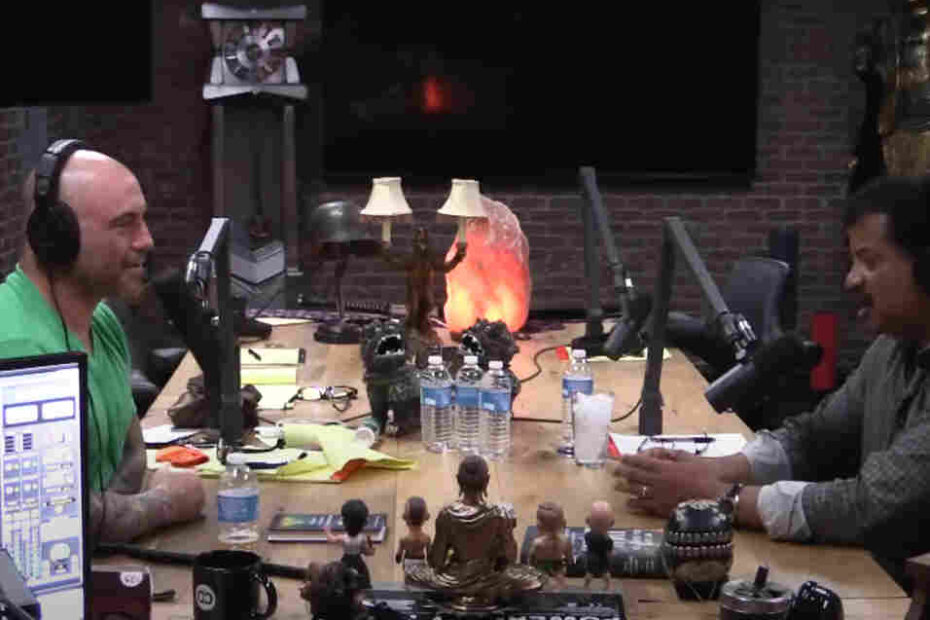
Read the full transcript of astrophysicist, cosmologist, author, and science communicator Neil deGrasse Tyson’s interview on The Joe Rogan Experience podcast #1159, August 23, 2018.
# Flying Cars and Pleasantries
JOE ROGAN: So why aren’t there flying cars?
NEIL DEGRASSE TYSON: You just jumping right in. You don’t say hi. You don’t say how’s the wife and kids? How’s the wife and kids, everybody?
JOE ROGAN: Man, how’s life? How’s your book that’s been on the Times bestseller list for how many weeks?
NEIL DEGRASSE TYSON: Oh, the Astrophysics for People in a Hurry. That’s been on the New York Times bestseller for 67 weeks.
JOE ROGAN: That’s pretty intense.
NEIL DEGRASSE TYSON: That’s a lot for any book, much less for a science book. And so that tells me, while all these Trump books are wafting in and out, this is bobbing like a cork on the ocean waves as the book of the moment that either praises Trump or criticizes him come in and off of that list.
So this tells me that there is this unserved hunger that people have. There’s a curiosity that this is serving, and it’s “Astrophysics for People in a Hurry.” That’s very purposefully juxtaposed. It’s like “neurosurgery in four easy steps.” If you saw a book with that title, you’d have to pick it up because you’d wonder what’s going on.
# Making Learning Fun
JOE ROGAN: Well, not to kiss your ass again, but I always say this about you, and I think it’s important. You make learning stuff about astrophysics fun, and that’s what’s missing. It’s not that people don’t like to be educated, that they don’t like to learn. They just don’t want to be bored.
NEIL DEGRASSE TYSON: That’s a perceptive point, because think of the image we have of, let’s say you’re in a school where most people don’t go to college, you’re in high school, and then last day of school comes. What do people do? They toss their papers in the air as they run down the steps. School’s out. What’s the rock song? “School’s Out for Forever.”
JOE ROGAN: Right.
NEIL DEGRASSE TYSON: So that attitude must mean the school didn’t train you to embrace curiosity.
JOE ROGAN: Right.
NEIL DEGRASSE TYSON: That learning was a chore, and now the chores are over. So I think the educational system needs an adjustment. Forget whether or not you go to college, because you’re going to spend more years not in school than in school. Even if you do go to college, what you want, I think, are lifelong learners. Lifelong curiosity.
Where once you are trained and your curiosity is stimulated, the curiosity we all had as children. Children don’t need to be taught to be curious. They are curious. To the point of destruction of whatever it is they touch. Oh, what is this egg on the counter? What is this glass? What is this plate? What’s under a rock? What happens if I pull a leg off a Daddy Longlegs?
They are experimenting with the world. We don’t think of it that way, but that’s what it is. They’re all born scientists. And I say this often: You spend the first years of a child’s life teaching it to walk and talk, then you spend the rest of his life telling it to shut up and sit down. This is the wrong combination.
So speaking as an educator, I think a missing component of school is, is it the teachers? Is it the curriculum? I don’t know. But when you get out of school, you should say to yourself, “Damn, I want to learn more.”
# Lifelong Learning
JOE ROGAN: It’s almost universally accepted, too, that that’s when your learning ends. When you get out of college, it’s over.
NEIL DEGRASSE TYSON: Then you say you’re done. And if it doesn’t, you’re ossified in life. And that’s how, when the job market shifts, you’re not ready for it because you don’t know how to think, you don’t know how to learn.
And it’s the difference in the workplace between the person who gets an assignment. “Joey, Janet, I need you to do this.” “That’s not in my job description. I’m not trained for this.” That’s one kind of person in a workplace.
Another kind of person is, “Here’s a new task I need you to do.” “Wow, I’ve never seen that before. Great. Let me figure it out.” These are two completely different species of human being. And what the world needs more of is the second case where you take a new task and you say, “Wow, I get to learn. I’m going to learn on my own. I’ll ask people who know more.” You just embrace the act of learning to satisfy your curiosity. And I think this book is capturing that in the public.
JOE ROGAN: Well, it must be doing something.
NEIL DEGRASSE TYSON: Yeah.
JOE ROGAN: 60, how many weeks?
NEIL DEGRASSE TYSON: 67 weeks.
JOE ROGAN: God dang.
NEIL DEGRASSE TYSON: Yeah. That’s a lot of weeks. Every morning I wake up, I’m calm, but I’m really not calm. I’m saying, “Holy shit.” Sorry, can I say that?
JOE ROGAN: You can say holy shit.
NEIL DEGRASSE TYSON: I can say it. Okay.
JOE ROGAN: Tyson swears. Ladies and gentlemen, human. People think you’re a robot. Now they know.
NEIL DEGRASSE TYSON: This is.
# The Rise of Science Podcasts
JOE ROGAN: It’s a great sign, I think. And I think your podcast is a great sign as well. The success of your podcast and the success of a lot of science podcasts.
NEIL DEGRASSE TYSON: That’s an excellent. Don’t you notice that there’s a rise of science curious podcasts out there?
JOE ROGAN: “Stuff to Blow Your Mind” is one that I really enjoy. I really love Radiolab. They’ve always got some really interesting science.
NEIL DEGRASSE TYSON: Perennial favorites.
JOE ROGAN: Fantastic.
NEIL DEGRASSE TYSON: So many people.
JOE ROGAN: Probably the best.
NEIL DEGRASSE TYSON: Right? Right.
JOE ROGAN: Yeah. And yours as well. And I love Chuck.
NEIL DEGRASSE TYSON: Nice.
JOE ROGAN: Shout out to Chuck.
NEIL DEGRASSE TYSON: Nice. Oh, Chuck. We all love Chuck.
JOE ROGAN: He’s great.
NEIL DEGRASSE TYSON: And as you know, not only yourself, as an exemplar of this, stand up comedians are some of the smartest people in the world. They have an awareness. I want to go that far.
JOE ROGAN: Okay, listen, come to the Comedy Store with me today. I’ll change your mind.
NEIL DEGRASSE TYSON: All right, let me buffer that a little.
JOE ROGAN: They’re curious.
NEIL DEGRASSE TYSON: Okay? So stand up comedians are perceptive people.
JOE ROGAN: Yes.
NEIL DEGRASSE TYSON: And for sure. And they’re aware and they notice things that you don’t notice. They see the same things you do and get to shape it in a way you never thought possible. And then you end up laughing at other things, at yourself.
# The StarTalk Concept
JOE ROGAN: Was it your idea to do your show with stand ups?
NEIL DEGRASSE TYSON: So what we have, there are several of us who created this concept, and there’s Helen Matsos is one of the partners. And there’s another one who’s now left, but I’ll get his name in a minute. But there are three of us who, David Gamble is his name.
The three of us got together and applied for a National Science Foundation grant. What we said was there are programs out there that serve people who already know they like science, but who serves the people who don’t know they like science? Or better yet, the people who know they don’t like science. There’s nothing for them because they’ve already rejected it. They’re not going to tune in to Science Friday because they don’t like science on NPR.
So what we thought was, suppose we bring in a celebrity. That’s the pop culture draw. This is a pop culture scaffold. We bring in this scaffold and clad the scaffold with science. Because whatever the celebrity does, it doesn’t matter. There’s going to be science in that person’s life. We have the guy who portrayed Gollum in Lord of the Rings.
JOE ROGAN: A lot of science in that. But there is, the suit that.
NEIL DEGRASSE TYSON: He had to wear. Exactly. So what we did was we interview him and we talked about the technology necessary to portray Gollum as a live. He portrayed that live. That was not some later animation. He is live, and he’s got his whole body wired up for this, and he is that voice, and he is portraying it.
So whatever it is that you have done that you do, there is science because it’s evidence that science is everywhere. You’re not going to, you can’t say, “Oh, I’m done with science. Let me sell my textbook and move on to other things.” Because practically anything else you do has been touched by science.
And so StarTalk is a celebration of that. And then it jumps species. And so now we’re on TV. It’s a TV show on National Geographic Channel, StarTalk. And since you started this, by the way, I didn’t come here to talk about you. You started this. It’s our fourth year in a row where we’re nominated for an Emmy for Outstanding Informational Programming.
# Cosmos: Possible Worlds
JOE ROGAN: Are you going to keep doing Cosmos too, though?
NEIL DEGRASSE TYSON: So Cosmos. I have one week remaining out of 70 shoot days to finish shooting Cosmos: Possible Worlds, premiering spring 2019. That’s the third installment of Cosmos. If you trace the first one to Carl Sagan back in 1980.
JOE ROGAN: I used your segment on wolves, on how wolves became dogs. I showed it to my kids. You can see the little wheel spinning. Whoa. Yeah, that’s how a dog became a dog.
NEIL DEGRASSE TYSON: What you didn’t see is I’m sitting at the campfire in this snowy environment, and they got wolves walking around me. They’re on these fishing wires because they are not dogs, okay?
JOE ROGAN: They do whatever they want.
NEIL DEGRASSE TYSON: Correct. And when they’re looking at you, it’s like, “Should I rip his neck out now or later when I’m more hungry?” There’s no eye contact with them because they don’t see you as anything other than something they could possibly eat. And so you can’t interact with them the way you would with ordinary dogs.
So they’re on these fishing, high tension fishing wire that you can’t see against the snow. And they’re hooting and hollering around me as I described. And the name of that show is “And the Wolf Shall Become the Shepherd.”
JOE ROGAN: My friend did a commercial with a wolf, and there’s this commercial where he’s running up this mountain and the wolf is there. And at the end of the commercial, they had to get the wolf to snarl. So what the trainer does is he shows the wolf some meat and then he pulls the meat away from the wolf and the wolf snarls and they’re like, and then the commercial’s over.
He’s like, “No, there’s no working after that. You’re not going to be near the wolf. That switch is turned on.”
NEIL DEGRASSE TYSON: Yeah.
JOE ROGAN: And it’s crazy. Once that thing snarled, everybody just backed off. And the trainer let everybody know, once I get to this point, we’re done, there’s no more.
NEIL DEGRASSE TYSON: And that thing’s like, “Okay, everybody, we’re done.”
JOE ROGAN: Let’s get out of here.
# Ann Druyan and the Soul of Cosmos
NEIL DEGRASSE TYSON: All three of these Cosmos, the original one with Carl Sagan, the one that I had the privilege of hosting in 2014 and 2019, are co-written by Ann Druyan, and she’s the widow of Carl Sagan.
JOE ROGAN: Oh, wow.
NEIL DEGRASSE TYSON: But kind of in his shadow back then. But she’s hugely creative and highly enlightened. And so most of the soul energy, if you will, what makes Cosmos distinct from other documentaries where you’re sort of sitting there learning, you put your thinking cap on, your learning cap on.
In Cosmos, it’s your feeling cap. You’re not only learning, you’re also feeling the science and its relationship to you, to civilization, to the world, to the universe. And her infusion of this, she’s a highly scientifically literate writer, producer, and so I just give a shout out to her. Just working with her has been a delight.
JOE ROGAN: Is Cosmos on Apple TV or Amazon or anything?
NEIL DEGRASSE TYSON: So Cosmos, after it first premiered on Fox and then went internationally on Nat Geo, it then went to Netflix. But I think this run of Netflix is going to drop until the next one comes in. I think they want to clear the landing zone for the next Cosmos. But it went to Netflix.
JOE ROGAN: But is it available for anyone to get right now?
NEIL DEGRASSE TYSON: Oh, right now it should be. I haven’t checked. That’s a great question.
JOE ROGAN: So I have it all on my DVR and I’m scared to delete it. I only have 6% space left.
NEIL DEGRASSE TYSON: That’s what everyone’s dealing.
JOE ROGAN: I got all your Cosmos in there.
NEIL DEGRASSE TYSON: Yeah. So thanks. Thanks for having them all in there.
JOE ROGAN: Who’s that? Morgan Freeman show Through the Wormhole. Yeah, I got that on there too.
NEIL DEGRASSE TYSON: That was a great show. That’s a Joe Rogan thing. If you didn’t have that I’d be disappointed. I’d say you’re an imposter. You’re a fake.
JOE ROGAN: It’s an opportunity to be entertained and learned, which I think is what everybody misses. And I think that’s what’s missing in most public education. People are bored. And you take these kids with so much energy, and then you make them sit still and watch something that’s not even remotely stimulating by a person who doesn’t really care to be there.
NEIL DEGRASSE TYSON: Right. And they know this intuitively, if not explicitly, that the enthusiasm is absent.
JOE ROGAN: Yeah. They could feel it. It’s the worst way to learn. It’s the worst way. And it’s so hard to escape once you get out of that system. It takes forever for a lot of these people to just get their excitement about education back.
The Impact of Great Teachers
NEIL DEGRASSE TYSON: You know what I say when I address teachers? We all, by the way, I’ll do this right now. In this room, we have only three of us. But let’s take a show of hands in your life with all the teachers you’ve ever had in every class you’ve ever taken, how many had a singular influence on who and what you became? Give me a number. It’s going to be, I’m betting it’s five or fewer. Probably more like three.
JOE ROGAN: Yeah. For teachers.
NEIL DEGRASSE TYSON: What’s your number?
JOE ROGAN: Well, there’s the one that I talked about on your show the last time I saw you.
NEIL DEGRASSE TYSON: Thanks for coming on to start talking to me.
JOE ROGAN: My pleasure. Who was a science teacher that I had when I believe I was in seventh grade, who told me that if you really want to hurt your brain, look up and recognize the fact that that goes on forever, that this is infinite. And then just think about what that means. Infinite. That there really is no end to it.
NEIL DEGRASSE TYSON: So, but how many teachers such as that were so influential on you?
JOE ROGAN: That one guy saying that one.
NEIL DEGRASSE TYSON: So if you…
JOE ROGAN: One class, he might be the one.
NEIL DEGRASSE TYSON: And what do you got? Two. For me, it’s like two and a half. And I’ve had scores of teachers. 100 teachers at least. So what I tell teachers is, be that teacher to your students. We’ve all had those teachers. Be that teacher.
And in every case, it wasn’t because the topic was something you knew in advance you would like. It’s because their energy for sharing their passion and love for the subject was palpable.
JOE ROGAN: Yeah.
NEIL DEGRASSE TYSON: And it just spilled out of them and went into course through your veins and your arteries. And you walk out of there thinking, wow, that was the most interesting thing I’ve ever done in my life. You don’t even care what you get on a test after that because you got touched and you became an enlightened participant in that exercise, in that exploration.
JOE ROGAN: Yeah, it’s just so hard for them to even get kids’ attention though. There’s just so many matches going on.
NEIL DEGRASSE TYSON: Unfortunately, that could be. In some places, half the energy of the teacher is maintaining order.
JOE ROGAN: I think the success of your book, the success of your show, your podcast, and many of these other really intelligent podcasts are showing that there’s an appetite for this stuff out there.
Accessory to War: Astrophysics and the Military
NEIL DEGRASSE TYSON: Yeah. And I’m delighted to be a servant of that curiosity. And this, I brought this just because it’s not even out yet. This you’re airing now live. This is it. You’re live. You’re live. You are live.
JOE ROGAN: Okay, so there’s like a five second delay.
NEIL DEGRASSE TYSON: Is that to bleep all my expletives?
JOE ROGAN: No, no, no, no, no.
NEIL DEGRASSE TYSON: What is this?
JOE ROGAN: Accessory to War.
NEIL DEGRASSE TYSON: Oh, this is another book. This is coming out in three weeks.
JOE ROGAN: Is this about space war?
NEIL DEGRASSE TYSON: Accessory to War. The unspoken alliance between astrophysics and the military. Yeah. So this other book was Astrophysics for People in a Hurry. If you’re in a hurry, do not buy this book. This is not for people in a hurry. This is not an impulse item at the checkout line.
This is all about, by the way, we know what role the physicist plays in war. The physicist makes the bomb, invents the bomb. The chemist perfects napalm, the biologist weaponizes anthrax. And the astrophysicist, well, we sit at the end of a telescope and wait for photons to cross the universe and enter our detector. And we go into conferences and argue about them.
So there is no obvious connection between what we do and military strength, hegemony, dominance, empire building. It’s just not obvious. That’s why the subtitle the Unspoken Alliance. It’s not a secret, it’s just, it’s not there. It’s there, but it’s not. Nobody’s talking about it.
Do you realize? I’ll just give an example. If you needed more reasons to think that Columbus was a dick, let me add one to it.
JOE ROGAN: There’s a difference between when we were kids and today.
NEIL DEGRASSE TYSON: Yeah, I know, I know. But actually, I do have something mildly redeeming to offer about Columbus, if you have the time.
JOE ROGAN: Oh, yeah.
NEIL DEGRASSE TYSON: Okay, okay, we’ll start off with that.
JOE ROGAN: You want me start out with that?
NEIL DEGRASSE TYSON: How you want to do it?
JOE ROGAN: No, no, I’ll do the dick part. I’ll do the dick part.
Columbus and the Lunar Eclipse
NEIL DEGRASSE TYSON: Okay. So on his third voyage, he’s in, by the time of his third voyage, he had already planted enough Spanish flags that Spain had already begun to set up governments and infrastructures in these places that he had found. Yeah, basically conquered.
And so in one of the places, it’s in the book accurately, but I think it’s Hispaniola, one of the islands today. He has to get back. This is third voyage, 1503, 1504. He has to, he’s got to get back to Spain. He doesn’t have enough resources, not enough food for his crew.
So he asked the natives, would you please give us some of your stock that you have collected from your farming? Now, this particular group of natives only makes exactly the amount of food they need to tie to the next crop. They don’t have surplus. So they said, no, we don’t have surplus. Sorry.
Columbus knew that one week hence, coincidentally, there was going to be a total lunar eclipse, where the moon, in its orbit around Earth, enters Earth’s shadow. The full moon enters Earth’s shadow and disappears. And that the geometry of that event, it’s just a simple lunar eclipse. But the geometry says that sunlight passes around Earth, through Earth’s atmosphere, and takes on sunset colors and that leach into Earth’s shadow, giving the moon, if you can see it at all, a deep red amber hue, almost the color of blood.
Columbus said, and he knew about this because he had read the tables, the eclipse tables. We’d known enough about the solar system at the time to we got that. Actually, back then, it was just the known world with Earth in the middle of the known universe. But that didn’t matter. The rhythms of the universe were known.
He says to the natives, “If you do not give us food, my God, which is more powerful than your God, will make the moon disappear and it will turn blood red. That will happen in one week. You have one week to comply.”
Some of them were skeptical. What? You can’t. What? Others said, we got to do what this guy said. Look at the ships they came in, their guns, their power, their culture. Look what they’ve got.
Sure enough, right on cue, the moon begins to disappear. According to that, there is a famous woodcut. Oh, you got this. Those viewing the video of this, there’s a famous woodcut. And notice the natives bowing to him. And he stands proudly because he knows the science, he knows the astronomy, he knew this and so he invokes this to dominate people who are not yet scientifically literate.
And within seconds of this beginning, they bring him all the resources he wants and he gets, and we don’t know what happened back at the island, whether the people survived the winter, but he got back to the island. That is one microcosm of ways that the universe has been invoked in this.
Los Alamos and Nuclear Weapons
I’ll give you another example. Los Alamos, one of the national labs, they today, as basically since their inception, are charged with tracking the nuclear arsenal of the United States. Our nuclear power, the nukes that would go into nuclear weapons. They think about this. Do you realize they hire astrophysicists? I had colleagues working there. You know why?
Because there’s a room, there are two rooms. I mean, I’m simplifying this, but basically there are two rooms adjacent to one another and a computer between the two of them. The most powerful computers in the world. And there is code running on those computers that calculates the energy yields of hydrogen fusion.
That’s exactly what an astrophysicist cares about. When stars blow up, the sun is undergoing nuclear fusion right now, and that’s how it’s making energy. And when high mass stars die, they explode as supernova. This is a natural thing going on in the universe.
On the other side, that’s a classified room. They’re calculating yields of hydrogen bombs and they have lunch together. They compare notes. The government doesn’t always have the best people, but if you hire some of the best people to do whatever it is they want, and their calculations happen to relate to a military project, there you have a two way street in progress.
Why do you think the Hubble telescope, the mirror issues notwithstanding, which were ultimately fixed when it was first launched, why was that so successful? There were versions of the Hubble telescope previously launched by the military. Looking down, the model for that telescope had already been conceived and built and was operating.
Then we said, oh, we want one of those. But that’s not public that this is going on. The telescope gets designed, has the benefit of previous versions of it having been used successfully. But looking down, and we look up. This is the perennial two way street of astronomy. In the old days and in modern times, astrophysics and the invention of the telescope.
You haven’t said anything yet or you just, you’re a good listener. Should I keep, just keep talking or am I preventing you from interrupting?
JOE ROGAN: Keep going. Don’t worry about me.
The Invention of the Telescope
NEIL DEGRASSE TYSON: Okay. Galileo perfects the telescope. He learned that it had just been invented in the Netherlands. The Dutch were opticians, so they invented the telescope and the microscope within a couple of years of one another. This transformed science.
JOE ROGAN: When did they invent the eyeglass? The reading glass?
NEIL DEGRASSE TYSON: The reading glass. Earlier than that, but I don’t know when. The real advance was putting two lenses in line with one another. Sounds trivial in modern times, but that was a huge leap, conceptual leap in what you would accomplish and in so doing, depending on how you curve them and how you grind the shape of those lenses, you would get a microscope or a telescope and we’re off to the races.
That’s basically the birth of modern science as we now think of it and conduct it. Because you say to yourself, my senses, I don’t trust them to be the full record of what’s going on in front of me. You pull out a microscope. Oh, my gosh.
Leeuwenhoek, he got the microscope guy, he got a drop of pond water, puts it under his microscope. Just to think, to do this. It’s just water. Why do you think that’s something interesting to do? He said, I wonder. He was curious. He puts it under and sees little what he described as animalcules, happily swimming. Animalcules. These are like the amoebas and paramecia. And…
JOE ROGAN: Oh.
The Birth of Microscopy and Telescopy
Oh, it is. And so he writes, he reports on this to the scientific authorities, and they don’t believe him. They say, “Van Leeuwenhoek, we think you might have had too much gin before you wrote this letter.” Why would anyone believe this, that there’s entire creatures, an entire universe of creatures thriving in a drop of pond water?
And so the way science works is, one report does not make it true. You need verification. They sent people to the Netherlands to verify his results. And there it was, the birth of microscopy. And then they looked at everything—cells. You need vocabulary to describe what you’re now seeing.
Well, that was the journey down small, then the journey went up big. And Galileo perfects the telescope. He looks up and says, “Whoa, I see craters, mountains, valleys on the moon. The sun has spots. Venus goes through phases.” This became the corpus of evidence for Earth going around the sun in support of Copernicus’ idea that Earth went around the sun.
Military Applications of Scientific Discovery
My point is, what was the second thing he did with his telescope? He contacted the Doge of Venice, invited him to the clock tower and said, “Look at what this instrument can do for you. As we look out into the lagoon, you can identify a ship’s intentions, friend or foe, by its flag ten times farther away than you can with the unaided eye.”
Venice bought a boatload of these telescopes in the service of their military defense. And this was a source of money to Galileo. Now he could go look at the universe. This has been a two-way street ever since. People have looked up. So this is an accounting of that. It goes on and on.
The first X-ray machines for airports—you’re old enough to remember why were they put in? Because of hijackings to Cuba. Basically they were armed hijackings of airplanes of American carriers to Cuba. And Congress said we got to do something about that.
Oh by the way, there’s a company in Boston called American Science and Engineering that was building an X-ray detector small enough to put on a satellite to observe the universe in X-rays. Because no one had used visible light, but not X-rays. That’s a branch of the electromagnetic spectrum. We think if there are black holes out there, their region surrounding them will give us X-rays. It’s a new window on the universe.
And then they said, “Oh my gosh, there’s a call for X-ray machines at airports. We’ve got the technology that we’ve perfected to put in a satellite.”
JOE ROGAN: So the technology for those ones you walk through at the airport initially came out?
NEIL DEGRASSE TYSON: Initially, yes. There was a two-way street. There was, “Oh my gosh, we need this for security. Oh my God, we were using—let’s apply that technology to these detectors.”
JOE ROGAN: Well that’s been a lot of the stuff with the space program, right? A lot of the stuff that they devised for use on the space station and many other technologies have trickled their way down into regular society.
The Creative Process and Space Innovation
NEIL DEGRASSE TYSON: Well that always happens. And even some simple things because people say, “Why spend money up there? We should be spending it down here.” But there’s an interesting fact here that is almost never discussed.
The people who think about the universe and study the universe are hugely creative. And the creative energies cannot be pre-prescribed. You can go to a creative person, but I don’t know that you’ll get their maximum creativity. Say, “I need you to invent a cure for cancer right now. Use that brilliance.” I’ll try. But the greatest discoveries, the greatest cures, the greatest of these comes from a cross-pollination of interests that people have, where they were engaged because they were interested just for the sake of being interested.
So watch what happens. Here’s an example: the space shuttle. It’s a glider when it lands. It’s got no engines, it’s got flaps, there’s a little bit of brakes in the tires, but that’s about it when it comes in. How do you make sure the thing stays on track? Because they kept drifting in crosswinds and this sort of thing.
And so they said, “Why don’t we groove the road so that the rubber on the runway can align with the grooves and stay in a straight line?” Because rubber doesn’t slide well, doesn’t slide sideways very easily on grooves. When they realized how effective that was, it’s now put on off-ramps to freeways. If there’s a freeway off-ramp that’s a little tight, not quite banked well enough, it’s going to be grooved. Check it out next time.
And you could say, “Well, okay, that’s pretty simple, low-tech solution. Why couldn’t we just discover that on our own without the $20 billion a year space agency called NASA?” But you didn’t. You didn’t.
Power tools, cordless, high-torque power tools were invented to service satellites in orbit by NASA because you can’t just plug it into a 120-volt socket when you’re floating in space. So the engineers said, “How are we going to solve this problem? Let’s make a high-torque power tool.”
So now NASA invents the high-torque. Now that is the only way you’re buying a power tool today—the cordless variety. All construction sites, they’re not looking for a power outlet for these things. So why didn’t we invent this without the $20 billion? You didn’t. You didn’t think about it. You said, “Oh, I can plug it in. This is great.” You’re not even thinking what you need.
So yes, there are all of these applications, but I don’t—that’s a good reason to do it, but I don’t think it’s the best reason. The best reasons are, “My gosh, don’t you want to keep dreaming? Don’t you want to keep looking into the future?”
JOE ROGAN: That would be ideal. But that’s not attractive to people that are spending tax dollars. When it comes to tax dollars, people get super pragmatic and they go, “Why do we need to go to Mars? Now what we need to do is take care of this and pay for that. And with the deficit and the budget—”
NASA’s Budget Reality
NEIL DEGRASSE TYSON: So you know, NASA’s budget today is four-tenths of 1% of the federal budget.
JOE ROGAN: So if you take a—four-tenths of 1%?
NEIL DEGRASSE TYSON: I will quantify it. Take a dollar bill. And imagine that’s your tax dollar and you can cut it to whatever percent you want. So let’s cut four-tenths of 1% off of the edge. That doesn’t get you into the ink. You’re still in the white area around it.
JOE ROGAN: You might not even notice that dollar.
NEIL DEGRASSE TYSON: You could trim that off the dollar.
JOE ROGAN: And pay for anything.
NEIL DEGRASSE TYSON: So my point is, most of the people who say, “Don’t spend it here, spend it there,” they think NASA has more budget than it actually does. If you ask them, “How much do you think they’re getting?” “Oh, 10%, 5%, several percent.” No, it’s one half of 1%.
So if you’re going to tell me that you can take that four-tenths of 1% and spend it on these other problems and solve them, I would say, “Yeah, go right ahead.” But is this where you really want to pull the money from when it’s the only thing that has us thinking about tomorrow? Thinking about a future.
JOE ROGAN: Well, for a guy like you, that’s super important. But for a guy who lives in Cleveland who doesn’t give a shit about science—
NEIL DEGRASSE TYSON: Oh, no. Excuse me. That’s like the person who says, “Okay, I don’t need the space program. Why do I need the space program? I have my cell phone and I have the weather channel and I know anything I need.”
Yeah, you’re using GPS satellites to understand where you are on this earth, to understand where grandma’s house is when you pulled—who created what?
JOE ROGAN: Who created spread spectrum technology that led to GPS and Wi-Fi?
NEIL DEGRASSE TYSON: Who is that?
JOE ROGAN: Hedy Lamarr.
NEIL DEGRASSE TYSON: Oh, I did know that. Yes.
JOE ROGAN: 1941.
NEIL DEGRASSE TYSON: Yes, she did. Under-recognized. Thanks for reminding me of that.
JOE ROGAN: Super hot, though. That was the problem. Nobody cared. “Yeah, you’re smart, too.”
GPS and Military Technology
NEIL DEGRASSE TYSON: Yeah. But it would take decades to really realize that. And of course, GPS is launched by the military, and it’s now hundreds of billions of dollars worth of the American economy thriving on this space application. But it was a military intent, and it was to navigate the surface of the Earth. And the first Gulf War was the first big use of space assets in the conduct of military operations.
JOE ROGAN: I believe even when Hedy Lamarr created it with another scientist, the idea behind it was for encoded transcriptions or encoded information during the war.
NEIL DEGRASSE TYSON: Well, so that’s a big challenge. How do you encode information? By the way, the future of this might come from—it’s still not clear. The jury’s still out, and there’s sort of opposing views on this.
Quantum Entanglement
But you’ve heard about quantum entangled particles, where I can create a pair of particles that know about one another, and now they’re separated in space and in time. And if you observe that other particle, it instantly changes the state of the particle back—the other particle that’s back where I am. And by the way, they communicate instantaneously, faster than the speed of light.
JOE ROGAN: When you say if you observe, do you mean that if you observe it—
NEIL DEGRASSE TYSON: With anything, it doesn’t matter.
JOE ROGAN: But you have to do something, observe it with—
NEIL DEGRASSE TYSON: Yes.
JOE ROGAN: So something has to interact with it. It’s not woo.
NEIL DEGRASSE TYSON: So not woo.
JOE ROGAN: But people—but you say that, people go, “Yeah, I saw that in The Secret.”
The Observer Effect and Quantum Physics
NEIL DEGRASSE TYSON: Yeah. So the problem is the word observed. People think it’s a psychological thing, but in physics, it’s got nothing to do with it. It’s a measurement thing. And so in other words, if there’s an electron sitting in the middle of this table and all the lights are out, I can say, I think there’s an electron here. Let me find out. And the moment I turn on the lights, the light interacts. A photon interacts with the electron and kicks it somewhere else.
So the more I try to measure its position, the less I know its position. Because you need to, the measurement requires an interaction with it. And in the quantum scale, interactions change the state of the experiment that you’re conducting. We know this, we’ve quantified it. We don’t like it, but we deal with it. And in the act of dealing with it, you can export that fact for other purposes.
We exploit quantum craziness to birth the information technology revolution. There is no creation, storage, or retrieval of information without an exploitation of the quantum. And by the way, the quantum was discovered in quantum physics, as a branch of physics was discovered in the 1920s.
If you were around back then, and you’re tax buddies who don’t like paying taxes, what would you have said? Why are you spending government money on the atom and on molecules? You can’t even see them. What good is it? All I care, I’m a woodworker. I just care about my wood atoms. Right? Here I am. Shove that where your tax dollar is.
And so it would look like you’re wasting your own time and everybody else’s money. It would take decades, five decades, four or five decades before we realize what role that would play in computing this creation, storage, and retrieval of information. And by some measures, it’s a third of the world’s GDP is traceable to what quantum physics does for us on a computing scale.
JOE ROGAN: Yes, yes.
NEIL DEGRASSE TYSON: Well, I mean, there are ways to do it. There’s certain industries that would still be there without computing, but they’re made more efficient with it. Okay, so UPS tracks all of their trucks with GPS and with computing devices that invokes the quantum. But UPS predates the use of these tools. But you can look at profits relative to their efficiencies that are enabled by these technologies, as well as entire fields that didn’t exist before computing. You add all that up, it’s a stunning fact.
The Importance of Exploration
And so my only point is that you, if you want today to say, why study this when we have these other problems? All I do is take you back to the cave and let’s say, all right, we’re in a cave and there’s a mountain over there in a valley. And I tell you, I tell the cave, I tell the tribe leaders, I want to explore that mountain in that valley. No, we can’t afford to send you out there now. We have to solve the cave problems first before anyone leaves the cave.
We laugh at that. That’s an absurd claim to make in caveman days. I don’t know if anyone did it, but that’s a crazy thought because there are solutions to your problems that might exist and time has demonstrated likely exist by leaving the cave that you can then discover. So for me, exploration is not just space. All the frontiers of the unknown. Biology, chemistry, AI, you know those frontiers. And then you can cross pollinate them and transform civilization.
Then the last example I give, and then I’ll shut up because I want to hear you talk too. It’s not for me, I got, I don’t. I want to hear you interact with what I’m telling. Here’s one. You ready? Okay.
From Nuclear Magnetic Resonance to MRI
My physics professor in college studied the universe, loved the universe, studied gas clouds between stars and studied how would you detect a gas cloud if it’s not radiating light? Well, they give off radio waves, all right. And he figured out what kind of radio waves they give off and why. And in this he gained expertise in the nucleus of the atom.
And he discovered that the nucleus can resonate. Depending on the mass of the nucleus it will, which means depending on what atom it is on the periodic table, it will resonate slightly differently when exposed to the same electromagnetic field. He discovered a new phenomenon in physics called nuclear magnetic resonance.
It would then take a clever medical technologist to say, wait a minute. If you can distinguish one heavy atom from another, let me make a machine out of that, put your body in it and I can then distinguish one kind of tissue from another. And thus was born the magnetic resonance imager, the MRI.
Arguably the most potent tool in the arsenal of modern medicine, where I can diagnose a condition in your body without cutting you open first. That is based on a principle of physics discovered by a physicist who had no interest in medicine. By the way, the real title should be Nuclear Magnetic Resonance Imaging. But that’s the other N word. You’re not so nuclear.
JOE ROGAN: You don’t like that one.
NEIL DEGRASSE TYSON: Yeah, people don’t like nuclear. They’re less likely to go inside the machine if the word nuclear was on it. But my point is that was a cross pollination of ideas with clever people on their frontiers looking over the fence at discoveries that are being made.
The Microwave Oven Discovery
It’s how we got the microwave oven that wasn’t invented by a thermodynamicist. Microwaves. This is a World War II attempt to communicate using microwaves. And they found out some guy’s chocolate bar melted in the microwave field. And they said, what happened there? And they did some more tests.
And of course the water molecule and other molecules common in food respond to microwaves. It vibrates them ferociously. And so you put food in a microwave cavity, the water content of the food vibrates, friction cooks the food. There’s still people today who say, oh, nuke this because it’s so fast. And they, oh, you still have no fear. It’s just friction. Okay, friction.
JOE ROGAN: Yeah, but everybody’s scared that it messes up the food. Well, does it?
NEIL DEGRASSE TYSON: No, it just heats the water.
JOE ROGAN: People get scared. The woo woo people do.
NEIL DEGRASSE TYSON: Okay, so here’s the thing. There’s certain foods that don’t respond well to the flipping of the water molecule. And one of them is bread products.
JOE ROGAN: Gets hard.
NEIL DEGRASSE TYSON: Yeah, it gets chewy and leathery.
JOE ROGAN: But only if you overdo it.
NEIL DEGRASSE TYSON: If you overdo it, you got to do it just right and you’re still good. If you overdo it, it can get leather. That’s kind of it. I’m trying to think. You wouldn’t grill a steak in a microwave. You would heat up the meat uniformly and that’s all it would do. It cooks bacon pretty fast, but it’s a mess and it splatters all over.
So you pick the foods that are best for that situation. As you would pick the foods best, you wouldn’t put toast in an oven at 350 degrees. Bread to make toast. We have toasters for that. So different things in your kitchen do things best. You wouldn’t make ice cream in your toaster oven.
JOE ROGAN: But people are afraid of microwaves. The one thing they’re afraid of.
NEIL DEGRASSE TYSON: It’s not that they’re afraid of microwaves, that they’re afraid of things they don’t understand. That’s your point precisely.
JOE ROGAN: They’re afraid that something’s going to happen to their food that makes it less good.
NEIL DEGRASSE TYSON: Correct. And it’s just, it’s not the not knowing that people fear.
JOE ROGAN: My wife’s friend’s mom will not eat something that comes out of a microwave.
NEIL DEGRASSE TYSON: Really?
JOE ROGAN: She quotes that as part of what makes her healthy. She drinks a lot of water. She refuses to eat microwave food.
NEIL DEGRASSE TYSON: The whole life is around not using microwave food.
JOE ROGAN: She won’t eat anything that comes out of a microwave.
NEIL DEGRASSE TYSON: Okay. I’m glad that she doesn’t. You know, she can live a long, happy life as such.
JOE ROGAN: She doesn’t reheat food. Old school.
NEIL DEGRASSE TYSON: Okay. One of the hardest things is reheating lasagna. If you don’t have a microwave oven.
JOE ROGAN: True.
NEIL DEGRASSE TYSON: That’s impossible.
JOE ROGAN: Because you’re going to cook it again.
NEIL DEGRASSE TYSON: You’re going to cook it again.
JOE ROGAN: Yeah. That’s a really good point.
NEIL DEGRASSE TYSON: So I think microwave ovens were invented for leftover lasagna. Yeah.
JOE ROGAN: Just a bowl of pasta. Just in general. Yeah.
NEIL DEGRASSE TYSON: Soup. Great for soup. Soup is good.
JOE ROGAN: Yeah. So you don’t have to worry about it. It’s not doing anything to it. It’s not sucking any nutrients out or adding any nuclear radiation.
Understanding Microwave Radiation
NEIL DEGRASSE TYSON: Correct. It has nothing to do with radiation in the normal sense other than electromagnetic radiation. It’s already light from the bulbs. We tend to use radiation in the context of stuff that would hurt you. So that would be radiation of high enough energy to hurt you. And microwaves are not in that category.
JOE ROGAN: I never even thought about what microwaves do until this conversation.
NEIL DEGRASSE TYSON: Really? Yeah. Yeah. So it’s a certain frequency of microwaves that beautifully pairs with the water molecule and it vibrates it brilliantly.
JOE ROGAN: So it doesn’t work for completely dried things.
NEIL DEGRASSE TYSON: Yeah. That’s why if you put something that has no water in it, it’s not really very useful. What happens if you jerky? There’s still some moisture in it. Correct. It’s why it heats the food and not the plate. If the plate gets hot, it’s not because the microwave oven heated the plate. It’s because the microwave and the food. That’s why you can usually pick it up with the handles. You can cook food on a paper plate. That’s right.
JOE ROGAN: It doesn’t burst into flames.
NEIL DEGRASSE TYSON: Doesn’t burst into flames.
JOE ROGAN: This is crazy.
NEIL DEGRASSE TYSON: What you didn’t.
MRI vs. fMRI
JOE ROGAN: What is the difference between MRI and fMRI?
NEIL DEGRASSE TYSON: Oh, so an fMRI, I don’t claim total expertise here, but I’ll tell you the little I know. MRI, they put you in there and you’re stationary, and then they make this map of whatever part of the body they’re studying. It’s typically your head. All right. But you can do it for your joints and other parts of your body that might require this level of three dimensional analysis.
And it’s a 3D map of what’s going on in the part that they surveyed. And so you look at it through slices through that section. So you might see in MRIs of your brain, of your skull, and they take slices as the slices go through, you see the eye socket come in and then go out again, or the nose cavity. And you can look at it in all three dimensions, front to back, side to side, up to down. So depending on the sophistication of the machine, fMRI is they are looking at your brain while you are thinking. So time is now an active coordinate of what’s going on.
JOE ROGAN: And they’re measuring it as they’re talking to you about something. Correct.
NEIL DEGRASSE TYSON: So they say, oh, think of ice cream sundae with a cherry on top. Think of a naked person who you’d want to have sex with.
JOE ROGAN: And F stands for functional.
NEIL DEGRASSE TYSON: Functional. Right. And so it’s basically a real time observation of what’s going on in your brain.
JOE ROGAN: To convict a person. There was a woman in India, it’s really a highly criticized case, but she was convicted of a crime, I believe it was murder, because she had functional knowledge of the crime scene. And the arguments against it were, if you’re going to be accused of a crime, clearly you’re going to study the evidence, you’re going to talk to a lawyer, you’re going to go over some things. You’re going to be.
NEIL DEGRASSE TYSON: I don’t know if fMRI is that precise.
JOE ROGAN: Yeah, they don’t think it is. That’s why it was very disturbing that this was used in court. It’s do you remember when these Italian geologists were, I think they were tried because they should have known about an earthquake before it happened. And then scientists had to say, hey, guys, this is not how it works. This stuff can just happen.
Three Kinds of Truth
NEIL DEGRASSE TYSON: Yeah, that’s, so do you remember that? No, I don’t, but that’s what I do know. Let me share a couple of things with you that I’ve thought deeply about recently. There are three kinds of truths in the world. Okay. Because we’re in it. Three. Let me, I’ll give you three. Okay.
JOE ROGAN: The Rudy Giuliani kind.
NEIL DEGRASSE TYSON: You’re welcome. Okay, so you’re right.
JOE ROGAN: True isn’t always true.
NEIL DEGRASSE TYSON: I know. So let me try to unpack that. All right. You ready? Okay.
JOE ROGAN: Alternative facts.
Objective Truth vs. Personal Truth
NEIL DEGRASSE TYSON: There’s something called an objective truth. An objective truth is something that is true whether or not you believe in it. And the methods and tools of science are uniquely conceived to seek out and establish objective truths. I’m referring to the invocation of the scientific method.
No one scientific research result is true until it is verified by other people’s research results using a different experimental method with different wall current from another country. When your competitor says, “I think you’re wrong. Let me show how you’re wrong,” and they reproduce your experiment and get the same result, when you have generally the same results emerging, that is a newly discovered objective truth about the natural world. And when you have objective truths, they’re not later shown to be false. That’s an objective truth.
Then you have personal truths. These are truths that you hold dearly. Jesus is your savior. Muhammad is the final prophet on earth. Abraham is your patriarch. These are your personal truths. There’s a heaven you’re going to. No one is going to take that from you, not in a free country where freedom of expression and speech and religion is protected. It’s a personal truth.
The problem here is you can’t convince someone else of your personal truth without some act of persuasion. And in the limit, an act of violence. This is how you get holy wars. So I have this personal truth, and I require that you share my personal truth.
JOE ROGAN: That’s a recipe for disaster and not a belief.
NEIL DEGRASSE TYSON: Because the people who hold the belief will tell you that it’s a truth. So I don’t want to take that usage of the word away from them.
JOE ROGAN: Okay, so you’re giving them…
NEIL DEGRASSE TYSON: I’m giving them the word truth but modifying it to say personal truth. That’s correct. They’ve used it that way for millennia. I’m not going to… They feel that it is true, and it’s true in their bones. I’m simply saying that because it’s your personal truth, you cannot require that someone else share it.
Religion and the Constitution
NEIL DEGRASSE TYSON: And in this country, in the United States, because God is not mentioned in the Constitution itself—a controversial thing in its day, by the way. Actually, God is mentioned, but in a very insignificant way. The Constitution is a God-free document. And because it’s a God-free document, it protects your expression of religious faith because it means the government has no say in who and what you believe or why.
If the Constitution mentioned God and Jesus, well, there it is. There’s Christianity built into the fabric of the country. And if you want to be some other religion, you’re going to have a hard time because we can set laws against it. This is why so many religiously persecuted people came to the United States to escape their country where they could not practice their religion a little differently, or a lot differently from what was going on in their homeland.
JOE ROGAN: Is it a problem, though, to call it truth?
NEIL DEGRASSE TYSON: I would rather not call it truth, but I’m a big word guy and I respect what happens to words. I don’t always like it, but I respect it. And so I’m going to say there’s an objective truth which is true whether or not you believe it. There’s your personal truth, which is true to you.
Political Truth
NEIL DEGRASSE TYSON: Third truth is a political truth. Political truth is something that is true because it has been incessantly repeated. And then you just believe it at that point. What’s Hillary Clinton’s first name? It’s crooked. Oh, her first name is actually Hillary. Okay, I thought it was crooked Hillary. This was incessantly repeated in the Trump campaign, and that’s an absurd example of it.
But the point is, if you keep saying that the New York Times is fake news, they just keep saying that eventually people believe it and it becomes a political truth because the politicians repeated it.
JOE ROGAN: So it’s a political truth that people believe it, or it’s a political truth because people believe it. Which one is it?
NEIL DEGRASSE TYSON: So again, you’re trying to preserve the fundamental meaning of the word truth. And I’ve just given up on that.
JOE ROGAN: Jordan Peterson and Sam Harris had an infuriatingly frustrating podcast where they went over the meaning of the word truth for more than an hour.
NEIL DEGRASSE TYSON: And like I said, you can do that. And philosophers like arguing and debating meaning of things. For me, it’s however people are using the word, that’s the meaning. I concede that.
Why I Don’t Call Myself an Atheist
JOE ROGAN: Well, we can see things, by the way.
NEIL DEGRASSE TYSON: It’s why I don’t call myself an atheist. You can look up the dictionary definition of atheist, and it kind of applies to me. But what is the definition of atheist in practice? It is what leading atheists do and it’s their conduct and it’s their behavior and it’s what they say and it’s their attitude. That is what an atheist is today because they are the most visible exemplars of that word. And most of their conduct I either don’t agree with or simply don’t engage in.
JOE ROGAN: What don’t you agree with?
NEIL DEGRASSE TYSON: I don’t debate religious people and tell them they’re idiots. I don’t.
JOE ROGAN: Yeah, that doesn’t work.
NEIL DEGRASSE TYSON: Whether or not it works, it’s not in me to do that. I don’t purge myself of words that have religious foundations in them. I once on my Facebook had a friend going up in orbit to repair the Hubble telescope, one of the astronauts, and I said “Godspeed,” and then I gave the astronaut’s name.
People wrote in the thread, said, “I thought you were an atheist. How can you say Godspeed?” An atheist got angry with me and I said, okay, first of all, this phrase is deeply historical in the space program. When John Glenn was launched, the headline was “Godspeed, John Glenn.” And every mission where we send human beings into space, somewhere there is that reference in the NASA family.
JOE ROGAN: What does that word mean?
NEIL DEGRASSE TYSON: I’ll tell you. I’ll tell you what it means.
JOE ROGAN: Please do.
Godspeed and Goodbye
NEIL DEGRASSE TYSON: Okay, so, oh, by the way, I’ll get to that in just one minute. Take your time. The atheists who are arguing that I was using Godspeed as a phrase, they all have used the phrase goodbye, haven’t they? See you later. Goodbye. Where does that word come from? It’s from “God be with you.” It’s a contraction of those three words.
And why would you say this? You would say this to someone leaving the city wall where it’s dangerous. Back when you had city states, you’re going to… “God be with you” to bring protection for you between one city wall and another.
JOE ROGAN: Gods look out for you.
NEIL DEGRASSE TYSON: So now what is the source of danger if you’re going to space? It’s not alien space muggers. It’s not space marauders. It’s the fact that you have high speed. And high speed is the source of essentially any death of anything that’s in motion if you were part of that disaster. So Godspeed is like a space equivalent to “God be with you.”
JOE ROGAN: Is that really the origin?
NEIL DEGRASSE TYSON: I’m just saying…
JOE ROGAN: But did they say that before there was space travel? Did they say Godspeed?
NEIL DEGRASSE TYSON: I don’t know the actual origin of the term. I don’t know how far back it goes, but I do know it became common after John Glenn, because they’re not going to say it to Yuri Gagarin, because they’re all atheists in the Soviet Union. But here in America, “Godspeed, John Glenn.” And I respect that tradition.
And so I said that, and then they jumped. So if atheists are jumping on me for having said that, clearly I’m not an atheist. And ask me my favorite Broadway musical of all time.
JOE ROGAN: What’s your favorite?
NEIL DEGRASSE TYSON: Jesus Christ Superstar. All right. And I still use BC and AD in my writings. I still do.
JOE ROGAN: You don’t use BCE?
NEIL DEGRASSE TYSON: I don’t use BCE. All right? Oh, see, even you copping a tude right there. Right? I saw your face. You got the camera. Do you see it?
JOE ROGAN: Interesting. I just said interesting. It’s interesting.
NEIL DEGRASSE TYSON: No, I’ll tell you why.
JOE ROGAN: Okay, okay, first of all, doesn’t make any sense. BCE, not current era, 2,000 years ago. I’m going to tell you.
The Gregorian Calendar
NEIL DEGRASSE TYSON: So, BCE as you know, stands for before common era, and CE stands for common era. So this is de-religiousifying AD and BC. Yet, of course, they reference the same calendar. Okay, well, who invented the calendar we all currently use in modern society? It’s called the Gregorian calendar. It was invented by the Catholic Church by Jesuit priests in the 1580s, assigned by Pope Gregory to fix the problems in the calendar because… I’m sorry I’m screaming at you here. You got me started.
JOE ROGAN: Scream, get crazy.
NEIL DEGRASSE TYSON: I got to calm down.
JOE ROGAN: I’ll bring you coffee.
NEIL DEGRASSE TYSON: The Julian calendar put forth in ancient Rome had one modification to previous calendars. It had a leap day. Leap day is how often? Every four years. This was good, because what are we trying to track? We’re trying to… Earth goes around the sun. And so we say, all right, how long does that take? Well, it takes a year.
But it turns out we’re not actually tracking how long it takes Earth to go around the sun. We’re tracking how long it takes Earth to repeat its seasons. And the year that corresponds to our seasons is slightly different from the year that corresponds to how long it takes to go around the sun. Slightly different. And that difference was not recognized in the early calendars.
And that difference accumulated so that by the year 1584, the vernal equinox, the first day of spring, did not occur on March 21. It occurred on March 10. It shifted from the calendar date. That’s what happens if you don’t match the cycles of things.
And the Pope said, “We’re not having any of this,” especially since Easter might land on Passover and we’re trying to distinguish ourselves mightily from the Jews. So let’s fix this. The Jesuit priests got to study this. They looked at the cycles of the heavens, the sun, the moon, the stars, and they came up with a new calendar, the Gregorian calendar, a modification to the Julian calendar.
You know what they had to do to invoke it? They had to take 10 days out of the calendar to jump start, to put the first day of spring back on March 21st. And this happened in October 1584.
JOE ROGAN: Why is there…
NEIL DEGRASSE TYSON: It took 10 days out of the calendar. So now how much rent do you pay? They have to invent amortized rent. Really? Yeah, because you’re going to pay for three weeks instead, you know, 20 days instead of 30. They have to figure that out. Point is, this was hard earned. And the whole world uses this calendar. It is the most accurate calendar ever devised.
JOE ROGAN: Is it?
The Most Accurate Calendar
NEIL DEGRASSE TYSON: Yes. I’ll tell you what. You asked, so watch what happens. The leap day overcorrected the calendar. It overcorrected. Yes. So you need a leap year. So, no, sorry. The leap day is every four years. That one day, every four years was slowly putting too many days into the year.
The Gregorian calendar figured this out, and it had put 10 extra days since the Julian calendar to the Gregorian calendar. 10 extra days. First jumpstart, get rid of the 10 days. Now everything’s lined up again. Now how do you prevent this from happening again? Because it overcorrects.
How long do you have to wait to remove a leap day that you would otherwise put in? That’s every hundred years. So every hundred years, that would be a leap day, you remove the leap day. Now it turns out that under-corrects it by an even smaller amount. So how long do you have to wait before you have to put a leap day back in?
JOE ROGAN: A leap day back in?
The Gregorian Calendar and Leap Years
NEIL DEGRASSE TYSON: Every 400 years. Oh, God. So the year 2000 was a century year, which normally would not have a leap day, except it’s a century year evenly divisible by 400. So they put the leap day back in. And everybody on February, almost everybody, everybody except the astronomers on February 29th in the year 2000 said it’s just a leap year because it’s divisible by four.
No, it is a rare leap year. It is a century year divisible by 400. That corrects it back. And so now you have a stable calendar for tens of thousands of years. I got to give props to the Jesuit priests. I’m not taking the Christianity out of this reference because they figured out the calendar that we all use and it’s an awesome calendar.
So I’m not just because some atheists are telling me to rid God out of everything in the universe, I’m not doing that. I’m going to say they came up with this calendar. The reasons were because they didn’t want to confuse it with Passover. The motivation is whatever it is, but the science is good. And so there it is.
So in Accessory to War, where we go back many centuries, the editor said, well, we should use BCE because that’s a liberal forward thing. I said, I am not using BCE and CE. And by the way, there was no year zero. You know why there’s no year zero? Because the Romans came up with the calendar and they counted using Roman numerals. And Roman numerals don’t have a zero. It was not yet invented.
JOE ROGAN: They didn’t have a zero.
NEIL DEGRASSE TYSON: No. So it went from 1 BC to AD. 1 BC is before Christ. AD is Anno Domini in Latin, the year of our Lord. Yeah. Now, of course, in Islam and in China and in Hebrew cultures, Israel in particular, they have access to the Chinese calendar. The Muslim calendar, Muslim of course, dates to Muhammad. Chinese calendar dates to actually a planetary alignment in 4700 BC.
JOE ROGAN: They don’t. They use a different system.
NEIL DEGRASSE TYSON: They use a different system, that’s fine. And the Hebrew calendar dates to the beginning of the universe as interpreted in the Torah. So they have access to those. But when they’re conducting international business, we just simply use the Gregorian calendar. Just get over it, move on.
JOE ROGAN: But if they use it in China, do they use it constantly and consistently or do they alternate between the Gregorian calendar and something else?
NEIL DEGRASSE TYSON: I’m not a Chinese expert, but from what I know of China and my friends and colleagues conducting business, the world’s business is conducted on the Gregorian calendar with a 12 month calendar with the year as referenced by everybody else.
JOE ROGAN: And does it have to be done that way? In terms of has anyone ever done a study on possibly creating a more effective, more accurate calendar that doesn’t invoke leap years?
NEIL DEGRASSE TYSON: The problem is the length of the day does not cut evenly to the time it takes Earth to go around the sun. So there will always be fractions of days that you’re accumulating. And then what do you do with them? You wait till you accumulate a day and you put it in or take it out.
JOE ROGAN: What did the Mayans do? A lunar cycle calendar.
NEIL DEGRASSE TYSON: They had a calendar based on Venus. And so, yeah, they had a really good calendar.
JOE ROGAN: Yeah, it was.
NEIL DEGRASSE TYSON: It was overstated that it was a really accurate calendar. Overstated. It was good. Better than anything that came before it.
JOE ROGAN: Not as good as the Gregorian.
NEIL DEGRASSE TYSON: No. Gregorian calendar.
JOE ROGAN: People love old stuff, though.
Ancient Knowledge vs. Modern Science
NEIL DEGRASSE TYSON: They do. And they want to believe that people who, you know, do you want to believe that people 5,000 years ago somehow knew more about the universe than we do today? Just, no.
JOE ROGAN: Why is that? Why do they want to believe that?
NEIL DEGRASSE TYSON: I think, I don’t know. For me, that’s one of the great puzzles of life. Why do people want to believe that the Egyptians somehow had some access to the universe?
JOE ROGAN: Well, they knew something. They definitely knew how to build some incredible stuff, of course. Right? But that alone, I don’t want to.
NEIL DEGRASSE TYSON: Take that away from them.
JOE ROGAN: Doesn’t the physical, just the presence of these incredible buildings leave the possibility that maybe they had some knowledge that we lost?
NEIL DEGRASSE TYSON: Lost knowledge is a real thing. I don’t want to belittle or diminish the significance of real knowledge. We forgot how to draw in perspective, you know, from ancient times. Had to be rediscovered in the, as I understand from the artists, had to be rediscovered in the Renaissance. The archway, the Roman arch had to sort of be rediscovered. Okay?
So, yes, yes, you can lose knowledge. But if you look at the knowledge we have gleaned using the methods and modern methods and tools of science that go far beyond our five senses in our access to the world, to say that somehow they knew something that we don’t, using our tools, that’s just false. Sorry, that’s just, it’s just, that’s not possible.
But we know the physiological limits of your ability to know what’s going on around you, right? And then people say, I have a sixth sense, fine. But as a scientist, I have dozens of senses, right? Okay. I can measure things that your five senses can’t. I can measure the magnetic field around you, the electromagnetic field, how much microwaves are coursing through your body. Now, we have no sensors for this.
JOE ROGAN: I can see auras.
NEIL DEGRASSE TYSON: Fine. I can see other things that are affecting your body. Now, I can tell you if ionizing radiation is passing through you. I have Geiger counters that can do that. You can’t. You’ll eventually learn whether you’re exposed to ionizing radiation because you’ll get cancer of your organs and your limbs fall off.
JOE ROGAN: All right, I concede that we know far more today than perhaps, no, not even perhaps, than at any other time in conceivable history. But it is possible that they knew some things, like how to build a pyramid.
NEIL DEGRASSE TYSON: Yes.
JOE ROGAN: That we really just don’t understand today.
The Pyramids and Ancient Architecture
NEIL DEGRASSE TYSON: I don’t know what it means to not understand how to build a pyramid. Today we have 150 story buildings.
JOE ROGAN: But we do.
NEIL DEGRASSE TYSON: We’re not thinking about pyramids. I can tell you this. Do you know where the first thing that was built by humans ever? No, no, that’s only part of the sentence. I love your enthusiasm. My sentence only barely came out of my mouth. The tallest thing humans built after the pyramids.
JOE ROGAN: I think it’s a building in Dubai.
NEIL DEGRASSE TYSON: No. So in other words, what’s the next tallest thing after the pyramids?
JOE ROGAN: Oh, right after.
NEIL DEGRASSE TYSON: Yeah. What is the next tallest thing we built? Stable structure after the pyramids.
JOE ROGAN: What?
NEIL DEGRASSE TYSON: The Eiffel Tower.
JOE ROGAN: Really?
NEIL DEGRASSE TYSON: Yes. 1889, late 1800s in Paris. The Eiffel Tower. That was the first stable structure we built as a civilization that was taller than the pyramids. So the Egyptians knew how to, they knew architecture, they knew, no one’s taken that away from them. But to claim they have some secret knowledge of the functionings of the universe. No, no.
JOE ROGAN: Well, people love seeing that kind of stuff.
NEIL DEGRASSE TYSON: Yeah. And it makes for great TV.
JOE ROGAN: But the fact that they didn’t have steel and the fact that you’re dealing with the very, very most recent 2500 BC and they built.
NEIL DEGRASSE TYSON: You just have to be more ingenious, more innovative than we otherwise would have to be. Yeah. How do you move the blocks? How do they make Stonehenge? Those rocks are nowhere in the region they were carted from. They found a place where those rocks would have been mined, removed and, yeah, those are some big rocks.
JOE ROGAN: Yeah. As are the ones. But isn’t it less impressive because they’re just big? The thing about the pyramids that’s so impressive is the precision and the sheer numbers. 2.6 million stones.
Stonehenge as an Observatory
NEIL DEGRASSE TYSON: Our best understanding of Stonehenge is that it’s a functioning observatory that can actually predict eclipses. So I just got it. Yeah. Bitch slap you there.
JOE ROGAN: Oh.
NEIL DEGRASSE TYSON: Stonehenge’s not impressive. It’s just big stones. They’re aligned with the summer solstice. They have their holes that are not stones. But they’re 56 holes, which is three times the Saros, which is the cycle of eclipses, of the matching of the orbits of the sun and the moon in the sky, the paths of the sun and the moon in the sky. And when they match up, you get an eclipse. It’s an eclipse observatory. Guy named.
JOE ROGAN: That’s absolutely what it is.
NEIL DEGRASSE TYSON: There’s a book published in the 1970s by a guy named David Dawkins. It’s not Richard Dawkins, but it’s another one of these. Hawkins. Richard Hawkins. Richard Hawkins. Hawking. Hawking. Hawkins. Damn.
JOE ROGAN: One of them dudes.
NEIL DEGRASSE TYSON: Damn. Well, we got our top crack researchers here.
JOE ROGAN: Jamie’s on the ball.
NEIL DEGRASSE TYSON: Just look up the title of his book was Stonehenge Decoded. Just look up the title of that book. Anyhow, it’s highly convincing, and we all, we’re all there with it.
JOE ROGAN: So it’s essentially just a study of the position of the stones in relationship to the, where the.
NEIL DEGRASSE TYSON: Okay. Gerald Hawkins.
JOE ROGAN: Thank you.
NEIL DEGRASSE TYSON: Yeah. Stonehenge Decoded. So he, I visited Stonehenge as a kid at age 15 on an expedition, and he was the expedition head.
JOE ROGAN: Oh, wow.
NEIL DEGRASSE TYSON: Yeah. So how lucky for you. Yeah, it was. It was good. And that stuck with me, which is why I named this phenomenon in Manhattan, where the sun sets along the streets.
JOE ROGAN: I saw that. I saw that on your Instagram.
Manhattanhenge
NEIL DEGRASSE TYSON: Yeah. Yeah. So I named that Manhattanhenge. Sort of harkening back to my early days, thinking about the alignment of the sun and structures that we might build. So twice a year, for those viewers or listeners who don’t know, twice a year, the Manhattan street grid, which is not perfectly aligned north, south, the Manhattan street grid will, the sun will set exactly on the grid.
And what’s up there now, that image, what’s not obvious is that picture is taken along a street that is itself three miles long. And then you’re crossing the Hudson River, and then there’s New Jersey on the other side. So people try to zoom in on it, but really what you really should do is zoom out from it, and then you get the vanishing point on it.
So all those are zoomed in. Let’s go to, yeah, that one looks more like my photo. Wait, go back to that other one. Yeah, see, so, so that’s on 34th Street, the one you see now. And then you get this sparkling effect that happens twice a year. Twice a year.
JOE ROGAN: That sort of crazy, wild light effect.
NEIL DEGRASSE TYSON: Yes.
JOE ROGAN: That looks Photoshopped almost.
NEIL DEGRASSE TYSON: Yeah.
JOE ROGAN: There’s an image on his Instagram that is linked on my Instagram. The most recent photo.
NEIL DEGRASSE TYSON: Okay, there he goes.
JOE ROGAN: Oh, there’s you with the selfie.
NEIL DEGRASSE TYSON: That’s the selfie. Okay, so come on down.
JOE ROGAN: Powerful Afro.
NEIL DEGRASSE TYSON: Oh, yeah.
JOE ROGAN: Strong.
NEIL DEGRASSE TYSON: That was my first selfie. How old were you? I was 14. Let me see. It was probably 1974.
JOE ROGAN: Wow.
NEIL DEGRASSE TYSON: So I would have been 15. I think I’ve been 14 or 15.
JOE ROGAN: So your path of curiosity was set.
NEIL DEGRASSE TYSON: Oh, it goes back. It goes back very early. Right, but that’s not the one we’re looking for here. Let’s go that one. Thank you. So there’s another one. Go back to all of the images.
JOE ROGAN: Of the river is wild.
NEIL DEGRASSE TYSON: Zoom back out. You see all the pictures there. Go to the bottom left. There you go. Okay. That might be the first ever Manhattanhenge photo.
JOE ROGAN: What year is that from?
NEIL DEGRASSE TYSON: I took that in 2001. Right. And it got published in 2002.
JOE ROGAN: This is before September 11th. This is July 11th.
Manhattanhenge: A Modern Celestial Celebration
NEIL DEGRASSE TYSON: I took it before September 11th. And then I had a means to publish it. And right then notice that it’s a green light and traffic is ready to knock me over. So no one is in the streets doing this. But now there are tens of thousands of people that pour into the streets on these days. We post what day you get Manhattanhenge from the American Museum of Natural History, my day job. And then that goes out. The press gets it, and tens of thousands of people spill into the street, blocking traffic. And if you think of all the ways traffic gets blocked in your day.
JOE ROGAN: Look at this.
NEIL DEGRASSE TYSON: Yeah, all of us.
JOE ROGAN: Too many of them do by yourself. It’s interesting.
NEIL DEGRASSE TYSON: It’s great. Yeah. So that’s what it has become.
JOE ROGAN: Holding up phones.
NEIL DEGRASSE TYSON: And it’s all because I went to Stonehenge. Yeah. So it’s also an observatory.
JOE ROGAN: So was it you that named this?
NEIL DEGRASSE TYSON: Yeah.
JOE ROGAN: Damn.
NEIL DEGRASSE TYSON: Check you out. Coined. Coined. I’d say coined it. Yeah. Manhattanhenge, because the buildings are like hinges. The hinge is a stone, is a vertical stone. There’s a vertical structure. If you made a stone, it’s a stone hinge.
The Problem with Leap Years
JOE ROGAN: Why isn’t it possible to construct a calendar that doesn’t have leap years?
NEIL DEGRASSE TYSON: What you would have to do, you could do it. But what would happen is it means you care more about the year than you do about the day. So what would happen is you would celebrate the new year at like 3 in the afternoon. And then the next year, you celebrate it at like 12 minutes after 3 in the afternoon. And then 20 minutes it would sort of move through your calendar, and then that means you cared more about the year. Sorry, you cared more about the… Did I say that right?
We always want to celebrate New Year’s on midnight. And by the way, New Year’s is celebrated in 24 time zones, not all at the same time.
JOE ROGAN: Right.
NEIL DEGRASSE TYSON: So it’s interesting everyone thinks of that as a moment, yet it’s really a calendar event. Sorry, it’s a clock event. It’s celebrated over 24 hours.
JOE ROGAN: Yeah. If you’re in Thailand, it’s 14 hours difference.
NEIL DEGRASSE TYSON: So therefore, if you were to do it astrophysically, you would know the exact moment where we returned in our orbit and everybody would celebrate that instant. And that would be… So then the whole world would celebrate the new year at the same time. That means you value it differently. It’s not a midnight celebration. It’s a… You could do that.
JOE ROGAN: Celestial celebration.
NEIL DEGRASSE TYSON: It’s celestial. Yeah.
JOE ROGAN: So that would be the only way.
NEIL DEGRASSE TYSON: Yeah, that’s the only way. Because a day doesn’t cut evenly into the year. Those two have nothing to do with one another. There’s no reason why that would have. So we… In other words, let me say it another way. Just because you’re looking like you’re looking off in space here.
So there’s New Year’s. Okay. Let’s count 365 days. When we do that, we are not at the same place we were when we last celebrated New Year’s Day, New Year’s Eve. Okay.
JOE ROGAN: We’re not at the same place in…
NEIL DEGRASSE TYSON: Our orbit, our revolution around the sun. You rotate on an axis, you revolve around something else. That’s those two words. Okay, how you use those two words. So we’re not in the same place, but we celebrate New Year’s anyway. Well, when will we be in the same place? A quarter of a day later. Six hours.
So we would celebrate the next New Year at 6 a.m. Nobody’s willing to do that. No one’s willing. And the next New Year at noon, then the next new year at 6 p.m. and then the next new year kind of aligns back again. Well, that’s the leap day. That’s the fourth year we put in a leap day.
JOE ROGAN: Oh, see? So it’s our love of the day that keeps us messed up with the world when it comes to the year.
NEIL DEGRASSE TYSON: Yeah.
JOE ROGAN: Wow.
NEIL DEGRASSE TYSON: You pick one and then that’s how you do it.
Ancient Calendars and End of the World Predictions
JOE ROGAN: And the Mayans base it on the moon. Right.
NEIL DEGRASSE TYSON: I didn’t study their calendar as deeply as I should have, and wanted to, especially back in 2012. And everyone said, oh, the Mayan calendar runs out, so therefore it’s the end of the world.
JOE ROGAN: That’s what I was thinking. I was thinking it was the end.
NEIL DEGRASSE TYSON: Of the world because the Mayans said so. The Mayans said so.
JOE ROGAN: That was back when, before that had happened. It was George Bush was president in 2007, and everybody was thinking, Jesus, this is going to be the end.
NEIL DEGRASSE TYSON: So every decade, there’s somebody predicting the end of the world. And I’m actually quite entertained by this exercise.
JOE ROGAN: Do you remember when they had billboards all around LA just a few years ago?
NEIL DEGRASSE TYSON: No, that’s a different end of the world. That’s a guy with a radio podcast, church that he… Yeah. And then the end of the world didn’t come, and so he pushed it forward. So that’s… It’s entertaining. We live in a free country. It’s evidence that we live in a free country where freedom of speech is protected and you can practice any religion you want.
JOE ROGAN: Right.
NEIL DEGRASSE TYSON: And they didn’t learn much science in school.
JOE ROGAN: That’s a part of it.
NEIL DEGRASSE TYSON: That’s part of the fact that you have this in our world. I don’t mind it, actually. I find it entertaining. But it becomes an issue if people such as that gain power over legislation, over the rest of us, because this would count as a personal belief. It’s your personal belief the world is going to end on October 19th. That’s your personal… You’re fine.
JOE ROGAN: Right.
NEIL DEGRASSE TYSON: But if you now create laws that require I go with that, you just impose your personal belief on me. And your personal belief is not true for everyone. It’s only true for you.
JOE ROGAN: Yeah, that’s a problem.
NEIL DEGRASSE TYSON: Right? And an objective truth is true for everyone. So if you’re going to have governance, you’re going to want to base governance on what is objectively true because it would apply to everyone independent of your belief system.
JOE ROGAN: Yeah, I agree with that.
The Challenge of Scientific Truth
NEIL DEGRASSE TYSON: And by the way, there are things that we’re not sure are true yet that we’re still researching. That’s not what I’m talking about as an objective truth. Objective truth have been verified by multiple scientific studies, not just one study.
This was the problem with the cholesterol study. This was a cholesterol study that set everybody on the course to drop their cholesterol levels. Okay? Saying it would be good for your heart and all the rest of this because a series of countries were studied where they had longevity and low heart disease and low cholesterol intake.
That study happened to leave out France. It just wasn’t in the study. And a couple of other places that have high cholesterol intake but don’t have higher heart disease. So that study was flawed, but it was hard to replicate it because it went over many years and it was thousands of people. And so everyone just jumped on it.
You don’t have a scientific truth. And this is a general problem with medical results, because the press is waiting at the journal editor’s office. Oh, here’s a new study that shows that this gives you cancer. Oh, that must be true. And out comes the headline because you want to be the first to report it. And then that gets emblazoned in people’s heads. And not everyone reads the follow up.
JOE ROGAN: Exactly.
NEIL DEGRASSE TYSON: No one could duplicate that study. So there’s a flaw. We don’t even know what the flaw is. We know that no one else could get those results. So it goes in the dustbin of scientific research.
Most research in any journal of the moment will ultimately be shown to be wrong. That’s the bleeding edge of science. It’s a great place to be because you’re in the trenches and you don’t know what is true. You can’t look up in the back of the book what the answer is to double check. You don’t even know what the question is to ask half the time.
JOE ROGAN: It’s very frustrating for people that don’t…
NEIL DEGRASSE TYSON: Get it correct, but it’s exciting for the scientists.
JOE ROGAN: It’s exciting for knowledge, period. It’s constantly expanding and growing. But it’s very frustrating for people that really don’t have the time and maybe did get some outdated nutrition or they need an answer right now.
NEIL DEGRASSE TYSON: They need an answer right now. And religion in many ways gives you answers right now without the need to sort of research it or to go on the frontier.
Millennials and Scientific Literacy
JOE ROGAN: The lack of education and the lack of curiosity about it is one of the scariest things about new generations of kids.
NEIL DEGRASSE TYSON: Right?
JOE ROGAN: Like when the new generations are coming up, if they know less than the generation before, that’s when we really start to freak out.
NEIL DEGRASSE TYSON: That would be a problem. Although I have good confidence in the 30 and under generation.
JOE ROGAN: Is that millennial, how old do you have to be?
NEIL DEGRASSE TYSON: I think millennials have only ever known the Internet and devices. So what would that be?
JOE ROGAN: It’s a recent…
NEIL DEGRASSE TYSON: But my son is a millennial and he’s like, my kids are millennials. So they’re 20-ish. So 30 is a little old. So 25 and under, I think are the millennials.
JOE ROGAN: Yeah, but 30, when they were 10, the Internet was around.
NEIL DEGRASSE TYSON: I know, but they need a different marketing term so you can market to them differently. So to me, I would put them in the same bin, just as you were thinking there. But they have a different relationship to science and technology. Of course, they don’t fear the science or the technology. They embrace it because it has shaped the civilization that has enabled their social life.
JOE ROGAN: It has, but through this… One of the things that I tweeted, I think it was from Scientific American yesterday. Maybe it was yesterday that it’s a little bit misleading, but one of the things they said is only 64% of millennials have a strong belief. These things, these coasters, are terrible. They look great, but then things stick to the bottom.
NEIL DEGRASSE TYSON: The hell is it made of?
JOE ROGAN: I don’t know, metal?
NEIL DEGRASSE TYSON: A metal coaster? Yeah. See, what the hell is that? Sticks?
JOE ROGAN: Yeah, that’s the issue. It sticks when it gets moisture.
NEIL DEGRASSE TYSON: You know about this where you flip this over and you tip it over and then it…
JOE ROGAN: What happened?
NEIL DEGRASSE TYSON: You ever done that? You never did that? What? Yeah. It’ll stay. Yeah.
JOE ROGAN: Oh, because the pressure.
NEIL DEGRASSE TYSON: Yeah. The air pressure on it.
JOE ROGAN: Yeah.
NEIL DEGRASSE TYSON: Okay.
JOE ROGAN: But don’t do it. I don’t trust your science.
NEIL DEGRASSE TYSON: Okay.
JOE ROGAN: Your objective truth.
NEIL DEGRASSE TYSON: 64% of what?
JOE ROGAN: Of millennials are not, or only 64% are convinced that the world is a ball, the world is a circle, that the world’s a… What is it, a spheroid? Is that what it’s called? Oblate?
Earth’s True Shape
NEIL DEGRASSE TYSON: I mean, I’d like to see how that question is asked.
JOE ROGAN: Exactly.
NEIL DEGRASSE TYSON: Because if they know that we are oblate and the thing is asking, is Earth a ball? They’ll say, no, we’re an oblate ball. We’re slightly wider below the equator than at the equator. So we’re a pear-shaped oblate spheroid.
JOE ROGAN: But it’s not a pear that you would find normally. If you found that pear, you’d be like this pear that’s shaped like a ball.
NEIL DEGRASSE TYSON: So these differences in measurements are so small that if you found it on the ground, you would say, this is a perfect sphere. Right. Let me tell you how good a sphere it is.
You ever see the schoolroom globes, the geographic globes? And you rub your finger over Nepal and you get the Himalayas. Yeah. And you get the Rockies, and you say, oh, that is a gross exaggeration of reality. Yes.
Do you realize if you took Earth with all of its mountains, valleys and hills and shrunk it down to the size of a cue ball, it would be smoother than any cue ball ever machined.
JOE ROGAN: Really?
NEIL DEGRASSE TYSON: Yes. Yes. Think about it.
The Scale of Earth’s Surface
JOE ROGAN: What?
NEIL DEGRASSE TYSON: Think about this. Joe, really nervous. Joe, chill. Listen to me. You ready? Okay. Do you know the deepest part of Earth’s crust?
JOE ROGAN: No.
NEIL DEGRASSE TYSON: The Marianas Trench, off the coast of the Philippines in the Pacific Ocean.
JOE ROGAN: That’s the deepest part.
NEIL DEGRASSE TYSON: Deepest part? It goes six miles down.
JOE ROGAN: Oh, okay.
NEIL DEGRASSE TYSON: So, okay, without digging, I was thinking.
JOE ROGAN: Of the depth of the crust itself.
NEIL DEGRASSE TYSON: No, no, just access to the deepest part of Earth’s crust. The lowest point on Earth’s surface. The Marianas Trench, right off the coast of the Philippines. The highest point on Earth’s surface. The tip of K1, of K2.
JOE ROGAN: Is it K1 or K2?
NEIL DEGRASSE TYSON: Which one?
JOE ROGAN: Is it Japan?
NEIL DEGRASSE TYSON: I think it’s K1. Well, why would you name the tallest peak K2?
JOE ROGAN: That’s a good point.
NEIL DEGRASSE TYSON: I’m not a mountain climber, but I’m…
JOE ROGAN: I’m just thinking, where is K1?
NEIL DEGRASSE TYSON: K1. It’s the Himalayan mountains.
JOE ROGAN: Okay.
NEIL DEGRASSE TYSON: In Nepal. Isn’t it in Nepal? I think it is, yeah. Okay, so now let’s… How high up is that? It was 28,000 feet. So it’s like five miles up.
JOE ROGAN: Right.
NEIL DEGRASSE TYSON: The distance between the lowest point on Earth’s surface and the highest point on Earth’s surface is 11 miles.
JOE ROGAN: That’s here to the Comedy Store.
NEIL DEGRASSE TYSON: That is less than the length of Manhattan.
JOE ROGAN: Whoa.
NEIL DEGRASSE TYSON: Yet we are 8,000 miles in diameter, and those two points are very far separated from one another. If you were a cosmic giant and you came up to Earth and you rubbed your finger over Earth’s surface, it would feel as smooth as a cue ball to you.
JOE ROGAN: Wow.
NEIL DEGRASSE TYSON: In fact, in this book, I have a whole chapter called “On Being Round,” which is all about this. It’s all about our perception of what is round and what is not.
Flat Earth Debate
JOE ROGAN: I had asked you to debate one of them flat Earth guys.
NEIL DEGRASSE TYSON: No, I don’t. I can’t. No, no.
JOE ROGAN: We talked about it, and we were going to have them on Skype.
NEIL DEGRASSE TYSON: No, what we do is… And I think this is a diabolical plot, so that the next time we can ship people en masse into orbit, they all want to be the first in line because they know we’re going to send them so that they can see the round Earth. They’re going to be the first ones in space just so they can stop annoying the rest of us.
JOE ROGAN: I don’t think you’re correct. I don’t think you’re correct.
NEIL DEGRASSE TYSON: You don’t think it’s a diabolical plot.
JOE ROGAN: I do have people that I’ve met that don’t believe, because the problem with YouTube videos is it’s a problem with a lot of things. But one of the things about being unchecked while you’re discussing things is you can say things, you can use big words, you can sound articulate and smooth, and you can do it in a very professional looking manner or do it passionately.
Yes, passionately, convincingly, charismatically, and you’re unchecked. But if you did that in front of an expert and you showed them that along the way, they go, stop, that’s not true. Stop. That’s not how it works. Let me show you why this is incorrect. Let me show you how you could prove that this is incorrect.
NEIL DEGRASSE TYSON: Let me show you objective truths.
JOE ROGAN: But this is not happening.
NEIL DEGRASSE TYSON: That render your argument invalid.
JOE ROGAN: Right. So people who don’t have any education and then they watch one of these YouTube clips, they start actually believing that this stuff makes sense because it’s unchecked.
The Importance of Skepticism
NEIL DEGRASSE TYSON: And I would say it’s not about whether they’ve had education. It’s about whether the education they had teaches them skepticism of information and teaches them how to inquire. Do you realize it’s just as intellectually lazy to believe everything you see as it is to deny everything you see?
JOE ROGAN: Yes.
NEIL DEGRASSE TYSON: Why should someone know automatically that Earth isn’t flat yet I tell them in the next breath that the entire universe was once as small as a marble? Both of those sound equally preposterous, except one has evidence to back it and the other does not. And very strong scientific, theoretical and experimental underpinnings.
So when you are trained to inquire, you don’t either believe everything outright or reject everything outright. You’re trained to ask questions. You’re trained to probe deeper than the layer of information that comes to you. That’s what should be taught in school. And it’s not. They give you a book and say, learn this. And you’ll get tested on it. And then when you’re done, learn this.
JOE ROGAN: Well, isn’t also, there’s a problem with being inexorably connected to your first belief. When you have an idea and it’s in your head, it’s very difficult for people to shake that idea and they start arguing that idea. That idea becomes a part of their…
NEIL DEGRASSE TYSON: Identity and they dig their heels in deeper when an opposing view is presented.
JOE ROGAN: To them because they connect themselves to these ideas. It is who they are.
NEIL DEGRASSE TYSON: Right. And so I try not to base my character profile on something that is not yet verified as objective truth.
JOE ROGAN: That’s a very good thing to do.
NEIL DEGRASSE TYSON: It’s one of the reasons why I don’t have tattoos on my body.
JOE ROGAN: Uh oh.
NEIL DEGRASSE TYSON: Holding aside, go on. Stretch in my face. Go on. One of the reasons is there’s nothing I am so sure about that I want to put it indelibly on my skin. No, no, let me say it differently. There’s nothing I value in my mind, body and soul so much in this moment that I want to indelibly etch it on my skin because I want to leave room for me to have a possibly more enlightening thought later that would override whatever was my decision in that moment.
And since I count myself among the lifelong learners, I’m learning stuff all the time. They say, wow, that’s good. I didn’t know that. Oh, that’s even better.
Basketball Physics
JOE ROGAN: What’s something you learned recently that you…
NEIL DEGRASSE TYSON: Ah, okay, let me think. Okay, here’s something I learned recently. I think I knew this when I was a kid, but if you’re playing basketball and you’re shooting, okay. And you say, oh, that didn’t go in. Oh my gosh. Well, you know, the rim, they should maybe make the rim a little bigger. I’d score more often.
Do you realize two basketballs can fit exactly side by side through the opening of a basketball hoop? Really? Yes. I guess that makes sense. Two basketballs, tough squeeze. Now, it’s not a cosmically mind blowing moment, but that gives you perspective. Next time you watch a basketball game, it’s how these guys can fly from the foul line in an airborne slam dunk and not miss. Because the area of this opening is four times… You do the math. It’s four times as large as the ball itself.
JOE ROGAN: Right. Because of the different positions it could be in.
NEIL DEGRASSE TYSON: So there are multiple positions and they can still do it. So it’s not that that’s easy to accomplish, but knowing this, you realize how much easier it is to score than you might have otherwise thought.
JOE ROGAN: I wonder if basketball…
NEIL DEGRASSE TYSON: So that was a recent revelation.
JOE ROGAN: That’s a good revelation. I wonder if basketball players occasionally practice with a smaller hole.
NEIL DEGRASSE TYSON: I think about this all the time. I said, if I was a basketball player, you don’t want to practice with…
JOE ROGAN: A heavier ball, saying, yes, because that…
NEIL DEGRASSE TYSON: Then you would, that would throw you off your practice.
JOE ROGAN: And a bigger ball. They use a bigger ball as well. We use a ball sometimes, it’s almost as big as the rim. Wait a minute. Is it heavier? No, no, no, no.
NEIL DEGRASSE TYSON: You don’t want… No, you don’t want to use a bigger ball.
JOE ROGAN: It’s a thing they did a long time ago.
NEIL DEGRASSE TYSON: I bet they still don’t. They no longer do it because then your grip is different. The grip matters where your two hands go and what that feels. So you want to do it. You use a smaller rim and in baseball, you’d throw a faster pitch to give you less reaction time. That pool table that you see, a skinnier bat.
JOE ROGAN: That pool table is a very small pocket opening. It’s a four inch pocket opening as opposed to a five and a half inch. Quite a bit different.
NEIL DEGRASSE TYSON: You’re doing it. You’re doing it. And so I would also, you know, growing up, I played stickball in the street in New York. And so you’re using basically a broom handle. And so when the first time you play baseball officially, it’s like, whoa, I’ve got this huge bat. And so stickball players tend to transfer very well to baseball when you’re a kid.
JOE ROGAN: Yeah.
NEIL DEGRASSE TYSON: Because your instrument is bigger.
Training Methods and Talent Development
JOE ROGAN: Did you read “The Talent Code”?
NEIL DEGRASSE TYSON: No.
JOE ROGAN: Daniel Coyle?
NEIL DEGRASSE TYSON: No.
JOE ROGAN: One of the interesting parts about it is Brazilian soccer players, how good they are. And he attributed it to a different game that they play with a heavier ball that they do indoors. It’s a small, heavy ball. And because they do it in tight quarters, it involves incredibly fast footwork and movement. And then these guys take that footwork and movement and it translates amazingly well to an open soccer field.
NEIL DEGRASSE TYSON: I wonder if they calculated that, because what you would do is, let’s say the ball weighs twice as much, then it would only go half as far when you kicked it. So then you make a field half as large.
JOE ROGAN: I don’t think they did that.
NEIL DEGRASSE TYSON: And then you could reproduce almost all of the dynamics of the soccer game.
JOE ROGAN: I think it was based on just trying to play a game.
NEIL DEGRASSE TYSON: Like how far are you going to throw it in? If the ball’s twice as heavy, you throw it half as far, the field is half the size.
JOE ROGAN: Right.
NEIL DEGRASSE TYSON: And then you have a mini game. Basically, if you do it right.
JOE ROGAN: That makes sense.
NEIL DEGRASSE TYSON: But there’s a whole fun exercise you can do playing sports on other planets with different gravities. It’s a very, very fun thing to do if you’re a dork.
JOE ROGAN: Sorry. You know, it’s funny, occasionally I’ll tweet something and people say dork. And I say, yeah, thanks for the compliment.
Reclaiming the Nerd Identity
JOE ROGAN: Nerd is okay. Nerd is taking… Dork used to be a bad thing.
NEIL DEGRASSE TYSON: It used to be.
JOE ROGAN: Take dork as well.
NEIL DEGRASSE TYSON: You give wedgies to the nerds.
JOE ROGAN: Yeah, well, the nerds would also be the people that were… But now a nerd is, you can be a science nerd and people like it. It’s, oh, yeah, I’m an old movie nerd. You can say that.
NEIL DEGRASSE TYSON: Yeah. Or movie geek. So I’m taking dork, geek and dork and nerd. Did I tell you? I must have told you this last time I was on your show. When I was a kid, I was bigger than other kids. I was always one of the tallest two kids in the class out of 30. So I was bigger than others in the day. And I was also physically fit and physically active, athletic. But I was squarely in the geek camp. I had my slide rule back in the day, walking down the corridor.
JOE ROGAN: But you were also wrestling.
Wrestling and Defending the Geeks
NEIL DEGRASSE TYSON: I was captain of my high school’s wrestling team. So I was a geek person who could actually kick your ass. And I saw how my fellow geeks, because that’s the community that I associated with card carrying, were treated by the football quarterback and the popular kids and the kids who are all beautiful and the ones who.
And I imagine my future as a superhero defender of the geeks. So that you put up a little, you know, bat signal, whatever. Geek signal. Put a few digits of PI, and I come flying in and there’s a wedgie impressed progress. I would just land and I’d grab the bully and rip them off the encounter and I would just save the day. This is my superhero.
JOE ROGAN: It’s always the football players, right?
NEIL DEGRASSE TYSON: Always. Because I think they’re rewarded for violence. They also have brain damage, as we’ve come to discover.
JOE ROGAN: How fucked up is that? You find it out high school kids that literally, across the board, the majority of people who play football have CTE as far down as seventh grade.
NEIL DEGRASSE TYSON: Yeah.
JOE ROGAN: What?
NEIL DEGRASSE TYSON: Yeah, CT. Remind me.
JOE ROGAN: That stands for Chronic Traumatic Encephalopathy. Say it like Mike Tyson.
Christopher Columbus and the Rejoining of Humanity
NEIL DEGRASSE TYSON: So let me tell you that story about Christopher Columbus.
JOE ROGAN: Please. The dick story.
NEIL DEGRASSE TYSON: No, I already told you the dick story. Now let me tell you just something else. I think him coming to America was the most significant thing to ever happen in our species. Whoa, silence.
JOE ROGAN: Not Internet porn.
NEIL DEGRASSE TYSON: No. That’s just porn in another medium. Yeah. So, yeah, Internet porn is just a matter of degree, not a matter of does it exist or does it not?
JOE ROGAN: Right.
NEIL DEGRASSE TYSON: I think it was the most significant event to happen in our species.
JOE ROGAN: Kind of amazing when you stop and think about the fact that at that point in time, other than the Native Americans who lived here, who were living a nomadic tribal existence, very few people that had the wheel, that had firearms, that had all these things that had already been achieved in the rest of the world had made their way to this place.
NEIL DEGRASSE TYSON: So now watch. Here’s how it worked.
JOE ROGAN: Right?
NEIL DEGRASSE TYSON: So you’re going to hear. So I presume that you have some skepticism of this claim, as most people would, especially the Columbus haters who are out there.
JOE ROGAN: I don’t really have any skepticism about it, to be honest with you.
NEIL DEGRASSE TYSON: So let me describe to you why I think this is true.
JOE ROGAN: Okay.
NEIL DEGRASSE TYSON: And then you can tell me whether you agree or not. We are hunter gatherers. We haven’t settled down yet. Early humans, and we’re basically wandering. We’re following the herds. And then the Ice age hits.
Well, what is an ice age? An ice age means it is so cold that when the moisture evaporates from the oceans goes to the clouds, the clouds go over the land. It doesn’t rain, it snows. And the snow falls and then it stays. So the water that had lifted up from the ocean does not return to the ocean. It accumulates on the land.
And this accumulation, when it’s significant and sustained, we call glaciers. Glaciers is not itself a snowfall. It is compressed snow that’s basically changed state into this ice river that flows very slowly back to the ocean. But the oceans are getting drained faster than they’re getting replenished.
So during the Ice age, the ocean levels dropped, exposing the Bering Strait land bridge between Asia and what is now Alaska, basically North America. Our ancestors who come out of Africa go into Europe. Some stayed, others kept wandering. Some stayed low above the Mediterranean, others went high. They populate Asia. They keep walking because there’s a land bridge there. They don’t even know it’s a bridge. It’s just more land.
So they walk and they enter North America. And from there, that’s kind of the only way you can go is south. At that point, the weather gets a little better. The Ice age ends. The glaciers melt back into the oceans. The oceans level, ocean levels rise, closing the land bridge, stranding a branch of the human species for 10,000 years.
Those humans who made it across that land bridge and spread out into North America, Central America, South America have only a few families as their parent, genetic. As their genetic origin. It’s like some research says it’s like eight family lineages populated the entire north and South American continents.
Then the land bridge breaks. Now you have Europe, Asia, Africa, and North and South America. And they know nothing of one another. Two separate branches of the human species, the Vikings notwithstanding. Maybe they came over. They didn’t. That even if they did, their influence was near zero relative to the Europeans. So we’re talking about influence here.
This is a branch had this continued. This is how you speciate. This is why the species on Australia, that’s why you have mammals there that have pouches. No other mammals do that. They split off and they evolved their own way. So 10,000 years is not enough to grow three heads or, you know, 12 fingers. But our species is separate now.
Columbus crosses the Atlantic, makes contact with humans. This is the first time that has happened in 10,000 years. We have rejoined two branches of the human species. We are now one common genetic group. And that genetic cross breeding, that continues to this day. We fly to any corner of the world and mate.
And the mating already began immediately. Yes. There were diseases that Columbus brought to North America. Much written about that. Less written is that he brought syphilis back to Europe. First cases of syphilis of 1492. And then it skyrocketed.
JOE ROGAN: Syphilis from the Native Americans. Did they have no problem with it?
NEIL DEGRASSE TYSON: Well, I don’t know the details of how the physiology of the natives dealt with that or whether it mutated, you know, and there may. People know that I’m not among them. That’s fascinating, but just look at the graph of syphilis. Reported syphilis cases in Europe. It all began in 1492 when he came back.
JOE ROGAN: Whoa.
NEIL DEGRASSE TYSON: So what I’m saying is this was a hugely significant event. The rejoining of the branches of the human species.
JOE ROGAN: Yeah, No, I would imagine that that makes sense. That is the most important event then.
NEIL DEGRASSE TYSON: And by the way, Native Americans, you know this famous, infamous problem with metabolizing alcohol. With Native Americans, you know who else has that problem? The Chinese.
JOE ROGAN: They do.
NEIL DEGRASSE TYSON: Yes. Really? Yes. Yes.
JOE ROGAN: So it’s an Asian issue.
NEIL DEGRASSE TYSON: Well, so who stayed in? So you look at who populated north and South America after the, you know, before the land bridge is whoever was right at the edge of Asia.
JOE ROGAN: Right.
NEIL DEGRASSE TYSON: Then the land bridges. So Asians and North American and the natives of north and South America have more in common with each other because of this than most other pairs of groups you might grab around the world.
But my point is, obviously there’s a lot to blame Columbus for, but he just happened to be the guy who did it first. Europe was coming to the New World no matter what. Everybody was trying to find a faster trade route to the Indies. And so if it wasn’t Columbus, it would have been Arnold Schmednik. Whatever, it doesn’t matter. Somebody did that. And the rest is, as they say, history.
JOE ROGAN: Wow.
NEIL DEGRASSE TYSON: So personally, I think it is the most significant thing to happen in our species. Otherwise we’d still be two stranded branches of humans.
JOE ROGAN: It would be fascinating, though, like Australia is stranded, to see what would happen. If this has gone on for hundreds.
NEIL DEGRASSE TYSON: Of thousands of years, hundreds of thousands, that would have been a different story, right?
JOE ROGAN: Yeah.
NEIL DEGRASSE TYSON: And your immunities would be different.
Alien Viruses and Planetary Protection
JOE ROGAN: Oh, yeah. Well, that’s the big concern about aliens, right? One of the big concerns is that there’s some sort of a virus that you pick up from somewhere.
NEIL DEGRASSE TYSON: I think that’s harder to accept. So, for example, what are the chances that an oak tree would catch whooping cough?
JOE ROGAN: Not so good.
NEIL DEGRASSE TYSON: Not so good. We’re two different species. So viruses tend to be very species targeted.
JOE ROGAN: Yeah, but what about human beings?
NEIL DEGRASSE TYSON: Now, they can jump species, sure, they can jump species, but so does it jump mammal to mammal? Does it jump vertebrate to vertebrate?
JOE ROGAN: But.
NEIL DEGRASSE TYSON: So yes, that can happen. But the more different the life form is, it is sensible to suppose that the less likely you’re going to share the same diseases. That’s all.
But NASA regardless, has safeguards in place in the event that that happens. So it’s called the Planetary Protection Program. In NASA, it’s got a whole division of NASA, it’s protecting Earth from bugs that could be coming from space on our own spaceship that we bring back and it protects destinations from us.
There’s a certain sterilization levels that we invoke. The Cassini spacecraft, we plunged that back into Saturn in its death. When we were done with it and ran out of money, we’re done with it. Plunged into Saturn to vaporize. We didn’t leave it in orbit around Saturn. Why? Because it might have crashed into one of Saturn’s moons. That might have life.
And if someone had sneezed on the spacecraft before it got launched, we don’t want to contaminate the life that we were later going to one day want to study.
JOE ROGAN: What.
NEIL DEGRASSE TYSON: So that’s why. So we plunged it into Saturn.
JOE ROGAN: That’s why.
NEIL DEGRASSE TYSON: That is why.
JOE ROGAN: Because they were worried about maybe hitting.
NEIL DEGRASSE TYSON: Europa or something once it’s dead and you can’t track it or guide it anymore. Then it’s a wild card. It might hit. Europa is a moon. And Jupiter. But Enceladus, there are other moons that have sort of ocean water. They’re water worlds, basically.
JOE ROGAN: So the concern is that we would introduce life.
NEIL DEGRASSE TYSON: Suppose we did. It crashed. And then we go back later and find life. And it has DNA just like here. But was it our life that we contaminated with. You don’t want to confuse the future science of it. So that’s the plan.
Science Fiction Movies and Misunderstood Intentions
JOE ROGAN: Can you even watch a science movie? Like science fiction movies? I know you had a real problem with gravity, but yeah.
NEIL DEGRASSE TYSON: All right, so let me set the record straight here. Let me just go on record.
JOE ROGAN: Okay?
NEIL DEGRASSE TYSON: I’ve been deeply misunderstood with my comments on movies. Deeply misunderstood.
JOE ROGAN: Deeply, deeply.
NEIL DEGRASSE TYSON: And so I’ve just stopped. When was the last time you saw a movie comment in my Twitter stream that you haven’t. You haven’t. I’ve kind of just stopped.
JOE ROGAN: Wasn’t the Matthew McConaughey movie. Did you comment on that one?
NEIL DEGRASSE TYSON: The one Interstellar. Interstellar. That’s the last one I commented on in any big way.
JOE ROGAN: And you’re done.
NEIL DEGRASSE TYSON: Yeah, I’m done. Because people then thought I was just being nitpicky. Oh, it’s not fun going to the movies with you. Why would you do. Tyson will just say that can never happen.
And so my intent was. My intent did not match how people received my intent. My intent is. Here’s an observation that I think if you understood this, it would enhance your appreciation of the movie. Let me give an example.
JOE ROGAN: Please do.
NEIL DEGRASSE TYSON: Star wars, the Force Awakens, they’ve got.
JOE ROGAN: Which one was that?
NEIL DEGRASSE TYSON: That’s the one that introduced BB8.
JOE ROGAN: Is that the most recent one?
NEIL DEGRASSE TYSON: No, no, no. This is like four movies ago now. Plus, I’ve lost track because there’s another one. Yeah, okay, so the one that introduced BB8. Cute as cut. Cute little fella.
And in there they have the updated Death Star. Remember the old Death Star? It has enough power to destroy a planet, and that’s devastating this one. It can suck energy out of a star so that the star no longer exists. Then it could take these energy beams and kill six planets at once. It’s no longer just a one Planet killer. Six or eight, whatever the number was. It was like high single digits.
Well, I did the math on this and I tweeted and I said first, okay, if you take all the energy from a star, you become a star. But let’s not. Maybe they’ve got a containment mechanism. I’ll give it to them. It is the future after all.
The Art of Post and Drop
JOE ROGAN: I don’t think it’s the future. Long time ago, in a galaxy far more.
NEIL DEGRASSE TYSON: It’s another universe of civilizations. Mass, but they have light speed and we don’t. So it’s the future of our technology, even if it’s the past of our time. Let me pause on that one.
So you do the calculation and I forgot the number, but I calculated how much energy is stored in a star. That’s enough energy to explode a thousand planets. Oh my gosh. They underrepresented the energy that it sucked out of the host, out of the star. And I thought this could have been more badass than even they came up with in this movie. That is the nature of my comments. Not could this happen? Could it not happen?
JOE ROGAN: Let me give you a perspective.
NEIL DEGRASSE TYSON: Okay, wait, wait. So 20% of people just get pissed off, 80% really like it and they want more. But that 20%, they cut me no slack. And I’m only doing this for people to enjoy. And if I have that level of hate mail, I don’t need to continue it. So I just basically stop. I’ll have these thoughts to myself, but I don’t have the urge to share them. I still have the thoughts.
JOE ROGAN: I got to teach you the art of post and drop. Okay? This is what you do. You post something, you know people are going to get mad, you drop your phone and you walk away. No, you got to learn how to do that, man. You can’t be reading those comments.
NEIL DEGRASSE TYSON: No.
JOE ROGAN: You’re dealing with too many human beings.
NEIL DEGRASSE TYSON: No, I got that. I get that, but—
JOE ROGAN: But you don’t because you’re still changing your behavior.
NEIL DEGRASSE TYSON: Here’s my rebuttal.
JOE ROGAN: Your rebuttal?
Expertise and Period Accuracy
NEIL DEGRASSE TYSON: My rebuttal is if you’re watching a movie that takes place in 1958, it’s a period piece and there’s a car from 1960.
JOE ROGAN: Oh, yeah. Drive you crazy.
NEIL DEGRASSE TYSON: And someone who’s a car expert points that out, you say, hey, he’s an expert. That’s pretty good. Do you complain that the person noticed that? No. You praise their expertise.
JOE ROGAN: I get mad at the movie.
NEIL DEGRASSE TYSON: If you get mad at the movie. If you’re watching a Jane Austen period piece, 1870, whenever they took place and someone gets out of the carriage with tie dyed bell bottoms, you would cry foul, right? That would take you. I’m exaggerating. There obviously could be a top hat instead of a derby. You would cry foul if you were a costume designer. And we would all be impressed by that level of knowledge that you exhibited.
I am bringing a level of science to bear on a movie that is no different from anybody else’s expertise. Who is out there that we have praised for that invocation. Yet people are not granting me that latitude to make those comments.
JOE ROGAN: I don’t like these generalizations. I don’t like this.
NEIL DEGRASSE TYSON: It is true.
JOE ROGAN: No, but I don’t like what you’re saying. People are not doing this. No. A small vocal minority that are assholes and those are the people that you’re altering your behavior for. That’s what I think is ridiculous about this.
NEIL DEGRASSE TYSON: No, because most people would enjoy it.
JOE ROGAN: Are you talking about Gravity and the fact the hair wouldn’t do that and the space stations weren’t that close together?
NEIL DEGRASSE TYSON: Right, right, right. You see it in the sky. My gosh.
JOE ROGAN: It wouldn’t work.
NEIL DEGRASSE TYSON: Right, right, but it’s assholes. No, my tweets are offerings. They’re not—but I’m not—
JOE ROGAN: The problem is you’re forced to see people. That’s the problem. The only problem is you’re reading responses. What you’re doing is wonderful. You’re educating people.
NEIL DEGRASSE TYSON: 20% freak out is high. Freak out.
JOE ROGAN: 20%? Listen, hear me believe those numbers. Hear me out.
NEIL DEGRASSE TYSON: I’m—
JOE ROGAN: When it’s 5%, then I take notice.
NEIL DEGRASSE TYSON: But you say 20%, what are you doing calculations? You actually doing a—
JOE ROGAN: I scan a hundred of them, I see 20 of them.
NEIL DEGRASSE TYSON: You just run into 20 assholes. So 20 assholes out of the millions and millions of people that follow you have decided to reach out and you’re altering your behavior for assholes. I like those quotes. I like when you break things down because I didn’t know those things. I like thinking about the hair and gravity. I was like, oh yeah, that shit would be standing straight up in here.
NEIL DEGRASSE TYSON: And the only reason why I mention about hair, because every photo of anybody with long hair wouldn’t happen to you. But anyone with long hair in space, it’s standing up on edge. It’s a completely obvious thing that was omitted from the filming of Gravity.
JOE ROGAN: Yeah, but you have to have hair and makeup. They have to have a reason to exist.
BB-8 and the Physics of Sand
NEIL DEGRASSE TYSON: So what I might do, I might take a poll, I might put up, I might post. I’m a servant of curiosity. I don’t want to force feed curiosity.
JOE ROGAN: You don’t have to listen to your feed.
NEIL DEGRASSE TYSON: I don’t want to force feed anybody, force feeding anything.
JOE ROGAN: You’re putting offerings out there. Like you said, it’s not force feeding. You’re not knocking on someone’s home.
NEIL DEGRASSE TYSON: Wake up, bitch.
JOE ROGAN: Read my shit.
NEIL DEGRASSE TYSON: That is true. I’m not forcing myself on your property.
JOE ROGAN: Doing it at all.
NEIL DEGRASSE TYSON: Put the shotgun down. You’re going to hear me talk about your movie. Listen, man, I said about BB-8. I said first I said BB-8’s way cuter than R2-D2. And I used five A’s in the way just to start a fight. Because that’s a fun fight, right?
Then I said, by the way, BB-8, a smooth, metal rolling spherical ball would have skidded uncontrollably on sand. And the whole movie is moving around on sand, right?
JOE ROGAN: Yeah, it would. That’s why you deflate your tires.
NEIL DEGRASSE TYSON: That’s why you deflate your tires to drive on sand. That’s correct. Have you ever tried riding a bicycle on sand? It’s impossible.
JOE ROGAN: It’s a good point.
NEIL DEGRASSE TYSON: And imagine, and that’s with rubber tires. Imagine steel tires.
JOE ROGAN: You ever tried running on a sand dune?
NEIL DEGRASSE TYSON: Holy shit. Oh my gosh. Oh, yeah.
JOE ROGAN: One of the hardest things you could do for engineers.
NEIL DEGRASSE TYSON: Talk about getting into shape. Yeah. So it will work if you have a hard surface just below a dusting of sand, then you can—
JOE ROGAN: You can dig into it.
NEIL DEGRASSE TYSON: You dig it off into some resistance. The sand then connects to the hard surface. So I posted this and people say you’re ruining the movie for me. And then people started—assholes.
JOE ROGAN: Assholes again. When you say people, you’re just listening to assholes. Smart people going to read that and go, oh yeah, yeah. This is stupid. It would roll around.
NEIL DEGRASSE TYSON: Yeah, just give that thing some tracks. But you know what’s actually happened as a result? I think I’m getting phone calls from producers. Oh, wow. There’s a little bit of science. We want to make sure that you don’t tweet about it. Come on, man.
JOE ROGAN: That’s good.
NEIL DEGRASSE TYSON: You’re keeping them on point. As you know, I might be most famous among in movie commenting for the final scene in Titanic. Okay, I don’t know if you knew about this.
The Titanic Sky Correction
JOE ROGAN: What did you say about the final scene?
NEIL DEGRASSE TYSON: We know where the Titanic sank. The longitude, the latitude.
JOE ROGAN: Yes.
NEIL DEGRASSE TYSON: We know what time of day, oh, what time of night. So at the POV, the point of view of Rose as she’s looking up deliriously to the sky, there’s only one sky she should have seen, and it was the wrong sky. Not only that, the left side of the sky, it was worse than that. The left side of the sky was a mirror reflection of the right side of the sky.
JOE ROGAN: Did you call James?
NEIL DEGRASSE TYSON: So it was lazy. I called, no reply. Back in 1996, I saw it when it first came out. I noticed instantly. And because I know the sky, this is what I—yeah, okay. So no reply.
Five years later, I bump into him at a meeting NASA hosted, a meeting with some explorers and some scientists. I brought it up to him and he says, well, at the time, I was not overseeing post production. And that’s when we added that. I immaturely wanted him to grovel at my feet for forgiveness.
JOE ROGAN: Did you really?
NEIL DEGRASSE TYSON: Yeah, I wanted him to, but that’s not what happened. So then five years after that, I brought it up again when I bumped into him, and then he said, you know, last I checked, Titanic has earned more than a billion dollars worldwide. Imagine how much more it would have earned if I’d gotten the sky correct.
JOE ROGAN: That’s a stupid answer from an asshole.
NEIL DEGRASSE TYSON: It was. They should be tweeting you. No, no. So that is an asshole answer. Listen, listen, that’s an ego answer, but it’s not the end of the story. So that was—okay. I have nothing more I can say here because he’s right, okay?
JOE ROGAN: No, he’s not.
NEIL DEGRASSE TYSON: He’s right.
JOE ROGAN: No, he made a lot of money and it would have made the same amount of money. That’s true, but that’s not the point.
NEIL DEGRASSE TYSON: But he’s right.
JOE ROGAN: The point is, you fucked up, bitch. You fucked up. Say you fucked up. Don’t say how much money.
NEIL DEGRASSE TYSON: A week later, I got a phone call. Hi, I forgot his name. John Smith. Hi, John. How can I help you? Is this Dr. Tyson? I said, yes. He said, I work post production for James Cameron. He’s producing a director’s cut where he’s adding new footage and he tells me, you have a sky he could use. Yes.
Oh, so the centennial release of Titanic, released in April 2012. Oh, yeah, that’s right. Yes. So how’d you dig up that there. It was April. April 2012.
JOE ROGAN: I feel like you and I had this conversation.
NEIL DEGRASSE TYSON: We might have. We might have. I just put this in context. Now it’s got—
JOE ROGAN: So.
The Martian and Scientific Accuracy
NEIL DEGRASSE TYSON: So he actually put in—so he did come through. So here’s what happened. Seth MacFarlane calls me up and said, I’m making a movie about a talking teddy bear and I need to know the sky over a town outside of Boston in 1985 on Christmas Eve, looking north, northeast. You got a sky. I say, I get back to you. Half hour later, I sent him the sky. That was the sky that the kid wished on to where Ted came to life.
JOE ROGAN: Wow.
NEIL DEGRASSE TYSON: So Ted had the correct sky and Titanic did not. So it’s on first.
JOE ROGAN: You’re correcting these.
NEIL DEGRASSE TYSON: Ted won, Titanic zero on that. Right. So the point is, people started thinking about it. And the highest compliment I ever got was Andy Weir, who wrote The Martian. He said to himself while he was writing the novel, he said, because he’s an engineer, so he has the fluency, and he also knows how to write. He’s write creatively.
He said, if Tyson were looking over my shoulder, what would he tweet about this or not? And so that put him on notice to make sure that his calculations were accurate. And The Martian is one of the most entertainingly accurate explorations of how to invoke science to not die that there ever was. So for me, that was a very high compliment. And it was kind of worth it, all of the naysayers, to know that Andy Weir came through on that.
JOE ROGAN: Yeah. So why stop?
NEIL DEGRASSE TYSON: I don’t know. Maybe you’ll—maybe I’ll change.
JOE ROGAN: I think you need to learn how to post and drop. Just think about it like this.
NEIL DEGRASSE TYSON: Post and boom, boom, boom. Walk away, walk away.
JOE ROGAN: Just go do something else, man. You don’t need to look at that shit.
NEIL DEGRASSE TYSON: You don’t need to look at what people are going to say.
JOE ROGAN: Make sure that there’s no typos. That’s always the struggle.
NEIL DEGRASSE TYSON: No, yeah, it is. Isn’t that amazing? Yeah. I got fat thumbs.
JOE ROGAN: Me too.
NEIL DEGRASSE TYSON: I care, though.
JOE ROGAN: I’m sure you do.
Understanding Communication and Audience Response
NEIL DEGRASSE TYSON: Care about what? How people can think about what I wrote if it’s a way that I had not considered.
JOE ROGAN: Okay.
NEIL DEGRASSE TYSON: I like knowing it makes me a better communicator. When I’m in front of an audience, I’ll know what percent will think one way versus another. And I can modify what I’m saying to be more precise and to, as we say in physics, to reduce the impedance between the signal and the receiver so that there’s a better match between the communicator and the audience.
JOE ROGAN: I understand that, but if you see—
NEIL DEGRASSE TYSON: You surely have told jokes that people just took the wrong way.
JOE ROGAN: Oh, yeah.
NEIL DEGRASSE TYSON: Without your intent.
JOE ROGAN: The right way. They just didn’t like what I was saying.
NEIL DEGRASSE TYSON: Oh, yeah.
JOE ROGAN: Yeah. But surely, you see the word “cuck” in a response, you know that person’s an asshole. Right. There’s certain things you just see, like “you’re a cuck.” Like, okay, I don’t have to listen to you anymore. Now I know what you are.
NEIL DEGRASSE TYSON: Yeah, you’re a fool. Right?
JOE ROGAN: You see that?
NEIL DEGRASSE TYSON: Yeah.
JOE ROGAN: “You stand all the time staring at the sky instead of fill in the blank.” Those are just assholes.
NEIL DEGRASSE TYSON: Well, I have pretty thick skin, so it’s not that it upsets me. It’s that I’m here to serve you, not to piss you off.
JOE ROGAN: But you’re not there to serve—
NEIL DEGRASSE TYSON: I’m an educator.
JOE ROGAN: There’s some people—
NEIL DEGRASSE TYSON: I’m an educator.
JOE ROGAN: They’re looking to get angry.
NEIL DEGRASSE TYSON: I get that. But maybe I can bring him around.
JOE ROGAN: But you can’t. The arrogance of thinking that you could fix 30 plus years of worthless shitbag living with a couple of tweets.
NEIL DEGRASSE TYSON: Okay. And you know something? I don’t even want to take you up on that challenge because you’re probably right.
JOE ROGAN: I’m telling you, you got to walk away. But for most people, myself included in those, most people, I enjoy those tweets. I learned something.
Confronting Stereotypes
NEIL DEGRASSE TYSON: Here’s one. So I tweeted something, and somebody responding to somebody else’s tweet said, “You know, I don’t really like Tyson. He’s so pompous.” Okay? So I tweeted back to that person and I said, “Thanks for your note. Could you please share with me the single most pompous thing you’ve ever seen me do?”
And he wrote back. He said, “Damn, you would have to be reading my tweets, would you? Now you put me on the spot. I can’t think of anything right now, but overall, I really like your work.” He put nothing forward.
JOE ROGAN: Yeah, that happens all the time because people are just shocked that you respond.
NEIL DEGRASSE TYSON: But plus, there is—people can get into a stereotype mode where there’s “that person is that.” And therefore every—
JOE ROGAN: They just decide.
NEIL DEGRASSE TYSON: That’s the side. Yeah, they decide.
JOE ROGAN: Yeah.
NEIL DEGRASSE TYSON: Right, right.
JOE ROGAN: You can’t listen to those people, dude. You’re too smart for this.
NEIL DEGRASSE TYSON: And other people said, “Look, the dude wrote a book called Astrophysics for People in a Hurry.”
JOE ROGAN: Yeah.
NEIL DEGRASSE TYSON: “You think, how pompous is that?”
JOE ROGAN: That’s not pompous at all.
NEIL DEGRASSE TYSON: Right. You’re a science educator I interviewed on StarTalk. Yes. You were one of my guests, but so too was Katy Perry. There you go. People got pissed off because “she’s got nothing to add. She’s a pop culture.” I said, she wrote a song about boning an alien, and I wanted to find out what she was thinking. Yes. Did she write it? Yeah, it’s her song and it’s a line about it which in making love to it. So there’s always ways you can—
JOE ROGAN: I’ll tell you, Russell Brand a few times or what’s his name? Peters. Sorry, Russell, I don’t—Yeah, Brand, what is it?
NEIL DEGRASSE TYSON: Russell Peters.
JOE ROGAN: Russell, what’s up? Russell Peters is a good friend of mine. He’s like—
NEIL DEGRASSE TYSON: Joe, what the fuck? Sorry, Russell, I don’t keep up.
JOE ROGAN: I just got back from Italy. Oh, yeah. Very confused. Yeah, my brains—
NEIL DEGRASSE TYSON: If you’re zoning a little.
JOE ROGAN: Yeah, I’m just out of it.
NEIL DEGRASSE TYSON: Just completely out of it. I’m trying to keep you awake for your—Russell Brand.
JOE ROGAN: Russell. Sorry. She was married to Russell Brand.
NEIL DEGRASSE TYSON: Say it. I didn’t know. I didn’t know any of this.
JOE ROGAN: They were married.
NEIL DEGRASSE TYSON: I didn’t know this.
JOE ROGAN: So he’s like an alien is my point. He’s a very odd duck.
NEIL DEGRASSE TYSON: Oh, I see.
JOE ROGAN: Yeah, he’s a very brilliant guy. But he’s out there.
NEIL DEGRASSE TYSON: He’d be like one of those guys that would be in the Men in Black. Aliens that they’re tracking to. Remember that scene in the headquarters. There’s a big undercover alien. Yeah, they’re undercover, all aliens. And they’re like Michael Jackson was there—people who just, there’s something a little different about them, you know, so there’s people that really do believe that.
Aliens Among Us
JOE ROGAN: That believe that there’s aliens amongst us again.
NEIL DEGRASSE TYSON: We live in a free country. I’m fine. But—
JOE ROGAN: Well, you know what happens.
NEIL DEGRASSE TYSON: Evidence at some point should matter.
JOE ROGAN: But you find out about Russian agents that have been living in like New Jersey for like 30 years.
NEIL DEGRASSE TYSON: That’s the whole premise of the show. Yeah, The Americans. Yeah.
JOE ROGAN: Well, it’s a real story too. I mean, it really has happened on multiple occasions. And so they wonder, well, if the Russians are willing to do that, what are the aliens willing to do?
NEIL DEGRASSE TYSON: Yeah, so just find me one. Yeah, maybe there are doing.
JOE ROGAN: Are you open minded to that?
NEIL DEGRASSE TYSON: Of course. Oh my gosh, no. Who doesn’t want to meet the alien?
JOE ROGAN: Do you wish—
NEIL DEGRASSE TYSON: I would love to meet the aliens. They’re going to have technology that we don’t know to compare notes. I want to—oh my gosh. Oh, by the way, in the movie Arrival with the—
JOE ROGAN: Which one the arthropod alien isn’t—there’s two arrivals?
NEIL DEGRASSE TYSON: Well, there’s an earlier Arrival with Charlie Sheen. Yeah, he played an astrophysicist, by the way.
JOE ROGAN: That’s a good one too.
NEIL DEGRASSE TYSON: So this one, you know, it’s like a septopus. Lands.
JOE ROGAN: Yes. It’s got seven freaky things with—speak in ink.
The Movie Arrival and First Contact
NEIL DEGRASSE TYSON: Okay, speak in ink, right. So they sent a physicist and an anthropologist. Not an anthropologist, a linguist. And I tweeted, I said, “You know, if aliens come, I would not send a physicist and a linguist. I would send an astrobiologist and a cryptographer.”
But then the linguist got all upset and they started piling on. The linguist piled on, yeah, she’s not a linguist. She was a—if you’re an anthropological linguist, or they all are. But could you just look up the title, what her profession was? But anyhow, so they all piled on. But that’s fine. Well, what’s that say to you? Because how many linguists are ever shown in a film? So this was their time in the sun. It was their big moment. So I get it, that’s fine.
But there are a couple of things. So for example, there it is making these circles and they’re interpreting them, but it’s making them on glass. So how do they know we weren’t seeing them? The mirror image of what it was trying to communicate, that was not addressed in the film.
But yeah, I’d want to meet the aliens as they did there. They brought the military, of course, that will be a likely fact, but because your protection is a extreme importance. But here, this happens in all sci-fi movies. You go up to this thing and you get lifted up against the force of gravity. At that point, I would just put down all my weapons because stuff going on, that’s way beyond your understanding of the laws of physics.
JOE ROGAN: Yeah.
NEIL DEGRASSE TYSON: You know, it’s like pulling out your pistol and shooting at the spacecraft across half the galaxy to come to you. What are you doing? They are clearly superior to you in ways that you don’t even know yet. So just find another way to do your talking rather than sending bullets their way.
JOE ROGAN: But isn’t that always the case in every film? I mean, it’s always part of the narrative is that the primitive people mess it up for the advanced civilization that’s coming here to help us.
NEIL DEGRASSE TYSON: Yeah, it’s never been good for the less technologically advanced civilization.
JOE ROGAN: Ever, ever, ever.
NEIL DEGRASSE TYSON: Yeah, right.
JOE ROGAN: And going on right now, currently, and by the way, undiscovered tribes.
Captain Cook and the Transit of Venus
NEIL DEGRASSE TYSON: Not to sound pluggy, but this one of the profiles here is of Captain Cook. Just a quick thing. I visited Hawaii only a couple of times in my life. One of the times I saw Don Ho in a show. Yes, yes.
JOE ROGAN: Yeah.
NEIL DEGRASSE TYSON: Oh, my gosh. And he was like—he only sat down. He was like big and heavy and old, and he died a couple of decades ago. But anyhow, Don Ho, he just tells Hawaiian stories. And one of them was about Captain Cook. And someone asked him, “Well, whatever happened to Captain Cook?” You know how he replies? He says “nobody’s ever seen him.”
JOE ROGAN: For people listening, he’s making things like he’s picking things out of his teeth.
NEIL DEGRASSE TYSON: Nobody’s ever seen Captain Cook of late. So rumors are that he was eaten by Pacific island natives, but that happened to a lot of pirates, so watch what happens.
So the Brits send Captain Cook to the South Pacific. Why? Well, you look at his marching orders. It’s, oh, there is what’s called a transit of Venus that’s going to take place visible only from the South Pacific. This is where Earth in our orbit and Venus in orbit are such that when Venus passes between us and the sun, it actually is exactly between us and the sun. You can watch it move, this circle move across the sun’s surface.
JOE ROGAN: Did they look at it through a device?
NEIL DEGRASSE TYSON: Yeah, they had devices. They had filters. We were fine. Okay, so if you measure that, you can learn the exact scale of the solar system. So you learn deep scientific knowledge about how far away the planets are and how far away the sun is from the Earth. It was not known with precision before that measurement was made.
So Captain Cook goes on his voyage to do this. Well, this is a pretty expensive voyage. Oh, oh, wait. Flip over the marching orders. Oh. Open the envelope. While you’re there, use these new navigation techniques that use the sun, moon and stars, and map every coastline you find and bring that information back to us.
Within 10 years of Captain Cook navigating the South Pacific, as well as the northern coast of Australia and New Zealand, within 10 years, Britain took control over those coastlines, became part of the British Empire hegemony at its finest. On the premise that he’s observing something about the universe. But there was a tandem role that he played.
JOE ROGAN: I did not know they knew that much about the cycles, the planets, that they could be there. They knew accurately that they could be—
Navigation and the Mapping of Earth
NEIL DEGRASSE TYSON: Part of the motivation of knowing any of this was navigation around the globe. How are you going to know where you are on Earth? You can get your latitude. That’s just the altitude, the height of Polaris, the North Star above the horizon. Measure that at night. You can wait that long. Where do you know where you are in longitude?
Ships would be shipwrecks. Millions of dollars worth of commerce would be at the bottom of the ocean because they didn’t know where a coastline was. And the only way you can measure coastline is if you have good navigational tools and tactics, which involves an accurate chronometer, a timekeeping device, and knowing what the sun, moon and stars are doing in your sky.
So the astronomer in that day was crucial to the mapping of the Earth. And who’s mapping Earth? Is it just geologists for fun? No, it is nations wielding power over regions beyond their own coastlines.
And that’s where this quote comes from. I got a guy from 1757, James Ferguson. Here’s his quote: “Of all the sciences cultivated by mankind, astronomy is acknowledged to be and undoubtedly is the most sublime, the most interesting and the most useful. For by knowledge derived from this science, not only the bulk of the Earth is discovered, but our very faculties are enlarged with the grandeur of the ideas it conveys. Our minds exalted above their low contracted prejudices.”
Whoa, I got to drop a mic on that. Here you go.
JOE ROGAN: Boom.
NEIL DEGRASSE TYSON: Drop that mic. So notice he lists mapping the Earth first. Then he talks about how it exalts in our grandeur. So, yeah, it’s an exercise in dominance, in hegemony, in power under the guise of studying. Well, it’s not so much. It’s just they co—
JOE ROGAN: They did it together.
NEIL DEGRASSE TYSON: They matter to one another.
JOE ROGAN: Yeah, it’s part of it.
NEIL DEGRASSE TYSON: It’s part of it.
JOE ROGAN: And they’re using a sextant for all this.
The Astrolabe and Islamic Navigation
NEIL DEGRASSE TYSON: Sextant helped. There’s an octant a little earlier and the Muslims used an astrolabe. By the way, around a half of all stars that have names in the night sky have Arabic names. Because in the golden age of Islam a thousand years ago, navigation was a big deal. And they navigated using astrolabes, which is sort of the Islamic counterpart to the sextant and the octant that were used in the rest of Europe.
Astrolabes are gorgeous. They’re works of art. They’re brass, they’re etched.
JOE ROGAN: They sell them.
NEIL DEGRASSE TYSON: You can buy replicas, but you’re not getting an original.
JOE ROGAN: Find astrolabe.
NEIL DEGRASSE TYSON: Yeah, yeah, astrolabe.
JOE ROGAN: Let’s see what that looks like.
NEIL DEGRASSE TYSON: Oh, yeah. So there’s a thing that hangs down. There are different discs that you can replace depending on where you are on Earth to know where you are more accurately. So this is all navigation.
JOE ROGAN: So it was almost like chips for a GPS device.
NEIL DEGRASSE TYSON: They’re gorgeous. They’re completely gorgeous.
JOE ROGAN: Wow. What the fuck?
NEIL DEGRASSE TYSON: And you’d carry them with you.
JOE ROGAN: If you found that somewhere, you go, okay, aliens have been here.
NEIL DEGRASSE TYSON: Yeah, yeah, exactly. If you didn’t otherwise know your history.
JOE ROGAN: Look at that.
NEIL DEGRASSE TYSON: The size of that. That’s about the size of a heavyweight champion’s buckle. Belt buckle.
JOE ROGAN: What is that thing doing?
NEIL DEGRASSE TYSON: So, yeah, it depends on where you are on Earth. This was a thousand years ago, 700 years ago, 600 years ago, 500. The Ottoman Empire is spreading their influence and they’ve got astrolabes. So this is Islam. You don’t even learn about this in school because you only hear about the rest of Europe, Christian Europe. So this mattered.
JOE ROGAN: Incredible looking device.
NEIL DEGRASSE TYSON: Yes. And these are dials that turn.
JOE ROGAN: It looks like a tattoo. It doesn’t even look like there’s a rhyme or reason to it with all the claws and everything. It completely looks like art. It looks like some bizarre—
NEIL DEGRASSE TYSON: It looks like an alien. Yeah. So again, if you’re only listening, just Google astrolabe and look at any of the—that’s a primitive, a more primitive one there, a simpler one. And so that’s 1602. So that one has the spirit of an astrolabe, but I don’t know if they would have called that an astrolabe. But others, they go way back.
And so the most decorated ones are the ones from the Middle East. But anyhow, the point is, GPS is no different from the navigation tools in concept, from the navigation tools that Captain Cook invoked for Britain to then take control over all the South Pacific.
Modern Navigation and Pulsars
NEIL DEGRASSE TYSON: That they did it is, where are we and do we know this information with precision? And what happens if an enemy force takes out our GPS and we have so much dependent on it? What are we going to do?
We’ve got people now working on using navigation by pulsars. Can’t take those out because those are cosmic. They’re sending highly timed pulses that reach Earth in different places on the sky. And by measuring them and the time delay between one and the other, you can actually localize yourself on Earth’s surface with extremely high precision and without any use of satellites. That’s the future of navigation, where you are insulated from a rogue nation that might want to take out your satellites.
JOE ROGAN: Pulsars.
The Space Force Debate
NEIL DEGRASSE TYSON: Pulsars. And by the way, the Trump Space Force—there are a whole lot of Trump haters out there. But if you want to hate Trump rationally, you want to not hate him no matter what he says. You want to evaluate statement by statement what he says, right? That’s what you need to do.
He says, I want a space force. Well, let’s think about that. In the Second World War, there was the Air Force, except they were not their own branch. They were part of the Army. It was called the Army Air Force. And then we realized that command and control in the air needs different kinds of soldiers because they have to be pilots. It’s a different kind of decision making, different kinds of tactical actions you would have in the theater of operations.
And so it was sensible to spawn off a new branch of the military called the Air Force. No one today would question whether that was a good idea. Today you should know that operations in space in the vacuum of the universe is a different regime that you’re operating in from moving through the air. Your hardware looks different, your strategies are different, your command and control is different.
So it’s not a crazy—just because it came out of Trump’s mouth doesn’t make it a crazy idea that you might want a space force. In fact, I had proposed a Space Force in 2001 when I was on a commission appointed by George W. Bush to explore the future of the United States space aerospace industry. A commission of 12.
So I put it on the table. We have Air Force generals there, former members of Congress, people from Lockheed Martin. And people said, well, the Air Force is currently overseeing space, United States Space Command. So everybody was happy with it. And so I said, okay, let’s not worry about it if everybody’s happy.
But as long as this needs of our presence in space grows, but more importantly, the size of our assets, as long as that continues to grow, what else would a military do beyond protecting your borders? They would protect your assets. And our space assets by day, day by day, are growing by leaps and bounds. So it’s not—what space assets mean?
JOE ROGAN: Like satellites, satellite space stations.
Protecting Space Assets
NEIL DEGRASSE TYSON: And the value of those. It’s not just the cost of the satellite, it’s the value of the satellite to you. The military is now creating a whole other GPS system that will be exclusive to them. And then they’re going to see the current GPS too.
And what have we done with GPS? This hard earned engineering and physics and orbital mechanics. What have we done with the GPS? We now use it to find out who you want to mate with.
JOE ROGAN: Oh, someone’s in your area.
NEIL DEGRASSE TYSON: Yeah. This is Tinder. This is Grindr. This is show me mateable people within 20 square blocks of where I am. That’s GPS.
JOE ROGAN: I heard you say mate on Grindr.
NEIL DEGRASSE TYSON: I did look up the definition. Mate implies you’re making a baby. Who are you going to have sex with? Fine.
JOE ROGAN: Yeah.
NEIL DEGRASSE TYSON: Yeah.
JOE ROGAN: So.
NEIL DEGRASSE TYSON: So that has a certain economic value to society. So does Uber. So do all the things that—so does UPS tracking their trucks.
JOE ROGAN: Yeah.
NEIL DEGRASSE TYSON: So it’s not the cost of the satellite, it’s the value of the satellite to our economy. You’d want that protected.
JOE ROGAN: Makes sense. Is there a Space Force currently? Is it real? Have they recruited people?
NEIL DEGRASSE TYSON: There’s the United States Space Command.
JOE ROGAN: So is there anybody who’s a general?
NEIL DEGRASSE TYSON: The generals in the Air Force overseeing Space Command. So if you’re going to make a Space Force, you would offload the space activities of the Air Force Space Command to this US Space Command, primarily to the Space Force. And then add or subtract from that in whatever way is sensible, given the need.
If we have a Space Force, you know what I want to see?
JOE ROGAN: What?
NEIL DEGRASSE TYSON: I want them to protect us from asteroids. How about that for a defense program?
JOE ROGAN: That makes sense. Do you want the government involved in that? Shouldn’t it be someone a little bit more thorough?
NEIL DEGRASSE TYSON: That’s not how it works.
JOE ROGAN: It’s not scientists.
Government vs. Private Enterprise
NEIL DEGRASSE TYSON: Yeah, you just made a blanket anti-government decision because you were just anti-government guy.
JOE ROGAN: That’s what people say.
NEIL DEGRASSE TYSON: So private enterprise is not good at doing expensive things that have never been done before.
JOE ROGAN: Need government money.
NEIL DEGRASSE TYSON: Government. Government does it first.
JOE ROGAN: Okay. Right.
NEIL DEGRASSE TYSON: Then you learn where the hostiles are, where the friendlies are, what patent did you need to make this happen? Then the venture capitalist meeting about whether I’m going to make a buck on it has some teeth in it. They say, how much will this cost? Well, we know because the government did it. And we think we can do it for half that price.
Is it dangerous? Yes. The government did this and they lost two people. But we will put protections in so we won’t have that risk. What is the return on the investment? The government got no return because that wasn’t the objective. But here’s how we can bring it.
So I’ll do it second. I won’t do it first. This is how you get the Dutch East India Trading Company. They were not the first Europeans to the New World, because where’s the edge of the earth? Will you find India? Where will you—you don’t know any of this. I’m screaming at you. Sorry.
You don’t know any of this. Columbus does it first, and he can tell you where there’s food and where there isn’t, and where they want to kill you and where they don’t. Then you hand that information to the mercantilists, and they make a buck after the fact.
JOE ROGAN: So they come in.
The Birth of Commercial Aviation
NEIL DEGRASSE TYSON: They come in. Yeah. That’s how you do it. That’s how modern airplanes came about. People are making planes in their garage. The government said this could be a cool thing. Let’s pay them and have them compete to carry air mail. New kind of mail. Mail delivered by air. Oh, that’s cool.
So now I make an airplane because I want that contract. You say, no, you want the contract. You make an airplane that has more cargo, a better engine. You’re cleverer. Now you just took the contract from me. Now I make a bigger airplane. So I say, oh, I see what he did there. But now I can improve on that.
Now, wait a minute. I don’t need to carry mail. I can carry people. And thus is born commercial air flight. The government basically bankrolled it, as did prize money for accomplishing certain achievements, like Lindbergh. No one talks about the fact that there was cash money available to him for having flown across the Atlantic solo first. Cash money.
JOE ROGAN: No kidding.
NEIL DEGRASSE TYSON: Yeah. He did it for the money. Yeah. As most of them did. Fly the longest, the highest, the fastest. Each of these had money associated with it. So this drove the marketplace. It was not whether you could make a product out of it initially, because you got to get over the early humps. You got to get through. You got to know what it is that works and what doesn’t.
Space Force and Weaponizing Space
JOE ROGAN: So is there a plan with the Space Force? Are they going to make space weapons and spaceships?
NEIL DEGRASSE TYSON: There’s a treaty in 1960s to which we are signatory. And I talk about it in Accessory to War. It’s again, I hate. I feel so bad for doing this.
JOE ROGAN: Plug it, baby.
NEIL DEGRASSE TYSON: No, I feel so—
JOE ROGAN: Let me hold it, then.
NEIL DEGRASSE TYSON: Yeah, you can. You hold it? Yeah, yeah, yeah. I just feel—but it’s the unspoken alliance between astrophysics and the military. You look beautiful with that book.
JOE ROGAN: Thank you.
NEIL DEGRASSE TYSON: Primarily because there’s a bow and arrow here being shot by Sagittarius. That became a weapon and a missile. And you’re a bow and arrow guy.
JOE ROGAN: Yeah, last I checked, yeah.
NEIL DEGRASSE TYSON: You’ve got a freaking bow and arrow in the back room here.
JOE ROGAN: Yes.
NEIL DEGRASSE TYSON: What are you afraid?
JOE ROGAN: Practice.
NEIL DEGRASSE TYSON: When the zombies come and you run out of bullets.
JOE ROGAN: Zombies. I’m pulling that sword out like the chick from Walking Dead. Seems to be the best weapon. Everybody runs out of bullets, the zombies.
NEIL DEGRASSE TYSON: And her weapon is in fact a samurai sword. Totally.
JOE ROGAN: Yeah.
NEIL DEGRASSE TYSON: So what was I saying before I interrupted myself? Space force. Who’s paying attention out there? Weapons.
JOE ROGAN: Asteroids.
The Outer Space Treaty
NEIL DEGRASSE TYSON: Weaponizing space. So there’s an Outer Space Treaty. Treaty for the peaceful uses of outer space. And it was in 1967. There’s some modifications since then, but that’s the basic one. And we are signature to it. And so are the other major countries of the world.
JOE ROGAN: Yeah, well, didn’t we just break out of the Paris Accord? Break out of that goddamn space pussy shit too?
NEIL DEGRASSE TYSON: It’s a beautiful document. It tries to be very forward looking. If there’s an astronaut from another country who is at risk, then you will go to help them without question. It’s very Kumbaya.
One of my sort of—now that I’m old and tired and I’m a realist—why should we promise to not kill each other in space when we are not successful at doing that here on Earth?
JOE ROGAN: And we don’t even promise to not kill each other.
NEIL DEGRASSE TYSON: We don’t even promise to do it here on Earth. Who are we to say, oh, well, we’ll kill each other, but in space we’ll all hold hands. I don’t have that much confidence in human conduct. I’ve become cynical over my years and I’m angry.
Demonstrate to me that on Earth you know how to not kill one another, then I’ll believe your space treaty. That’s all I’m saying here.
Now, given that there is a treaty, it says you can’t put heavy weapons in space. As I detail in one of the—oh, by the way, I have a co-author on this. I started doing this 12 years ago and it was like, I will never finish this for a thousand years. So I brought in a co-author, Avis Lang, who is a longtime editor of my essays that I’d written for Natural History magazine. Just give a shout out to my co-author. How does that work?
JOE ROGAN: So the case sort of takes your stuff and stitches it together.
NEIL DEGRASSE TYSON: In this particular case, there are a lot of ways we collaborated. Some of them I just dictated entire chapters to her. But leaving out certain details that would require a nitty gritty of research just to get the right numbers and the right year and the right commander and the right this. But I know broadly how it happened and what sequence.
And so then she would take that and shape that into a chapter. Other places I would say, you know, this happened, this happened and that happened. She would say, well, that wouldn’t fit the narrative as it’s coming together. Let’s drop the middle one and take the other two. I’d say, great. So I’d write that up and she would stitch it, she would graft it is a better word into the rest of what was going on.
So this is—even though there are places here where I speak in first person, it’s actually a co-written project. It’s not ghost written. It’s not I’m just putting my name but somebody else wrote. I mean, I write, I know how to write. So we’re co-authors on this. But thanks for asking, that was good.
Why Space Weapons Don’t Make Sense
So here’s a problem that we detail here. People say, I don’t want weapons in space. There’s nothing more useless than a space weapon relative to Earth’s surface. If you’re in space, you’re in orbit. Think it through. If I use your skull here, that’s kind of cool. Do you have anything more spherical here? I guess not. I’m using your skull.
JOE ROGAN: I think so.
NEIL DEGRASSE TYSON: All right, so this is Earth and I’ve got a satellite in orbit around the Earth. And I say, okay, I want to weaponize the satellite, put a bomb in it, and I want to drop over some city. Some bad person wants to make that decision, right? Well, what’s the city you want to hit? Well, it’s up here somewhere, so you—
JOE ROGAN: Got to drop it halfway there.
NEIL DEGRASSE TYSON: Well, no, it’s not just that. These are not very high above the planet. And so you have to change the orbit to align it so that it goes over your target. Satellites don’t go over every spot on Earth. They only go over the orbit that had been preset for it.
We can already destroy a city with an intercontinental ballistic missile. And we can aim that. We can aim a missile to any place on Earth and it’ll get there in less than 45 minutes and destroy the whole city with nuclear weapons. We can already do that. There is no advantage to putting nukes in space if that’s your objective.
Not only that, suppose there’s a rogue satellite and it’s messing with you. It’s beaming energy particles at you. And you want to take it out. How are you going to take it out? You going to destroy it? Oh, now you break it into a million pieces, a thousand pieces. Now each piece is moving 18,000 miles an hour and puts your own satellites at risk.
That’s the modern equivalent to in the First World War, when they said, oh, we have a good idea because we can’t shoot them in the trenches. Let’s gas them out so they have the mustard gas. Oops, the wind changed directions. And all of a sudden you become a victim of your own weapon, such as would happen in space if you go in and start exploding satellites out of orbit. So war in space is a different thing. It’s not what you think it would be.
JOE ROGAN: So what would they do?
NEIL DEGRASSE TYSON: So the Outer Peaceful Use of Outer Space Treaty allows you to have defensive things in space, not offensive for defensive purposes. It allows that.
JOE ROGAN: So treaty aside, though, what could you do? Could you—I mean, could you have a rogue—
NEIL DEGRASSE TYSON: State could take out our GPS satellite. But what if render the military blind, and then you won’t be able to pick up your Uber. You won’t have anyone have sex with tonight. That’s the range of stuff the GPS applies to. Right?
And so it’ll affect our economy and it’ll affect our security, and then our Navy can’t talk to the Air Force. The Air Force can’t talk to it, and that would be bad. Armies, wars are no longer fought just by how many soldiers have you lined up at the border. It’s what have you done strategically to render your opponent, just to render, to weaken your opponent or render them incapable of fighting you.
September 11th and Modern Warfare
This is why the attacks on September 11th worked. Because we had a policy that if someone wants to hijack a plane, you follow their instructions. You do not deny them their requests. Because the assumption was that if you deny their request, they will start harming people. And if you follow their requests, it will delay when they harm them, if they harm them at all, and maybe everyone will end up safe. It was not in the game plan that they would crash the plane on purpose.
So September 12th, you will never again be able to do that to the American plane. Forget the extra X-rays that we’re doing. A pilot will never relinquish the cockpit ever again, no matter who they’re torturing in the back. In the back of the plane, no matter what they’re doing, even if they’re shooting people one by one, because the plane going down takes everybody out. So that was a pretty easy door to close, literally and figuratively. But no one saw it coming.
JOE ROGAN: You know what drives me crazy? When they put that drink cart—
NEIL DEGRASSE TYSON: Mm.
JOE ROGAN: In the hallway to protect the pilot when they open.
NEIL DEGRASSE TYSON: I asked them about that. So it’s just to delay you a fraction of a second to give them a chance to go in and lock the door. Right. It’s—you have to get through them. And the flight attendant. That takes an extra second. You can’t just run in. Plus, they don’t even allow you to stand in the aisle while that’s happening. They’ll tell you to sit down. Correct.
So you have to get out of your thing, charge the cart, and get through the cart. And the flight attendant who will be fighting for their life at this point. Because you’re the plane is everything, right?
JOE ROGAN: Yeah. I’ve seen that opening, though. You can get through there. Those ladies ain’t going to stop me. Nobody who really is physically Joe Rogan.
NEIL DEGRASSE TYSON: Has already thought this through.
JOE ROGAN: It’s an unfortunate thing that my mind does.
NEIL DEGRASSE TYSON: The point is, you can.
JOE ROGAN: Oh, I would never do it. Of course.
NEIL DEGRASSE TYSON: You know what I thought about? Not that, but I thought to myself. The plane that way, because that was—I witnessed September 11th. Four blocks, six blocks away from six walking blocks. Four blocks.
JOE ROGAN: Did you have to witness the plane hit?
NEIL DEGRASSE TYSON: No, because that was—my view is blocked from the south, so—but I have camcorder footage of the explosion. Biggest explosion I’ve ever seen. And by the way, one thing I noticed is that there was no shock wave. I might have been the closest scientist to the event, so all I could do was apply every bit of physics that I know.
There was no shockwave. I said, well, how can we have an explosion and no shockwave? And I later learned if you can make a deflagration wave, if you atomize fuel and then you spark it, then the flame moves across the fuel. It’s not a shock wave. It’s just a deflagration wave. And therefore, there’s no shockwave. And so windows are not blown out a quarter mile away as they were in Oklahoma City with the giant bomb.
JOE ROGAN: Tim McVeigh.
NEIL DEGRASSE TYSON: Timothy McVeigh. Why am I bringing this up? What was I talking about? September 11th, the plane. Oh, yeah. Oh, yeah. So here’s something I calculated. I said, if I was in a 767 and we’re about to crash into a building, if I was in the last row of the plane, how much time would elapse before the front row crumbled and it met me in the back row. Given the speed of the plane going—
JOE ROGAN: Into the building, 500 miles an hour.
NEIL DEGRASSE TYSON: Yeah. Well, it’s probably slower than that by then. I would say closer to 400. It’s a known speed and I don’t know it. But I don’t think it was as—because you can’t turn at that high a speed and it had to turn around and aim.
JOE ROGAN: I have to say it’s about a second less.
Space Debris and Collision Speeds
NEIL DEGRASSE TYSON: A fraction of a second. It’s a fraction. So the question is, tiny fraction, how long does it take a plane to go its own length when it’s going at 400 miles an hour?
JOE ROGAN: Yeah, that’s a second.
NEIL DEGRASSE TYSON: Yeah, it’s a fraction of a second. So it’s like that’s it. You can’t even process that. So I figured the deaths were pretty quick.
JOE ROGAN: Instantaneous.
NEIL DEGRASSE TYSON: Yeah, it’s basically instantaneous. You are pulverized, a pile of goo.
Space Warfare and Defense
JOE ROGAN: Are they planning on making spaceships that can shoot down other spaceships?
NEIL DEGRASSE TYSON: So any space wars would not be war between space and Earth. It would be between stuff in space. That’s all.
JOE ROGAN: Stuff in space.
NEIL DEGRASSE TYSON: Like space to space.
JOE ROGAN: Yeah.
NEIL DEGRASSE TYSON: Space to space. Yeah.
JOE ROGAN: Here’s another question. What are they going to do with all that stuff that’s just floating around up there?
NEIL DEGRASSE TYSON: The debris?
JOE ROGAN: Yeah.
NEIL DEGRASSE TYSON: How about another task of a space force? Why don’t you clean up space so that we can have tourism and not risk our lives by a paint chip or bolt or nut moving at 18,000 miles an hour. That’ll put a hole straight through you.
JOE ROGAN: Yeah, right.
NEIL DEGRASSE TYSON: So yeah, I would like to see the portfolio of a space force, if there is a space force, broadened in scope to include protecting us from asteroids and figuring out a way to clean up the debris of space.
JOE ROGAN: Is there a concept in place?
NEIL DEGRASSE TYSON: No, no, no.
JOE ROGAN: Boy, when you look at that map, and I know the map is not to scale, but it shows you the known satellites in space.
NEIL DEGRASSE TYSON: Oh, well, it’s to scale in the sense that they’re there.
JOE ROGAN: There’s that many of them.
NEIL DEGRASSE TYSON: There’s that many of them. So relative distance, but they have a lot. You can see their orbital line. So it feels crowded.
JOE ROGAN: But it’s so crazy when you look at it. It’s just littered. And we’re continuing to launch new things up there.
NEIL DEGRASSE TYSON: And I joke, I say one of the reasons why we’ve never been visited by aliens is because they came to us. “What is all that junk? Oh, crap. We’re not risking it. Let’s go to another planet.”
JOE ROGAN: Yeah. If they didn’t know the map of where everything was and they had to calculate their incoming, forget it.
NEIL DEGRASSE TYSON: They’ll just take on. It’s not worth it.
JOE ROGAN: Yeah. When you’re on your way in, you have to think about it going around in a circle.
NEIL DEGRASSE TYSON: If you were visiting another planet that had a civilization and they left a lot of crap in their atmosphere, you would… Yeah, well, that’s not the debris. Those are the satellites. So if you… Oh, no, that is debris. No, you got it. So the Air Force tracks debris, as does NASA. They both track debris and sometimes launch windows of spacecraft.
JOE ROGAN: Pieces of shit that’s floating around. Look at that. That’s crazy.
NEIL DEGRASSE TYSON: Are you scrolling through?
JOE ROGAN: I’m going as fast as I can. Oh, my God, that is so nuts. We’re so crazy. And we’ve only been doing this for 60 years.
NEIL DEGRASSE TYSON: Yeah. So you track it. Right.
The History of Satellites
JOE ROGAN: When was the first satellite?
NEIL DEGRASSE TYSON: First satellite was Sputnik.
JOE ROGAN: What year? But what year?
NEIL DEGRASSE TYSON: You’re too far away for me to slap you.
JOE ROGAN: Oh, sorry, sorry.
NEIL DEGRASSE TYSON: Sputnik, October 4, 1957.
JOE ROGAN: 57.
NEIL DEGRASSE TYSON: The first artificial anything in orbit around the Earth. And on that day, still up there, there was only one thing.
JOE ROGAN: One thing only then. Wow. From 57 to 2018.
NEIL DEGRASSE TYSON: Right. So 60 years.
JOE ROGAN: Wow. One thing. That’s crazy. And now how many things?
NEIL DEGRASSE TYSON: Well, there’s countless debris. There’s hundreds of active satellites. There’s thousands if you include the dead ones.
JOE ROGAN: Thousands of dead satellites.
NEIL DEGRASSE TYSON: Yes. We have no way to clean it up. Maybe it’s some big vacuum one day, I don’t know. But space vacuum, they’d have to be valuable. You know, you could probably sell space debris if you brought it back to Earth.
JOE ROGAN: Yeah, people are dumb. They’d buy it. You want some space debris in your house? Oh, hell yeah. I’m going to put this over here.
The Chelyabinsk Meteor
NEIL DEGRASSE TYSON: Speaking of debris, there was this asteroid that collided with Earth over Chelyabinsk in the Soviet Union. In Russia. Sorry. Just near Siberia. In the Ural Mountains. Just on the coast of Siberia. On the border of Siberia that was visible to everybody in broad daylight. And you had to avert your eyes when it happened.
And they felt a shockwave. And the shockwave broke windows and sent 600 people, nearly a thousand people to the hospital. What happened? Well, because they saw the light and they came. They got up from their table and went to the window to see what had happened. There’s a time delay between the shock wave and the light, because light travels fast and sound travels slow.
So they’ll go to the windows, and the shockwave hits, and it blasts broken glass into their face. So it’s a big band-aid collision that we had. The injured people all needed, basically, band-aids. Okay. No one died, but nearly 1,000 people were injured.
So at an auction, by the way, that actually exploded and pieces of it were recovered. At an auction, I purchased a piece of that meteorite. But you know what else? I purchased some of the shards of glass that the shock wave had broken.
JOE ROGAN: What do you do with this shit?
NEIL DEGRASSE TYSON: I’ve got it. It’s just… I have it. I’m a part of it. It’s a shot across our bow. That’s what that is. No one died.
JOE ROGAN: But it’s a warning.
NEIL DEGRASSE TYSON: There’s no better way to be warned than to have a band-aid cover your injuries that could have vaporized you or rendered your species extinct.
JOE ROGAN: What’s crazy is the ones that don’t even make impact still do devastating damage. Like Tunguska.
NEIL DEGRASSE TYSON: Yes. That one didn’t even touch earth. Right, right. It incinerated 10,000 square kilometers of forest.
JOE ROGAN: Look at that hunk.
NEIL DEGRASSE TYSON: Holy shit. Yeah. So, February 15, 2013. And there is a…
JOE ROGAN: Weighs over half a ton. That little rock weighs a thousand pounds.
NEIL DEGRASSE TYSON: Oh, yeah.
JOE ROGAN: Holy shit.
NEIL DEGRASSE TYSON: That’s just a piece that made it through.
JOE ROGAN: Is it iron?
NEIL DEGRASSE TYSON: Oh, the actual piece would have been about the size of this room. So a small home.
JOE ROGAN: But that’s amazing that that small rock… Go back up to that again, please. Look at the size of that. That’s not that big.
NEIL DEGRASSE TYSON: No, that’s what’s left over. Most of it vaporized on the explosion as it came through the atmosphere.
JOE ROGAN: But they’re saying that that piece of it weighs a thousand pounds.
NEIL DEGRASSE TYSON: Do they give the weight of it?
JOE ROGAN: Yeah, it weighs over a half ton.
NEIL DEGRASSE TYSON: Yeah. Oh, half ton. Yeah. A thousand pounds.
JOE ROGAN: That’s crazy. That rock is that fucking heavy.
NEIL DEGRASSE TYSON: Yeah. So the… Yes. Well, I have to read that to know for sure, but I think it was an iron meteorite.
JOE ROGAN: I’ll tell you something.
NEIL DEGRASSE TYSON: What?
JOE ROGAN: I have a knife that was made out of a piece of meteorite.
NEIL DEGRASSE TYSON: Oh. As do I. They’re beautiful.
JOE ROGAN: Oh, yeah. It’s a kitchen knife that I use.
NEIL DEGRASSE TYSON: Oh. See, mine is like a… It’s like a Crocodile Dundee knife.
JOE ROGAN: Oh, yeah. “That’s not a knife.”
NEIL DEGRASSE TYSON: “That’s a knife.” But it’s waiting. I want to make or get someone to make a handle for it. It’s just the metal that would be… that would then get… It’s a forged metal with the blade but then you get a pearl handle attached to the base of it. So it’s a handleless, an unadorned piece of metal that would become a knife sharpened. It’s completely sharpened.
JOE ROGAN: Where’s the fucking handle?
NEIL DEGRASSE TYSON: There is the metal hand. Have you ever seen kitchen knives? The metal goes all the way down the center of the handle and you screw wooden handles on the side.
JOE ROGAN: So you just need the wooden…
NEIL DEGRASSE TYSON: I just need the wood. Or the… If I’m patent, it would be pearl, you know.
JOE ROGAN: Yeah, yeah. Like a pearl handled revolver.
NEIL DEGRASSE TYSON: Yeah, yeah, yeah. Pearl pistol.
JOE ROGAN: Yeah.
NEIL DEGRASSE TYSON: So yeah. It’s a part of history and it’s a reminder that if you want to think about the future of civilization, you have to include a defense plan against asteroids. Yeah, the dinosaurs. Dinosaurs. I bet if they could, they would have had a space program to not go extinct.
JOE ROGAN: No shit.
Asteroid Defense Plans
JOE ROGAN: Now is there anything that we’re doing now other than occasionally looking up?
NEIL DEGRASSE TYSON: Yeah, we’re looking. We’re monitoring and cataloging them.
JOE ROGAN: Yeah but we don’t really know what to do if something happens.
NEIL DEGRASSE TYSON: The day would come. Well, we know what to do. There’s engineering conferences. How would you deflect an asteroid? How would you destroy an asteroid?
JOE ROGAN: We see one and it’s coming 100%.
NEIL DEGRASSE TYSON: Kiss your ass goodbye. That’s it. We would have the power to tell you when you would die and what part of Earth it would hit.
JOE ROGAN: Yeah. So there’s people that have very delusional ideas about what we can and can’t do with asteroids. And that drives me crazy.
NEIL DEGRASSE TYSON: Well no, it’s not. We know how to define… I’ve seen the engineering plans. They look very good. But there’s nothing in place. There’s Project Sentinel, you can look it up. That has tasked themselves with organizing world governments to protect Earth from species-killing asteroids.
And you need the world because you don’t know in advance until it’s discovered what part of Earth it’s going to hit. And if it’s going to hit in the Indian Ocean and if India, if the surrounding regions don’t have a space program, are the countries that do have a space program going to sit idle?
No, what you want to do is you want to have a fund and every country pipes in a little bit of their GDP. And then, or whatever, you know, you measure it however you want it, whatever you think is fair, do it the way the UN does it. Okay. So there’s a tax of the world relative to your wealth, and then that money pays to save the world when we find such an asteroid.
That’s how you… The Sentinel, Project Sentinel has thought this through. So there were engineers and scientists.
JOE ROGAN: Ample time, there’s possible, there’s a possibility that they could actually implement some of these plans.
NEIL DEGRASSE TYSON: It’s all about how much time you have. Because what you want to do is go out and nudge it a little bit. A little bit. You just have to give it a sideways velocity relative to its path towards Earth. If you do that early enough, the sideways velocity sort of accumulates.
JOE ROGAN: Right. Like a ship turning slightly over the ocean. Over the course of time, it’ll deviate quite a bit.
NEIL DEGRASSE TYSON: Correct. So that angle grows. I mean, it’s the same angle, but it spreads out. And the ocean example is perfect. There’s a perfect analogy. So if you do that early enough, you do it enough so that it misses Earth and it’s still out there to harm you in another day, but it won’t render you extinct on that passage.
JOE ROGAN: How much time do we need today?
NEIL DEGRASSE TYSON: I would say we could probably get something built in 10 years.
JOE ROGAN: Oh, Jesus. Neil deGrasse Tyson. What did you just do? 10 years?
NEIL DEGRASSE TYSON: I’m looking for a… Oh, no. Oh, my gosh.
JOE ROGAN: So if we have a year…
Asteroid Threats and Grid Vulnerabilities
NEIL DEGRASSE TYSON: The good thing about species killing asteroids is that they’re large and visible.
JOE ROGAN: What about city killing ones? Them suckers slip through.
NEIL DEGRASSE TYSON: Yeah, they’ll slip through. But most of Earth’s surface is not city, so it’ll probably hit the ocean or land. But yeah, if it does, it would take out a city.
JOE ROGAN: Yeah. A whole city gone.
NEIL DEGRASSE TYSON: Yeah. There’s a branch of government part of, I don’t know if it survived the Trump changeover, but it’s part of Homeland Security where it worries about devastation to a region where the grid is taken out as well. So you can’t bring emergency services that bring either food, water, medicines, any other form of transportation or communication.
JOE ROGAN: How much thought is there to putting in a more robust grid?
NEIL DEGRASSE TYSON: Yeah, what you would need is, that’s a good point. So you need a grid that can sort of rewire itself rapidly to then bring power to a region. That’s what you would need. And they’re sort of doing that now, making a grid sort of lightning proof, power surge proof.
I grew up in New York City, where there were a couple of very famous blackouts. One in 1966, another in, when was it? 1978, I think. And it was like, whoa, how is this even allowed? You don’t have a backup plan.
JOE ROGAN: Yeah.
NEIL DEGRASSE TYSON: You don’t have a way to rewire this to redirect the electricity. So, yeah, you’d need that and you’d want that. And I thought the new grid is supposed to have those kinds of protections built into it, but I don’t know enough about it to comment.
JOE ROGAN: What? All it takes is one. One impact. One big one.
NEIL DEGRASSE TYSON: Yeah.
JOE ROGAN: Takes out the grid.
NEIL DEGRASSE TYSON: Takes out the grid and then what?
Solar Power and Country Living
JOE ROGAN: Do you have solar power at your place?
NEIL DEGRASSE TYSON: We just put in solar panels. Yeah. You live in a place. We have a place in the country that we escape to.
JOE ROGAN: That’s a good move to have that escape space spot.
NEIL DEGRASSE TYSON: Yeah.
JOE ROGAN: You have a place in upstate New York?
NEIL DEGRASSE TYSON: No, no, it’s out on Long Island. Yeah. I used to think of it as an escape because we thought of getting it after September 11th. Got it in ’03, ’02, something like that. But now it’s just a good place for me to refuel and do a lot of good writing there and this sort of thing.
JOE ROGAN: Look out for ticks.
NEIL DEGRASSE TYSON: I know. Oh, my God.
JOE ROGAN: Long Island’s overwhelmed with Lyme disease.
NEIL DEGRASSE TYSON: They got a new tick, apparently, that prevents you from eating meat. I wonder if the vegetarians bred that.
JOE ROGAN: Well, I think it’s called the Lone Star tick.
NEIL DEGRASSE TYSON: It prevents you from eating the meat of mammals.
JOE ROGAN: Yes. It makes you allergic to alpha galactose. Is that what it is? It’s Alpha Gal. Another great Radio Lab podcast.
NEIL DEGRASSE TYSON: Yeah.
JOE ROGAN: Detail.
NEIL DEGRASSE TYSON: I think the vegans and the vegetarians, I think they did it.
JOE ROGAN: I think they, you can still eat fish.
NEIL DEGRASSE TYSON: Yeah. Not eat a mammal.
JOE ROGAN: You just can’t eat red meat. It’s something in red meat.
NEIL DEGRASSE TYSON: Yeah. So that’s one of the challenges.
The Lyme Disease Epidemic
JOE ROGAN: Those goddamn ticks. They are everywhere. And we looked at it the other day because I have quite a few friends that have Lyme disease, and it’s something you do keep for life. And quite a few friends, like seven or eight, I think, at this point, that have devastating Lyme disease. And it’s all east coast people.
NEIL DEGRASSE TYSON: Yeah. Making love in the brush. What are they doing?
JOE ROGAN: Just walking around, going for a hike.
NEIL DEGRASSE TYSON: Yeah. I’m a city person, so even though I moved to the country, I go for a hike on my deck.
JOE ROGAN: You don’t go anywhere.
NEIL DEGRASSE TYSON: No, no, sit back. Just look out. Yeah, I’m cool on the deck.
JOE ROGAN: But you’re out there in this gorgeous country. Don’t you want to go wander around a little bit?
NEIL DEGRASSE TYSON: No, no, that’s honestly not a thought. My wife, who’s from Alaska, has those thoughts all the time. But the power of ticks overwhelms her power of curiosity.
JOE ROGAN: Those are powerful people. In Alaska, that’s a different type of human.
NEIL DEGRASSE TYSON: Yeah, they’re bred differently up there.
JOE ROGAN: Oh, they’re strong. Those people can survive and they have a sense of unity up there. It’s really interesting.
NEIL DEGRASSE TYSON: That unity, I think, comes from the fact that they’re all in the same risk factors together. And if you and I have the same things that can kill us, that makes us friends.
JOE ROGAN: It’s also they’re overwhelmed by nature. It’s like they’re overwhelmed by both its beauty and just the sheer evidence that you’re insignificant.
NEIL DEGRASSE TYSON: I would say they’re not overwhelmed. They are whelmed.
JOE ROGAN: Ah, whelmed. Yeah. Yeah.
NEIL DEGRASSE TYSON: There’s the right amount of whelm.
Alaska’s Wildlife and Geography
JOE ROGAN: I have a buddy of mine who lived up there, a grizzly bear killed a moose in his driveway.
NEIL DEGRASSE TYSON: Ooh, like what? Right? That’s the kind of stuff.
JOE ROGAN: What, in the driveway, they had to be careful getting out of the house because the bear had cached the moose.
NEIL DEGRASSE TYSON: When we first went up there, my brother in law, my wife’s sister’s husband, kept a loaded shotgun over their bed so that when the door starts rattling in the middle of the night, the gun is in his arm’s reach.
JOE ROGAN: And.
NEIL DEGRASSE TYSON: That was good. That was good. Yeah.
JOE ROGAN: Those fucking things. You ever seen one in real life?
NEIL DEGRASSE TYSON: I mean, zoo. I mean, captive.
JOE ROGAN: Not a real one. Real one. There’s a look they gave.
NEIL DEGRASSE TYSON: Oh, no, no, I did. No, no. We visited Denali Park, but I saw it’s 500 yards away. It’s not any closer than that.
JOE ROGAN: Denali Park. They’re a little bit habitualized too, right?
NEIL DEGRASSE TYSON: No, that’s pretty wild.
JOE ROGAN: Oh, Denali Park.
NEIL DEGRASSE TYSON: Don’t confuse it with Jellystone Park.
JOE ROGAN: I’m thinking of something different.
NEIL DEGRASSE TYSON: You’re thinking of Jellystone Park.
JOE ROGAN: Denali Park is, what is that near? What part of Alaska is that near?
NEIL DEGRASSE TYSON: It’s got Mount McKinley. It’s got Denali the mountain in it, so, oh, so where is it? It’s, I forgot geographically, but that’s not like.
JOE ROGAN: Near the Brooks Range, right?
NEIL DEGRASSE TYSON: No, I couldn’t tell you. I’m not mountain range.
JOE ROGAN: This is the sheer size of Alaska. When you actually look at it over the United States, superimpose it, you go, oh, yeah.
NEIL DEGRASSE TYSON: What? You want to know another one? You want to know another one?
JOE ROGAN: Yeah.
NEIL DEGRASSE TYSON: The size of Africa relative to the United States. You’ve done that. Excellent.
JOE ROGAN: Everything fits in there.
NEIL DEGRASSE TYSON: Everything fits in like five United States can fit in Africa.
JOE ROGAN: Well, literally everything fits in there. It’s like most of the world fits in there.
NEIL DEGRASSE TYSON: The United States plus Europe, plus Asia, China. China.
JOE ROGAN: Yeah.
NEIL DEGRASSE TYSON: It’s fucking crazy.
JOE ROGAN: It’s a giant place. But what’s really interesting about Alaska is how few people are there.
NEIL DEGRASSE TYSON: I mean, it’s such a population density.
JOE ROGAN: Yeah, population density. So light. But Anchorage is a really cool city. Like, if you go there, you’re like, oh, this is a cool ass town. Nice people. But if you go there in the summer, bring some things to cover your eyes.
NEIL DEGRASSE TYSON: Oh, why?
JOE ROGAN: Because when you go into bed at night, you’re going to bed during the day.
NEIL DEGRASSE TYSON: Yeah, yeah, it’s, yeah. So my wife said, in the winter when they go to school and dark, it’s not nighttime, it’s just dark. They don’t use night and day. It’s just dark and light.
JOE ROGAN: Yeah, because it’s only light for a few hours.
NEIL DEGRASSE TYSON: Yeah. So that’s light and then it’s dark.
Vampire Movies and Female Action Heroes
JOE ROGAN: Did you ever see that movie, what was it called? 30 Days of Night? A vampire movie about Alaska?
NEIL DEGRASSE TYSON: No.
JOE ROGAN: Yeah, the vampires came to, it was actually a pretty fun movie.
NEIL DEGRASSE TYSON: I’ve seen like one vampire movie in my life.
JOE ROGAN: I don’t like vampire movies.
NEIL DEGRASSE TYSON: I have nothing against them. They just don’t.
JOE ROGAN: They’re much smart.
NEIL DEGRASSE TYSON: They don’t call to me. They don’t. I don’t.
JOE ROGAN: You can’t put that.
NEIL DEGRASSE TYSON: I don’t see the romance of getting bitten in the neck.
JOE ROGAN: Well, it’s not romance. It’s scary.
NEIL DEGRASSE TYSON: Actually, I think the, what’s that? Twilight series. No, no, the other.
JOE ROGAN: Tell me you liked it.
NEIL DEGRASSE TYSON: The other series.
JOE ROGAN: Underworld.
NEIL DEGRASSE TYSON: The Underworld series. I’ve seen a few of those.
JOE ROGAN: Did you like those?
NEIL DEGRASSE TYSON: Those are fun.
JOE ROGAN: Those are the dumbest ones. No, those are the ones that the Twilight fans make fun of.
NEIL DEGRASSE TYSON: No, I just like the fact that there’s a lead woman kicking ass. Oh, you’re women. Women who kick ass.
JOE ROGAN: Get it? Go ahead, do your show.
NEIL DEGRASSE TYSON: I love women.
JOE ROGAN: Put on your little show. I love when women are winning.
NEIL DEGRASSE TYSON: Yeah, kick ass. No, it’s just fun.
JOE ROGAN: Well, then you must love Alien. The original Alien.
NEIL DEGRASSE TYSON: Yeah. That’s good.
JOE ROGAN: We talked about Ripley from Aliens, Weaver, she’s the original female movie badass.
NEIL DEGRASSE TYSON: Well, no, no, they go before her and I just reminded myself of this. Is it Barbara Rigg? Barbarella? No, Barbara Rigg, I think is her name. She was the woman in the original British series, the Avengers.
JOE ROGAN: Oh, yeah, that’s true. But that was hokey.
NEIL DEGRASSE TYSON: Yeah, but she was wearing black leather and knew martial arts and kicked ass.
JOE ROGAN: Wasn’t believable, but was believable. Like when she’s shooting that thing like you, but you bite. Like, look, she’s throwing.
NEIL DEGRASSE TYSON: Oh, yeah. Okay, okay, listen.
JOE ROGAN: This, to me, is like, to you when you’re making fun of mistakes that they make in these movies about space. This shit drives me crazy. People just flipping people through the air and kicking them and they fly off buildings. Stop. You driving me fucking crazy.
Phone Cases and Military Discipline
NEIL DEGRASSE TYSON: Actually, I have a tweet. I’m thinking, I wish I post it now. No, the tweet’s too long. I got to tighten it up.
JOE ROGAN: Are you one of those dangerous guys that doesn’t put a case in your phone? You have the fucking.
NEIL DEGRASSE TYSON: Yeah, I don’t put a case on it.
JOE ROGAN: In your back, on your phone, your lock screen is the Stonehenge of Manhattan.
NEIL DEGRASSE TYSON: Yeah, yeah. Look at that. Yeah, yeah. Manhattanhenge.
JOE ROGAN: That’s what.
NEIL DEGRASSE TYSON: I’m sorry.
JOE ROGAN: And you have no case in your phone, so you’re a risk taker.
NEIL DEGRASSE TYSON: Right? No. So you can think of it as risk taking or, when I got the phone, because I admire how thin this is. Right. I’d like technology serving me. Okay? So what I did, when I got the phone, I said, let me do this with it. Okay.
JOE ROGAN: Flip it around.
NEIL DEGRASSE TYSON: Yes. And I reminded myself, why do, in the military cadets, why do they twirl their gun? Of what possible value is this in combat? Why do they do these things with their gun? And then I realized, you’re not supposed to drop your gun. Ever.
JOE ROGAN: Mmm.
Phone Flipping and Risk Management
NEIL DEGRASSE TYSON: Ever. So if you twirl the gun and you don’t drop it, it means stuff can happen to you in combat and it is always attached to your body. So I said, so when I got my phone, I said, let me just do this. Okay? Let me just do this. If I pick up the phone and—
JOE ROGAN: Dropped it.
NEIL DEGRASSE TYSON: Okay. Jesus Christ. So when you do that, then you never drop your phone. So it’s not that I’m a risk taker, it’s that I’ve changed my risk to make it so low that it essentially won’t happen.
JOE ROGAN: And you got AppleCare? Did you get AppleCare?
NEIL DEGRASSE TYSON: No, you didn’t? No, of course not.
JOE ROGAN: You don’t get Apple Care. No, you’re a risk taker.
NEIL DEGRASSE TYSON: First, I fix my own damn computer. Second, how are you going to fix—
JOE ROGAN: Your own damn phone if the screen breaks? You’re going to get in there with a screwdriver and pop that bitch out. Put a new one in.
NEIL DEGRASSE TYSON: The key phrase is there if the screen breaks, but you’re not going to drop it. Sorry about that. I also carry relatively expensive fountain pens.
JOE ROGAN: What happens with that?
NEIL DEGRASSE TYSON: I never lose them.
JOE ROGAN: Oh, I see what you’re saying.
NEIL DEGRASSE TYSON: If you always lose your pens, it means you’re not spending enough money on them.
JOE ROGAN: Right. Like sunglasses.
NEIL DEGRASSE TYSON: Exactly.
JOE ROGAN: I’ve had the same pair of sunglasses now for a record number of times.
NEIL DEGRASSE TYSON: That meant it cost you $200 to get them.
JOE ROGAN: Fucking lose them. They’re just my favorite ones. Actually. Got them for free. Shout out to skeleton sunglasses. Oh, skeleton optics. Zeiss lenses.
NEIL DEGRASSE TYSON: Zeiss Powerful.
JOE ROGAN: Fucking.
NEIL DEGRASSE TYSON: They invented the planetarium projector.
JOE ROGAN: Did they really?
NEIL DEGRASSE TYSON: Yes, they did. They make some badass 1923. 1923. Yeah.
JOE ROGAN: Shout out invented it, but I’ve had these same sunglasses now.
NEIL DEGRASSE TYSON: I think you’re doing well here.
JOE ROGAN: Six months. This is fat stupid fingers.
NEIL DEGRASSE TYSON: So once you—once you get that, then it doesn’t drop. So it’s not that I’m a risk taker. I’ve changed the risk so that it’s low enough so that it is on par with other risks that you take routinely.
JOE ROGAN: I smoke a lot of pot, dude. This is going to drop if I keep doing this.
NEIL DEGRASSE TYSON: Also, the things—if you pick up the phone with one hand and it’s upside down, you hold it in places where the center of gravity flips it.
JOE ROGAN: But you also have some sort of a skin in the back, which—
NEIL DEGRASSE TYSON: It’s just a—that’s a sector of Van Gogh’s Starry Night. Yeah, but it’s not—there’s no texture to this. It’s just a slippery. Yeah, it’s slippery. What is it? Oh, it’s a skin. It’s skin.
JOE ROGAN: Definitely more texture.
NEIL DEGRASSE TYSON: How did you feel that? That’s flicker.
JOE ROGAN: It’s covered.
NEIL DEGRASSE TYSON: Okay, that’s not why it’s there. But my point is that’s not why it’s there.
JOE ROGAN: But it’ll aid in the friction a little bit.
NEIL DEGRASSE TYSON: Scientists, you should recognize this friction is good.
Asteroid Deflection and Space Physics
JOE ROGAN: Yes. I mean, isn’t it one of the things they decided to do to asteroids to change their path, spray some goo on them, and it’ll literally cause more friction in the air and cause them to deviate slightly from their path? Over a long period of time.
NEIL DEGRASSE TYSON: I don’t know where you just pull that out of your ass. Yeah. It was that moment. In that moment.
JOE ROGAN: No, I read that. Maybe it was some dummy who wrote it.
NEIL DEGRASSE TYSON: And I remember in the vacuum of space, there is no friction, so—
JOE ROGAN: But isn’t there some shit they could put on the—if it’s traveling. Right. Isn’t there something they could put on that would aerodynamically change its path?
NEIL DEGRASSE TYSON: In the vacuum of space, there is no aerodynamics.
JOE ROGAN: Okay. So it’s moving.
NEIL DEGRASSE TYSON: By the time it hits Earth’s atmosphere, it’s too late.
JOE ROGAN: So there was a coating that they were planning on putting on some aspect of—would it be the act of putting the coating on?
NEIL DEGRASSE TYSON: So what you would do is—you may be thinking of there’s a coating you can put on an asteroid that differently absorbs sunlight relative to the other side. Oh. So it causes the spin that can create a net, a vector motion.
JOE ROGAN: “Space asteroids could protect Earth from space rock threat.”
NEIL DEGRASSE TYSON: Okay, so there you go.
JOE ROGAN: That sounds like some clickbaity shit right there. That’s some clickbaity shit. Okay.
NEIL DEGRASSE TYSON: Change the amount of sunlight reflected by the space rock, but you would not do that to the entire rock. You do it to a part of the rock.
JOE ROGAN: “Potentially nudging it away from Earth and the accumulated push provided by many thermal photons as they radiate from the atmosphere.” Wow.
NEIL DEGRASSE TYSON: From the asteroid surface.
JOE ROGAN: Holy shit.
NEIL DEGRASSE TYSON: Yeah.
JOE ROGAN: Yeah, see, I didn’t think that through very well.
NEIL DEGRASSE TYSON: And somehow you added KY jelly to this.
JOE ROGAN: I’m trying to flip this phone still.
NEIL DEGRASSE TYSON: Yeah, I don’t—
JOE ROGAN: You know, my friend Andrew Santino? He carries this bitch around, case free, and I admire him. He’s a braver man than I.
NEIL DEGRASSE TYSON: So do we. I sent you a list of topics. Did we hit all of them? Yeah, we hit all of them.
JOE ROGAN: We didn’t hit innovation in other countries?
NEIL DEGRASSE TYSON: No. No. Here’s one.
JOE ROGAN: Oh, we never even got into cars.
Why Flying Cars Will Never Happen
NEIL DEGRASSE TYSON: Flying cars. Why? They’ll never be flying cars.
JOE ROGAN: Yeah.
NEIL DEGRASSE TYSON: May I share this with you, please? Okay.
JOE ROGAN: Since we’re 2 hours and 40 minutes—
NEIL DEGRASSE TYSON: In, is that allowed? Oh, my gosh.
JOE ROGAN: Yeah. We’re flying, dude.
NEIL DEGRASSE TYSON: No, but people don’t have three hours, do they?
JOE ROGAN: Oh, we do it all the time.
NEIL DEGRASSE TYSON: Really?
JOE ROGAN: Yeah.
NEIL DEGRASSE TYSON: Oh, Are you sure? 100%. Yeah. This is not. You sure?
JOE ROGAN: Yeah. Average podcast right now. Average.
NEIL DEGRASSE TYSON: Really? Yeah, dude, I’m honored to be your average.
JOE ROGAN: The ones we’ve done, we’ve all been close to three hours. Okay.
NEIL DEGRASSE TYSON: Neighborhood. Here you go.
JOE ROGAN: Is that a ding?
NEIL DEGRASSE TYSON: Oh, dear. Oh, it’s rude. Okay, so let me—
JOE ROGAN: I flipped it. I turned that goddamn switch on.
NEIL DEGRASSE TYSON: Okay? So let’s go back to flying cars. Let’s go back to why anyone would want a flying car in the first place.
JOE ROGAN: Because they’re an asshole.
NEIL DEGRASSE TYSON: Okay?
JOE ROGAN: Stuck in traffic. So here it is, better than everybody.
The Physics of Traffic and Dimensions
NEIL DEGRASSE TYSON: So let’s watch. Let’s say there was only one road, okay? Okay. That was the width of your car, and you’re driving on this road and the car’s behind you. The fastest you could go on that road is the speed of the slowest car on the road.
JOE ROGAN: Right?
NEIL DEGRASSE TYSON: Make sense?
JOE ROGAN: Yes.
NEIL DEGRASSE TYSON: This is travel in one dimension. That sucks. What you really want is travel in two dimensions. So you take the road and widen it. Let’s make two lanes. Two lanes in one direction. You can have two the other way as well. It doesn’t matter. Here now you have two lanes. So now I can go around you, your slow ass car. Okay, but—and that’s fine. This was a great improvement on one dimensional travel.
Now it’s two dimensions, okay? I can shift left or right as well as move forward or backwards to move. And the more lanes you have, the more two dimensional that is. Okay. The 405 here in Los Angeles, what is it, six lanes each? It’s 12 fricking lanes. Okay? You are fully exploiting the two dimensionality of travel, but you still have so many cars that you say to yourself, I want to bypass this traffic.
If you went from one dimensions to two dimensions, bypassing is just another lane. But now all 12 lanes are plugged and you want to bypass it. So you’re thinking, I need to travel in another dimension. I want to travel in the third dimension. If I do that, I can bypass all these cars. I want a flying car. Yeah. Okay. Well, the point is we already have flying cars. They’re called helicopters.
JOE ROGAN: Well, the helicopters are originally invented for that.
NEIL DEGRASSE TYSON: They’re called helicopters. They’re noisy. They have to create a downward thrust of air equal to its own weight. If you’re going to have a flying car, that’s what it’s going to have to do. They’re noisy, they completely disrupt the terrain wherever they fly.
So the issue is not that you want a flying car, you want to travel in that third dimension. We already do that. How do we do that? They’re called tunnels, they’re called bridges. When you have a huge intersection, you don’t move people through one another. You build the—you build one road over the other, you build one road under the other. You are exploiting three dimensions so that traffic can go in perpendicular directions simultaneously.
That’s what the flying cars would have given you. But we do that at intersections because it would be impossible to move 12 lanes of traffic through an intersection that crossed another freeway. New York City has done this. We do this. The New York—you’re in the streets, there’s too many cars. You can’t move. Let’s move in the third dimension. Let’s build a subway.
JOE ROGAN: This sounds like a guy who’s trying to sell me something. I’m telling you, better than a flying car.
NEIL DEGRASSE TYSON: This is what it sounds like.
JOE ROGAN: You’re listening. Listen, man, that flying car is bullshit. I’ll tell you why you could buy a flying car.
NEIL DEGRASSE TYSON: I want you to appreciate moving in the third dimension. The New York City subway system moves a billion people a year. And they all go in the third dimension, beneath the ground through tunnels. Tunnels that are layered on top of one another.
JOE ROGAN: Well, the New York City subway system is amazing. No doubt about it.
NEIL DEGRASSE TYSON: You can move that many people, it’s great.
JOE ROGAN: But it’s not as good as a flying car.
NEIL DEGRASSE TYSON: It’s not as cool as a flying car, but it’s as effective as a flying car.
JOE ROGAN: No, not as a flying car. Person has a flying car, doesn’t have to get in line. You don’t have to get on the subway. You don’t have to have a token. You don’t have to go through the turnstile. You don’t have to deal with some guy who’s rubbing his body up against yours. Flying cars is shit. You just fly around.
NEIL DEGRASSE TYSON: I’m just saying—
JOE ROGAN: Took a boat.
NEIL DEGRASSE TYSON: Tunnels, but for the air. And bridges. Or flying cars.
JOE ROGAN: The beautiful thing about a boat is you just go wherever you want to go.
NEIL DEGRASSE TYSON: Now, here’s the thing.
JOE ROGAN: It’s kind of—you don’t have to call air traffic control. I would say I’m turning left.
NEIL DEGRASSE TYSON: I would take you to another dimension. No. Someone will have to know where the hell your flying car is going, just the same way. Traffic rules matter in a street. It’s not free for all. It is with boats. And you know what happens if a car fails?
JOE ROGAN: Falls.
NEIL DEGRASSE TYSON: It’s just on the ground. It just stops. If a flying car fails, you’re dead. Right. Okay. So I want to add another dimension to this conversation.
JOE ROGAN: Elon Musk. There’s tunnels on the ground.
Flying Cars and Higher Dimensions
NEIL DEGRASSE TYSON: Ready? Exactly. Exactly. So watch. Here’s a desk in front of me, okay? It’s a physical desk. And I have a lot of sheets of paper. And so I lay them side by side. I tile the desk with all my sheets of paper, then there’s no desk surface left. I ran out of two dimensional space.
If I want to store more pages on my desk, what do I do? I get one of those organizers. I’ve just introduced a third dimension. So now I could have pages in another dimension sitting above the page that was previously occupying another place that I couldn’t have put another sheet. That’s three dimensions.
JOE ROGAN: Yes.
NEIL DEGRASSE TYSON: Okay. If we were two dimensional people, we would wonder what happened to that sheet of paper because we have no access to that third dimension. It would just left our universe.
JOE ROGAN: At this point, I’d be trying to back out of the showroom and I’d say, thank you, but I’m going to go to the flying car, please.
NEIL DEGRASSE TYSON: So now watch. But look at how much you’ve increased your storage by introducing another dimension. Now imagine a fourth spatial dimension. We don’t have access to that, but we’re now filling all three dimensions. And a four dimensional creature will say, well, just put it up in this direction.
JOE ROGAN: What would be the fourth dimension in that regard?
NEIL DEGRASSE TYSON: You can’t imagine it because our brain evolved in three dimensions. We can describe it mathematically.
JOE ROGAN: Maybe a wormhole in Pasadena takes you to downtown LA. Boing, boing.
NEIL DEGRASSE TYSON: So our storage needs would be—you could open a door, put it through this portal to the fourth dimension and close the door and look on the other side of the door and nothing would be there. Yeah, just the way on the surface of the desk. If you live in the surface of the desk, someone opens a door, they put the paper through the door, close the door, and you look around it and say, where did it go? I have no idea.
Because you can’t even see. You can’t even imagine that third dimension. We cannot imagine a fourth dimension. But if the world one day gets so crowded that even three dimensional space has traffic, access to a fourth dimension would greatly help that. That’s all I’m saying.
Human-Sized Drones and Flying Vehicles
JOE ROGAN: Yeah, good luck with that. Getting people to step through. What is this, Jamie? Some flying thing that just came out last night. Oh, look at this thing. Wait a minute. That’s CGI. That part seems CGI, but it’s actually flying over grass. What? It’s moving it. Look at this thing. What is it solar powered? I don’t know.
NEIL DEGRASSE TYSON: Huh?
JOE ROGAN: The trailer, like showing it describing it. Does it have sound? Does it make sound?
NEIL DEGRASSE TYSON: Know what it looks like? It looks like a human sized drone.
JOE ROGAN: Yes, that’s exactly what it looks like. Okay, what about something like this? What about something like this with really powerful magnets all outside the outer edge. So it repels against other drones.
NEIL DEGRASSE TYSON: So you want a maglev flying car.
JOE ROGAN: So if you get so close.
NEIL DEGRASSE TYSON: Oh, I see. It’ll be like a force field.
JOE ROGAN: Slam into each other.
NEIL DEGRASSE TYSON: Oh, so it’ll be like bumper cars. Yes, but with cushions.
JOE ROGAN: Yes. Yeah. Some sort of electromagnetic force field that, you know, everyone agrees that you don’t have ones that are attracted to each other but are opposed.
NEIL DEGRASSE TYSON: By the way, see how big that human sized drone is? Have you ever heard how loud a drone is?
JOE ROGAN: Fucking loud.
NEIL DEGRASSE TYSON: Yeah. You can’t even have a conversation.
JOE ROGAN: Yeah, I got an asshole in my neighborhood flies on around.
NEIL DEGRASSE TYSON: That’s what shotguns are for. I’ve never fired a gun in my life, but the first time I ever use one, it’s to shoot the drone that’s going to be looking through my window at my apartment.
JOE ROGAN: Oh, yeah, this is fucking asshole in my neighborhood. He flies all over people’s yards. But I can’t uncork. They already think I’m crazy. There’s no way. And if I shoot it with a bow and arrow, I’m not sure I’ll hit it.
NEIL DEGRASSE TYSON: By the way, did that video have sound accompanying with it?
JOE ROGAN: It has them.
NEIL DEGRASSE TYSON: Some. A little bit.
JOE ROGAN: There’s music and some description of it.
NEIL DEGRASSE TYSON: Oh, it’s music, but it’s not the actual sound of those propellers.
JOE ROGAN: You know this. But they have on their webpage here that it’s quieter than a car on a freeway. What? It’s quieter than an electric car at 150 feet away.
NEIL DEGRASSE TYSON: Measured at 150 feet.
JOE ROGAN: That’s incredible.
NEIL DEGRASSE TYSON: It’s about the same as a car. Well, it says motorcycles don’t count, so.
JOE ROGAN: They’re counting that as an electric car, though.
NEIL DEGRASSE TYSON: Oh, they are? Yeah.
JOE ROGAN: Yeah. Gasoline car is on the bottom, but.
NEIL DEGRASSE TYSON: Cars today are not.
JOE ROGAN: That’s energy consumption. I don’t know if they’re using the same icon to represent. See, they’re using the same icon.
NEIL DEGRASSE TYSON: So it’s an electric electric car. So it’s the sound of an electric car.
JOE ROGAN: No, no.
NEIL DEGRASSE TYSON: So there’s no engine there.
JOE ROGAN: But no, don’t get deceived there, because that’s energy consumption. See, energy consumption uses the same icon for electric car as it does for gasoline car. And then down low, see, it says noise. It shows highway, just car. It doesn’t tell you which of those DBA.
NEIL DEGRASSE TYSON: Yeah, right, right.
JOE ROGAN: There’s no way 76 DBA is the sound because electric car is far quieter than a regular car. All you hear is the drone of the tires.
Aircraft Noise and Aerodynamics
NEIL DEGRASSE TYSON: But what happens is above a certain speed, the aerodynamic noise is greater than the engine noise. So in a landing airplane, here’s what you do. You live in LA, go to the In-N-Out near LAX, which is right near a landing strip. Okay. Yeah. And listen to the sound of the planes as they come in for landing. Most of that sound is airfoil noise, not engine noise.
JOE ROGAN: Ah, yeah.
NEIL DEGRASSE TYSON: Which is why you can pretty much still maintain a conversation. You’re old enough. We remember a plane would fly overhead in a city and you’d have to halt your conversation until it finished. Why?
JOE ROGAN: What happened?
NEIL DEGRASSE TYSON: Engines got quieter and quieter, which enabled people to build real estate closer and closer to airports and not have a sound problem. But it didn’t happen overnight. It was slow and steady.
JOE ROGAN: No kidding.
NEIL DEGRASSE TYSON: Yeah, I never, I forgot airfoil noise.
JOE ROGAN: I forgot that you had to stop talking when I remember it, in fact.
NEIL DEGRASSE TYSON: Shea Stadium in New York City, nearby, near LaGuardia Airport, the announcers had to stop anytime a plane flew over it. They couldn’t announce the game.
JOE ROGAN: Wow, that’s crazy.
NEIL DEGRASSE TYSON: And when the Mets were in the World Series in 1969, Mayor Lindsay redirected the airport traffic to not fly over the World Series games.
JOE ROGAN: Wow.
NEIL DEGRASSE TYSON: I thought that was a badass move of him, of his. Mayor Lindsay, 1969. Yeah.
JOE ROGAN: I completely forgot how loud planes used to be.
NEIL DEGRASSE TYSON: Used to be, correct. And now they’re now there. It’s a sound that’s in, quote, “the noise of the street.” You don’t even stop and notice it.
JOE ROGAN: You didn’t even pay attention at all.
NEIL DEGRASSE TYSON: You barely hear it. You barely hear it. And so next time you’re at a runway when it’s landing, it’s much noisier taking off because it’s got to gain altitude. But coming down, most of that sound is glider noise.
And evidence of this is the noise of air going over the airfoil of the fuselage. If you, you know the moment they deploy the landing gear, next time you’re in an airplane, when they say we are clear for landing, just listen. Listen to the ambient sound of the plane. Then listen to the sound after they deploy the landing gear. It’s four, three times as loud.
JOE ROGAN: It ramps up hard, hard because of.
NEIL DEGRASSE TYSON: The sound of the air going around something that’s not aerodynamic. The frickin’ wheels. Oh, yes.
JOE ROGAN: Yeah. I just never, for whatever reason, I never remembered that airplanes used to be louder.
NEIL DEGRASSE TYSON: Yeah, I think about it all the time.
JOE ROGAN: So why can’t I have a flying car?
NEIL DEGRASSE TYSON: You want the drone flying car?
JOE ROGAN: Yeah.
NEIL DEGRASSE TYSON: Yeah. So you need a.
JOE ROGAN: You wouldn’t want it.
NEIL DEGRASSE TYSON: That would look ugly if two of those collide in the sky.
JOE ROGAN: But what about my magnet theory?
NEIL DEGRASSE TYSON: Now it’s got to have more power to lift the weight of the magnet solar bro. Plus you get some testosterone infused guy who doesn’t want to let you ahead of them, they try to bump you and then you break the propeller and then you both fall out of the sky.
JOE ROGAN: Sky rage.
NEIL DEGRASSE TYSON: Sky rage. Oh, it’s a lot of sky rage. You know, it’ll do. It’ll cull the herd of testosterone driven men.
Automated Cars and the Future of Transportation
JOE ROGAN: Okay, but what if they do it, but the only way they work is through like the same sort of Tesla system that allows them to have, you know, automated cars.
NEIL DEGRASSE TYSON: Auto. Yeah. No, if you have automated cars, you don’t need flying cars. Yeah, you do, because first there’s too many of us. No, there’ll be fewer cars on the road. But how do you figure that? Oh my gosh.
JOE ROGAN: Automated cars. There’ll be fewer cars.
NEIL DEGRASSE TYSON: Yes.
JOE ROGAN: How so?
NEIL DEGRASSE TYSON: How so?
JOE ROGAN: How so?
NEIL DEGRASSE TYSON: Because. Because what? Your second greatest asset, your car, most people’s second greatest asset spends 90% of its time doing nothing. You drive to work and it’s parked. You come home and it’s parked.
JOE ROGAN: Right?
NEIL DEGRASSE TYSON: 90% of his time doing nothing. Okay, I come to work 10 minutes after you, a half hour after you, an hour after you. I’m using your car.
JOE ROGAN: You ain’t using my car. I’m telling you right now, you’re not using my car. No one’s using anybody’s car.
NEIL DEGRASSE TYSON: I forgot this is LA. You go to New York, okay? For people where the car—your car is a utility rather than a something you’re trying to get chicks with on the street corner. Oh, stop.
JOE ROGAN: People try to get chicks in New York too.
NEIL DEGRASSE TYSON: Don’t try to get up with the cars.
JOE ROGAN: There’s a lot of people that do.
NEIL DEGRASSE TYSON: Nobody has cars, but if you do, you’re a baller.
JOE ROGAN: You got one of them spots that cost you a thousand bucks a month. Baby. I’ve seen some fancy cars when I’ve been in New York City.
NEIL DEGRASSE TYSON: There’s some fancy cars, but that’s not. It’s not. It.
JOE ROGAN: It’s not a hundred percent.
NEIL DEGRASSE TYSON: It’s not 100%.
JOE ROGAN: Yeah, but that’s just that one stupid spot where everybody.
NEIL DEGRASSE TYSON: You could still own the car, but you’ll be relegated to a lane where you won’t be able to drive as fast as the automated car. Consider that if you’re in a self driving car and it wants to change lanes it communicates that to other self driving cars near it.
JOE ROGAN: The other self driving cars tell you to fuck off. You have it programmed like that.
NEIL DEGRASSE TYSON: Now I have a rude self driving Joe Rogan upload.
JOE ROGAN: Give some rude Russian bot car that’s not letting anybody in.
NEIL DEGRASSE TYSON: The Joe Rogan upload.
JOE ROGAN: I feel like it wouldn’t change anything if there was automated cars in Los Angeles. I really do. I don’t think there’d be any less traffic.
NEIL DEGRASSE TYSON: I just think they’re going to make a lane that’ll take automated cars and it’ll go 120 miles an hour. And watching everybody with their wasted horsepower in their, in their stuck in traffic.
JOE ROGAN: Yeah, I was tweeted.
NEIL DEGRASSE TYSON: I was in LA and I was in a Prius and we passed a Lamborghini doing 40 miles an hour. And that just seemed so embarrassing to the Lamborghini. Lamborghini, 30 miles an hour. We’re doing 40 miles an hour. Have we passed the Lamb?
JOE ROGAN: Feel better?
NEIL DEGRASSE TYSON: No, it was like, why do you have a Lamborghini?
JOE ROGAN: Because there’s some times when there’s no one on the road.
NEIL DEGRASSE TYSON: Not from what I’ve ever seen.
JOE ROGAN: You just got to go late at night. If you got a Lamborghini, you drive late at night.
NEIL DEGRASSE TYSON: The Lamborghini is the peacock feathers, as best as I can judge.
JOE ROGAN: Have you ever driven one?
NEIL DEGRASSE TYSON: No.
JOE ROGAN: They’re wonderful. It’s marvel of engineering and science. You should appreciate it. It’s good thing goes zero to 62 and a half seconds.
NEIL DEGRASSE TYSON: You’re still burning gas.
JOE ROGAN: Oh, you don’t like gas?
NEIL DEGRASSE TYSON: Not if I don’t have to.
JOE ROGAN: Do you prefer electric? If you had a car, if you lived, if for whatever reason the planetarium decided, look Neil, you’re the best ever. And we opened up the most amazing spot ever. It’s in Los Angeles, California. We’d love you to relocate and bring star car.
NEIL DEGRASSE TYSON: Then I’d have to have a car. If I was forced to relocate and I had only one car, I’d get an electric car, probably a Tesla.
JOE ROGAN: Would you get a Prius or a Tesla? Would you go?
NEIL DEGRASSE TYSON: Oh, definitely Tesla.
JOE ROGAN: Oh yeah.
NEIL DEGRASSE TYSON: You wouldn’t? Yeah, I mean their performance car, slice of cheese. What does that say? Nothing against Prius, I’m just saying. No, it’s an important car that set a lot of other manufacturers into motion to try to, there’s a dynamic, it’s a box, it’s a dynamic.
JOE ROGAN: That’s a nice car.
Electric Cars and Energy Sources
NEIL DEGRASSE TYSON: These things, one thing happens and then drive something else makes that happen. But when you plug your car into the wall, you’re not asking yourself, I wonder where this power comes from. It could come from any one of a dozen sources. Hydro, it could. Solar panels, it could. Tidal energy, it could come from. Nukes, it could come from oil or coal. Come from any of those.
JOE ROGAN: What about clean coal? Have you heard about this? Clean coal. The President’s been tweeting about it. Clean coal, all capital letters. I’m like, whoa, I didn’t know about that. I thought it was just coal.
NEIL DEGRASSE TYSON: Yeah, I don’t.
JOE ROGAN: Clean coal. That’s what he retweeted.
NEIL DEGRASSE TYSON: So here’s my point. If you can power things with a choice of a dozen sources of energy, then those sources of energy compete with one another for your business. As the price of oil goes up, you say, I’m not going to generate power with oil. I’m going to use the, and I have a wind farm. And I come online. I’m going to sell you my wind energy. And I, and I, you’re the power company. You buy my wind energy, you send that power to the wall outlet. And you, charging your car, don’t know and don’t care where that energy came from.
Whoa. There’s a book called “Turning Oil Into Salt.” Look it up. So we can mention turning oil into salt. Correct.
JOE ROGAN: Why would you want to do that?
Turning Oil Into Salt
NEIL DEGRASSE TYSON: There was a day when salt was a strategic commodity.
JOE ROGAN: Yes.
NEIL DEGRASSE TYSON: There was no other known way to preserve food from the autumn harvest to the spring set of crops. So food got salted. Okay, there’s the book. What’s the woman’s name? Gail Luft and Anne Korin. Okay, so I’m now describing the thesis of that book. Okay. “Turning Oil Into Salt.”
So here’s what you do. So we had salt. If I took away your salt reserves, you would starve over the winter. So everybody knew where their salt came from. Everybody knew how much their salt cost. Do you realize that General Grant destroyed the salt reserves of the Southern Confederacy knowing that that would force them faster to surrender because they wouldn’t have food reserves to last through the winter?
I, growing up, did not understand the phrase, “you are the salt of the earth.” Salt gives you high blood pressure. What do you mean? The salt of the earth doesn’t.
JOE ROGAN: Stop saying that. That’s not true.
NEIL DEGRASSE TYSON: Sodium does.
JOE ROGAN: No.
NEIL DEGRASSE TYSON: Yeah.
JOE ROGAN: Doesn’t.
NEIL DEGRASSE TYSON: Do we have too much of it?
JOE ROGAN: No, no.
NEIL DEGRASSE TYSON: Let’s get that in a minute. Let me finish the thing. Too much of it.
JOE ROGAN: I think you have to have something wrong with you for that to happen.
NEIL DEGRASSE TYSON: So whether it’s chronic or not that, but I agree with you there. If you have chronic high blood pressure, it’s not just the salt. But I can increase my blood pressure now by not peeing and taking and ingesting salt.
JOE ROGAN: By not peeing. Why would you not pee?
NEIL DEGRASSE TYSON: Well, because you retain the water and it gets pumped through. This is what the salt does. You retain the liver. Let me get back to the thing we’re talking about. Energy.
Okay, so I said, “salt of the earth.” Why is that a compliment? I remember thinking to myself, but there was a day when salt really mattered. Okay, all right, so what happens? The 19th century, we figure out how to can foods. You can have berries and put them, we can them, you seal, you can make preserves. The name of the food is what it is. It’s preserved.
Okay, so now there’s another way to protect your food, to have it last through times when you don’t have crops. Wait a minute. Refrigeration. We have electricity that can refrigerate. Wait a minute. I can now freeze food. I got a half dozen ways I can eat over the winter, and only one of them is salt. So now salt has lost its strategic value.
JOE ROGAN: Lost its mojo.
NEIL DEGRASSE TYSON: Lost its mojo. It’s still there. We still eat salted foods as a, flavor. Flavor.
JOE ROGAN: But it’s a different thing now.
NEIL DEGRASSE TYSON: Culture is a different thing now. It’s a matter of choice, not a matter of necessity. A lot of great foods came out of that. The salted pork and the bacon and the very tasty foods came out of that movement.
Okay, so right now, when you buy salt, do you know where it came from? No. Unless you get Hawaiian salt. Unless you get gourmet salt from Whole Foods, you’re just buying Morton salt. Do you know where it came from? No. Do you remember how much it costs? No. It’s too cheap for you to even remember that.
Okay, if you’re going to turn oil into salt, what you’re doing is you’re turning energy into salt. That’s the value of a plug in the wall. Design a car that can run on five different kinds of energy. Then oil has to compete with the other kinds of energy.
JOE ROGAN: Oh, I see what you’re saying. So have an engine that works on hydrogen, correct?
NEIL DEGRASSE TYSON: Yeah, yeah, yeah. Fuel cells, batteries.
JOE ROGAN: So they have hybrids now that work on two different things.
NEIL DEGRASSE TYSON: It’s a start. But my point is, if you do that, then we no longer fight wars for oil.
JOE ROGAN: What do we fight for now?
NEIL DEGRASSE TYSON: Maybe you don’t fight for freedom. How about freedom?
JOE ROGAN: Bro, freedom isn’t free. Freedom isn’t free.
NEIL DEGRASSE TYSON: We just did three hours.
JOE ROGAN: Three hours. Oh, yeah.
NEIL DEGRASSE TYSON: Three hours.
JOE ROGAN: Isn’t it crazy how time flies by? Dude, “Astrophysics for People in a Hurry.”
NEIL DEGRASSE TYSON: That’s, this is old and it’s not a good hurry.
JOE ROGAN: On the New York Times bestseller list.
NEIL DEGRASSE TYSON: Crazy fact.
JOE ROGAN: Seven weeks.
NEIL DEGRASSE TYSON: 67 weeks. 67 weeks.
JOE ROGAN: “The Unspoken Alliance Between Astrophysics and the Military.”
NEIL DEGRASSE TYSON: That’s not even out. You can pre-order, of course you can pre-order, but it’s not out yet. They’d like it if you pre-order so they know how to print in the thing.
JOE ROGAN: Greasy hands.
NEIL DEGRASSE TYSON: That’s if you’re not in a hurry.
JOE ROGAN: I’m learning some things you’re not.
NEIL DEGRASSE TYSON: Look, I’m reading. Don’t buy this book if you’re not in a hurry.
JOE ROGAN: Yeah, this is, this is a long form book, ladies and gentlemen. You got to do some thinking. There’s no pictures. I just checked.
NEIL DEGRASSE TYSON: That’s why you were thumbing it.
JOE ROGAN: Never know. Neil deGrasse Tyson, ladies and gentlemen. Oh, StarTalk Radio. It’s on. It’s a podcast.
NEIL DEGRASSE TYSON: It’s also on Nat Geo. Yeah, it’s SiriusXM channel 121, the Insight channel, I might add, and Cosmos. Look for Cosmos in the spring. The date isn’t announced yet, but thanks, sir. We got to do. Always love you, man.
JOE ROGAN: Love you too. All right, bye, everybody.
Related Posts
- Bialik’s Breakdown: w/ Channeler Lee Harris -Part 2 (Transcript)
- Scott Ritter: Russia Threatens Strike on Finland & Baltic States (Transcript)
- PBD Podcast #778: Who Is Sadhguru? (Transcript)
- Larry Johnson: Trump’s Naval Blockade & Ceasefire Collapse (Transcript)
- Prof. Mohammad Marandi: What Really Happened in Islamabad (Transcript)