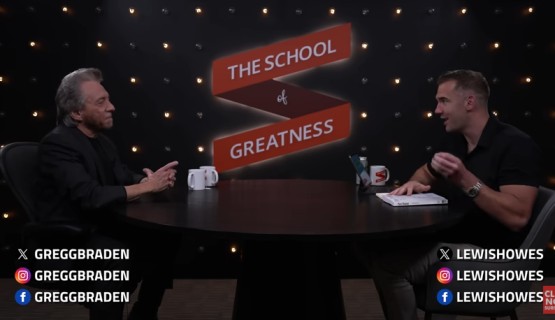
Editor’s Notes: Discover the ancient “soft technology” within your body that’s more powerful than any machine and learn how it shapes your reality, health, and destiny. In this episode, Lewis Howes sits down with scientist and spiritual teacher Gregg Braden to expose why our human divinity is under attack and what 2030 really means for our future. You’ll uncover how unresolved trauma imprints itself chemically in the body, how to finally release it, and the exact inner tools—thoughts, breath, emotions, and focus—to manifest the life you desire. Watch until the end to learn practical steps for turning grief, fear, and limitation into peace, freedom, and true abundance. (Jan 29, 2025)
TRANSCRIPT:
Introduction: The Power of Human Potential
LEWIS HOWES: My friend, I’m so excited about this episode with Gregg Braden because we are going to talk about why your body is an advanced soul soft technology with capabilities beyond what modern science can replicate and how trauma creates chemical imprints in your body and the exact techniques to release them physically and emotionally to create your ultimate human potential.
This is going to be a big one. If this is your first time here, please like this video, leave a comment on your biggest takeaway and click the subscription button right now to subscribe so you can stay notified on all the great episodes we have here on the School of Greatness. So click that subscription button right now and also make sure to get a copy of my brand new book, Make Money Easy. If you’re looking to create more financial freedom in your life, the link will be below in the description as well. And without further ado, let’s jump in.
Welcome back everyone to the School of Greatness. Very excited about our guest and the conversation we’re about to have. We have the five-time New York Times bestselling author Gregg Braden in the house who’s also an amazing pioneer in emerging paradigm bridging science and human potential. And there’s so many topics that I want to dive into.
But there’s a quote that you have that I want to start with and the quote is that you’ve said, “By the year 2030, we will either have awakened to the truth of our untapped human potential or we will be locked into a society of hybrid humans that is engineered away from our powers of creativity, emotion, empathy and intuition.”
And my first question for you is, what is our true untapped human potential? What is it that we haven’t even had access to that ancient humans had access to?
GREGG BRADEN: You can start with easy questions first.
LEWIS HOWES: Yeah, the easy question. What is that untapped human potential that we have no clue how to tap into, that the ancients knew how to? And how can we start tapping into it?
Consciousness and Human Technology
GREGG BRADEN: There’s an emerging philosophy in the scientific community right now that I think will help to answer that question. This is completely unscripted. I don’t know where we’re going. I’m going to follow your lead on this. So I’m going to begin by sharing that philosophy.
And it begins with a statement that simply says that consciousness informs itself through its creations. And we break that down. What it means is the things that we build in the world around us, everything from the books that we write and the art, the sculpture, the dance, certainly the music, our entertainment in some respects. And beyond that, that they are reminding us, they’re telling us something about ourselves, that we are asking ourselves to either remember or perhaps learn for the very first time.
And if this is true, Lewis, it applies to technology as well. I’m a scientist by degree, systems thinker. I worked during the Cold War years in some of the most advanced technologies, for example in the SDI, Star Wars Defense Initiative, advanced lasers, communication, radar systems. And I’ve seen and deeply respect this technology.
I’m going to say at that time, and even to this moment, I have yet to see any technology built in the world around us that does not mimic what we already do in the cells and the systems of our body. And in many cases we meet and exceed the capacities. We do it better, really.
So the answer to your question about what is it that we’re about to give away—our humanness is under attack right now. We are the product of multiple generations where to be human, the idea of our humanness has been denigrated. It has been degraded. We are teaching our young people in school right now. Young people are being taught that carbon-based life in general, and humans specifically, are flawed.
Among our flaws: emotion, because emotion clouds sometimes our logic and our ability to think clearly. Our human experiences of empathy, sympathy, compassion, the ability to self-regulate our own biology—these are seen as flaws. And for young people, if there are flaws, it means we need a savior. And the savior is being touted as technology: AI, computer chips, chemicals in the blood, RFID chips under the skin, sensors in the body, nanobots.
The 2030 Timeline and Human Hybrids
So the idea, this 2030, this was reflecting a statement by Ray Kurzweil. Ray Kurzweil, I think some of our viewers know, he’s an author, he’s a visionary, he’s a futurist. He is heading up AI research at Google right now. And he made two statements that I think are relevant to this conversation.
First, he said, “By the year 2030,” which is only five years from now—I mean, we’re just about the year 2025—he said, “By the year 2030, when we talk to someone on the street, we will no longer be talking to a pure human. We will be talking to someone who has either embraced or been mandated to have some kind of technology accepted into their bodies.” So by 2030, we will be speaking to human hybrids.
By the year 2045, he says, we will have achieved what he just wrote his most recent book about, something called the Singularity.
So I wrote a book called Pure Human. And I wrote this book to advocate for our humanness, to celebrate and maybe awaken a deeper sense of pride for what it means to be human and a deeper appreciation for our humanness. So it’s a long answer to a short question. I wanted to kind of lay that out as we start this conversation.
From Unfulfilled to Actualized
LEWIS HOWES: Yeah. And I think a lot of people that are watching or listening, they want to figure out how to go from a place in their life that they’re unhappy or unfulfilled with to actualizing their potential, their dreams, their desires. But they don’t know how to go from where they are currently to manifesting or creating that reality, that untapped reality in the future, and they don’t know how to draw it to themselves faster. How do I bring this idea into the world and make it happen?
GREGG BRADEN: I’m with those people, you know. Just off camera just now, we just had a conversation. I don’t talk about this a lot because it’s not often relevant, and I’m not ashamed to share. I’m the product of a very dysfunctional, abusive, alcoholic family. I was born in the 1950s, and the idea of abuse and addiction and counseling and therapy were very different in the 50s and 60s than they are now.
LEWIS HOWES: It was not accepted then as much, right?
GREGG BRADEN: Well, looked down upon. There was a stigma.
LEWIS HOWES: Something’s wrong with you if you need that.
GREGG BRADEN: There was a stigma attached to it. And to complicate it even more, I was born in a rural community in northern Missouri, which is, for our international viewers, right in the middle of this big, beautiful country we live in.
So I was raised in an environment where the abuser will typically belittle and criticize those around them to elevate their sense of worth. And fortunately, I was born with a very strong soul compass. I didn’t believe what I was being told.
I have a younger brother, four years younger. Same household, same experience, you know, listening to the same things. And he’s a good man. And I love my younger brother. And we’re like night and day. If you were in this room, we don’t look alike. We certainly don’t think alike. And unfortunately, he believed everything that he heard and has chosen to be defined in his life by that criticism.
And I can’t say consciously when I made the decision, but I remember thinking, “I will not be defined by my father’s idea of who I am,” because I was blessed, again, with a strong soul compass. I’m not saying I did it all right.
For me, in the 50s and 60s, music was my outlet, and I began playing guitar at 8. I play it to this day. I’m a musician when I’m not doing what I’m doing right now. And I left our home at the age of 14, which now I think is probably illegal. But I moved in with my rock band, and during that time, the drugs were abundant, and I watched beautiful, talented men and women—we had a female vocalist—I saw their lives destroyed in a matter of months through the chemicals that they put into their bodies.
And Lewis, I didn’t know then, obviously what I know now, but I always had a sense that there’s something about us that is so rare and so beautiful that we need to honor and respect this gift of the body. And I had a sense I would need this body for something later in life. And my friends didn’t think that way. So it was hard to have these conversations.
But I was always looking to see what it is within me. How can I be the best version of myself? How can I serve? How can I serve this world? And when I leave this world—I don’t know how long I’m here, we never do. I feel good and I think I’m here for a while. But the day that I leave, when I look back, I want to know that I left no stone unturned, that I gave to and loved this world to the best of my ability.
Knowing what I know, and I do, I love this world and the people of this world. We’re going through a tough time right now, man. It’s a tough time. It’s not just America, it’s everybody in the world. And what I want our viewers to know is it’s not going to last forever. And it’s not random, it’s not spontaneous. There’s a structure. We are moving rapidly toward the close of a cycle.
Understanding the Cycles
LEWIS HOWES: And what’s that cycle?
GREGG BRADEN: There are cycles within cycles. There are cosmological cycles that shift our planet. There are geologic cycles that I studied as a degree geologist. There are financial cycles, there are economic cycles. There are conflict and war cycles. Many people don’t know that the conflict and war are actually driven by natural rhythms.
The magnetic fields of the sun influence the earth, influence our heart rate variability, they influence our sleep patterns, they influence blood pressure, all those things. So they’re all converging now, and they appear to be converging around the year 2030.
LEWIS HOWES: Really? Why is that?
GREGG BRADEN: Well, this is—okay, this is—I don’t know how deep you want to go.
LEWIS HOWES: Go as deep as you want.
GREGG BRADEN: So to have that conversation, we need to tread on territory that many of my peers are not comfortable talking about. And I’m happy to do that. And I want to do it in a really good and a responsible way.
The year 2030, for example, the United Nations has identified 2030 as the year they want to remake society and remake the world through what are called the 17 Sustainable Development Goals. The World Economic Forum has identified 2030 as the target date for their vision, their vision of what they want the world to look like.
LEWIS HOWES: What is that vision for the World Economic Forum versus the UN?
The World Economic Forum and UN Agenda 2030
GREGG BRADEN: It’s the same vision. This is a very concerning relationship. So now we’re covering a lot of ground. Let’s just back up.
WEF, World Economic Forum. Independent, non-elected individuals. They started meeting in 1971, Davos, Switzerland. We all hear about the meetings every year that, you know, for a week you get little tidbits.
LEWIS HOWES: The billionaires.
GREGG BRADEN: Yeah, yeah, yeah. You get little—well, they’re CEOs, corporations, they’re politicians, they’re kings, they’re queens. They’re leaders of nations in many cases. And they’ve always met to have their conversations about what they feel, what these elites feel that our lives and our world should look like. And they have every right to do that. No problem until 2019.
Now the United Nations has had a series of programs beginning—they started, then there was UN SDG or the Sustainable Development Goals. SDG for the year 2000, their 15-year plan that expired in 2015, and now they’re looking another 15 years, which expires in 2030.
They put together 17 Sustainable Development Goals that on the outside, Lewis, are beautiful goals. And when you look at these, if you go to the computer and go to the website, they are a list of 17 things. Who wouldn’t want these in the world?
LEWIS HOWES: What are a couple of them that—
The Power of Human Divinity and Overcoming Limitations
GREGG BRADEN: Yeah, for example, not all 17, but food. Yeah. Food security. Who doesn’t want food security? Global health for families, global health for children. Who doesn’t want those things?
Now, you read the fine print of how they plan to achieve those goals and it is horrendous. It is a remaking of social structure, of family and society, social engineering to a degree we’ve never seen in our world before and leading to a world of centralized power and control.
So let me, I’ll just give you an example. Food security. Everybody wants food security. I’m down with that, you know, 100%. Now you read the fine print, you would think they would want to help small agrarian families in rural areas throughout the world. Their idea of food security is to pump money into the big pharma and big agriculture, corporate farms, GMO seeds, GMO insects to take care of these things.
And what’s happening is the little farmers are being forced out of business in the rural areas, not just in America. This is happening all over the world and we are the prize, Lewis. This is why I want to say this is what our viewers to know. I want people to have a deeper appreciation and be proud of our humanness because it’s through our humanness that we have access to something that no other form of life has.
And that is, I’ll use the word and then I’ll define it and then we can have a conversation about. The word is “human divinity.” For many people, divinity is linked with religion. And I can see why there are schools of divinity that have been built to make that association. But the contemporary definition of divinity has nothing to do with religion.
It literally reads divinity is the ability to transcend perceived limitations. Transcend means to become more than perceived. I love this. They may not even be real—we may be living limits in our lives. And as a 14-year-old boy from a dysfunctional alcoholic family, I was told what my limits were as a man, as a human would be. And this is where I began to push against those limits and test those limits.
Now, I didn’t know then obviously what I know now, but the ability to transcend the limits that we’ve been indoctrinated through family, culture, society, science, medicine, have all led us to believe we’ve got limits. And here’s the thing, new discoveries are blowing the doors off every one of those limits.
Consciousness informs itself through its creations. The technology that we’re building in the world around us is reminding us that we are that technology, that within us, we have the capabilities as what we now call “soft technology.” Not computer chips and chemicals in the blood and wires under the skin. We’re more than that. We’re human, we’re neurons and we’re DNA and we’re cell membranes.
And we have the ability to self-regulate this soft technology in a way that no other form of life has. And here’s the beauty, and this is every guest you’ve ever had is hitting on one facet of this technology. When I was in the industry, what I learned is the more complex a system is, the simpler the user interface. You’ve probably seen that. I mean, pick up a cell phone, you touch the screen and man, you could pay your bills and talk to your friends and you never even typed a letter. That’s very sophisticated.
LEWIS HOWES: Push a button and I can be on a video call from you from around the world in a second.
GREGG BRADEN: Exactly, exactly. So our user interface is like that. And it is the subject of our most ancient and cherished spiritual traditions. Thoughts, feelings, emotions, breath, focus, nutrient and movement. That’s our user interface.
When we know how to bring those together in just the right way, we are awakening the potential of a soft technology that was given to no other form of life. And it’s a very different way of thinking.
So divinity, because we’re covering a lot of ground here, divinity is the essence of our humanness. Divinity is the part of us that’s timeless, it’s ageless. It’s where our love begins. That’s where our sympathy, empathy, compassion, forgiveness, understanding, it’s where our healing begins, is our divinity.
So there is a concerted movement now to veil us from our own divinity, to steal that power from us. Because when we are no longer connected with our divinity, we are more vulnerable to fear, more vulnerable to the agendas and the ideas of others and more willing to accept other people’s views of what our lives and what our world should look like.
LEWIS HOWES: You didn’t accept your parents’ views of you?
GREGG BRADEN: I didn’t. I didn’t reject them. I just didn’t accept them. It wasn’t safe in my family to reject anything. If you’ve been around alcoholism, that’s very unpredictable. You know, your father comes home, you never know which father you’re going to get. You never know how your conversation is going to be heard or responded to.
LEWIS HOWES: So you’re in survival mode a lot.
Unresolved Grief and Its Physical Impact
GREGG BRADEN: You are in survival. Can I just do a little side journey on that just to show how deep that goes? I lost my mom during COVID. I wasn’t ready for it. And it surprised me because I’m an adult and I’m 70, and I knew that I was going to lose her at some point.
But when you’re in a dysfunctional family, an alcoholic family like that, at least in our case, my mom was always my protector. And there was a part of me, not the grown adult, Greg, but there was a part of my psychology when my mom passed that realized that my protector in this world was gone.
LEWIS HOWES: Wow.
GREGG BRADEN: And I ended up—I was twice in the hospital with heart issues that were not heart issues. They kept saying, “Mr. Braden, psychological issues.” Well, they call them somatic now, which was very kind. But it was funny. They went through all the tests and they said, “Mr. Braden, you’re really, really healthy. There’s nothing wrong with your heart.”
And I said, “Well, what am I feeling?” And they said, “This is somatic.” Well, this is the doctor. He would come in and say, “There’s nothing wrong with you. I don’t know why you’re here in this hospital bed.” I was in the ER. He said, “I don’t know why you’re here in the ER.” And then he left.
A nurse came in. The first thing she did, she looked at me, Lewis, and she said, “What’s happening in your life?” And I started to say the words, “I just lost my mom.” And I couldn’t even get those words out. And I was just sobbing. I wasn’t even crying. It was like gasping sobs.
And she said, “You’re dealing with unresolved grief.” And I said, “Okay, yeah, I know that. No surprise there.” She said, “Grief isn’t bad. But the unresolved grief can actually have a physical influence on the little muscles in the chest around the heart. And if you don’t know any better, you think, and it’s good to get it checked out,” she says. “You think you’re having an episode, a heart episode,” she says. “Unresolved grief.”
I went to a grief counselor and went away, never came back.
LEWIS HOWES: How does someone unresolve their grief through grief counseling?
GREGG BRADEN: Redefining. And it’s different for everyone. For me, I had to find a sense of safety knowing that my protector was no longer in the world. And I say that because I know I’m not the only one. Other people have that experience, but that’s how deep and how lasting those kinds of experiences go in our lives.
The ability to resolve grief is a facet of human divinity.
The Chemical Nature of Emotions and Trauma
LEWIS HOWES: If someone is experiencing symptoms, whether it be heart palpitations or they don’t know if it’s grief or not, but they’re feeling anxiety, maybe panic attacks, maybe ADHD, maybe just depressive thoughts, things like that. What happens when someone who is experiencing some type of mental or emotional altercation in their body? What happens when someone decides to go the medical route versus the healing, somatic route?
GREGG BRADEN: Well, I’m going to answer it in two ways, and this is not separate from this conversation we’re having about human divinity. And I’m going to tie back into what we’re now exploring. I just want to give context and structure here.
We’re exploring, getting into the nitty gritty of the power of human divinity and why we want it and what happens if we give it away, if we give our humanness away. We no longer have the abilities that I’m going to share right now. So this is part of the conversation.
First of all, when someone feels that, it’s always good to get it checked out, because you don’t know, you cannot determine unless it’s happened in the past and you recognize this is exactly what happened in the past. You really can’t.
LEWIS HOWES: It’s terrifying. It’s scary.
GREGG BRADEN: It is. It is. And fortunately, we live in a city where we had—it’s a small Santa Fe, New Mexico. It’s not a big 80,000 people. It’s not a big community. But we had, and I had good medical care to answer the question.
We have to understand what’s really happening. Every emotion that we’ve ever had in our lives, from the moment even before we emerged into the world through the birth canal, while we’re still in the womb, every emotion that we’re having has a chemical equivalent that is called—Candace Pert was the first Harvard-trained medical physician that linked emotion in chemicals in the body and in a scientific way.
I had the honor of knowing her before she passed in 2013. She wrote a book called “Molecules of Emotion.” I’m sure a lot of your viewers are familiar with that. And she identified these chemicals. They’re called neuropeptides.
Neuropeptides typically will be created by the emotion, and they metabolize through the body. No big deal. Unless we’re having an emotion that we can’t resolve. Then the neuropeptides, our bodies are so smart. The neuropeptides will stay in the body. The body will actually store the neuropeptides.
And this is where it gets really interesting. In the organs, tissues, and glands that we associate with our trauma. And everyone has trauma and everyone’s trauma, your trauma, you might have a trauma. And I look at it and say, “What’s the big deal?” Because my filters interpret it differently. Or I would have a trauma and you would look at it and say, “Come on, Greg, suck it up and get over it,” because your filters are different.
But we all have trauma, and it’s personalized. And those neuropeptides will stay with us 10 minutes or 70 years until we have the tools to resolve the trauma. Sometimes they’ll give you a little nudge to let you know they’re still there. It might be a little irritation, might be a rash in the body or inflammation or swelling.
And we will take a pill or put on a cream to make the symptom go away, but that neuropeptide is still there. And then they’ll say, “Well, maybe you need a little bit more, a little bit more of a nudge.” And then we start developing symptoms of things that we call illness and disease.
This is so fascinating to me because the science is showing us rarely do our bodies break. Rarely do we have illness and disease in the way we think we have it. What we are experiencing is our body in the presence of the conditions, the epigenetic conditions that we’ve given it to work with. It can be nutrition, it can be environment. And the most powerful environment is the emotional environment. Over 90% is the emotional environment.
So rather than saying our bodies are broken, which ruins the trust that we have in our bodies, it’s useful to say, “What am I giving my body to work with? What is the environment?” And sometimes emotional environment is subconscious. In my case, it was subconscious. I had a subconscious fear of not being safe because I wasn’t when I was a child.
LEWIS HOWES: Even though you were in your late 60s at that point and you were an adult, and you could logically say, “Well, I have resources, I have protection, I have a home, I have money, I have safety.” But the little boy in you didn’t feel safe.
The First Seven Years: Programming Our Reality
GREGG BRADEN: Exactly. Well, it makes sense because the first seven years average, first seven years of a human life, we are in an altered state of consciousness. It’s actually called a hypnagogic state is the term that psychologists use, where we have very few, if any, filters.
We are absorbing behavior patterns from our caregivers. This is nature’s way of preparing us for life. Nature believes that we’re going to be in the same environment that our parents are. So we learn from our parents how to deal with conflict and how to treat people that you like and how to treat people you don’t like.
LEWIS HOWES: And we mimic them.
GREGG BRADEN: We do consciously and subconsciously. Those are consciously. Those are the programs. Up until the age of seven, the Jesuits knew this. Maybe you’ve had other speakers talk about this. They would say, “Give us your sons,” because it was a male organization. “Give us your sons until the age of seven and they’ll be ours forever.”
So what they meant—give them to us for this first seven years. They can go home to you, but they won’t want to because they will be indoctrinated into the patterns of the Jesuits and their home life will no longer make sense. That’s an example of how powerful those first seven years of life are.
LEWIS HOWES: Is the programming, right?
The Power of Neuropeptides and Emotional Release
GREGG BRADEN: It’s the programming. So the neuropeptides can stay in the body as long as they need to. And there are techniques, breathwork techniques, heart-brain coherence. You know, my brother Joe Dispenza taught—he and I have taught together, and we use these techniques. There are all kinds of body EFT and body memory therapy, and it’s a whole conversation. But there are a lot of ways to resolve that.
And it’s fascinating to me because when we do resolve them through a breathwork session, for example, those neuropeptides are made of chemicals in the body and elements, minerals. And you’ll actually begin to taste metallic taste in your mouth or your urine. Your urine will smell funny because it’s not the typical urine. These are chemicals. Or your tears or your perspiration will taste different and it’ll smell different. You’ll sweat and you’ll smell different when you’re going through this. Because now those neuropeptides are metabolizing through the body, through body secretions, processing body secretion. So it’s tears, perspiration, saliva, sexual fluids, feces. All of those things is how we release.
LEWIS HOWES: Wow.
The Field That Connects Everything
GREGG BRADEN: Isn’t that fascinating? This goes back to the power. Human divinity is a part of us that’s timeless, it’s ageless, it’s all knowing. It is the part of us where our healing begins. And what the science is showing is that divinity doesn’t live—those patterns don’t live in our bodies. This is where it gets really, really interesting. It was already interesting. Now it’s going to get really, really interesting.
They don’t live in the cells of our bodies. The cells of our bodies, the neurons, DNA and the cell membranes literally are antenna that tune us to an energetic place in a field that underlies all existence. That we now know. Science confirmed it in the year 2012 that the CERN Superconducting Super Collider, they actually announced it on July 4th in America. 4th of July, 2012, that there is a field that underlies all existence. 2022, the Nobel Prize in Physics was given to the physicists that confirmed that in this field, everything’s connected. Entanglement really is what it’s called.
LEWIS HOWES: What is this field that we’re living in?
GREGG BRADEN: It’s an energetic field, and we are that field. Every human, the average human, is about 50 trillion cells in the body, approximately, give or take. You’ve got more cells than I do because you’re taller than I am. And every one of those 50 trillion cells has about 100 trillion atoms. And every one of those atoms is doing this. It’s emerging from that field and collapsing into that field every nanosecond of the day. Like, right this nanosecond. And as it emerges from the field, it is building our bodies to fit the template that we hold in our consciousness.
LEWIS HOWES: That’s crazy.
GREGG BRADEN: Of who we are. And this is why healing is possible. This is why spontaneous healing is possible. When we change the way we think and the way we feel, we change that blueprint, we change the template, and that information will now fill in a new and healthier blueprint. And this is all very well documented. I mean, the science knows the bits and pieces. Science is reluctant to bring them together because it tells a story that many scientists are reluctant to embrace.
LEWIS HOWES: What’s that?
Why Human Divinity Is Under Attack
GREGG BRADEN: The story is that we are not what we’ve been told. We’re more than we’ve been led to believe. And that is the essence of why I’ve written this book. I’m going to answer that question for you right now. What I’m going to say is this, Lewis. There’s something inside of us, we humans, that is so powerful, it is so beautiful, it is so ancient, it is so precious, that there are organizations in the world today, and there always have been societies in the past that will go to any length to shield us from that part of ourselves, because that’s where we find our power.
When we are in our power, we are less vulnerable to fear. And fear, I think you’ll agree, is probably the greatest commodity in a world that is moving toward authoritarian authority. The ability to create authority and centralize that authority in the world—that is our divinity. This is why we are the prize. We are literally the prize.
And I want to make this conversation relevant to our viewers, because so many people, they write to us and we see the comments and say, “Okay, you know, these conversations are cool. What’s that have to do with the world?”
LEWIS HOWES: And what’s that have to do with my life right now?
GREGG BRADEN: Yeah, the world out there. So here’s what it has to do with the world that we’re living in. That part of us that is so beautiful, powerful, ancient, precious, is the reason for everything we’re seeing happening in the world. Those powers that be will stop at nothing to distract us and keep us diverted.
Nations will go to war with nations, economic systems will be collapsed, pandemics will be unleashed, climate will be engineered, nations will rise and fall, all in an effort to distract us. Because we are the prize. The human body is the prize, because our humanness is the link to our divinity.
This is why I began talking about an ancient battle. There’s an ancient battle between good and evil, and evil means different things to different people. But the ultimate evil is to shield a human from their divinity. When we are kept from our divine nature, our ability to love fearlessly, to forgive, to heal, to imagine, to innovate, to create, that is a form of evil. And that’s a form that is playing out right now. And this 2030 window of time is the window of time when it is proposed that our humanness, our biology, be replaced.
LEWIS HOWES: Wow.
The 2030 Agenda and the Battle for Humanity
GREGG BRADEN: With technology, with AI, with computer chips, chemicals in the blood that mimic the systems that we do with synthetics, computer chips in the brain linking us to the computers now. And it’s a very different way of thinking now. I’m a systems thinker, so I look at the big picture so that I understand where the nanosecond of my life fits into that big picture. And then I let it go.
We don’t have to know any of this, but I want people to know that what we’re seeing—and it’s not a crazy world, it’s insane. It’s not crazy. There is a method, there’s a system, there’s a process, and it won’t last forever. It’s this little window of time where you’re seeing the powers that be jockey for position. And our humanness is a problem because we are such powerful beings, and nobody’s telling our kids that.
Our kids are being told that they’re flawed forms of life, that they need something outside of themselves to be the best version of themselves and to compete in business and compete in the world. So our kids are willing to give themselves away to virtual reality, to computer chips.
I mean, I had some young people in one of my courses earlier, it was in the summer, and we were talking about Neuralink, the chip that FDA just approved from Elon Musk. This is his company, and it allows a human without any wires at all to communicate directly with the hard drive on their computer. And so here’s these young kids in the room, and they’re saying, “This is cool.” They’re saying, “Mr. Braden.” And I said, “No, please, Greg.” And I said, “Okay, Greg.” I said, “I’m only 70. I’m not a Mr. Braden yet.”
They said, “Are you telling me that all I have to do is put a computer chip in my brain and I can play Grand Theft Auto with no wires, no control, I can think, no controls. Sweet,” or there’s some other words they use, but sweet.
LEWIS HOWES: Right, right, right.
Use It or Lose It: The Biological Imperative
GREGG BRADEN: Sweet was a lot of it, because they don’t realize this. The biological imperative. There is an adage in biology that says, “Use it or lose it.” Perfect example. When I was back in the ’50s and ’60s, I was taught, and you probably were when you were young as well, that we were born with a fixed number of neurons in the human brain. And so this was leverage in college. You know, when you’re in college, every beer you drink, you’re going to lose some neurons. So you better not drink too many beers. You know, this is what they’re saying.
But now we know up until the last breath, the hippocampus in the human brain is creating new neurons. But there’s a catch. Every time those neurons are created, they must be engaged in a meaningful way within about seven days, or they will atrophy and die. So that is true for all the systems in the body. We are a biological system that works on demand. If we don’t use our systems, then they begin to atrophy.
So you begin to replace the human brain with computer chips. Or here’s a study, an actual study that was done. Young kids 3, 4, 5 years old get up in the morning. They eat their bowl of Cheerios or whatever it is. Their parents sit them on the floor with an AI visor, and they leave them there for a few hours. And here’s what’s happening in that AI world. They’re seeing stuff they would never see in their backyard. They’re hearing sounds. They’re seeing images, colors.
And what has happened—this has gone in long enough now that psychologists are able to do the studies. Those young people are—their physical stature is demented. Their brain size is stunted, their cognitive development is stunted. Their visual cortex is enlarged. Because look at what they’re doing. They are simply watching rather than engaging in creating. When you and I were kids, I mean, we go out, we take a—
LEWIS HOWES: Blanket off the holes in the backyard.
The Power of Human Biology vs. Technology
GREGG BRADEN: Yeah, yeah, yeah. We make a tent and make a fort, and all of a sudden we’ve got a fort and we’re using our imagination. They’re not doing that. They’re just watching it all done for them. And so the psychology magazines are actually showing that. And it can all be reversed through epigenetics. So they’re not lost, but it’s showing that it’s not harmless. There is an impact. There is an effect.
And it’s another example. When our biology is replaced with technology, the gift of our humanness begins to atrophy in many different ways in one generation. Next generation comes along through epigenetics. Now it’s passed down, and the body says, oh, you know, we don’t do those functions anymore. We used to. But it’s a vestige of our past because now we’ve got a chemical to create the immunity in our bodies, for example. And that’s something that’s actually proposed, you know, right now.
Right now, policies are being written, laws are being enacted to implement many of these technologies in our bodies. And the term—there’s a general term for this, Lewis—it’s called transhumanism. Trans simply means beyond. And human is our biology. So it’s beyond our biology.
And I did an interview recently, and someone asked, I said, well, isn’t this a part of our natural evolution? It’s not a part of our natural biological evolution. It is a form of a technological evolution that’s not good for us. It’s not good for us humans because we lose the very essence of what it is that we cherish in our humanity.
We lose our ability to love, forgive, sympathy, empathy, compassion. We lose the ability to discern rather than judge. We’re taught to judge, but the healing comes from our ability to discern. We lose all of those things when we begin to give our humanness away.
So we’ve just covered a whole lot of ground. I’m going to come back. There’s a concerted effort right now in these next few years to diminish the power of our humanness. One of the ways that’s being accomplished is by us either being encouraged or mandated. Some of the policies will be mandates coming from the UN through our United States Congress. They’re going the legal route to accept technology into our bodies to replace our humanness.
When we do that, we relinquish that precious, ancient and sacred gift that we were given when the first of our kind stepped onto this planet 200,000 years ago. You know, we’ve only been here 10,000 generations, 200,000 years, not that long. And we were given these abilities, given to no other form of life. And now we’re being taught and indoctrinated to believe that we are flawed, powerless victims of a world that we have no control over and that we need something outside of us.
Humans as Advanced Soft Technology
So the flip side of this, now the new science, and this is exciting, is showing us that we are literally a highly advanced, technologically sophisticated soft technology, neurons. One of the reasons that science is beginning to think of us—maybe some of your guests have talked about this—is that we’ve been conditioned to think of our biology as this soft, gooey, sticky, wet stuff, you know, inside the cells. And that is one way of thinking of us.
But now scientists are looking at us from a perspective of information technology. These are IT perspectives. And so the discoveries, they’re not showing up in biology books, they’re showing up in engineering journals like IEEE, you know, and these engineering journals.
Who’s reading those? I mean, my community’s not reading them. But let me just give you an example. There was the Journal of Advanced Computing Technology, which I don’t read and most of my colleagues don’t as well, unless we’re researching a book or something, came out with an article and it showed that human DNA is literally a fractal antenna is the term that they use.
So what’s that mean? We think of antennas being tuned to something very specific, like a specific TV station or radio station or, you know, CB station or whatever. Fractal antennas are receiving multiple signals from a broad spectrum of bandwidth simultaneously. We’re pulling in information from the world around us all the time across this broad spectrum. And we’re transducing it into meaningful signals in our bodies. That’s a very different way of thinking of the human body.
So I’ll just run through this really quick what the science is showing. 50 trillion cells in the body. Every cell is a miniature, a micro circuit. It’s a gated circuit is what engineers call. It’s got input, output. All the functions within our cells, they function as transistors, as resistors, as capacitors that are massaging that information.
Every cell has a voltage of about 0.07 volts. You say, well, that’s not very much, but you do the math. 50 trillion times 0.07 is over 3 billion—no, over 3 trillion volts of electrical potential, which—
LEWIS HOWES: Is in our body.
GREGG BRADEN: In our bodies. Now, we don’t actualize it all the time, but what if you could harness that for your own healing or to optimize cognition, optimize whatever it is we’re going to do in our lives?
But it doesn’t stop there because we’re receiving photons of information. We’re transmitting photons of information. We already said the DNA in our bodies—our DNA stores information, and let me just use the terminology and see if you’ve heard this before. The DNA in our bodies stores every successful genetic transaction in our species in a way that’s transparent, it is immutable, and it’s secure.
And if that sounds familiar, it should, because that is the basis for what is the new financial system of the world. The decentralized financial system we call blockchain technology. Blockchain technology mimics the way information is stored in the DNA of our body.
LEWIS HOWES: Really?
The Human Brain vs. Microprocessors
GREGG BRADEN: So once again, I’m saying all this—we build around this is mirroring what we already do in our bodies. They compared a human brain to a microprocessor. The Salk Institute in La Jolla is where this actual—I’m doing this from memory—Salk Institute in La Jolla. And the way they did it for our techie engineers out there is they equated the synapse in the human brain between neurons to the transistors on the chip.
And interestingly, the numbers are very similar. On a modern microprocessor, it’s about the same number of synapses we have in the brain. Then they did the studies, and what they found is the human brain is a hundredfold faster than the processors.
LEWIS HOWES: Wow.
GREGG BRADEN: Here’s the beauty of where this goes. All of those computer chips, man, they’re fast. They’re accurate, hands down. But are they scalable? They can only scale as far as the limit of the physics of the stuff they’re made of allows. So if it’s a silicon chip, the atoms are in predetermined geometric patterns that make silicon. And information can only move so fast across those. Interesting. So fast, yes. Efficient, yes. Scalable, not so much.
Now, human neurons, every time they push a human neuron to the edge of the limit that has been accepted in the textbooks, we do what humans do. The neurons morph and they adapt and open up an entire new vista of processing capability. And we do this again and again and again. What is the upper limit of a human neuron? We don’t know. We may be infinite when it comes to scalability. That’s soft technology.
And it goes on from there. I’m just giving a couple of examples. I know I’m covering a lot of ground. Can I share one more? This is really exciting. And then we’ll pull this together.
The Pong Experiment: Neurons and the Field
There was an experiment that was done in 2022, and some of our viewers may be old enough to remember the computer game that I’m going to reference. 1972, a game called Pong. Pong was released—today it looks primitive. It is essentially a tennis game, a badminton game. Two little blocks going up and one ball, and it’s going like this. People were fascinated when that game first came out.
So here’s what happened. Scientists took human neurons independent from the body and put them into a petri dish. So they’re not even attached to a human. And they have a special chip where the little dendrites, little tentacles, if you will, from the neuron will fit into a port on the chip. So now you’ve got a chip and a neuron interface, and they were able to hook that up to a computer that was loaded with Pong.
Well, guess what? These neurons started playing the game Pong. But listen, they knew how to play. And the longer they played, the better they got. They learned. So here’s the question now that the scientists have to ask: How does a neuron not attached to a human in a petri dish know how to play Pong? Are the instructions stored in the neuron? The answer is no.
And this is going to go back to what we said earlier. The neuron is the antenna that tunes to the place in the field where Pong lives in our—some people call it Akashic record, or they call it the Planck field or zero point field, or the divine matrix or the matrix, whatever you want to call it. There’s a field that underlies all existence, and that field is information.
So in the experiment, the neuron was the antenna connected to Pong. In our lives, the neurons in our brain and the neurons in our hearts and in every organ of the body—they’ve now been found—connect us to that field.
When we replace our natural biology with synthetics and we no longer are using those neurons and we’re no longer using DNA, we’re still human and we can still function, but we’ve lost our divinity. We’ve lost our ability to love, forgive, to initiate our own healing, innovation, imagination, creativity. This is the essence of our humanness.
This is why we’re the prize. Because when we lose those, we are vulnerable to power, control, and other people’s ideas of what our world and our lives should look like. The transhuman movement is the movement to do just that. In these next five years are critical. So does that help to understand why our bodies are so powerful?
The Power of Our Divinity
LEWIS HOWES: 100%. I mean, this is great context for people, and I can already tell people wanting to follow up with a question in their mind. So I think this is a great context to give people a small percentage of all the information you’re talking about here to give us context.
There’s a couple quotes I want to read that kind of back what you’ve been talking about that you shared before. Quote from you: “Expressing our divinity frees us from the fear that keeps us small, insignificant and powerless, allowing us to triumph over life’s challenges.”
GREGG BRADEN: Can you see where that would be now? Based on everything, that’s where I wanted to cover experiments.
LEWIS HOWES: Okay, the next quote you said is, “Awakening your divinity begins with the way you think of yourself, your story.” And then one more quote to tie into this. You said, “The language we use, the words we choose to describe ourselves and share our thoughts, feelings, emotions and beliefs forms the framework for the unity or separation that we experience when we think and solve the problems of everyday life.”
GREGG BRADEN: And did I write that?
LEWIS HOWES: This is what you wrote.
GREGG BRADEN: You know, I’m laughing because this is a new book and this is the first time I’ve heard someone reading those things back.
LEWIS HOWES: But my question is for you. Then you know you’re talking about our human DNA. I heard you say is a fractal antenna.
GREGG BRADEN: Fractal antenna.
The Importance of Our Inner Story
LEWIS HOWES: Fractal antenna. Meaning we’re receiving all different types of information from all over the place. So I’m curious then. We’re getting information from the outside world, whether it be media, parents, friends, peers, whatever it might be, advertising, all coming to us. We’re also getting what I heard you say—our most powerful environment is our emotional environment. So we’re getting information from our emotional environment constantly.
How important then is our inner self-talk and the stories we tell ourselves in how we either create and attract what we want in terms of abundance or have more of a miserable type of a life?
GREGG BRADEN: Well, you nailed it. And that is the essence of our humanness. We have conscious stories and unconscious stories. I had an unconscious story that I am not safe in the world without my protector. I was not consciously aware of that.
So that inner conversation is vital. It’s more than important, it’s vital. Our story defines the way that we are in the world. So we live our lives based upon our story, the way we’re conditioned to think about ourselves. Everybody has a story that begins before we’re even born in our mother’s womb. The epigenetic factors are determining our subconscious story. The way that our friends and our family and our peers and our school and our church teach us to deal with the world. That’s all part of our story.
And based upon our story, our story defines every relationship we’ll ever have. This is an adult audience, I’m assuming. So every relationship, every friend that we’ll ever have, every human that we invite into our bed is a reflection of the story that we have told ourselves about ourselves and believe.
This is the key. What story do you believe? Many people tell themselves stories, but they don’t even believe their own stories. Those are called affirmations. You can say the affirmations a million times a day. If you don’t believe that you are worthy of a perfect mate, if you don’t believe that you’re worthy of the—
The Power of Belief and Self-Worth
LEWIS HOWES: How does one, Gregg, start to believe they are worthy and deserving of incredible love and abundance? Even if they had a horrible backstory, even if parents abandoned them, abused them, if they’ve been cheated on, lied to, stolen from, physically, sexually, emotionally abused over and over again when their reality was something that was painful and suffering, how can they believe “I’m worthy” to look at all the bad stuff that’s happened to me?
GREGG BRADEN: What you just described is the workshop of life. That’s where the workshop begins. But the workshop has to begin with the story.
Lewis, we are not—we’ve been told we’re more than we’ve been led to believe. We need the reasons to think differently about ourselves. I can walk into an audience and I can say, “You’re powerful beings.” And I’ve seen it a million times with a million speakers. People have a notebook just like you have right there. And they write just like you’re writing right now. And they’ll say, “I am powerful. I’m a power.” And then they’ll look up and say, “Yeah, what’s next?” Because it meant nothing.
LEWIS HOWES: But if they don’t believe it, exactly, it doesn’t mean nothing to them.
GREGG BRADEN: Knowledge is power.
LEWIS HOWES: Seeing the story plus the belief of that story.
GREGG BRADEN: Well, one of the reasons I honor the left brain—everyone has a left brain to some degree. Everyone learns differently. Not everyone learns the same. Not everyone wants to hear everything that I just shared with you. But if someone is looking for the reason to think differently, they’re saying, “Gregg, give me a reason to think differently about myself.”
I’m sharing with you in the book a lot more detail, but I’m sharing the science that shows us that we are a soft technology. We’re not a frail, biological, flawed biological form of life subject to flaws. We have very, very few flaws. Our body performs with what it’s given to work with. Our body is a reflection. Candace Pert, the Harvard MD, said this.
LEWIS HOWES: The Molecules of Emotion.
GREGG BRADEN: Molecules of Emotion. She actually said, “Your body is your subconscious mind,” because what you believe about yourself is creating the chemicals in the body.
LEWIS HOWES: Fascinating.
GREGG BRADEN: Yeah, it really is.
LEWIS HOWES: And your body is your subconscious mind. So that means what you think and believe about yourself, consciously and subconsciously, you create within your body.
The Journey to Understanding Human Divinity
GREGG BRADEN: So I, as a child, had to reconcile what I felt, what I would call my soul compass, because it wasn’t supported in my community. People didn’t talk like this when I was a kid. And it sent me on a journey to understand myself. And that led me on a journey to understand our past.
And that led me on a journey to understand—I had two, I don’t know how we’re doing on time. Can I share a couple of stories?
LEWIS HOWES: Yeah.
GREGG BRADEN: Two very powerful stories. Experience when I was 14. So now I’ve left home, I’m living with my band, and I go see my first rock concert. There was a group that was called Jefferson Airplane, and the lead singer was this stunningly beautiful woman named Grace Slick. She’s still alive today.
And I sat on the front row and yelled at Grace Slick and told her how much I loved her. And she completely blew me off. But I watched in that room—there were about 30,000 people.
LEWIS HOWES: Wow.
GREGG BRADEN: And I watched them moved by what a couple of people did on that stage. But here’s the thing. Then the concert was over and we left. And everyone needed to have something to recreate that experience. At that time, there were eight-track tapes or albums. They needed something to recreate that.
LEWIS HOWES: Now, that feeling.
GREGG BRADEN: A couple of weeks later, I had another experience. And I’m not saying I’m aligned with the message. There was an evangelist named Billy Graham. Powerful, powerful speaker. He spoke to 70,000 people in the Kansas City Athletics Stadium, outdoor stadium.
And here’s the difference. When those people left, they felt differently about themselves. They didn’t need anything to recreate the feeling because his words had helped them to sense and to feel and to see themselves differently than they did before they went in to hear that.
LEWIS HOWES: Wow.
The Power of Words and Acoustic Waveforms
GREGG BRADEN: What I recognized as a kid, I said, “I don’t know exactly how I’m going to do this, but I think there is a way.” Our words, the words are so powerful. I mean, when you think about what we do with words, we breathe the breath from outside of us. We invite it into our bodies. We begin to flutter our diaphragm. We push the air back over the direction it just came down from.
And as it’s moving back, we begin to flutter our vocal cords in just the right way. Listen to this: to reflect the thoughts and the feelings that we’re having as acoustic waveforms so they can leave our bodies and fall on the skin and onto the eardrums of another living being to convey our deepest, most intimate experiences. Fascinating how powerful that is.
LEWIS HOWES: Fascinating.
GREGG BRADEN: And nobody tells us that. Nobody tells us that.
LEWIS HOWES: So we’re expressing a frequency based on the words we use, the sounds we use in that. And then every other person is receiving that frequency as well.
GREGG BRADEN: It begins with a thought. Nobody could see our thought, but we’re converting the thought into acoustic waveforms through the air that we’re forcing back. And the ability to modulate our vocal cords in just the right way to create those acoustic patterns. And then they leave our bodies. My words have left my body. Now they’re falling on you. They’re touching your skin, they’re touching your eardrums.
And your nervous system is now interpreting my thoughts. And we are so good at it, we don’t give it a second thought. That’s how powerful we are.
LEWIS HOWES: What is the frequency of our words and how it supports or harms us?
GREGG BRADEN: It’s not so much the words themselves. It’s the meaning that we give to the words. That’s the key.
LEWIS HOWES: So it’s the interpretation of the words.
GREGG BRADEN: The significance that we give to the word that we either tell ourselves about ourselves and believe—we have to believe them—or that other people instill within us before the age of seven.
Breaking Free from Past Interpretations
LEWIS HOWES: You talked about this story in the beginning, where you and your brother grew up in the same environment, same parents and same schooling, essentially. But you have different lives. You interpreted things differently.
How can one learn to break an interpretation that they’ve lived a life of pain, sadness and suffering, not deny the experience that happened to them, but not define them moving forward and holding them back from the abundance that they want to create in their life?
GREGG BRADEN: That’s the beauty of our humanness and our divinity. We have the ability to choose. We must accept the responsibility with that choice that we choose not to be defined by our past. That was a choice. It was a conscious choice I made when I was young.
I looked at my father’s life. I looked at the destruction, the emotional destruction. I looked at what it was doing to me, and I said—now my younger brother, and I love my brother, and if he’s watching this, I haven’t talked to you for a while, brother, but I love you. He carries that hurt and allows that to define his life.
And so all of the misfortune, and this isn’t nothing new, you’ve heard this. All the misfortunes, the bad relationships, the bad jobs, whatever it is, it’s somebody else’s fault. You know, you’re looking around you for the reasons, and that is a fundamental shift in understanding our relationship to the world.
We must choose consciously or subconsciously. I’m not saying it’s always a conscious choice, but on some level we choose to be defined by the circumstances of the past, or we choose to free ourselves. Human divinity is what allows us to do that.
If we don’t have our human divinity, the ability to innovate, to imagine, to create, to love—those are all facets of human divinity. You begin to see why it’s so important for us to preserve, to claim and preserve our bodies.
I think perhaps the greatest task that we’re given as humans is to honor, preserve, protect the gift of our bodies. Because once we relinquish our humanness, the technology, we’ll never get it back. Once we give our humanness, once we give our biology away, we’ll never get it back. And we become something very different. This is what Ray Kurzweil is talking about and it’s what the others are talking about.
But it comes down to something even deeper than that. And if you’re going to do a sound bite, maybe this is going to be the sound bite. Because not everybody’s into the good and evil. Not everybody’s into the technology. And all of that comes down to love.
The question that we all ask ourselves: Do we love ourselves enough to accept the gift of our humanness and the responsibility that comes with being a human and our divinity, expressing our divinity fearlessly in this world? That’s the question we’re all asking ourselves.
And without a verbal answer, the choices that we make, the politics that we choose, the medical systems that we choose, the food that we eat, the wars that we create or the peace that we create are the answer to that question. We’re all answering it right now. But how can you answer it if you don’t know the context?
Triumphing Through Living Our Best Version
So I’m going to go back. Good and evil, a battle between good and evil—this is a very different battle. You don’t win this battle. It’s not the kind of battle that you win by fighting. We don’t want to win. We want to triumph.
And the way you triumph, and this is the beauty, you don’t have to know any of this. The way we triumph is by living the best version of ourselves. We live our humanness, we live our divinity, we love fearlessly, we innovate, we create, we forgive without expectation. When we do that forgiveness, we do all of those things.
And by doing that, that is the very opposite. The evil wants to defeat us by separating us from those expressions. When we live them, we have triumphed. Wow. And I think that’s the beauty of where we are right now.
Practical Steps to Transformation
LEWIS HOWES: So, again, if someone—it makes sense to me, of course. But if someone’s watching, listening, and they’re thinking, “I’ve just had a rough—I’ve just had a tough life.” I’m sure you can think of someone in your life who has been holding on to that story and maybe it’s validated, right? Like they can validate that and they’ve had it really challenging.
If we can try to simplify the steps, maybe the actions and the practice might take a lot of time and energy and conscious effort, but if we could simplify the steps, if someone is feeling completely stuck or broken in their relationships, their financial situation, their career path. And they just feel like energetically things are not working for me. I’m not able to create the life I want.
I’m hearing you say we’re supposed to protect and preserve our bodies, but I’m taking drugs because it’s helping me deal with all this stress. I’m using alcohol, porn addiction because I’m exhausted. What would be the practical steps that they could start to apply in their life to go from a story and a past of suffering or sadness and transform it into peace, freedom and financial and emotional abundance in their life?
GREGG BRADEN: That is a really good question. And what we’re doing now is the answer to that question. It has to begin with knowing that you have a choice.
LEWIS HOWES: First of all, step one, know you have a choice.
GREGG BRADEN: So many people believe that there is no choice because they have been conditioned and indoctrinated to believe that they are powerless victims of a world around them that they have no control over and that they are a flawed form of life that needs something outside of their bodies.
So knowledge is power. You have to be willing to embrace the deep truth of your humanness and your divinity. It’s very difficult to break through those patterns if you are not willing to accept the truth of your humanness and the power and responsibility that comes with being a human on this earth.
And we’re given very few reasons to do that, Lewis, in our lives. And our school children are given very few reasons to do that. And that’s why they’ve lost respect in many cases for their bodies. They don’t have a sense of a future because the indoctrination is telling them they live in a world where it’s hopeless. That’s what it’s telling them.
Now, with the exception of the drugs, I’ve been—we were more than poor when my father finally left. He left when I was 10. Fortunately. Tough for my mom, raising two boys. She didn’t have a job. This was early 1960s.
LEWIS HOWES: Northern Missouri or where were you?
GREGG BRADEN: Yeah, Northern Missouri. Just north of Kansas City.
LEWIS HOWES: Missouri North, Northwest Missouri.
The Power of Choice and Human Divinity
GREGG BRADEN: Northwest Missouri. Yeah, I lied about my age. I went to work in a copper mill so I could be a union worker after school. I worked union hours, 4am to 4pm to 4am. There were 12-hour shifts. We lived in government subsidized housing for most of my teen years until I left.
And then I was forced to go back at the age of 14. I left. The court intervened and said, you have to go back until you’re 18 or you become a ward of the state. So I went back. We lived in government subsidized housing.
And it’s one of those things. You can hear the words from a million different people. You have to find a reason to become more than the circumstances of your past. You have to find that reason for yourself.
And that’s why the information, it’s more than just data. When I can show someone the potential within their bodies to look at it differently. When I can show someone what their divinity is really all about, and that it’s so valuable that nations will create wars to divert and distract us, what is it within us that could possibly warrant that extreme of hurt and suffering? It’s because we are so valuable and so precious.
I can tell you another story about—I have no idea how we’re doing on time. Are we okay?
LEWIS HOWES: We still got time. Yeah, to wrap up that thought.
GREGG BRADEN: Right.
LEWIS HOWES: The first step is to know you have a choice. Knowledge is power.
GREGG BRADEN: But then the story will fit into this as well. To know, you have to know that you’ve got the choice.
LEWIS HOWES: I think the second thing you said was the need to be willing to tap into your divinity and humanity.
The Human Body as Temple
GREGG BRADEN: To recognize that that potential is there and that we are rare and precious and beautiful and ancient and sacred form of life. No one’s telling our young people that at all.
You know, we see this in religious traditions where the human body is often called the temple. You see that in biblical traditions, other traditions. From that perspective, if someone is biblically inclined, I think it’s First Corinthians 13, I think, that says, “Know ye not that you’re the temple of God.” What does that mean?
Well, we go to Egypt, we go to Greece, we go to many of these ancient civilizations. When they build temples, they build them in layers. And the innermost sanctum is where the most precious secrets and the wisdom are always kept.
For example, the Ark of the Covenant in Solomon’s Temple wasn’t like by the doorway. When you walk in, you had to go through layers, the chambers. And only certain people were allowed in there.
Well, from that perspective, if the human body is a temple, those ancient traditions, that innermost sanctum was called the holy of holies—is the term that’s given, the holy of holies. It’s where the Ark was kept in Solomon’s Temple.
We, as a temple, as a human body temple, have not one holy of holies. We have 50 trillion holy of holies. Because the nucleus of every cell in our body holds the information that reminds us that we are not what we’ve been told. We’re so much more than we’ve been led to believe.
And when you begin to think of yourself from that way—now, I agree, if you’re down and out, broke, strung out, unemployed, I mean, these are big concepts. Who’s got time for that when you’re just—
LEWIS HOWES: It’s hard to overcome that.
GREGG BRADEN: But it’s not impossible because we’re human. We are human and we have a choice. And this is what sets us apart from all of the forms of life.
Releasing Trauma Chemically and Physically
Now, there are techniques that we teach, and some of your other guests have talked about these as well. For example, you can’t change what’s happened to us. I can’t change the hurt from my past. And what I’ve experienced is nothing compared to what many of my brothers and sisters on this planet have experienced.
The trauma creates the chemicals in the body. There are techniques to release that trauma. And once it’s released chemically, then what remains is the emotional remedies. It doesn’t make a lot of sense to go through the emotional remedies within the context of chemical trauma in the body. So I would recommend—
LEWIS HOWES: So first, release it physically.
GREGG BRADEN: I would recommend exploring techniques to release the trauma and what I have found most effective. We do this in our four-day programs. I’m not here to talk about that, but I want people to know these are available.
There are forms of breath work. The breath work is a lubricant. It’s an emotional lubricant that frees those neuropeptides to move through the body. There are emotional freedom techniques, EFT, for some specific forms of trauma.
LEWIS HOWES: The tapping, yeah.
GREGG BRADEN: Tapping techniques that people have used. Therapy can work to a limited degree. And I want to back that statement up.
1991, scientists discovered 40,000 specialized cells in the human heart. I say discovered—they’d always been there, but no one thought to look because they’re essentially neurons. Why would you look for a neuron that you know is in the brain? Why would you even look into the heart? Well, they found a neural network in the heart.
LEWIS HOWES: Wow.
The Heart’s Intelligence
GREGG BRADEN: So what that means is when we have trauma, we experience it in two places. And the neural network in the heart thinks, feels, remembers, and emotes independently of the cranial brain.
So that means the trauma that we experience throughout our lives, including me in coming from an abusive alcoholic family, that trauma is instilled if it’s unresolved in both places. So I can go to a therapist and talk about my trauma from the polarity of my left and right brain. That’s the ego and the brain, because it’s a polarity organ, it does what it always does.
The brain will always see your trauma in polarity. Good, bad, right, wrong, success, failure, worthy, not worthy. That’s what the brain does.
The beauty of being able to access trauma from the heart is the heart is not in polarity. And there are techniques called, for example, heart-brain coherence. Some of your guests have talked—I know my brother, Dr. Joe. He and I used to teach together. I was using my programs. He began using his programs. It was very successful. He’s taken it light years beyond where we were working together in the past because it works.
And when you can begin to experience the trauma without the judgment, the polarity of the rightness or the wrongness or the goodness—how could they do that to me? Or I was betrayed, or how could she have done that? Or how could he—that’s what keeps us locked in the trauma.
LEWIS HOWES: Because they don’t understand why someone could do something so bad to you.
GREGG BRADEN: Yeah, well, that’s the ego, that’s the emotion. But to heal, we don’t have to understand it. What we’re doing is releasing it.
And the beauty of the breath work, the beauty of the coherence work is that you don’t have to say any words, you don’t have to describe it to someone, you don’t have to relive it. Because every time you relive that trauma, what you’re doing is you’re strengthening the neural network that’s hanging on to that trauma. And really what you want to do is to free the neuropeptides that were—
LEWIS HOWES: Created from that chemically and physically.
GREGG BRADEN: So to be able to release, physically release that trauma is where I personally in my journey—I’m, what I’m describing to you is my journey. And from that, knowing that we are chemically free of the trauma, there’s an emotional component that says, ah, you know, you feel different. I mean, feel a release.
Oh man, what I invite people to do in our four-day programs is take a picture of their own eyes before we go through this process. And the process involves what we’re doing now. It’s information to give them reasons to think differently. It’s techniques and it’s breathing and other things that go with that and then take pictures afterwards.
Now I’m not saying it’s easy. I mean these people, I respect, I just respect them. Oh man.
LEWIS HOWES: Deep.
GREGG BRADEN: It’s tears, snot all over their face.
LEWIS HOWES: You know, screaming, the whole thing.
GREGG BRADEN: Yeah, you’ve been through that and through all that, their eyes clear, perfectly clear, light and shiny. And they are so happy. And they say, “My God, I didn’t know.” They’re so accustomed to the burden of the trauma. They forgot what they are like in the absence of that burden.
LEWIS HOWES: Man, it’s so incredible.
GREGG BRADEN: It can happen so fast. It happens fast.
Changing the Meaning of Past Experiences
LEWIS HOWES: When you can learn to release the trauma physically, you feel like a brand new person. Now what I’m hearing you say is first you need to learn how to—in order to heal, you need to learn how to understand it, but also you need to release it and free it chemically and physically. But then how do you emotionally link it together so that the emotions don’t come back?
GREGG BRADEN: You will never change what happened to you in the past. What changes is the significance, the meaning that you give to those experiences.
LEWIS HOWES: Like Viktor Frankl.
GREGG BRADEN: Exactly, man.
LEWIS HOWES: Search for meaning.
GREGG BRADEN: You know, part of my heritage, I’m a Hebrew blood. But our faith was denied in the ’50s because people were afraid. It was right after the war. We lost family in the Holocaust, so it was denied. And part of my blood is Cherokee. Cherokee was also a holocaust. They were victims of the Holocaust, the Trail of Tears experience. That was still epigenetically. Those things are passed down.
And I can’t change what happened, but I have worked and I will—it’s not an event. The healing is never an event. It’s a process, a journey. It’s a journey. We’re already healed or we wouldn’t be here. And we are seeking deeper levels of healing. And I think that’s important for people to realize.
Our bodies are wired to heal. We are constantly healing. Healing is our nature. Every organ in the human body is now documented with the ability to stop the damage that’s been incurred, to reverse that damage, and actually to heal and regrow telomeres, for example, on the DNA.
Even the organs that we were told could not—pancreatic tissue, heart tissue, brain tissue, we were told couldn’t. And all of them have been documented with the ability to do this, Lewis. And here’s the catch. There is a catch. They have to be given the environment to initiate that healing, to create that healing.
And the environment is the emotional environment that has the greatest impact. We have to feel that we are worthy of that healing. Divinity is the reason for that worth. And we understand our divine nature. And it has, again, nothing to do with religion. People will link religion to it if they want to. That’s fine, that’s fine. But go back to the definition—the ability to transcend perceived limitations. That is a powerful, powerful facet.
Overcoming Unworthiness
LEWIS HOWES: But if our past has continued to define us and we have created the belief that we are unworthy because of everything that’s happened, how do we then, after decades of thinking something, start to believe actually I’m not unworthy the way my parents told me, or that this ex told me, or that my teachers told me or my friends or my older siblings, I’m not unworthy. I am worthy. How do we actually believe that after decades of programming and blocking our divinity and our freedom?
GREGG BRADEN: That’s what we’re taught. You have to know that there is a possibility, another possibility.
LEWIS HOWES: So a lot of just faith is just—
The Power of Knowledge and Divinity
GREGG BRADEN: No, it’s not faith. A lot of people discount knowledge. They say, “Yeah, I don’t want to. Just tell me what to do, tell me what to do.” The knowledge is a code. Once you see a potential about your body, you can’t unsee it. Now you have a choice. You can deny it. We have free will. We can deny divinity.
Everyone has divinity, but not everyone will express their divinity. We have the ability to deny our own. And many people will. They will say they’re not worthy, that they don’t have the power. We can have our divinity taken from us by those who have power over us, conditioned out of us. And that happens through an abusive family relationship.
Technology can steal our divinity. Because think about this. Divinity doesn’t live in the body. We have to be able to communicate with the part of us that doesn’t live in here. Science is struggling with this. How did the neuron know how to play Pong? There’s a part of that game that’s not in the neuron. There’s a part of us that’s not in the body. That’s what it’s telling us.
So we have to be able—this is why now more than ever. I mean, it’s always important to be healthy. These next five years, we’ve got to be healthier than we’ve ever, ever been in our lives. Because we need every iota, every ounce of our biology, our humanness, so that we can fully express our divinity, so that we can love. We’re going to love this world. We’re going to love this world into a new world. We’re going to love this world into healing.
And there is a component about who you surround yourself with. You want to transcend without judging. But if you want to transcend a violent or hurtful past, then you seek community. Community can be one person. Doesn’t have to be an ashram, you know, for some people it is. But you seek those that will support your vision consciously or unconsciously. And we do that in life. This is what relationships are all about.
We will all—our prime directive is to be whole. We all seek wholeness. And we will seek the wholeness in relationships with other people who hold the energetic patterns that we’ve lost, given away, or had taken away from us by those who have power over us.
LEWIS HOWES: Say that one more time for people.
Seeking Wholeness Through Relationships
GREGG BRADEN: We will seek our wholeness by being in relationships. Let me say it and I’ll explain it. By being in relationships with those who have the parts of us that we’ve lost, given away, or had taken from us by those who have power over us.
So now we’re talking about energetic, energetic imprints. So when we find a partner and we know this, we’ll actually say the words. We’ll say, “Man, I feel really good when I’m with you,” or “I feel whole,” or “You’re my better half,” or “I feel complete.” Those are all—and we’re being very honest because when we’re with them, think of it like a puzzle.
My father, for example, attempted through criticism to denigrate and demean my capabilities. And he did to some degree, but I didn’t believe a lot of it. But I, as a musician, I would seek out a community. And when I was with other people that believed in themselves and they had the guts to walk up on that stage and own that stage and pull out that guitar and blast those vocals where I felt very self-conscious.
LEWIS HOWES: You felt insecure around—
GREGG BRADEN: Insecure. Because I had been taught that I wasn’t worthy of that. And by being around other people, you know, you say it doesn’t have to be an intimate sexual relationship. It can be. And that’s where we usually learn the fastest. Because that intimacy goes right to the core of the essence of our being.
LEWIS HOWES: The chemicals, our vulnerability.
GREGG BRADEN: It’s the fast track to a deep healing if we’re honest with ourselves.
LEWIS HOWES: Or it’s the fast track to a deep wound.
GREGG BRADEN: Or it’s a fast track to a deep wound. And I have multiple divorces to attest to that. Because we all learn and grow differently in life.
So we’re seeking that wholeness. And I think if someone wants that healing, to remain in a community with others who have poor self-esteem, poor vision of themselves, who hate their bodies, wake up in the morning and actually, some people say of themselves, they hate their bodies, and all they want to do is get out of here. They want to get off this planet. Those are not conducive to the healing.
The Heart’s Energetic Field
And there’s actually an energetic component, Lewis. There is a consciousness, an energetic component. The Institute of HeartMath I’ve worked with since the year of their inception, 1994, ’95. I’m not their employee, but they have empowered me as an independent author because I understand their technology, to use their technology.
And one of the things they found was that around every physical heart, there’s an energetic blueprint. There’s a field that extends between three and five feet.
LEWIS HOWES: Wow.
GREGG BRADEN: And I asked them once, I said, “Man, if the heart’s so powerful, why does it stop at five feet?” And they said, “Oh, well, that’s the limitation of the equipment.” They said, on the quantum level, in all probability, our hearts are influencing the world around us on an infinite level, on a quantum level.
But here’s what it means. You and I are within three to five feet. We’re sharing a heart field right now. And I love you, brother.
LEWIS HOWES: I’m loving you right now. Appreciate it.
GREGG BRADEN: And I feel your love and support. So when you’re healing to surround yourself with people who have a healthier—I mean, I don’t think anyone’s 100%—but to have a healthier sense of self and a deep respect and a reverence for life and for their bodies, that field is going to influence your body.
And it’s one of those things. I can talk about it, but you have to experience it. And here’s what it’ll feel like. You’ll just start feeling different. And all of a sudden somebody’s going to offer you a hit of acid or a line of coke, and something in you is going to say, “You know what? That’s not for me.”
That shift is the awakening of that divinity and a deep respect and appreciation for the human body. Because we all know we’re here. If you’re here now, we’re here for a really special time to advocate for our divinity in the presence of a field or evil, if you want to think of it that way, that wants to steal it from us. We’re here to claim it.
And that little shift, or maybe somebody will offer you a big greasy burger and big greasy fries with a heap of ketchup that you would have done anything for a week earlier. And you look at that, and your body feels different and that. And you have to listen to that, because that’s your body saying, “I’m worth more. I’m worth more than what this food is going to do to my body.”
Because the meal is not about filling the empty space. The meal is about nourishing the gift of my biology, of the gift of my temple. Whatever words everybody uses, different words. Those little signs begin to happen when you go through these steps. And then it’s a choice. You follow that path and you say, “Wow, what else am I eating?” Maybe that—
LEWIS HOWES: Emotionally, physically, you know.
Nourishing the Gift of Life
GREGG BRADEN: Well, we’re—because we’re conditioned to feed ourselves in a way that steals from us the very thing that we cherish the most, and that’s life itself.
LEWIS HOWES: Wow.
GREGG BRADEN: That’s our conditioning. You know, I take groups to Peru every year. I used to, before COVID. We finished our 48th trip in 46 years.
LEWIS HOWES: Wow.
GREGG BRADEN: And in the capital of Cusco, or the city of Cusco in the Andes mountains, it’s always been an indigenous community, really pure food. They grow their own, you know, beautiful potatoes, corn. They built a KFC, and they built a McDonald’s side by side. And all the kids started going there after school every day. And now obesity and diabetes are rampant. And they’re people saying, “What happened? We don’t understand what happened.”
LEWIS HOWES: Well, look at your environment.
GREGG BRADEN: They’re nourishing themselves with something that is not supporting the gift of life.
LEWIS HOWES: And you didn’t see that 40 years ago.
GREGG BRADEN: Yeah, yeah. No, no, you didn’t. I did see it 10 years ago. This has happened within just the last 10 years it happened.
LEWIS HOWES: You didn’t see obese people in that town.
GREGG BRADEN: No, necessarily. Yeah. No, you don’t see obese because they’re eating—they grow their own food, and they don’t have a lot of chemicals and preservatives and things like that. And, you know, they’re high elevation. They get a lot of exercise.
LEWIS HOWES: Yeah. A lot of hiking.
GREGG BRADEN: So these—how are we doing on our list? Is this helping?
LEWIS HOWES: This is powerful. And I want to—you know, we’ve—I have a couple final questions for you before we have to wrap up.
GREGG BRADEN: I want to honor—I’m realizing I did a lot of talking, and I want to stop and allow my host to ask.
LEWIS HOWES: Of course. No, this is beautiful. I want to—I want you to speak for more hours. I mean, this is—I feel like we’re just scratching the surface, but I have a few final questions before I ask them.
I want people to get a copy of your book. It’s called Pure Human: The Hidden Truth of Our Divinity, Power and Destiny by Gregg Braden. Make sure you guys get a copy, a few copies of this book if you want to learn more about your divinity and your power and how to unlock your power for abundance, peace and prosperity in your life. Extremely powerful.
And if you are loving this, if you’re on YouTube or if you’re listening on audio on Apple or Spotify, leave a comment in the YouTube of your biggest insight or takeaway that you’ve heard so far. And if you want more with me and Gregg, let me know in the comments below and maybe we can get Gregg out here in the future again to talk more about this. I feel like we just scratched the surface.
GREGG BRADEN: Lewis and Gregg’s Big Fun Podcast Part Two.
LEWIS HOWES: Exactly, exactly. So let us know if you want more of that. Like it up. Leave a comment. I’ve got a few final questions and we’ll see if we can keep these tighter.
GREGG BRADEN: To be respectful, I’ll do the lightning round.
Lightning Round: What Blocks Your Abundance?
LEWIS HOWES: Lightning round. I don’t know how fast you’ll be able to make this one, but 40 plus years of work, research, dedication, acquiring knowledge, and also teaching—what is the biggest thing at this season of your life that is blocking your abundance?
GREGG BRADEN: Blocking my abundance? I feel nothing is blocking my abundance. I feel I just turned 70. I feel better than I’ve ever been. I feel like I’ve been training my entire life for what is in our future.
I used to be conditioned to think that I made mistakes, and I believe that I’ve made no mistakes. I believe I’ve made choices based on what I knew and understood at the time. Some of them had consequences and outcomes that were unexpected. But that’s a very different idea than saying that it was a mistake.
Just a quick story. When my dad walked out the door, I was 10 years old. My mom knew we were in for a tough ride. She didn’t know what it meant. She knew we were in for a tough time. She gave me a book. She had the insight to give me a book. And it was called The Prophet by Kahlil Gibran. And some of our viewers I know are very familiar with that book. Each chapter is only maybe a page and a half, two pages and a deep insight.
And there was one chapter that spoke to me that now is on every email that I send out and I say it to myself every day. And that simply said, “Work is love made visible.”
And what that said to me, Lewis, was whatever crosses my path that I’m willing to do, consider it carefully. And if I say yes—I don’t always say yes—if I say yes, I’m in a million percent. And that path will lead me to an expression of my love, not only for the world, but for myself in the world.
Work Is Love Made Visible
So, practical application. I used to work nights loading boxcars with 50-pound bags of Purina Cat Chow. And my coworkers hated it. Man, it was hot in Missouri. Summer, humid. It was tough. Work is love made visible. So I said, “You know what, if I do this just right, here I am getting paid eight hours a night. If I lift with my legs, I’ve got a quad workout.” I said, “If I’m using more upper body now I’ve got an upper body workout. I can come down here, have a job, get paid and leave physically better than I was when I came in.”
That’s love made visible. It’s a very different—it’s all in the mind. It’s a very different mindset. And I think it’s important. Whatever we do in life, if we say yes, we’re all in.
LEWIS HOWES: That’s beautiful. Work is love made visible.
GREGG BRADEN: I love that. Kahlil Gibran.
LEWIS HOWES: Kahlil Gilbert.
GREGG BRADEN: Kyle Gabran.
LEWIS HOWES: Here’s a question I ask everyone at the end. So I have two final questions for you, but again, I want people—
GREGG BRADEN: Should I sit down?
LEWIS HOWES: This sounds big, but again, I want people to get this book “Pure Human: The Hidden Truth of Our Divinity, Power and Destiny.” Make sure you get this. We’ll link it up and follow Greg online as well. What’s the best place to support and follow you? Is it gregbraden.com? Greg is two G’s.
GREGG BRADEN: Mom did that intentionally. Two G’s means it’s not a Gregory.
LEWIS HOWES: Oh, there you go.
GREGG BRADEN: One G’s or Greg.
LEWIS HOWES: It’s just Greg. It’s not abbreviation, plain old Greg. Two G’s, gregbraden.com, and you’re still leading workshops and retreats and all these different things. So all that will be linked up there.
GREGG BRADEN: A little bit fewer, and we’re doing more domestic, but yeah, all the live events are listed on the website.
The Three Truths
LEWIS HOWES: There you go. And again, if you want a part two, make sure to comment below. Here’s a question I ask everyone towards the end. It’s called the three truths. Hypothetical question and scenario. You said before we got jumped on here you want to live to 200, correct?
GREGG BRADEN: I think I’m on the 200-year plan.
LEWIS HOWES: 200-year plan, which we’ll talk about next time, what that looks like. But imagine it is the year 200 for you. You’re 200 years young, and for whatever reason, that’s the end in this world. And imagine you get to create everything you want from this moment. You’re 70 for another 130 years, and you get to live the life of your dreams from this moment till then.
But for whatever reason, you have to take all of your work with you. This book, every book you’ve created, this interview, it’s all gone. Hypothetical scenario. But on the last day, you get to leave behind three things you know to be true. Three lessons about life, the world, whatever it may be. And that’s all we have to remember you by. What would those three truths be for you?
GREGG BRADEN: Three truths I think would be, number one, that we are divine beings. We’ve been told so much more than we’ve been led to believe about ourselves. And we’ve come to awaken that divinity within ourselves and within one another.
Through that divinity, we love fearlessly and discover a level of love that allows the nations of this world to come together and the leaders to look at one another in the eyes and ask the question, “How much good can we do in the world before we leave?” If my work in some way could influence that event, I would be so deeply honored and grateful.
And number three, to look back on all the good that has come from whatever it is that I’ve offered, whatever sense I’ve offered for people to think differently about themselves, because I love this world and the people of this world, and just to really bask in the fruition of all the good and all the beauty that we all know is possible in our hearts, to bring that into the reality of the world. I can’t think of a better way.
LEWIS HOWES: Wow. That’s a beautiful grave. That’s beautiful, Greg.
GREGG BRADEN: And to come back on Lewis’s podcast 200 years from now, because we’re going to have new mics and new cameras.
LEWIS HOWES: There we go. It’s going to be amazing.
Acknowledgment and Final Question
Greg, I want to acknowledge you before I ask the final question. I want to acknowledge you, Greg, for being a conscious leader in the world that struggles with divinity, spirituality, and pure love. And you’ve been doing this work for over four decades, being a vessel of service and truth and knowledge and wisdom.
And I want to acknowledge you for being a leader in this space where I feel like it just seems to be getting harder and harder for the youth. I mean, for adults as well, it’s harder and harder for people. And over the next five years, as the forces of evil try to capture people’s hearts and souls, I’m grateful and appreciative of you being an interruption for people with wisdom, knowledge and practical lessons to take back and reclaim our own power to have some type of transcendence over it all.
So I acknowledge you for being a leader in this space.
GREGG BRADEN: Thank you. What you don’t know is it’s been a tough couple of weeks. It’s really good for me to hear that. So thank you. Thank you. It means a lot to me for you to say that to me.
LEWIS HOWES: Of course, Greg. Of course. I’m excited to do more in the future. But my final question, what’s your definition of greatness?
GREGG BRADEN: The definition of greatness is when we say yes to what the universe has brought to our doorstep and then we do our very best, no holds barred, and that’s all we can do. We have to be great. That’s all we can do.
So our greatness is allowing our divinity, our light, our love, our skills, our talents to show through, to shine in this world and doing it in a way that brings joy to us and hopefully to the people around us.
LEWIS HOWES: Greg Braden, thanks for being here. Appreciate it.
GREGG BRADEN: Thank you very much.
LEWIS HOWES: Powerful.
GREGG BRADEN: I appreciate you.
GREGG BRADEN: How do I change so my life changes? And I thought what a great question. And I saw that it wasn’t as easy to change as we think. Right? You could say on Monday morning you’re going to stop cursing and stop complaining, and then by 3 o’clock in the afternoon, you’re on.
Related Posts
- Bialik’s Breakdown: w/ Channeler Lee Harris -Part 2 (Transcript)
- Scott Ritter: Russia Threatens Strike on Finland & Baltic States (Transcript)
- PBD Podcast #778: Who Is Sadhguru? (Transcript)
- Larry Johnson: Trump’s Naval Blockade & Ceasefire Collapse (Transcript)
- Prof. Mohammad Marandi: What Really Happened in Islamabad (Transcript)