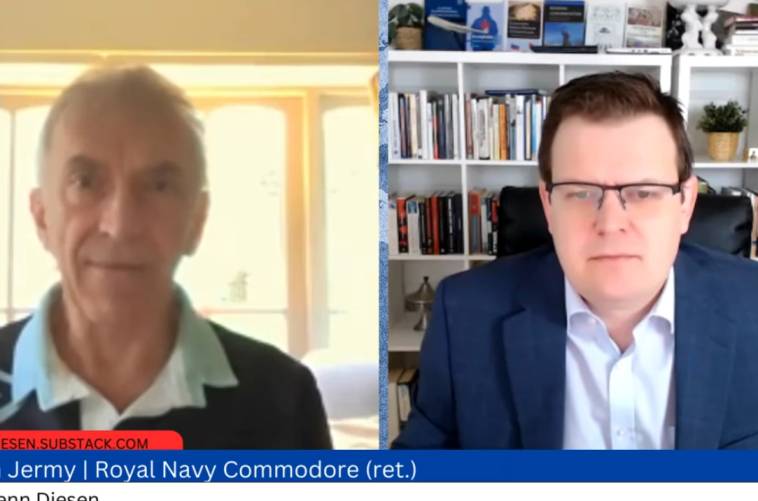
Editor’s Notes: In this insightful interview, Glenn Diesen sits down with retired Royal Navy Commodore Steven Jermy to analyze the complexities of the current conflict involving Iran, Israel, and the United States. They delve into the strategic failures of past Western interventions and discuss why the goal of regime change through air power alone may be destined for failure. The conversation also explores the broader geopolitical stakes, including the impact on global energy supplies and the shifting power dynamics between the U.S., Russia, and China. This deep dive provides a critical assessment of the potential for a strategic reversal and what it means for the future of global stability. (Mar 1, 2026)
TRANSCRIPT:
Introduction
GLENN DIESEN: Welcome back. Today we are joined by retired Royal Navy Commodore Steven Jermy, who commanded warships in the 5th Destroyer Squadron and Britain’s Fleet Air Arm. He was also a strategy director in the British Embassy in Afghanistan. So thank you for coming back on. It’s good to see you again.
STEVEN JERMY: Yeah, good to be back, Glenn. They say may you live in interesting times. And we certainly do.
Assessing the War Against Iran
GLENN DIESEN: Yeah. Well, the last two days especially been interesting. The war against Iran, it’s very different than anything we have seen or done over the past 30 years. It seems, I mean, in terms of a war, there doesn’t seem to be a clear strategy. The planning appears to have been insufficient in terms of preparing for a smaller war, there seems to be little capacity to defend all the assets in the region. There’s no escalation dominance, it seems, and too many things that could go wrong and now seems to be going wrong.
I simply put, I don’t really understand the decision of going to war, given that so many of the variables here were uncertain. But you are a Royal Navy Commodore. What are you looking at to assess whether the Americans and Israelis will be defeated here or if they will win?
STEVEN JERMY: I’m looking at the analysis from two points of view, Glenn. The first is at the political military level and in the shorter term. So how do I think the campaign will actually play out? And then the second is at what I call the grand strategic level. And what does this look like in the medium to the longer term? And it’s quite subtle at that second level. But we might want to perhaps approach the question at those two levels.
Looking first at the political military level, I think a good introduction to this is the work of two people who you will know as well as I probably. The first is General von Clausewitz, who said that before entering into a war you really need to understand the nature of the war. And I’ve got a strong sense that the Americans don’t understand the nature of the war.
The other thing is General André Beaufre, who’s a French General, who I’m a fan of, who said that in war the loser deserves to lose because his defeat will be a consequence of failures of thinking either before or during the war. And I’m worried that failures of thinking before the war are likely to lead to consequences that not only result in a potential defeat for the forces of Israel and America, but also longer term consequences which run against the whole interest of the west and indeed the global economy. So that’s the way I’ve been thinking about it.
Strategic Objectives: Regime Change Through Air Power
In terms of the strategic objectives, I think at least we can be clear. And I think one thing I would say — I would just challenge you on one thing which you said, that this isn’t like the last wars. I think it is like Afghanistan, Iraq, Libya and then Syria, inasmuch as there isn’t a strategy. So again, we seem to be in the same situation where we don’t seem to have thought it through strategically.
I think that there does seem to be a strategy here from Israel and America’s point of view, which is to achieve regime change through air power. Now, that’s a big deal, achieving regime change through air power, not least of all because I can’t remember when it was last done or if indeed it has ever been done, because regime change — you really need to have something substantial. You need substantial forces on the ground, which of course, neither Israel nor the United States want to commit to.
So I think at least we do understand the approach that is being taken. I think it’s really important as well to be clear on that regime change objective, because on that falls the success or failure of the campaign. And if regime change isn’t achieved, then it would seem to mean that from Israel and the United States’ point of view, this will be a failure.
I think from Iran’s point of view, the objective to me seems to be to survive, because if indeed they can survive — and not necessarily, I don’t think they would ever expect to defeat Israel and the United States objectively — but if they can survive and do significant damage, and I think that their damage is starting to be done, then it will be a victory for them.
So survival, really, a bit like it has been for Hamas and Hezbollah — if for them it’s about not being defeated, rather than winning, and not being defeated for the Iranians, I think it’s a win. So I think that’s the way I’m starting to think about it, and then thinking about the campaign as well, which we could talk about. But is that your sense as well about what the overall objectives and strategy looks like?
Lessons from Past Wars: Afghanistan, Iraq, Libya, Syria
GLENN DIESEN: Yes, I think so. I think the US and Israelis probably planned for a quick war where they knock out the leadership and then the assumption will be that the whole thing would fall apart.
So I think a lot of them were a lot of miscalculation about how they would be received. I think for the Iranians, probably time is on their side because they just have to survive. They have to just exhaust their adversary and then inflict enough pain to make sure that this would not be done again.
But no, I agree that there is a lot of commonality compared to the last 30 years, because in Afghanistan we had a 20 year war only to replace Taliban with Taliban. In Iraq, all these hundreds of thousands of dead — and what was achieved? Well, Iraq is now more closely aligned with Iran, who used to balance Iran, closely aligned with Iran, which was supposed to be the main regional adversary.
Of course, Libya had some stability. Now it’s just flooding Europe with refugees. It’s been a mess for 15 years. In Syria, we had a government which at least respected minority rights. And now we have an ISIS leader essentially ruling it as our ally.
It’s just — when we went into all these things, we had other ambitions. But again, there’s very little room for criticism in terms of what can actually be achieved. Even if the goal should be to regime change all these countries, where has been the success? And it’s always the same. Whenever there’s a next war, it’s always the same idea that if you criticize it, then you’re not patriotic enough. It’s very frustrating to see that we do the same thing over and over again.
But my point is that Iran is very different from all these other failures. This is, as we see now, a country which can absorb a lot of pain and it can dish out a lot of punishment to those who attack it.
The Campaign So Far: Air Supremacy and Iranian Retaliation
STEVEN JERMY: Yeah, indeed. I think the interesting thing is that in terms of the way the Shia mentality, actually absorbing pain plays to a broader audience, which isn’t just in Iran, but it’s in what I would call the fundamentalist Islamic who see this as again, fighting against the evil Satan or Satans. I’m not suggesting that’s necessarily right, but I’m just saying how this plays out.
I think going back to the wars you’ve mentioned, the one that was interesting for me and particularly interesting is Iraq, because what we did in Iraq — I think the Americans went in there with lots of support from others, deposed the government, didn’t allow the Ba’athist structures to remain in place, and assumed that democracy would break out. Now, of course, what happened was when elections happened and the 20% Sunni Ba’athist leadership was deposed democratically by the 60% Shia who voted, not surprisingly, for Shia leaders. And of course, the Kurds have always wanted to be independent anyway. So you then got a shift, which is why, quite foreseeably, the Iraqis moved closer to the Iranians because of the Shia relationship between the two nations.
I think at the moment, as I see the campaign, I would think that the Americans and Israelis are probably satisfied at the moment, although it’s very, very difficult to say with the relatively low level of information we have. From what I can see, the first part of the campaign, we’re using the Americans in sort of support roles and the Israelis for strike roles. TLAM — sorry, that’s Tomahawk missiles, Glenn — were the primary means by which the strikes were carried out by Americans, although I suspect they’ll have drones in as well, with apparently aircraft being used by the Israelis, although we don’t know for sure.
I think the interesting thing is that if the Israelis were flying aircraft over Iran, then that gives a sense of the impact they feel they’ve had on the air defense system. So it suggests to me that they have achieved some success against the air defense systems. Although I did hear that Iranian aircraft have been flying over Tehran. So it seems to be not complete. So what they have not achieved is air supremacy. And I guess that may still be some way off. But when they’ve got air supremacy — if they can get it, or air superiority, I should say — that means that American and Israeli aircraft could operate with reasonable impunity across Iran.
Iran’s Capacity to Respond: The Critical Factor
The issue, though, I think, is the ability of Iran to respond. And the missile attacks are as I had expected — they’re against American bases in the Gulf nations. Although it’s interesting that the BBC is talking about attacks against the Gulf nations rather than the American bases in the Gulf nations. I suspect there’d been one or two bits of collateral damage, but I’d be surprised if those attacks by Iran are against the Gulf nations themselves. Rather, I think they’ll be against US forces.
But much more important, I think, is the attacks on Israel. Very difficult to get a sense of what that looks like. But I would expect those attacks to be focused at infrastructure — military, energy, and anything to do with the economics of Israel — and this time I would expect them to be much more intense and go on for as long as the Iranians can maintain them.
And this seems to me to be critical to the whole campaign, because if the Iranians can maintain a sustained bombardment of Israel, coming up to the 12 day mark where Israel — we now know — asks for the Americans to intervene because they couldn’t take it, if they can go beyond that, and I suspect that any sorts of offers for negotiations by the Americans or the Israelis, were we to come to a moment where the Israelis couldn’t take it, I suspect the Iranians will say no and they will just keep going, because they won’t trust either the Israelis or the Americans to abide by their words.
How the Campaign Will Play Out
So I think the way this campaign will play out will depend on the ability of the Americans to actually write down those strategic bombardment forces, and/or the ability of the Israeli economy and society to sustain a prolonged bombardment. Again, difficult to say how that will play out, but I think that’s the key thing on which the campaign will hinge.
My guess is that if we get to 12 days — and I’ve heard that the Americans are looking for campaign end in a month — if we get anywhere near a month and the Iranians are still in good shape or in effective shape, then I think we’ll be looking towards very difficult decisions for the Americans, less so for the Israelis. But if the Americans are expecting to achieve a campaign success in a month and we haven’t seen any signs of that, that’ll put them in a very difficult situation.
Again, I think the issue here with the Iranians is the Iranian regime’s capacity to maintain the regime in the face of bombardment, but also calls from the west for those within Iran to actually rise up. And I think that’s an open question. My guess is that we’ll find it very difficult because it’s generally difficult to do these things from air.
So my guess is that the campaign will end up in a strategic reversal for the Israelis and the Americans. But we probably won’t know that until at least day 15, if not until the end of this month.
Assessing Iran’s Military Strategy and Regional Dynamics
GLENN DIESEN: Well, yeah, because I’m thinking the same that Iran has every incentive in the world to suggest they have almost unlimited missiles. And again it’s possible that they do in storage. But if their enemies will believe that they can fight on for months and months based on their weapon storages, then no one would dare to attack them. But because there’s such a threat coming from abroad, we don’t know that much, do we, about the Iranian weaponry? I mean, when I speak to any Iranians, of course they will say, “Well, we have a lot, a lot,” but there’s no way to verify this. And of course it would be foolish to show where these weapons are.
But I think on the other hand, the United States probably underestimated them as well as the Israelis, as evident from that 12 day war. But if you were in the United States, how would you assess, I guess, progress in this war? Would it be the destruction of air defenses primarily so you can begin to control the skies? Or how would you — I mean, what are they going for? I guess if they were able to knock out the government on the first day, encourage a regime change. But if that doesn’t happen, if the government stands strong and this becomes a war of attrition, what are they going after?
Regime Change from the Air: A Difficult Proposition
STEVEN JERMY: Well, I would say that if regime change is my primary objective, and from what Trump has said it is, then what we would call the supporting objectives are those which enable us to achieve regime change. So one of which would be suppression of enemy air defence so that you could operate with impunity across the campaign. But the question is how do you depose a regime when you’re operating only from the air? And that’s a very, very good question because I can’t see it, obviously.
So even if air superiority or even air supremacy is achieved, then without boots on the ground, it will require those Iranians who do want regime change to rise up and attempt to overthrow the IRGC and the other Iranian forces. So I think that’s a very, very difficult call, which is why even were the Americans to achieve air superiority and the Israelis to achieve air superiority and air supremacy, I think that would still — you know, the Americans may get lucky, the Israelis may get lucky with those who are against the regime rising up. But I’d say there’s a 70/30 chance that they won’t and that the regime will maintain its control over the population, not least because I suspect quite a few of the population will rally around the flag and be much more interested in opposing an external change of government than actually doing it themselves internally.
I once wrote in an article for the London Times, many, many years ago, I said, “When you’re getting involved in operations, especially in the Middle East, the first principle should be do no harm.” And I think there’s quite a lot of chance that we would have done more harm in this than good, as we have done in the last four interventions in this region.
I think, again, a lot of it is really not understanding how the regime works and how the politics and religion in the regime are so closely interlinked that I think often it’s best to think of them as one thing, which is so obviously not the case in the West. I think the danger is too often in the West, we think that people think as we do and we fail to do the analysis. Whereas when you actually look into these countries, they’re very, very different in the way they think and feel.
I give you a really good example, which is when I was in Afghanistan, it took us ages to actually work out what the insurgency was. We took it as an Afghan insurgency against Western forces. But I can remember sitting in the ISF headquarters in Kabul in 2007 with a map of the war fighting incidents which were against Western forces, and a map of the Pashtun tribes. And we suddenly realized the two things were completely contemporaneous, they were completely aligned. And we realized that what we had was not an Afghan insurgency, but a Pashtun insurgency. And that was sort of four to six years into the campaign.
I think getting a really, really good understanding of how the regime thinks and the makeup of the country is essential before embarking on anything like this. I don’t think I’ve seen much sign of this at all. I don’t know whether you have, but I certainly haven’t.
Miscalculations and the War of Attrition
GLENN DIESEN: No. I think it’s definitely important to know who one is fighting against. But I get the impression this is another miscalculation, though, perhaps with the kind of weapons that are being used, because the US might be looking at trying to stop the initial attacks by Iran and then believing that they’re being exhausted due to the old weaponry. But from Iran, they said that they’re doing the opposite, that they’re just clearing out first the old missiles and the old drones just to exhaust the American air defenses, and then once this has been exhausted, then bring out the more modern weapons.
I’m not sure if this is correct. It seemed to be in the 12 day war, at least, that they first used older equipment. It’s just unclear which side would be exhausting the other, again, as it would be in a war of attrition.
But I did want to ask you about the attacks on all of the American bases across the Gulf states. Do you think this is a risk in terms of provoking these countries to then join in on the war against Iran? Or do you think this is, I guess, a strategically smart thing to do in terms of sending out a clear warning against allowing the US to use them? Because if you look, for example, towards the Russian war, we see that the Europeans can almost act with impunity. They can talk about, “We’re going to send these weapons, we’re going to do deep strike, we will do this, we will do that,” and the Russians don’t retaliate.
It seems as if the Iranians just want to set a clear precedent that anyone who assists will be hit. I’m just wondering if this is how you assess this strategy from the Iranians. Is this something that will spread the war to their disadvantage, or is it something that will clearly restore their deterrent and make the region more cautious about cooperating with the Americans?
Iran’s Strikes on US Bases: Regional Deterrence or Escalation Risk?
STEVEN JERMY: I think it is a finely balanced judgment, but I think it’s more likely that it will make the region more cautious. I think it would be a mistake to assume that the Sunni Gulf states are great fans of Iran. There’s a lot of antipathy between the two, and there had been huge amounts until of course the Palestine situation kicked off and people began to draw away from Israel. We saw that the Abraham Accords were going to be signed, but then suddenly they weren’t. So there’s a lot of antipathy, but I think part of the antipathy exists at the elite level rather than the level of the populaces. Because of course, what you’ve got in the Gulf states are autocratic states — let’s be quite clear about that — in the same way that the Iranian state is autocratic in ways. So they aren’t democracies, rather they’re monarchies, but autocratic monarchies.
And I think that one of the concerns that I suspect the monarchies in these states will feel is that what the Iranians are doing will be quite popular with their populaces, who have watched the way in which operations have been conducted in Palestine against other Arab nations and Islamic nations. And so I think that amongst their populaces there may well be quite a bit of popular support for what the Iranians are doing, in which case they may be very cautious about doing anything like declaring war or coming in on the side of the Americans and the Israelis. They’ve talked loudly about how the Iranian retaliation is unjustified. But I suspect that as long as the Iranians keep their retaliation focused on the American bases, then the message will be the message that you suggested.
I’ve heard in the media of course that there have been attacks which have happened in places other than the American bases. I suspect, I doubt that’s deliberate. I suspect it’s actually either the weapons have gone in the wrong direction or they’ve been shot down and you’ve had collateral damage as a result of the weapons falling to places where they were not targeted at. It could also be air defense missiles coming down as well. So there’s a range of reasons. I’d just be surprised — I can’t imagine why the Iranians would think it’s in their interest to target the Gulf State populations more broadly. I think keeping it at the airbases and naval bases makes more sense to me.
So that will be my sense of it, Glenn. And coming back to your point about whether they’re using the more obsolete missiles first — I suspect they probably are. I thought their attacks during the first 12 day war were quite sophisticated in the way that they were done. So it seems to me they probably are using up the older stuff first. Not least of all because you don’t know as an air defender what you’ve got coming at you, and you have to assume worst case and therefore work to shoot it down. And of course what you’re doing with that is actually using up ammunition.
I was fascinated to hear Scott Ritter say — I think it might have been with you or it might have been with Judging Freedom — that an American admiral, the Chief of the Joint Chiefs of Staff, was removed three days ago and the sort of feedback was that he was removed because he said, “We haven’t got enough ammunition to do this.” And when you think about both the amount of ammunition that’s being pushed towards the Ukraine war, but also the difficulty that we have in the West in general, and America has in particular, of producing ammunition at scale and speed, then it wouldn’t surprise me if ammunition stocks were an issue here and that too might play into the timing of this conflict.
If they know that their ammunition is limited after the end of March, then you’ve got the answer to the question about what happens next — they’ll have to stop. But again, I don’t know. It might be the end of March, it might be the end of April, who knows? We just don’t know what the ammunition stocks might look like. But it wouldn’t surprise me if it’s a key factor in their thinking and the need to actually bring the war to a close more quickly than it might otherwise be possible.
Iran’s Escalation Options: Energy and Economic Targets
GLENN DIESEN: Yeah, but my comment on the escalation control — it might not be up to the Americans when and how this war comes to an end, because I think for the Iranians, if a key objective would be to restore the deterrent and make sure they don’t come back in another six months yet again, they would want to bring a lot of pain and to make sure that this wouldn’t happen again. But yeah, we see all these military targets, of course the bases across the region. But do you see Iran escalating further, going after more economic and energy targets?
Iran’s Strategic Focus and the Strait of Hormuz
STEVEN JERMY: I think the ones I will be surprised — it’s not impossible, but I would be surprised if they go after Gulf States energy infrastructure. I just don’t think it’s in their interests. I might be wrong.
But what I do see is them going after Israeli infrastructure. So I would expect to see them targeting the ports. I know they’ve already targeted Haifa. I would expect to see them, as well as the military targets and the intelligence targets, targeting the ports, the transport infrastructure and the energy infrastructure in Israel, within the limits of the accuracy of their systems, because those are critical for the survival of Israeli society. So that’s what I would expect to see them doing.
And Israel is a small nation — it’s 1/80th of the size of Iran. So they’ve got much better chances, I would say, of destroying that infrastructure than the reverse, even with the Americans and the Israelis achieving full air superiority or air supremacy. So that’s where I would expect to see their focus.
It’d be interesting to see — I see that they’ve actually closed the Strait of Hormuz, but only through warning rather than mining it or using force. And that’s the other place that I expect to, or I watch with interest, to see how that works. It would be very straightforward to mine the Strait of Hormuz and very difficult for the West or the Israelis or anybody to do anything about it.
But so far I’ve heard that they’ve actually issued warnings and the traffic in the Strait of Hormuz has actually come to a stop, as far as I can see. So it’s had an effect. I would expect as well that even if there were to be traffic, the insurance rates would be high — and the figure I’ve heard is 10% of the overall value of the ship/oil package, which is a big deal in terms of insurance. So that was bound to have an effect on the global economy, or oil within the global economy.
Although I don’t think that effect will be as quick as some people say. It might be quick in the oil prices, but less so in the refined products, which will still be being delivered under the old cost of oil built into the supply chain.
That said, it’s also a bit of a two-edged sword as well, because of course China relies quite heavily on Iranian oil. So it’s a bit of a two-edged sword quite how they do that.
So I think, to summarize, I think the focus will be on Israel and Israel’s economic capacity, and it’ll be interesting to see how that too plays into America.
The Wider Geopolitical Context: Great Power Rivalry
GLENN DIESEN: Well, I’m glad you brought up China, because this is not just the US and Israel on one side and Iran on the other. As we see, of course, attacking all these bases across the region makes all these countries involved somehow. But Iran is also — again, it’s not a Yemen or it’s not a Syria. It’s a massive country at the southern end of the Eurasian continent. So how do you see this war in the wider context, in the struggle between the different great powers? Unless we assume Trump launched this war to help protesters or promote democracy, what are the wider geopolitical struggles or gamble here?
STEVEN JERMY: I’ve always thought there are three key things in the geopolitical context at the moment — the global geopolitical context. But there’s a fourth to add to this.
I think the first one is the shift from a unipolar to a tripolar world, with three great powers: China, Russia and the United States. The second is the rather perilous state of the global economy. And the third is the situation in global energy supplies. To that, in this particular one, I would also add the role that radical Islam plays in the Middle East and other locations.
But taking the first of those, I think the key issue here is that China is significantly dependent on external oil. And here I think the thing that I got wrong in the initial analysis of why the war might happen was that I didn’t really think about Elbridge Colby and the national security strategy, and how that was being constructed in a way which was seeking to regain the unipolar situation of America.
So Elbridge Colby, of course, is the thinker, I think, behind a lot of what’s going on in the United States. And when you look at his work, it seems clear that he judges that it is possible for the United States to regain a unipolar situation. I think it’s wrong, but nevertheless, I’ve seen very good analysis from Andrew Korybko, who has talked about this particular war being part of a broader strategy in which Venezuela was part and Iran now is. So it’s seeking to either shift Iran away from BRICS and away from the China and Russia relationship, and towards a relationship which is much closer to America — ideally, I’m sure they would like one which is as it was before the Shah was deposed.
I think that’s a really, really difficult thing to do. And I think if that’s their view, then it’s a view which has underestimated the way in which Iranians — but particularly those within fundamentalist Islam — feel about the United States.
I think what had confused me was that I was 50/50 about whether the war would take place, because it seemed to me that there were so many downsides and little chance of success. So it seemed to me — I said to Danny Davis, I think about two or three days ago — that I thought if it was going to happen, it would be in the middle of next week when people had time to clear their embassies. But I rather think now that this has been planned for some time. I rather think it’s been planned for weeks, as part of this broader strategy.
Because if you see the war as part of a broader strategy — so it’s not just about regime change, but it’s about confronting China — I can see that that might shift the calculation in the White House towards, “Okay, well, let’s take the risk because it’s worth it for that broader reason.”
I happen to think that it’s a reasoning which is likely to be highly unsuccessful, because I think that people don’t understand why China has got to where it has, and they don’t understand the relationship between how you develop the military power of a nation — which is to do with energy and industrial capacity — and China is so far ahead in terms of industrial capacity than anybody else that we’re talking about some 20 years before we would get anywhere near to it.
So I just wonder if that was one of the factors. It makes sense to me, and I found Andrew’s analysis very plausible.
I think the third part of this is the energy situation. Again, this ties back into China. So it’s not only the energy situation, but the energy and the economic situation. What you’ve got, of course, in China is a nation which is holding on to a lot of American debt. And you have in America a rather parallel situation as regards how you refinance your debt tsunami, which is coming up — I think most of it needs to be refinanced this year or next. And if China’s not going to buy it, and indeed if China decides aggressively to sell it, then what does that do for the dollar and what does that do for the American economic situation, which already looks difficult?
If America is bad, then think what it’s like for the European nations — particularly the British, the French and the Germans — all of whom are in a fairly perilous situation and will not be looking with great joy at the prospect of high energy prices. They’re bad enough as it is, but imagine what it’s like when it’s going to be even higher.
So I think, for all these reasons, Glenn, I think that there’s a fair bit of — if it’s a narrow focus on China, then it misses these broader strategic things which are going on. And for all those reasons, I think that the chances of us doing more harm than good are high and increasing. Again, I’d be curious to see what you think about that.
All-or-Nothing Strategies and the Risk of Cementing Alliances
GLENN DIESEN: Well, it does seem that whether or not one does more harm than good, it seems that a lot of the great power strategies have been almost an all-or-nothing strategy.
For example, with the Biden administration, based on the rhetoric you heard from many of the military and political leadership, the idea more or less was — as we saw with Russia — we saw Russia and China moving closer. And the general idea was: if we can use Ukrainians to knock out Russia from the ranks of great powers, then we can focus all our resources on countering China, and this will be the way of restoring US primacy in the world. But then, of course, this began to fail.
And then you see Trump has a different approach. Let’s see — we’re not going to be able to defeat the Russians. Let’s try to instead win them over a little bit. I don’t think it’s realistic that they would get the Russians to switch from China, but at least get some daylight between them. Russia would like to diversify and make good relations with the United States. And then a natural balance of power will assert itself, which is in its favor.
Now, I think a similar logic appeared possibly with Iran. That is, you see this very powerful Iran, which is important to this wider Eurasian constellation with China, Russia and Iran. And the idea is: we can knock out the Iranians — either put them on our side under some US-friendly government, or just make a big mess out of it so it can’t be used as a partner for anyone else.
But again, if this fails as well, it’s just going to cement the determination of Iran to look towards Russia and China as necessary partners. And I think this is what they did with the Russians as well — they now need the Chinese more than ever. And I think this could be the same with the Iranians.
So it just seems that either we knock them out and then the distribution of power will be in our favor, or we fail — but then we’re going to cement a very powerful de facto alliance against us. It’s a very desperate strategy, it seems. I like to see strategies where you can improve a little bit or improve a lot, but here it’s either/or every time. Again, I might be interpreting it incorrectly, but —
The Role of Fundamentalist Islam in Western Interventions
STEVEN JERMY: I don’t think you are at all, Glenn. I think you’re actually on the money.
I think one of the other things that plays into this as well — which didn’t, for example, play in Venezuela, but does play in here — is that when you look at these last, if you include Iran now, these last five or so interventions which have all failed, there is another more subtle issue in here, which is the role of fundamentalist Islam.
Now, my brother is a brilliant analyst of this, and he actually explains how what we’re seeing within Islam is a civil war which has been going on in Islam. It’s along two axes of civil wars. On the one hand you have the fundamentalists and the reformers. On the other hand you have the Sunni and the Shia. And the fundamental thing that they’re all trying to work out is how, in so many ways, the West has succeeded since the 1850s, whereas the Islamic world has not.
And one of the things that seems to bind them is that the fundamentalists tend to say, “Well, the problem has been the West and it’s the way they’ve operated with US colonialism in that dimension.” Whereas the reformers actually are much more pro-West — they would much prefer to see a situation where they’re moving. I’m not saying they’re liberalizing their societies, but they’re not so hard-nosed about how the Quran is interpreted and how they deal with the West.
And I think this is a factor which I’ve seen very little understanding of, particularly in the United States.
I think the great danger is — if you look at those interventions — what did we do in Afghanistan? We deposed the Taliban, spent 20 years, and now the Taliban is back in charge. In Iraq, we assumed that democracy would break out, but we now have a much closer Shia-leaning country — albeit it’s interesting that Sistani, who is the great theologian in Iraq, is much less interventional in politics, unlike Al-Khamenei and his new successor, it appears.
And then in Libya, we apparently went in on a responsibility to protect, but really we deposed Gaddafi — and sought to depose Gaddafi, notwithstanding what we said.
And last but not least is Syria, where we deposed an Alawite-led government. And the Alawites, as my brother always said, would fight to the death because they knew that they would probably be slaughtered by the overwhelming Sunni population within Syria. What we’ve essentially done is we’ve taken what was ISIS — which we sought to work against — and we’ve now reestablished the caliphate, but it’s just in Syria. So if anybody can tell me why that’s a good idea, then I’m open to offers.
But I think the great danger here is: as long as we keep intervening, we’re going to do more damage than good. And if the Americans are intervening largely on the basis of regime change — “Let’s Balkanize Iran and do this because it’s in our national interest, the way we see our broader strategy against” —
GLENN DIESEN: Against —
The Limits of Western Intervention
STEVEN JERMY: China, then it misses the point that actually by intervening this way we are actually making it much more difficult for Islamic reformers because again, time and again they see and their populace see the West intervening in a very heavy handed and clumsy and often bullying way. And so of course all that does is play to the hands of the fundamentalists and play to the hands of those who want no reform whatsoever and see that reform is the problem, not the solution.
My strong view is that we’ve really got to think again and think much more strategically and perhaps in a grand strategic way, perhaps thinking about the sorts of ways that George Kennan was working containment to be much more about laissez faire and about not intervening. It’s difficult sometimes not to intervene. And certainly when I was in Afghanistan I can remember being at dinner with a few people which included two Afghan women politicians and they were extremely keen to have the West’s intervention because it allowed them to shift the whole conversation about what was going on and sort of fight against the Taliban who are fairly misogynistic frankly.
But the problem is that to do that, you’ve got to intervene with the understanding that it’ll only work. Even if it was a good idea, I don’t think it is. But it will only work if you’re prepared to do it for generational periods. Are you prepared to intervene in the country for 20, 30, 40, 50, 60, 70 years? And there’s no appetite to do that. So we’ve got to accept that even though we might not like how a regime works, the first thing to work out is if we do seek to intervene in the way this appears to be happening, then there’s a strong likelihood that we’re going to make things worse rather than better. I can’t think of a single intervention in this last 25 years when we’ve done anything other than make things worse rather than better. But tell me if you think I’m wrong.
GLENN DIESEN: No, no, I think you’re correct. Indeed. And again, even if the outcome, what one wants to achieve, even if that’s not the main focus here, you still need some strategic thinking. You used the word clumsy, and I think that’s very correct. I mean, from my perspective, I would have preferred a path where, with Iran, that we can have some mutual understanding, make some peaceful settlement, because we never really did it over the past 47 years. And if it doesn’t work, one can use some form of containment.
But that’s my view. Others might take a different view, that it’s not possible to have a peace with Iran, that it has to be defeated and destroyed. Well, if that’s the perspective, at least you still need strategic thinking then. The whole rhetoric — “we can’t allow ayatollahs with nuclear weapons,” “all the Iranian people want to do is be free of them,” “if we just shake up the regime a bit, it will fall apart, and then the people take to the street, welcome us as liberators” — it’s just so much nonsense and hope and wishful thinking. Whether one wants to find a peace with Iran or destroy it, at least there has to be some honest assessment here.
I just listen to the politicians, at least in this country, and the media. It’s all just emotional ideological sloganeering. There’s nothing there. It doesn’t surprise me that we keep making these stupid mistakes over and over again, war after war, because it’s detached from reality.
The Failure of Western Strategic Thinking
STEVEN JERMY: Well, as you know, I wrote a book. Again, it’s not a plug for the book, because it’s out of print, but I wrote a book called Strategy for Action. I wrote it for just this reason, Glenn, because I wrote it in 2011. And so by that time, I had been closely associated with the Iraq war, visiting Iraq a number of times, but also deployed in the Afghan war. And I realized that we just can’t do strategy in the West. We’re really bad at it.
And I think that’s not to say that if we had done strategy, we would have won those wars, but I think it’s to say something much more profound, which is that if we had done the proper strategic analysis, we wouldn’t have engaged in those wars in the first place. And this is what I feel with the Syrian interventions and with the Libyan interventions and with this one as well. If we did the proper strategic analysis and really thought them through, really worked hard to understand these countries with specialists. So many of the specialists have been lost. I remember going into Afghanistan, we had hardly any Farsi speakers and hardly any Pashtun speakers, and all that expertise that used to be there in the West when we were much better engaged was lost. And so the understanding of how these countries think.
But I think if we had done the analysis, we wouldn’t have done it in the first place. And that, to me, comes back to Clausewitz. Clausewitz said that anybody involving themselves in war must first understand the nature of the war. And we have not understood the nature of the wars in any of these interventions, I’m afraid. And partly, thinking again, as I said, André Beaufre — the loser deserves to lose. We deserve to lose those wars because we never thought them through in the first place. So it sounds to me like we’re in violent agreement.
GLENN DIESEN: Yeah, well, this is why often I like to sit down and talk with more senior people who have background from the intelligence services, because they don’t hate their opponents. They want to understand them. They can appreciate their culture. It doesn’t matter if they were fighting against the Soviets, they nonetheless respected their opponent. Because once you take an interest and have some respect, as opposed to hating, then you can assess what is the possibility to make peace, to harmonize interests. And if this is not possible, how can we defeat them?
But when you go in with this mentality that they are inferior, they’re horrible, they’re evil, there’s no way to either make peace or have a realistic plan in terms of winning. I find it completely exhausting to listen to this political class which dominates. It’s horrific. But let me ask you the last question. What do you think is the likely success here, though, in this war — that is the U.S.-Israeli attack on Iran — or do you think they will fail?
Assessing the Odds: 30/70
STEVEN JERMY: I would say 30/70. It’s by no means clear — 30/70, in terms of more likely, 30% chance of success and 70% chance of failure. I was surprised that air superiority seems to have been achieved earlier than I expected. Not completely surprised, but a bit surprised. But again, I come back to this fundamental thing which is very difficult to achieve: regime change. If you don’t have boots on the ground, there will never be a significant amount of American and Israeli boots on the ground. So if you measure success against the objective of regime change, then I think it will fail.
What I could imagine, though, is that actually when we get to day 30 and it hasn’t fallen, there is some sort of reconstruction of the objectives — a bit like the successful withdrawal from the Red Sea operations against the Houthis. That sort of suits the United States’ purposes to say something like, “Okay, well, we’ve written down the bombardment forces, we’ve written down the nuclear forces. We’re now happy to stand back from this and let the Iranians undertake their own regime change.” It’ll be a way of — I’m sure most people will see through it — but it’s the way that I could imagine this going. If by day 30, the end of this month, the primary objective has not been achieved, then in which case this is not successful. The Iranians, I think, simply need to survive for success rather than defeat the Americans and the Israelis. So that would be my first guess. I’d be curious, though, to see what you think as well, Glenn.
Redefining Victory: Trump’s Off-Ramp
GLENN DIESEN: I think Trump can walk it back to some extent because I’m looking back at the 12-Day War when they attacked Iran in June. And at that point he was making comments — “we will only accept unconditional surrender.” That was not forthcoming. But then afterwards he just said, “Well, we bombed their nuclear facilities. It’s been obliterated. They can’t restore it. Victory.” So you redefine your victory and then you can go home and pretend as if you won. I think they did something similar with Yemen.
I think that’s a strength because often countries look for an off-ramp. His BS can be his strength in this regard. He’s changed the definition of victory before so he can do it again. I think it’s possible. If this drags on for a few weeks, they’re running dry on their weaponry and the Iranians are causing too much destruction for them and their allies, then I can see that Trump might say, “Well, we destroyed so many of their factories where they’re building these missiles. The ballistic missile capability has been set back for decades and victory is ours now. We will put an end to this and go home.”
So that’s not unthinkable. I think that’s probably the direction we would go. But the idea that the Iranians would make any real concessions, I don’t see it. Because what the Americans wanted was essentially for Iran to capitulate, to give up the deterrent. But if it didn’t have the ballistic missiles and drones, then it would be finished. They could just bomb it to the ground. So I don’t know. This is what I expect because it’s an existential threat for the Iranians. I don’t see how they’re willing to accept anything other than for the Americans to eventually pull away.
STEVEN JERMY: Yeah, I think it may not be existential to the United States. It clearly isn’t an existential war for the United States. It may be existential for Israel, but I think it’s very possibly existential for the Trump presidency. Because actually if they do pull back and run into the midterms in a way which I suspect — if it begins to appear that it is simply a redefinition of victory — I would be interested to see how many Republicans in particular actually stay the course with backing Trump as they run into the midterms.
So it’ll be very interesting to see what is the chance of the Congress actually going back to the War Powers Act and starting to act against Trump. I don’t know, but it could be existential for the Trump presidency. But we’ll see. They’ll need to be fleet footed to actually persuade people that this indeed is a victory by redefining what the objectives of war were in the first place. But let’s see.
GLENN DIESEN: Yeah, well, thanks for coming on and sharing your insights. We’ll revisit this, how it plays out, but I just don’t think the objectives the Americans set out in this war are achievable. Well, it is achievable, but I don’t think it’s probable. However, I could be wrong, so.
STEVEN JERMY: Yeah, me too, Glenn, but whatever, keep up the good work. It really matters. We need this independent analysis. It’s so important. Thank you.
Related Posts
- PBD Podcast #778: Who Is Sadhguru? (Transcript)
- Larry Johnson: Trump’s Naval Blockade & Ceasefire Collapse (Transcript)
- Prof. Mohammad Marandi: What Really Happened in Islamabad (Transcript)
- Transcript: U.S and China One Step Away from Conflict in Hormuz w/ Lt. Gen. Ben Hodges
- The Why Files: w/ Peter Levenda on Nazis, UFOs, and the Hidden History (Transcript)